The United States of America (USA)
Dinosaurs and other prehistoric animals, fossils, Thomas Jefferson "the Father of American paleontology" on stamps, postmarks and postal stationeries of USA
The United States of America (USA), commonly referred to as the United States, US, USA or America, is a federal republic composed of 50 states, a federal district, five major territories and various possessions. The 48 contiguous states and Washington, D.C. are in central North America between Canada and Mexico. The state of Alaska is in the northwestern part of North America, bordering western Canada. The state of Hawaii is an archipelago in the mid-Pacific. The territories are scattered about the Pacific Ocean and the Caribbean Sea. [R1]
USA as well as Canada is a country with many locations where fossils are found. Many dinosaur bones are found here including species that are commonly shown on stamps from around the world. These include Tyrannosaurus Rex, Triceratops, Brachiosaurus, Diplodocus, etc.
The first stamp issue of the U.S. was offered for sale on July 1, 1847, in New York City, with Boston receiving stamps the following day and other cities thereafter. They consisted of an engraved 5-cent red brown stamp depicting Benjamin Franklin (the first postmaster of the U.S.), and a 10-cent value in black with George Washington. Like all U.S. stamps until 1857, they were imperforate. [R2]
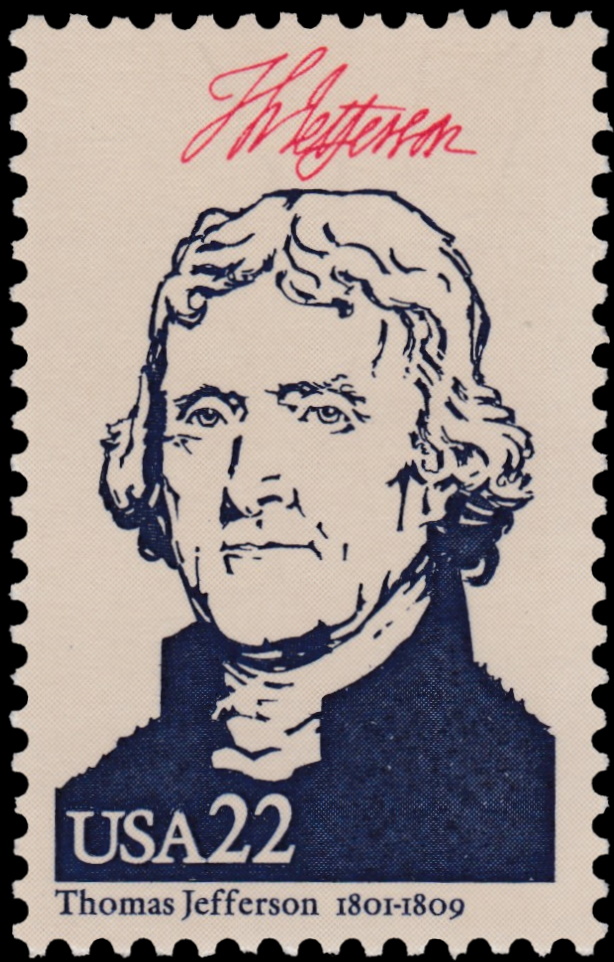
Between 1851 and 1857 USA issued a set of 6 definitive stamps with portraits of Benjamin Franklin, George Washington and Thomas Jefferson, who is known not only as the 3rd US President, but also often called the "Father of American Paleontology".
The stamp (Scott 12) of Thomas Jefferson issued on March 3rd1856 is the first Paleontology related stamp ever. [J1]
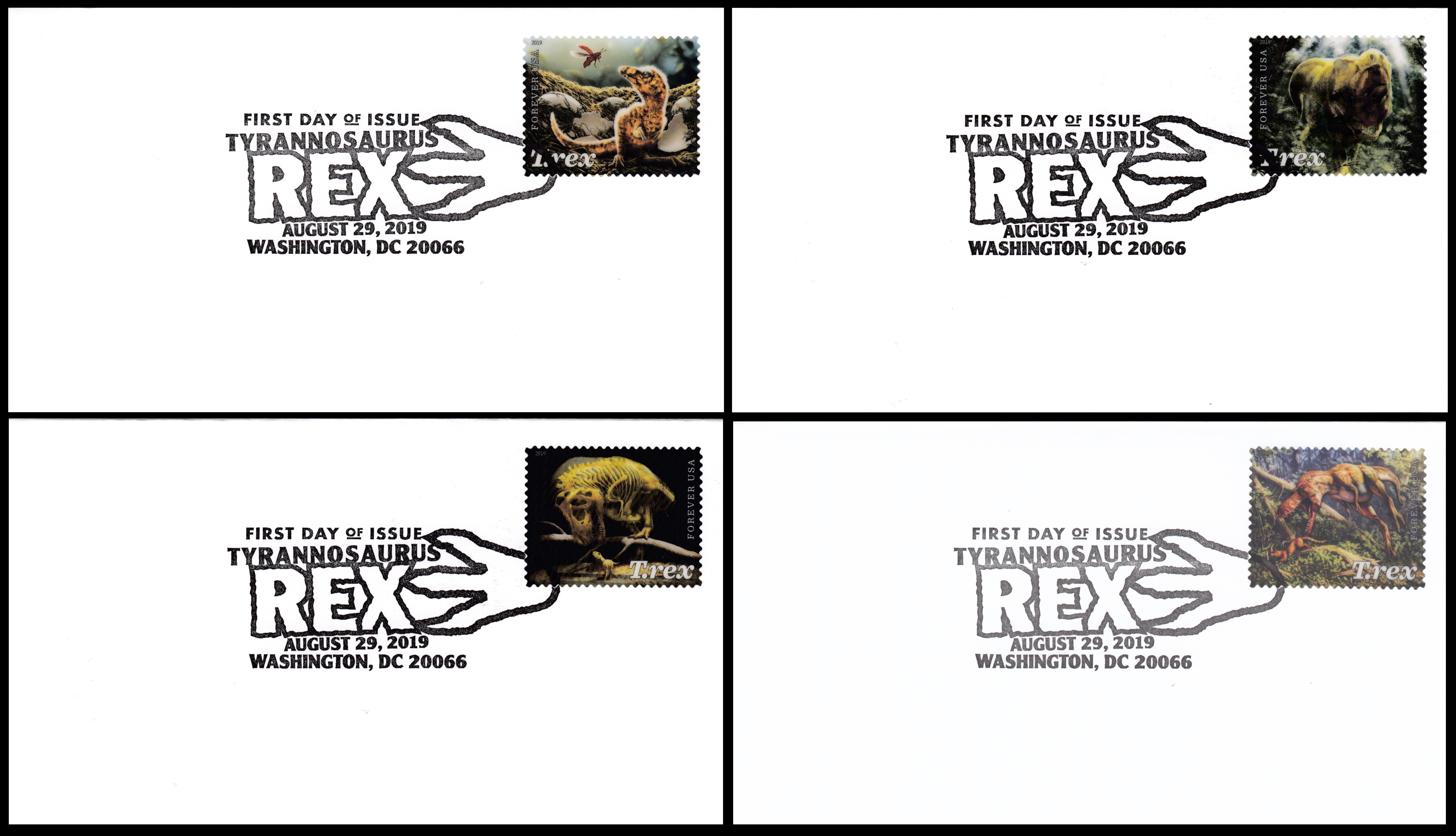
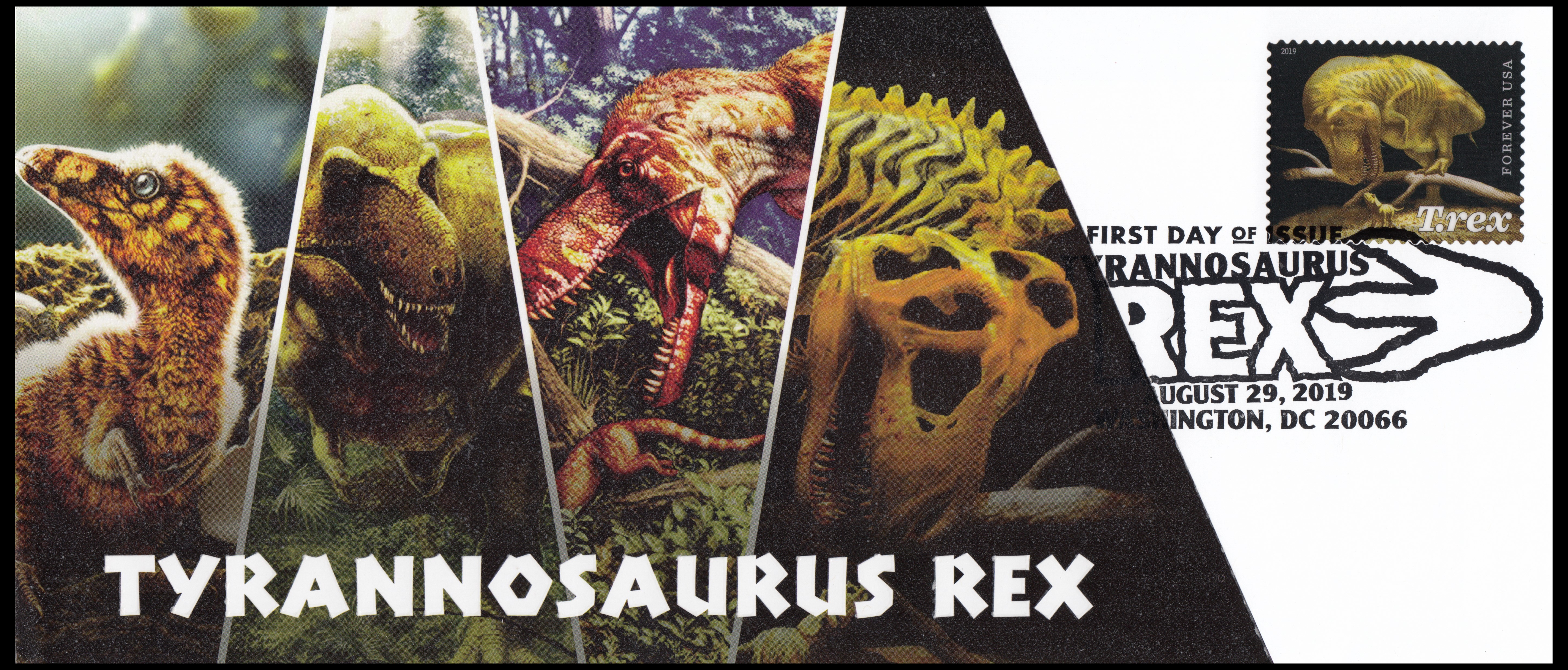
Unlike most countries, the USPS (Postal Authority for the USA) does not produce illustrated covers (or special cachets) for the FDC (though there are a few recent exceptions – including a cover for the T-Rex 2020 issue).
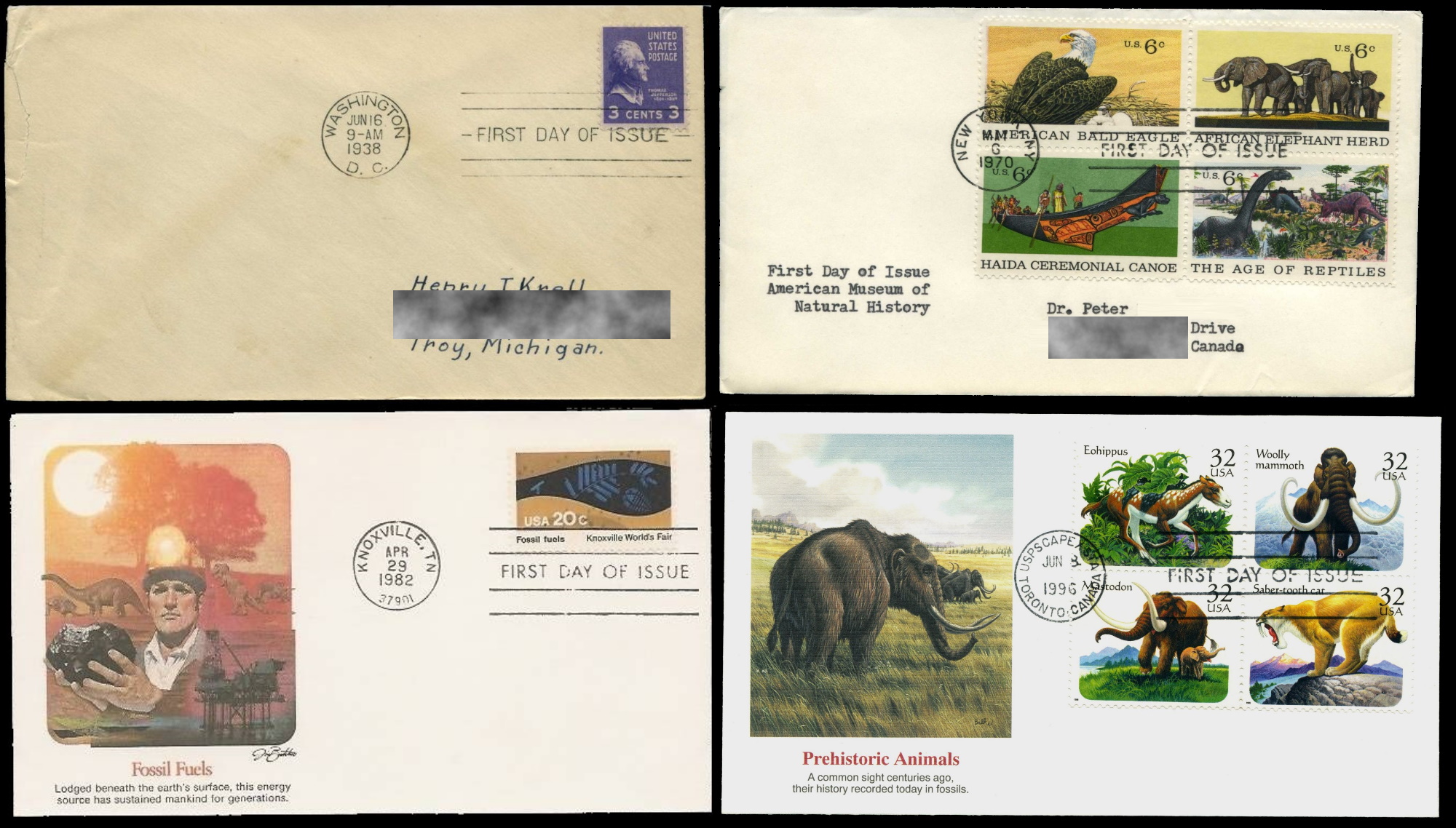
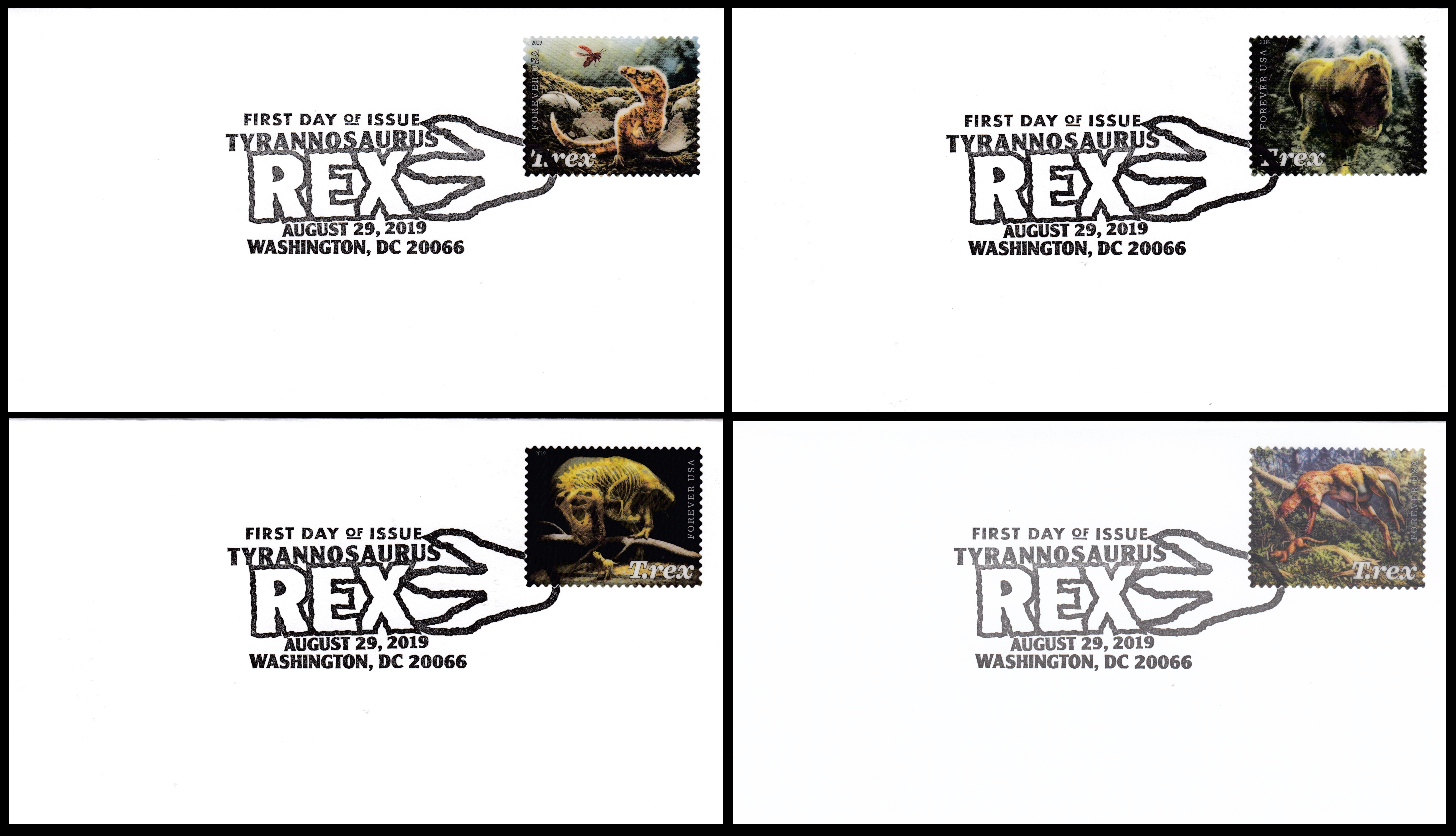
Until very recent time, the first day postmark, often, was a combination of a regular, round postmark with the day of the stamp(s) issue and another postmark attached to it on the right side with "FIRST DAY OF ISSUE" text in between one or two horizontal lines (see example below).
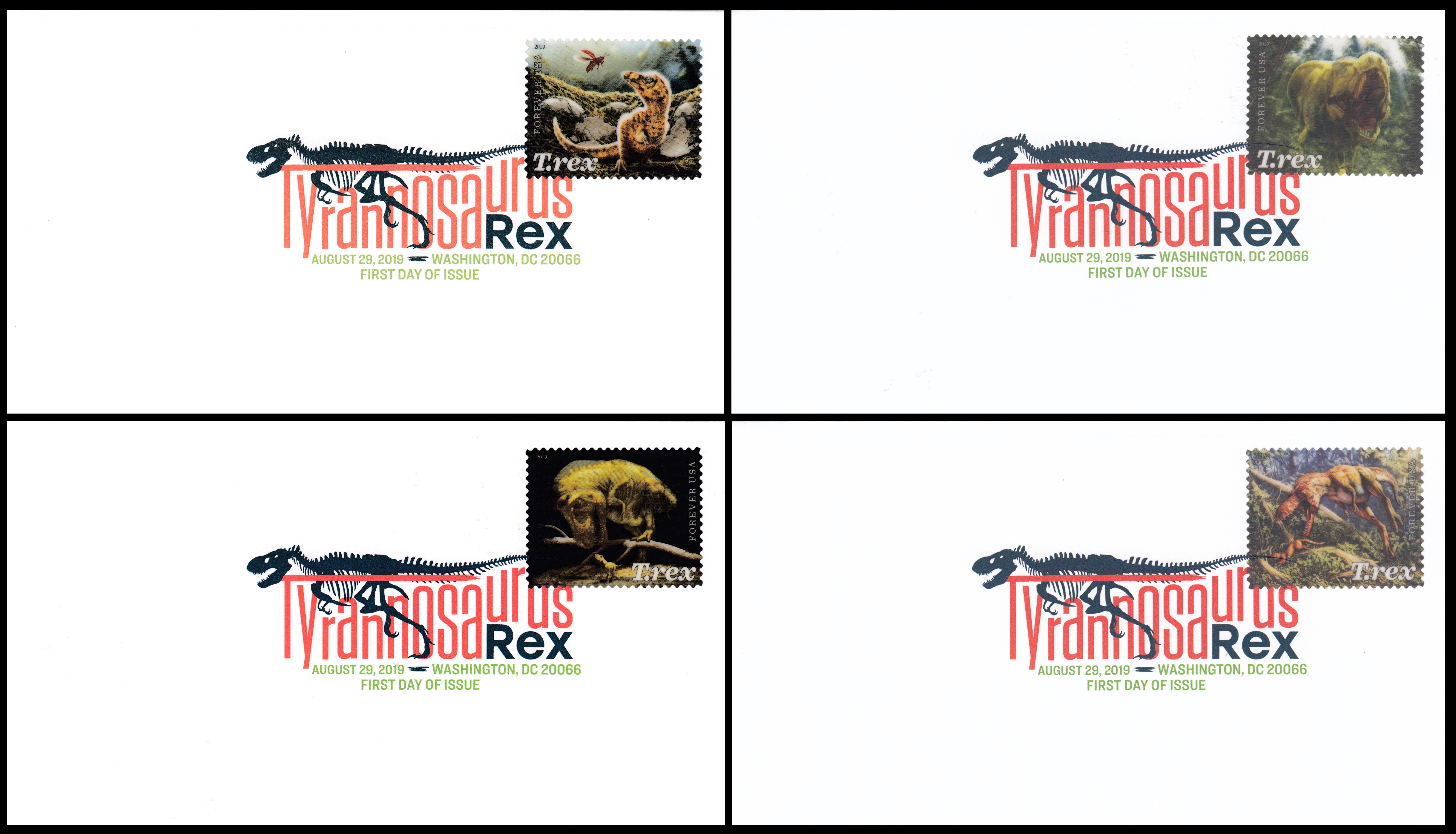
In the last few years, USPS start to produce some commemorative postmarks, sometimes even colorful digital postmarks, which are not available for mail-use, but may be purchased as a collectible piece, for their FDC covers.

|
|
|
| USPS official FDC colorful digital postmark for Tyrannosaurus rex stamps from 2019. | USPS official FDC with black postmark for Tyrannosaurus rex stamps from 2019. | Some examples of old FDC with and without personalized cachet. |
There are many philatelic clubs around USA, as well as some dealers, who produce their own illustrated FDC with very nice cachets for FDC collectors. Almost all American FDC with cachets are privately produced, personalized covers.
Official stamps of USA related to Paleontology: reconstructions and fossils of dinosaurs and other prehistoric animals, fossils
- Reconstructions and fossils of dinosaurs and other prehistoric animals.
- Portraits of Thomas Jefferson (who was not only the 3rd American President, but also a central player in the beginnings of American paleontology).
- Some other stamps related to Thomas Jefferson.
Reconstructions and fossils of dinosaurs and other prehistoric animals on stamps of USA
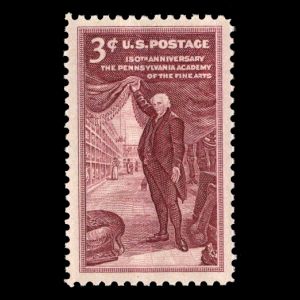
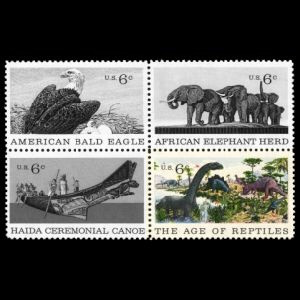
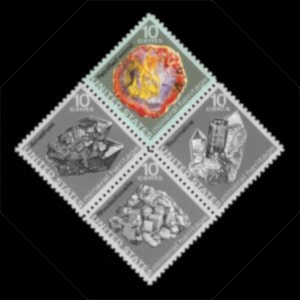
| 15.01.1955 "150th Anniversary of the Pennsylvania Academy of the Fine Arts" [1] | 13.06.1970 "Centenary of American Natural History Museum" | 13.06.1974 "Mineral Heritage" |
 |
 |
 |
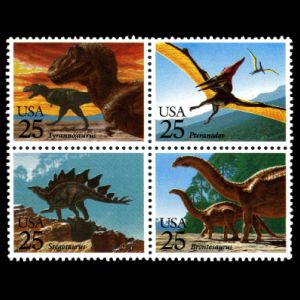
01.10.1989 "Prehistoric animals" [2]
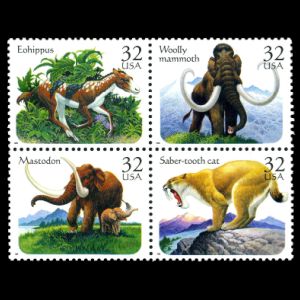
| 08.06.1996 "Prehistoric animals" |
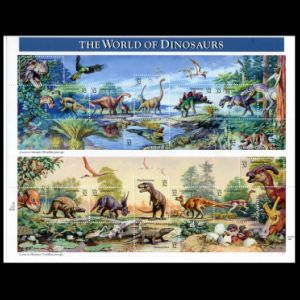
01.05.1997 "The World of Dinosaurs" |
|
 |
 |
 |
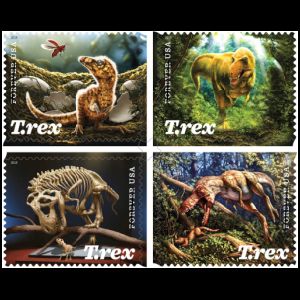
| 29.08.2019 "Tyrannosaurus rex" | ||
 |
||
Notes:
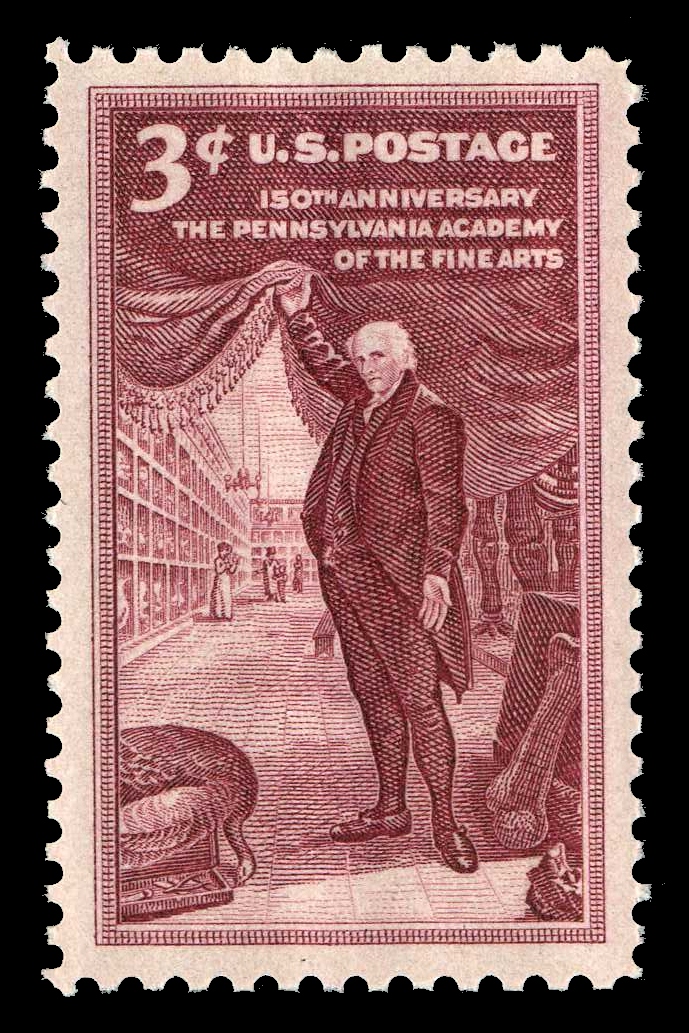
[1] First stamp shows the famous painter and fossil collector Mr. Charles Wilson Peale ( 1741-1827, USA).
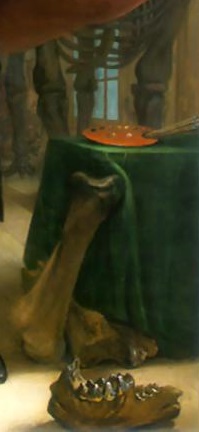
 On the background to the right you will find portions of a skeleton of a Mastodon (Mammut americanus)
including a thigh bone and the lower jaw bone. These bones found their way via London
to Darmstadt in Germany and are still on exhibit at the Hessisches Landesmuseum.
On the background to the right you will find portions of a skeleton of a Mastodon (Mammut americanus)
including a thigh bone and the lower jaw bone. These bones found their way via London
to Darmstadt in Germany and are still on exhibit at the Hessisches Landesmuseum.
The stamp was issued in conjunction with the sesquicentennial celebration of the Pennsylvania Academy of Fine Arts and is a reproduction of " The Artist in His Museum" painted in 1822.
Many of the museum’s exhibits were collected by Peale, and he includes some of them in his painting. The stamp features several, like a wild turkey ready to be preserved as well as a great Mastodon's bones, in honor of one of Peale's greatest reconstruction of a Mastodon’s skeleton.
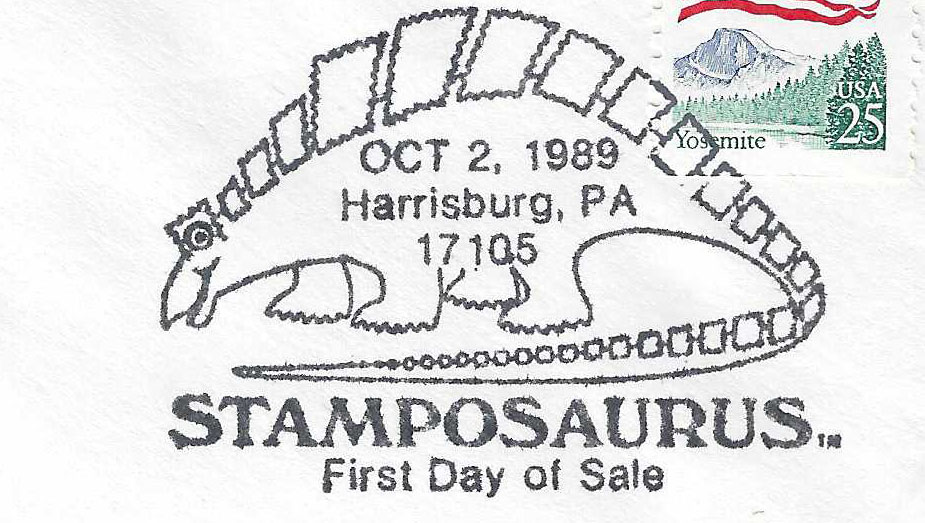
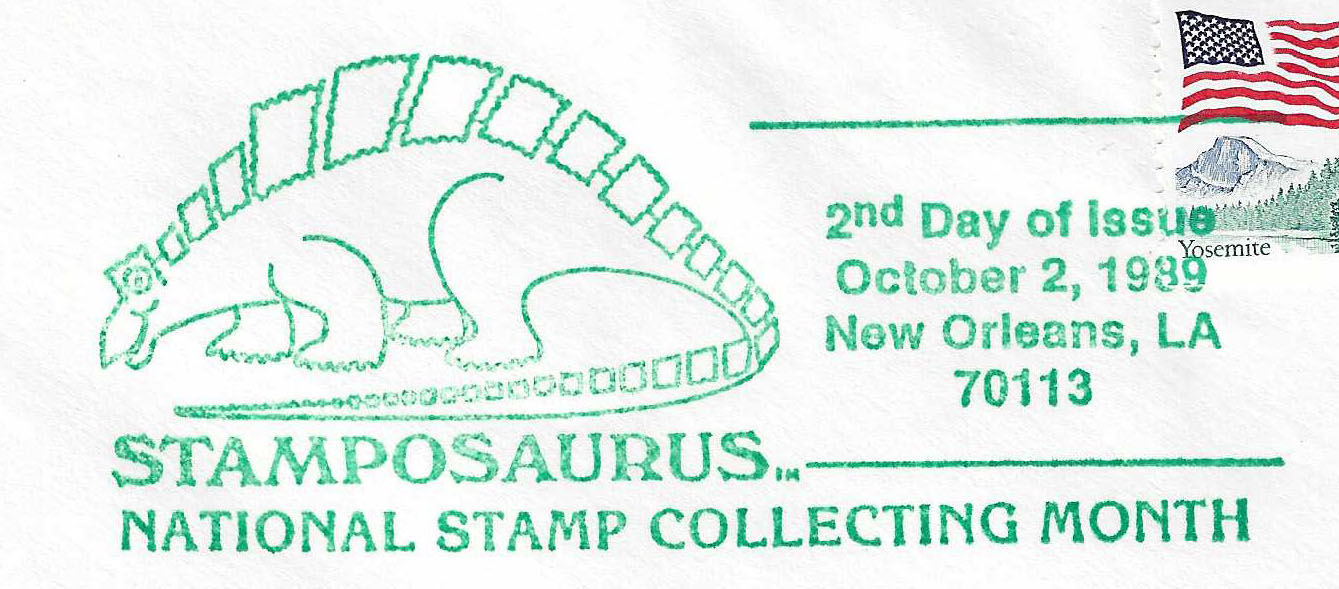
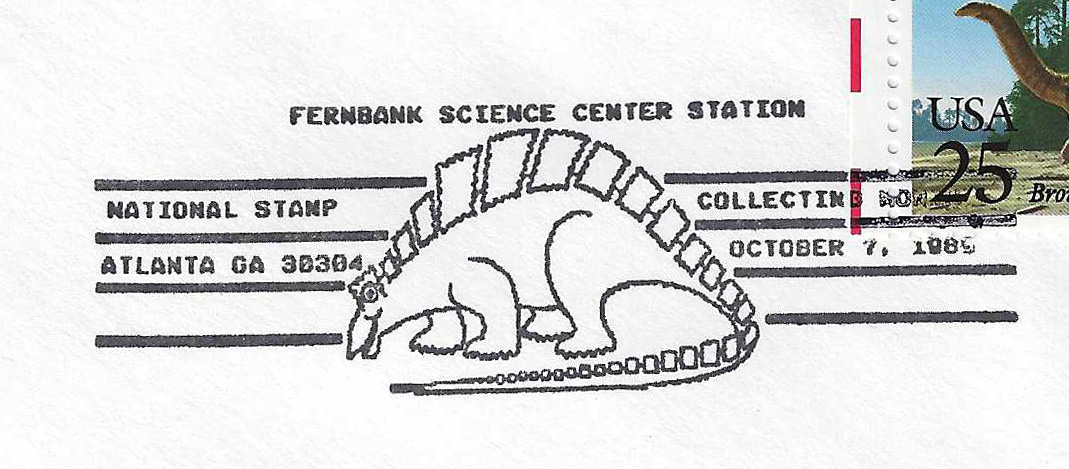
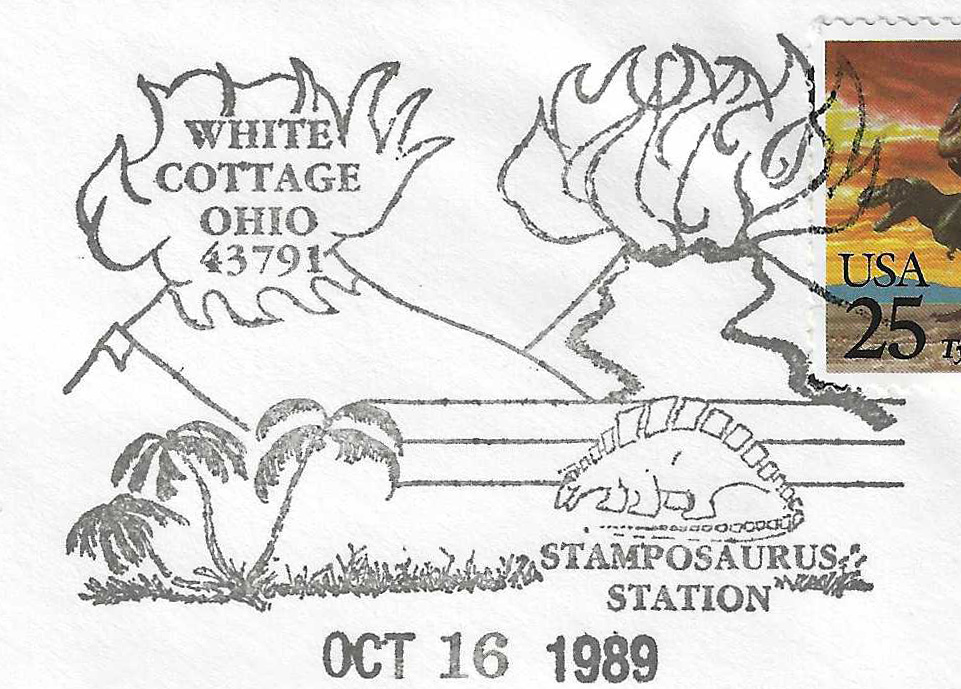
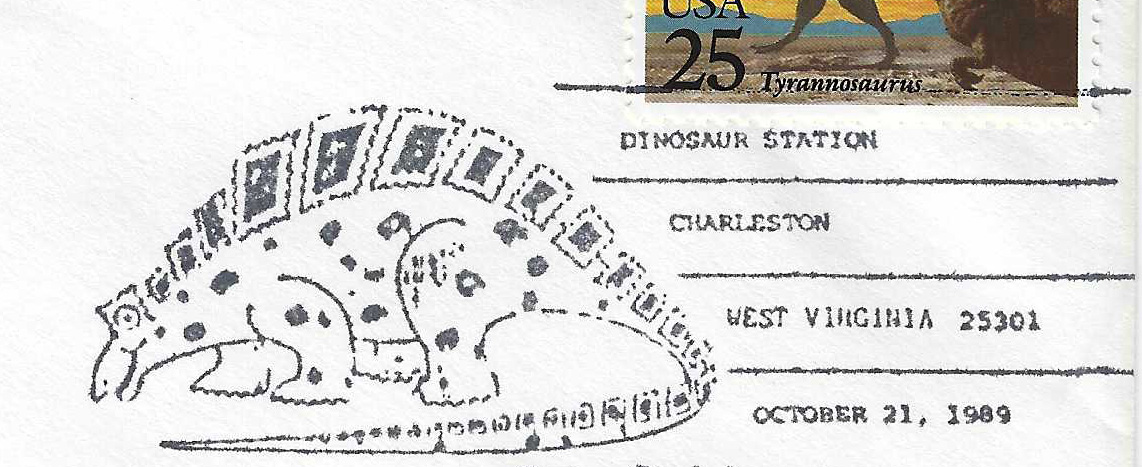
 [2] Stylized Stegosaurus with upright plates in form of postage stamps,
called “Stamposaurus” is in the selvage on the margin of the stamps sheets.
[2] Stylized Stegosaurus with upright plates in form of postage stamps,
called “Stamposaurus” is in the selvage on the margin of the stamps sheets.“Stamposaurus” also can be seen on commemorative postmark that attached to regular "FIRST DAY OF ISSUE" mark as well as on the postmark of Brisbin anniversary Station, dated October 2nd 1989 (second day of the stamps issue).
Thomas Jefferson on stamps of USA
Thomas Jefferson who was not only the 3rd American President (1801-1809),
but also a central player in the beginnings of American paleontology.
- Stamp issue date of some old USA stamps are different in MICHEL and Scott catalogs. In this case, the Scott Catalog dates are used in the table below.
- Only stamps of Thomas Jefferson on a neutral background are listed below. Other stamps, such as "Civil War" or "Declaration of Independence" are skipped as irrelevant to the topic of Paleontology.
| 14.031856 "Thomas Jefferson" [J1] | 1857 "Thomas Jefferson" [J2] | 19.08.1861 "Thomas Jefferson" [J3] |
 |
 |
 |
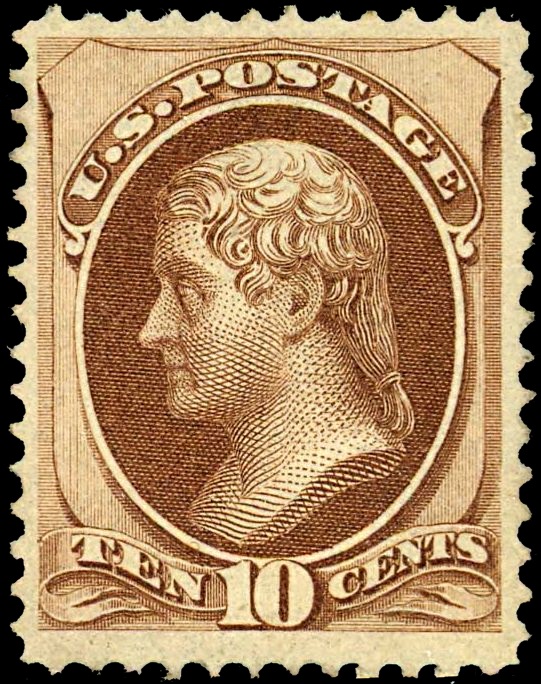
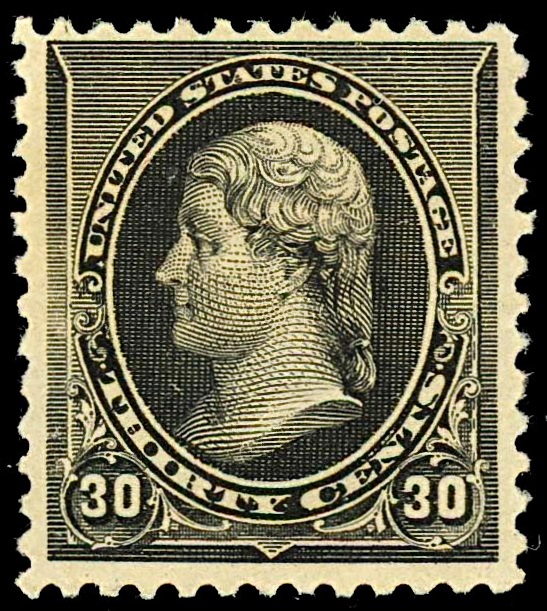
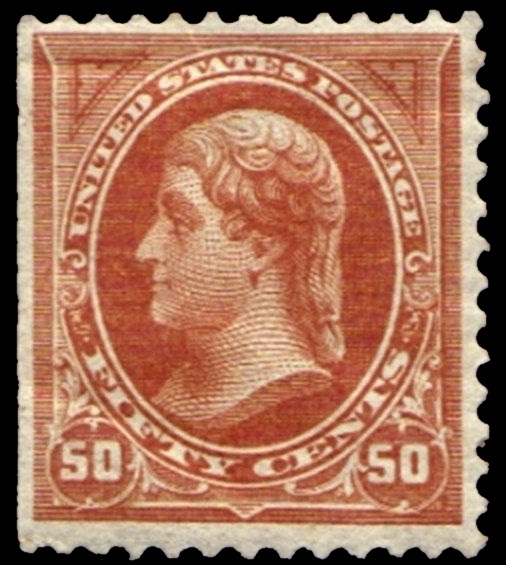
| 13.03.1870 "Presidents" [J5] | 22.02.1890 "Presidents and other famous personalities", part of multi-year (1890-1893) definitive set | 01.01.1894 "Presidents and other famous personalities" [J6] |
 |
 |
 |
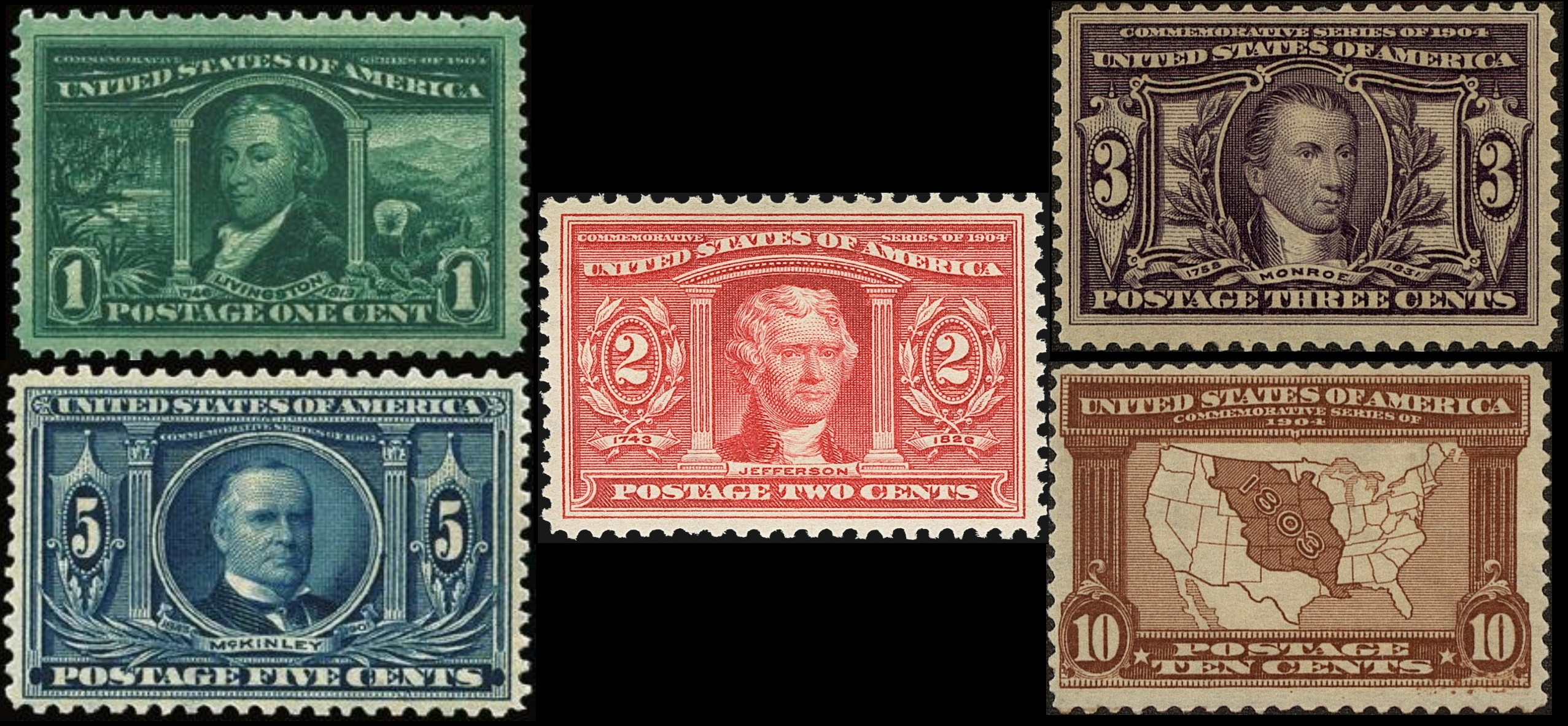
| 23.03.1903 "Presidents and other famous personalities", part of multi-year (1902-1908) definitive set | 21.04.1904 "Louisiana Purchase Exposition" [J7] | 15.01.1923 "Personalities and Landscapes" [J8] |
 |
 |
 |
| 01.05.1929 "Personalities and Landscapes" [J8] | 16.06.1938 "Presidents of USA" [J9] | 15.09.1954 "Liberty issue" [J10] |
 |
 |
 |
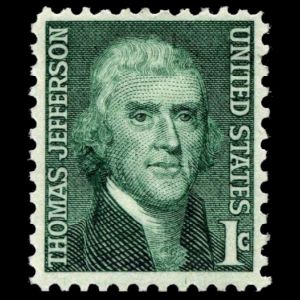
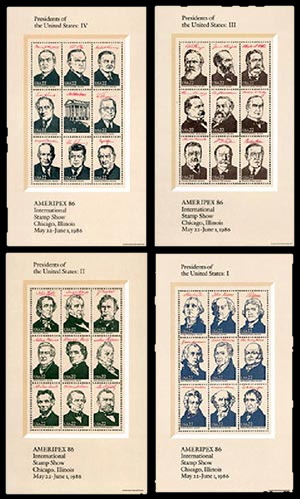
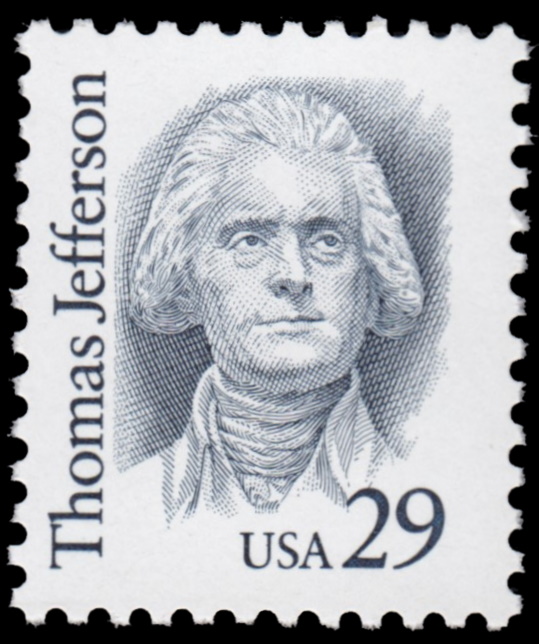
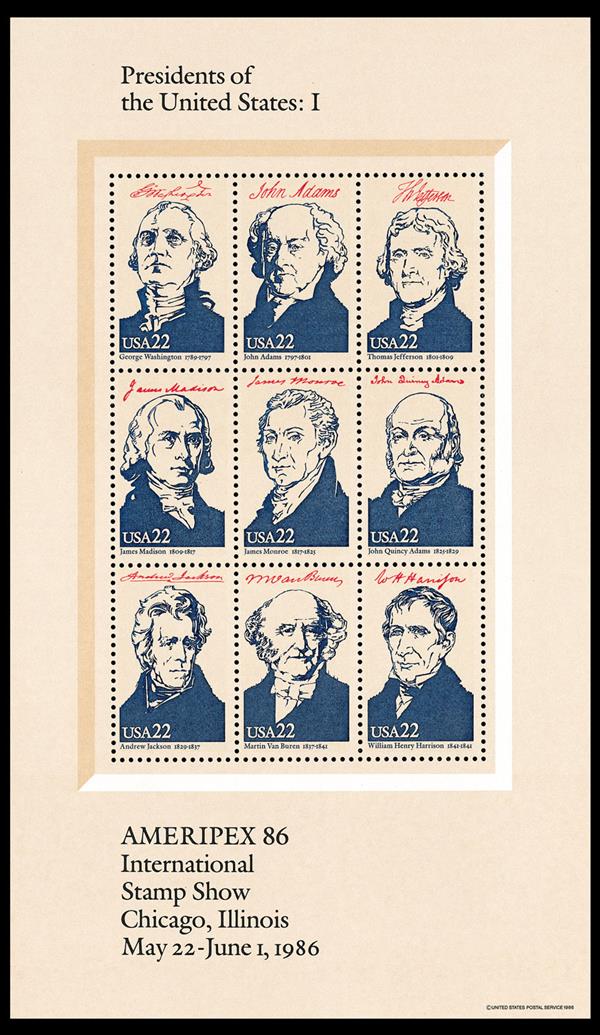
| 12.01.1968 "Famous Americans" [J11] | 22.05.1986 "AMERIPEX'86, International Stamp Show - Presidents of the United States" [J12] | 03.04.1993 "Great Americans", part of big multi-year (1986-1994) definitive set |
 |
 |
 |
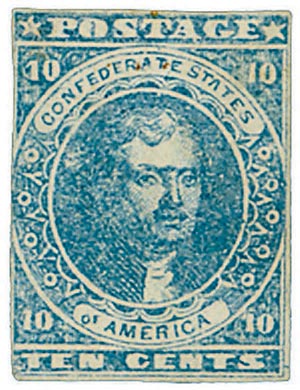
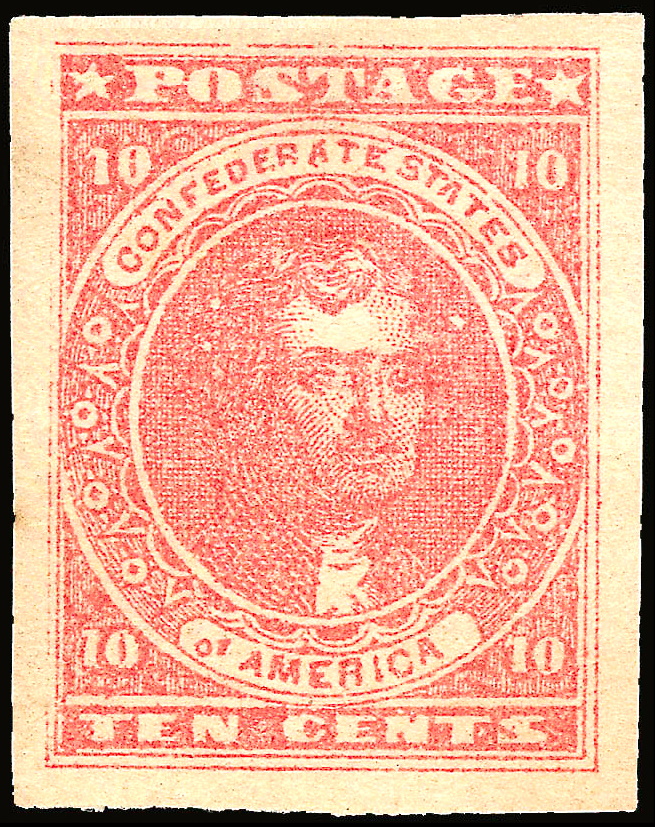
Confederate States, issued during the American Civil War (April 12, 1861 – May 26, 1865) [J4]
| 08.11.1861 definitive issue 1 | 25.07.1862 definitive issue 2 | 1862 reprint |
 |
 |
 |
Notes:
Thomas Jefferson (1743-1826) is rightfully renowned as the principal author of the Declaration of Independence, the Third President of the United States, and a champion of Liberty.
|
Thomas Jefferson on stamp of USA 1856 |

Georges-Louis Leclerc Comte de Buffon, on stamp of France 1949 |
Jefferson was one of the main opponents of Georges-Louis Leclerc, Comte de Buffon. Buffon was one of the most famous naturalists of the time. He compared the animals of the Old World (Europe, Asia and Africa) to similar animals in the New World (the Americas) – and suggested that the New World animals were smaller. He declared these animals degenerate and inferior to the life forms of Europe.
Buffon believed, that nature is less active, less energetic on one side of the globe than she is on the other.
Jefferson started to collect bones and skins of large American animals to disprove Buffon’s theory. He was interested not only in known animals but also in fossils. He was very interested in "Mammoth" bones, later assigned to American Mastodon species.
At the end, he convinced Buffon that the American fauna was not degenerate, after sending Buffon several skeletons and skins of large American animals like the Moose.
In 1797 Thomas Jefferson, when he was the 2nd Vice President of the United States, was elected president of the American Philosophical Society at Philadelphia. In March, the same year, he read his only paleontological article “A Memorial of the Discovery of certain Bones of a Quadruped of the Clawed Kind in the Western Part of Virginia” at a meeting of the society. In this article Jefferson describe some fossil bones sent to him by Colonel John Stuart in 1796. In this article he theorized that the bones represented the remains of a lion and compared them to the bones of a modern African lion. He named this animal Megalonyx - "giant claw".
This presentation to the American Philosophical Society is often credited as the beginning of vertebrate paleontology in North America.
In 1799, Dr. Caspar Wistar correctly identified the remains as those of a giant ground sloth. In 1822, Wistar proposed naming the species Megalonyx jeffersonii in honor of the former statesman. [R3]
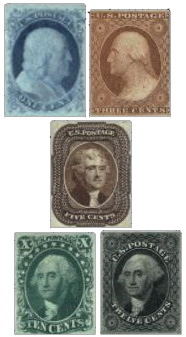
Multi-year definitive set dedicated to American Statesmen, issued between 1851 and 1856. |
This imperforate stamp is a part of multi-year definitive set of 5 stamps dedicated to American presidents, issued between June 1st 1851 and March 24th 1856.
[J2] This stamp, a perforate version of the imperforate 5¢ Jefferson stamp of the Series of 1851-57, is reprinted some years after and varieties can be recognized by their different colors.
- 06.10.1858 (Scott 27) - perforation: 15.5x,15.5 color: brick-red
- 08.08.1857 (Scott 28) - perforation: 15.5x15.5, color: red-brown. Type I.
- 31.03.1858 (Scott 28A) - perforation: 15.5x15.5, color: indian-red. Type I.
- 04.04.1859 (Scott 29) - perforation: 15.5x15.5, color: brown. Type I.
- 04.05.1860 (Scott 30A) - perforation: 15.5x15.5, color: brown. Type II
- 08.05.1861 (Scott 30) - perforation: 15.5x15.5, color: orange-brown. Type II
The following stamp issued for the 1876 Centennial Exhibition in Philadelphia, it is a reprint of the 5¢ stamp from the series of 1857-61. However, because it was issued for collectors and not postal use, it was issued in much smaller quantities.
- 1875 (Scott 42) - perforation: 12x12, color: orange-brown
[J3] This stamp was reprinted several times between 1861 and 1875. Different prints can be recognized on the basis of their color and or grill.
- 19.08.1861 (Scott 67) - perforation: 12x12, color: buff (light brownish yellow )
- 02.01.1862 (Scott 75) - perforation: 12x12, color: red-brown
- 03.02.1863 (Scott 76) - perforation: 12x12, color: brown
- 1867 (Scott 80) - perforation: 12x12, color: brown. "A" grill.
- 1875 (Scott 95) - perforation: 12x12, color: orange-brown
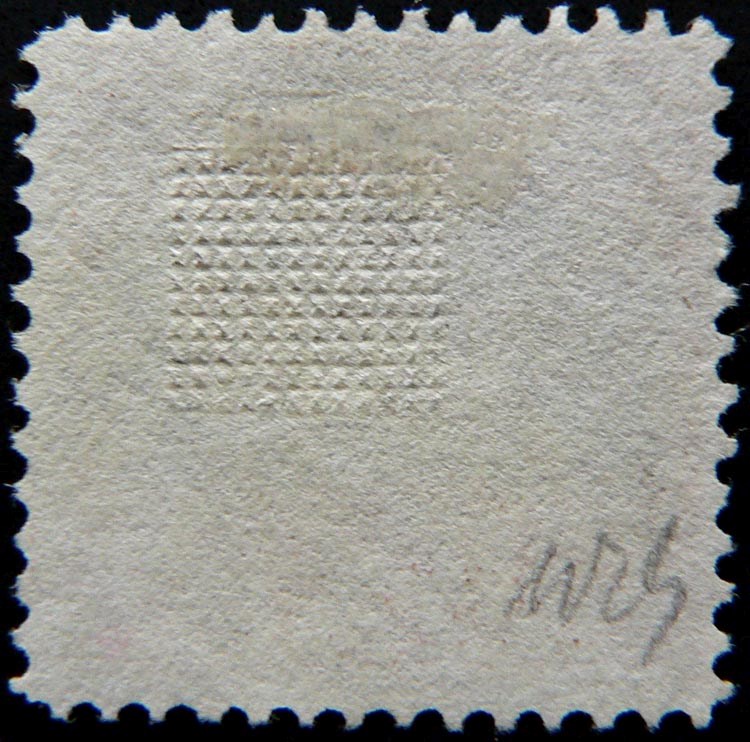
G grill on a stamp of the 1869 issue. The image is from Wikipedia |
In the late 1800s, officials were worried that people were “recycling” stamps by washing the cancels away and using them again.
So they gambled on an experiment – a grilling machine invented by Charles F. Steel.
From 1867-75, Steel’s machine used a roller pitted with either small depressions or small raised pyramids to break fibers in stamp paper.
The rollers with depressions created a “points up” pattern while those with raised pyramids made a “points down” pattern.
These broken fibers allowed cancellation ink to thoroughly penetrate the paper.
This meant even regular pen ink, which was used to cancel stamps at smaller post offices, would be impossible to remove completely.
The experiment was short-lived, ending in 1875.
According to Scott stamps catalog, "A" type grill was made by a roller covered with ridges shaped like an inverted V. Pressing the ridges into the stamp paper forced the paper into the pyramidal pits between the ridges, causing irregular breaks in the paper.
[J4] The Confederate States of America (CSA), commonly referred to as the Confederate States (C.S. or CS) or the Confederacy, was an unrecognized breakaway state that fought against the United States during the American Civil War, existed from 1861 to 1865
In 1865, after four years of heavy fighting and 620,000–850,000 military deaths, all Confederate land and naval forces either surrendered or otherwise ceased hostilities. The war lacked a formal end, with Confederate forces surrendering or disbanding sporadically throughout most of 1865. After the Civil War broke out, the U.S. declared all of its stamps invalid, so the South was forced to supply its own stamps. However, the South didn’t have proper printing facilities. That’s why early Confederate stamps (including stamps of Thomas Jefferson) were printed by stone lithography.
Stone lithography involves the use of a grease-based medium on a stone surface. When ink is applied, the natural reaction between grease and water creates the printing pattern. It is a fairly primitive way to produce stamps.
The first postage stamp issued by the Confederate States (1861) was a 5¢ green depicting Jefferson Davis. Like almost all Confederate issues, these stamps were imperforate, and single stamps had to be cut from the sheet with razors or scissors.
A 10¢ blue with Thomas Jefferson also appeared in 1861, designed by Charles Ludwig of Hoyer & Ludwig, Richmond, Virginia. This issue was printed by two different companies: Hoyer & Ludwig and later, J. T. Paterson & Co. of Augusta, Georgia.
The image of Thomas Jefferson used on both printings lithographically reproduced the same image that had been engraved on the U.S. 5-cent issue of 1856. Secret marks were added by the Paterson firm to the transfer stones to distinguish its version from the Hoyer & Ludwig prints of the same design. The most typical use was for the ten-cent rate after July 1, 1862.
The stamp from 1861 exists in 5 variations (MICHEL catalog includes 3 variation only), all without gum. The earliest printings were made by Hoyer & Ludwig, the later ones by J. T. Paterson & Co.:
- light blue color, - Scott Nr. CSA2a.
- dark blue color, printed Hoyer & Ludwig - Scott Nr. CSA2b. Issue date according to MICHEL: 08.11.1861
- indigo (deep/reach blue) color - Scott Nr. CSA2c. Issue date according to MICHEL: 25.07.1862
- blue color, printed on both sides - Scott Nr. CSA2d. I
- greenish blue color, printed Paterson & Co - Scott Nr. CSA2e.
- rose color - Scott Nr. CSA5
- carmine (imperial red) color- Scott Nr. CSA5a
[J5] This stamp is part of multi-year definitive (1870-1871) set.
This stamp is reprinted some years after and can be recognized by different color
- .04.1870 (Scott 139) - perforation: 12x12, color: brown, printed by National Bank Note Company
- 14.05.1870 (Scott 150) - perforation: 12x12, color: brown, printed by National Bank Note Company
- 02.08.1873 (Scott 161) - perforation: 12x12, color: brown, printed by Continental Bank Note Company
- 05.09.1879 (Scott 187) - perforation: 12x12, color: brown, printed by American Bank Note Company
- 05.10.1878 (Scott 188) - perforation: 12x12, color: brown, printed by American Bank Note Company
- 04.05.1882 (Scott 209) - perforation: 12x12, color: brown, printed by American Bank Note Company
- 1882 (Scott 209b) - perforation: 12x12, color: black-brown, printed by American Bank Note Company
[J6] This stamp is part of multi-year definitive (1890-1893) set.
This stamp is reprinted some years after and can be recognized by different color
- 01.11.1894 (Scott 260) - perforation: 12x12, color: orange, printed by Bureau of Engraving and Printing, without watermark
- 09.11.1895 (Scott 275) - perforation: 12x12, color: orange, printed by Bureau of Engraving and Printing, with Double line USPS watermark
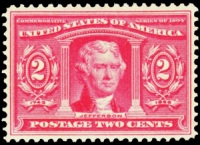 [J7] There are many definitive stamps of Thomas Jefferson issued by the United States Postal Service, but only a few commemorative stamps.
 The first commemorative stamp of Jefferson issued as part of Louisiana Purchase Exposition Issue of 1904
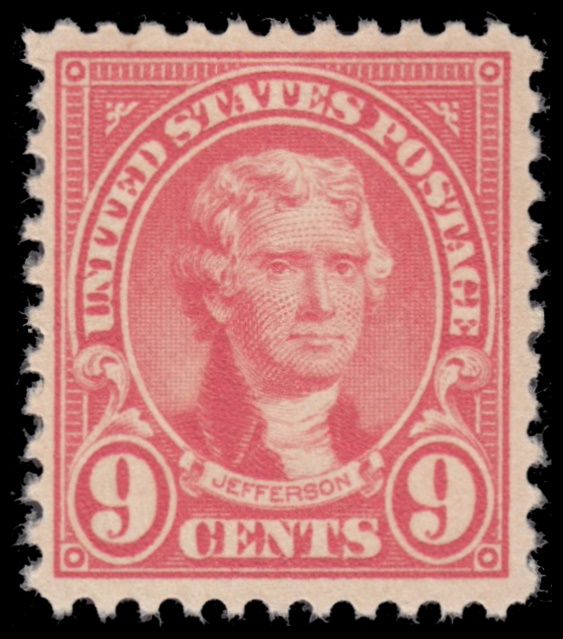
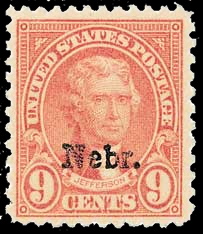
[J8] This stamp is part of multi-year (1922-1934) definitive set. The same design issued with different perforations and color variation.
- 15.01.1923 (Scott 561) - perforation: 11x11, color: rose
- 29.05.1926 (Scott 590) - perforation: 10x10, color: rose
- 17.05.1927 (Scott 678) - perforation: 11x10.5, color: light rose, with overprint "Nebr."
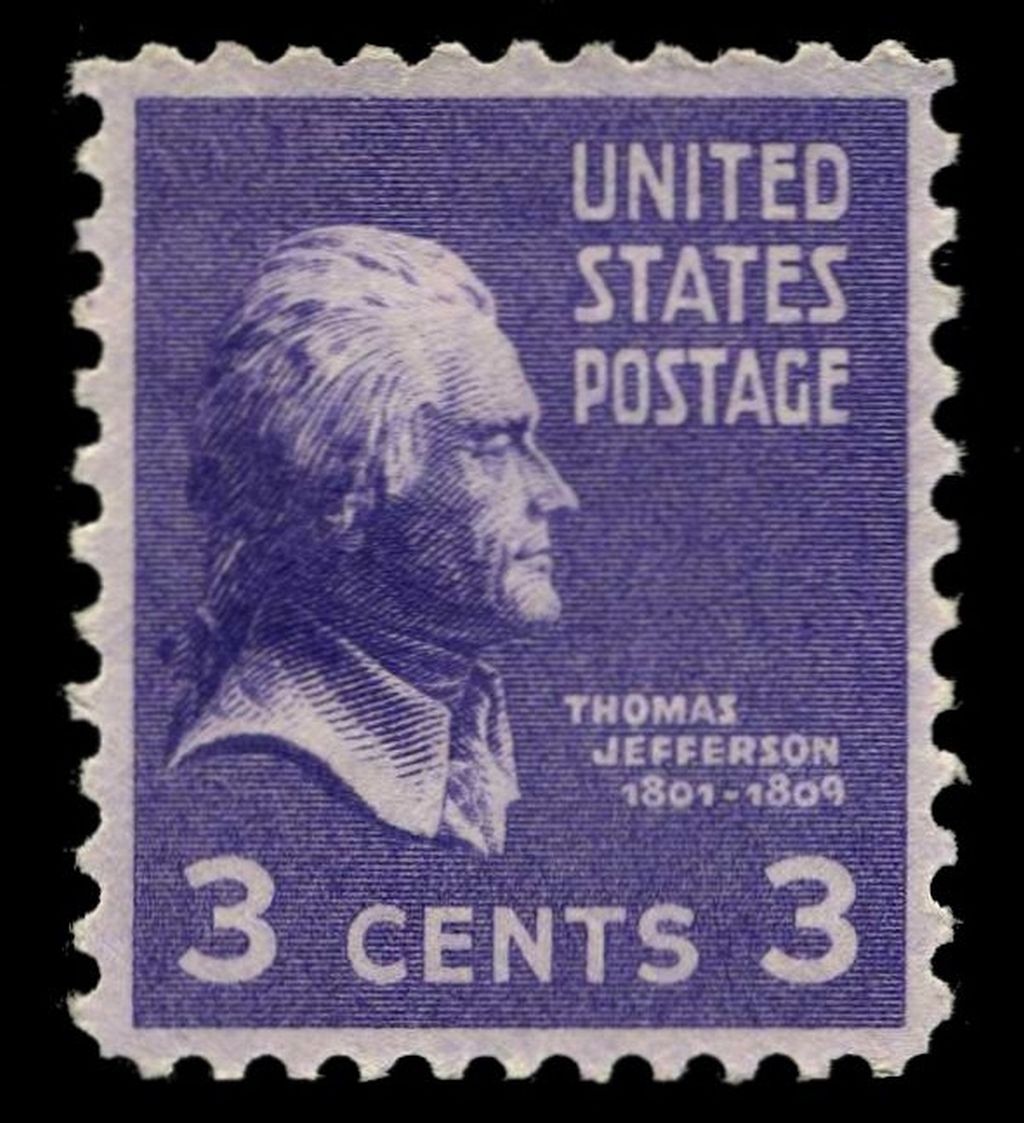
[J9] This stamp is part of multi-year (1938-1954) definitive set. The same design issued with different perforations and print techniques.
- 16.06.1938 (Scott 807) - perforation: 11x10.5, color: deep violet
- 16.06.1938 (Scott 807a) - perforation: 11x10.5, color: deep violet, booklet pane of 6
- 16.06.1938 (Scott 807b) - perforation: 11x10.5, color: deep violet, horizontal pair imperforated
- 16.06.1938 (Scott 807c) - perforation: 11x10.5, color: deep violet, imperforated pair
- 16.06.1938 (Scott 807)d - perforation: 11x10.5, color: deep violet, vertical pair imperforated
- 20.01.1939 (Scott 842) - perforation: 10x10, color: deep violet, coils stamps with horizontal perforation
- 20.01.1939 (Scott 851) - perforation: 10x10, color: deep violet, coils stamps with vertical perforation
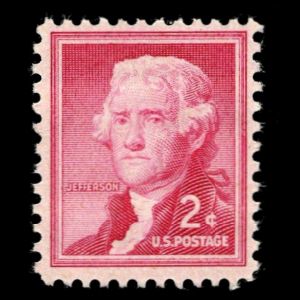
[J10] This stamp is part of multi-year (1954-1973) definitive set. The same design issued with different perforations and print techniques.
- 15.09.1954 (Scott 1033) - perforation: 11x10.5, color: carmine rose
- 22.10.1954 (Scott 1055) - perforation: coil stamps, 10x10 when top and bottom sides are imperforated, color: carmine rose
 [J11] This stamp is part of multi-year (1965-1978) definitive set.
The same design issued with different perforations and print techniques.
[J11] This stamp is part of multi-year (1965-1978) definitive set.
The same design issued with different perforations and print techniques.
- 12.01.1968 (Scott 1278) - perforation: 11x10.5, color: green
- 12.01.1968 (Scott 1278a) - perforation: 11x10.5, color: green, booklet pane of 8
- 12.01.1968 (Scott 1278b) - perforation: 11x10.5, color: green, booklet pane of 4 with 2 labels on top
- 12.01.1968 (Scott 1278c) - perforation: 11x10.5, color: green, utagged (bureau precanceled)
- 12.01.1968 (Scott 1299) - perforation: 10x10, color: green, coil stamps, top and bottom sides imperforate,
- 12.01.1968 (Scott 1299a) - perforation: 10x10, color: green, coil stamps, top and bottom sides imperforate, bureau precanceled
- 12.01.1968 (Scott 1299b) - imperforated pairs of coil stamps (error), color: green
[J12] Thomas Jefferson depicted on one of the stamps on a Mini-Sheet with blue stamps.
Other stamps of USA to consider
- Fossil found places: National Parks)
- Natural History Museums: Smithsonian
- Miscellaneous: stylized prehistoric animals
- Some stamps related to Thomas Jefferson: Mount Rushmore National Memorial, Jefferson memorial, Virginia’s Rotunda
| Fossil found places: National Parks | ||
| 16.07.-08.10.1934 "National Parks" (The Grand Canyon [A1a], Yellowstone National Park[A1b]) |
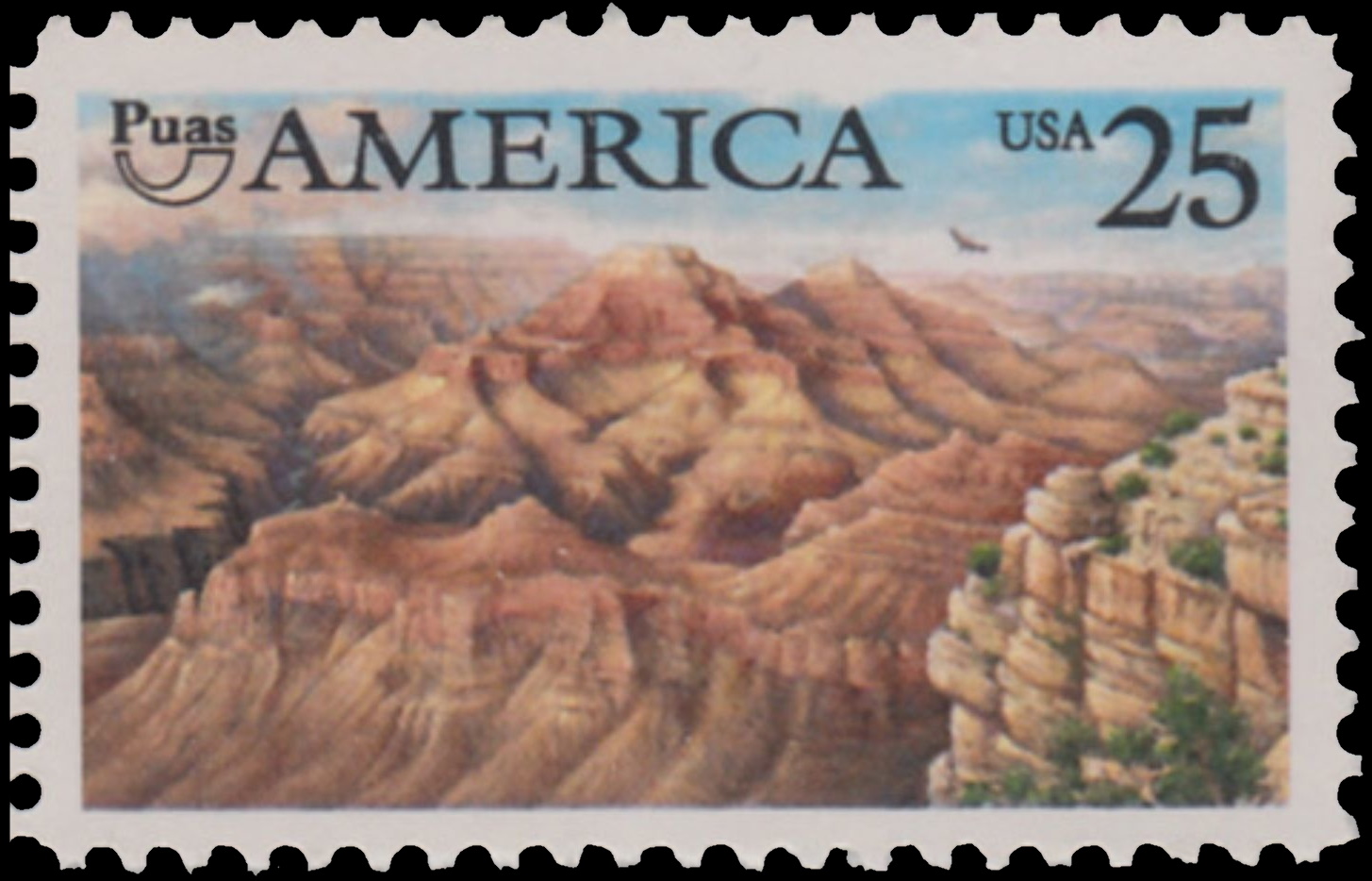
01.03.1972 "100th anniversary of Yellowstone National Park" [A1b] | 12.10.1990 "Pre-Columbian America: the Grand Canyon [A1a] (500 years ago)" |
 |
 |
 |
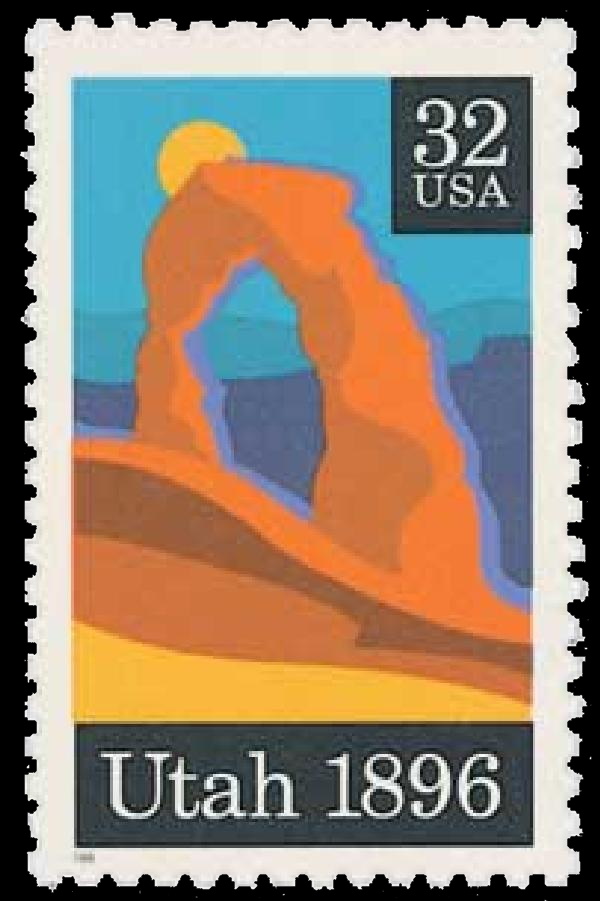
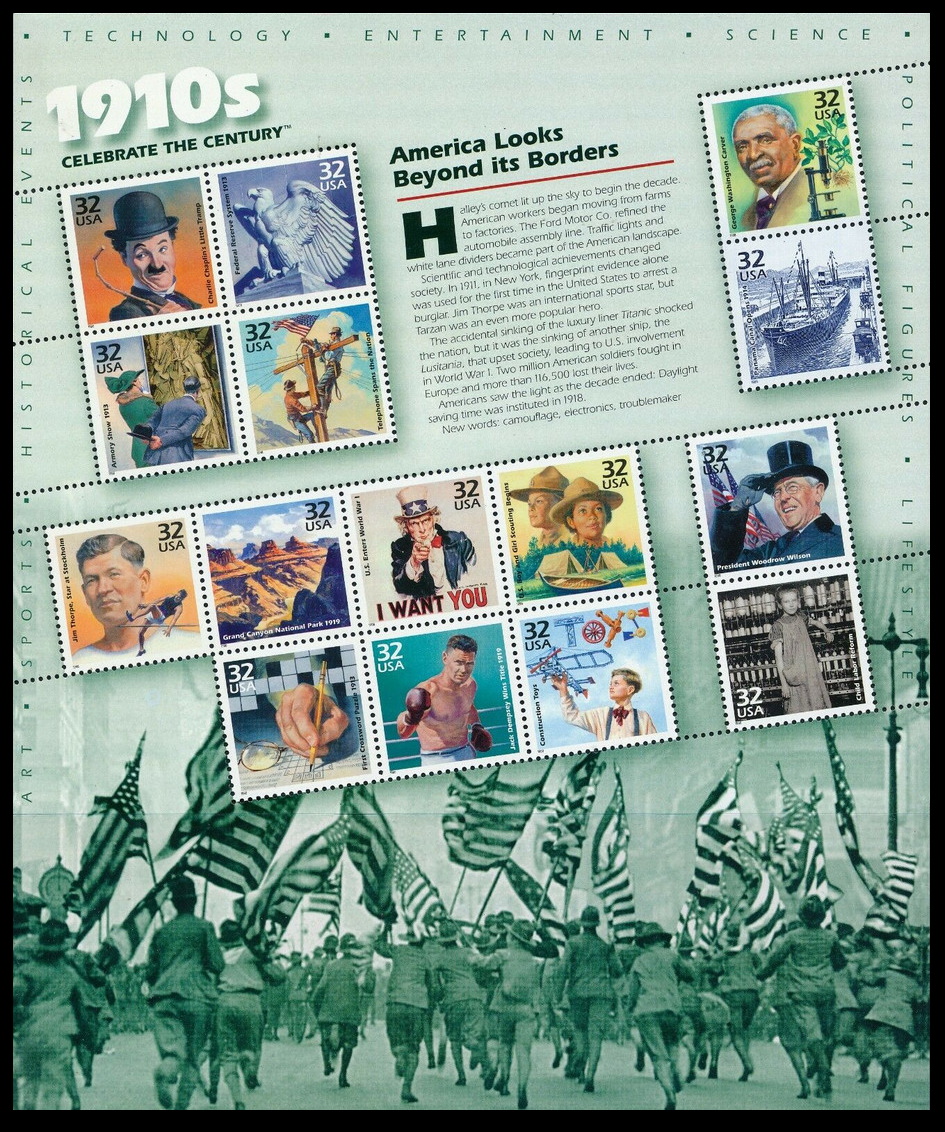
| 04.01.1996 "Centennial Utah Statehood National Park" [A1f] | 03.02.1998 "Celebrate the Century: Years 1910-1919" (The Grand Canyon [A1a]) |
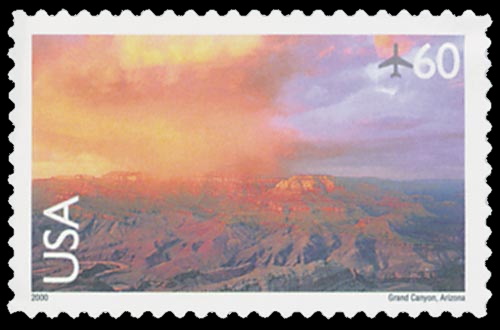
20.01.2000 "Scenic American Landscapes: the Grand Canyon" [A1a] |
 |
 |
 |
| 24.02.2006 "Scenic American Landscapes" (Bryce Canyon National Park [A1h], Yosemite National Park [A1g]) |
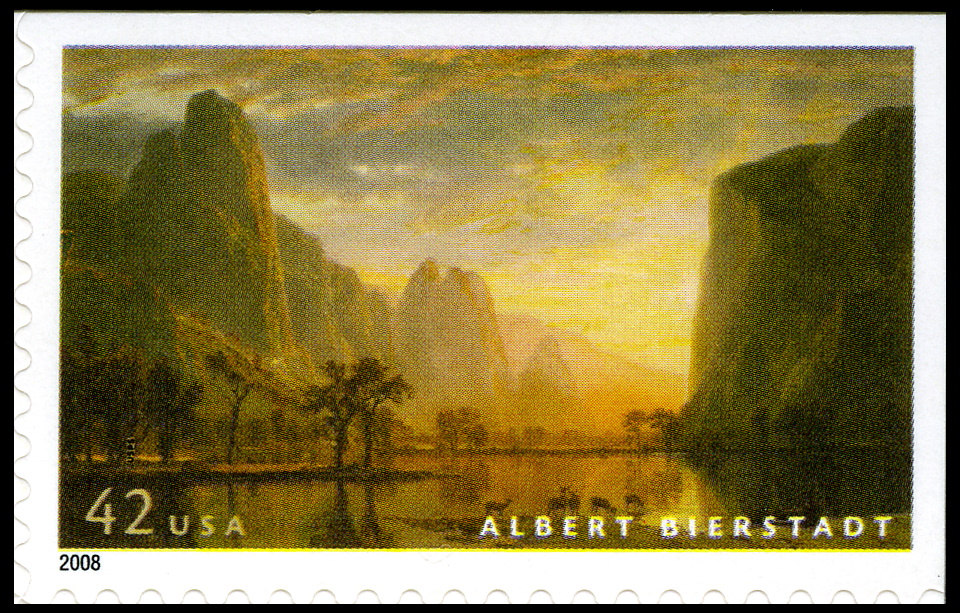
14.08.2008 "Albert Bierstadt, American Treasures Series" (Yosemite National Park [A1g]) |
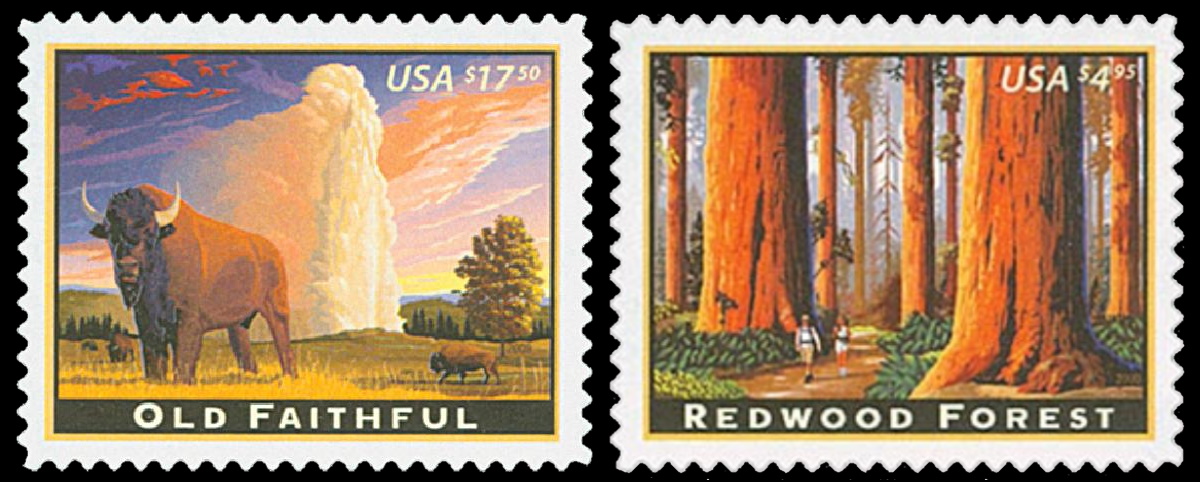
16.01.2009 "Sightseeing" (Old Faithful, part of Yellowstone National Park [A1b]) |
 |
 |
 |
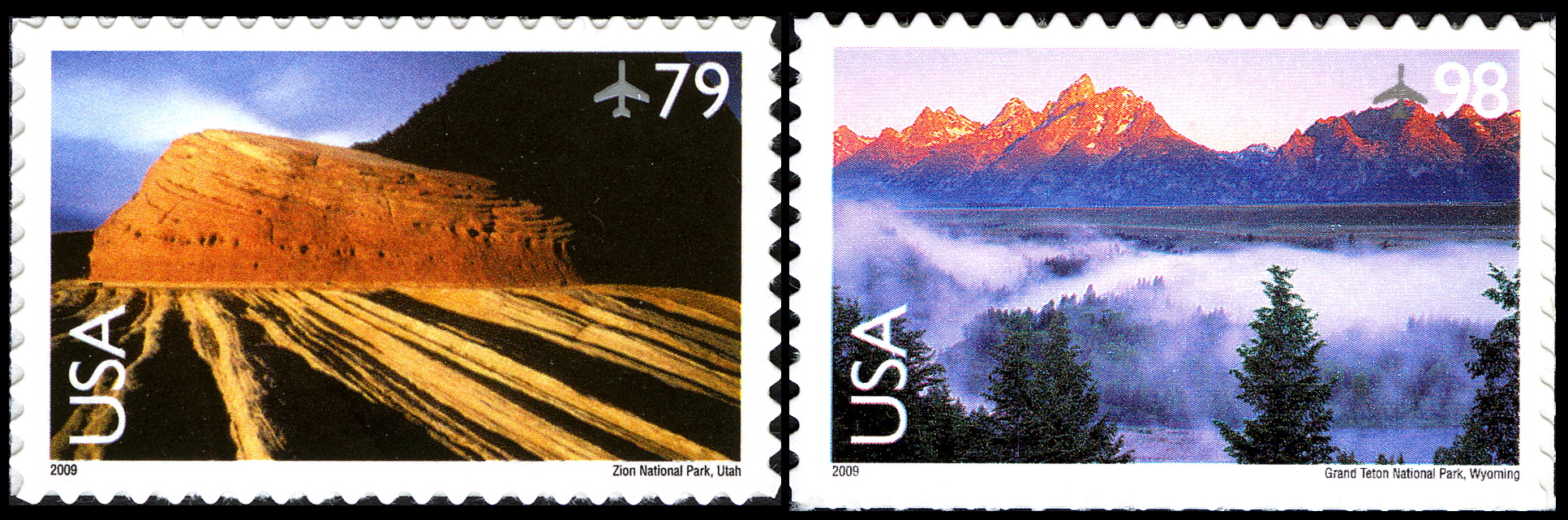
| 28.06.2009 "Scenic American Landscapes" (Zion National Park [A1a]) |
19.01.2012 "Scenic American Landscapes: Glacier National Park" (Glacier National Park [A1h]) |
21.08.2014 "American treasures, Hudson River School Paintings" (The Grand Canyon[A1a]) |
 |
 |
 |
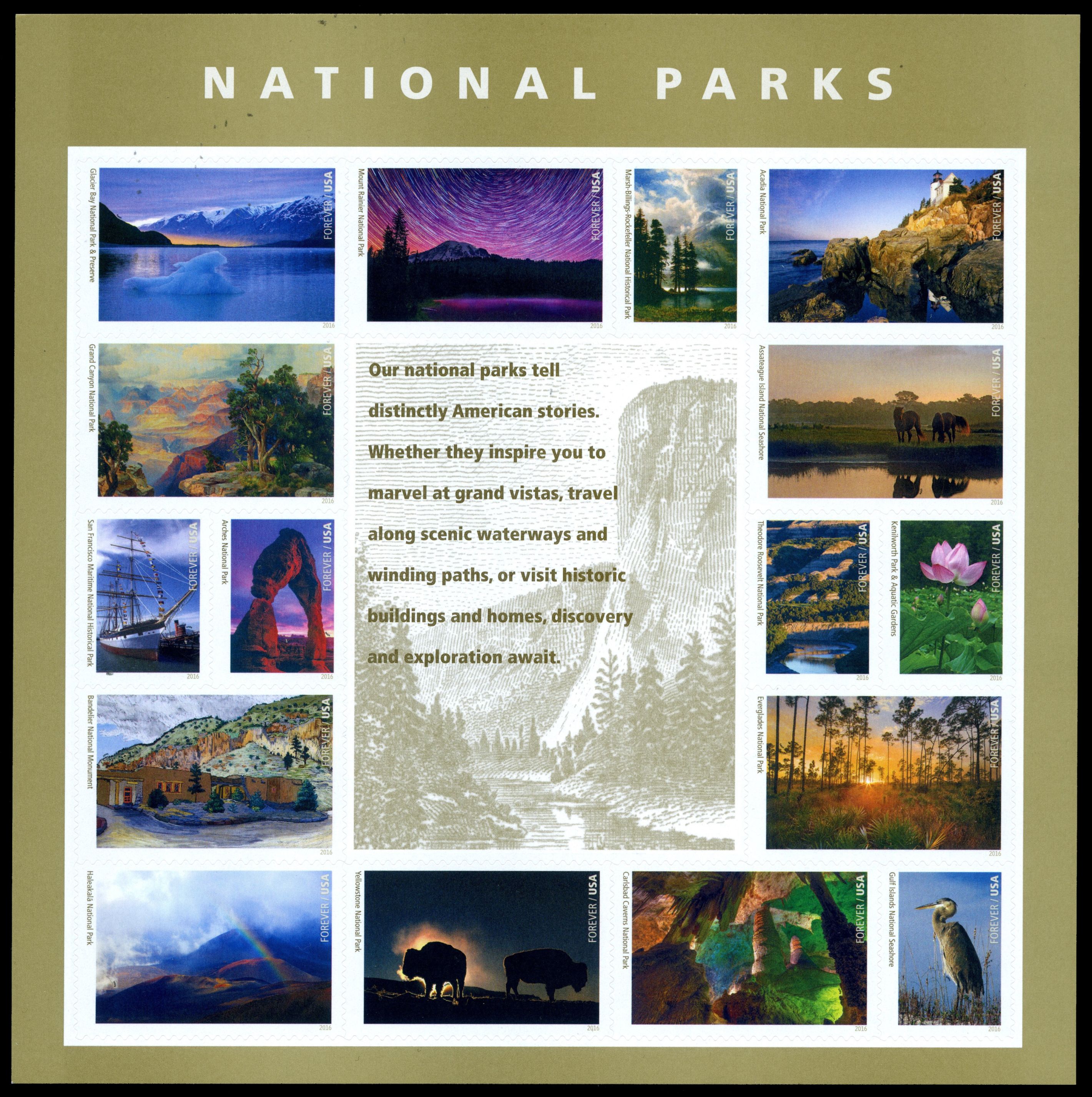
| 02.06.2016 "National Parks" (The Grand Canyon [A1a], Carlsbad Caverns National Park [A1e]) |
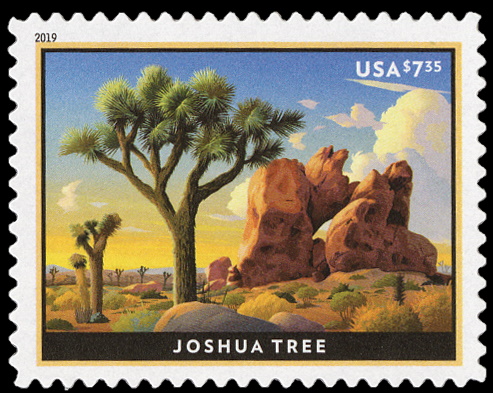
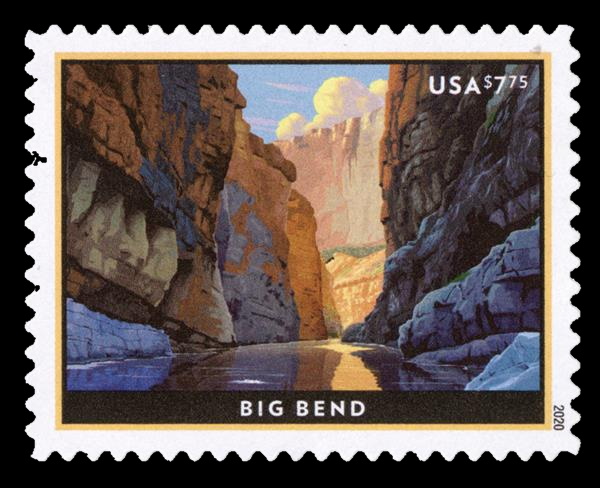
2019 "Joshua Tree National Park" [A1c] | 2020 "Big Bend National Park" [A1d] |
 |
 |
 |
| 14.02.2022 "Monument Valley in Utah" | ||
 |
||
| National History Museums: Smithsonian Institution [A2] | ||
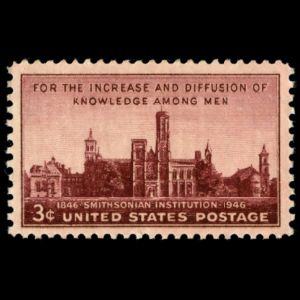
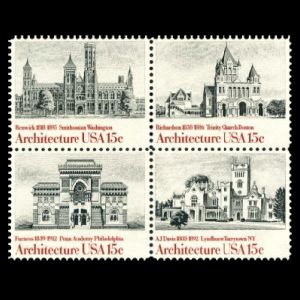
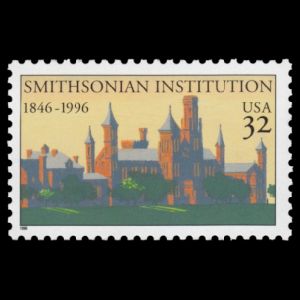
| 10.08.1946 "100 anniversary of Smithsonian Institution" | 09.10.1980 "American Architecture" | 07.02.1996 "Smithsonian Institute" |
|
|
 |
| Miscellaneous | ||
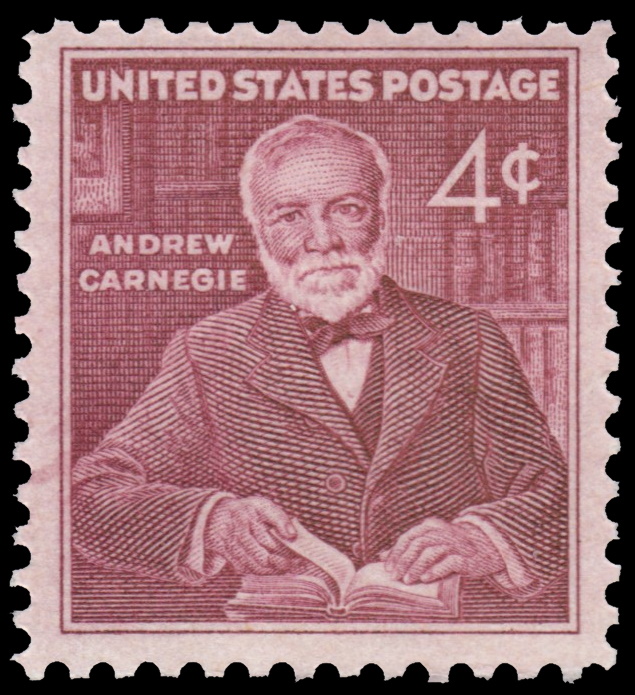
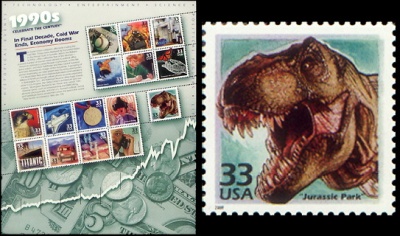
| 25.11.1960 "Andrew Carnegie" [A5] | 29.04.1982 "Knoxville World’s Fair" | 02.05.2000 "America in XX Century: Years 1990-1999" [A3] |
 |
 |
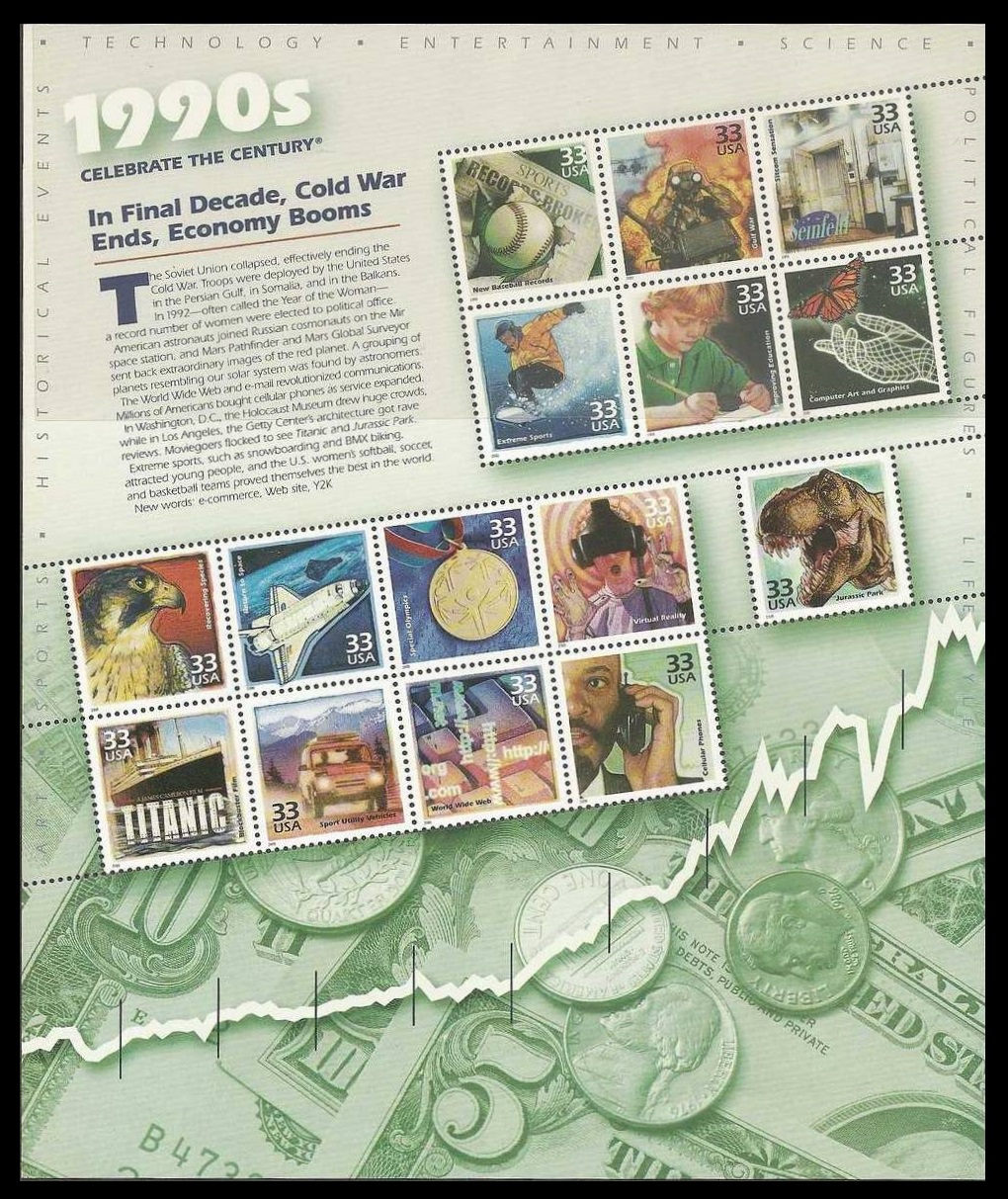 |
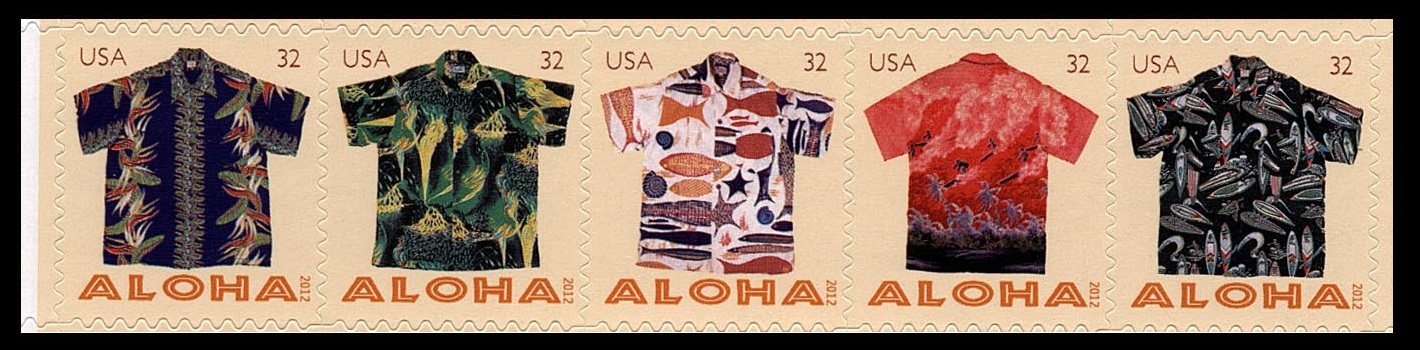
| 19.01.2012 "Aloha Shirt" [A4] | ||
 |
||
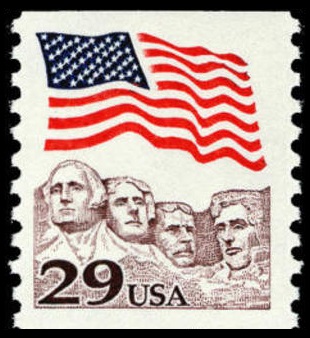
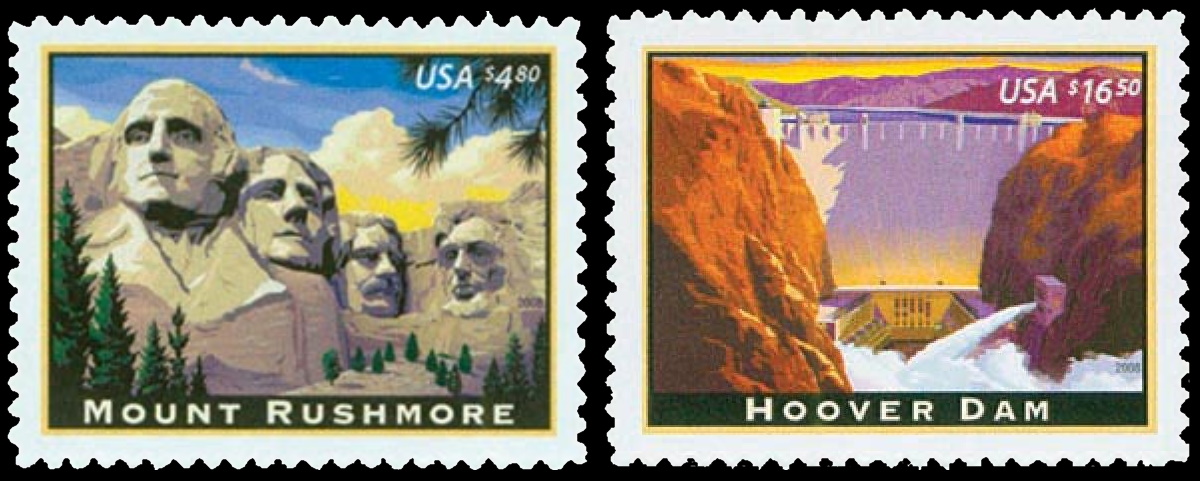
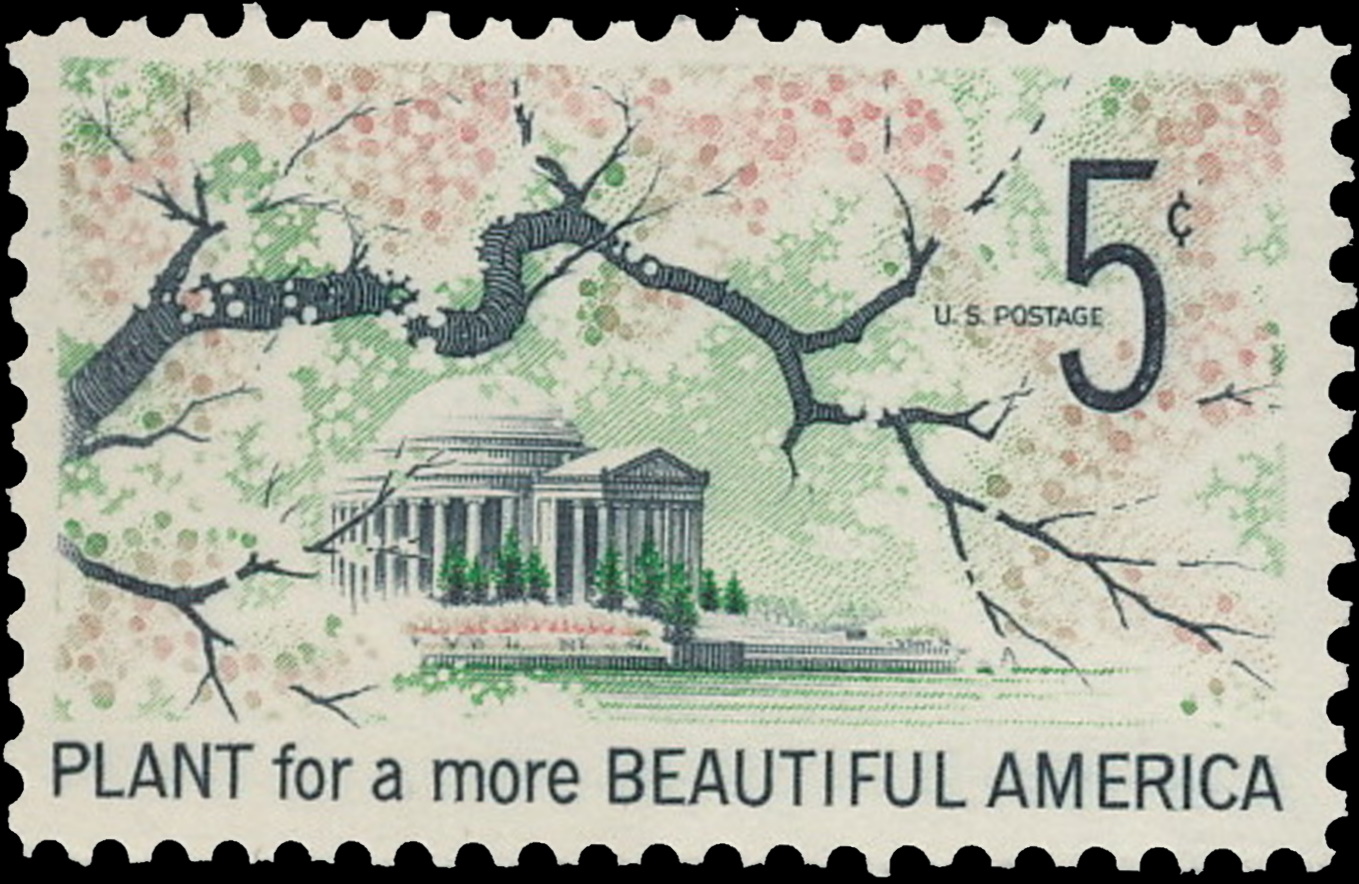
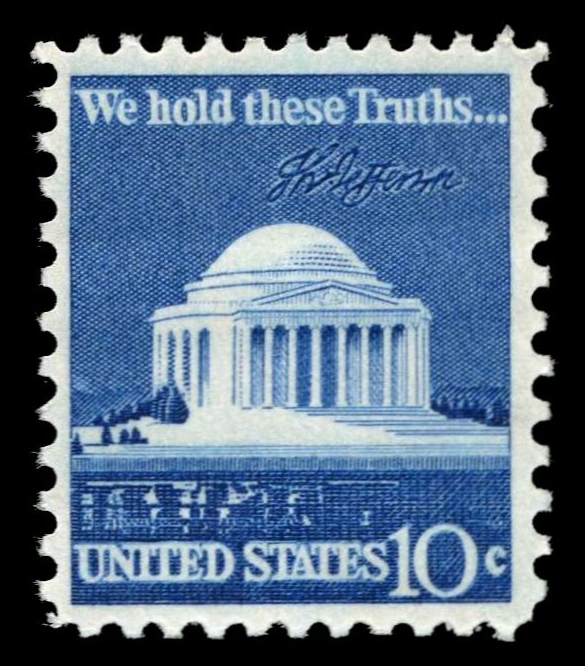
Some other stamps related to Thomas Jefferson: Mount Rushmore National Memorial, Jefferson memorial, Virginia’s Rotunda.
| Mount Rushmore National Memorial [JO1] | ||
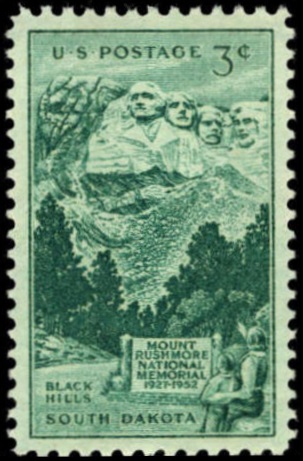
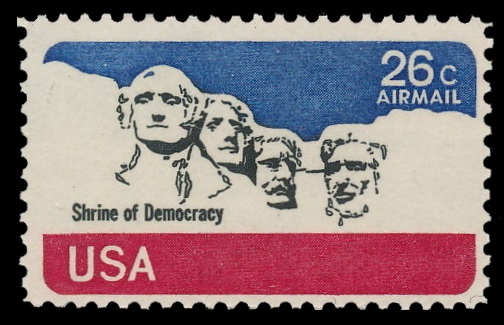
| 11.08.1952 "25th anniversary of the dedication of the Mount Rushmore National Memorial" | 02.01.1974 "Mount Rushmore" (airmail) | 29.03.1991 "Flag over Mount Rushmore National Memorial" (coil stamp) |
 |
 |
 |
| 06.06.2008 "American landmarks" (Priority and Express Mail) | ||
 |
||
| Jefferson memorial [JO2] | ||
| 05.10.1966 "Beautification of America" (part of "Plant for a more beautiful America” campaign, initialized by President Lyndon B. Johnson and his wife.) | 14.12.1973 "Jefferson memorial and Signature" (available with various perforation combinations. Scott 1510a-f) |
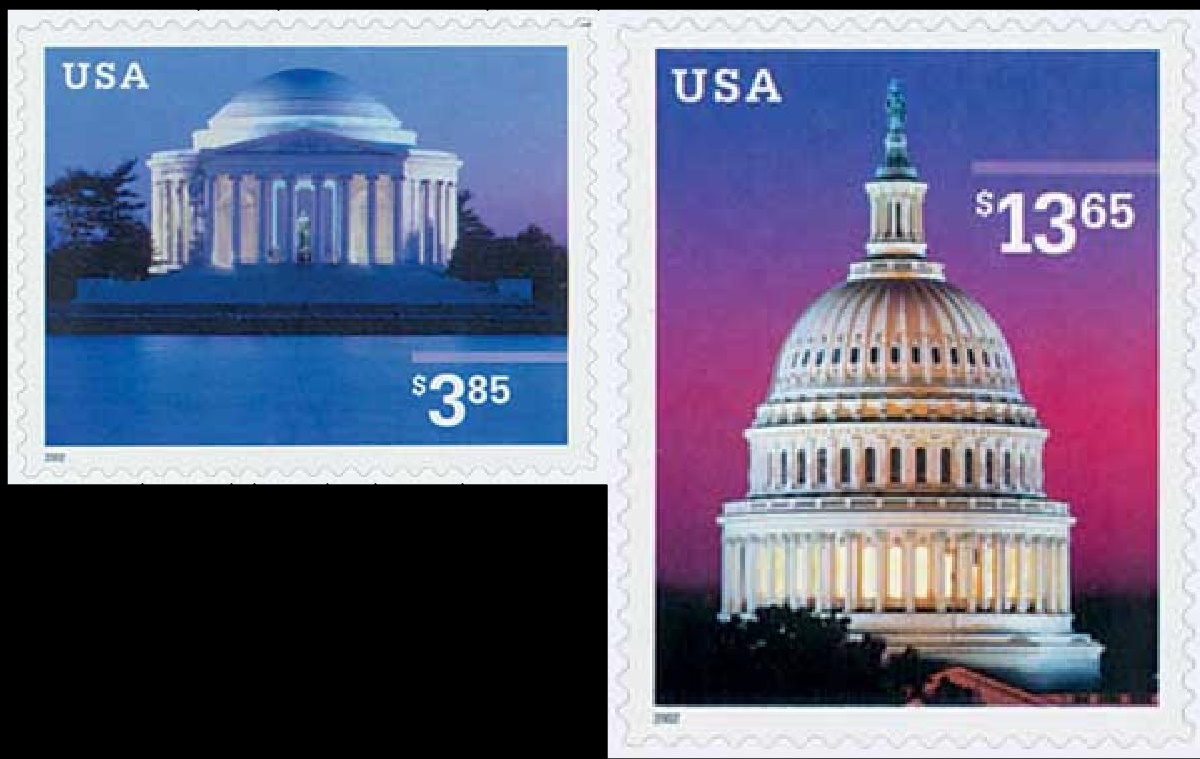
30.06.2002 "Jefferson memorial and Capitol Dome" (Priority and Express Mail, self-adhesive stamps) |
 |
 |
 |
| Virginia’s Rotunda [JO3] | ||
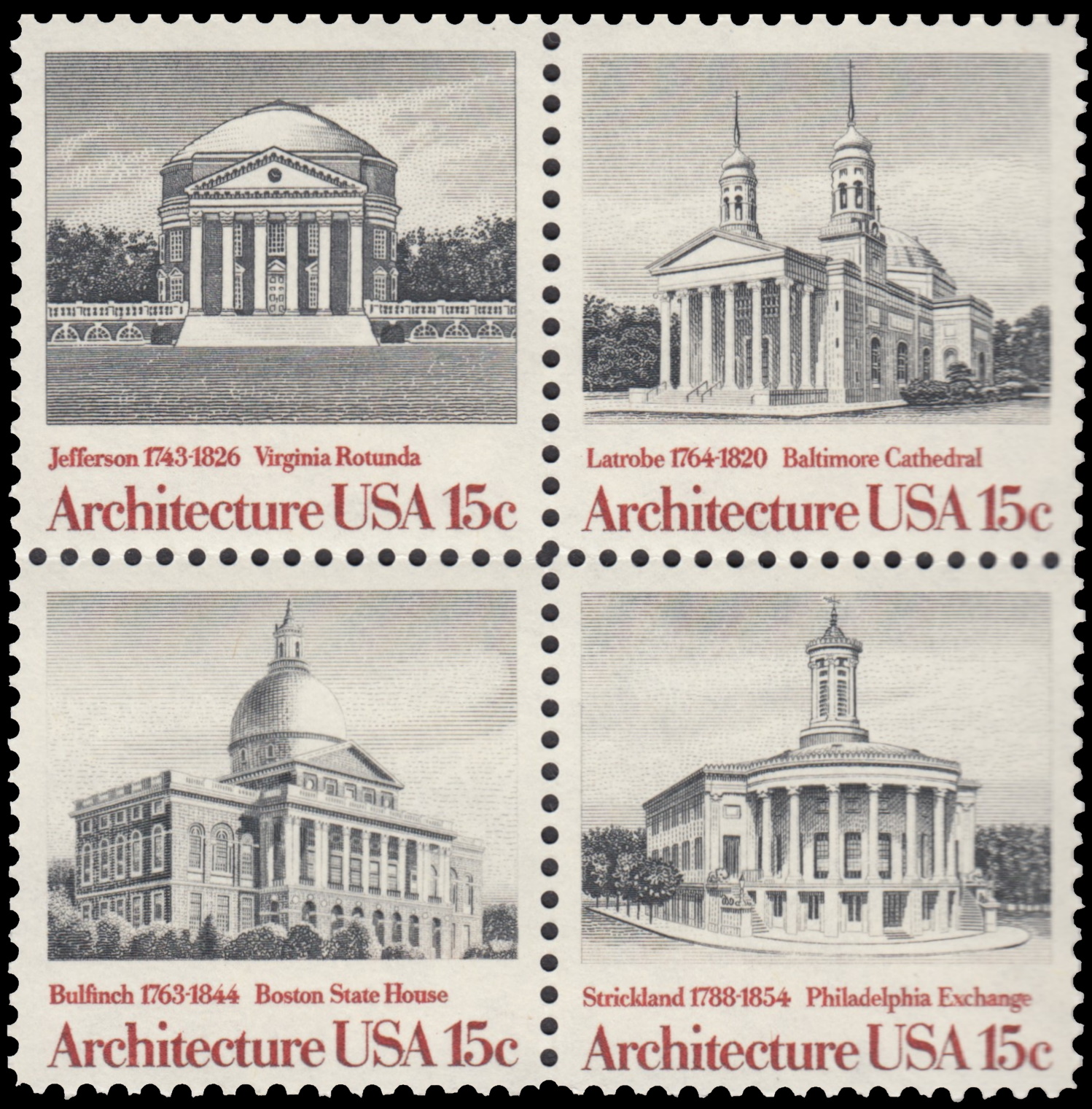
| 04.06.1979 "American Architecture" | ||
 |
||
Notes:
[A1] Many of USA's National Parks are also great fossil found places.
-
[A1a] The Grand Canyon, Zion and Bryce Canyon National Parks
are all close to together in northern Arizona and southern Utah and include
one of the best accessible sequences of rock on the planet covering a huge span of geologic time.
At the Grand Canyon Precambrian and Paleozoic rocks can be found. The youngest rock at Grand Canyon (the Kaibab Limestone – a Permian age unit) is the oldest rock at Zion National Park. Zion covers from the Permian to the Lower Cretaceous Dakota Sandstone. The Dakota Sandstone is the oldest unit at Bryce Canyon – which completes the Mesozoic and above that the Lower Cenozoic.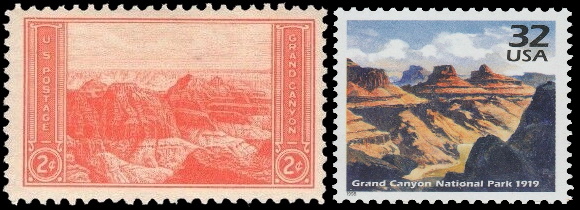
The Grand Canyon on stamp of USA 1935, 1998
In the 1880s, many large dinosaur skeletons were excavated from southern Utah in regions north of the Grand Staircase. (The Grand Staircase is an immense sequence of sedimentary rock layers that stretch south from Bryce Canyon National Park and Grand Staircase-Escalante National Monument, through Zion National Park, and into the Grand Canyon National Park.)
Following these discoveries there was little interest in further exploration. In the late 20th and early 21st centuries there has been greatly renewed interests in the strata of the Grand Staircase, particularly since the exposure and collection of new fossils in previously unexplored strata has a high probability of revealing fossil remnants of hitherto unseen species – a matter of substantial importance to young paleontological researchers wishing to advance in their profession. [R5] -
[A1b] Yellowstone National Park
is an American national park located in the western United States, largely in the northwest corner of Wyoming and extending into Montana, and Idaho.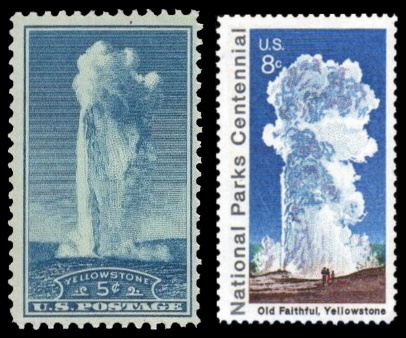
The Yellowstone National Park on stamp of USA 1935 and 1972
It was established by the U.S. Congress and signed into law by President Ulysses S. Grant on March 1, 1872. Yellowstone was the first national park in the U.S. and is also widely held to be the first national park in the world.
Yellowstone National Park has one of the world's largest petrified forests, trees which were long ago buried by ash and soil and transformed from wood to mineral materials. This ash and other volcanic debris are believed to have come from the park area itself as the central part of Yellowstone is the massive caldera of a supervolcano.
In the Yellowstone National Park, most of the trees were entombed in the upright position in which they grew, by the outpouring of various volcanic materials, and as the softer rock surrounding them is gradually worn away they are left standing erect on the steep hillsides, just as they stood when they were living; in fact, it is difficult at a little distance to distinguish some of these fossil trunks from the lichen-covered stumps of kindred living species. Such an aggregation of fossil trunks is therefore well entitled to be called a true fossil forest. [R6]
Old Faithful (geyser from Yellowstone) also shows up on the 2009 stamp, with a bison on a front. -
[A1c] The Joshua Tree National Park
Seventeen national parks in the United States were created partly to protect the fossils found in them. Joshua Tree National Park is one of these.
For almost 100 years, scientists have known that Joshua Tree National Park contains Pleistocene (11.500 - 2.6 million years ago) vertebrate fossils.
Excavations in the early 2000s greatly expanded our knowledge about which animals used to live here during the last ice age. Scientists uncovered animals like horse, camel, llama, deer, wolf, badger, tortoise, and even Columbian mammoth. [R10] -
[A1d] Big Bend National Park
Over 90 dinosaur species, including some previously unknown to science, have been discovered at Big Bend National Park. Some of it are only found in the park. For example Agujaceratops mariscalensis, Agujaceratops mavericus, Bravoceratops polyphemus, Gryposaurus alsatei. The best place in Big Bend to discover the stories dinosaurs is at the Fossil Discovery Exhibit, located 8 miles north of the Panther Junction Visitor Center.
At the Fossil Discovery Exhibit, visitors can view the fossil record of Big Bend – the fossil plants animals and the world they lived in over the past 130 million years.
Over 1200 different fossil species are known from the park: numerous fossils of plants, fish, frogs, salamanders, turtles, crocodiles, lizards (include Deinosuchus riograndensis a 10 meter long giant alligator), and early mammals, placing Big Bend in the top tier of “fossil parks”.
The world’s largest known flying creature of all time was found in Big Bend National Park. This is Quetzalcoatlus northropi, a pterosaur (flying reptile) with a 10 meter wingspan.
These discoveries provide one of the most complete pictures of a prehistoric ecosystem known anywhere on earth.
The fossil record here continues uninterrupted from the Age of Reptiles into the Age of Mammals.
In 1940, legendary paleontologist Barnum Brown, of the American Museum of Natural History in New York, made the final fossil-hunting trip of his career to what is now Big Bend National Park. His campsites and excavation localities are now considered to be historic sites. [R11] -
[A1e] Carlsbad Caverns National Park
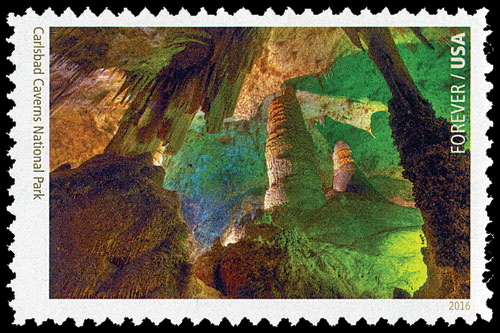
The stamp image is a photograph by Richard McGuire of the interior of the caverns. High ancient sea ledges, deep rocky canyons, flowering cacti and desert wildlife are all treasures above and below the Chihuahuan Desert ground. Carlsbad Cavern is one of more than 300 limestone caves in a fossil reef laid down by an inland sea 240 million to 280 million years ago.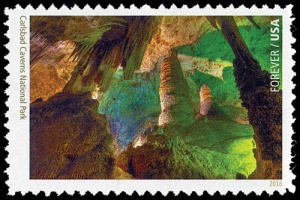
The rocks and fossils of Carlsbad Caverns National Park tell a story of the area during the Permian Period (286 – 230 million years before present) when the landscape was dramatically different from what we see today. Carlsbad Caverns National Park contains some of the world’s best examples of marine fossils from the Permian period of earth’s history. The Permian period of geologic history began without a great deal of environmental change from the preceding Carboniferous period. The Carboniferous/Permian rock boundary is marked only by the appearance in the fossil record of a new genus of single - celled fusulinids and a new plant genus. In general, the land and marine life from the late Carboniferous to the early Permian periods were quite similar. However, by the end of the Permian period, the earth had experienced monumental changes in its geography, climate, and terrestrial and marine life. [R4] -
[A1f] Arches National Park
The story of Arches begins roughly 65 million years ago. At that time, the area was a dry seabed spreading from horizon to horizon.
Established in 1929, Arches National Monument was granted park status on November 16, 1971. Prior to its recognition as a national park, however, the area had a record of inhabitants and visitors ranging from Native Americans to miners and ranchers.
You can use full screen option for more convenient view of th evideo.Some of the fossil creatures found here are not known from anywhere else. Utahraptor for example.
Utahraptor is a genus of large carnivorous (predator) dinosaur that lived during the Early Cretaceous period (145-100 millions years ago). Since 2018, Utahraptor is Utah state Dinosaur.
The largest species of Utahraptor, Utahraptor ostrommaysi is estimated to have reached up to 7 meters long and somewhat less than 500 kg in weight, comparable to a polar bear in weight. The dinosaur had a large retractable sickle claw on its foot, specialized for cutting. It was a ferocious hunter that used its sickle-shaped claws to attack and rip apart its prey. Although feathers have never been found in association with Utahraptor specimens, there is strong phylogenetic evidence suggesting that the dinosaur possessed them. [R12a]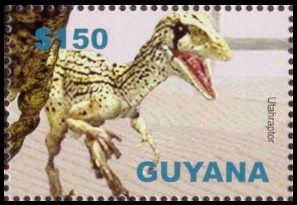
Utahraptor dinosaur on stamp of Guyana 2005. The image is from 'Walking with Dinosaurs' BBC film.
Although primarily known for its geologic features - the arches, windows, and pinnacles that give the park its name - Arches National Park has a diverse and scientifically significant fossils record. The park provides public education on cultural and natural resources as well as the management and protection of non-renewable resources such as fossils, include many dinosaur traces, named Moab Dinosaur Megatracksite (millions of tracks are estimated in this location). These tracks extend from Moab to Crescent Junction.
The first dinosaur bones discovered in the park in early 1930s. In 1933, the Arches National Monument Scientific Expedition announced the discovery of dinosaur bones in the Moab newspaper. Remains and reconstructions of dinosaurs and other prehistoric creatures can be seen in the Moab Giants event park.
[R12] -
[A1g] Yosemite National Park
First protected in 1864, Yosemite National Park is best known for its waterfalls, but within its nearly 1,200 square miles, there are also deep valleys, grand meadows, ancient giant sequoias, a vast wilderness area, and much more.
The Yosemite Museum has a small geological collection that represents the overarching geology of the park. Ranger-naturalists from the Yosemite Field School collected many of the park's specimens during the first half of the 20th century. The museum contains a very small paleontological collection, largely consisting of petrified wood, with specimens from the northern park border and Miocene lahar deposits west of Hetch Hetchy. The collection also contains some shell, crinoid, and coral fossils found near and just outside of the park's eastern border. [R13] -
[A1h] Glacier National Park
Glacier National Park, established in 1910, is an American national park located in northwestern Montana, on the Canada–United States border, adjacent to the Canadian provinces of Alberta and British Columbia. The park encompasses over 1 million acres (4,000 km2) and includes parts of two mountain ranges (sub-ranges of the Rocky Mountains), over 130 named lakes, more than 1,000 different species of plants, and hundreds of species of animals.
The mountains of Glacier National Park began forming 170 million years ago when ancient rocks were forced eastward up and over much younger rock strata. Known as the Lewis Overthrust, these sedimentary rocks are considered to have some of the finest examples of early life fossils on Earth.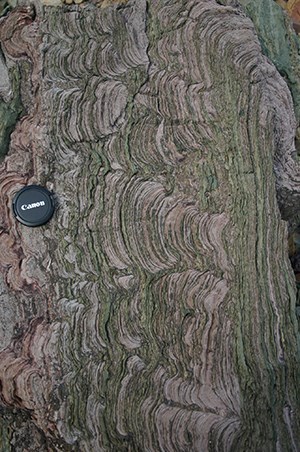
Stromatolites fossils in Glacier National Park.
The image is from nps.gov. website.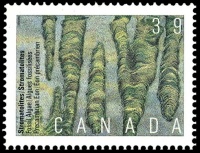
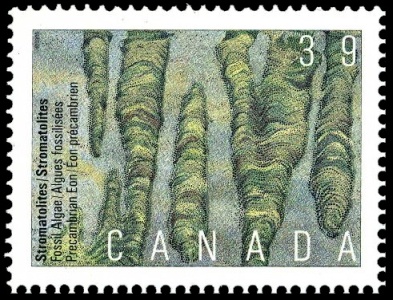
Stromatolites on stamp of Canada 1990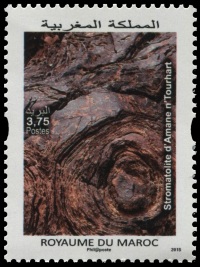
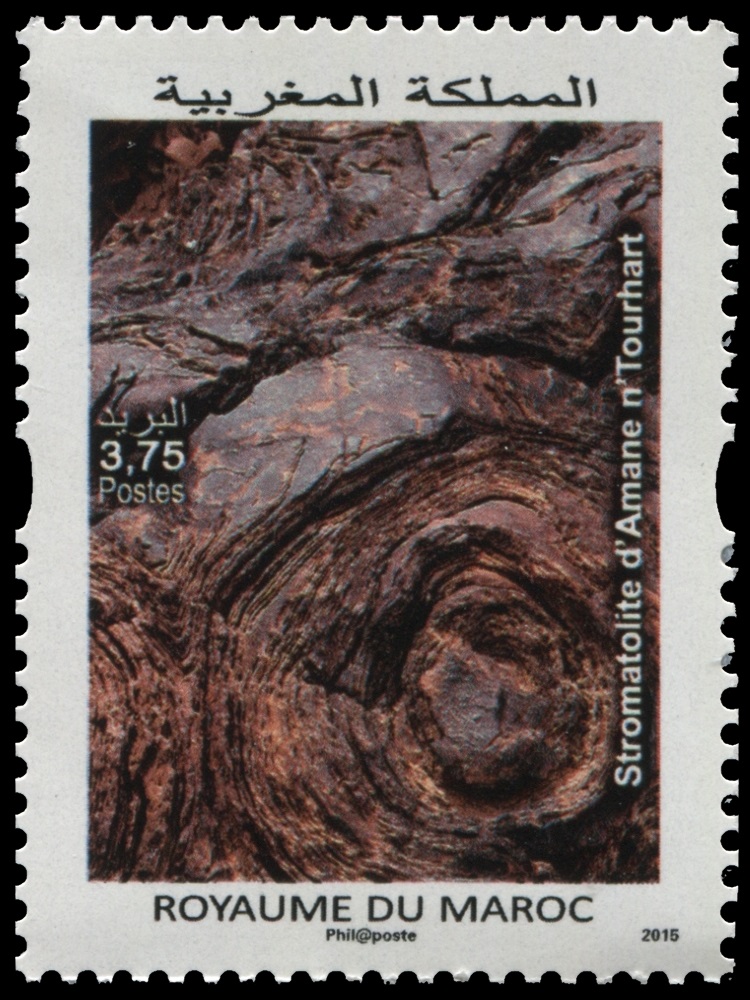
Stromatolites on stamp of Morocco 2015
The rocks in Glacier National Park are the best preserved Proterozoic sedimentary rocks in the world, with some of the world's most fruitful sources for records of early life -forms on earth—cyanobacteria (blue-green algae) , called stromatolites.
These fossils are mounds composed of sediment and cyanobacteria. Stromatolites are preserved when sediment is trapped and the algae grow over and through this sediment, creating alternating layers of algal mat and sediment. These often form mounds and columns that when grouped together form a type of reef called a bioherm. These microorganisms would have grown in shallow, clear, quiet waters. The absence of grazing animals allowed stromatolites to be a large and dominant life form at the time. Occasionally rocks are found in the park that contains large chunks of ripped-up fossilized algal mats.
Some of the oldest stromatolites known from the park are found in the upper Altyn Limestone (1.35 to 1.45 billion years old) near Apikuni Falls. These were first described by two paleontologists, Carroll and Mildred Fenton (husband-wife team, authors and illustrators of numerous books on geology and paleontology for a general audience), in 1931.
The great variety of stromatolite fossils at Glacier National Park comprises one of the richest accumulations of Precambrian life in the United States. These fossils help tell the deep history of the park, illustrate how the environment has drastically changed over the earth's long history, and are notably some of the oldest fossils preserved in any National Park Service unit. [R14]
[A2] Smithsonian Institution has a very large Paleobiology Department. The building of the Institution is depicted on several stamps:
- 1946 single stamp dedicated to 100th anniversary of the Smithsonian Institution
- 1980 part of set of 4 stamps of "American Architecture", shows famous American buildings. Smithsonian Institution is on the first stamp in the first row
- 1996 single stamp dedicated to 150th anniversary of the Smithsonian Institution
|
 Some fossils on an Aloha Shirt. |
 |
|
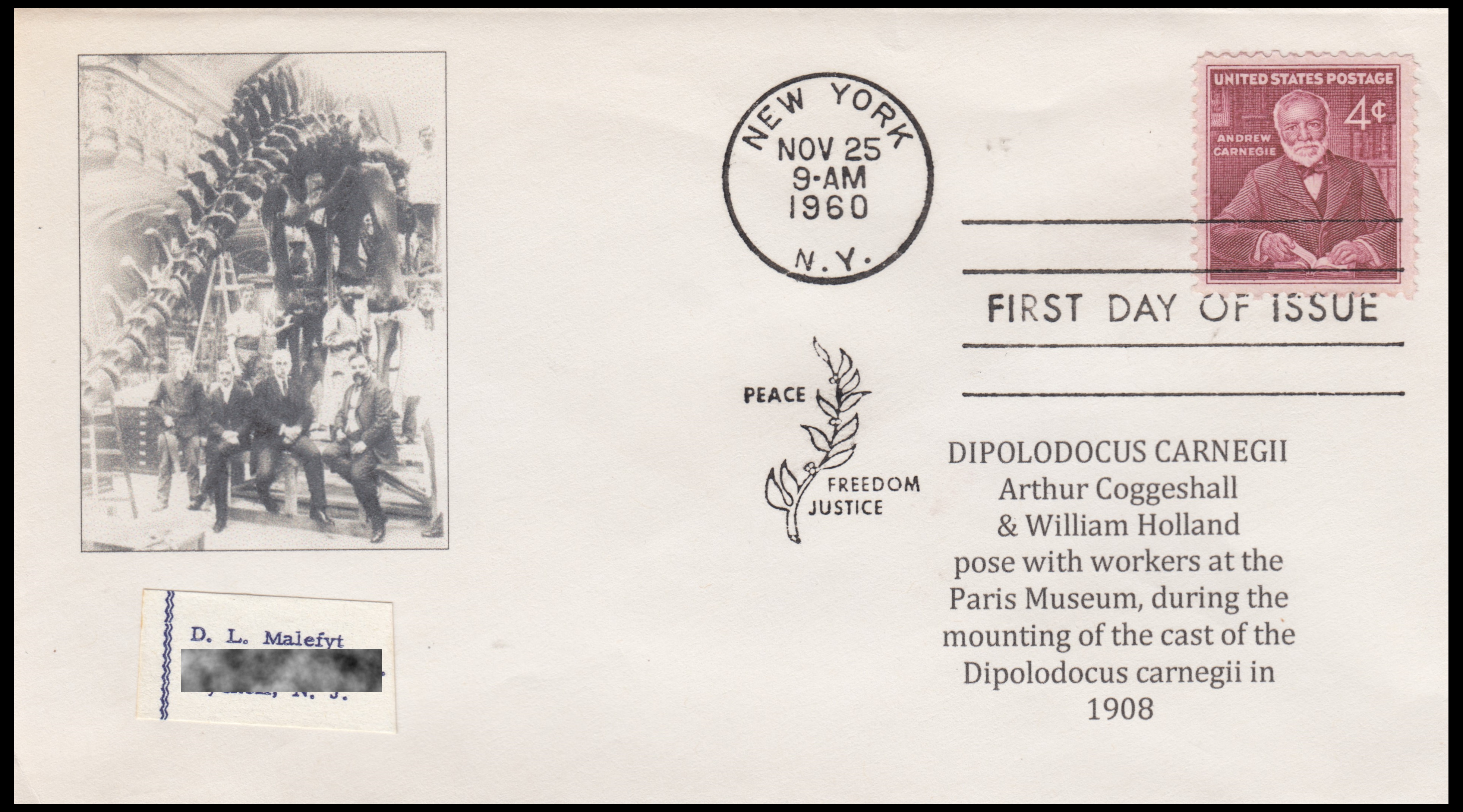
| Diplodocus carnegii on FDC with Andrew Carnegie stamp of USA 1960. The catalog numbers of the stamp- MiNr.: 801, Scott: 1171 | |
Jurassic Park is a 1993 American science fiction adventure film directed by Steven Spielberg based on the book of the same name by Michael Crichton. It is the first installment in the Jurassic Park franchise. The film is set on the fictional island of Isla Nublar, located off Central America's Pacific Coast near Costa Rica. There, wealthy businessman John Hammond and a team of genetic scientists have created a wildlife park of genetically recreated dinosaurs.
[A4] Some fossils are depicted on an Aloha Shirt on the middle stamp of the stripe. Self-adhesive coil of 5 designs. Issued in a booklet of 10.
[A5] Andrew Carnegie (1835–1919) was a Scottish-American industrialist and philanthropist.
Carnegie led the expansion of the American steel industry in the late 19th century and became one of the richest Americans in history.
He became a leading philanthropist in the United States and in the British Empire.
In 1899 Andrew Carnegie sponsored the excavation of a dinosaur discovered by William Reed in Wyoming, Utah. This dinosaur specimen was named after him: Diplodocus carnegii.
After the discovery, the remains of the dinosaur were transferred to Pittsburgh, Pennsylvania, where the specimen was mounted.
It was shown to the public for the first time in 1907, in the main room of the Carnegie Museum of Natural History, a place built expressly for its exhibition, since at that time there was no museum that had a room large enough for its placement.
| The Most Famous Dinosaur In History - Part 1 | The Most Famous Dinosaur In History - Part 2 |
Over a dozen replicas of the mounted skeleton were manufactured and Andrew Carnegie and his wife Louise donated them to Natural History Museums in Europe and South America.
One of the replicas is even shown on cachets of personalized FDCs. [R16]
[JO1] Mount Rushmore National Memorial is a sculpture carved into the granite face of Mount Rushmore, a granite batholith in the Black Hills in Keystone, South Dakota, United States. [R3a]
Sculpted by Danish-American Gutzon Borglum and his son, Lincoln Borglum, Mount Rushmore features 60-foot (18 m) sculptures of the heads of four United States presidents:
- George Washington (1732–1799)
- Thomas Jefferson (1743–1826), the second from the left
- Theodore Roosevelt (1858–1919)
- Abraham Lincoln (1809–1865)
[JO2] The Thomas Jefferson Memorial is a presidential memorial in Washington, D.C., dedicated to Thomas Jefferson (1743–1826), built in Washington, D.C. between 1939 and 1943 under the sponsorship of President Franklin D. Roosevelt.
The bronze statue of Jefferson was added in 1947. [R3b]
[JO3] Designed by the University’s founder, Thomas Jefferson, the Rotunda is the centerpiece of the Academical Village.
Modeled after the Pantheon in Rome, it was designed to house the library and be flanked on either side by faculty pavilions, interspersed with student rooms.
The University was established in 1819. Jefferson presented his plans for the Rotunda to the Board of Visitors in 1821, and it was still under construction, plagued by delays and problems, when Jefferson died in 1826. [R3c]
Postal stationery of USA related to Paleontology: fossils, dinosaurs, Thomas Jefferson
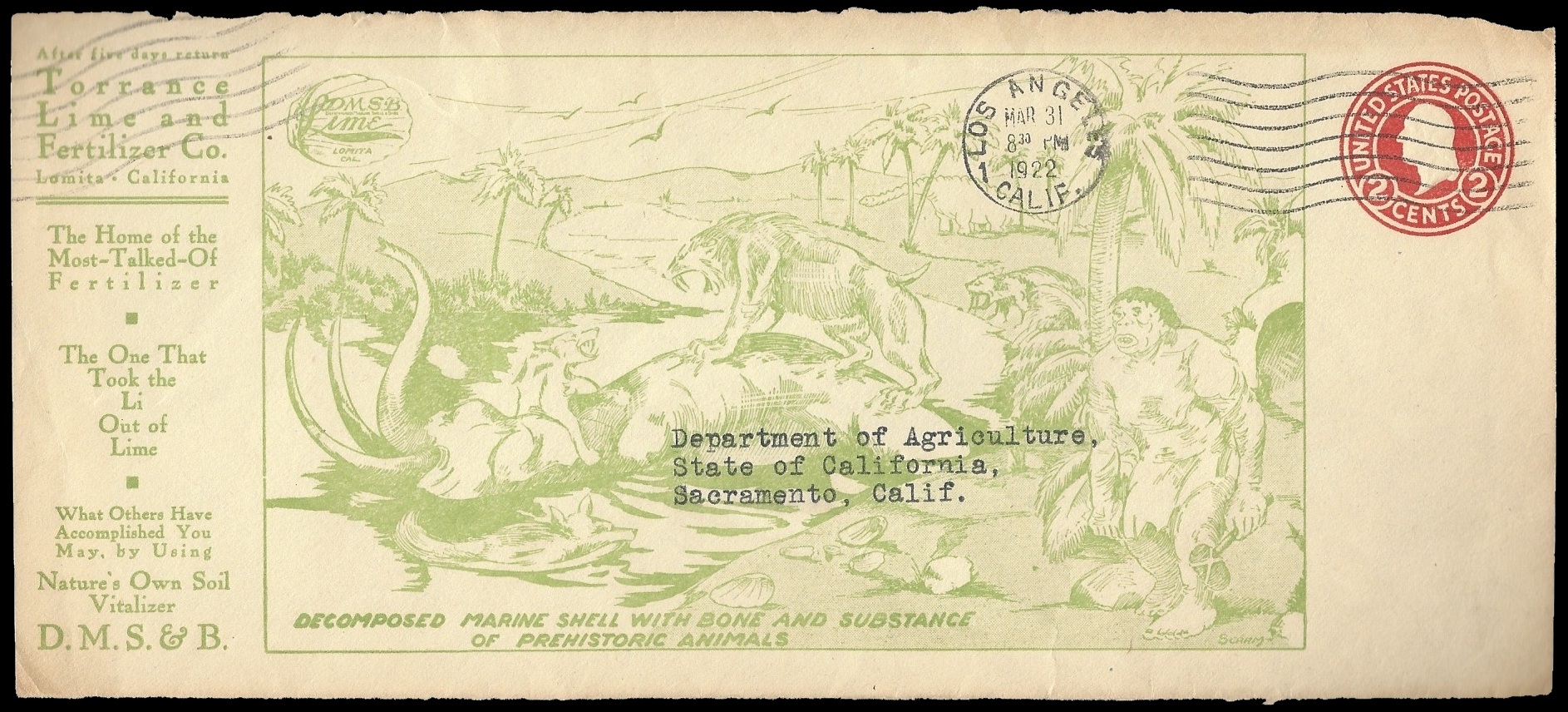
| 1922 "Torrance Lime & Fertiliser Company" [PS1] | ||
 |
||
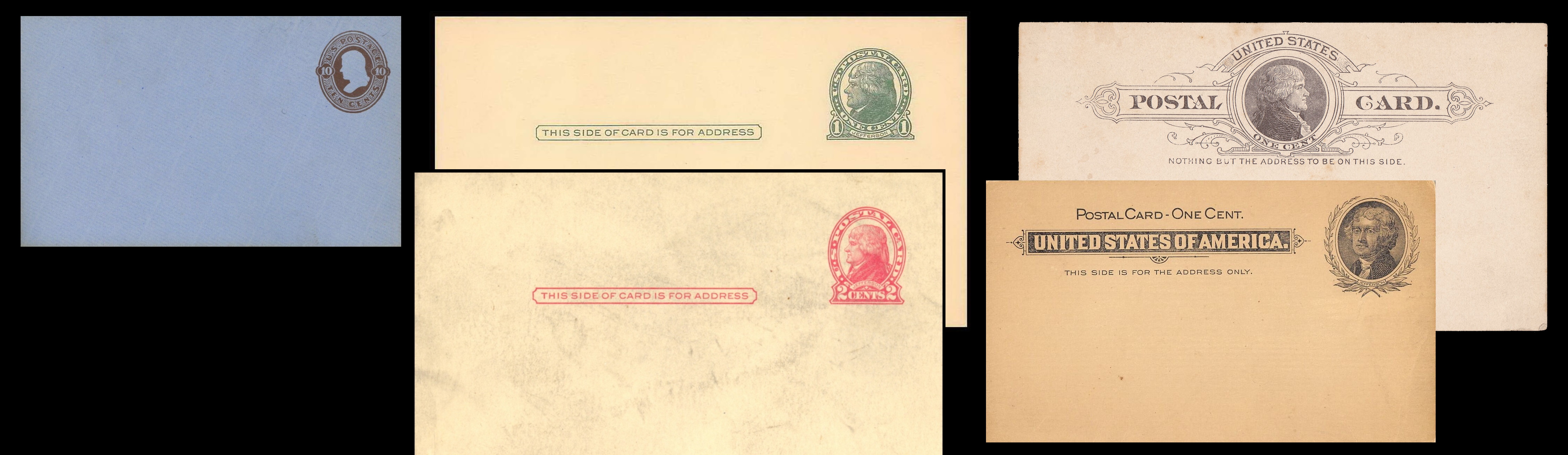
There are many postal stationeries with portraits and profiles of Thomas Jefferson issued in USA in the second half of 1800s and beginning of 1900s
Notes:
[PS1] This is, very likely, the very first philatelic item related to Paleontology.
2c prepaid envelope from the USA, produced by the Torrance Lime & Fertiliser Company, from Lomita city in California, which shows some prehistoric animals and Neandertaler. The image on the cover based on several earlier illustrations and reconstructions:


Neanderthals man as imagined in Chicago's Field Museum diorama circa 1920.
Drawing by Robert Bruce HORSFALL for “A History of Land Mammals in the Western Hemisphere“, by Robert BERRYMAN Scoot, 1913, shows a saber-toothed cat (Smilodon californicus) and a dire wolf (Canis dirus) fighting over a Columbian mammoth (Mammuthus columbi) carcass in the La Brea Tar Pits.
The La Brea tar pits is very famous because of the huge range of fossils, especially of predators like Smilodon.
By the way, Sabre tooth cat (Smilodon) is the heraldic animal of California and it was designated as the official state fossil in 1973.
Smilodon is one of the four mammal species honored on American stamps in 1996.

 There is also a quadrupedal dinosaur in the background, who lived much earlier then Smilodon and Neanderthal,
and some marine shells on the foreground and as also part of the logo of the company.
There is also a quadrupedal dinosaur in the background, who lived much earlier then Smilodon and Neanderthal,
and some marine shells on the foreground and as also part of the logo of the company. The company used fossils of prehistoric animals to make their fertilizer. [A fertilizer is any material of natural or synthetic origin (other than liming materials) that is applied to soils or to plant tissues to supply one or more plant nutrients essential to the growth of plants.]
Very strange use of fossils in today's European point of view. However, Americans still mine phosphorite in the southeastern U.S. Phosphorites are ancient bonebeds - in the case of the southeastern US, marine bonebeds with shark, fish and whale bones making up part of the rock. Later during lithification, additional apatite (calcium phosphate) is precipitated as cement around the bones fusing them into rock.

Commemorative postmarks and meter frankings of USA related to Paleontology: fossils, dinosaurs
Legend is here
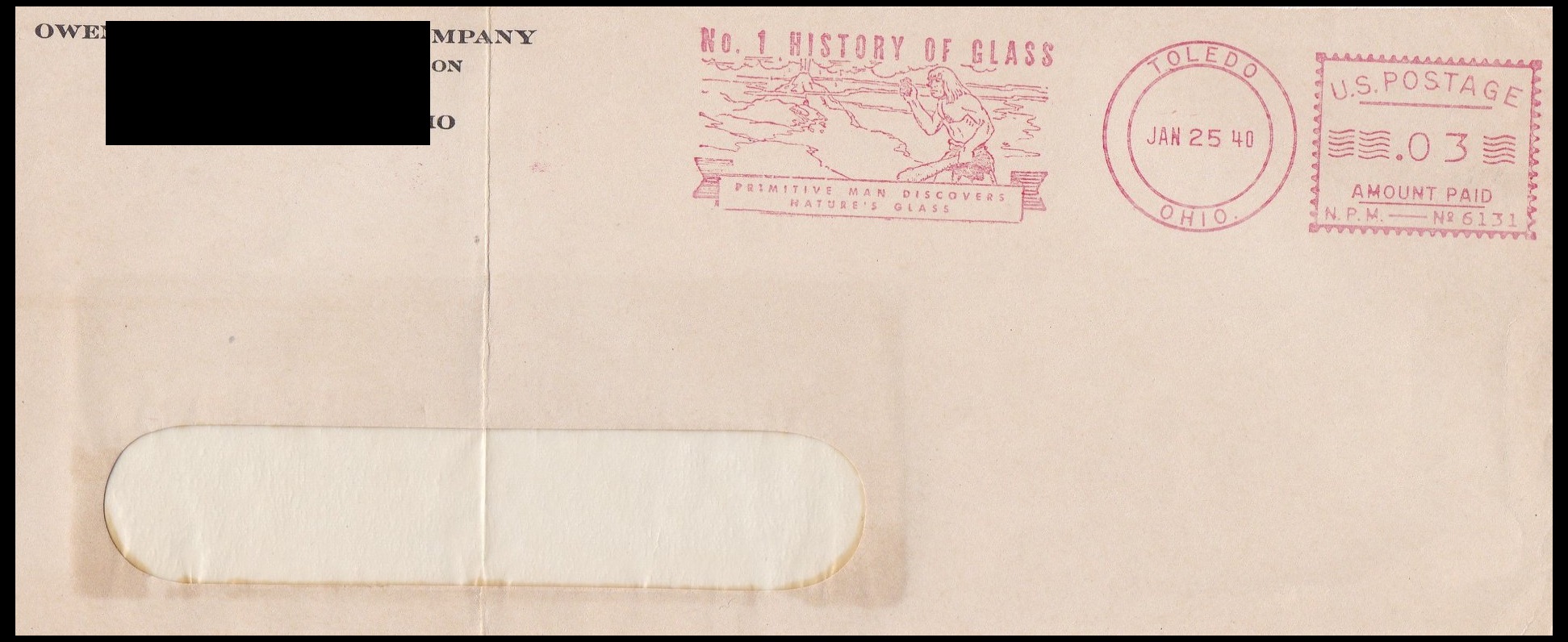
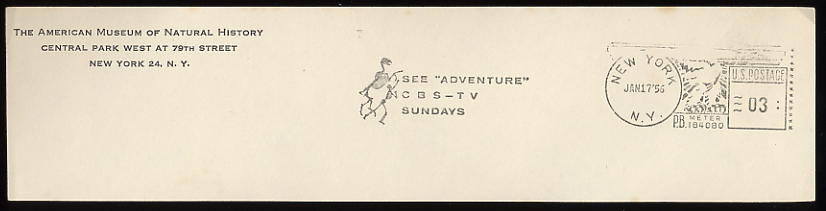
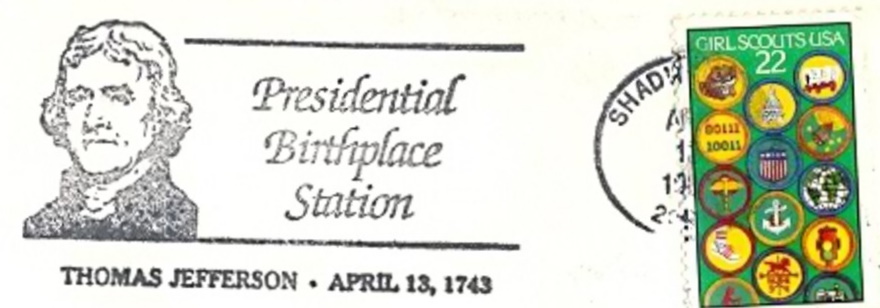
| 1939[DU] "History of Glass" [PM] | 1956[DU] "Adventure exhibition in the American Museum of Natural History" [Sp] | 13.04.1973 "Thomas Jefferson, Presidential Birthplace Station" [Sp] | |
 |
 |
 |
|
| 05.07.1984 "Fair Park Station" [Sp] - |
|||
 |
|||
| 05.07.1984 "Fair Park Station" [Sp] - |
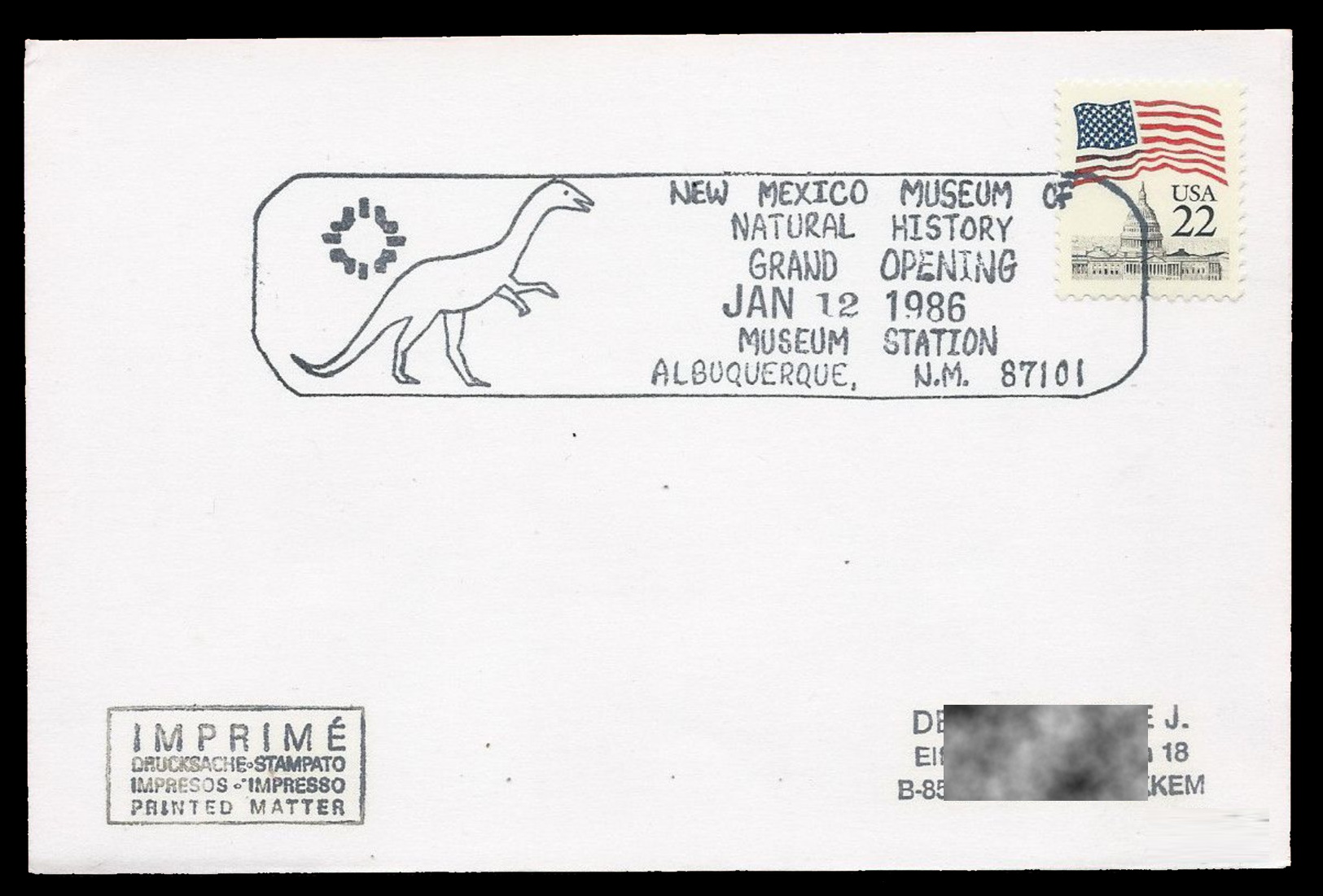
12.01.1986 "New Mexico Museum of Natural History, grand opening, Museum station" [Sp] - |
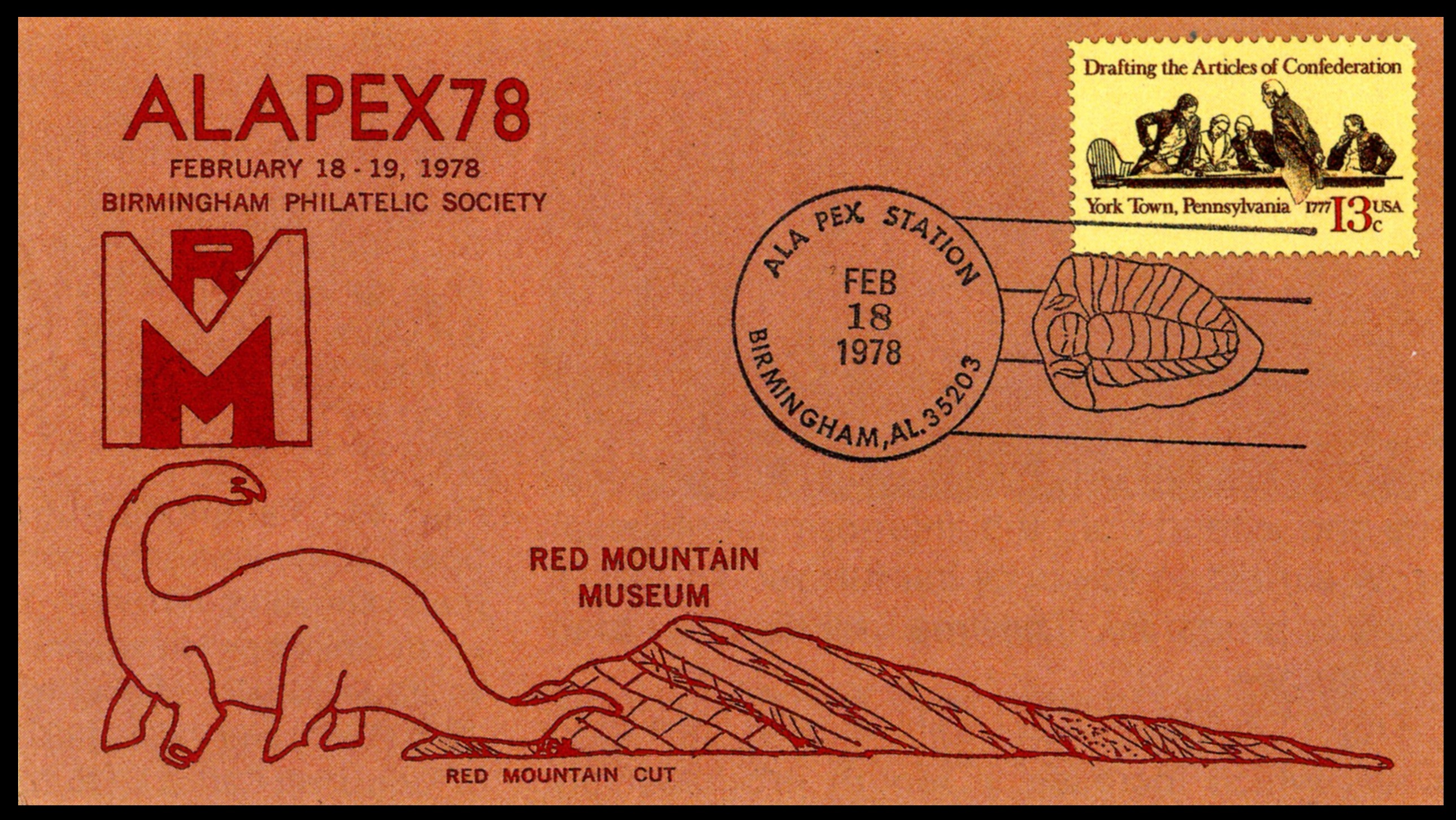
18.02.1978 "ALAPEX'78" [Sp] | |
 |
 |
 |
|
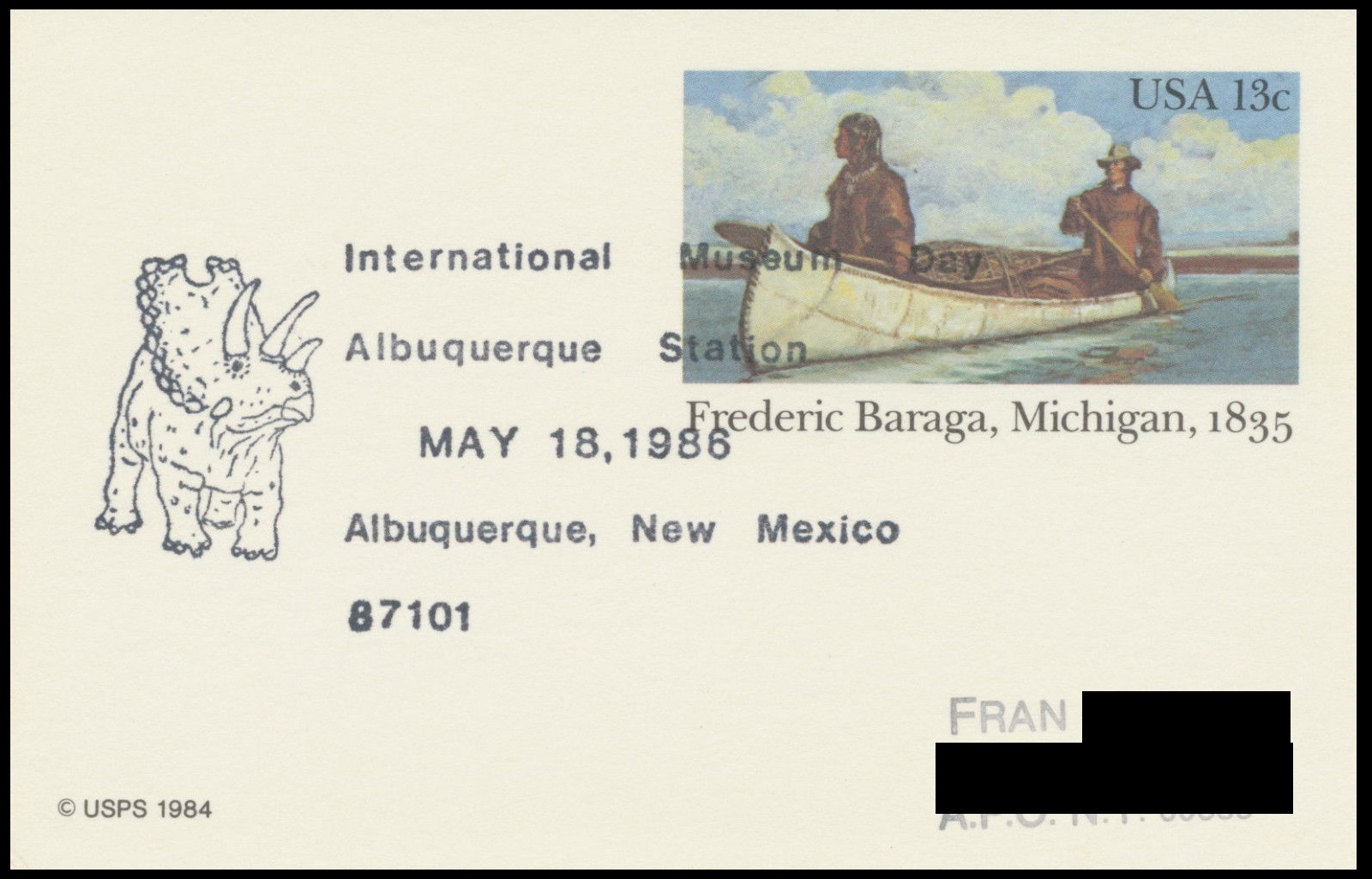
| 18.05.1986 "International Museum Day" [Sp] |
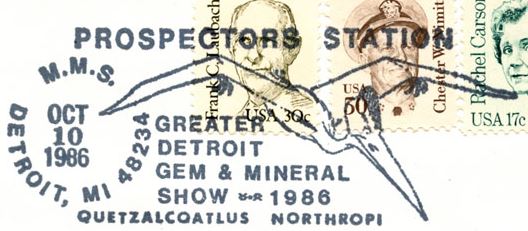
10.10.1986 "Greater Detroit Gem and Mineral Show" [Sp] - |
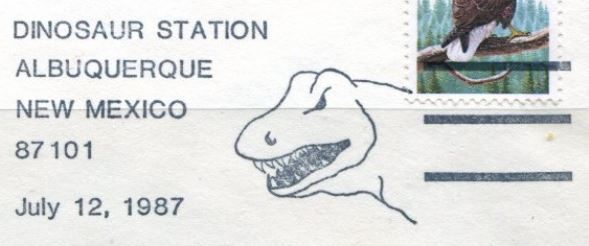
12.07.1987 "Dinosaur Station Albuquerque, New Mexico" [Sp] - |
|
 |
 |
 |
|
| 23.04.1988 "Maps Expo X STA - the Year of the Fish" [Sp] - |
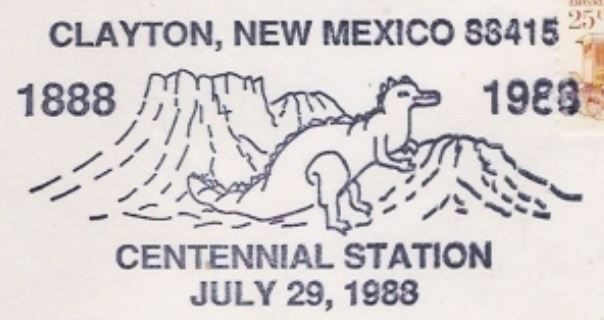
29.07.1988 "Centennial station, Clayton, New Mexico" [Sp] - |
||
 |
 |
|
|
| 1989 | |||
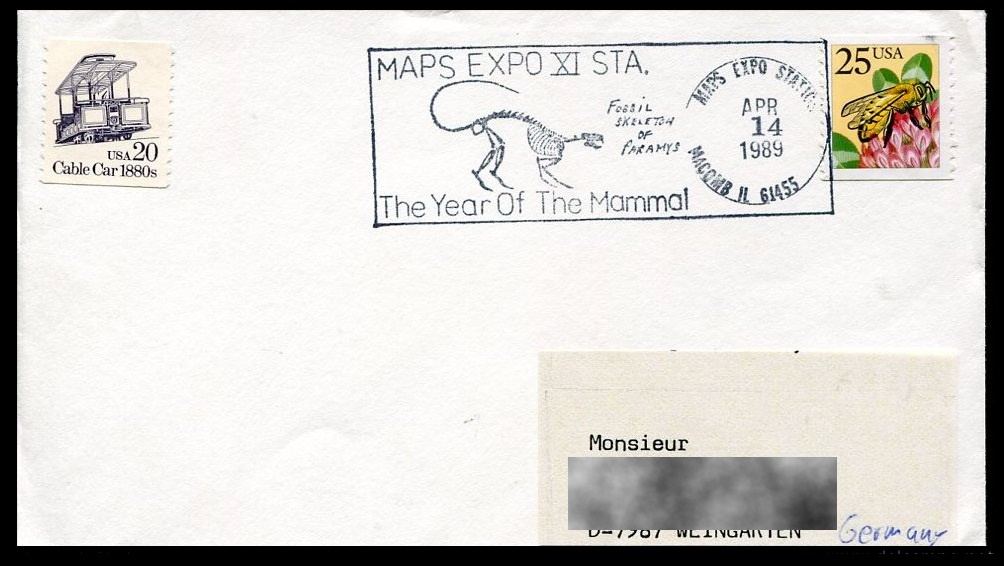
| 14.04.1989 "Maps Expo XI STA - The Year of the Mammal" [Sp] |
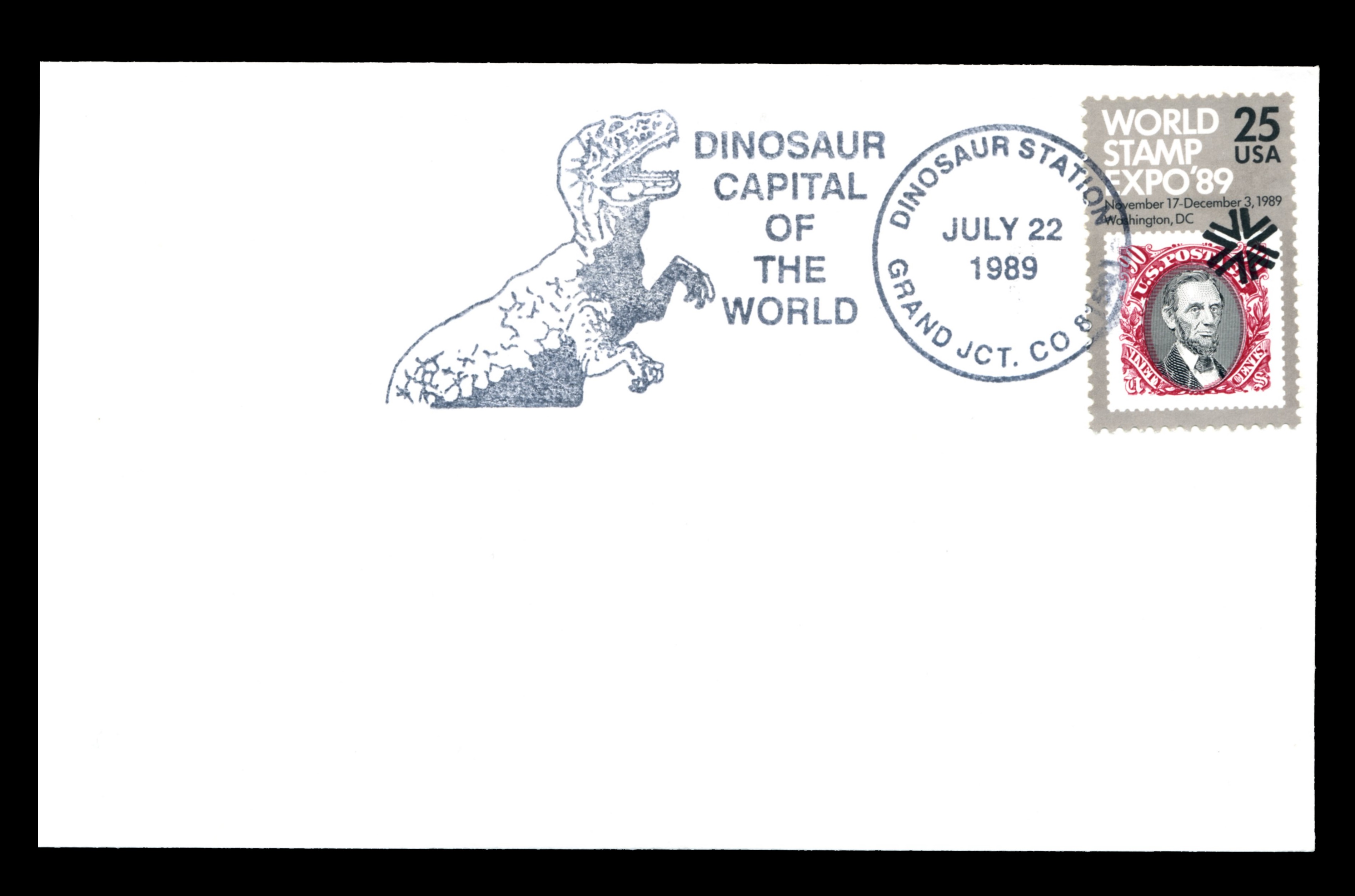
22.07.1989 "Dinosaur Capital of the World" [Sp] |
24.07.1989 "Centennial of Dinosaur Park Station in South Dakota" [Sp] - |
|
 |
 |
 |
|
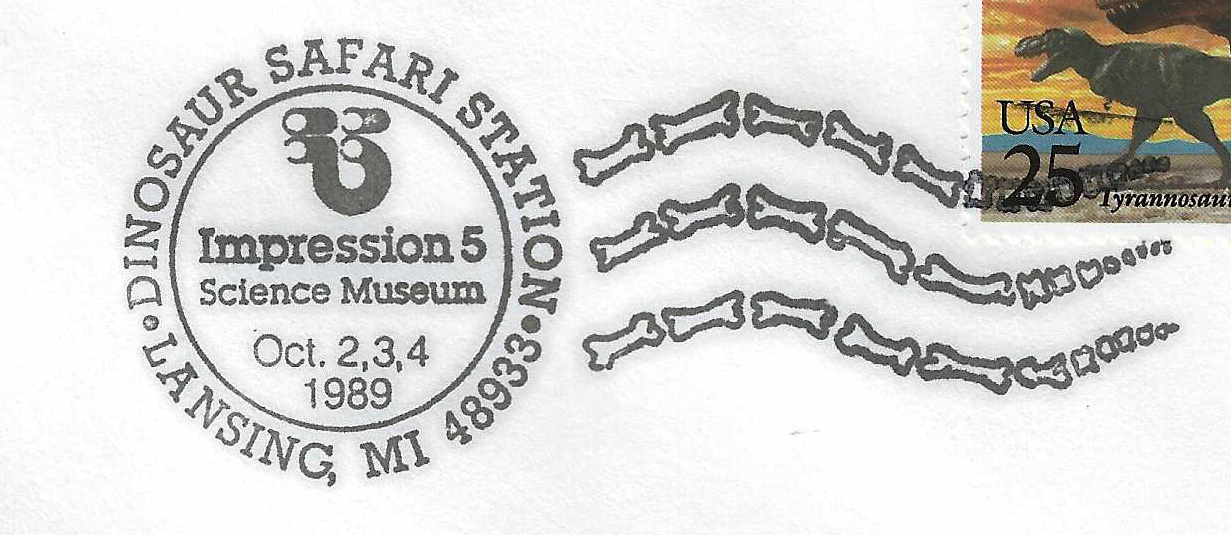
| 02.10.1989 "Dinosaur Safari Station, Lansing, MI." [Sp] - |
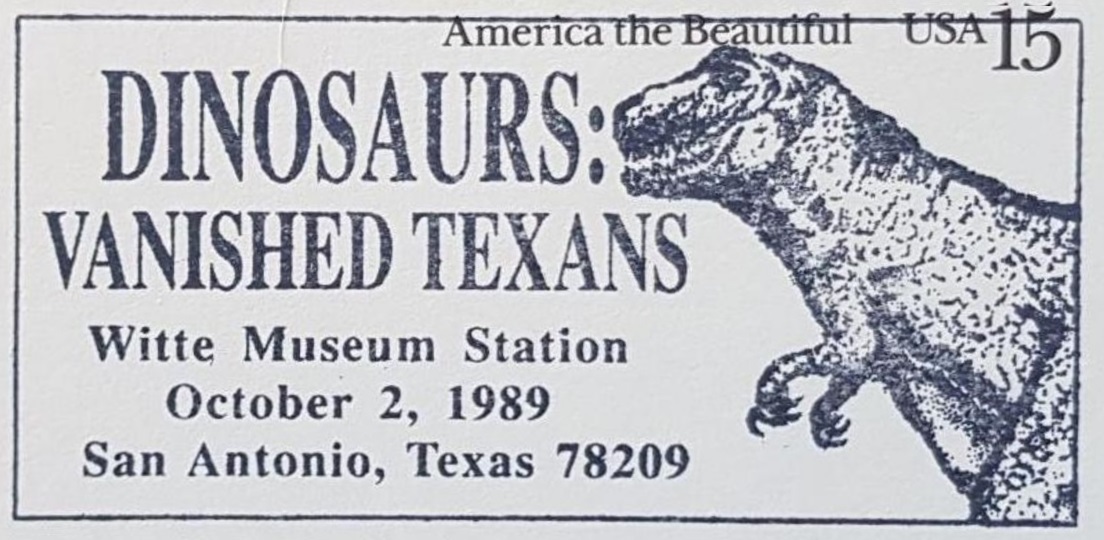
02.10.1989 "Dinosaurs Vanished Texas" [Sp] - |
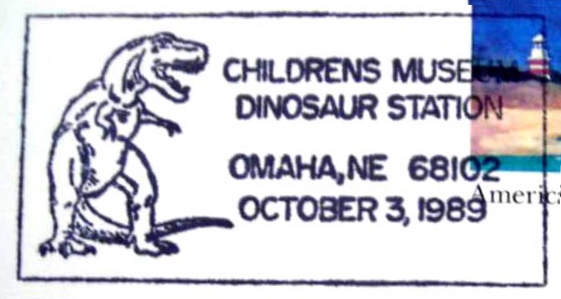
02.10.1989 "Dinosaur station, Children Museum, Omaha, NE" [Sp] - |
|
 |
 |
 |
|
| 02.10.1989 "Natural Science Center Station" [Sp] - |
02.10.1989 "Natioanl Stamp Collecting Month" [Sp] - |
||

|

|
|
|
| 02-06.10.1989 "National Stamp Collecting Month, Dinosaur station, Mobile AL" [Sp] - |
02.10.1989 "Dinotrek Station, Baton Rouge, LA" [Sp] - |
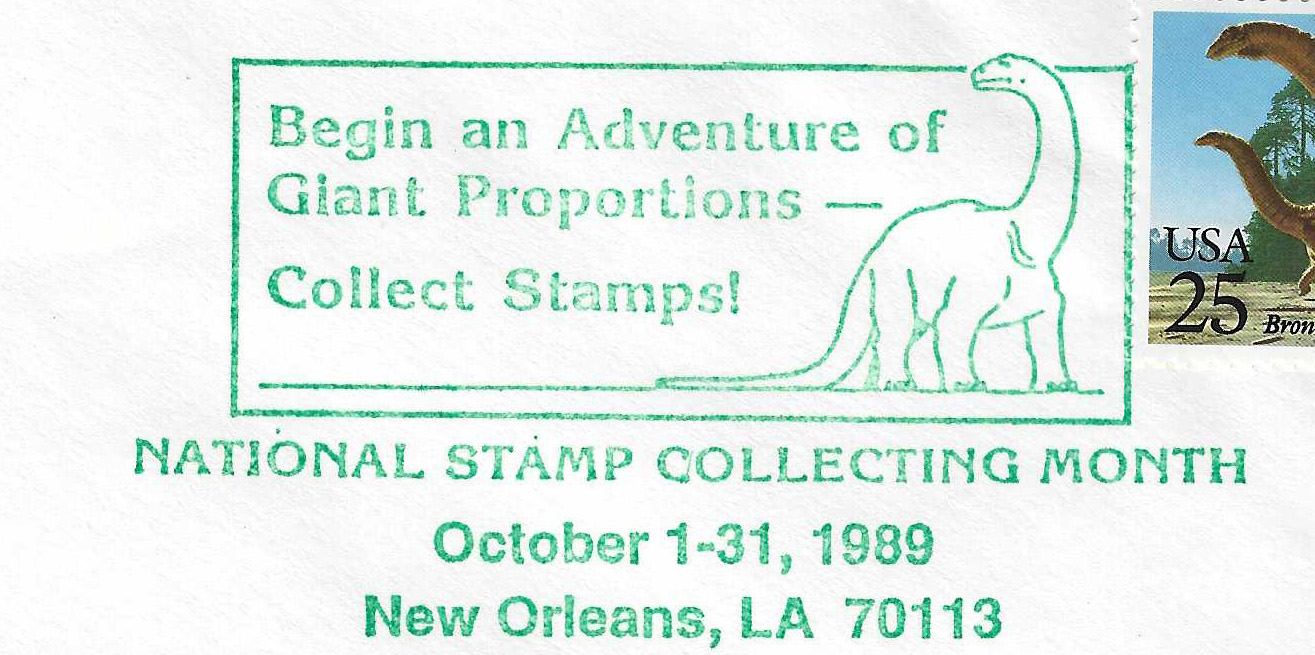
1989[DU] "National Stamp Collecting Month, New Orleans, LA" [Sp] - |
|

|

|
|
|
| 02.10.1989 "Brontosaurus Station" [Sp] - |
02.10.1989 "Dinosaur Garden Station - Dinosaurland,Vernal, Utah" [Sp] - |
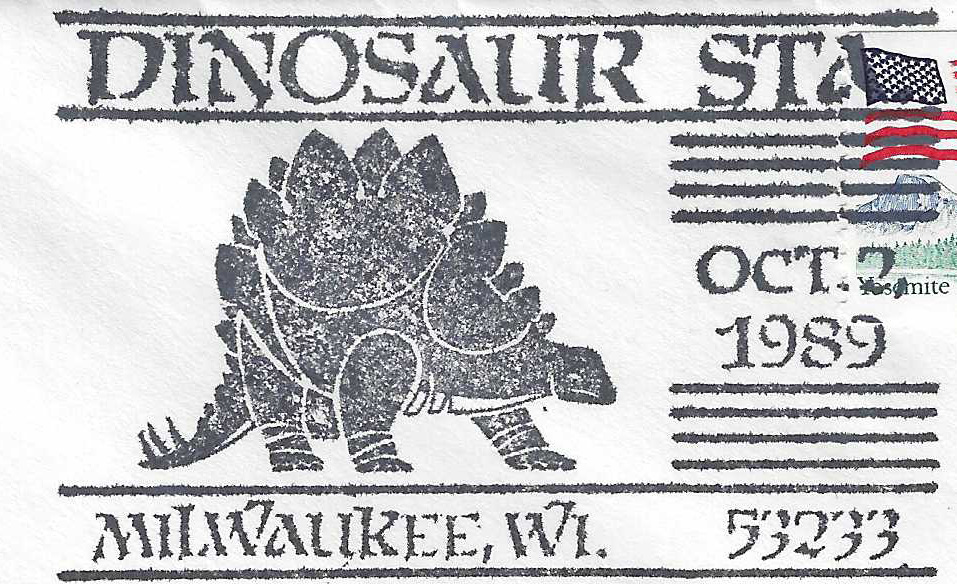
02.10.1989 "Dinosaur station, Milwaukee WL" [Sp] - |
|

|

|
|
|
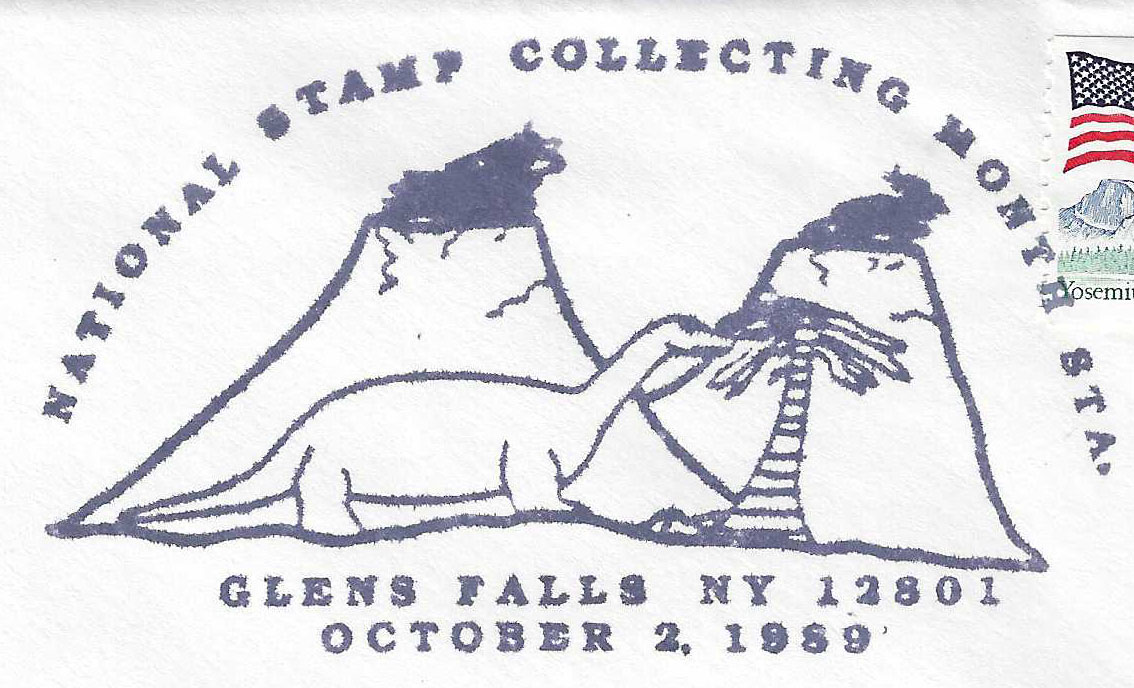
| 02.10.1989 "National Stamp Collecting Month, Glens Falls, NY" [Sp] - |
02.10.1989 "Dinosaur Station, second day of issue, Lubbock, TX" [Sp] - |
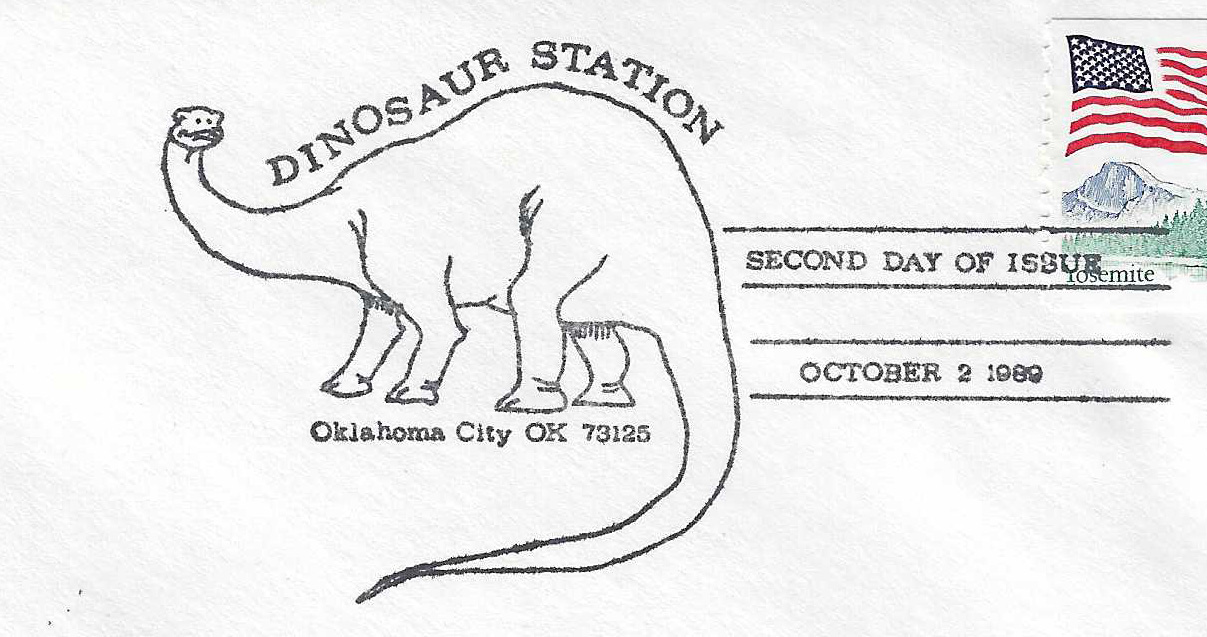
02.10.1989 "Dinosaur Station, second day of issue, Oklahoma City, OK" [Sp] - |
|
|

|
|
|
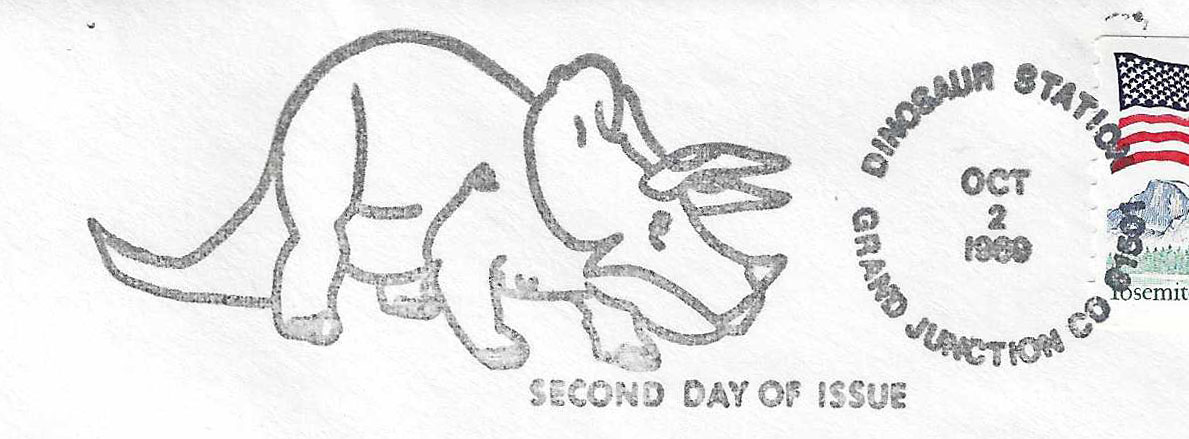
| 02.10.1989 "Dinosaur Station, Grand Junction, CO" [Sp] - |
02.10.1989 "Quetzalcoatus Station, Crossroads Plaza, Pico Rivera, CA" [Sp] - |
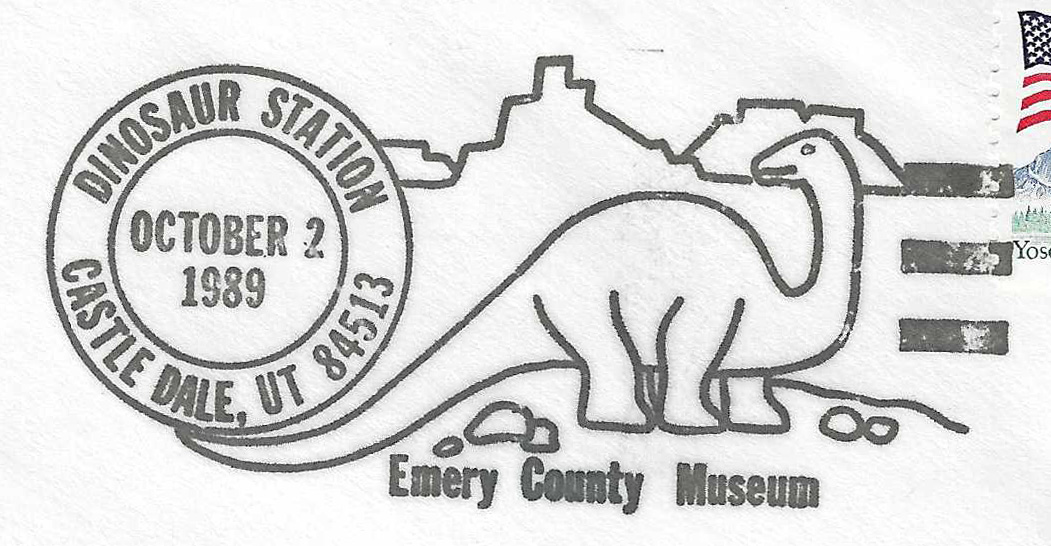
02.10.1989 "Dinosaur Station, Emery Country Museum, Castle Dale, UT" [Sp] - |
|
|

|
|
|
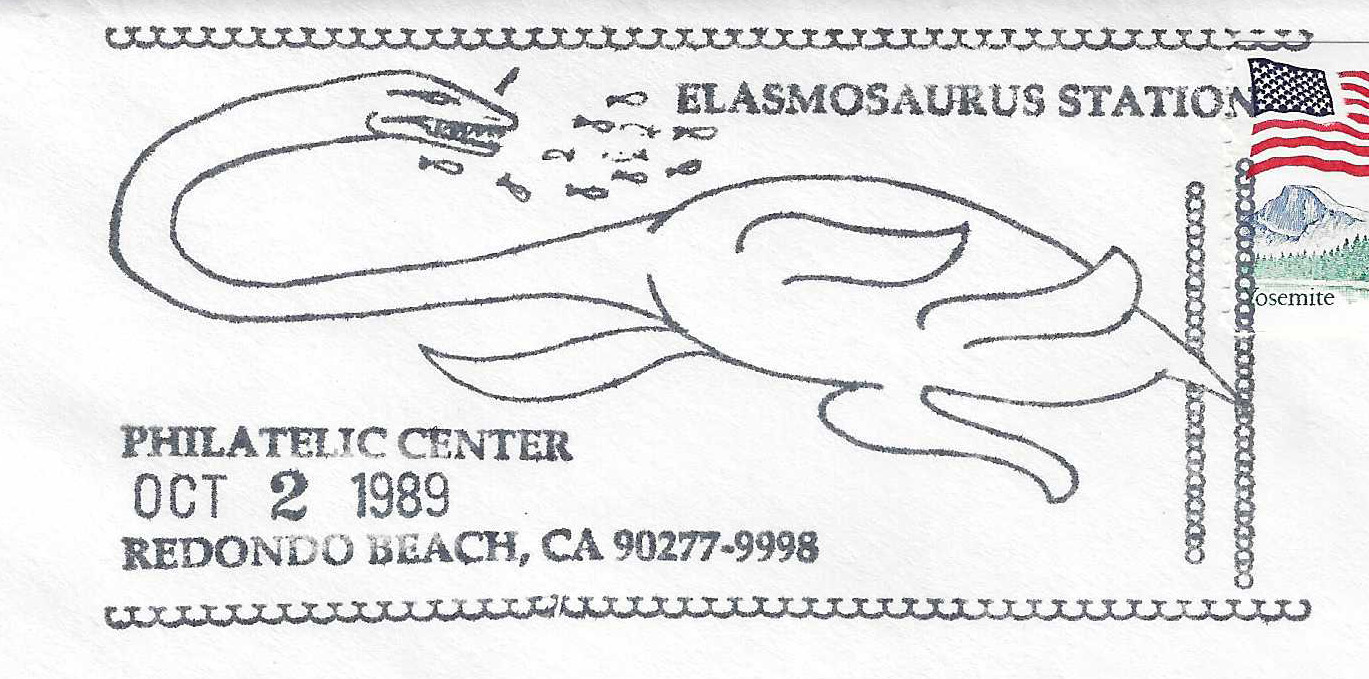
| 02.10.1989 "Elasmosaurus Station, Philatelic Station, Redondo Beach, CA" [Sp] - |
02.10.1989 "National Stamp Collecting Month, Dinosaur station, Binghamton" [Sp] - |
05.10.1989 "National Stamp Collecting Month Station, Long Beach, CA" [Sp] - |
|
|

|

|
|
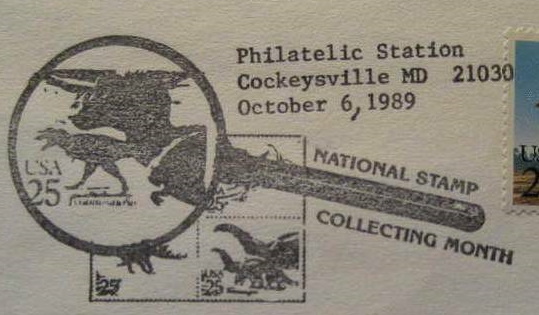
| 06.10.1989 "National Stamp Collecting Month, Philatelic Station Cockeysville, MD" [Sp] - |
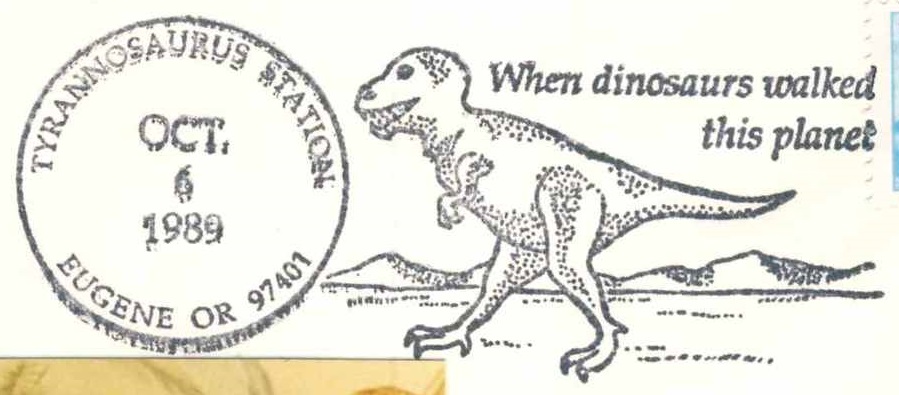
06.10.1989 "When dinosaurs walked this planet, Tyrannosaurus Station, Eugene, OR" [Sp] - |
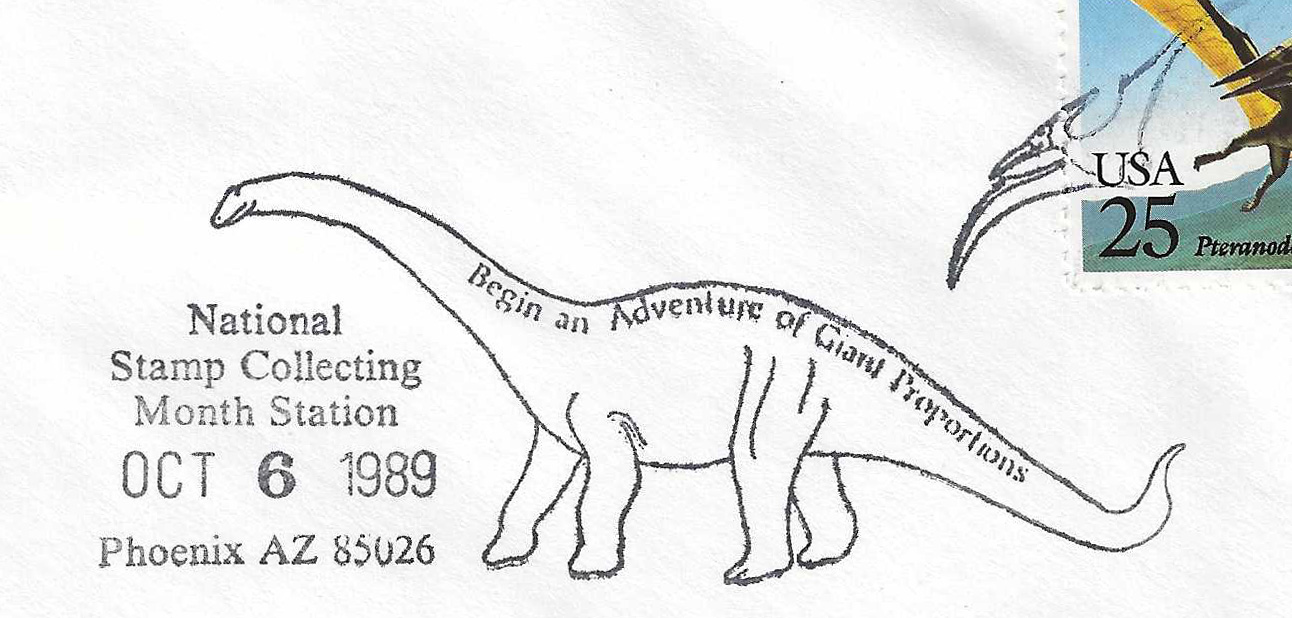
06.10.1989 "National Stamp Collecting Month Station, Phoenix, AZ" [Sp] - |
|
|
|
|
|
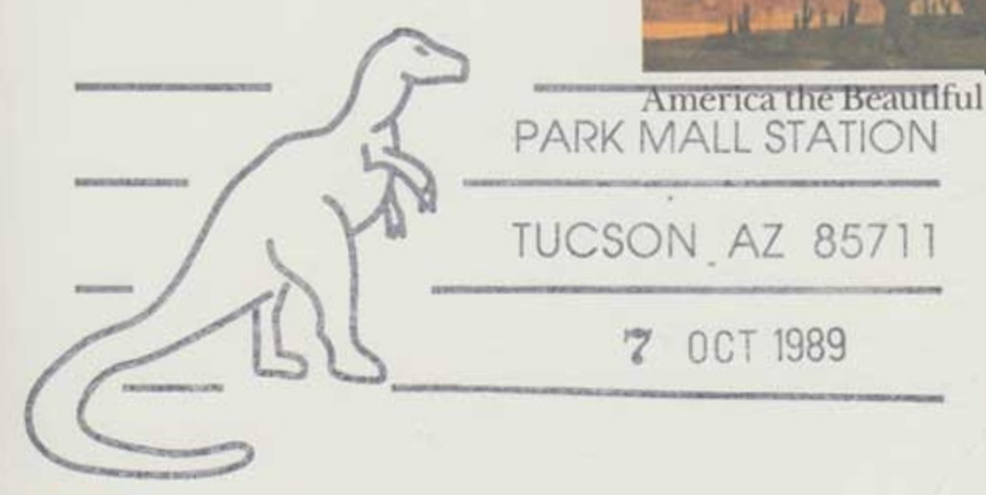
| 07.10.1989 "Park Mall Station, Tucson, AZ" [Sp] - |
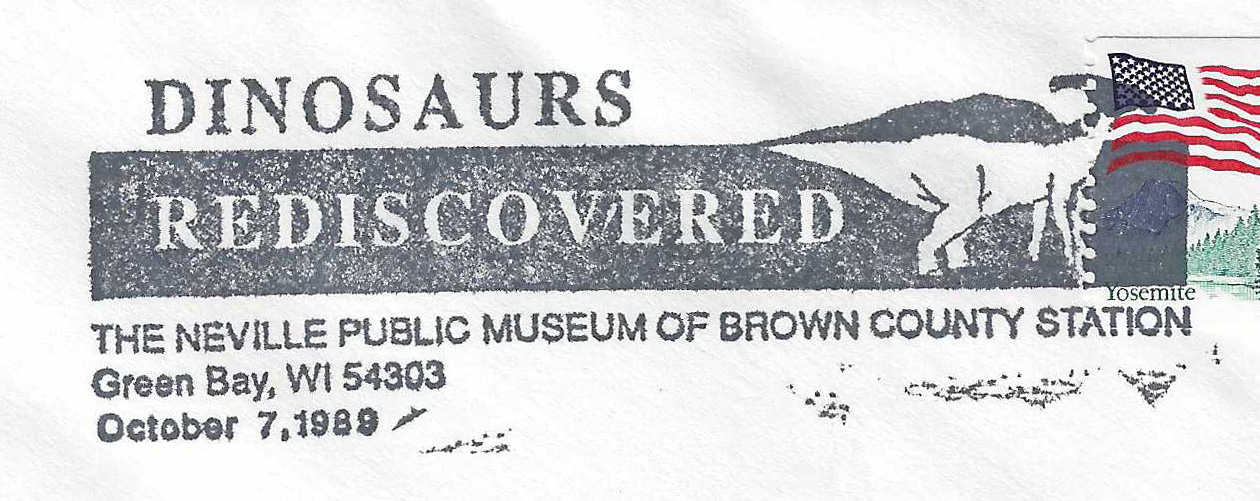
07.10.1989 "Dinosaurs Rediscovered, the Neville Public Museum of Brown Country Station, Green Bay, WI" [Sp] - |
07.10.1989 "Dinosaur station, Children Museum, Indianapolis, IN" [Sp] |
|
|
|

|
|
| 07.10.1989 "Tyrannosaurus Station, Rutland, Ohio" [Sp] - |
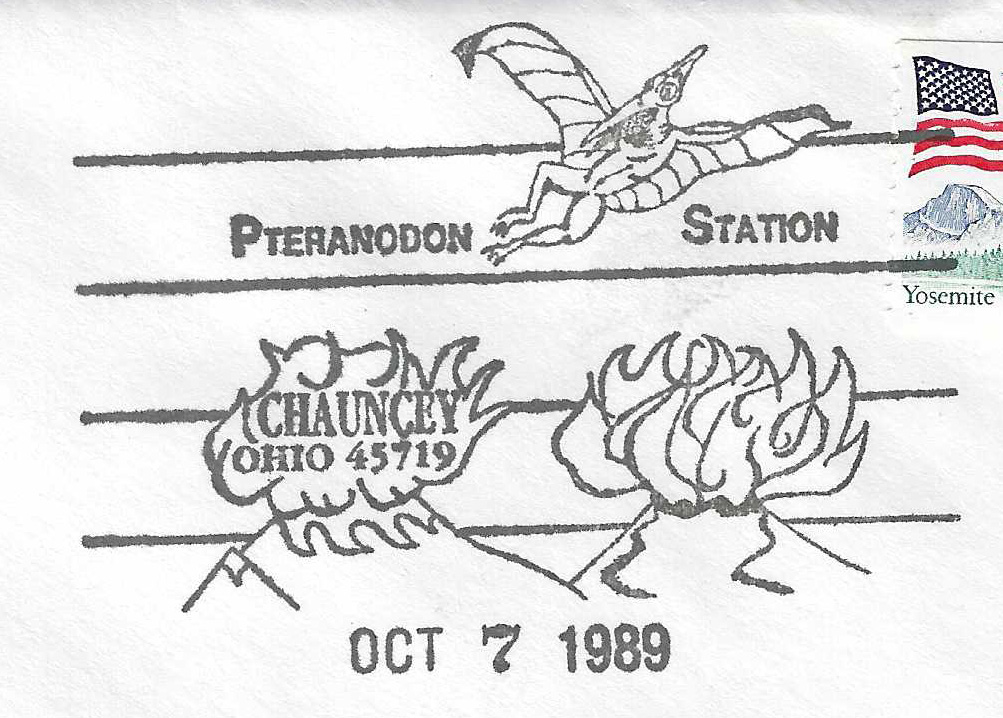
07.10.1989 "Pteranodon Station, Chauncey, Ohio" [Sp] - |
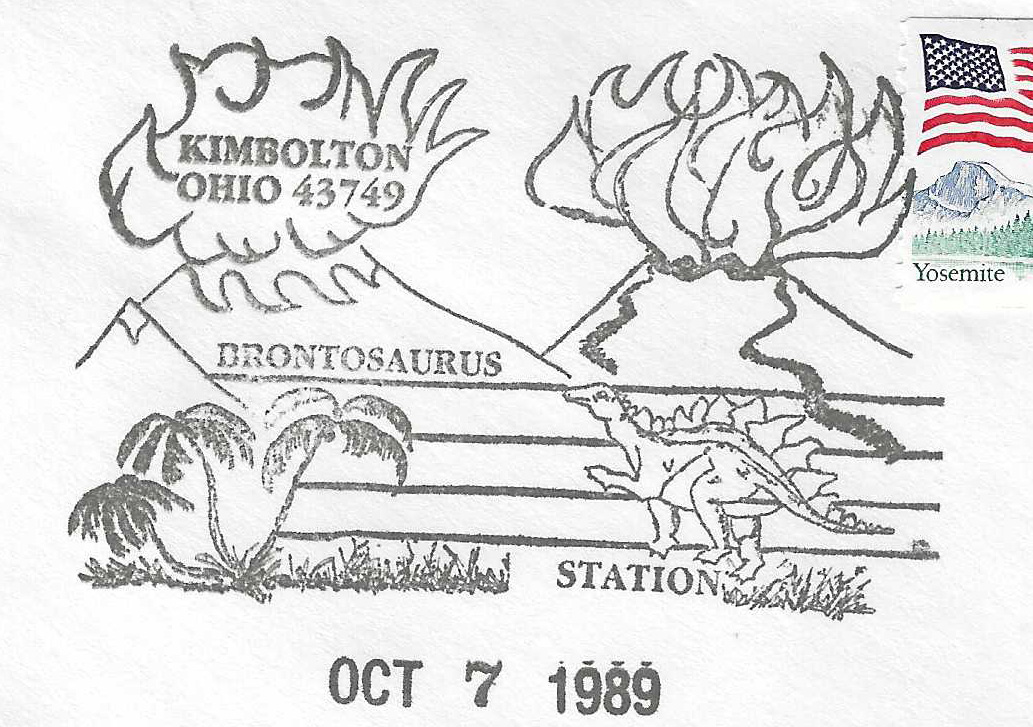
07.10.1989 "Brontosaurus Station, Kimbolton, Ohio." [Sp] - |
|

|
|
|
|
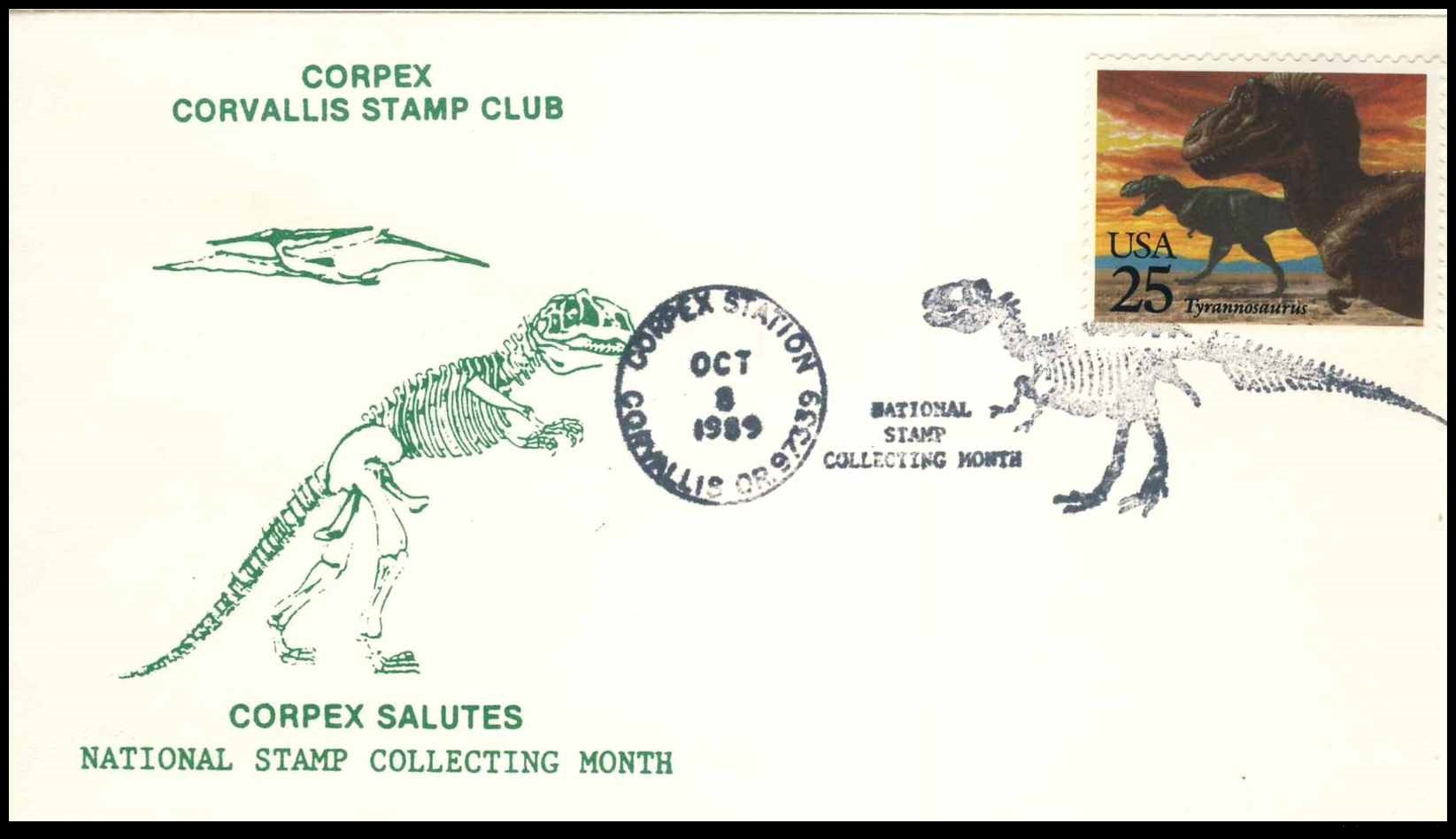
| 08.10.1989 "National Stamp Collecting Month, Tyrannosaurus" [Sp] |
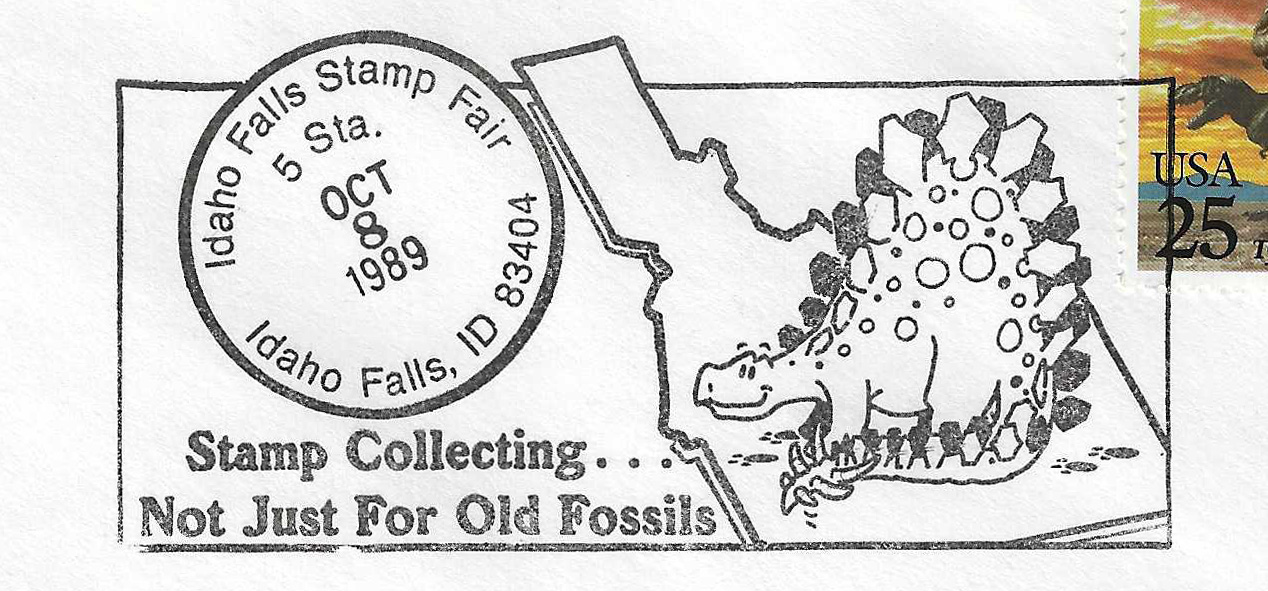
08.10.1989 "Idaho Falls Stamp Fair Station" [Sp] - |
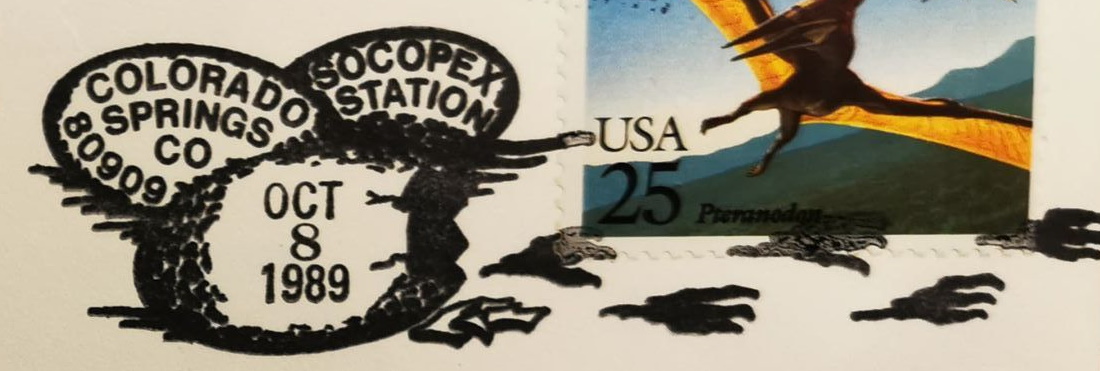
08.10.1989 "Colorado Springs CO, Socopex station" [Sp] - |
|
|
|
|
|
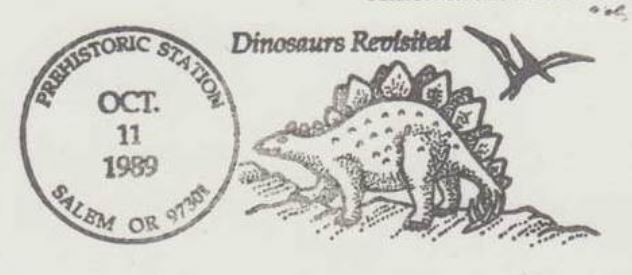
| 11.10.1989 "Dinosaurs Revisited, Prehistoric Station, Salem, OR" [Sp] - |
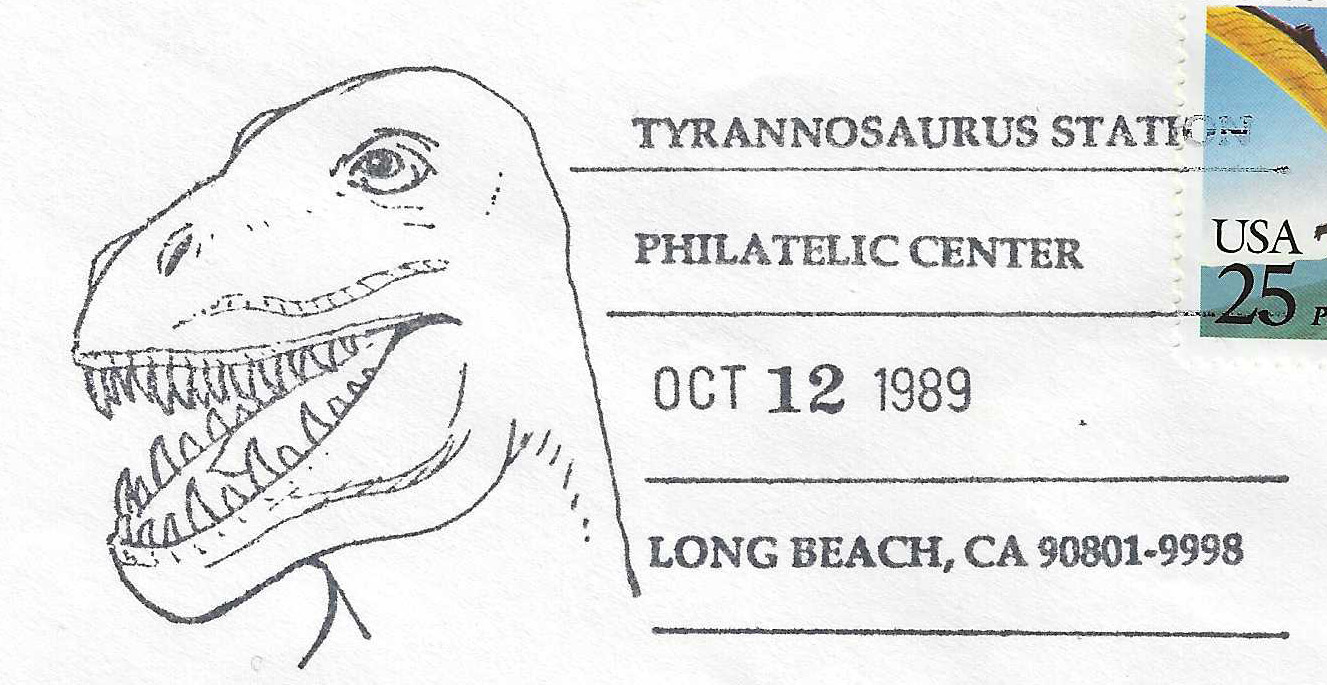
12.10.1989 "Tyrannosaurus Station" [Sp] - |
13.10.1989 "The Land of Dinosaurs, Washington Park and Zoo Railway, Brontosaurus Station" [Sp] |
|
|
|

|
|
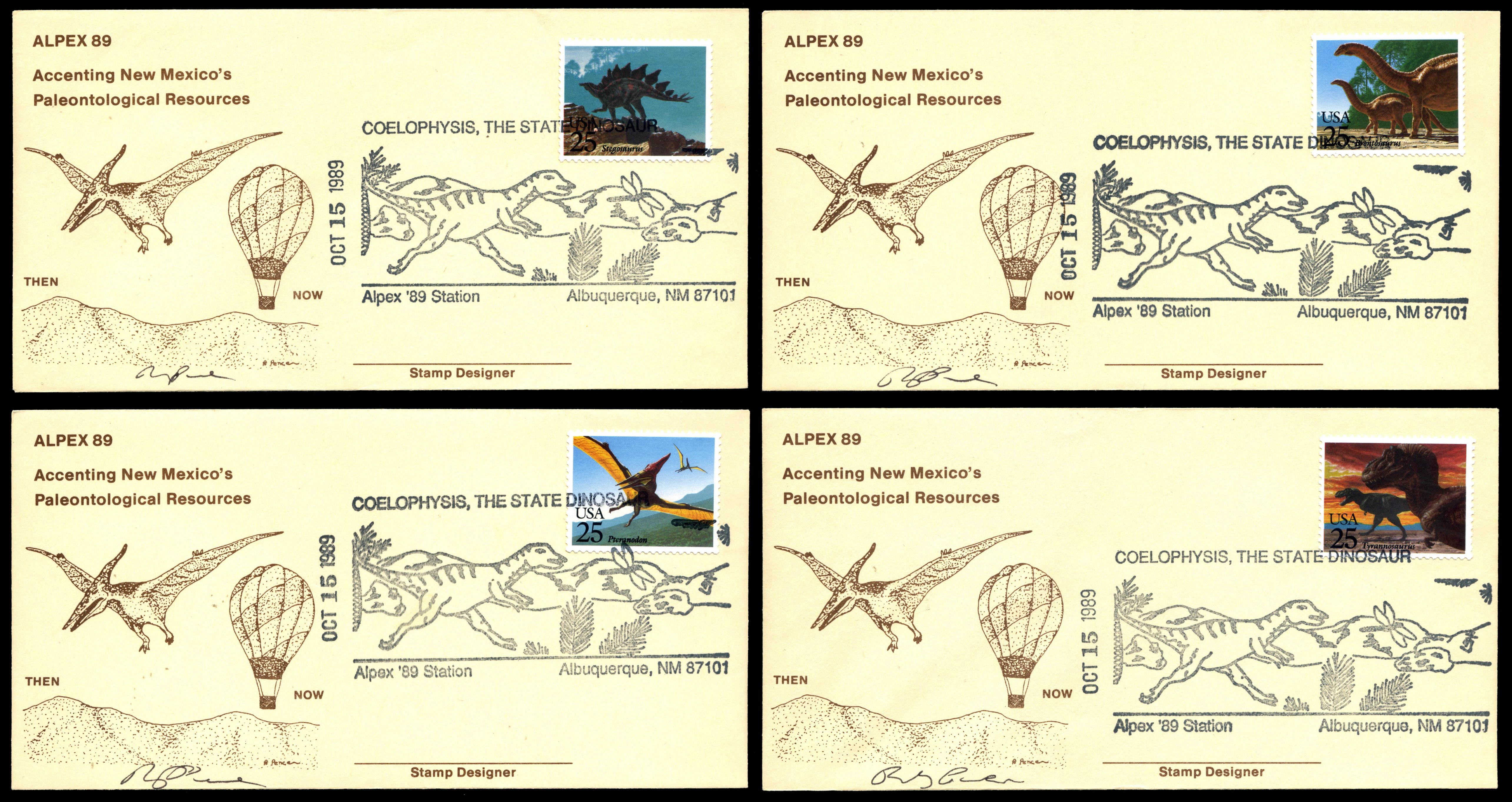
| 13-15.10.1989 "Coelophysis, the State Dinosaur, ALPEX'89 Station, Albuquerque, NM" [Sp] |
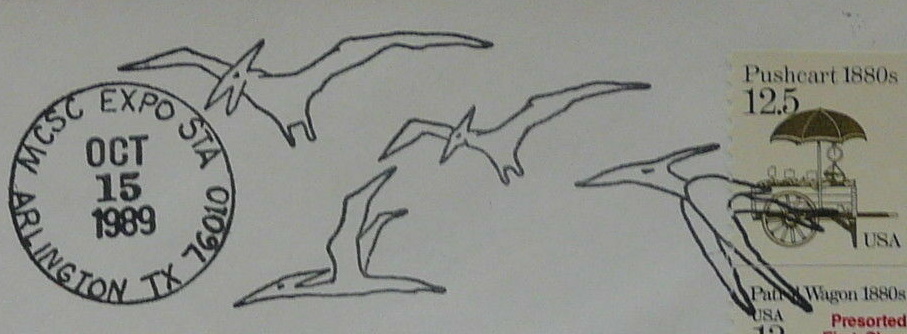
15.10.1989 "MCSC EXPO STA, Arlington, TX" [Sp] - |
20.10.1989 "Mammoth tusk, Stepex Station, Horseheads, New York" [Sp] |
|
|
|

|
|
| 20.10.1989 "Stamp Collecting Station, Honolulu, HI" [Sp] - |
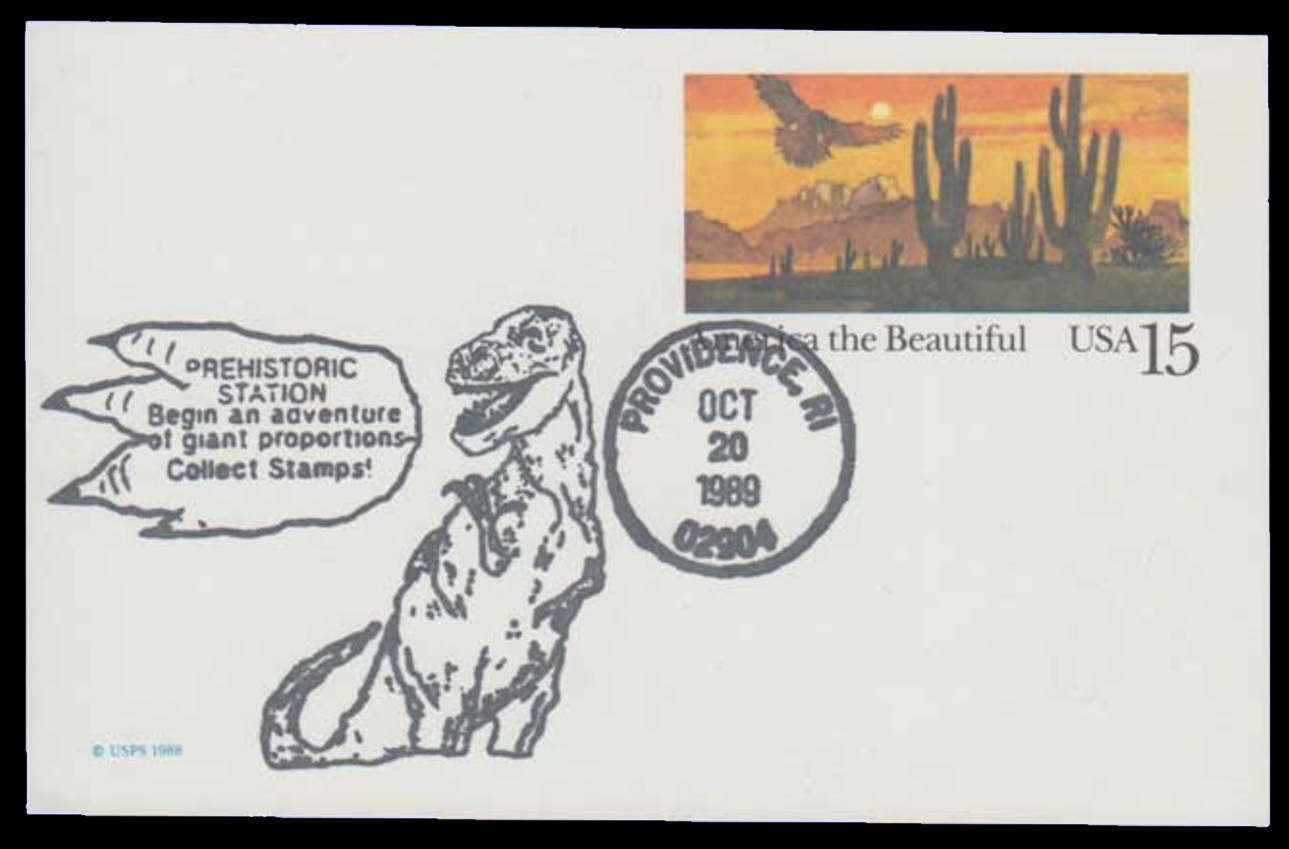
20.10.1989 "Prehistoric Station, Providence, RI" [Sp] |
20.10.1989 "Pteranodon Station, Philatelic Center, Cerritos, CA" [Sp] - |
|

|
|

|
|
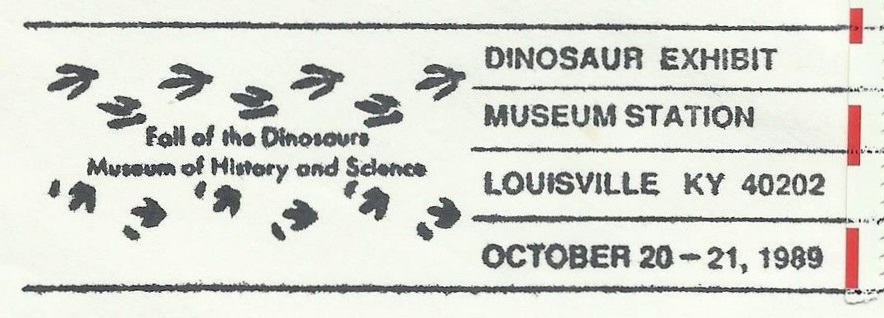
| 20-21.10.1989 "Dinosaur exhibit, Museum Station, Louisville, KY" [Sp] |
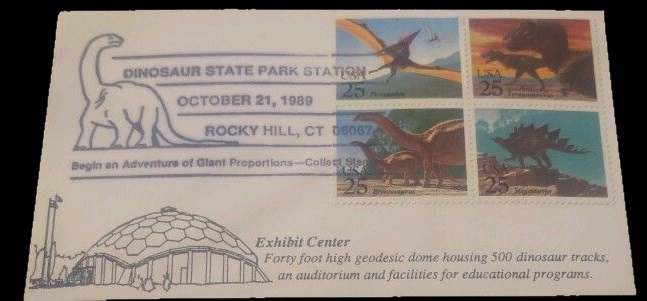
21.10.1989 "Dinosaur State Park Station, Rocky Hill, CT" [Sp] |
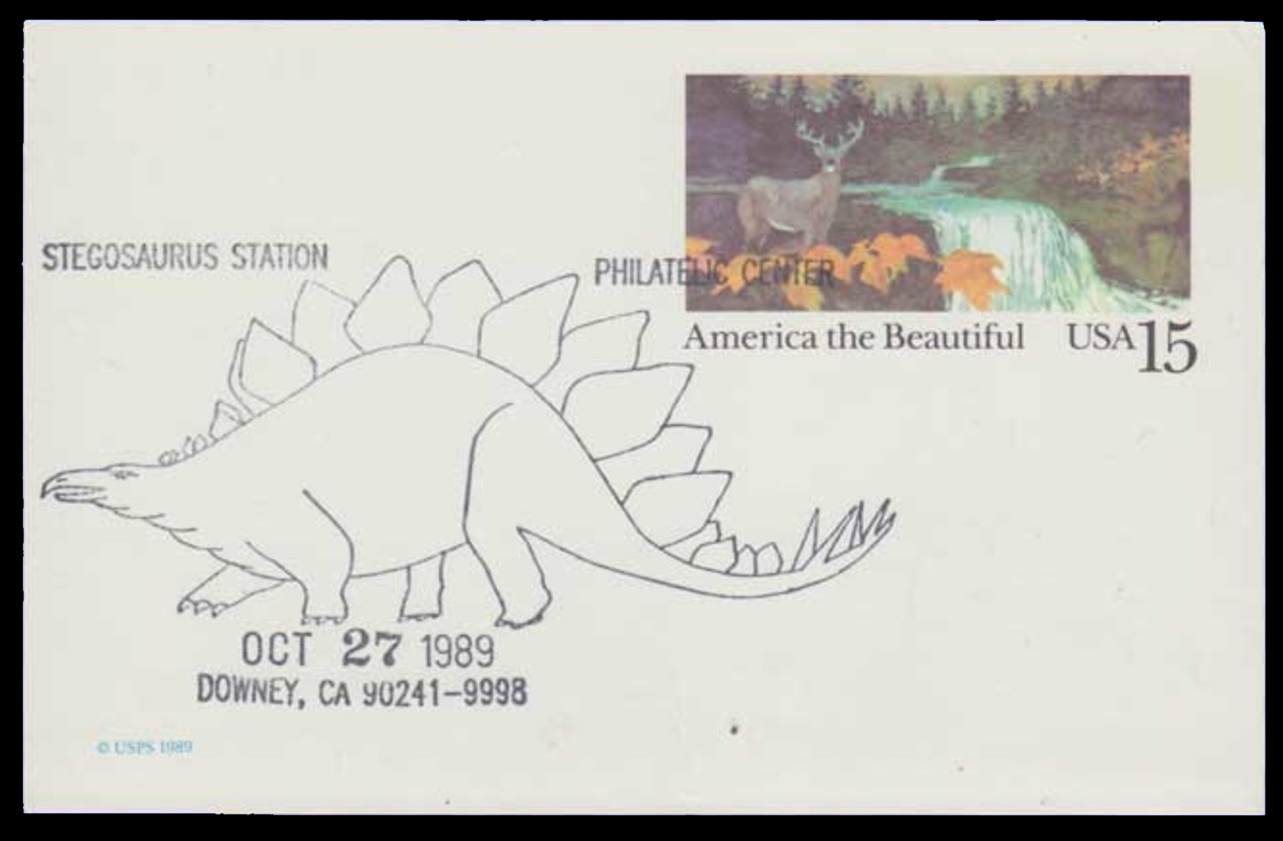
27.10.1989 "Stegosaurus Station, Philatelic Center, Downey, CA" [Sp] |
|
|
|
|
|
| 28.10.1989 "Kidpex STA, Milwaukee, WI" [Sp] |
28.10.1989 "Dinosaur Station, Long Beach, CA" [Sp] - |
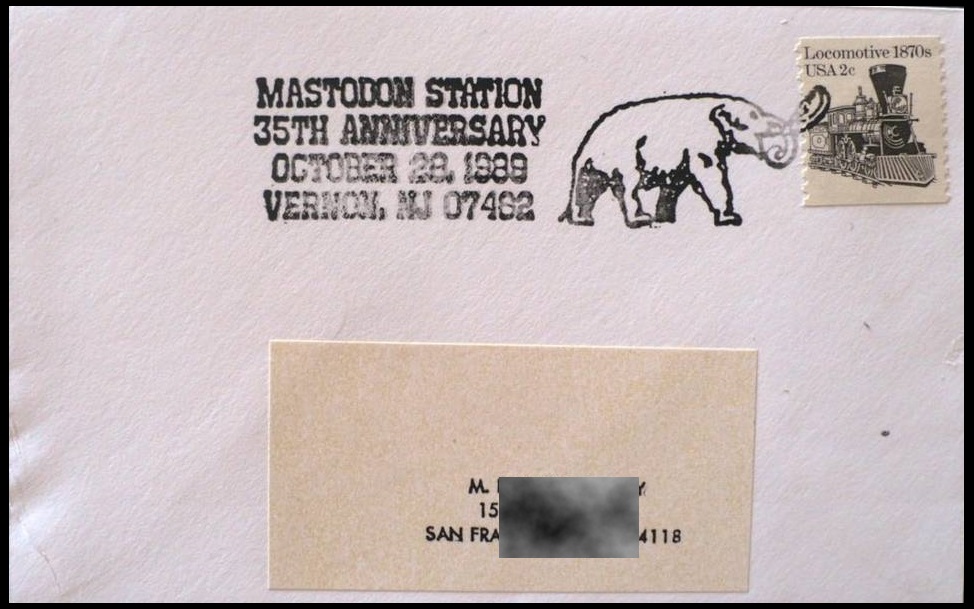
28.10.1989 "Mastodon Station, 35th anniversary, Vernon, NJ" [Sp] |
|

|

|
|
|
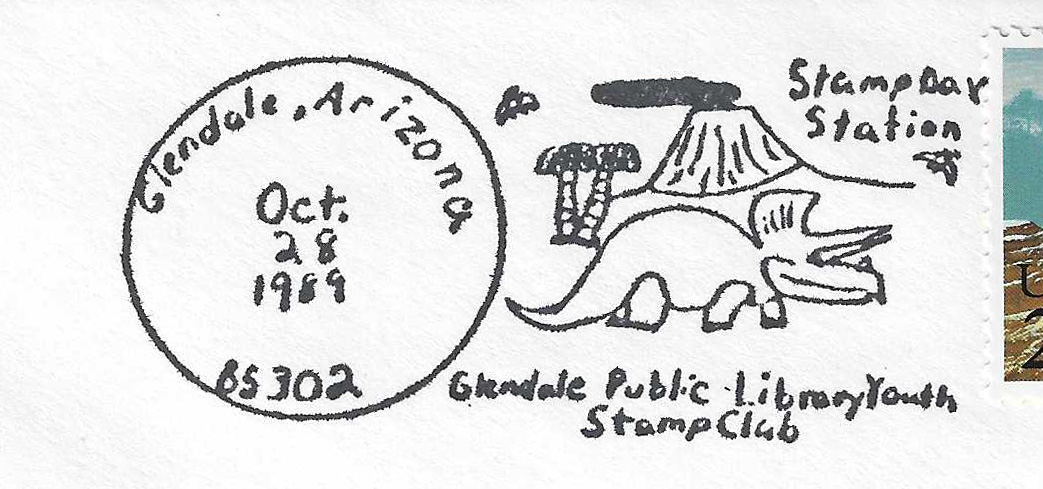
| 28.10.1989 "Stamp Day Station, Glendale Public Library Youth Stamp Club, Glendale, Arizona" [Sp] - |
28.10.1989 "St. Louis Science Station" [Sp] - |
29.10.1989 "AWPEX'89 Exhibition Station, Fort Wayne, IN" [Sp] |
|
|

|

|
|
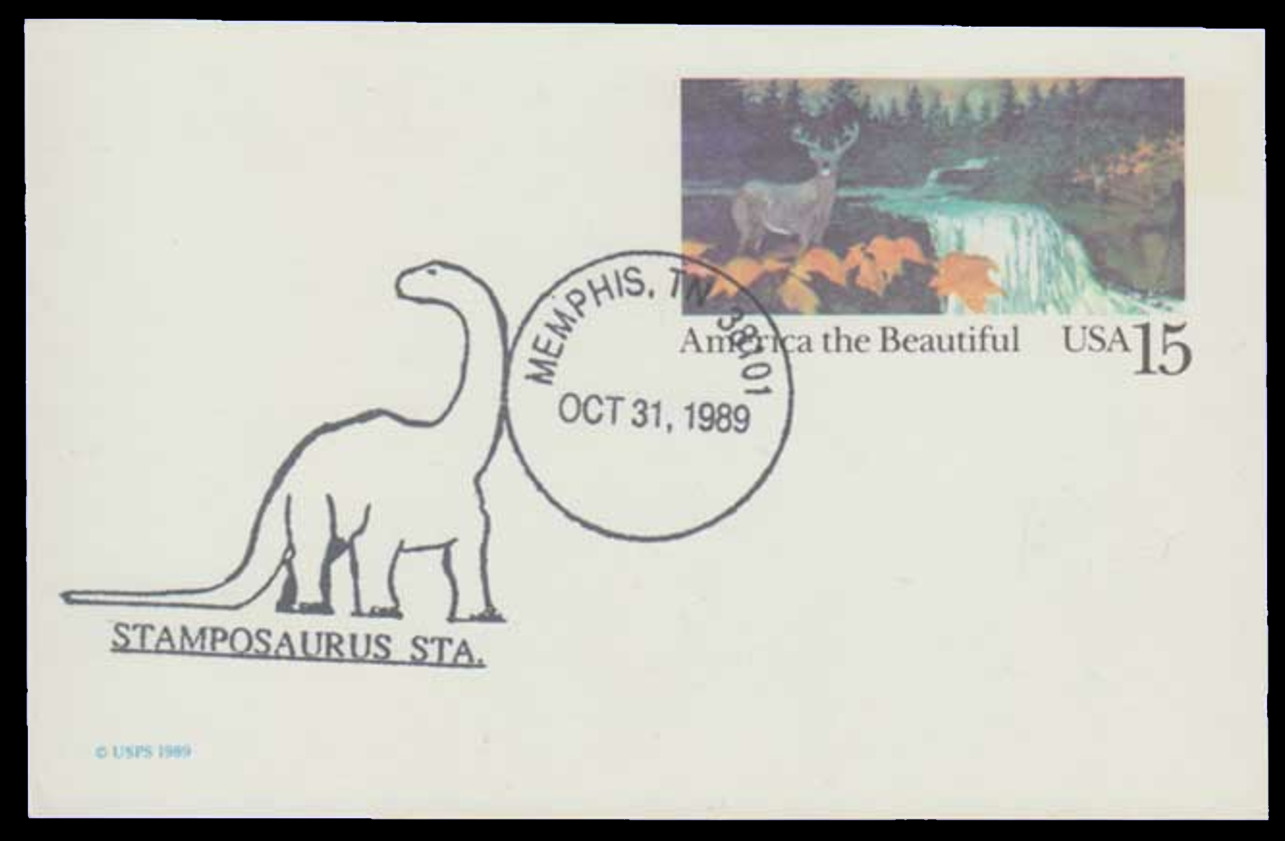
| 31.10.1989 "Stamposaurus, Memphis, TN" [Sp] |
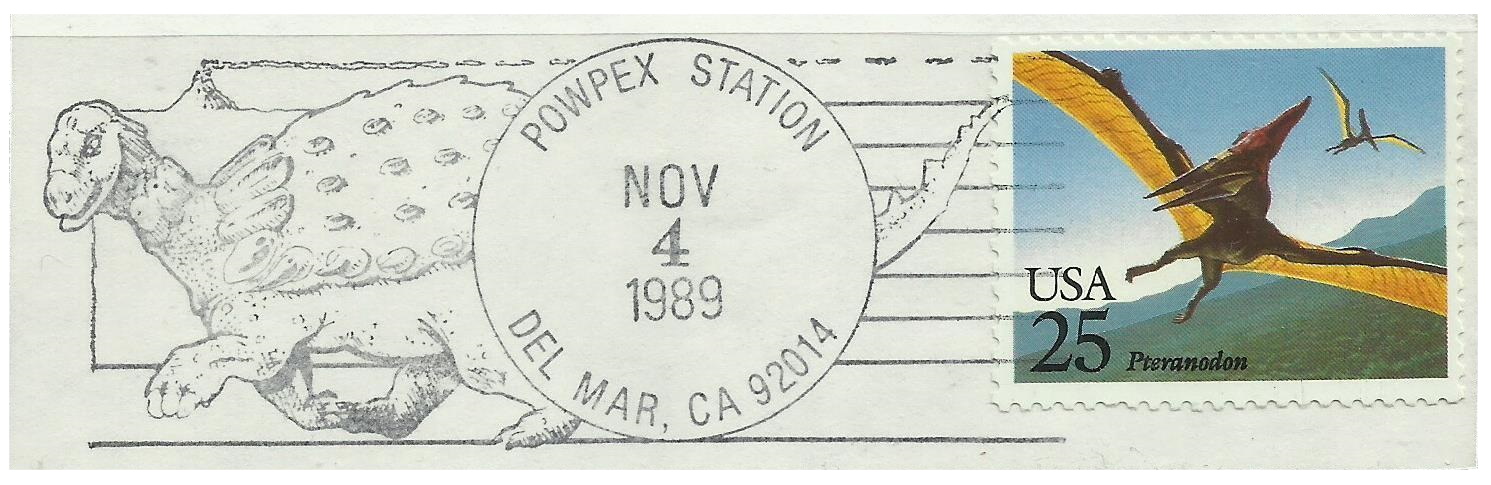
04.11.1989 "Pompex Station, Del Mar, CA" [Sp] - |
04.11.1989 "Avpex'89, Animals Valley Mall Station, Farmington, New Mexico" [Sp] |
|
|
|

|
|
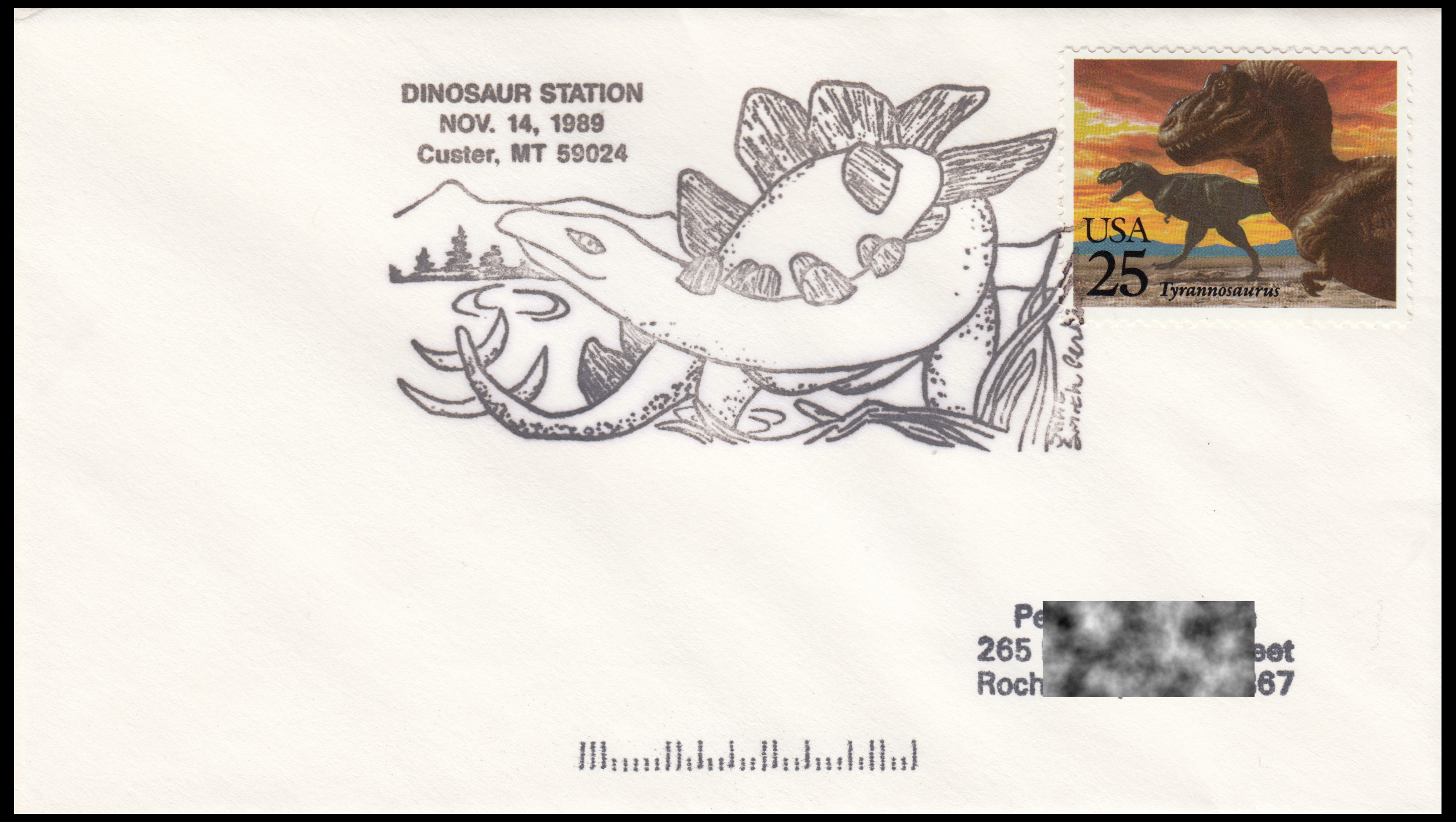
| 14.11.1989 "Dinosaur Station, Custer, MT" [Sp] |
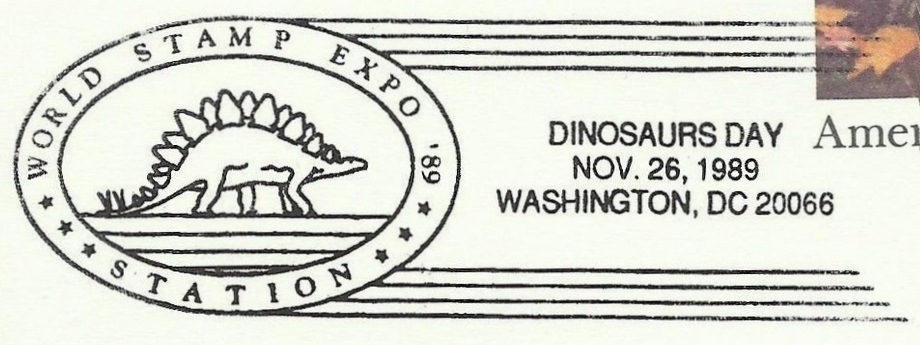
26.11.1989 "World Stamp EXPO'89, Dinosaur Day, Washington, DC" [Sp] - |
09.12.1989 "Dinosaur Station, Redlands, California" [Sp] - |
|
|
|

|
|
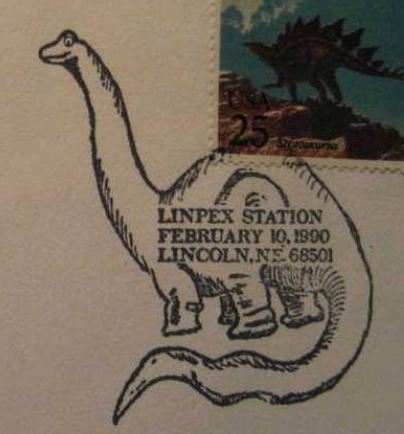
| 10.02.1990 "Linpex Station, Lincoln, NE" [Sp] - |
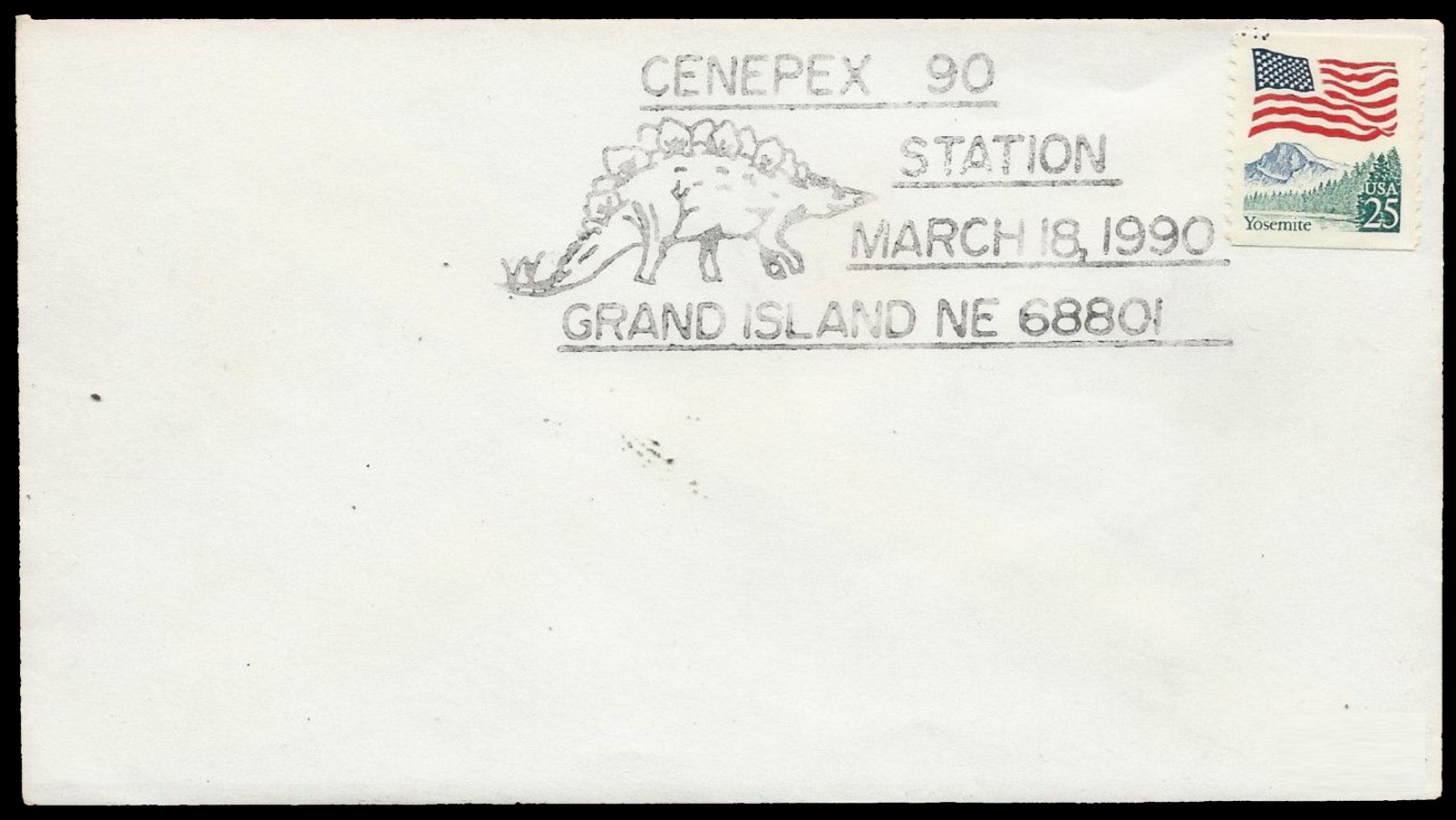
14.11.1990 "CENEPEX'90 Station, Grand Island, NE" [Sp] |
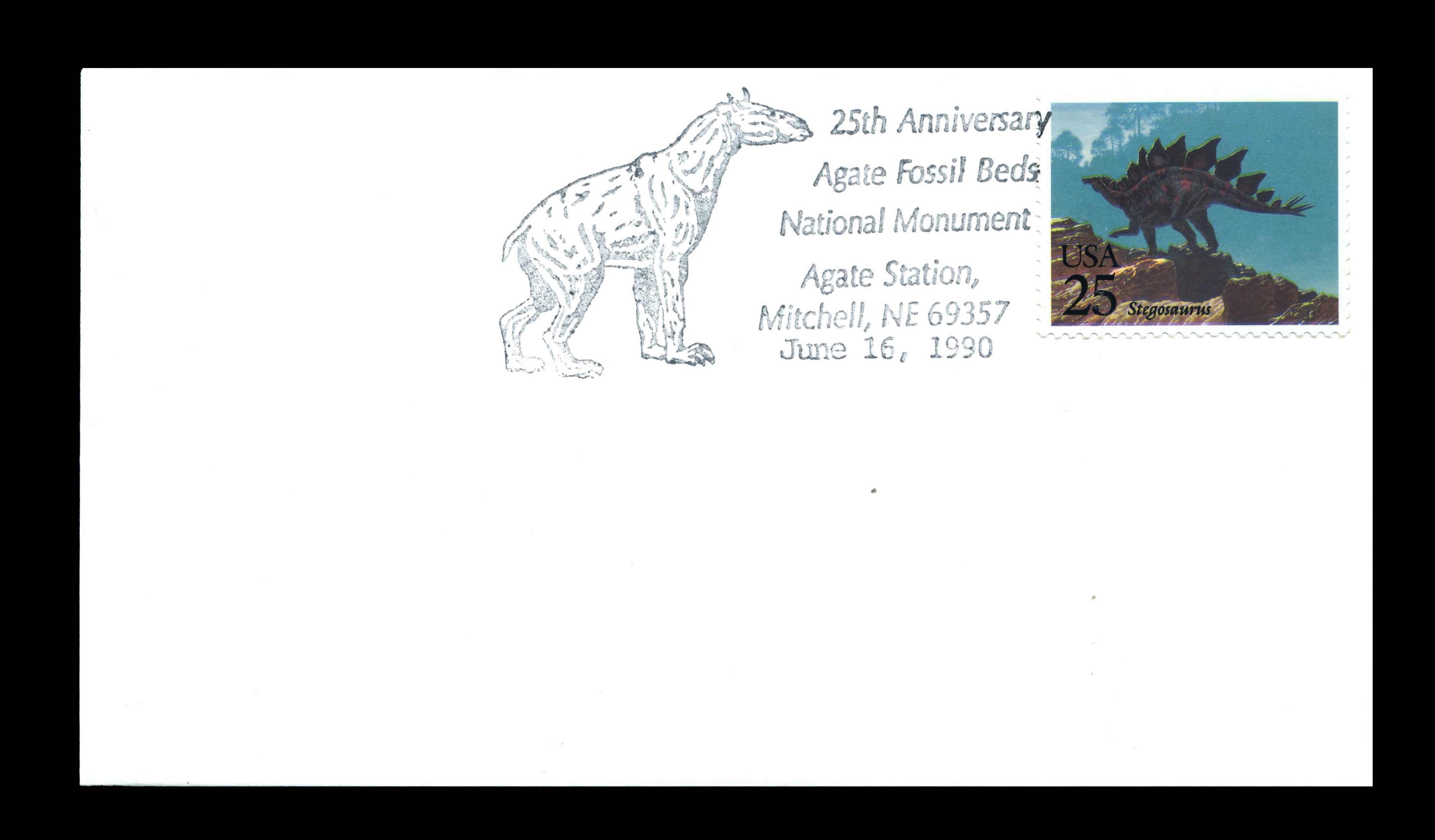
26.11.1990 "25th anniversary Agate Fossil Beds National Monument, Agate Station, Michell, NE" [Sp] |
|
|
|
|
|
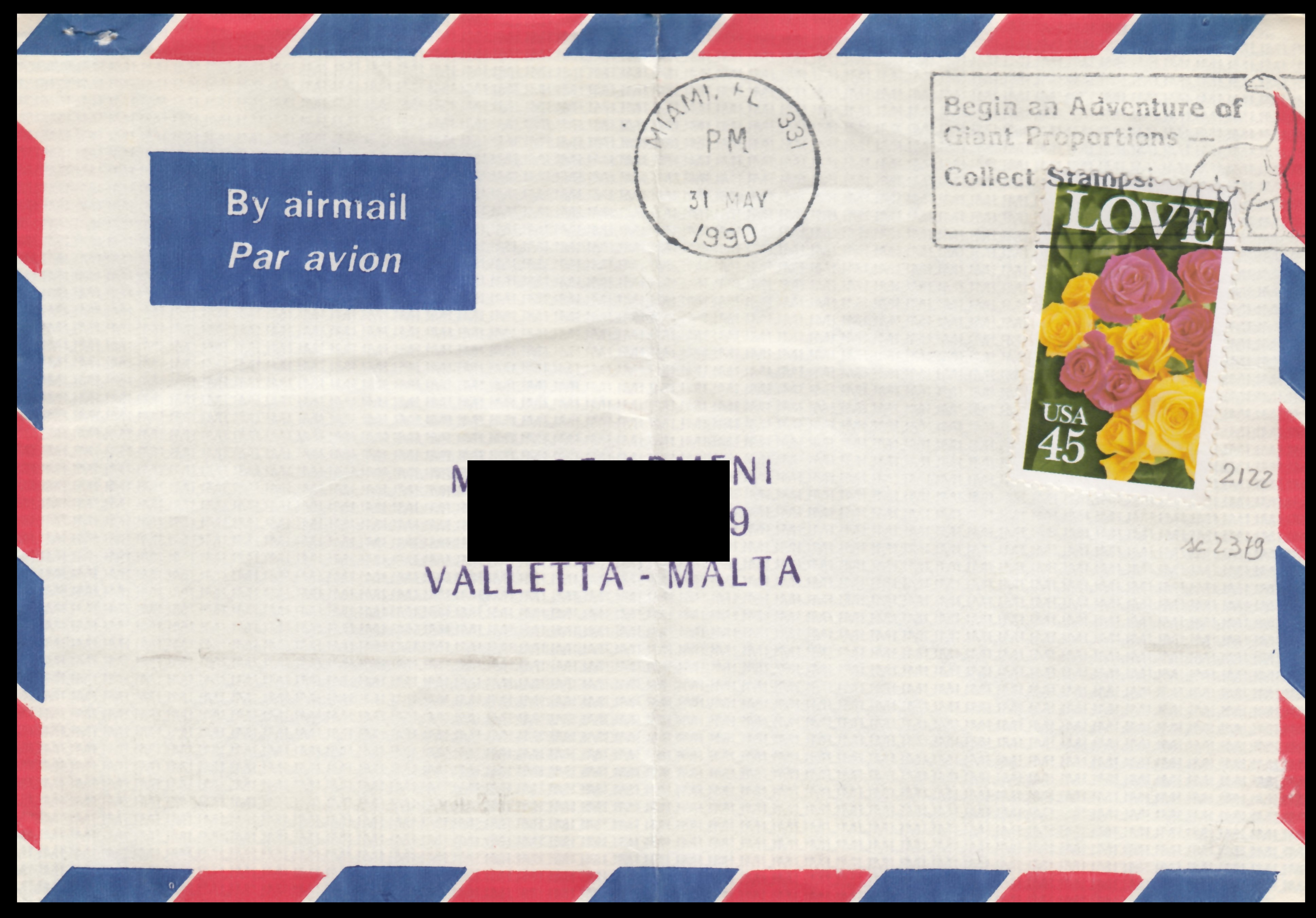
| 1990[DU] "Begin an Adventure of Giant Proportions - Collect Stamp!" [PM] (the same design, but different cities across USA) |
19.04.1991 "MAPS EXPO XIII SRA, Tully Monster" [Sp] | 26.10.1991 "110,000,000 years ago Dinosaurs roamed in Maryland" [Sp] |
|
|

|

|
|
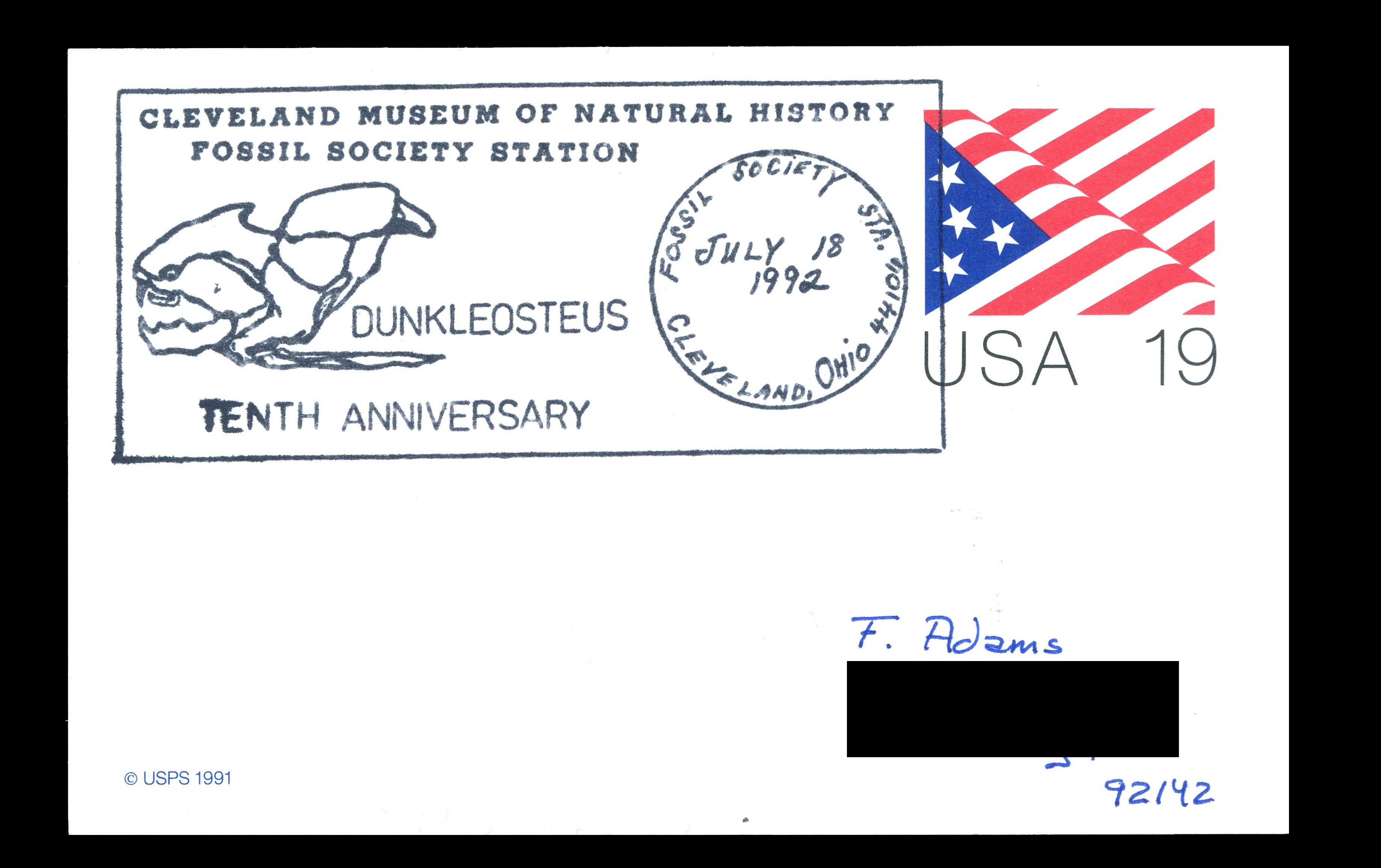
| 18.07.1992 "Cleveland Museum of Natural History, Fossil Society Station"[Sp] | 23.07.1992 "American-Midwest Federation Show SRA., Brunwick, OH [Sp] | ||
|

|
|
|
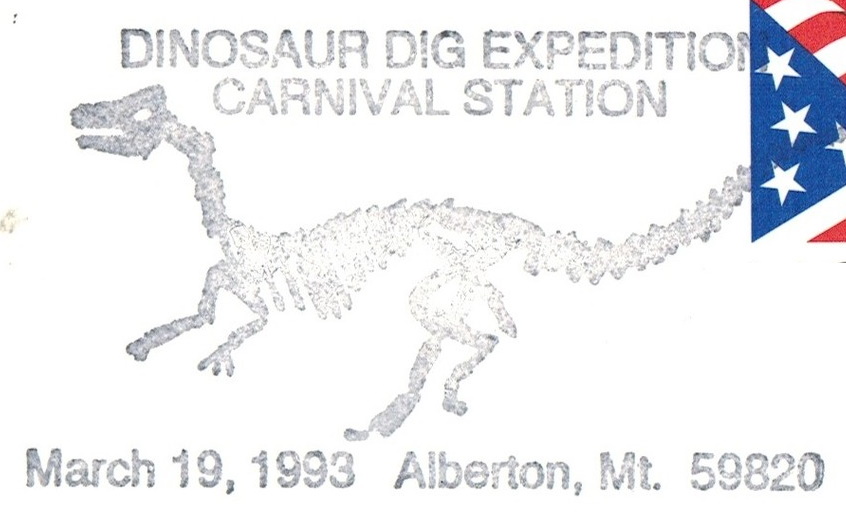
| 19.03.1993 "Dinosaur dig expedition, Carnival Station, Alberton, Mt." [Sp] - |
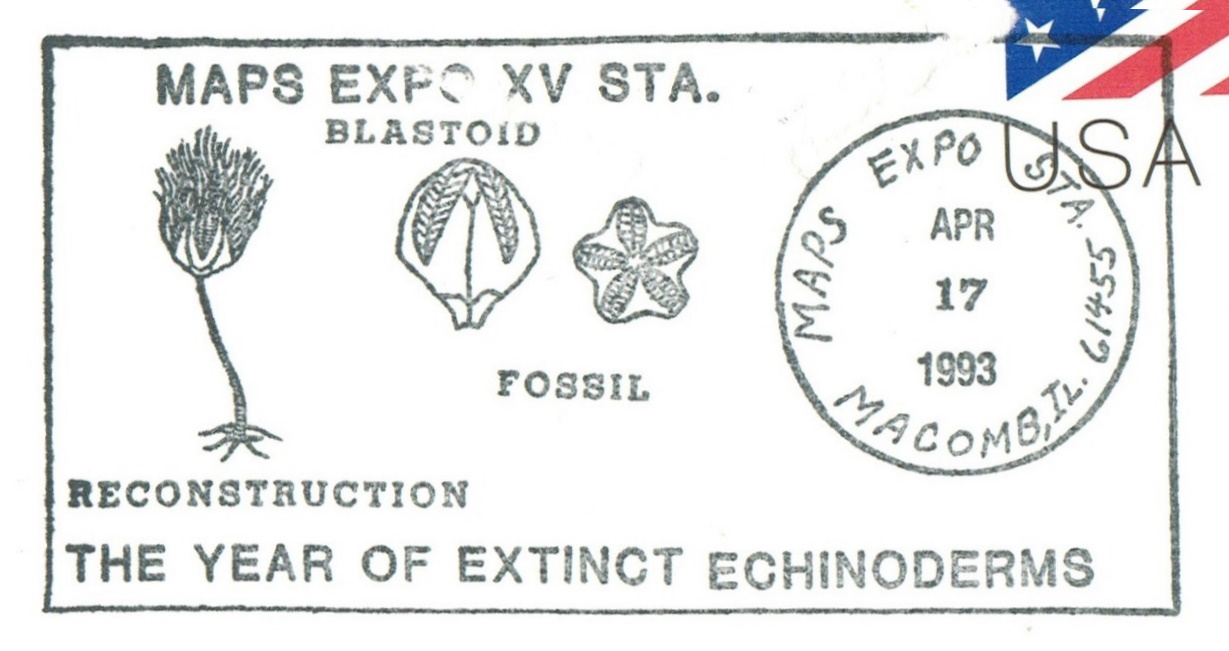
29.05.1993 "MAPS EXPO XV STA., the year of extinct Echinoderms" [Sp] - |
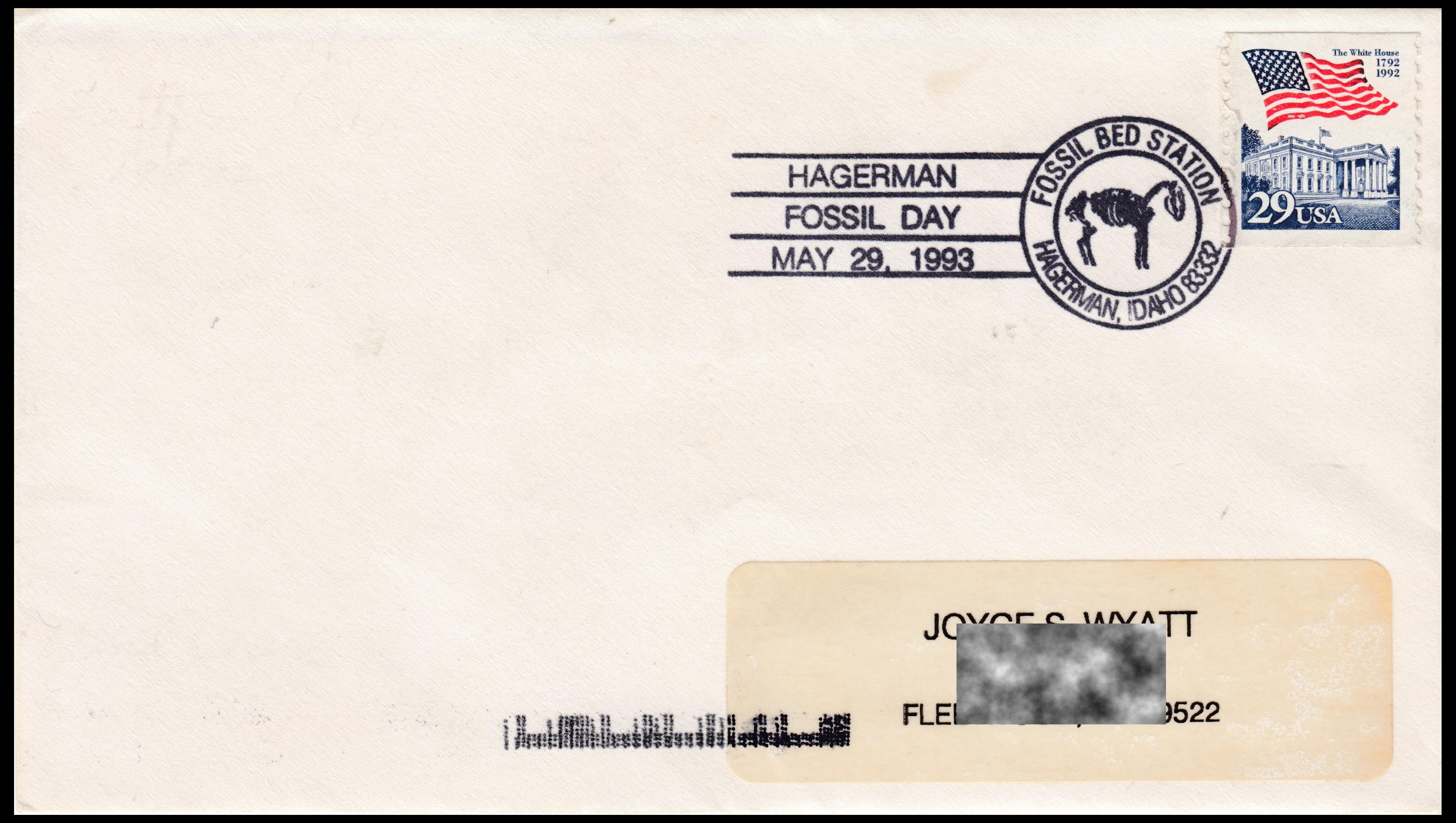
23.07.1993 "Hagerman Fossil Day, Idaho" [Sp] |
|
|
|
|
|
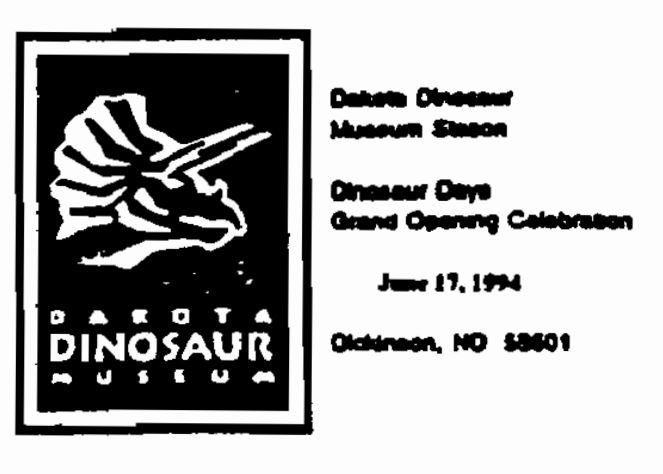
| 17.01.1994 "Dinosaur Day, Dinosaur Dakota Museum" [Sp] - |
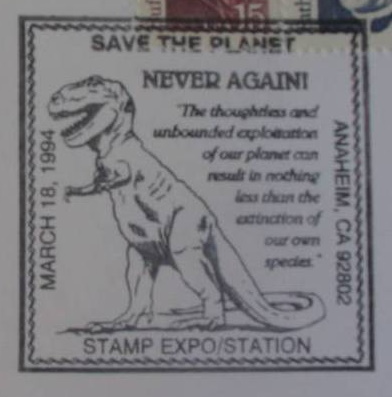
18.02.1994 "Stamp EXPO/Station - Save the planet" [Sp] - |
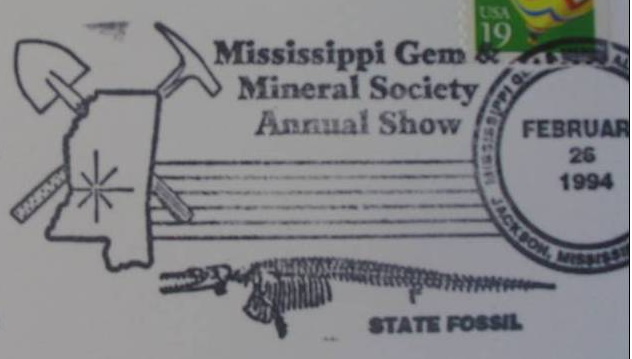
26.02.1994 "Mississippi Gem and Mineral Society Annual Show" [Sp] - |
|
|
|
|
|
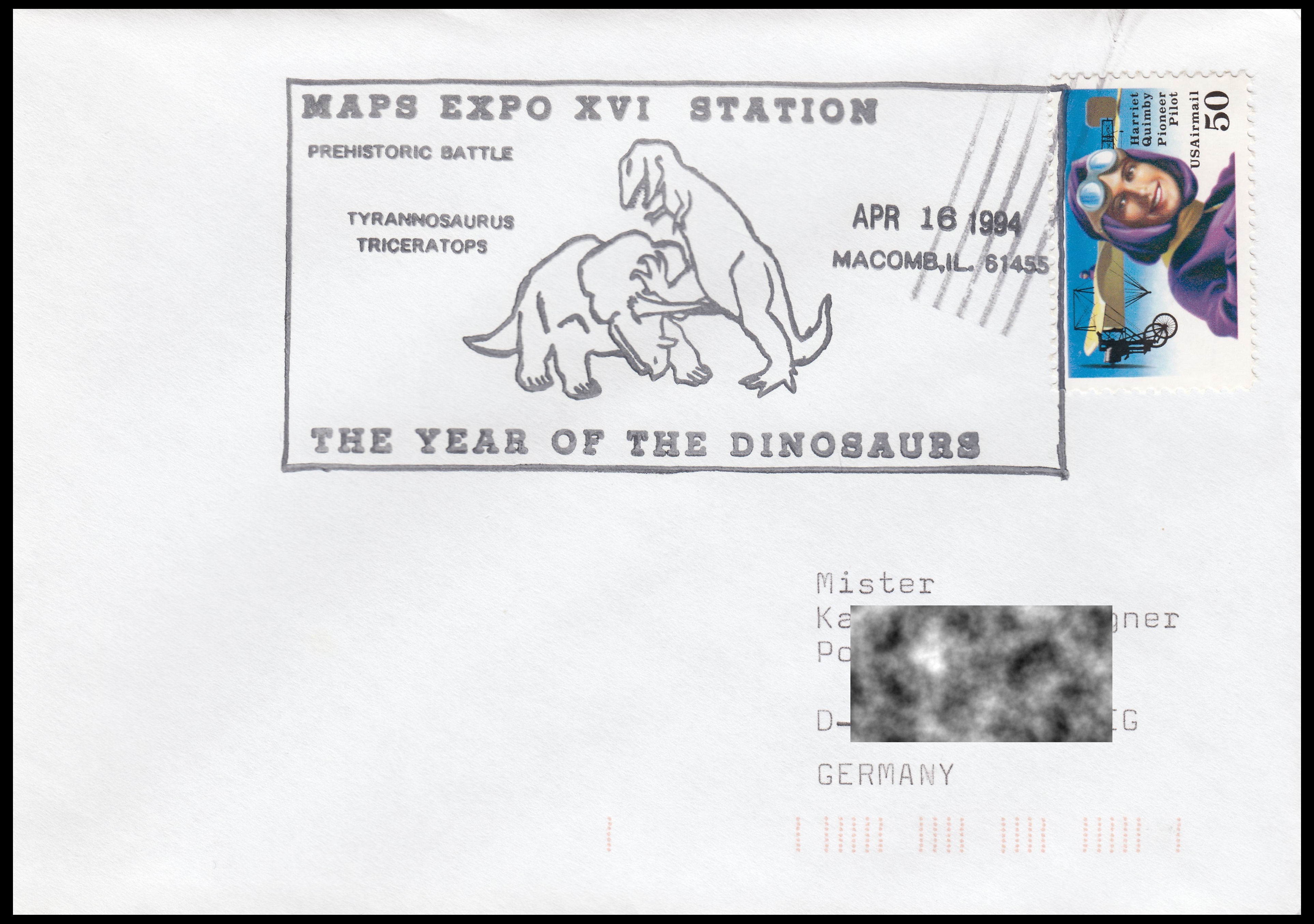
| 16.04.1994 "The year of dinosaurs - maps Expo XVI station" [Sp] - |
27-29.05.1994 "Fossil Festival, Aurora, N. C." [Sp] - |
||
 |
 |
|
|
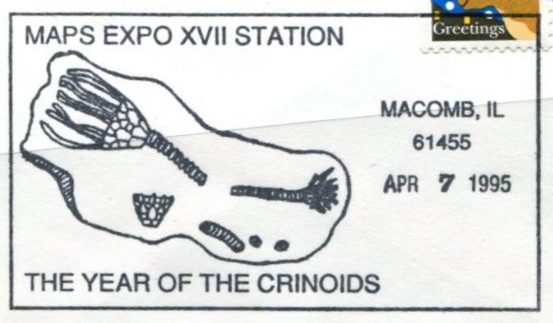
| 07.04.1995 "MAPS EXPO XVII Station - the year of the Crinoids" [Sp] - |
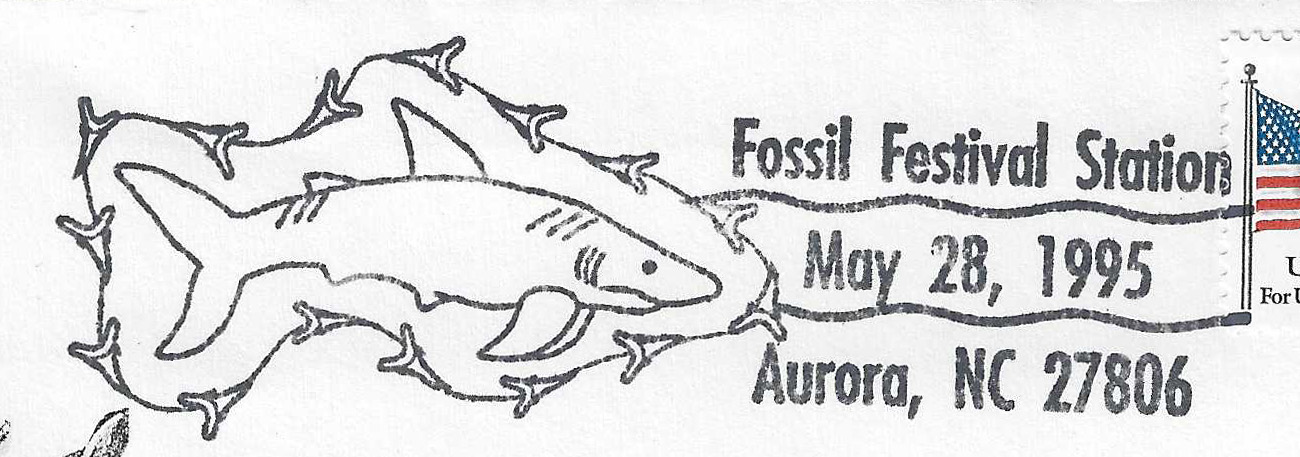
28.05.1995 "Fossil Festival Station, Aurora, NC" [Sp] - |
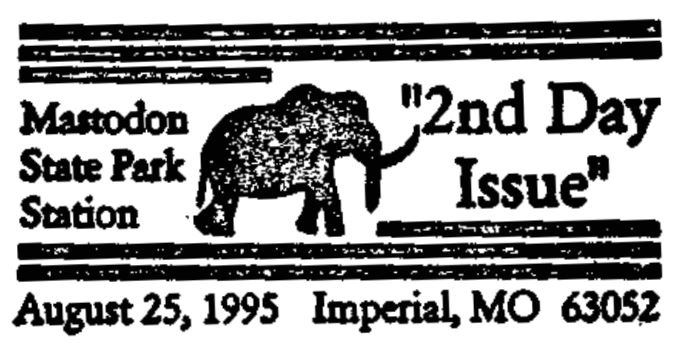
25.08.1995 "Mastodon State Park Station - 2nd" Day Issue" [Sp] - |
|
|
|
|
|
| 25.08.1995 "Prehistoric animals, Fossil Bed Station, Hagerman, Idaho" [Sp] - |
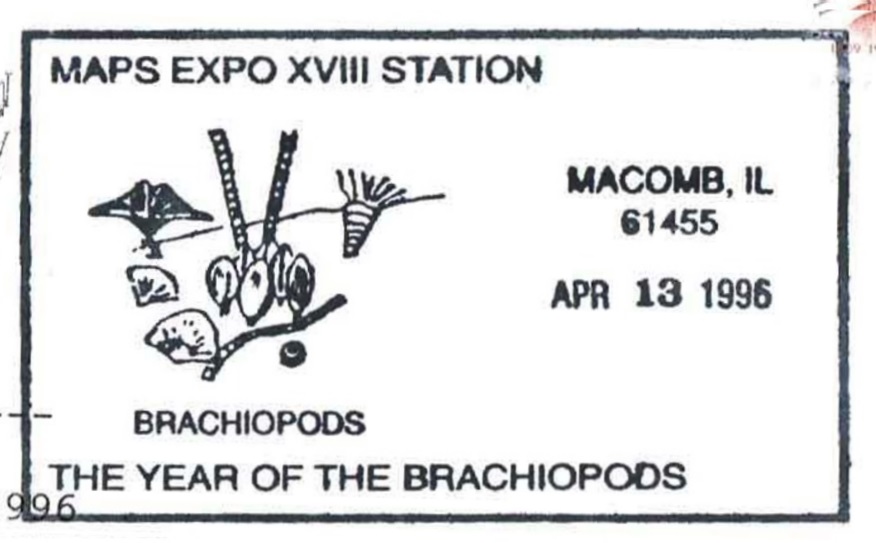
13.04.1996 "MAPS EXPO XVIII Station - the year of the Brachiopods" [Sp] - |
09.06.1996 "Hinckley Historical Society Station, Ohio" [Sp] - |
|

|
|

|
|
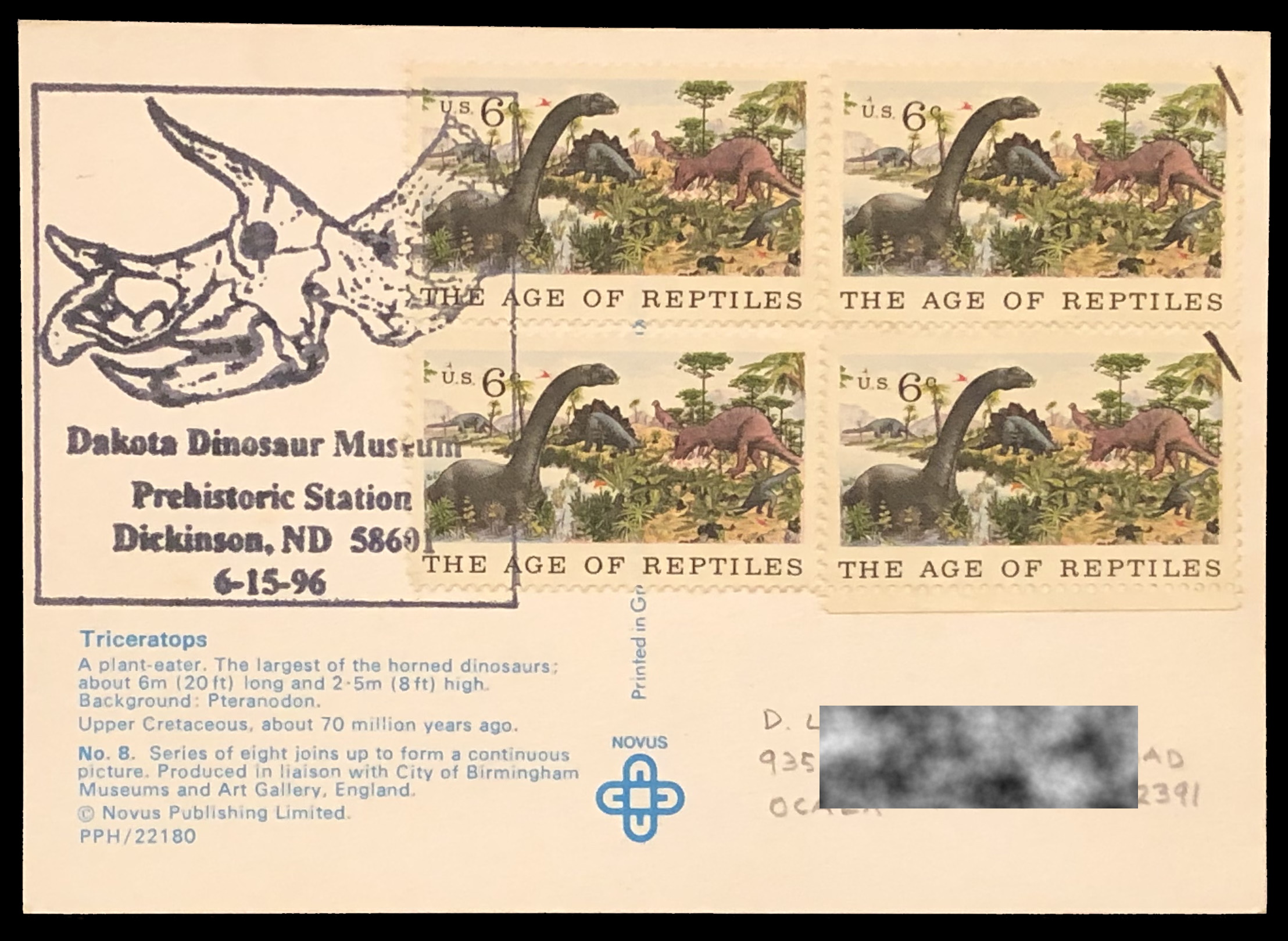
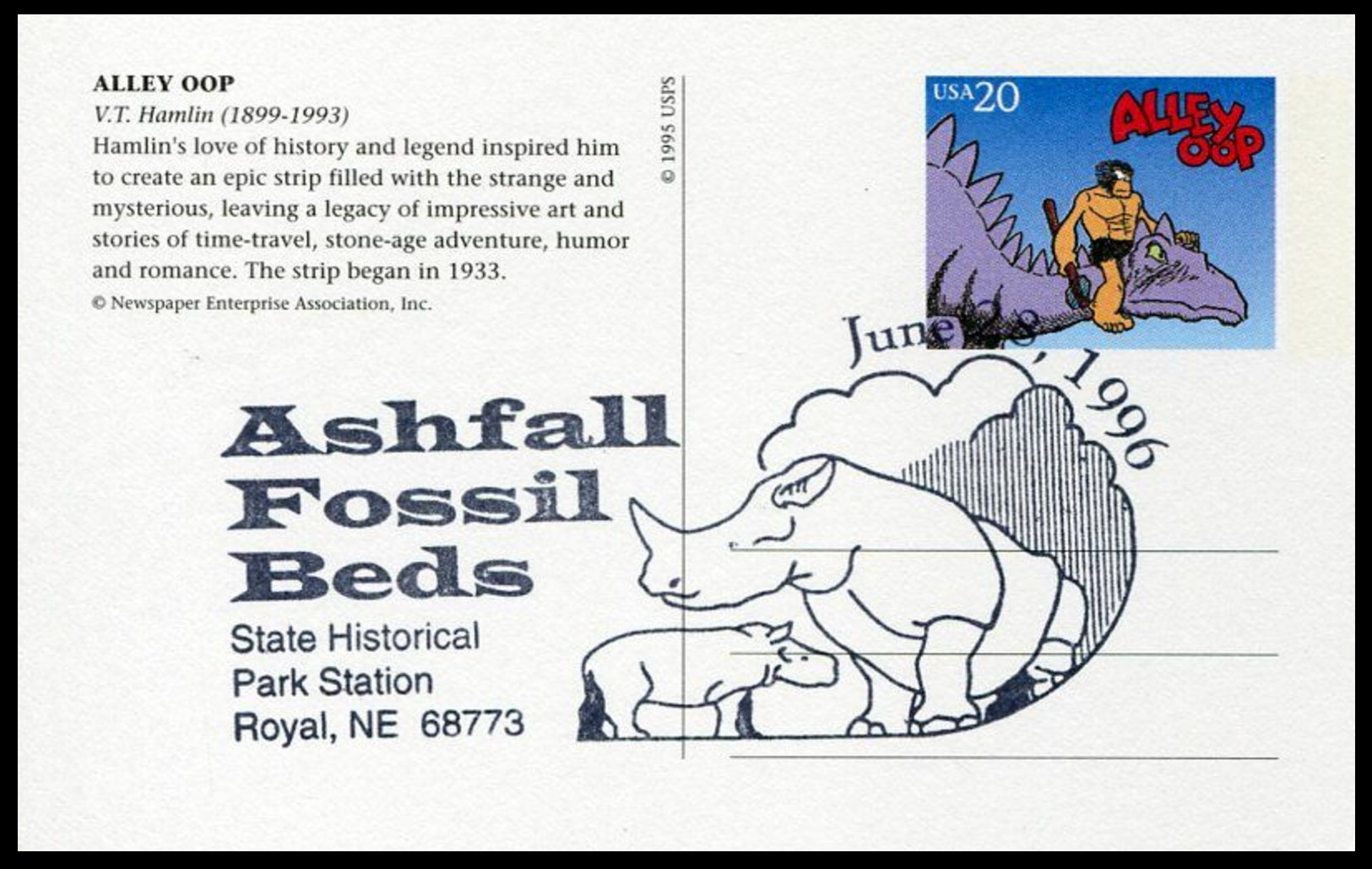
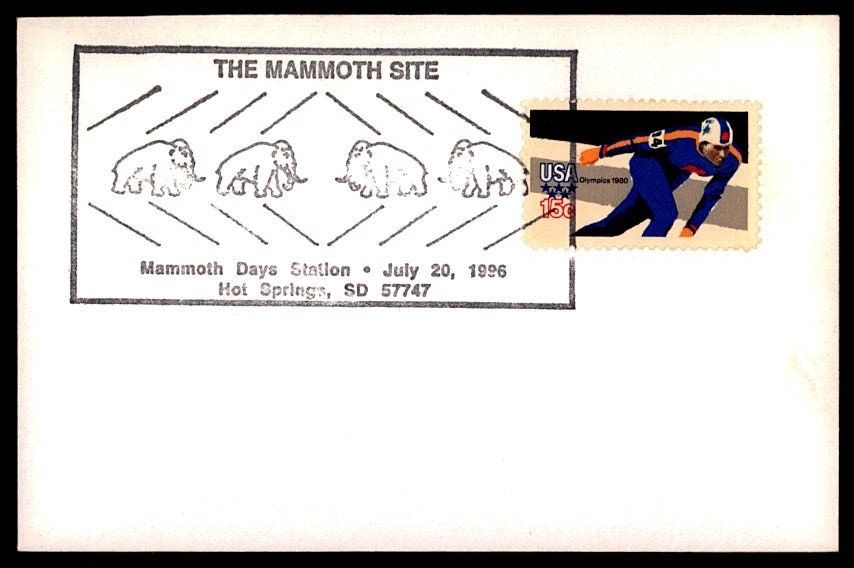
| 15.06.1996 "Dakota Dinosaur Museum, Prehistoric station" [Sp] | 28.06.1996 "Ashfall Fossil Beds, State Historical Park Station, Royal, NE" [Sp] | 20.07.1996 "The Mammoth Site, Hot Springs, SD" [Sp] - |
|
 |
|
|
|
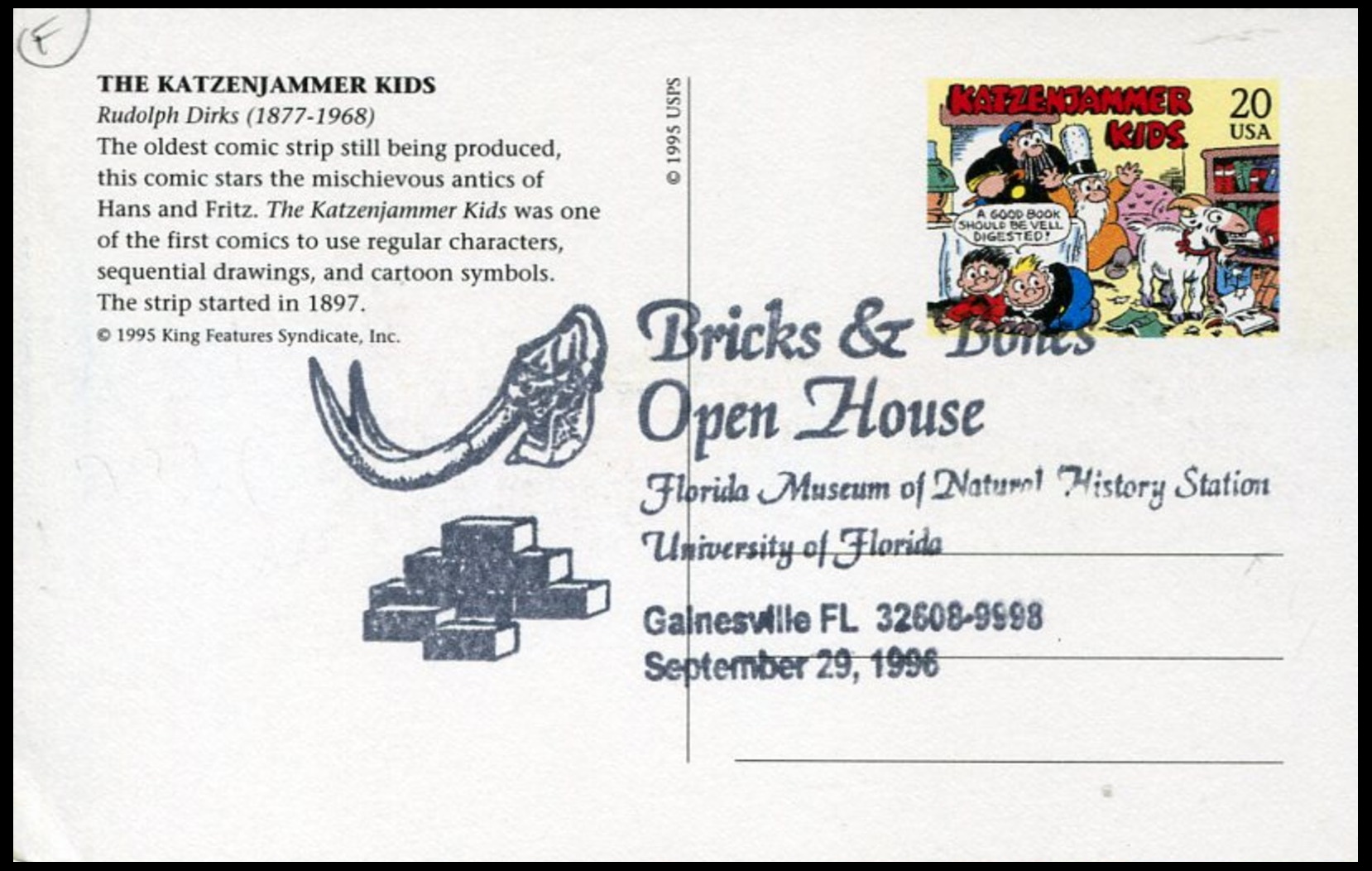
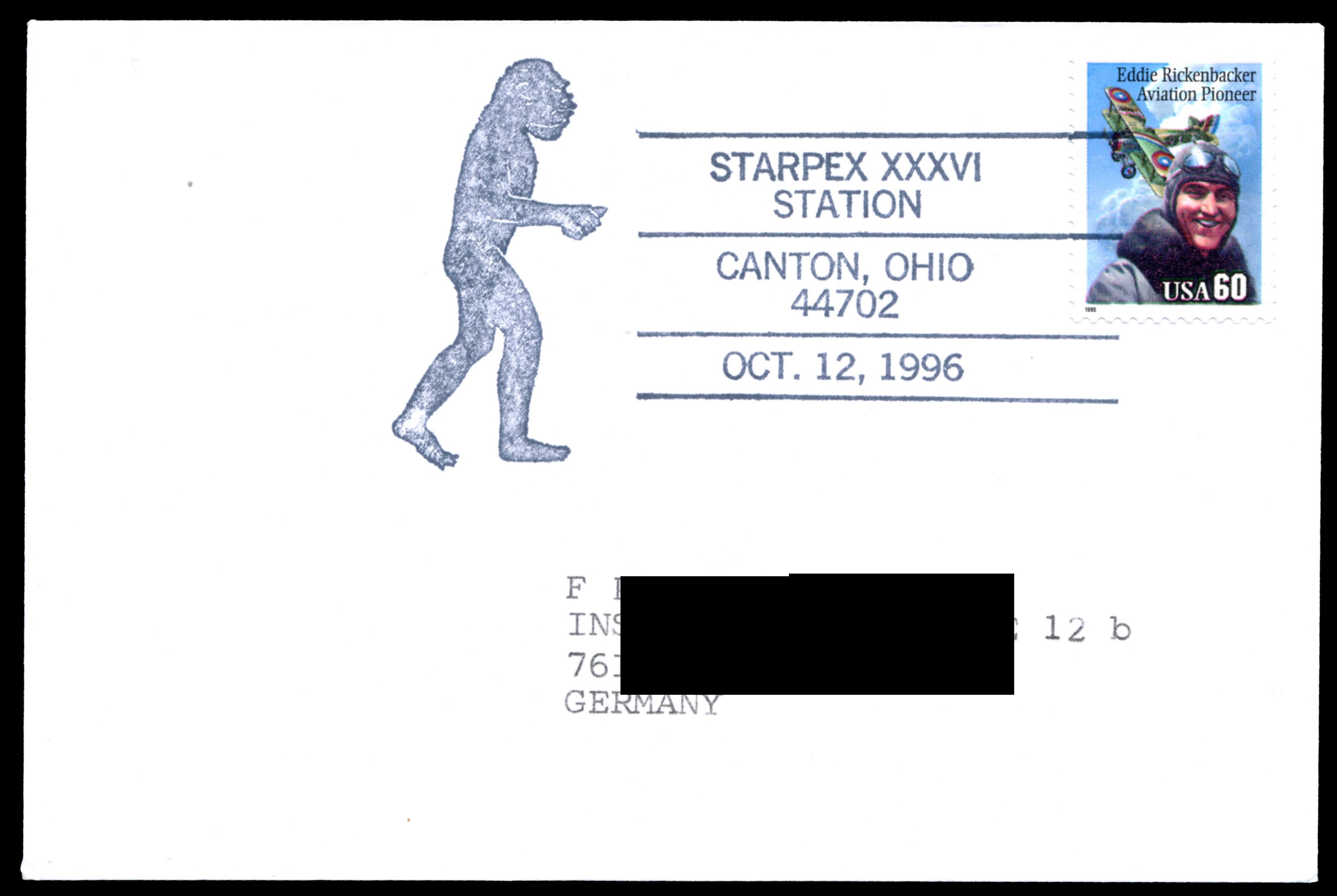
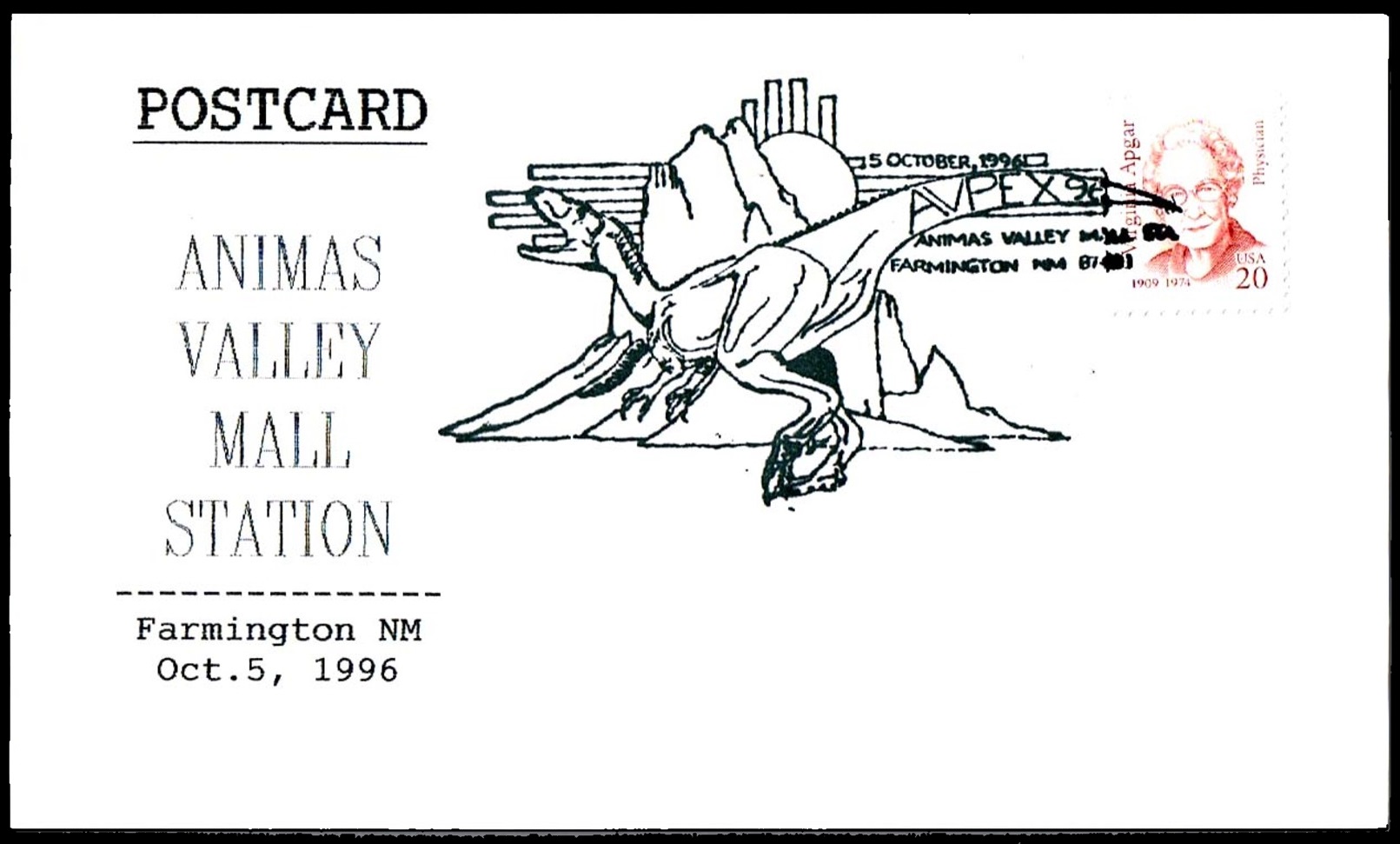
| 29.09.1996 "Bricks and Bones, Florida Museum of Natural History" [Sp] | 12.10.1996 "STARPEX XXXVI Station, Canton, Ohio" [Sp] | 15.10.1996 "AVPEX'96, Animal valley Mall Station, Farmington, NM" [Sp] | |
|  |
 |
|
| 1997 | |||
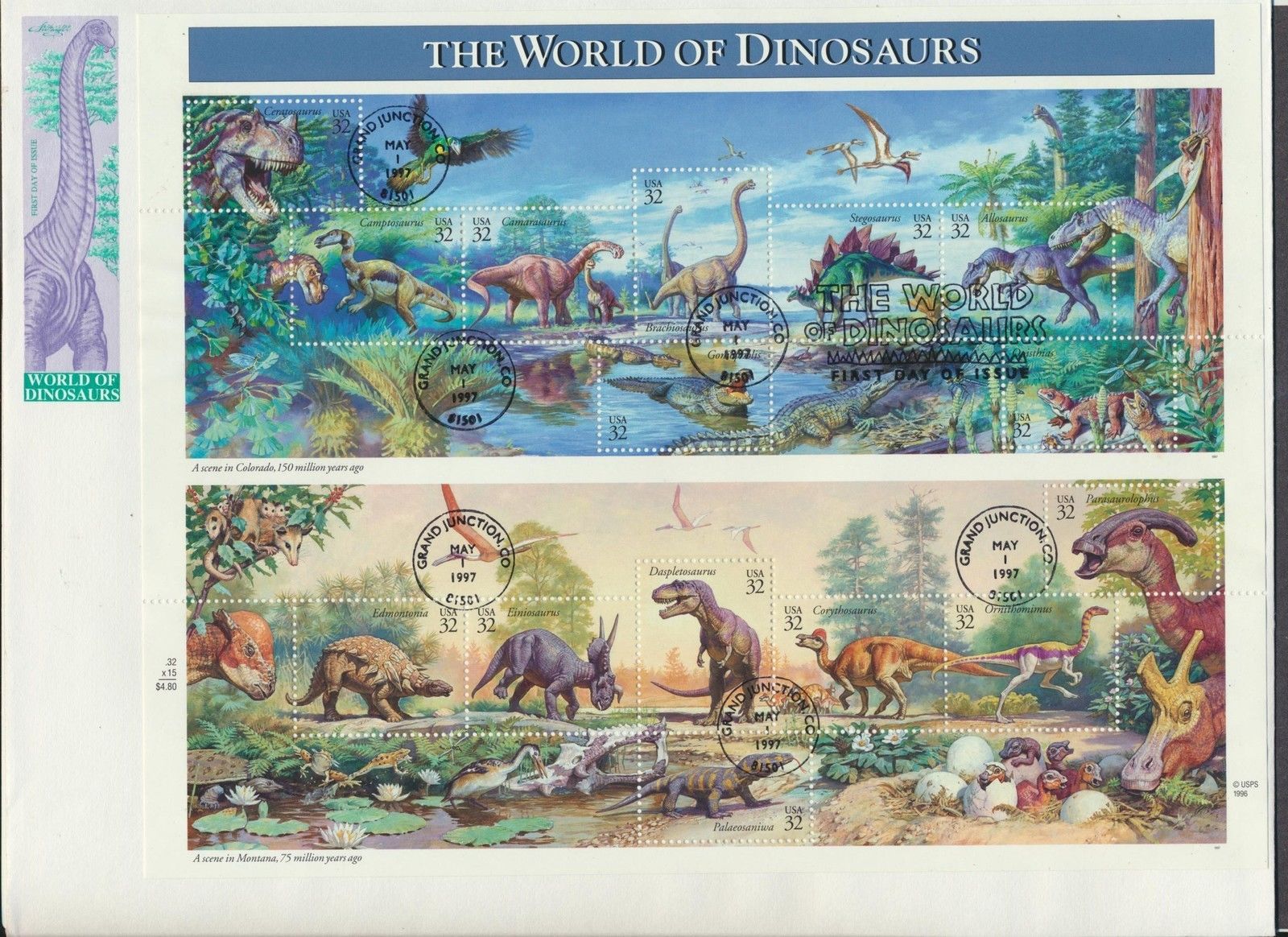
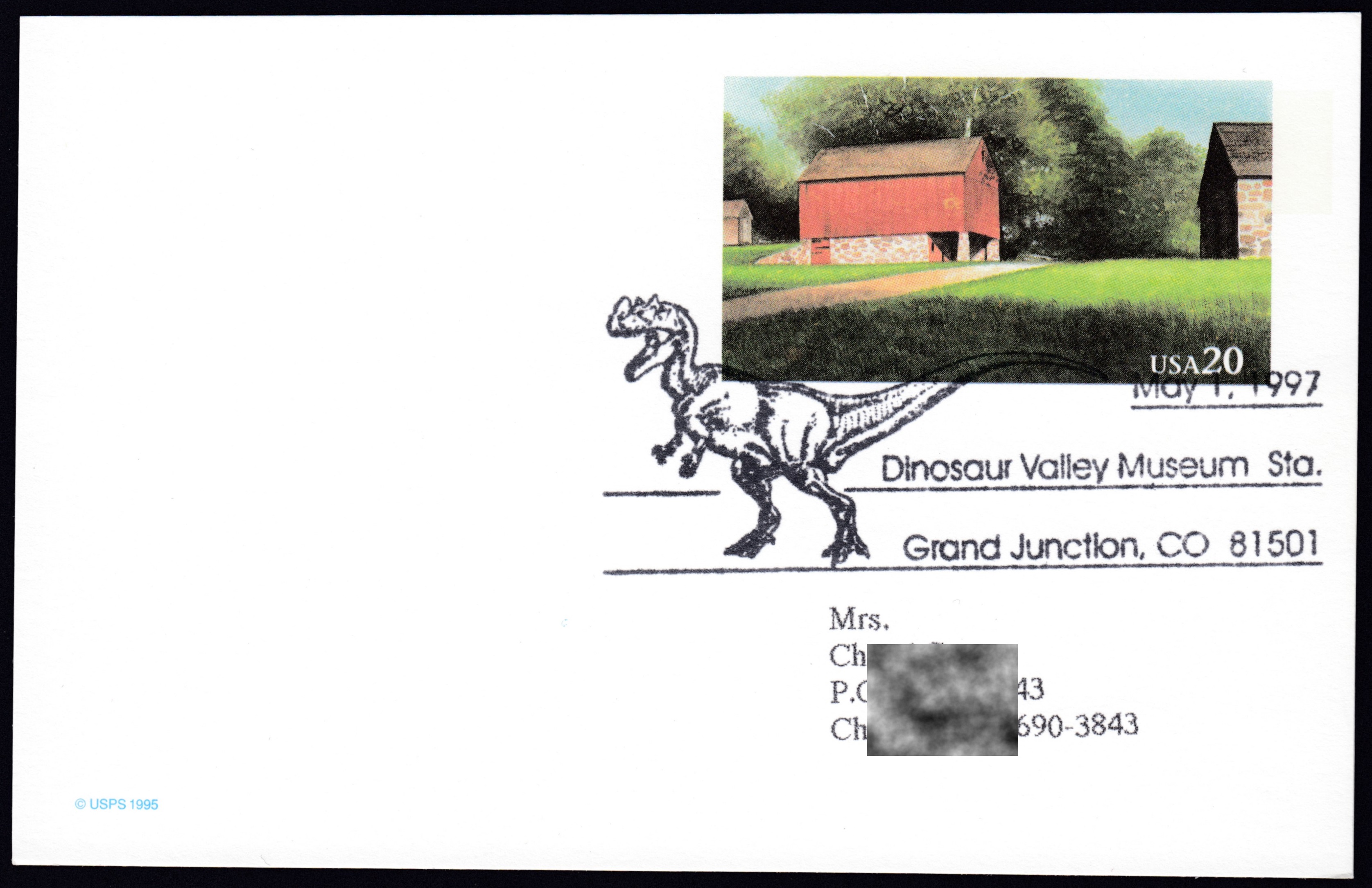
| 01.05.1997 "The World of Dinosaurs" [FDC] | 01.05.1997 "Dinosaur Valley Museum STA., Grand Junction, CO" [Sp] |
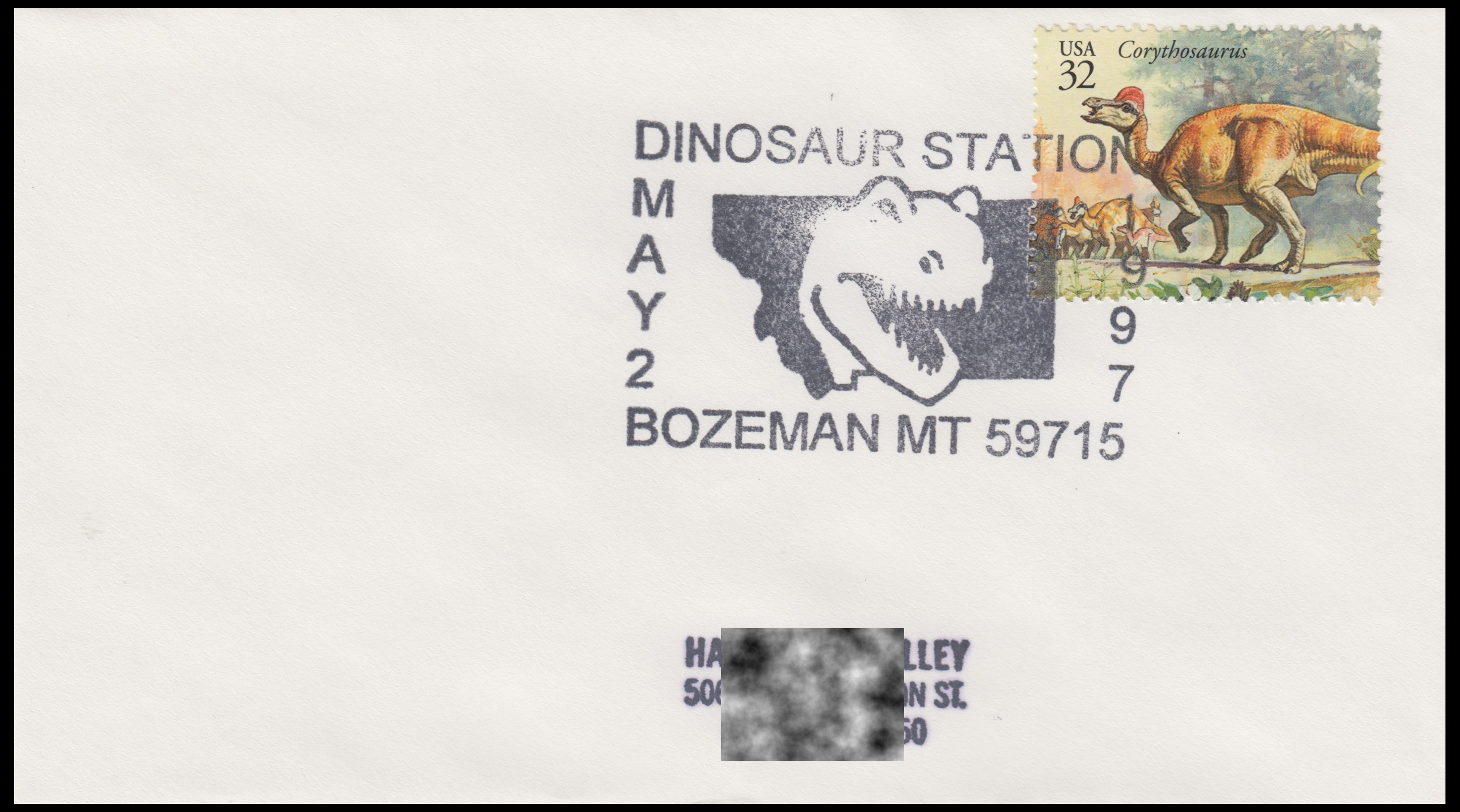
02.05.1997 "Dinosaur Station Bozeman, MT" [Sp] - |
|
|
|
|
|
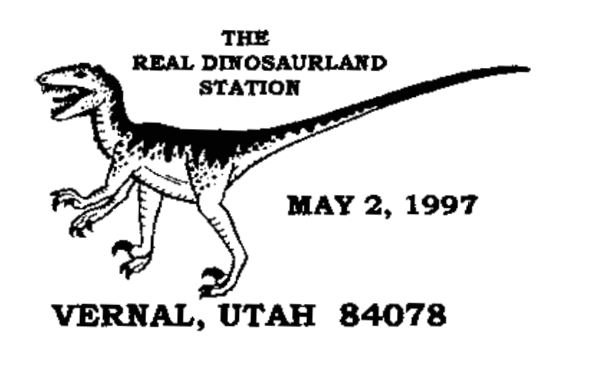
| 02.05.1997 "The real Dinosaurland Station, Vernal, Utah" [Sp] - |
02.05.1997 "Dinosaur Station Agar, SD" [Sp] - |
02.05.1997 "Denver Museum of Natural History, Dino Station, Denver, Colorado" [Sp] |
|
|

|

|
|
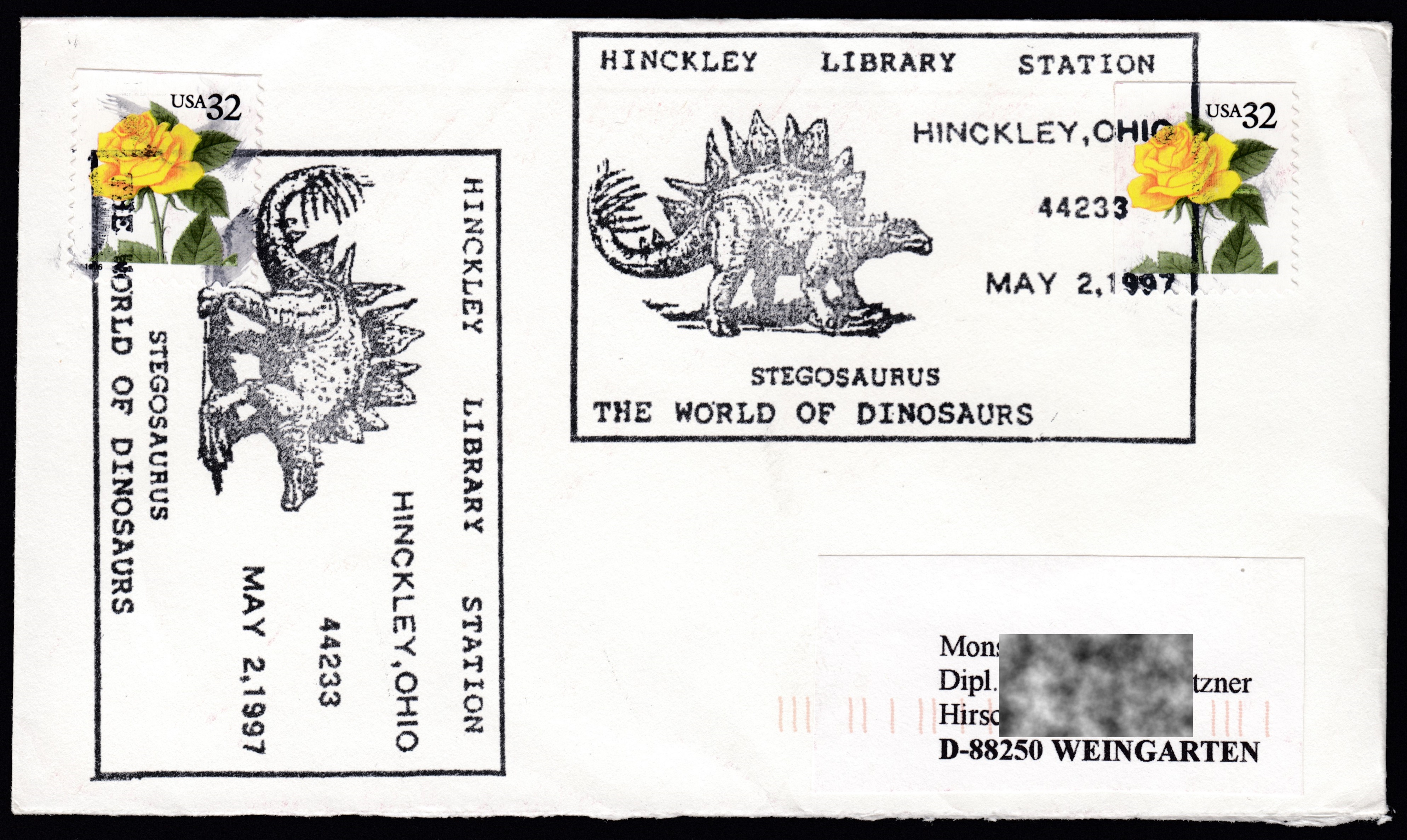
| 02.05.1997 "The world of Dinosaurs, Hinckley Library Station, Hinckley, Ohio" [Sp] |
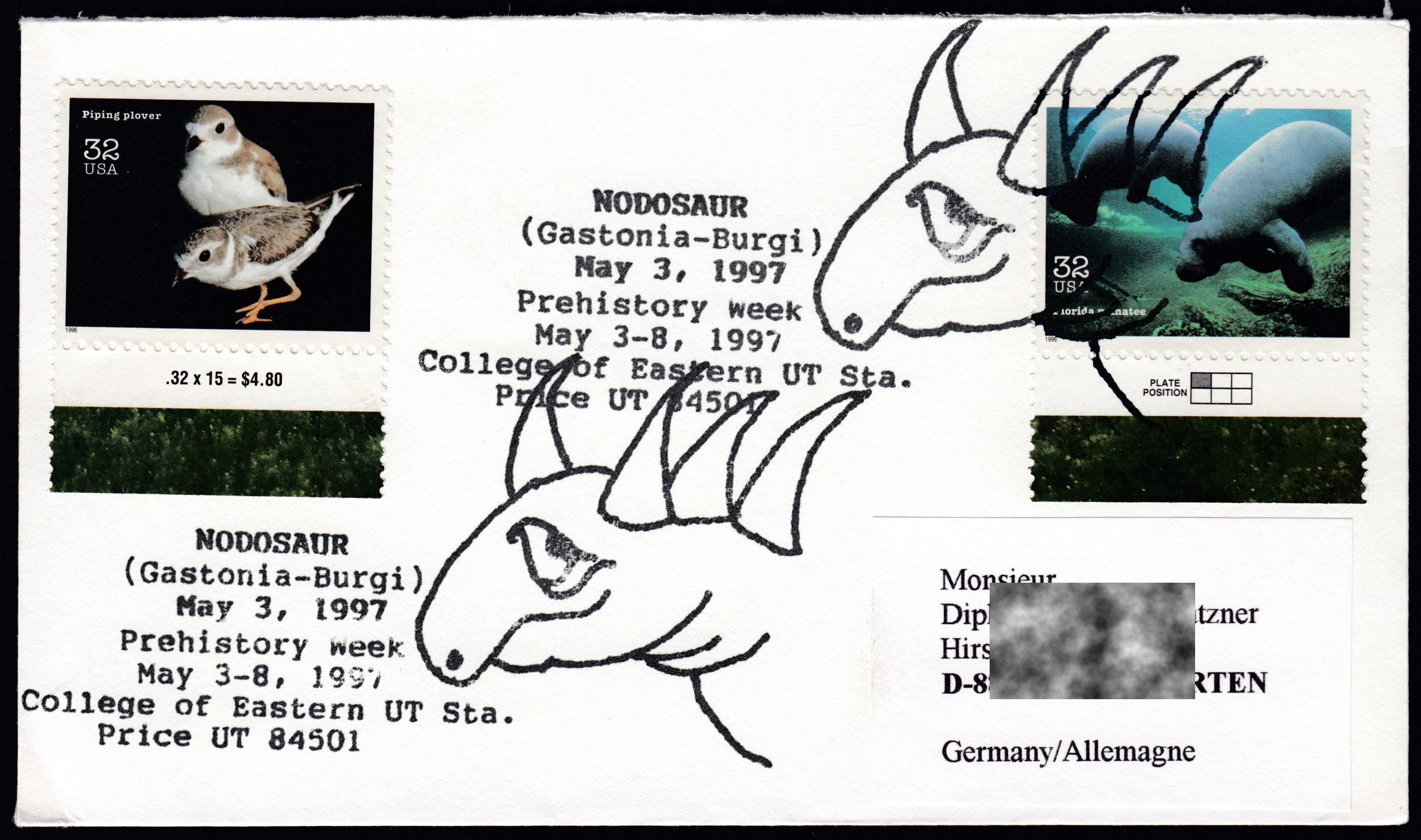
02.05.1997 "Prehistory week in College of Eastern UT Sta., Price, UT" [Sp] |
03.05.1997 "New Mexico Museum of Natural History and Science" [Sp] |
|
|
|

|
|
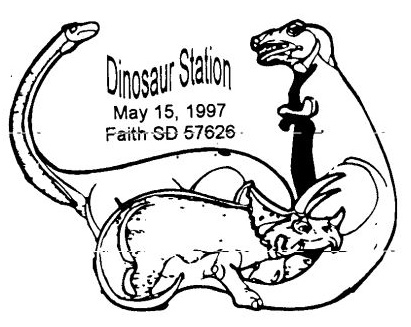
| 15.05.1997 "Dinosaur station, Faith, SD" [Sp] |
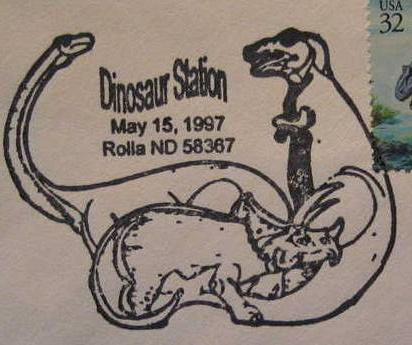
15.05.1997 "Dinosaur station, Rolla, ND" [Sp] |
16.05.1997 "DINO Station Canton, OH" [Sp] |
|
|
|

|
|
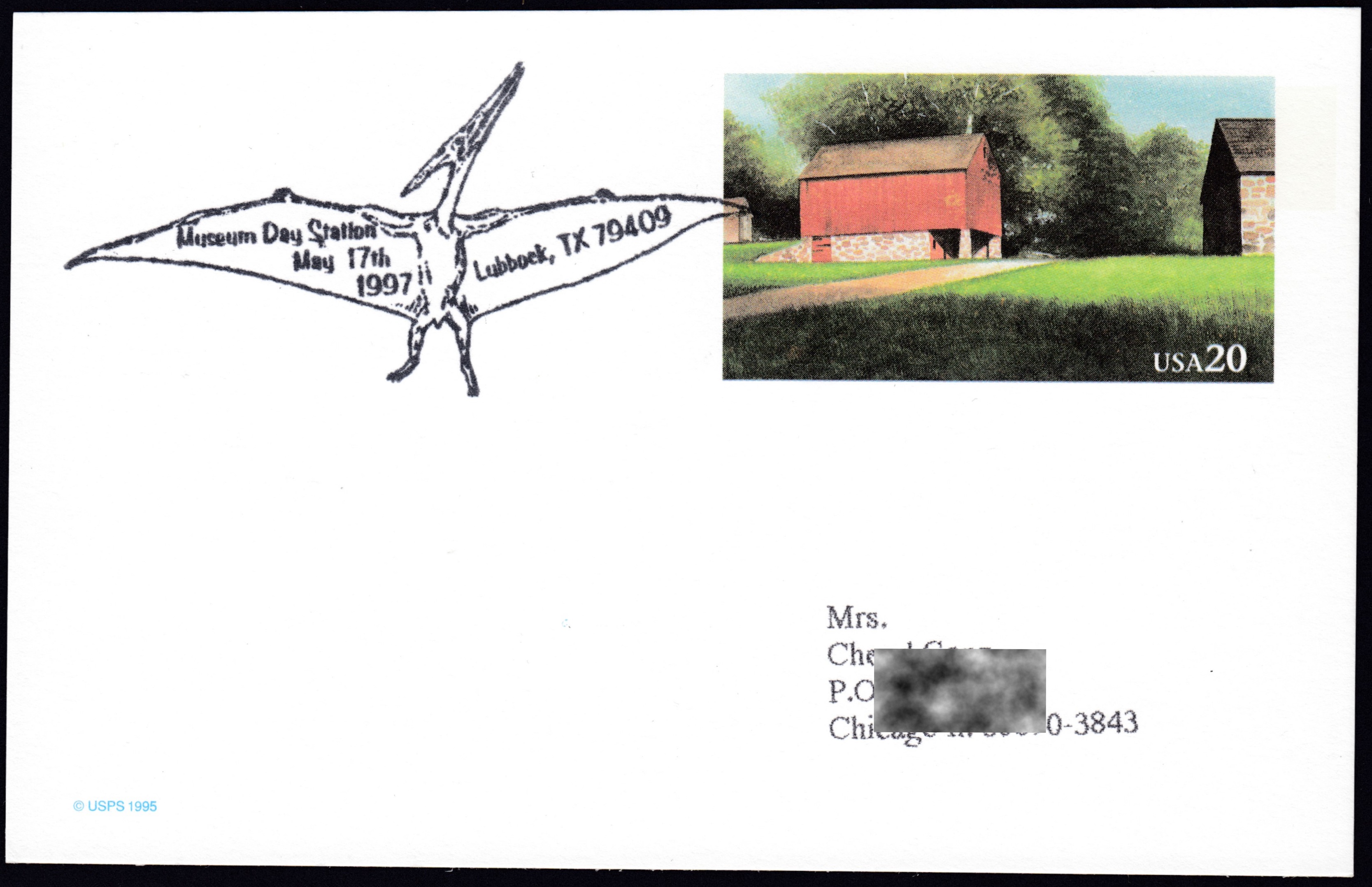
| 17.05.1997 "Museum Day Station, Lubbock, TX" [Sp] |
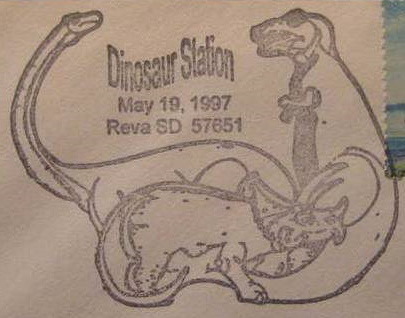
19.05.1997 "Dinosaur station, Reva, SD" [Sp] - |
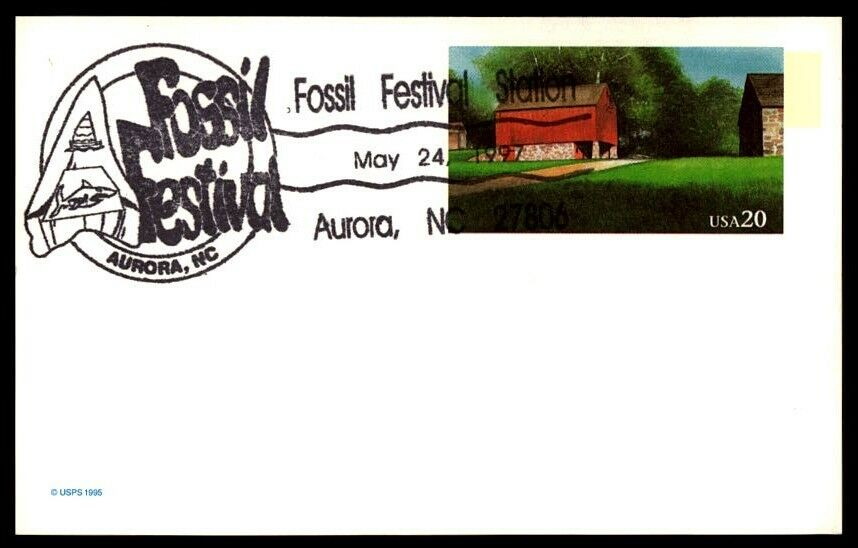
24.05.1997 "Fossil Festival Station, Aurora, NO" [Sp] |
|
|
|
|
|
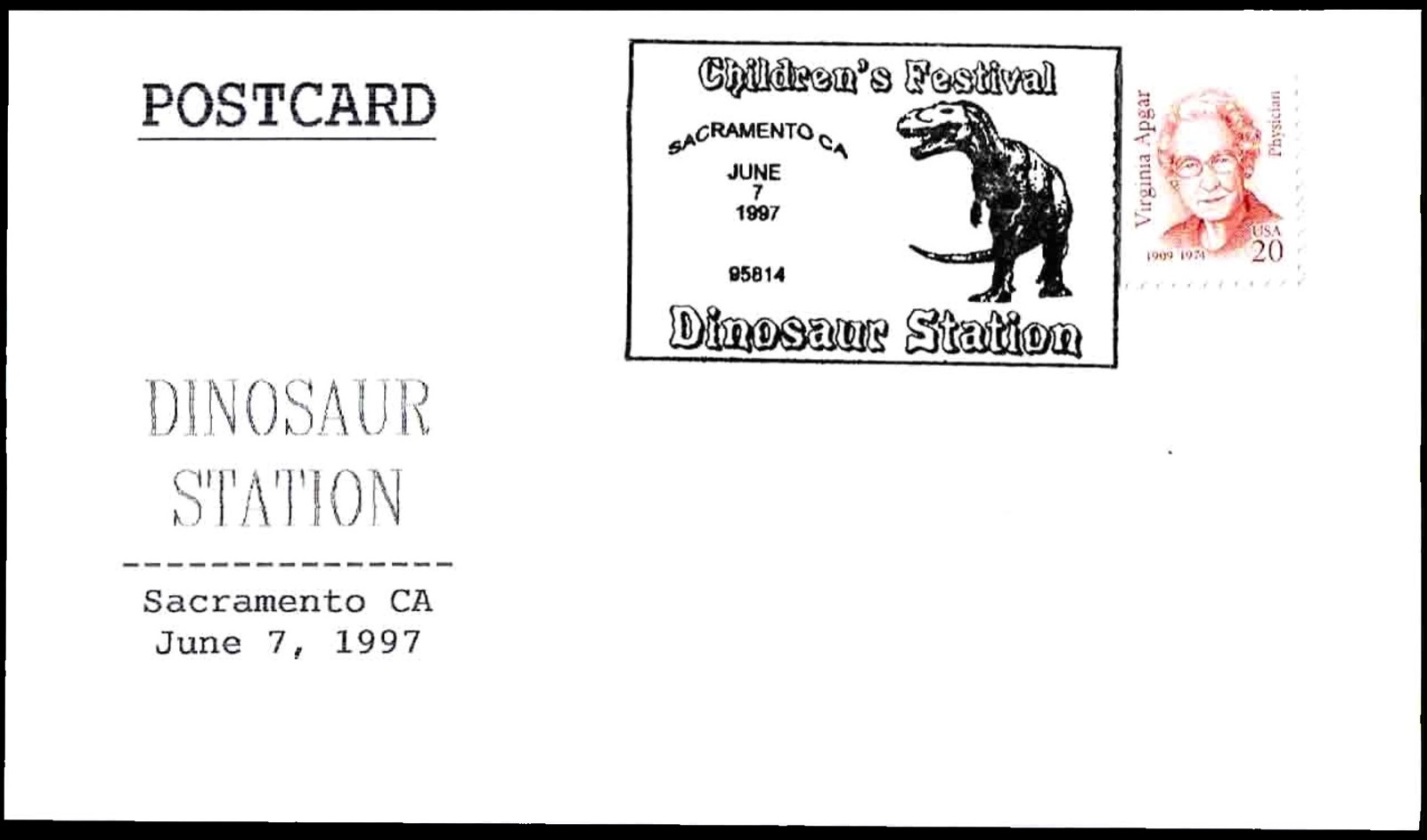
| 07.06.1997 "Dinosaur Station, Children's Festival, Sacramento, CA" [Sp] |
21.06.1997 "Planet Dinosaur, Fernbank Museum of Natural History, Atlanta, GA" [Sp] - |
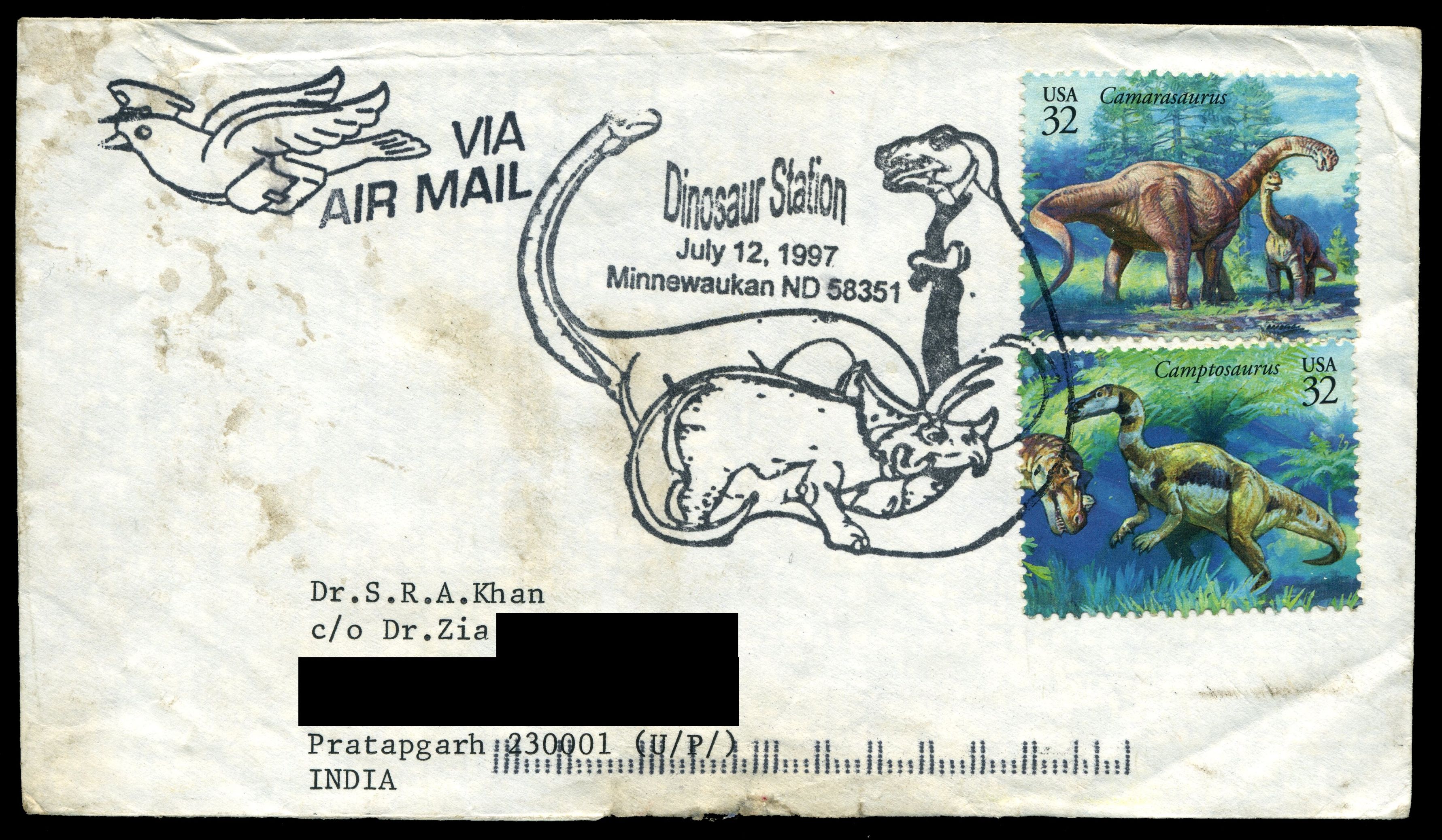
12.07.1997 "Dinosaur station, Minnewaukan, ND" [Sp] |
|
|

|
|
|
| 12.07.1997 "Dinamation, Virginia Living Museum" [Sp] - |
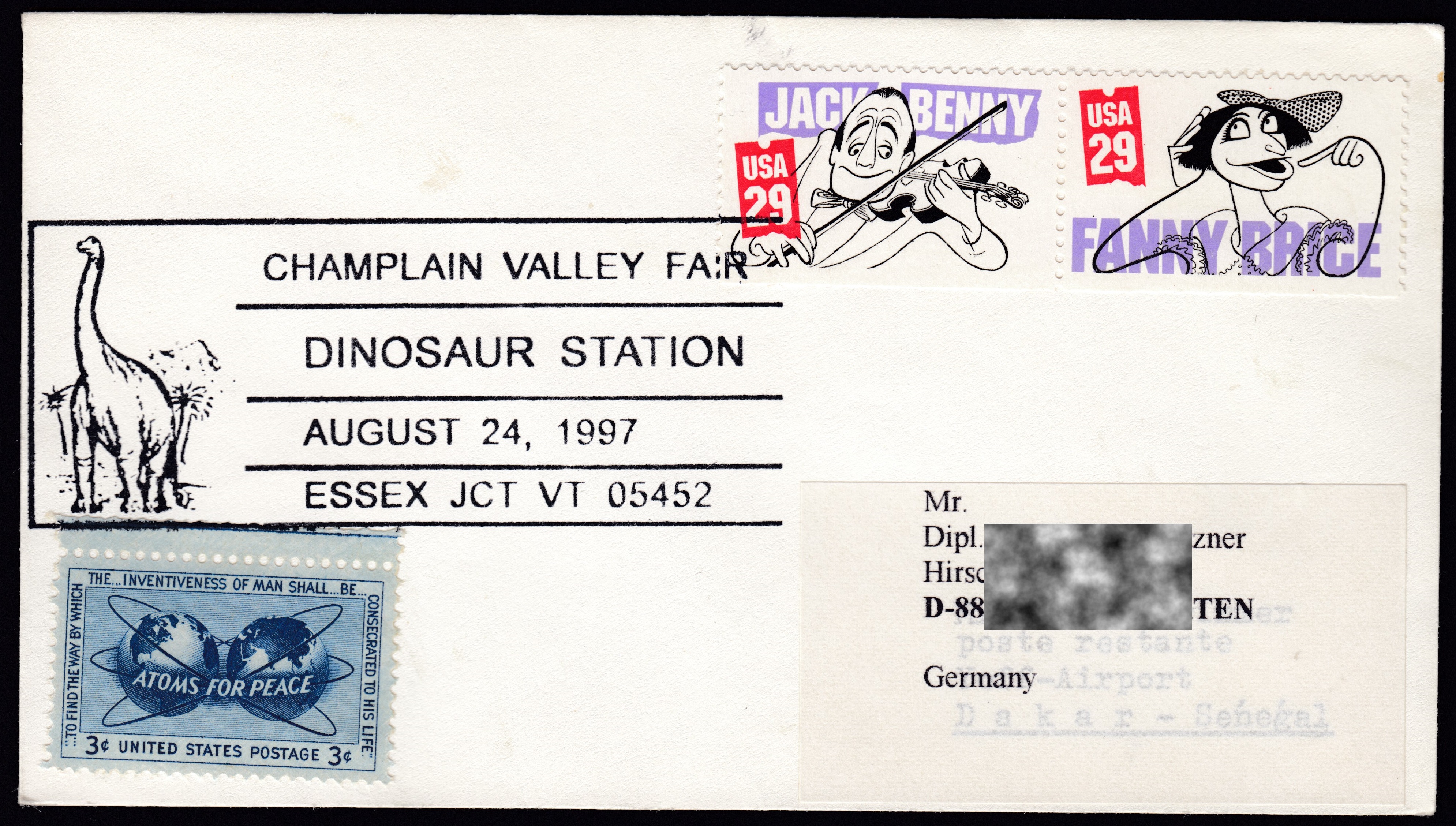
24.08.1997 "Dinosaur Station, Champlain Valley Fait, Essex, JCT" [Sp] |
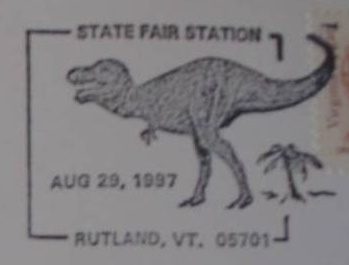
29.08.1997 "State Fair Station, Rutland, VT" [Sp] - |
|

|
|
|
|
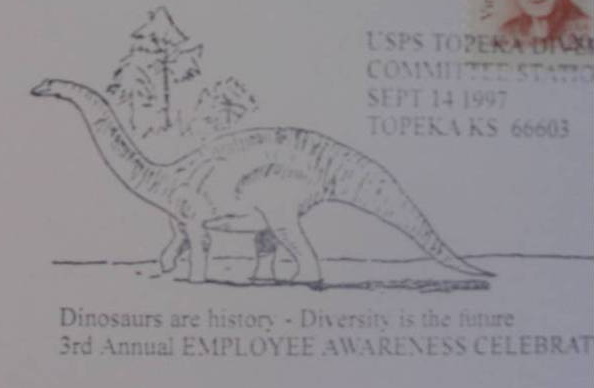
| 14.09.1997 "3rd Employee Awareness Celebration, TOPEKA, KS" [Sp] |
20.09.1997 "Falls of the Ohio Fossil Festival, Clarksville, Indiana" [Sp] - |
27.09.1997 "Designing Dinosaurs, solving prehistoric puzzles. Bruce Museum Station, Greenwich, CT" [Sp] |
|
|

|

|
|
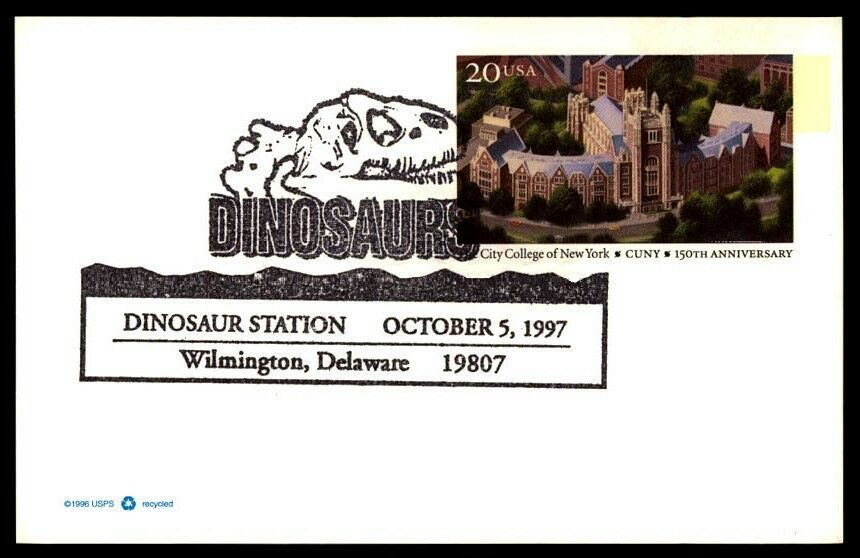
| 05.10.1997 "Dinosaur Station, Wilmington, Delaware" [Sp] |
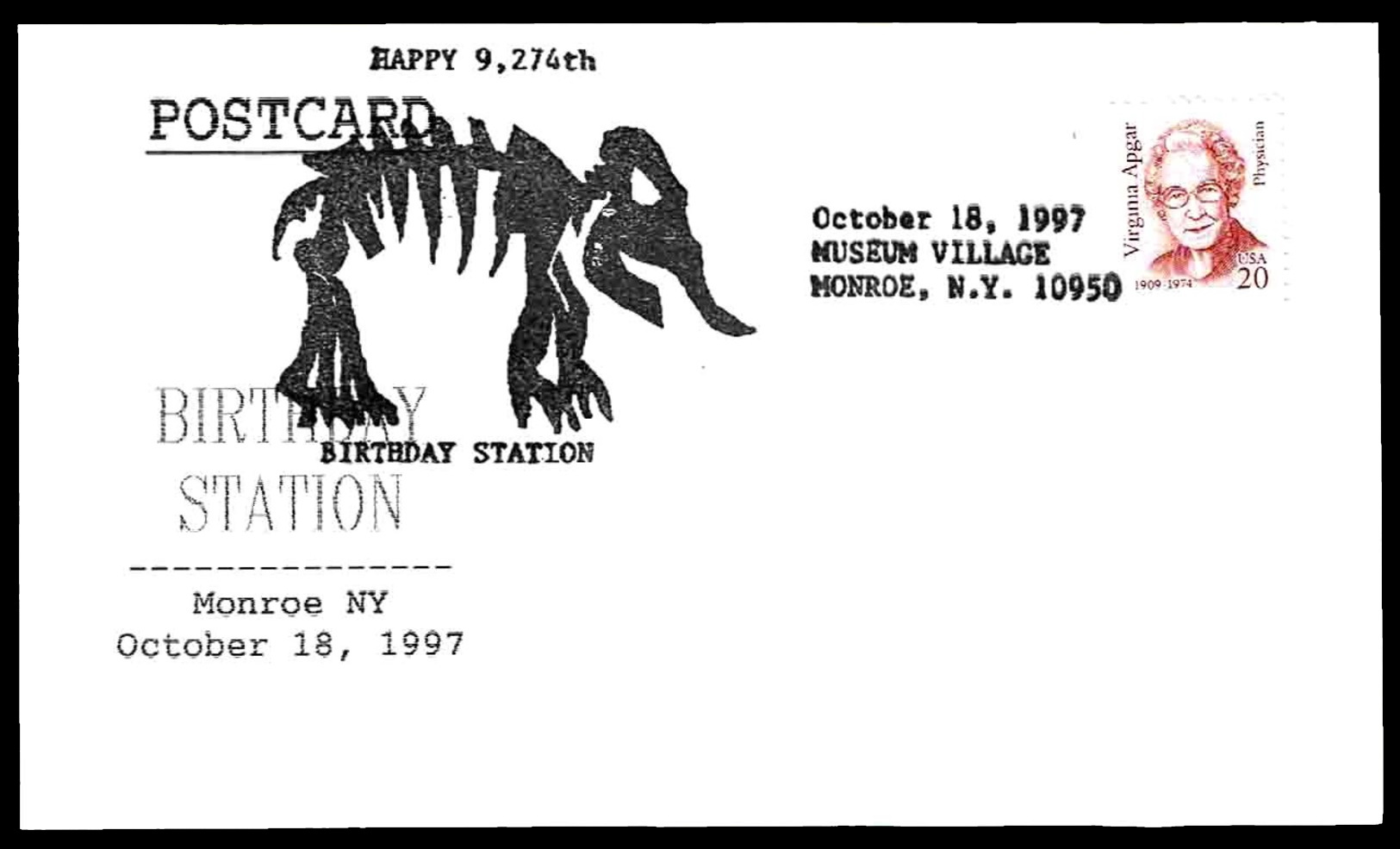
18.10.1997 "Birthday Station, Museum Villace, Monroe, N.Y." [Sp] - |
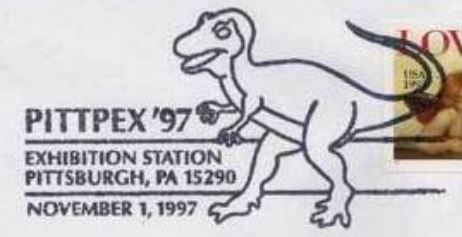
01.11.1997 "PITTPEX'97, Exhibition Station, Pittsburgh, PA" [Sp] |
|
|
|
|
|
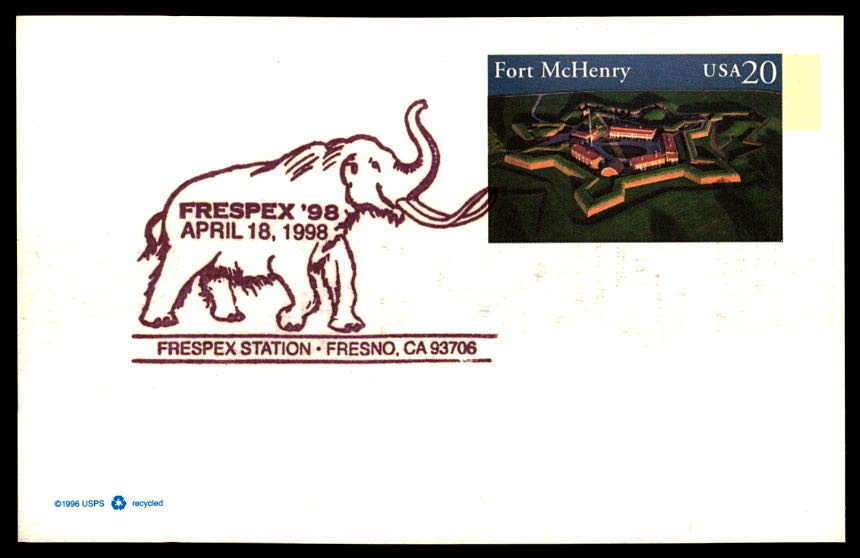
| 18.04.1998 "FRESPEX'98, Frespex Station, Fresno, CA" [Sp] |
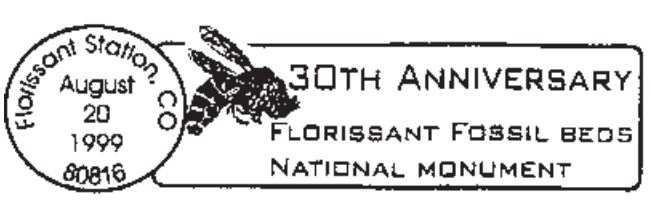
20.08.1999 "30th anniversary Florissant Fossil Beds, National Monument." [Sp] |
23.05.1999 "Fossil Festival Station, Aurora, NC" [Sp] |
|
|
|
 |
|
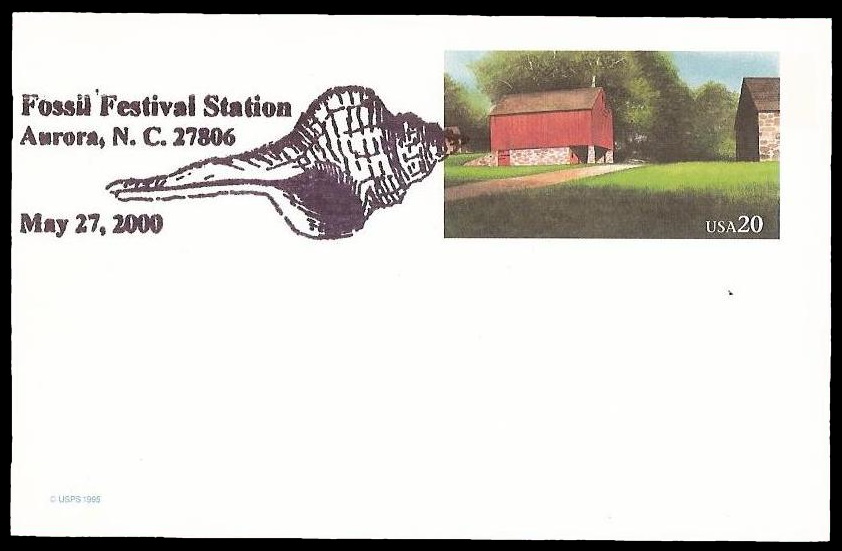
| 27.05.2000 "Fossil Festival Station, Aurora N.C." [Sp] |
|||
|
|||
| 19.08.2000 "Fish within a Fish, Gove country Kansas" [Sp] |
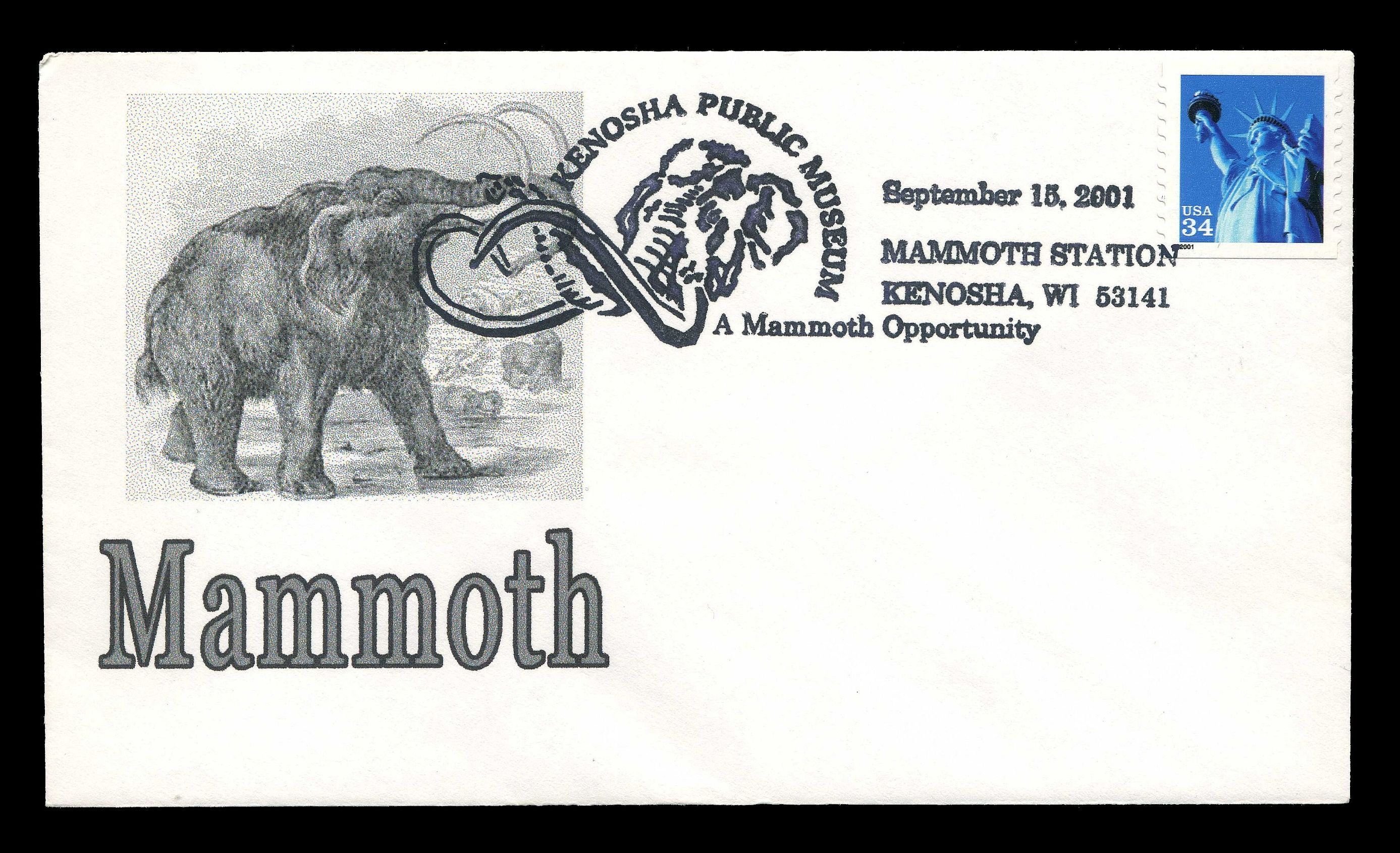
15.09.2001 "Kenosha Philatelic Museum, mammoth Station" [Sp] |
23.09.2000 "3rd annual Hamptonburgh Country Festival" [Sp] |
|

|
|

|
|
| 30.03.2001 "MAPS EXPO XXIII Station, the Year of the Trilobite" [Sp] |
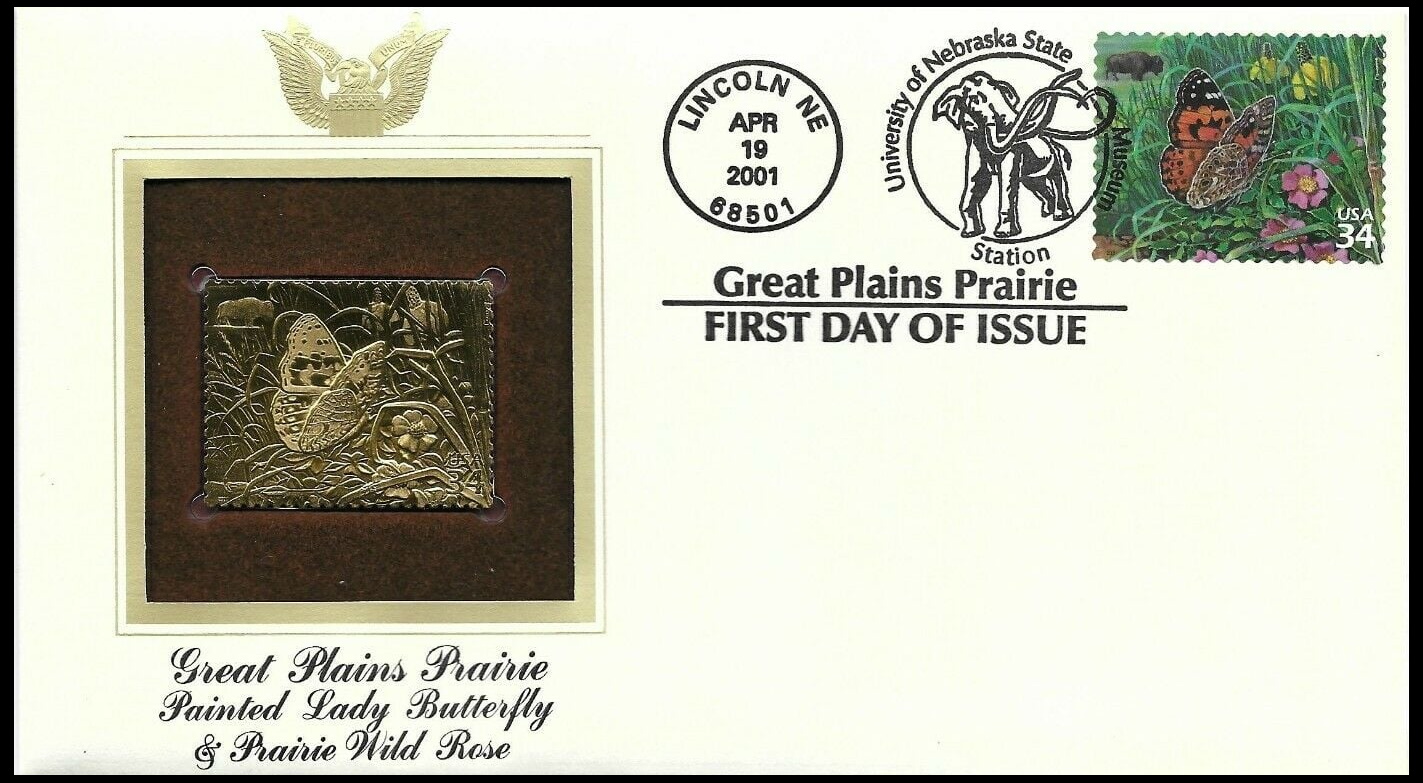
19.04.2001 "University of Nebraska State" [FDC] |
26.05.2001 "Fossil Festival Station, Aurora, NC" [Sp] |
|

|
|

|
|
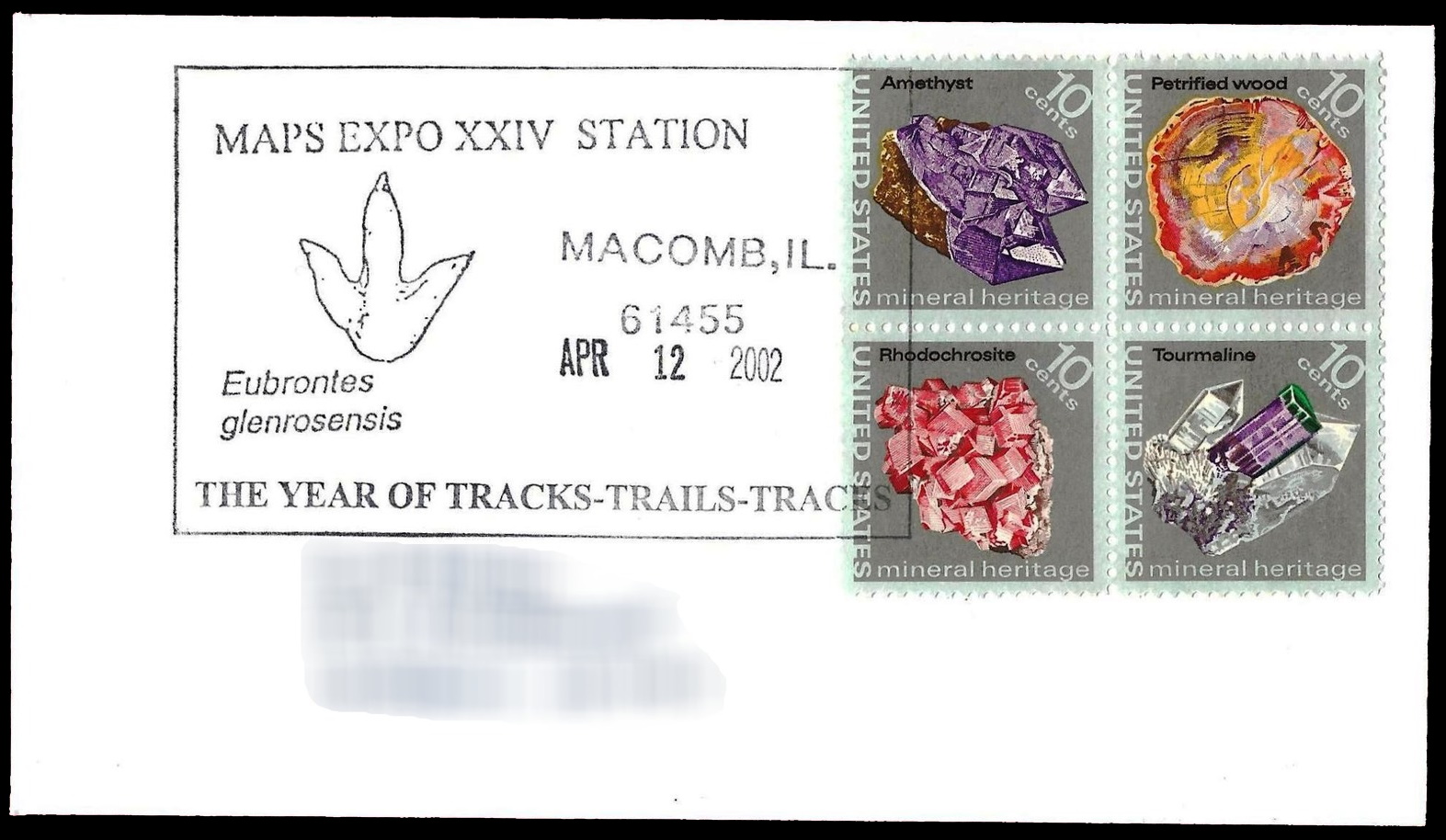
| 12.04.2002 "MAPS EXPO XXIII Station, the Year of tracks trails tracks" [Sp] |
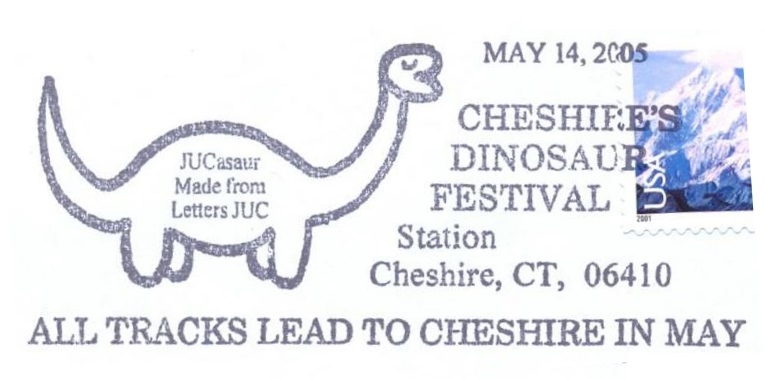
14.05.2005 "Cheshire’s Dinosaur Festival Station, Cheshire, CT" [Sp] - |
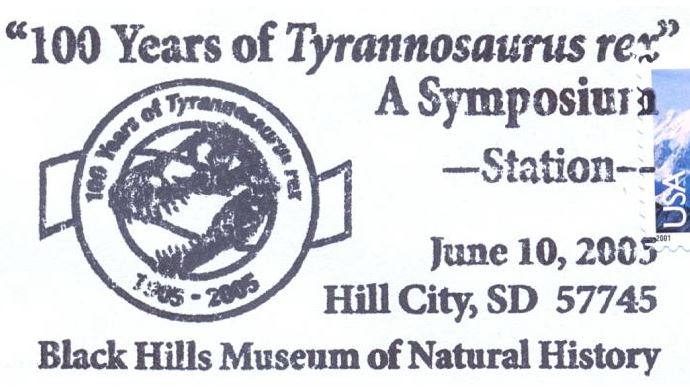
10.06.2005 "100 years of Tyrannosaurus rex, a Symposium Station, Hill City, SD" [Sp] |
|
|
|
|
|
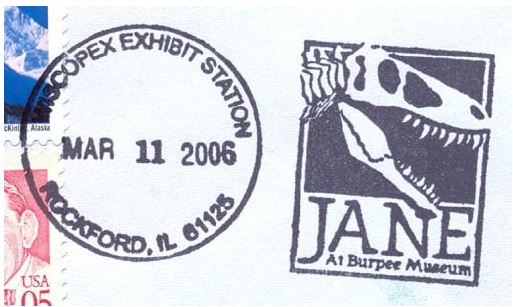
| 11.03.2006 "Wiscopex Exhibit Station, Jane at Burpee Museum, Rockford, IL" [Sp] - |
10.06.2006 "A special exhibition, A T. Rex Named Sue, Sam Noble Oklahoma Museum of Natural History, Norman, OK" [Sp] - |
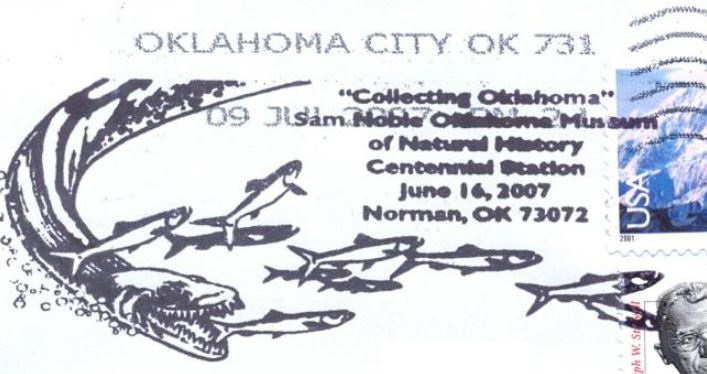
16.06.2007 "Collecting Oklahoma, Sam Noble Oklahoma Museum of Natural History, Norman, OK" [Sp] |
|
|

|
|
|
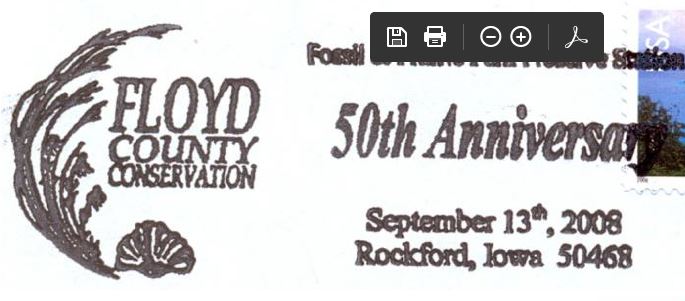
| 13.09.2008 "Floyd Country Conservation, Rockford, Iowa" [Sp] - |
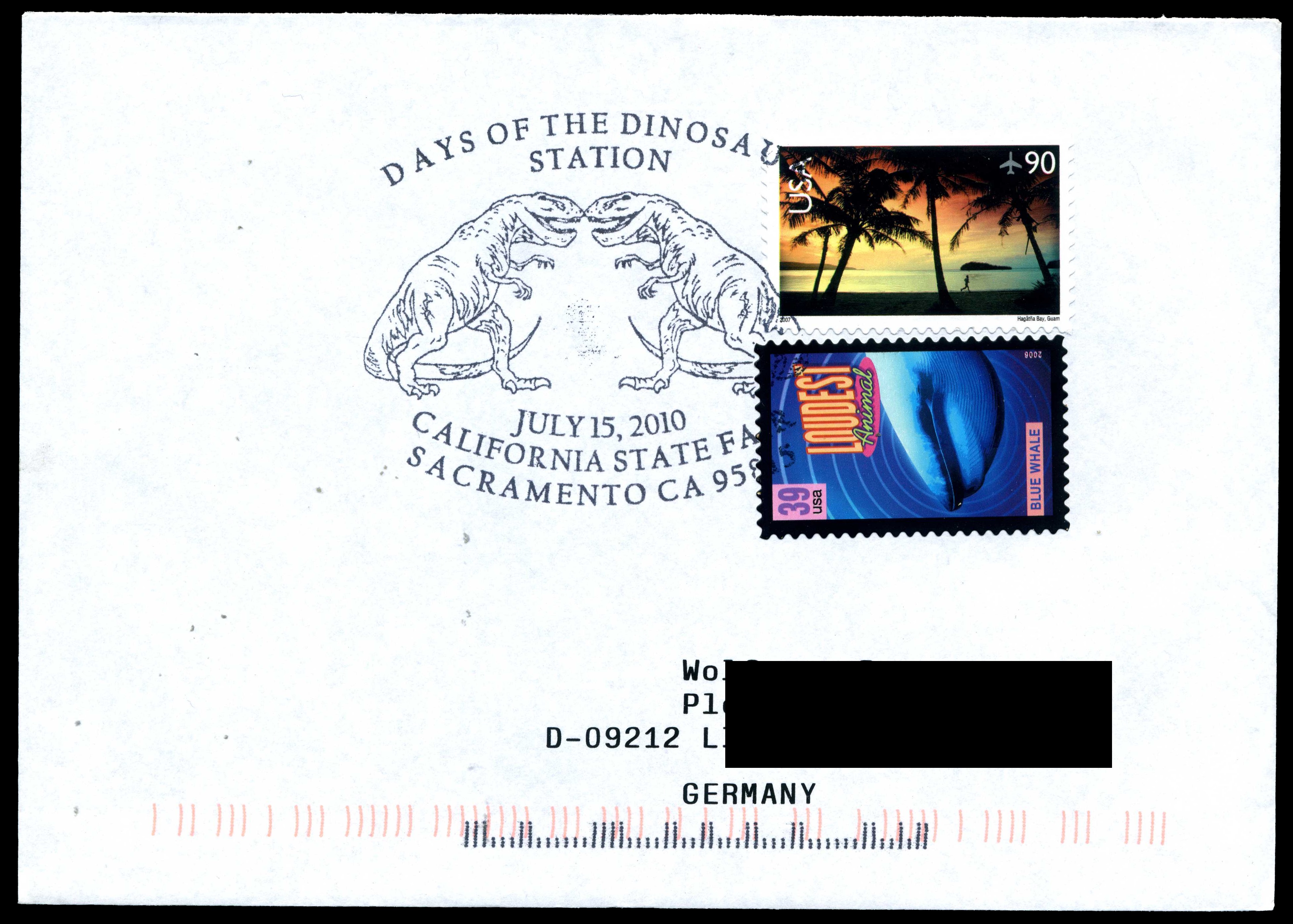
15.07.2010 "Days of the Dinosaur Station, California State Fair, Sacramento, CA" [Sp] - |
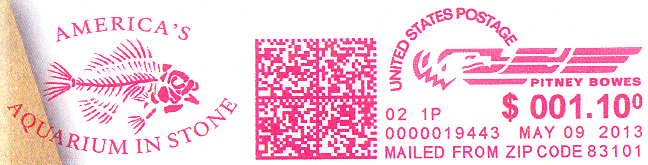
2013[DU] "America's Aquarium in Stone" [Sp] |
|
|
|
|
|
| 2019 | |||
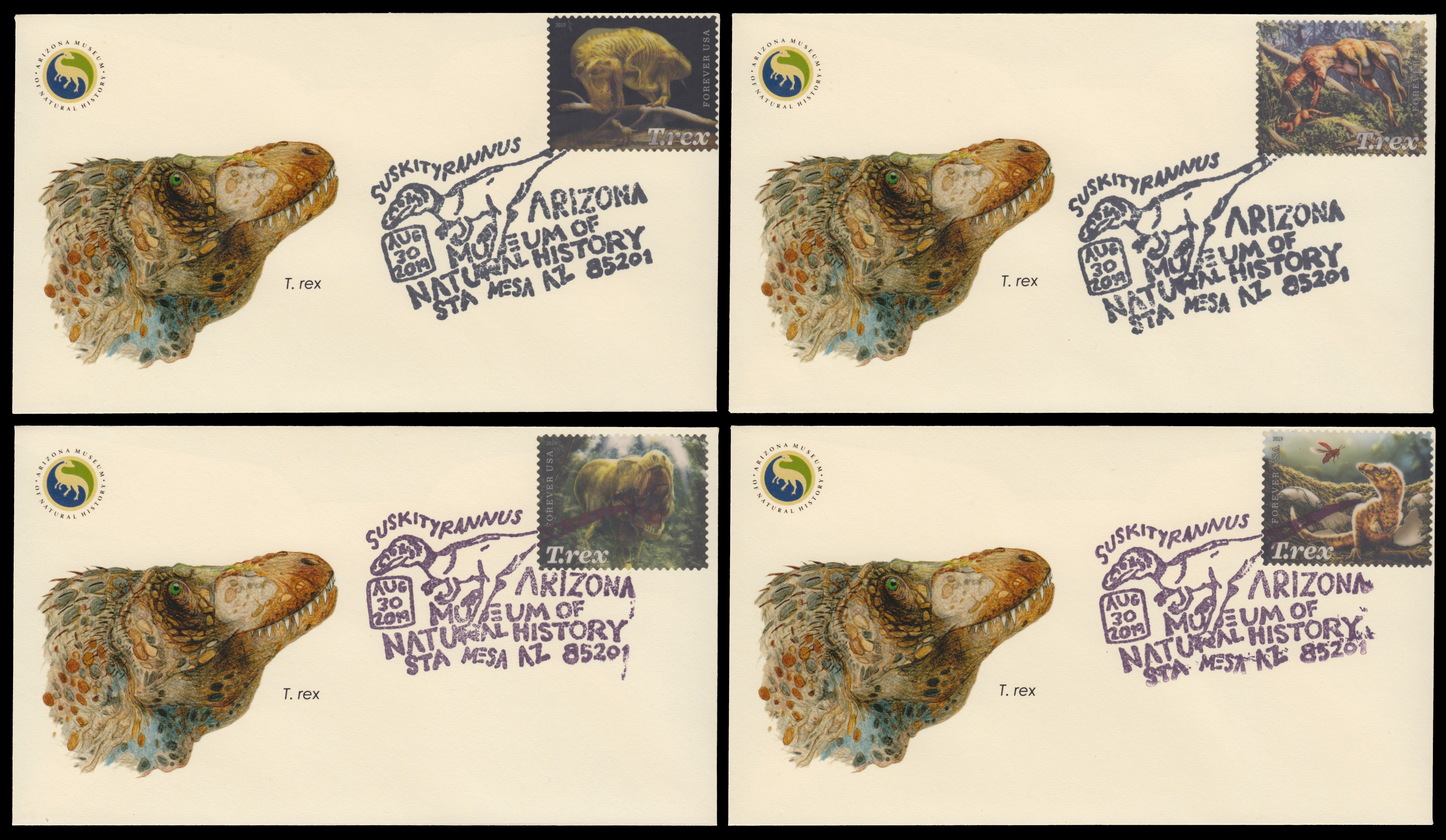
| 29.08.2019 "Tyrannosaurus Rex, Washington, DC" [FDC] | 29.08.2019 "Tyrannosaurus, Washington, DC" [FDC] | 30.08.2019 "Arizona Museum of Natural History" [Sp] | |
|
|
|
|
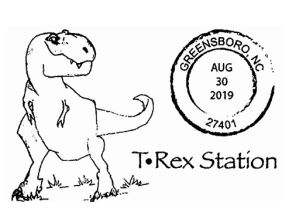
| 30.08.2019 "T-Rex Station, Greensboro, NC" [Sp] - |
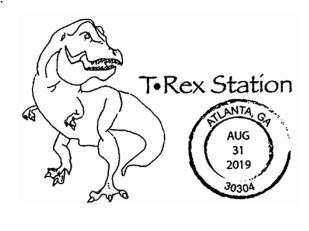
31.08.2019 "T-Rex Station, Atlanta, GA" [Sp] - |
31.08.2019 "T-Rex Station, Fayetteville, GA" [Sp] - |
|
|
|

|
|
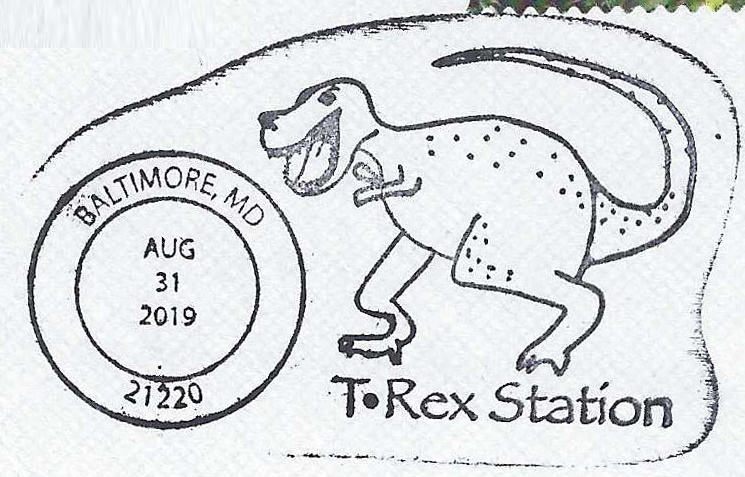
| 31.08.2019 "T-Rex Station, Baltimore, MD" [Sp] - |
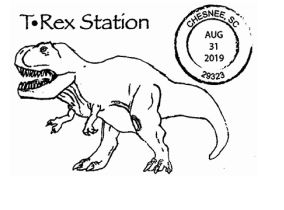
31.08.2019 "T-Rex Station, Chesnee, SC" [Sp] - |
31.08.2019 "T-Rex Station, Cover, SC" [Sp] - |
|
|
|

|
|
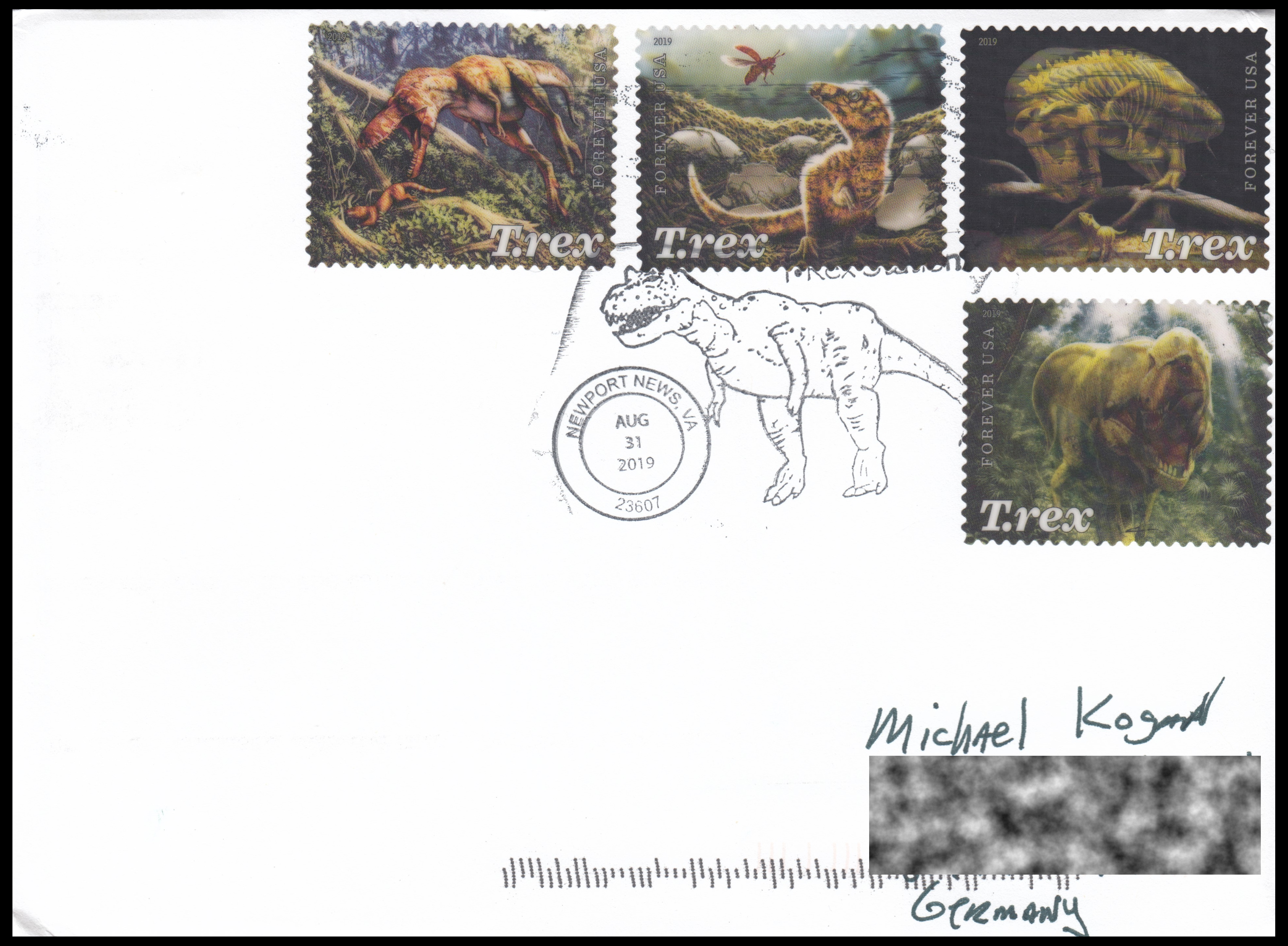
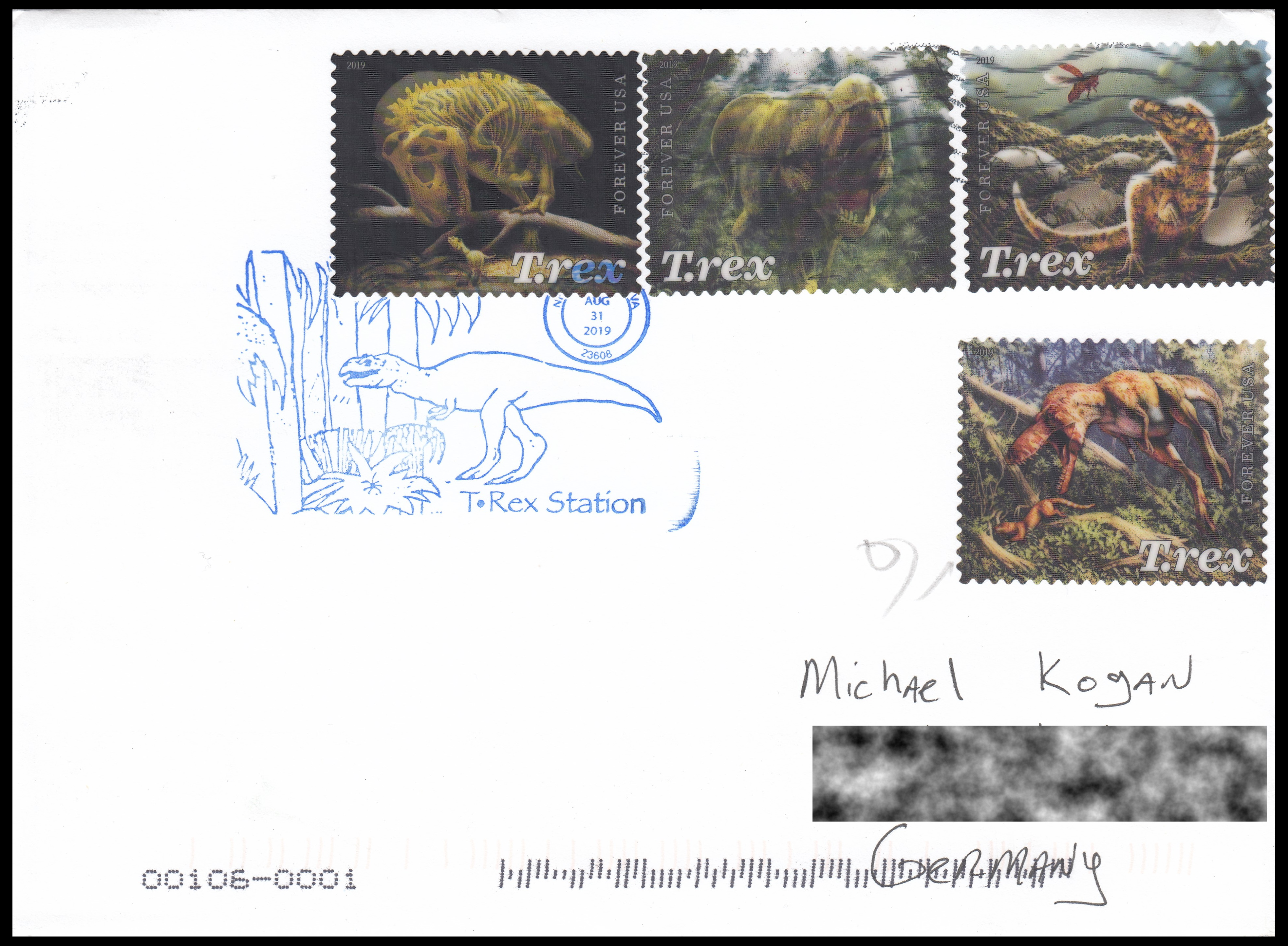
| 31.08.2019 "T-Rex Station, Newport News, VA" [Sp] | |||

|
|
|
|
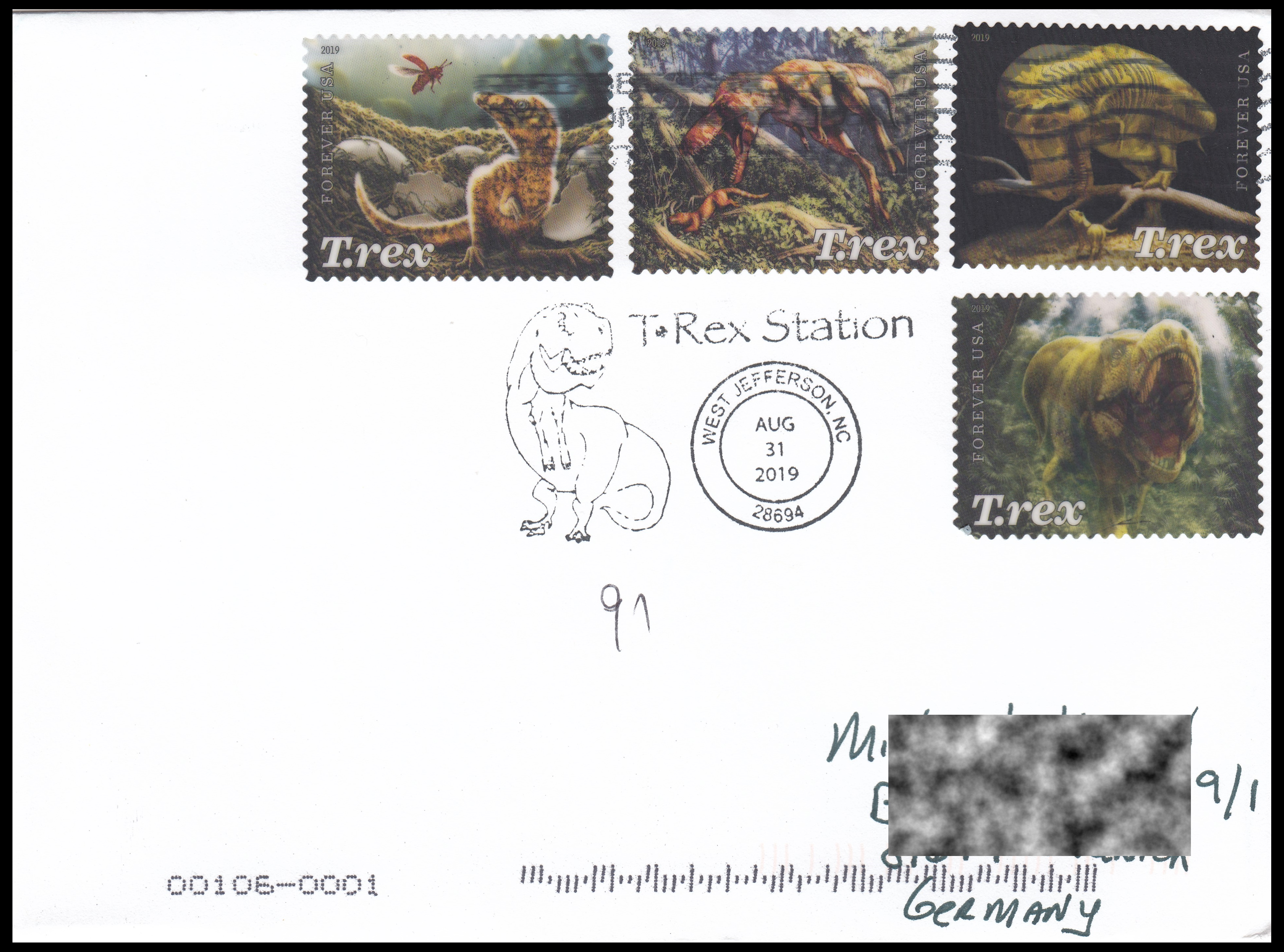
| 31.08.2019 "T-Rex Station, West Jefferson, NC" [Sp] |
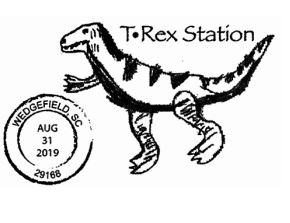
31.08.2019 "T-Rex Station, Wedgefield, SC" [Sp] - |
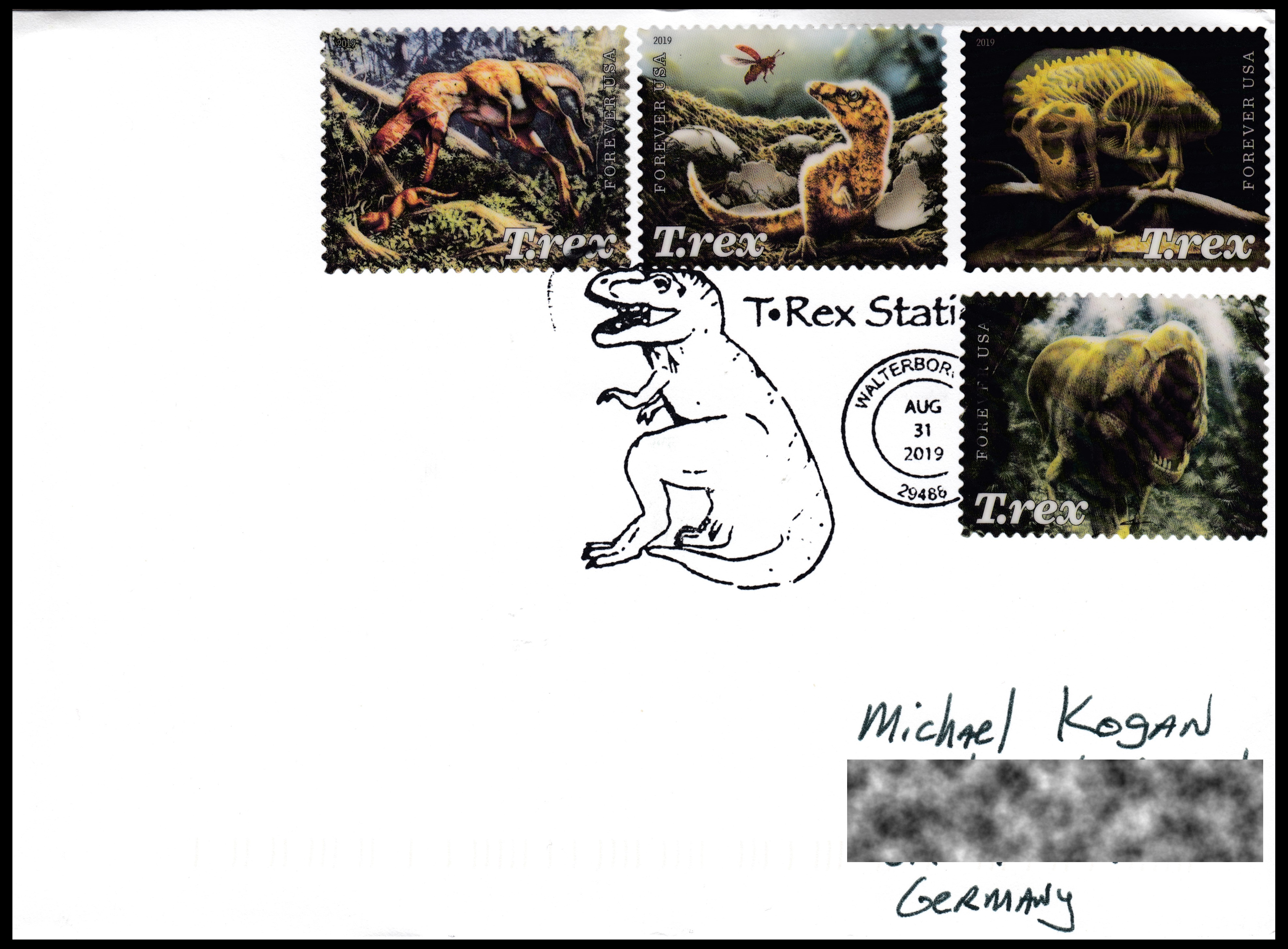
31.08.2019 "T-Rex Station, Walterboro, SC" [Sp] |
|
|
|
|
|
| 31.08.2019 "T-Rex Station, Clover, SC" [Sp] - |
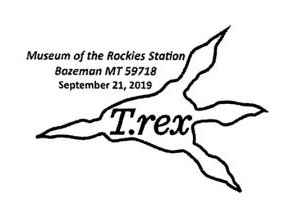
21.09.2019 "Museum of the Rockies Station" [Sp] - |
||

|
|
|
|
Postmarks and meter frankings of commercial companies with fossils and prehistoric animals on it.
Legend is here
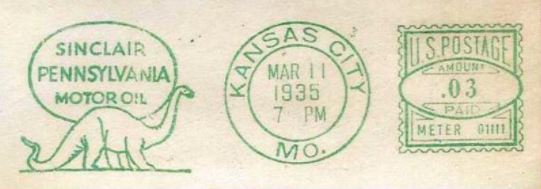
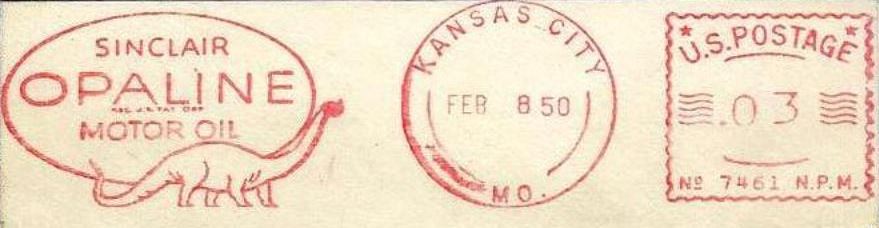
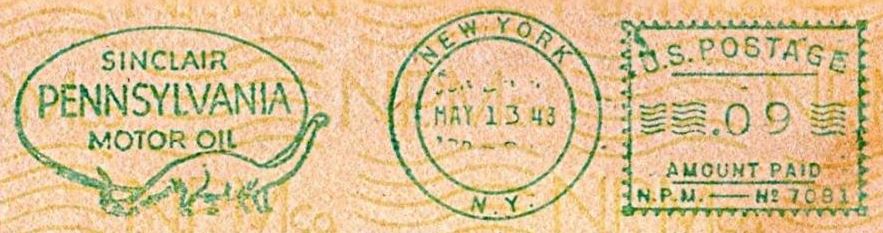
| 1934-1941 Sinclair Company, type 1 [PM] [PMC1] | 1934-1942 Sinclair Company, type 2 [PM] [PMC1] | 1934-1941 Sinclair Company, type 3 [PM] [PMC1] |
 |
 |

|
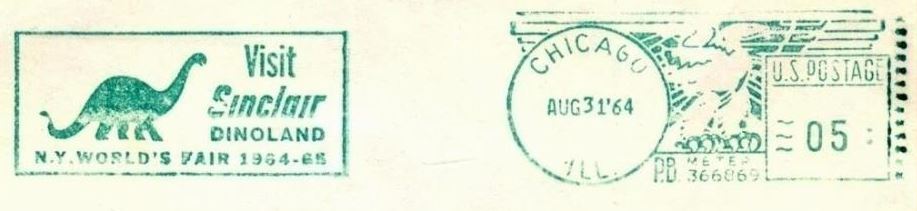
| 1939-1952 Sinclair Company, type 4 [PM] [PMC1] | 1939-1948 Sinclair Company, type 5 [PM] [PMC1] | 1964-1965 Sinclair Company, type 6 [PM] [PMC1] |
|
|
|
Notes:
[PMC1] Between 1934 and 1965, the Sinclair Oil Company used this meter franking, as well as regular advertisements to advertise their motor oil.
In 1935 - 1938 they also run an Ad campaign. As part of it, they issued set of stamps-like labels (this kind of "stamps" are known as Cinderellas in philatelic community) depicting various dinosaurs. This is the first Cinderella set of stamps depicting prehistoric animals ever. (Examples of these stamps are here )
They chose a dinosaur for a company logo as a symbol of the great length of time their oil spent in the ground.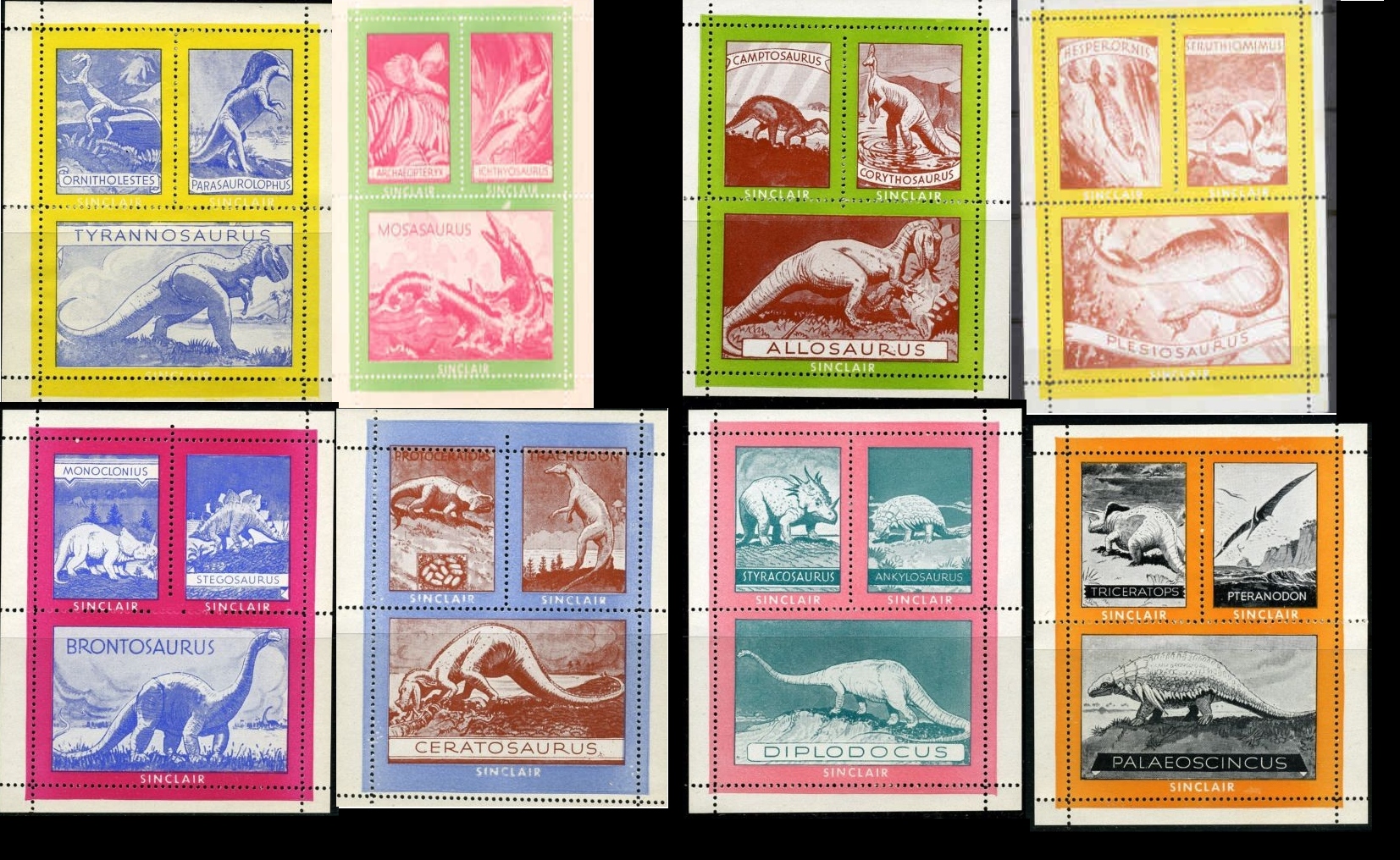
For more information about Sinclair meter frankings, please have a look at
- "Oil and Dinosaurs" presentation of Mr. Dominique ROBILLARD (available in French too)
- "Sinclair postmarks" presentation of Mr. Fran Adams
Postmarks with Paleontology related Town Names
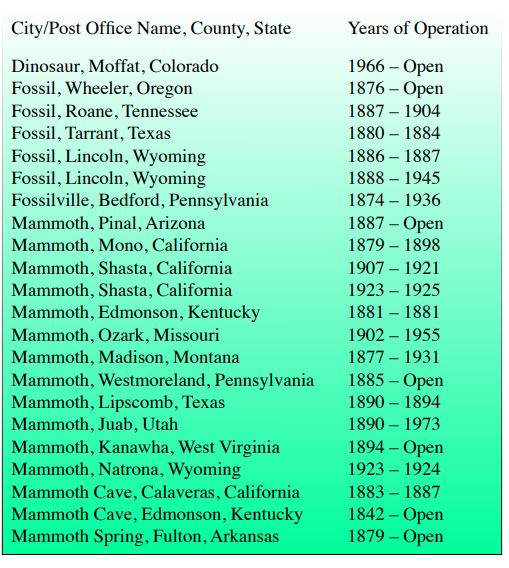
There are several places across USA named Dinosaur, Fossil, Mammoth etc.
|
| Full list of Post offices with names of Dinosaur, Fossil, Mammoth etc. published in "The Mezozoic Time" blog and "The Mezozoic Time" magazine of Fran Adam. |
However, not every town in the list has a connection to the paleontological subject of its name.
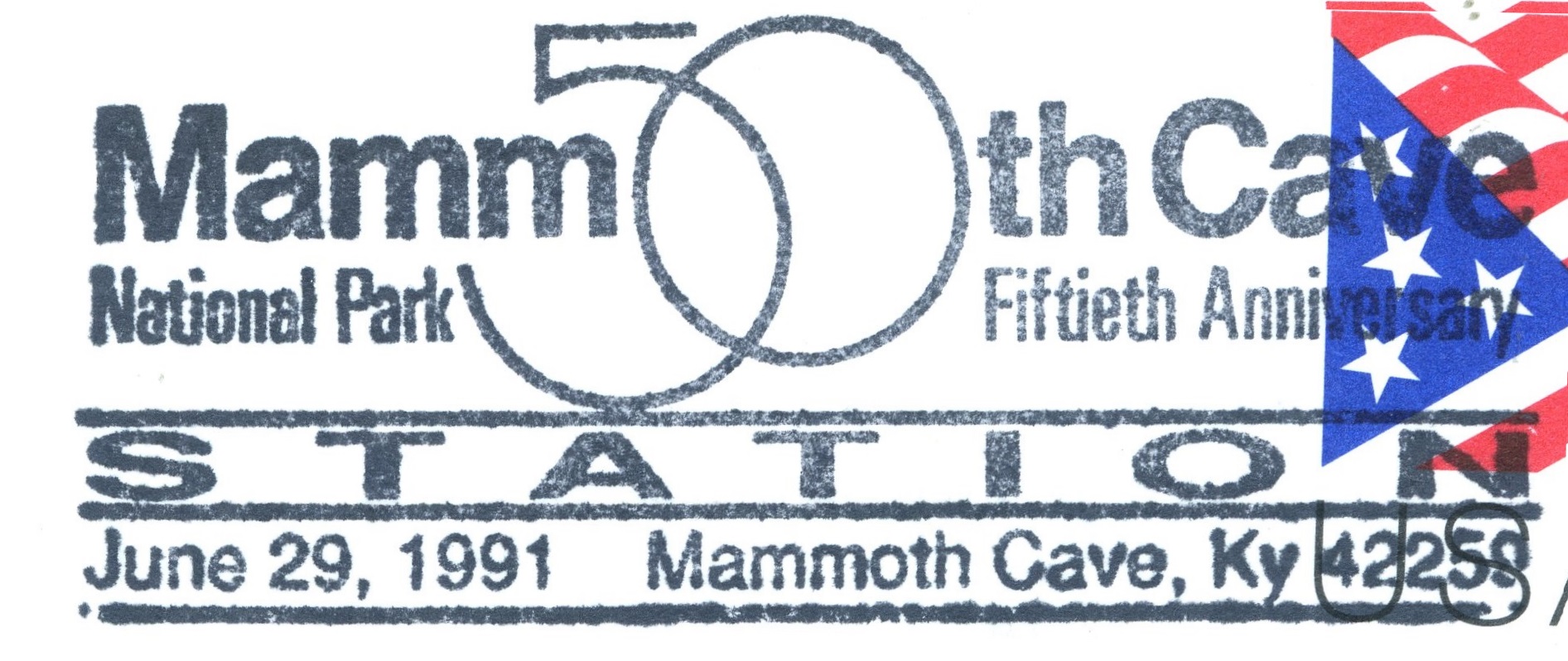
For example, no fossils of the woolly mammoth have ever been found in Mammoth Cave,
and the name of the cave has nothing to do with this extinct mammal.
The cave's name refers to the large width and length of the passages connecting to the Rotunda just inside the entrance.
[R15]
Many of this locations have their post offices since middle of 19th centuty and changed with the time.
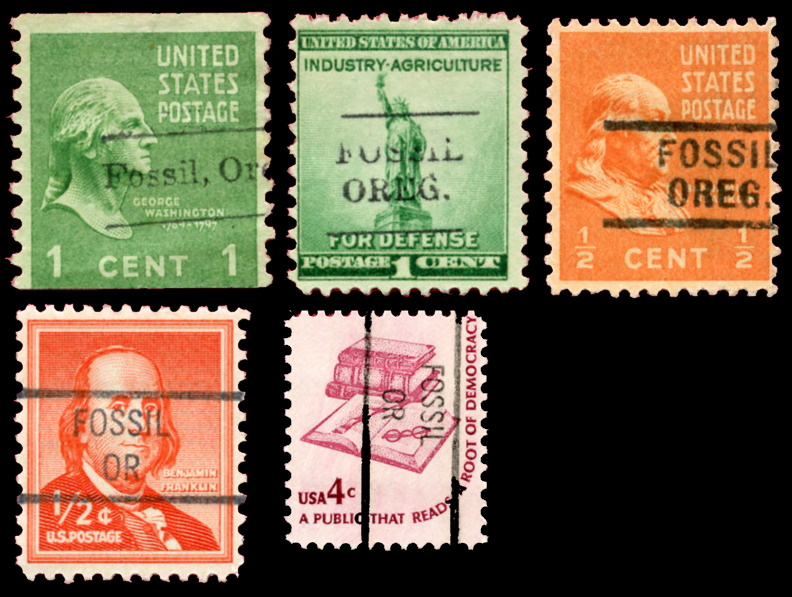
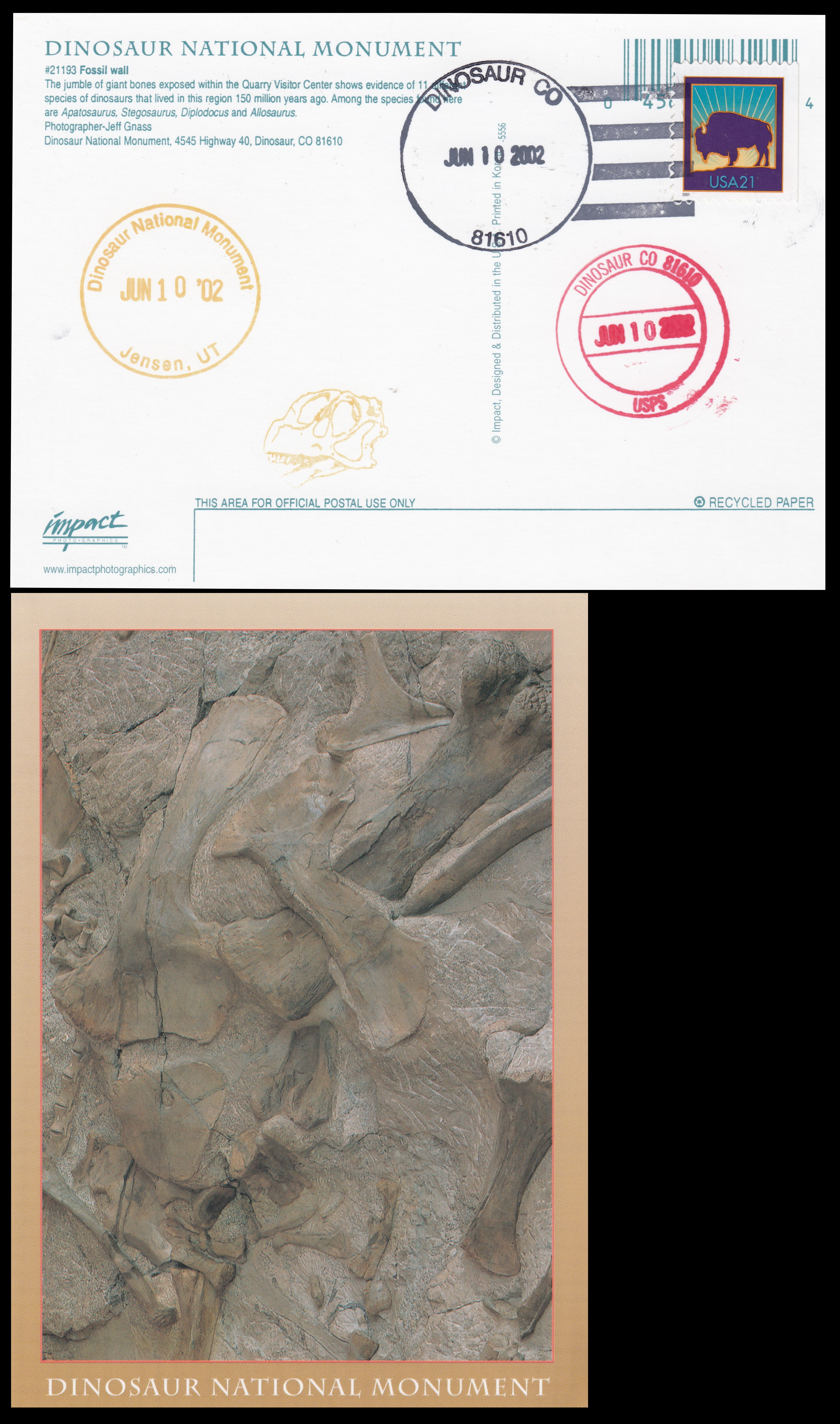
| Dinosaur Town, Colorado [PML1] | Fossil Town, Oregon – Precancels from 1960s [PML2] | Fossil Town, Oregon [PML2] |
 |
 |
 |
Notes:
[PML1] Dinosaur is a statutory town located in Moffat County, Colorado, United States. The town population was 339 at the 2010 census.
Originally established Dec 9th, 1947 as the Town of Artesia, Dinosaur Colorado, changed its name in 1966 to capitalize on the ever-increasing popularity of the Dinosaur National Monument, conveniently located just two miles east of the Town of Dinosaur.
|
|
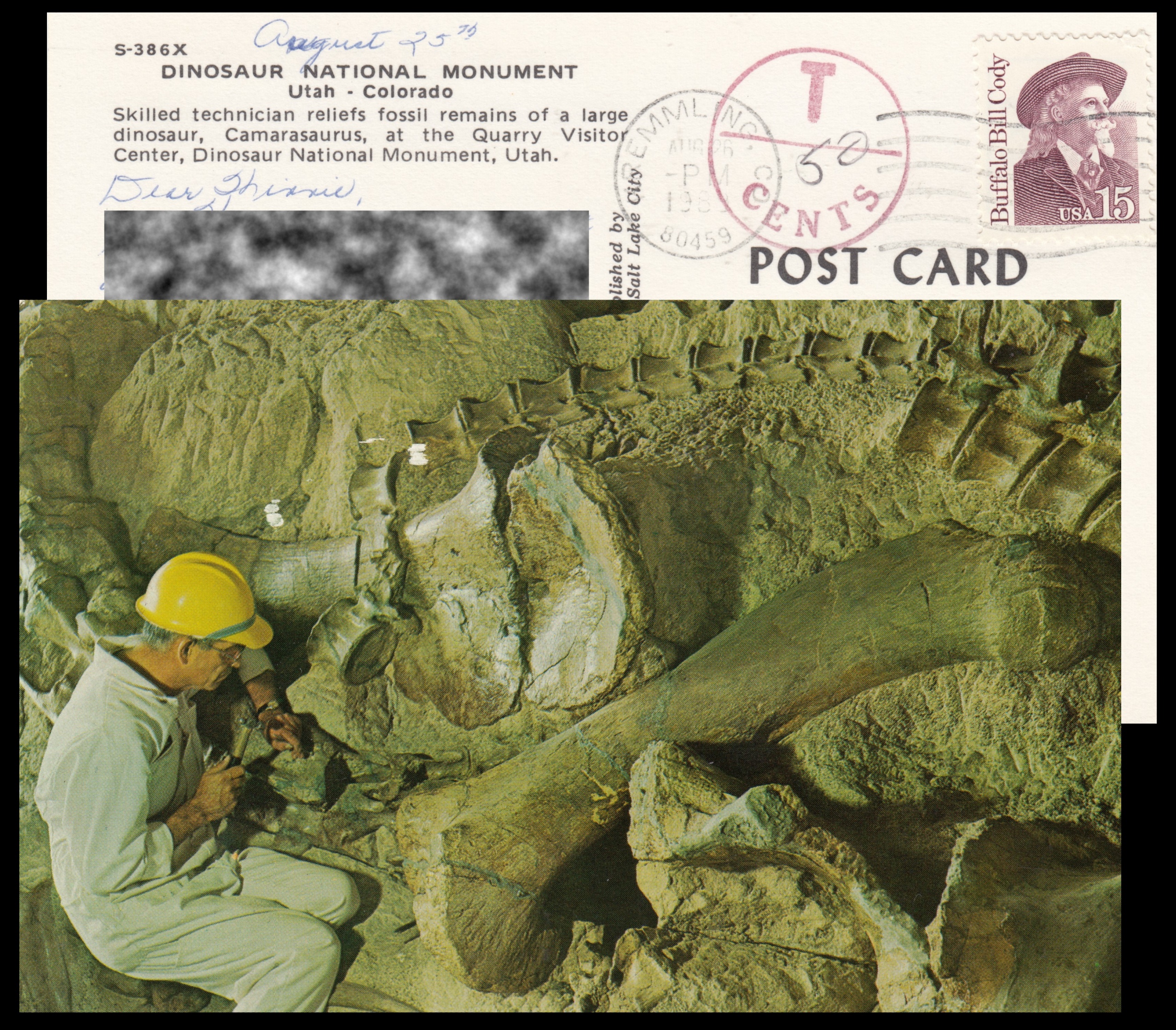
Dinosaur National Monument is an American national monument located on the southeast flank of the Uinta Mountains on the border between Colorado and Utah at the confluence of the Green and Yampa rivers.
The park contains over 800 paleontological sites and has fossils of dinosaurs including Allosaurus, Deinonychus, Abydosaurus, and other sauropods.
However, there are NO Dinosaur bones found on the Colorado side of the Monument yet.
[R8]
[PML2] Fossil is a town in and the county seat of Wheeler County, Oregon, United States. The name was chosen by the first postmaster, Thomas B. Hoover, who had found some fossil remains on his ranch. The population is about 500. The town is located nearby John Day Fossil Beds National Monument.
John Day Fossil Beds National Monument showcases one of the world’s best and most continuous records of the Tertiary,
the time from about 50 million years to 5 million years ago that is generally regarded as the Age of Mammals.
The fossils found in the National Monument’s three units helped define the evolution of horses, camelidsq,
felines, canids, and other important mammal lineages.
The fossils of the region were first discovered by soldiers who traveled the Dalles Military Road to the Canyon City area following the discovery of gold there in 1862.
They brought the fossil discoveries to the attention of Reverend Thomas Condon, Oregon’s first state geologist and first chair of the Geology Department at the University of Oregon.
In the 1870s, other famed paleontologists, including Othniel Marsh and Edwin Drinker Cope, sent expeditions to the area.
In the 1960s, the US Post Office sold pre-canceled stamps with the names of their post office locations.
Here are some variations of Fossil town in Oregon. All images are from mesozoictimes.wordpress.com website. Regular postmark with the name of the town is available till present.
Some other postmarks and meter frankings of USA to consider: stylized prehistoric animals, fossils of ancient humans (Homo sapiens)
Legend is here
| 01.10.1989 "Prehistoric animals" [FDC] | 02.10.1989 "Stamposaurus, Brisbin anniversary Station" [Sp] | 02.10.1989 "Stamposaurus, Harrisburg" [Sp] |
 |
 |
 |
| 02.10.1989 "Stamposaurus, New Orleans, LA" [Sp] | 02.10.1989 "Ben Franklin Stamp Club Station" [Sp] | 02.10.1989 "National Stamp Collecting Station, Utica, NY" [Sp] |
|

|

|
| 07.10.1989 "Stamposaurus, Fernbank Science Center Station" [Sp] | 07.10.1989 "National Stamp Collecting Station, Syracuse, NY" [Sp] | 16.10.1989 "Stamposaurus Station, White Cottage, Ohio" [Sp] |
|
|
|
| 21.10.1989 "Stamposaurus, Dinosaur Station, Charleston, West Virginia" [Sp] | 24.10.1989 "Stamposaurus, Youth Day Station, Shreveport, LA" [Sp] | 28.10.1989 "Dinosaur Day, Geology Museum Station, University of Wisconsin-Madison" [Sp] |
|

|

|
| 28.10.1989 "Dinosaur, Cuy-lor Station, Rocky River, Ohio" [Sp] | 29.06.1991 "50th anniversary of Mammoth Cave National Park" [Sp] | 17.10.1999 "Kennewick Man Station, Richland, WA" [Sp] [PMO1] |

|
|

|
| 14.10.2006 "9000 Years + 10, Kennewick Man Station, Richland WA" [Sp] - |
||
|
||
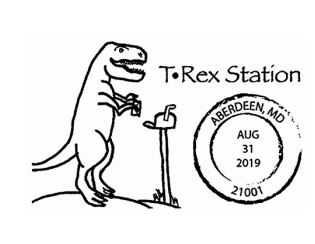
| 31.08.2019 "T-Rex Station, Aberdeen, MD" [Sp] |
31.08.2019 "T-Rex Station, Baltimore, MD" [Sp] - |
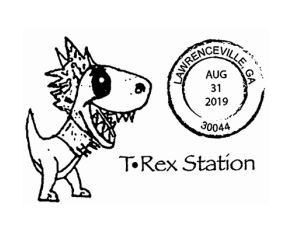
31.08.2019 "T-Rex Station, Lawrencevile, GA" [Sp] |
|

|
|
| 31.08.2019 "T-Rex Station, Leesburg, VA" [Sp] |
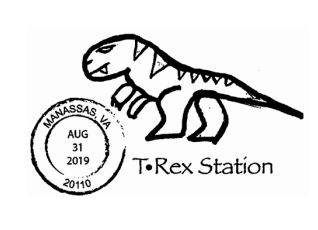
31.08.2019 "T-Rex Station, Manassas, VA" [Sp] - |
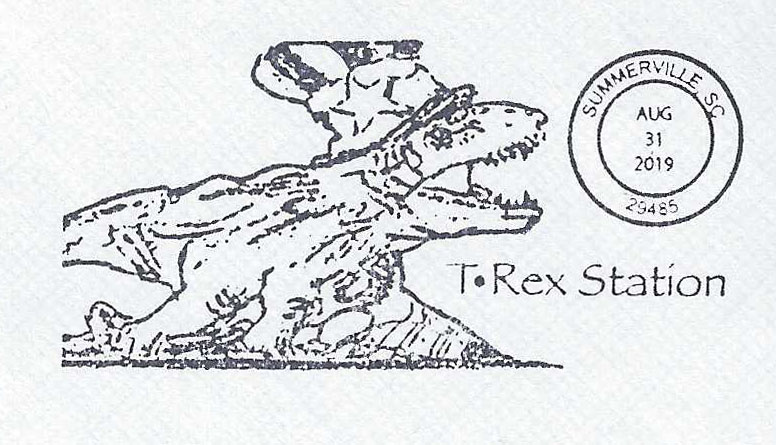
31.08.2019 "T-Rex Station, Summerville, SC" [Sp] |

|
|
|
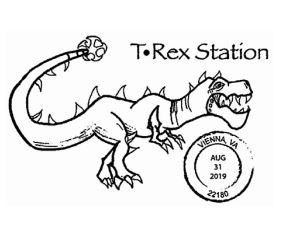
| 31.08.2019 "T-Rex Station, Vienna, VA" [Sp] |
27.09.2019 "T-Rex Station, Carolina Beach, NC" [Sp] - |
|
|

|
|
Notes:
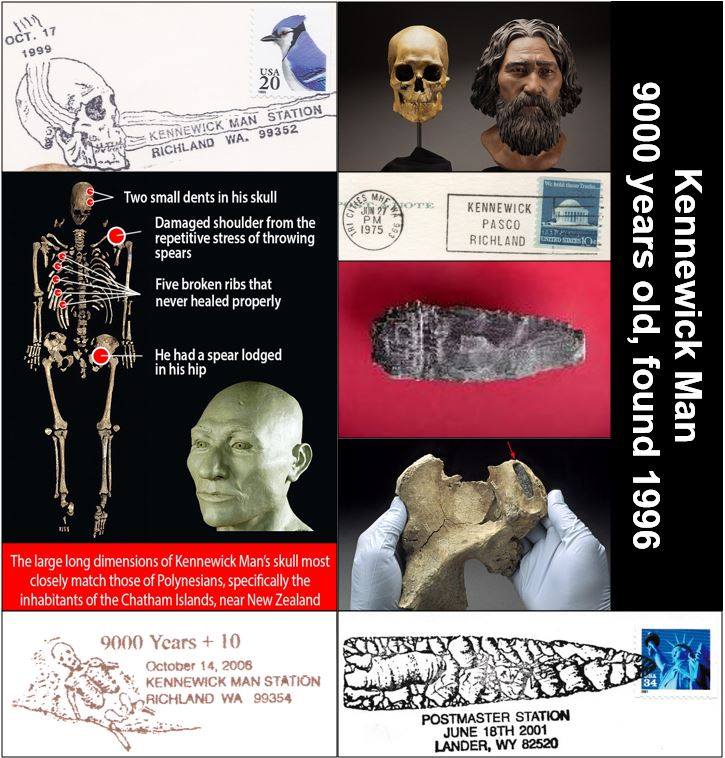 |
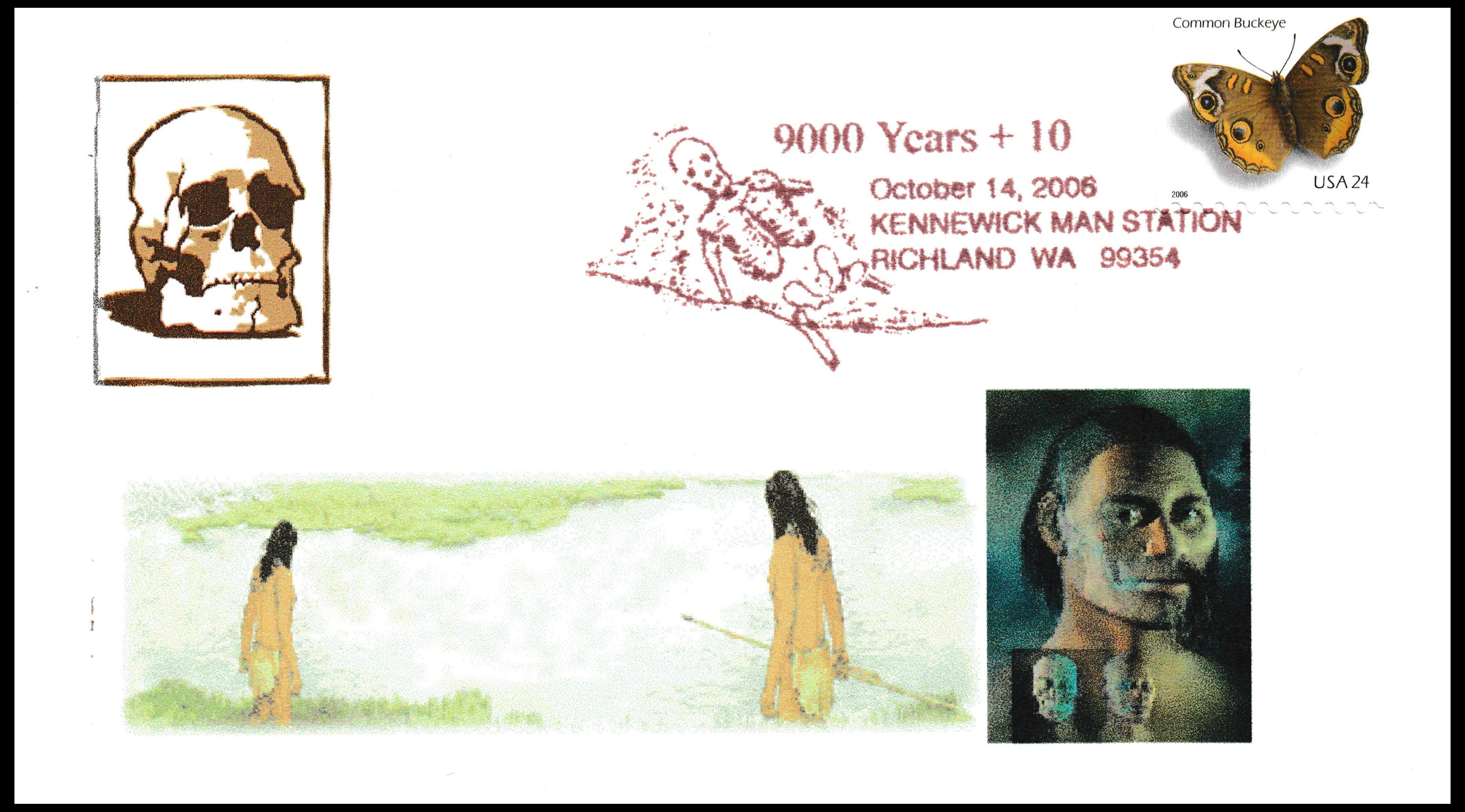
It is one of the most complete ancient skeletons ever found. Radiocarbon tests on bone have shown it to date from 8.9k to 9k calibrated years before present. [R17]
References
[R1] USA: Wikipedia, WikiTravel, Flag Country.
[R1a] Confederate States (1861-865) Wikipedia.
[R2] Postal history of USA: Links to USA's post authority and stamps catalog websites are here
Wikipedia, "The Mezozoic Time" blog and "The Mezozoic Time" magazine of Fran Adam, THE DIGITIZED US POSTAL BULLETINS and PL&Rs.
Some explanation about Digital Postmarks
[R2a] Postal history of Confederate States (1861-865): Wikipedia, Mystic Stamps.
[R3] Thomas Jefferson: Thomas Jefferson: Paleontologist by Thomas O. Jewett,
"A Memorial of the Discovery of certain Bones of a Quadruped of the Clawed Kind in the Western Part of Virginia", by Thomas Jefferson, "THOMAS JEFFERSON AS A PALEONTOLOGIST" by HENRY FAIRFIELD OSBORN, Wikipedia article about Thomas Jefferson ,
Presidents of the United States on U.S. postage stamps, Megalonyx on Wikipedia.
[R3a] Mount Rushmore National Memorial: Official Site,
Wikipedia.
[R3b] Jefferson Memorial: Official Site,
Wikipedia.
[R3c] Virginia’s Rotunda: Official Site,
Wikipedia.
[R4] Carlsbad Caverns: nps.gov.
[R5] Grand Canyon: nps.gov, Wikipedia, Grand Staircase on Wikipedia,
[R6] Yellowstone National Park: Wikipedia, nps.gov,
[R7] Dinosaur town in Colorado: Wikipedia, The town website, Dinosaur National Monument
[R8] Dinosaur National Monument: nps.gov, Wikipedia.
[R9] Fossil town in Oregon: Official town site, The Oregon Encyclopedia: Fossil town and John Day Fossil Beds Wikipedia, mesozoictimes.wordpress.com.
[R10] Joshua Tree National Park: nps.gov,
[R11] Big Bend National Park: nps.gov, Fossil Discovery Exhibit (general information), Fossil Discovery Exhibit (detailed information), Pride of Big Bend.
[R12] Arches National Park: Swanson, B. A., V. L. Santucci, S. K. Madsen, A. S. Elder, and J. P. Kenworthy, 2005. Arches National Park Paleontological Survey. National Park Service, Geologic Resources Division, Technical Report NPS/NRGRD/GRDTR-05/01 (PDF file).
Moab Giants.
[R12a] Utahraptor Wikipedia, National History Museum of Utah
[R13] Yosemite National Park: nps.gov.
[R14] Glacier National Park: nps.gov. Wikipedia.
[R15] Mammoth Cave: nps.gov. Wikipedia.
[R16] Andrew Carnegie: Wikipedia, Diplodocus carnegii (Wikipedia).
[R17] Kennewick Man : Wikipedia,
Acknowledgements
Many thanks to Dr. Peter Voice from Department of Geological and Environmental Sciences, Western Michigan University, for his help to find an information and share scans of postmarks from his collection for this article, the draft page review and his valuable comments.