USA
1968
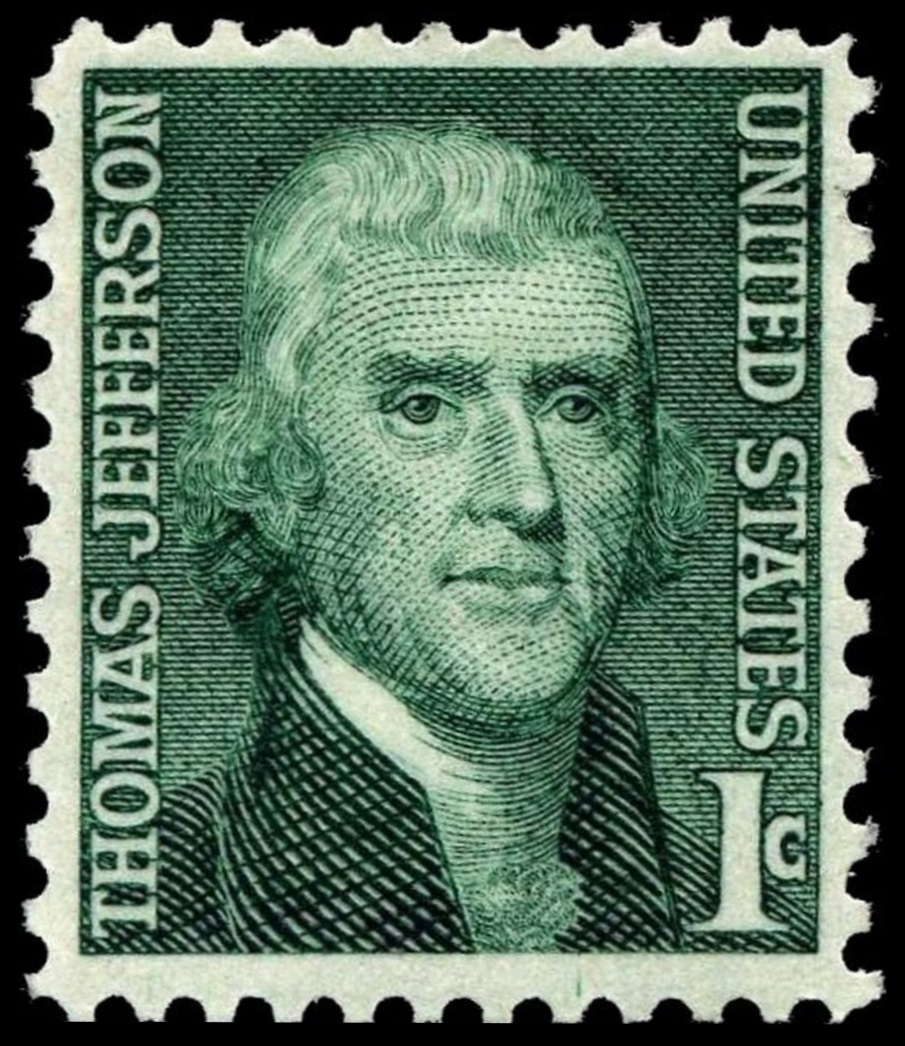
"Thomas Jefferson third President of the United States"
| Issue Date |
12.01.1968 |
| ID |
Michel: 940 ;
Scott: 1278 ;
Stanley Gibbons: 1259 ;
Yvert et Tellier: 816 ;
Category: Co |
| Design |
Robert J. Jones |
| Stamps in set |
1 |
| Value |
1c - Thomas Jefferson |
| Emission/Type |
definitive |
| Places of issue |
Jeffersonville, IN |
| Size (width x height) |
22mm x 26mm |
| Layout |
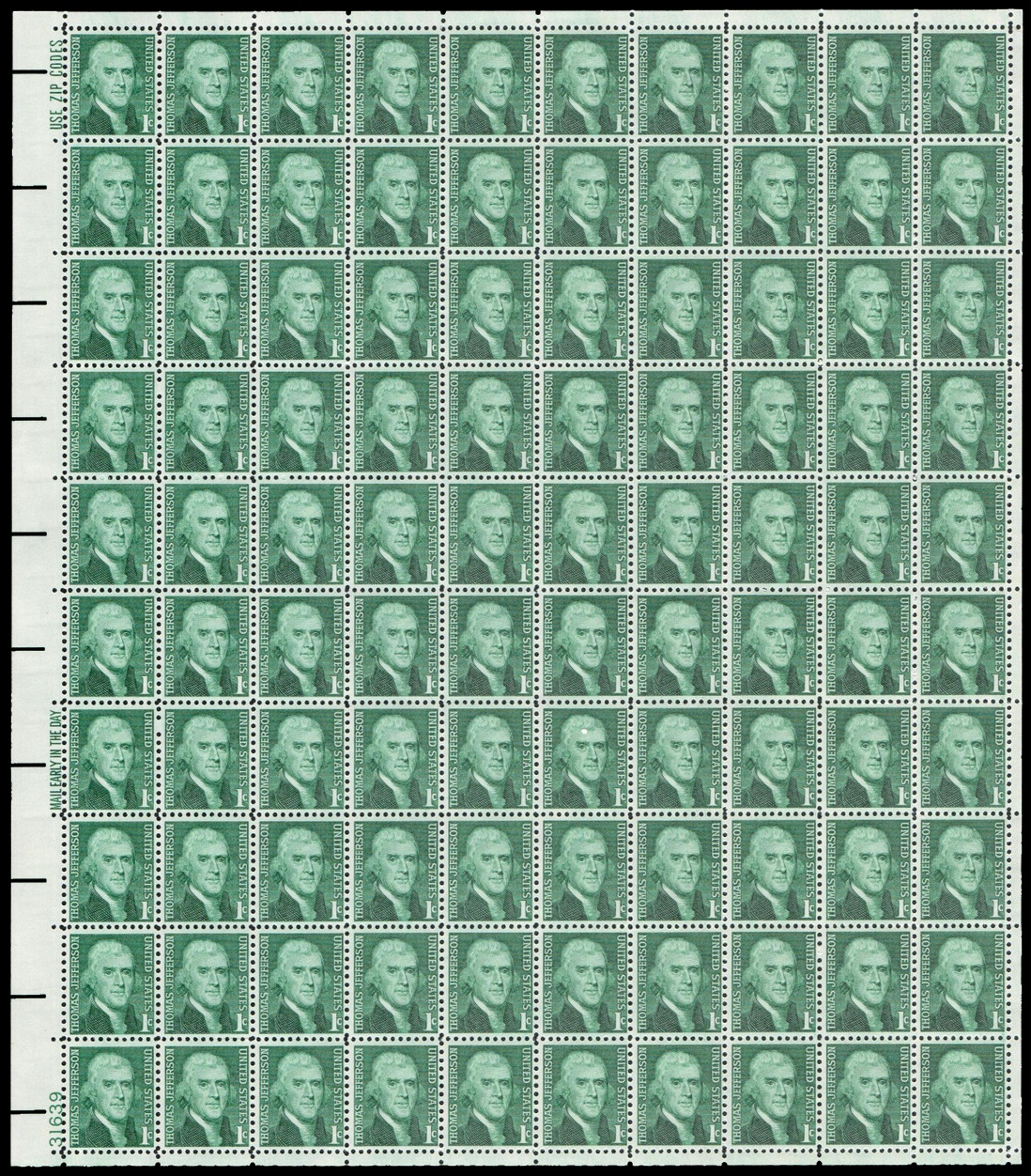
Sheet of 100 stamps (10x10),
coils of 500 and 3.000
|
| Products |
None |
| Paper |
No Watermark |
| Perforation |
11.25 x 10.50
coil stamps: 10 x 10
|
| Print Technique |
Rotary Press |
| Printed by |
Bureau of Engraving and Printing |
| Quantity |
|
| Issuing Authority |
U.S. Postal Service |
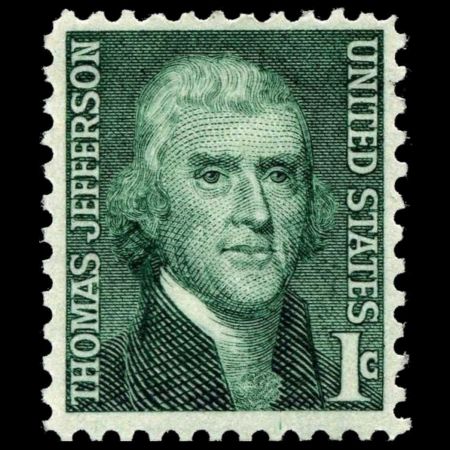
On January 12
th, 1968, the United States Post Office issued a definitive stamp portraying
Thomas Jefferson.
This stamp, designed by Robert J. Jones of New York City, was based on the portrait of Thomas Jefferson
painted by Rembrandt Peale, one of the sons of
Charles Willson Peale.
The original painting, which hangs in the White House, served as the model for the stamp, which was
printed in green on the Cottrell press.
The stamp formed part of a long-running definitive series that began on November 10, 1965.
In total, 25 denominations were released in what became known as the “Prominent Americans” Series,
which eventually replaced the Liberty Series.
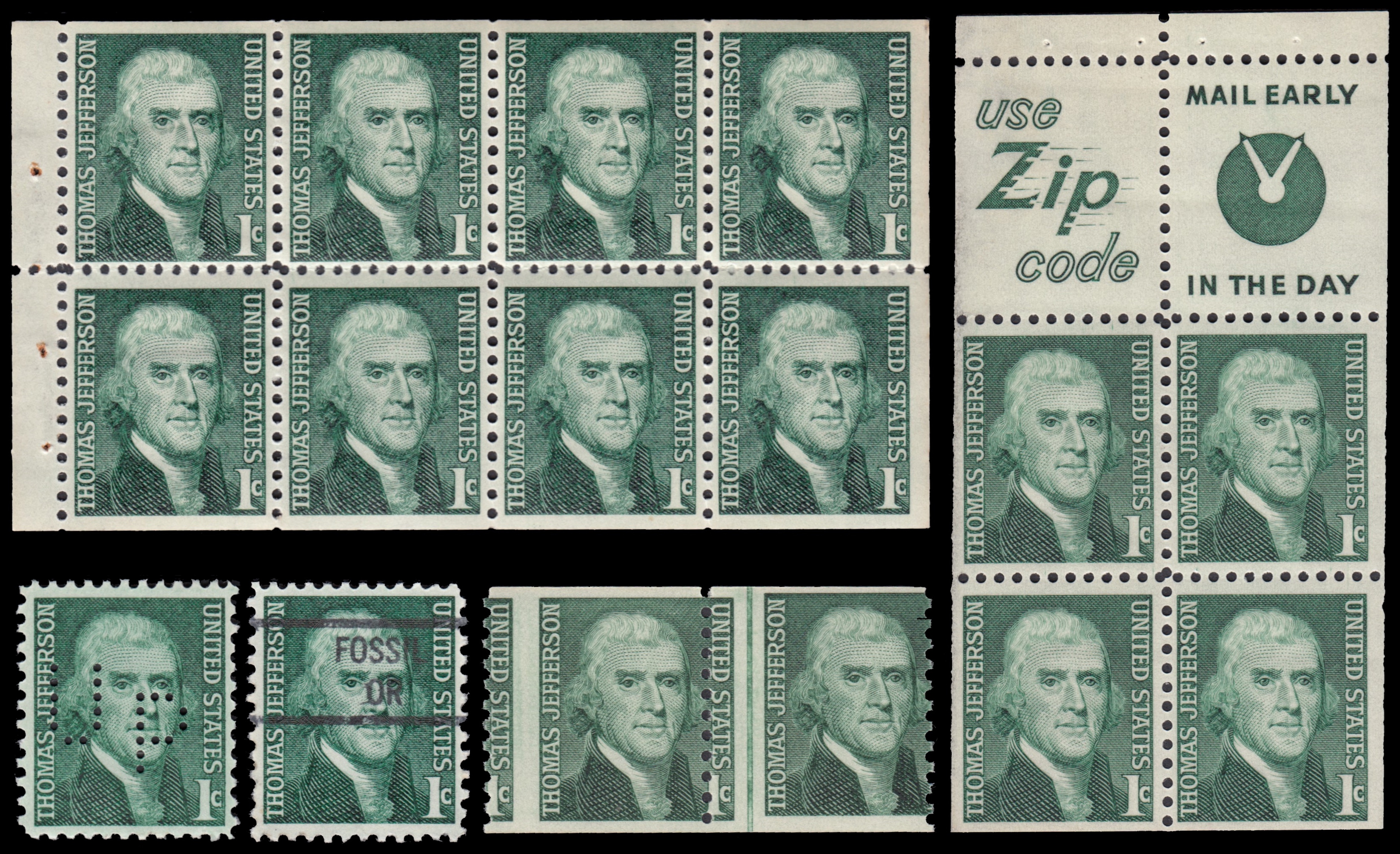
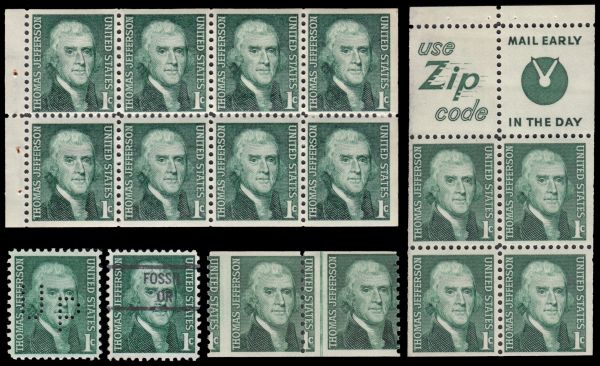
The Jefferson issue appeared in several production formats:
- Sheet of 100 perforated on all 4 sides stamps - perforation 11.25 x 10.50
- Booklet panes of 10 stamps, perforated on two or three sides - perforation 11.25 x 10.50
- coil stamps with vertical perforation only - perforation 11.25 x 10.50
 |
|
Variants of the Thomas Jefferson Stamp of the USA, 1968.
|
|
 |
|
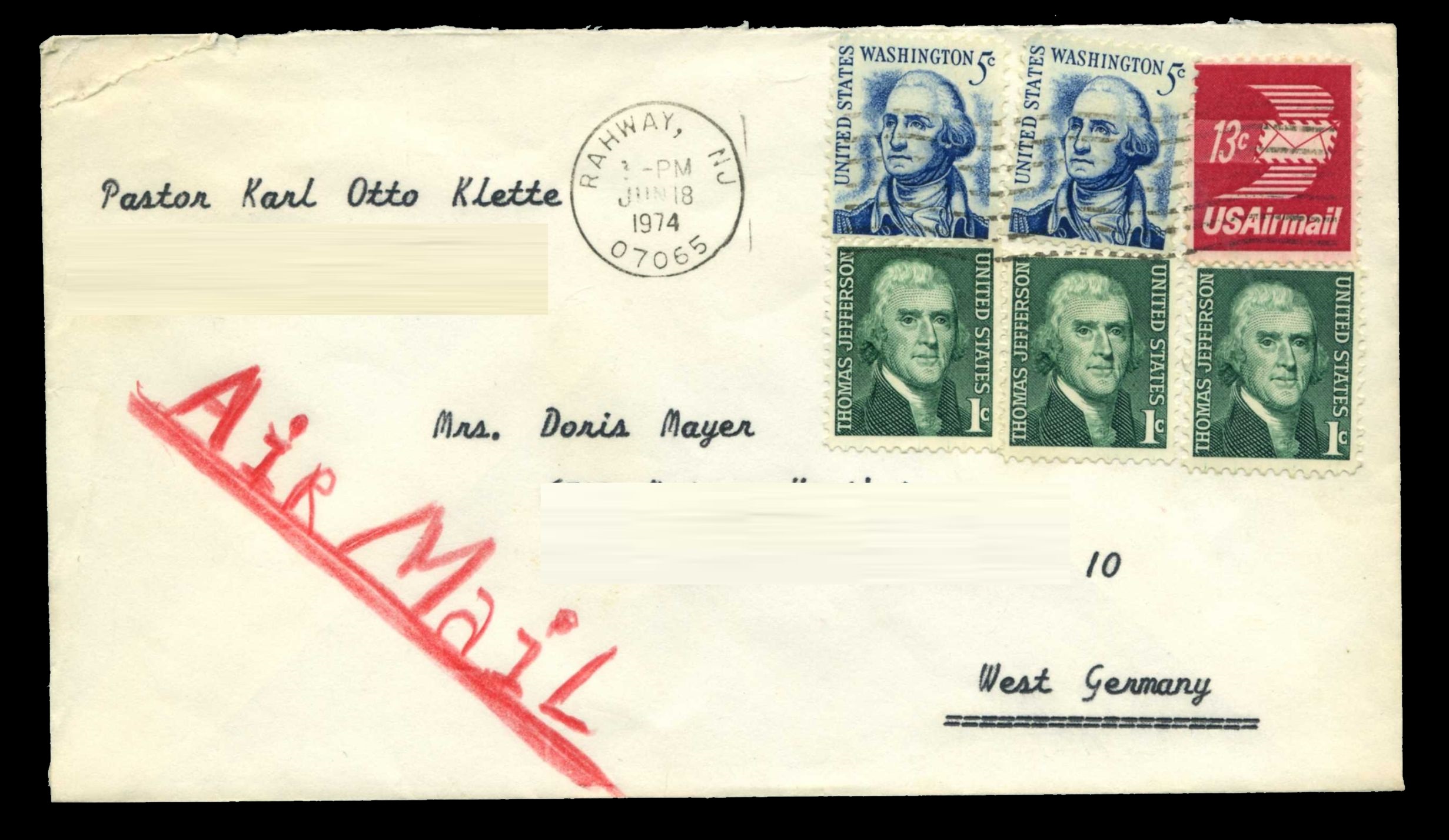
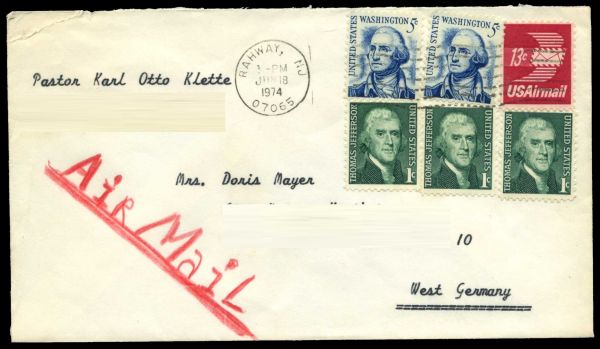
George Washington (1966) and Thomas Jeffersons (1968) definitive stamps from the “Prominent Americans” Series
on a cover posted in 1974.
|
Two types of paper were used during production: plain paper and paper with a phosphor tagging (overprint)
applied for automated mail processing.
The MICHEL stamp catalogue distinguishes 11 different varieties, based on combinations of perforation
types and paper varieties.
In addition to these standard production variations, the stamp was overprinted with the names of
certain post offices for official or local use.
Because it was widely used by commercial firms and large corporations, numerous perfin (perforated initials)
varieties are also known.
The coil version, produced for vending machines and other automated postal equipment, was sold
in rolls—typically containing 500 or 1,000 stamps.
Coil stamps are easily distinguished from sheet stamps by their vertical perforations only.
Due to the long production period and multiple printings, imperforate examples as well as various
misperforated varieties have been documented.
Thomas Jefferson
Thomas Jefferson (1743–1826)
was an American Founding Father and the third President of the United States from 1801 to 1809.
He was the primary author of the Declaration of Independence.
Jefferson was the nation's first U.S. Secretary of State under George Washington and then the nation's second Vice President under John Adams.
Jefferson was a leading proponent of democracy, republicanism, and natural rights, and he produced formative documents and decisions at the state,
national, and international levels.
Paleontologists such as Frederic A. Lucas, then Curator‑in‑Chief of the U.S. National Museum,
and Henry Fairfield Osborn, at the time Curator of Vertebrate Paleontology at the American Museum of Natural History,
described Jefferson as having founded American vertebrate paleontology and regarded him as the discipline’s
earliest guiding figure.
They crediting him with:
- Refuting Buffon’s degeneracy theory
- Encouraging systematic fossil collection
- Promoting stratigraphic awareness in excavation
- Presenting the first scientific paper on a North American fossil vertebrate
Today, Thomas Jefferson is often regarded as
the father of American vertebrate paleontology.
For more details about Jefferson's interest to palaeontology,
please read
Thomas Jefferson the father of American Paleontology
article on this website.
Products and associated philatelic items
No official philatelic products were issued in connection with this stamp issue.
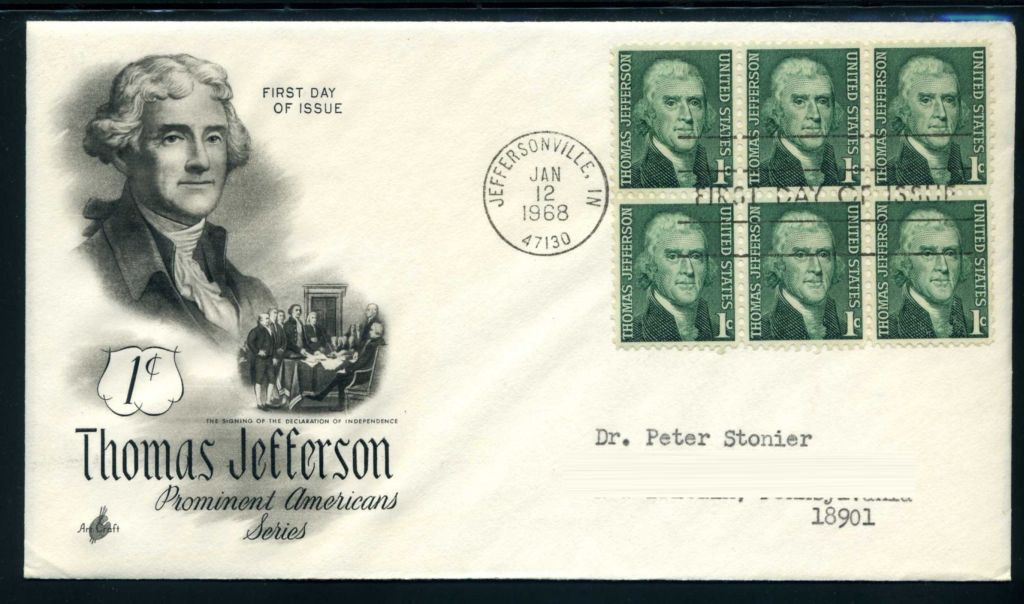
The United States Postal Service did not produce an official First Day Cover (FDC)
or a pictorial First-Day-of-Issue postmark.
All first day covers illustrated below are privately produced items.
References
Acknowledgement
Many thanks to Dr.
Peter Voice from Department of Geological and Environmental Sciences, Western Michigan University,
for reviewing the draft page, his valuable comments and great help to find materials for this article.
Last update 24.03.2026
Any feedback, comments or even complaints
are welcome: admin@paleophilatelie.eu (you
can email me on ENglish, DEutsch, or RUssian)