USA 1996 "Prehistorical animals"
| Issue Date | 08.06.1996 |
| ID | Michel: 2735-2738; Scott: 3077-30780; Stanley Gibbons: 3212-3215; Yvert et Tellier: 2510-2513; Category: pR |
| Design | Illustrations: Don Balke, Stamp Design: David Meltzer |
| Stamps in set | 4 |
| Value |
32c - Eohippus 32c - Woolly mammoth 32c - Mastodon 32c - Saber-tooth cat |
| Emission/Type | commemorative |
| Places of issue | Toronto, Canada |
| Size (width x height) | 78mm x 64mm |
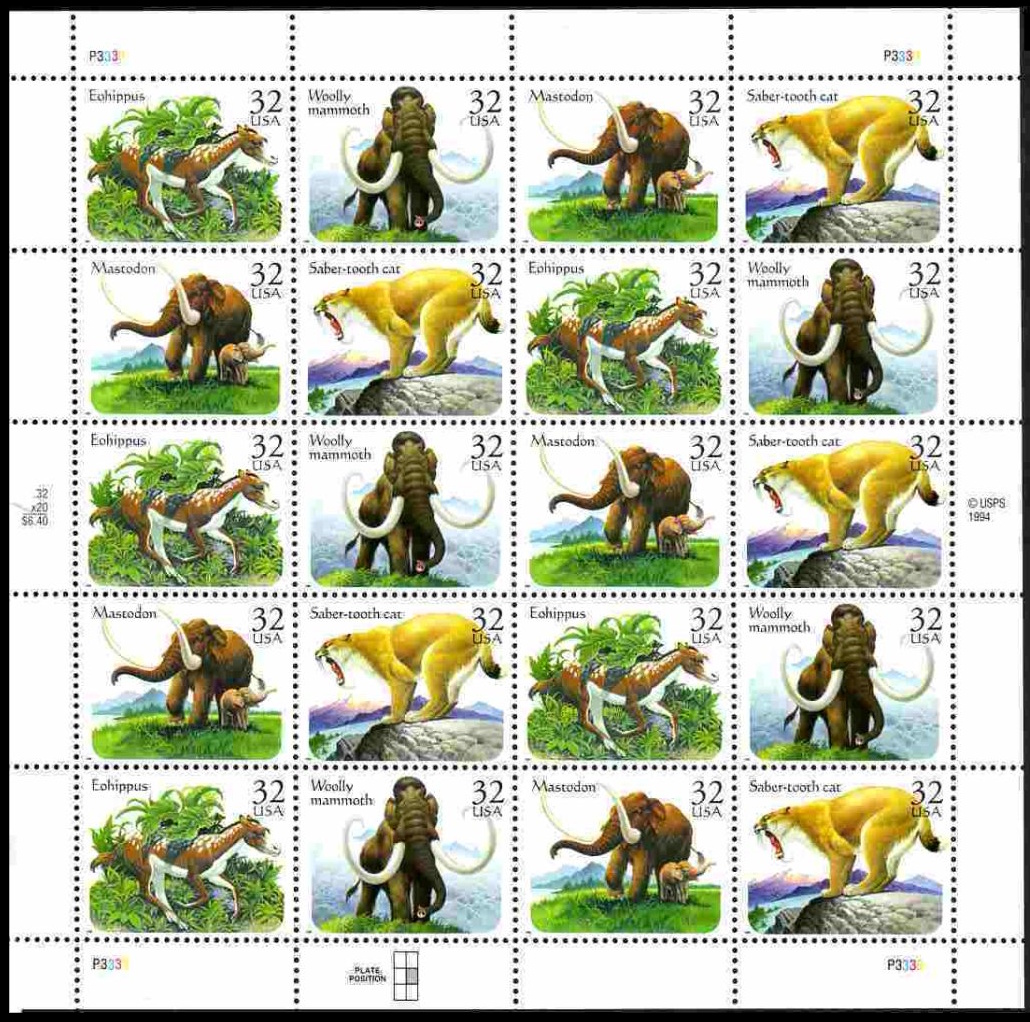
| Layout | Sheet of 40 |
| Products | |
| Paper | No Watermark |
| Perforation | 11 x 11 |
| Print Technique | Lithography, multicolor |
| Printed by | Ashton-Potter (USA) Ltd |
| Quantity | 27,730,000 |
| Issuing Authority | U.S. Postal Service |
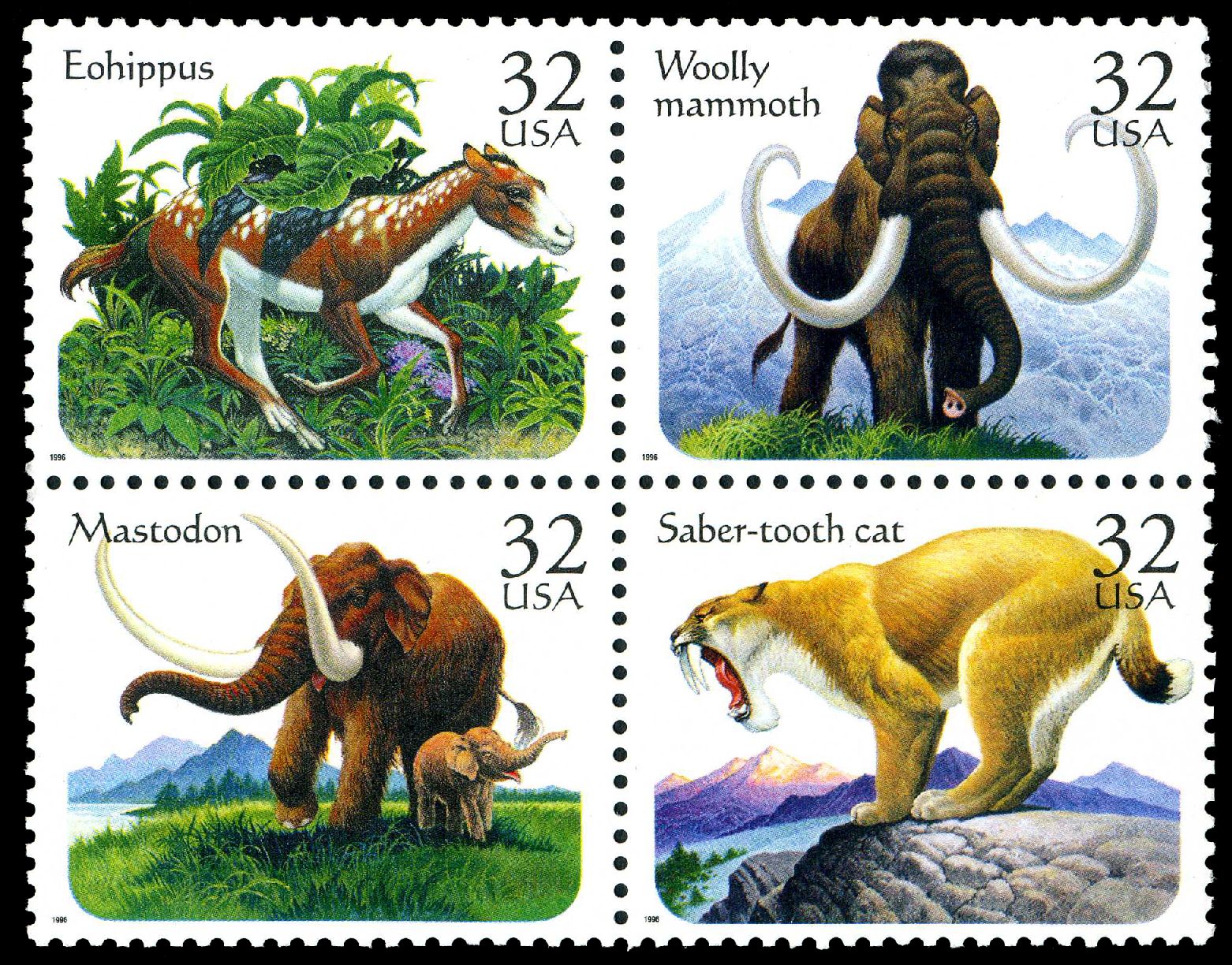
On June 8th, 1996, the United States Post Office issued its second set of prehistoric animal stamps. Unlike the 1989 set, which featured Mesozoic reptiles, this new issue depicted Cenozoic mammals: the prehistoric horse Eohippus, the woolly mammoth, the mastodon, and the saber-toothed cat.
According to the Stampedout website, some of the scientific names used for the animals are outdated or inaccurate. Eohippus is now generally regarded as synonymous with Hyracotherium; the “woolly mammoth” illustrated on the stamp more closely resembles Mammuthus imperator (the Imperial mammoth); the mastodon should properly be referred to as Mammut; and the saber-toothed cat corresponds to the genus Smilodon.
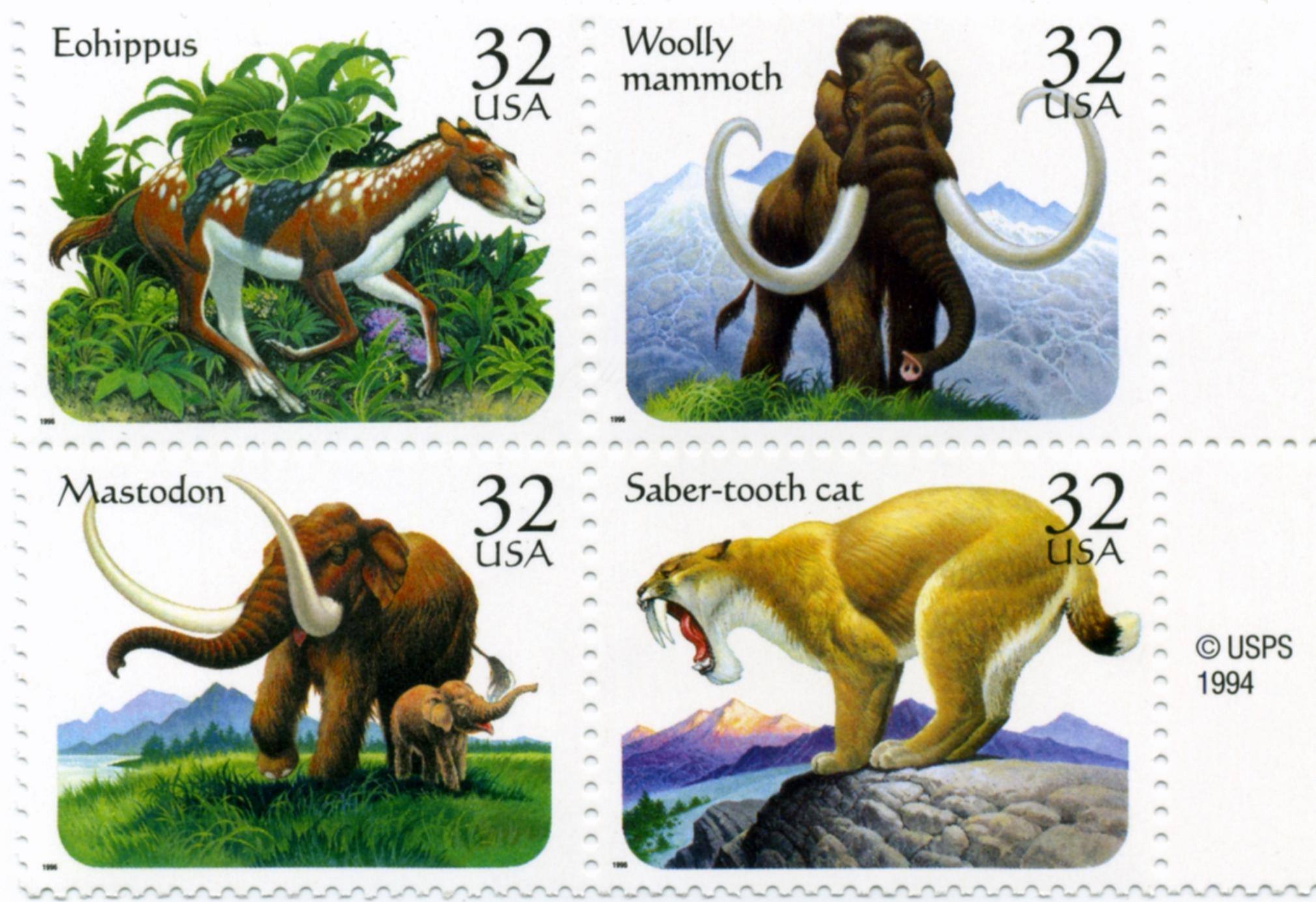
The stamp designs were based on illustrations created by wildlife artist Don Balke. Born and raised in rural Wisconsin, Balke developed a deep appreciation for nature and wildlife, reflected in his numerous finely detailed paintings. His artwork is known for its vivid sense of mood and movement. In these illustrations he sought to capture the awe and mystery of prehistoric mammals.The designs were completed in 1994, as indicated on the selvages of the sheet. The issue was originally scheduled for release in August 1995 during STAMPSHOW 95 in St. Louis, Missouri. However, technical problems in the printing process delayed the release, and the stamps were ultimately issued the following year at CAPEX ’96 in Toronto, Canada.
Around 66 million years ago, at the end of the Mesozoic Era, a major mass extinction eliminated the non-avian dinosaurs and many other groups. In the aftermath, mammals diversified and became the dominant large land animals of the Cenozoic Era, often called the “Age of Mammals”. During this time, early relatives of modern elephants, horses, and camels appeared, while carnivorous mammals diversified into forms that eventually gave rise to modern canine and feline lineages. As environments continued to change, some species adapted and flourished, while others migrated or eventually became extinct.
The prehistoric animals depicted on the stamps
Eohippus
 |
| Eohippus on stamp of USA 1996 MiNr.: , Scott: |
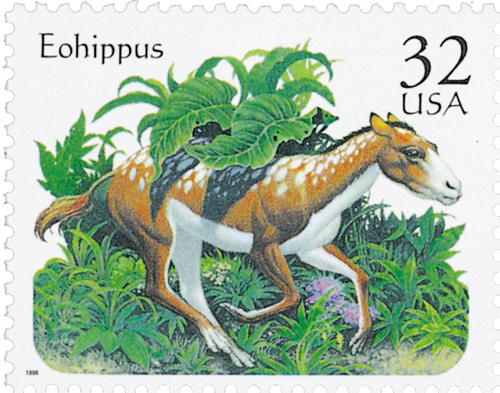
In fact, the dawn horse closely resembled a dog-like creature, as it lacked the straight back and long face of modern horses. The Eohippus had four toes on its front foot (one of these was non-functional), and three on its hind foot. Each toe ended in a separate hoof. The part of the foot which bore the animals weight was covered with a tough pad, much like a dogs.
Scientists have determined from fossilized teeth that Eohippus was more of a browser than a grazer which means it ate more like a rabbit than a horse. But, like todays horse, the Eohippus depended on its speed to evade predators.
Nature began replacing Eohippus with a more horse-like animal, the Mesohippus or middle horse, about 35 million years ago. Twenty-six million years ago Merychippus (cud-chewing horse) emerged. It had three toes on each foot, but the strong, large-hoofed center toe bore all the animals weight. Animals resembling todays horse appeared about 3 million years ago.
Woolly mammoth
 |
| Woolly mammoth on stamp of USA 1996 MiNr.: , Scott: |
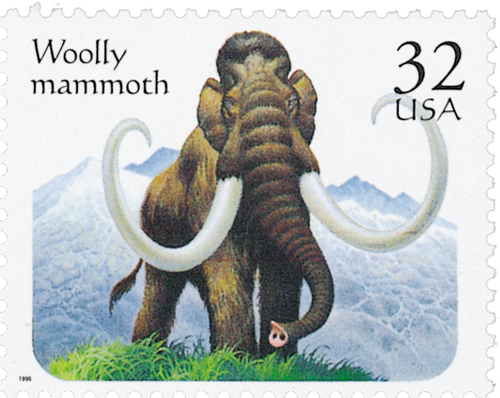
Measuring 14 feet high at the shoulder, the woolly mammoth was a huge, lumbering animal. Its tusks, which curved up and crossed in front of its trunk, could measure up to 13 feet in length. Three inches of fat under the skin provided further insulation, and there was a large hump of fat on its back. The mammoths skull was high and dome-like, and its ears were smaller than an elephants.
Mammoths first appeared in Africa 4 million years ago, and they reached North America about 1.5 million years ago. Their fossils are among the most common in the world. Remarkably preserved 30,000-year-old mammoths have been found in Siberia. Prehistoric man pictured mammoths in his cave art. In Europe, realistic depictions of entire herds of mammoths have been found. Evidence exists that prehistoric human settlers of North America hunted these huge animals. Mammoths became extinct at the end of the Ice Age.
Mastodon
 |
| Mastodon on stamp of USA 1996 MiNr.: , Scott: |
Mastodons were related to another extinct, elephant-like species, the four-tuskers. Both of these creatures were shorter and stockier than modern elephants. Like four-tuskers, early types of mastodons had tusks on both their lower and upper jaw, but many later examples of the species no longer had this trait. Some types of mastodons and four-tuskers had prominent lower tusks which were very flat. These animals are called shovel-tuskers. All mastodons were covered with reddish brown hair, and had teeth that were much smaller and more primitive than those of elephants.
By 10,000 years ago, at the end of the Pleistocene Epoch, most mastodons had disappeared. However, evidence indicates that the mastodon existed in North America after the Pleistocene which means they would have co-existed with historic Native American groups. Mankind was probably a factor in the mastodons extinction, especially in North America.
Saber-tooth cat
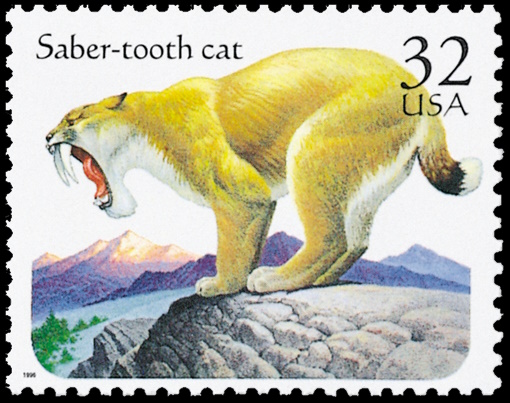 |
| Saber-tooth cat on stamp of USA 1996 MiNr.: , Scott: |
About 2 million years ago, during the Pleistocene Epoch, the most famous of the saber-tooth cats, the Smilodon, appeared. This animal represented the peak of saber-tooth evolution. It was approximately the same size as a tiger, but stockier and with shorter limbs. Smilodon roamed all over North and South America hunting large plant-eaters such as mammoths. Many Smilodon bones have been preserved in the tar pits of Rancho La Brea in Los Angeles, California.
The saber-tooth cats became extinct approximately 10,000 years ago. During that time the last glaciers retreated north. The changing climate, the subsequent changes in plants, and the success of man were probably responsible for the demise of the saber-tooth cat.
Products and associated philatelic items
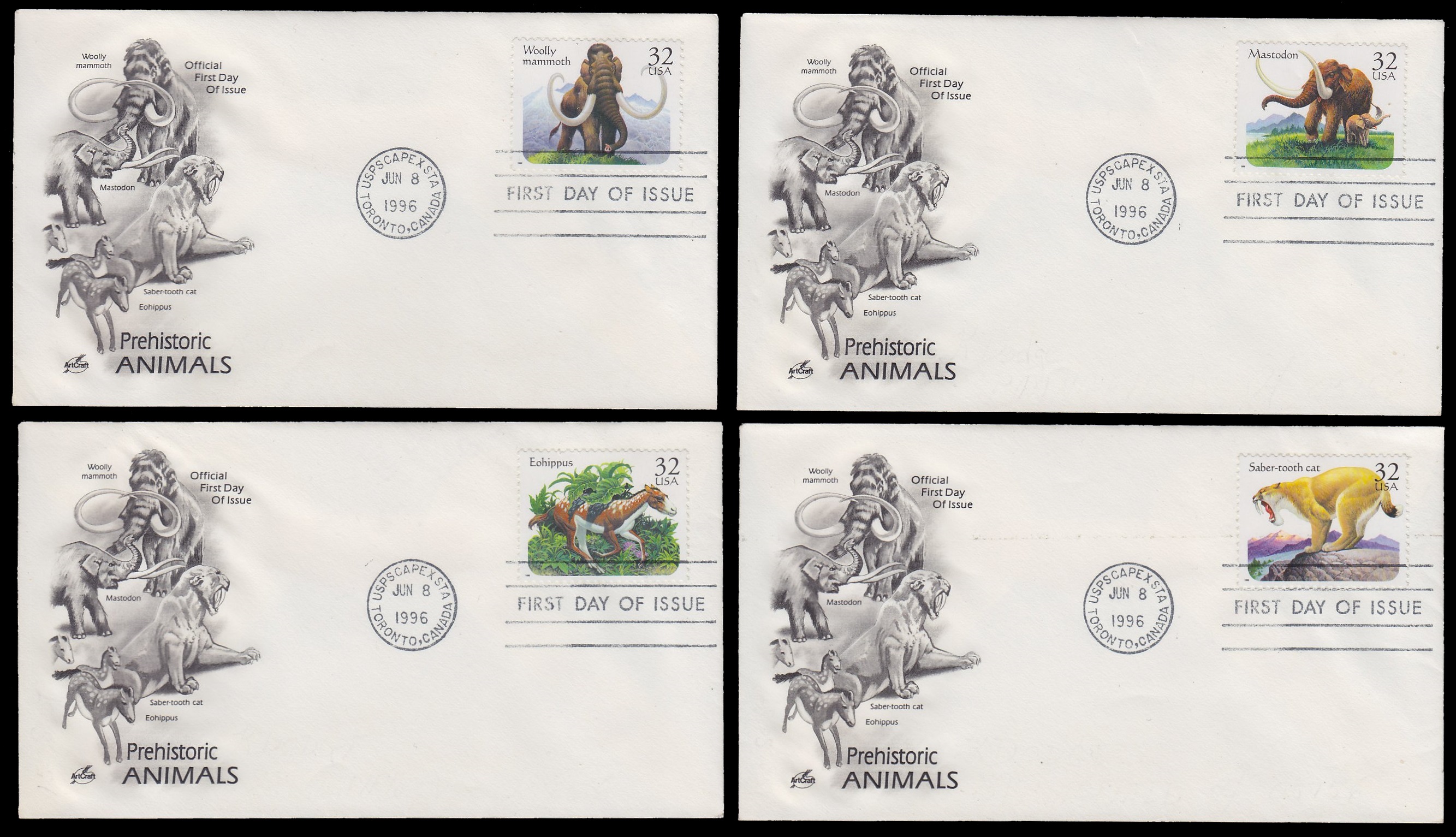
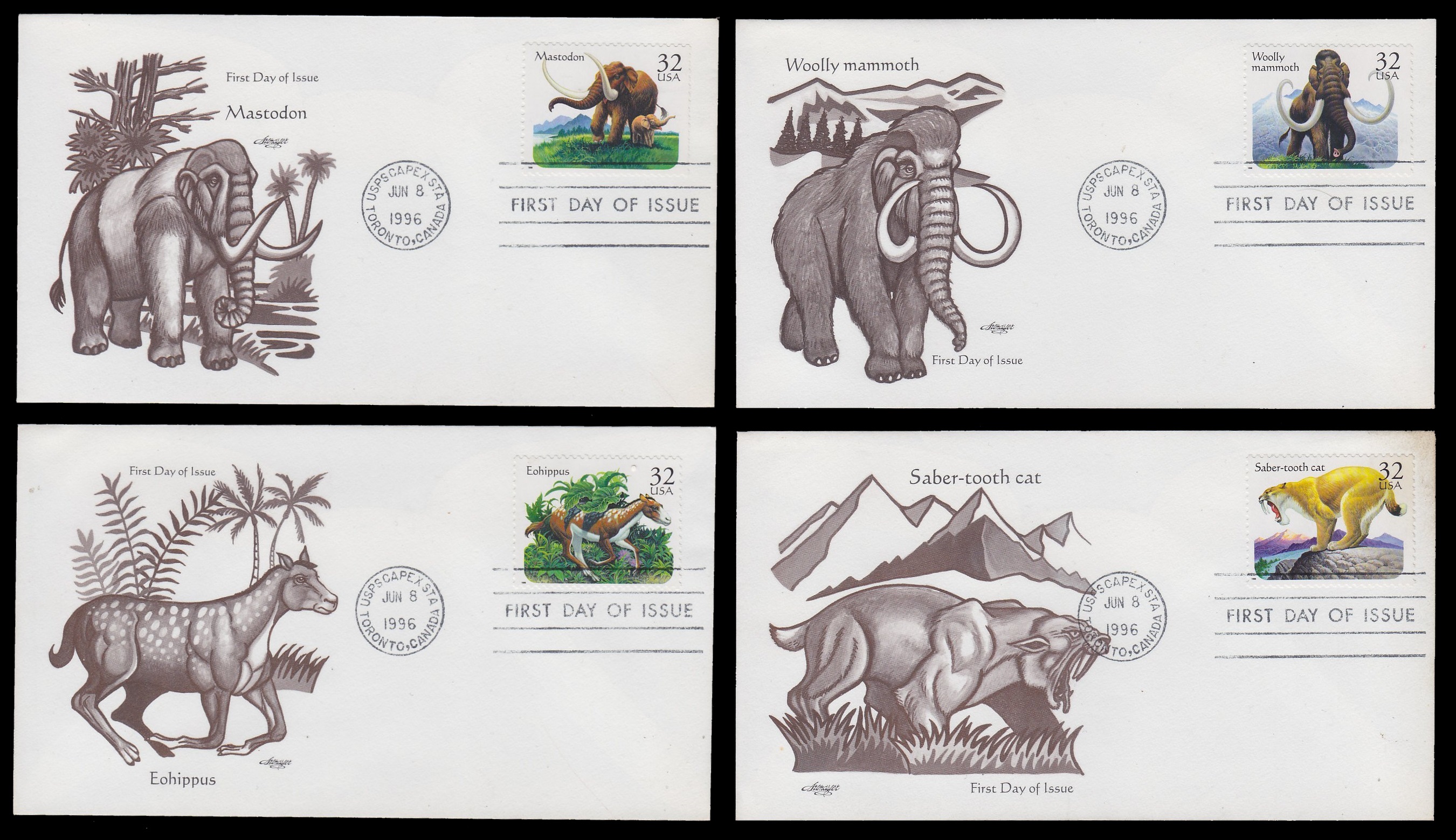
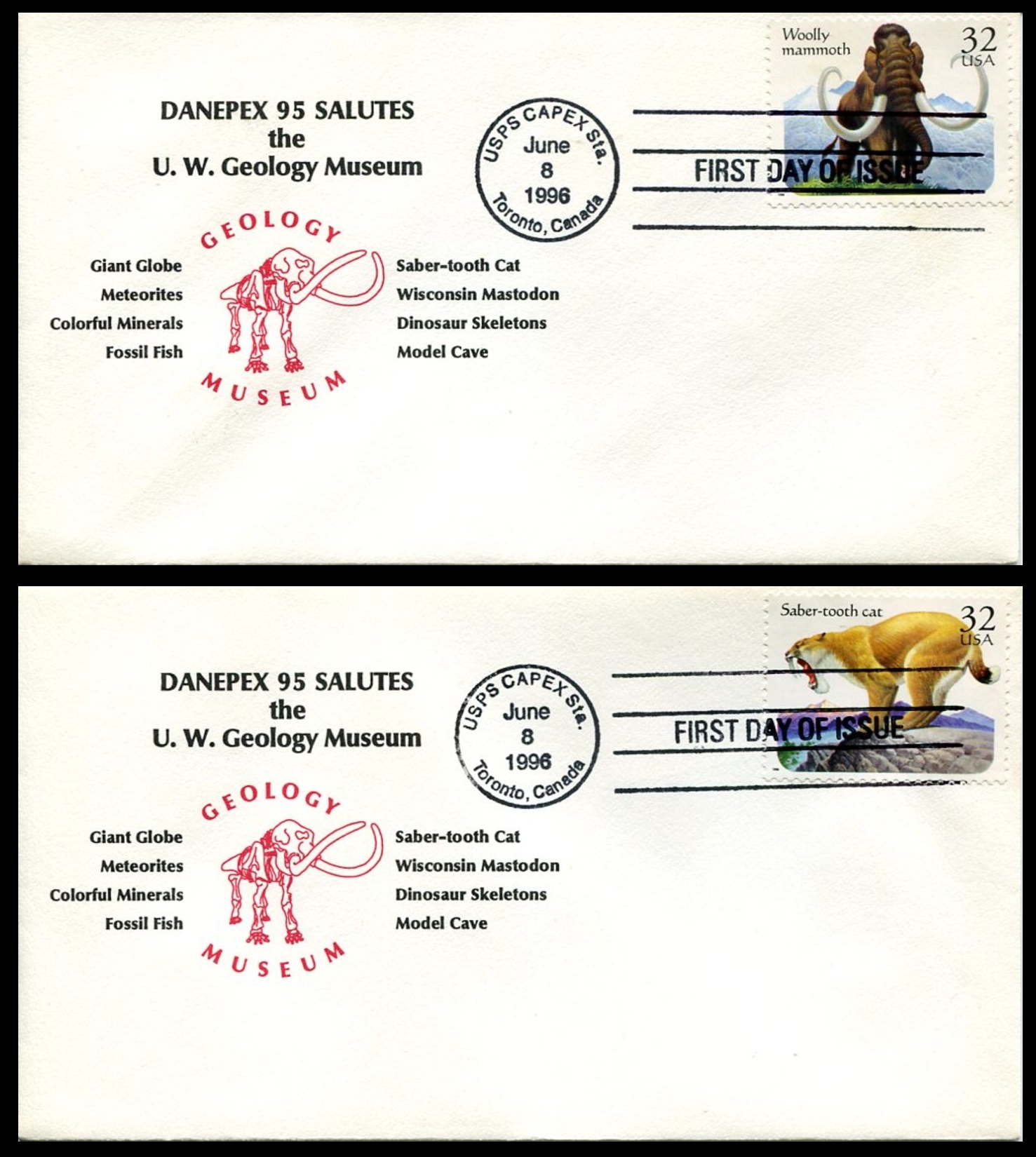
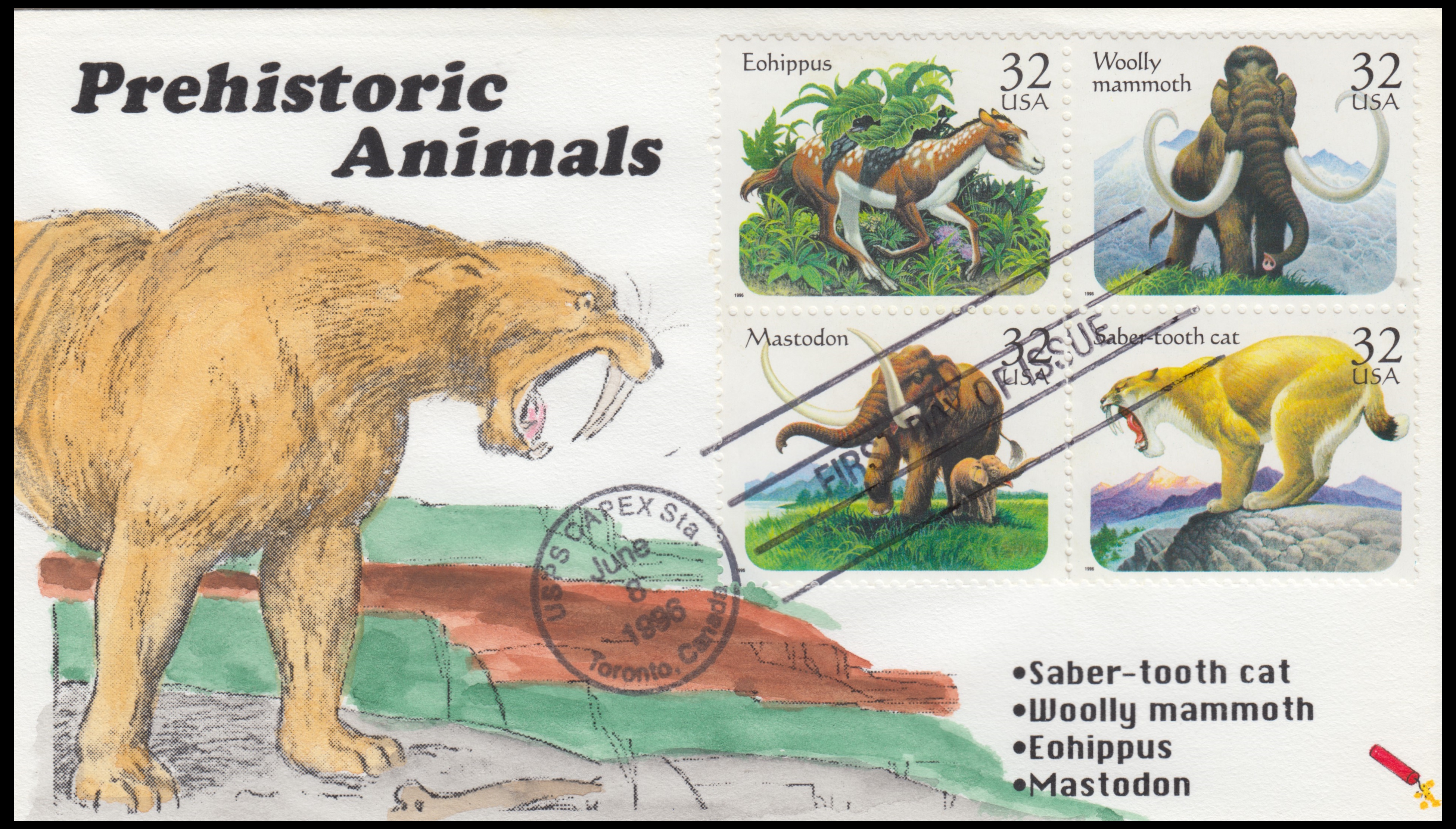
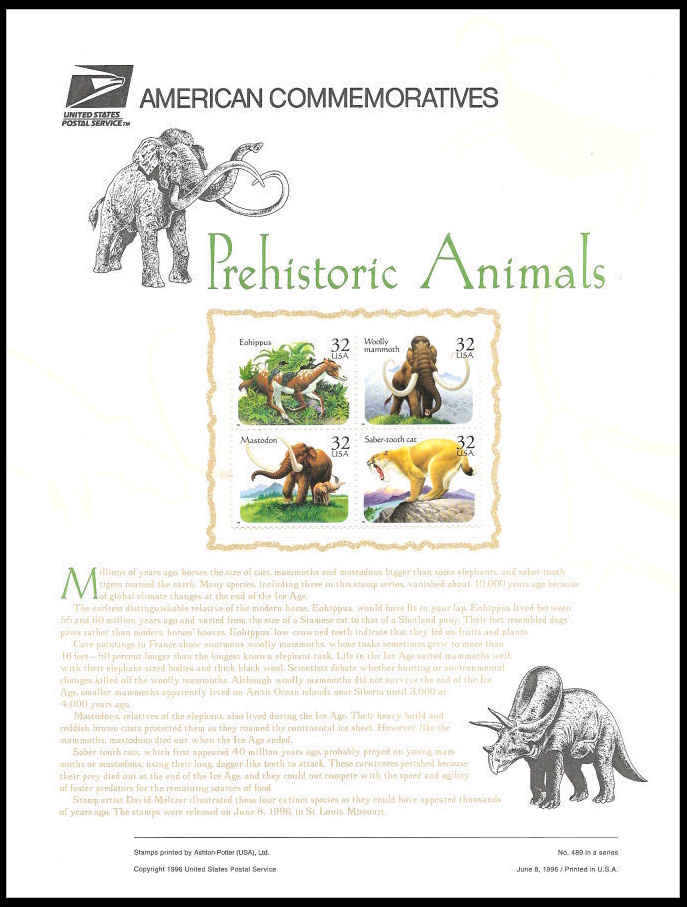
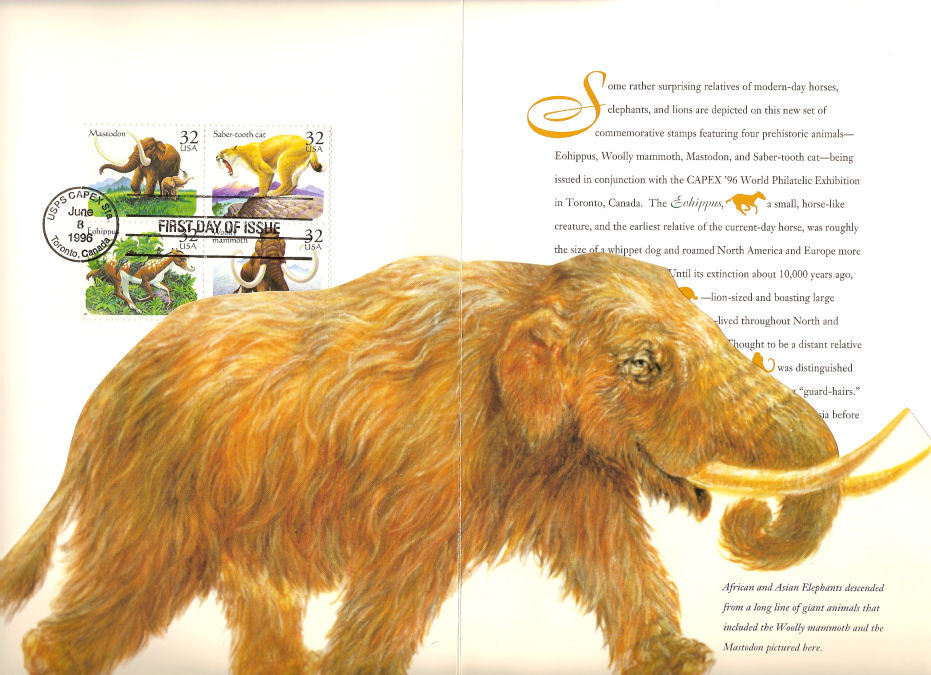
No official First Day Cover (FDC) were issued in connection with this stamp issue. The United States Postal Service did not produce an official FDC or a pictorial First-Day-of-Issue postmark. All first day covers and maxi cards illustrated below are privately produced items.
| Examples of personalized FDCs (many more exist) | ||
 |
 |
 |
 |
 |
 |
| Stamps Sheet | Commemorative Panel | Souvenir Panel |
 |
 |
 |
| Booklet | ||
 |
||
References
- Technical Details: Souvenir Panels, colnect, mysticstamp, stampedout.
- Short description of the animals depicted on the stamps: Reverse side of First Day Cover.
- Eohippus:
Wikipedia,
Encyclopedia Britannica.
- Hyracotherium: Wikipedia,
- Mammuthus imperator / Columbian mammoth:
Wikipedia,
Encyclopedia Britannica.
- Mammoth: Wikipedia,
- Smilodon: Wikipedia.
- Mastodon :
