The Czech Republic
Dinosaurs, prehistoric animals, fossils and fossil found places, paleontologist, Charles Darwin on stamps and postmarks of the Czech Republic
The Czech Republic, also known as Czechia, is a nation state in Central Europe
bordered by Germany to the west, Austria to the south,
Slovakia to the east and Poland to the northeast.
It is a unitary parliamentary republic, has 10.5 million inhabitants and the capital
and largest city is Prague, with over 1.2 million residents.
In the 19th century, the Czech lands became the industrial powerhouse of the monarchy and were subsequently the core of the Republic of Czechoslovakia, which was formed in 1918 following the collapse of the Austro-Hungarian Empire after World War I. Czechoslovakia was occupied by Germany in World War II, and was liberated in 1945 by the Soviet and the United States Armies.
Between 1948 and 1989 Czechoslovakia was a one-party communist state under Soviet influence. In 1989, the Velvet Revolution led to the collapse of the Communist Regime and a multi-party parliamentary republic was formed. On 1 January 1993, Czechoslovakia peacefully dissolved, with its constituent states becoming the independent states of the Czech Republic and Slovakia. [R1]
The first stamps of the Czech Republic were issued on 20 January 1993 after the former Czechoslovakia was split into the Slovak Republic and the Czech Republic on 1 January 1993. Before then, stamps of the Czechoslovak Republic were in use and were still valid until 30 September 1993. [R2]
Notes:
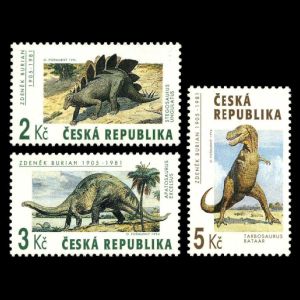
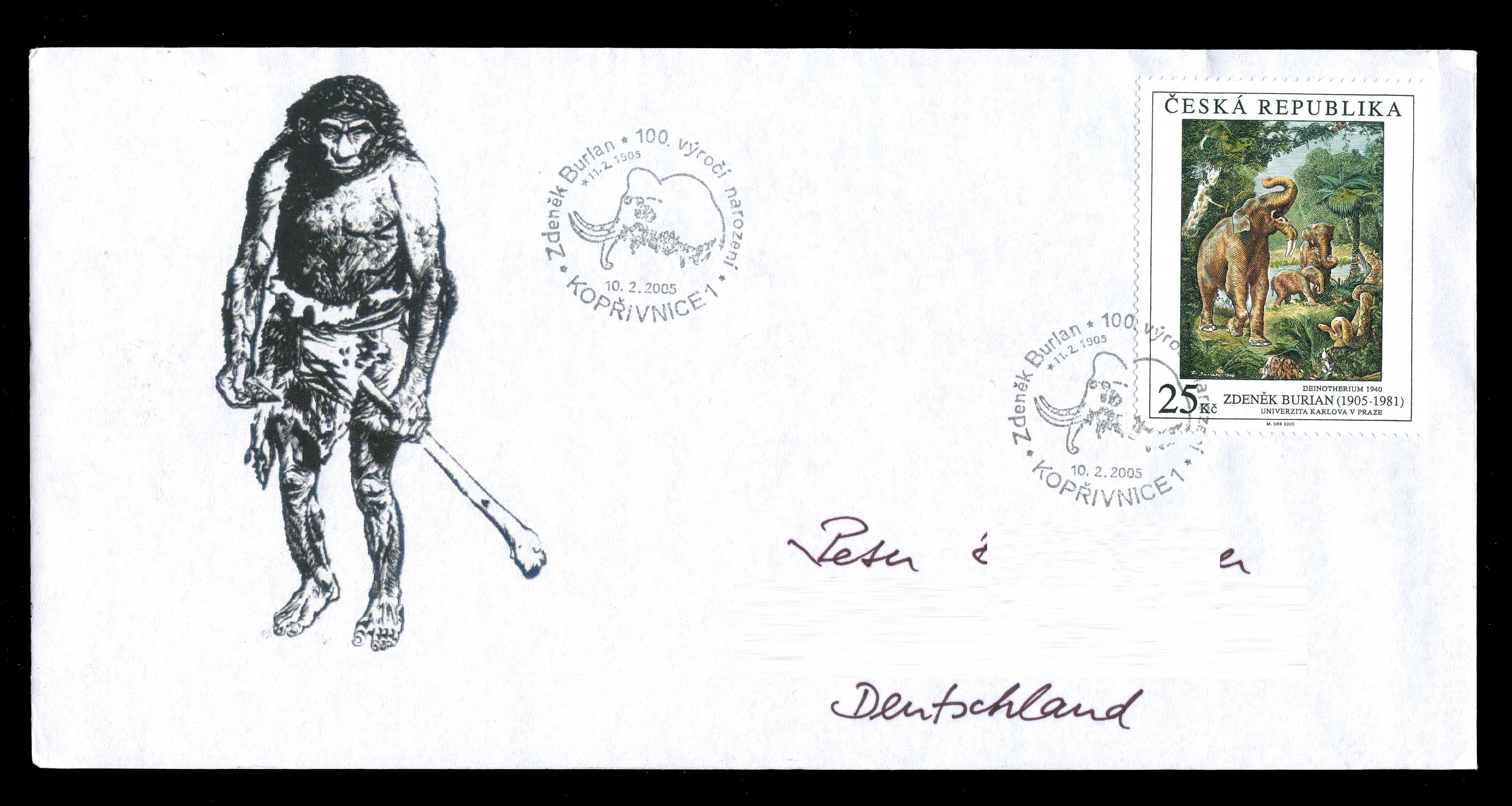
[1] All three stamps based on illustrations of famous Czechoslovakian paleo-artist Zdenek Burian. So far there are no stamps that show a portrait of Zdenek Burian, however a postmark with his image was produced by the Czech Post in 1995.
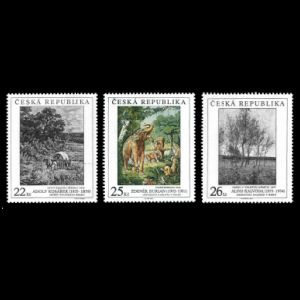

[2] Stamp with face value of 25 CZK of "Works of art on postage stamps" shows Deinotherium picture painted in 1940 by famous Czech Paleoartist Zdenek Burian for Charles University in Prague.
Deinotherium
("terrible beast") was a large prehistoric relative of modern-day elephants that
appeared in the Middle Miocene and survived until the Early Pleistocene.
During that time, it changed very little.
In life, it probably resembled modern elephants, except that its trunk was shorter,
and it had downward curving tusks attached to the lower jaw. [R3]
More information about this stamp is here
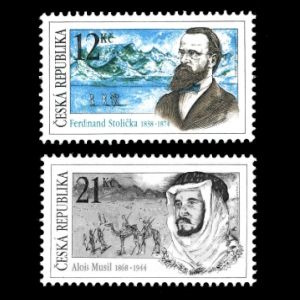
[3] Stamp with face value of 12 CZK from "Explorers" set shows Ferdinand Stolicka, who was a Czech geologist, paleontologist and natural scientist of world significance, who worked in India on paleontology, geology and various aspects of zoology, including ornithology and herpetology. [R4] He died of High-altitude sickness during an expedition across the Himalayas. More information about this stamp is here.
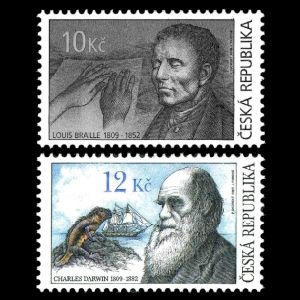
[4] Stamp with face value of 12 CZK from "Personalities" set shows Charles Darwin.
Michel catalog list these stamps individually (Minr: 584, 585), when Scott (3408-3409) and Czech's Post define these two stamps as a set.
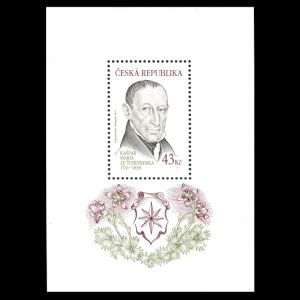
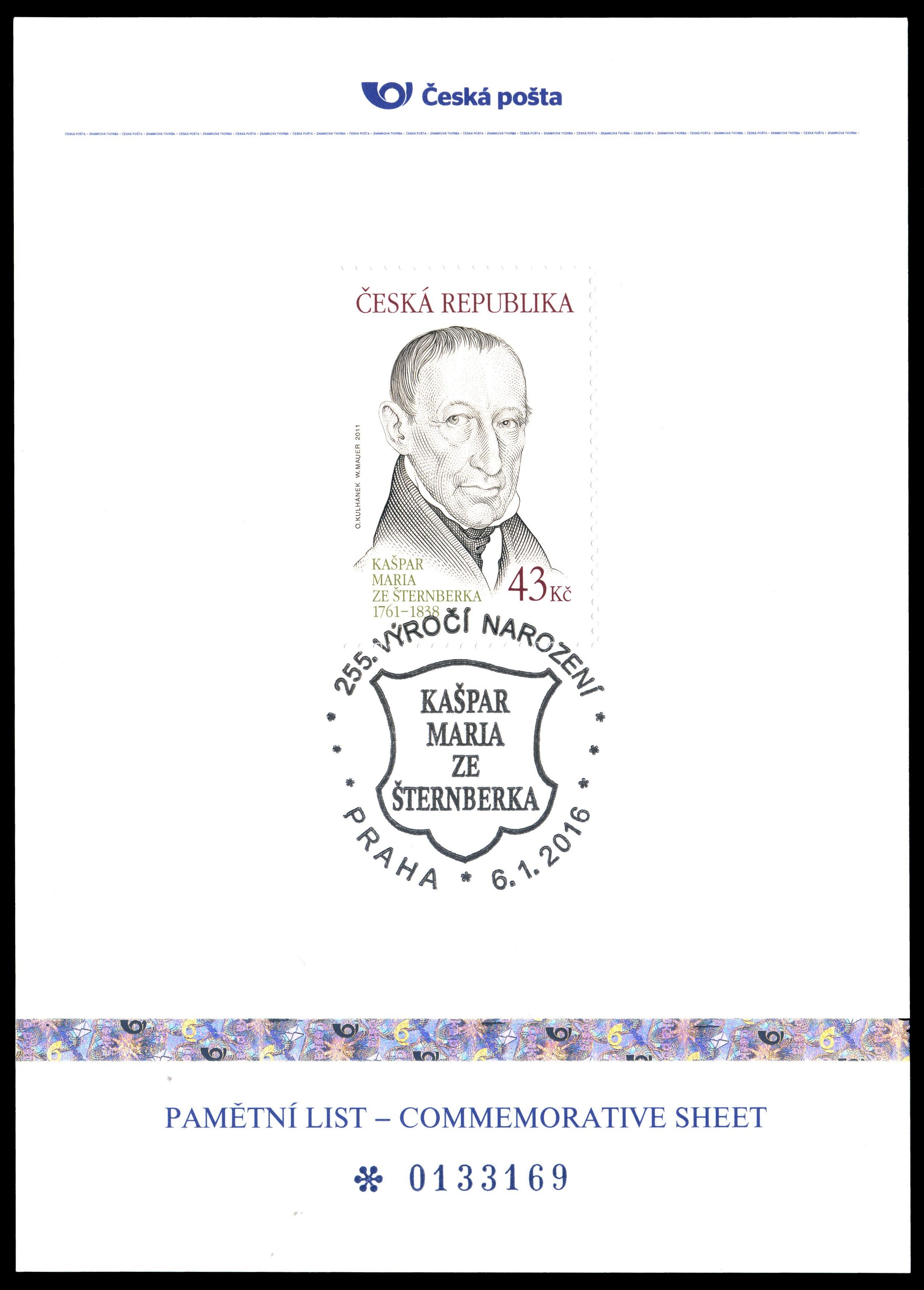
[5] Kaspar Maria von Sternberg (born on January 6th, 1761 at Brezina Castle) was one of the leading scientists of the first half of the 19th century, with a special interest in botany, geology and paleontology, and is considered as one of the founders of paleobotany. [R5]
More information about this stamp is here.
Notes:
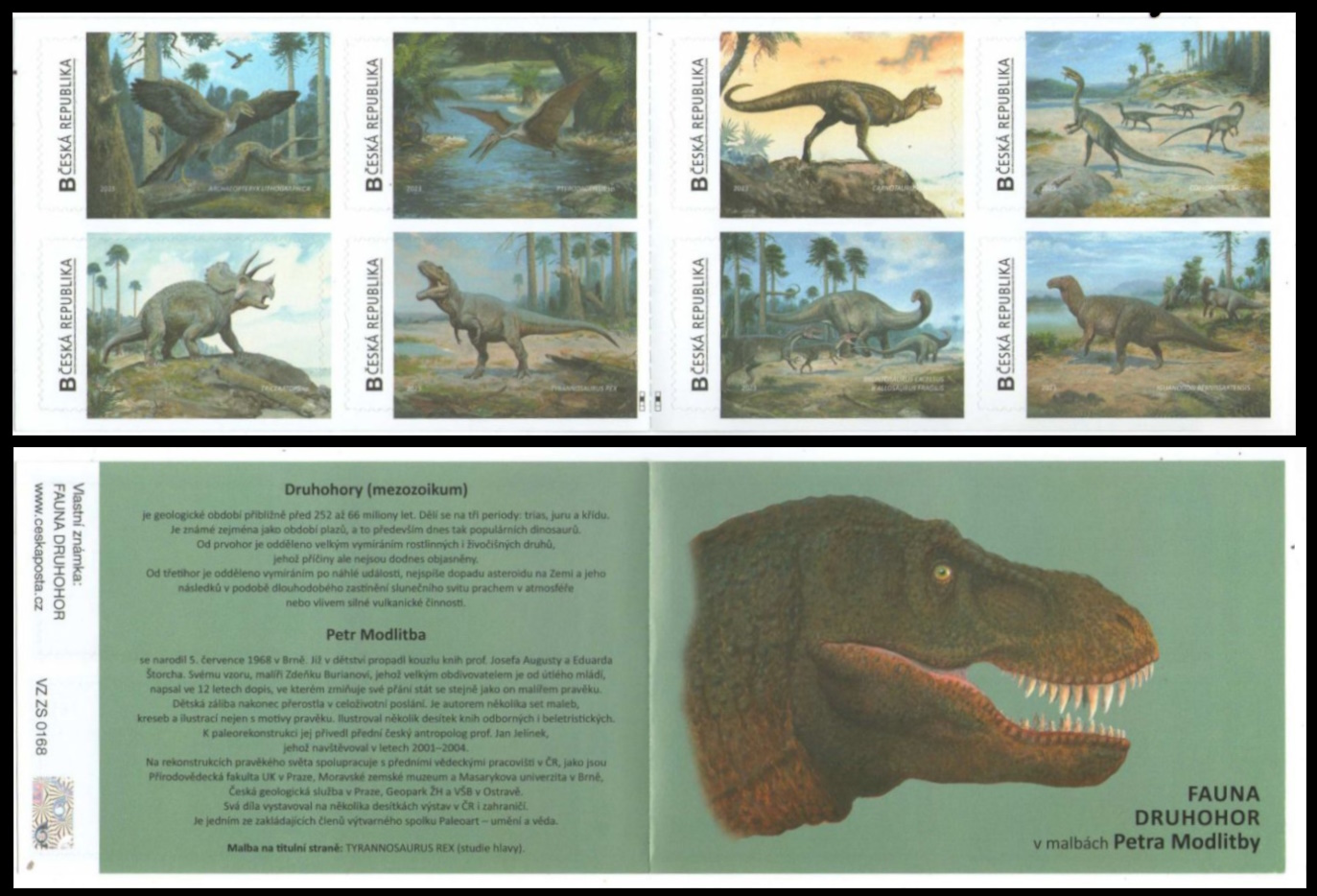
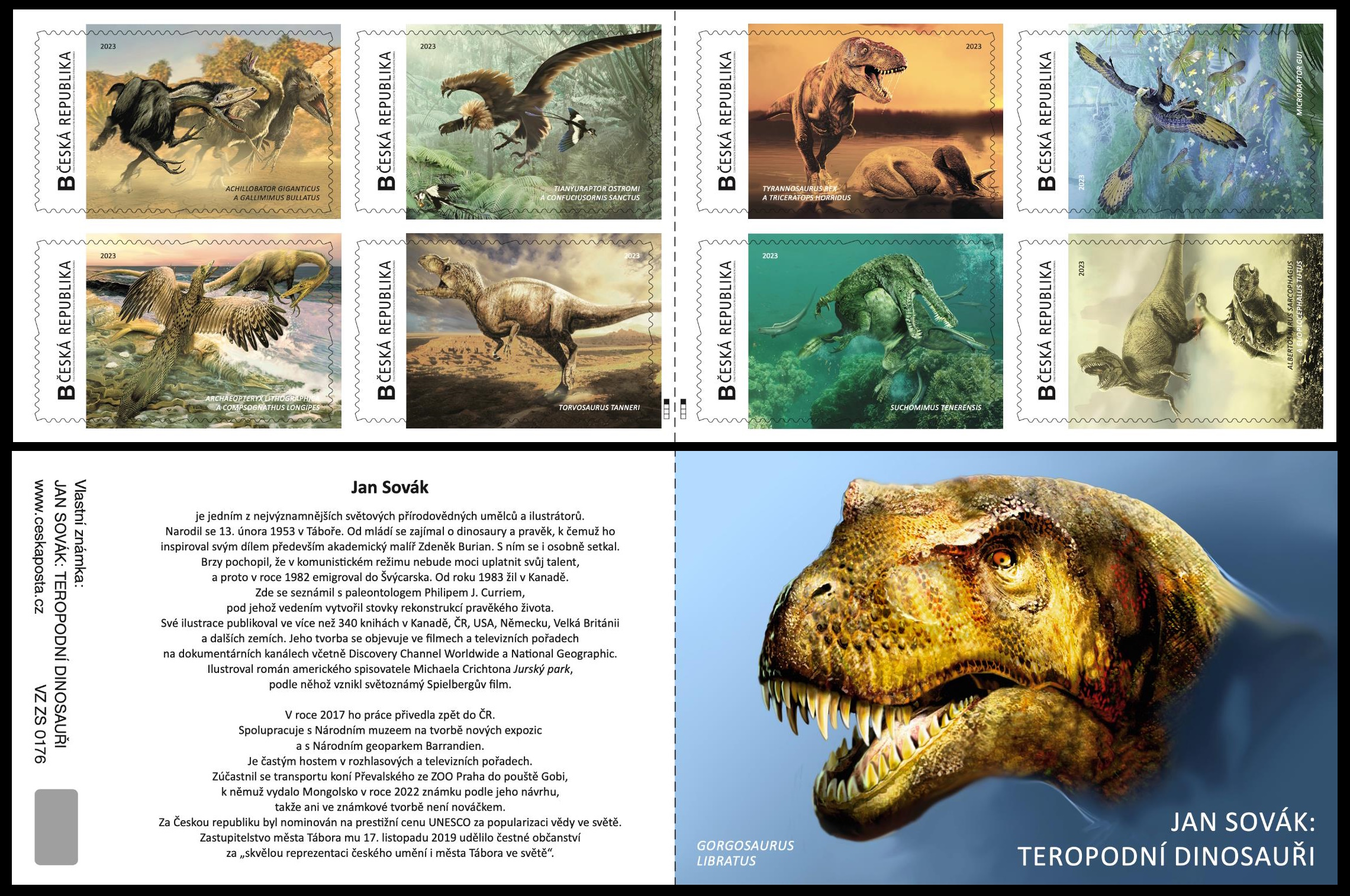
[SP1] Since 2022 the Fauna-Flora Philatelic Society of the Czech Philatelists Association, started to issue personalized stamps of all kinds of "Flora and Fauna" topics, both modern and prehistoric. Their stamps were issued in booklets of 8 self-adhesive stamps each and have the face value "B" corresponded to the rate of small domestic letter and was equivalent to 27 CZK or €1.10 in 2023.
The Society is led by Mr. Vaclav Fiala, who sells their philatelic productions on the internet, for a very expensive price. The package of a booklet, FDC and Maxi Cards of the first issue (2022) offered on the website of the Society for CZK 6.200 which is equivalent to €255. The issues of 2023 are even more expensive and can reach €350 or even more.
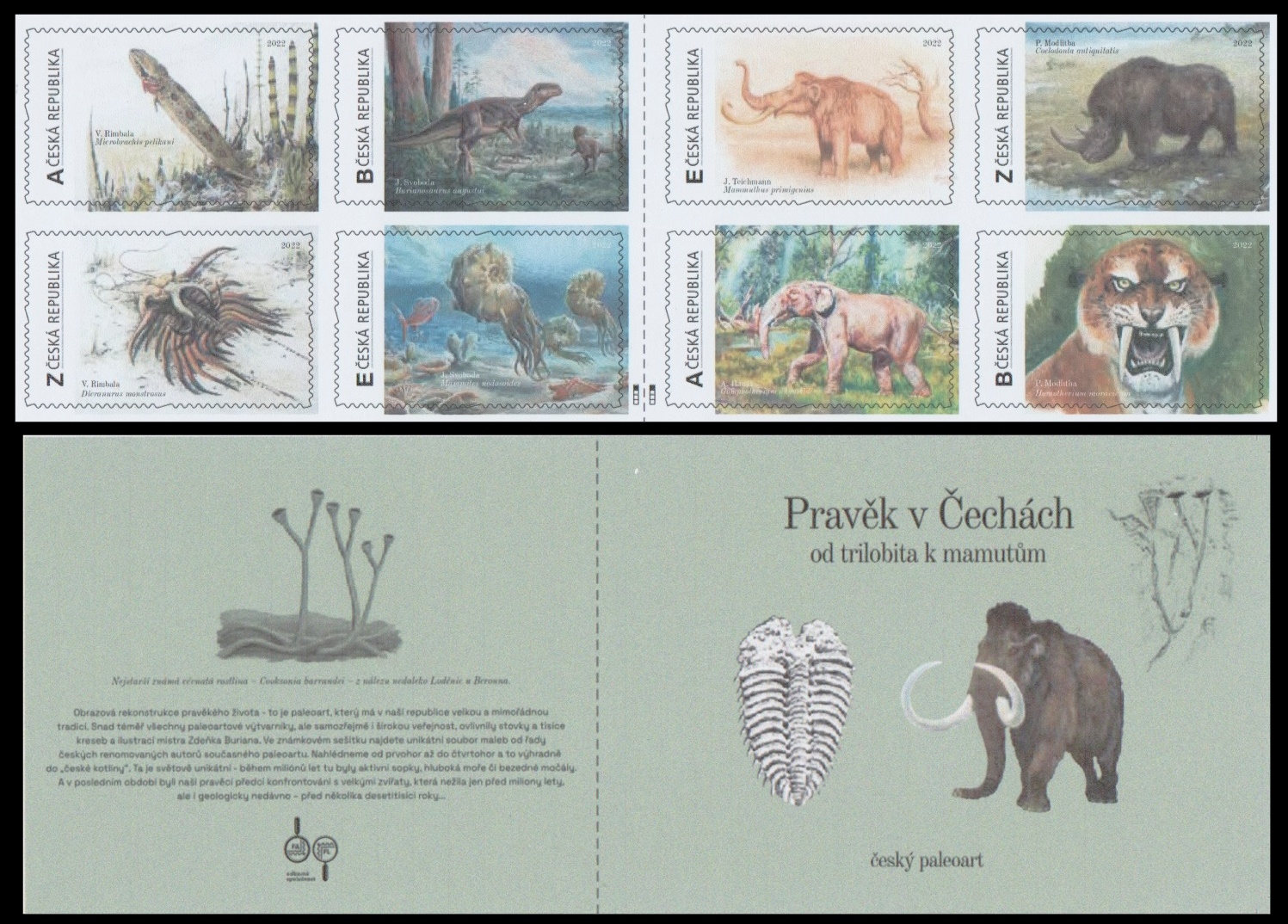
The first booklet "Prehistory in Bohemia" was issued on March 10th 2022 and shows artwork of five Czech paleoartists: Petra Modlitbu, Jiri Svoboda, Arnost Hanak, Jiri (George) Teichmann, Vladimir.
The next four booklets were issued in 2023 and were dedicated to a single paleoartist. For more details, please click here.
Notes:
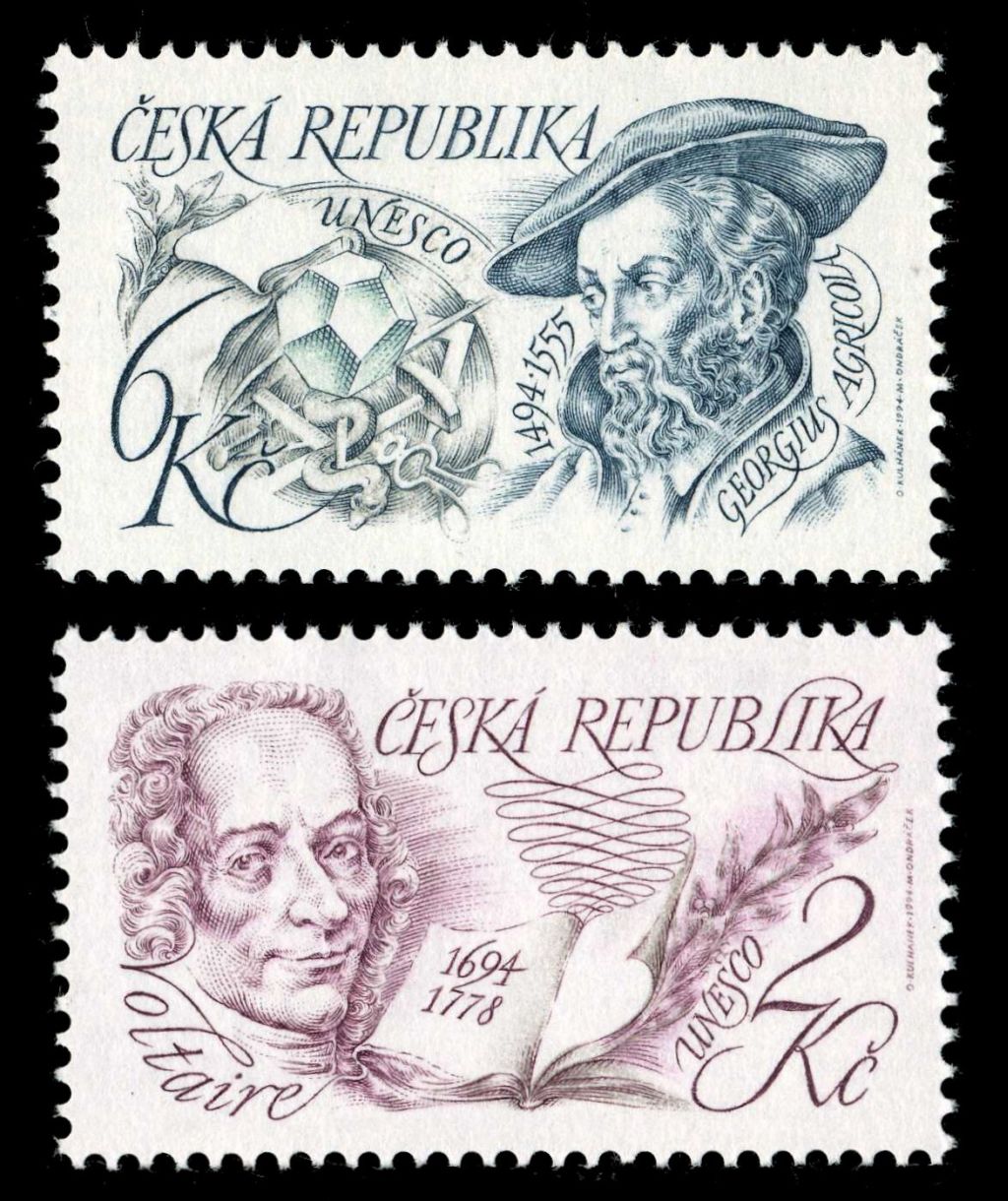
[A1] Georg Bauer (1494- 1555), depicting on "blue" stamp with face value of 6 kc, better known by the Latin version of his name Georgius Agricola, is considered the founder of geology as a discipline.
His work paved the way for further systematic study of
the Earth and of its rocks, minerals, and fossils.
In 1544, he published the "De ortu et causis subterraneorum", in which he laid the first foundations of physical geology, and criticized the theories of the ancients.
However, he maintained that a certain 'materia pinguis' or 'fatty matter', set into fermentation by heat, gave birth to fossil organic shapes, as opposed to fossil shells having belonged to living animals.
In 1545, he followed with the "De natura eorum quae effluunt e terra";
in 1546 the "De veteribus et novis metallis", a comprehensive account of the discovery and occurrence of minerals and also more commonly known as "De Natura Fossilium";
in 1548, the "De animantibus subterraneis"; and in the two following years a number of smaller works on the metals. [R6]
 [A2] "Nature Protection - The Krivoklatsko Region - A UNESCO Biosphere -
Eudia pavonia Reserve" shows various landscapes of the region, also known as a location where fossils have been found.
Fossils with Well-preserved soft parts were ascertained in several different formations of two Cambrian
units of the Příbram-Jince Basin as well as in diverse levels of the Skryje-Týřovice Basin,
the area belongs to the region.
[A2] "Nature Protection - The Krivoklatsko Region - A UNESCO Biosphere -
Eudia pavonia Reserve" shows various landscapes of the region, also known as a location where fossils have been found.
Fossils with Well-preserved soft parts were ascertained in several different formations of two Cambrian
units of the Příbram-Jince Basin as well as in diverse levels of the Skryje-Týřovice Basin,
the area belongs to the region.
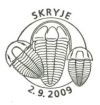
Some trilobites are depicted on commemorative postmarks used on one FDC of the set.
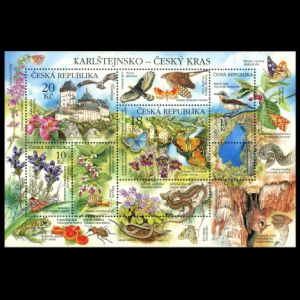
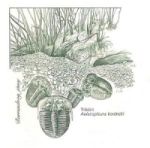 [A3] The mini sheet "Nature Protection - Karlstejn Region"
shows various landscapes of the region, also known as a location where fossils have been found.
The area boasts many precious, geologically significant profiles and world-famous fossil deposits
shared with the neighboring Bohemian Karst area.
The prevailing sedimentary structures contain numerous karst caves.
The Koněprusy Caves, hidden in the Zlatý kůň (Golden Horse) hill about 5 km far from
Beroun, are the best known ones.
Visitors can see about 600 meters of the more than 2 kilometre long caves.
Inside, archaeologists found many animal bones dating back more than half a million years and human bones
about 13 thousand years old. [R8]
Some trilobites are depicting on one FDC of the set.
[A3] The mini sheet "Nature Protection - Karlstejn Region"
shows various landscapes of the region, also known as a location where fossils have been found.
The area boasts many precious, geologically significant profiles and world-famous fossil deposits
shared with the neighboring Bohemian Karst area.
The prevailing sedimentary structures contain numerous karst caves.
The Koněprusy Caves, hidden in the Zlatý kůň (Golden Horse) hill about 5 km far from
Beroun, are the best known ones.
Visitors can see about 600 meters of the more than 2 kilometre long caves.
Inside, archaeologists found many animal bones dating back more than half a million years and human bones
about 13 thousand years old. [R8]
Some trilobites are depicting on one FDC of the set.
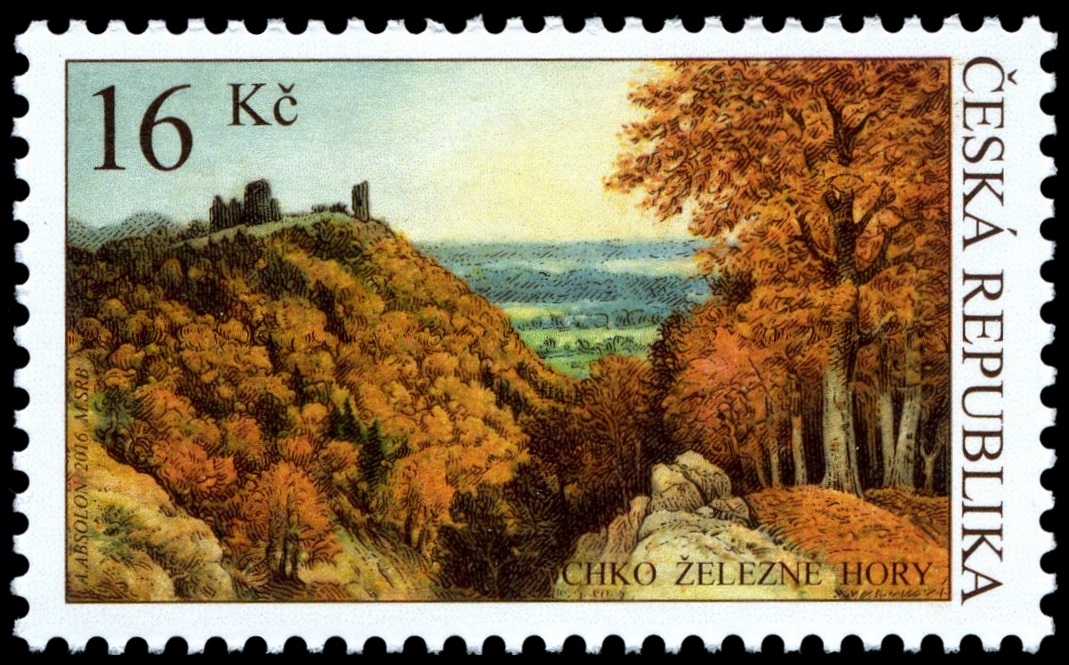
[A4] Iron Mountains are the key to geological history of central Europe. Proterozoic gneisses and volcano sedimentary complexes (subaerial and submarine volcanism) are present. The earliest life forms have been found – stromatolites.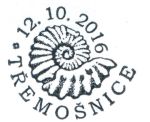 The Paleozoic comprises Cambrian siltstones, Ordovi cian quartzites, Silurian shales,
Devonian limestones and Carboniferous sediments.
Rare fossils include trilobite and graptolite fauna.
The third oldest ichnofossil of Zoophycos type in the world has been reported from this locality.
The Mesozoic (Upper Cretaceous) sedimentary cover has a unique development, with abundant fauna and flora.
Sandstones and spiculitic marlstones provide excellent conditions for groundwater accumulation.
Tertiary rocks are represented by basalt enclosing olivine-rich xenoliths.
Geological story of the area is completed by Quaternary loess and sandy gravel.
Over a hundred geosites have been described from this area.
The above facts became grounds for listing the Iron Mountains as a National Geopark.
[R7]
Fossilized ammonite depicting on a postmark used for FDC.
The Paleozoic comprises Cambrian siltstones, Ordovi cian quartzites, Silurian shales,
Devonian limestones and Carboniferous sediments.
Rare fossils include trilobite and graptolite fauna.
The third oldest ichnofossil of Zoophycos type in the world has been reported from this locality.
The Mesozoic (Upper Cretaceous) sedimentary cover has a unique development, with abundant fauna and flora.
Sandstones and spiculitic marlstones provide excellent conditions for groundwater accumulation.
Tertiary rocks are represented by basalt enclosing olivine-rich xenoliths.
Geological story of the area is completed by Quaternary loess and sandy gravel.
Over a hundred geosites have been described from this area.
The above facts became grounds for listing the Iron Mountains as a National Geopark.
[R7]
Fossilized ammonite depicting on a postmark used for FDC.
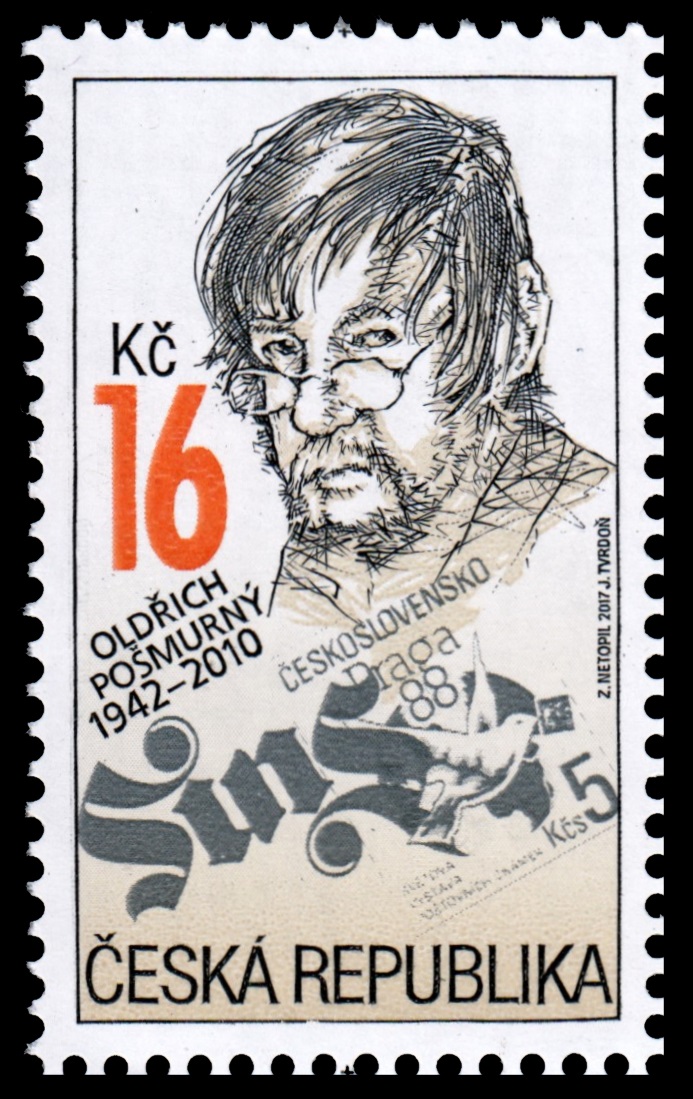
[A5] Oldřich Pošmurný (1942-2010) was artist and stamps engraver. He studied graphic design of books and magazines with Prof. Vladimír Ringes, history of book design with Prof. František Klikar, and illustration and figure drawing with V.J. Žižka. After graduation Oldřich Pošmurný worked as a graphic editor in the Svoboda publishing house. From 1968, he worked as a free-lance graphic artist. [R10] He co-designed the series Zdeněk Burian’s Ancient Dinosaurs and designed Dinosaur's stamps of Czech Republic in 1994.
The postage stamp is issued both in the form of sheets and as a book of 8 stamps and 4 coupons.
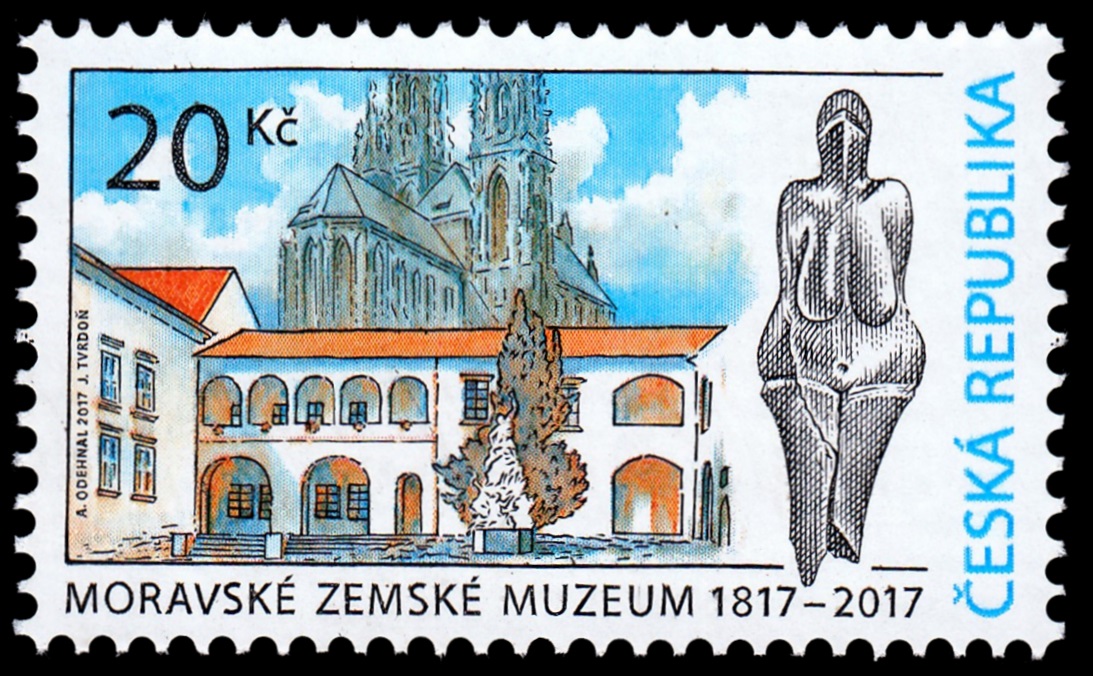
[A6] The museum was founded in July 1817 in Brno. Its collections include over 6 million objects from many fields of science and culture, include some fossils in Paleontologic and Paleoanthoropolgic exhibits. [R11]
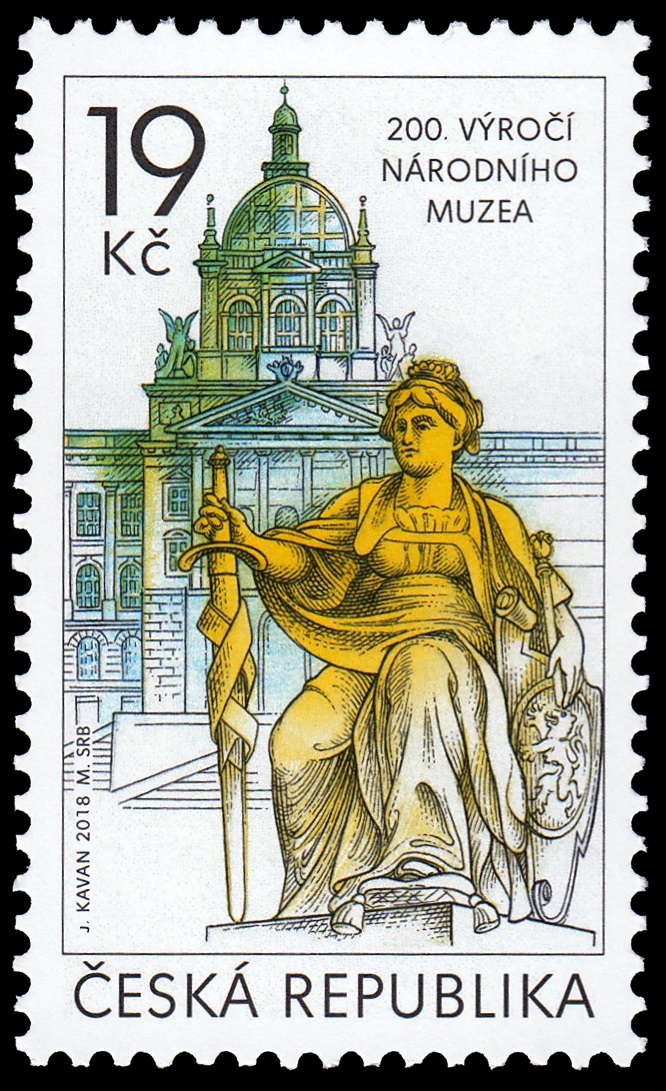
[A7] On October 10th 2018 Post authority of Czech Republic issued a stamp "200 years of the National Museum in Prague". The stamp depicts the building and expositions of the National Museum. The National Museum is the largest Czech museum. Museum started with donations of large private collections, dedicated mostly to natural science, by a group of local aristocrats led by Count Kaspar Maria Sternberg, who also led an effort to set up the museum. [R12]
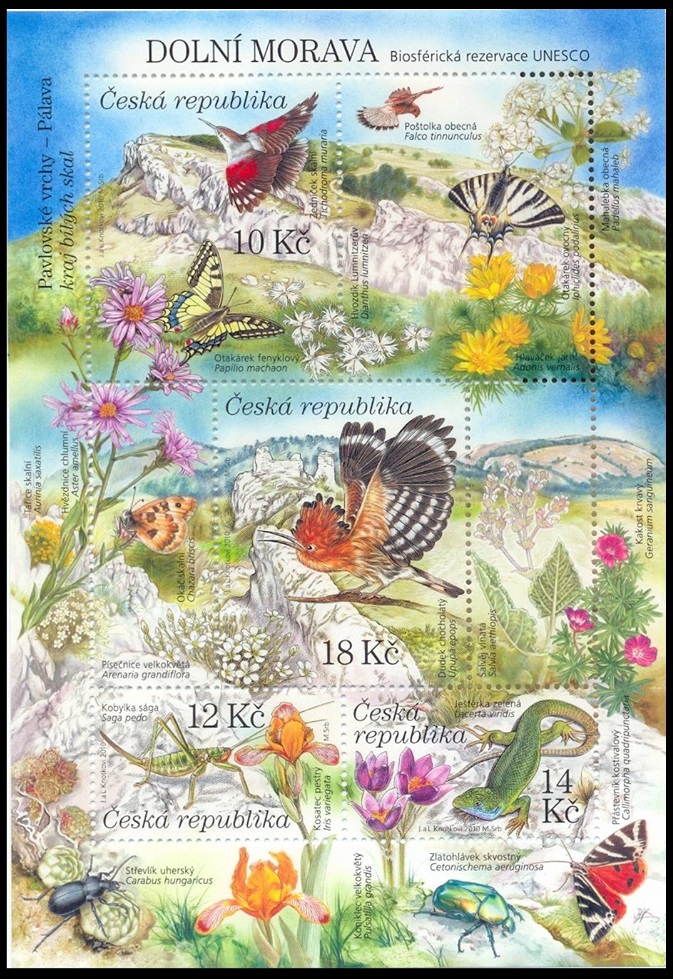
[A8] In 2003 the Committee of the International Coordination Council of UNESCO's Man and the Biosphere (MAB) programme in Paris approved the extension of the Pálava Biosphere Reserve to include the Lednice-Valtice Cultural Landscape and the floodplain forests at the confluence of the Morava and Dyje rivers. The newly designated area, covering over 300 km2>, was renamed the Lower Morava Biosphere Reserve.
The reserve encompasses a unique combination of limestone cliffs of the Pálava Hills (In the Upper Tertiary period, the hills were surrounded by a warm sea. During the Quaternary fossils were deposited on the foot slopes of the Pavlov Hills), the Central European lowland floodplains along the lower reaches of the Kyjovka, Dyje and Morava rivers and the Lednice-Valtice Cultural Landscape. [R7]
There are many personalized postal stationery (post cards with imprinted stamp) issued by the Czech Republic,
here are only some of them.
These post stationaries are based on standard postal stationery produced by
Czech's Post Authority without any image on the left side.
Notes:
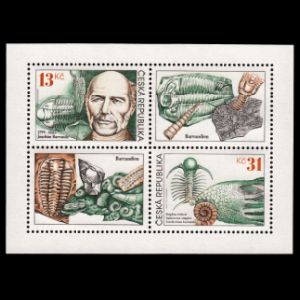
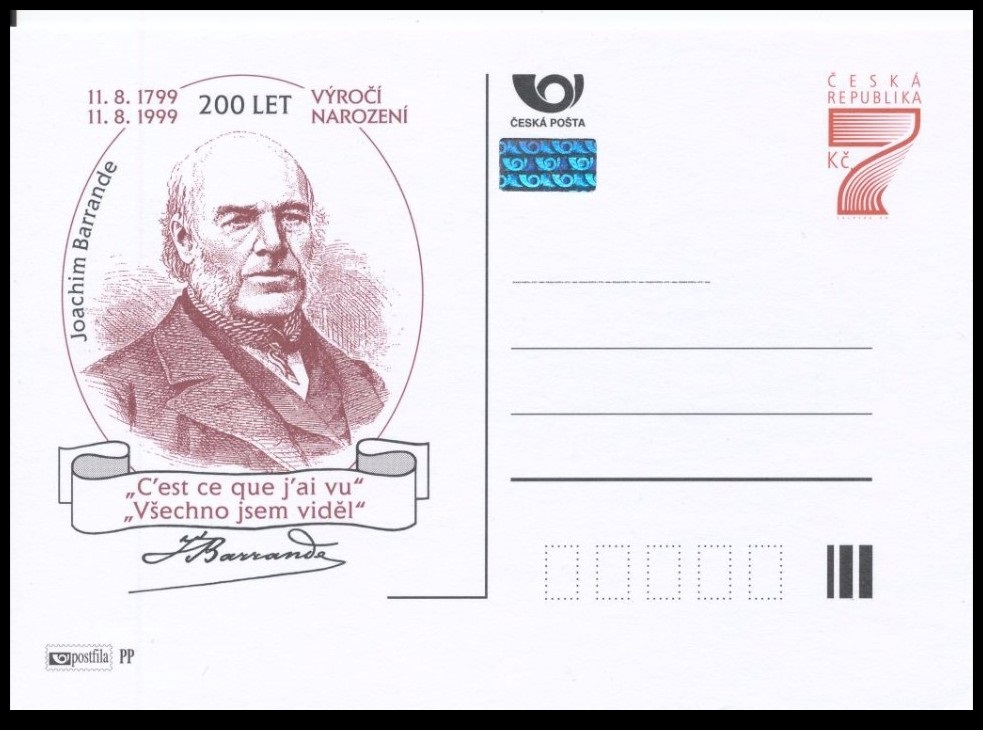
[PS1] Paleontologist Joachim Barrande is also depicted on the 1999 postage stamp.
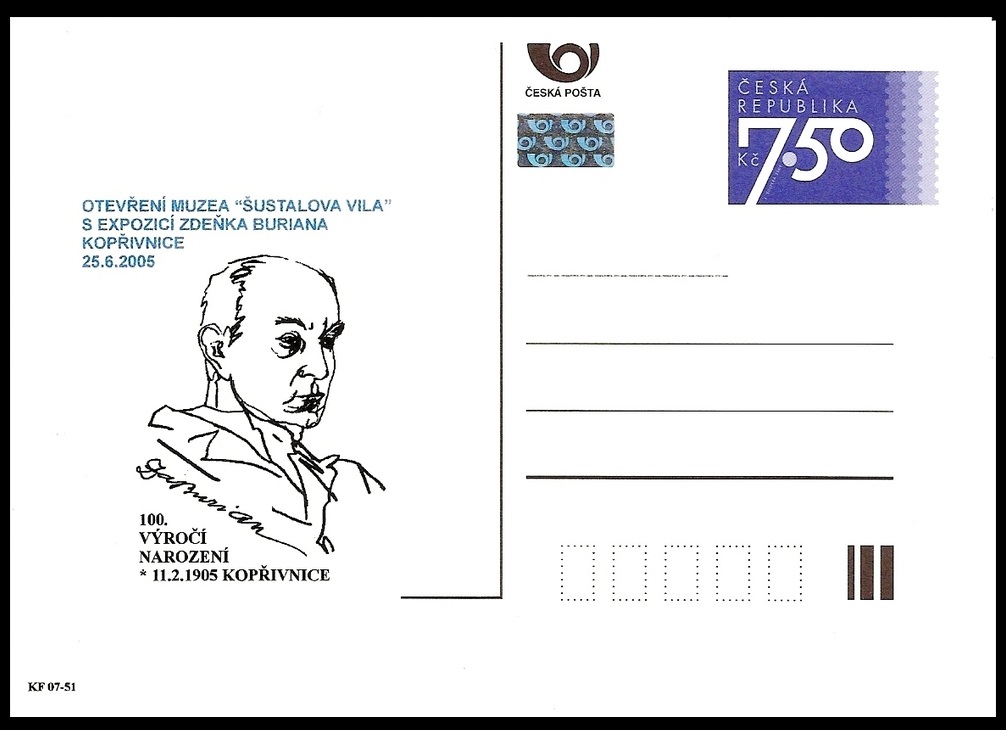
[PS2] Famous Czech's paleoartist Zdenek Burian. His illustrations can be seen on many stamps, for example Czech 1994
[PS3] Paleontologist Kaspar Maria von Steinberg also depicted on a postage stamp from 2011
Legend is here
Since 2019 "Flora and Fauna" philatelic club in Czech Republic start to produce its own commemorative R-labels with permission of Czech Post.
Legend is here
Notes:
[CA1] Zdenek Burian (1905-1981) was a Czech painter and book illustrator whose work played a central role in the development of palaeontological reconstructions during a remarkable career spanning five decades.
Many of his works were used as the source material for the images on many international stamps, including the 1994 Czech Prehistoric Animals – Dinosaurs set. [R13]
[CA2] Registered label with postmark of Czech's "Flora and Fauna" philatelic club. The postmark of ammonite shape shows a stylized dinosaur, perhaps a T Rex, inside the chambers of the ammonite.
The text above the postmark: "Resumption of Fauna-Flora Expert Section at Union of Czech Philatelists." Similar postmarks issued in Prague, Plzen and Kladno cities.
Many thanks to Dr. Peter Voice from Department of Geological and Environmental Sciences, Western Michigan University, for reviewing the draft page and his very valuable comments.
In the 19th century, the Czech lands became the industrial powerhouse of the monarchy and were subsequently the core of the Republic of Czechoslovakia, which was formed in 1918 following the collapse of the Austro-Hungarian Empire after World War I. Czechoslovakia was occupied by Germany in World War II, and was liberated in 1945 by the Soviet and the United States Armies.
Between 1948 and 1989 Czechoslovakia was a one-party communist state under Soviet influence. In 1989, the Velvet Revolution led to the collapse of the Communist Regime and a multi-party parliamentary republic was formed. On 1 January 1993, Czechoslovakia peacefully dissolved, with its constituent states becoming the independent states of the Czech Republic and Slovakia. [R1]
The first stamps of the Czech Republic were issued on 20 January 1993 after the former Czechoslovakia was split into the Slovak Republic and the Czech Republic on 1 January 1993. Before then, stamps of the Czechoslovak Republic were in use and were still valid until 30 September 1993. [R2]
Official stamps of Czech Republic related to Paleontology: dinosaurs and other prehistoric animals. fossils, paleontologist, Charles Darwin
| 01.06.1994 "Prehistoric animals - Dinosaurs" [1] | 23.06.1999 "Joachim Barrande and Czech Trilobites" | 09.11.2005 "Works of art on postage stamps" [2] |
 |
 |
 |
| 18.06.2008 "Explorers" [3] | 02.01.2009 "Personalities" [4] | 05.01.2011 "Kaspar Maria von Sternberg" [5] |
 |
 |
 |
Notes:
[1] All three stamps based on illustrations of famous Czechoslovakian paleo-artist Zdenek Burian. So far there are no stamps that show a portrait of Zdenek Burian, however a postmark with his image was produced by the Czech Post in 1995.
[2] Stamp with face value of 25 CZK of "Works of art on postage stamps" shows Deinotherium picture painted in 1940 by famous Czech Paleoartist Zdenek Burian for Charles University in Prague.

|
|
Deinotherium (1940) by Zdenek Burian on postage stamps of Czech Republic 2005. MiNr.: 452 Scott: 3288 |
[3] Stamp with face value of 12 CZK from "Explorers" set shows Ferdinand Stolicka, who was a Czech geologist, paleontologist and natural scientist of world significance, who worked in India on paleontology, geology and various aspects of zoology, including ornithology and herpetology. [R4] He died of High-altitude sickness during an expedition across the Himalayas. More information about this stamp is here.
[4] Stamp with face value of 12 CZK from "Personalities" set shows Charles Darwin.
Michel catalog list these stamps individually (Minr: 584, 585), when Scott (3408-3409) and Czech's Post define these two stamps as a set.
[5] Kaspar Maria von Sternberg (born on January 6th, 1761 at Brezina Castle) was one of the leading scientists of the first half of the 19th century, with a special interest in botany, geology and paleontology, and is considered as one of the founders of paleobotany. [R5]
More information about this stamp is here.
Some personalized stamps related to Paleontology: prehistoric animals
| 10.03.2022 "Prehistory in Bohemia" [SP1] | 24.03.2023 "Tertiary period animals" [SP1] | 04.07.2023 "Prehistory of the genus Homo" [SP1] |
 |
 |
 |
| 08.09.2022 "Mesozoic Fauna" [SP1] | 24.11.2023 "Theropod Dinosaurs" [SP1] | |
 |
 |
|
Notes:
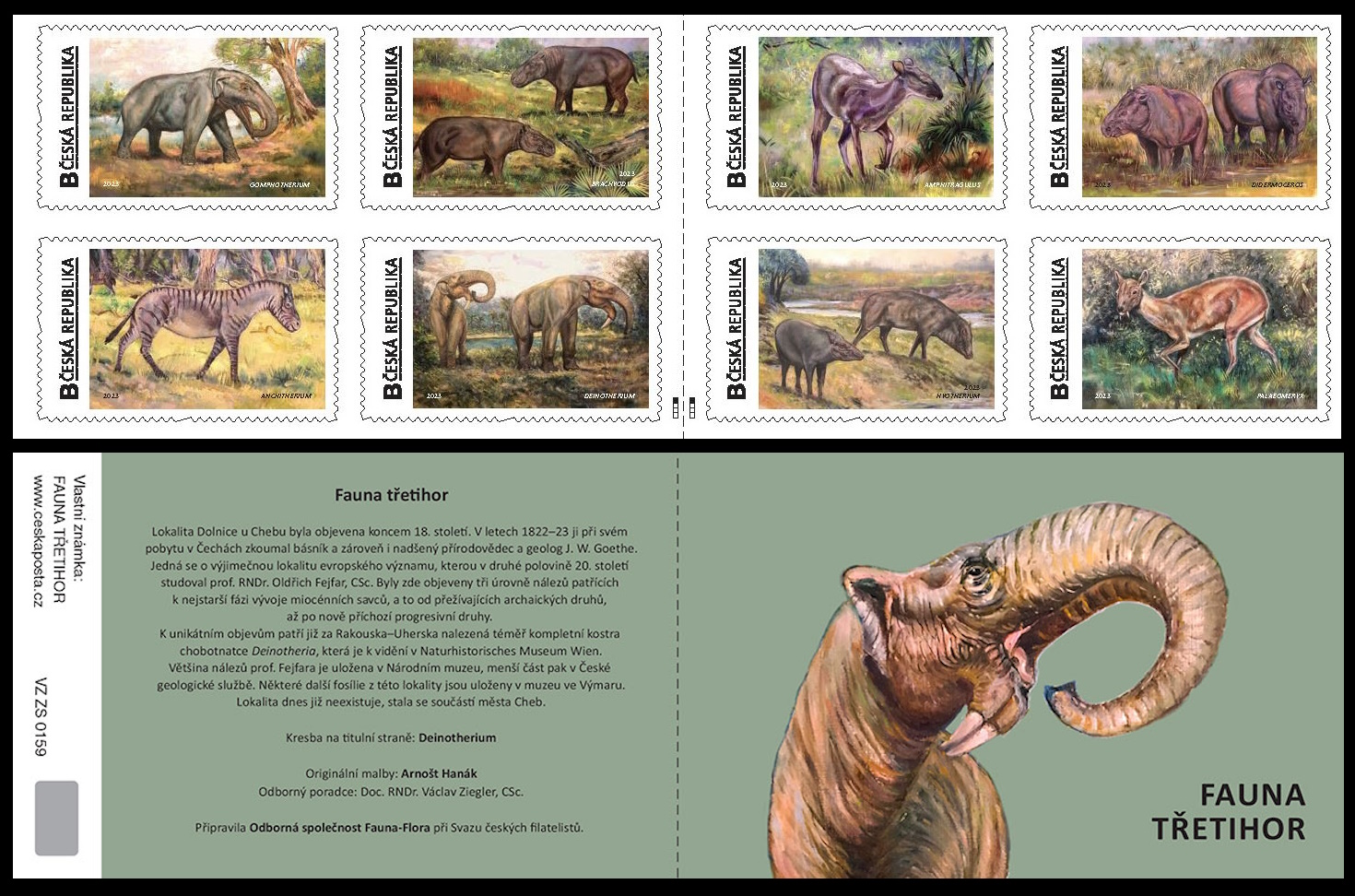
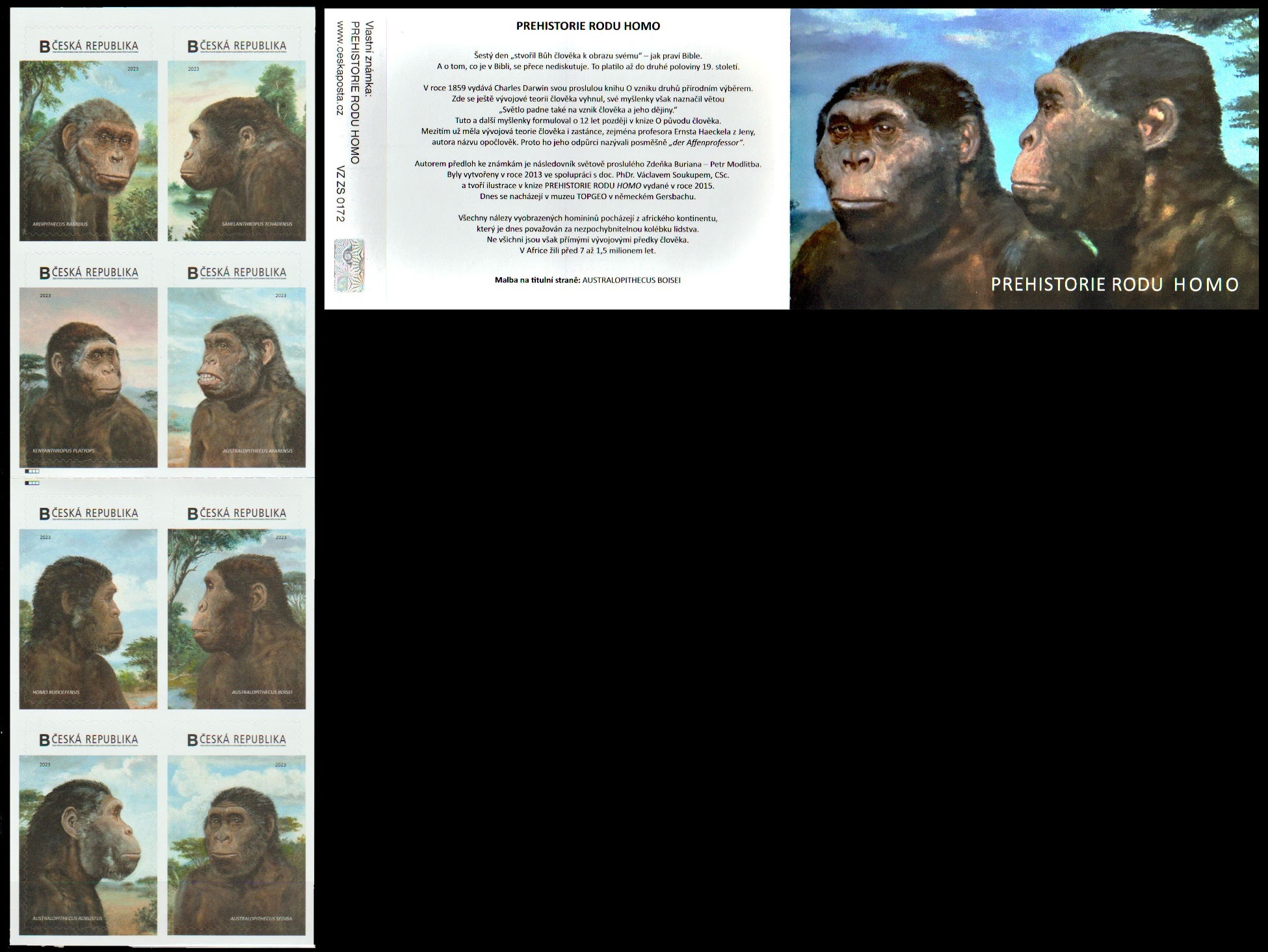
[SP1] Since 2022 the Fauna-Flora Philatelic Society of the Czech Philatelists Association, started to issue personalized stamps of all kinds of "Flora and Fauna" topics, both modern and prehistoric. Their stamps were issued in booklets of 8 self-adhesive stamps each and have the face value "B" corresponded to the rate of small domestic letter and was equivalent to 27 CZK or €1.10 in 2023.
The Society is led by Mr. Vaclav Fiala, who sells their philatelic productions on the internet, for a very expensive price. The package of a booklet, FDC and Maxi Cards of the first issue (2022) offered on the website of the Society for CZK 6.200 which is equivalent to €255. The issues of 2023 are even more expensive and can reach €350 or even more.
The first booklet "Prehistory in Bohemia" was issued on March 10th 2022 and shows artwork of five Czech paleoartists: Petra Modlitbu, Jiri Svoboda, Arnost Hanak, Jiri (George) Teichmann, Vladimir.
The next four booklets were issued in 2023 and were dedicated to a single paleoartist. For more details, please click here.
Other stamps to consider: fossil found places, contributors to Paleontology science, Natural History Museums
| 02.02.1994 "Personalities" [A1] | 02.09.2009 "Nature Protection - The Krivoklatsko Region - A UNESCO Biosphere - Eudia pavonia Reserve" [A2] | 01.09.2010 "Nature Protection - Biosphere Reserve Lower Morava" [A8] |
 |
 |
 |
| 04.09.2013 "Nature Protection - Karlstejn Region" [A3] | 12.10.2016 "The Zelezne hory Protected Landscape Area" [A4] | 20.01.2017 "Tradition of Czech Stamp Design — Oldrich Posmurny" [A5] |
 |
 |
 |
| 21.06.2017 "The Moravian Museum in Brno" [A6] | 10.10.2018 "200 anniversary of the National Museum in Prague" [A7] | 04.04.2018 "Eduard Storch" |
 |
 |
 |
Notes:
[A1] Georg Bauer (1494- 1555), depicting on "blue" stamp with face value of 6 kc, better known by the Latin version of his name Georgius Agricola, is considered the founder of geology as a discipline.

|
|
Georg Bauer/Georgius Agricola on stamp of Czech Republic 1994. MiNr.: 33 Scott: 2914 |
In 1544, he published the "De ortu et causis subterraneorum", in which he laid the first foundations of physical geology, and criticized the theories of the ancients.
However, he maintained that a certain 'materia pinguis' or 'fatty matter', set into fermentation by heat, gave birth to fossil organic shapes, as opposed to fossil shells having belonged to living animals.
In 1545, he followed with the "De natura eorum quae effluunt e terra";
in 1546 the "De veteribus et novis metallis", a comprehensive account of the discovery and occurrence of minerals and also more commonly known as "De Natura Fossilium";
in 1548, the "De animantibus subterraneis"; and in the two following years a number of smaller works on the metals. [R6]
 [A2] "Nature Protection - The Krivoklatsko Region - A UNESCO Biosphere -
Eudia pavonia Reserve" shows various landscapes of the region, also known as a location where fossils have been found.
Fossils with Well-preserved soft parts were ascertained in several different formations of two Cambrian
units of the Příbram-Jince Basin as well as in diverse levels of the Skryje-Týřovice Basin,
the area belongs to the region.
[A2] "Nature Protection - The Krivoklatsko Region - A UNESCO Biosphere -
Eudia pavonia Reserve" shows various landscapes of the region, also known as a location where fossils have been found.
Fossils with Well-preserved soft parts were ascertained in several different formations of two Cambrian
units of the Příbram-Jince Basin as well as in diverse levels of the Skryje-Týřovice Basin,
the area belongs to the region.Some trilobites are depicted on commemorative postmarks used on one FDC of the set.
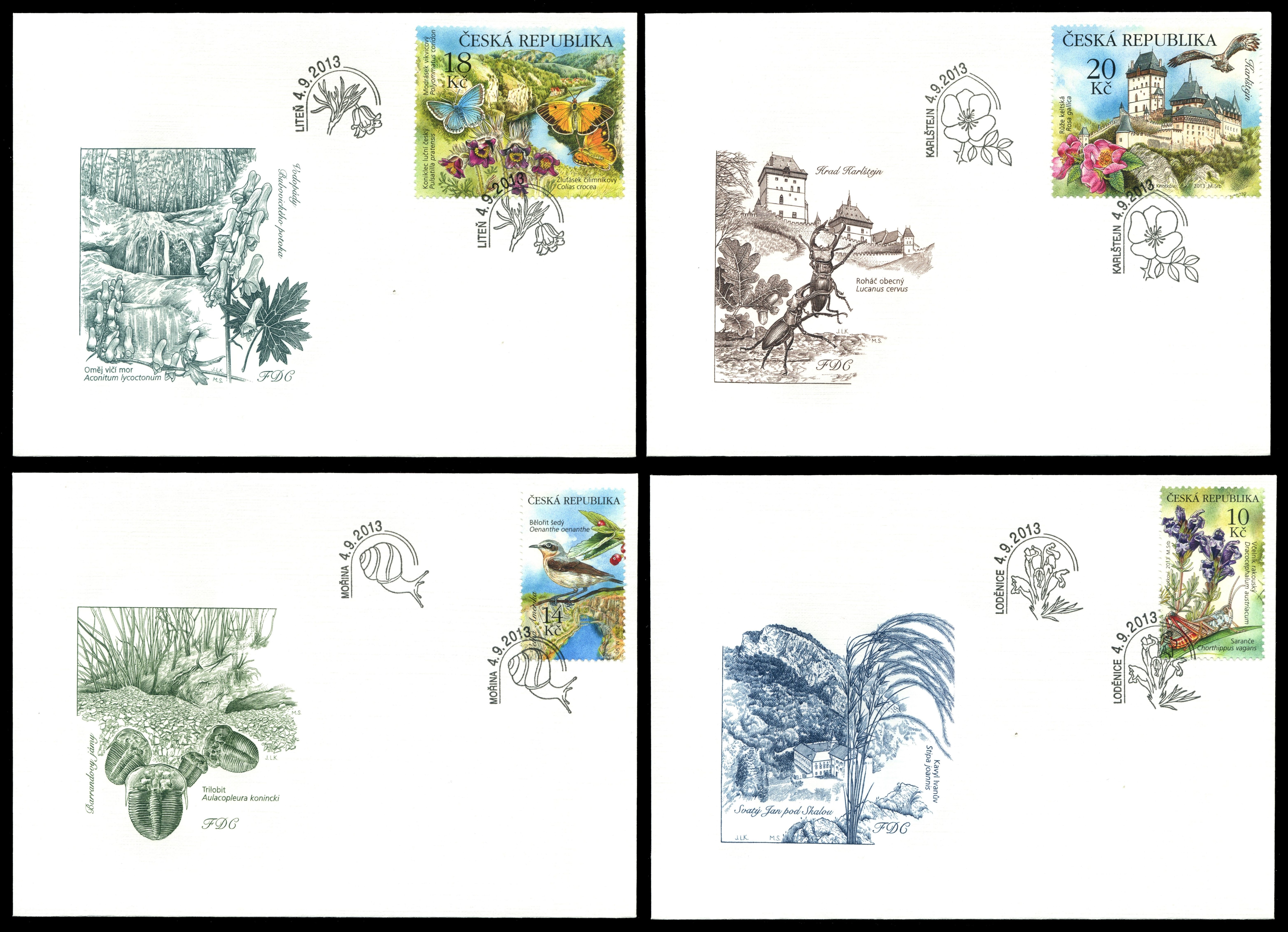 [A3] The mini sheet "Nature Protection - Karlstejn Region"
shows various landscapes of the region, also known as a location where fossils have been found.
The area boasts many precious, geologically significant profiles and world-famous fossil deposits
shared with the neighboring Bohemian Karst area.
The prevailing sedimentary structures contain numerous karst caves.
The Koněprusy Caves, hidden in the Zlatý kůň (Golden Horse) hill about 5 km far from
Beroun, are the best known ones.
Visitors can see about 600 meters of the more than 2 kilometre long caves.
Inside, archaeologists found many animal bones dating back more than half a million years and human bones
about 13 thousand years old. [R8]
Some trilobites are depicting on one FDC of the set.
[A3] The mini sheet "Nature Protection - Karlstejn Region"
shows various landscapes of the region, also known as a location where fossils have been found.
The area boasts many precious, geologically significant profiles and world-famous fossil deposits
shared with the neighboring Bohemian Karst area.
The prevailing sedimentary structures contain numerous karst caves.
The Koněprusy Caves, hidden in the Zlatý kůň (Golden Horse) hill about 5 km far from
Beroun, are the best known ones.
Visitors can see about 600 meters of the more than 2 kilometre long caves.
Inside, archaeologists found many animal bones dating back more than half a million years and human bones
about 13 thousand years old. [R8]
Some trilobites are depicting on one FDC of the set.
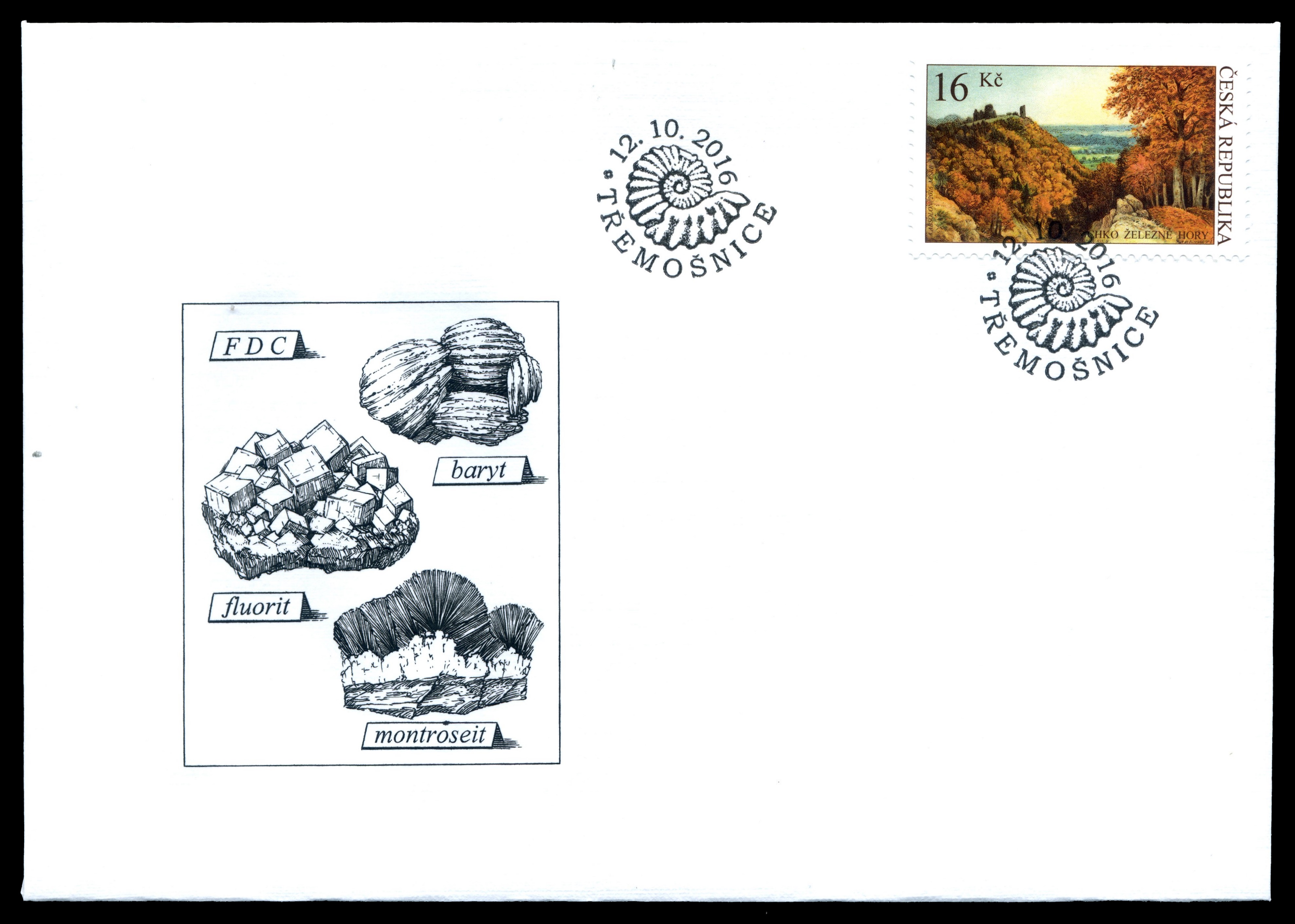
[A4] Iron Mountains are the key to geological history of central Europe. Proterozoic gneisses and volcano sedimentary complexes (subaerial and submarine volcanism) are present. The earliest life forms have been found – stromatolites.
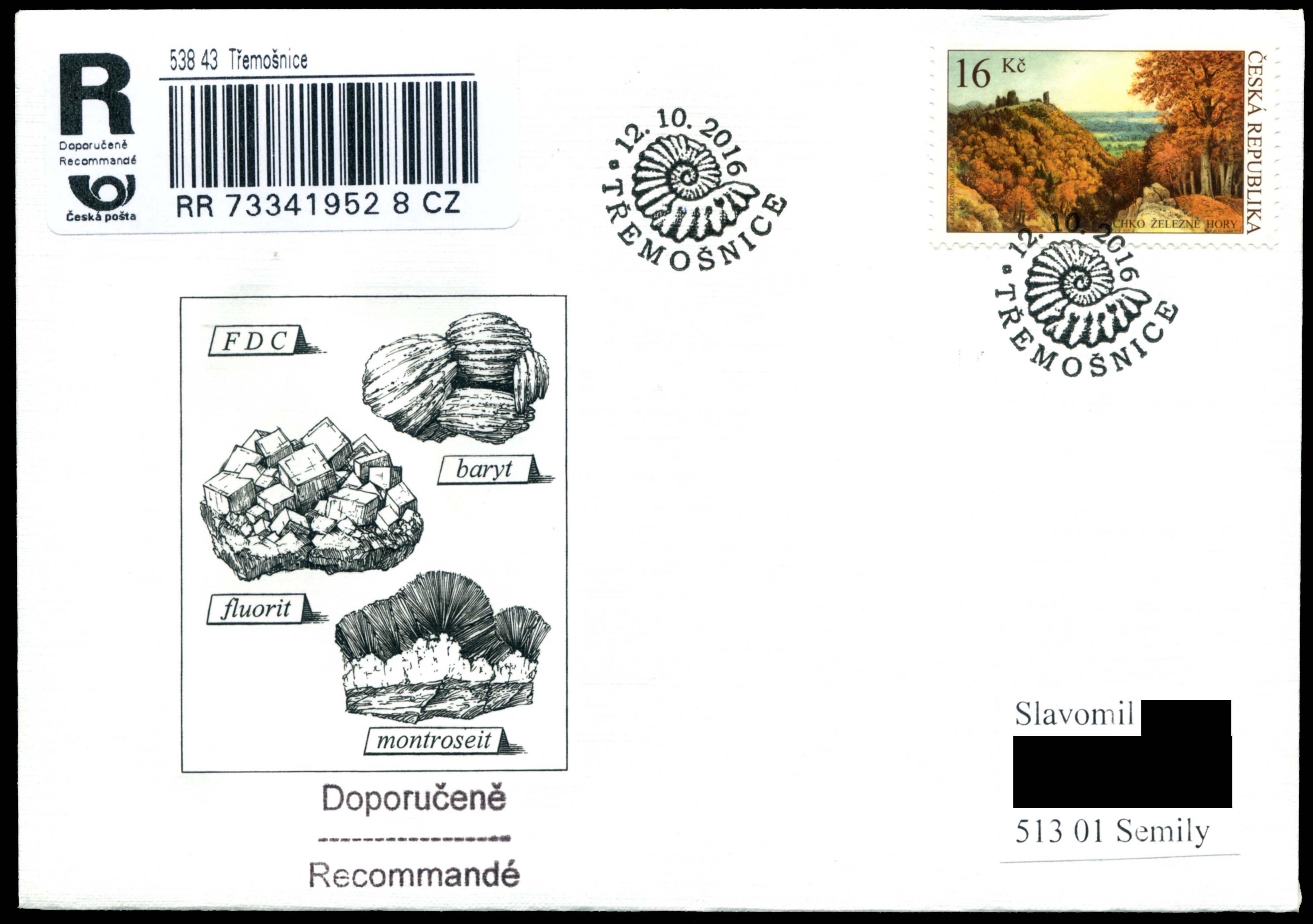 The Paleozoic comprises Cambrian siltstones, Ordovi cian quartzites, Silurian shales,
Devonian limestones and Carboniferous sediments.
Rare fossils include trilobite and graptolite fauna.
The third oldest ichnofossil of Zoophycos type in the world has been reported from this locality.
The Mesozoic (Upper Cretaceous) sedimentary cover has a unique development, with abundant fauna and flora.
Sandstones and spiculitic marlstones provide excellent conditions for groundwater accumulation.
Tertiary rocks are represented by basalt enclosing olivine-rich xenoliths.
Geological story of the area is completed by Quaternary loess and sandy gravel.
Over a hundred geosites have been described from this area.
The above facts became grounds for listing the Iron Mountains as a National Geopark.
[R7]
Fossilized ammonite depicting on a postmark used for FDC.
The Paleozoic comprises Cambrian siltstones, Ordovi cian quartzites, Silurian shales,
Devonian limestones and Carboniferous sediments.
Rare fossils include trilobite and graptolite fauna.
The third oldest ichnofossil of Zoophycos type in the world has been reported from this locality.
The Mesozoic (Upper Cretaceous) sedimentary cover has a unique development, with abundant fauna and flora.
Sandstones and spiculitic marlstones provide excellent conditions for groundwater accumulation.
Tertiary rocks are represented by basalt enclosing olivine-rich xenoliths.
Geological story of the area is completed by Quaternary loess and sandy gravel.
Over a hundred geosites have been described from this area.
The above facts became grounds for listing the Iron Mountains as a National Geopark.
[R7]
Fossilized ammonite depicting on a postmark used for FDC.[A5] Oldřich Pošmurný (1942-2010) was artist and stamps engraver. He studied graphic design of books and magazines with Prof. Vladimír Ringes, history of book design with Prof. František Klikar, and illustration and figure drawing with V.J. Žižka. After graduation Oldřich Pošmurný worked as a graphic editor in the Svoboda publishing house. From 1968, he worked as a free-lance graphic artist. [R10] He co-designed the series Zdeněk Burian’s Ancient Dinosaurs and designed Dinosaur's stamps of Czech Republic in 1994.
The postage stamp is issued both in the form of sheets and as a book of 8 stamps and 4 coupons.
[A6] The museum was founded in July 1817 in Brno. Its collections include over 6 million objects from many fields of science and culture, include some fossils in Paleontologic and Paleoanthoropolgic exhibits. [R11]
[A7] On October 10th 2018 Post authority of Czech Republic issued a stamp "200 years of the National Museum in Prague". The stamp depicts the building and expositions of the National Museum. The National Museum is the largest Czech museum. Museum started with donations of large private collections, dedicated mostly to natural science, by a group of local aristocrats led by Count Kaspar Maria Sternberg, who also led an effort to set up the museum. [R12]
[A8] In 2003 the Committee of the International Coordination Council of UNESCO's Man and the Biosphere (MAB) programme in Paris approved the extension of the Pálava Biosphere Reserve to include the Lednice-Valtice Cultural Landscape and the floodplain forests at the confluence of the Morava and Dyje rivers. The newly designated area, covering over 300 km2>, was renamed the Lower Morava Biosphere Reserve.
The reserve encompasses a unique combination of limestone cliffs of the Pálava Hills (In the Upper Tertiary period, the hills were surrounded by a warm sea. During the Quaternary fossils were deposited on the foot slopes of the Pavlov Hills), the Central European lowland floodplains along the lower reaches of the Kyjovka, Dyje and Morava rivers and the Lednice-Valtice Cultural Landscape. [R7]
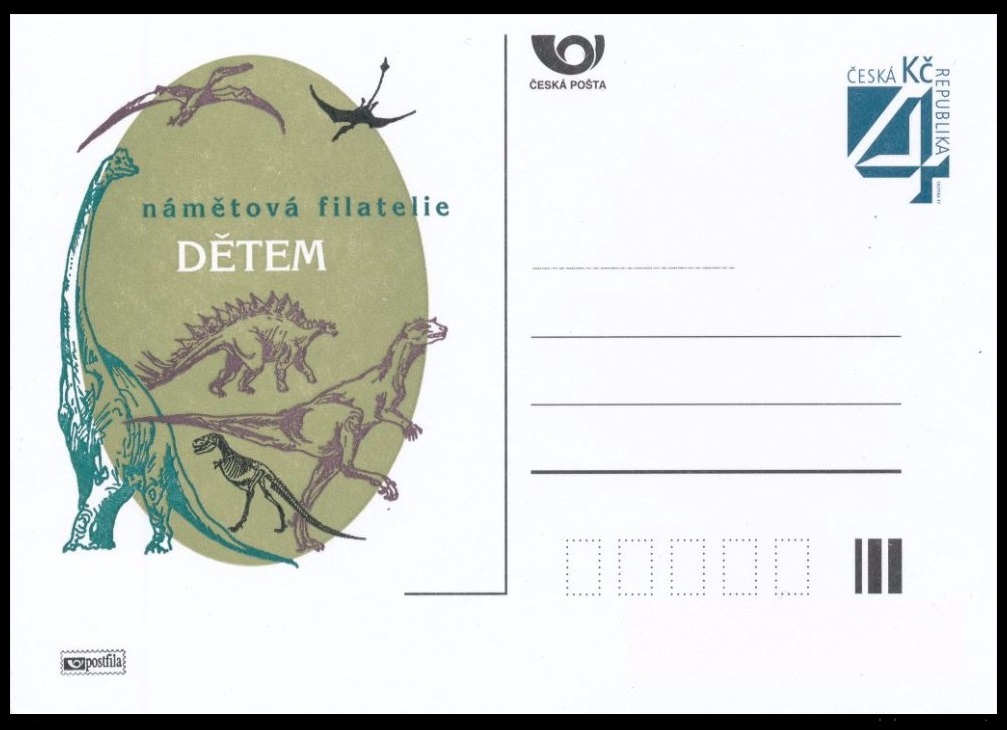
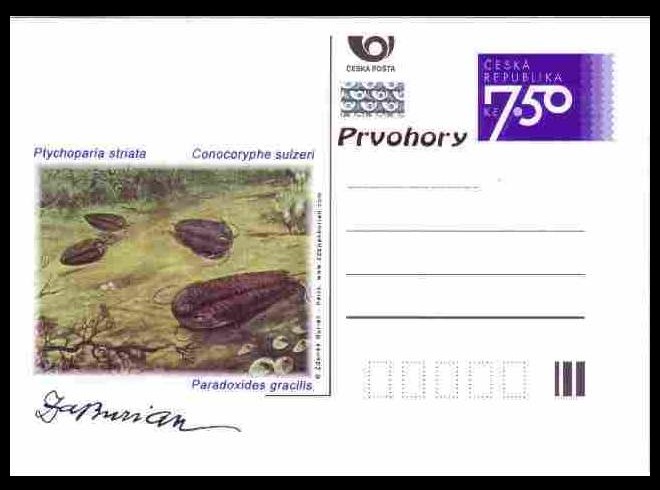
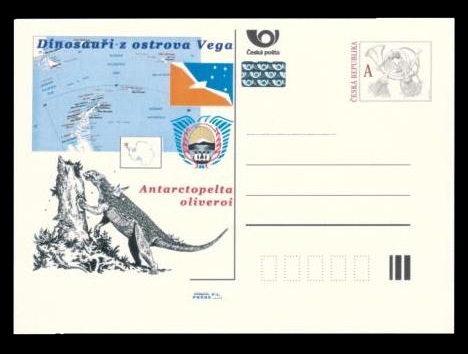
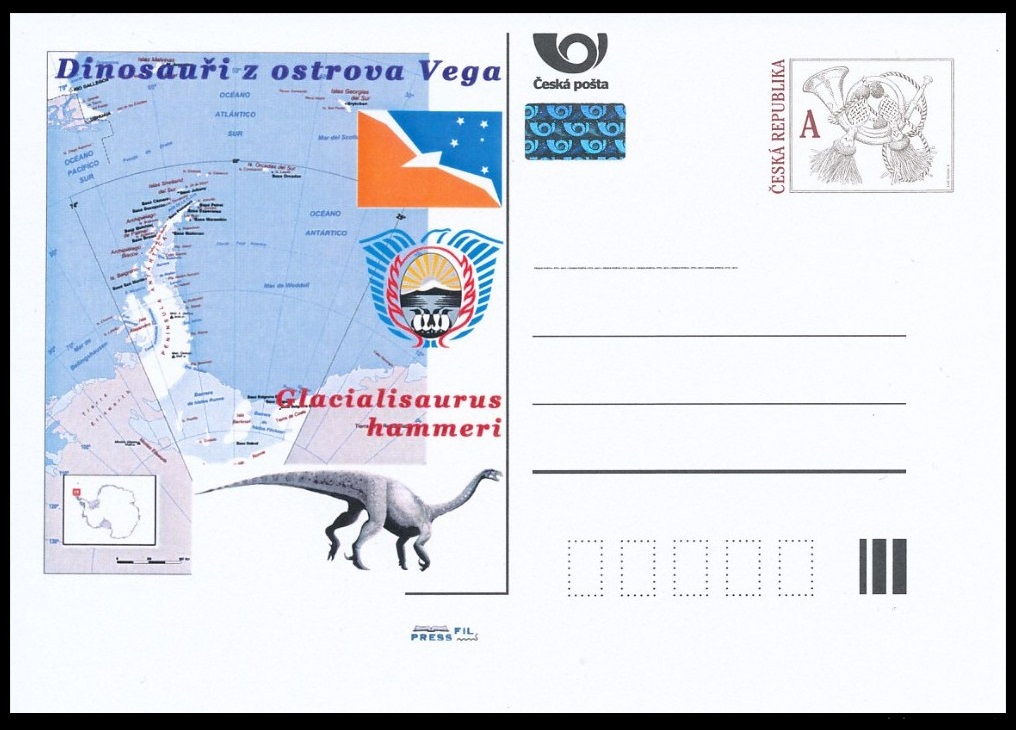
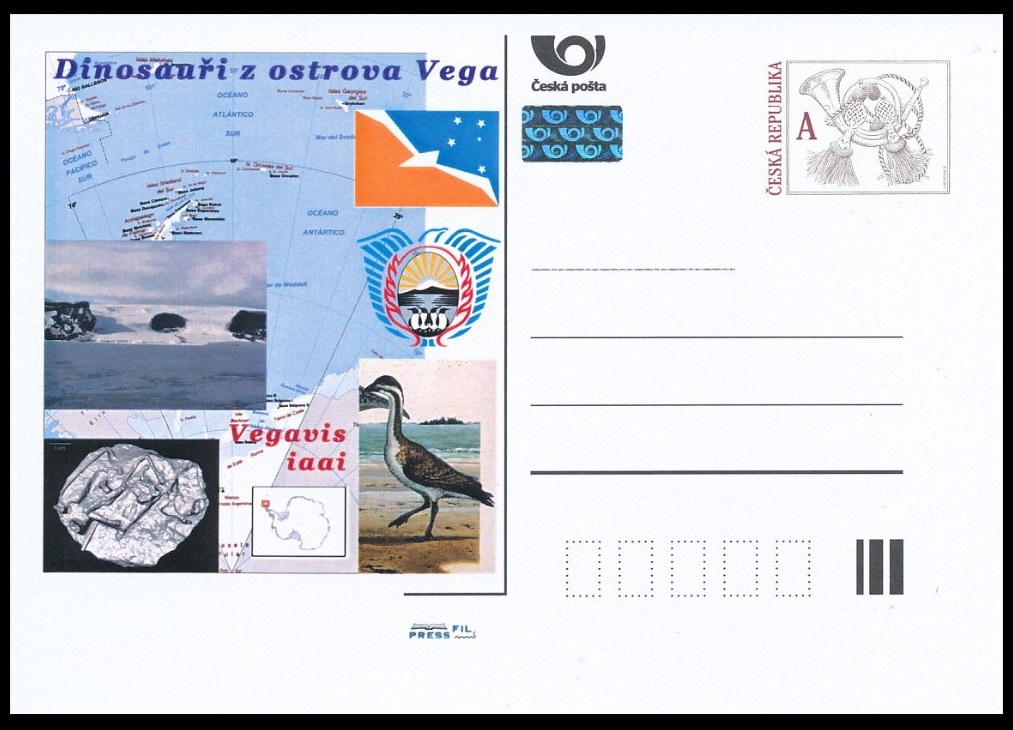
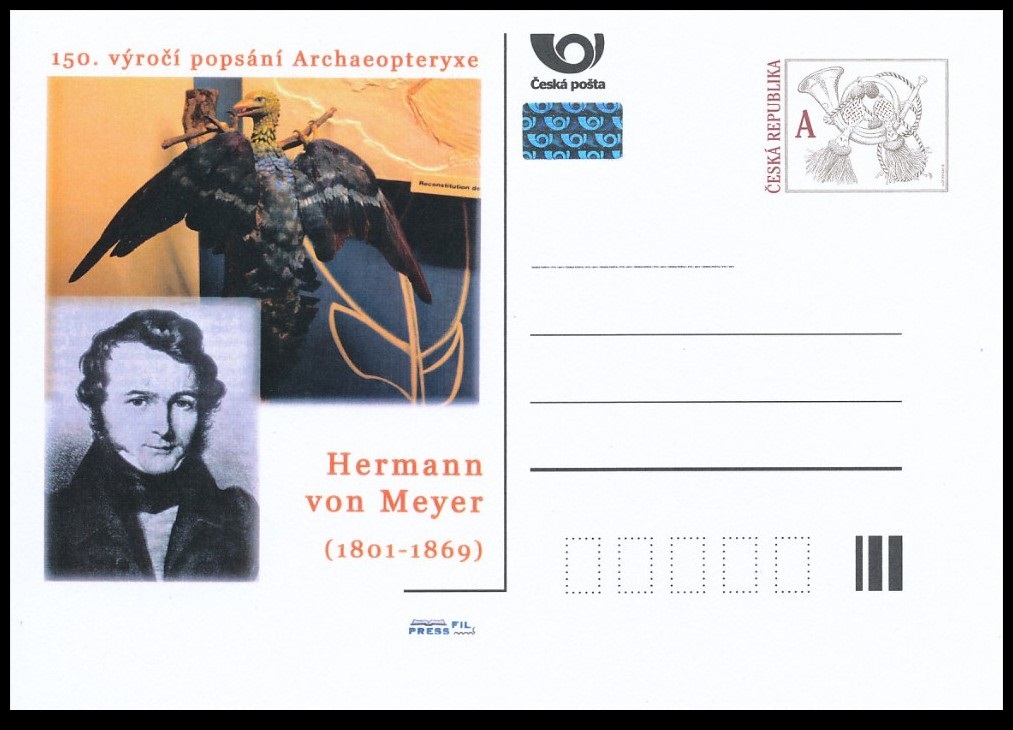
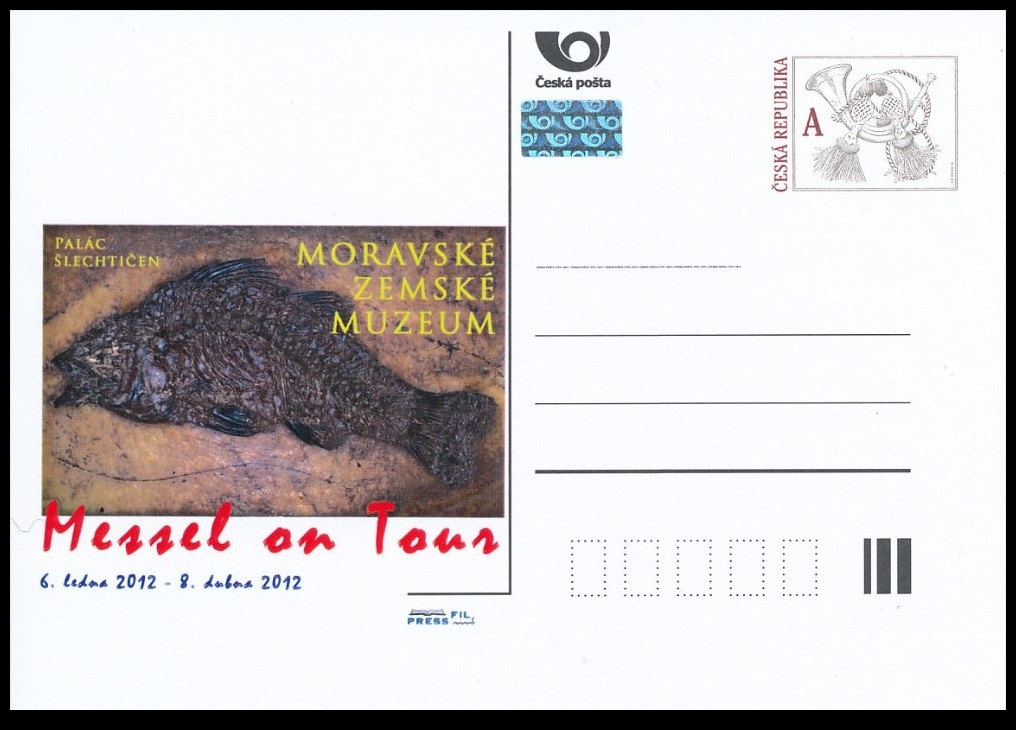
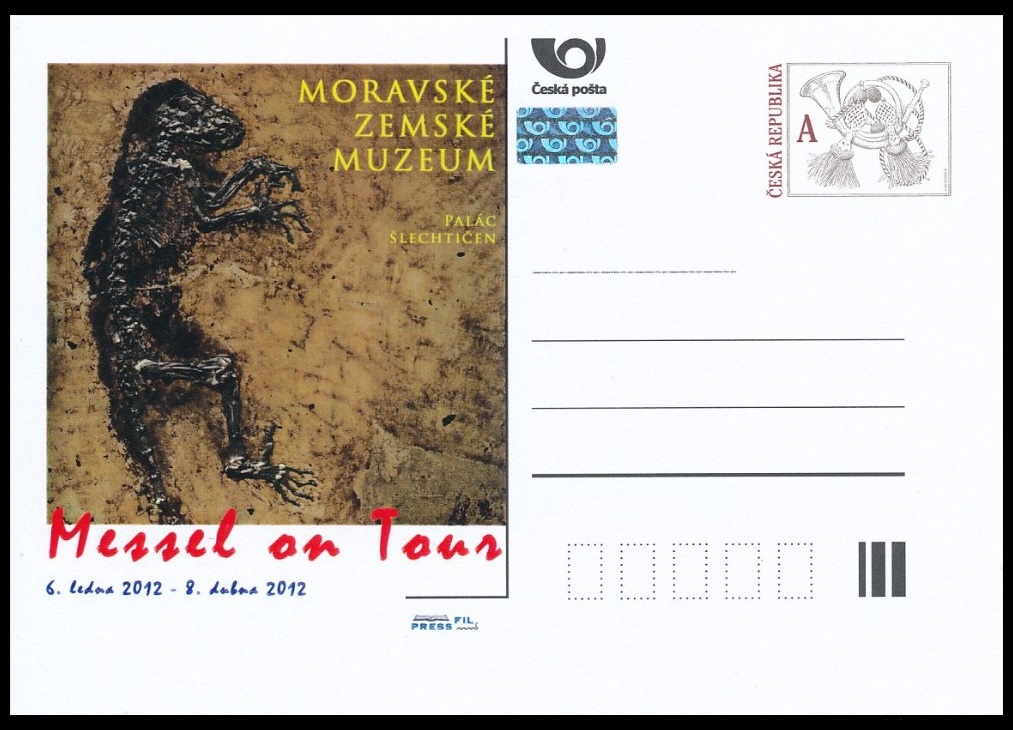
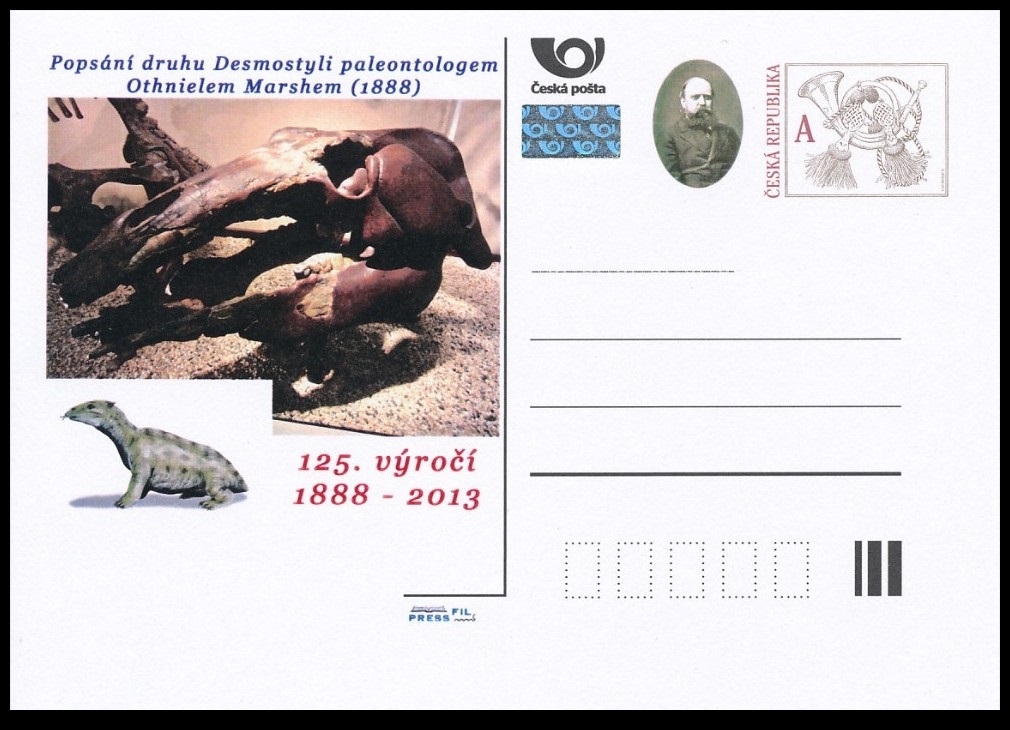
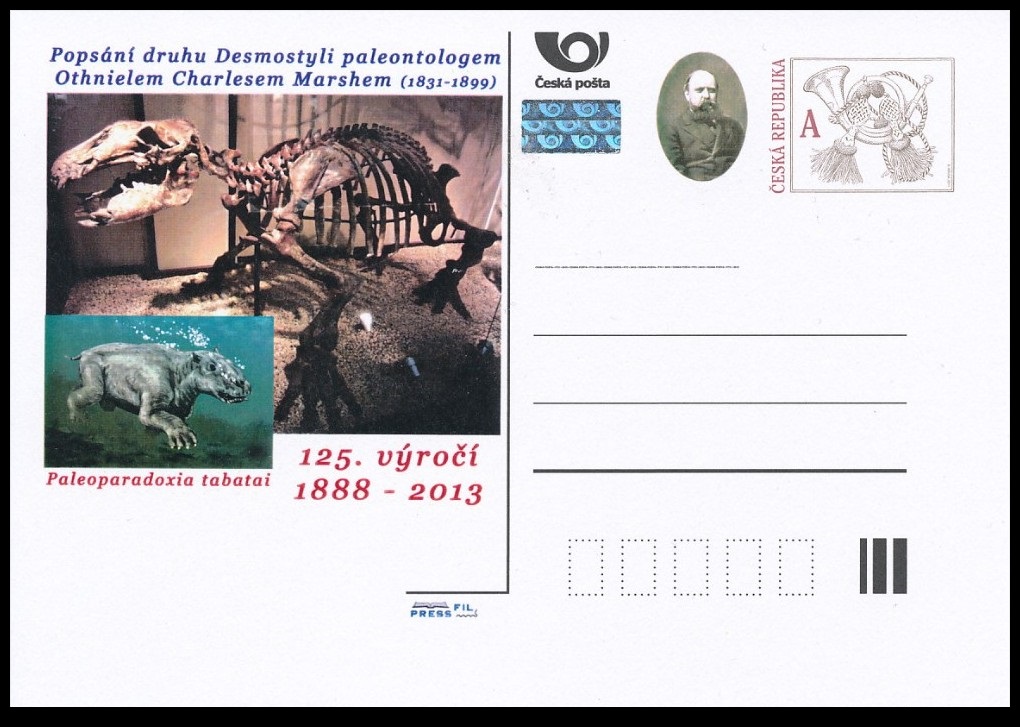
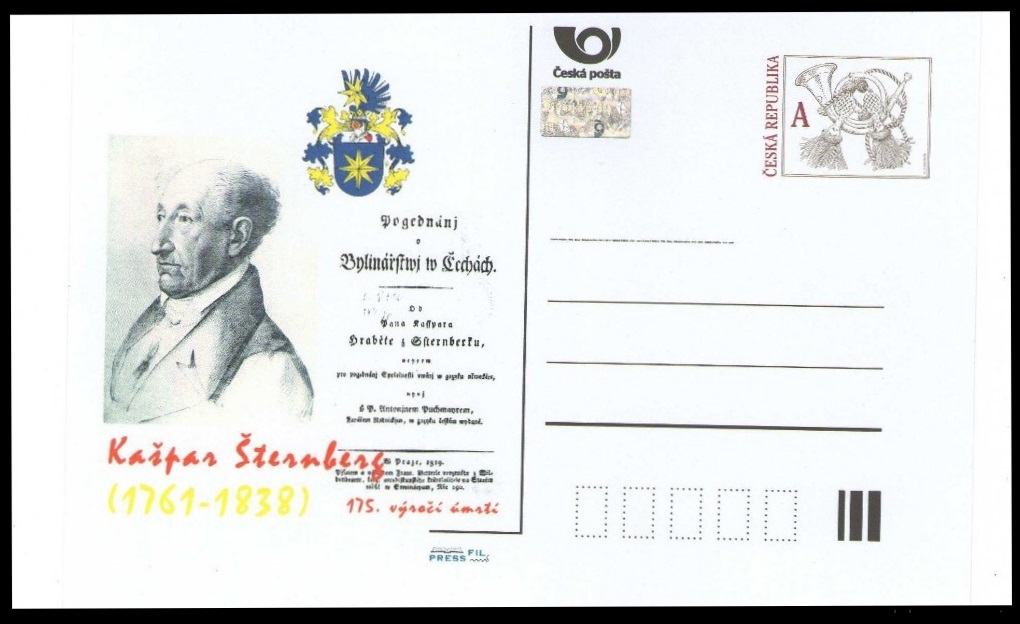
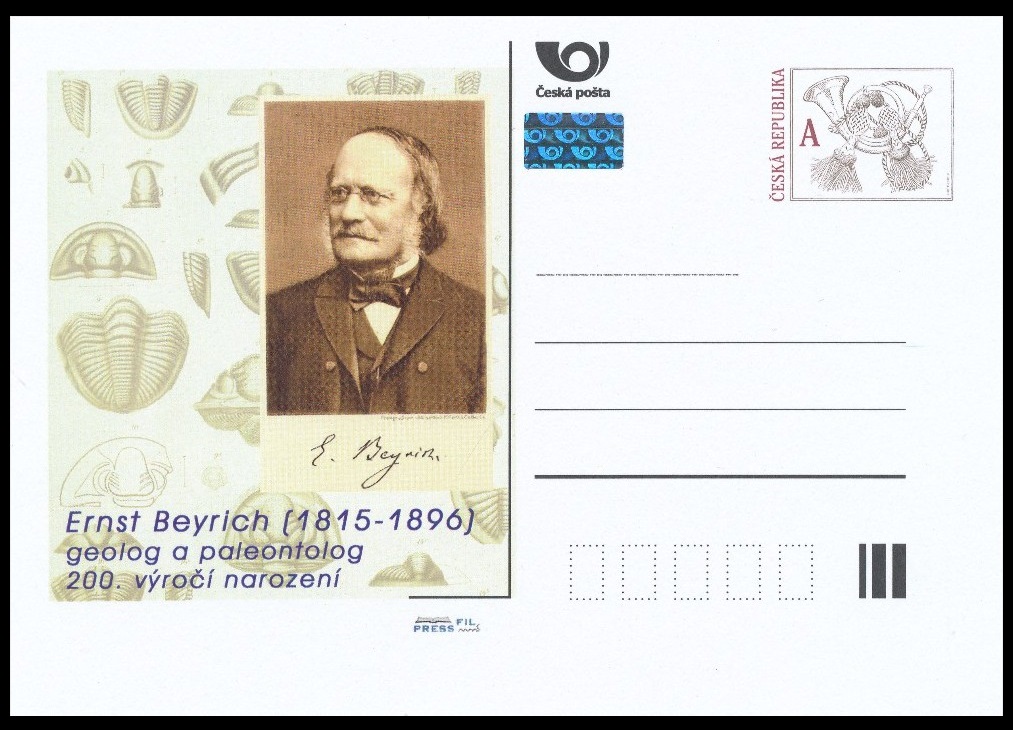
Personalized Post Stationaries
 |
| 1998 | 1999 [PS1] | 2005 [PS2] |
 |
 |
 |
| 2007 | 2011 | |
 |
 |
 |
| 2011 | ||
 |
 |
 |
| 2011 | 2012 | |
 |
 |
 |
| 2012 | 2013 | |
 |
 |
 |
| 2013 [PS3] | ||
 |
 |
|
| 2015 | ||
 |
 |
 |
| 2019 | ||

|  |
|
Notes:
[PS1] Paleontologist Joachim Barrande is also depicted on the 1999 postage stamp.
[PS2] Famous Czech's paleoartist Zdenek Burian. His illustrations can be seen on many stamps, for example Czech 1994
[PS3] Paleontologist Kaspar Maria von Steinberg also depicted on a postage stamp from 2011
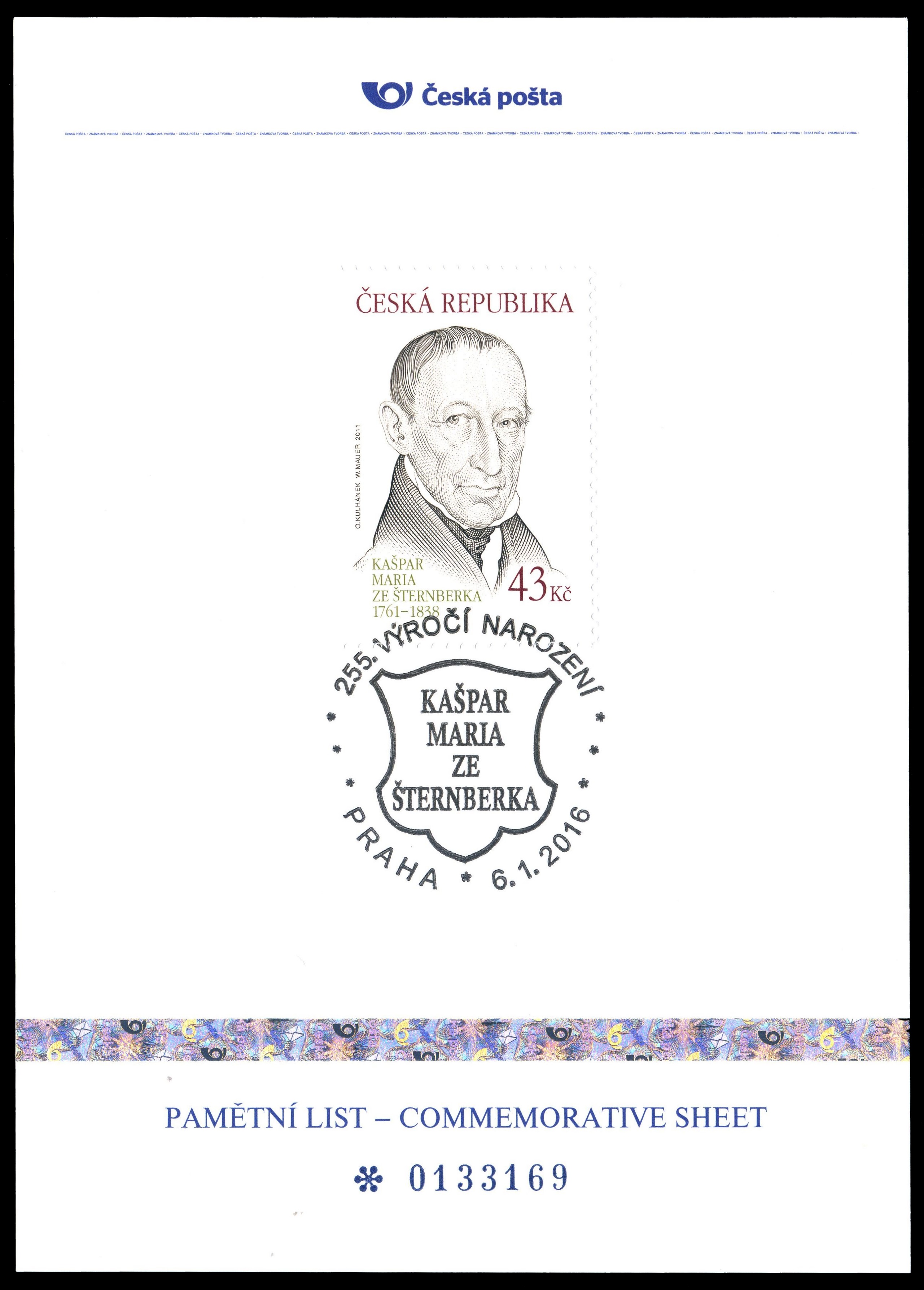
Other Paleontology related Philatelic products of Czech's Post
| 06.01.2016 Commemorative Sheet : "Kaspar Maria von Sternberg" [5] | ||
 |
||
Postmarks of Czech related to Paleontology: dinosaurs and other prehistoric animals, fossils, paleontologists
Legend is here
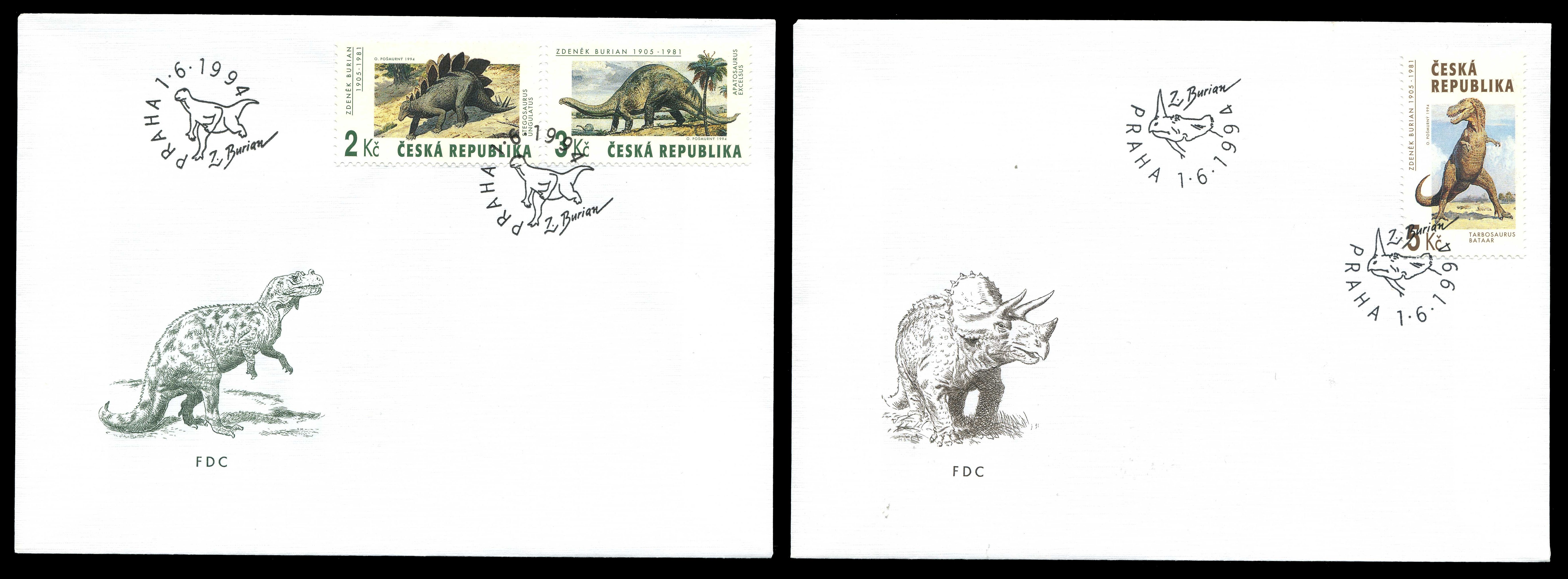
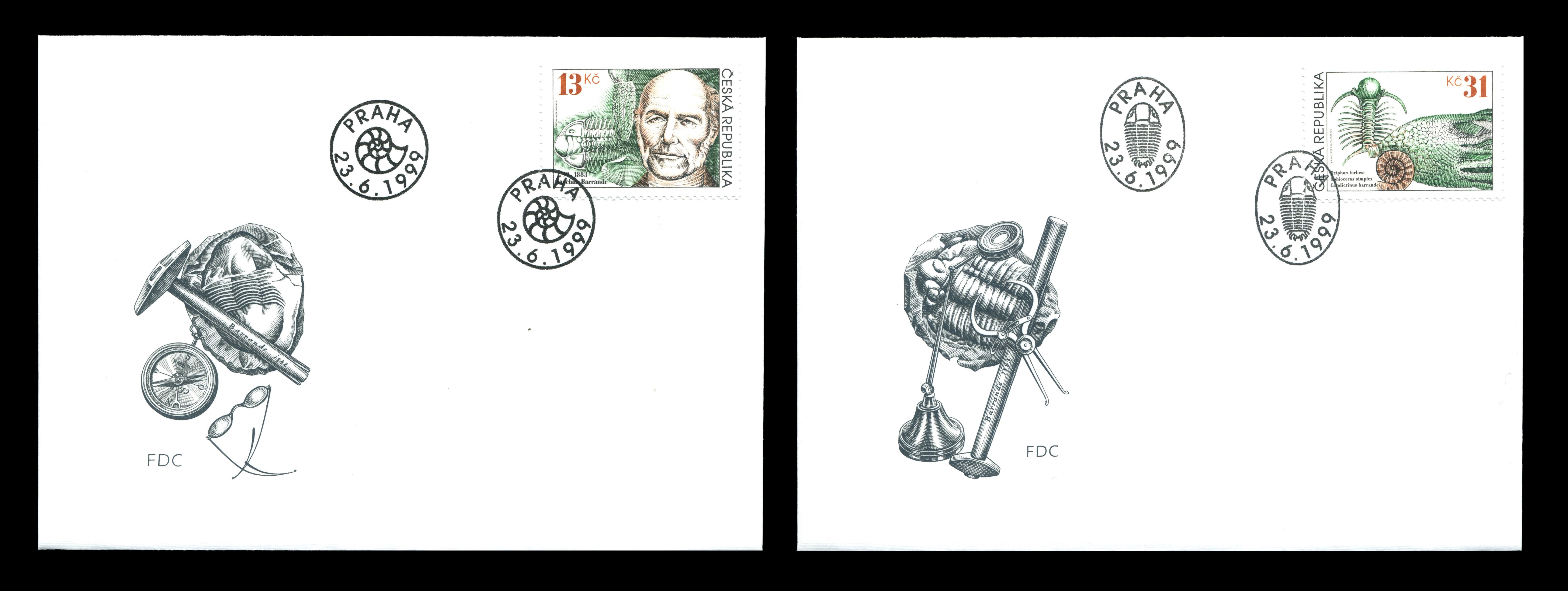
| 01.06.1994 "Prehistoric animals -Dinosaurs" [FDC] | 23.06.1999 "Joachim Barrande and Czech Trilobites" [FDC] | |
 |
|
|
| 23.06.1999 "Joachim Barrande and Czech Trilobites" [FDC] | 26.06.1999 "Barande Conference in the National Museum (Prague)" | 10.02.2005 "100 anniversary of Zdenek Burian" [Sp] [1] |
|

|
 |
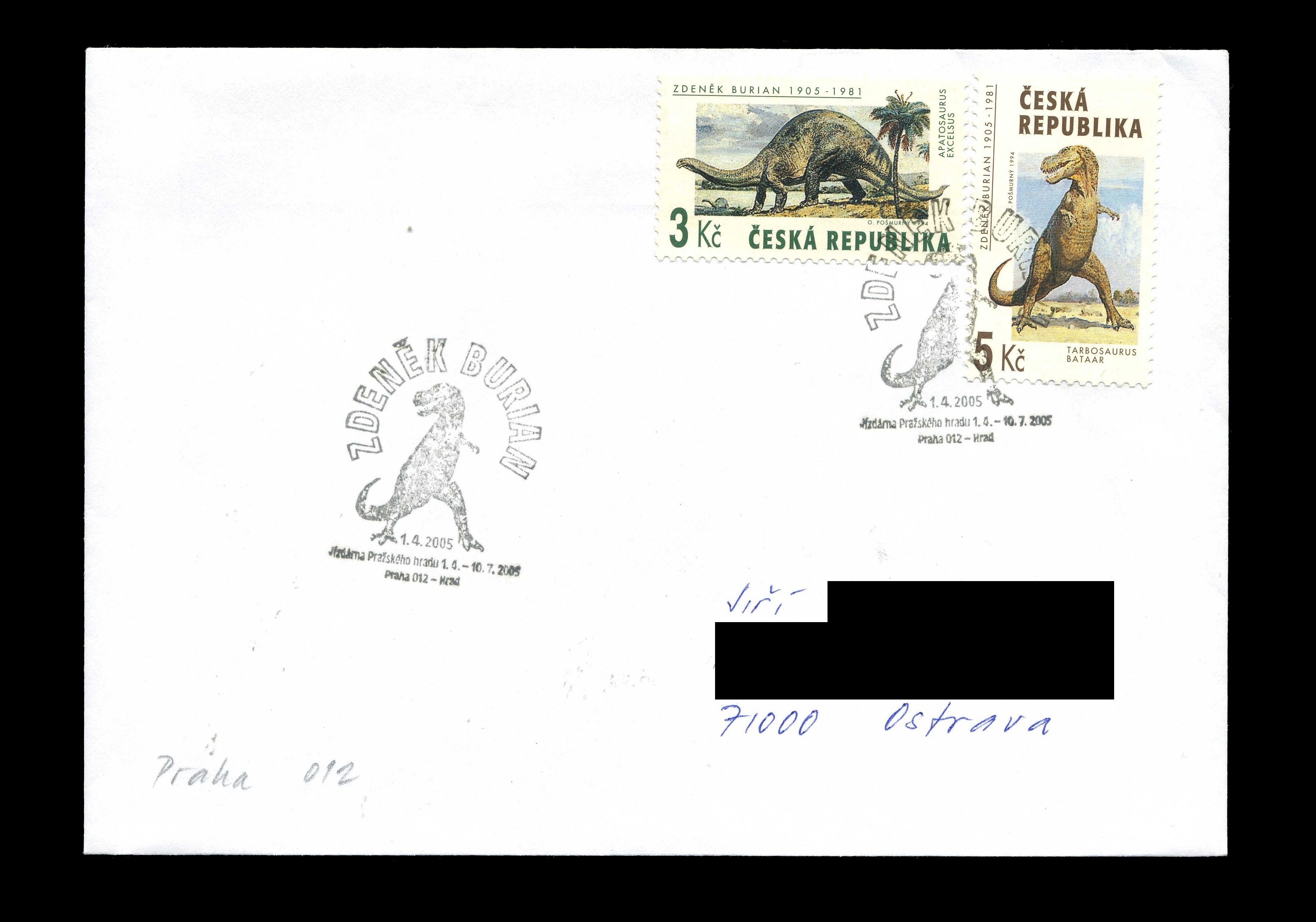
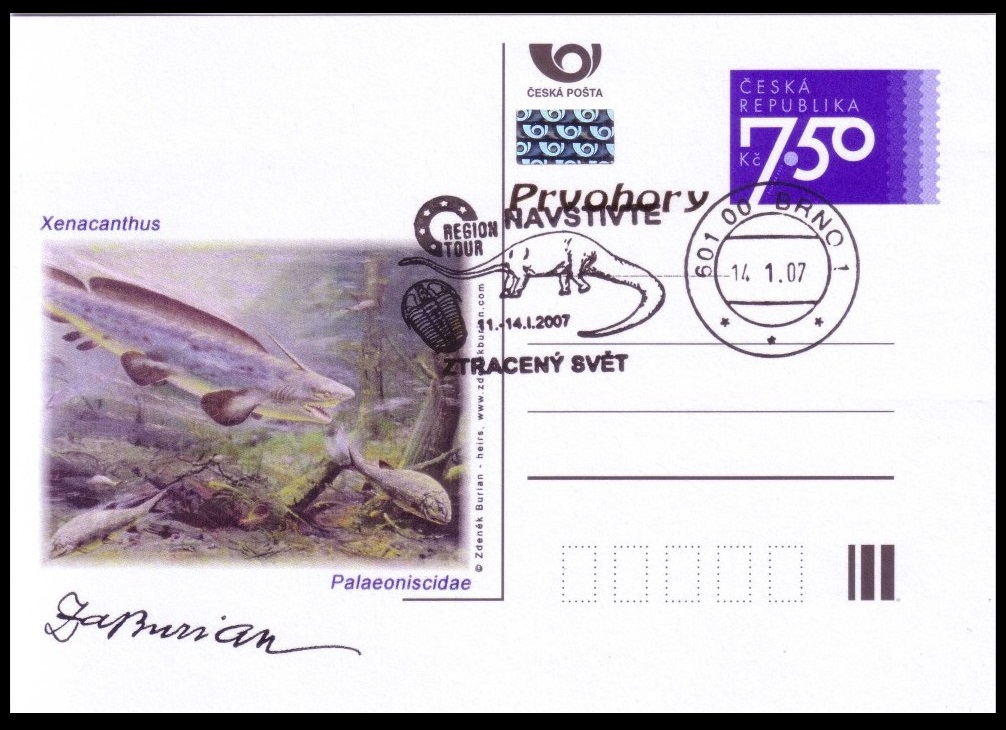
| 01.04.2005 "100 anniversary of Zdenek Burian" [Sp] [PS2] | 09.11.2005 "Works of art on postage stamps" [FDC] | 11.01-14.01.2007 " [Sp] |
 |
 |
 |
| 02.09.2009 "Nature Protection - The Krivoklatsko Region - A UNESCO Biosphere - Eudia pavonia Reserve" [A1] [FDC] | 06.01.2016 "Kaspar Maria von Sternberg" [5] [Sp] | 12.01.2016 "The Zelezne hory" [FDC] |
|
 |
 |
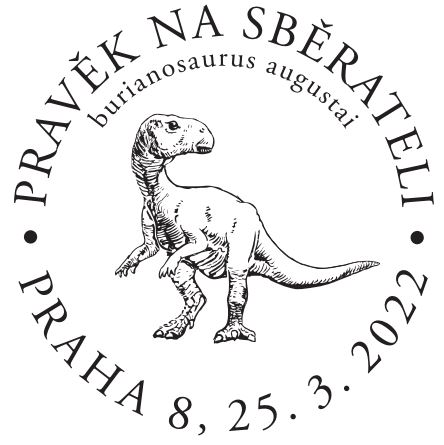
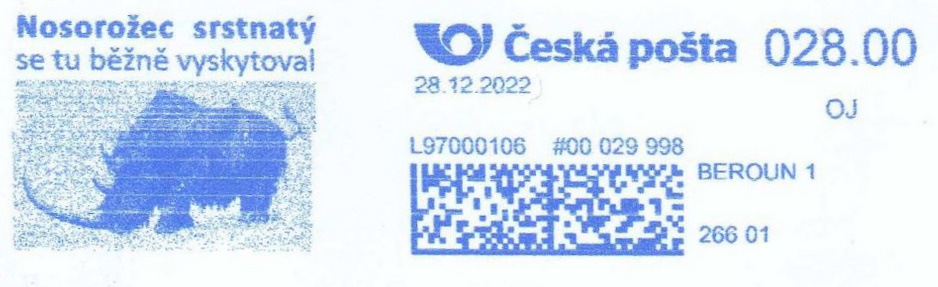
| 20.11.2020 "1 year since death of Czech paleobotanic Dr. Zlatko Kvaček" [Sp] | 25.03.2022 "Burianosaur Augustaii" [Sp] | 29.12.2022 "Woolly rhinoceros" [Sp] |
 |
 |
 |
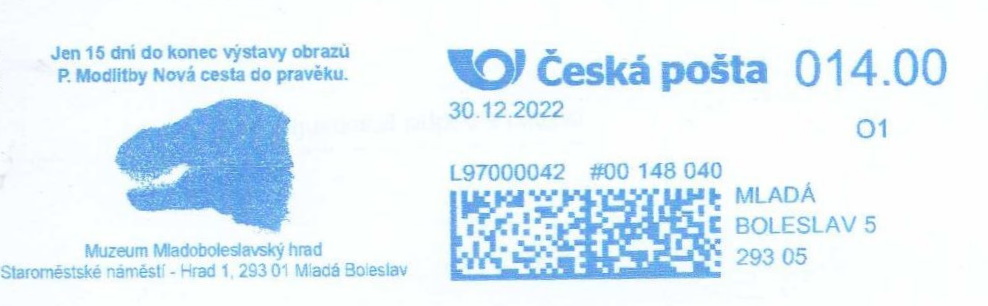
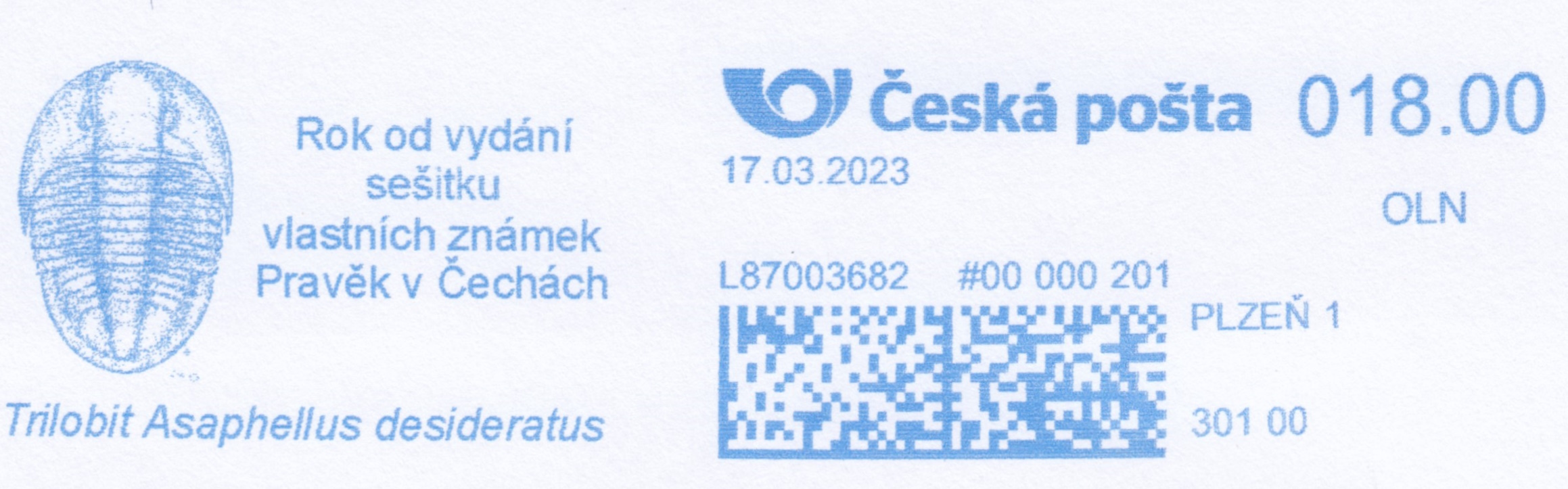
| 30.12.2022 "Only 15 days left until the end of the painting exhibition P. Modlitby A new way to prehistoric times in Museum of Mladoboleslavsky hrad" [Sp] | 17.03.2023 "120 years of birth Czech paleontologist Josef Augusta" [Sp] | 17.03.2023 "Sberatel trade show: Trilobite Asaphellus desideratus" [Sp] |
 |
 |
 |
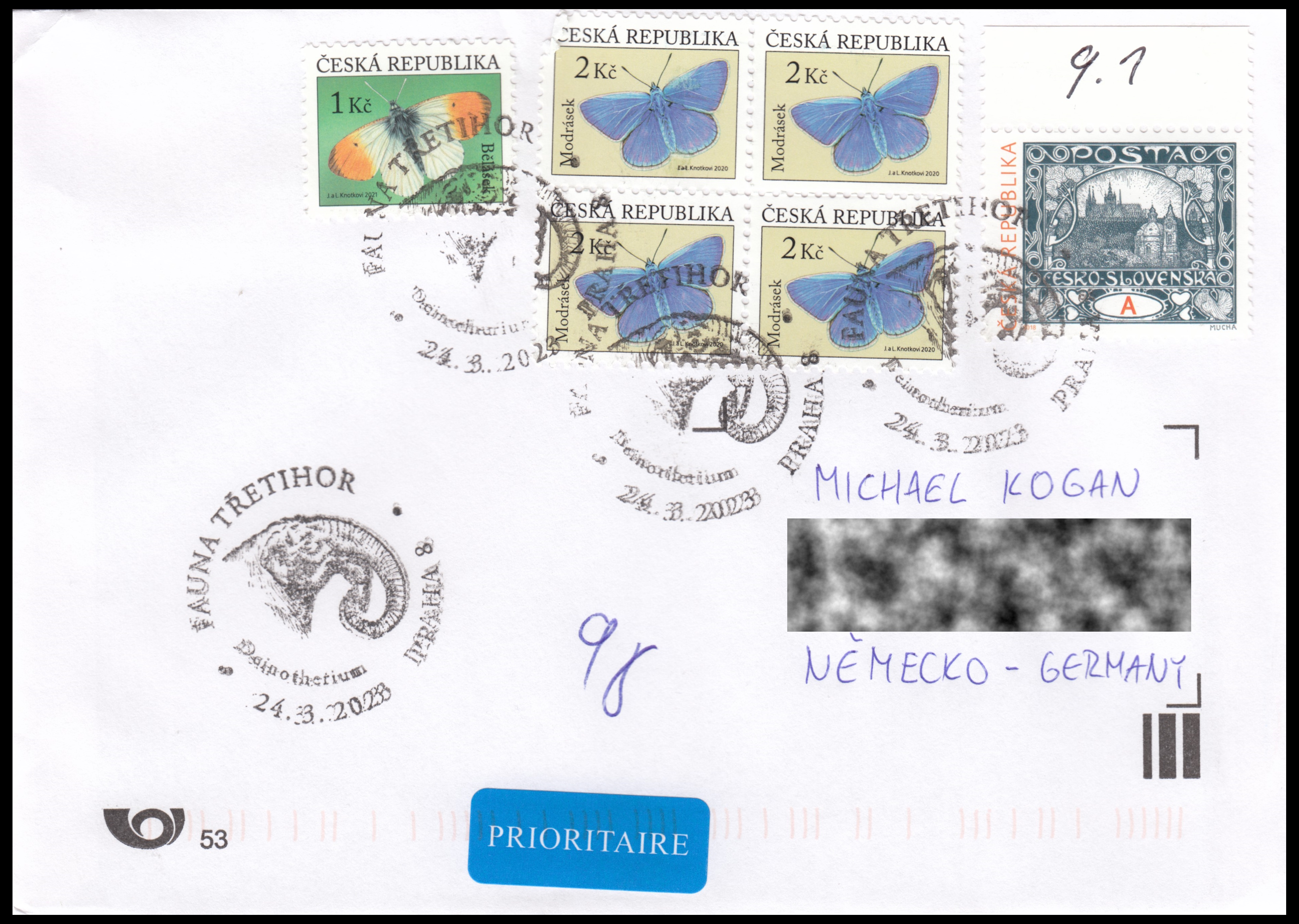
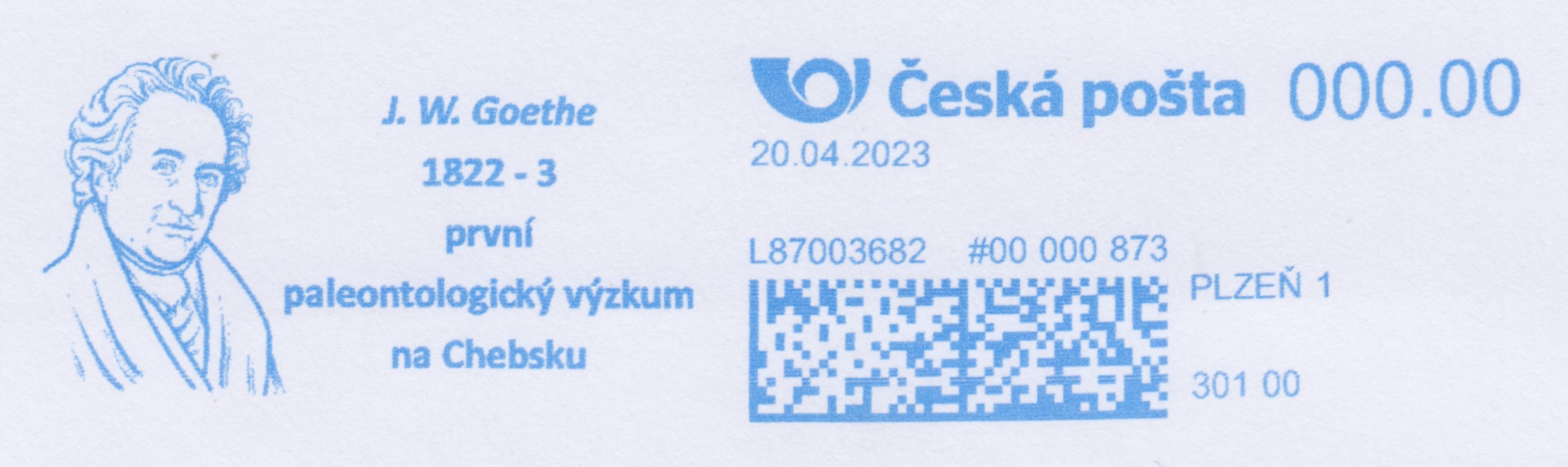
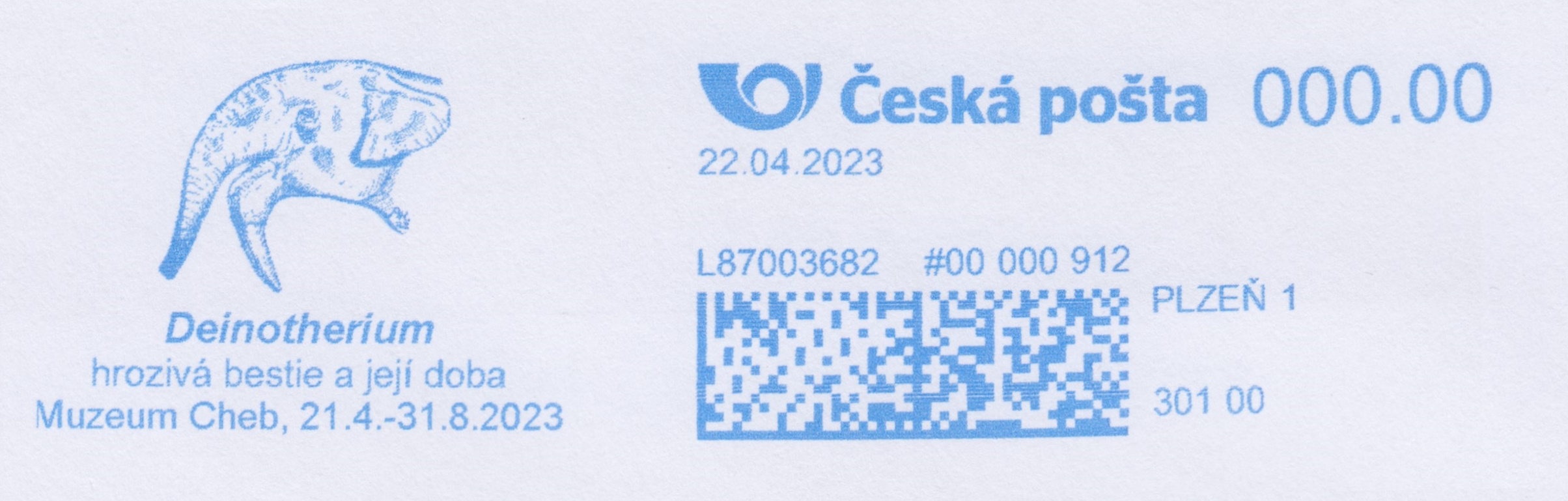
| 07.04.2023 "Tertiary fauna: Deinotherium" | 20.04.2023 - "Paleontologist J.W. Goethe" [Sp] | 22.04.2023 - "Deinotherium" [Sp] |
 |
 |
 |
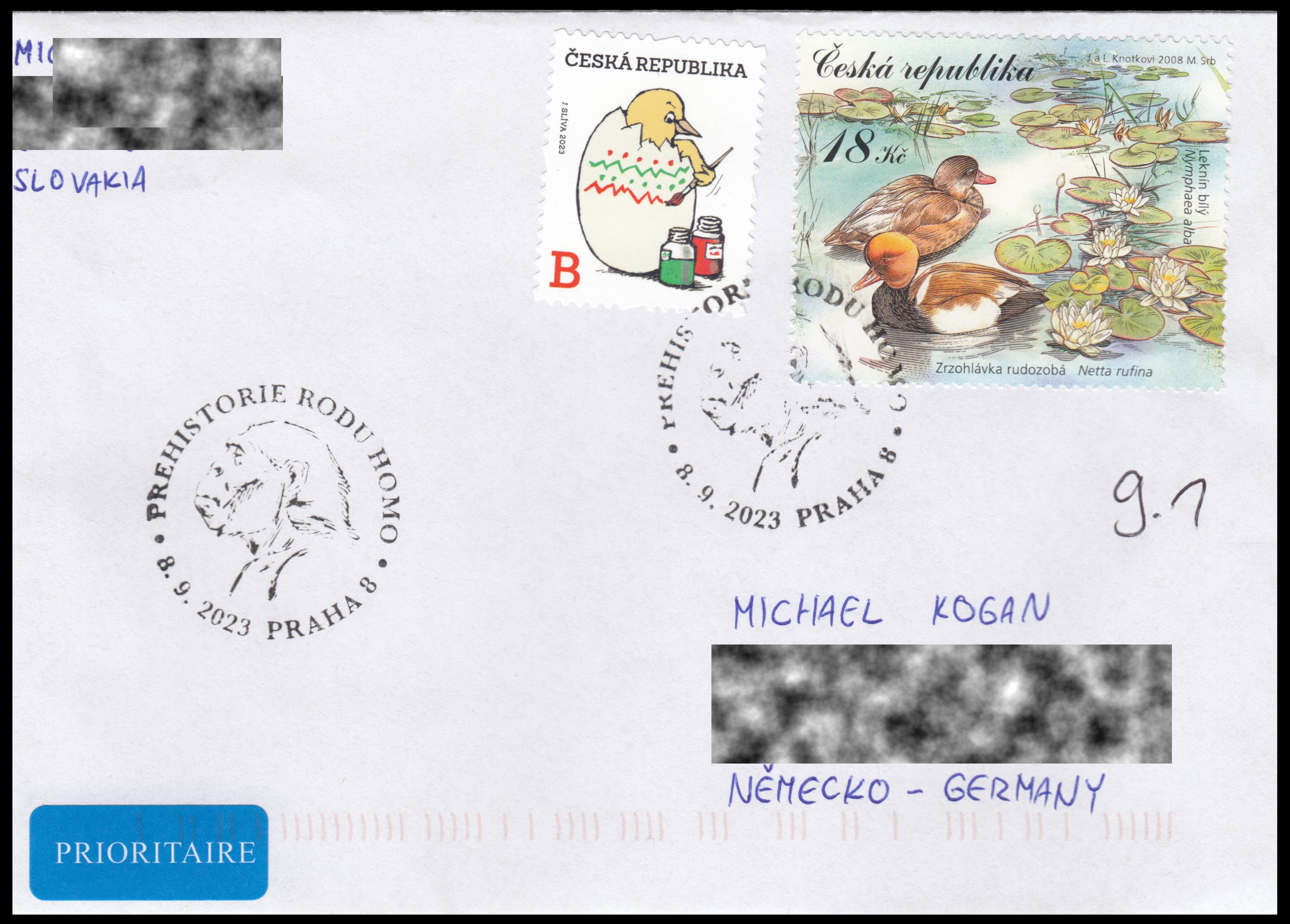
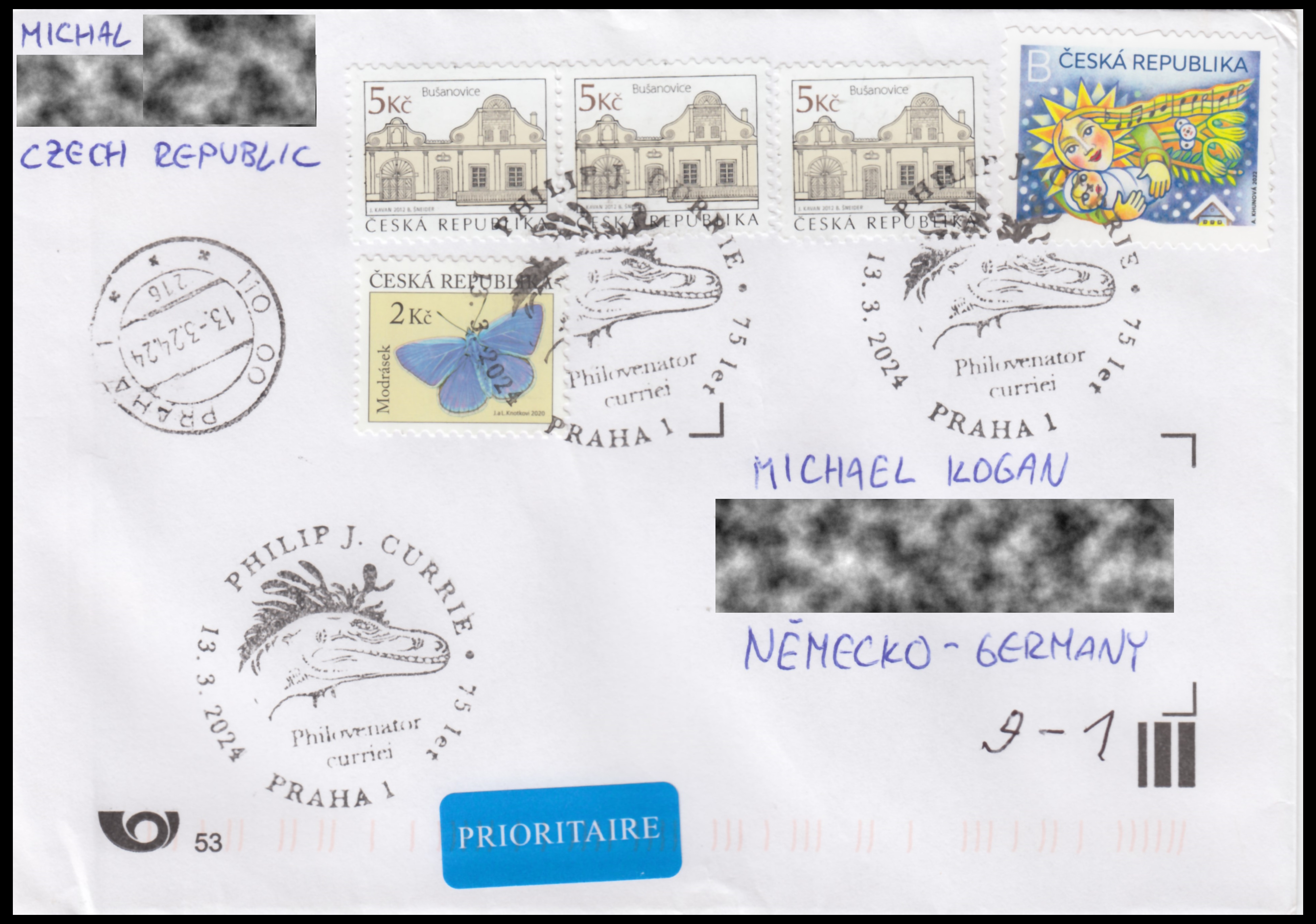
| 08.09.2023 "Prehistory of Homo" [Sp] | 13.03.2024 "Philip J. Currie - 75 years" [Sp] | 23.03.2024 "Torynobelodon" [Sp] |
 |
 |
 |
| 08.08.2024 "225th anniversary of Joachim Barrande" [Sp] | ||
 |
||
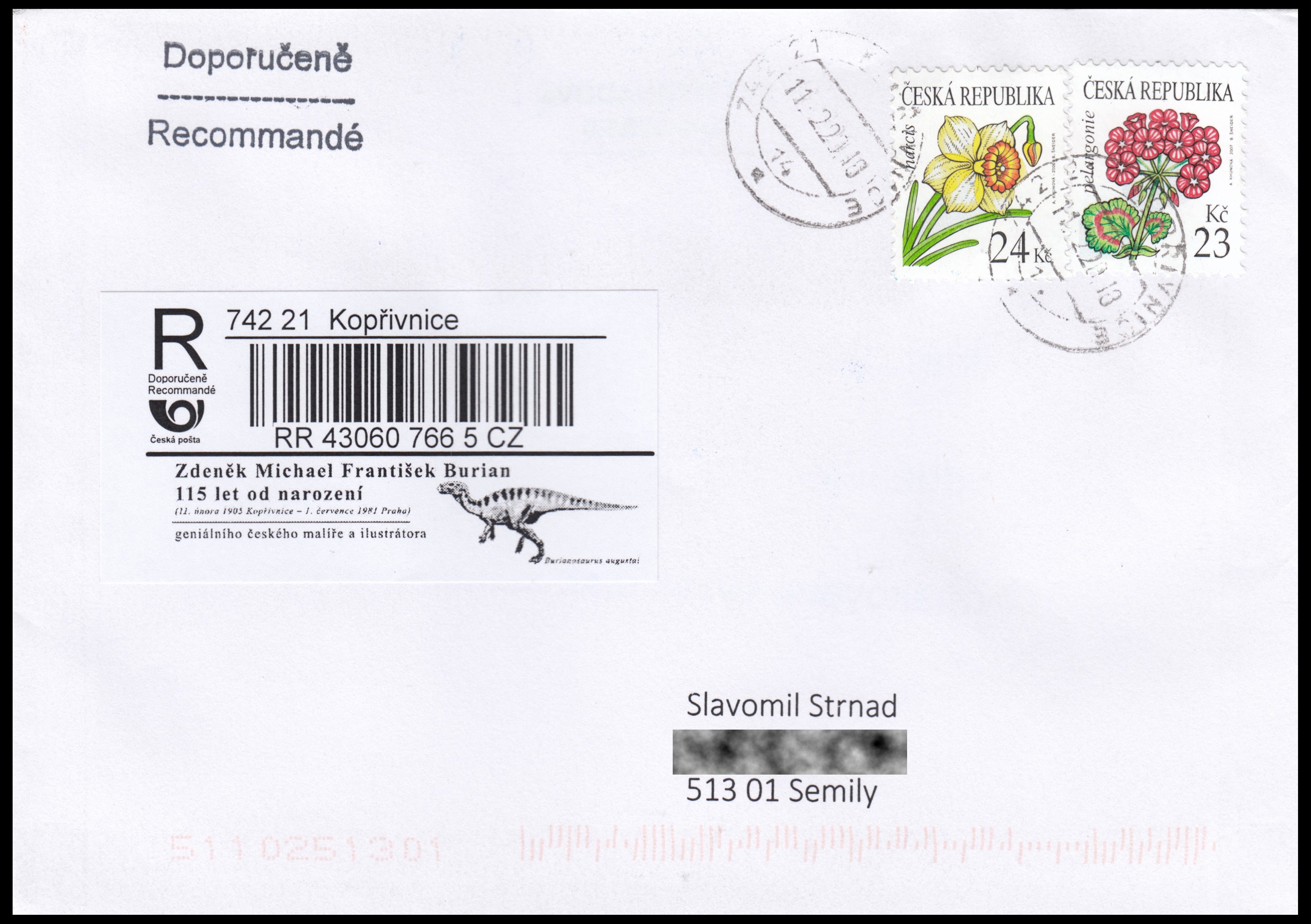
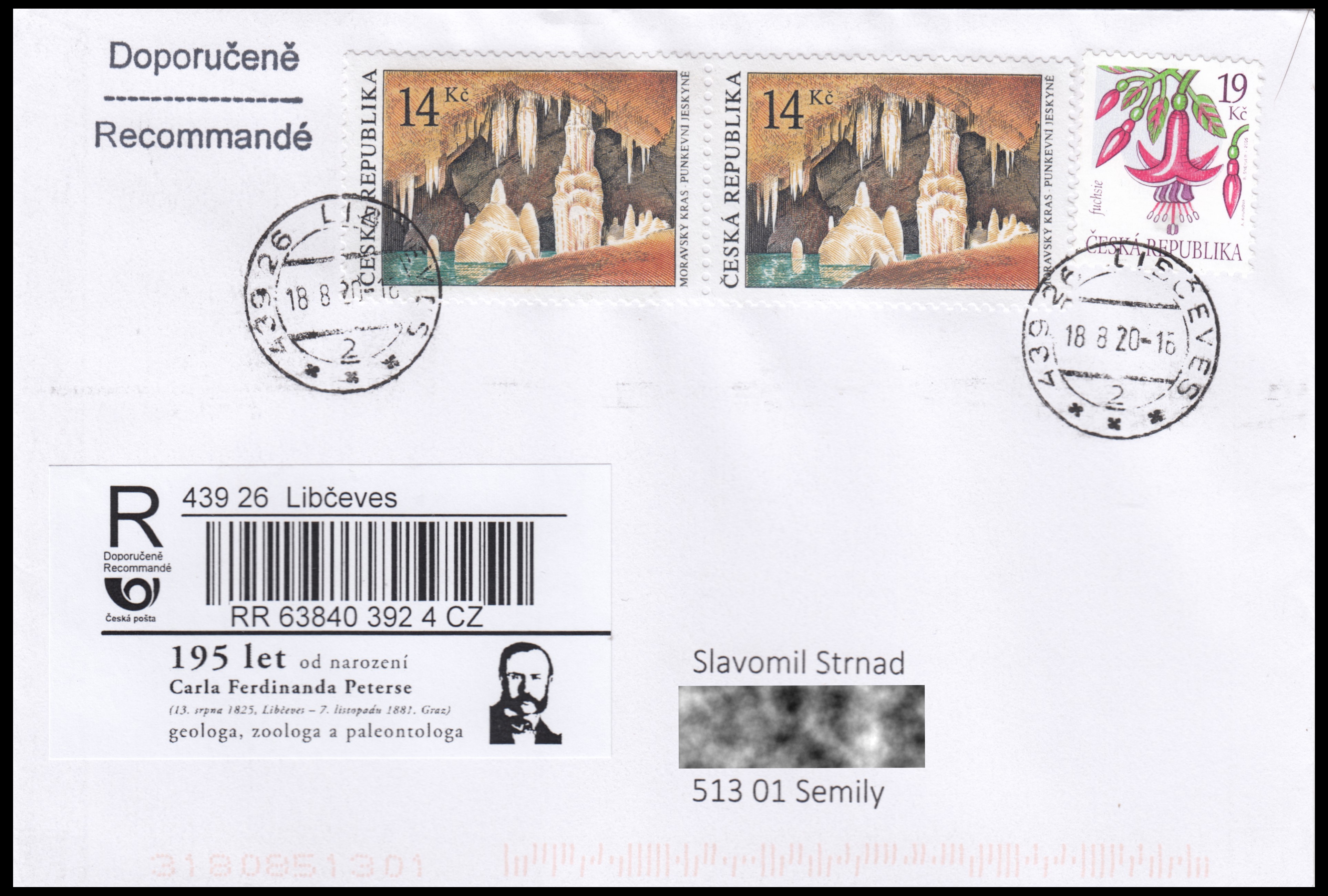
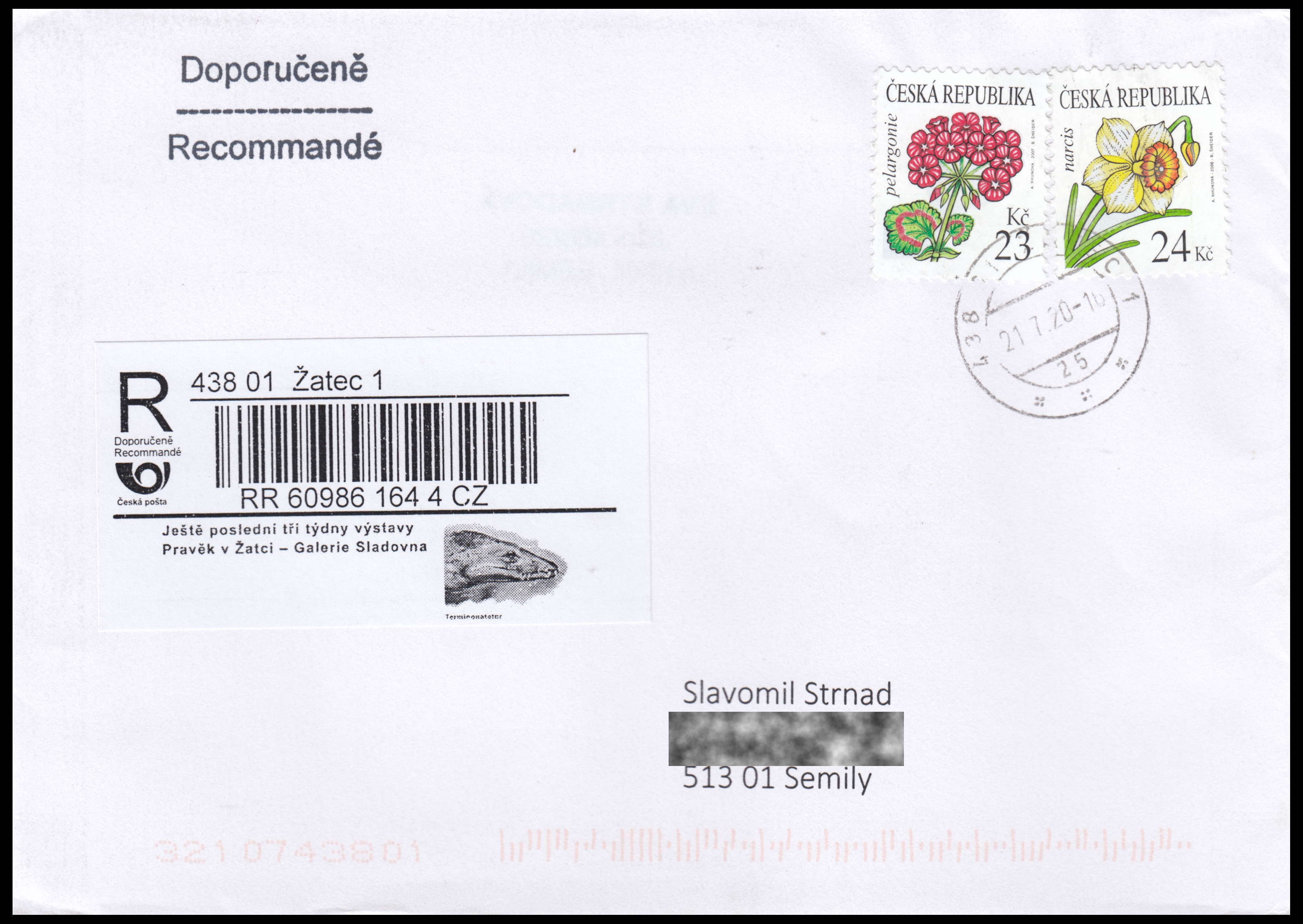
Commemorative Registered Letters lables (R-labels) directly related to Paleontology and Paleoanthropology: dinosaurs and other prehistoric animals, fossils, human ancestors, paleontologists
Since 2019 "Flora and Fauna" philatelic club in Czech Republic start to produce its own commemorative R-labels with permission of Czech Post.
| 22.01.2020 "115th anniversary of Zdenek Michael František Burian" | 20.07.2020 "95th anniversary of Carl Ferdinand Peterse" | 31.07.2020 "The last three weeks of the Prague exhibition in Zatec - Sladovna Gallery" |
 |
 |
 |
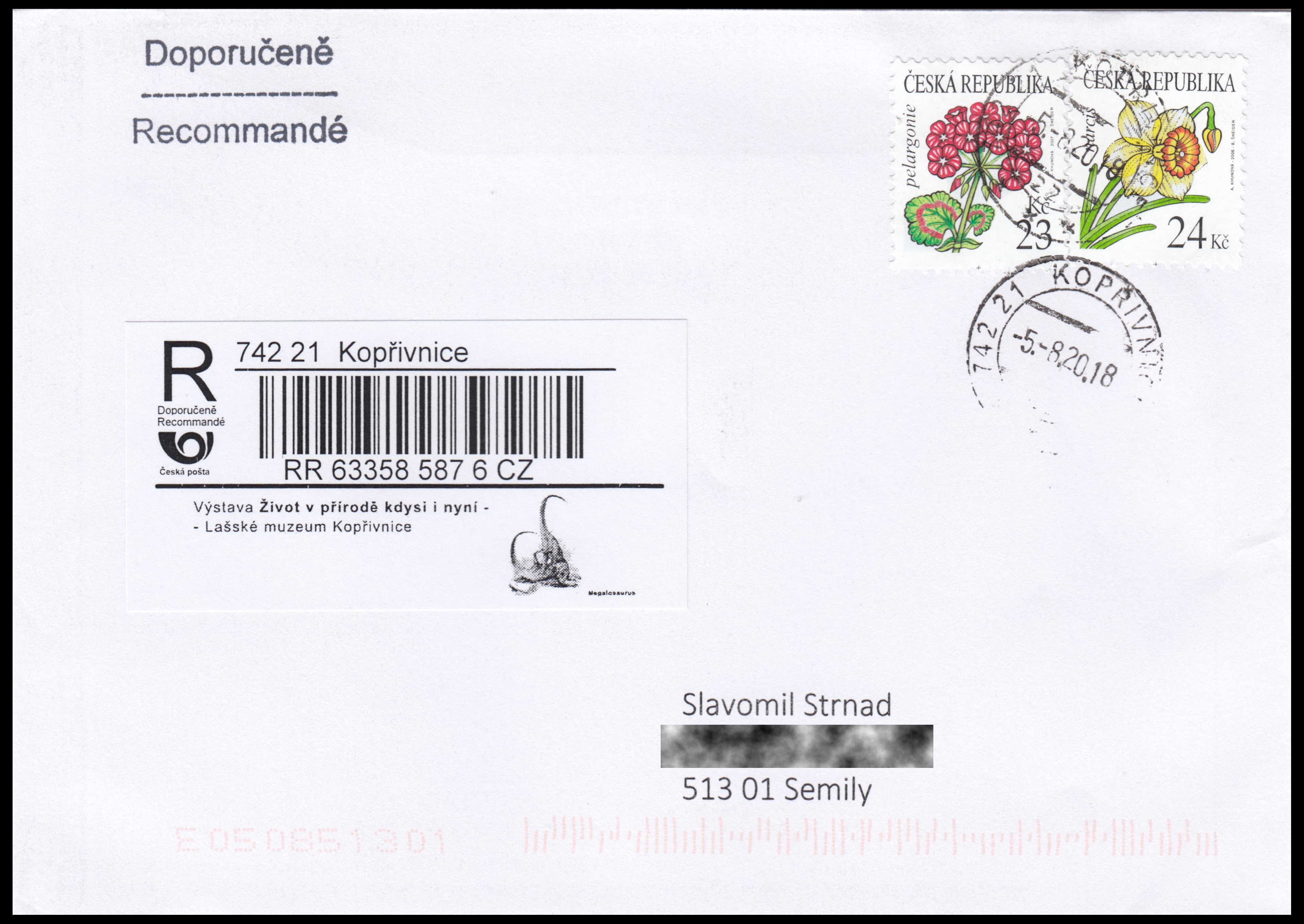
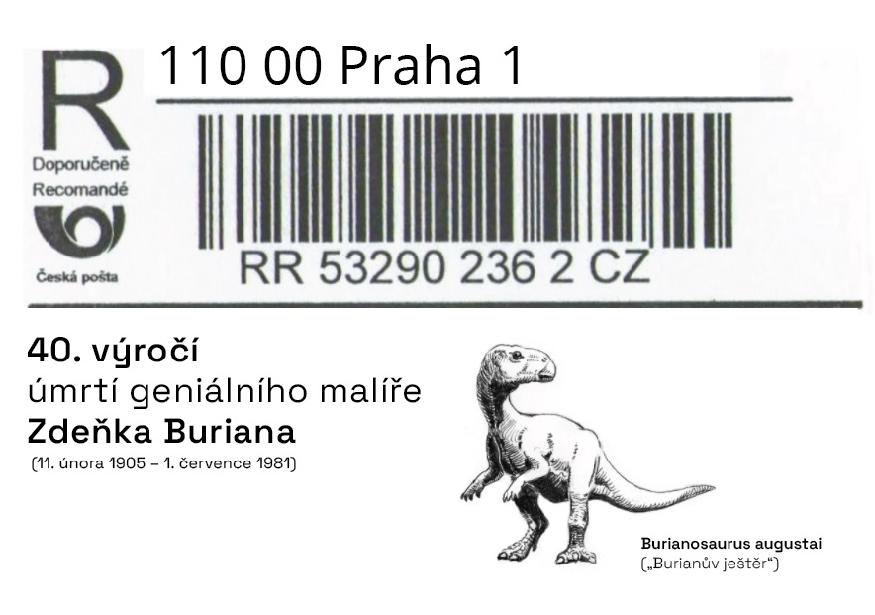
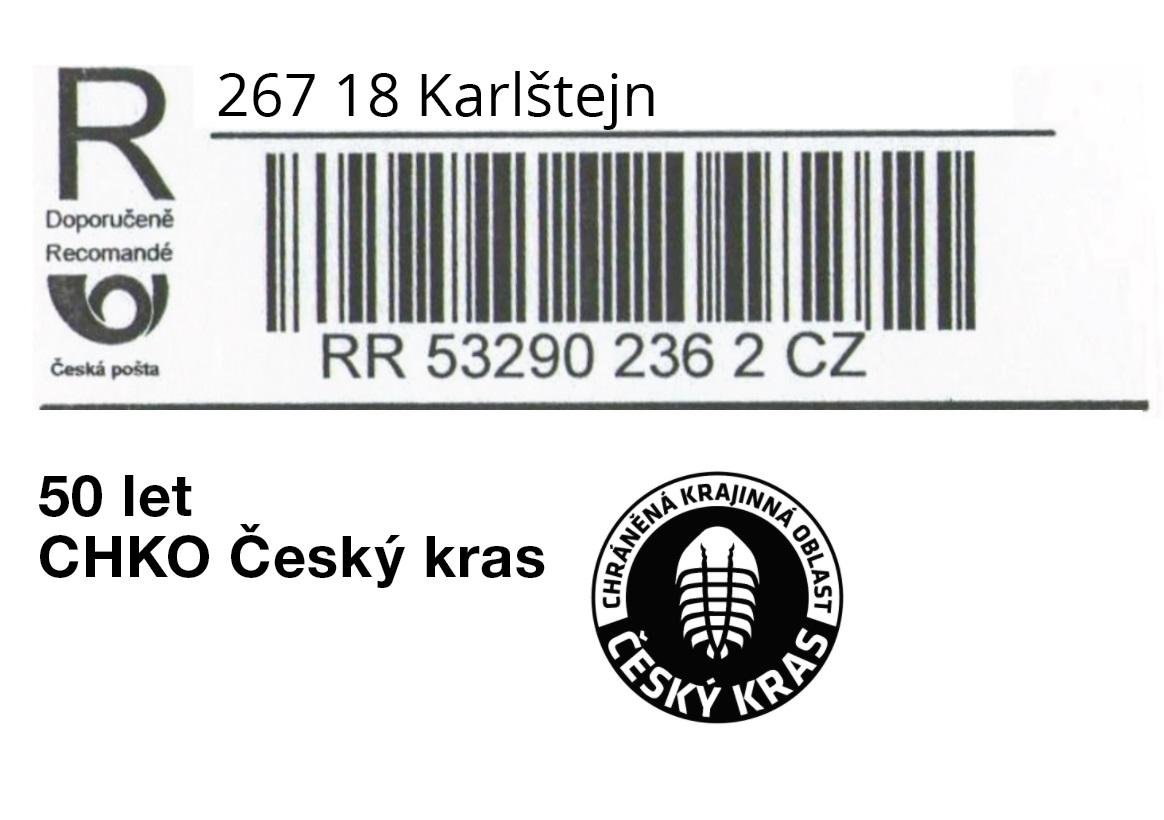
| 05.08.2020 "Modern and prehistoric animals show of the Lasske Museum in Koprinnice" | 01.07.2021 "40 years since death of famous painter Zdenek Burian" | 13.04.2022 "50 years of the Bohemian Karst Protected Landscape Area"" |
 |
 |
 |
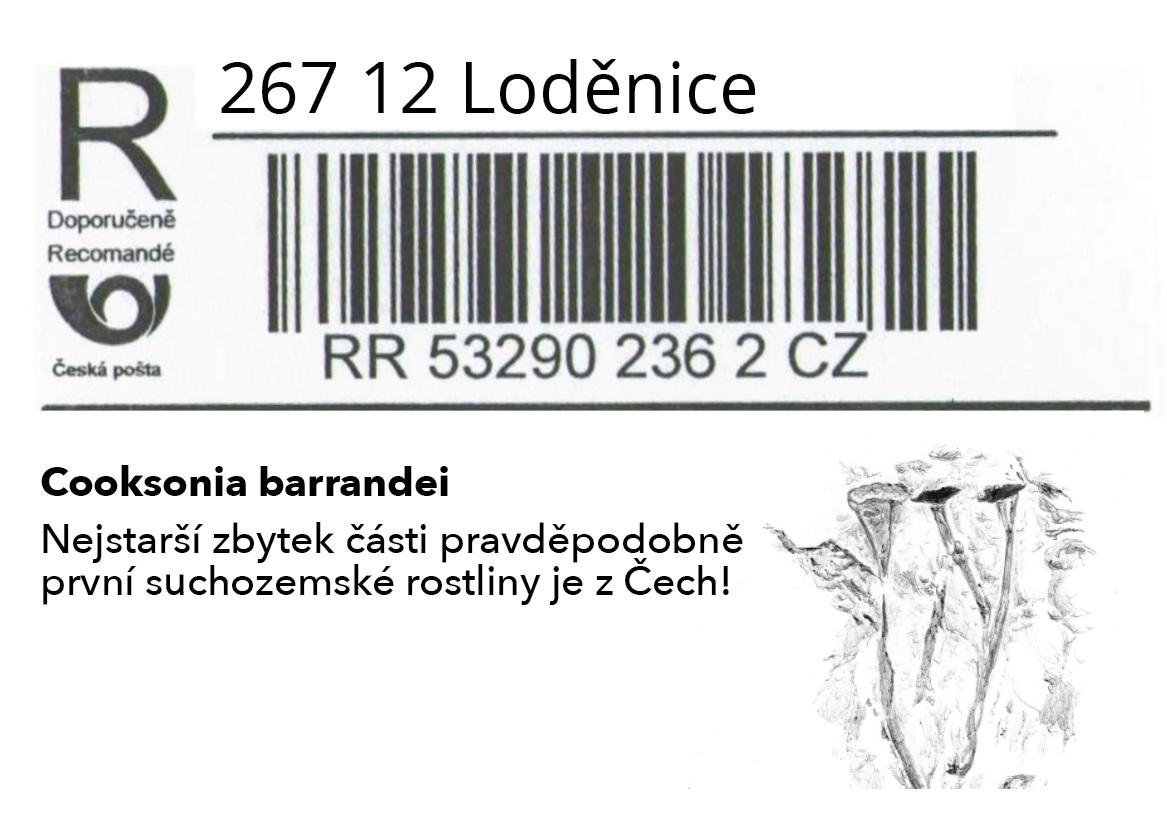
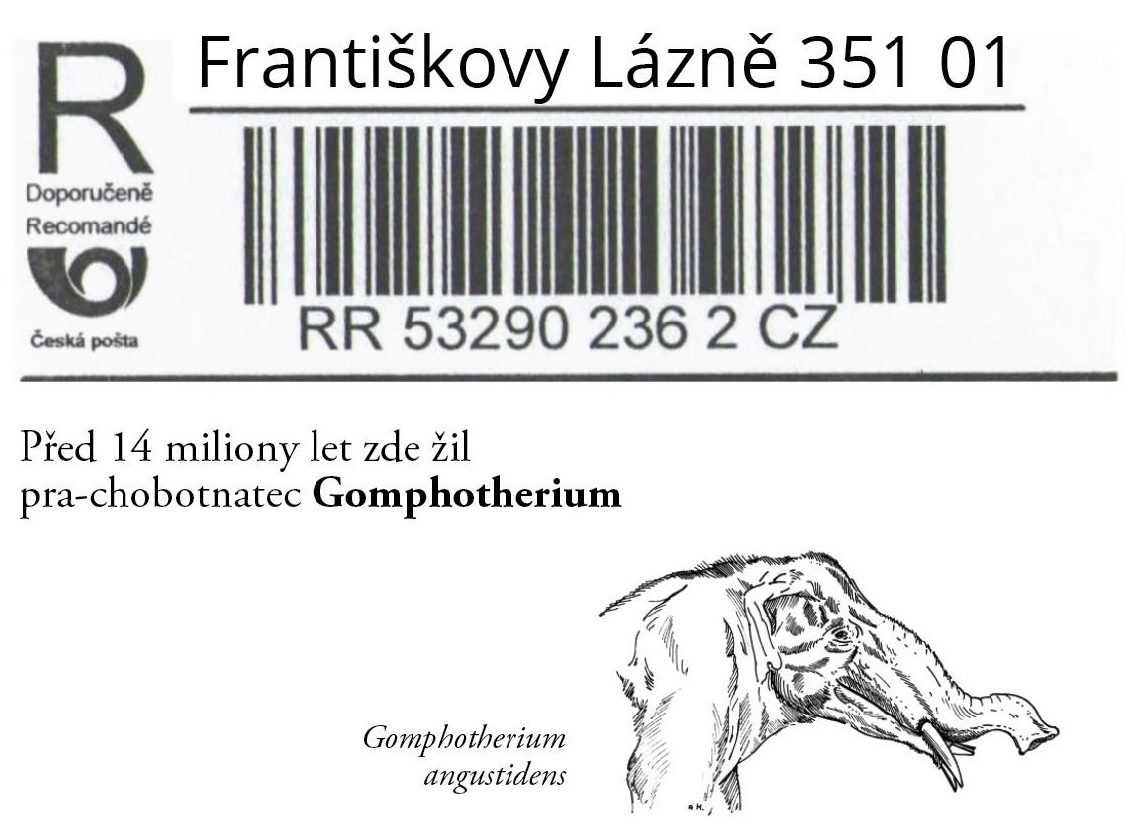
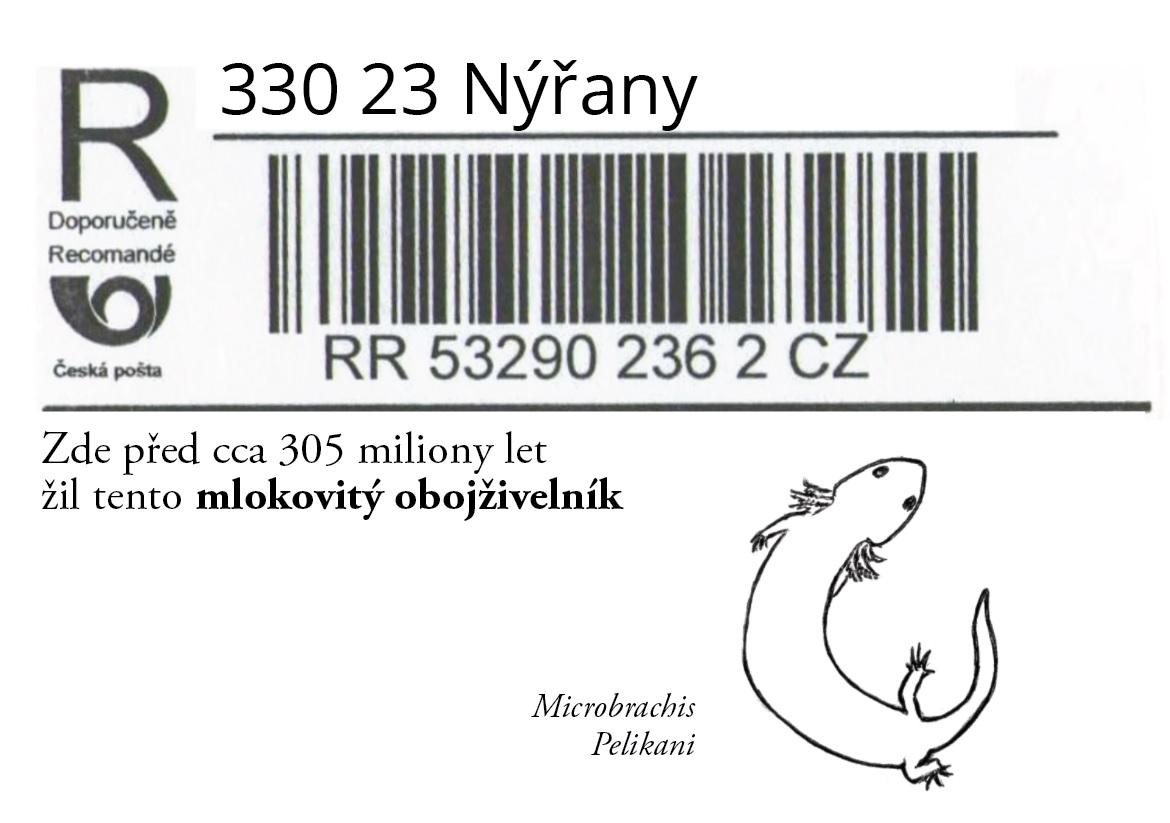
| 13.04.2022 "Cooksonia barrandei - one of the oldest plants"" | 14.05.2022 "Gomphotherium angustidens" | 06.06.2022 "Prehistoric newt Microbrachis Pelikani" |
 |
 |
 |
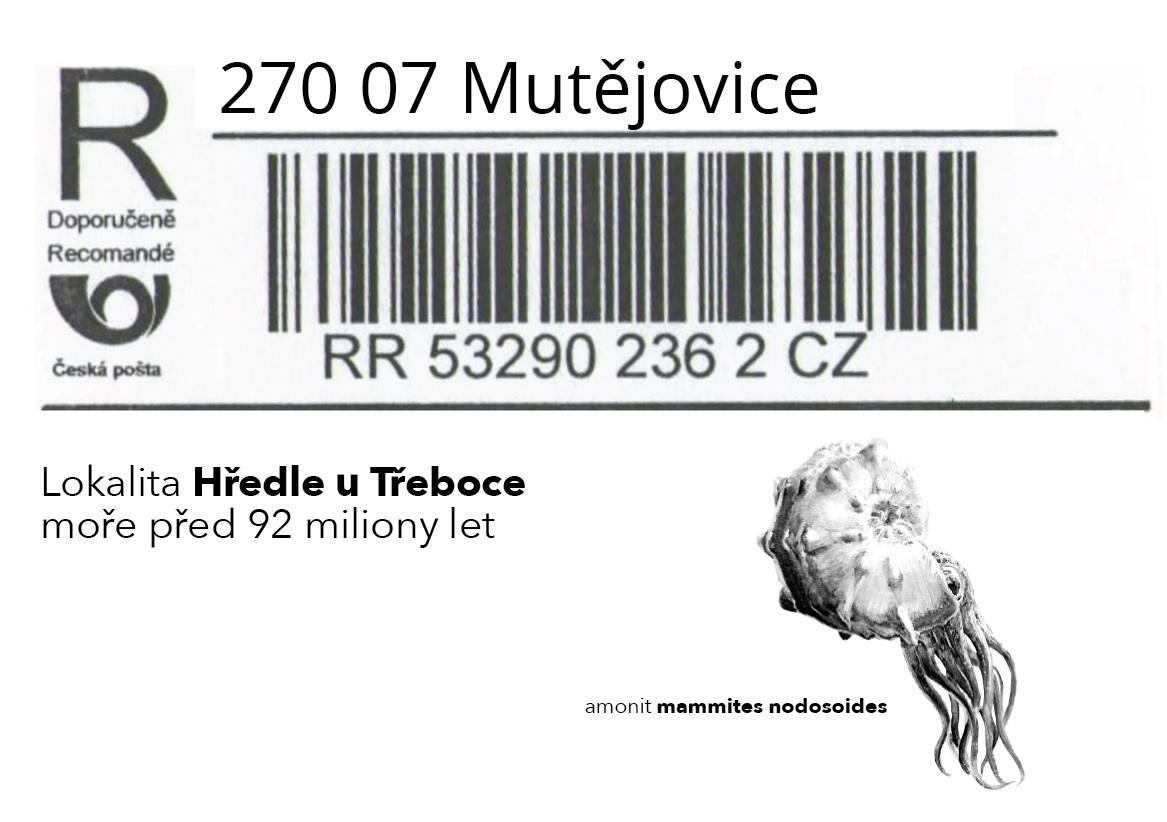
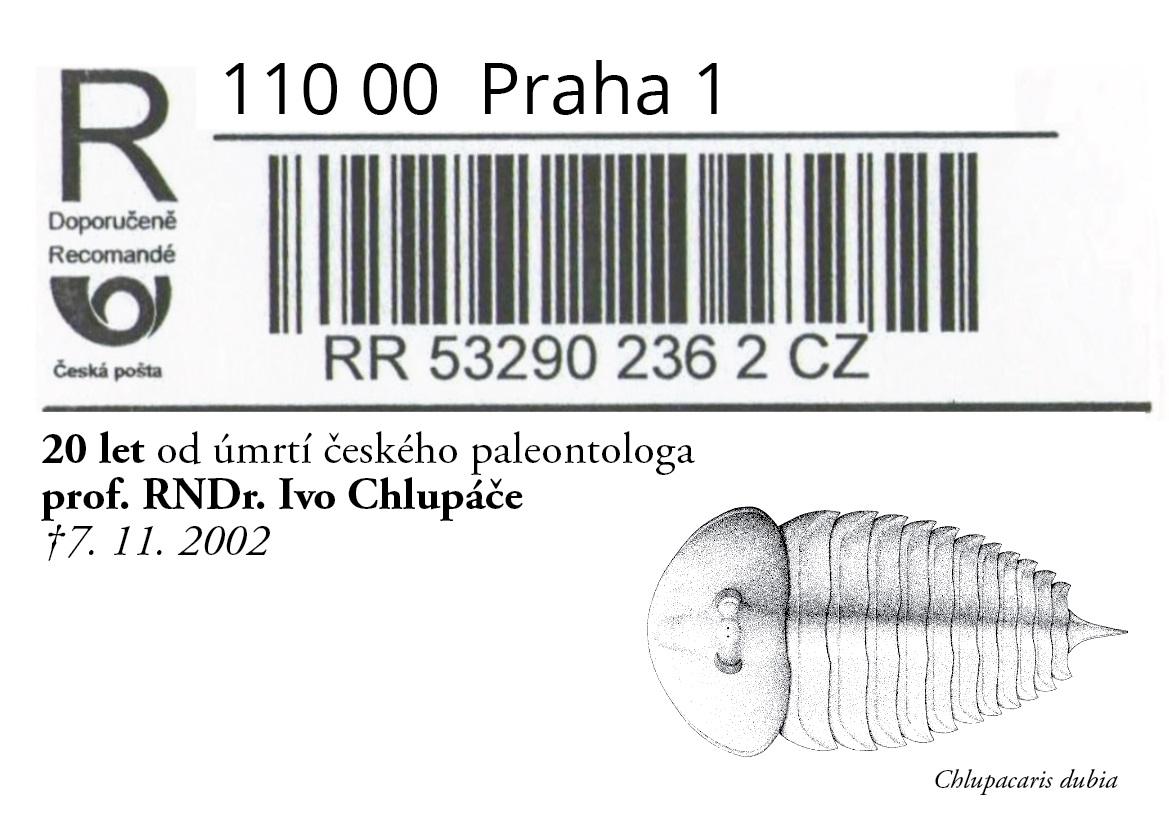
| 05.10.2022 "A reminder of the discovery of ammonites in the former sea in the locality of Hředle u Třeboce, where they lived approx. 92 million years ago." | 17.10.2022 "Important paleontological site Stránská skála, where 12 thousand years ago the so-called "sabre-toothed tiger" Homotherium moravicum lived." | 30.10.2022 "20 years since the death of Prof. RNDr. Ivo Chlupac - Chlupacaris dubia " |
 |
 |
|
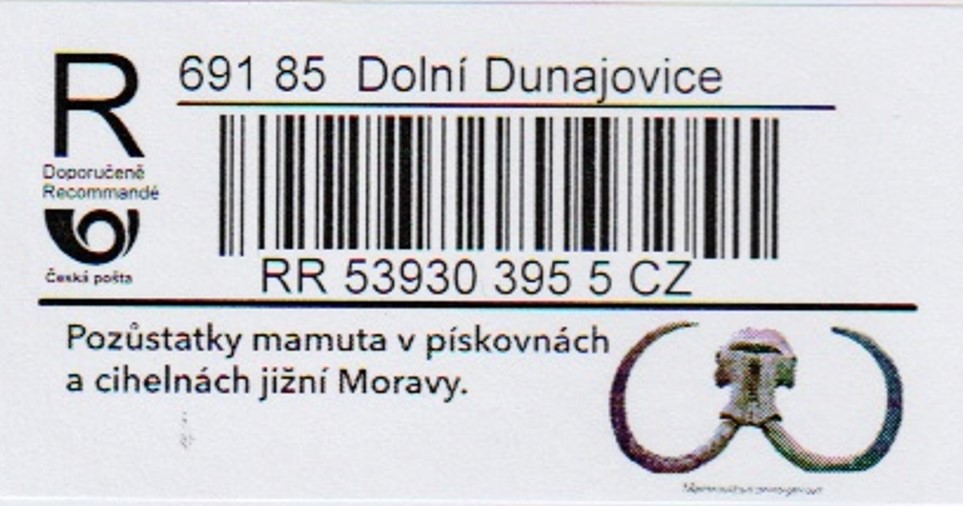
| xx.xx.2022 "The remains of a mammoth in the sand and brick houses of southern Moravia" [Sp] | ||
 |
||
Other postmarks and (R-labels to consider: flint tools, Paleo-artists, stylized prehistoric animals
Legend is here
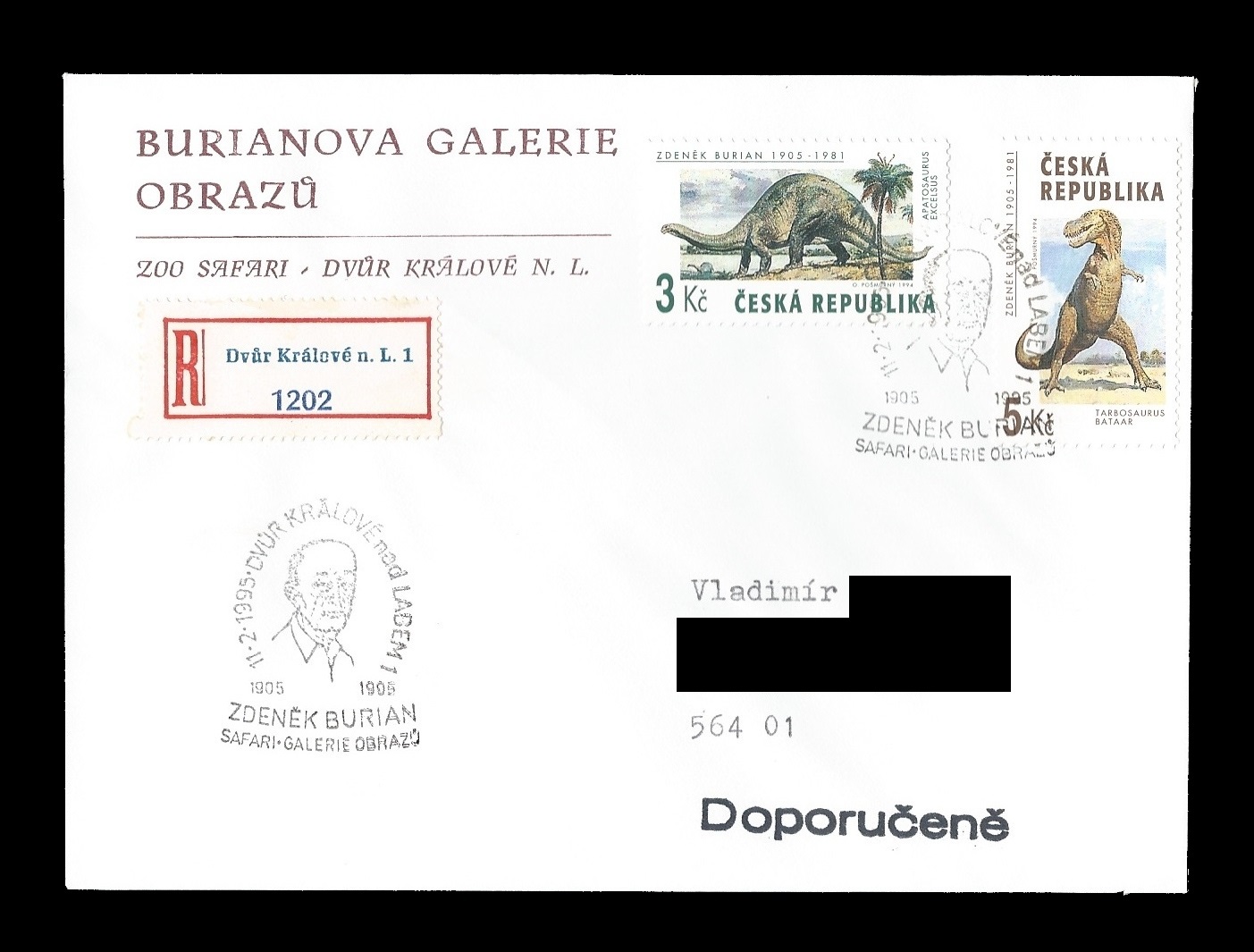
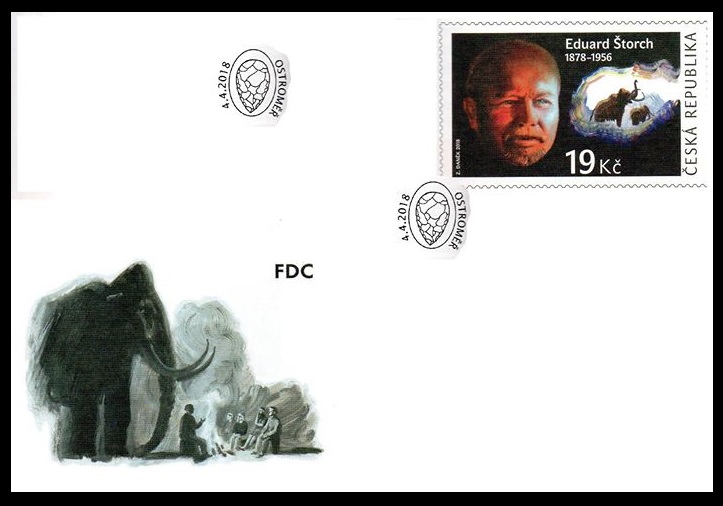
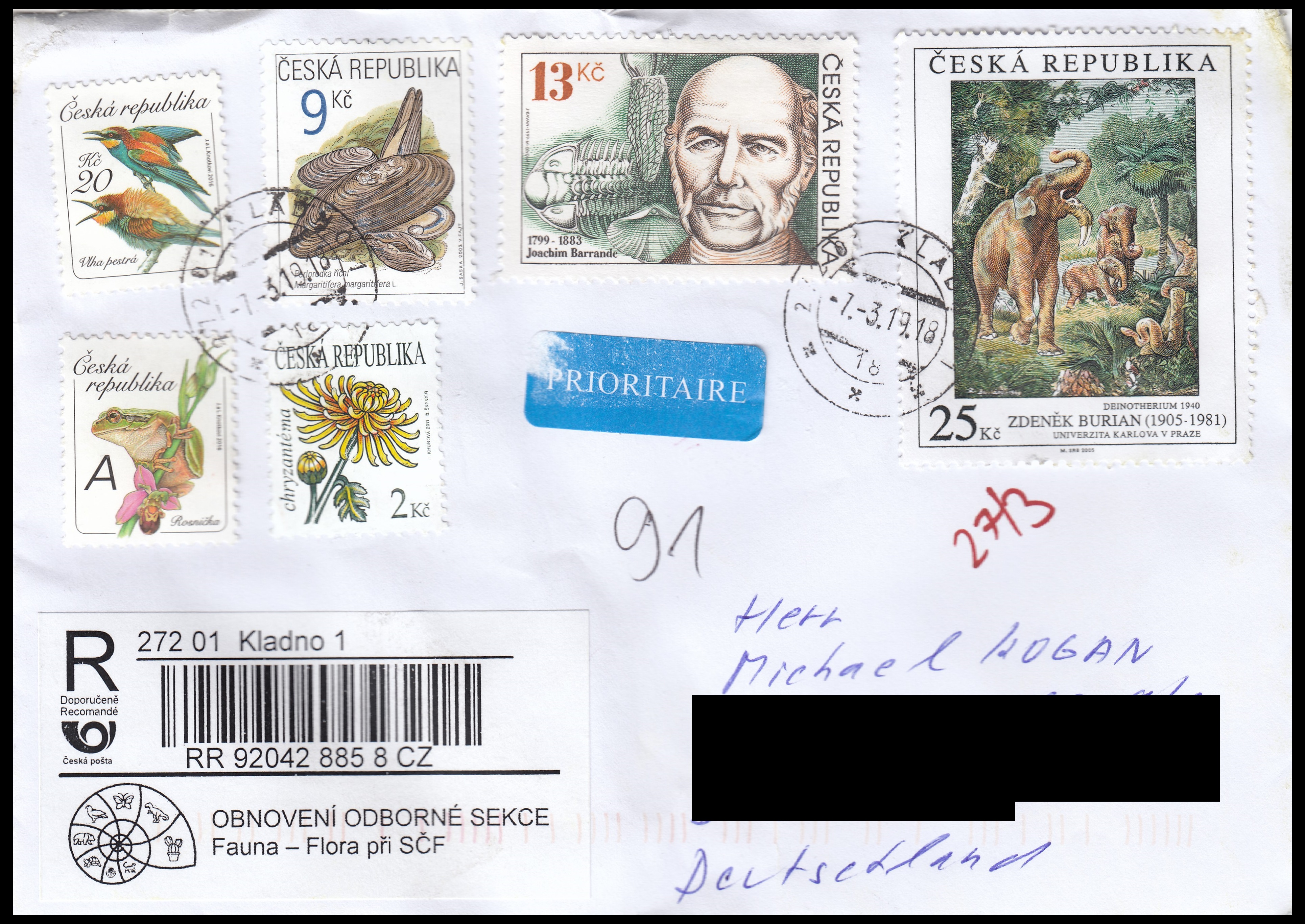
| 11.02.1995 "90th anniversary of Zdenek Burian" [CA1] [Sp] | 04.04.2018 "Eduard Storch" [FDC] | xx.xx.2019 "Fauna-Flora philatelic club" [CA1] [Sp] |
 |
 |
 |
| 06.10.2019 "60 years of death of Prof. Dr. Karl Absolona" [Sp] | ||
 |
||
Notes:
[CA1] Zdenek Burian (1905-1981) was a Czech painter and book illustrator whose work played a central role in the development of palaeontological reconstructions during a remarkable career spanning five decades.
Many of his works were used as the source material for the images on many international stamps, including the 1994 Czech Prehistoric Animals – Dinosaurs set. [R13]
[CA2] Registered label with postmark of Czech's "Flora and Fauna" philatelic club. The postmark of ammonite shape shows a stylized dinosaur, perhaps a T Rex, inside the chambers of the ammonite.

The text above the postmark: "Resumption of Fauna-Flora Expert Section at Union of Czech Philatelists." Similar postmarks issued in Prague, Plzen and Kladno cities.
References
- [R1] Czech Republic: Wikipedia, WikiTravel, FlagCounter.
- [R2] Postal History and Philately of Czech Republic:
Wikipedia,
Links to official website of the Post Authority, stamp catalog and a list of new stamps of Czech Republic are here. - [R3] Deinotherium: Wikipedia
- [R4] Ferdinand Stolicka: Wikipedia
- [R5] Kaspar Maria von Sternberg: Wikipedia
- [R6] Georgius Agricola: Wikipedia Encyclopedia Britannica
- [R7] Nature Protection - Biosphere Reserve Lower Morava:
official release of Czech Post.
Pavlov Hills:
Wikipedia, Pavlov Hills: Botanical Excursion Guide , by Jiří Danihelka, Vít Grulich & Milan Chytrý (PDF file), summitpost.org. - [R8] Nature Protection - Karlstejn Region: Wikipedia, official release of Czech Post, visitstrednicechy.cz.
- [R9] Iron Mountains: Wikipedia, official stamp release of Czech Post, geoparkzh.cz,
- [R10] Oldřich Pošmurný: Official release of Czech Post.
- [R11] The Moravian Museum in Brno:
official website,
Official stamp release of Czech Post.
Venus of Dolní Věstonice:
Wikipedia - [R12] National Museum in Prague: official website, Wikipedia Official stamp release of Czech Post.
- [R13] Zdenek Burian: Wikipedia, zdenekburian.com, zburian.blogspot,

Acknowledgements
Many thanks to Dr. Peter Voice from Department of Geological and Environmental Sciences, Western Michigan University, for reviewing the draft page and his very valuable comments.