Czech Republic (Czechia)
2011
"Kaspar Maria von Sternberg (1761 - 1838)"
| Issue Date | 05.01.2011 |
| ID | Michel: 664; Scott: Stanley Gibbons: Yvert: Category: pP |
| Design | Graphic designer: Oldrich Kulhanek Engraver: Wolfgang Mauer |
| Stamps in set | 1 |
| Value | 43 CZK - |
| Emission/Type | commemorative |
| Issue place | |
| Size (width x height) | Picture size: 26mm x 40mm |
| Layout | Souvenir-Sheet with 1 stamp |
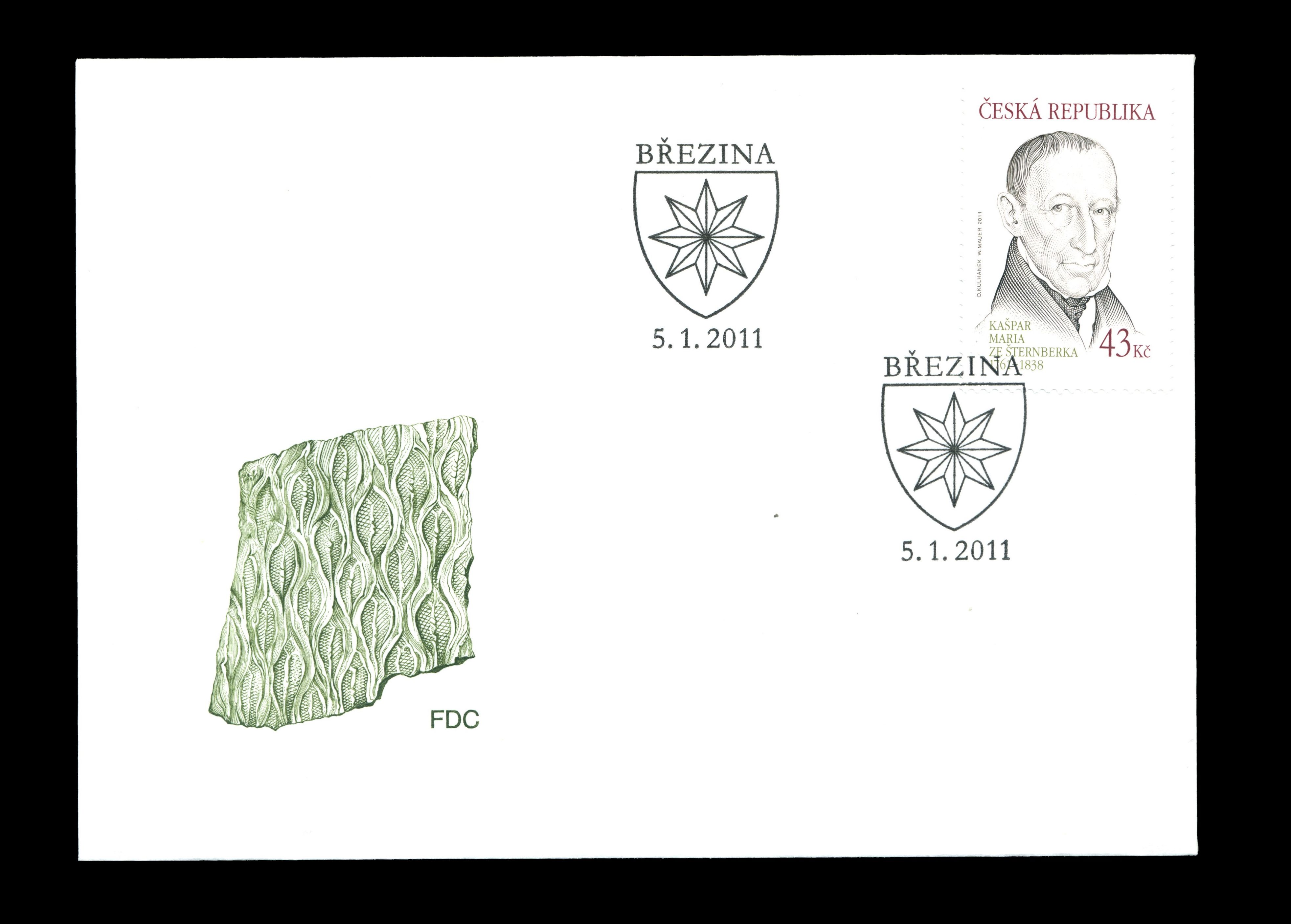
| Products | FDC x1 |
| Paper | |
| Perforation | 12x12 |
| Print Technique | |
| Printed by | Post Printing House |
| Quantity | |
| Issuing Authority | Czech Post |
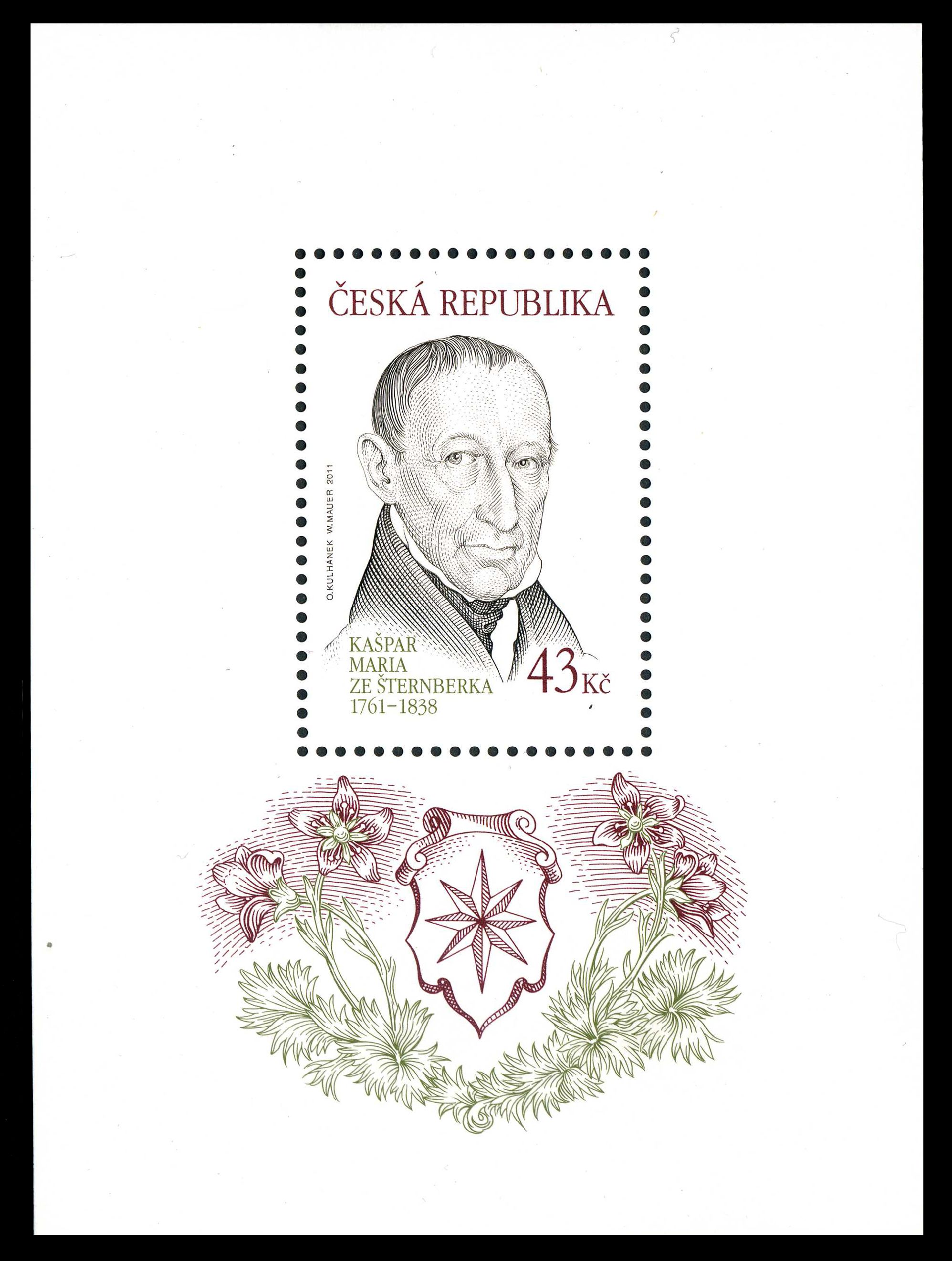
On January 3rd, 2011, the Post Authority of the Czech Republic issued a block with stamp in honor of the famous Czech Paleobotanist, Kaspar Maria von Sternberg.
Kaspar Maria von Sternberg (born on January 6th, 1761 at Březina Castle) was one of the leading scientists of the first half of the 19th century, with a special interest in botany, geology and paleontology, and is considered one of the founders of paleobotany.
He collected an extensive and precious collection of minerals, fossils and herbs that became the core collection of the National Museum in Prague, founded by Kaspar Maria von Sternberg. Kaspar Maria was born the eighth and last child (third son) of Johann von Sternberg and Anna Josefa Krakovská of Kolovraty, into a not wealthy Czech aristocratic family of Sternbergs.
 |
| Kaspar Maria von Sternberg 1838 painting by Alexander Clarot Image credit: Wikimedia |
During his French stay, Sternberg was introduced to Alexander von Humboldt and a group of elite French paleontologists and botanists. His book, A Survey of Saxifrages in Pictures (published in Latin) was based on materials collected during his scientific trips, especially to the Bavarian Alps. Shortly after the publication, he inherited the West Bohemian Radnice estate from his older brother and devoted scientist Joachim. He set up a botanical garden in Radnice and was a frequent visitor to the newly opened coal mines in the neighborhood where he searched for primordial plant fossils. After his A Treatise on Botany in Bohemia (originally published in German and soon after also in Czech), he (together with Karel Bořivoj Presl and Augustin Corda) co-authored the 1820-38 An Attempt at Geographical and Botanical Description of Primordial Plants. He also became one of the key shareholders in Prague Railway Company (1825) authorised to build the Prague-Lány Horse-Drawn Railway (1827).
Kaspar Maria von Sternberg was elected President of the Society for the Establishment of the Czech National Museum in 1818, and bequeathed his library and paleontological collection to the museum. He died at Březnice Castle on December 20th, 1838 as the last male heir of the Leopoldine branch of the Sternberg family. [R1]
 |
 |
| Lepidodendron modulatum and diplodigioides. Image credit: Wikimedia | Lepidodendron reconstruction. Image credit: Wikimedia |
Lepidodendron — also known as the scale trees — is an extinct genus of primitive, vascular, tree-like plants related to the lycopsids (club mosses). They were part of the coal forest flora. They sometimes reached heights of over 30 metres, and the trunks were often over 1 m in diameter.
It was tree-like, branching at the top and with a trunk covered with leaf scars.
They thrived during the Carboniferous Period (about 359.2 ± 2.5 Mya (million years ago) and were found until the Late Triassic, about 205 Ma) before going extinct.
Lepidodendron was named and described by Kaspar Maria von Sternberg. His description of Lepidodendron came from his deep studies of the fossils associated with coal mines in Bohemia. [R2]
Products and associated philatelic items
| FDC | Example of circulated cover | |
 |
 |
|
References
[R1] Czech Post
[R2] Wooster Geologists Wikipedia
Acknowledgements
Many thanks to Dr. Peter Voice from Department of Geological and Environmental Sciences, Western Michigan University, for reviewing the draft page .