Australia
Dinosaurs and other prehistoric animals, fossils, fossil found places, Charles Darwin on official and personalized stamps, postmarks and postal stationeries of Australia
Australia is world famous for its natural wonders and wide open spaces, its beaches, deserts, "the bush", and "the Outback". Australia is one of the world's most highly urbanised countries; it is well known for the attractions of its large cities such as Sydney, Melbourne, Brisbane and Perth. [R1]
Australia is also world famous for its discovery of Dinosaur and Megafauna fossils, some of it are unique - found nowhere else and bears the names of Australian locations where their fossils were discovered. Muttaburrasaurus[R9] a dinosaur, was named after Muttaburra town [R8] in Queensland state of Australia.
Many of the prehistoric creatures who roamed the territory of modern Australia can be seen on Australian stamps.
Did you know ?
-
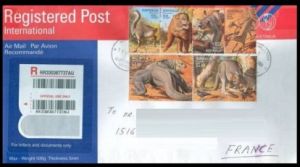
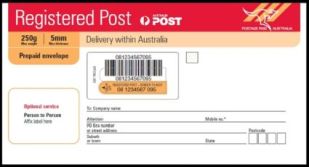 Registered letters can be sent in Australia in special prepaid “Registered Post” envelopes that include a unique
tracking code.
The price of the envelope already includes postage and registered tracking.
Some covers are sold that have stamps on registered posts – these stamps are absolutely
redundant and are only used for decoration (as in the above cover on the left).
“Decorated” covers have no philatelic value – don’t waste your money on them!
[R2]
Registered letters can be sent in Australia in special prepaid “Registered Post” envelopes that include a unique
tracking code.
The price of the envelope already includes postage and registered tracking.
Some covers are sold that have stamps on registered posts – these stamps are absolutely
redundant and are only used for decoration (as in the above cover on the left).
“Decorated” covers have no philatelic value – don’t waste your money on them!
[R2]
-
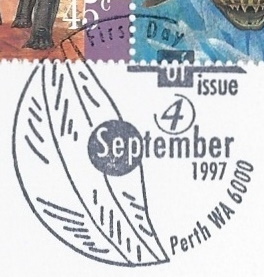
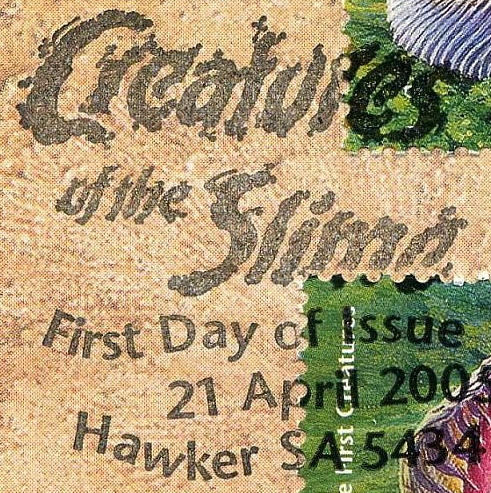
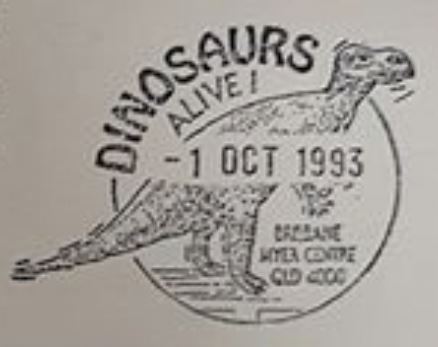
 According to Australian Post all postmarks designed for their FDC match the stamps topic.
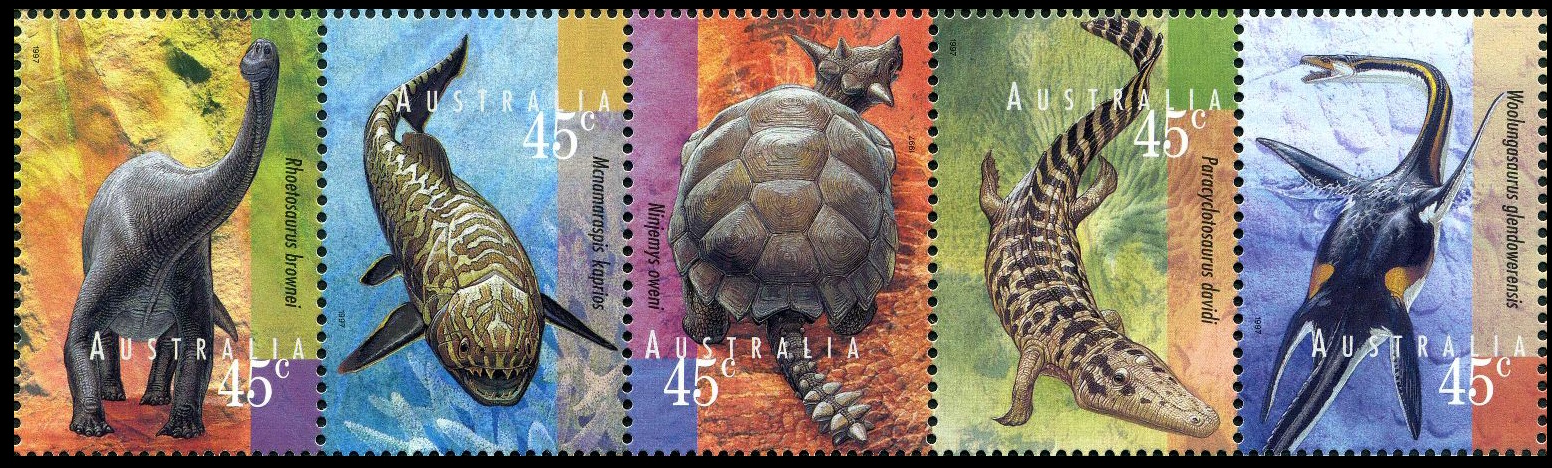
However, some postmarks have an abstract image, as the one for "Wildlife of Ancient Australia" stamps set from 1997 (see on the right).
The graphic design line drawing could just be a representation of a rock "Impression" and not associated with any particular fossil type.
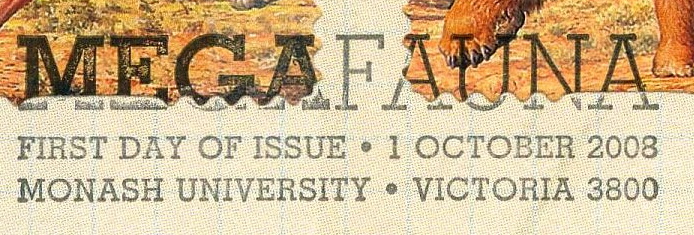
In some other cases the postmarks are not pictorial, but just decorative text with the name of the issue as the postmarks for "Creatures of the Slimes" from 2005 and "Megafauna" from 2008 for example


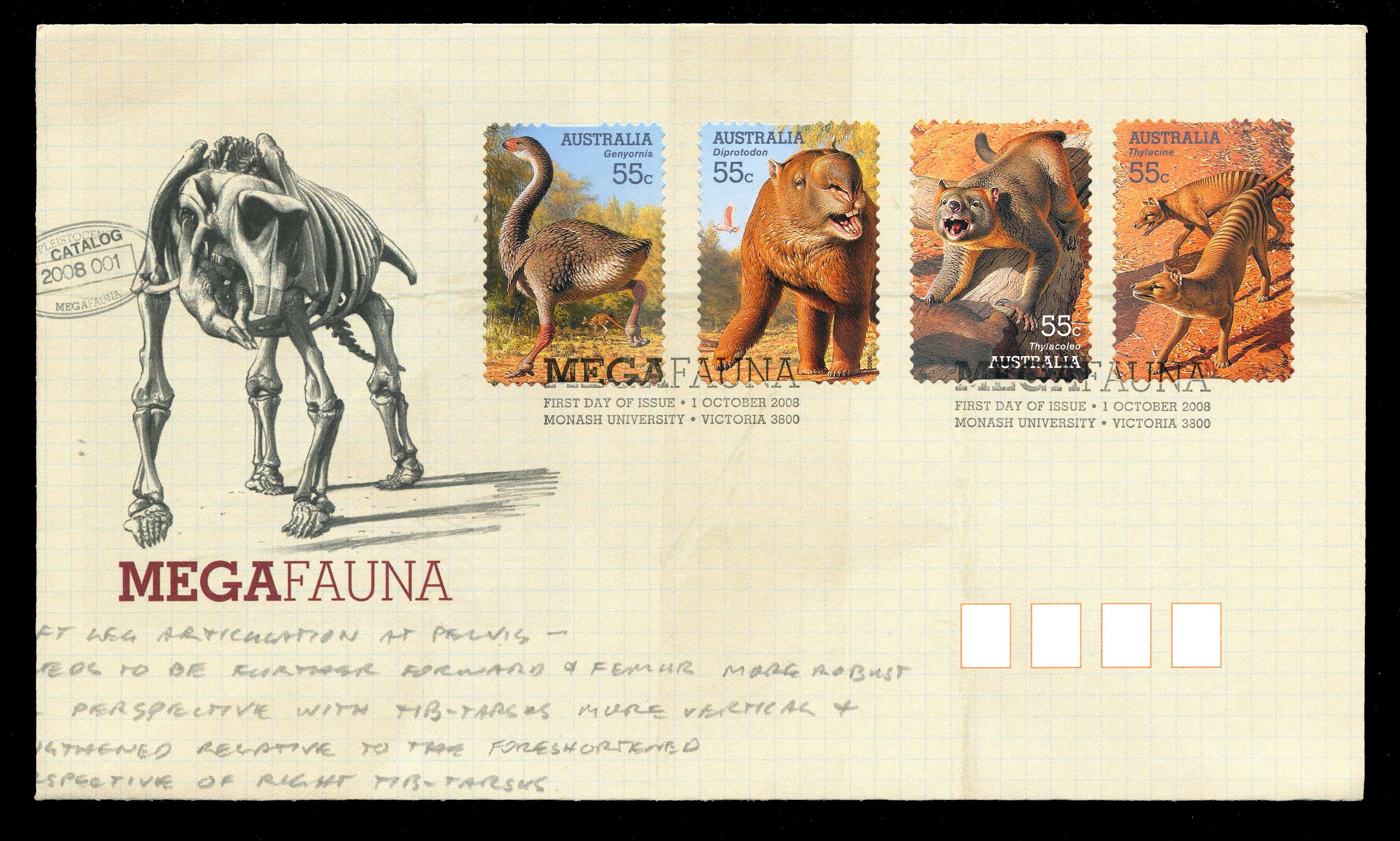
Official stamps of Australia that related to Paleontology: dinosaurs and other prehistoric animals
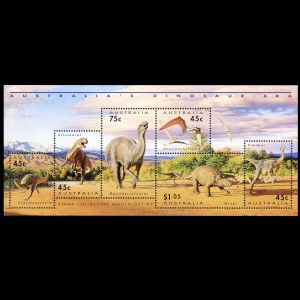
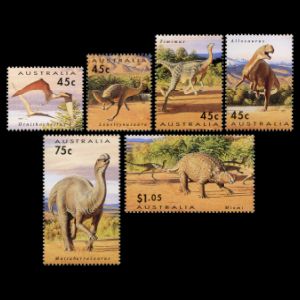
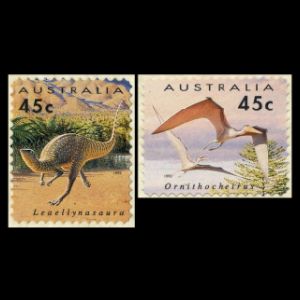
| 01.10.1993 "Australia’s Dinosaur Era", mint and self-adhesive stamps [1] | ||
 |
 |
 |
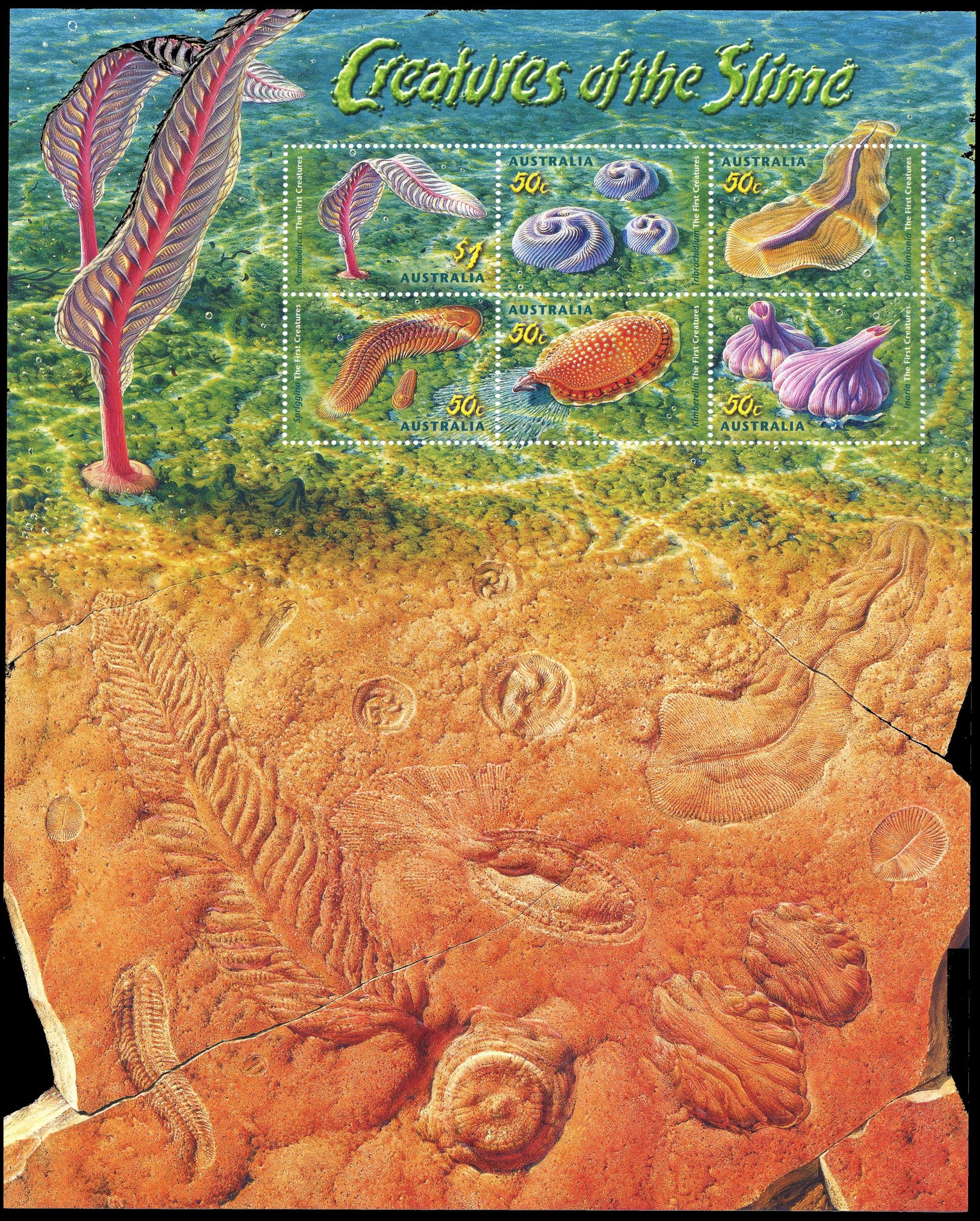
| 04.09.1997 "Wildlife of Ancient Australia" | 21.04.2005 "Creatures of the Slimes" (Ediacaran biota), Mini-Sheet, strip and single stamps | |
 |
 |
 |
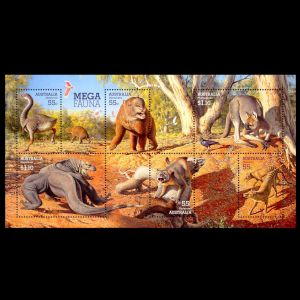
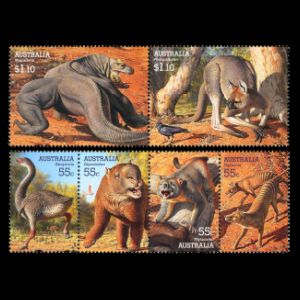
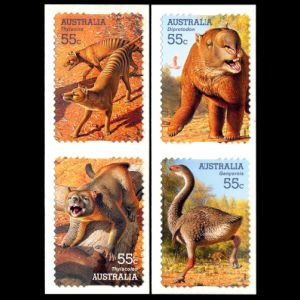
| 01.10.2008 "Megafauna", mint and self adhesive stamps | ||
 |
 |
 |
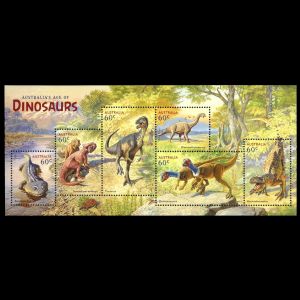
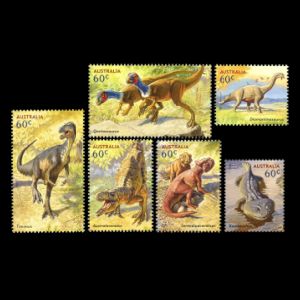
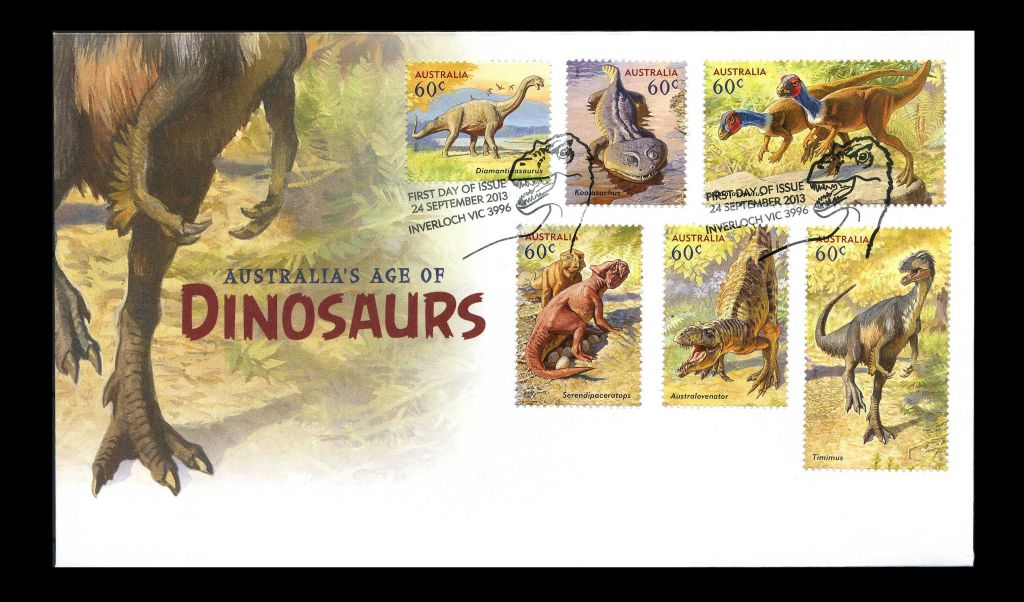
| 24.09.2013 "Australia’s Age of Dinosaurs" mint and self adhesive stamps | ||
 |
 |
 |
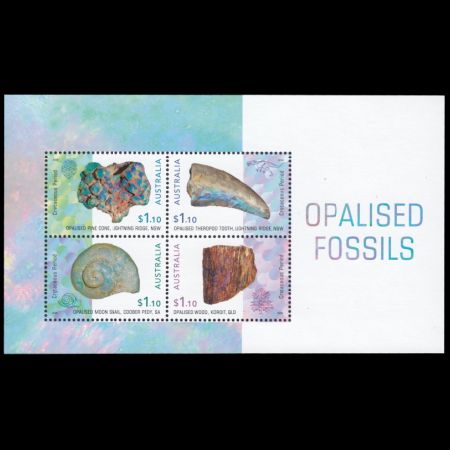
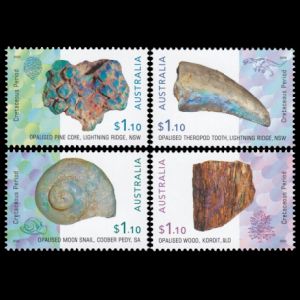
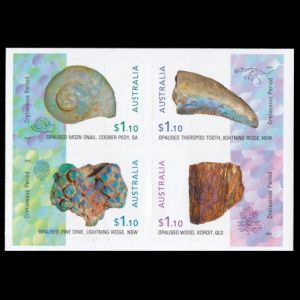
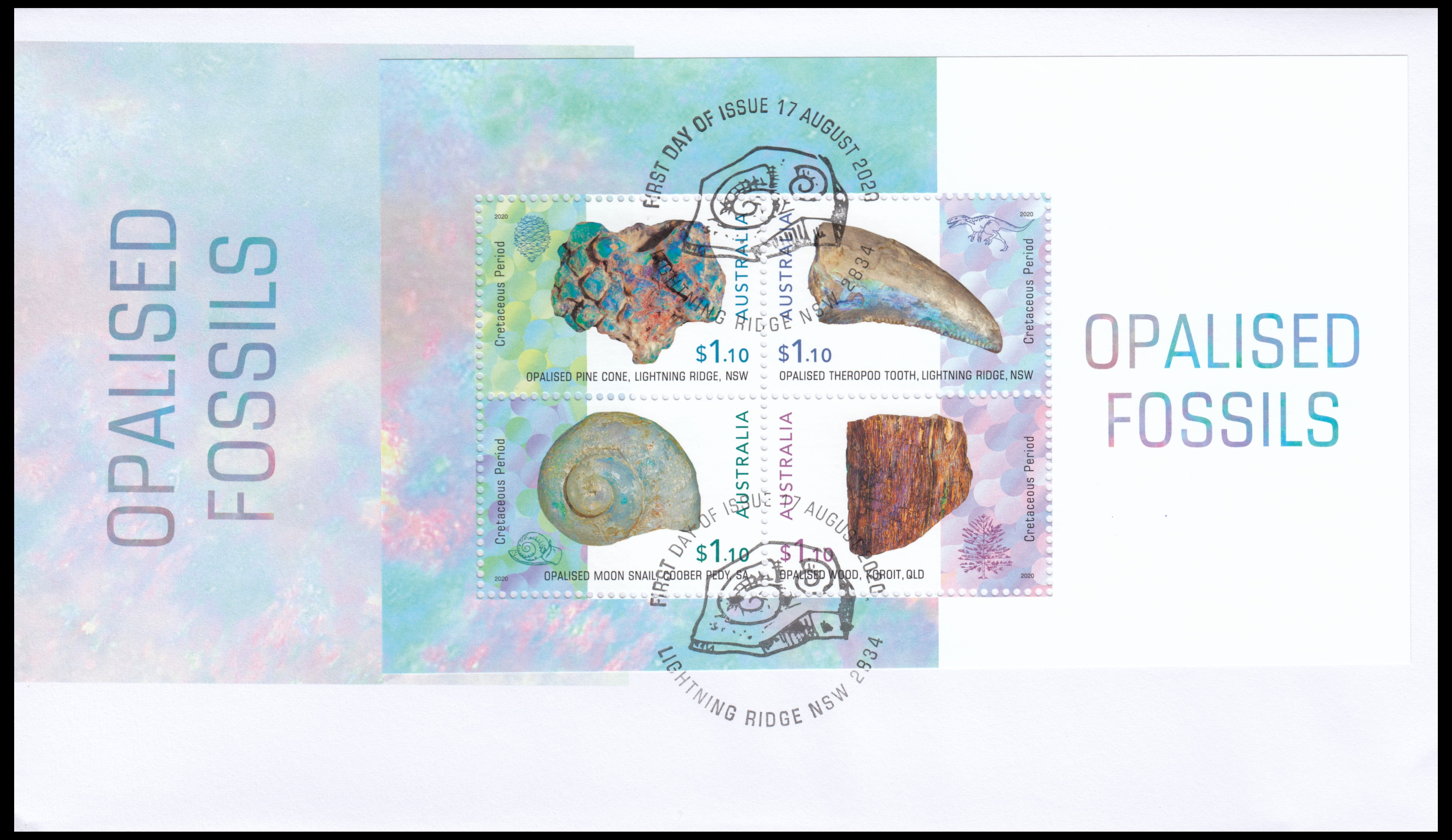
| 17.08.2020 "Opalised fossils" mint & self-adhesive stamps | ||
 |
 |
|
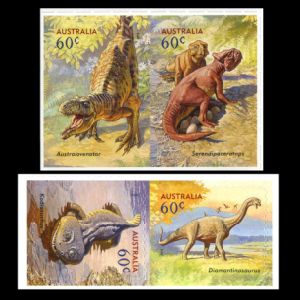
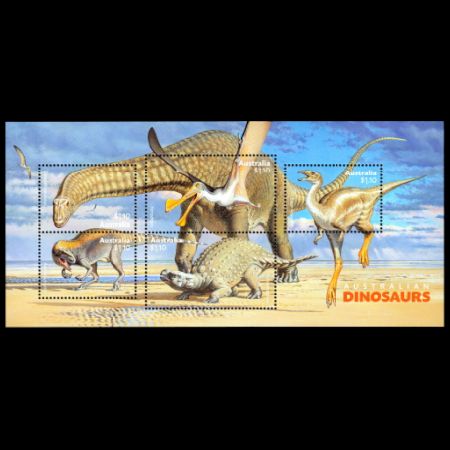
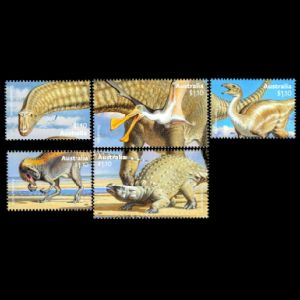
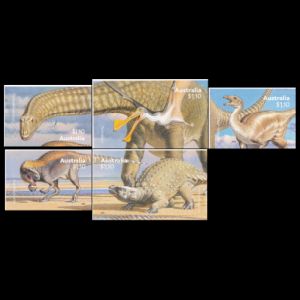
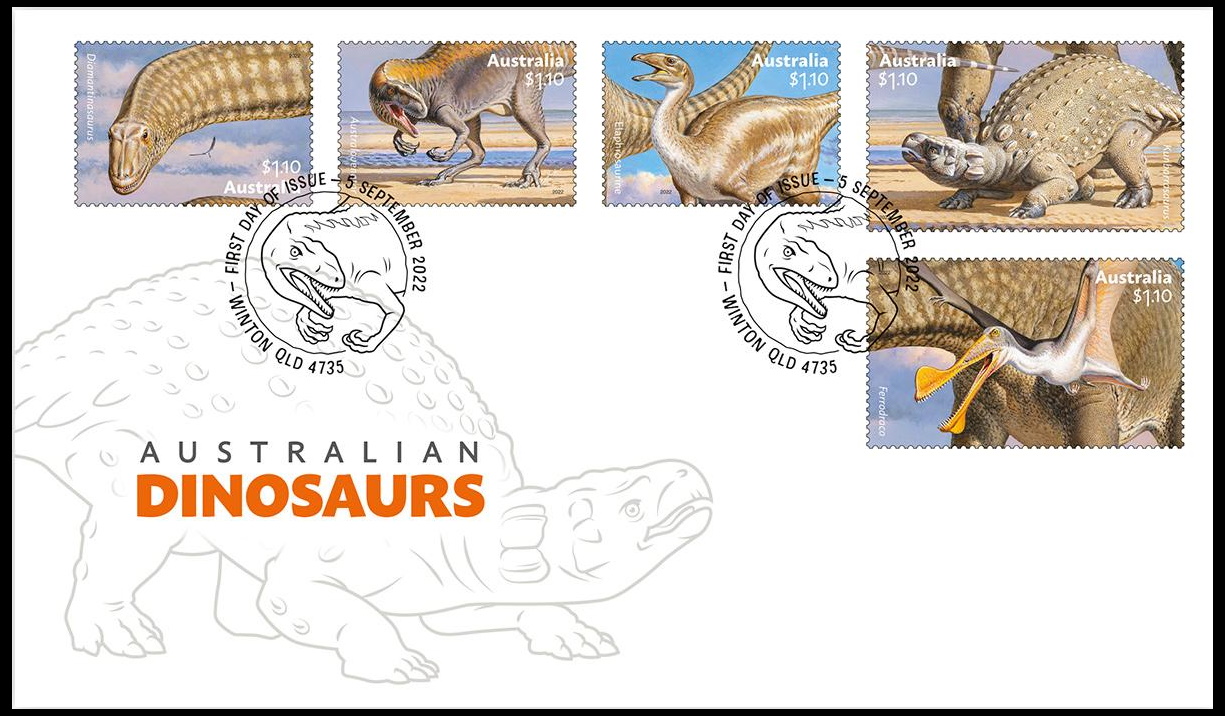
| 05.09.2022 "Australian Dinosaurs" mint & self-adhesive stamps | ||
 |
 |
|
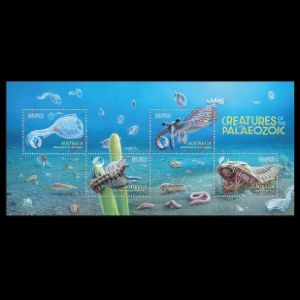
| 10.02.2026 "Creatures of the Palaeozoic" | ||
 |
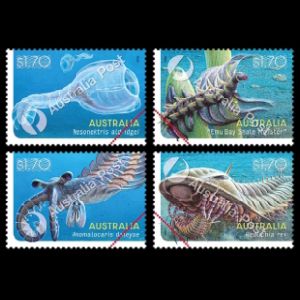 |
|
Notes:
[1] On October 10, 1993, only three month after release of "Jurassic Park" movie, three commonwealth countries: Australia, Canada and New Zealand issued dinosaur stamps.
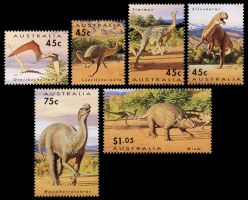
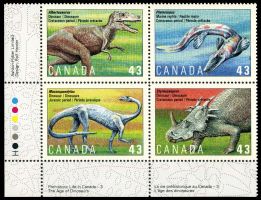
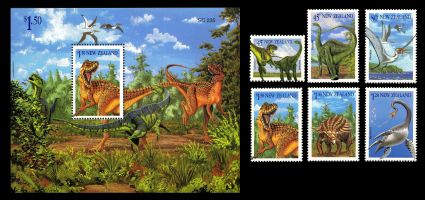
The Australian issue were issued in single sheets and mini-sheets of all 6 stamps. Two stamps from the set were also issued as self-adhesives in booklets and rolls. The mini-sheet was available with several overprints in gold and black colors – the overprints were for some stamp shows.
Many Australian stamps of Prehistoric animals including “Dinosaurs” (1993), “Creatures of the Slime” (2005), and “Megafauna” (2008) are based on drawings by famous Australian Paleoartist Peter Trusler.
Below are some videos where Peter Trusler talks about his work.
Personalized stamp: dinosaurs
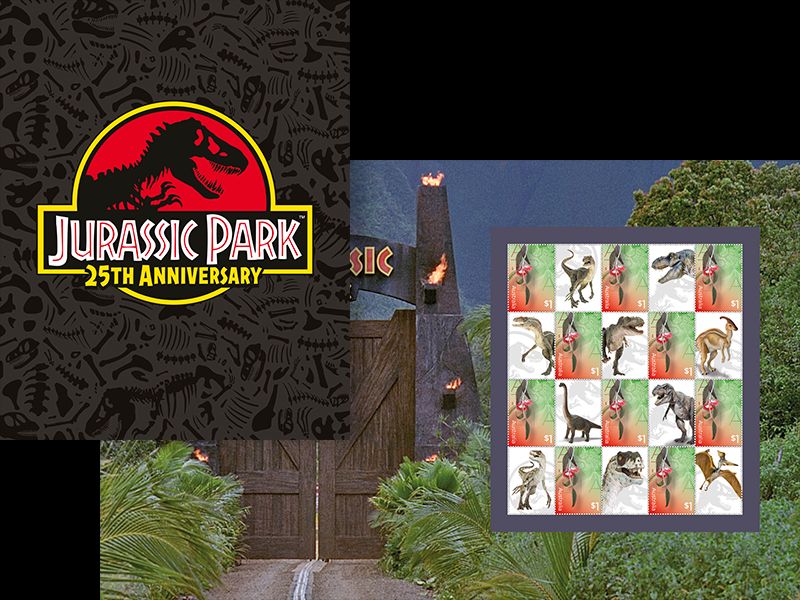
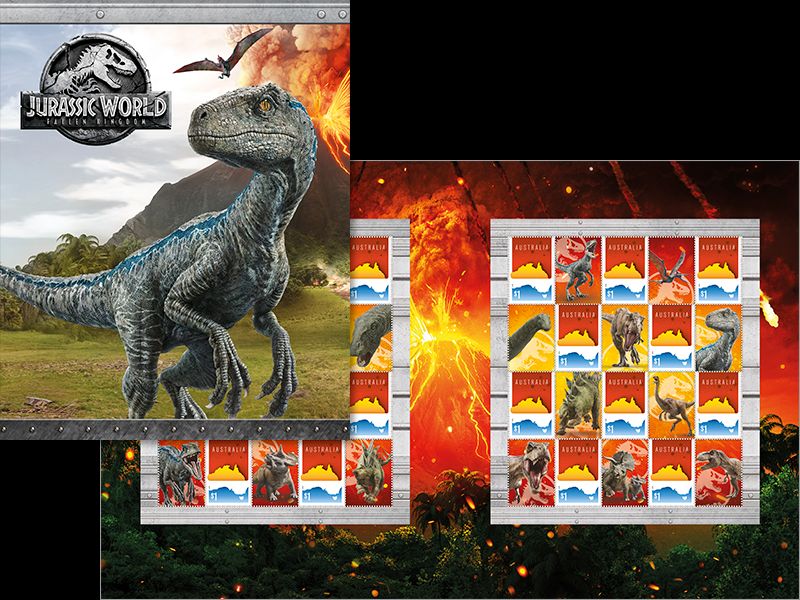
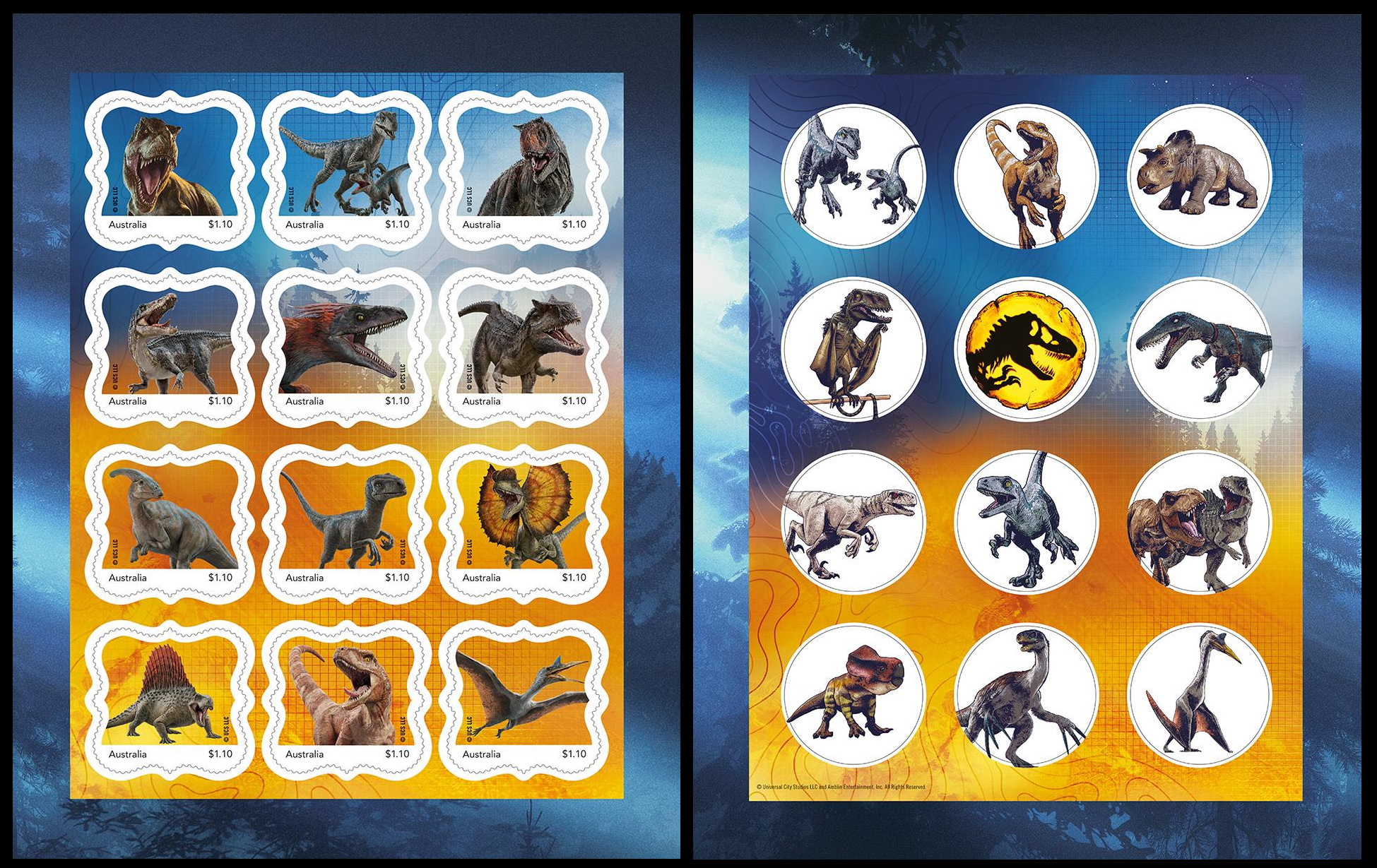
| 13.02.2018 "Jurassic Park 25th Anniversary stamp pack" [SP1] | xx.06.2018 "Jurassic World 2 Fallen Kingdom" [SP2] | 14.06.2022 "Jurassic World: Dominion Stamp Pack" [SP3] |
 |
 |
 |
| 05.09.2022 "Jurassic World Stamp Pack" | ||
 |
||
Notes:
[SP1] Souvenir sheet with 10 stamps and some Dinosaurs on tabs in between. Issued by Australian Post to celebrate one of the biggest movie franchises in motion picture history with the Jurassic Park 25th anniversary!

This film takes you to an amazing theme park on a remote island where
dinosaurs once again roam the Earth and five people must battle to
survive among the prehistoric predators.
Featuring visually stunning imagery and groundbreaking filmmaking, this epic film is sheer
movie-making magic that was 65 million years in the making.
This film takes you on a breathtaking adventure you will want to experience again
and again. Welcome to Jurassic Park.
[SP2] Jurassic world 2 Fallen Kingdom - personalized stamps of Australian post. Souvenir sheet with 20 stamps and some Dinosaurs on tabs in between.
The pack centres on the newly released Jurassic World: Fallen Kingdom. In this latest installment of this hugely popular movie franchise, four years have passed since the destruction of the Jurassic World theme park, and there’s a push to rescue the remaining dinosaurs from the island.
 With all of the wonder, adventure and thrills synonymous
with one of the most popular and successful franchises in cinema
history, we see the return of favourite characters and dinosaurs –
along with new breeds more awe-inspiring and terrifying than ever before.
Welcome to Jurassic World: Fallen Kingdom.
With all of the wonder, adventure and thrills synonymous
with one of the most popular and successful franchises in cinema
history, we see the return of favourite characters and dinosaurs –
along with new breeds more awe-inspiring and terrifying than ever before.
Welcome to Jurassic World: Fallen Kingdom.
It’s been four years since theme park and luxury resort Jurassic World was destroyed
by dinosaurs out of containment.
Isla Nublar now sits abandoned by humans while the surviving dinosaurs fend for themselves in the jungles.
When the island’s dormant volcano begins roaring to life, Owen (Chris Pratt)
and Claire (Bryce Dallas Howard) mount a campaign to rescue the
remaining dinosaurs from this extinction-level event.
Owen is driven to find Blue, his lead raptor who’s still missing in the wild and Claire
has gained respect for these creatures she now makes her mission to save.
Arriving on the unstable island as lava begins raining down,
their expedition uncovers a conspiracy that could return our entire
planet to a perilous order not seen since prehistoric times.
[SP3] Jurassic World: Dominion is the next chapter in one of the biggest franchises in the history of cinema.
 The film, from Universal Pictures and Amblin Entertainment, sees the return of director Colin Trevorrow,
who also serves as executive producer with Steven Spielberg.
The film, from Universal Pictures and Amblin Entertainment, sees the return of director Colin Trevorrow,
who also serves as executive producer with Steven Spielberg. Frank Marshall and Pat Crowley also return as producers. Alexandra Derbyshire joins as executive producer.
Chris Pratt and Bryce Dallas Howard again star and are joined by Academy Award® winner Laura Dern, Golden Globe nominee Sam Neill and Jeff Goldblum, who reprise their roles as Dr Ellie Sattler, Dr Alan Grant and Dr Ian Malcolm.
The film also stars an impressive international cast including Mamoudou Athie, Scott Haze, Dichen Lachman, Daniella Pineda, Campbell Scott, Isabella Sermon, Justice Smith, Omar Sy, DeWanda Wise and, as Dr Henry Wu, BD Wong.
Other stamps of Australia to consider: fossil-found place
| 1993 "DINO'93" [O4] | 04.03.1993 "Australian World Heritage Sites" [O1] | 14.03.1996 "Australian World Heritage Sites" [O2] |
 |
 |
 |
| 05.04.2007 "Definitive stamps: Islands" [O3] | 02.05.2017 "Caves" [O3] | 12.06.2018 "The Art in Nature" [O1] |
 |
 |
 |
| 22.02.2022 "Our Beautiful Continent" [O5] | ||
 |
||
Notes:
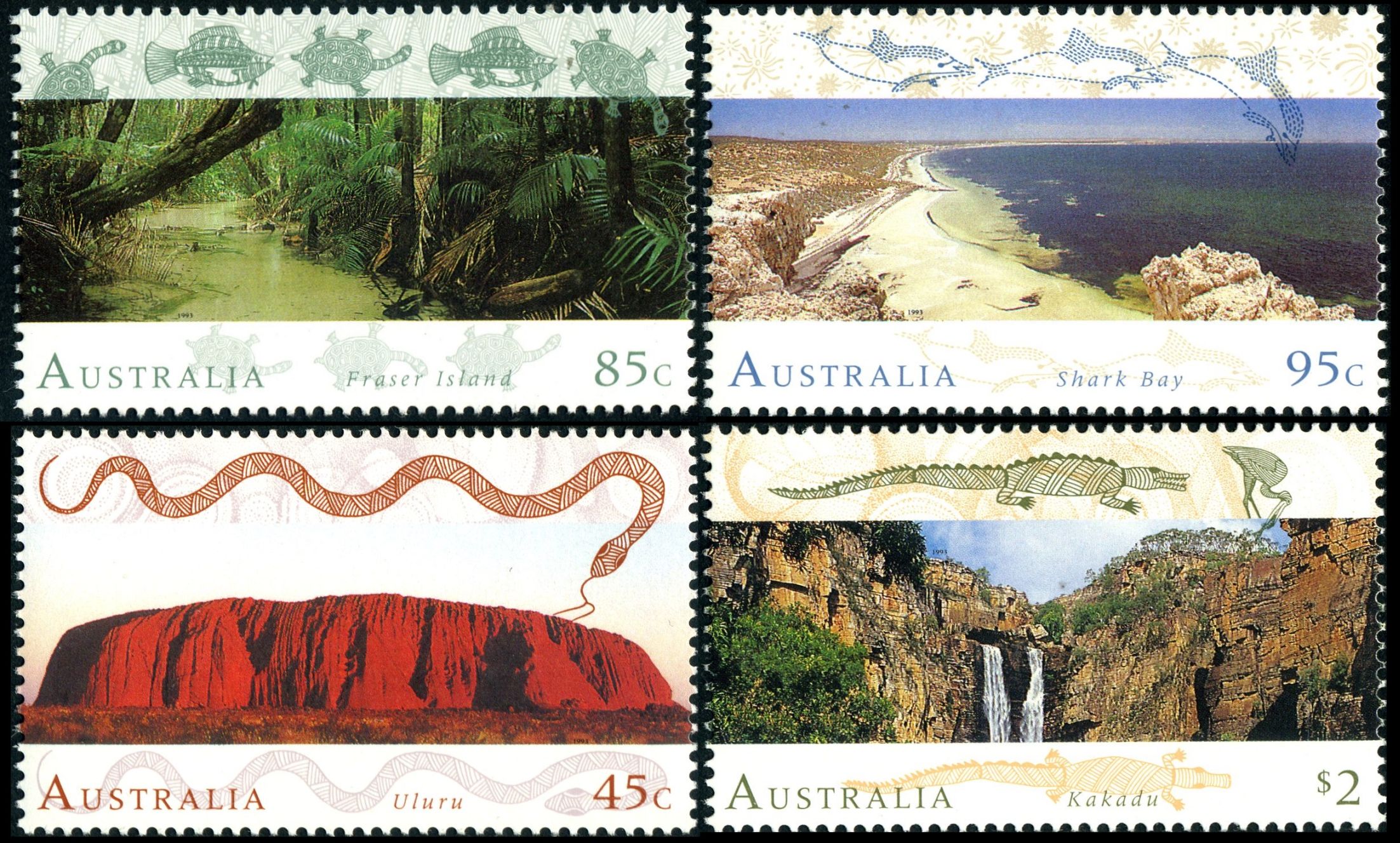
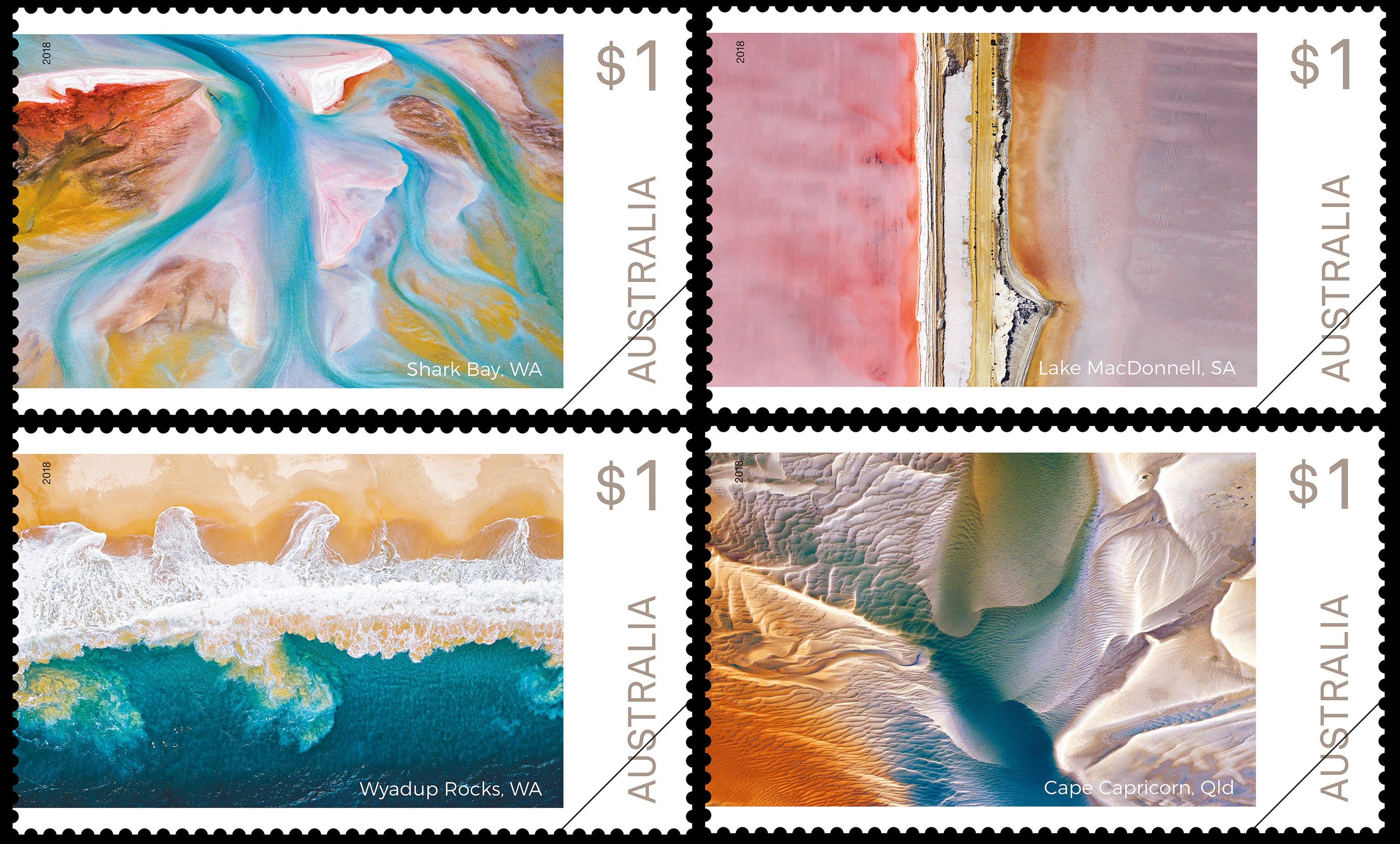
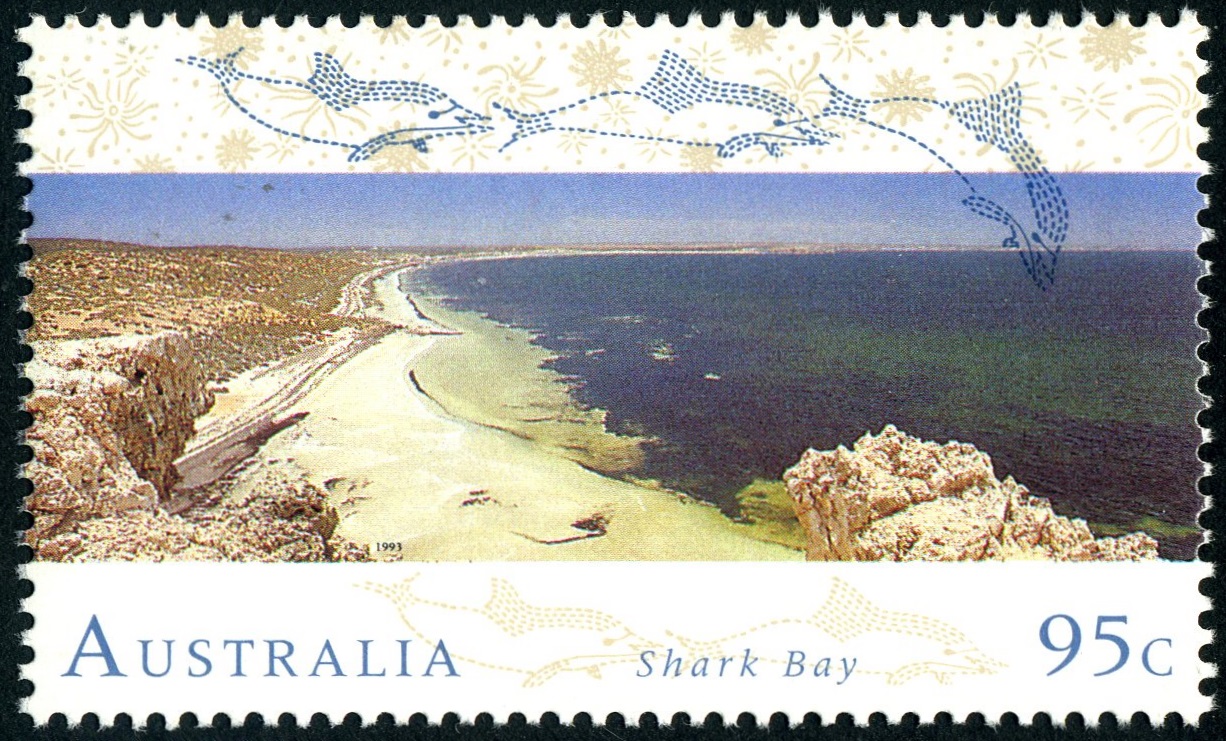
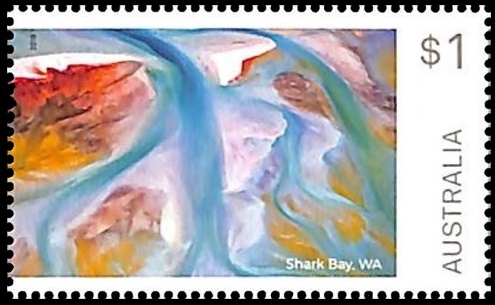
[O1] Shark bay is a World Heritage Site in the Gascoyne region of Western Australia.
The bay's landscape appeared on two Australian stamps: the first time in 1993 (face value of 95c), then in 2017 (face value of $1).
Shark Bay, located about half way up Western Australia's west coast, stretches along 1,500 kilometres of coastline. It includes several islands, white sand beaches, red cliffs and tranquil turquoise lagoons and is home to remarkable biological diversity and marine life.
|
|

|
| Shark Bay on stamp of Australia 1993 and 2018, MiNr. 1337 and 4813 | Stromatolite Shark Bay The image is from Wikipedia |
|
Based on growth rate it is believed that about 1,000 years ago cyanobacteria (blue-green algae) began building up stromatolites in Hamelin Pool at the Hamelin Station reserve in the southern part of the bay. These structures are modern equivalents of the earliest signs of life on Earth, with fossilized stromatolites being found dating from 3.5 billion years ago at North Pole near Marble Bar, in Western Australia, and are considered the longest continuing biological lineage.
Stromatolites make-up the majority of fossils from the Precambrian.
They were first identified in 1956 at Hamelin Pool as a living species[dubious – discuss], before that only being known in the fossil record. Hamelin Pool contains the most diverse and abundant examples of living stromatolite forms in the world. Other occurrences are found at Lake Clifton near Mandurah and Lake Thetis near Cervantes. It is hypothesized that some stromatolites contain a new form of chlorophyll - chlorophyll f. [R10]
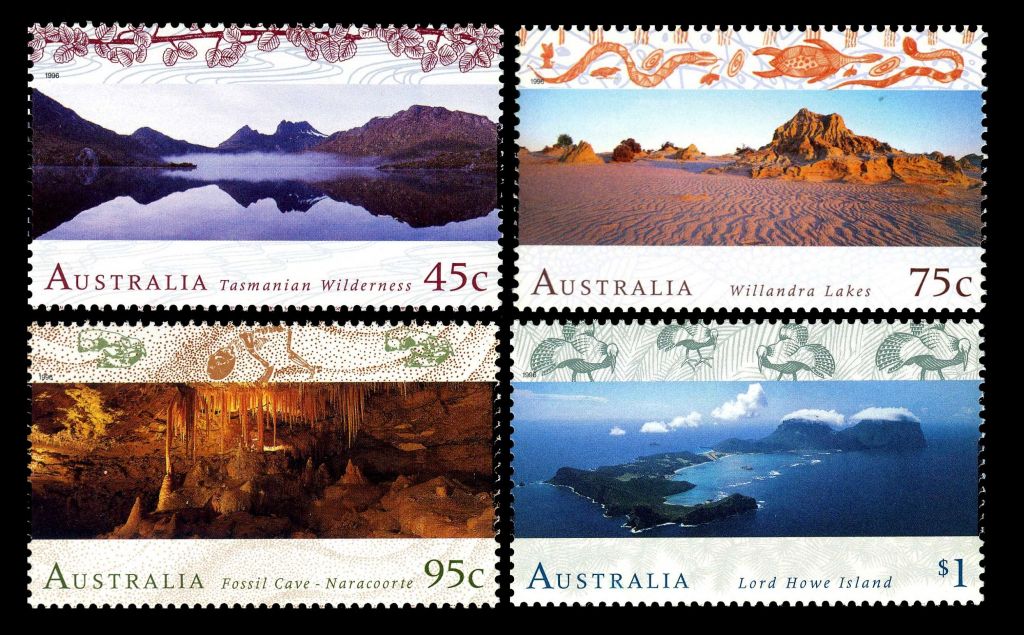
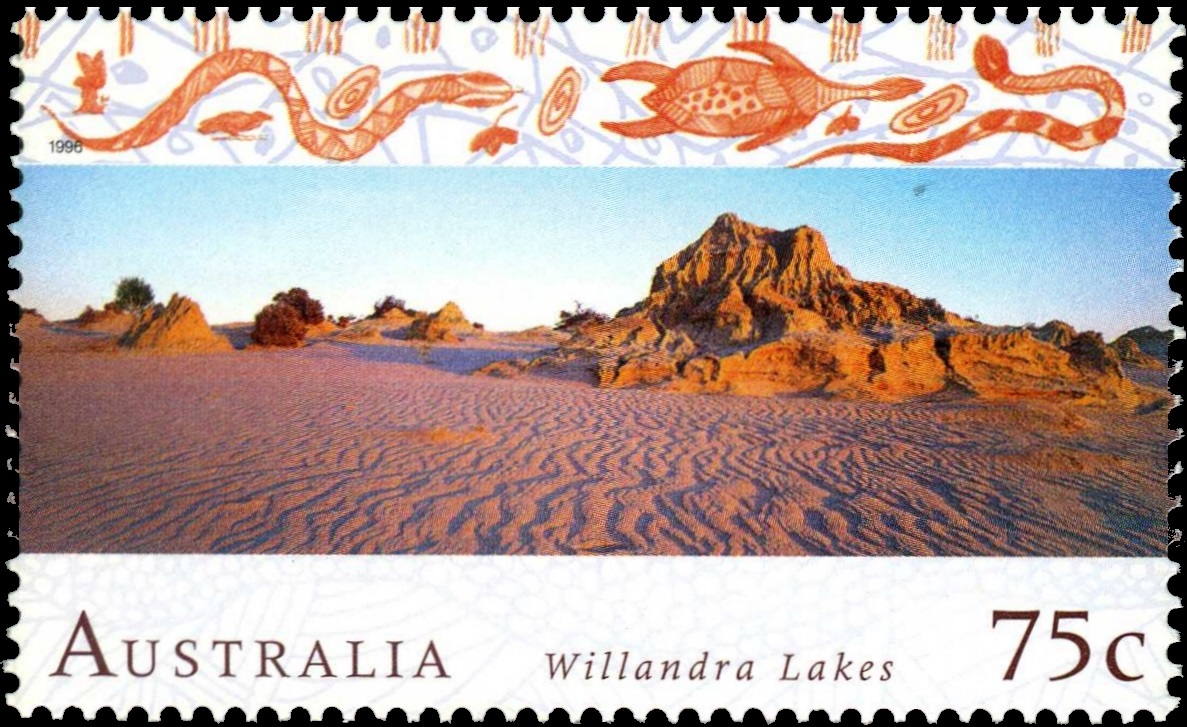
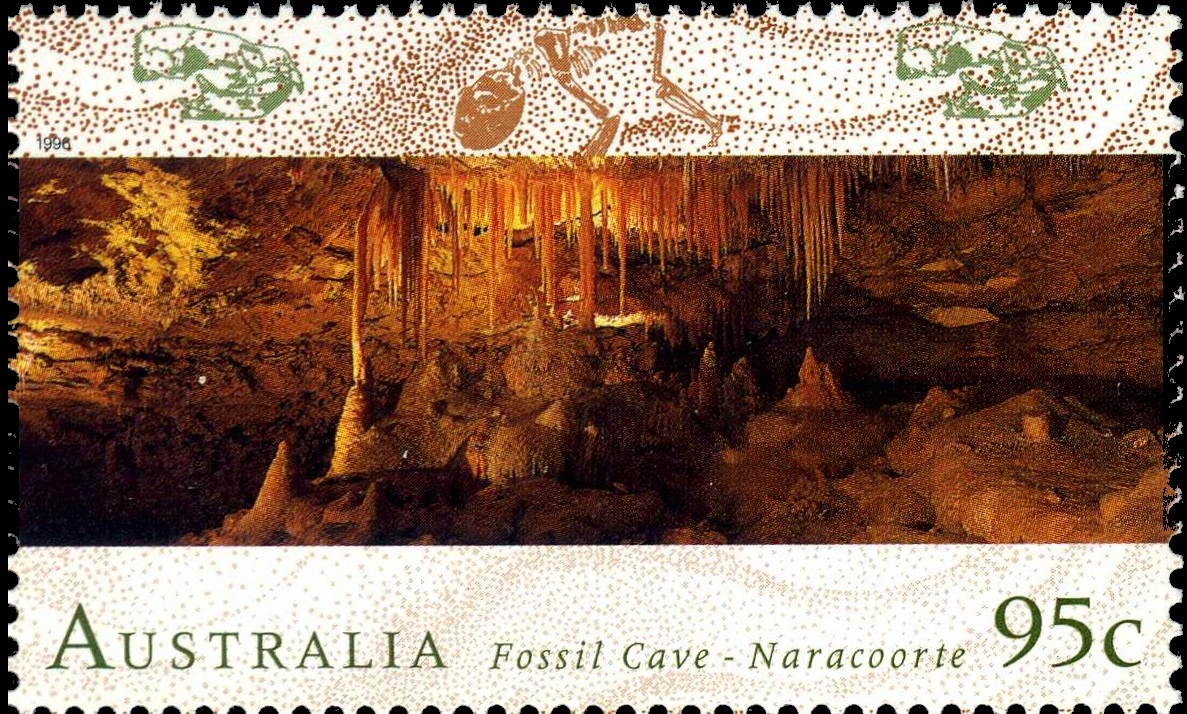
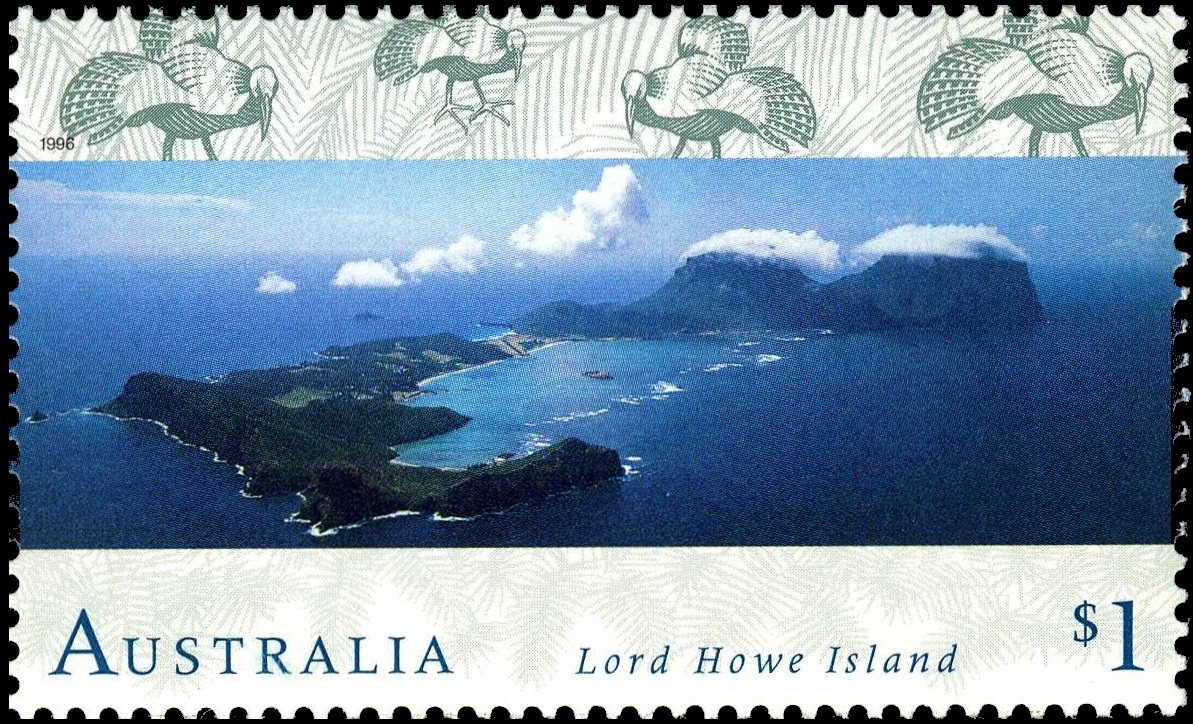
[O2] Three stamps of the set show important fossil-found places in Australia.
The Willandra Lakes Region is a World Heritage Site in the Far West region of New South Wales, Australia.
|
| Willandra Lakes on stamp of Australia 1996, MiNr. 1537 |
Fossil cave - Naracoorte Australian fossil mammal site.
Palaeontology is a familiar activity at the Naracoorte Caves World Heritage Area.
|
| Fossil cave - Naracoorte on stamp of Australia 1996, MiNr. 1538 |
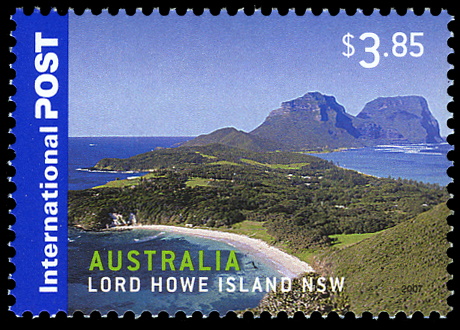
Lord Howe Island
|
|
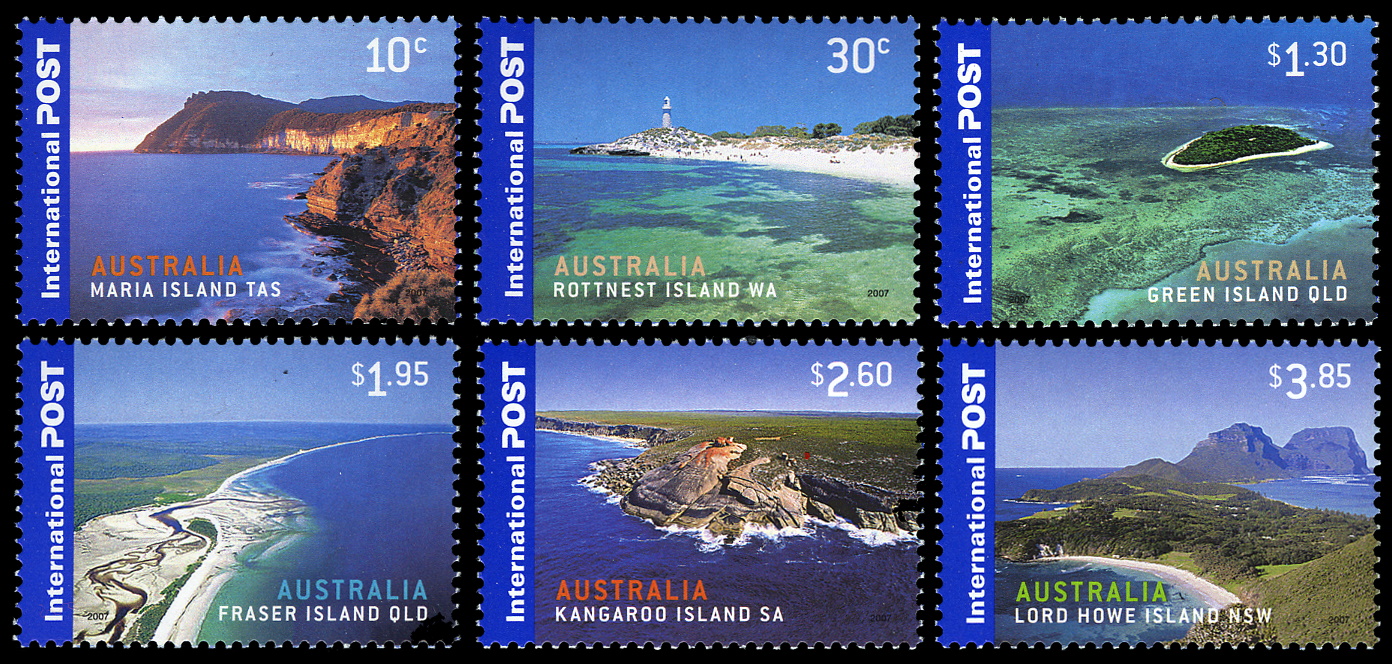
| Lord Howe Island on stamp of Australia 1996 and 2007, MiNr. 1539 and 2788 | |
In this rock are fossils of bird bones and eggs, land and marine snails and the extinct endemic horned turtle (Meiolania platyceps) now thought to be an ancient relict non-swimming tortoise with relatives in South America. [R5]
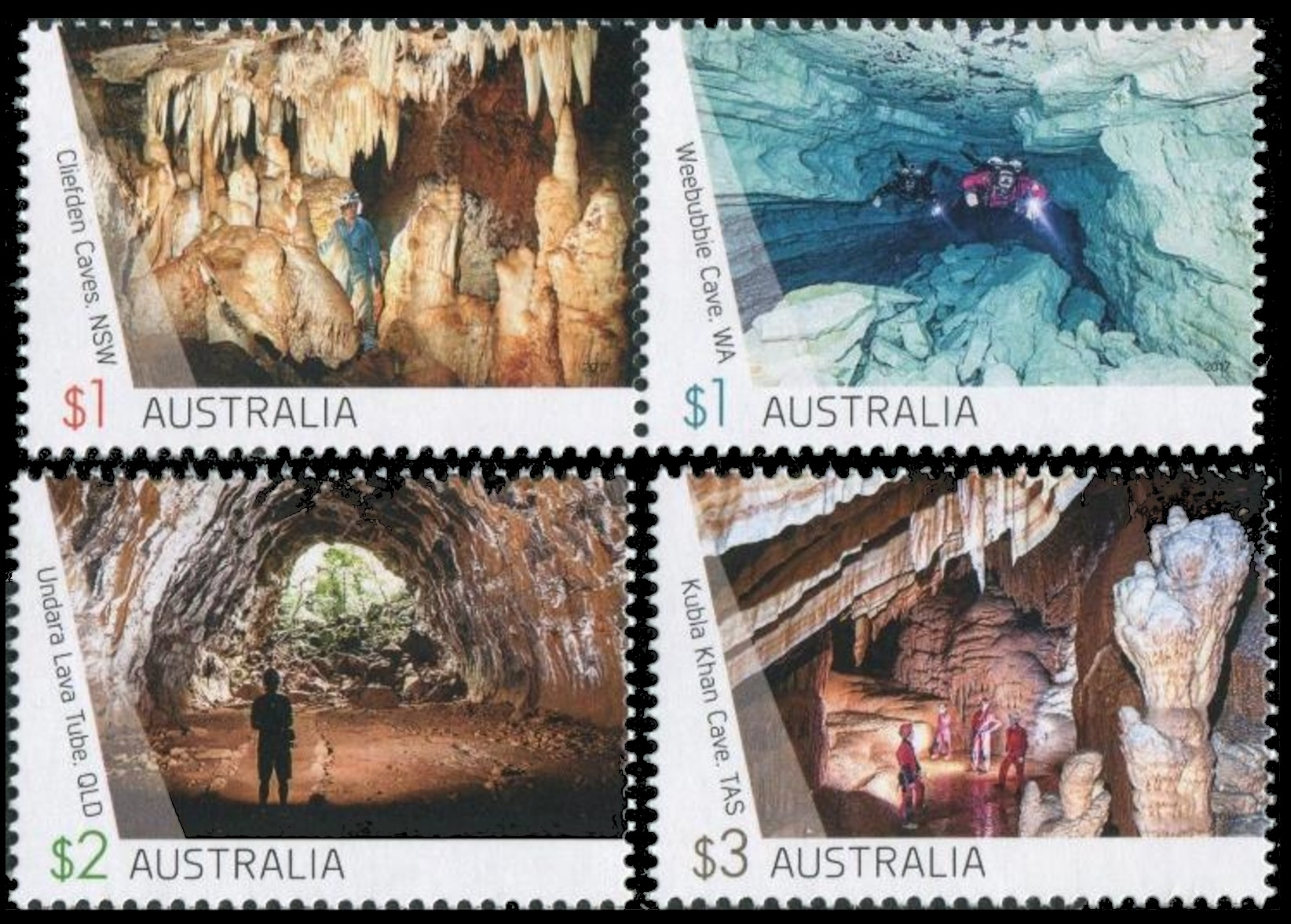
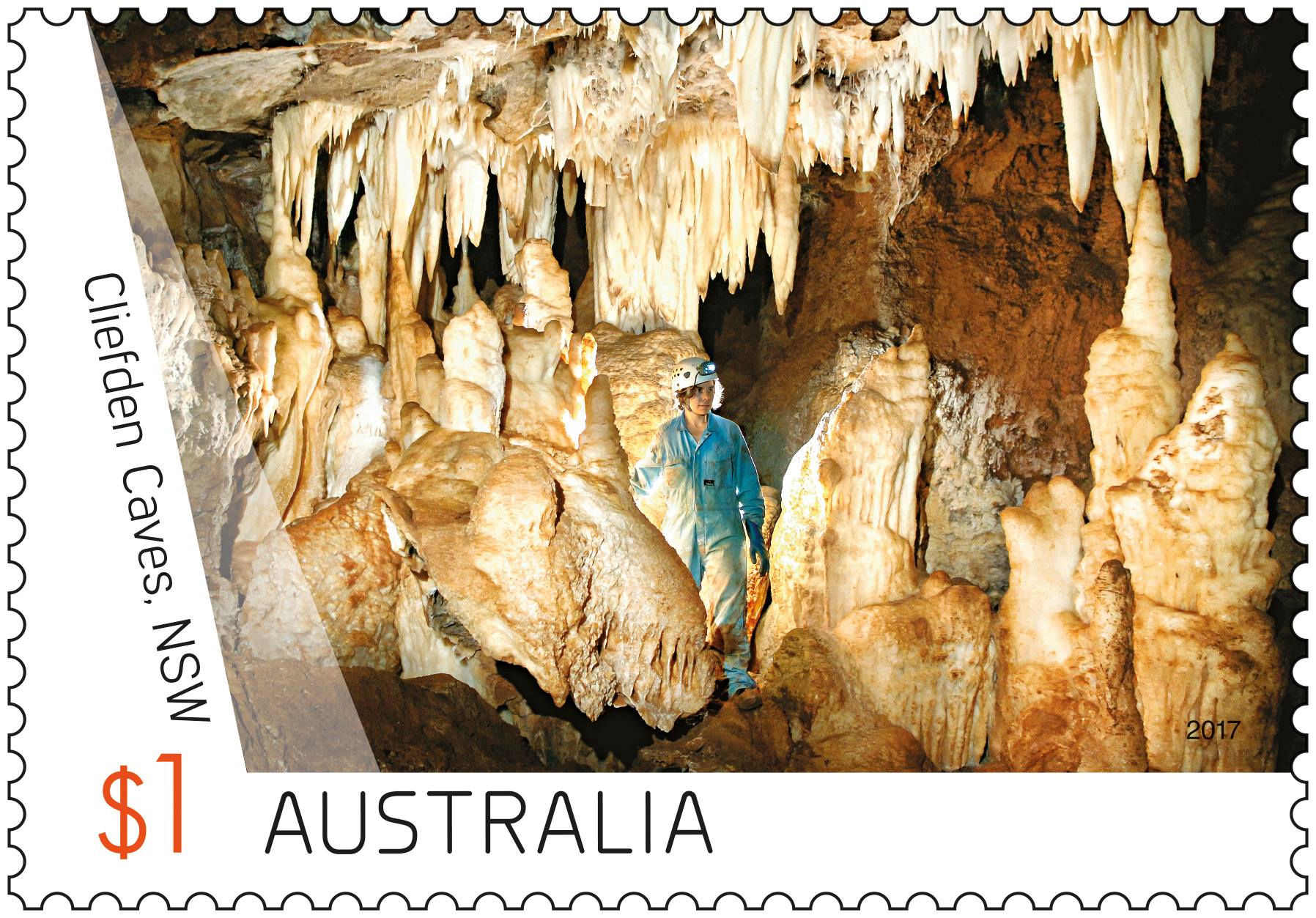
[O3] This stamp issue presents four highly significant caves from around Australia. Each stamp provides us with a glimpse into these spectacular underground environments.
|
| Cliefden Cave on stamp of Australia 2017, MiNr. 4625, Scott: 4619a. |
The Cliefden Caves Geoheritage Site is multifaceted, containing internationally significant Ordovician fossil localities, limestone caves of national significance, a warm spring and tufa dams of state significance and the historically significant site where limestone was first discovered in inland Australia.
It has been ranked among the 70 most significant fossil sites in Australia by the Australian Heritage Council and as the thirteenth most significant limestone cave site in Australia by Davey.
The site was nominated to the Register of the National Estate by the Geological Society of Australia in the late 1970s and registered in 1987. [R11]
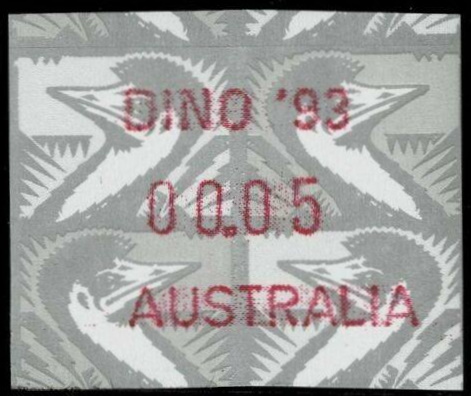
[O4] ATM stamp, exist with multiple face values, with promote text "DINO'93".
The animals depicted on the stamp are not dinosaurs, but Australian Emu birds.
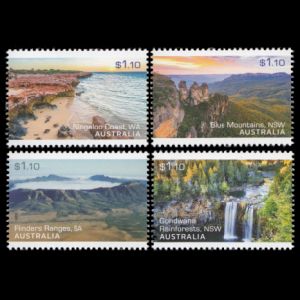
[O5] Two stamps from the "Our Beautiful Continent" stamps set of Australia can be considered as stamps with fossil sites landscapes..
The Flinders Ranges is a semi-arid mountainous landscape. It has rich biodiversity and an exceptional geological record of the dawn of animal life on Earth.
The Gondwana Rainforests are so-named because the fossil record indicates that when Gondwana (ancient continent) existed it was covered by rainforests containing the same kinds of species that are living today.
For more details, please click here.
Postmarks of Australia that related to Paleontology: dinosaurs, Charles Darwin
Legend is here
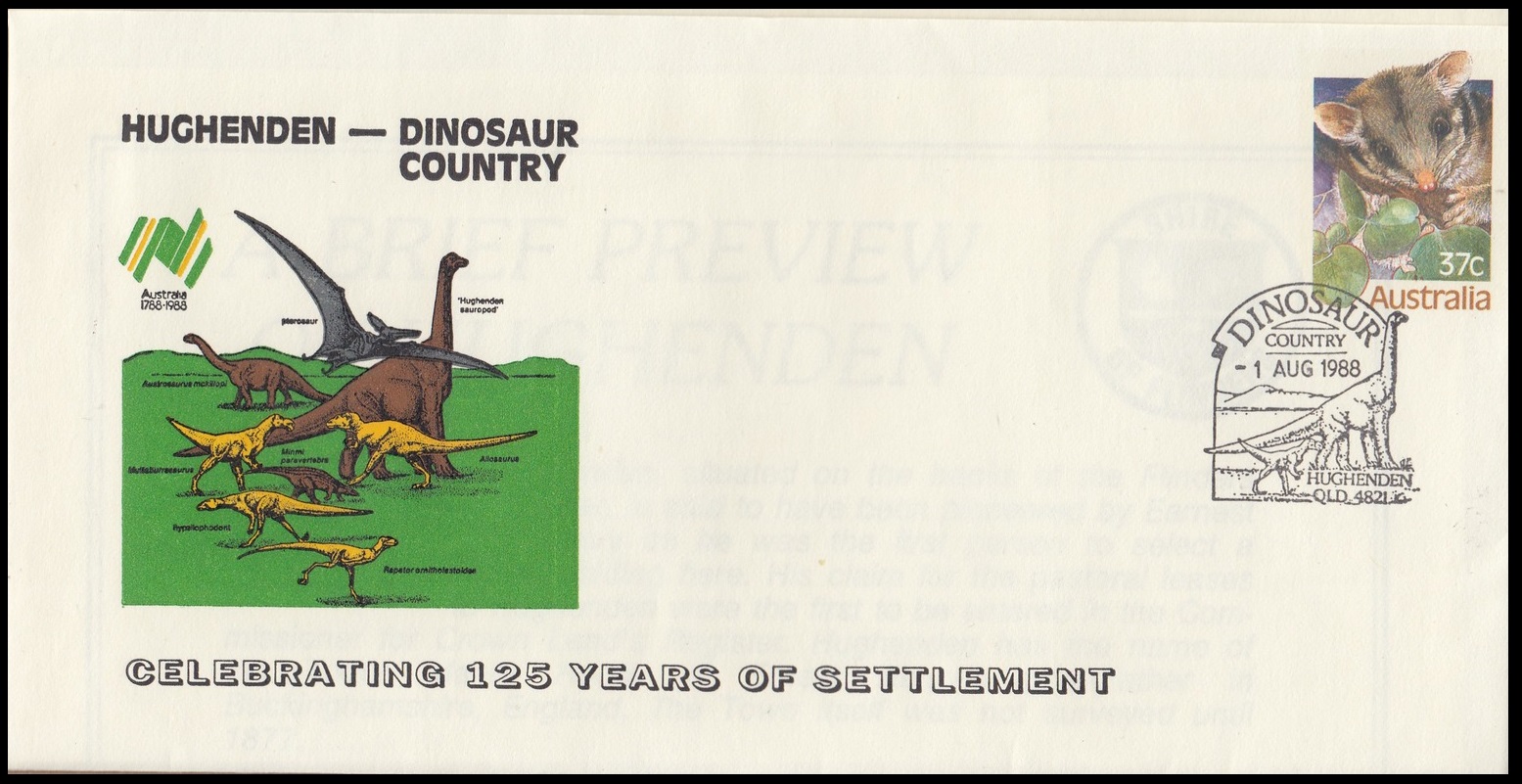
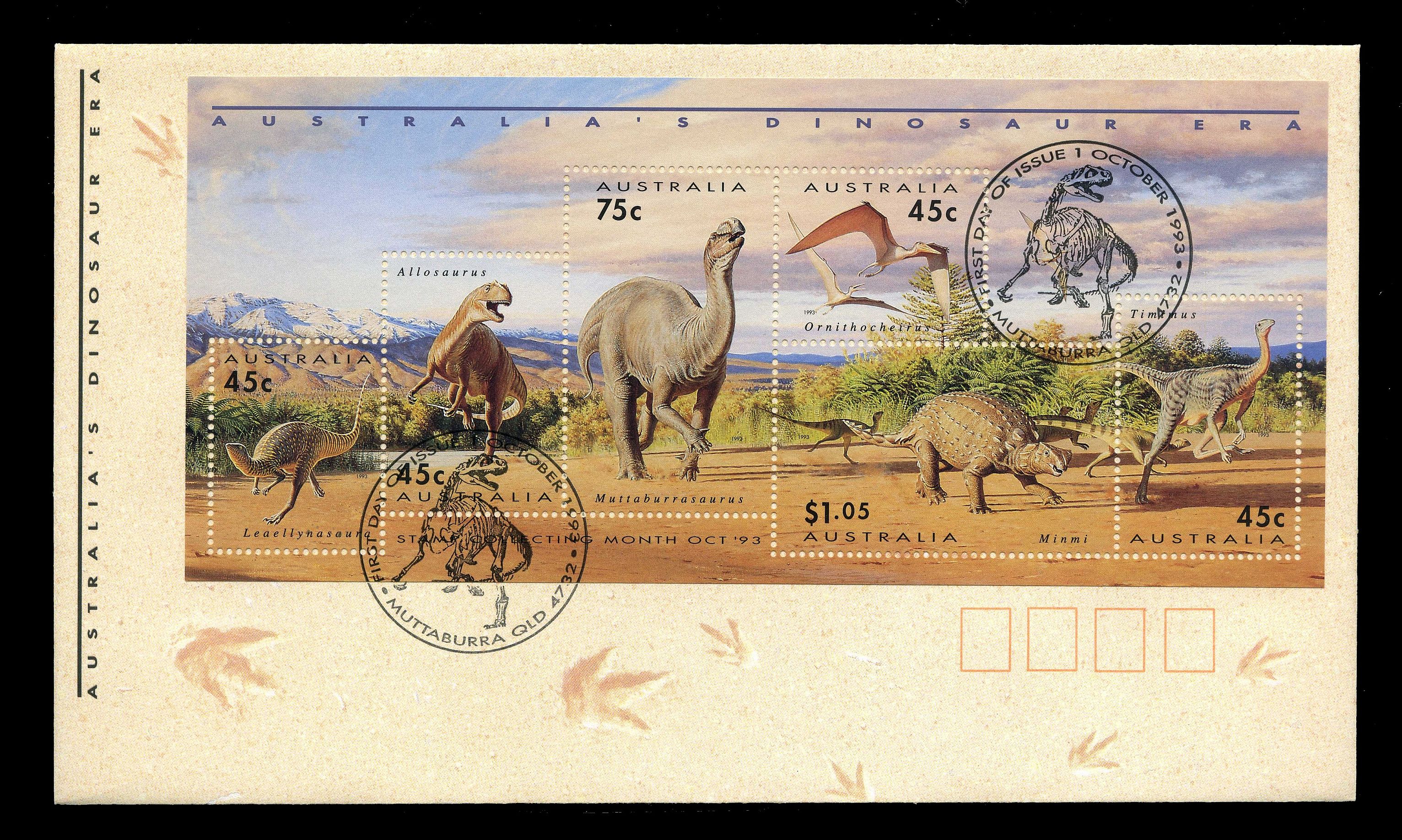
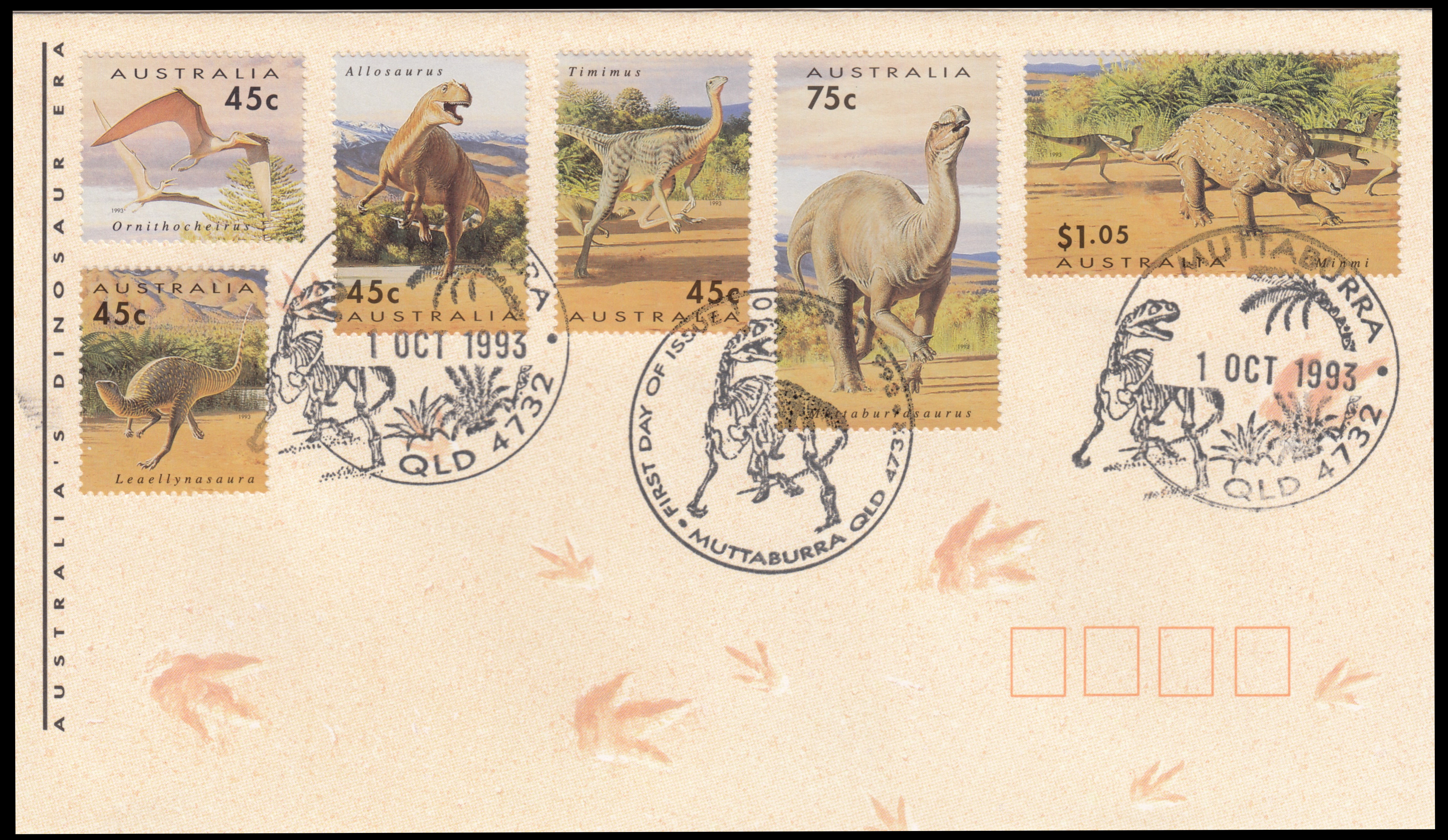
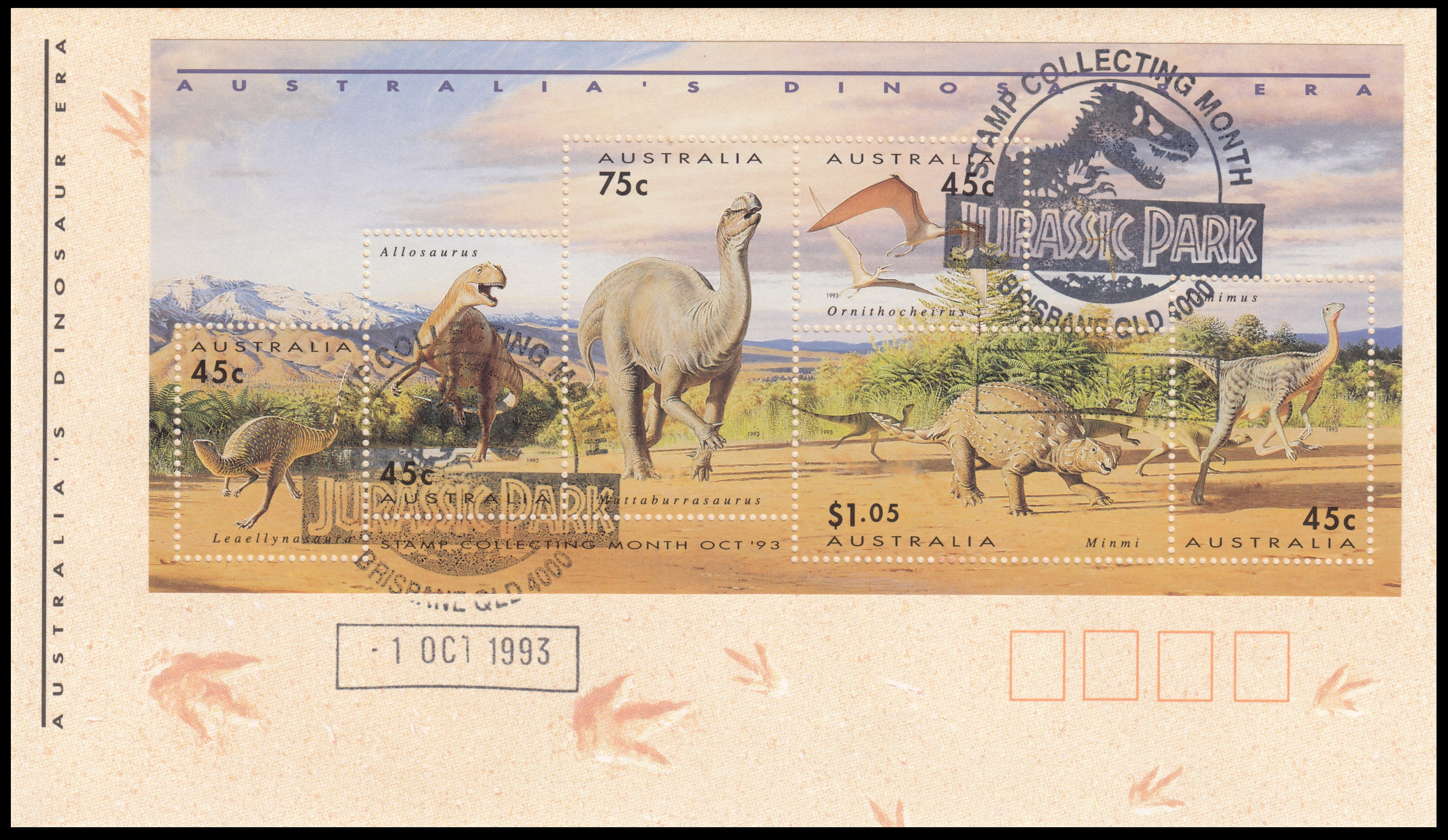
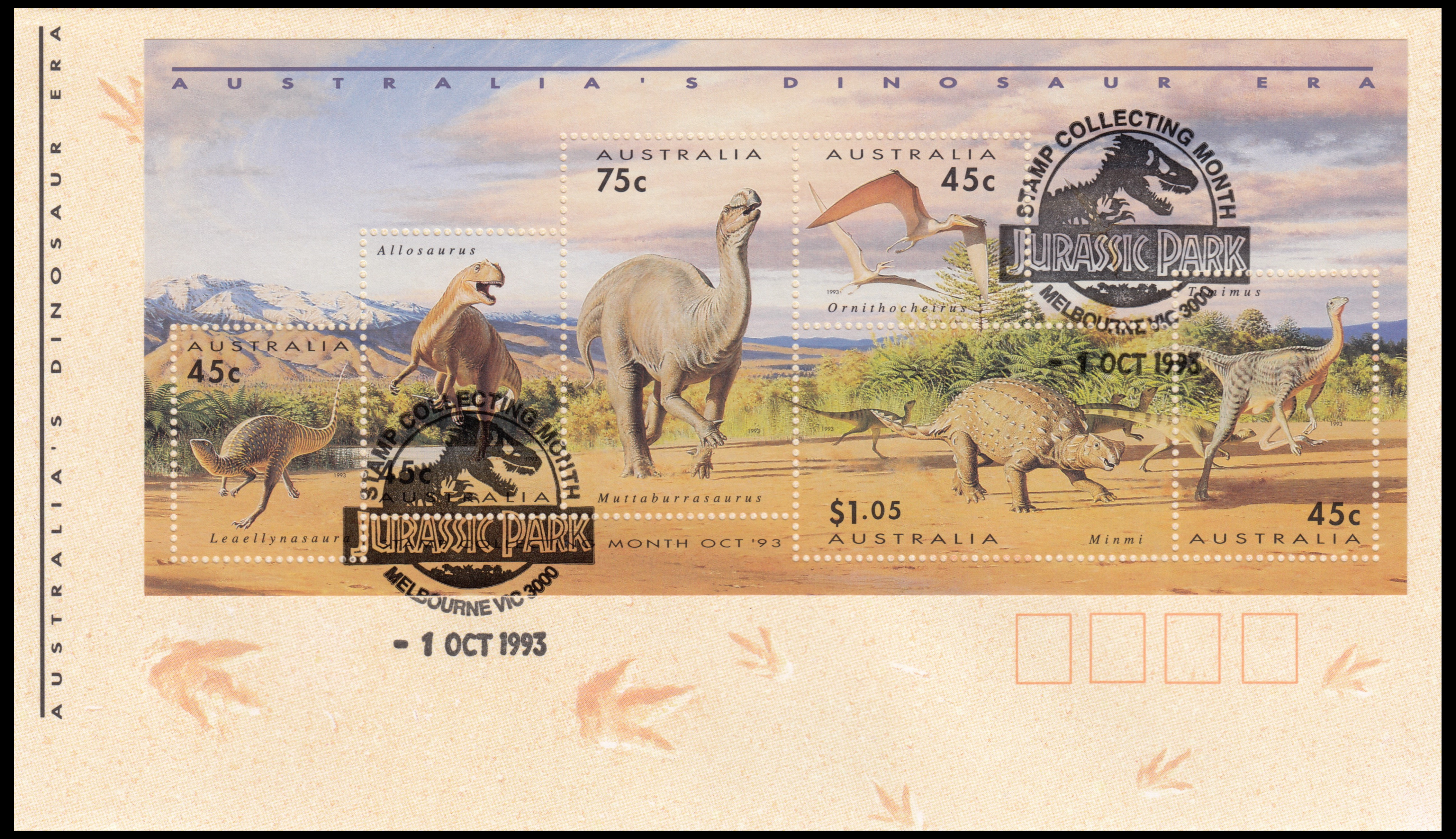
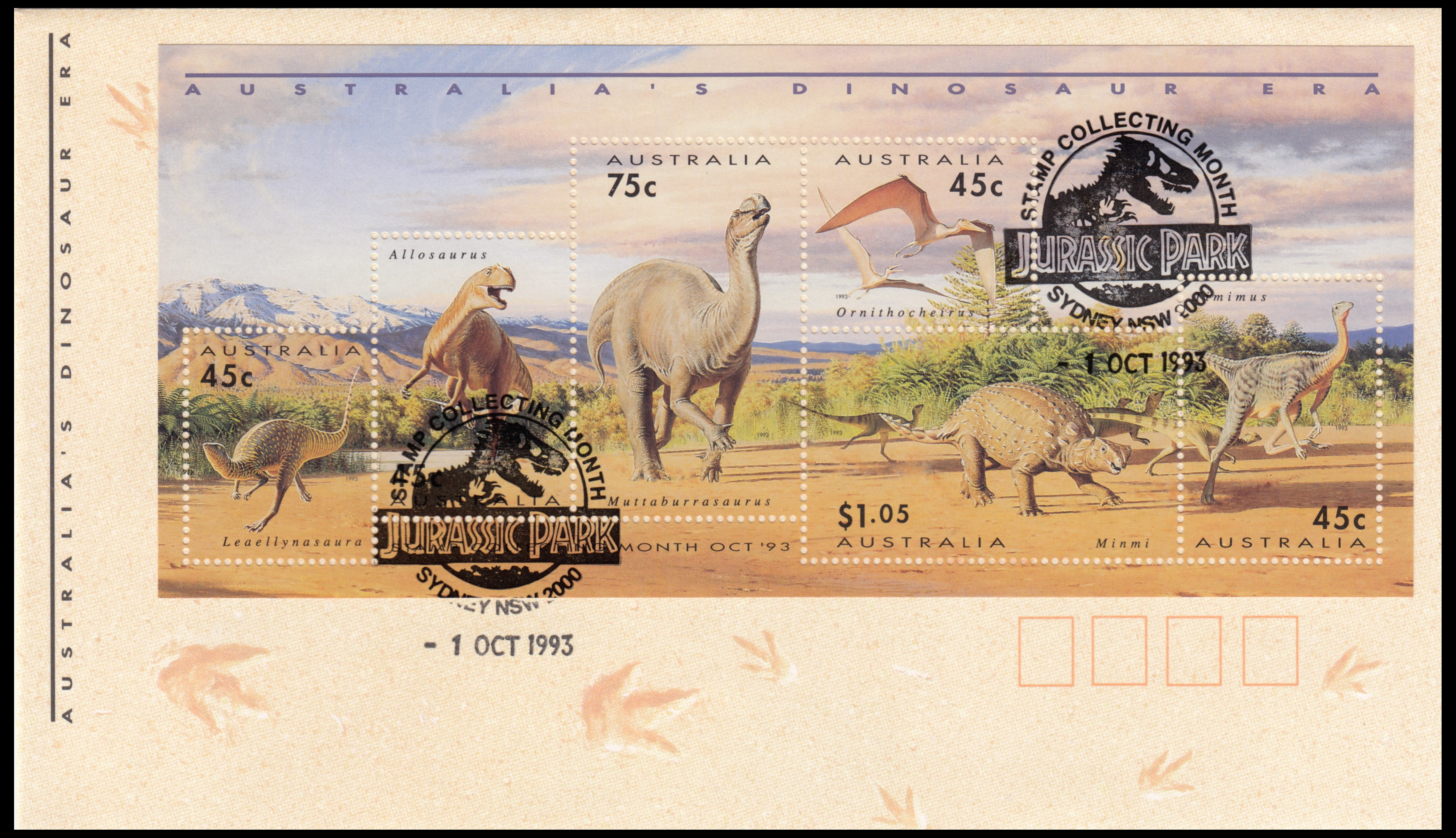
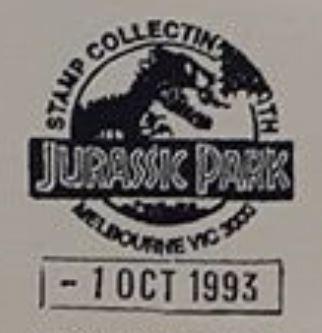
| 01.08.1988- ? [DU] Hughenden - Dinosaur-country, celebrating 125 years of settlement" [Sp] [PM1] | 01.10.1993 "Australia’s Dinosaur Era"- Official FDC postmark [FDC] [PM2] | 01.10.1993 "Australia’s Dinosaur Era" [FDC] [PM2] |
 |
 |
 |
| 01.10.1993 "Australia’s Dinosaur Era" [FDC] | ||
| Available in two sizes: 32x33mm and 33x35mm |
Available in two sizes: 27x29mm Sydney GPO and 33x35mm from Sydney Philatelic Bureau |
|
 |
 |
 |
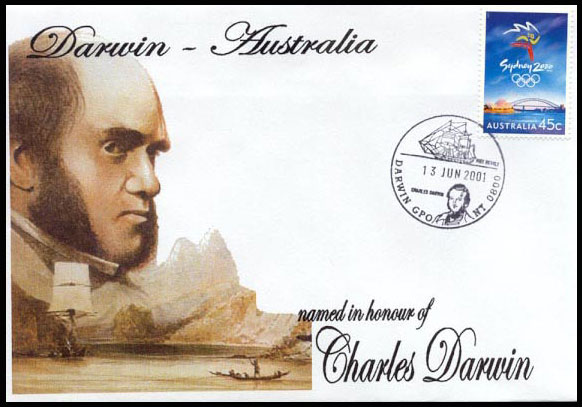
| 01.10.1993 "Australia’s Dinosaur Era" [FDC] | xx.xx.1999 "Charles Darwin" [PM] | |
 |
 |
 |
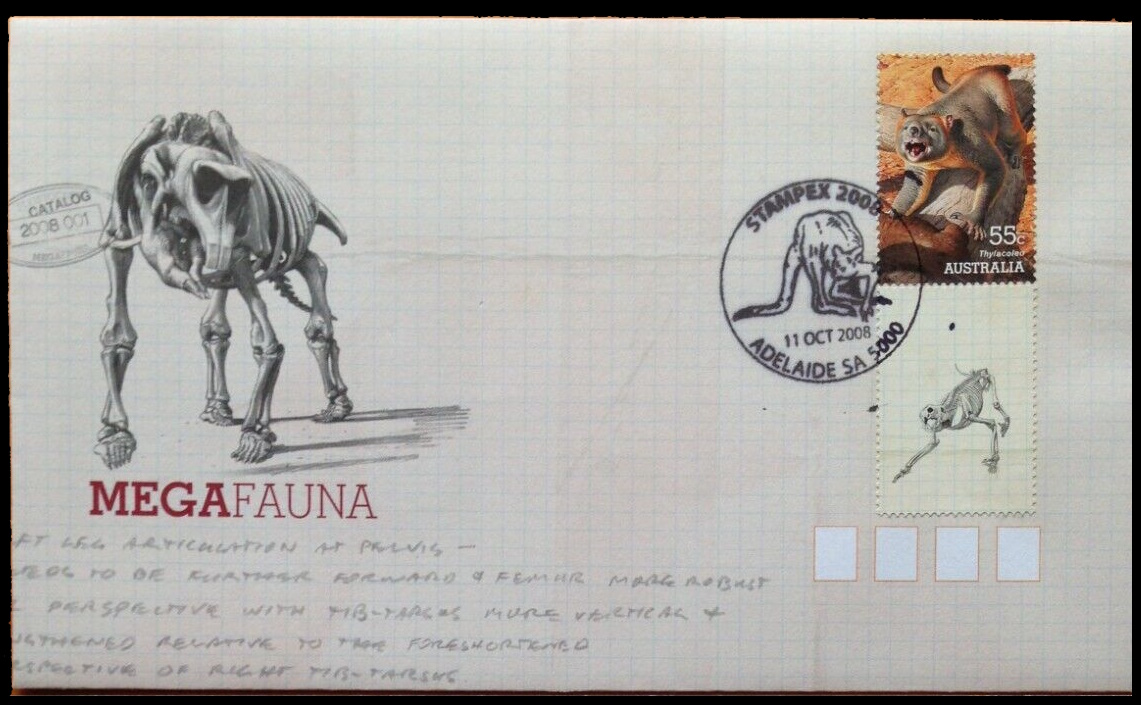
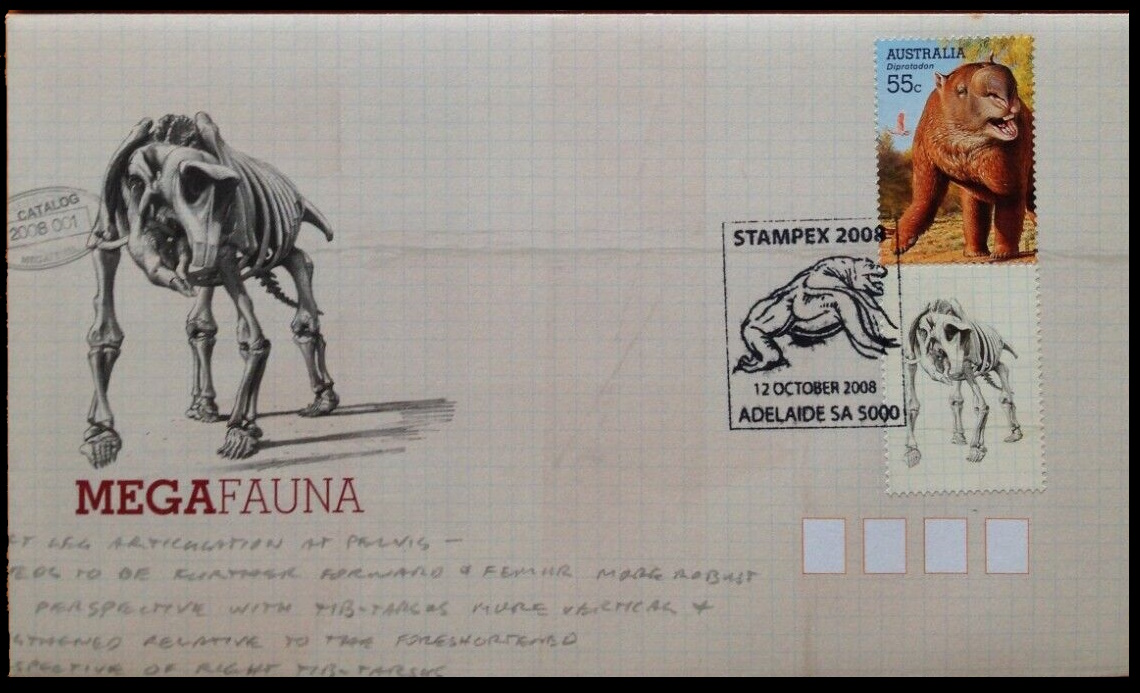
| 11.10.2008 "Stampex 2008" [Sp] [PM3] | 12.10.2008 "Stampex 2008" [Sp] [PM3] | 24.09.2013 "Australia’s Age of Dinosaurs" [FDC] |
 |
 |
 |
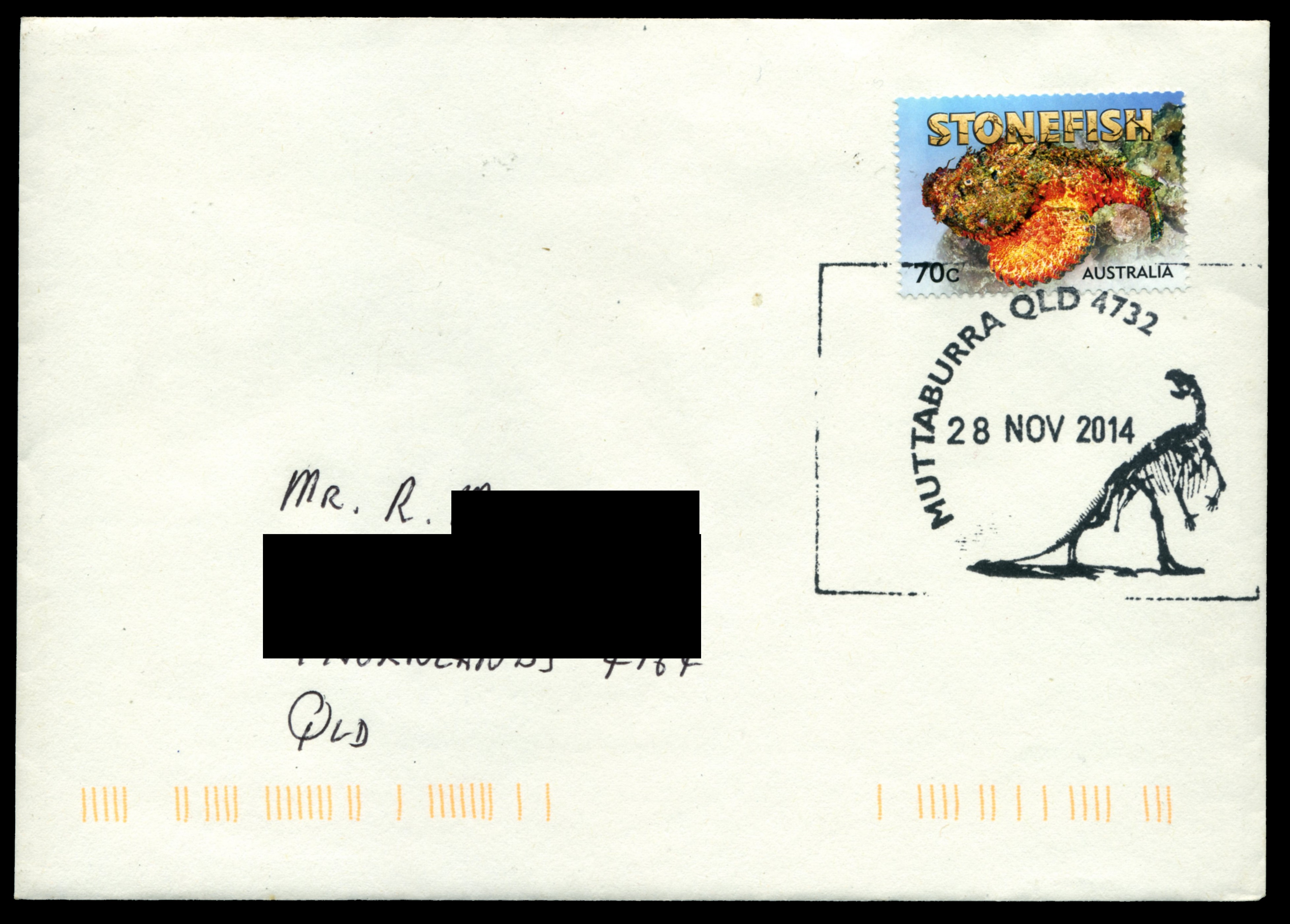
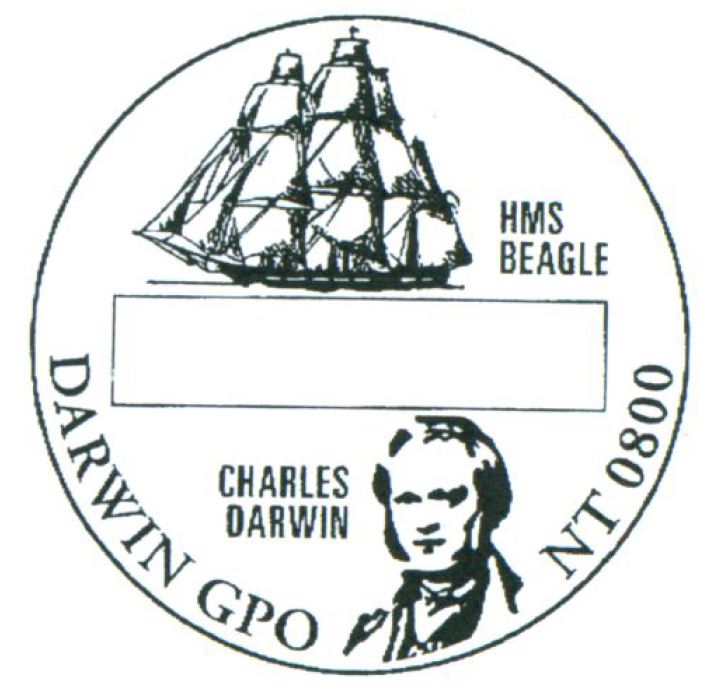
| 28.11.2014 "Muttaburrasaurus" [Sp] [PM2] | xx.xx.2015 "Charles Darwin" [PM] [N] | 17.08.2020 "Opalised fossils" [FDC] |
 |
 |
 |
| 05.09.2022 "Australian Dinosaurs" [FDC] | 10.02.2026 "Creatures of the Palaeozoic" [FDC] | |
 |
 |
|
Notes:
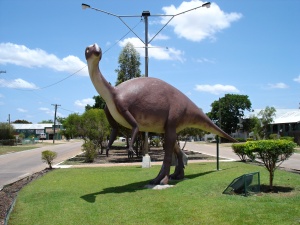
[PM1] Hughenden is a town and locality in the Shire of Flinders, Queensland, Australia with population of about 1,1200 and situated on the banks of the Flinders River.
|
|
The life size Muttaburrasaurus replica in Hughenden, The image is from Wikipedia. |
|
|
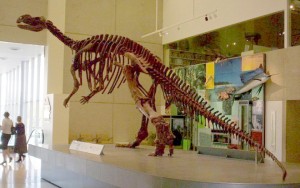
Muttaburrasaurus skeleton in the Queensland Museum, The image is from Wikipedia. |


The town is home to the Hughenden Dinosaur Festival, which attracts tourists and includes entertainment and other events.
Flinders Discovery Centre and Museum is also located in the town. The hundreds of fossils are superbly displayed in many individual glass cabinets. Well labelled, these fossils range from crustaceans in rock to ammonites ranging in size, colour and shape from around the world. Several different dinosaur bones, vertebrae and other exciting fossils are included in the collection. [R7]
[PM2] Muttaburra is a town and locality in the Barcaldine Region, Queensland, Australia with population of about 330 people.
Muttaburrasaurus, one of Australia's largest dinosaurs, was first found at Rosebury Downs station beside the Thompson river near the town of Muttaburra in 1963.
It was discovered by a local rancher, Mr. D.Langdon of Muttaburra.
The fossil remains had been scattered about by the feet of cattle for years and some of the locals had taken pieces home with them. Once the importance of the find was known the locals were asked to return the material they had collected as souvenirs, and most was recovered.
At its time it was the most complete dinosaur skeleton found in Australia.
The skeleton is on display in Queensland Museum (see right).
It roamed the Australian landscape about 100 million years ago during the Cretaceous period. It was a herbivore, eating such plants as ferns, cycads or conifers but many have also eaten some meat. It grew up to 7 metres long, was 2.2 metres tall at the hips and weighed up to 1-4 tonnes. Muttaburrasaurus could most likely walk on two or four legs and lived in herds that were a way of defending itself. [R8] [R9]
[PM3] Two prehistoric mammals of Australia's Megafauna were featured on commemorative postmarks at ADELAIDE STAMPEX 2008 stamps show.
One postmark featured Procoptodon - the largest of all kangaroos - extinct round 18,000 years ago. For more information about Procoptodon please click here.
Megalania - is an extinct species of giant varan that inhabited Australia during the Pleistocene. For more information about Megalania please click here.
Some other postmarks of Australia: stylized prehistoric animals, stamp shows etc.
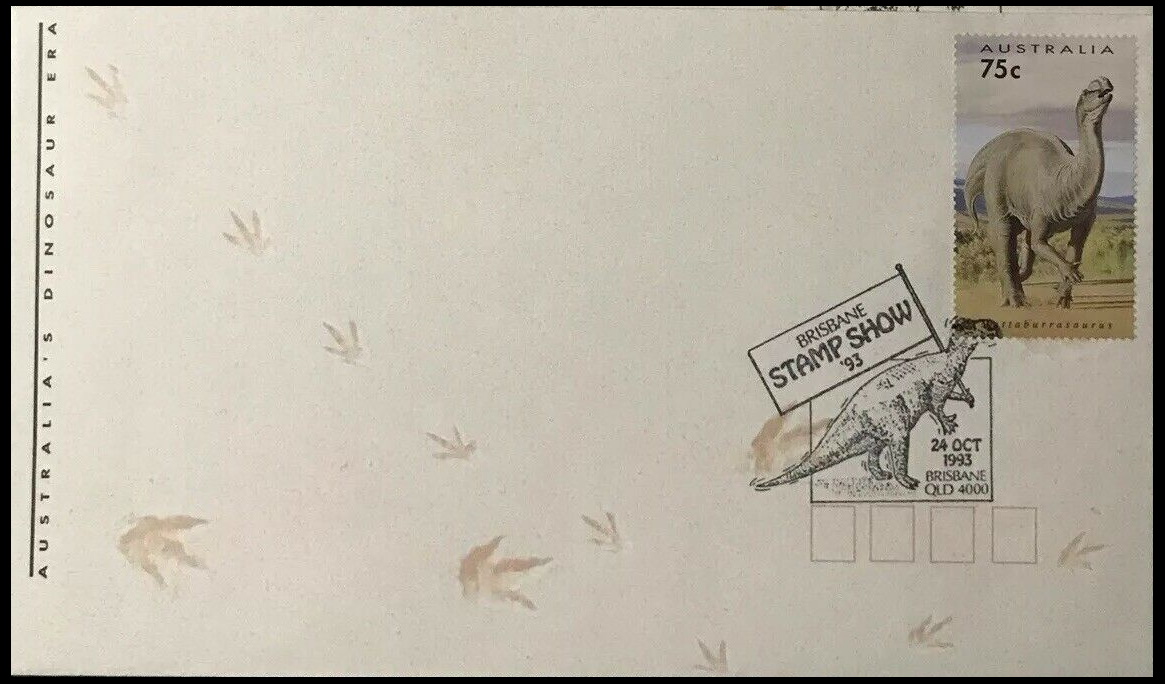
| ??.??.1983 "Visit the Museum in Adelaide" [Sp] | 15.10.1993 "Sydney Stamp and Coin Show" [Sp] [PMO1] | 23.10.1993 "Brisbane Stamp Show'93" [Sp] [PM2] |
 |
 |
 |
Notes:
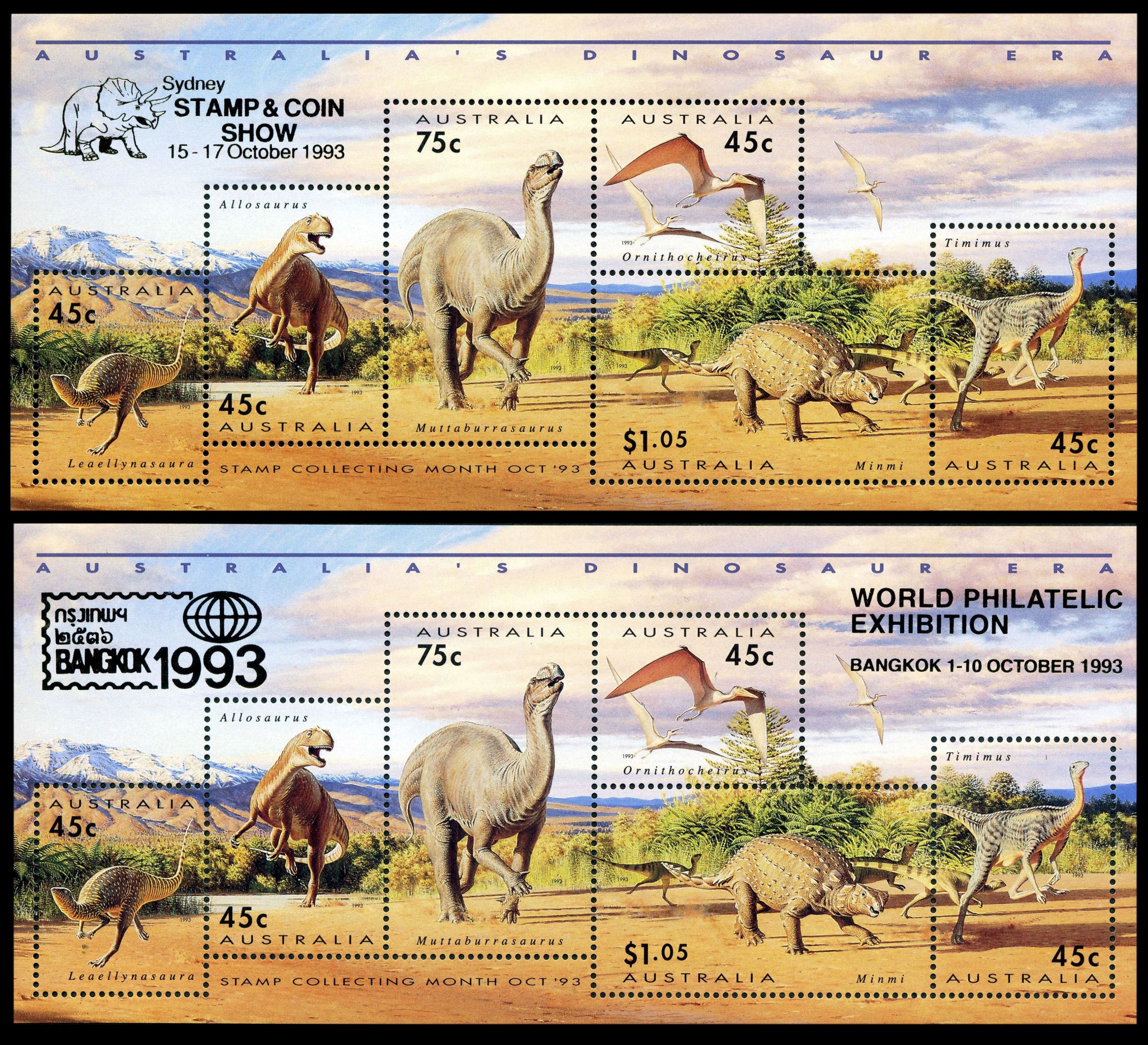 [PMO1] There are some not postal, but souvenir marks designed by Australian Post
for some stamp shows and used for overprint - placed on the margin of a Mini-Sheet (not on stamp).
[PMO1] There are some not postal, but souvenir marks designed by Australian Post
for some stamp shows and used for overprint - placed on the margin of a Mini-Sheet (not on stamp).Most of the times it shows the logo of the show with its name and dates.
In some special cases, pictorial marks with the show unrelated image produced. There are at least one of such non postal mark issued in 1993 that shows a dinosaur.
The overprint-mark with Triceratops dinosaur next to name and dates of Stamp and Coin show in Sydney. The mark is in golden colour, but appears as a black when scanned
(click on the image on the right to see such a Mini-Sheet).
Postal stationery that related to Paleontology: prehistoric animals and their fossils, Charles Darwin
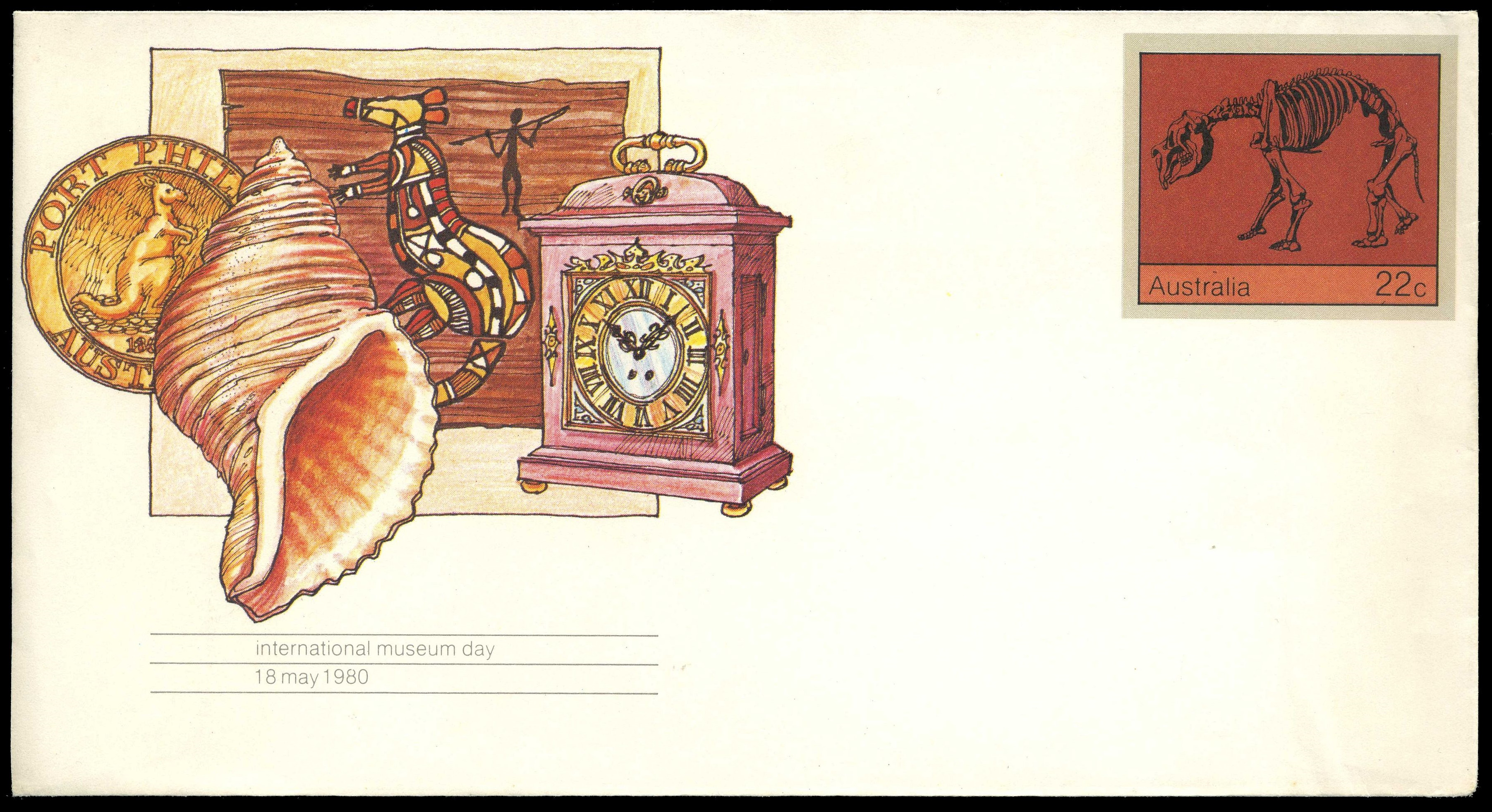
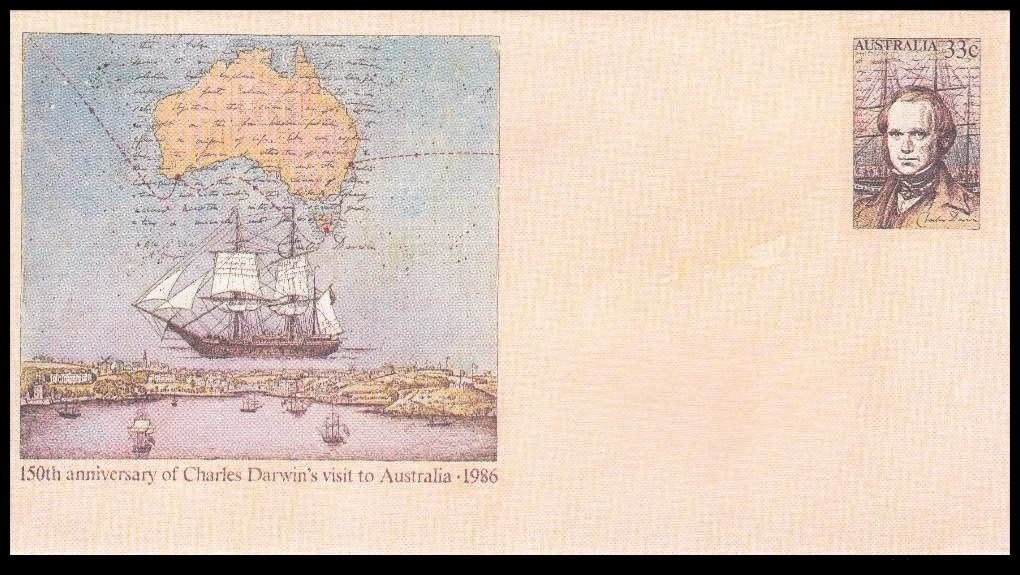
| 04.09.1980 "International museum day" [PS1] | 15.01.1986 "150th anniversary of Charles Darwin' visit Australia" [PS2] | |
 |
 |
|
Notes:
 |
| Diprotodon on stamp of Australia 2008, MiNr. 3103 |
Diprotodon, meaning "two forward teeth", is the largest known marsupial to have ever lived.
Along with many other members of a group of species collectively known as the "Australian megafauna", it existed from approximately 1.6 million years ago until extinction some 46,000 years ago.
Reconstruction of the animal is depicted on Australian Megafauna stamp from 2008 (see right).
Diprotodon fossils have been found in sites across mainland Australia, including complete skulls and skeletons, as well as hair and foot impressions.
Female skeletons have been found with babies located where the mother's pouch would have been. The largest specimens were hippopotamus-sized: about 3 metres from nose to tail, standing 2 metres tall at the shoulder and weighing about 2,790 kilograms.
Aboriginal rock art images in Quinkan traditional country (Queensland, Australia) have been claimed to depict diprotodonts.
They inhabited open forest, woodlands, and grasslands, possibly staying close to water, and eating leaves, shrubs, and some grasses. [R6]
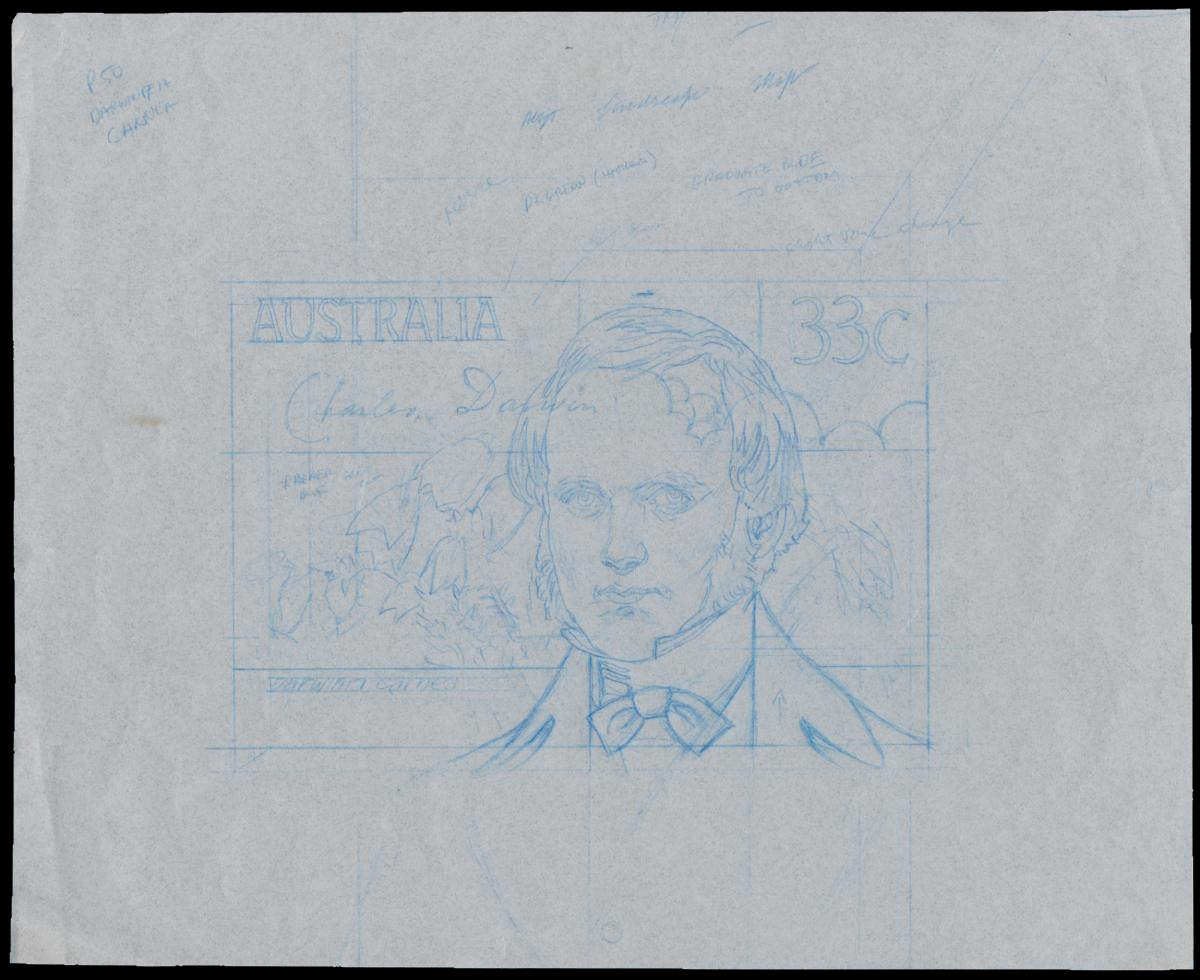 |
| Sketch of Charles Darwin stamp, created by Brian Clinton, but unadopted by Australian Post in 1986 |
Unfortunately, the stamp was not adopted but the postal stationary, the postal stationery, "150th Anniversary of Charles Darwin's Visit to Australia", was issued instead.
The postal stationery was designed by Ron Brooks.
Here is the short text from the reverse side of the envelope:
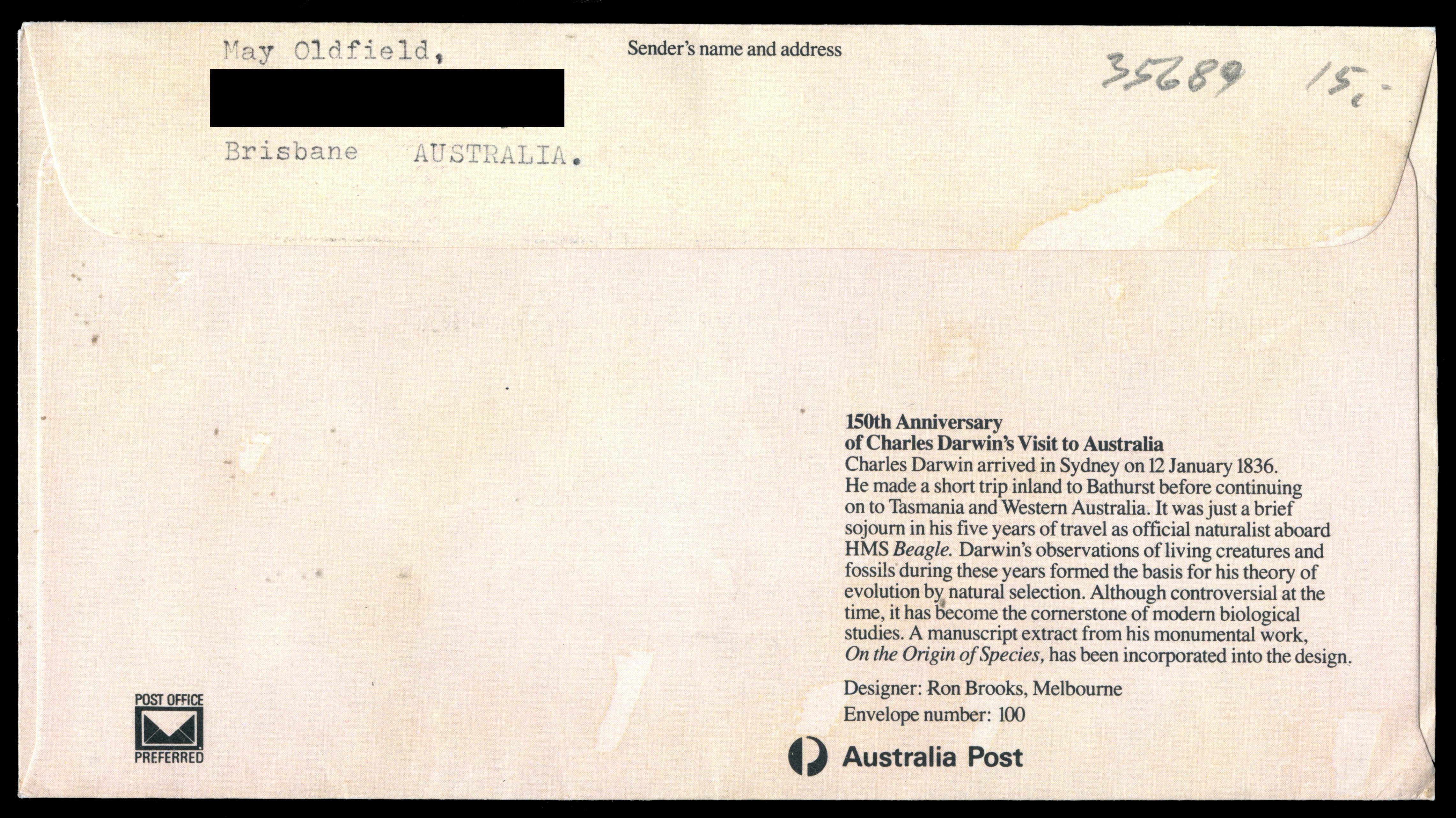
"Charles Darwin arrived in Sydney on 12 January 1836.
He made a Short trip inland to Bathurst before continuing on to Tasmania and Western Australia.
It was just a brief sojourn in his five years of travel as official naturalist aboard HMS Beagle. Darwin's observations of living creatures and fossils during these years formed the basis for his theory of evolution by natural selection.
Although controversial at the time, it has become the cornerstone of modern biological studies. A manuscript extract from his monumental work, On the Origin of Species, has been incorporated into the design."
Special covers that related to Paleontology: prehistoric animals and their fossils
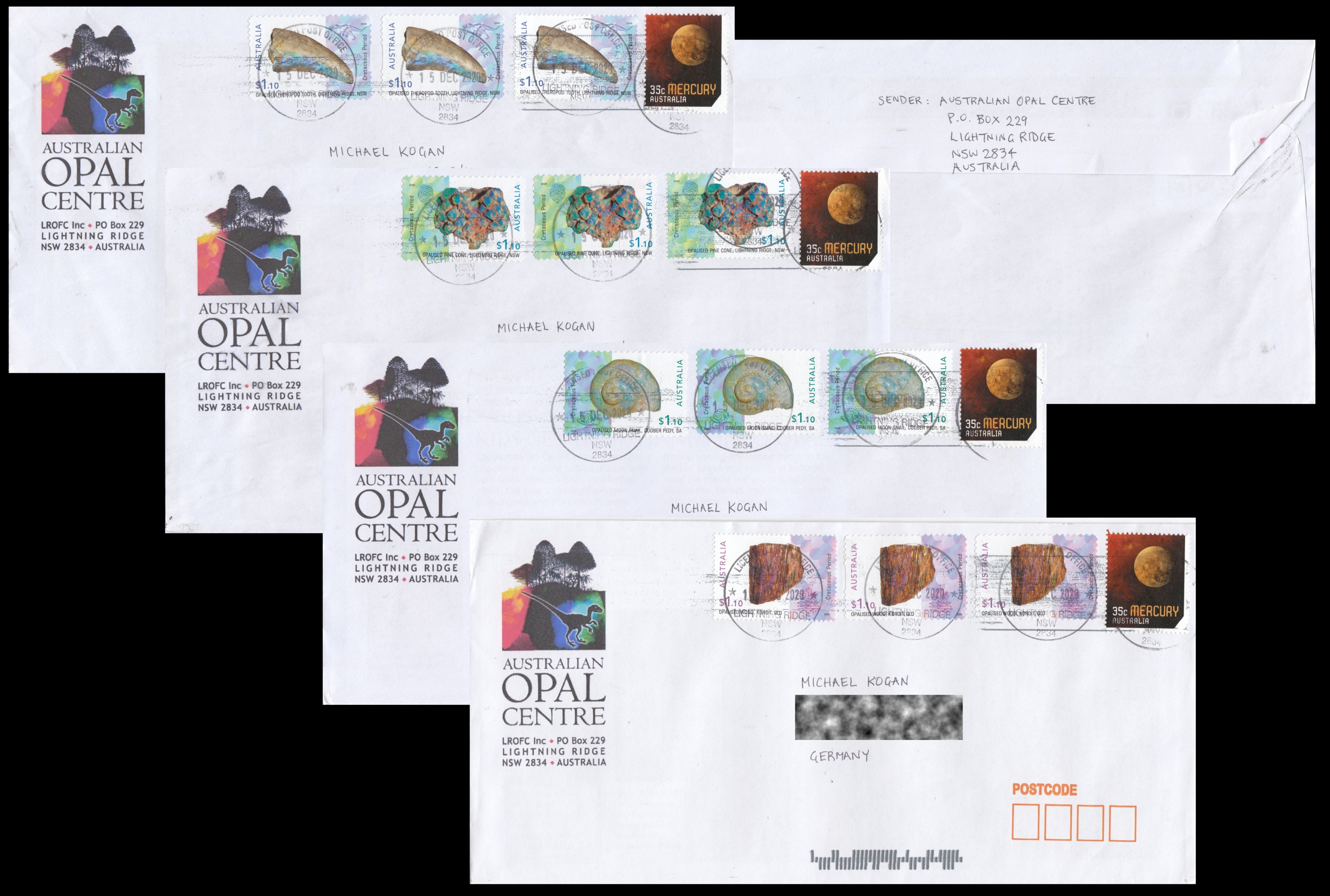
| Australian Opal Center [Cov1] | ||
 |
||
Notes:
[Cov1] The Australian Opal Centre (AOC) is an extraordinary national museum being developed in the outback opal mining town of Lightning Ridge, New South Wales to preserve, display and research the greatest ever public collection of Australian opal, opalised fossils, include some dinosaur bones and claws, and the colourful history and heritage of the Australian opal fields. [R12]
Three of four opalized fossils that shown on Australian stamps from 2020 are on display in the AOC.
References
- [R1] Australia: Wikipedia, WikiTravel, FlagCounter.
- [R2] Postal History and Philately of Australia:
Wikipedia,
"How Australian stamps come to be: Program development",
Links to official website of the Post Authority, stamp catalog and a list of new stamps of Australia are here. - [R3] Willandra Lakes Regionon: Wikipedia
- [R4] Naracoorte cave: environment.sa.gov.au
- [R5] Lord Howe Island: Wikipedia
- [R6] Diprotodon: Wikipedia
- [R7] Hughenden: Wikipedia, Australias Dinosaur Trail
- [R8] Muttaburra: Wikipedia
- [R9] Muttaburrasaurus: Wikipedia, Australias Dinosaur Trail
- [R10] Shark Bay: official site, ABC Science, Wikipedia
- [R11] Cliefden Caves: Wikipedia
- [R12] Australian Opal Centre: Official website
Acknowledgements
Many thanks to Dr. Peter Voice from Department of Geological and Environmental Sciences, Western Michigan University, for reviewing the draft page and his very valuable comments.