Indonesia
Fossils of prehistoric animals and humans on stamps and postmarks of Indonesia
Indonesia's republican form of government includes an elected legislature and president. Indonesia has 34 provinces, of which five have Special Administrative status.
The country shares land borders with Papua New Guinea, East Timor, and the eastern part of Malaysia. Other neighbouring countries include Singapore, the Philippines, Australia, Palau, and the Indian territory of the Andaman and Nicobar Islands. [R1]
The first stamp released by the Indonesia Post Administration, after the Proclamation on Indonesia’s Independence on 17 August 1945, were issued on 1 December 1946. The first issue has stamps showing a raging bull and a bull with an Indonesian flag – they were printed to commemorate half a year of independence. Printed in Yogyakarta with single color and two colors, using a simple printing technique. Most of Indonesian stamp in this period were printed and overprinted in Jakarta, Bandung, Yogyakarta, Pematangsiantar, Padang, Palembang and Aceh. [R2]
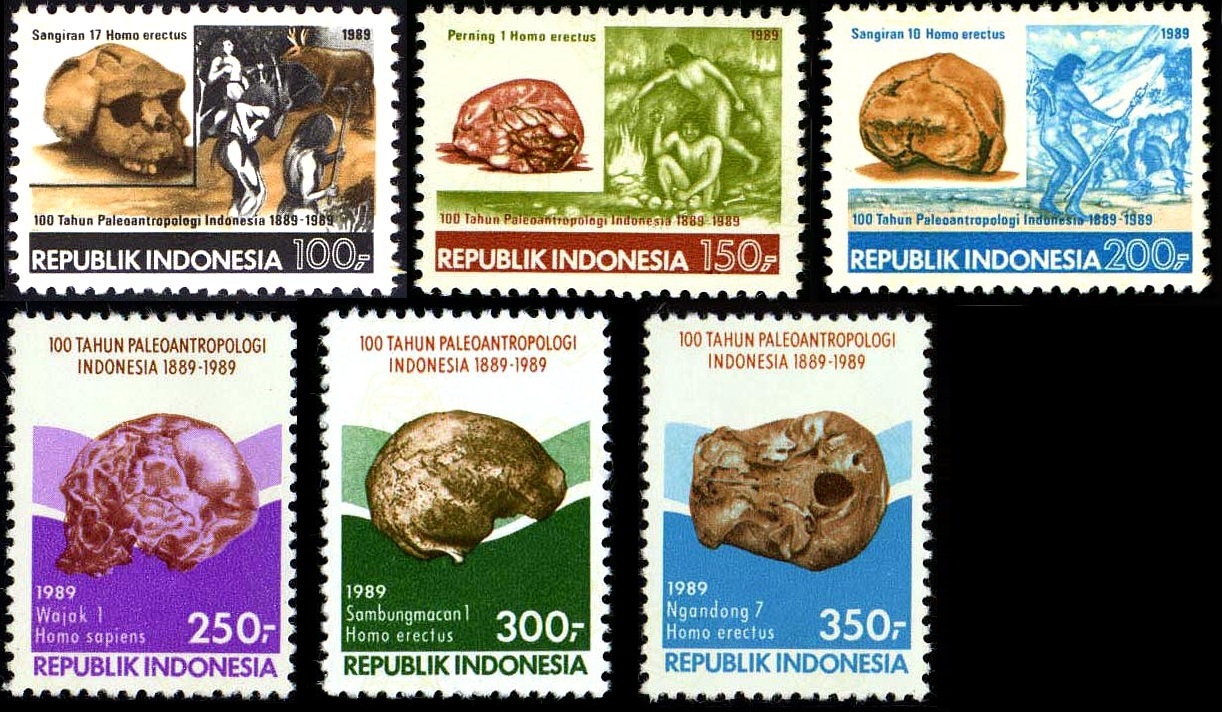
Official stamps of Indonesia related to Paleontology and Paleoanthropology: prehistoric humans, petrified wood, fossils
| 31.08.1989 "100th anniversary of Paleoanthropological Institute Indonesia" | 20.05.1998 "Gemstones (INDONESIA 2000)" [1] | 20.05.1999 "Gemstones (INDONESIA 2000)" [2] |
 |
 |
 |
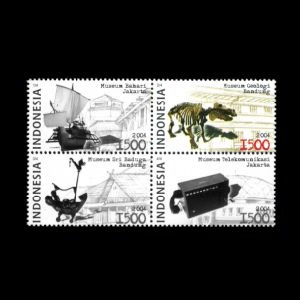
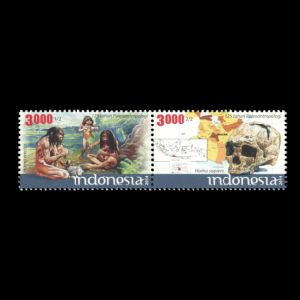
| 29.02.2004 "Museums of Indonesia" [3] | 31.08.2014 "125th anniversary of Paleoanthropological Institute Indonesia" | |
 |
 |
|
Notes:
[1] Petrified wood. The stamp is also issued in sheet of 8 with 7 other stamps, other stamps showing minerals and gemstones
[2] Silicified Coral. The stamp is also issued in sheet of 10 with 9 other stamps, other stamps showing minerals and gemstones.
[3] These stamps shows some artefacts from various museums of Indonesia. One of them is the Bandung Geology museum. The Bandung Geology museum is the biggest and most complete museum in Indonesia of its kind. The museum has a large collection of fossils, of which about 6000 are on display and another 250,000 fossils stored in archives. One stamp in the set shows a fossil hippopotamus and the building of the Museum.
Other stamps of Indonesia to consider
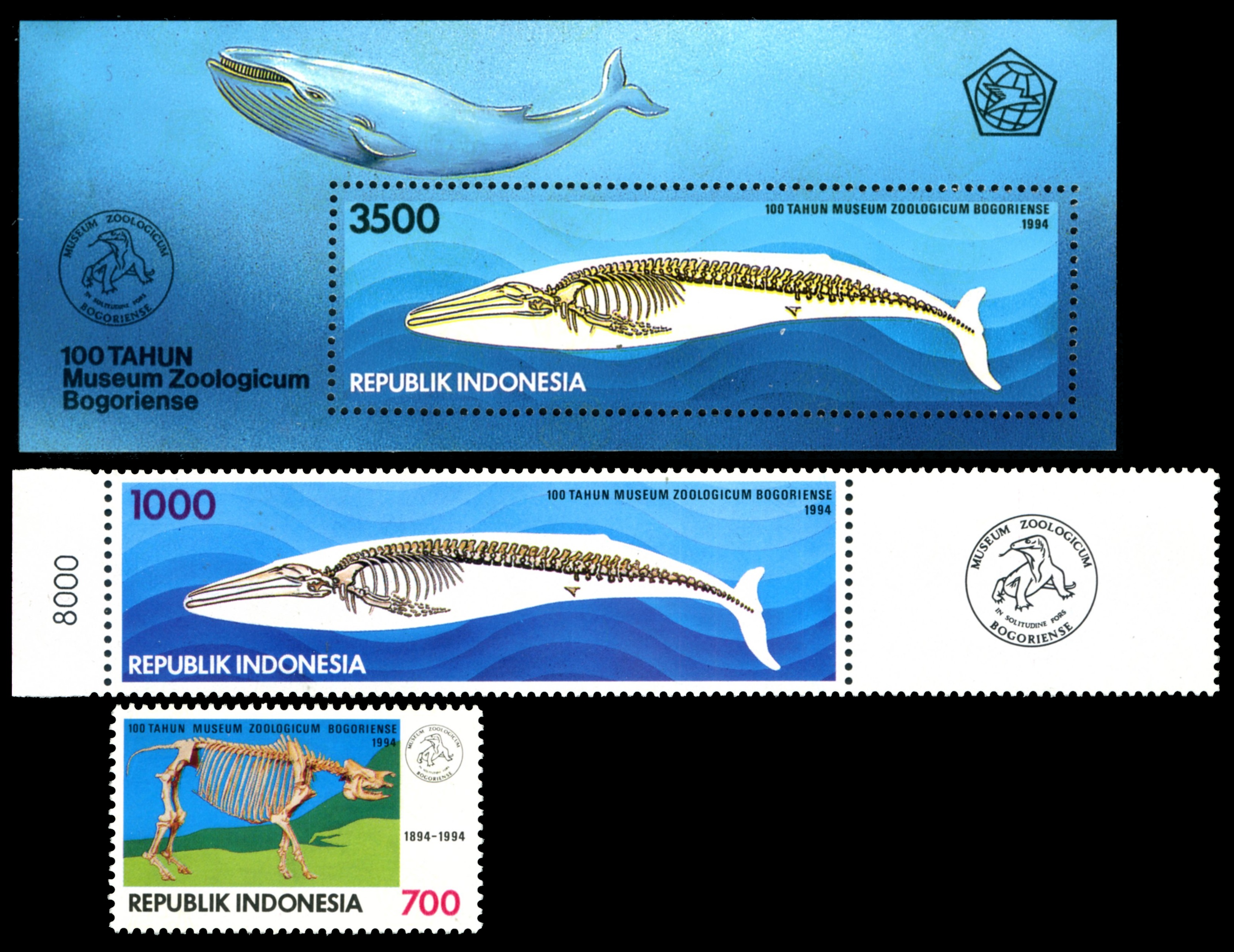
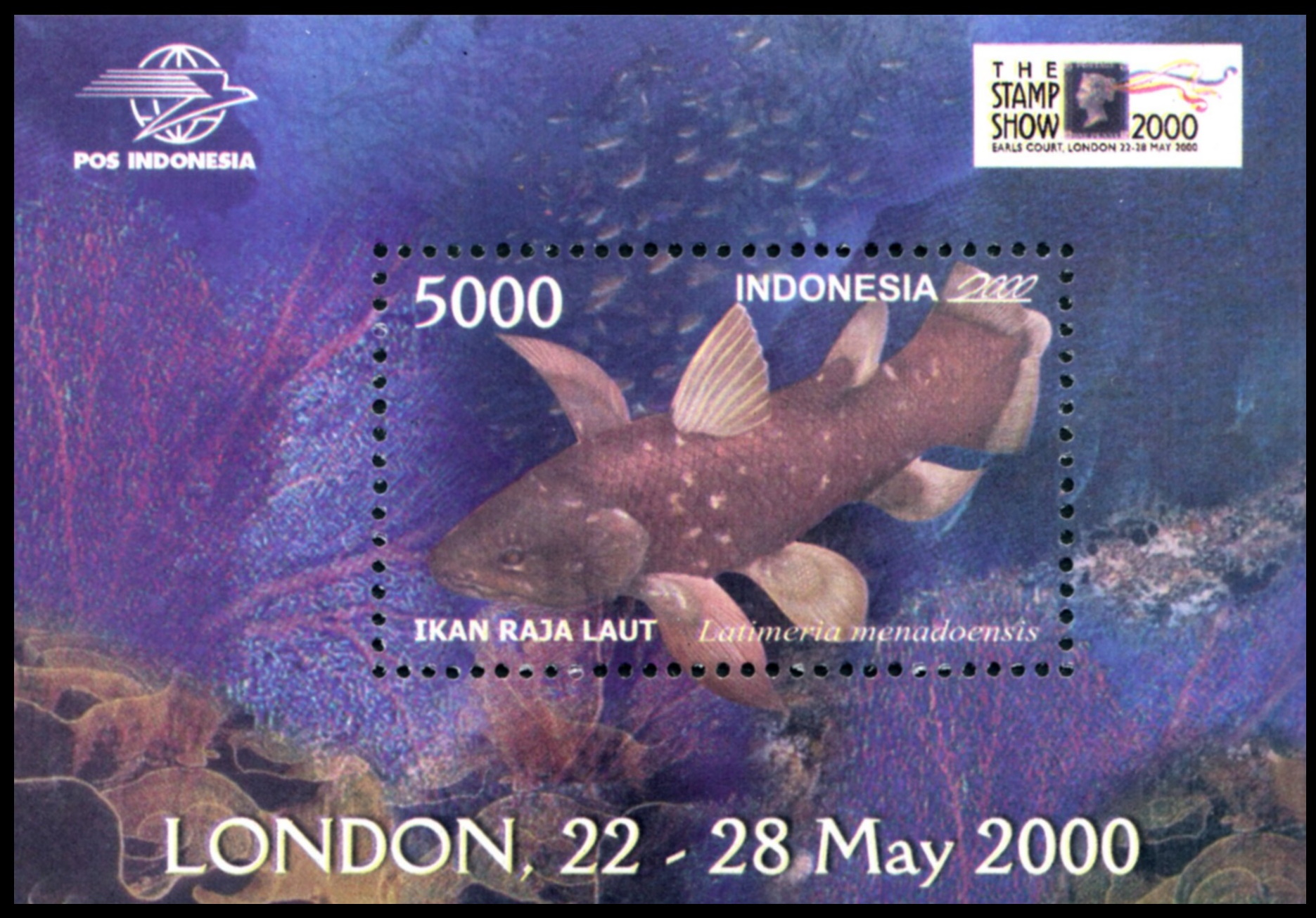
| 10.08.1994 "100th anniversary of Zoological Museum in Bogor" [A1] | 22.05.2000 "Latimeria menadoensis" [A2] | |
 |
 |
|
Notes:
[A1] Bogor Zoology Museum is a museum located located next to the main entrance of the Bogor Botanical Garden in the city of Bogor, Indonesia. The museum and its laboratory were founded on 1894 by government of Dutch East Indies during the colonial era. It contains one of the largest collection of modern, preserved fauna specimen in Southeast Asia as well as some fossilized remains of prehistoric animals.
Two skeletons of modern animals are shown on these stamps: Balaenoptera musculus (blue whale), which is the biggest of its kind in Indonesia and Rhinoceros sondalcus. [R3]
[A2] Latimeria menadoensis is the Indonesian coelacanth, discovered in 1998. It is one of two living species of Coelacanth, identifiable by its brown color. Separate populations of the Indonesian coelacanth are found in the waters of north Sulawesi as well as Papua and West Papua. [R3]
Until 1939, Coelacanth was known to the science from fossil record only.
It appeared about 400 million years ago during the Devonian Period and was abundant over much of the world.
The fish is also considered to have been the ancestors of land vertebrates.
It was supposed that coelacanths became extinct about 66 million years ago.
On 20 February 1939, the strange fish was caught off the Chalumna River mouth near East London (a city in RSA).
Miss Marjorie Courtenay-Latimer, Curator of the East London Museum, was informed of the catch, but was unable to identify the fish.
"Searching for African Coelacanths" exhibit of Susan Bahnick Jones explain
the story of the "living fossil" discovery.
Personalized stamps of Indonesia related to Paleontology: dinosaurs
| 03.07.2024 “The Asian International Stamp Exhibition & Competition” [SP1] | ||
 |
||
Notes:
[SP1] On July 3rd, 2024, the Post Authority of Indonesia issued the set of five numbered Souvenir and Mini Sheets dedicated to “The Asian International Stamp Exhibition & Competition”, which took place in Jakarta between July 3rd and July 7th, 2024.
These sheets were sold as a set in souvenir folder. One of the Mini-Sheets showing two dinosaurs: a sauropod and Triceratops


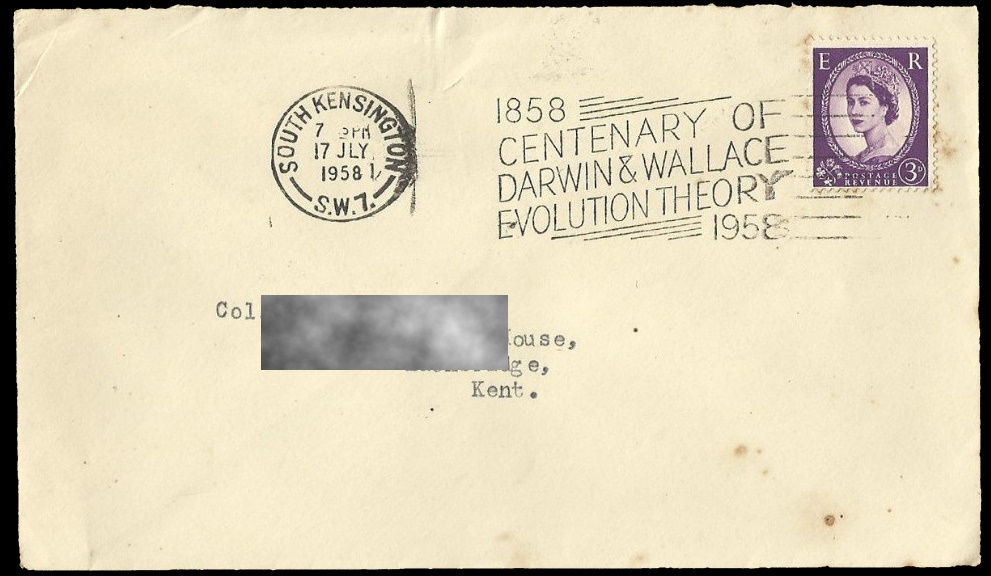
Some personalized stamps of Indonesia to consider: contributors to Evolution theory
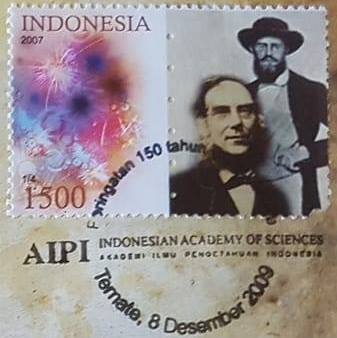
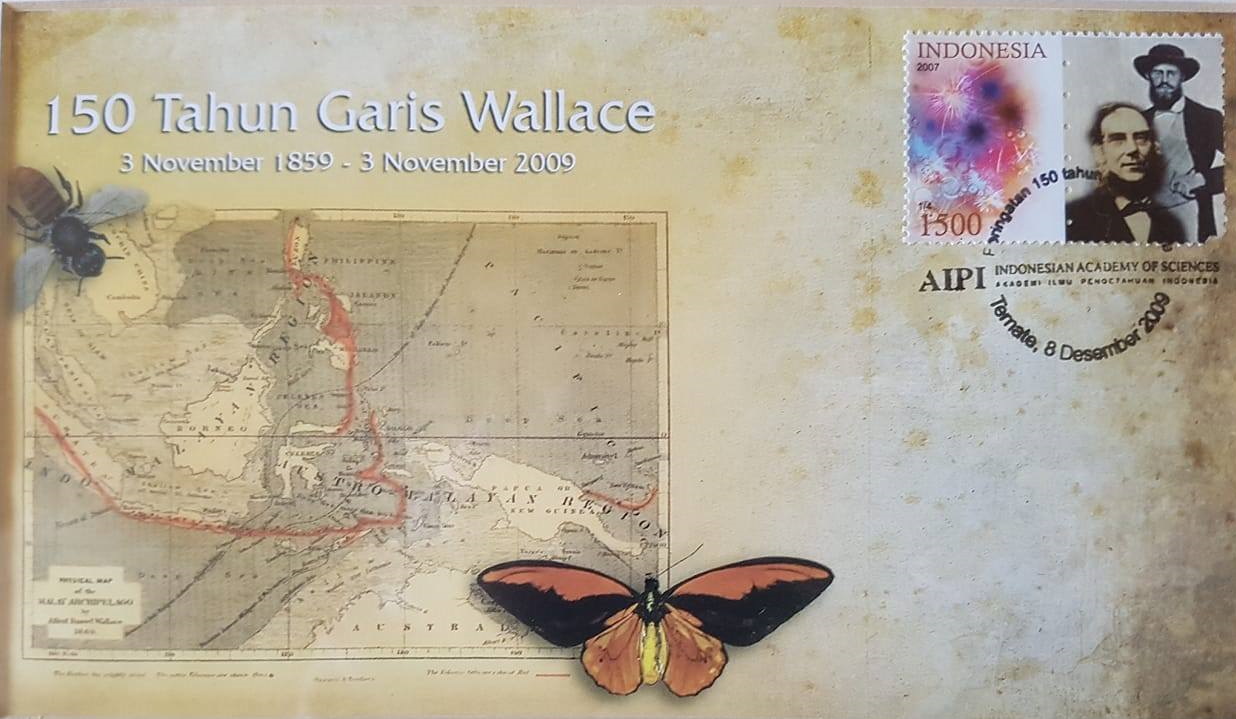
| 08.11.2009 "150th anniversary of the Wallace Line" [P1] | ||
 |
||
Notes:
 |
 |
It was releas in Ternate on 8 December 2009, during a celebratory event organized by the Indonesian Academy of Sciences (AIPI) with the Wallace Foundation and the city of Ternate.
The imaginary line, marking a geographical faunal discontinuity, was first described in a paper "ON the Zoological Geography of the Malay Archipelago", written by Alfred Russel Wallace in Ternate and prrsented to the Linnean Society on 3 November 1895.
Alfred Russel Wallace (1823-1913) was a British naturalist, explorer, geographer, anthropologist and biologist.
He is best known for independently proposing a theory of evolution due to natural selection that prompted Charles Darwin to publish his own theory.
He was considered the 19th century's leading expert on the geographical distribution of animal species and is sometimes called the "father of biogeography".
For more details about Wallace contribution to Evolutionary Biology please go here.
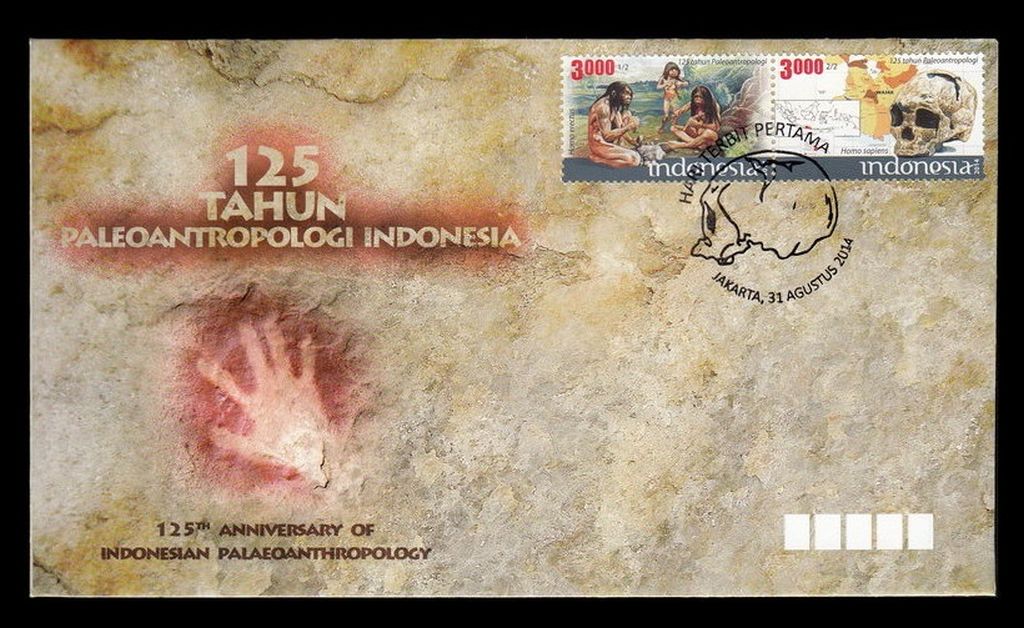
Commemorative postmarks of Indonesia related to Paleoanthropology: flint tool, skull of prehistoric human
Legend is here
| 31.08.1989 "100th anniversary of Paleoanthropological Institute Indonesia" [FDC] | 31.08.2014 "125th anniversary of Paleoanthropological Institute Indonesia" [FDC] | |
 |
 |
|
References
- [R1] Indonesia:
Wikipedia
WikiTravel
FlagCounter
-
[R2] Postal History and Philately of Indonesia:
Wikipedia
Links to official website of the Post Authority, stamp catalog and a list of new stamps of Indonesia are here - [R3] Bogor Zoology Museum: Wikipedia
- [R4] Latimeria menadoensis: Wikipedia, Encyclopedia Britannica
Acknowledgement
Dr. Peter Voice from Department of Geological and Environmental Sciences, Western Michigan University, for reviewing the draft page and his valuable comments.