Official product of the South Korean Postage Museum: three booklets with all dinosaur stamps from 2010, 2011 and 2012.
| Booklet 1 | Booklet 2 | Booklet 3 |
 |
 |

|
 |
 |
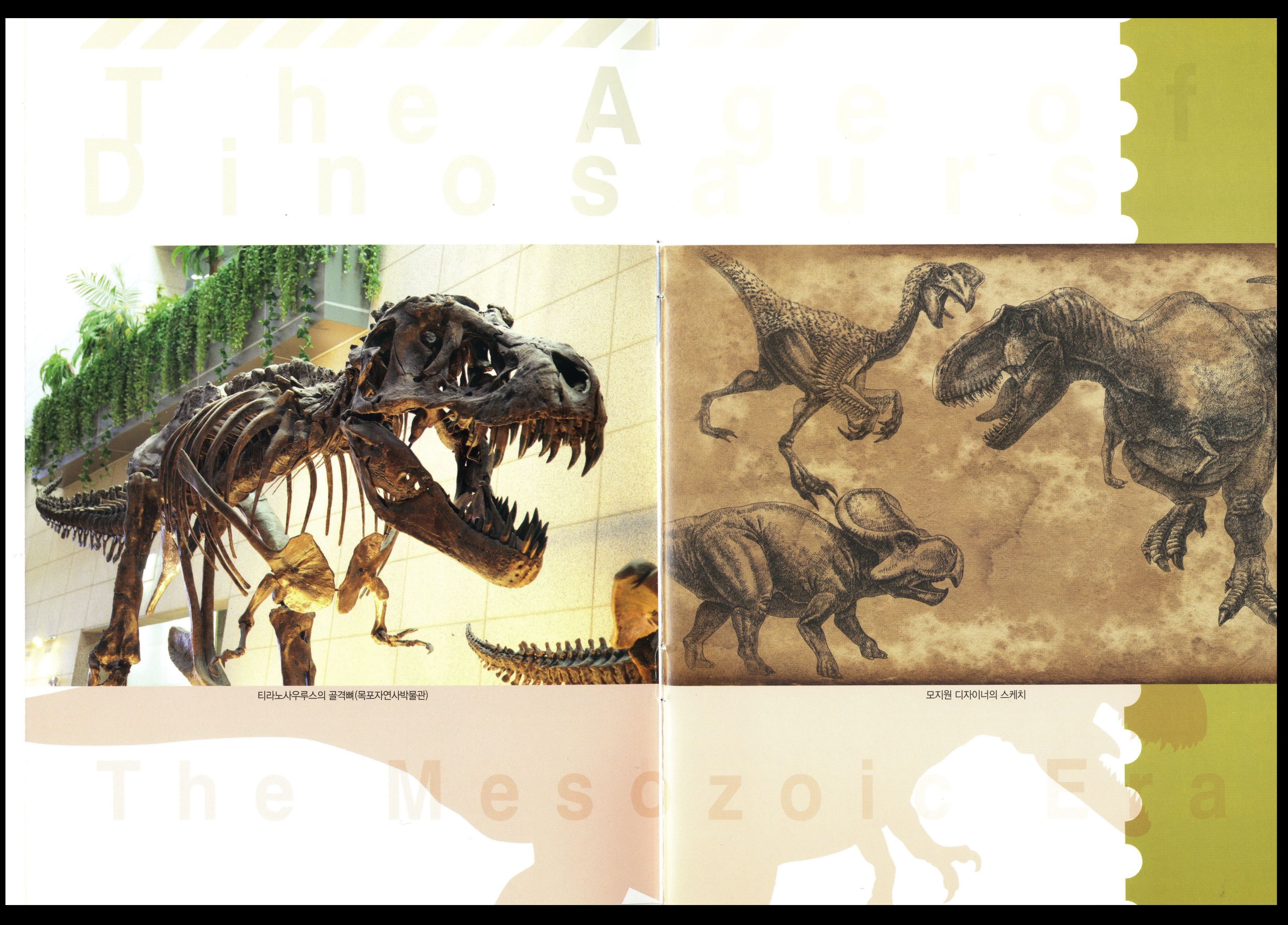 |
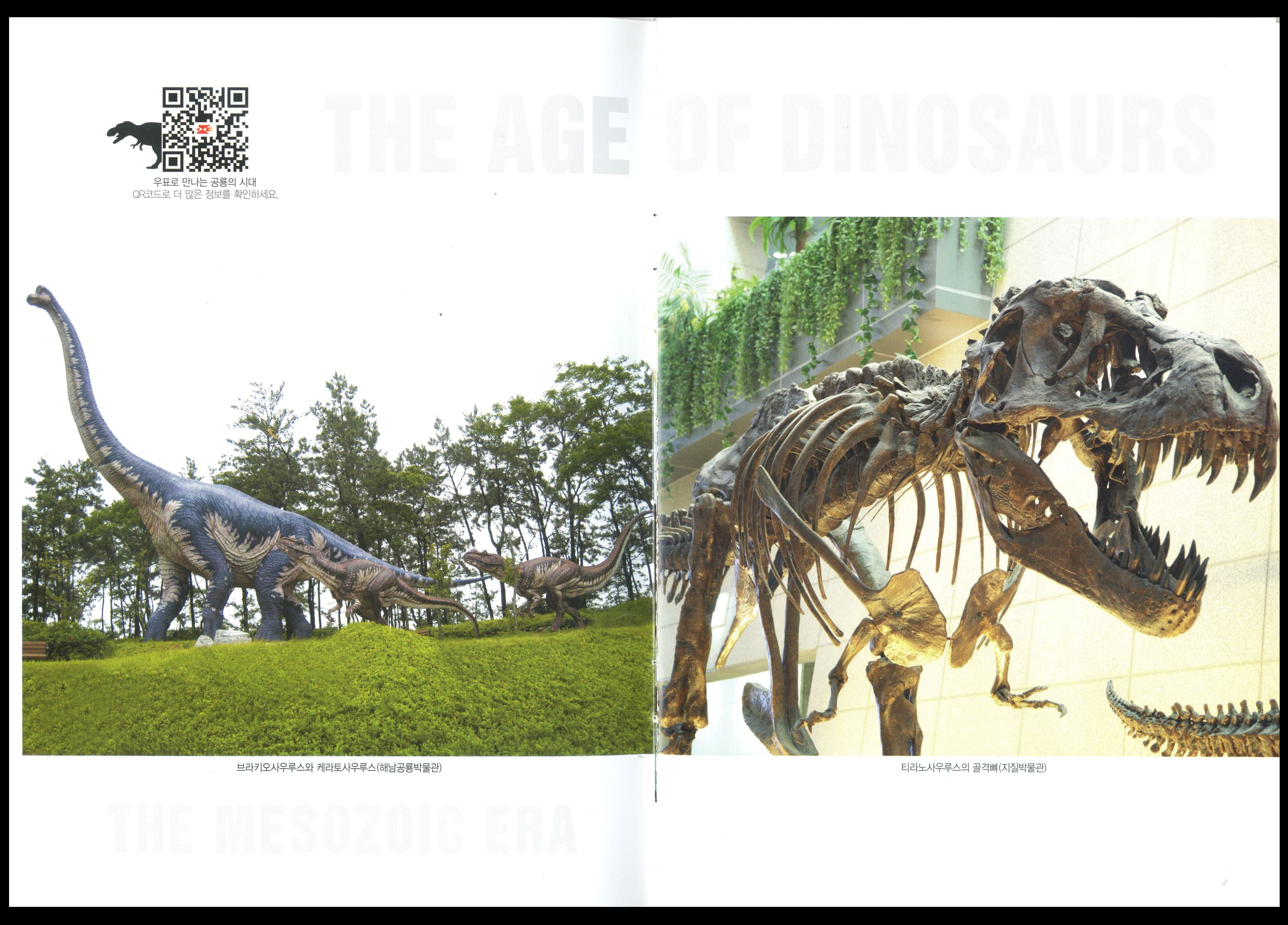
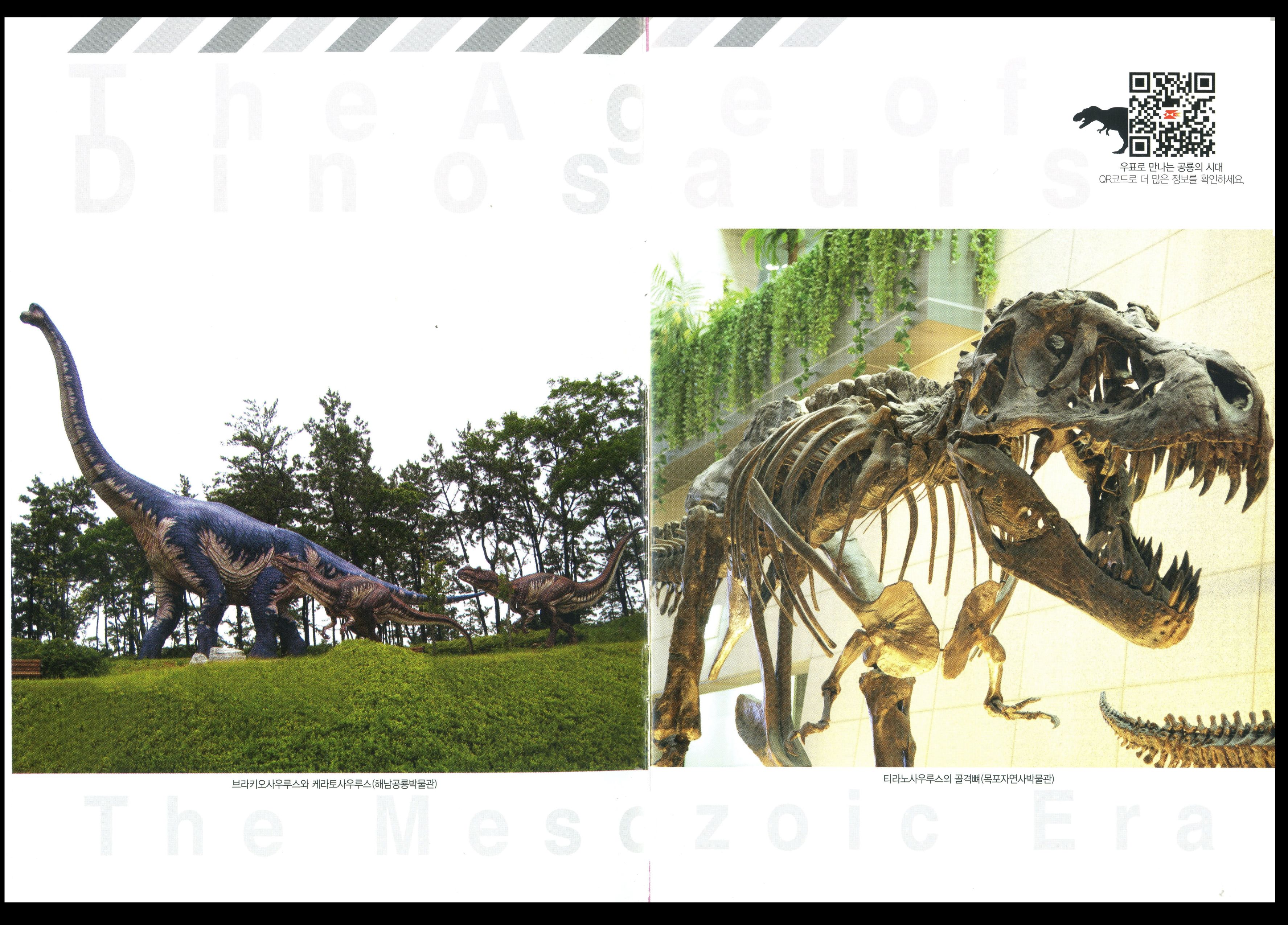
| Pages 1 and 2 of each booklet show a picture of the Museum’s TTyrannosaurus skeleton on the right (booklets 1 and 2) and on the left (booklet 3). Booklets 1 and 2 depict dinosaur reconstructions at the Haenam Dinosaur Museum on the left. The third booklet has a sketch showing several dinosaurs, perhaps Protoceratops, Oviraptor, and Tyrannosaurus or Tarbosaurus. | ||
 |
 |
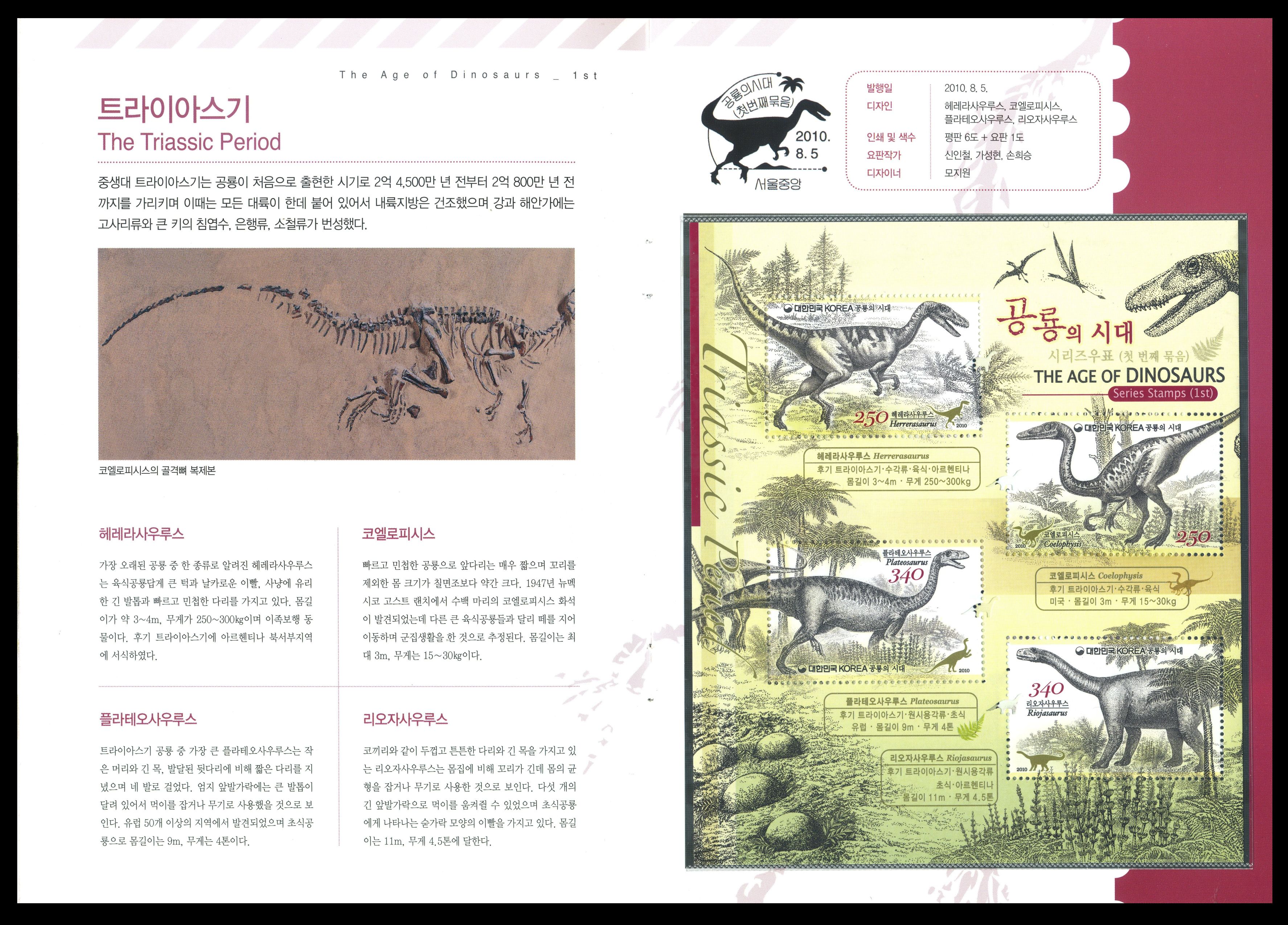 |
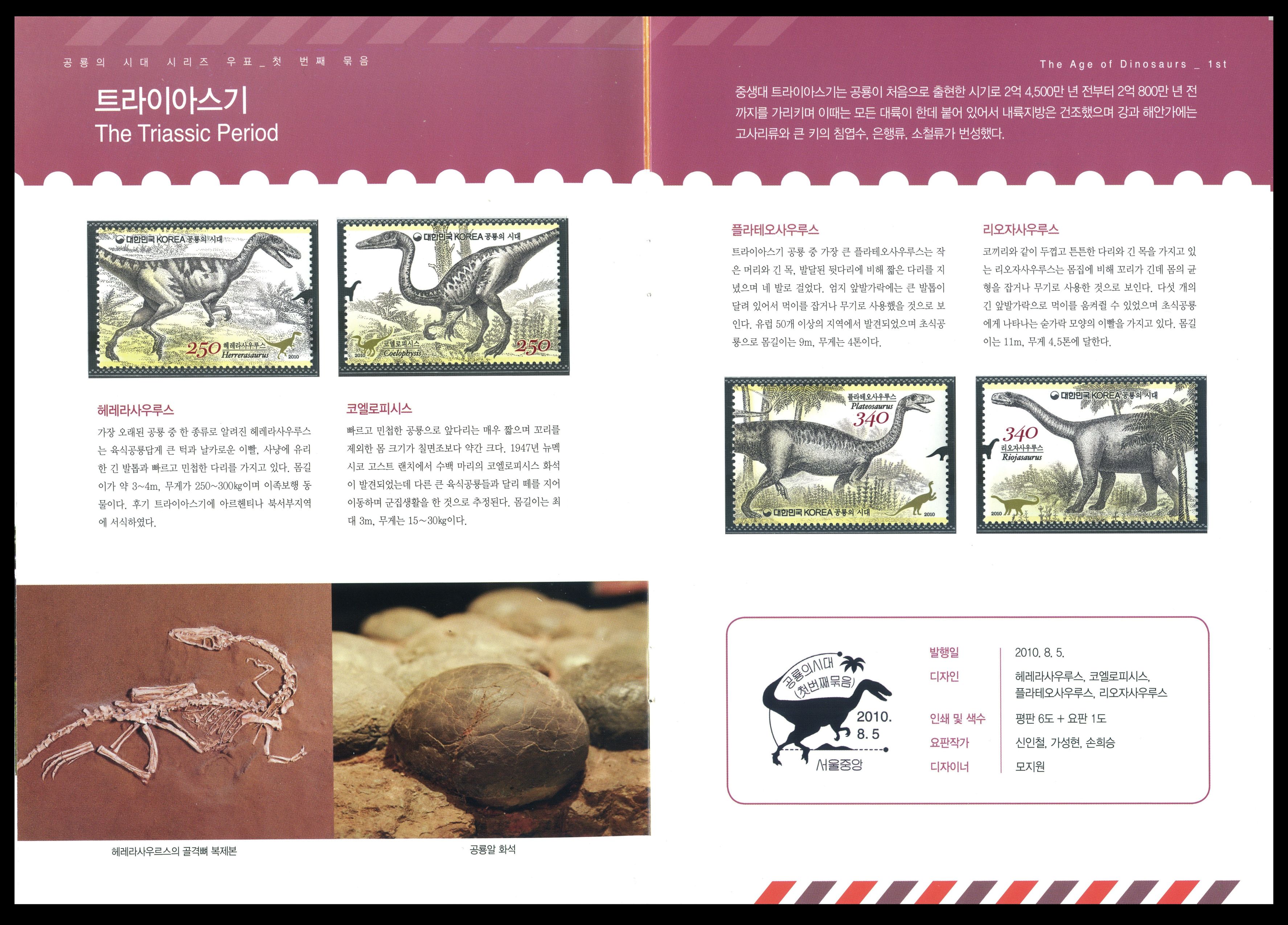
| : The Triassic Period |
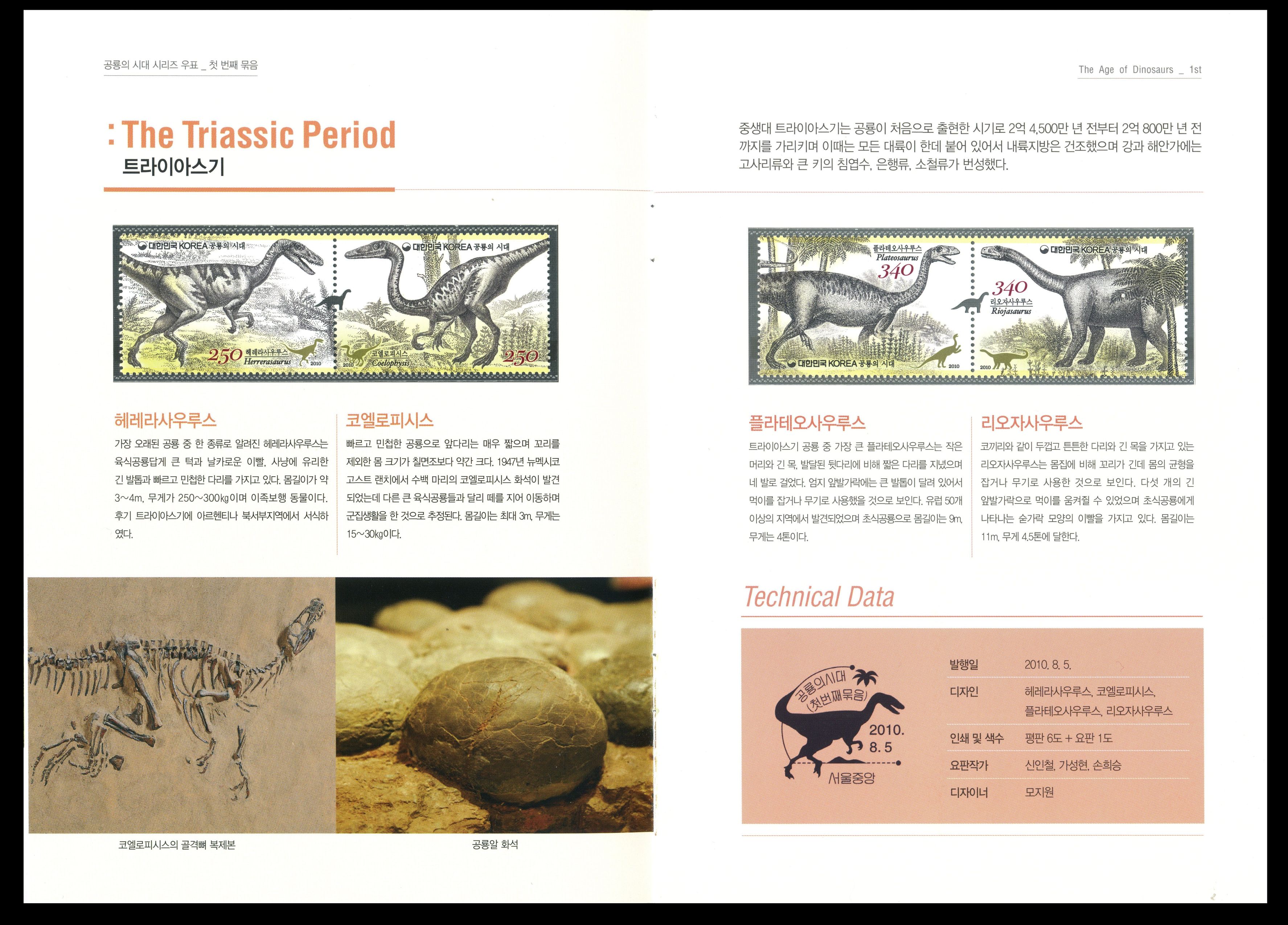
The Triassic Period of the Mesozoic Era, when dinosaurs first appeared, lasted from 245 million to 208 million years ago.
At that time, all the continents on Earth were joined together, and much of the land was dry.
Rivers and seashores were covered with ferns, tall coniferous trees, ginkgos, and cycads. |
| Coelophysis | Herrerasaurus | Plateosaurus | Riojasaurus |
| As a quick and agile dinosaur, its front legs were very short, and its body, excluding the tail, was only slightly larger than that of a turkey. In 1947, hundreds of Coelophysis fossils were discovered at Ghost Ranch in New Mexico, USA. Unlike other large carnivorous dinosaurs, Coelophysis appears to have lived in groups and moved in herds. Its body reached up to 3 m in length and weighed between 15 and 30 kg. | Known as one of the oldest dinosaur species, Herrerasaurus had several carnivorous features, including a large jaw, sharp teeth, long claws, and quick, agile legs adapted for hunting. Measuring about 3–4 m in length and weighing 250–300 kg, it was a bipedal animal. It inhabited northwestern Argentina during the Late Triassic. | As one of the largest Triassic-age dinosaurs, it had a small head, a long neck, and front legs that were shorter than its well-developed hind legs. Plateosaurus walked on four legs. The big toe bore a large claw, which appears to have been used either for hunting or as a defensive weapon. Its fossils have been found at more than 50 sites across Europe. This herbivorous dinosaur reached about 9 m in length and weighed around 4 tons. | Riojasaurus, with legs as thick and robust as those of an elephant and a long neck, had a disproportionately long tail, which appears to have been used either for balance or as a weapon. It grasped its food using five long front toes. Like other herbivorous dinosaurs, it had spoon-shaped teeth. It reached about 11 m in length and weighed around 4.5 tons. |
| Images titles | Technical Details | ||
| Booklet 1: Skeleton replicas of Coelophysis and dinosaur eggs | Date | 2010.08.05 | |
| Booklet 2: Skeleton replicas of Herrerasaurus and dinosaur eggs | Design | Coelophysis, Herrerasaurus, Plateosaurus, Riojasaurus |
|
| Booklet 3: Skeleton replicas of Coelophysis and dinosaur eggs | Designer | Jiwon MO | |
| Engraver | Sin Inchel . Ka Seonghyeon. Son Heeseung | ||
 |
 |
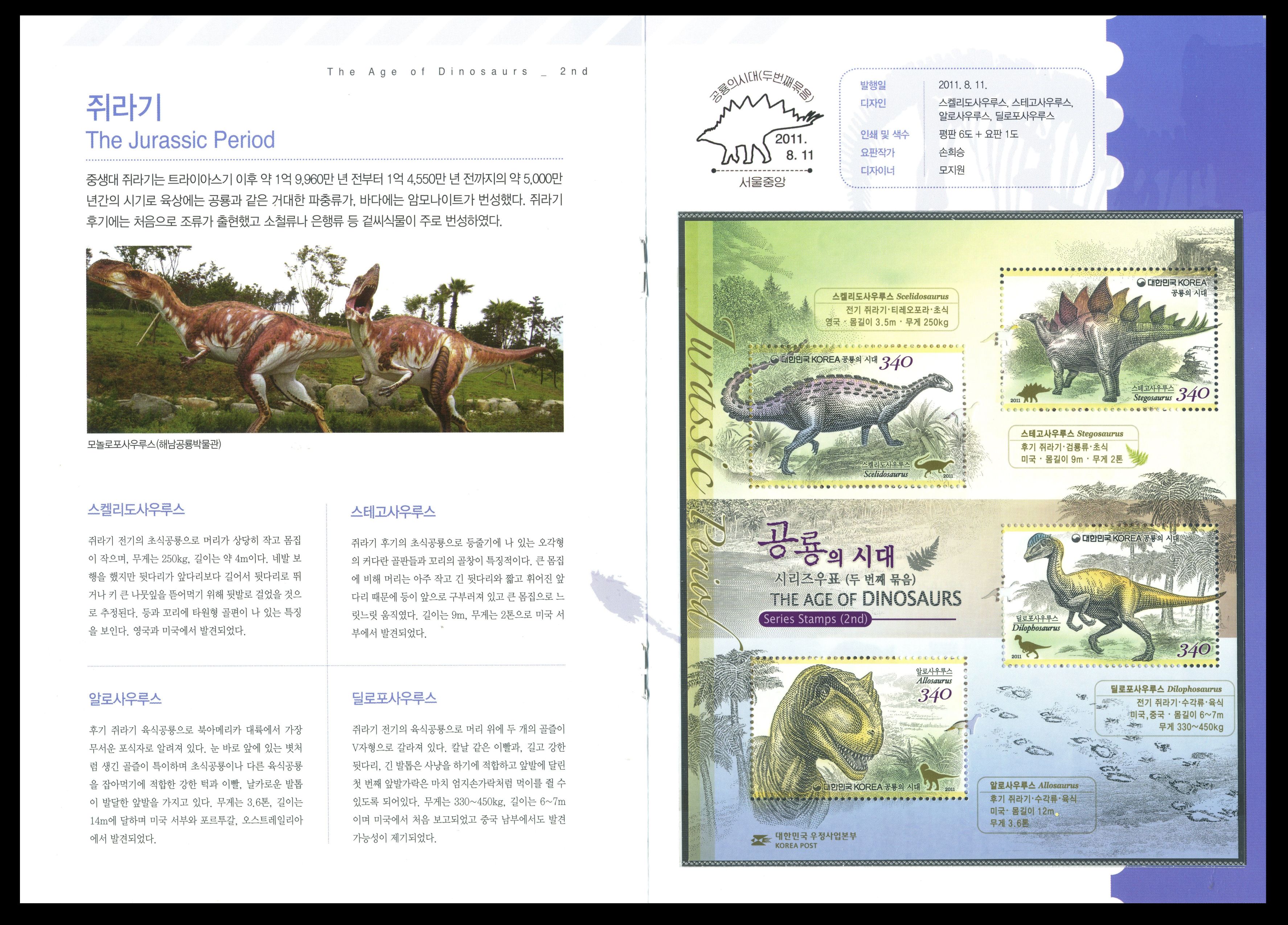 |
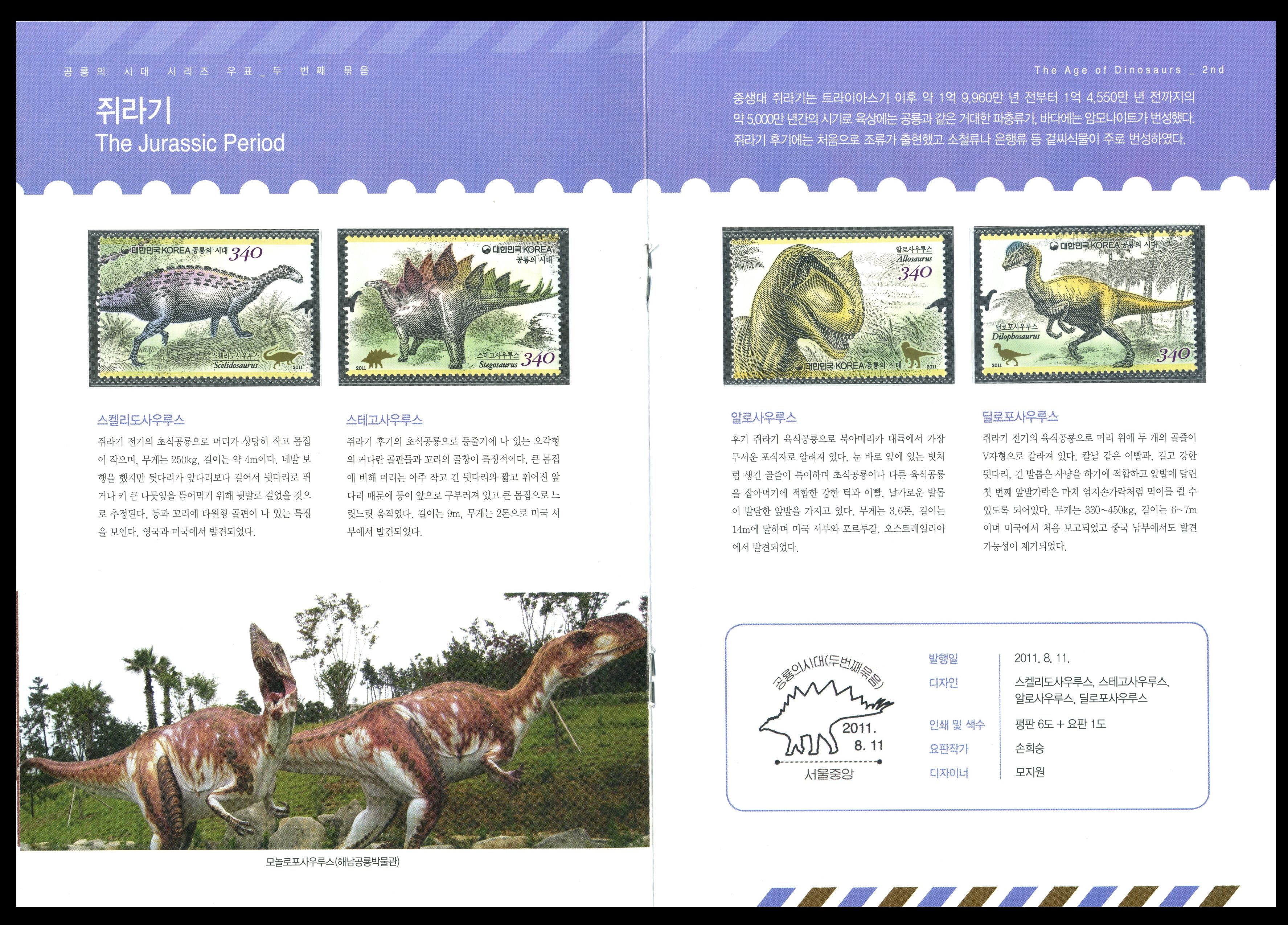
| : The Jurassic Period |
Jurassic Period of the Mesozoic Era, which spanned about 50 million years from approximately
199.6 million to 145.5 million years ago, refers to the period that followed the Triassic Period.
During this period, giant reptiles such as dinosaurs thrived on land, while ammonites flourished in the sea.
In the later part of the Jurassic Period, birds first appeared, and gymnosperms such as cycads and ginkgoes also thrived.
|
| Scelidosaurus | Stegosaurus | Allosaurus | Dilophosaurus |
| As an herbivorous dinosaur, it had a rather small head and small body, weighing about 250 kg and measuring about 4 m in height. It walked on four legs. With its hind legs being longer than its front legs, it is thought to have run using its hind legs and to have walked on all fours while feeding on the leaves of tall trees. Its most prominent body feature is the oval-shaped dermal scutes on its back and tail. It was discovered in both the U.K. and the U.S.A. | As an herbivorous dinosaur from the Late Jurassic, it had spikes on its tail. Compared to its large body, its head was relatively small, and its long hind legs and short, crooked front legs made its back slope forward. Due to its large body, it moved very sluggishly. It is about 9 m in height and weighs 2 tons. It was discovered in the western part of the U.S.A. | As a carnivorous dinosaur that flourished in the latter part of the Jurassic Period, it is known as one of the fiercest predators in North America. A notable feature is the crests just in front of its eyes. It also had a sturdy jaw and teeth adapted for killing herbivorous and other carnivorous dinosaurs, as well as hands with sharp claws. It weighed about 3.6 tons and was 14 m in length. It was discovered in the western part of the U.S., Portugal, and Australia. | As a carnivorous dinosaur from the Early Jurassic Period, it had two V-shaped crests on top of its head. Its razor-sharp teeth, long and strong legs, and long claws were ideal for hunting. Its first finger on the hand was adapted for grasping prey, functioning like a thumb. It weighed about 330–450 kg and measured about 6–7 m in length. It was first reported in the U.S., with the possibility of discoveries in southern China also being suggested. |
| Images titles | Technical Details | ||
| Monolophosaurus at Haenam Dinosaur Museum | Date | 2011.08.11 | |
| Design | Scelidosaurus, Stegosaurus, Allosaurus, Dilophosaurus |
||
| Designer | Jiwon MO | ||
| Engraver | Son Heeseung | ||
 |
 |
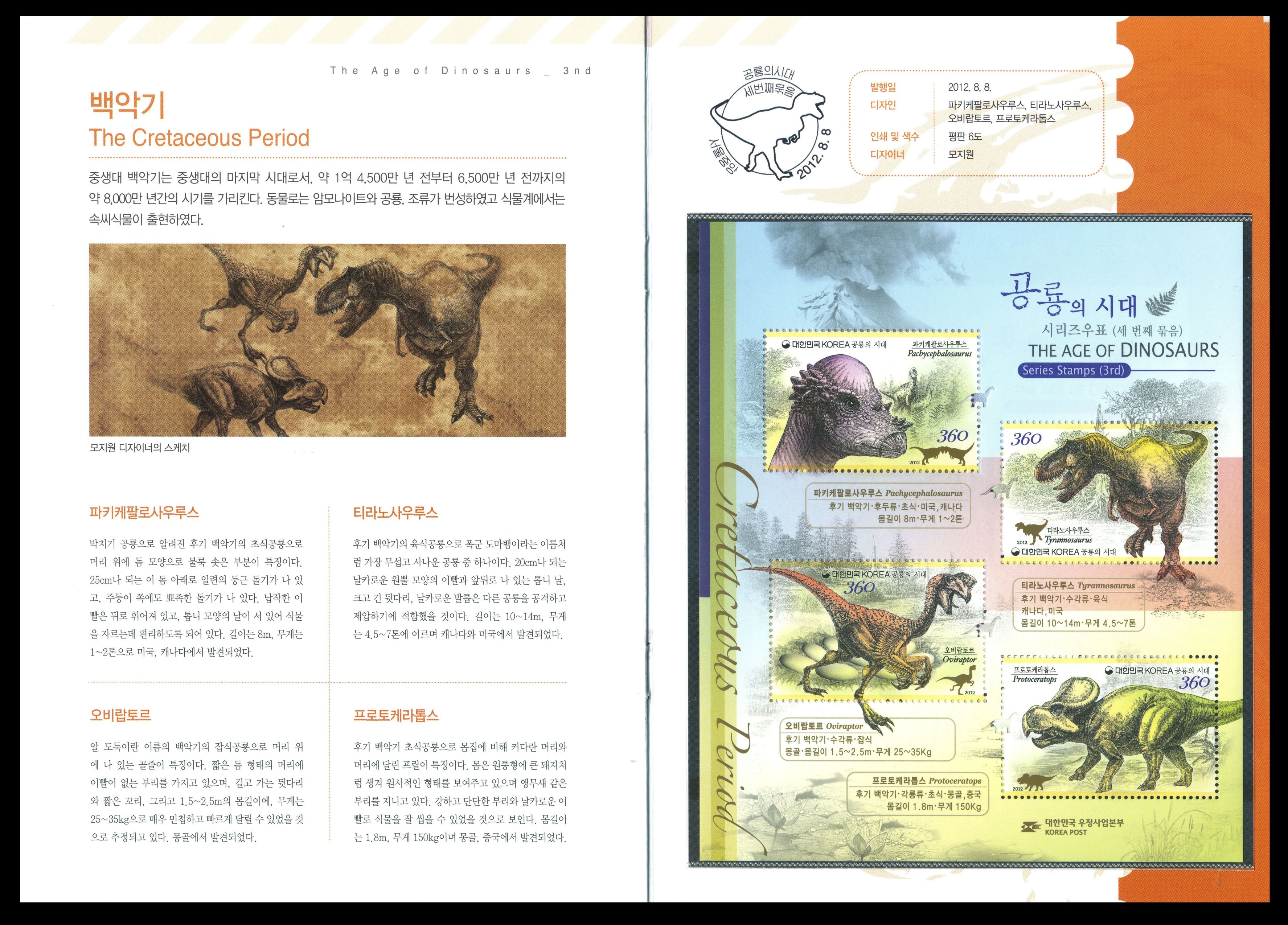 |
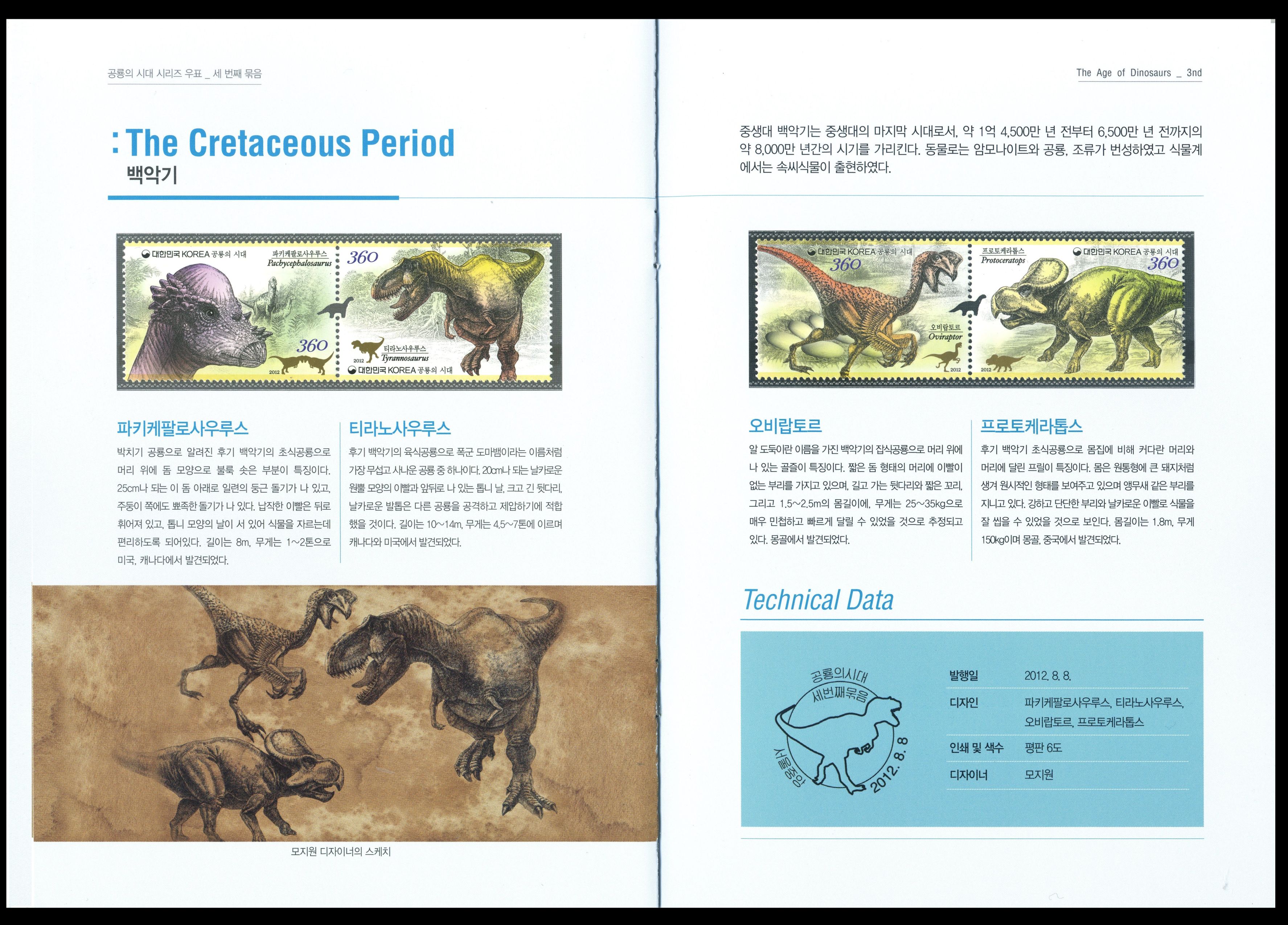
| : The Cretaceous | the Cretaceous Period, the last period of the Mesozoic Era, refers to about 80 million years spanning from approximately 145 million to 65 million years ago. During this period, a wide diversity of animals, such as ammonites, dinosaurs, and birds, prospered alongside angiosperms. |
| Pachycephalosaurus | Tyrannosaurus | Oviraptor | Protoceratops |
| As an herbivorous dinosaur known as a dome-headed dinosaur, it is characterized by a very thick skull resembling a dome. The domed skull, up to 25 cm thick, was surrounded by a series of bumps, and sharp bumps also existed around its mouth. Its flat teeth were bent backwards, with saw-like edges helping it cut leaves. Pachycephalosaurus lived in the U.S. and Canada, grew to about 8 meters long, and weighed 1–2 tons. | As a carnivorous dinosaur of the Late Cretaceous, it is one of the most frightening and fiercest dinosaurs, as indicated by its name meaning “tyrant lizard.” It is easily distinguished by anatomical features suited for attacking and dominating other dinosaurs, such as sharp, cone-shaped teeth up to 20 cm long, saw-like edges on its teeth, long and powerful hind legs, and sharp claws. Tyrannosaurus lived in the U.S. and Canada, grew up to 10–14 m long, and weighed 4.5–7 tons. | As an omnivorous dinosaur of the Cretaceous Period, Oviraptor, meaning “egg thief,” is characterized by a crest on its skull. It had a short dome-shaped skull, a curved beak with no teeth, long and slender hind legs, and a short tail. Oviraptor was 1.5–2.5 m long and weighed 25–35 kg, and fossils have been found in Mongolia. It is believed to have been a very agile animal capable of running swiftly. | As an herbivore of the Late Cretaceous, Protoceratops is characterized by a large skull with a frill comparable in size to its body. Its body was bulky like that of a large pig, giving it a primitive appearance. It also had a beak similar to that of a parrot. Equipped with a strong, hard beak and sharp teeth, it is believed to have been able to chew plant material effectively. Protoceratops lived in Mongolia and China, was 1.8 m long, and weighed 150 kg. |
| Images titles | Technical Details | ||
| sketch of stamp designer Mo Jiwon | Date | 2012.08.08 | |
| Design | Pachycephalosaurus, Tyrannosaurus, Oviraptor, Protoceratops |
||
| Designer | Jiwon MO | ||
| Engraver | Son Heeseung | ||
 |
 |
 |
The left pages (page 9) of the first and second booklets include the same text.
The Age of Dinosaurs
(Korea Post Stamp Collectors’ Letter — written by Lee Eom-yong of the Korea Stamp Collectors Association)
The age of dinosaurs is divided into the Triassic, Jurassic, and Cretaceous periods. These divisions are not based on the evolution of dinosaurs themselves, but on geological strata that include many other forms of life. Nevertheless, these periods are often used to explain when particular dinosaurs lived.
Triassic Period
During the Triassic Period, all of Earth’s continents were joined together into a single enormous supercontinent called Pangaea.
Because this landmass lay mostly in warm climatic zones, conditions were favourable for the emergence of dinosaurs.
Dinosaurs appearing during this era were generally small and lightly built, such as Coelophysis and Herrerasaurus.
Early primitive dinosaurs included species such as Plateosaurus and Riojasaurus.
Jurassic Period
In the Jurassic Period, the supercontinent Pangaea gradually split into two large landmasses: Laurasia in the north and Gondwana in the south.
These geographic changes altered the climate, creating warm and humid conditions under which dinosaurs flourished.
This was the time when gigantic dinosaurs first appeared, including enormous herbivores such as Stegosaurus and Camarasaurus.
Dinosaurs also diversified greatly, and predatory species such as Allosaurus and Dilophosaurus emerged during this period.
Cretaceous Period
In the final era, the Cretaceous Period, Laurasia and Gondwana continued separating until the continents began to resemble their present-day forms.
Climate zones also became more distinct.
As the continents drifted apart, dinosaurs evolved differently in isolated regions, producing many new forms adapted to local environments.
For example, dinosaurs such as Oviraptor were found in China and Mongolia, while Pachycephalosaurus and Triceratops evolved mainly in North America.
Large carnivores such as Tyrannosaurus also appeared there, whereas other regions had only distant relatives.
The exact reason why many kinds of dinosaurs disappeared at the end of the Cretaceous Period still remains an unsolved mystery.
Dinosaur Stamps Around the World
The world’s first dinosaur stamp was issued in China in 1958.
Later, dinosaur stamps were also issued in Poland and San Marino in 1965.
After the success of the film *Jurassic Park* in the 1990s, many more countries around the world began issuing dinosaur-themed stamps.
The first row represents Asia
|
The second row represents Oceania (New Zealand)
|
The third row represents Africa
|
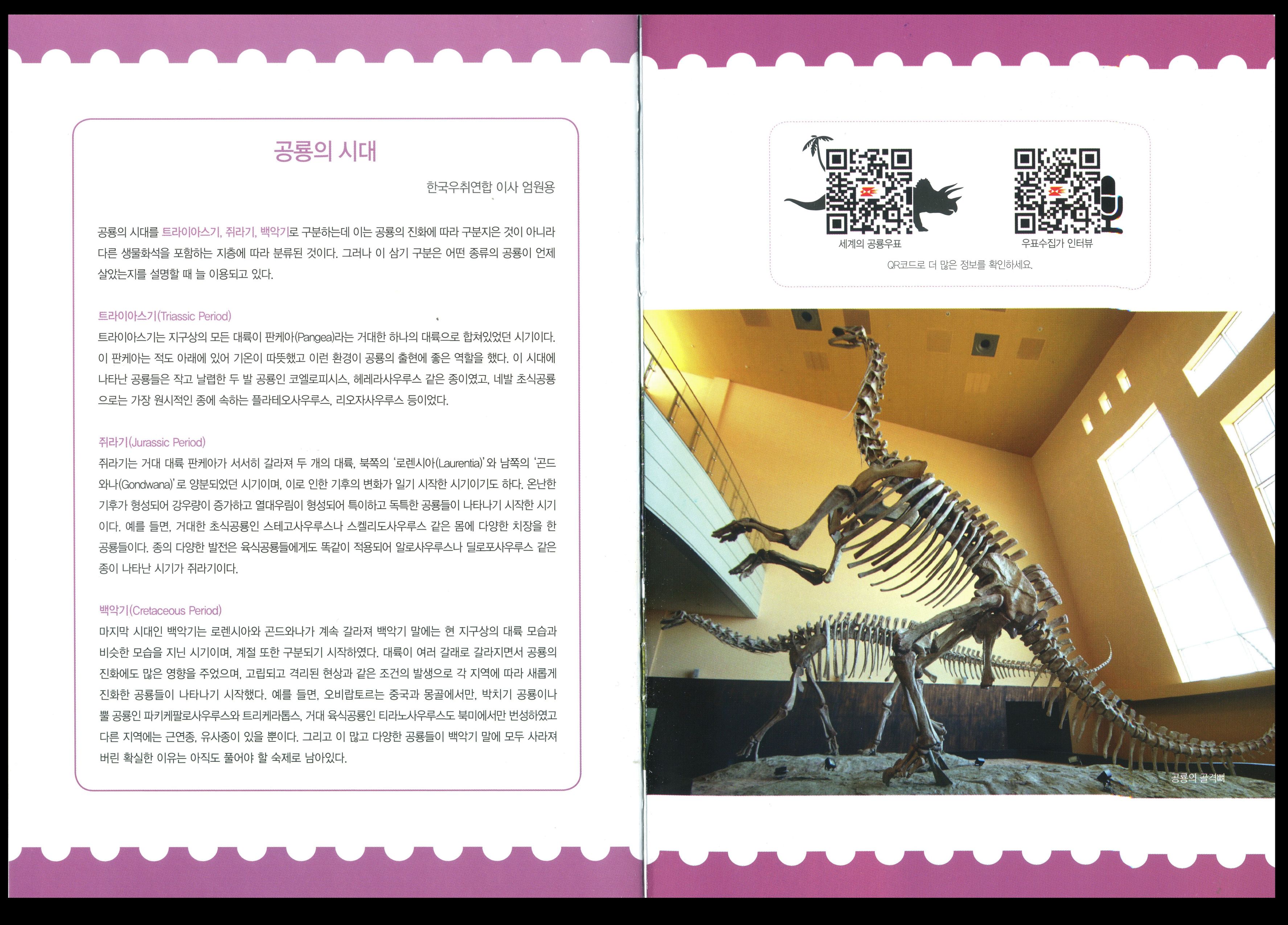
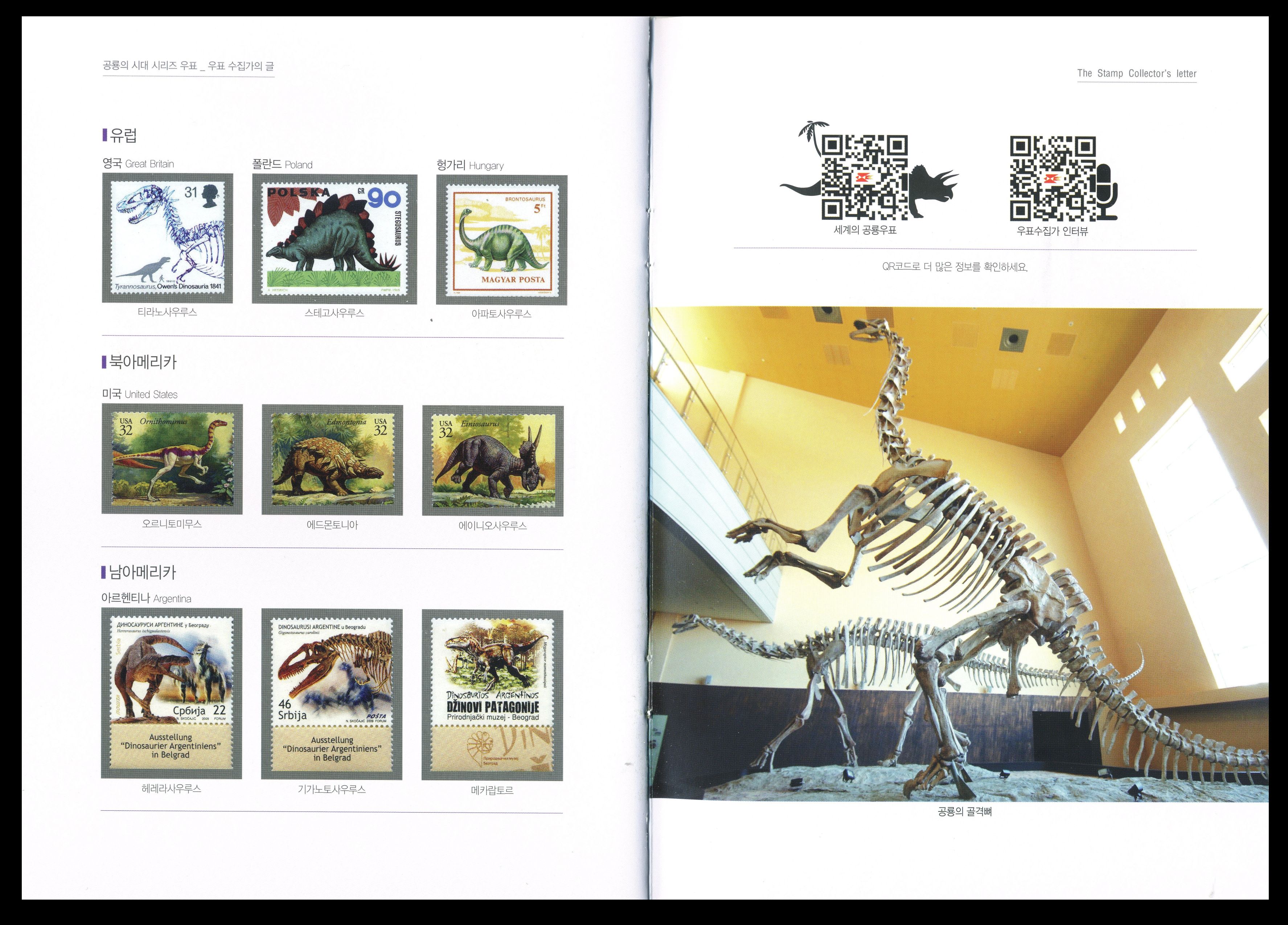
The photo showing a pair of dinosaur skeletons features a Plateosaurus on display at the Senckenberg Nature Museum (Naturmuseum Senckenberg) in Frankfurt, Germany.
A short version of the interview was published on the left page of the third booklet.
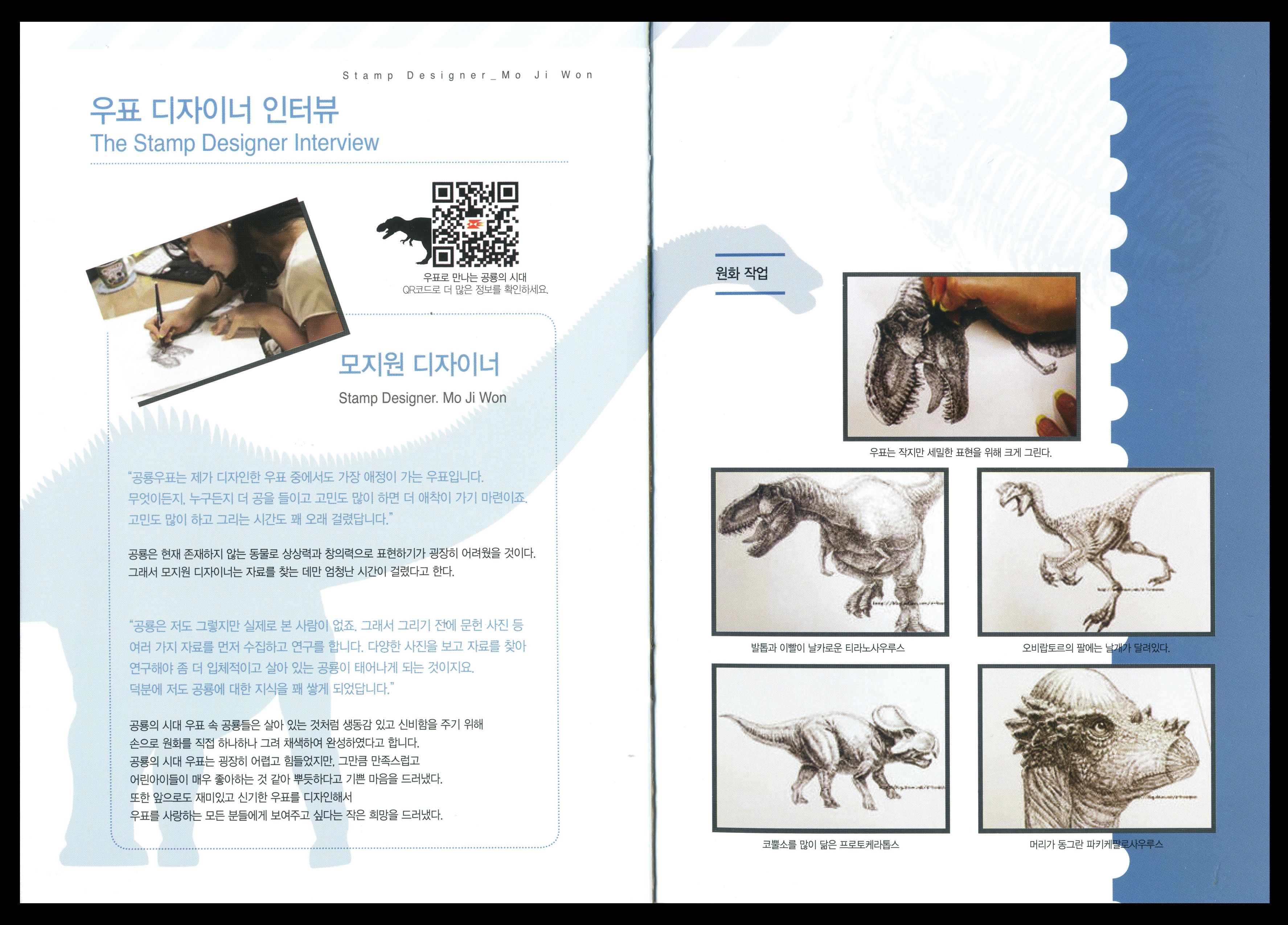
The Stamp Designer Interview
Stamp Designer: Mo Ji Won
The dinosaur stamp is the stamp I feel most attached to among all the stamps I have designed.
No matter what it is, if you put more effort and thought into it, you naturally develop more affection for it.
I also spent a lot of time thinking and drawing it.
Dinosaurs are animals that do not exist today, so expressing them through imagination and creativity must have been very difficult.
Therefore, Designer Mo Ji Won says that the time spent searching for reference materials was as important as the drawing itself.
No one, including myself, has ever actually seen a dinosaur in person.
That is why, before drawing, I first collect and study various reference materials such as photos of fossils.
By looking at various photos, searching for materials, and studying them, a more three-dimensional, lifelike dinosaur is created.
Thanks to this, I also gained a lot of knowledge about dinosaurs.
To give the dinosaurs a sense of realism and mystery, as if they were alive during the age of dinosaurs, she painted each original illustration by hand to complete them.
While the dinosaur stamps were very difficult and challenging, they were equally satisfying, and she felt proud and happy that children loved them so much.
Furthermore, she expressed a hope to continue designing fun and mysterious stamps for everyone who loves stamps.
- Drawings are small, but they are drawn closely for detailed expression.
- Tyrannosaurus with sharp claws and teeth
- Oviraptor running with flying wings
- Protoceratops resembling a rhinoceros.
- Pachycephalosaurus with a round head
 |
||
The first row represents Europe
|
The second row represents North America (USA)
|
The third row represents South America (Argentina)
|

|

|

|