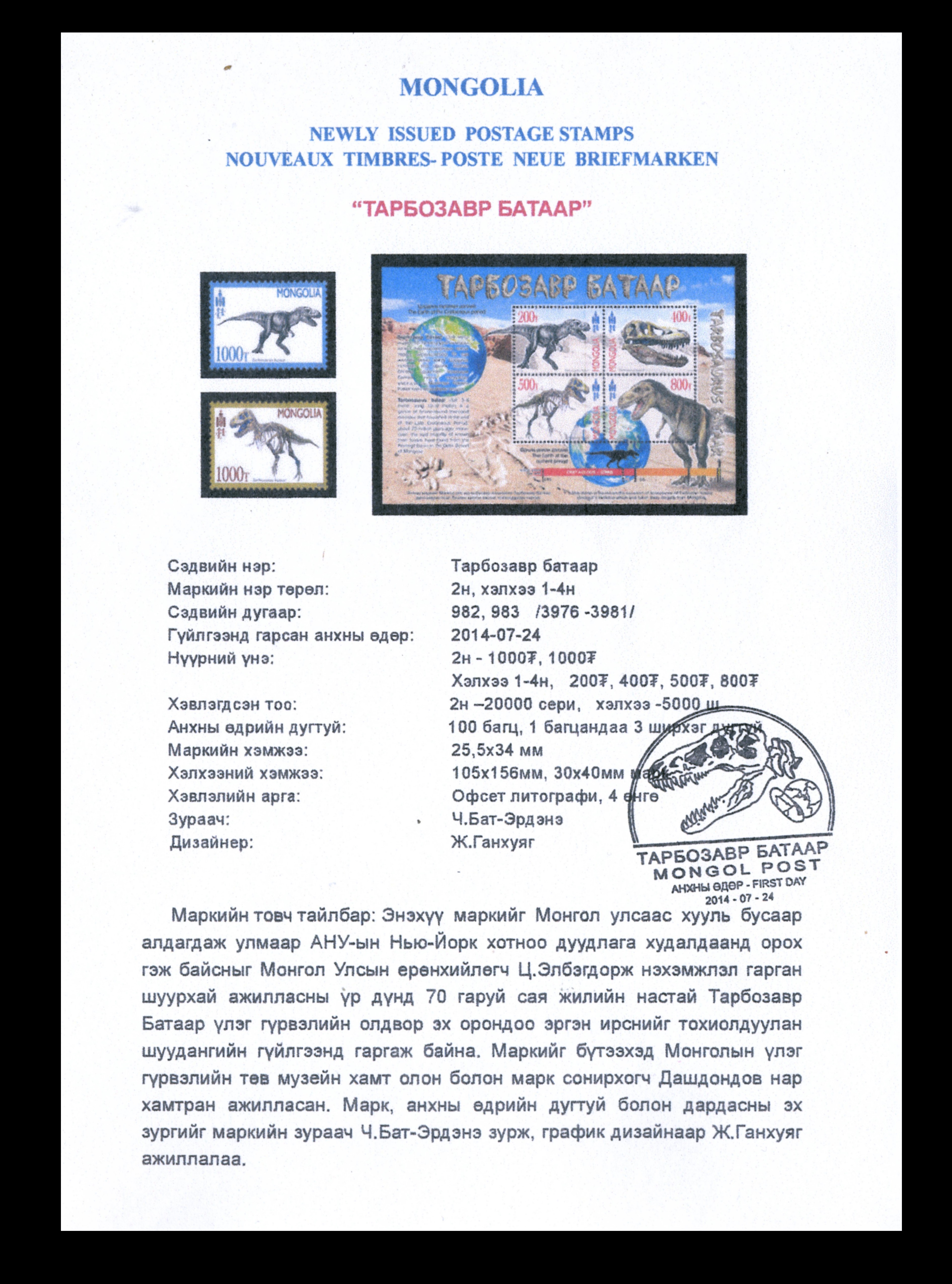
Mongolia 2014 "Tarbosaurus Bataar"
| Issue Date | 24.07. 2014 |
| ID | Michel: 3917-3918, Bl. 418 (3919-3922); Scott: 2810-2810, 2811a-d ; Stanley Gibbons: 3299-3230, MS3301; Yvert et Tellier: 2998-2999, BF374; Category: pR |
| Design | Artist: Ch.Bat-Erdene, Stamps designer: J. Gankhuyag |
| Stamps in set | 6 |
| Value | 200 - reconstructions of Tarbosaur bataar 400 - skull of Tarbosaur bataar 500 - skeleton of Tarbosaur bataar 800 - reconstructions of Tarbosaur bataar 1000 - skeleton of Tarbosaur bataar 1000 - fossils and reconstructions of Tarbosaur bataar |
| Size (width x height) | 25.5mm х 34mm |
| Layout | Two sheets of 20 stamps each, Souvenir-Sheet with 4 stamps |
| Products | FDC x3 |
| Paper | |
| Perforation | 12 x 12 |
| Print Technique | Offset lithography |
| Printed by | Beijing Stamp Printing House of State Postal Bureau, China |
| Quantity | stamps: 25.000, FDC: 100 |
| Issuing Authority | Postage Stamp Authority of Mongol Post |
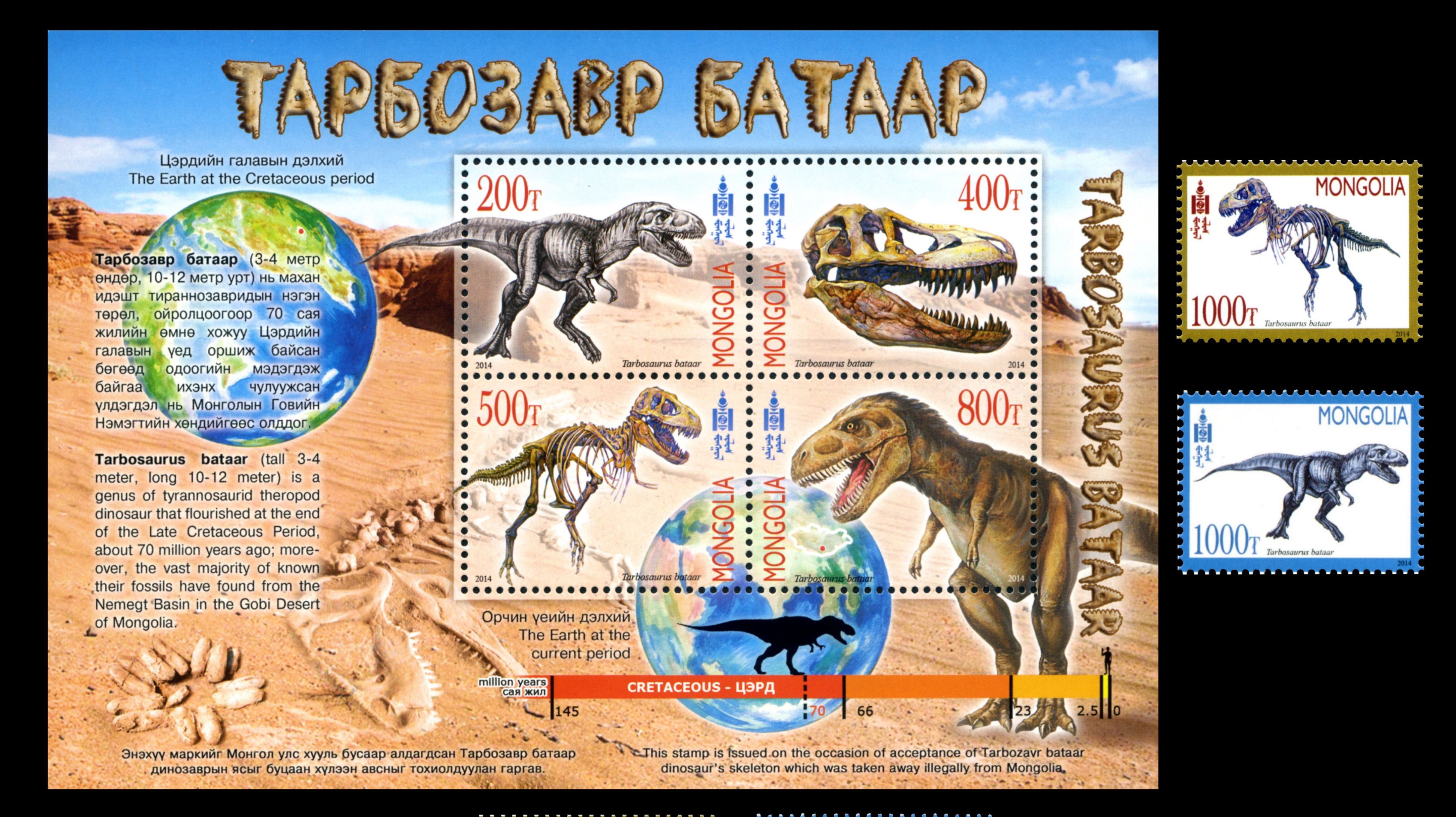
The Ministry of Culture, Sport and Tourism of Mongolia together with the "Mongol Post" (Mongol Shuudan) jointly released the postal stamp Tarbosaurus Bataar". Both organizations officially introduced the new postal product to the Central Dinosaur Museum (CDM) on Thursday, July 24th, 2014.
These stamps were printed as a Souvenir-Sheet of 4 stamps and two sheets, 20 stamps each. All stamps show fossils and reconstructions of one of the most famous Mongolian dinosaurs Tarbosaurus bataar.
Tarbosaurus is a genus of tyrannosaurid theropod dinosaur that flourished in Asia about 70 million years ago, at the end of the Late Cretaceous. Its fossils have been recovered in Mongolia, with more fragmentary remains found further afield in parts of China.
Although many species have been named, modern paleontologists recognize only one as a valid species: Tarbosaur bataar.
Tarbosaurus and Tyrannosaurus, if not synonymous, are considered to be at least closely related genera.
Like most known tyrannosaurids, Tarbosaurus was a large bipedal predator, weighing up to six tonnes and equipped with about sixty large teeth. It had a unique locking mechanism in its lower jaw and the smallest forelimbs relative to body size of all tyrannosaurids, renowned for their disproportionately tiny, two-fingered forelimbs. It was an apex predator, preying on other dinosaurs.
In 1946, a joint Soviet-Mongolian expedition to the Gobi Desert in the Mongolian Omnogovi Province discovered a large theropod skull and some vertebrae in the Nemegt Formation.
In 1955, Evgeny Maleev, a Soviet paleontologist, made this specimen, the type specimen of a new species, which he called Tyrannosaurus bataar. The specific name is a misspelling of the Mongolian баатар/baatar ("hero").
A nearly complete Tyrannosaurus bataar skeleton was returned to Mongolia following the high-profile prosecution of a Florida paleontologist by federal authorities in New York after it was sold at a Manhattan auction for $1.05 million.
During the ceremony of introduction of the new postal stamp "Tyrannosaurus Bataar", the Minister of Culture, Sport and Tourism Ts. Oyungerel noted:
After the rare findings of the Tarbosaurus Bataar skeleton, the noticeable sculpture artworks and fine-art paintings have been delivered; and this time, the new postal stamp was also released with great efforts from the "Mongol Shuudan". This remarkable event will surely contribute to protect our cultural heritages as well as to provide value-added cultural and economic impact to Mongolia.... The launch of these new postmarks celebrates both the 90th anniversary of Mongolia’s postmark production and modern museum establishment in Mongolia. It is delightful to see Bataar becoming the theme of postmarks.
The original painting of the “Tarbosaurus Bataar” postage stamp was drawn by the painter Ch. Bat-Erdene and graphically designed by J. Gankhuyag.
Ch. Bat-Erdene talked about how he created Bataar:
Stamp depictions requires more intricate drawings compared to other pieces for publications. I spent two months drawing Bataar for the stamps. Each depiction to be used for stamps is always based on detailed research before going to design, as they represent Mongolia’s name in the international postage market.
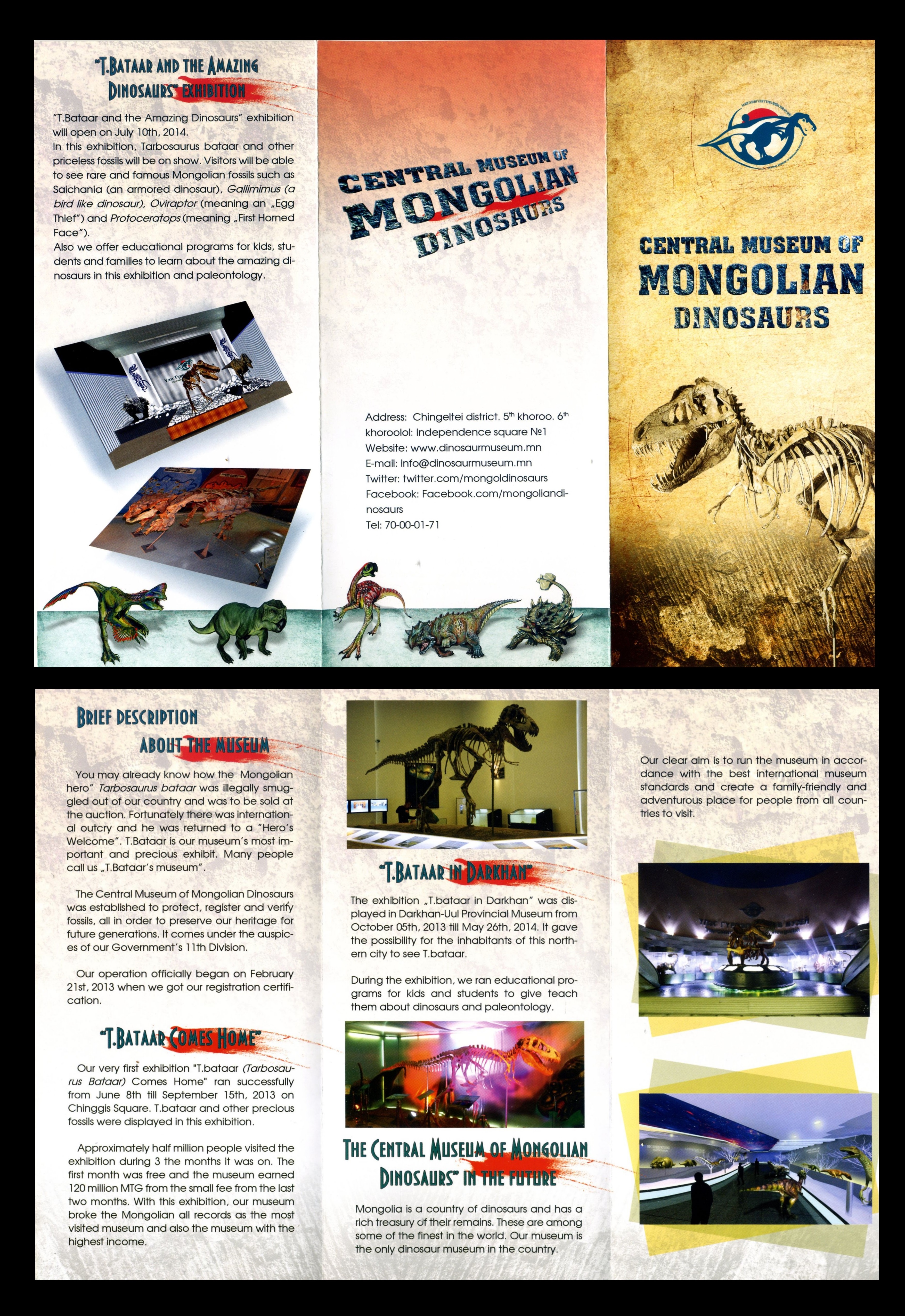
“The Central Dinosaur Museum ” in Ulaanbaatar was established to protect, register and verify fossils, all in order to preserve Mongolian heritage for future generations.
|
The very first exhibition "Tarbosaurus bataar come home" took place between June 8th and September 15th, 2013. The estimated number of visitors to the exhibition was half a million people, a record for attendance to a Mongolian museum. During the exhibition the museum ran some educational programs for kids and student about dinosaurs and paleontology. To date (2014) this is the only dinosaur museum in Mongolia.
Another exhibition "Tarbosaurus bataar and amazing dinosaurs" was opened on July 10th, 2014. This exhibition showed Tarbosaurus bataar as well as many other dinosaur's fossils such as Saichania, Gallimimus, Oviraptor, Protoceratops. The Central Dinosaur Museum has introduced 48 different dinosaur-themed postcards since 2013 as well as paintings and the story books for children. The books tell the story how the skeleton of Tarbosaurus was returned to Mongolia from the United States. The Central Dinosaur Museum in Ulaanbaatar was built specially for and dedicated to Mongolia’s dinosaurs.
Mongol Post expressed its interest in opening a branch in the Central Dinosaur Museum building, as tourists prefer to collect postcards or send postcards to share their impressions of the museums they have visited with their friends and family at home.
The story of how Tarbosaurus bataar returned to Mongolia A nearly complete skeleton of a towering Tyrannosaurus bataar was set to go on auction at the Texas-based Heritage Auction on Sunday, May 20th, 2012.

|
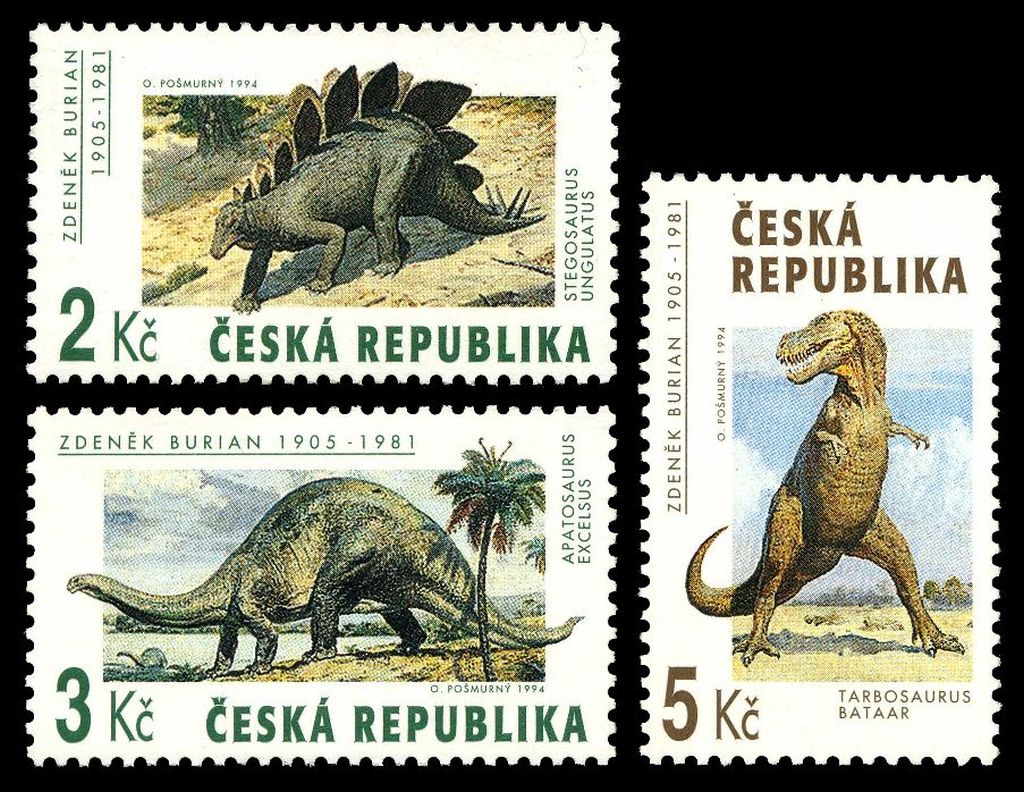
Tarbosaurus bataar on stamp of Czech Republic, 1994, MiNr.: 43, Scott: 2924. Based on illustration of famous Czech Paleoartist Zedek Burian. |
There is no reasonable doubt that the Tarbosaurus had been stolen. China and Mongolia strictly regulate who is allowed to launch dinosaur expeditions and collect fossils and where those specimens must be reposited. There was no legal route by which the dinosaur could have ended up in a New York City auction. Days before it was set to be sold, paleontologists and the president of Mongolia objected to the auction. Paleontologist Mark Norell of the American Museum of Natural History, who has worked extensively in Mongolia, pointed out that the dinosaur must be an illicit specimen from the Gobi Desert.
Mark Allen Norell (born July 26, 1957) is an American vertebrate paleontologist. He is currently the chairman of paleontology and a research associate at the American Museum of Natural History. He is best known as the discoverer of the first theropod embryo and for the description of feathered dinosaurs. Norell is credited with the naming of the genera Apsaravis, Byronosaurus, Citipati, Tsaagan, and Achillobator. His work regularly appears in major scientific journals (including cover stories in Science and Nature) and was listed by Time magazine as one of the ten most significant science stories of 1993, 1994 and 1996. Norell is both a fellow of the Explorer's Club and the Willi Hennig Society. He was featured in the fourth installment of Miracle Planet—a six-part documentary series that was released in 2005.
According to Mongolian heritage laws, any recovered bones must ultimately rest within an approved Mongolian institution.Heritage Auctions pooh-poohed the concerns and affirmed that the auction house trusted the dealer it was working with. Greg Rohan, president of Heritage Auctions, steadfastly defended the auction, whining that it was too close to the date of the auction to do anything about the complaints of the Mongolian government and concerned researchers. Lawyers working in concert with the Mongolian government entered the kerfuffle and demanded that the auction be halted until the provenance of the skeleton could be settled. The auction went ahead as scheduled. In the middle of the bidding, a lawyer announced that he had on the phone a judge who had issued an order against the sale. Even this last-minute tactic didn’t stop the bidding. The final price of the Tarbosaurus was just over $1 million. Fortunately, the unknown buyer couldn’t simply walk off with the dinosaur. Investigations continued, now with the begrudging assistance of Heritage Auctions, and Norell and other paleontologists confirmed that the tyrannosaur must have been uncovered in Mongolia. More than that, what was billed as a nearly complete individual animal turned out to be made of several different dinosaurs.
|
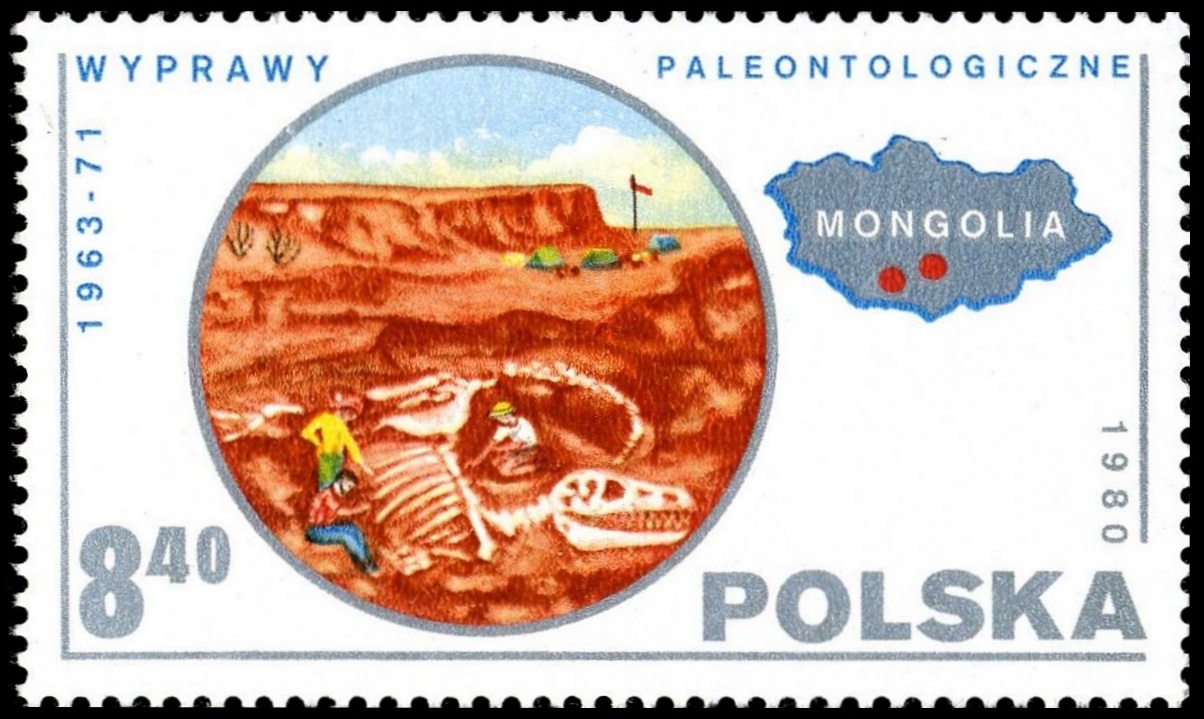
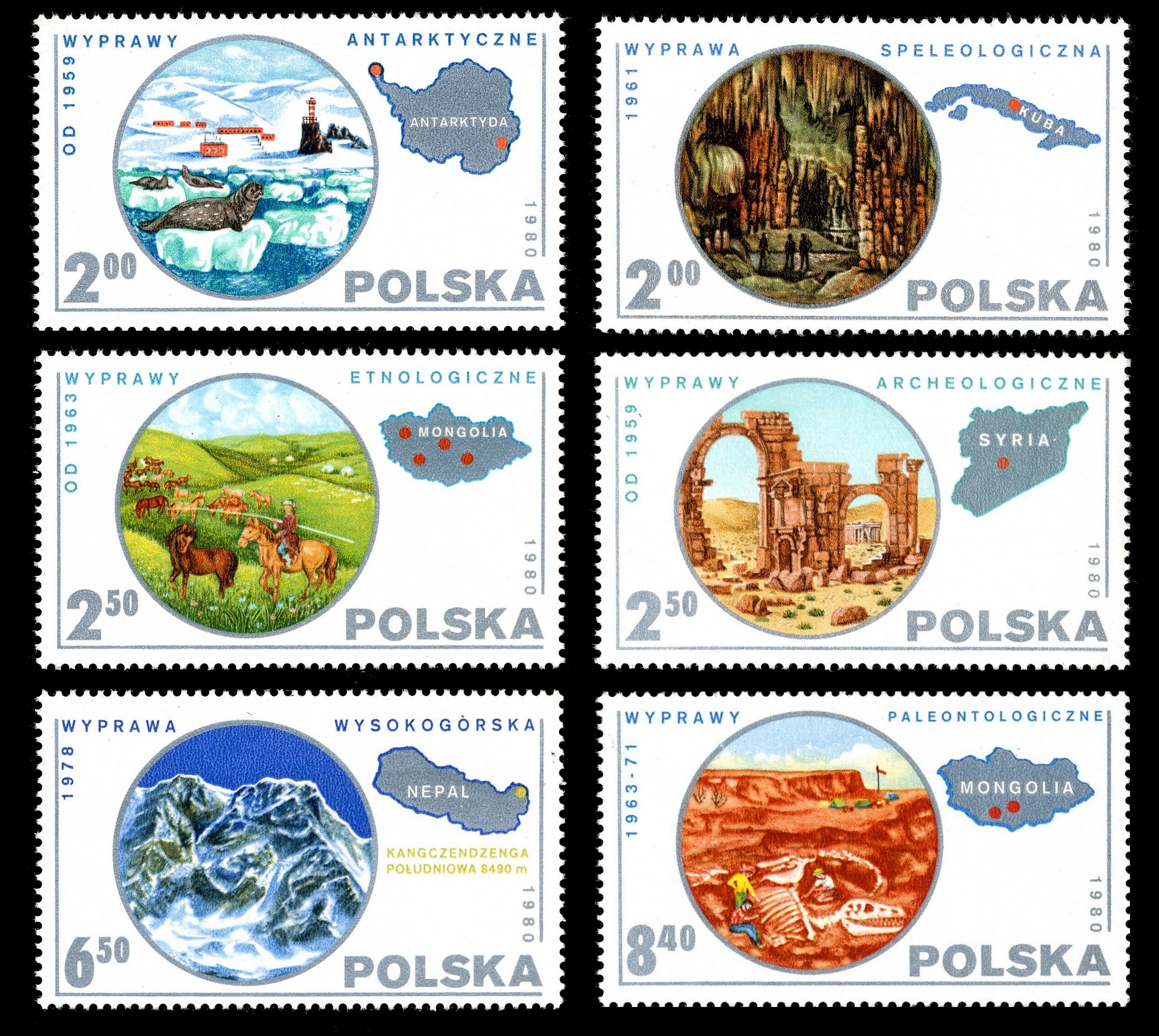
| Polish-Mongolian joint expeditions to the Gobi Desert began in 1963 and continued until 1971, recovering many new fossils, including new specimens of Tarbosaurus from the Nemegt Formation, commemorated on stamp of Poland 1980. MiNr.: 2691, Scott: 2395. |
|
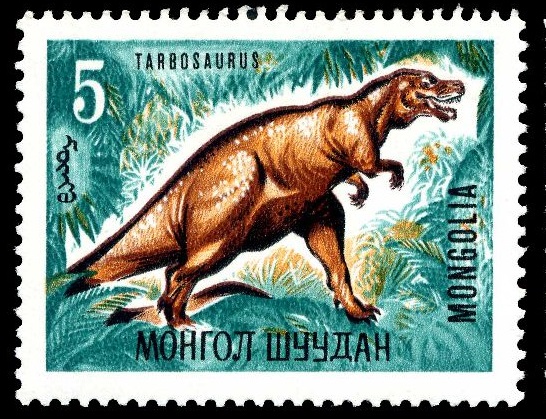
The first stamp of Tarbosaurus, Mongolia 1967, MiNr.: 460, Scott: 447. |

On May 17, 2013, the 70-million-year-old Tyrannosaurus bataar skeleton finally returned to its homeland. The delivery landed on “Chinggis Khaan” International Airport at 11:15 pm, where authorities from the Government including Head of the Office of the President P. Tsagaan, Minister of the Cabinet Office of the Government of Mongolia Ch. Saikhanbileg, Minister for Culture, Sports and Tourism Ts. Oyungerel and other officials were present to receive the Tarbosaurus bataar.
The fossils were packaged in 7 boxes and delivered by “Korean Air”. This is the first ever repatriated fossils and officials was saying dozens of dinosaur findings will be returned by air and ship transportation soon.
Products and associated philatelic items
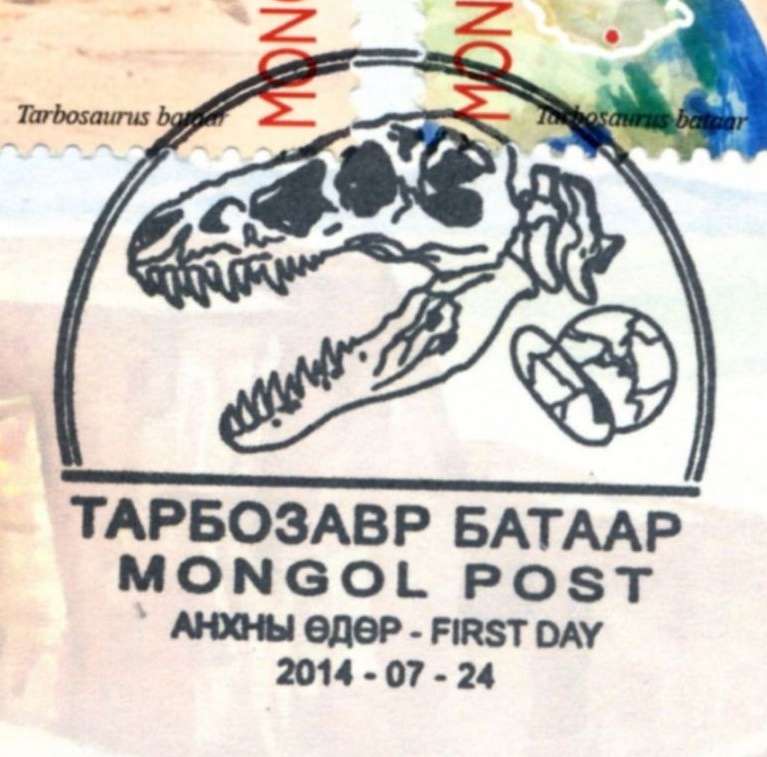
| FDC | First-Day-of-Issue Postmark | Stamp Sheets |
 |
 |
 |
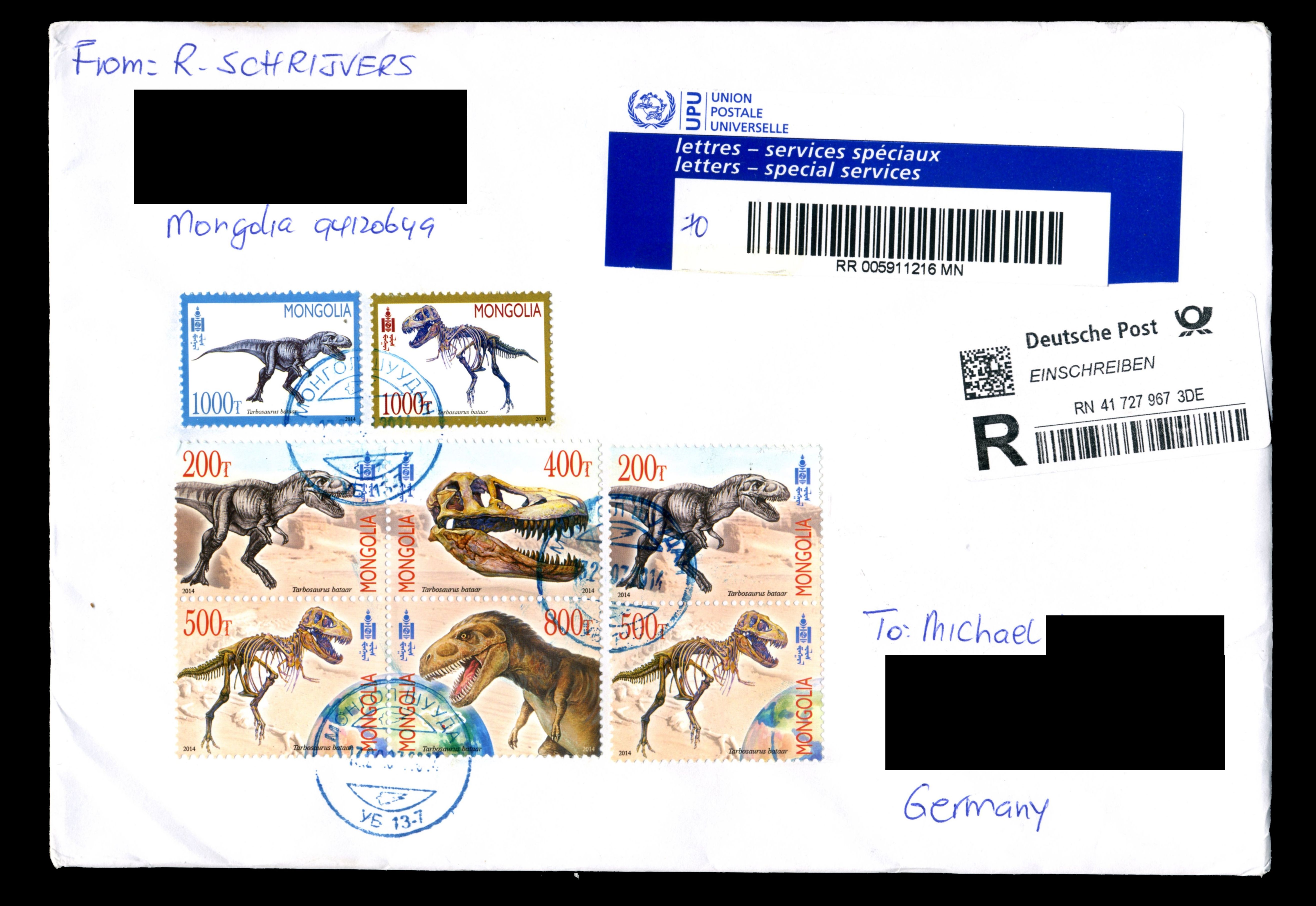
| Examples of circulated covers | ||
 |
 |
 |
| Registered letter mailed in 2014. | Postcard mailed in 2015. | Registered letter mailed in 2026. |
 |
|
|
| Commemorative cover mailed in 2023. | ||
References
-
Technical details and short description of the stamps:
Info Mongolia, News.mn, colnect. -
Stamps Presentation:
Ikon.mn. -
Tarbosaurus:
Wikipedia- The story of Tarbosaur bataar fossil - returns smuggled fossils to Mongolia :
Live Science, Slate, Nature World News.
- The story of Tarbosaur bataar fossil - returns smuggled fossils to Mongolia :
-
Central Museum of Dinosaurs of Mongolia:
Flyer of the Museum, Wikipedia, My Dinosaurs.
Acknowledgements
Many thanks to Dr. Peter Voice from Department of Geological and Environmental Sciences, Western Michigan University, for reviewing the draft page and his valuable comments.