Mongolia
Fossils, reconstruction of Dinosaurs and other prehistoric animals Charles Darwin on stamps and postmarks of Mongolia
Ulaanbaatar, the capital and largest city, is home to about 45% of the country's population of around 3 million people.
The country contains very little arable land, as much of its area is covered by grassy steppe, with mountains to the north and west and the Gobi Desert to the south.
Mongolia is one of the most important countries yielding abundant dinosaur remains.
Expedition parties by
American,
Russian (and the former
USSR), and
Polish researchers in partnership with Mongolian researchers have discovered
large numbers of dinosaur skeletons in the Gobi Desert.
Sea turtle and mollusc fossils have been found in the Gobi apart from the
more well-known dinosaur fossils.
The Mongols eventually retired to their original steppe homelands and in the late 17th century came under Chinese rule.
Mongolia won its independence in 1921 with Soviet backing and a communist regime was installed in 1924.
After the anti-Communist revolutions of 1989, Mongolia conducted its own peaceful democratic revolution in early 1990. This led to a multi-party system, a new constitution of 1992, and transition to a market economy.
The official language of Mongolia is Mongolian, and is spoken by 95% of the population, however they use the Cyrillic alphabet for writing, although in the past it was written using the Mongolian script. [R1]
The first stamps used in Mongolia were those of Russia from 1858 who operated a number of post offices in the country.
The first stamps of Mongolia were issued in August 1924, but still use Cyrillic text on it.
Until 1985, Mongolian Post issued 50 stamps a year on average. Beginning in 1986, the number of stamps issued per year grew. In 1998 and 2000 more than 200 stamps were produced.
Many of these stamps were connected with Mongol culture or history, but many others featured popular global subjects, cartoon characters and individuals from sports and entertainment, including Elvis Presley and Marilyn Monroe.
This gives an impression that in the 1990s the Mongol Post had two separate stamp issuing programs, one catering for local needs by issuing stamps designed by local artists and depicting national culture, and the other one, appealing to topical collectors world-wide, with most stamps designed by IGPC. [R2]
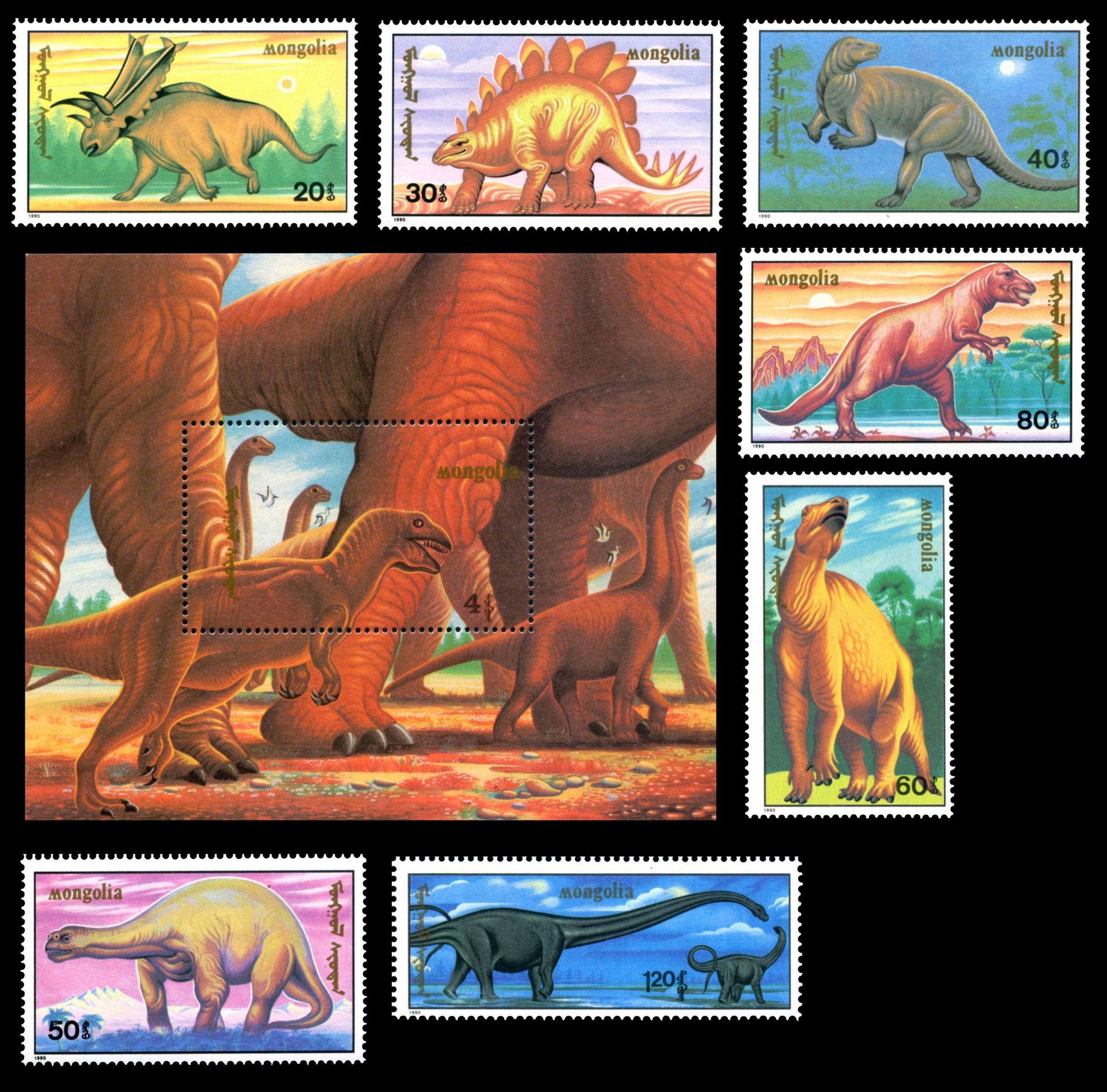
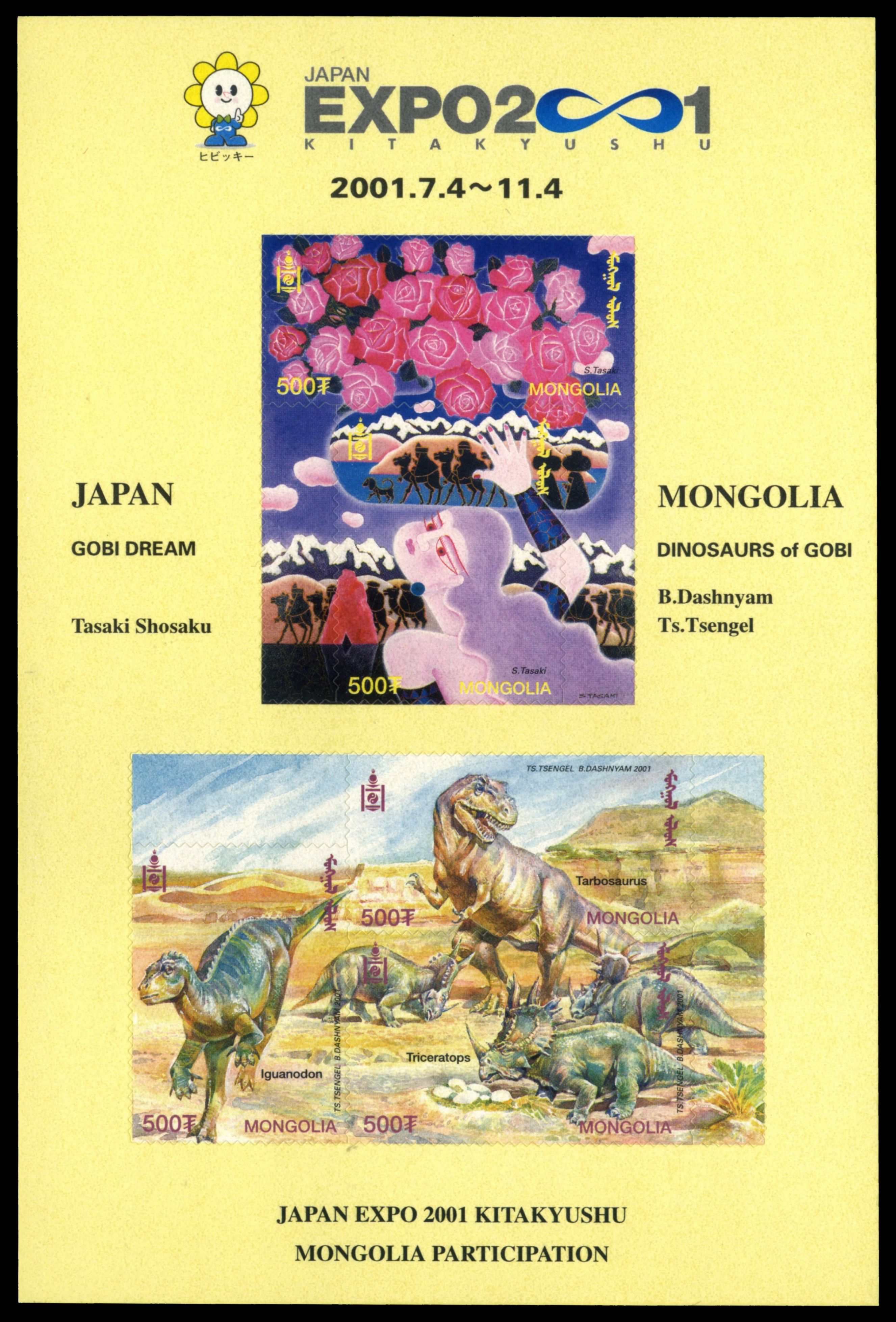
Official stamps of Mongolia related to Paleontology: dinosaurs and other prehistoric animals
| 31.03.1967 "Prehistoric Animals" | 07.05.1977 "Prehistoric Animals" | 17.08.1990 "Dinosaurs" |
 |
 |
|
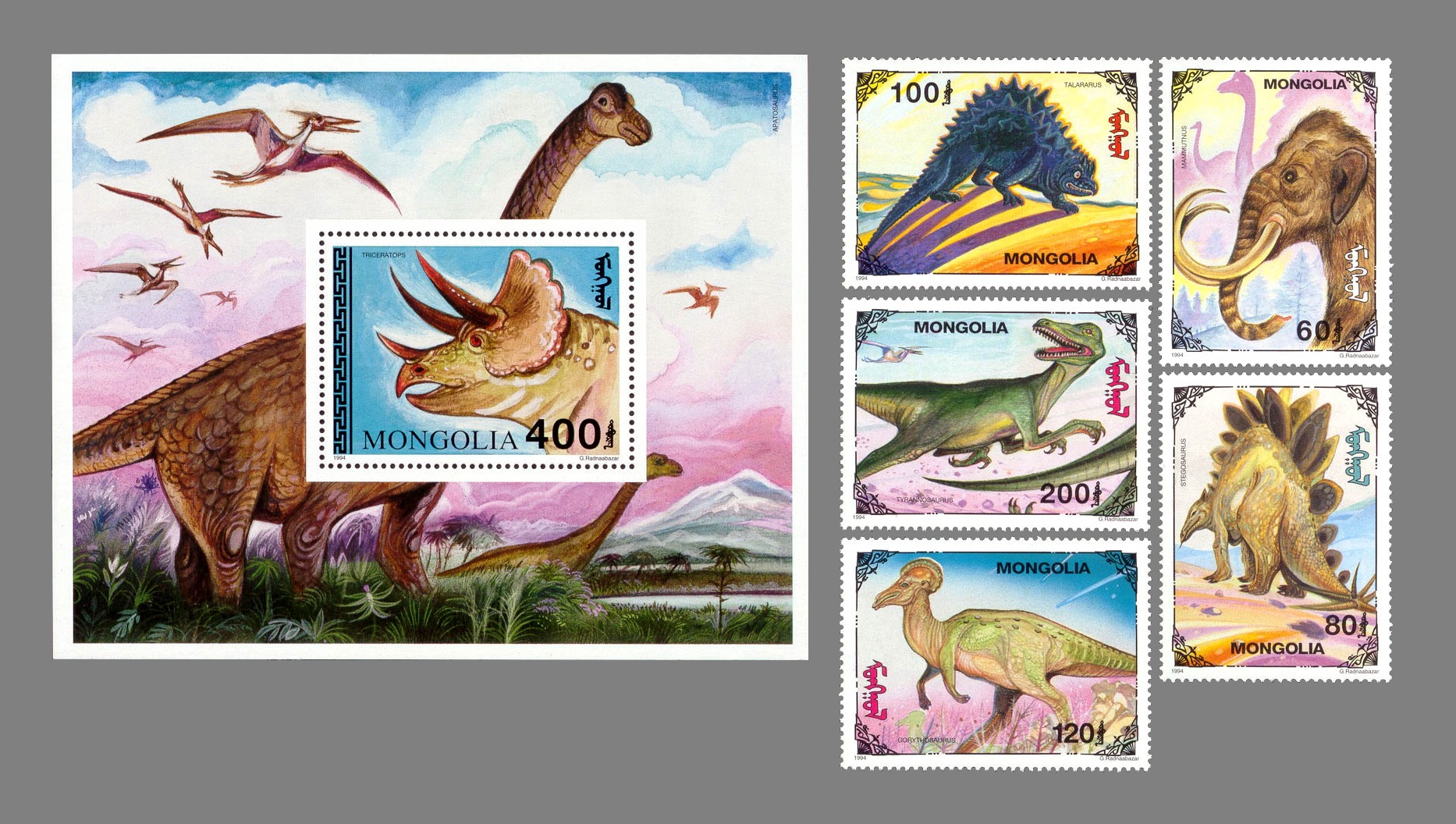
| 30.11.1994 "Prehistoric Animals" [1] | 05.10.2000 "Millennium of Exploration" [2] | 01.07.2001 "Japan: Expo 2001" |
 |
 |
 |
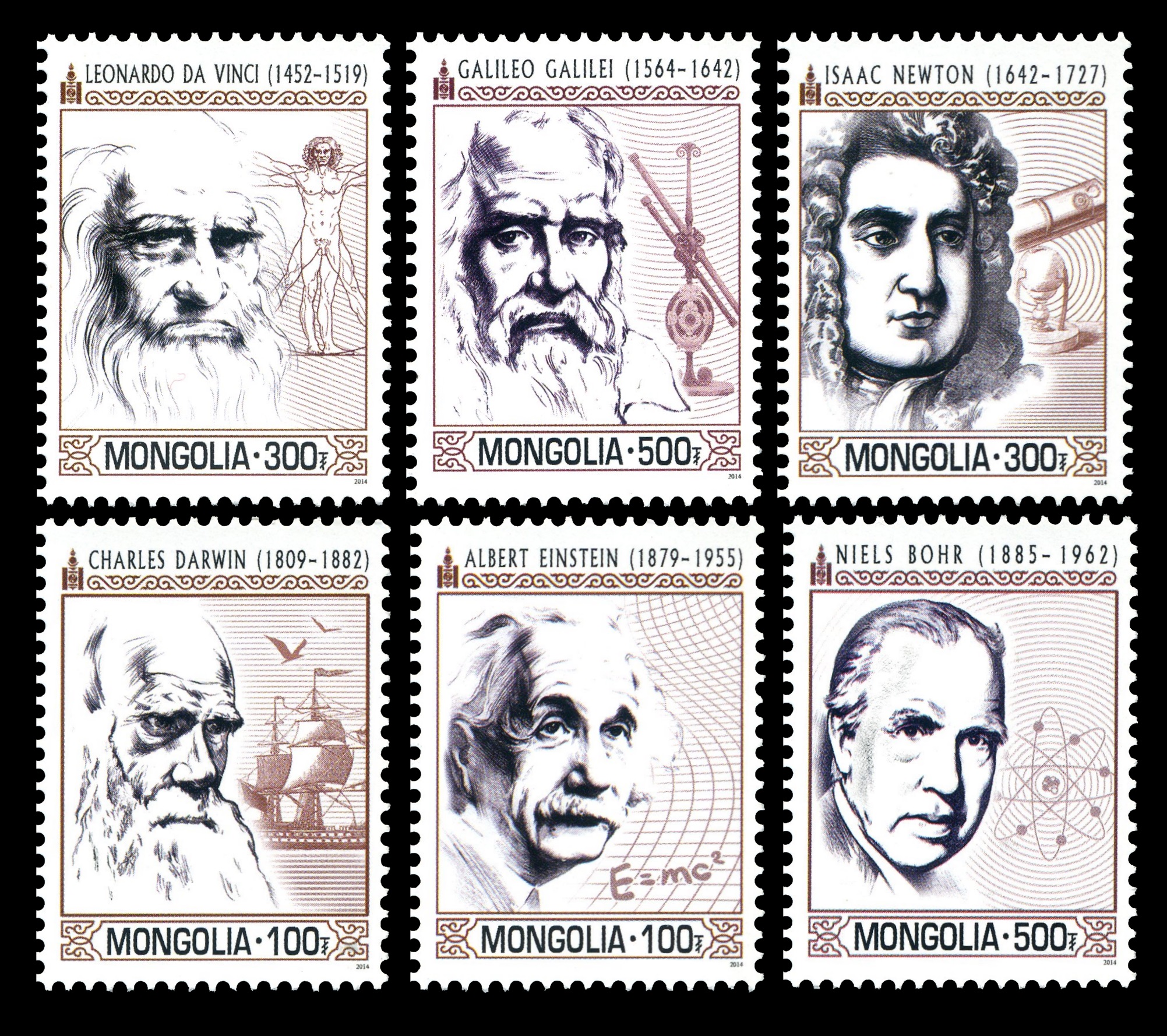
| 11.07.2003 "Visit Mongolia" [3] | 01.02.2006 "Europa" [4] | 25.03.2014 "Famous personalities" [5] |
 |
 |
 |
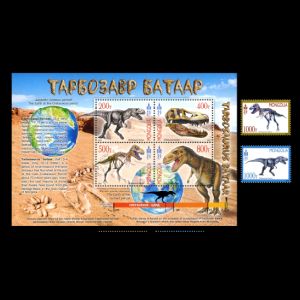
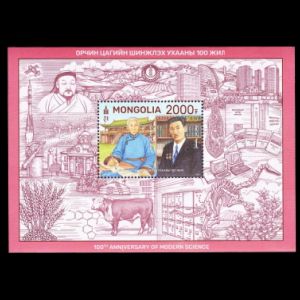
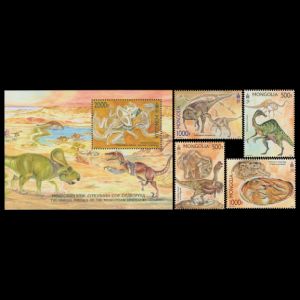
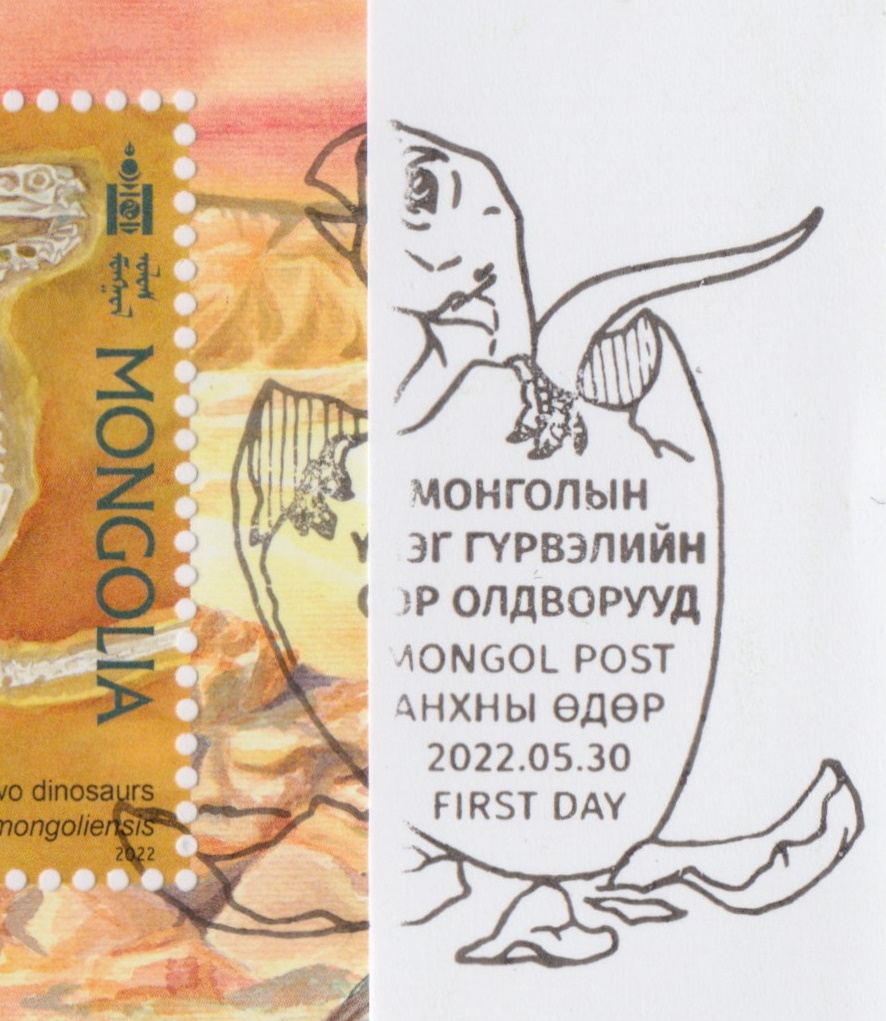
| 24.07.2014 "Tarbosaurus batar" | 24.12.2021 "100th Anniversary of Modern Science" [6] | 30.05.2022 "The Unique Findings Of The Mongolian Dinosaurs" |
 |
 |
 |
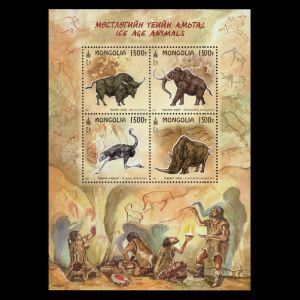
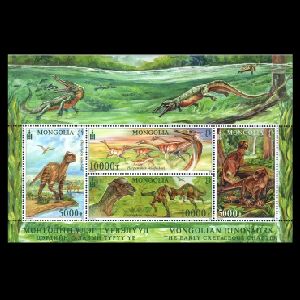
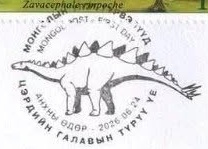
| 21.12.2023 "Ice Age Animals" | 24.06.2026 "Mongolian Dinosaurs, the Early Cretaceous" | |
 |
 |
|
Notes:
[1] The prehistoric animals on these stamps look cartoonish instead of as reconstructions.
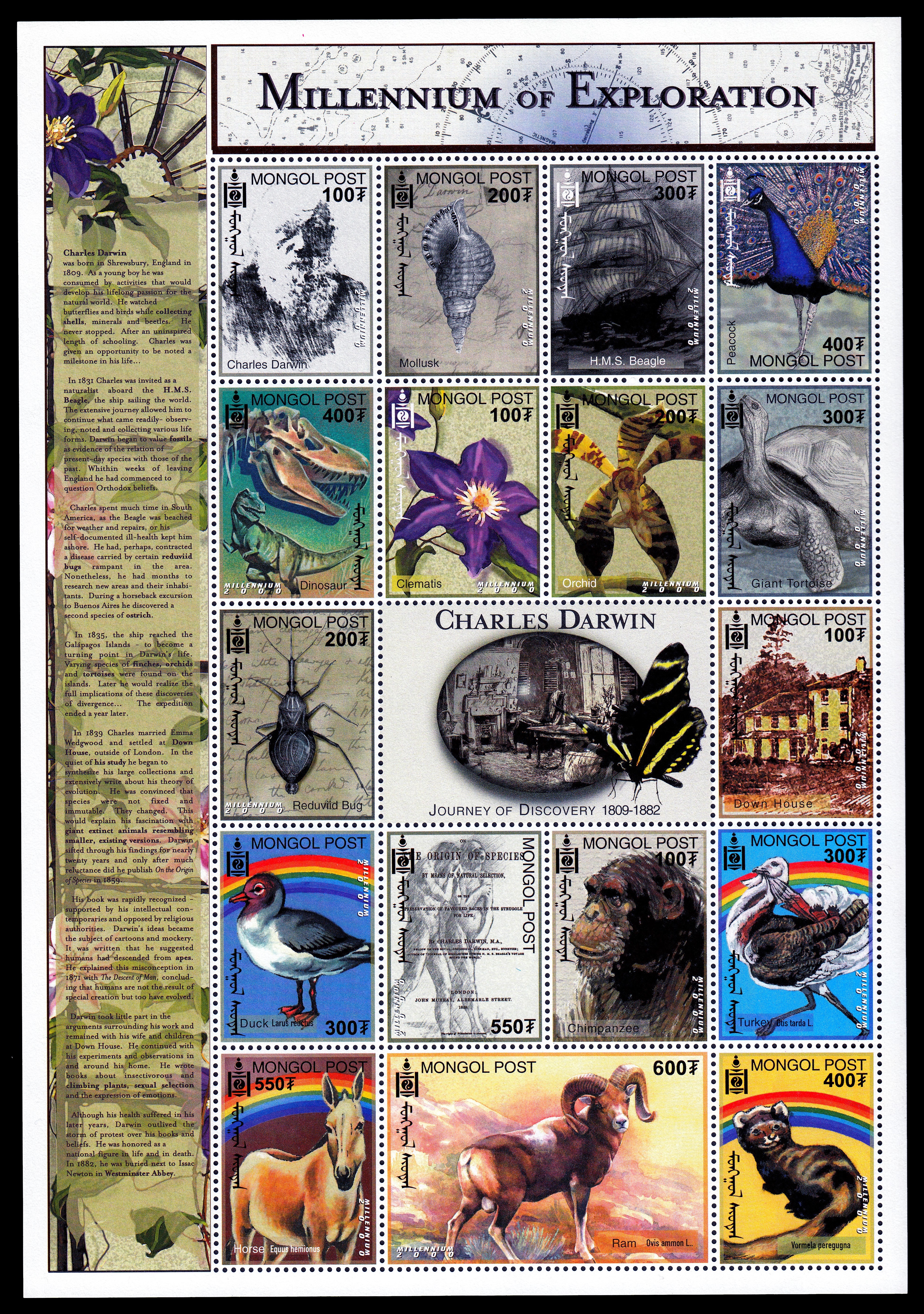
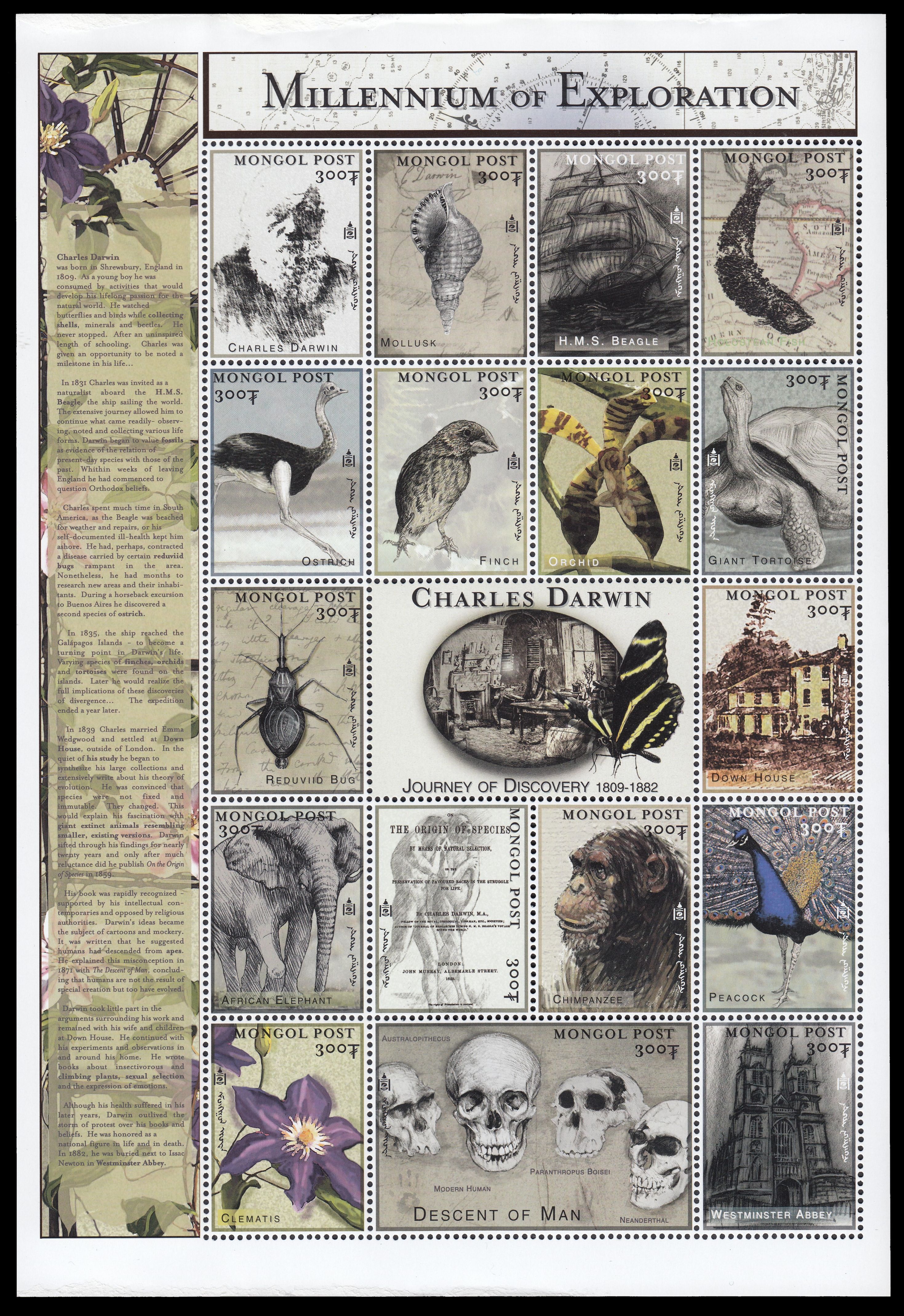
[2] In October 2000 Post Authority of Mongolia issued a mini sheet with 17 stamps with the subject "Millennium of Exploration".
|
|
|
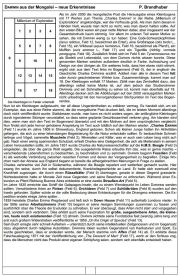
| Charles Darwin on stamps of Mongolia 2000 MiNr.: 3213-3229, Scott: | Charles Darwin on unadapted stamps of Mongolia | German Article about Mongolian stamp of Darwin 2000 |
Another strange feature is the text on the left side of the sheet - all about Charles Darwin: his life, voyage on HMS Beagle around the world his explorations, theory of evolution, but many stamps have nothing to do with Darwin.
The skull of theropod dinosaur, perhaps Tarbosaurus bataar, most famous dinosaur of Mongolia, is shown on the first stamp in the second row. Only few Dinosaur species were known at Charles Darwin time. Fossils of Tarbosaurus were discovered in 1946, 64 years after Charles Darwin's death. Przewalski's horse, ram, duck, turkey and marbled are inhabitants in Mongolia, but have nothing to do with Darwin too.
Initially, a different set of stamps are planed for the issue (see image in the middle) - all about Charles Darwin's life, every stamp corresponds to a paragraph on the left side of the sheet when all stamps were designed in the same style. For some reason, 7 of the 17 stamps were replaced at the last moment by stamps that have nothing to do with Charles Darwin. Instead, these new stamps represent modern and prehistoric life of Mongolia. Only a few examples of the original mini sheets survived, perhaps as a small production run to confirm the designs.
These stamps are extremely rare and not listed in stamps catalogs.
Note: Some of these stamp sheets appeared on the internet in 2021 at a very low price. Most likely they are fakes.
According to a fellow collector, Peter Brandhuber, who has the original stamp sheet, purchased from a Mongolian dealer in 2000, the new sheets are printed on a different type of paper.
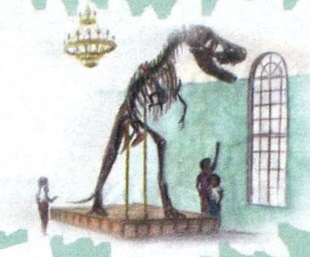
[3] Fossilized skull of Tarbosaurus shown on margin of one of mini-sheets. [R4]
[4] In February 2006 Post Authority of Mongolia issued a set of 12 stamps "50 years of EUROPA stamp” showing various sightseeing locations across the country.

|

|
|
| Tarbosaurus bataar on EUROPA stamp of Mongolia 2006. MiNr.: 3590A, Scott: 2612g | Tarbosaurus bataar on EUROPA stamp of Mongolia 2006. MiNr.: 3590B, Scott: 2613g | Zoomed dinosaur image from the Mongolian EUROPA stamp from 2006. |
One of the stamps shows fossilized skeleton of Tarbosaurus bataar - the most famous dinosaur of Mongolia.
Tarbosaurus is a genus of tyrannosaurid theropod dinosaur that flourished in Asia about 70 million years ago, at the end of the Late Cretaceous Period. Fossils have been recovered in Mongolia, with more fragmentary remains found further afield in parts of China.
Although many species have been named, modern paleontologists recognize only one, Tarbosaurus bataar, as valid.
Some experts see this species as an Asian representative of the North American genus Tyrannosaurus; this would make the genus Tarbosaurus redundant. Tarbosaurus and Tyrannosaurus, if not synonymous, are considered to be at least closely related genera. Alioramus, also from Mongolia, is thought by some authorities to be the closest relative of Tarbosaurus. [R4] [R5]
[5] Charles Darwin shown on one of the stamps.
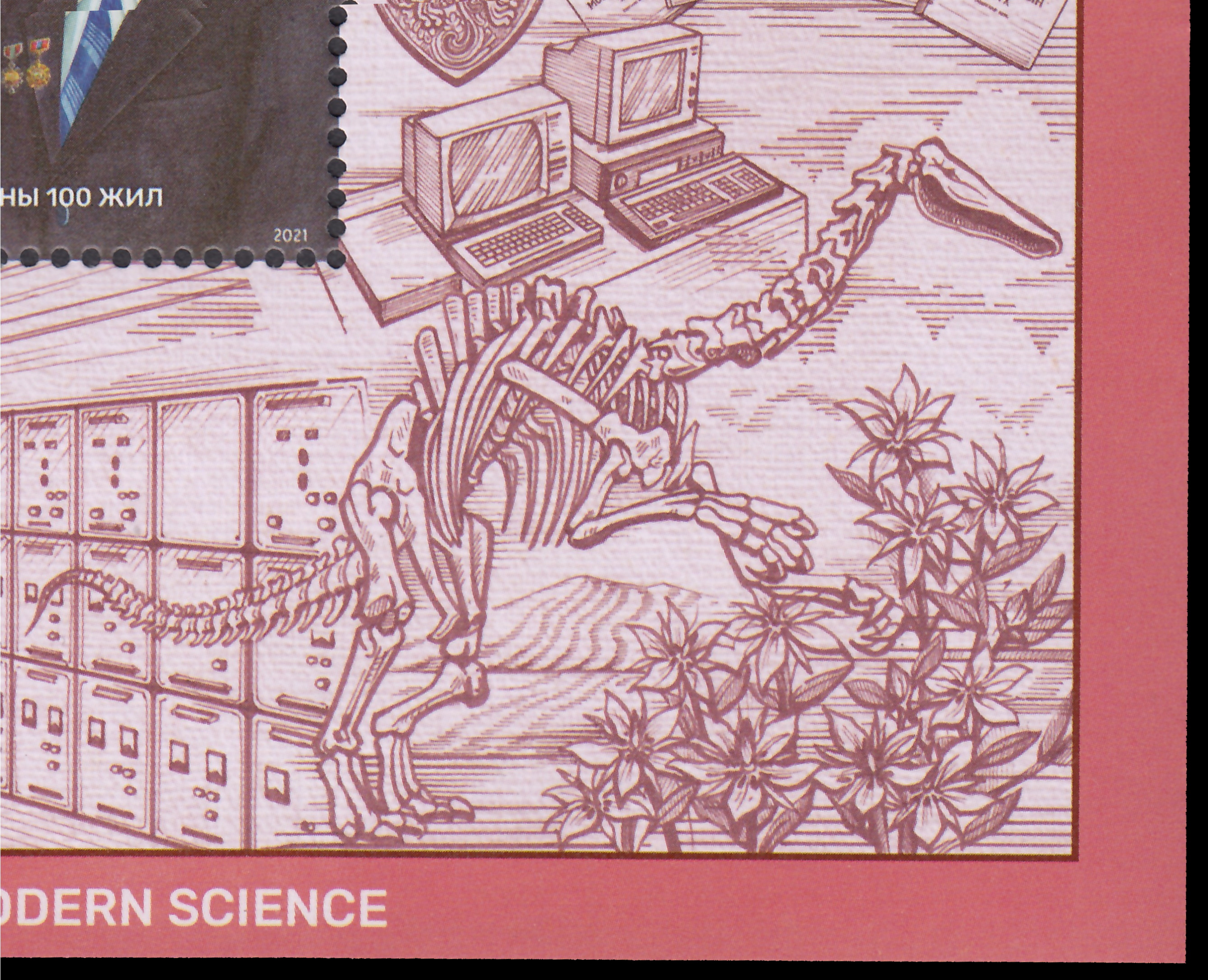
[6] The dinosaur's skeleton on the left-right side of the Souvenir-Sheet, is the Deinocheirus mirificus.
 |
 |
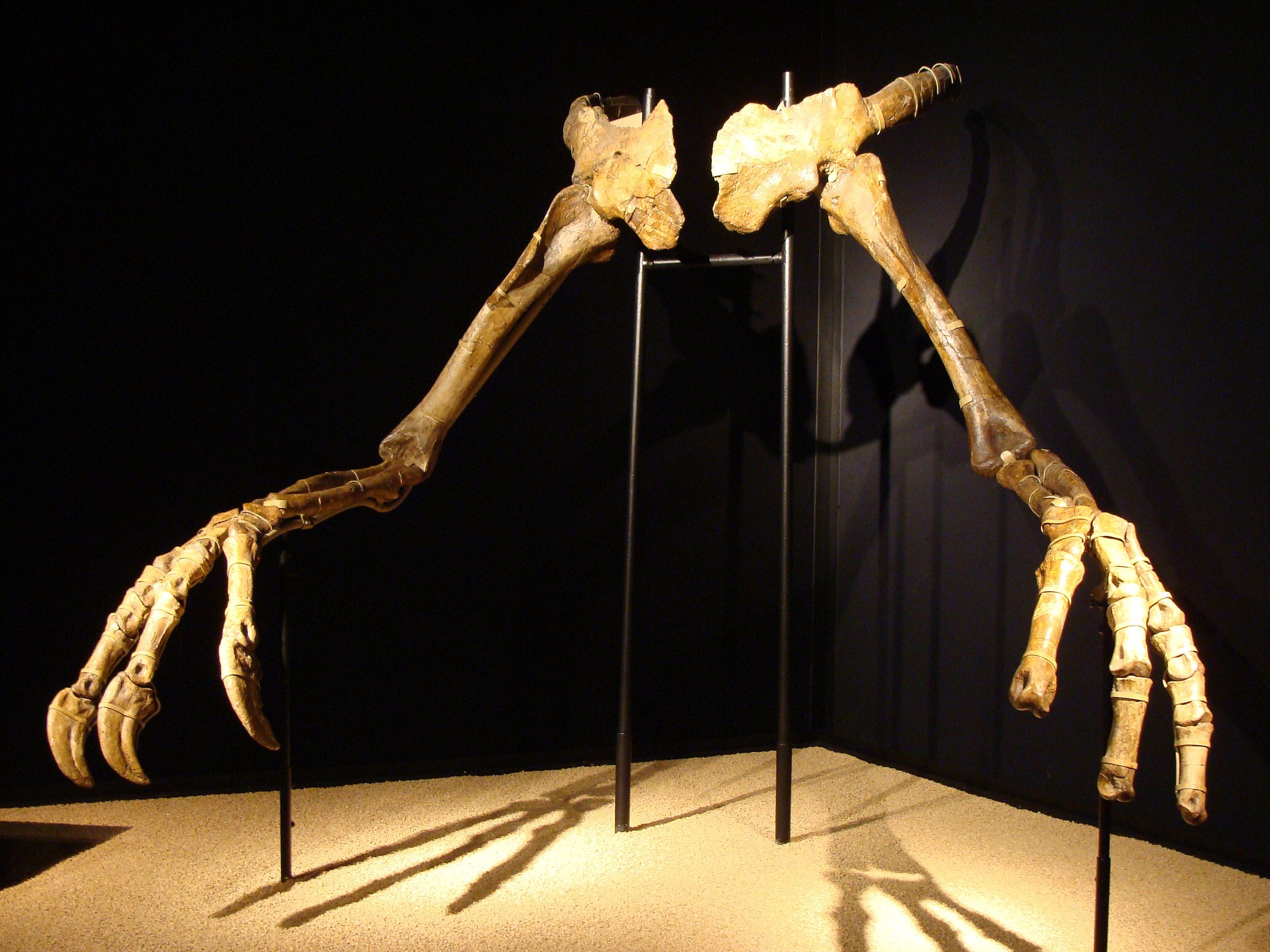 |
| Dinosaur on margin on 100th Anniversary Of Modern Science Souvenir Sheet of Mongolia 2021 | Skeleton and arms of Deinocheirus mirificus, Image credit: Wikipedia. | |
Deinocheirus is a genus of large ornithomimosaur that lived during the Late Cretaceous
around 70 million years ago.
In 1965, a pair of large arms, shoulder girdles, and a few other bones of a new dinosaur were first
discovered in the Nemegt Formation of Mongolia, by Polish paleontologists f
rom Polish-Mongolian paleotological expedition (1963-1965).
In 1970, this specimen became the holotype of the only species within the genus, Deinocheirus mirificus;
the genus name is Greek for "horrible hand".
No further remains were discovered for almost fifty years, and its nature remained a mystery.
Two more complete specimens were described in 2014, which shed light on many aspects of the animal.
Parts of these new specimens had been looted from Mongolia some years before, but were repatriated in 2014.
[R6]
Other stamps to consider
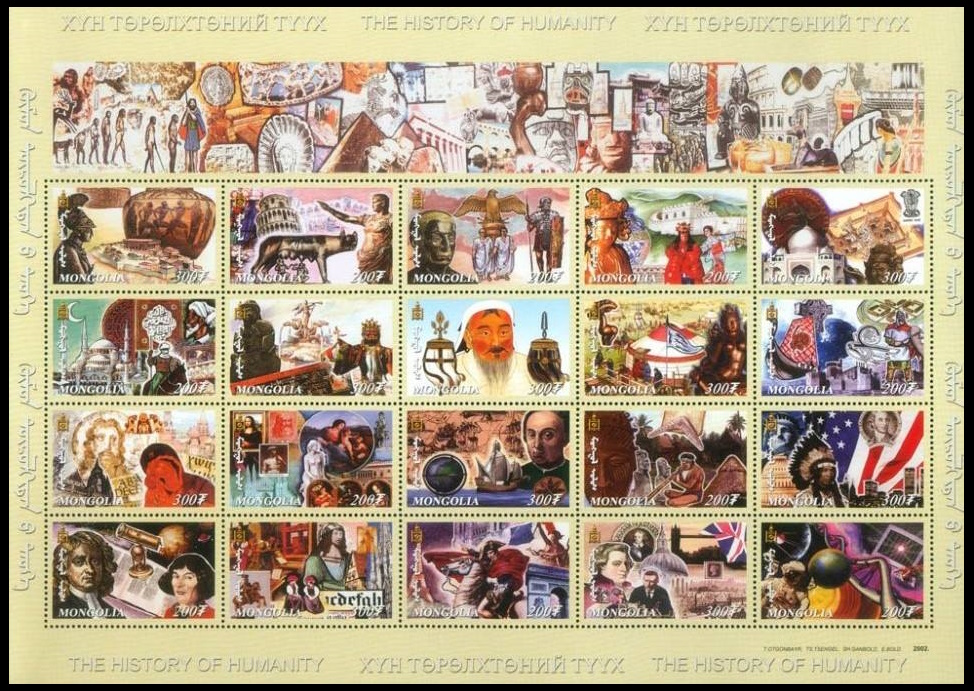
| 01.12.1980 "Antarctic Animals and Exploration" [A1] | 30.12.2001 "The history of humanity" [A2] | |
 |
 |
|
Notes:
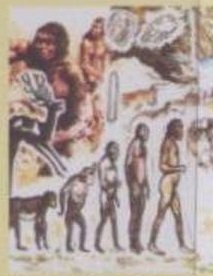 |
| Human evolution sequence and some cave paintings are shown on a sheet margin at the top-left corner. |
|
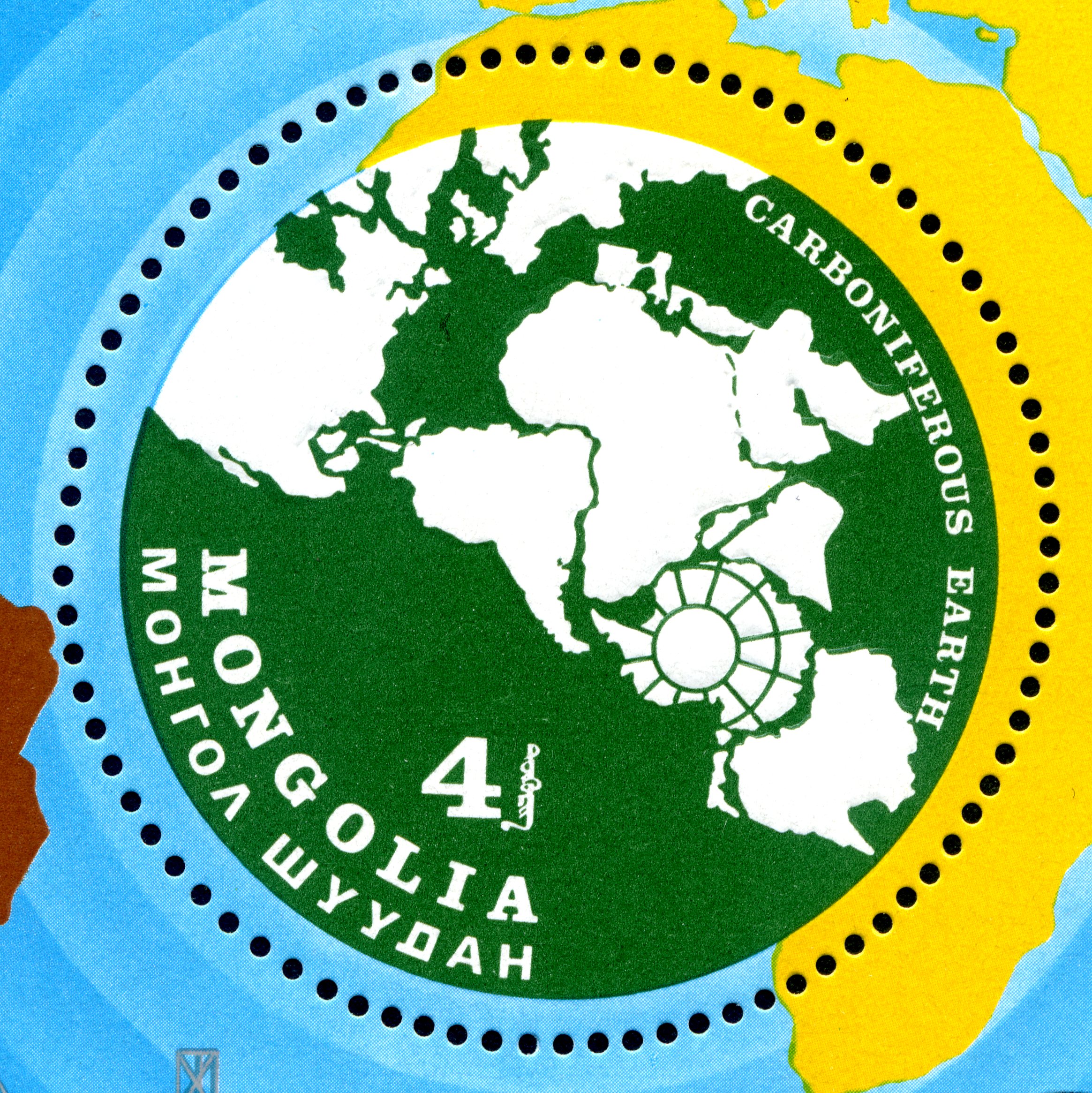
| Continents maps at Carboniferous period on stamp of Mongolia 1980. MiNr.: Bl.67, Scott: |
The Carboniferous Period lasted from about 359.2 to 299 million years
ago during the late Paleozoic Era. The term "Carboniferous" comes from England, in reference
to the rich deposits of coal that occur there.
These deposits of coal occur throughout northern Europe, Asia, and midwestern and eastern North America.
A major marine and terrestrial extinction event occurred in the middle of the period, caused by climate change.
The later half of the period experienced glaciations, low sea level and mountain building as the continents
collided to form Pangaea.
The Carboniferous was a time of active mountain-building, as the supercontinent Pangaea came together.
The southern continents remained tied together in the supercontinent Gondwana, which collided with
North America–Europe (Laurussia) along the present line of eastern North America.
[R3]
[A2] Human evolution sequence and some cave paintings are shown on a sheet margin at the top-left corner (zoomed image on the right).
Commemorative postmarks of Mongolia related to Paleontology: dinosaurs
Legend is here
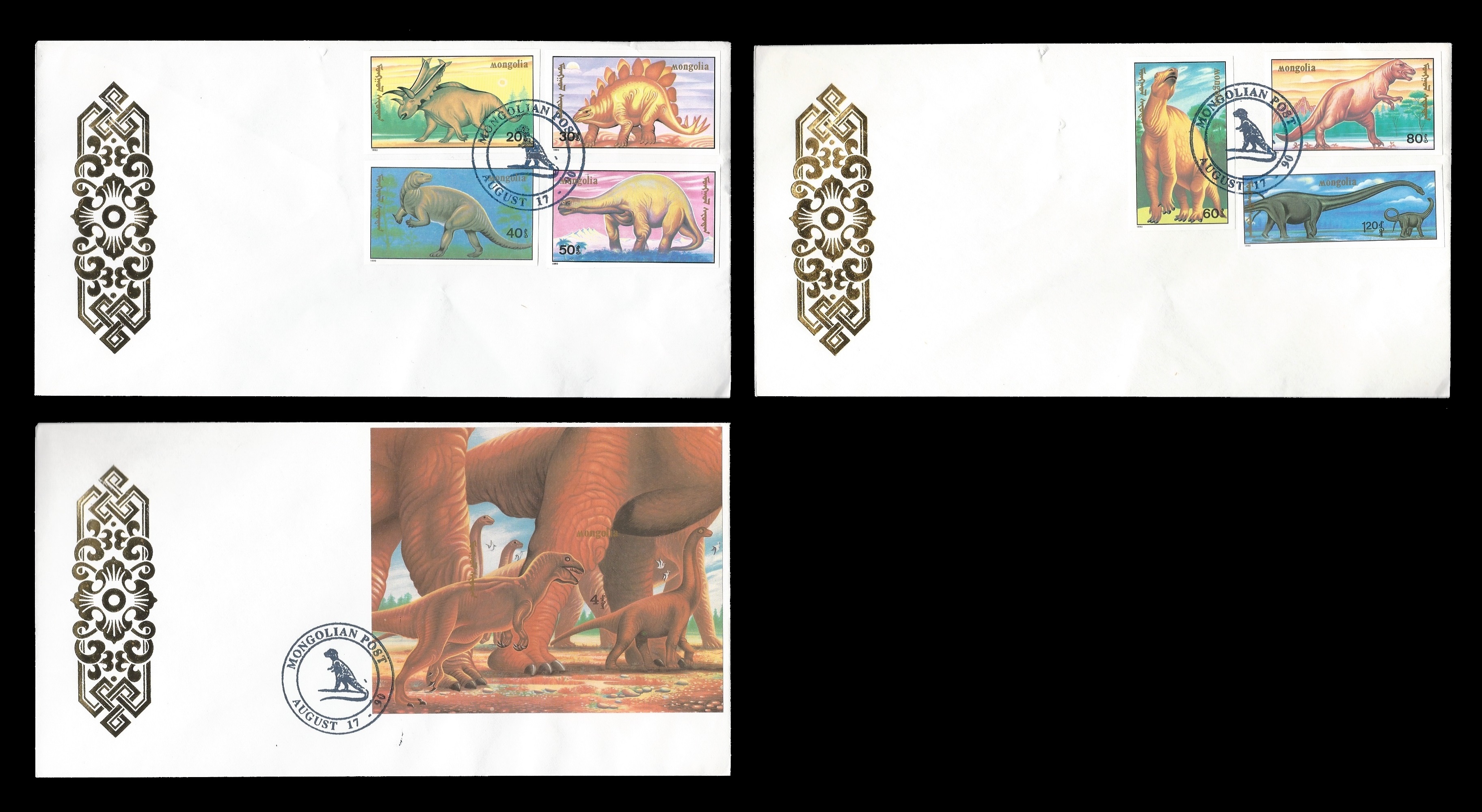
| 17.08.1990 "Dinosaurs" [FDC] | 24.07.2014 "Tarbosaurus batar" [FDC] | 30.05.2022 "The Unique Findings Of The Mongolian Dinosaurs" [FDC] |
 |
 |
 |
| 24.06.2026 - 2026 "Mongolian Dinosaurs, the Early Cretaceous" [FDC] | ||
 |
||
Some commemorative postmarks to consider: contributors to Paleoanthropology
Legend is here
| 21.12.2023 "Ice Age Animals" [FDC] | ||
 |
||
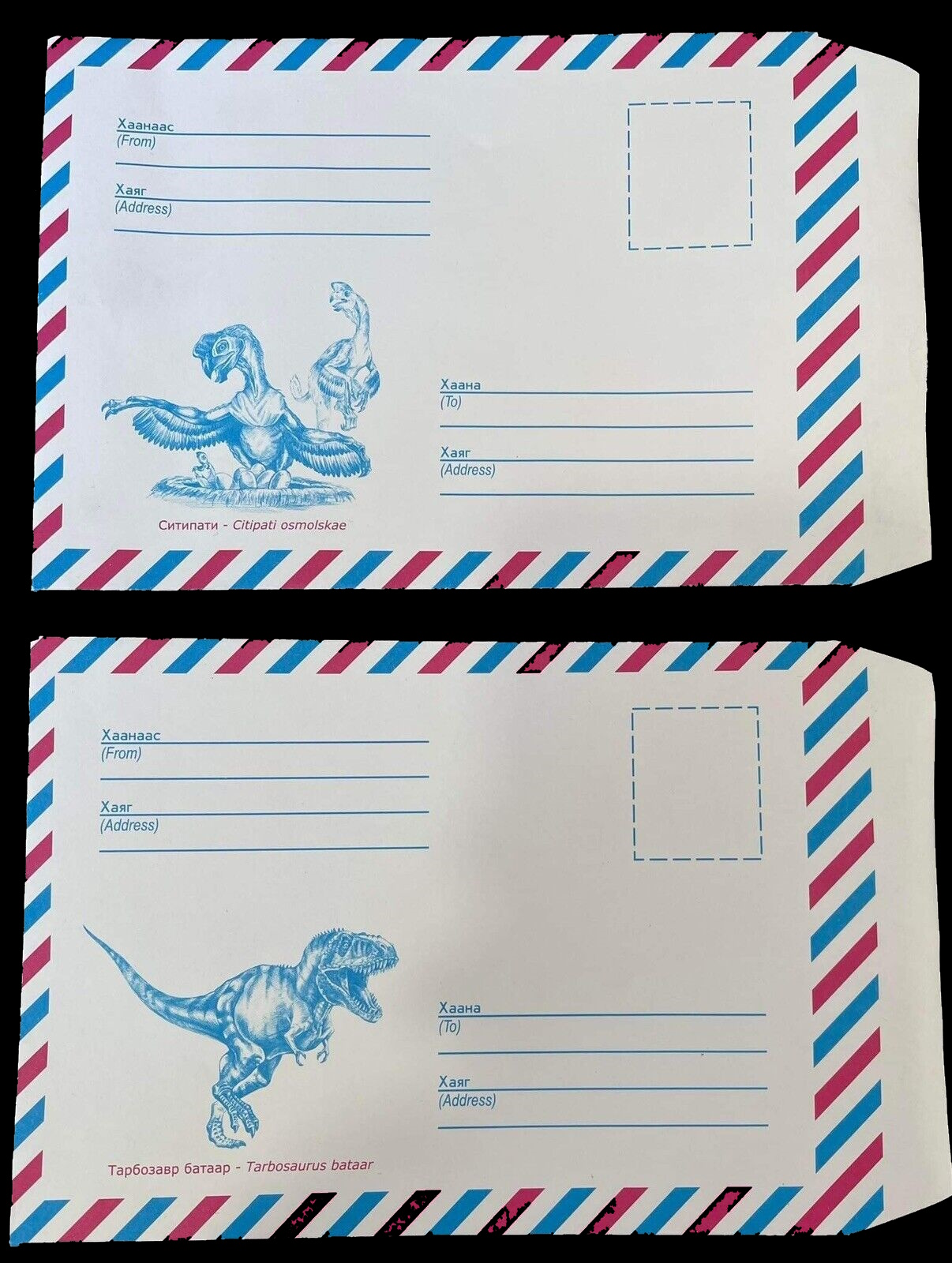
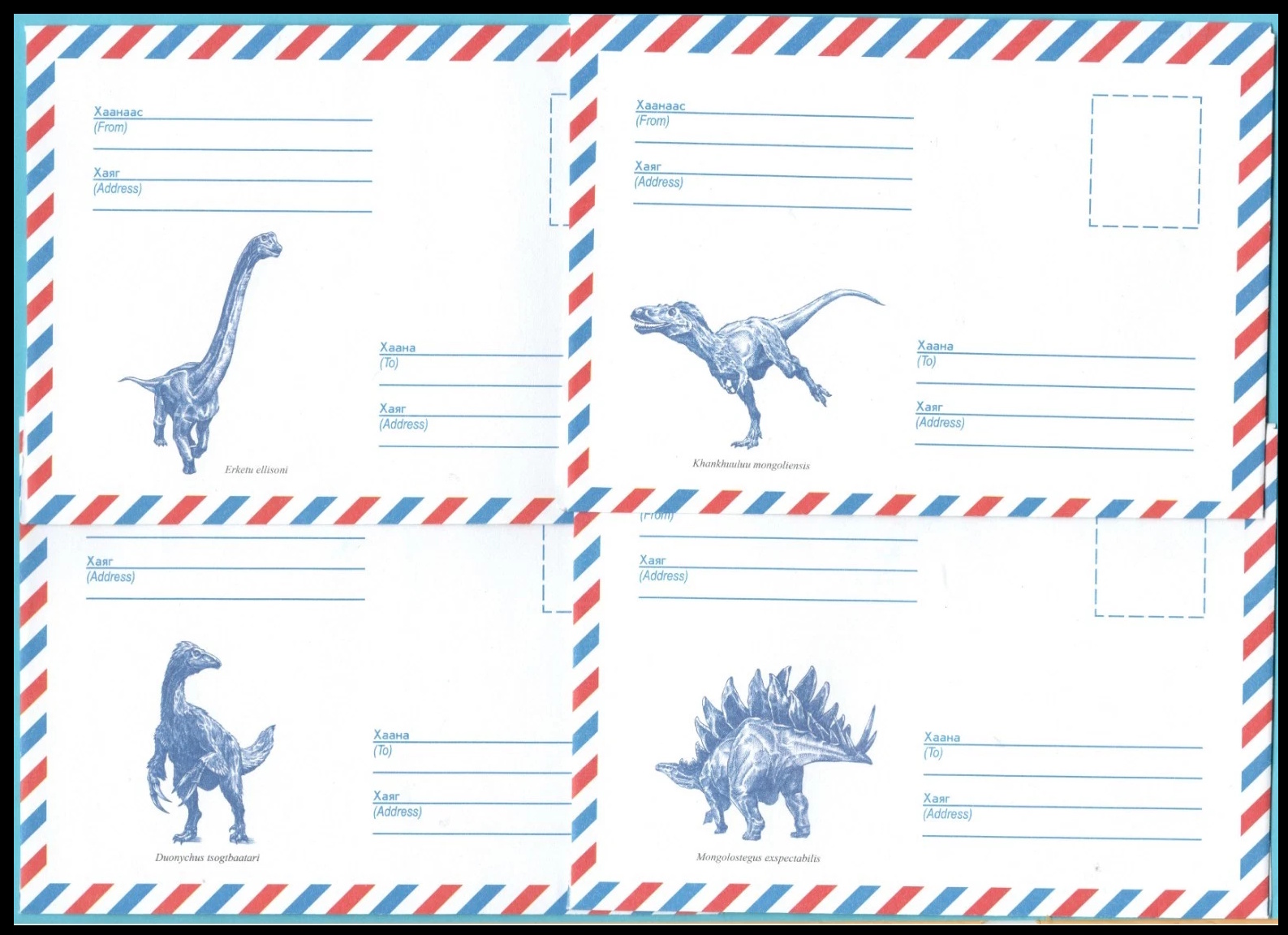
Commemorative covers of Mongolia related to Paleontology
| 2023 "Dinosaurs" | 2026 "Dinosaurs" | |
 |
 |
|
References
- [R1] Mongolia: Wikipedia, WikiTravel FlagCounter
- [R2] Postal History and Philately of Mongolia:
Wikipedia,
"In quest for abusive and undesirable stamp issues" by Jari Majander, published in Nr. 29 of TCNews (p. 24-64),
Links to official website of the Post Authority, stamp catalog and a list of new stamps of Mongolia are here - [R3] Carboniferous:
Wikipedia,
University of California websites.
- [R4] Tarbosaurus: Wikipedia,
- [R5] EUROPA stamps of Mongolia 2006: "Mongolia and Europe stamps CEPT study on the 50th anniversary series of the first Europe stamps issued by Mongolia in 2006", by Romina Aimar, ISBN: 978-987-8344-07-2.
- [R6] Deinocheirus: Wikipedia, National Geographic,
Acknowledgements
- Many thanks to fellow collector Peter Brandhuber for information about "Millennium of Exploration" issue of Mongolia 2000 and his article (in German) about the sheet.
- Many thanks to Dr. Peter Voice from Department of Geological and Environmental Sciences, Western Michigan University, for reviewing the draft page and his valuable comments.