Letter from Alexander Nasmyth to William Buckland, 1838
 |
| Letter from Alexander Nasmyth to William Buckland, 1838 |
The letter addressed to "Dr. Buckland, Christ Church, Oxford", written and sealed by Alexander Nasmyth, dentist of Hanover Square, London. It was posted between November 25th and 28th 1839, charged 8d (eight Penny) and marked as "PAID" by the sender. The black boxed handstamp says "NEW BO", a London postal marking indicating the letter was posted from New Bond Street's post office (only few minutes walking from the Hanover Square).
 |
 |
| "PAID" had stamps of London | The seal of Alexander Nasmyth |
The reverse side of the cover bears a red wax seal with Nasmyth’s monogram and the family crest: the hand holding a sword palewise Argent, between two broken hammers, which symbolizes strength through labor and the legacy of craftsmanship.
The letter was addressed to a leading geologist and paleontologist of the time, Professor of Geology at the University of Oxford – William Buckland who was the first Reader in Geology at Oxford, appointed in 1818, and still actively held the post in 1838. His correspondence was often sought for both geological advice and fossil access.
In this letter, Alexander Nasmyth respectfully requests William Buckland’s assistance in locating fossil teeth specimens. Nasmyth explains that he is preparing a publication based on his investigations into the structure of teeth, including comparisons between fossil and living species.
He mentions that his research builds on, but also differs from, the earlier work of a prominent Swedish anatomist and anthropologist Anders Retzius (notably known for identifying growth lines in enamel, or "Striae of Retzius"). Retzius is particularly known for his work on tooth and bone microstructure, and in this case, Nasmyth is referencing Retzius's influential research on the internal structure of teeth. Retzius was one of the first scientists to systematically study the microscopic structure of enamel and dentin, contributing to both comparative anatomy and paleontology.
Nasmyth emphasizes that his approach and methods are original and that he aims to present these findings in a manner useful to geologists. His hope is that Buckland, as a leading figure in geology and paleontology, might know of or have access to relevant fossil material. This letter reflects the collaborative and interdisciplinary nature of early 19th century science, particularly between the emerging fields of anatomy and geology.
Here is the content of the letter:
In the following year (1839) Alexander Nasmyth published the book "Researches on the Development, Structure, and Diseases of the Teeth" in which he discussed a structure in tooth enamel (later named after him “Nasmyth's membrane”) and mentioned several fossil teeth of horse, elephant and Orycteropus. He also made some references to publications of the most famous paleontologist of that time - Georges Cuvier. In this work Alexander Nasmyth conducted a comprehensive study of dental anatomy, focusing on both living and fossilized specimens. This comparative approach was intended to shed light on the development and structural variations of teeth across different species and time periods.13A George Street, Hanover Square, 25 November 1838.
The letter from Alexander Nasmyth to Prof. William Buckland, written on November 25th, 1838.
Sir, Might I request the favour of you to inform me whether at present you know of any fossils which are to be disposer of containing teeth. I have been for a long time preparing for press a series of investigations on the structure of the teeth combining those of Retzius. I mean to give delineation of the appearances observable in as many fossil teeth as I can get hold of in connection with those I have already prepared of living species. My observations having been conducted on other principles than those who have gone before me have led me to results considerably different, and having adopted a more simple and better plan for preparing the Lectures, the whole I think may prove useful to the Geologist. If you can direct me to any thing which can be obtained I shall feel particularly obliged, and trust you will excuse the liberty I take thus troubling you, and believe me
Sir Very Respectfully
Your Obst St [Your Obedient Servant]
Alexr Nasmyth

Nasmyth's investigations were notable for their use of microscopy to analyze the enamel and dentin structures of teeth, contributing significantly to the understanding of dental histology. His work laid the groundwork for future studies in both dentistry and paleontology.
Note: The author was unable to locate a response from William Buckland to Alexander Nasmyth’s 1838 letter in the Bodleian Library and other known archives. If such a reply exists, the author would be sincerely grateful for any assistance in locating it.
The archive of the Oxford University Museum of Natural History contain the letter from Professor Richard Owen to William Buckland, written on December 12th, 1838 (WB/A/1/341) which mentioned Owen and Nasmyth receiving a notice from Buckland. Owen implied that he introduced Nasmyth to Anders Retzius’ work.
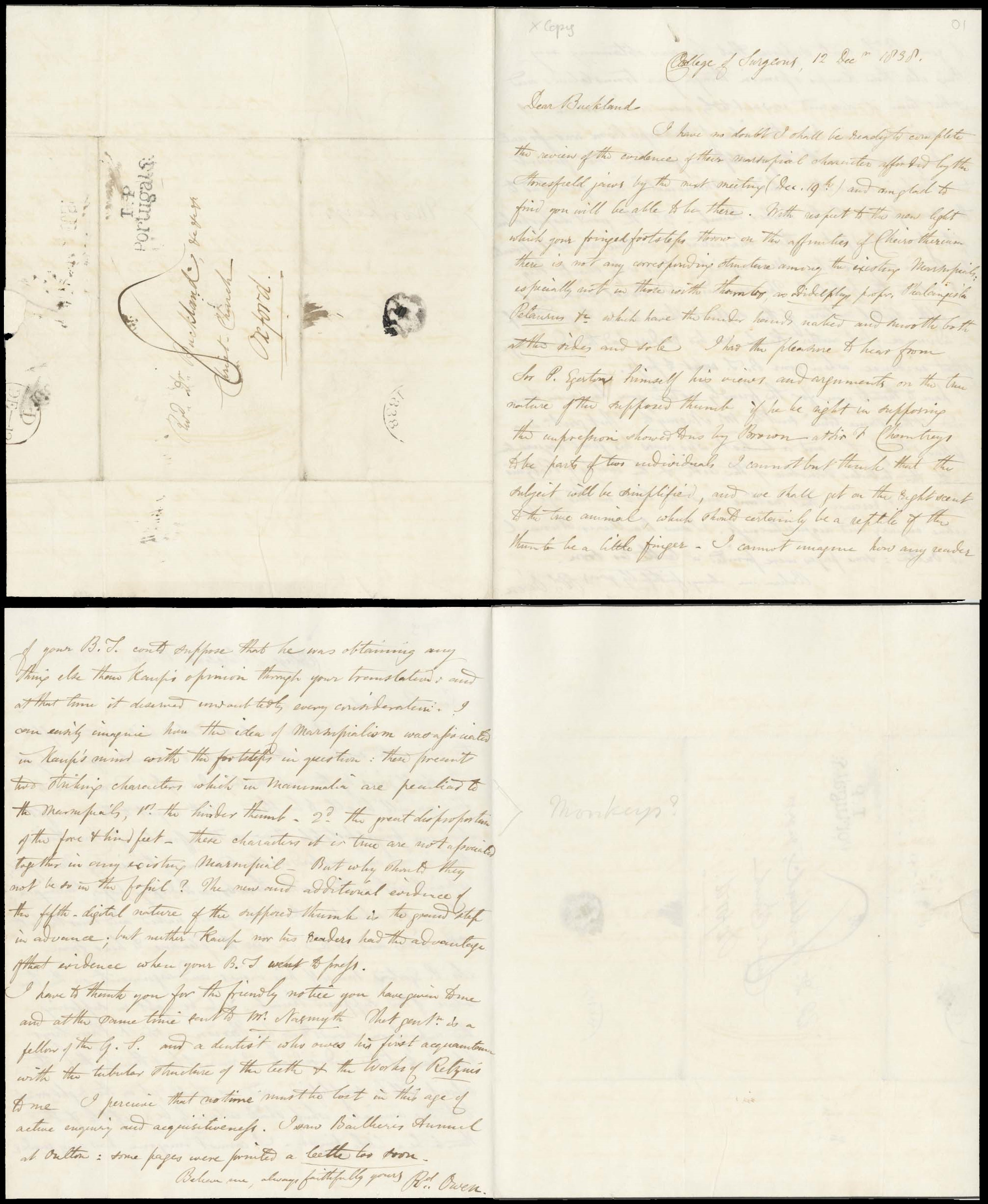
I have to thank you for the friendly notice you have given to me and at the same time sent to Mr Nasmyth
that gent is a fellow of the G.S. and a dentist who owes his first acquaintance with the tubular structure
of the teeth & the works of Retzius to me I perceive that no time must be lost in this age of active enquiry and acquisitiveness.
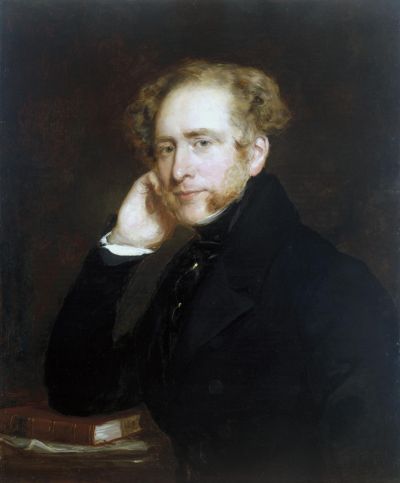 |
| Alexander Nasmyth by Francis Grant. Image credit: Science Museum Group |
Alexander Nasmyth (1789–1848), was a Scottish dental surgeon and anatomist, best known for his work on the structure of teeth, member of the Royal College of Surgeons, London; fellow of the Royal Medical and Chirurgical Society.
He was well known as an anatomist and surgeon-dentist: elected Fellow of the Royal College of Surgeons in 1844, appointed dentist to Queen Victoria since 1845. Whilst practising at 13A George Street, Hanover Square in London, he had a house at Great Malvern, where he died on August 4th, 1848. He made valuable donations to the Royal College of Surgeons Museum, and was included in Richard Owen's "Lists of Donors of Specimens presented to the Museum, 1832-1856".
The membrane covering the enamel of an unworn tooth is named after him 'Nasmyth's membrane', and his work on the anatomy of the teeth was of high importance. Nasmyth worked harmoniously with Edwin Saunders (the first dental surgeon to be knighted), in connection with the dental treatment of cleft palate. He became paralysed in the spring of 1846, when Saunders undertook his practice at an hour's notice and carried it on successfully.
William Buckland (1784–1856) was a leading geologist and paleontologist of the time, the first professor of geology in England, known for presenting the first scientific description of a dinosaur and for his effort to reconcile geological discoveries with the Bible and antievolutionary theories.
The most famous teeth studied by Buckland was a jaw collected around Oxfordshire in the late 17th century. Buckland did not know to what animal these bones belonged, he thought it was likely amphibious, living partially in land and water and he called it Megalosaurus, or great lizard.
.jpg "Portrait of The Reverend William Buckland, D.D. F.R.S (4672228)") |

| |
| William Buckland and the Megalosaurus jaw on postmark of South Korea 2001. | ||
 |
 |
|
| The Reverend William Buckland. Image credit: Wikimedia | The jaw of the Megalosaurus | Megalosaurus on one of the "Dinosaurs" stamps of UK 2013, MiNr.: 3534, Scott: 3236. |
When Buckland realized from the shape of its teeth, that Megalosaurus was carnivorous he found himself in trouble.
The University of Oxford is one of the world's most prestigious universities, was established in the 12th century, with teaching beginning around 1096 and it is the oldest university in the English-speaking world. The University of Oxford was initially founded to train clergy and scholars in theology, philosophy, and the liberal arts. The influence of religion remained in Oxford very strong in the 19th century. The goal of the science was to confirm the Bible story. Professors who tried to teach something that was in the contrary of the Bible could be banned from the University.
According to the Christian faith carnivorous animals were associated with violence, and evil had only begun on Earth with human decadence — with original sin. In the Garden of Eden, everything was peaceful and beautiful, and this carnivorous beast did not fit, it could not have been created by God. So, Buckland, who spent much of his early career trying to demonstrate the reality of the biblical flood using geological evidence, justified it by saying that Megalosaurus was a perfect killing machine, capable of causing death without pain, so God created it to eliminate suffering in an effective way.Buckland's work proving that Kirkdale Cave had been a prehistoric hyaena den, for which he was awarded the Copley Medal, was widely praised as an example of how detailed scientific analysis could be used to understand geo-history by reconstructing events from deep time.
He was a pioneer in the use of fossilized feces, for which he coined the term coprolites, to reconstruct ancient ecosystems. Buckland was a proponent of the Gap Theory that interpreted the biblical account of Genesis as referring to two separate episodes of creation separated by a lengthy period; it emerged in the late 18th and early 19th centuries as a way to reconcile the scriptural account with discoveries in geology that suggested the earth was very old.
Early in his career he believed that he had found geologic evidence of the biblical flood, but later became convinced that the glaciation theory of Louis Agassiz provided a better explanation, and he played an important role in promoting that theory in Great Britain.
Acknowledgements
- Many thanks to Mrs. Marina Afonso, Project Archivist and Dr. Emma Nicholls, Collections Manager of Vertebrate Palaeontology at the Oxford University Museum of Natural History, for their kind assistance.
References:
- Alexander Nasmyth (1789-1848):
Royal College of Surgeons of England, Science Museum Group.- "Researches on the Development, Structure, and Diseases of the Teeth" - Google Books
- Origins, Myths and Legends of the Naysmith name: Naysmith family blog, the Heraldry Society
- Edwin_Saunders (partner of Alexander Nasmyth), personal dentist of Queen Victoria: Wikipedia
-
William Buckland (1784-1856):
Wikipedia, Encyclopaedia Britannica, Linda Hall. - Correspondence and papers of William Buckland
-
Anders Retzius (1796-1860):
Wikipedia, Encyclopaedia Britannica,