Serbia
Fossils, dinosaurs, paleontologists, Charles Darwin on stamps and postmarks of Serbia
Serbia is landlocked and borders Hungary to the north; Romania and Bulgaria to the east; Macedonia to the south; and Croatia, Bosnia-Herzegovina, and Montenegro to the west; it also claims a border with Albania through the disputed territory of Kosovo.
The capital of Serbia, Belgrade, is one of the largest cities in Southeast Europe. As of a 2011 census, Serbia (excluding Kosovo) had a total population of 7.2 million.
The Kingdom of Serbs, Croats, and Slovenes was formed in 1918; its name was changed to Yugoslavia in 1929.
Following disastrous casualties in World War I, and the subsequent unification of the former Habsburg crownland of Vojvodina (and other lands) with Serbia, the country co-founded Yugoslavia with other South Slavic nations, which would exist in various political formations until the Yugoslav Wars of the 1990s.
During the breakup of Yugoslavia, Serbia formed a union with Montenegro, which was peacefully dissolved in 2006, restoring Serbia's independence as a sovereign state for the first time since 1918. [R1]
The Principality of Serbia (Kingdom in 1881) began to issue its own stamps in 1866. This continued until 1920, when its postal system was merged with the postal system of the former Austro-Hungarian territories with which it formed the Kingdom of Serbs, Croats and Slovenes. After the Germans established the Government of National Salvation in 1941 it issued its own stamps until 1944. Initially, Yugoslavian stamps were simply overprinted in German with the word Serbien. Later regular issues were inscribed both Serbien and Србија (Serbia). From 1944 onwards, Serbia was again part of Yugoslavia. Upon the dissolution of the union of Serbia and Montenegro in 2006, Serbia began issuing its own stamps once more. The Post of Serbia issues the country's stamps. [R2]
Official stamps of Serbia related to Paleontology: dinosaurs, fossils, paleontologists, Charles Darwin
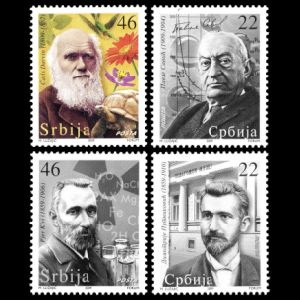
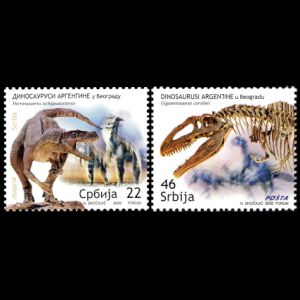
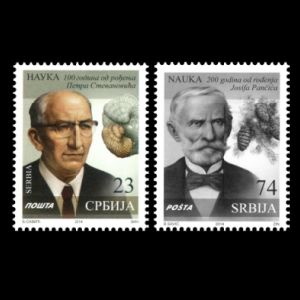
| 22.06.2009 "Famous people" [1] | 09.11.2009 "Dinosaurs of Argentina" | 08.10.2014 "Science" [2] |
 |
 |
 |
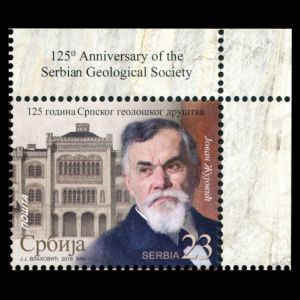
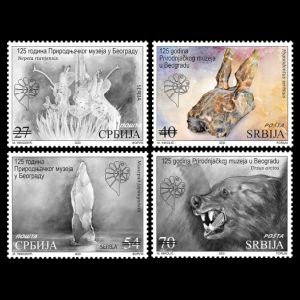
| 23.02.2016 "125th Anniversary of the Serbian Geological Society" [3] | 10.07.2018 "Science"[4] | 03.11.2020 "125th anniversary of the Natural History Museum in Belgrade" |
 |
 |
 |
Notes:
[1] One of the stamps is dedicated to the 200th anniversary of Charles Darwin's birth.
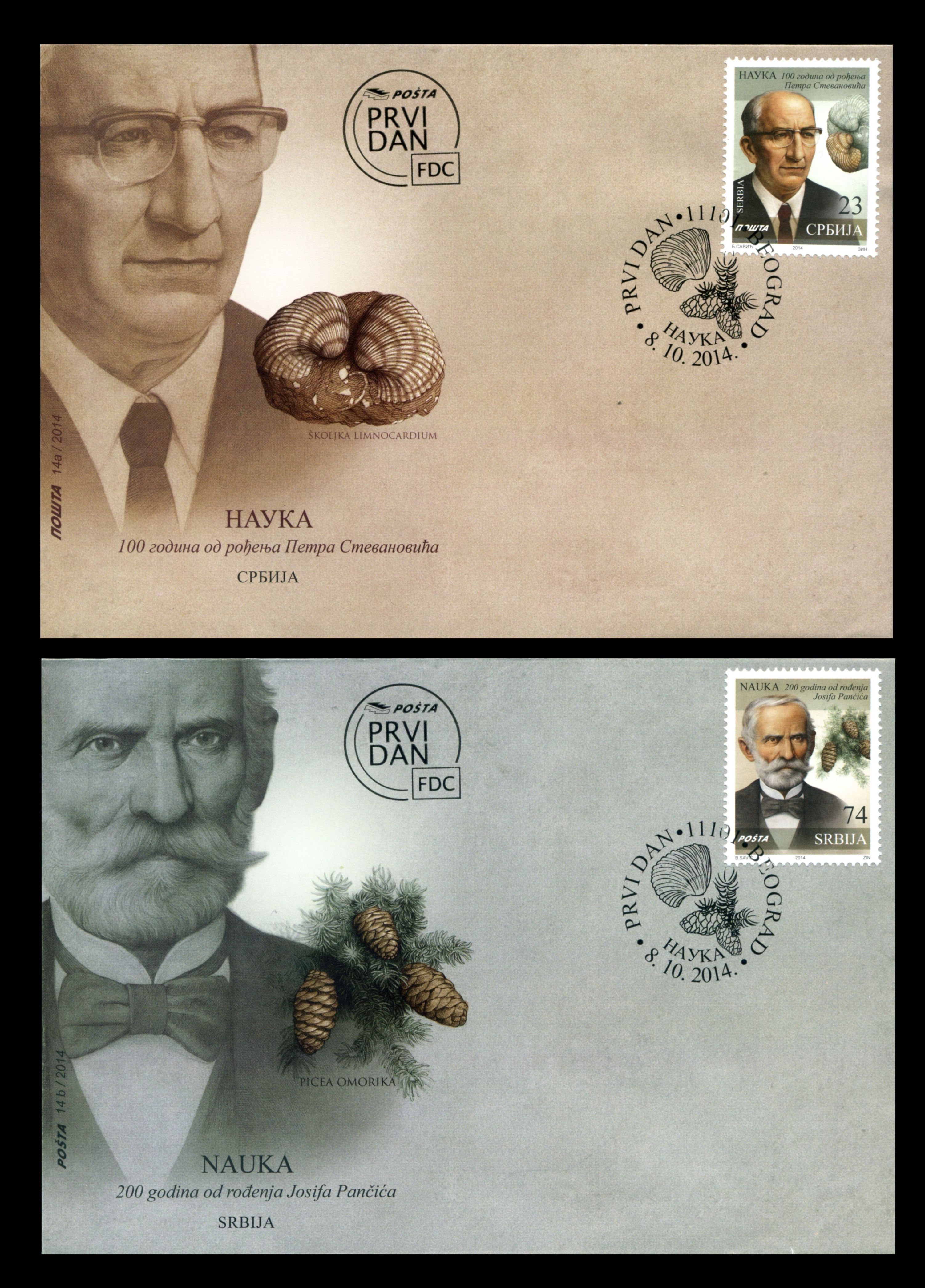
[2] PETAR STEVANOVIC (1914–1999), professor of geology at the University of Belgrade, member of the Serbian Academy of Sciences and Arts, president of the Serbian Geological Society, who also performed some paleontological research.
Two fossilized shells of shellfish Lymnocardium sp. can be seen on the top-right side of the stamps. These shells are from fossil collection of Petar Stevanovic, which is on display at Geology Department of the Natural History Museum in Belgrade.
[3]
|
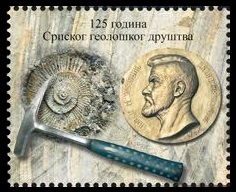
| Ammonite on tab of Mini-Sheet with stamps dedicated to 125th anniversary of the Serbian Geological Society stamp of Serbia 2016. |
The stamp issued in Mini-Sheet of 8 with Ammonite fossil on the label in the middle.

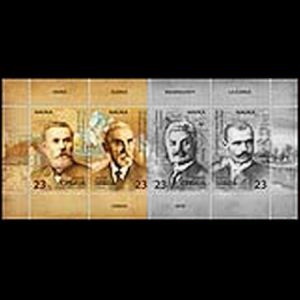
[4] Mini-Sheet with 4 stamps of some famous scientists of Serbia. Vladimir D. Laskarev and Antan Koch were geologists and paleontologists.
Antal/Anton Koch (Sombor, 7.1.1843 – Budapest, 8.2.1927), he worked as the Professor of geology and paleontology in Budapest. In honour of Antal Koch, 34 fossils are named after him.
Vladimir D. Laskare (Biryuch, Russian Empire, June 26, 1868 – Belgrade, April 10, 1954) who held lectures in paleontology at the University of Belgrade. His main research field was Neogene and Quaternary stratigraphy.
Other stamps to consider: contributors to Paleontology science (Milutin Milankovitch), human evolution sequence
The union of Serbia and Montenegro
| 23.03.2004 "125th anniversary of Milutin Milankovitch" [O1] | ||
 |
||
Serbia
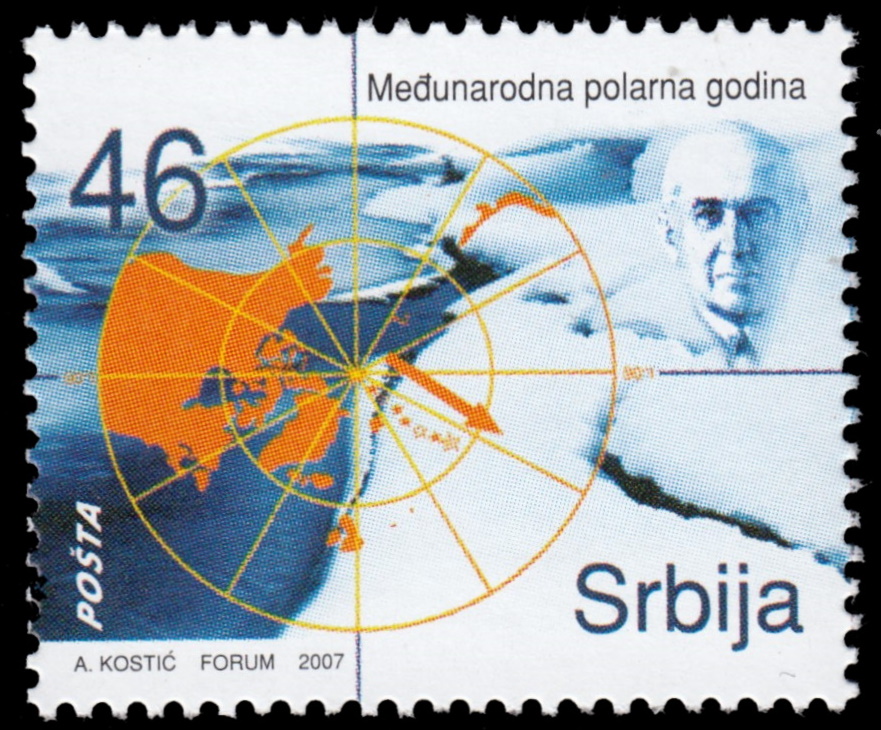
| 30.01.2007 "International Polar Year" [O1] | 09.05.2016 "Europa: Think greed" [O2] | 23.05.2019 "Scientists" [O1] |
 |
 |
 |
| 22.11.2023 "100 years of the Milankovich calendar" [O1] | ||
 |
||
Notes:
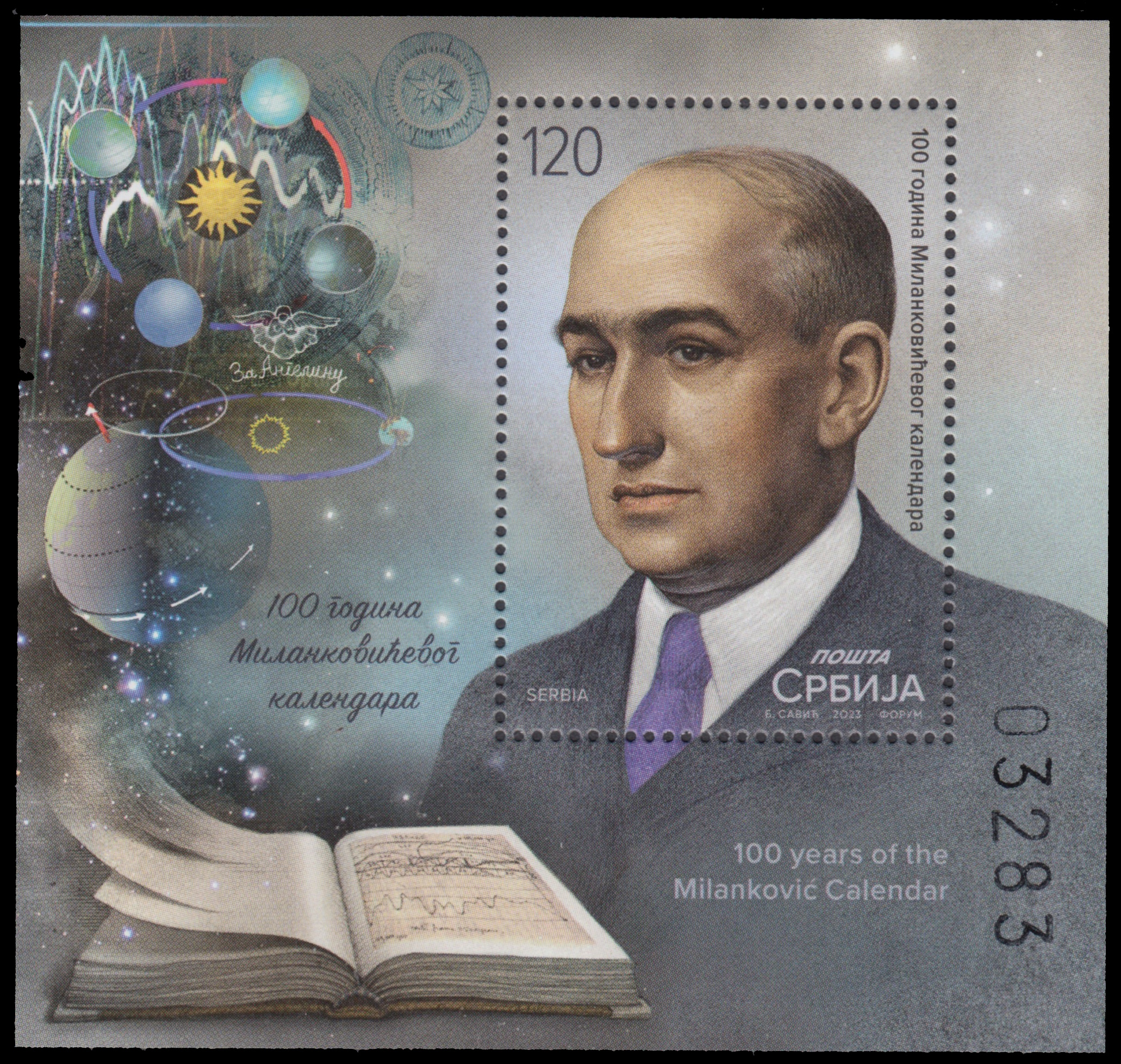
[O1] Milutin Milankovitch (Dalj, May 28, 1879 – Belgrade, December 12, 1958), was a mathematician and climatologist, who showed how the Earth's surface temperature was sensitive to changes in the Earth's orbit and tied it to several orbital parameters - the tilt of the Earth's axis, the eccentricity of the Earth's orbit, and the precession of the Earth's axis. Each of these three parameters change over set frequencies - and geologists have used his model to look at paleoclimate through time.
Milankovitch's works on astronomical explanations of ice ages, especially his curve of insolation for the past 130,000 years, received support from the climatologist Wladimir Köppen and from the geophysicist Alfred Wegener. Köppen noted the usefulness of Milankovitch's theory for paleoclimatological researchers. Milankovitch received a letter on 22 September 1922 from Köppen, who asked him to expand his studies from 130,000 years to 600,000 years. [R3]
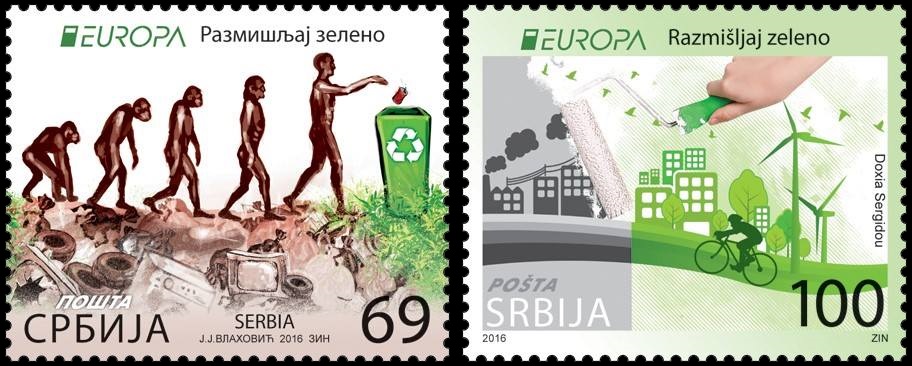
[O2] This year EUROPA stamps issued with the common topic "Ecology in Europe - Think Green".

|
| Human evolution sequence on Europa think green stamps of Serbia (MiNr.:, Scott: ) and Estonia (MiNr.: 861, 814, Scott: 667, 741) |
All countries participated in the project issued a stamp with the same design. Some countries, such as Serbia and Estonian issued an additional stamp with their own original design.
Serbia has added a stamp with human evolution before a recycle bin to signal the fact the human evolution resulted in a polluted environment.
Human evolution sequence is the famous "March of Progress" image, properly called "The Road to Homo Sapiens", that also appeared on many postal stamps are painted by famous paleo-artist Rudolph Zallinger who also painted huge mural "The Age of Reptiles" 34 m mural depicting the period of ancient history when reptiles were the dominant creatures on the earth, painted by Rudolph F. Zallinger. The fresco sits in the Yale Peabody Museum in New Haven, Connecticut and was completed in 1947 after five years of work. A portion of this mural is shown on the US stamp from 1970.
Commemorative postmarks of Serbia related to Paleontology: fossils, dinosaurs
Legend is here
| 09.11.2009 "Dinosaurs of Argentina" [FDC] | 08.10.2014 "Science" [FDC] | |
 |
 |
|
Some commemorative postmarks of Serbia to consider: stylized fossil
Legend is here
| 03.11.2020 "125th anniversary of the Natural History Museum in Belgrade" [FDC] [PMO1] | ||
 |
||
Notes:
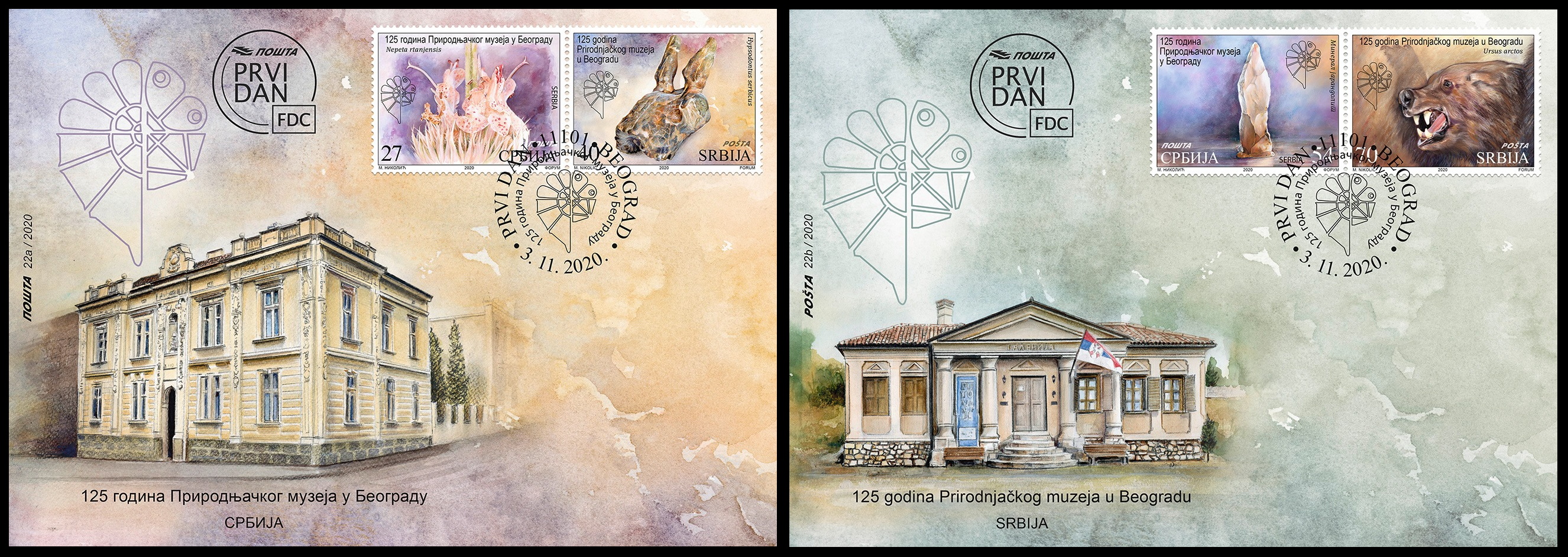
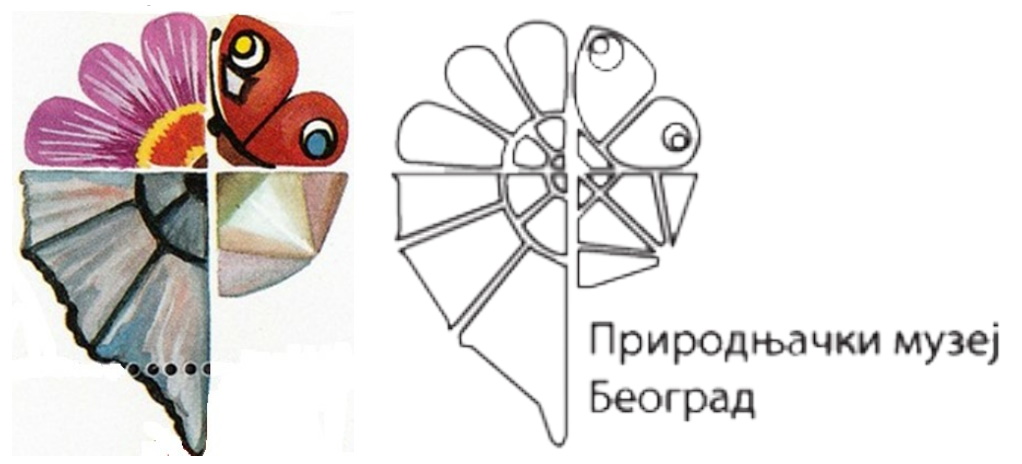
[PMO1] The postmark from the FDC of "125th anniversary of the Natural History Museum in Belgrade" stamps set of Serbia, reproduce the logo of the Museum.
|
| Stylized Ammonite on logo of Natural History Museum in Belgrade. |
It represents four major divisions of the museums: modern flora and fauna, paleontology and geology.
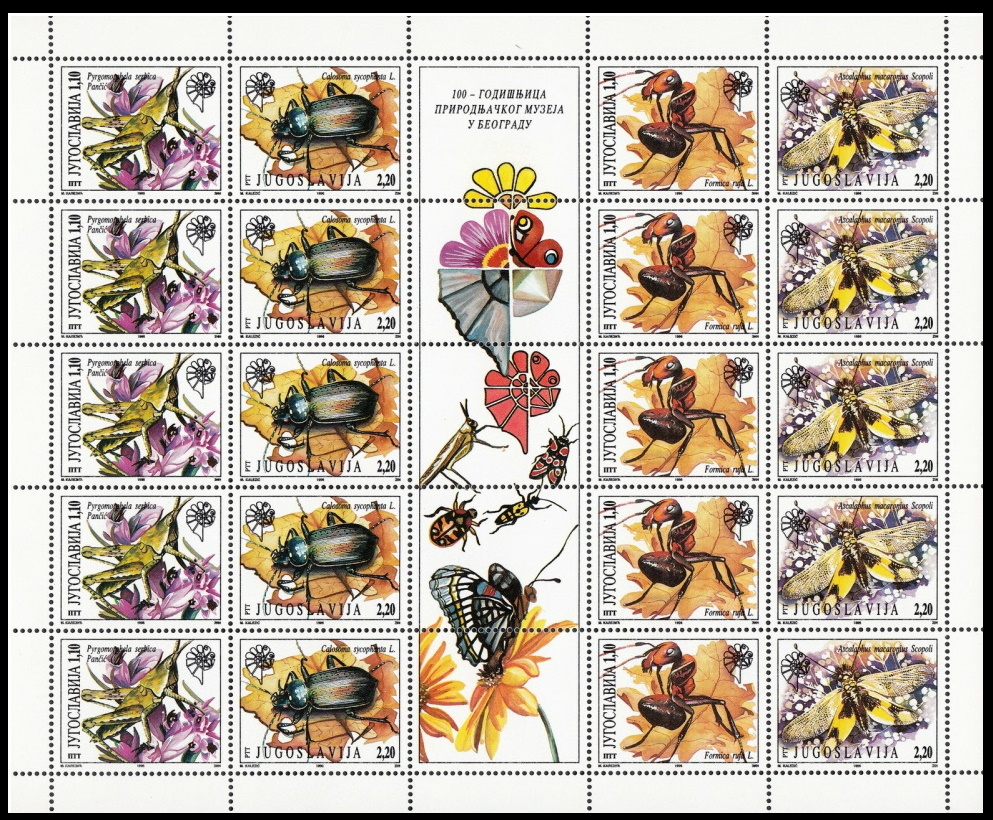
The colorful logo was printed on a label in the middle of sheet of "100th anniversary of the Natural History Museum in Belgrade" issued in Yugoslavia in 1996 for the first time.
Unfortunately, in 1996 all stamps of the set were insects - nothing about Paleontology at all.
References
- [R1] Serbia: Wikipedia, WikiTravel, FlagCounter.
- [R2] Postal History and Philately of Serbia:
Wikipedia,
Links to official website of the Post Authority, stamp catalog and a list of new stamps of Serbia are here. - [R3] Milutin Milankovich: Wikipedia
Acknowledgement
Many thanks to Dr. Peter Voice from Department of Geological and Environmental Sciences, Western Michigan University, for reviewing the draft page and his valuable comments.