Taiwan 2025 "Dinosaurs"
| Issue Date | 07.11.2025 |
| ID | Michel: Bl. 253 (4811-4814) ; Scott: ? ; Stanley Gibbons: ?, Yvert et Tellier: ?. Category: pR |
| Design | Zhang Zongda (also known internationally as Chung-Tat Cheung) |
| Stamps in set | 4 |
| Value |
NTD 15 - Titanosaur NTD 15 - Hadrosaurus NTD 15 - Oviraptor NTD 15 - Therizinosaurus |
| Emission/Type | commemorative |
| Places of issue | |
| Size (width x height) | stamps: 63.0 mm x 34 mm Mini-Sheet: 150 mm x 100 mm |
| Layout | Mini-Sheet of 4 |
| Products | FDC x 1, MC x1 |
| Paper | Self-adhesive stamp paper |
| Perforation | Die cut |
| Print Technique | Offset |
| Printed by | Royal Joh. Enschede B.V. (Netherlands) |
| Quantity | 300,000 |
| Issuing Authority | Chunghwa Post |

On November 7th, 2025, the Postal Authority of Taiwan (Chunghwa Post) issued the first set of four self-adhesive "Dinosaurs" stamps in the form of a Mini-Sheet. Another Mini-Sheet was issued on July 7th, 2026.
The issue depicts four dinosaur groups from the Late Cretaceous: titanosaurs, hadrosaurs, oviraptors, and therizinosaurs, and highlights one of the most fascinating aspects of dinosaur biology: reproduction.
In addition to life reconstructions of the animals, each stamp features a fossil egg containing a developing embryo, emphasizing discoveries that have significantly improved our understanding of dinosaur nesting behaviour and parental care.
The dinosaurs depicted on the stamps
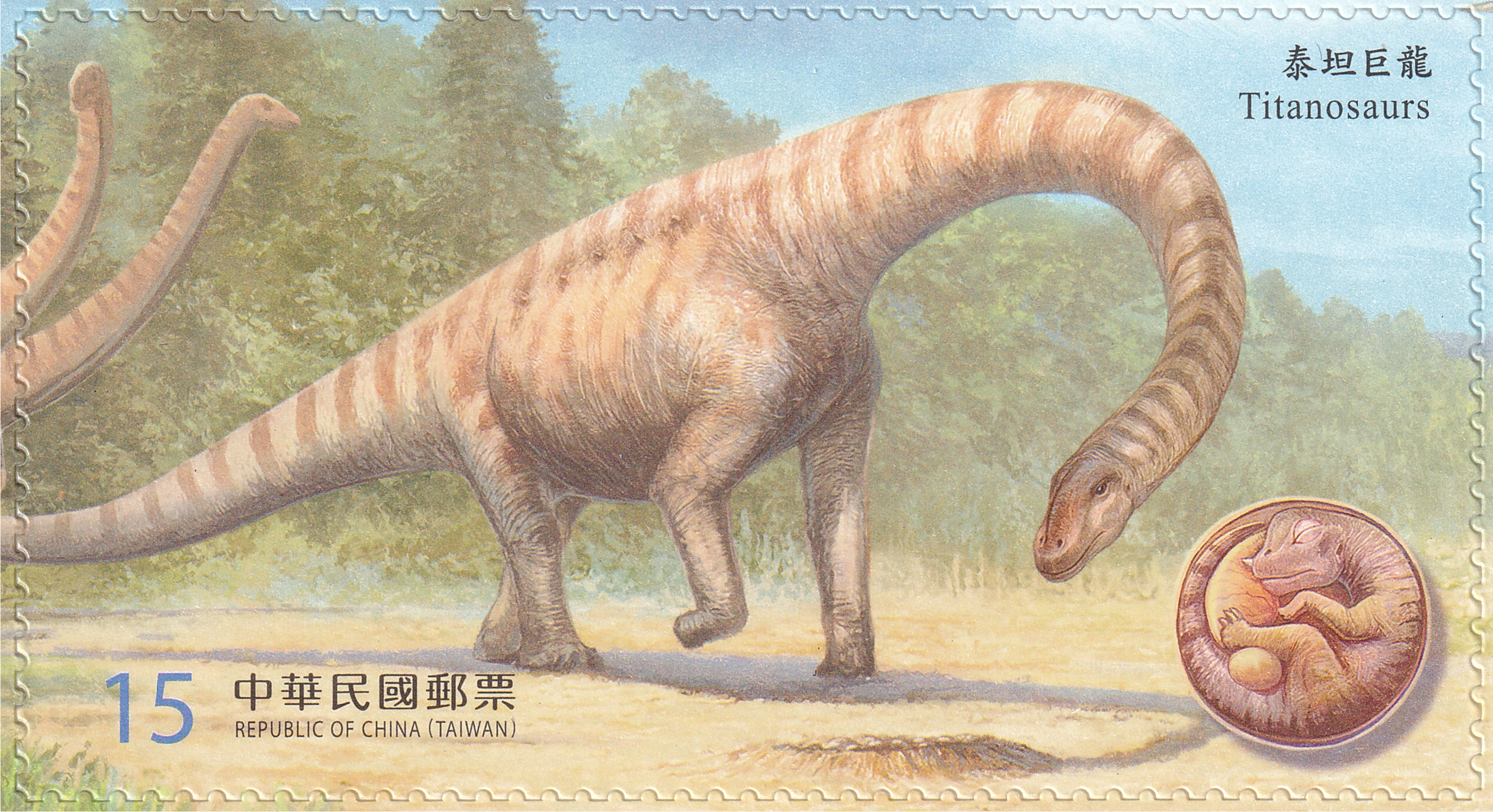
Titanosaurs
 |
| Titanosaurs on stamp of Taiwan 2025, MiNr.: ?, Scott: ?. |
The official Taiwan Post description states that the reconstruction depicts a titanosaur from India.
India has yielded some of the richest Late Cretaceous titanosaur fossil deposits in the world, particularly from the Lameta Formation in central and western India. Numerous skeletal remains, together with thousands of fossil eggs and nesting sites, have been discovered in Gujarat, Madhya Pradesh, and Maharashtra. These discoveries have provided valuable insights into the anatomy, reproduction, and nesting behaviour of titanosaurs, making India one of the most important regions for the study of sauropod dinosaurs.
Titanosaurus indicus, described by British paleontologist Richard Lydekker
in 1877 from the Late Cretaceous Lameta Formation, was the first species assigned to
the genus Titanosaurus.
Although the genus is now regarded as a nomen dubium, it gave its name to the diverse sauropod clade Titanosauria and marked the beginning of more than a century of research on Indian titanosaurs.
One of the most important titanosaur localities in India is the Raiyoli (Balasinor)
Dinosaur Fossil Park in Gujarat, where thousands of fossil eggs, numerous nesting
sites, and skeletal remains have been discovered in the Lameta Formation.
The importance of these discoveries was recognized by India Post in 2009 with the issue of a commemorative cover marking the Balasinor Dinosaur Fossil Park. Although the cachet depicts a theropod dinosaur beside fossil eggs, the site is best known for its spectacular titanosaur discoveries. Thousands of fossil eggs and dozens of nesting grounds have been uncovered at Balasinor, together with skeletal remains attributed to titanosaurs, confirming that these giant sauropods nested there during the Late Cretaceous. The exceptional preservation of the nests, eggs, and embryos has provided unique insights into titanosaur reproduction, colonial nesting behaviour, and the early development of their young, making Balasinor one of the world's most important dinosaur nesting sites.
Although the genus is now regarded as a nomen dubium, it gave its name to the diverse sauropod clade Titanosauria and marked the beginning of more than a century of research on Indian titanosaurs.
 |
| Theropod and fossil eggs on the 2009 commemorative cover of the Balasinor Dinosaur Fossil Park, India. |
The importance of these discoveries was recognized by India Post in 2009 with the issue of a commemorative cover marking the Balasinor Dinosaur Fossil Park. Although the cachet depicts a theropod dinosaur beside fossil eggs, the site is best known for its spectacular titanosaur discoveries. Thousands of fossil eggs and dozens of nesting grounds have been uncovered at Balasinor, together with skeletal remains attributed to titanosaurs, confirming that these giant sauropods nested there during the Late Cretaceous. The exceptional preservation of the nests, eggs, and embryos has provided unique insights into titanosaur reproduction, colonial nesting behaviour, and the early development of their young, making Balasinor one of the world's most important dinosaur nesting sites.
Titanosaurs are also renowned for their nesting sites.
Thousands of fossil eggs have been discovered in extensive nesting colonies in Argentina, India, Spain, France, Romania, and other countries. The eggs were usually buried in shallow pits and incubated by the heat generated within the surrounding sediment, probably aided by geothermal activity or decomposing vegetation. Several eggs have preserved embryos, including remarkably complete specimens from Patagonia and India, providing valuable information about the anatomy, growth, and development of these gigantic dinosaurs.
Hadrosaurus
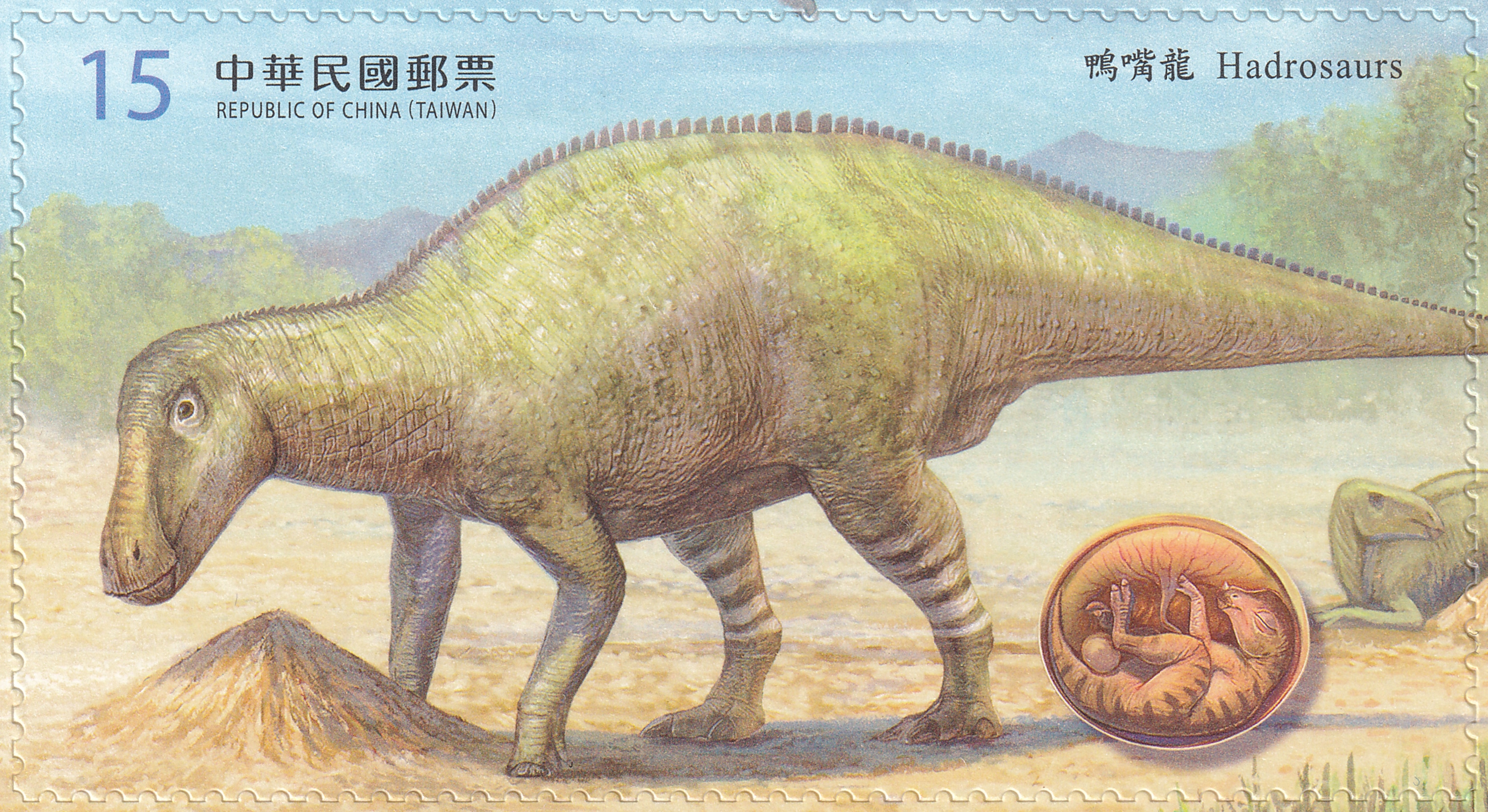
According to the official Taiwan Post description, this reconstruction depicts a Hadrosaurus from the United States.
 |
| Hadrosaurus on stamp of Taiwan 2025, MiNr.: ?, Scott: ?. |
The fossil record of hadrosaur reproduction is among the most completely known for any group of dinosaurs. Numerous nesting colonies, eggs, embryos, hatchlings, and juveniles have been discovered, particularly in the Upper Cretaceous rocks of Montana, USA. These remarkable finds demonstrate that hadrosaur parents cared for their young after hatching until they were able to leave the nest. The inset on the stamp depicts a fossil egg containing a developing hadrosaur embryo.
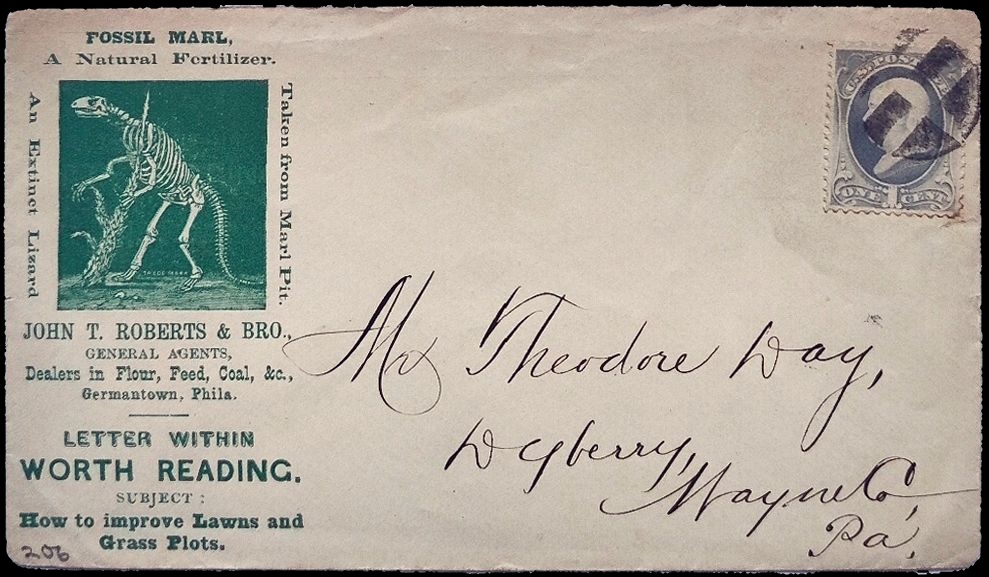
A Hadrosaurus (Hadrosaurus foulkii) was
the world’s first mounted dinosaur skeleton,
named by the American palaeontologist Joseph Leidy in 1858.
Under Leidy’s supervision, the English sculptor and
natural history artist Benjamin Waterhouse Hawkins,
who, under the guidance of Richard Owen, had created the first three-dimensional models of dinosaurs
(including Iguanodon) and other prehistoric animals for
the Crystal Palace exhibition in Sydenham in 1854,
reconstructed and mounted the incomplete skeleton at the Academy of Natural Sciences in Philadelphia in 1868.
Although many missing bones had to be restored, it became the first dinosaur skeleton ever exhibited to the public and marked the beginning of modern museum displays of dinosaurs. The Bernissart Iguanodon, mounted fourteen years later, was the first nearly complete dinosaur skeleton to be reconstructed and exhibited.
 |
|
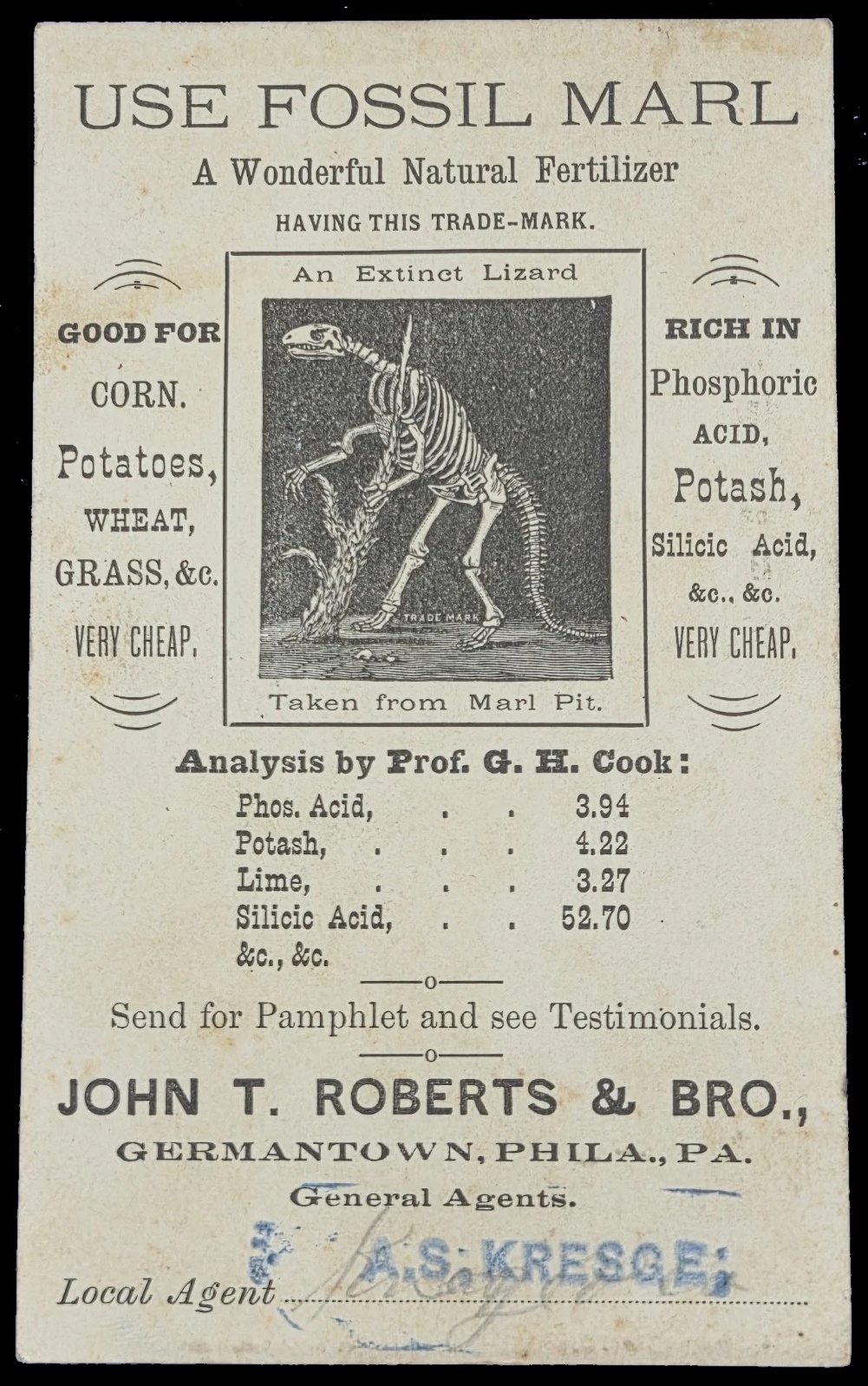
Hadrosaurus foulkii on a cachet of a U.S. advertising cover from the 1870s or 1880s.
It was used to advertise fossil marl,
a natural fertilizer produced by John T. Robert & Bro. of Germantown, Philadelphia. Image courtesy: Dr. Lida Xing, MSc, PhD, Associate Professor and doctoral advisor, China University of Geosciences (Beijing), Beijing, China |
Although many missing bones had to be restored, it became the first dinosaur skeleton ever exhibited to the public and marked the beginning of modern museum displays of dinosaurs. The Bernissart Iguanodon, mounted fourteen years later, was the first nearly complete dinosaur skeleton to be reconstructed and exhibited.
Oviraptor
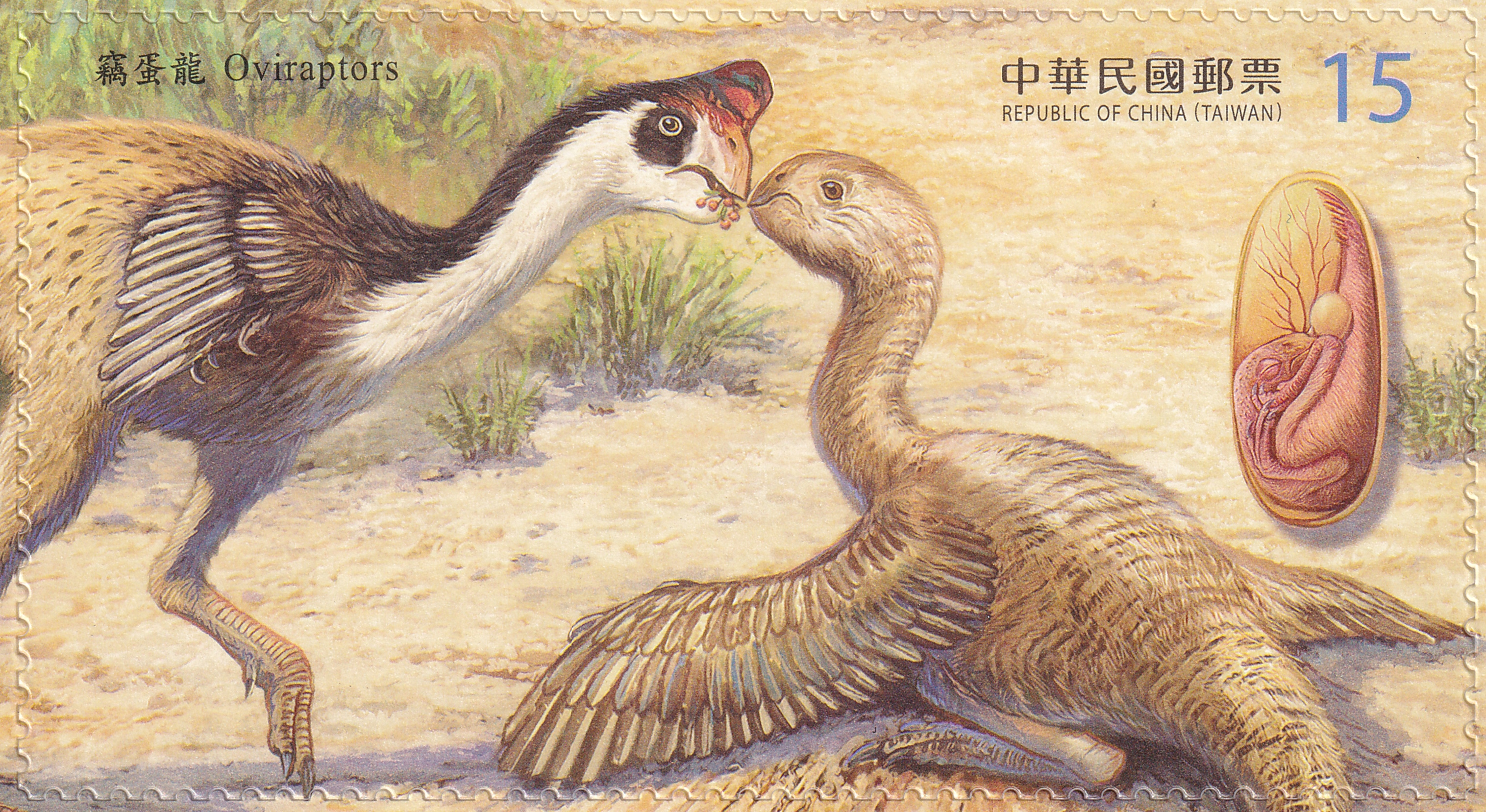 |
| Oviraptor on stamp of Taiwan 2025, MiNr.: ?, Scott: ?. |
The name Oviraptor, meaning "egg thief," was coined in 1924 after the first specimen was discovered lying on a nest believed to contain the eggs of Protoceratops. Decades later, spectacular discoveries of exquisitely preserved oviraptorid embryos and adults brooding their nests demonstrated that these eggs actually belonged to Oviraptor and its close relatives. The fossils showed that the adults protected and incubated their eggs in a bird-like posture, making oviraptorids one of the best examples of the evolutionary link between non-avian dinosaurs and modern birds. The inset on the stamp depicts an oviraptorid egg containing a developing embryo.
One of the most remarkable examples is Citipati osmolskae, a genus of oviraptorid dinosaur, discovered in the Late Cretaceous deposits of Mongolia’s Gobi Desert. This dinosaur was among the largest oviraptorids; it is estimated to have been around 2.9 meters in length and to have weighed 75–83 kg.
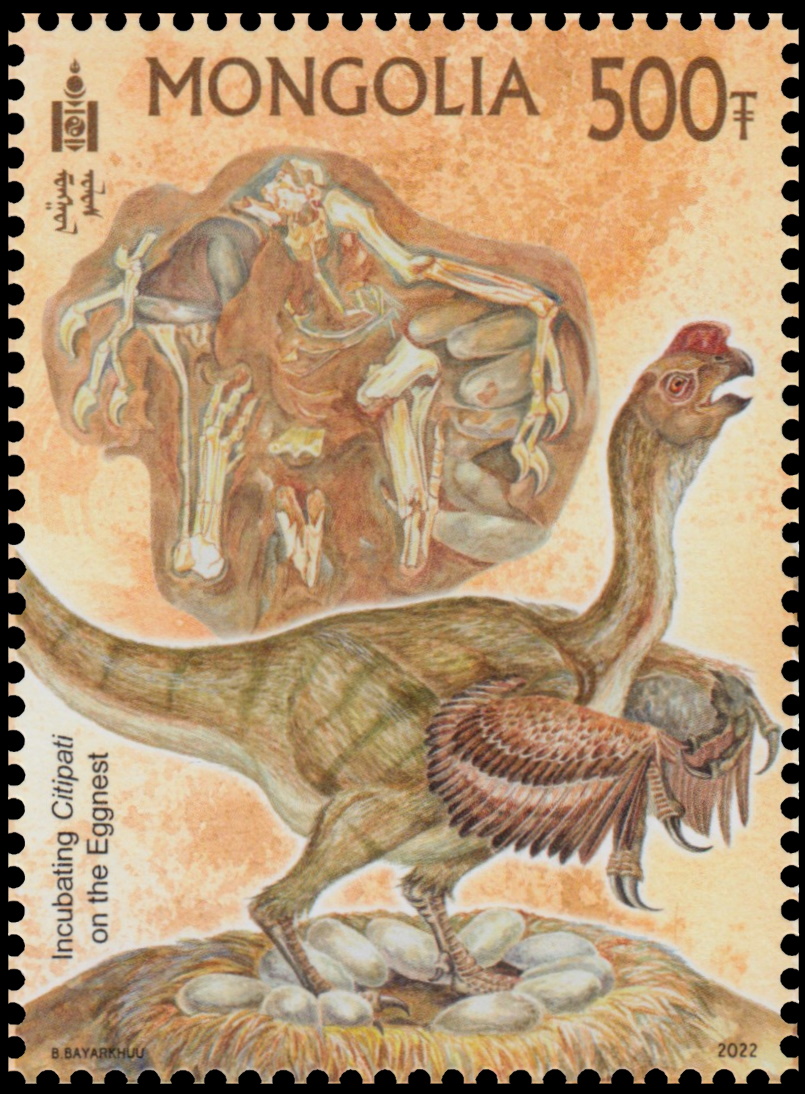 |
| Incubating Citipati on its nest of eggs on stamp of Mongolia 2022, MiNr.: 4206, Scott: 2993. |
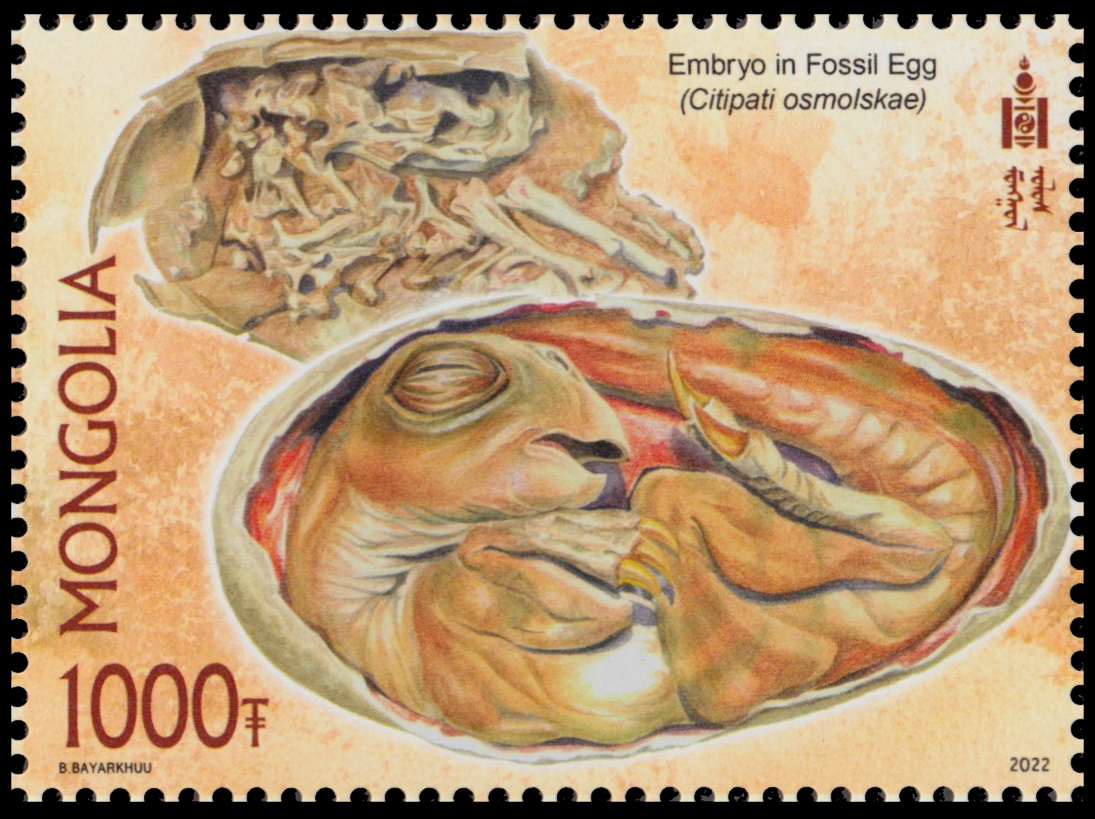 |
| Embryo of Citipati osmolskae on stamp of Mongolia 2022, MiNr.: 4209, Scott: 2995. |
The posture of the specimen was remarkably similar to that of modern birds protecting and incubating their nests. It provided some of the strongest evidence that oviraptorid dinosaurs cared for their eggs rather than stealing them, as had been assumed when the first Oviraptor specimen was discovered. The discovery of "Big Mama" helped transform our understanding of dinosaur reproduction and behavior, revealing that many theropod dinosaurs displayed complex nesting strategies and parental care.
Therizinosaurus
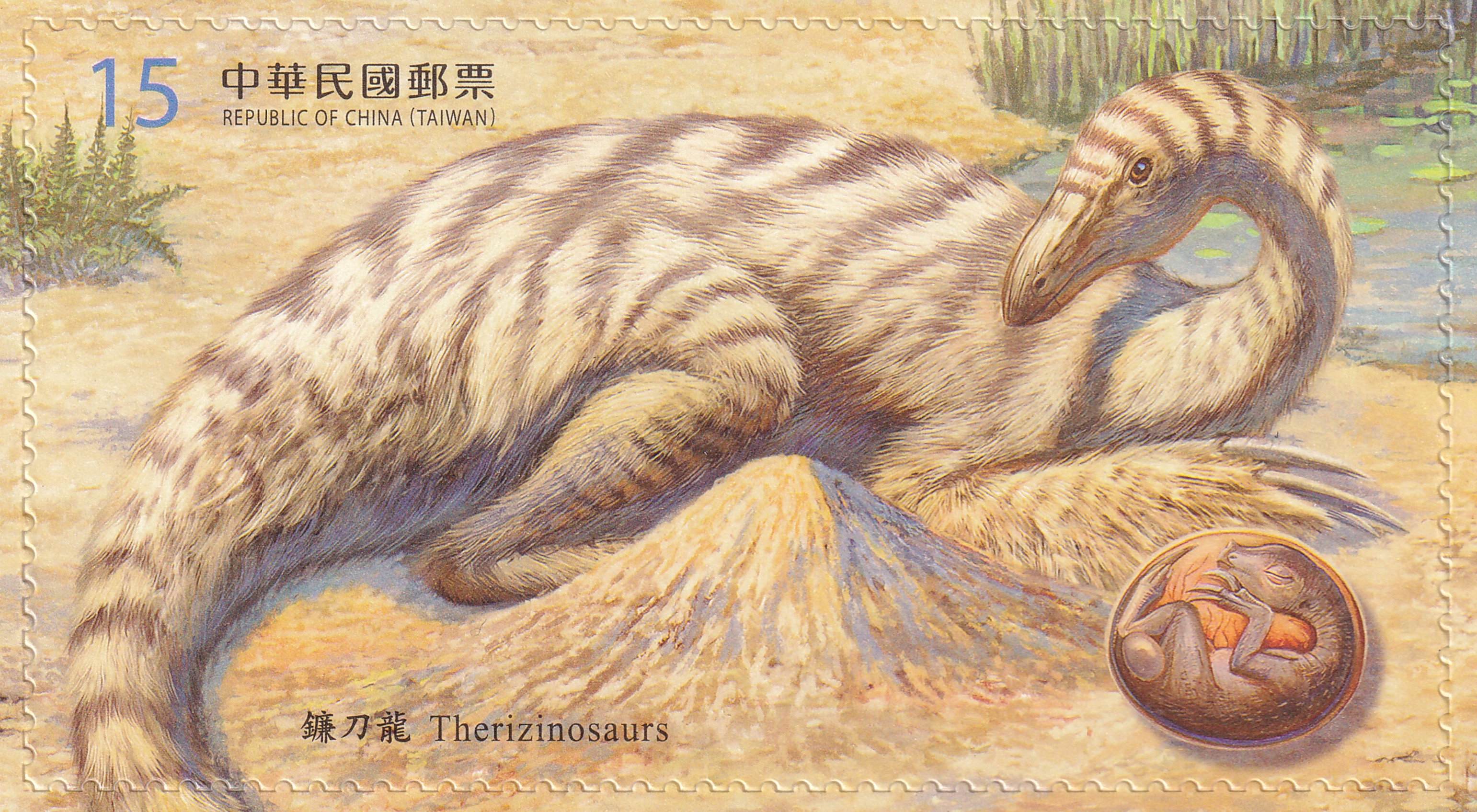 |
| Therizinosaurus on stamp of Taiwan 2025, MiNr.: ?, Scott: ?. |
When the first remains of Therizinosaurus were discovered in Mongolia in the 1940s, only the huge claws were known, leading to great uncertainty about the animal’s appearance and lifestyle. Later discoveries of related therizinosaur dinosaurs revealed that these animals were feathered maniraptoran theropods, closely related to the evolutionary line leading to modern birds. The enormous claws were probably not used for hunting, but may have helped the animal gather vegetation, defend itself, or as a display to threaten rivals.
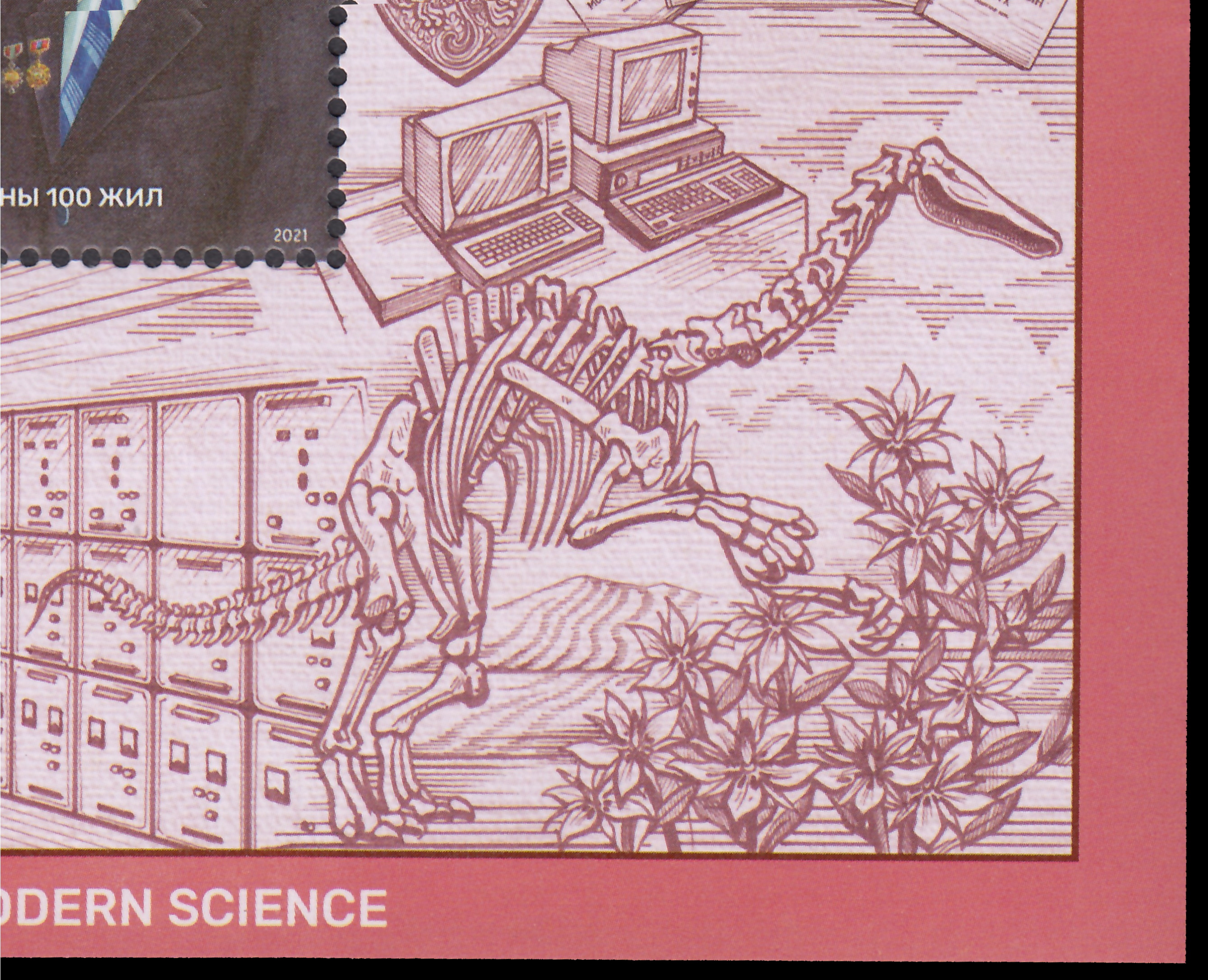 |
| Skeleton of Deinocheirus mirificus on margin on 100th anniversary of modern science Souvenir Sheet of Mongolia 2021 |
Fossil eggs attributed to therizinosaurs have been discovered in Asia, including Mongolia and China, providing valuable information about their reproductive biology. Studies of eggshell microstructure and embryonic remains indicate that therizinosaurs shared nesting characteristics with other maniraptoran dinosaurs, including bird-like incubation behaviors. These discoveries provide further evidence of the close evolutionary relationship between non-avian dinosaurs and modern birds.
Together, the four stamps celebrate discoveries that have fundamentally changed our understanding of dinosaur biology. Fossil eggs, embryos and brooding adults demonstrate that many dinosaurs reproduced and cared for their offspring in ways strikingly similar to modern birds, providing important evidence for the evolutionary relationship between non-avian dinosaurs and birds.
Products and associated philatelic items
| FDC | First-Day-of-Issue Postmarks | |
 |
 |
 |
| This postmark was printed on the FDC during its production | This postmark was available in the GPO on the first day of issue only | |
| FDC (circulated) | Postcards | |
 |
 |
 |
| There are two more stamps on the reverse side of the FDC, posted as registered letter to Germany on the day of issue. | The English name on the cover of the postcards set "Maximum Cards of Dinosaur Souvenir Sheet" is an erroneous translation from Chinese. The postcards on the right are postcards with corresponding cancelled stamps on their reverse sides. | |

References
- Technical details and short description: Taiwan Post, Online store of Taiwan Post.
- Titanosauria: Wikipedia, Encyclopaedia Britannica, Paleobiology Database
- Hadrosaurus foulkii: Wikipedia, Encyclopaedia Britannica
- Oviraptor philoceratops: Wikipedia, Encyclopaedia Britannica
- Citipati osmolskae: Wikipedia
- Therizinosaurus cheloniformis: Wikipedia, Encyclopaedia Britannica
- Deinocheirus mirificus: Wikipedia, Encyclopaedia Britannica
- Dinosaur eggs and embryos: Wikipedia, Encyclopaedia Britannica
- India dinosaur nesting sites (Balasinor): Wikipedia
Acknowledgements
Many thanks to Dr. Peter Voice from Department of Geological and Environmental Sciences, Western Michigan University, for reviewing the draft page and his very valuable comments.