Taiwan 2026 "Dinosaurs"
| Issue Date | 07.07.2026 |
| ID | Michel: ; Scott: ; Category: pR |
| Design | Chung-Tat Cheung |
| Stamps in set | 4 |
| Value |
NTD 15 - Spinosaurus NTD 15 - Xixianykus NTD 15 - Halszkaraptor NTD 15 - Mononykus |
| Emission/Type | commemorative |
| Places of issue | |
| Size (width x height) | stamps: 63.0 mm x 34 mm Mini-Sheet: 150 mm x 100 mm |
| Layout | Mini-Sheet of 4 |
| Products | FDC x 1, MC x1, PP x1 |
| Paper | Self-adhesive stamp paper |
| Perforation | |
| Print Technique | Offset |
| Printed by | TOPPAN Inc. (Japan) |
| Quantity | |
| Issuing Authority | Chunghwa Post |
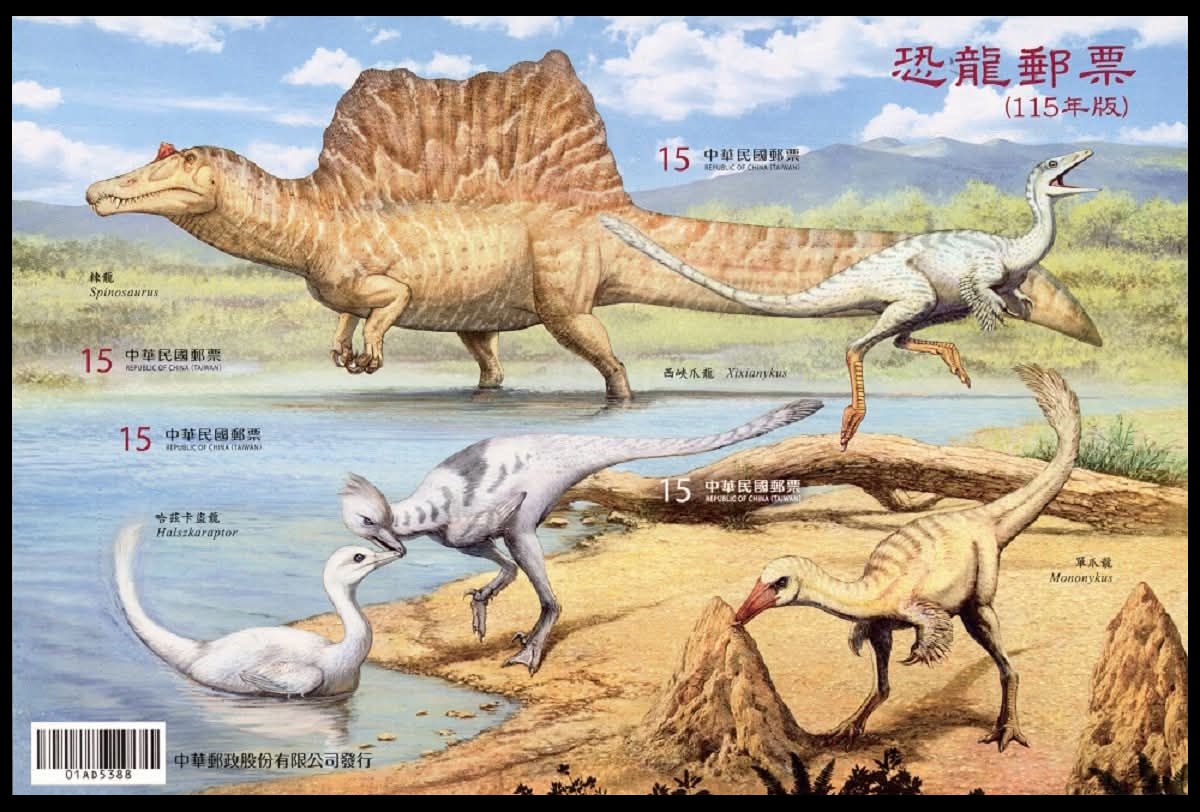
On July 7th, 2026, following the successful release of the "Dinosaurs Souvenir Sheet" in 2025, Chunghwa Post issued a second dinosaur-themed Mini-Sheet comprising four self-adhesive stamps, each with a face value of NT$15. Unlike the previous issue, which featured gigantic herbivorous dinosaurs, this set highlights four remarkable saurischian dinosaurs that illustrate the extraordinary diversity and evolutionary specialization of theropods during the Late Cretaceous.
The selected species: Spinosaurus, Xixianykus, Halszkaraptor, and Mononykus, represent some of the most unusual dinosaurs known to science. Rather than focusing solely on famous giants, Chunghwa Post chose species that reflect recent paleontological discoveries and modern scientific interpretations. Together they demonstrate the wide range of adaptations evolved by predatory dinosaurs, including semi-aquatic fishing, insectivory, and possible aquatic foraging.
Dinosaurs first appeared during the Late Triassic, about 230 million years ago. Over the following 160 million years they diversified into thousands of species, occupying nearly every terrestrial ecosystem on Earth. By the Late Cretaceous, dinosaurs had evolved an extraordinary variety of body forms, sizes, and ecological niches, ranging from giant herbivores to swift insect-eaters and specialized fish hunters.
Although Taiwan has no confirmed dinosaur fossils, the island has yielded numerous important Cenozoic fossils. Discoveries include fossil whales, dolphins, rhinoceroses, deer, elephants, crocodiles, birds, and other Ice Age mammals, particularly from the Penghu Channel and the Zuojhen area of Tainan. The famous Denisovan jawbone from the Penghu Channel is one of the most significant recent paleoanthropological discoveries in East Asia. By depicting dinosaurs from Africa and Asia rather than native species, this stamp issue celebrates the global history of paleontology and the remarkable diversity of prehistoric life.
The dinosaurs depicted on the stamps
Spinosaurus
A member of the Spinosauridae family, Spinosaurus was one of the largest known carnivorous dinosaurs, reaching an estimated length of about 14–15 metres. It is characterized by its long, narrow crocodile-like skull with conical teeth, ideally adapted for catching fish. Its powerful forelimbs bore enormous, hooked claws, which were probably used to seize prey and forage along riverbanks. Fossil evidence suggests that Spinosaurus inhabited rivers, lakes, and coastal wetlands in what is now North Africa, making it one of the few dinosaurs well adapted to a semi-aquatic lifestyle. Its most distinctive feature was the spectacular sail formed by elongated neural spines along its back, which may have been used for display, thermoregulation, or species recognition.
Although no fossils of Spinosaurus or other spinosaurids have been discovered in Taiwan, the species was selected for this stamp issue to showcase one of the most remarkable dinosaurs known to science.
Xixianykus
A member of the Alvarezsauridae family, Xixianykus was a small, lightly built theropod dinosaur that lived during the Late Cretaceous, about 90 million years ago, in what is now Henan Province, China. It had exceptionally short but powerful forelimbs ending in a single enlarged claw, long hind limbs adapted for fast running, and a compact, agile body. Like other alvarezsaurids, it is believed to have fed primarily on insects, using its specialized claw to break into termite or ant nests. Xixianykus is one of the most primitive known members of the Alvarezsauridae and provides important evidence for the early evolution of this unusual group of bird-like dinosaurs.
Although no fossils of Xixianykus have been discovered in Taiwan, its inclusion in this stamp issue highlights the remarkable diversity of Asian dinosaurs and the important paleontological discoveries made in neighboring China.
Halszkaraptor
A member of the Dromaeosauridae family, Halszkaraptor was a small feathered theropod that lived during the Late Cretaceous, about 75 million years ago, in what is now Mongolia. Unlike most dromaeosaurs, it possessed a remarkably long neck, a flattened crocodile-like snout with numerous small teeth and retained the enlarged sickle-shaped claw on the second toe typical of its relatives. Its anatomy combined features of terrestrial predators with adaptations resembling those of modern waterfowl, leading scientists to suggest that it foraged in shallow water for fish and other aquatic prey. Some researchers have proposed that it had webbed feet and was capable of swimming, although these interpretations remain the subject of ongoing scientific debate. The genus was named in honor of the renowned Polish paleontologist Halszka Osmólska, whose pioneering work greatly advanced the study of Mongolian dinosaurs.
Although no fossils of Halszkaraptor have been discovered in Taiwan, its inclusion in this stamp issue highlights one of the most unusual dinosaur discoveries of the 21st century.
Mononykus
A member of the Alvarezsauridae family, Mononykus was a small, feathered theropod dinosaur that lived during the Late Cretaceous, about 70 million years ago, in what is now Mongolia. It was characterized by its extremely short forelimbs, each ending in a single enlarged thumb claw from which its name, meaning "single claw," is derived. Paleontologists believe that these powerful claws were used to tear into termite or ant nests, while its long legs allowed it to run swiftly between feeding sites. This specialized anatomy suggests that Mononykus occupied a unique ecological niche among dinosaurs as an insectivore.
Although no fossils of Mononykus have been discovered in Taiwan, the species was selected for this stamp issue as one of the best-known members of the remarkable Alvarezsauridae family and an excellent example of evolutionary specialization.
Products and associated philatelic items
Images coming soon
References
- Technical details and short description: Chunghwa Post,
- Spinosaurus: Wikipedia, Encyclopaedia Britannica, Ibrahim et al. (2014): Semiaquatic adaptations in a giant predatory dinosaur, Ibrahim et al. (2020): Tail-propelled aquatic locomotion in a theropod dinosaur, Chunghwa Post – Official First Day Bulletin.
- Xixianykus: Wikipedia, Dinopedia, The Dinosaur Database, Xu et al. (2010): A monodactyl nonavian dinosaur and the complex evolution of the alvarezsauroid hand, Chunghwa Post – Official First Day Bulletin.
- Halszkaraptor: Wikipedia, Encyclopaedia Britannica – Dromaeosaur, Cau et al. (2017): A dinosaur that breathed like a bird and swam like a crocodile, Cau et al. (2017): A bizarre Cretaceous maniraptoran theropod with preserved evidence of an aquatic lifestyle, Chunghwa Post – Official First Day Bulletin.
- Mononykus: Wikipedia, Encyclopaedia Britannica, Perle et al. (1993): Flightless bird from the Cretaceous of Mongolia, Perle et al. (1993): The first record of a primitive bird from the Cretaceous of Mongolia, Chunghwa Post – Official First Day Bulletin.