Tanzania
Dinosaurs, prehistoric animals, prehistoric humans on stamps of Tanzania
It is bordered by Kenya and Uganda to the north; Rwanda, Burundi, and the Democratic Republic of the Congo to the west; Zambia, Malawi, and Mozambique to the south; and by the Indian Ocean to the east.
Mount Kilimanjaro, Africa's highest mountain, is in northeastern Tanzania. Tanzania's population of 52 million is diverse, composed of several ethnic, linguistic and religious groups.
German rule began in mainland Tanzania during the late 19th century when Germany formed German East Africa.
This was followed by British rule after World War I. The mainland was governed as Tanganyika, with the Zanzibar Archipelago remaining a separate colonial jurisdiction.
Tanganyika gained independence from the United Kingdom in 1961 and merged with Zanzibar in 1964 to form the United Republic - Tanzania. The same year, Tanzania had joined the British Commonwealth.
Many important hominid fossils have been found in Tanzania, such as 6-million-year-old Pliocene hominid fossils.
The genus Australopithecus ranged all over Africa 4 to 2 million years ago; and the oldest remains of the genus Homo are found near Lake Olduvai.
Following the rise of Homo erectus 1.8 million years ago, humanity spread all over the Old World, and later in the New World and Australia under the species Homo sapiens. [R1]
However, not only prehistoric human (hominid) fossils were uncovered in Tanzania, but also some prehistoric animals, including dinosaurs.
Between 1909 and 1911, famous German paleontologist Werner Janensch, excavated very well-preserved skeleton of Brachiosaurus (Giraffatitan) brancai from the Tendaguru Formation in southeastern Tanzania. The Tendaguru Formation is considered the richest Late Jurassic strata in Africa. [R6]
This specimen in the central exhibit in dinosaur hall of The Natural History Museum in Berlin today.
It stands 13.27 meters tall and is the tallest mounted dinosaur skeleton in the world, as the Guinness Book of Records confirms.
The first stamps of Tanzania were issued 7 July 1964, inscribed "UNITED REPUBLIC OF TANGANYIKA & ZANZIBAR", two values depict a map of the coast from Tanga to Dar-es-Salaam along with Zanzibar and Pemba, whilethe other two show hands holding a torch and spear.
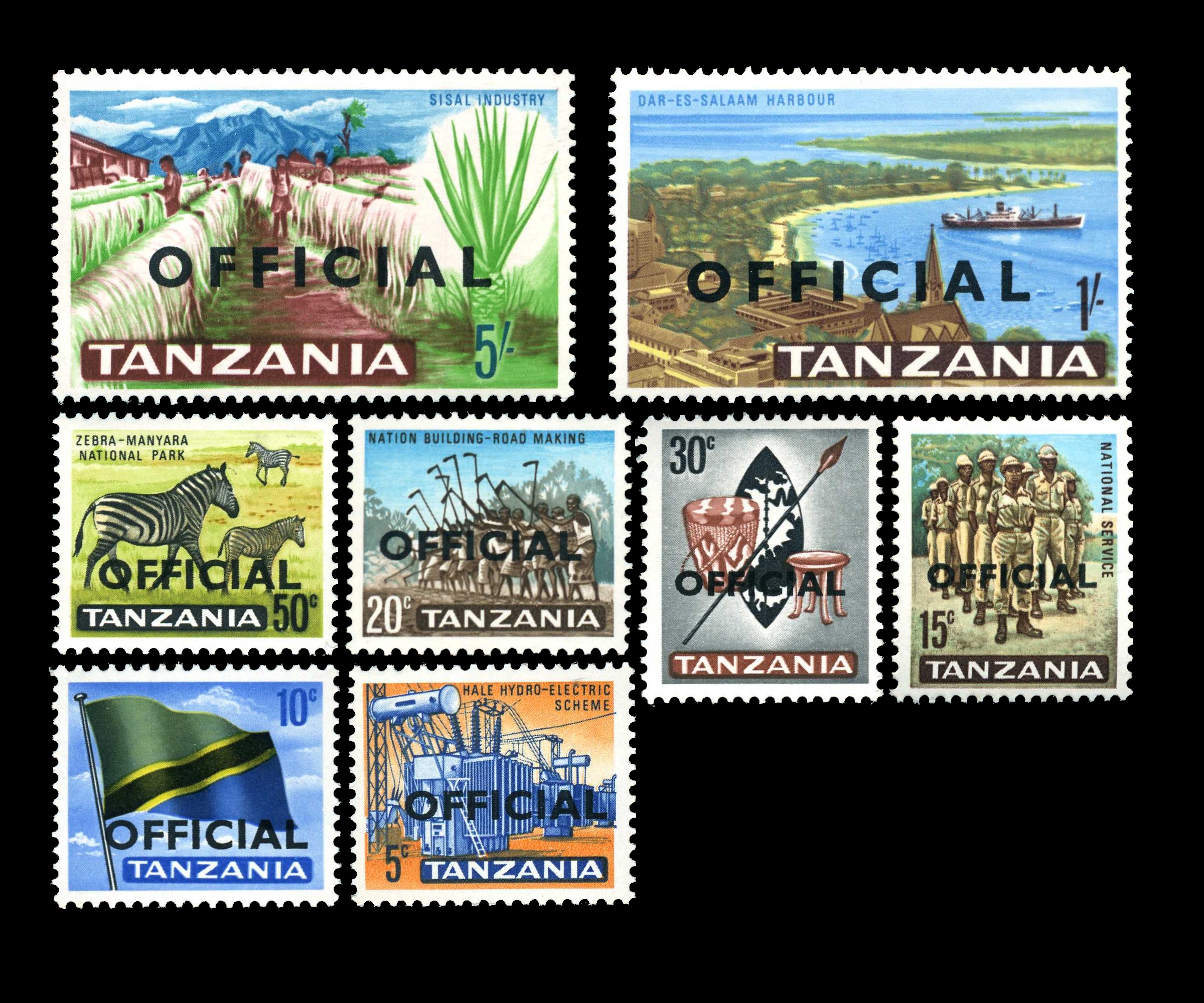
The first definitive series was issued 9 December 1965 and consisted of a set of 14 values ranging from 5 cents to 20 shillings, show a variety of scenes, symbols, and wildlife, include a skull of Zinjanthropus.
In the first few years after gaining independence, the Post Authority of Tanzania issued a reasonable number of stamps per year.
In the 1990s, the number of stamps issued increased significantly, with averages of well over 200 stamps per year.
Stamps became a source of income from sales to collectors.
The increase in number of stamps issued were accommodated by the release of stamps showing a wide variety of popular thematic topics – many of them without any link to the country’s culture or natural history.
A peak was reached in 1999, when 778 stamps in 110 miniature sheets were issued. [R2]
Official stamps of Tanzania related to Paleontology and Paleoanthropology: dinosaurs and other prehistoric animals, prehistoric humans
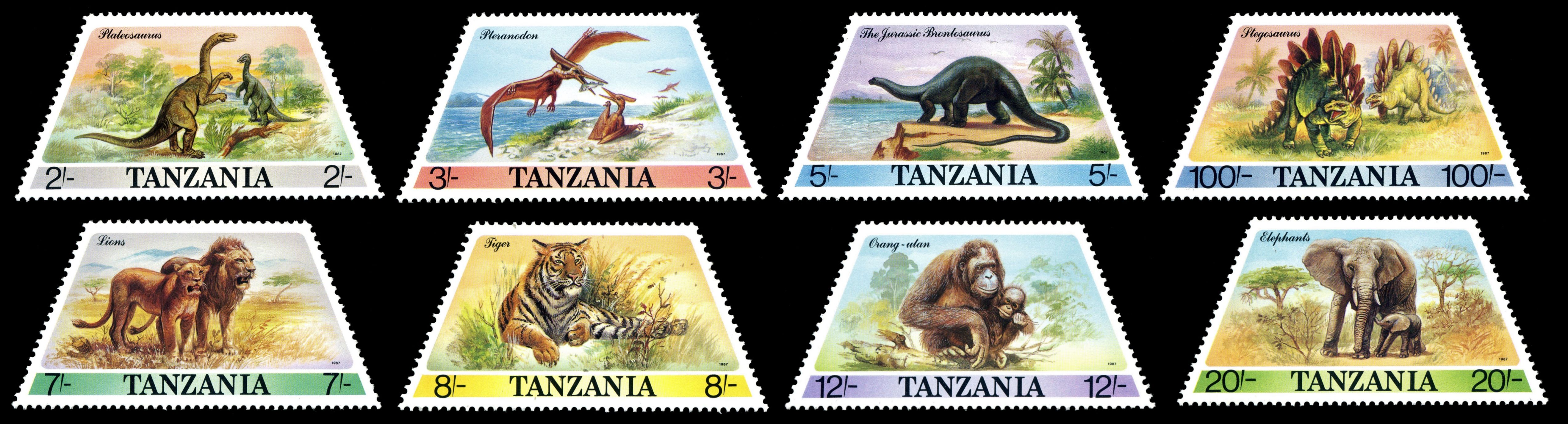
| 09.12.1965 "The first definitive set" [1] | 15.01.1977 "2nd World Black and African Festival of Art and Culture" [2] | 22.04.1988 "Prehistoric and Modern Animals" [3] |
 |
 |
 |
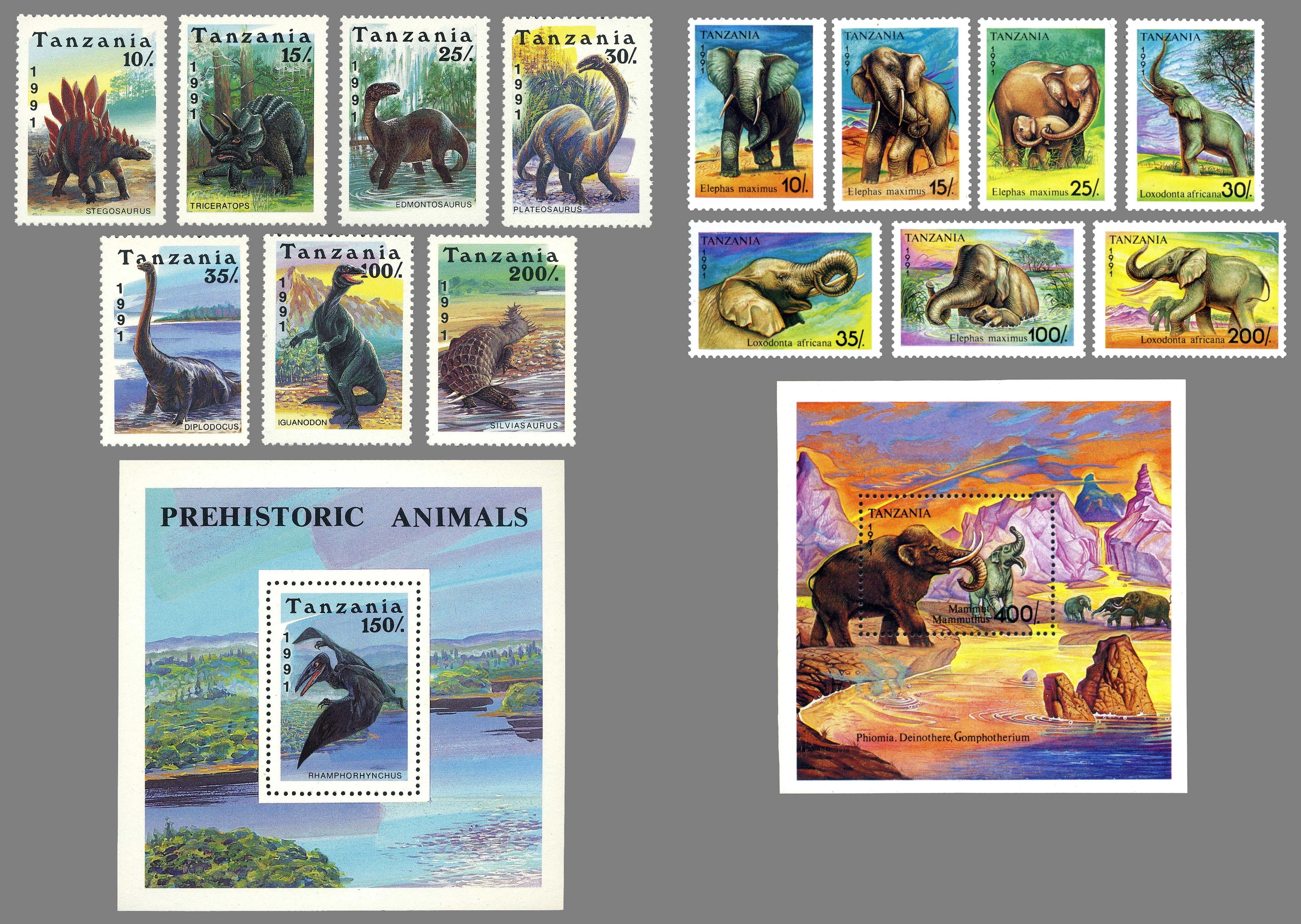
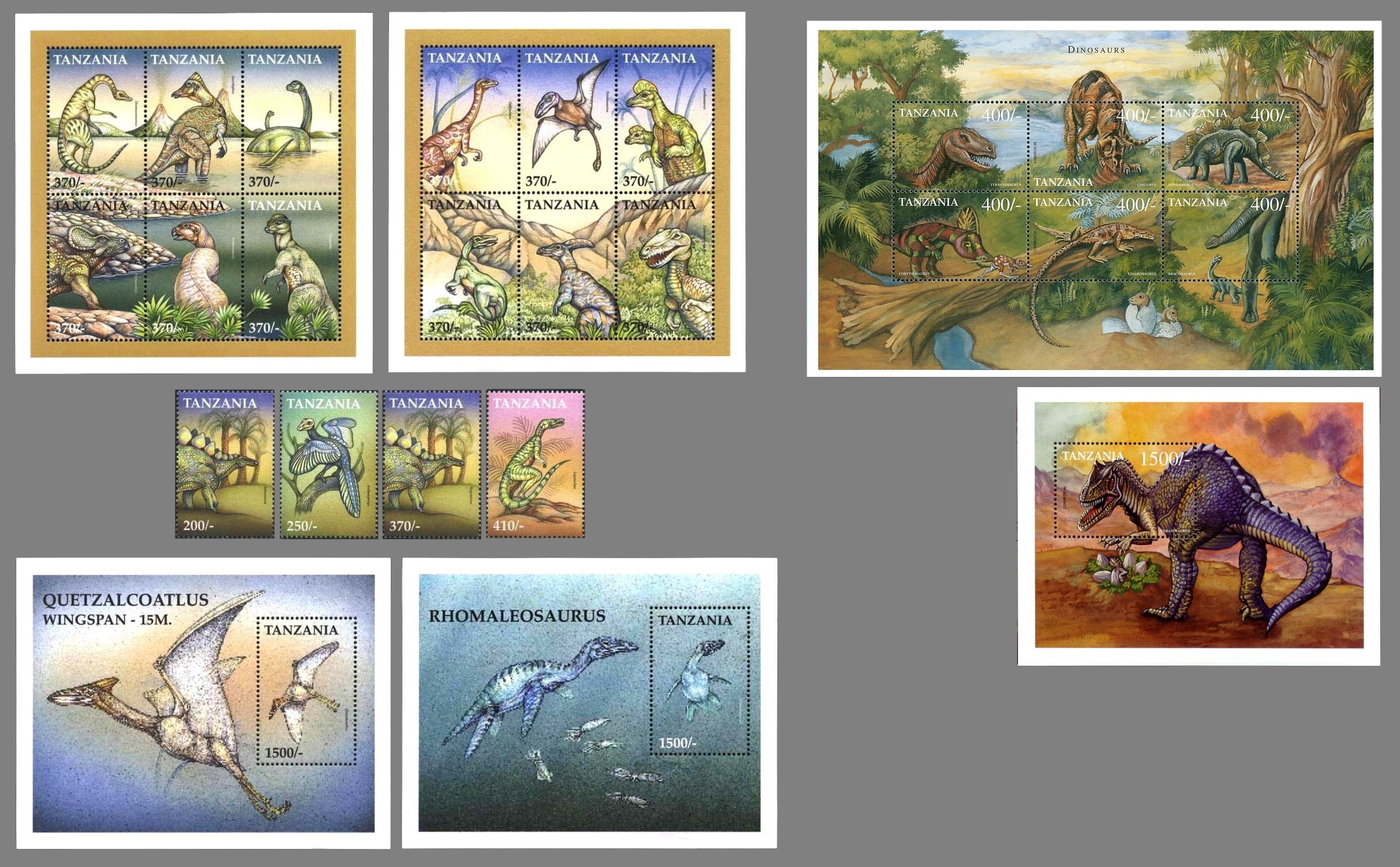
| 28.10.1991 "Dinosaurs" 28.11.1991 "Elephants" [4] |
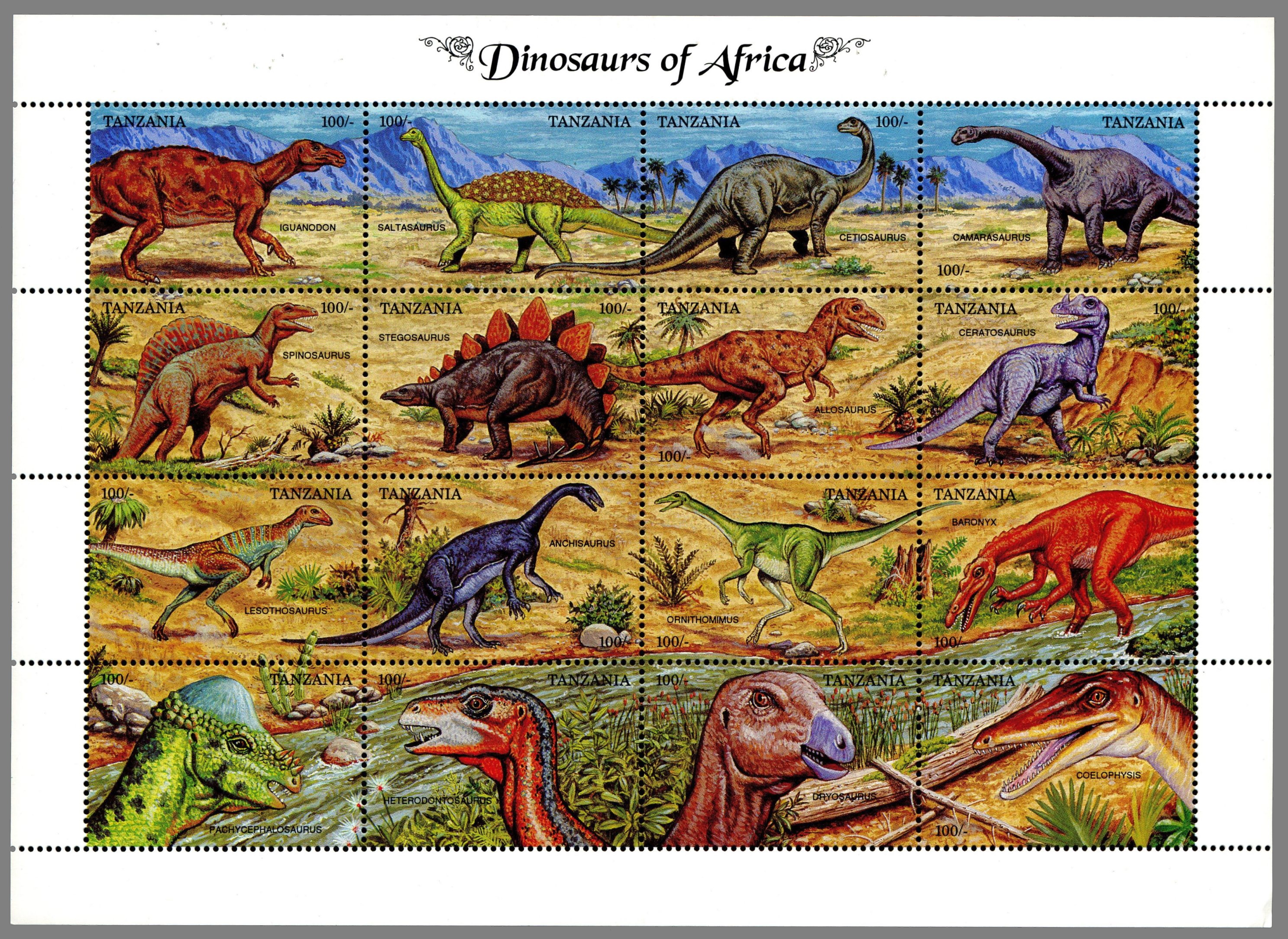
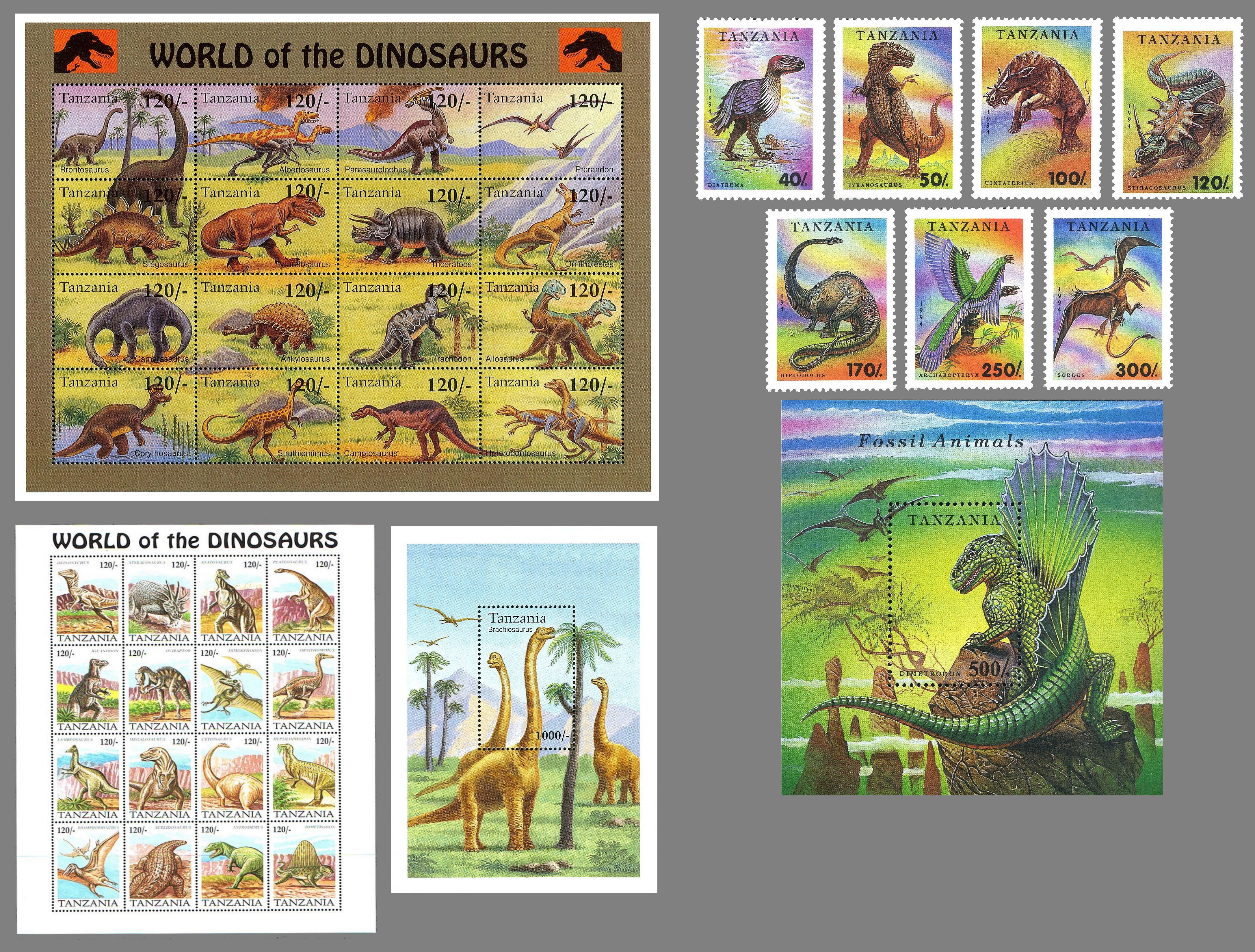
05.11.1992 "Dinosaurs" | 30.06.1994 "Prehistoric animals" 26.12.1994 "Prehistoric animals" [5] |
 |
 |
 |
| 30.04.1999 "Dinosaurs" 15.11.1999 "Prehistoric animals" |
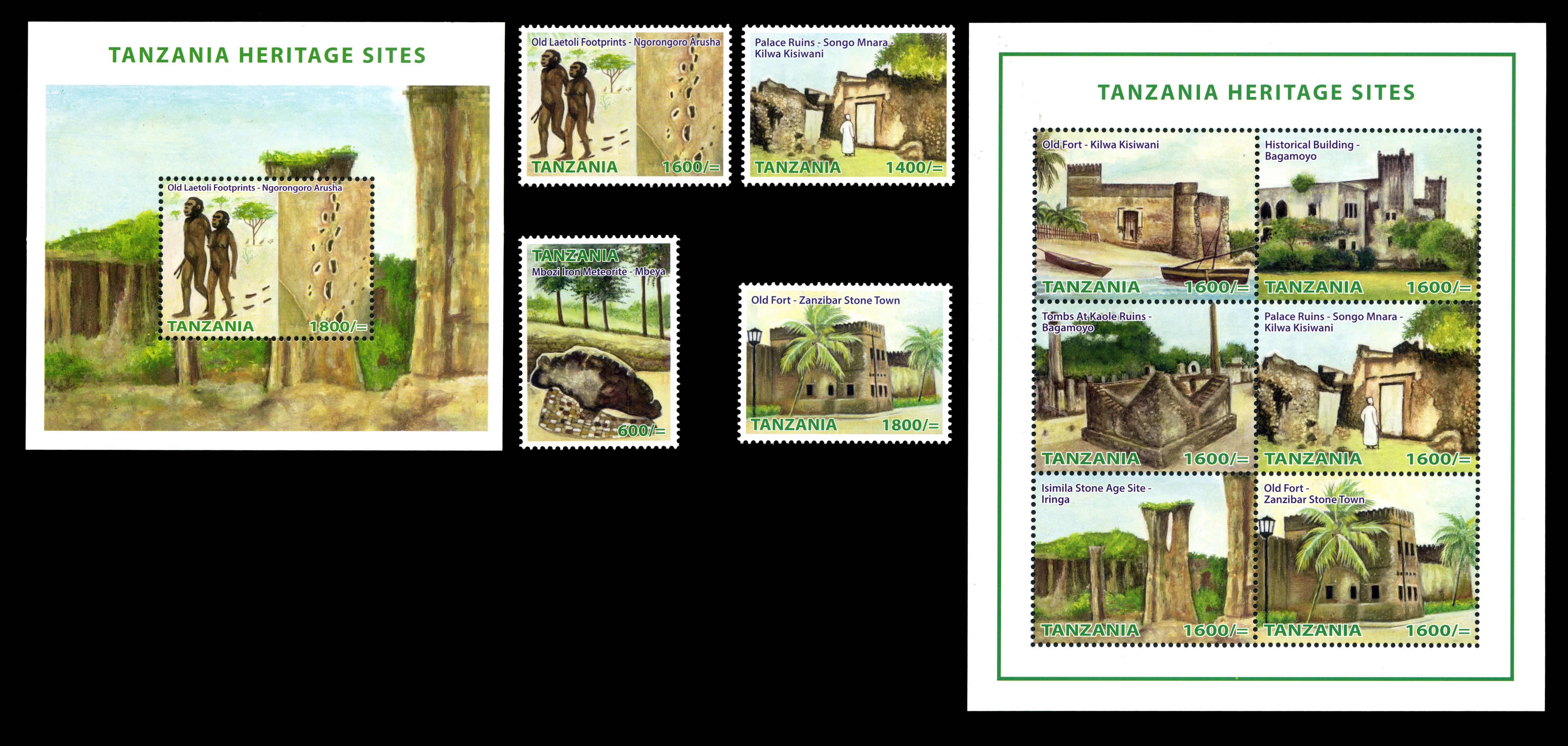
20.09.2014 "Tanzania heritage sites" [6] | |
 |
 |
|
Notes:
[1] On December 9, 1965 Tanzania issued a set of 14 stamps shows some typical animals, landscapes and some historical episodes to show development of the country.
 |
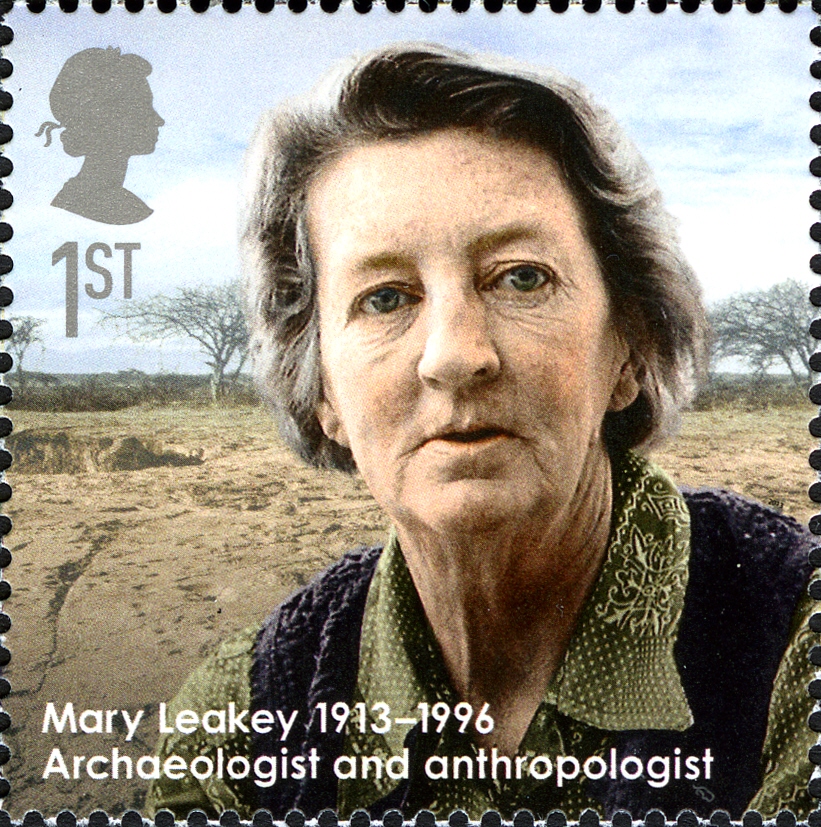 |
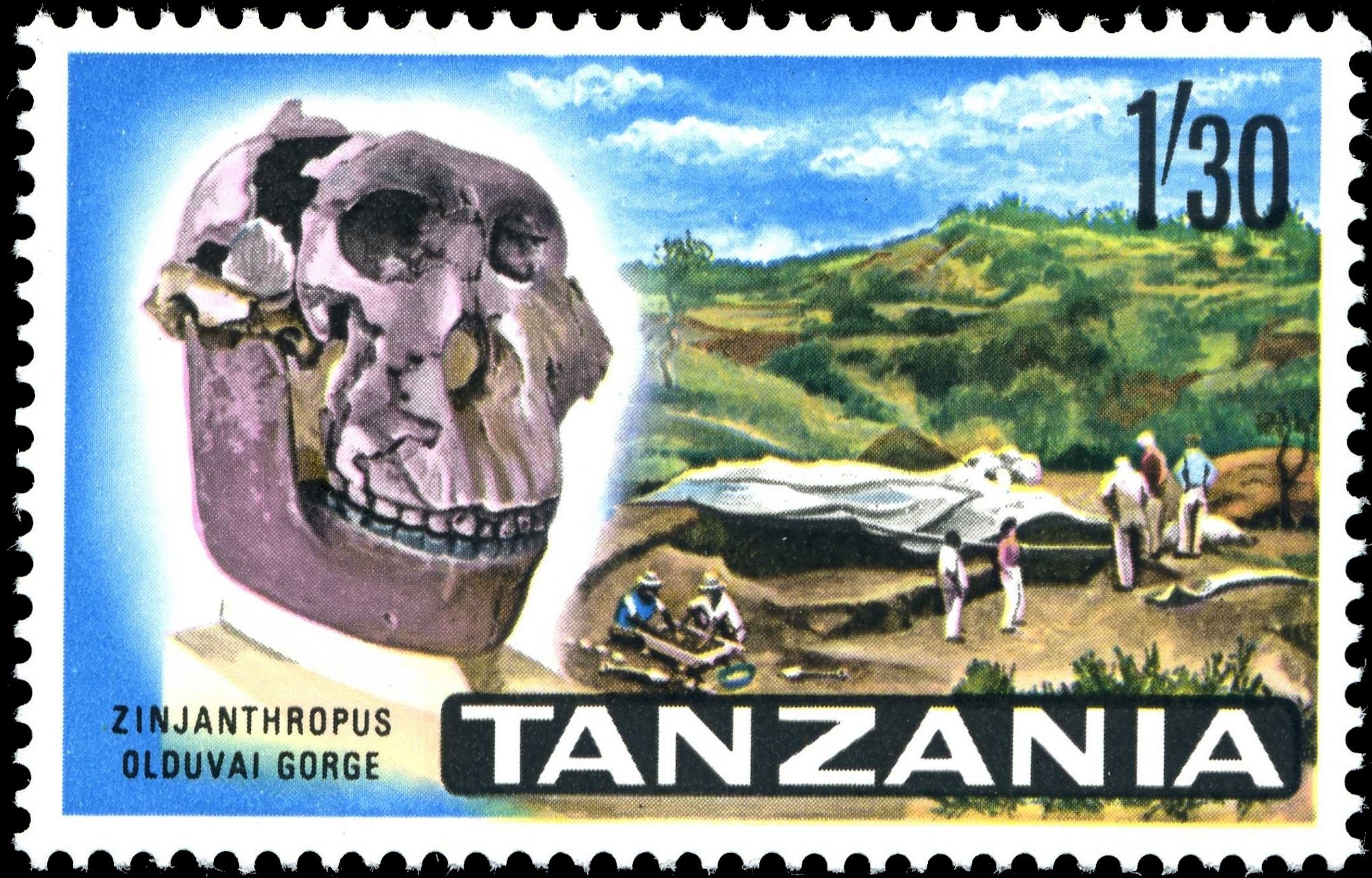
| A skull of Zinjanthropus and group of paleoanthropologists on stamp of Tanzania 1965 MiNr.: 14, Scott: 14. | Mary Leakey on stamp of UK 2013 MiNr.: 3448, Scott: 3164. |
The 1.30sh stamp shows a skull of Zinjanthropus and its excavation site at Olduvai Gorge valley, the place known as “cradle of humankind”.
Zinjanthropus, later categorized as Paranthropus boisei, is an extinct hominid postulated from a skull discovered in Olduvai Gorge, Tanzania, by British paleoanthropologist, Mary Leakey (who is honoured on Great Britannia’s stamp in 2013) on 17 July 1959.
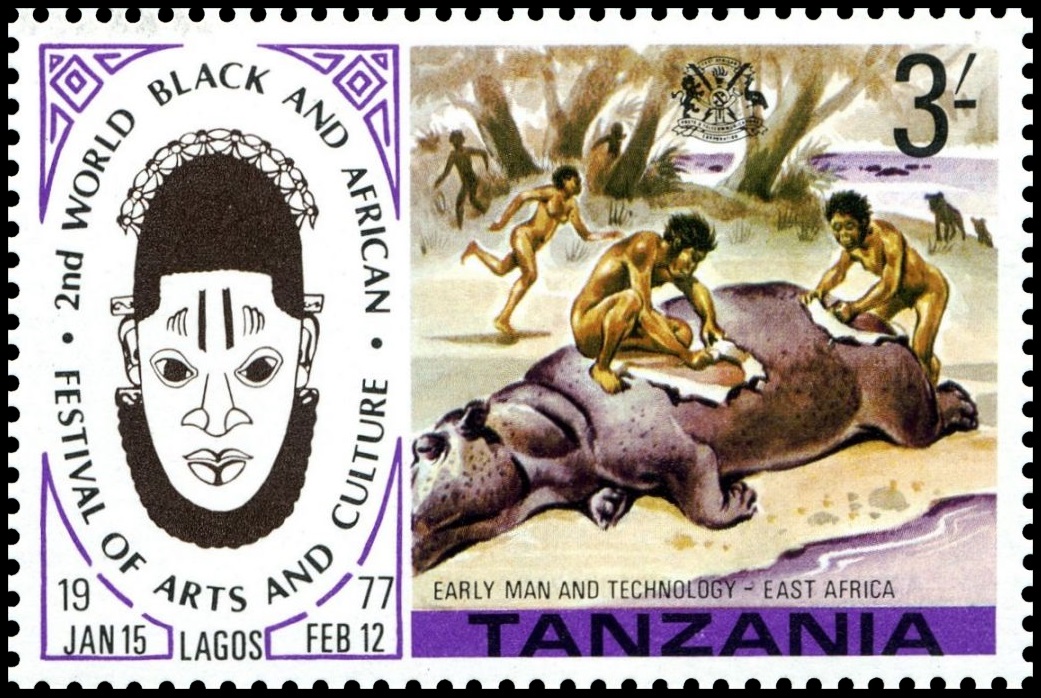
[2] "2nd World Black and African Festival of Art and Culture" stamps were issued by East-African community of Great Britain: Kenya, Uganda and Tanganyika/Tanzania in 1975 and later on as joint issue of independent countries: Kenya, Tanzania and Uganda in 1977.

|
|
| Stone age primitive men butchering a Hippopotamus on stamps of Kenya Tanzania Uganda 1975 MiNr.: 306, Scott: 319 | Stone age primitive men butchering a Hippopotamus on stamps of Tanzania 1977 MiNr.: 73, Scott: 75 |
Festac '77, also known as the Second World Black and African
Festival of Arts and Culture (the first was in Dakar, 1966), was a cultural
jamboree held in Lagos, Nigeria, from 15 January 1977 to 12 February 1977.
The month-long event celebrated African culture and showcased to the world African music,
fine art, literature, drama, dance and religion.
About 16,000 participants, representing 56 African nation and countries of the African Diaspora,
performed at the event.
Stone age primitive men butchering a Hippopotamus shown on a bottom-right stamp of the mini-sheet.
[R3]
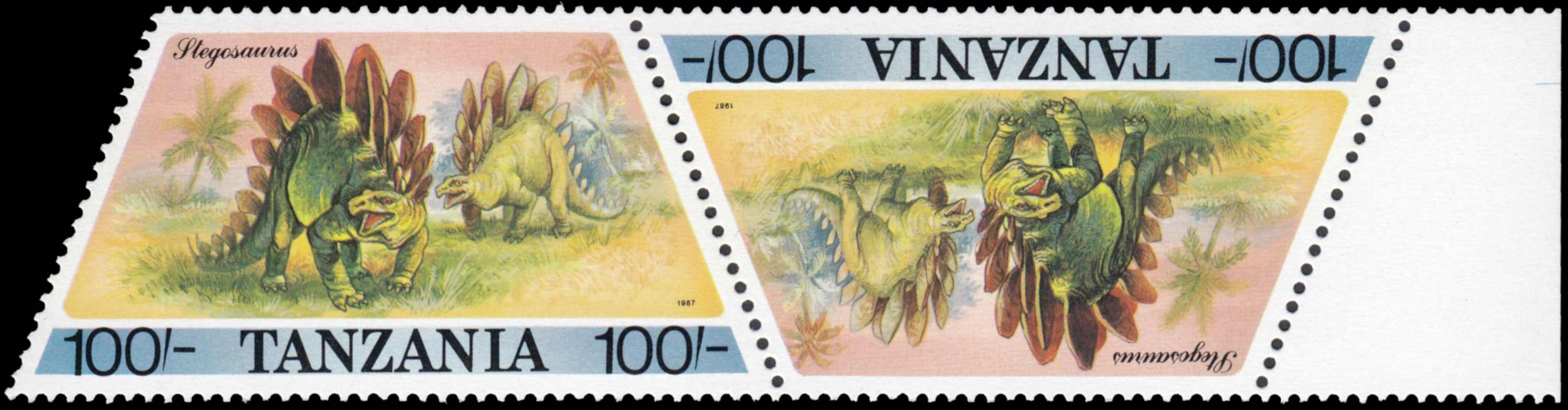
[3] These stamps printed in tete-beche format - every second stamp in the row was rotated by 180 degrees, as shown on the image below.
[4] Mammuthus primigenius depicted on the block.
[5] Similar sheets issued in Maldives:
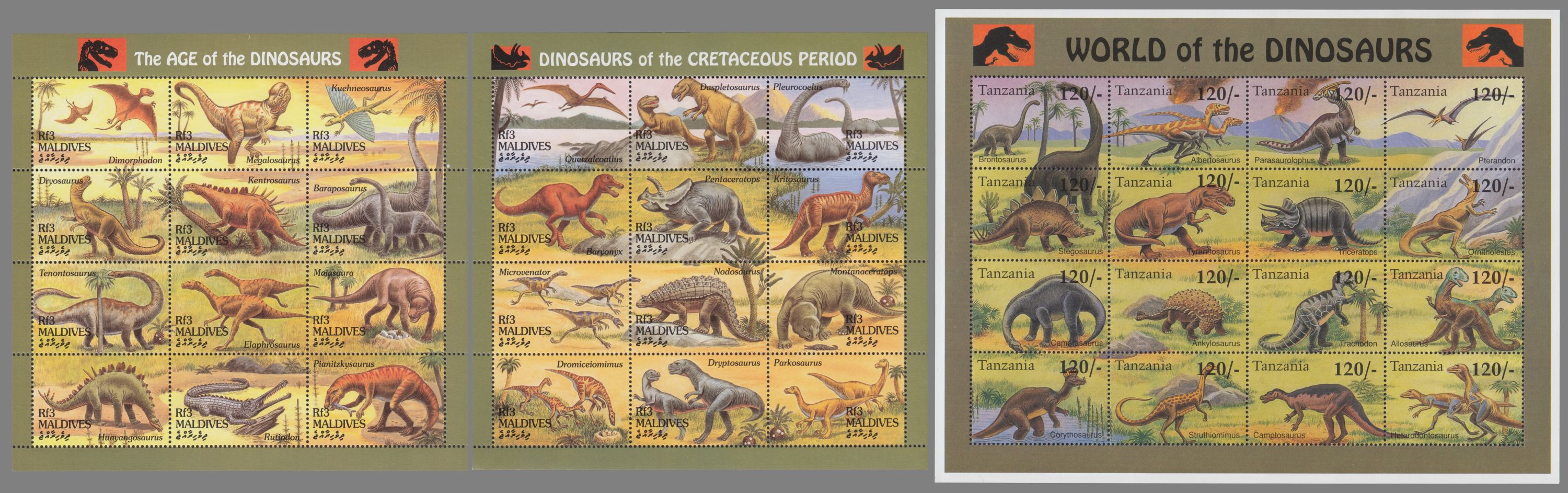
Maldives (20.06.1994) - MiNr.: 2157-2168, 2169-2180; Scott: 1969, 1970. Tanzania (26.12.1994) - MiNr.: 2000-2015, Scott: 1250.
In 1994, both countries outsourced the production of their stamps to the IGPC Agency. In that year, IGPC produced 221 stamps for the Maldives and 378 stamps for Tanzania, including many dinosaur stamps for both countries.
|
|
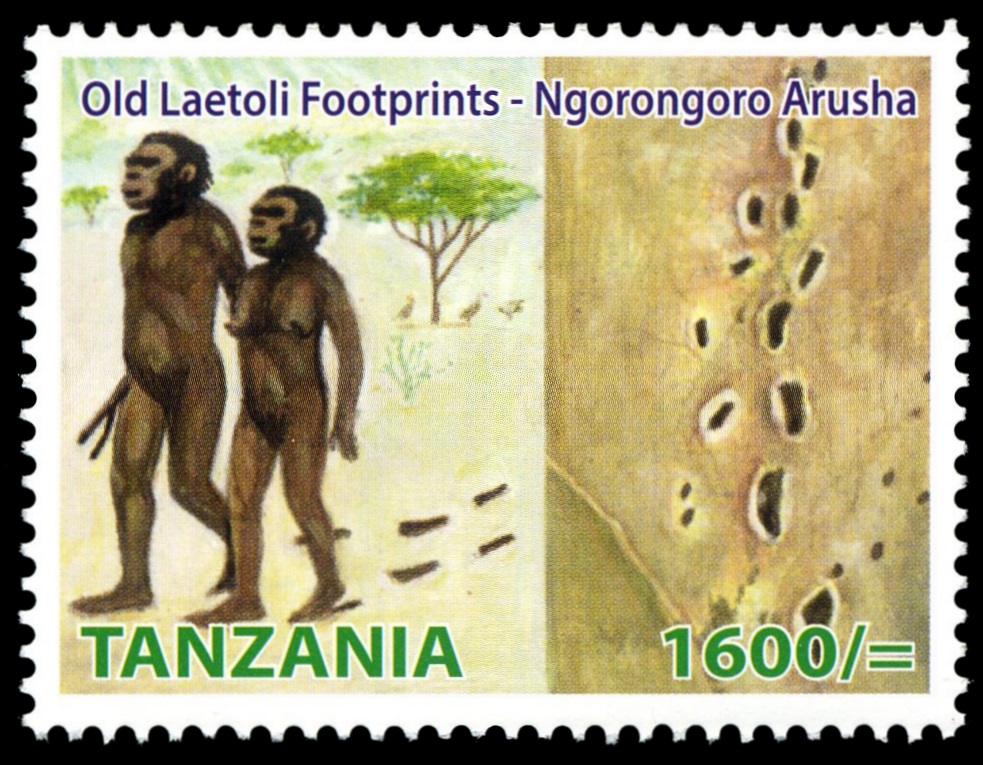
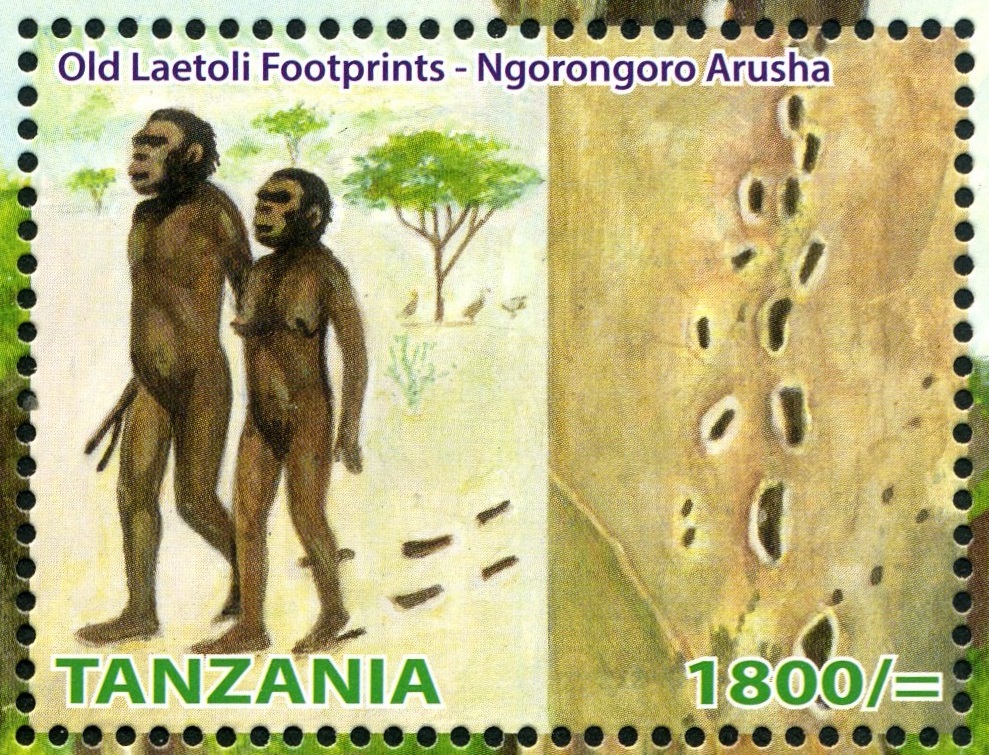
| Laetoli hominids and their footprints on stamps of Tanzania 2014. The stamp from the individual sheet, face value 1600/=, on the left. The stamp from the Mini-Sheet, face value 1800/=, on the left. MiNr.:, ; Scott: | |
One stamp and one block show two walking hominids and their footprints, known as "Laetoli footprints".
The stamps are the same except the face value.
Laetoli is a site in Tanzania, dated to the Plio-Pleistocene and famous for its
hominin footprints, preserved in volcanic ash.
The site of the Laetoli footprints (Site G) is located 45 km south of Olduvai gorge.
The location and tracks were discovered by archaeologist Mary Leakey in 1976 and were excavated by 1978.
[R4]
Some other stamps of Tanzania to consider: fossil found locations
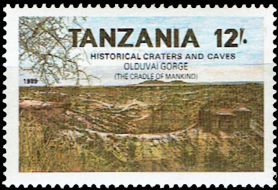
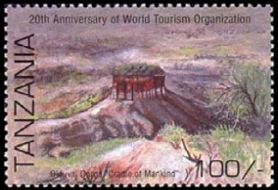
| 28.03.1991 "Craters and Caves" [A1] | 18.12.1995 "20th anniversary of World Tourism Organisation" [A1] | |
 |
 |
|
Notes:
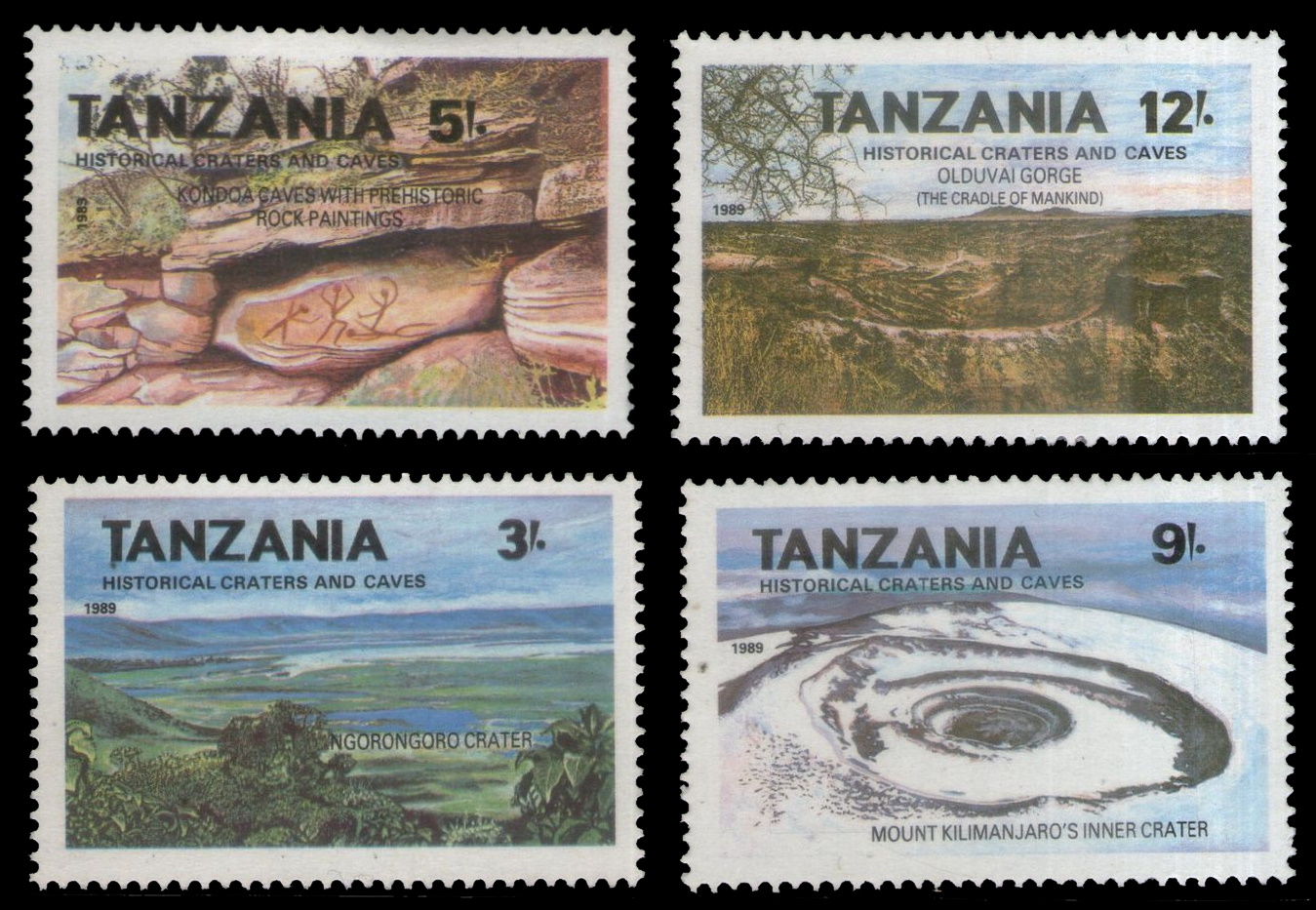
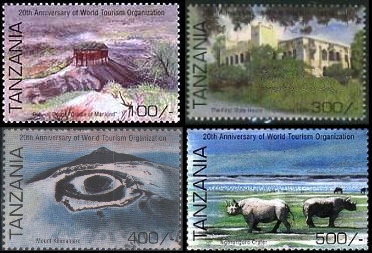
[A1] Olduvai Gorge valley the place known as "cradle of humankind" shown on stamps of Tanzania in 1991 and 1995.
|
|
| Olduvai Gorge valley the place known as "cradle of humankind" shown on stamps of Tanzania in 1991 and 1995, MiNr.:, Scott: | |
The Olduvai Gorge or Oldupai Gorge in Tanzania is one of the most important paleoanthropological sites
in the world; it has proven invaluable in furthering understanding of early human evolution.
A steep-sided ravine in the Great Rift Valley that stretches across East Africa, it is about 48 km long,
and is located in the eastern Serengeti Plains within the Ngorongoro Conservation Area in the Arusha Region,
about 45 kilometres from Laetoli, another important archaeological site of early human occupation.
The British/Kenyan paleoanthropologist-archeologist team of Mary and Louis Leakey established and developed
the excavation and research programs at Olduvai Gorge which achieved great advances of human knowledge
and world-renowned status.
[R5]
References
- [R1] Tanzania: Wikipedia FlagCounter
- [R2] Postal History and Philately of Tanzania:
Wikipedia
Links to official website of the Post Authority, stamp catalog and a list of new stamps of Tanzania are here - [R3] Festac '77: Wikipedia,
- [R4] Laetoli: Wikipedia,
- [R5] Olduvai Gorge valley: Wikipedia, Encyclopedia Britannica, Leakey Foundation.
- [R6] Tendaguru Formation: Wikipedia,
Acknowledgements
Many thanks to Dr. Peter Voice from Department of Geological and Environmental Sciences, Western Michigan University, for reviewing the draft page and his valuable comments.