USA 1954 "Thomas Jefferson third President of the United States"
| Issue Date | Perforated stamps: 15.09.1954, Coil stamps: 22.10.1954, |
| ID | Michel: 654A, 654C; Scott: 1033, 1055 ; Stanley Gibbons: 1031, 1055; Yvert et Tellier: 588, 588a ; Category: Co |
| Design | Designers: Tyler Dingee and William Schrage Engravers: Matthew D. Fenton, George L. Huber. |
| Stamps in set | 1 |
| Value | 2c - Thomas Jefferson |
| Emission/Type | definitive |
| Places of issue | |
| Size (width x height) | 21.5mm x 25.0mm |
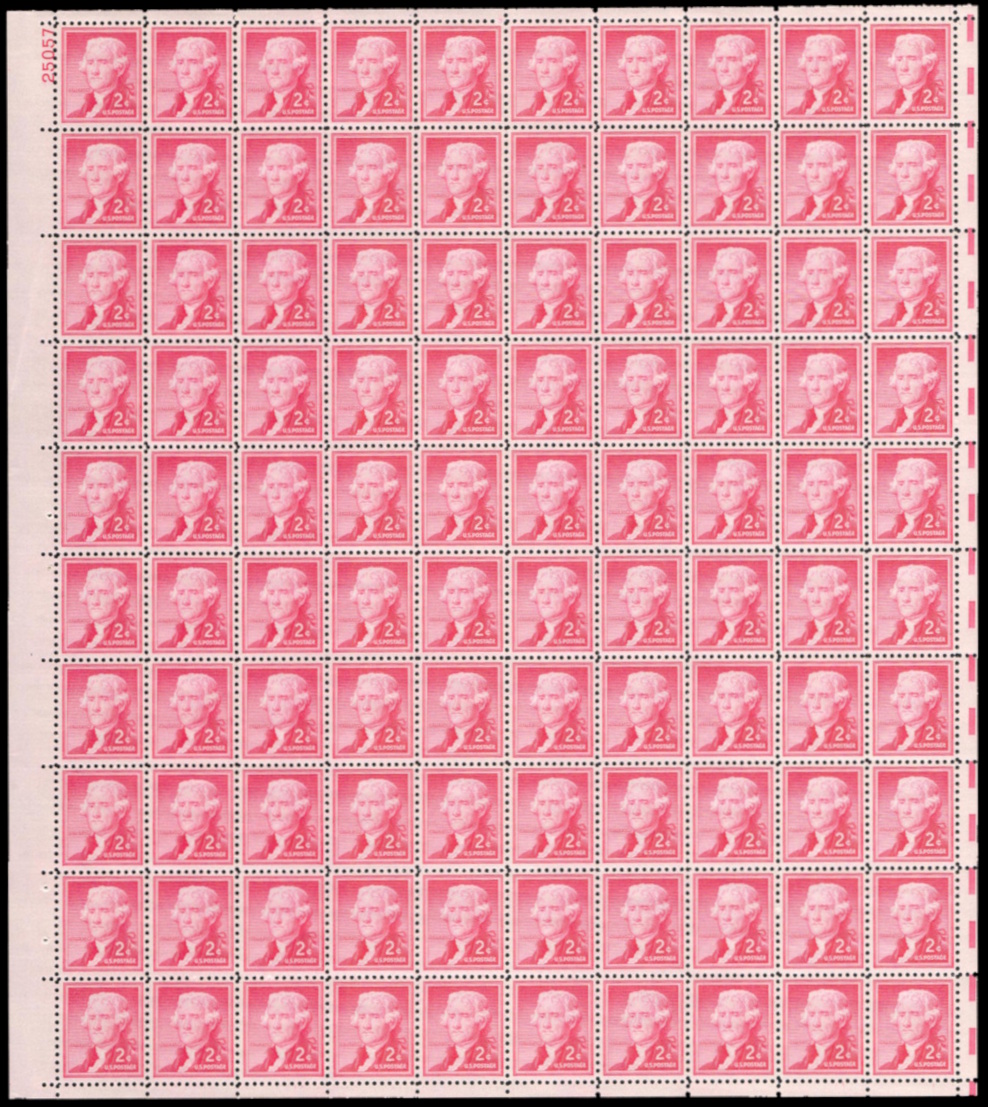
| Layout | Sheet of 100 stamps (10x10), coils of 500 and 1.000 |
| Products | None |
| Paper | No Watermark |
| Perforation | 11.00 x 10.5 |
| Print Technique | Dry printing |
| Printed by | Bureau of Engraving and Printing |
| Quantity | |
| Issuing Authority | U.S. Postal Service |
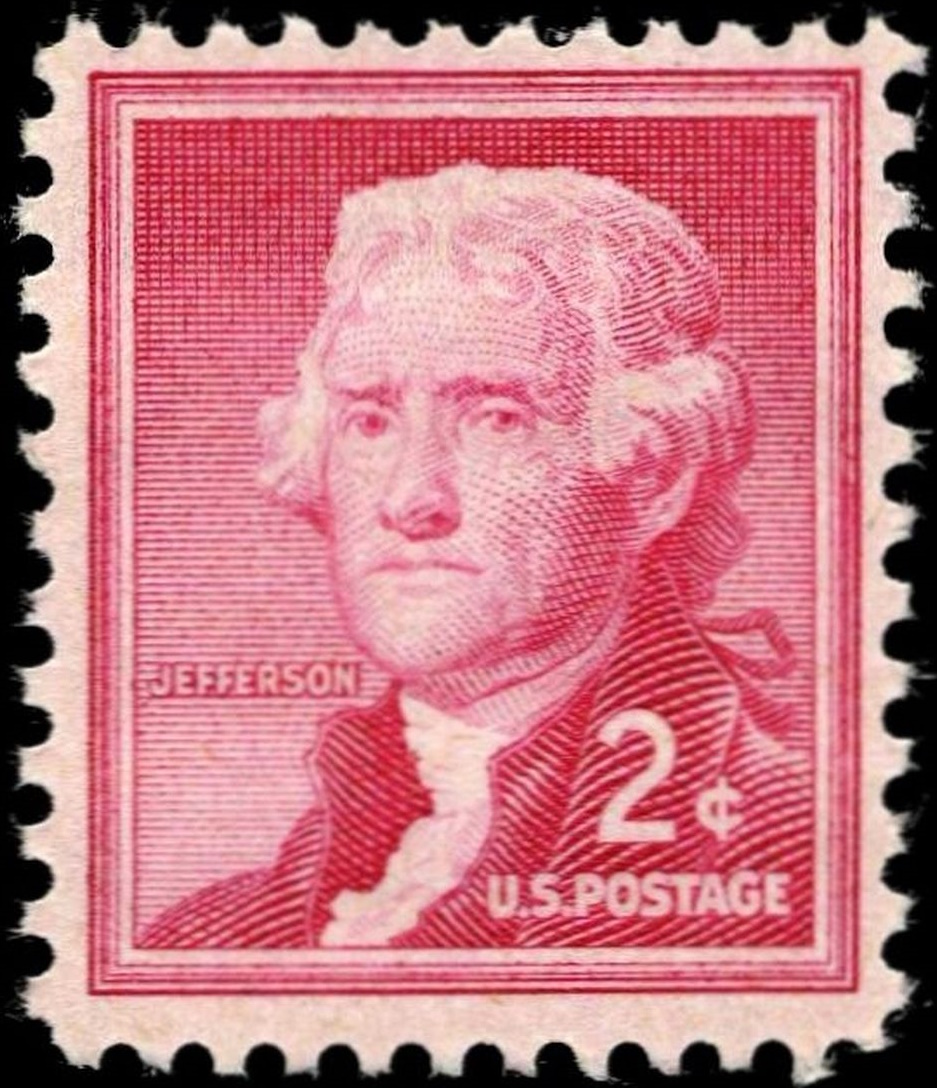
On September 15th, 1954, the United States Postal Service issued a definitive stamp portraying Thomas Jefferson. The stamp design was, probably, inspired by the bust of Thomas Jefferson sculpted from life in 1789 by Jean-Antoine Houdon.
The stamp formed part of a new long-running definitive series. The series began on April 5th, 1954, with the first stamp depicting the Statue of Liberty. In total, eighteen denominations were released as part of what became known as the “Liberty Series”. The series was issued primarily between 1954 and 1961 and was later succeeded by the Prominent Americans Series in 1965. Nevertheless, certain denominations, particularly the Jefferson stamp, continued to be reprinted and remained in postal use well into the 1980s due to sustained demand.
 |
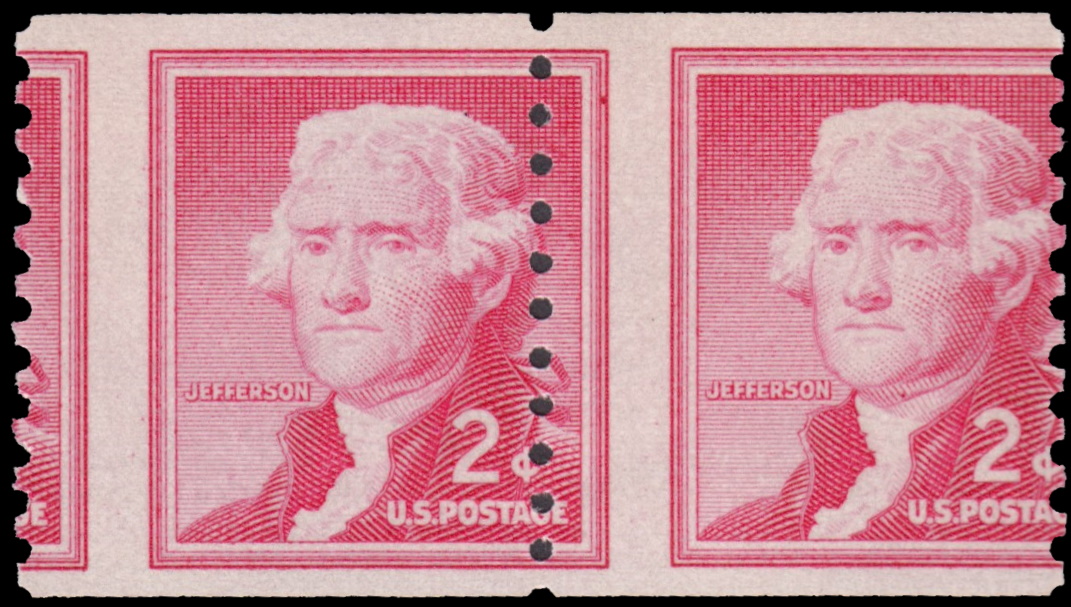 |
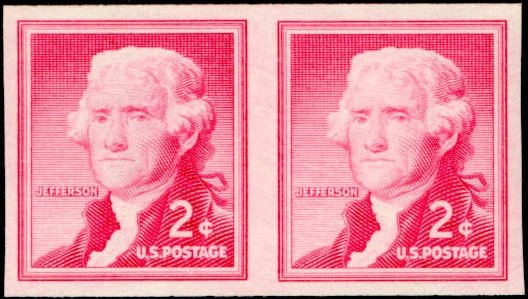
| Imperforate and misperforated coil stamps of Thomas Jeffersons, USA 1954. | |
Thomas Jefferson
Thomas Jefferson (1743–1826) was an American Founding Father and the third President of the United States from 1801 to 1809. He was the primary author of the Declaration of Independence. Jefferson was the nation's first U.S. Secretary of State under George Washington and then the nation's second Vice President under John Adams. Jefferson was a leading proponent of democracy, republicanism, and natural rights, and he produced formative documents and decisions at the state, national, and international levels.
In the late 19th to early 20th century, paleontologists such as Frederic A. Lucas, then Curator‑in‑Chief of the U.S. National Museum, and Henry Fairfield Osborn, at the time Curator of Vertebrate Paleontology at the American Museum of Natural History, described Jefferson as having founded American vertebrate paleontology and regarded him as the discipline’s earliest guiding figure.
They credit him with:
- Refuting Buffon’s degeneracy theory
- Encouraging systematic fossil collection
- Promoting stratigraphic awareness in excavation
- Presenting the first scientific paper on a North American fossil vertebrate
For more details about Jefferson's interest to palaeontology, please read Thomas Jefferson the father of American Paleontology article on this website.
Products and associated philatelic items
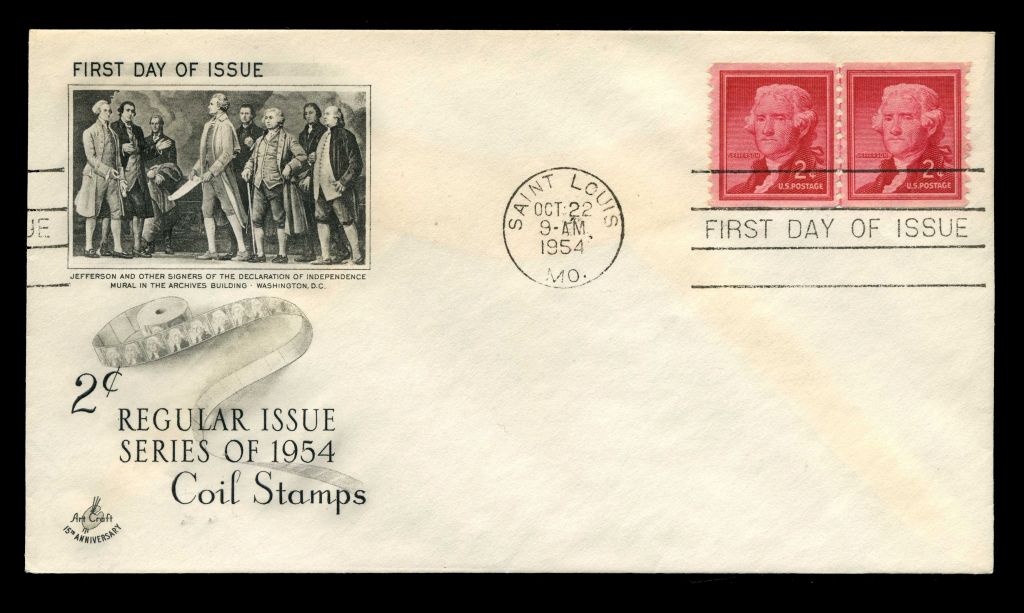
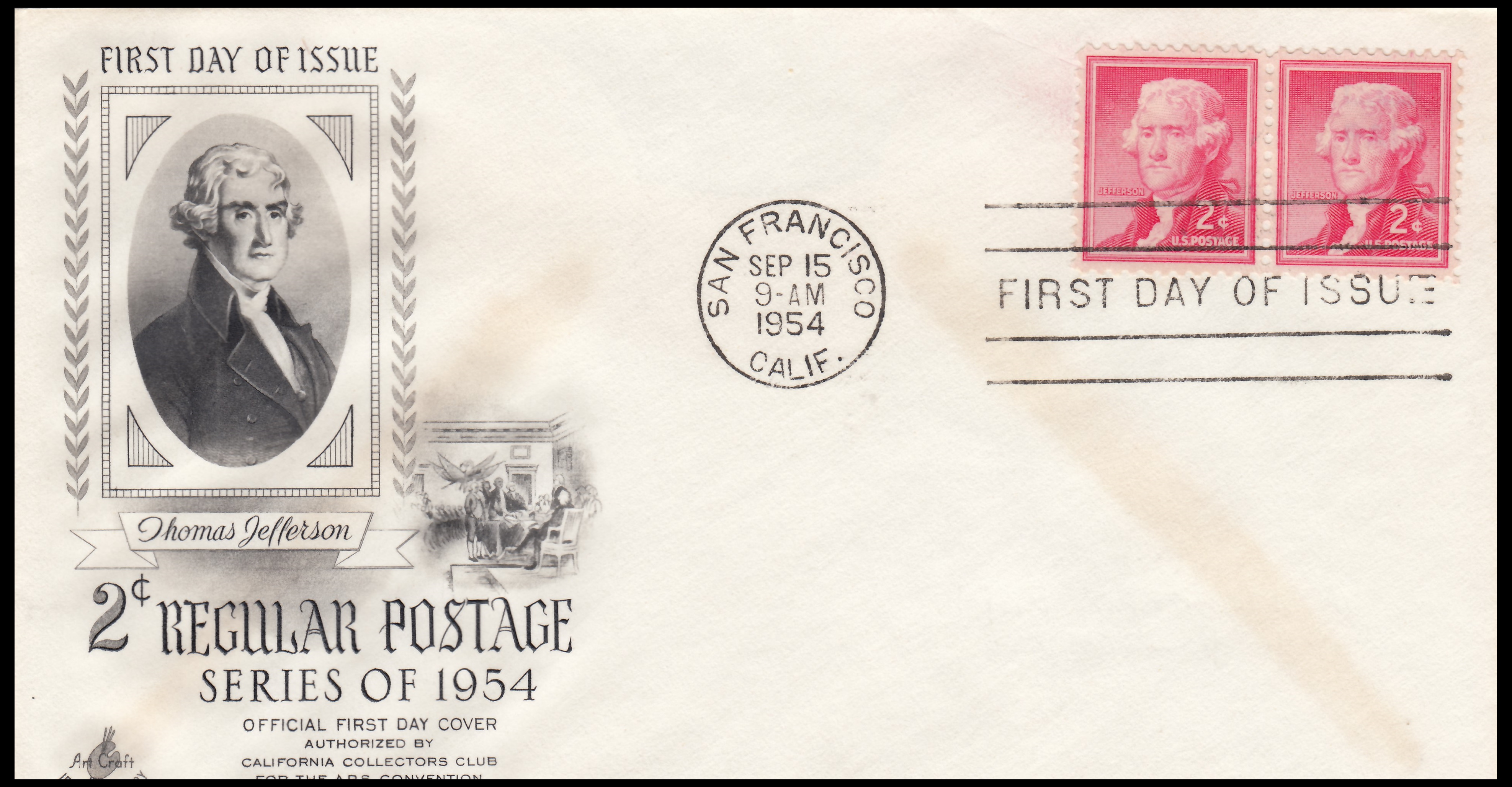
No official philatelic products were issued in connection with this stamp issue. The United States Postal Service did not produce an official First Day Cover (FDC) or a pictorial First-Day-of-Issue postmark. All first day covers illustrated below are privately produced items.
| FDC | Sheet of 100 | |
 |
 |
 |
| Coil of 500 stamps | ||
 |
||
References
- Technical Details: colnect, mysticstamp.
Acknowledgement
Many thanks to Dr. Peter Voice from Department of Geological and Environmental Sciences, Western Michigan University, for reviewing the draft page, his valuable comments and great help to find materials for this article.