USA 1955 "150th Anniversary of the Pennsylvania Academy of the Fine Arts"
| Issue Date | 15.01.1955 |
| ID | Michel: 684: Scott: 1064; Stanley Gibbons: 1066; Yvert: 591; Co, pF. |
| Designer | Designers: Victor S. McCloskey, Jr. Engraver: Charles A. Brooks and Robert J. Jones |
| Stamps in set | 1 |
| Value | 3c - Charles Willson Peale with objects from his museum |
| Emission/Type | commemorative |
| Places of issue | Philadelphia, Pennsylvania |
| Size (width x height) | 26mm x 40mm |
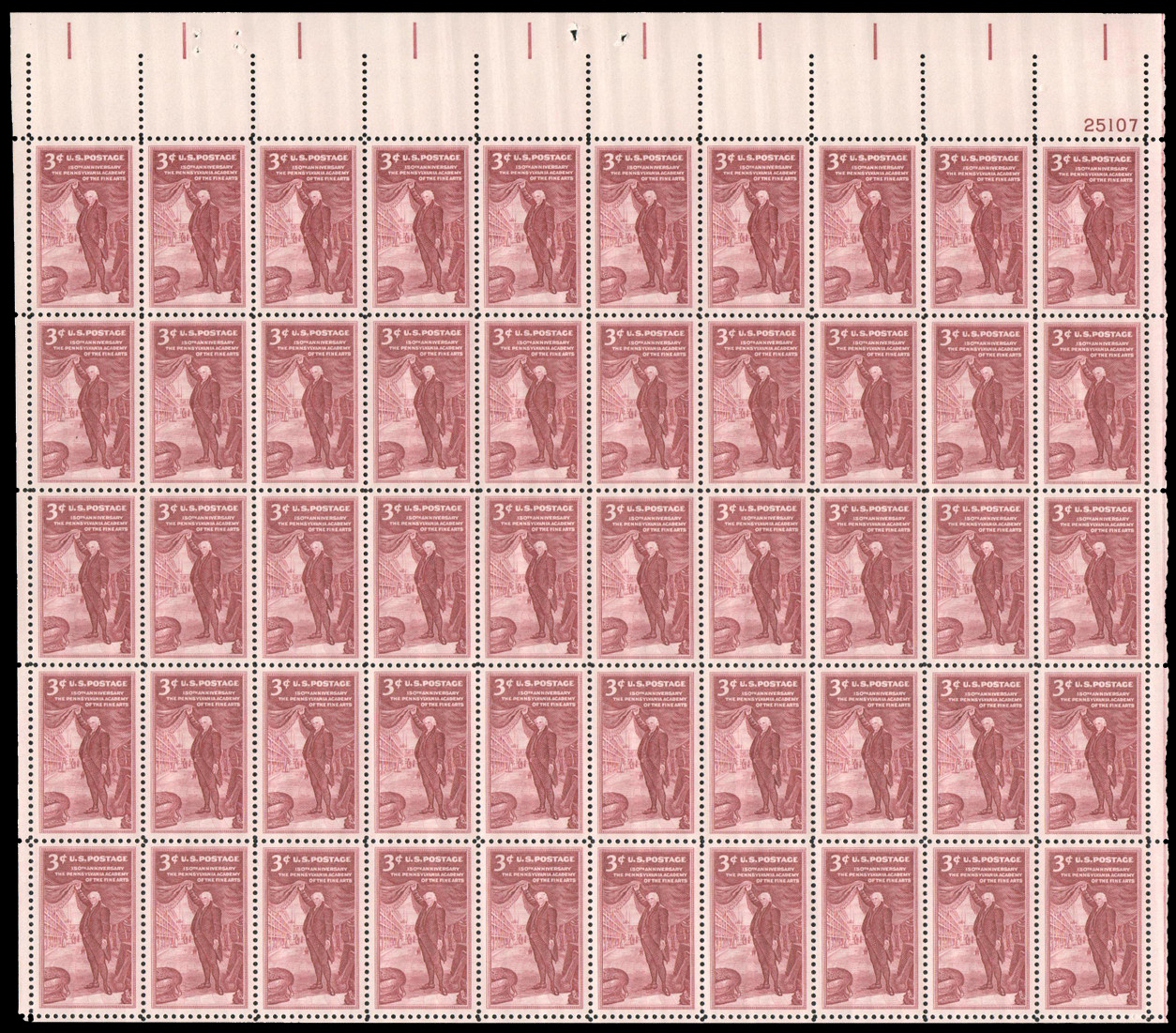
| Layout | Sheet of 50 stamps (10x5) |
| Products | None |
| Paper | No Watermark |
| Perforation | 10.5 x 11 |
| Print Technique | Rotary Press |
| Printed by | Bureau of Engraving and Printing |
| Quantity | 116.139.800 |
| Issuing Authority | U.S. Postal Service |
On January 15th, 1955, the United States Post Office issued a stamp commemorating the 150th anniversary of the Pennsylvania Academy of the Fine Arts.
The Pennsylvania Academy of the Fine Arts, founded in 1805 by portrait painter and museum founder Charles Willson Peale, sculptor William Rush, and other civic leaders, is the oldest art museum and art school in the United States. Its historic building, designed by architects Frank Furness and George Hewitt, was built in 1876. The museum is internationally renowned for its collection of 18th-, 19th-, and 20th-century American paintings, sculptures, and works on paper. Recognized as a National Historic Landmark, the building underwent a major restoration in 1976.
The stamp features Charles Willson Peale’s self-portrait, The Artist in His Museum. Commissioned in 1822 by the trustees of his museum as a full-length likeness, the painting was executed between 1822 and 1826 and shows many objects collected and prepared by Peale himself.
| "The Artist in His Museum" (Image credit: Wikipedia) | |
 |
The composition is organized into three spatial zones.
|
Charles Willson Peale (1741–1827) was an American painter, soldier, and naturalist, best known for his portraits of leading figures of the American Revolution, including the third U.S. President, Thomas Jefferson, who is often regarded as the father of American vertebrate paleontology.
His artistic and scientific pursuits converged in the founding of the Philadelphia Museum, later known as the Peale Museum, widely regarded as the first major museum in the United States. Its collections included botanical, zoological, and archaeological specimens, numerous bird displays, and the celebrated mounted mastodon skeleton that symbolized both Peale’s scientific ambition and his vision of a national museum.
Discovery of the first American Mastodon
The mastodon bones and reconstructed skeleton on the stamp belonged to the first mounted mastodon in the United States.
 |
| Peale's Exhuming the First American Mastodon (1806). Image credit: Wikipedia |
Peale directed an ambitious excavation at Masten’s farm, though it produced little additional material. Undeterred, he investigated nearby sites and ultimately recovered a nearly complete second skeleton at Millspaw’s Bog. Returning to Philadelphia, he spent three months reconstructing the specimen with the guidance of anatomist Caspar Wistar, carefully replacing missing bones with wood or papier-mâché. The completed skeleton debuted at the American Philosophical Society in late 1801, astonishing audiences and igniting widespread fascination with what was then called the “mammoth”.
At the time, such remains were commonly referred to as mammoth bones. Around 1800, however, the French naturalist Georges Cuvier clarified the distinction between mastodons and mammoths, establishing terminology that remains in use today.
After reconstructing the mastodon skeleton, Charles Willson Peale hosted a memorable dinner beneath its massive ribs in his Philadelphia Museum in late 1801, celebrating the scientific achievement with a small group of friends and colleagues. He used the event to highlight the mastodon as both a scholarly and public attraction.
Later, in 1804, another dinner was held beneath the skeleton to honor the visiting German naturalist Alexander von Humboldt.
Peale’s display attracted attention in both the United States and Europe—not only for the impressive fossil itself, but also for his innovative method of mounting large skeletons in three dimensions. His museum was among the first in America to organize its collections according to Linnaean taxonomy, distinguishing it from institutions that presented artifacts merely as curiosities. Over time, the museum occupied prominent Philadelphia buildings, including Independence Hall and the original home of the American Philosophical Society. Despite its scientific ambition and popularity, the museum ultimately failed due to financial difficulties and Peale’s inability to secure sustained government support. After his death, the collection was sold and dispersed by showmen P. T. Barnum and Moses Kimball.
In 1854, the German naturalist Johann Jakob Kaup purchased Peale’s mastodon skeleton—the very specimen immortalized in Peale’s painting of the 1801 excavation. It is now on display at the Hessisches Landesmuseum Darmstadt in Germany.
Mastodon
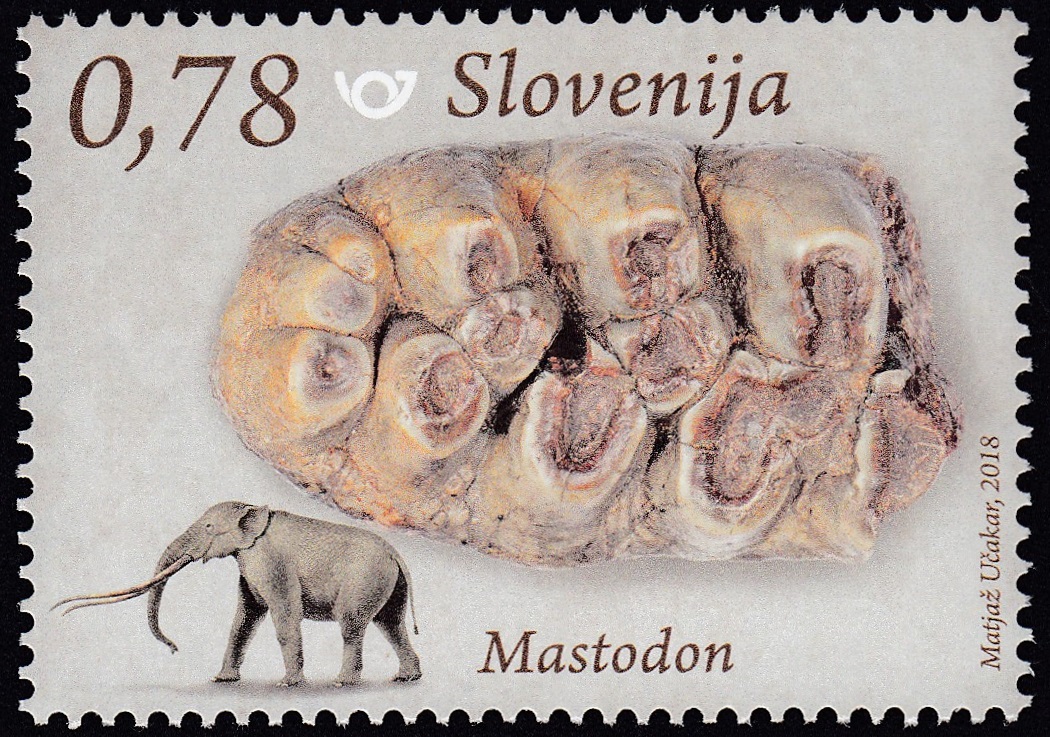
Mastodons were large, elephant-like mammals belonging to the extinct genus Mammut (depicted on the US stamp in 1996). Although closely related to modern elephants, they were not true elephants and differed in body shape, skull structure, and especially in their teeth.
 |
|
|
Above:
First Day Cover (FDC) produced by Fleetwood for the 1996 U.S. mastodon stamp;
the cachet design later became the motif for a stamp issued by
the Marshall Islands in 2009. Right: Mastodon tooth on stamp of Slovenia 2018. |
 |
Mastodons were part of the order Proboscidea, which also included gomphotheres, sometimes informally called “four-tuskers”, as well as mammoths and modern elephants. Some early proboscideans had both upper and lower tusks, and certain gomphotheres possessed flattened lower tusks, earning them the nickname “shovel-tuskers”. However, typical mastodons had only upper tusks.
Compared to modern elephants (genera Elephas and Loxodonta), mastodons were generally shorter and more heavily built. Their teeth were very different from those of elephants and mammoths: instead of flat grinding plates, mastodons had cusped molars suited for browsing on leaves, twigs, and shrubs. The name “mastodon” means “nipple tooth,” referring to these distinctive cusps. They likely had hair, especially in colder climates, though the extent and coloration of their coat are uncertain.
Mastodons survived until the end of the Pleistocene, becoming extinct roughly 11,000–10,000 years ago. They coexisted with early Native American populations in North America. Most scientists believe their extinction was caused by a combination of rapid climate change at the end of the Ice Age and human hunting pressure.
Products and associated philatelic items
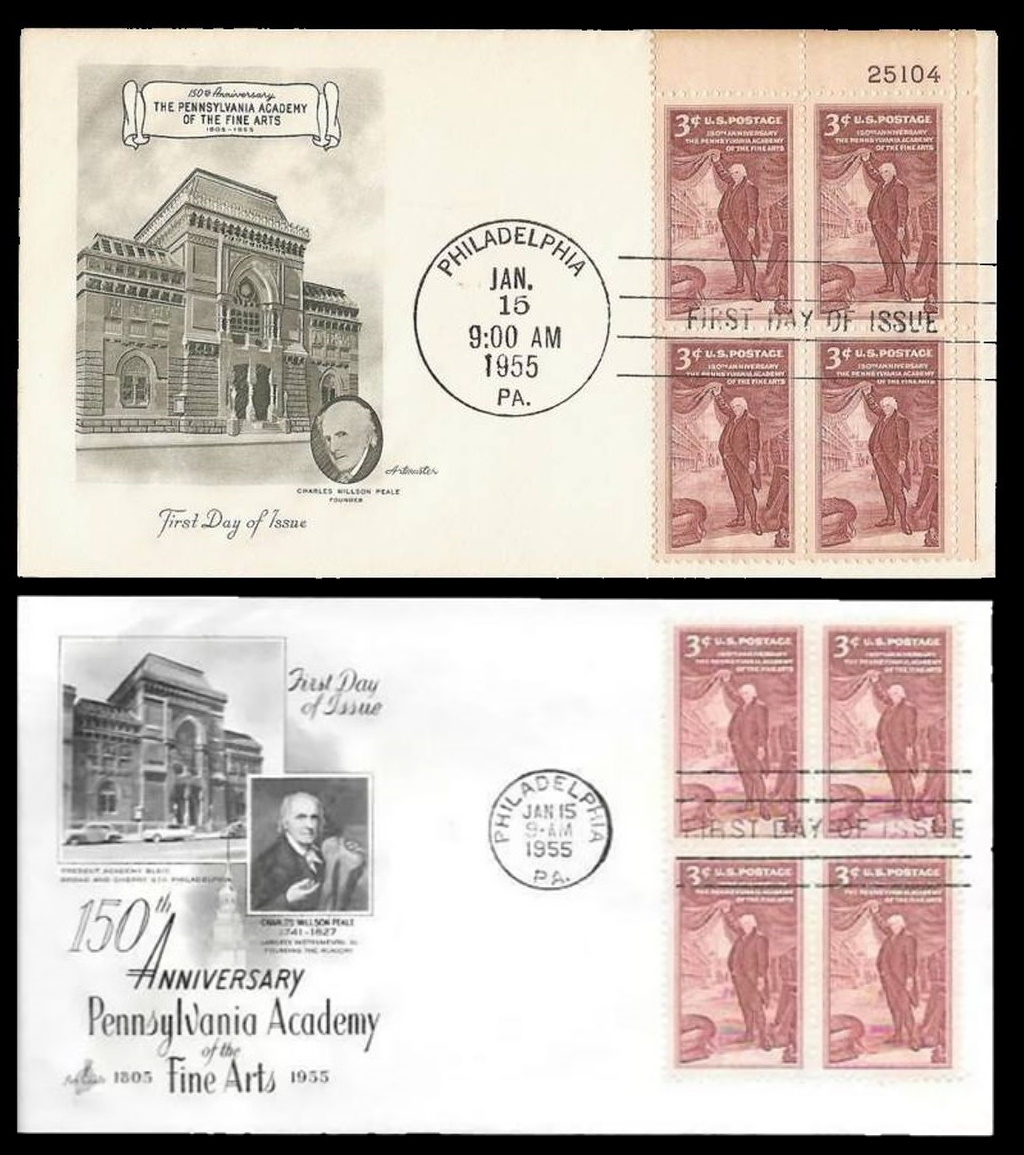
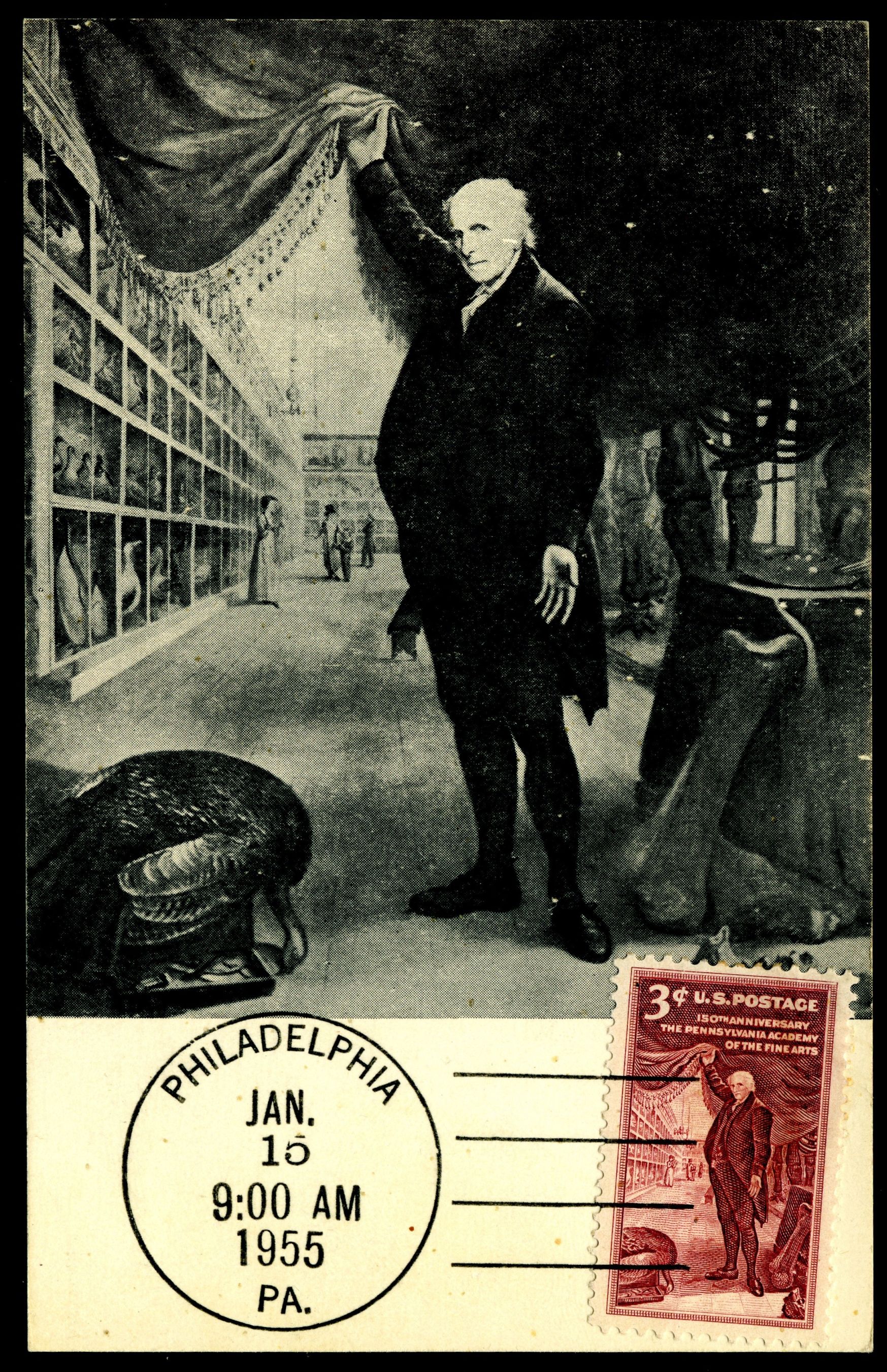
No official philatelic products were issued in connection with this stamp issue. The United States Postal Service did not produce an official First Day Cover (FDC) or a pictorial First-Day-of-Issue postmark. All first day covers and maxi cards illustrated below are privately produced items.
| FDC | Maxi Card | |
 |
|
 |
| Stamps Sheet | ||
 |
||
References
- Technical Details:
colnect, mysticstamp. - Charles Willson Peale:
Wikipedia, American Heritage. - "The Artist in His Museum":
Wikipedia. - Mastodon:
Encyclopaedia Britannica, Wikipedia. - Charles Willson Peale’s Mastodon:
Smithsonian: The story of Charles Willson Peale’s massive Mastodon, Skeleton of the Mastodon;
American Monster, Chronogram, Earth Magazine.
Acknowledgement
Many thanks to Dr. Peter Voice from Department of Geological and Environmental Sciences, Western Michigan University, for reviewing the draft page, his valuable comments and great help to find materials for this article.