Portugal 2000 - 2001 "Dinosaurs of Portugal"
| Issue Date | 21.02.2000 - AMIEL 13.03.2000 - SMD 20.12.2000 - NewVision |
| ID |
Michel: 29.1-32.1 (SMD: MSPost VE 50),
29.2-32.2 (AMIEL: SIMA 1020),
29.2-32.2 (NewVision: Epost 2000); Scott: N/A; Stanley Gibbons: ?; Yvert et Tellier: ?; Category: pR |
| Design | artwork: Jose Projecto, stamps design: Mariana Santos |
| Stamps in set | 4 self-adhesive ATM labels |
| Value |
Esc 50 / €0.25 : Esc 350 / € 1.75 - Sauropod with footprints Esc 50 / €0.25 : Esc 350 / € 1.75 - Lourinhasaurus Esc 50 / €0.25 : Esc 350 / € 1.75 - Dacentrurus Esc 50 / €0.25 : Esc 350 / € 1.75 - Allosaurus |
| Emission/Type | ATM |
| Places of issue | Lisbon. Porto, Coimbra, Evora e Faro, Lourinha |
| Size (width x height) | 55 mm x 30 mm |
| Layout | strip of 4 self-adhesive labels |
| Products | Any FDC or additional philatelic product was produced by Portuguese Post. |
| Paper | Esmalte, fluorescent |
| Perforation | imperforate, self-adhesive |
| Print Technique | Offset lithography |
| Printed by | Amiel and SMD vending machines |
| Quantity | N/A |
| Issuing Authority | CTT - Correios de Portugal |
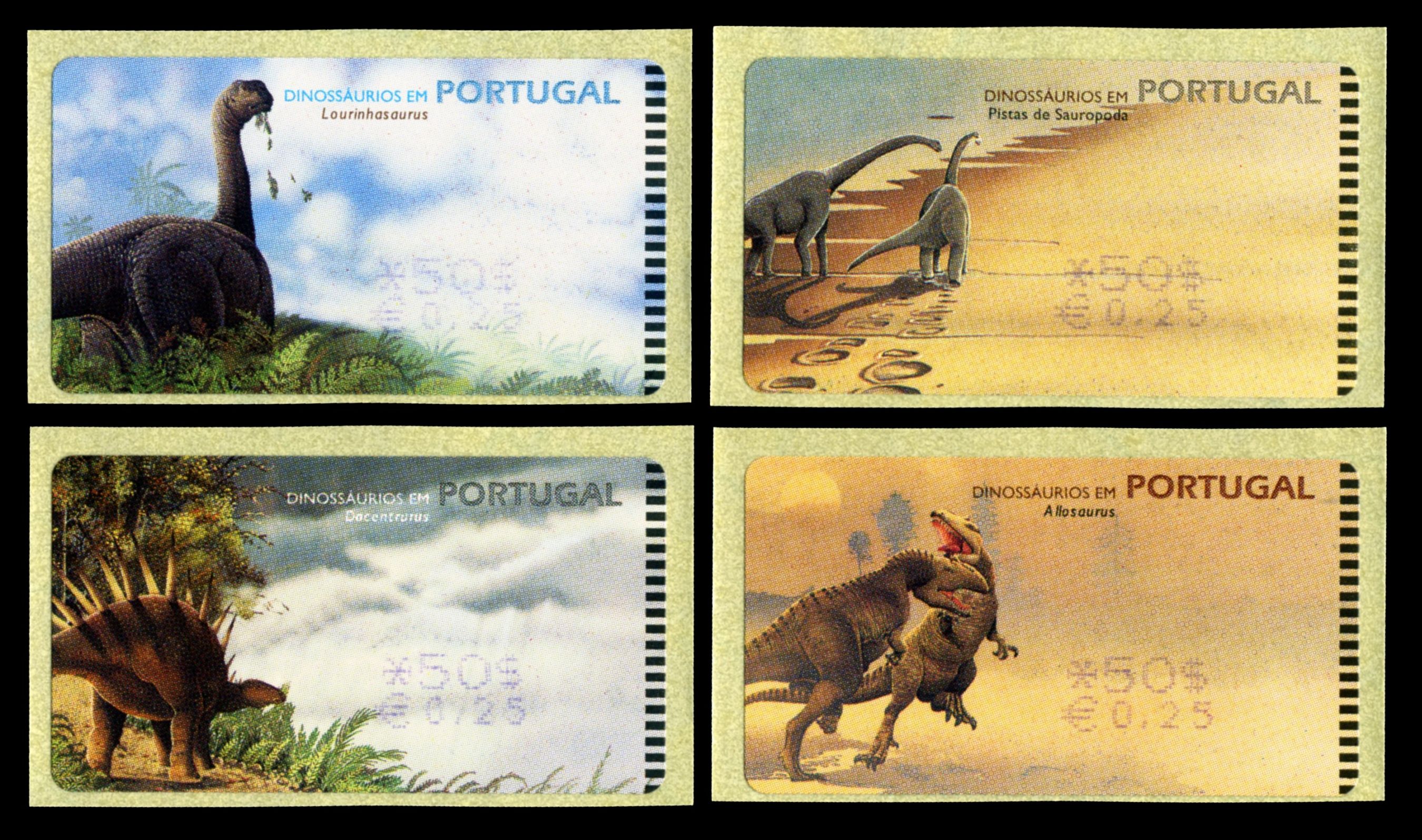
In 2000, Portugal and 15 other European countries started preparing to use a new common currency - the Euro.
As part of the preparations all prices on everything were written in both local and EURO currencies till the EURO currency replaced local currencies in January 2002.
The same changes were made for the dinosaur ATM stamps too.
Since November 1999 till March 2002 the Post Authority of Portugal issued 3-5 sets of vending machine stamps (ATM) per year. "Dinosaurs of Portugal" stamps are one of them.
Four different designs of dinosaurs and their footprints, were created by Portuguese artist Jose Projecto, then transferred to stamp-templates (self-adhesive labels) by the graphic-designer Mariana Santos. Fossils of all dinosaurs depicted on the stamps as well as their footprints were discovered in Portugal.
Descriptions of the dinosaurs depicted on these stamps are available in the article about the ATM stamps from 1999.
The first dinosaurs ATM stamps with the double currency were issued on
- February 21st, 2000 by AMIEL SIMA 1020 machines
- March 13th, 2000 by SMD MSPost VE 50 machines
The first dinosaur stamps were printed by NewVision vending machine on December 20th, 2000.
NewVision vending machine was not available at the philatelic desk, therefore the stamps produced by this machine are very rare.
| Change of postal rates on dinosaur ATM stamps of Portugal between 1999 and 2003 | ||||||||
| Year of issue | Without additional label (regular mail) |
"Correio Azul" (priority mail) |

Vending machines used in Portugal in 2000 and 2001, from left to right:
|
|||||
| Domestic [1] | Spain | Europe, except Spain | Rest of the world | Domestic | International | |||
| up to 20g. | up to 100g. | up to 20g. | up to 20g. | up to 20g. | up to 20g. | up to 20g. | ||
| 1999 | *50.00* | *85.00* | *95.00* | *100.00* | *140.00* | *80.00* | *350.00* | |
| 2000 | *50.00$ | *85.00$ | *90.00$ | *100.00$ | *140.00$ | *85.00$ | *350.00$ | |
| *50.00$ / €0.25 | *85.00$ / €0.42 | *90.00$ / €0.45 | *100.00$ / €0.50 | *140.00$ / €0.70 | *85.00$ / €0.42 | *350.00$ / €1.75 | ||
| 2001 | *50.00$ / €0.25 | *85.00$ / €0.42 | *95.00$ / €0.45 | *105.00$ / €0.50 | *140.00$ / €0.70 | *80.00$ / €0.42 | *350.00$ / €1.75 | |
| 2002 | €0.27 | €0.45 | €0.46 | €0.54 | €0.70 | €0.43 | €1.75 | |
Notes:
 |
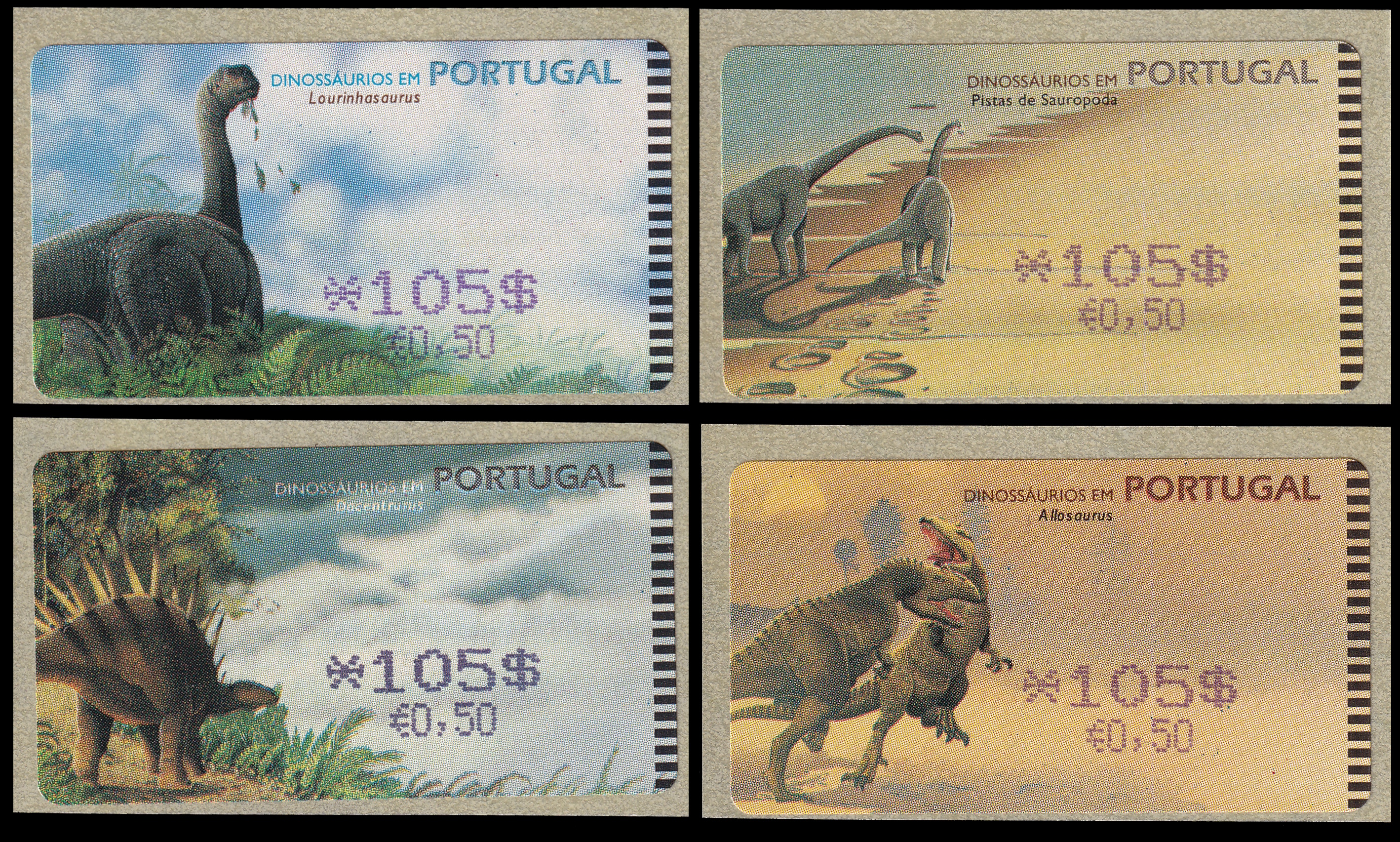
| "*105.00$ / €0.50" ATM stamp of AMIEL vending machine from 2001. |
- In 2000, the rate of Domestic 20g letter was Escudo 52 and in 2001 Escudo 53, but the vending machines were programmed for Escudo 50 to prevent the Escudo 1 coins from constantly being emptied in the change compartment. The letters with vending machine stamps of "Escudo 50 / €0.25" were accepted by the Post, without any extra charge.
-
The rate of letter to Spain with weight up to 20g was updated on
January 1st, 2000, from "*95.00*" to "*90.00*".
The dinosaurs ATM stamps with this rate are very rare, as they were printed for
2-2.5 months only.
Another rate, the letter to "Europe except Spain" with weight up to 20g was updated on January 1st, 2001, from "*100.00$ / €0.50" to "*105.00$ / €0.50". The dinosaurs ATM stamps with this rate are more common on circulated letters, but very rare in mint condition. - In 2000 Escudo 85 stamps were available at vending machines in both philatelic desk and at the post offices.
Like the 1999 issue, these stamps were on sale at the philatelic desk from two different ATM: AMIEL and SMD.
AMIEL printed the text in bold and large font, while SMD machines used smaller and thinner text, as on examples below.
As more text was needed to print on the stamps, the text size on stamps printed by AMIEL vending machines became a bit smaller, but the text on the SMD stamps were still larger compared to the 1999 issue.
".00" after the Escudo value were omitted by both machines to save space. The text on stamps of NewVision machines was the smallest.
Moreover, the Euro symbol ("€") was printed differently by all three vending machines: it is more round on the stamps printed by SMD machines. The horizontal lines of the Euro symbol on NewVision's stamps were the shortest.
| Amiel SIMA 1020 text | SMD MSPost VE 50 text | NewVision Epost 2000 text |
 |
 |
 |
In 2000 and 2001, vending machines at as philatelic desk and at the post offices were programmed differently.
Stamps printed at philatelic used a dot (".") as Euro value separator (€0.25 for example), while at the post offices a coma (",") was used as Euro value separator (€0,25 for example). Mint stamps with coma are more difficult to get and are more expensive, but they appear often on the circulated letters.
 |
 |
 |
| SMD stamp: thin and small face value | AMIEL stamp: bold and large face value. The stamp on the right used coma separator and has currency conversion error (€0.40 instead of €0.42) | |
Products and associated philatelic items
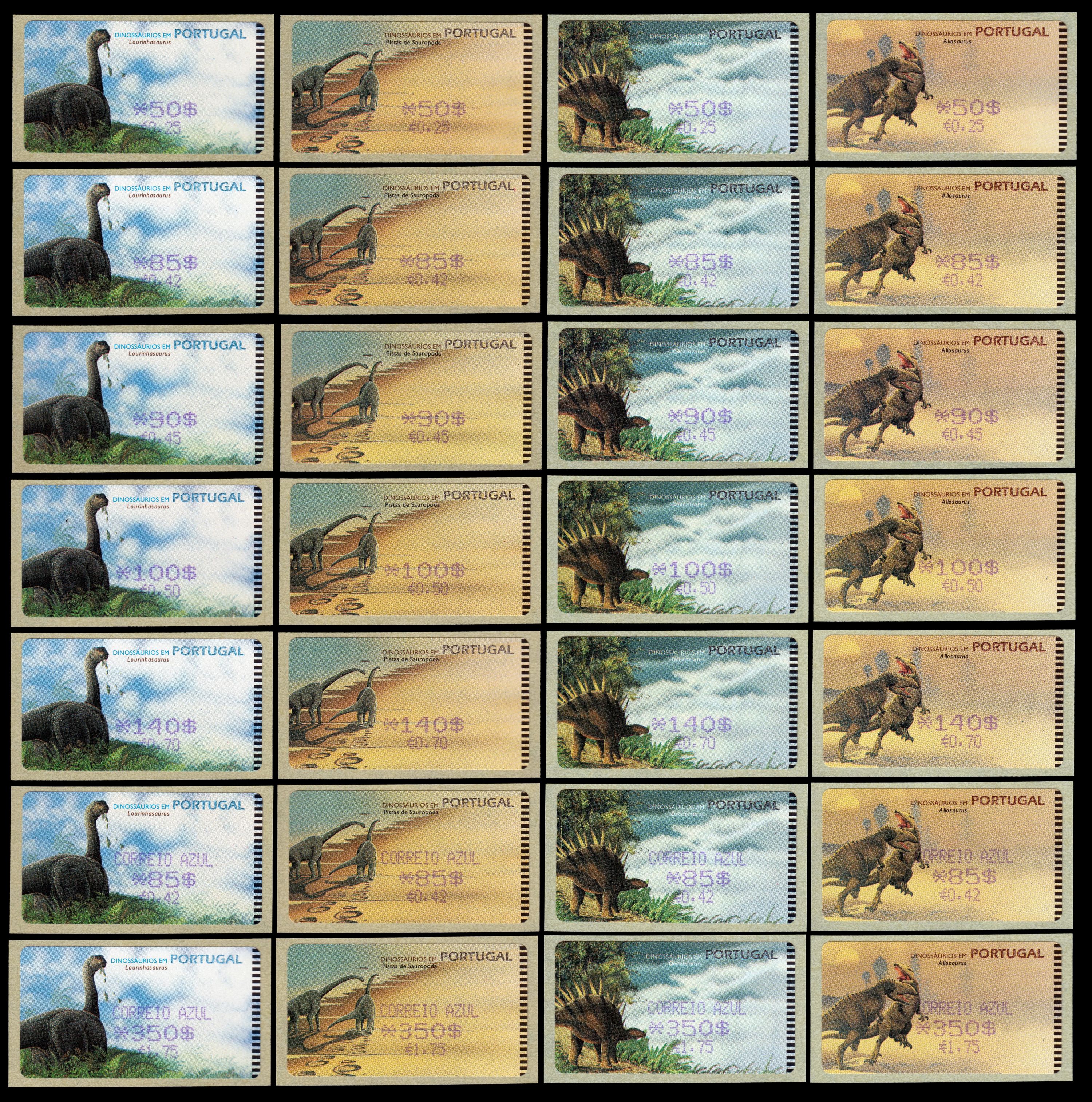
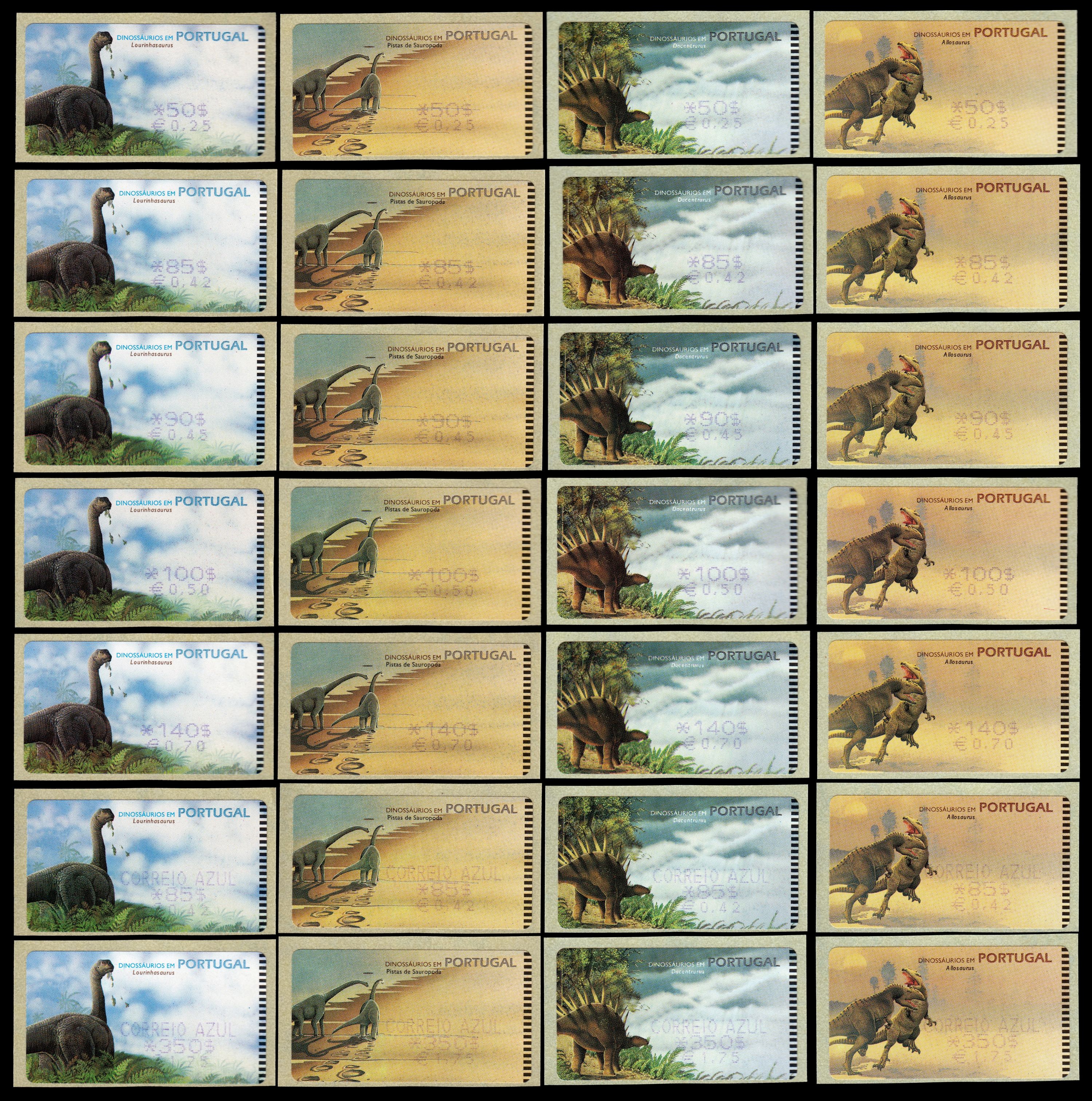
| Full sets (28 stamps) | CTO | |
 |
 |
 |
| AMIEL stamps with all 2000 rates | SMD stamps with all 2000 rates | Cancelled to Order stamps of AMIEL machine, were cancelled on the first day of issue: 21.02.2000. |
| Stamps with face value from 2001 | Ink variations | |
 |
 |
 |
| Most of the machines used blue ink, but some used red or black ink: | ||
| Red ink |
Black ink and currency conversion errors: "*90$ / €0.40" instead of "*90$ / €0.45" | |
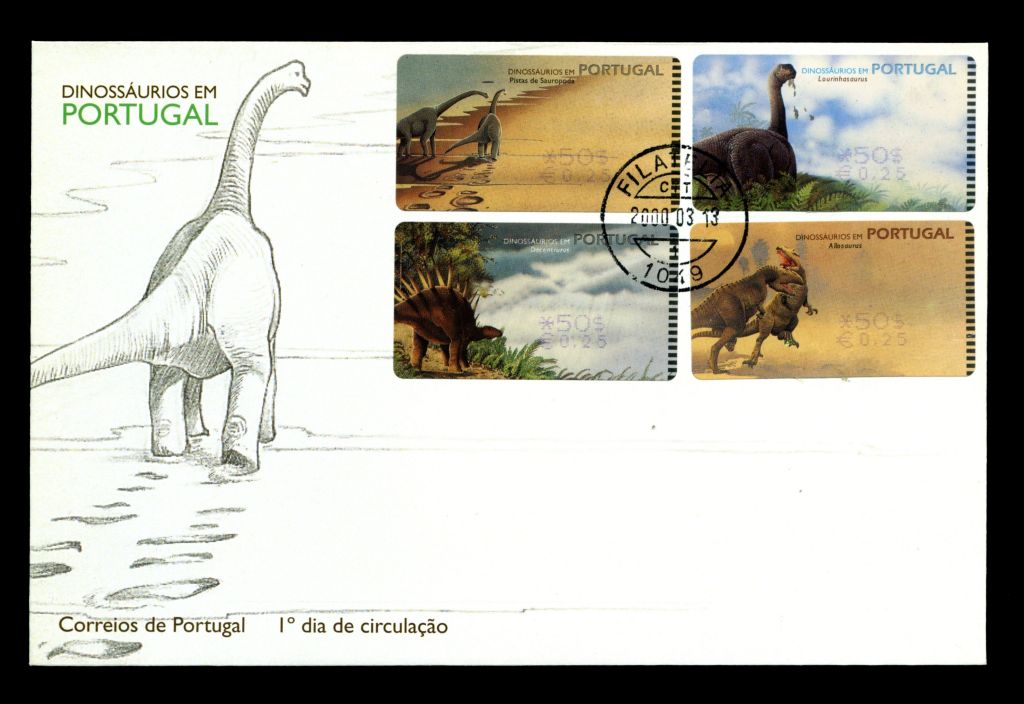
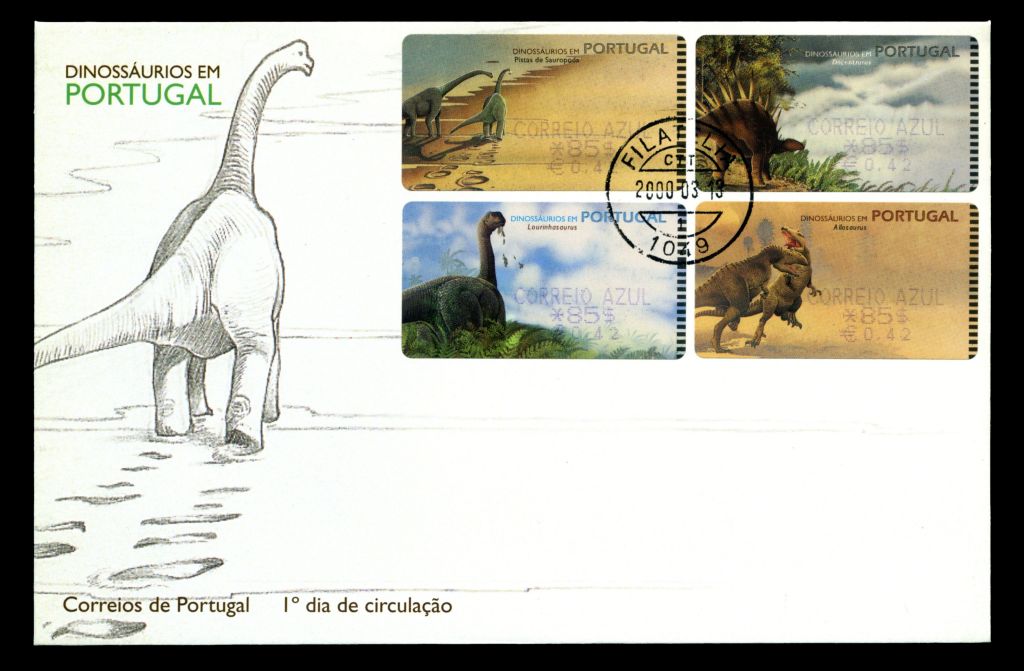
No official FDCs or other philatelic products were issued by the Portuguese Post for the dinosaur ATM stamps after their introduction in 1999. The FDCs shown below were created by collectors or dealers, using either commemorative covers from 1999 or ordinary envelopes bearing postmarks dated on the first day of issue of the ATM stamps with double face values.
 |
 |
 |
| FDC with SMD stamps. | Additional stamp of Escudo 30 was added on the reverse side of each cover. | |
| Example of circulated covers and postcards | ||
 |
 |
 |
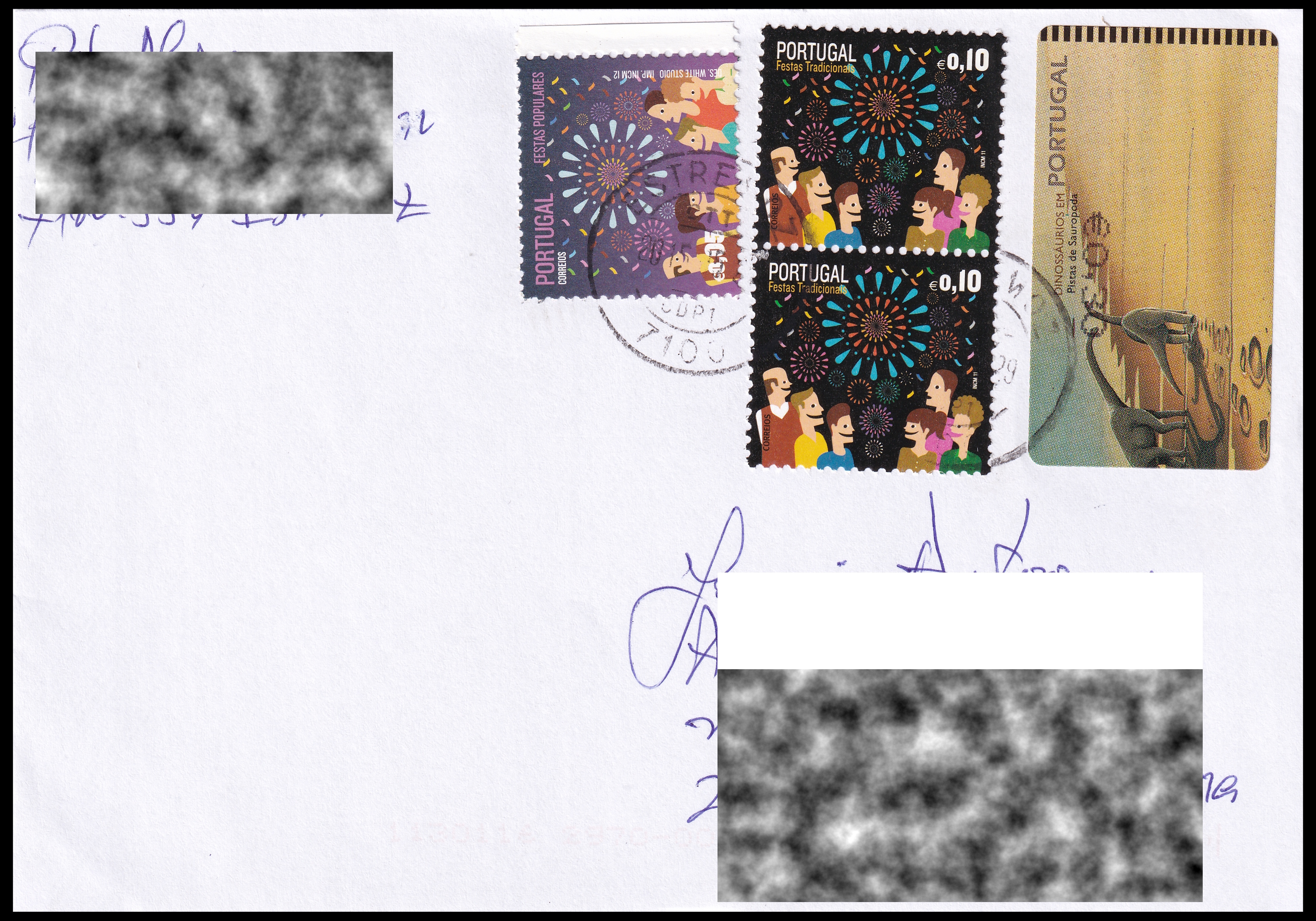
| The stamps on these covers exhibit a comma separator in the euro price. | Cover posted in 2001, bearing one error stamp showing the value “85$/€0.40”, instead of “85$/€0.42”. | A cover posted in 2004. Two of the stamps have an error stamp: "*85$/€0.82" |
 |
 |
|
| Postcards with stamps showing the 2001 error face value “105.00$ / €0.52”, which should have been “105.00$ / €0.50”. | ||
Production Errors
Malfunction
The stamp on the right illustrates a malfunction that occasionally occurred in Amiel vending machines during the printing of variable-value stamps.
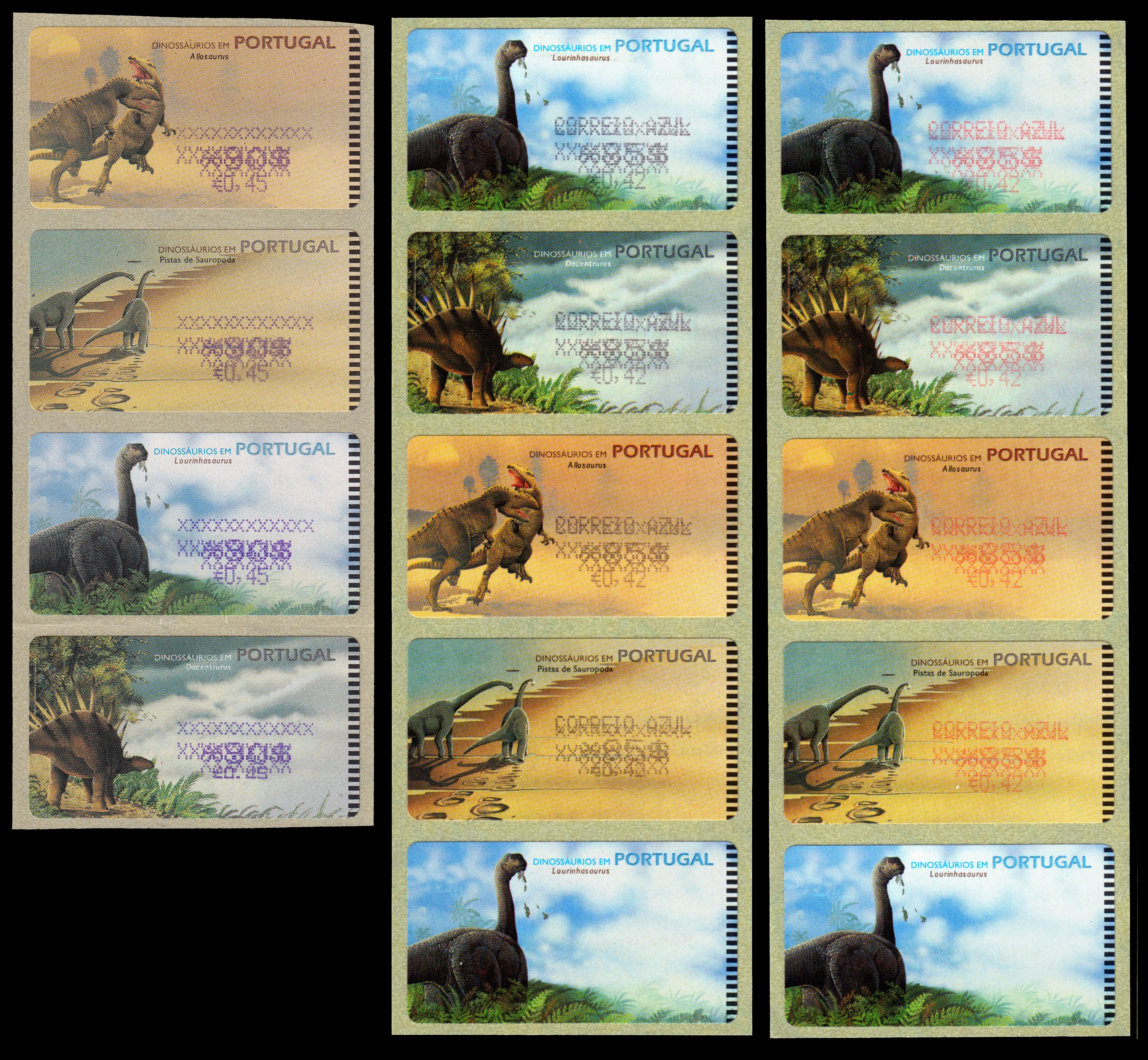 |
In this case, the customer selected one or more fees for printing, but the machine failed to dispense
the labels.
Although the fees were successfully processed and charged, the printed labels remained trapped inside
the machine.
When this happened, the customer was left without both the money and the labels,
and the terminal immediately went out of service.
Recovery of the fees or the missing labels was only possible by requesting assistance and filing
a complaint with a postal worker.
A distinctive feature of this malfunction is that the machine often printed multiple fee impressions
on a single label, creating highly unusual production errors such as the multi-impression examples shown
here.
These pieces are the direct result of the printer continuing to operate while the labels failed
to advance or exit the dispenser.
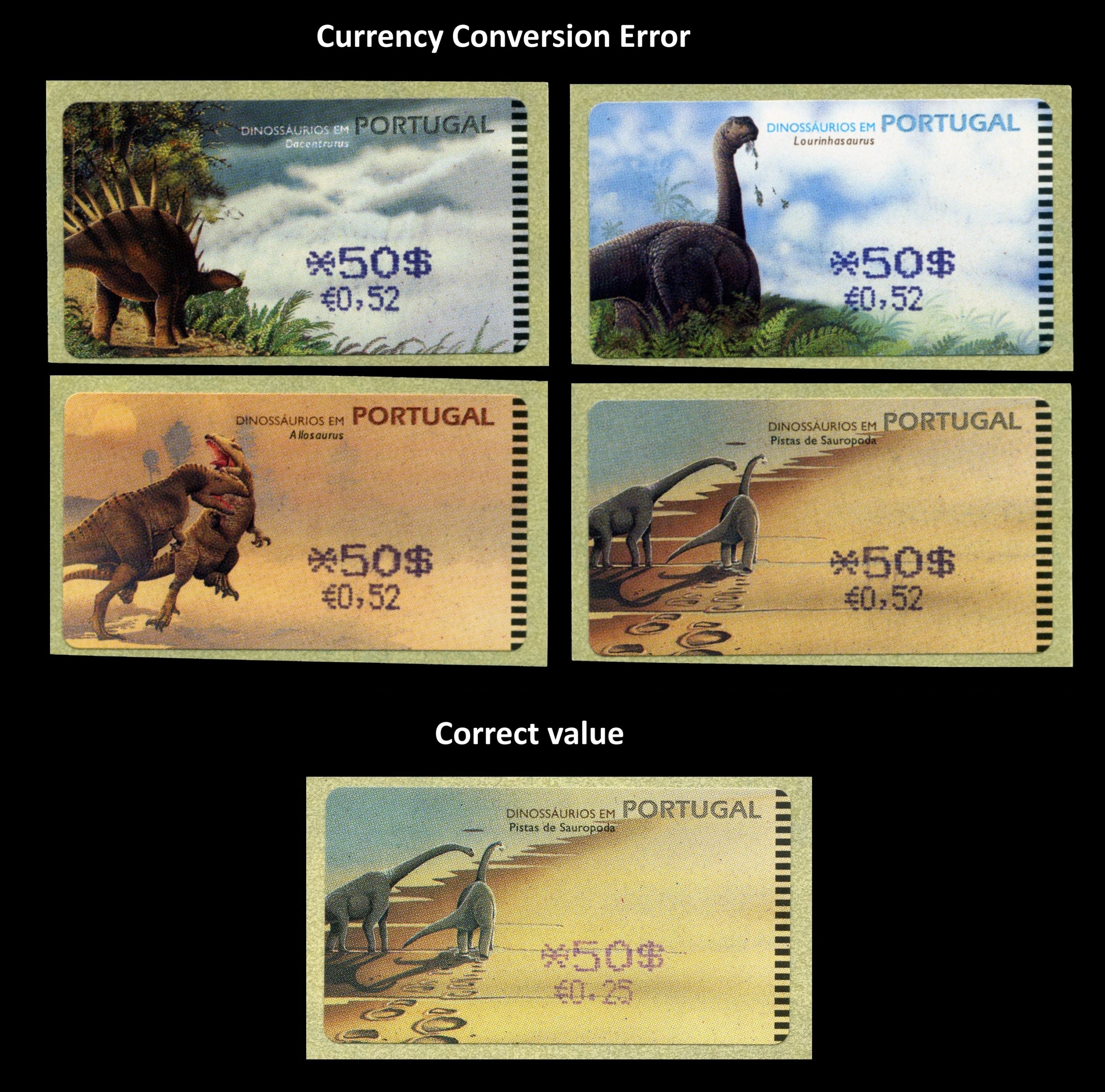
Currency Conversion errors
In theory, such an error could happen by programming the vending machine to the new currency,
but this issue should have been recognized by the maintenance staff,
who should have printed some test value stamps to check for errors.
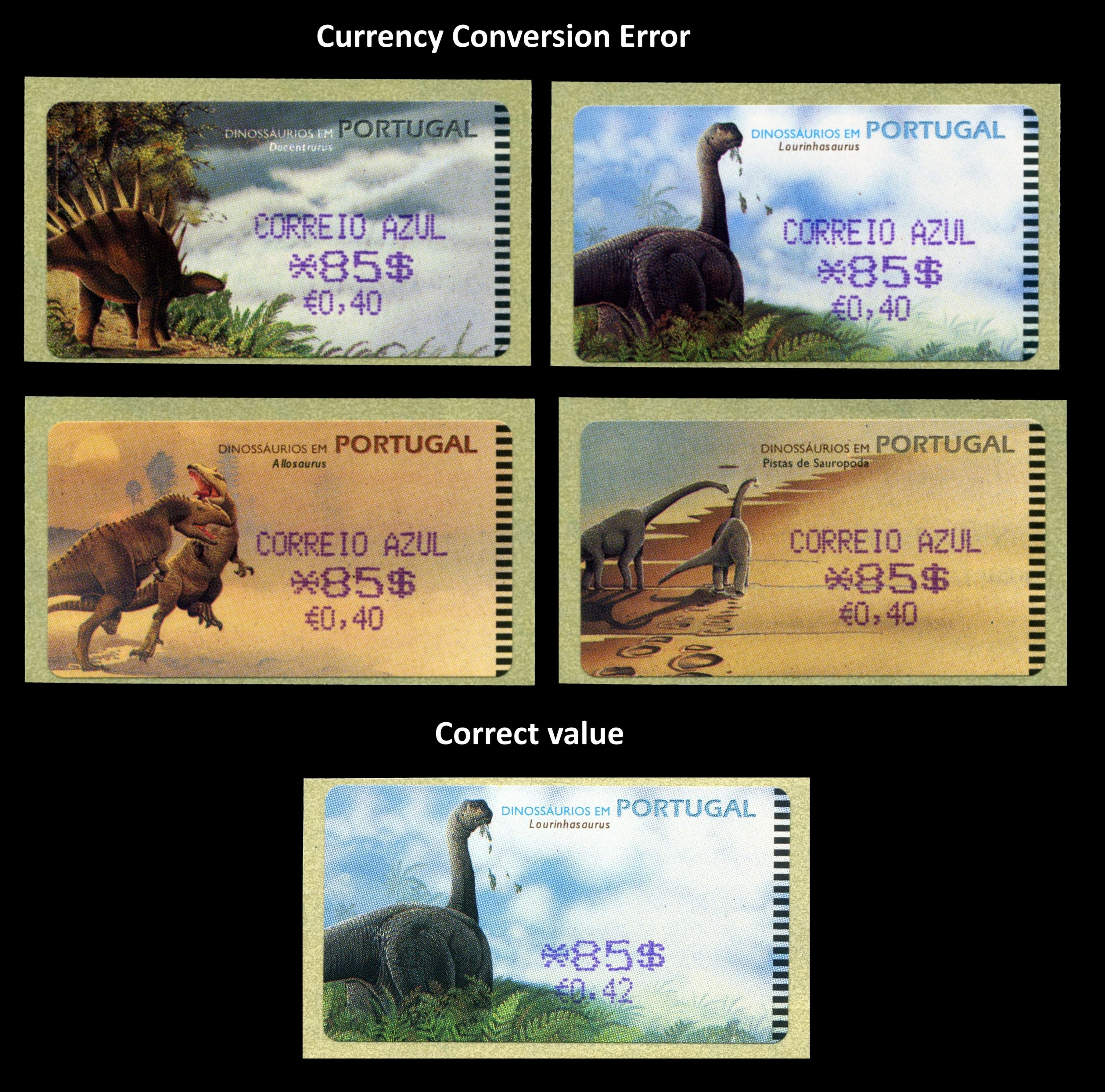
These stamps have very clear text with strong colors, in comparison to other stamps with correct values.
Probably, the error was created on demand by the staff for some fellow collectors or dealers.
 |
 |
 |
|
The stamps on the left: "*50$ / €0.52" instead of "*50$ / €0.25" The stamps on the right: "*85$ / €0.40" instead of "*85$ / €0.42" |
"*140$ / €0;z0" or probably "*140$ / €0:zo" was printed instead of correct face value
of "*140$ / €0:70". This kind of typo is unique and the ink looks the same as by most of the stamps with correct values. Perhaps, it was indeed printed by a machine unintentionally, without any manipulation. |
|
Inverted text
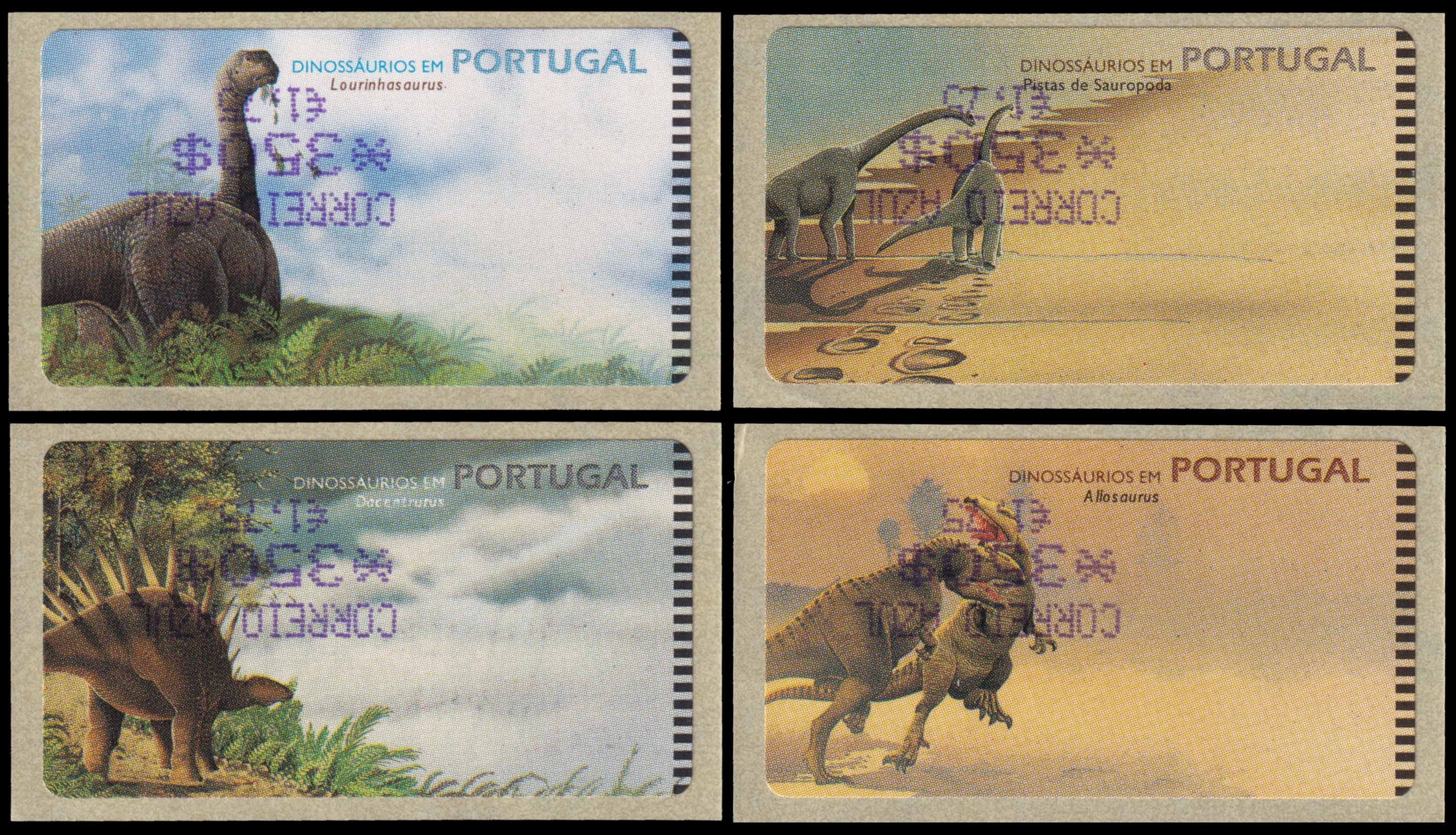
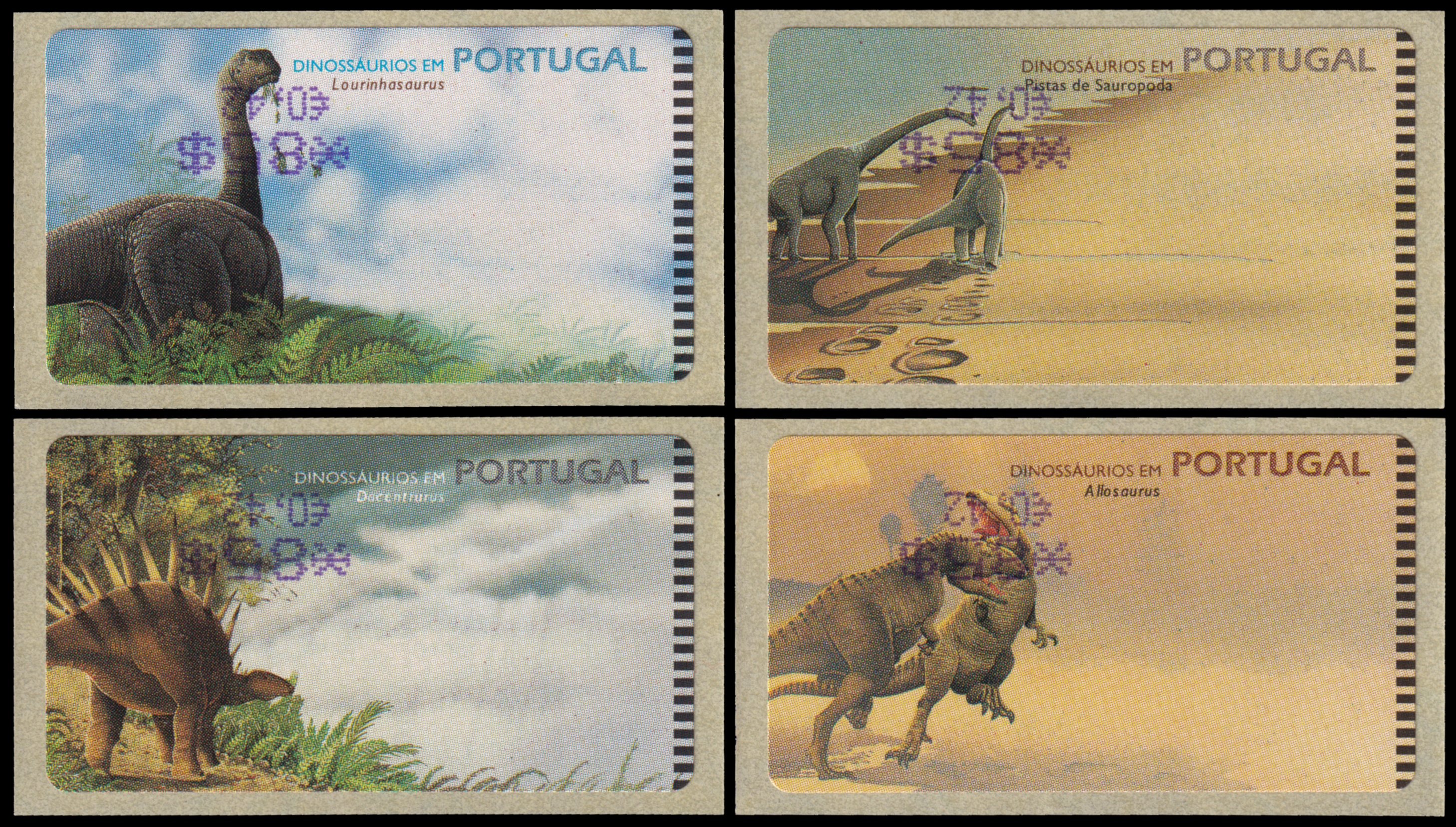
These stamps were most likely created through deliberate manipulation by machine-service staff,
who inserted short strips in the wrong orientation
either at the request of collectors or dealers, or simply to profit from producing such varieties.
According to several Portuguese specialists in ATM stamps, it is impossible to insert an entire roll
and print it in reverse.
Instead, the operator would have to cut a strip of labels from the roll,
apply adhesive to the back, attach the strip upside down onto the remaining roll,
and then feed it into the machine, when machine was open.
Nevertheless, a few examples of stamps with inverted text have been found on genuinely
circulated covers and postcards.
 |
 |
 |
References
- Technical details and short description:
- colnect
- MICHEL Automatenmarken-Speziel (Vending Machines Special) 2013/2014, 7. Auflage (7th Edition), ISBN: 978-3-95402-951-4
- AFINSA (National Portuguese stamps catalogue) 2009, ISBN: 978-972-9468-15-5
- Stamp designers
- ATM stamps and vending machines of Portugal
Acknowledgments
- Many thanks to fellow stamp collector Mr. Vitor Vieira, who run a blog about ATM stamps of Portugal from Portugal, for his help finding some information about these stamps and for sharing scans of some stamps and covers from his collection.
- Many thanks to fellow stamp collector Mr. Jose Lalanda Jorge from Sintra, Portugal for sharing scans of signed FDC covers from his collection.
- Many thanks to Dr. Peter Voice from Department of Geological and Environmental Sciences, Western Michigan University, for reviewing the draft page and his very valuable comments.