Simultaneous Development of Philately, Geology, and
Palaeontology as a Result of the British Industrial Revolution
Part 6: Mulready envelopes and letter sheets
Issue of the first British postal stationery for general public use: Mulready envelopes and letter sheets
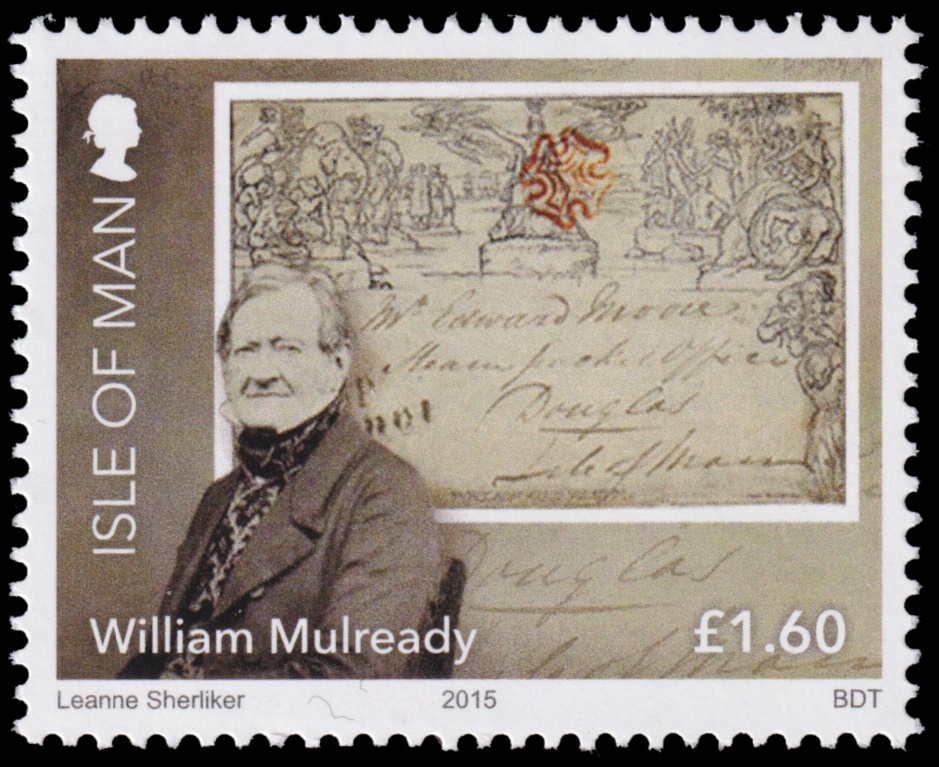 |
| William Mulready on stamp of Isle of Man 2015, MiNr: 2014, Scott: 1708. |
These postal stationery items are known today as "Mulready postal stationery" or "Mulready covers", after the competition winning Irish artist William Mulready, who was a member of the Royal Academy.
The design was approved within the Treasury and Post Office administration, under the authority of Francis Baring, Chancellor of the Exchequer (who was responsible for authorizing official decisions, including the adoption of the Mulready postal stationery and the Penny Black stamp designs), Rowland Hill, the full council of the Royal Academy of Arts in London, and personally by Queen Victoria.
1.
In the official General Post Office notes and circulars from the 1840s,
these letter sheets and the envelopes were called:
Penny, Two-penny or Twopenny "stamped Covers and Envelopes".
2.
"Postal Stationery - an item of stationery that has been printed specially by a postal authority to show the
prepayment of postage."
"GLOSSARY OF PHILATELIC TERMS"
of the Postal Museum UK.
Similar to the Penny stamps, the official first day of use for this postal stationery was May 6th, 1840, although a small number of envelopes and letter sheets were used from May 1st, 1840.
 |
|
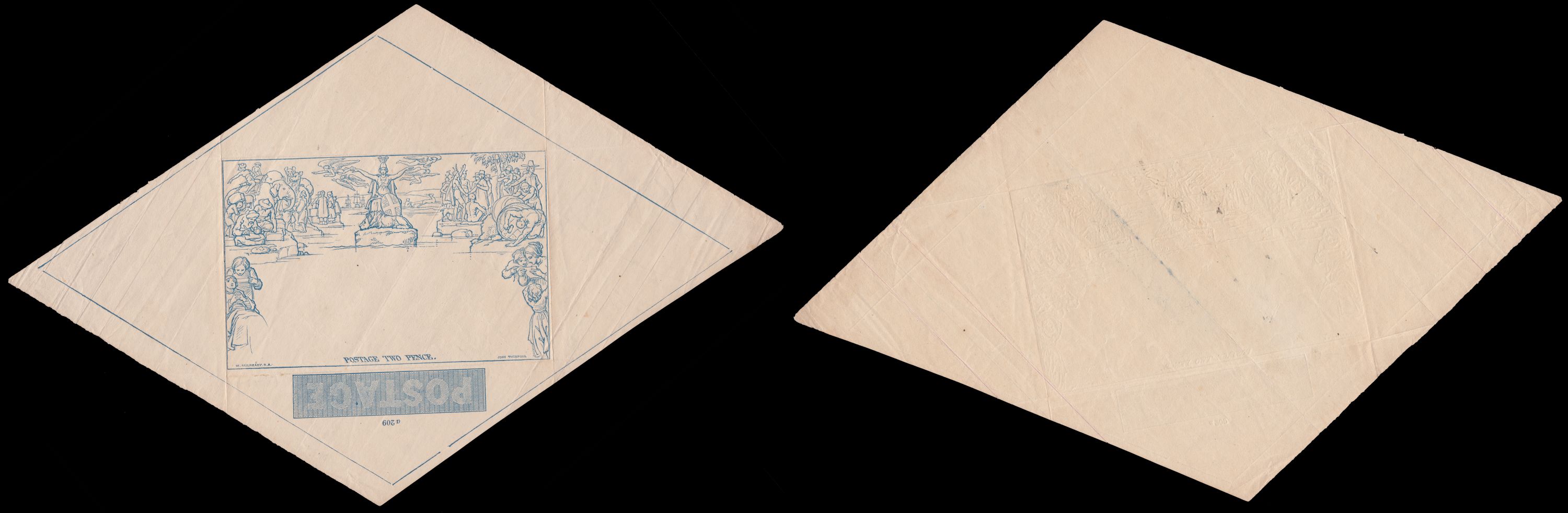
Unfolded Mulready's "Two Pence" envelope. |
Like the Penny stamps, the postal stationery was available in two denominations: "One Penny Black" and "Two Pence Blue". The Two Pence stationery exists in several shades due to variations in ink preparation and printing.
The text at the bottom of the folded envelope or letter sheet read "POSTAGE ONE PENNY" or "POSTAGE TWO PENCE", indicating that the postage had been prepaid.
While their inscribed postage values were not valid yet, the sender or the receivers were required to pay for the postage in cash, therefore all such early used postal stationery bears postal markings indicating that postage was paid.
While the Penny Black and the Two Pence Blue were the first adhesive postage stamps, the Mulready covers were not the first postal stationery issued in Great Britain, but they were the first postal stationery available for general use.
Therefore, before these prepaid envelopes went on sale, on April 24th, 1840, the "London Gazette" published a Treasury Warrant indicating that from May 6th, 1840 letters written on stamped paper or enclosed in stamped covers would pass through the post without any further charges.
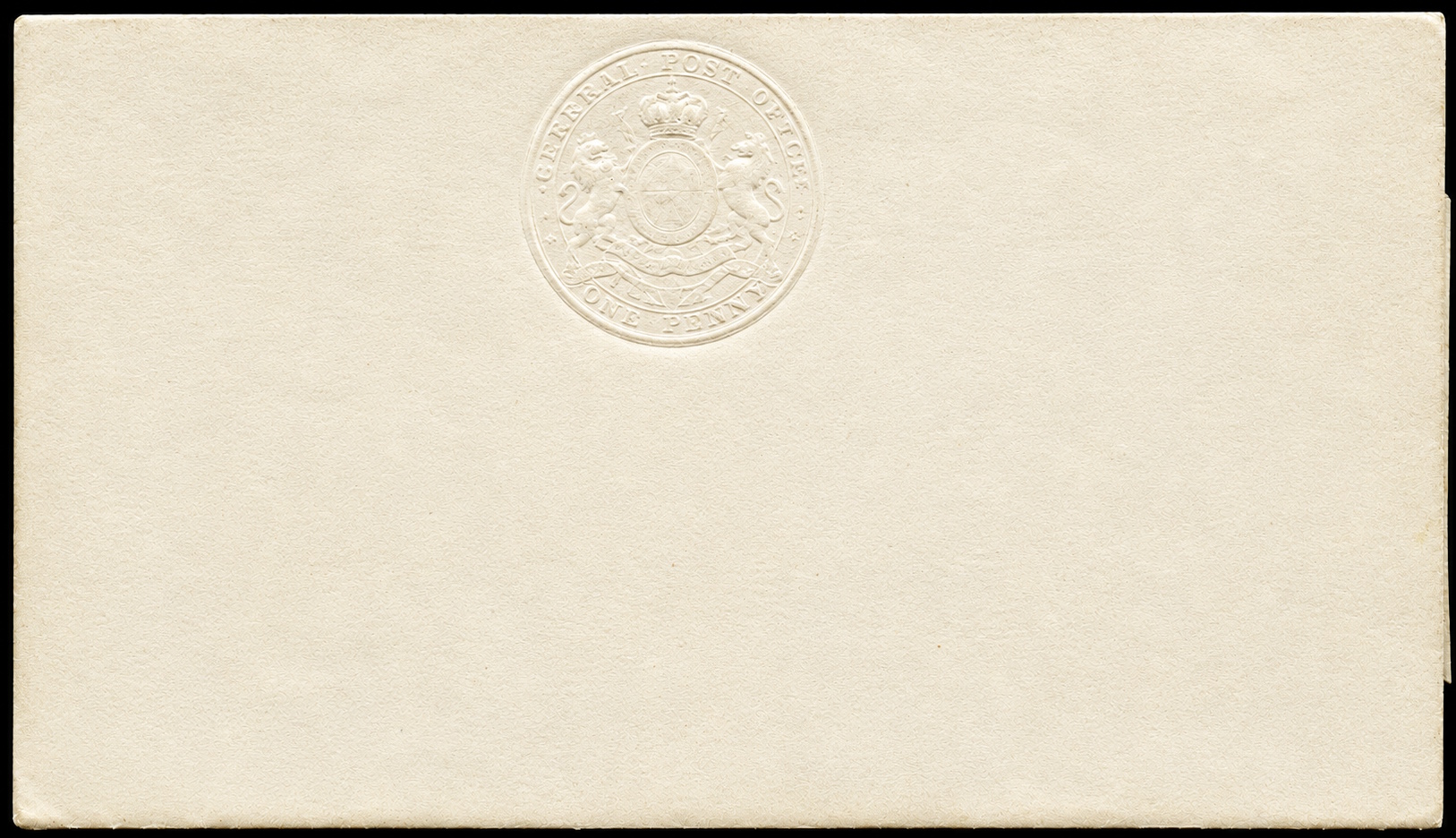
| Early examples sometimes considered predecessors of postal stationery date from the 17th century, including Venetian prepaid letter sheets, with folded letters bearing the coat of arms of Venice (today part of Italy). However, such stationery was mostly limited to official or elite use and was not something the general public could freely buy and send. | The first postal stationery items in the British Empire is generally considered to be the embossed letter sheets issued by the General Post Office of Sydney, New South Wales, in 1838 (Australia was a colony of Great Britain at the time) in 1838. These sheets bearing the embossed seal of the colony, were sold for a penny and prepaid correspondence within the Sydney area, while unpaid letters were charged double. The use of this postal stationery was limited to the Sydney region and remained in use until 1857. |
 |
 |
|
Prepaid Venetian Acque Letter Sheet from 1620. |
Pre-paid postage envelope of the General Post Office Sydney New South Wales from 1838. |
Design of Mulready stationery
The design of the postal stationery was probably inspired by papers printed by the "Mercantile Committee on Postage" during the lobbying period for cheap postage. In these papers they wrote not only about the business, but private communication too. Many citizens of the British Empire lived or travelled far away from their families. As a result of the Industrial Revolution many people were moving from the countryside to towns and cities, but the high cost of postage prevented separated families from communicating with each other.
Mulready's view of the design was
This Design is intended to convey the idea that the measure it assists in carrying out, emanated from Great Britain, and that it is a very wide spreading benefit, facilitating our friendly and commercial intercourse with remote lands, and bringing, in a manner, our separated brethren closer to the sick beds and cheerful firesides of home.
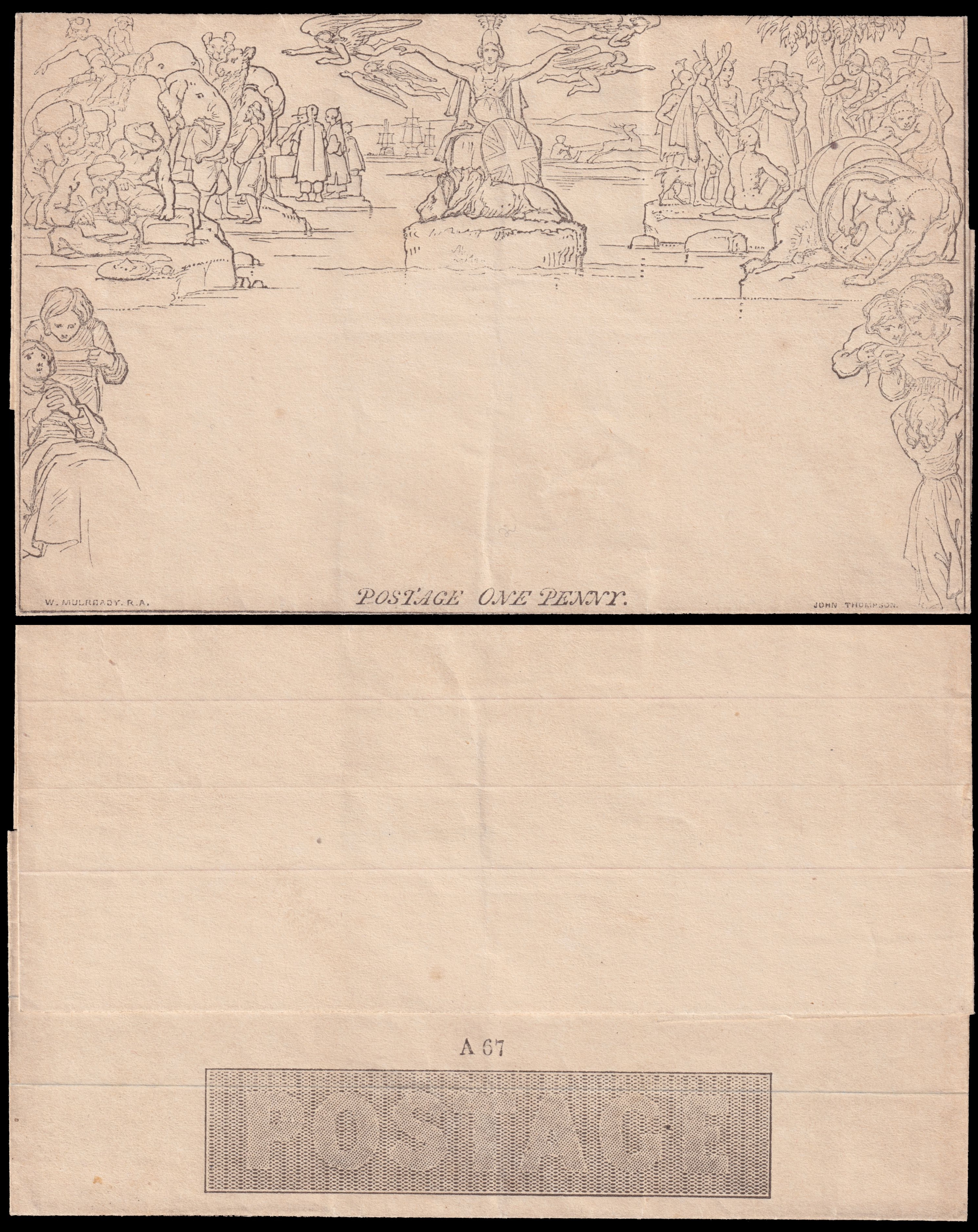
The design was officially titled "Britannia sending letters to the world", was a romanticised view of the benefits of affordable mail.
- Allegorical figure of Britannia in the center top with a shield depicting the Union Flag and the British Lion at her feet.
- Britannia sends angels (one of them has only one leg) with the message to the four sides of the world.
- The sailing ships and sleigh drawn by reindeer can be seen behind Britannia, a group of Native Americans greeting Europeans with dogs between them, palm tree and planter supervise the loading of casks, representing the North American province (Canada) of the British Empire.
- The group of Chinese with queues, camels, elephants and scribes writing letters represent the continents of Asia shown on the top-left side.
- Two groups reading letters were drawn on the bottom side of the postal stationery: a woman reading a letter to an ill person and a woman (probably a mother) reading a letter to two children represent communication between members of separated families.
 |
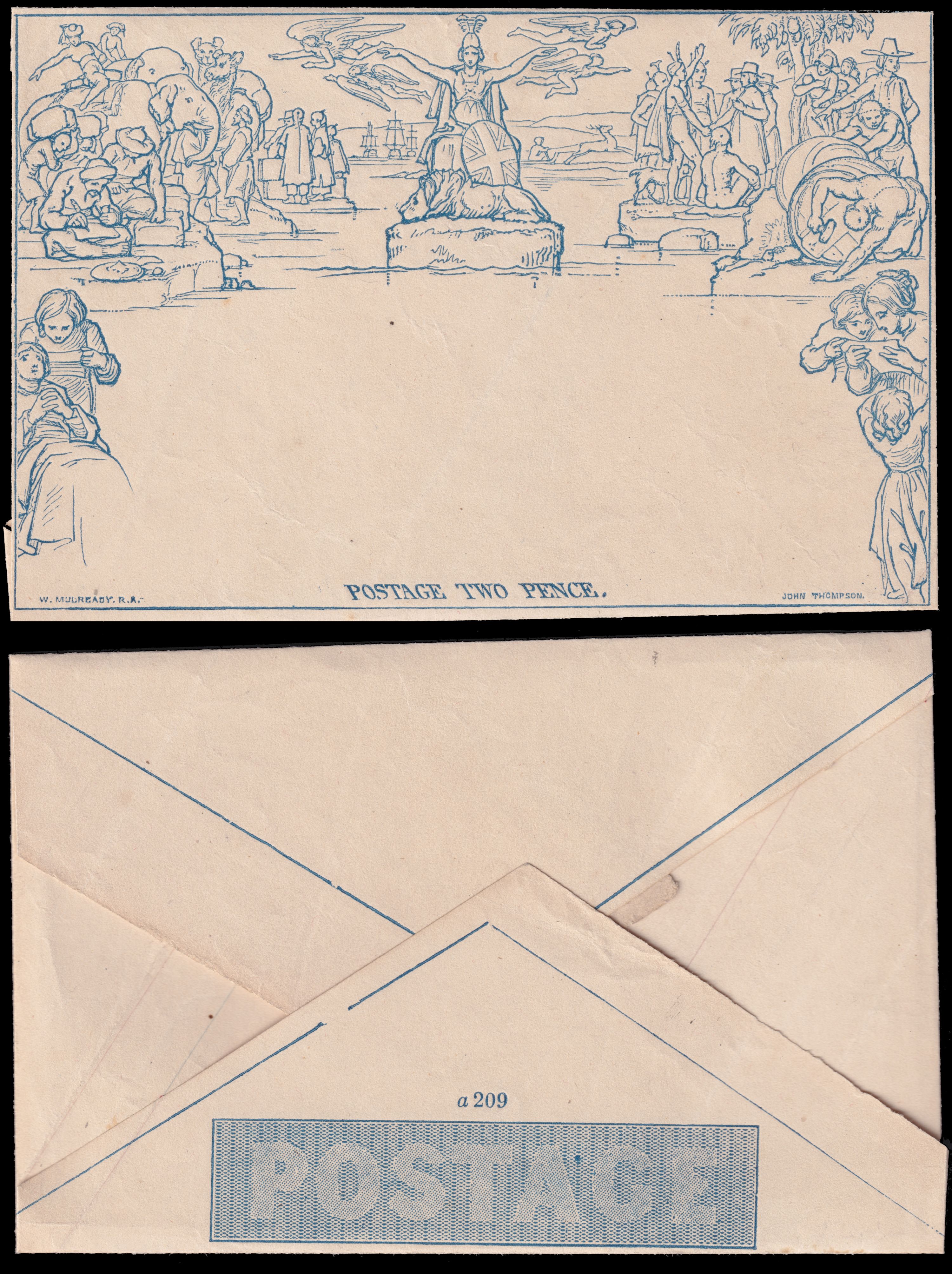 |
| The front side of Mulready's postal stationery: "POSTAGE ONE PENNY" and "POSTAGE TWO PENCE" were the same for the letter sheet and the envelope. They also were of the same size when wrapped. | |
Several wild and domestic animals were depicted on the postal stationery (lion, camels, elephants, reindeer, dog), but it took 11 years to see an animal depicted on a postage stamp. In 1851 the Province of Canada (a British colony at that time) featured a beaver - the National symbol of Canada, on their first adhesive postage stamp (Scott No. 1).
Production of Mulready covers
|
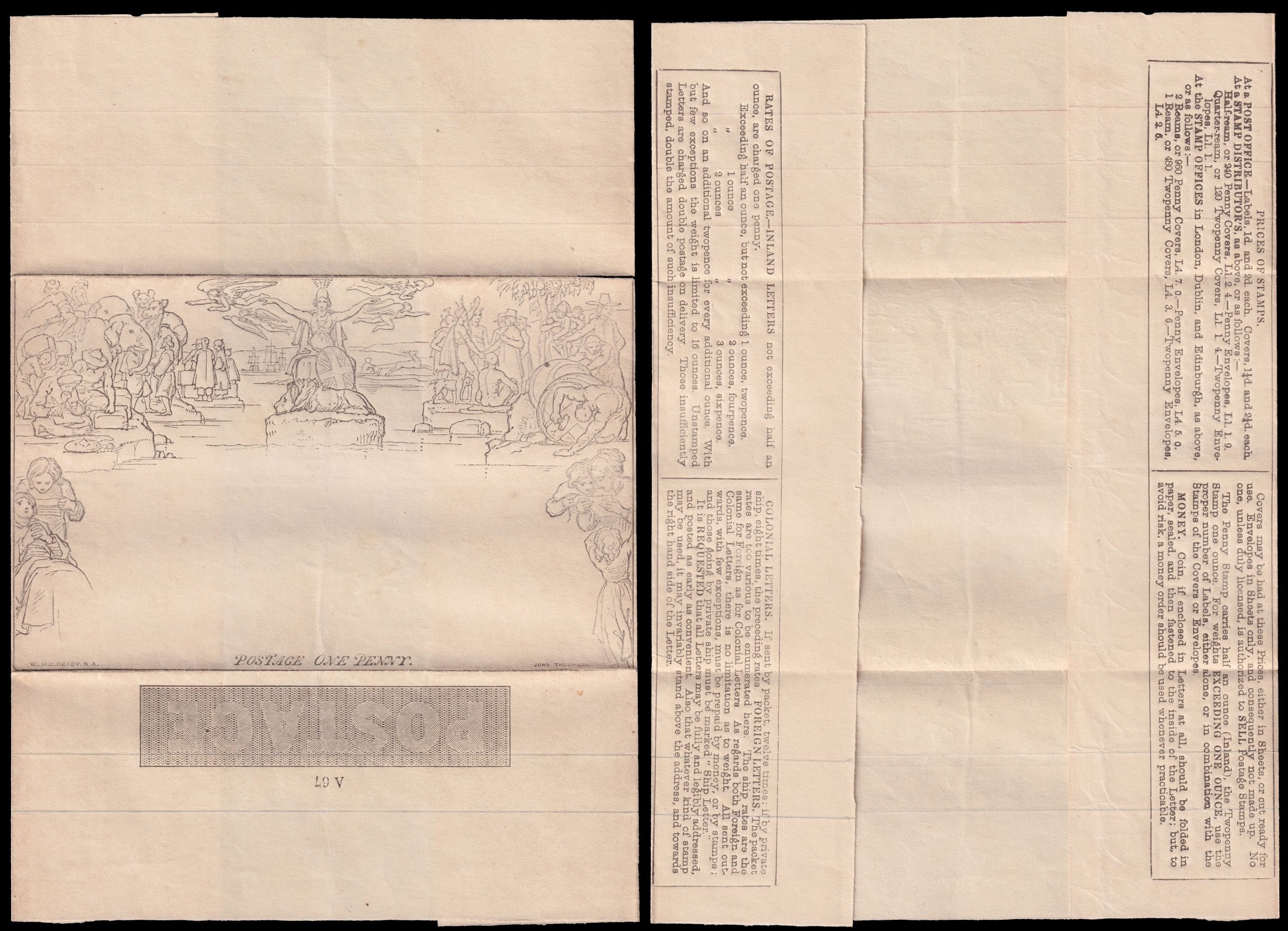
| Mulready letter sheet, One Penny Black, stereo A67. |
|
| Mulready envelope, Two Pence Blue, stereo a209 |
The letter sheets cost one farthing more (four farthings made one penny, the Forme of 12 cost 15 pence) than their postage value, to cover the sheet cost and were sold individually. The Formes of letter sheets could be cut into individual items and sold individually, but the Formes of envelopes could not be cut into individual items and were sold in full Formes, which made them less attractive for most buyers.
Each envelope or letter sheet had an identifying number printed on it for security purposes. These numbers were called stereos and were slightly different for the "One Penny" and "Two Pence" postal stationery: the stereo numbers of the "One Penny" envelopes and letter sheets have prefix "A", while prefix "a" was used for "Two Pence" envelopes and letter sheets.
The usage of these numbers was similar to the check letters of Penny stamps - should the postmaster see the same stereo number appearing often he might suspect forgery.
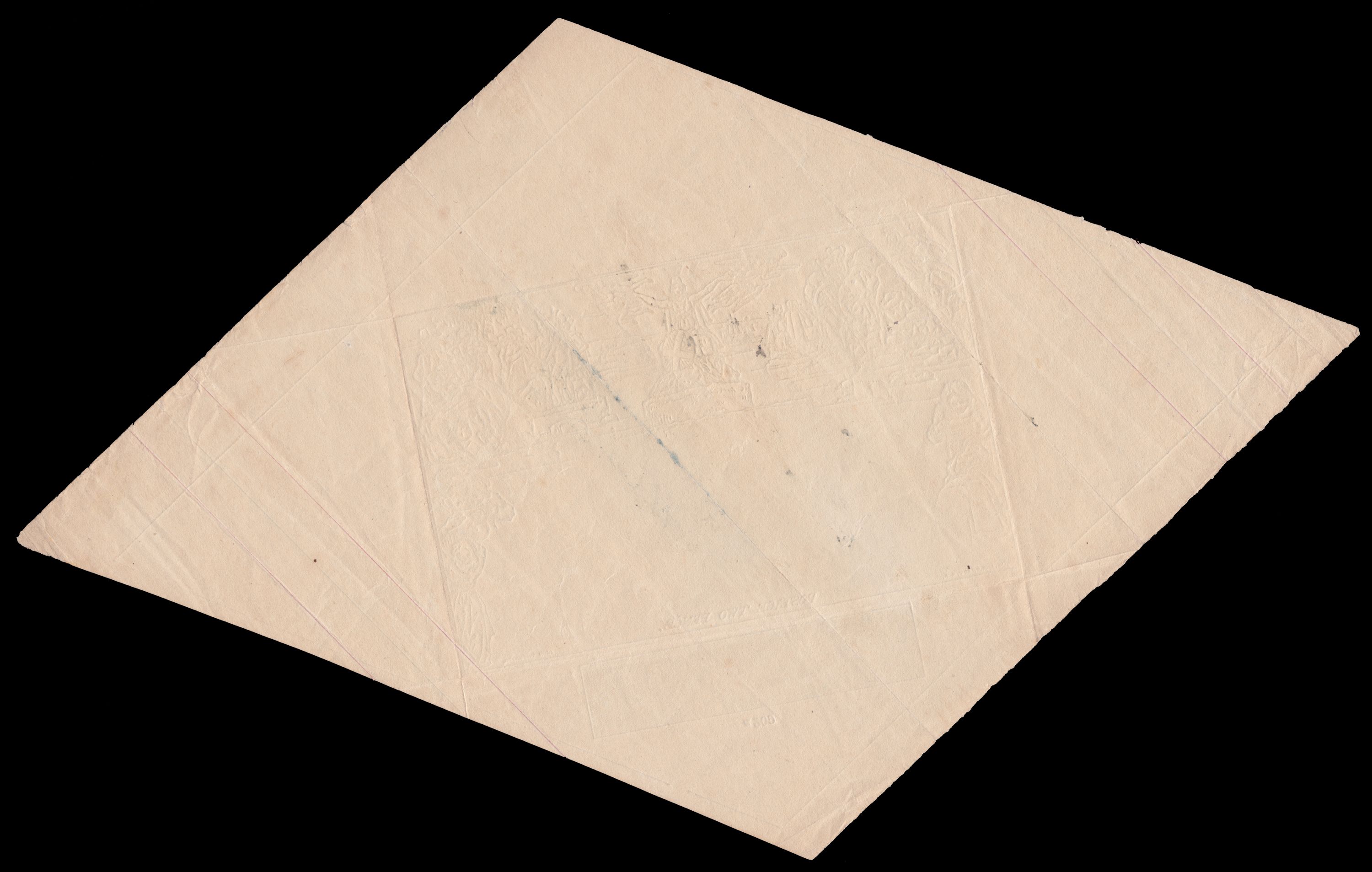
Embedded thread paper for the "Mulready postal stationery" was produced by John Dickinson and is commonly known as "Dickinson silk" (the "silk" threads were made from cotton).
The threads were embedded in the paper as a security feature (similar concepts, such as embedded fibres, are still used as security features in modern banknotes) to prevent fraud and forgery.
The letter sheet has three pink threads crossing the top side and two blue threads crossing its bottom side.
The envelope has two pink threads and one blue thread crossing it on the right and left sides.
Cancellation style of Mulready stationery
Another security method was the cancellation style.
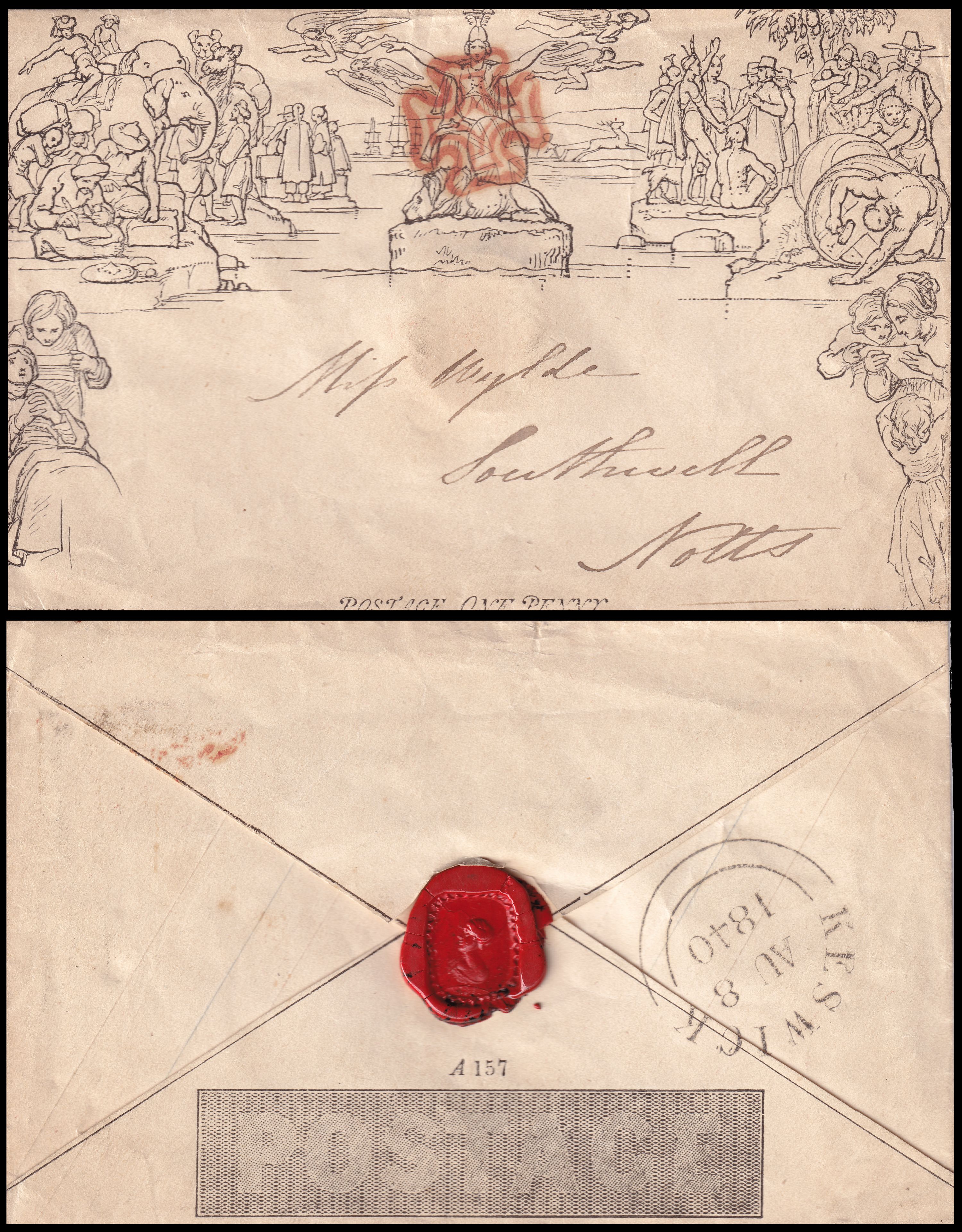
All postmasters were instructed to apply the postmark (Maltese Cross) on the figure of Britannia, to prevent reuse of the postal stationery. Should the postmaster see a stamp affixed over Britannia, he might suspect the sender was attempting to reuse an envelope or a letter sheet by covering the Maltese Cross with a stamp.
 |
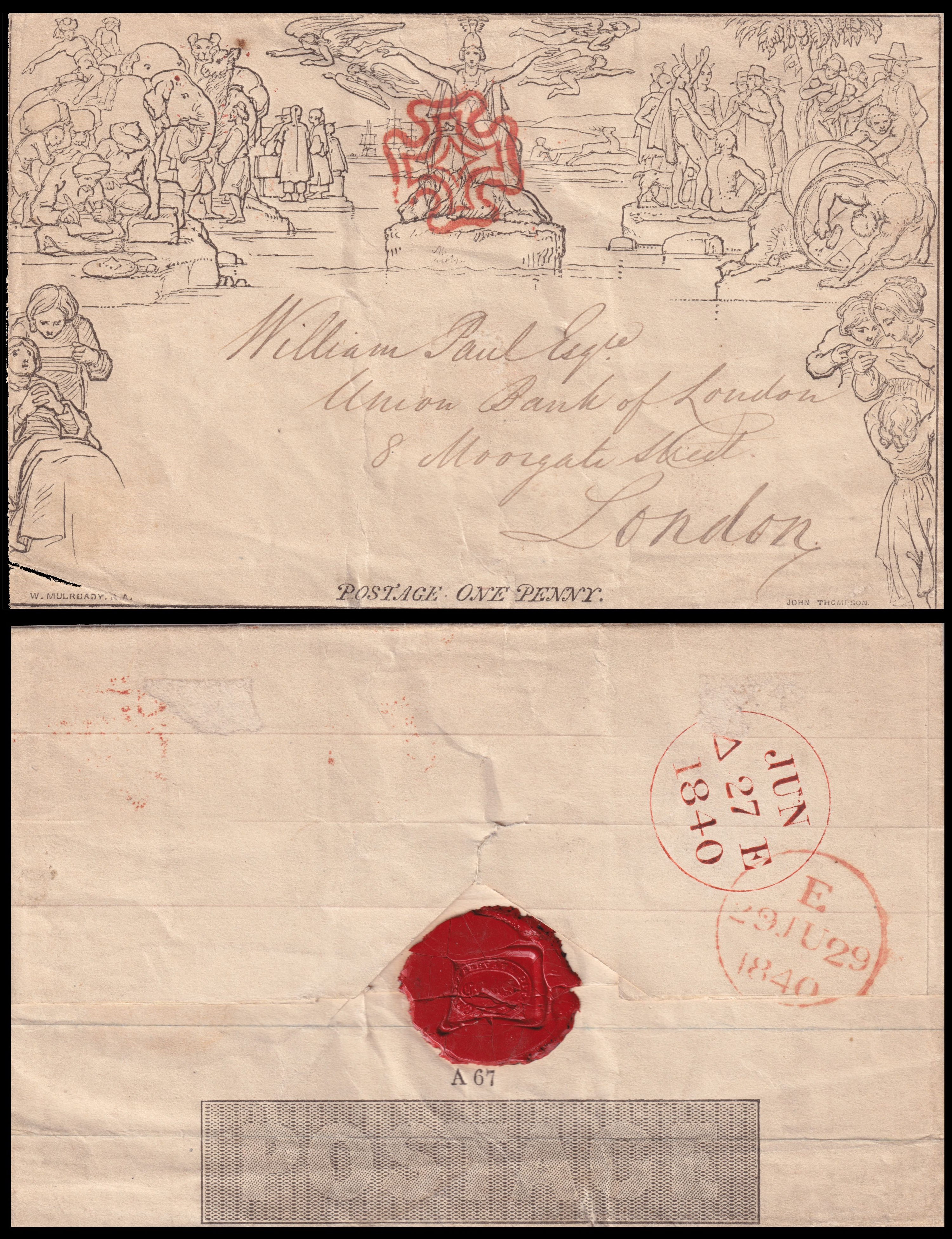 |
| Mulready envelope and letter sheet, One Penny Black, cancelled by red Maltese Cross on the figure of Britannia. | |
The circular of the General Post Office from April 1840 (exact date is not written), to all postmasters explained:
You will carefully Stamp with the Cancelling Stamp that has been forwarded to you, the stamped Covers and Envelopes, as well as the adhesive Stamps, the two former must be struck on the figure of Britannia, and in case of more than one adhesive Stamp being attached to a Letter, each Stamp must be separately obliterated.
The use of the Cancelling Stamp, however, will not dispense with that of the ordinary dated Stamp, which will be struck on the Letter as usual [usually on the reverse side]. Where the value of the Stamps is under the rate of Postage, to which the Letter if pre-paid in Money would be subject, you will Surcharge the Letter with a Pen in the usual manner. You will acknowledge the receipt of this Letter and the Specimen Stamps by return of Post.
Two copies of "Mulready" One Penny and Two Pence letter sheets and envelopes were attached to be used as the reference by the postmasters.
Mulready Letter sheets
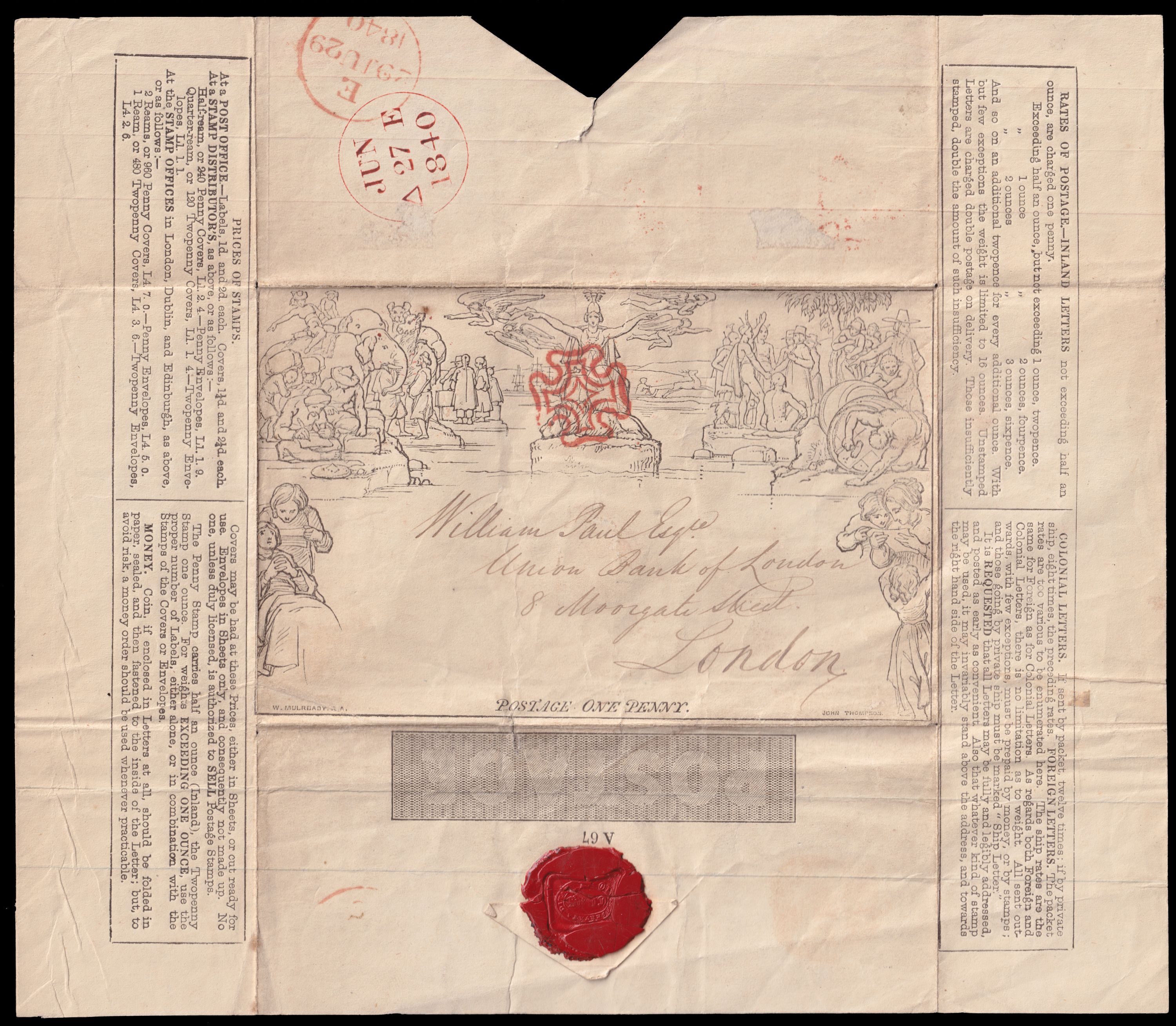
Mulready Letter sheets were of the same size as traditional letter sheets, with inscribed instructions and rates printed on its left and right sides
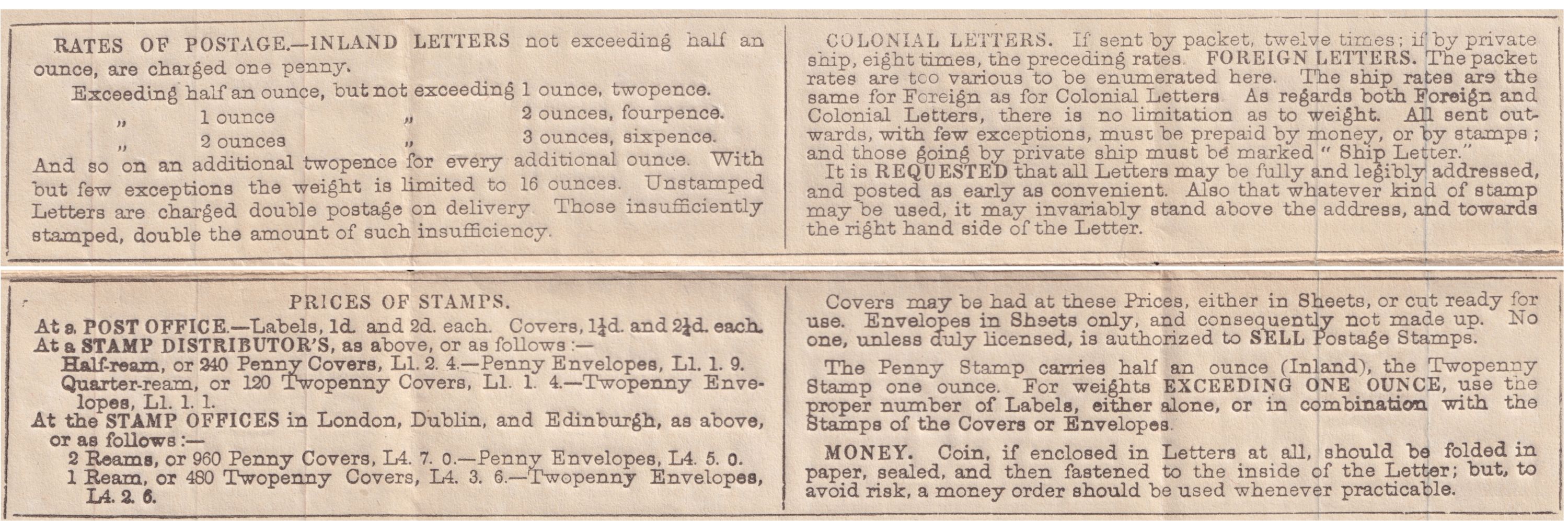
Post Office instructions and rates printed on the sides of Mulready letter sheet
 |
 |
| Mulready prepaid letter sheet ("One Penny Black", A67), posted from Edinburgh to London on June 27th, 1840, cancelled by bright red Maltese Cross and arrived London on June 29th 1840. The letter was addressed to "William Paul Esq., Union Bank of London, 8 Moorgate Street, London" |
The letter sheet sent to the famous English Professor of Geology William Buckland
(who described the first dinosaurs - Megalosaurus in 1824),
from London to Oxford on November 26th, 1838 and charged 8d.
|
Mulready Envelopes
Until 1840, the use of envelopes was virtually unknown to the general public in Great Britain, even though one of the earliest recorded letters sent in an envelope dates from March 1835. At that time, postage was charged by the number of sheets of paper, and an envelope counted as an additional sheet. As a result, only a few wealthy individuals who enjoyed “free” postage privileges occasionally used envelopes, while others wrote on a single folded sheet without any cover.
With the introduction of postage charges based on weight rather than the number of sheets, this restriction disappeared. Rowland Hill believed that most people would continue to write on folded paper, but that the envelope would become a useful and convenient addition.
 |
 |
|
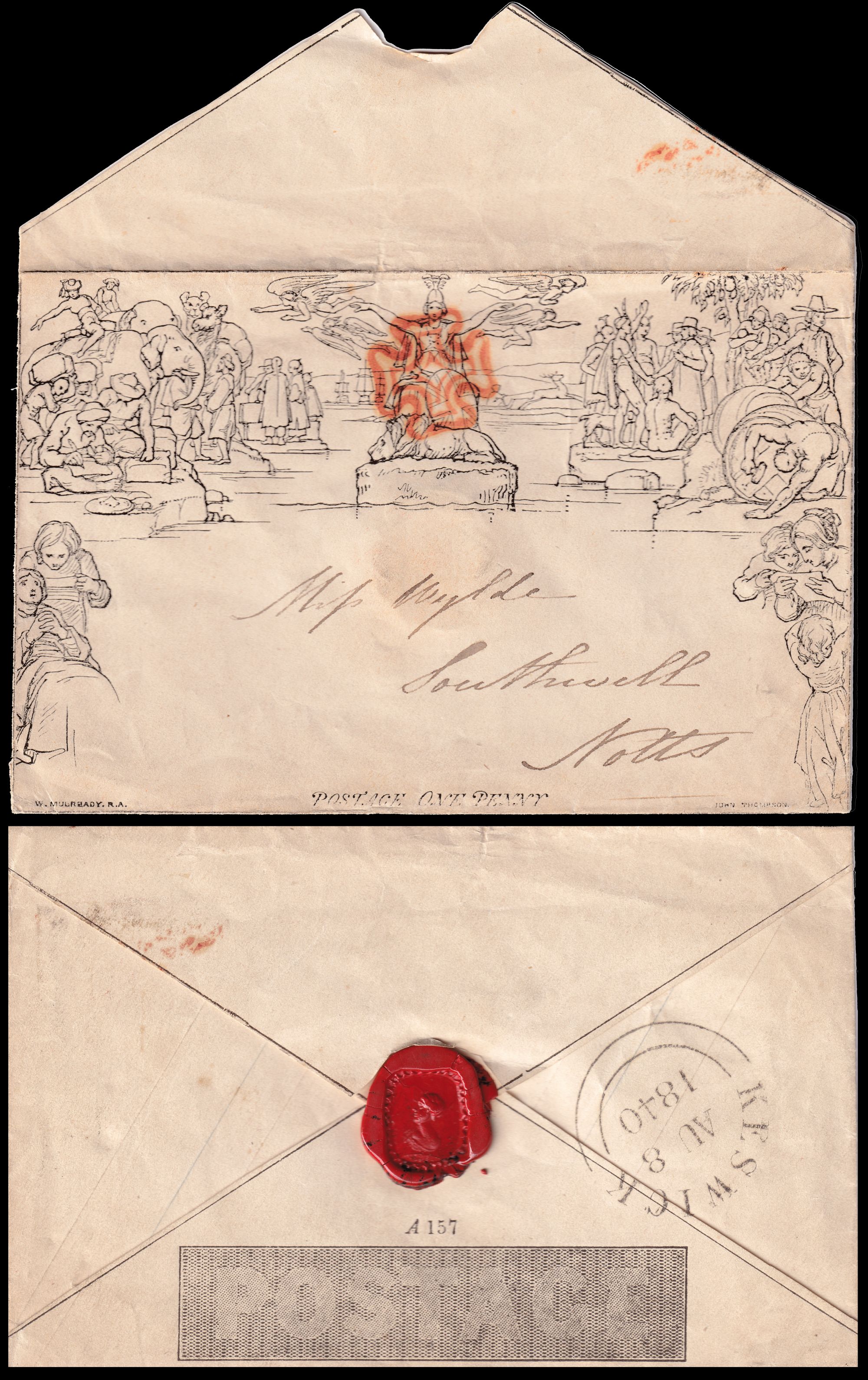
Mulready prepaid envelope ("One Penny Black", A157),
posted from Keswick on August 8th, 1840,
cancelled by bright red Maltese Cross. The letter addressed to "M.P. Wylde, Southwell, Notts". "Notts" is the common abbreviation for Nottinghamshire, a county in England. |
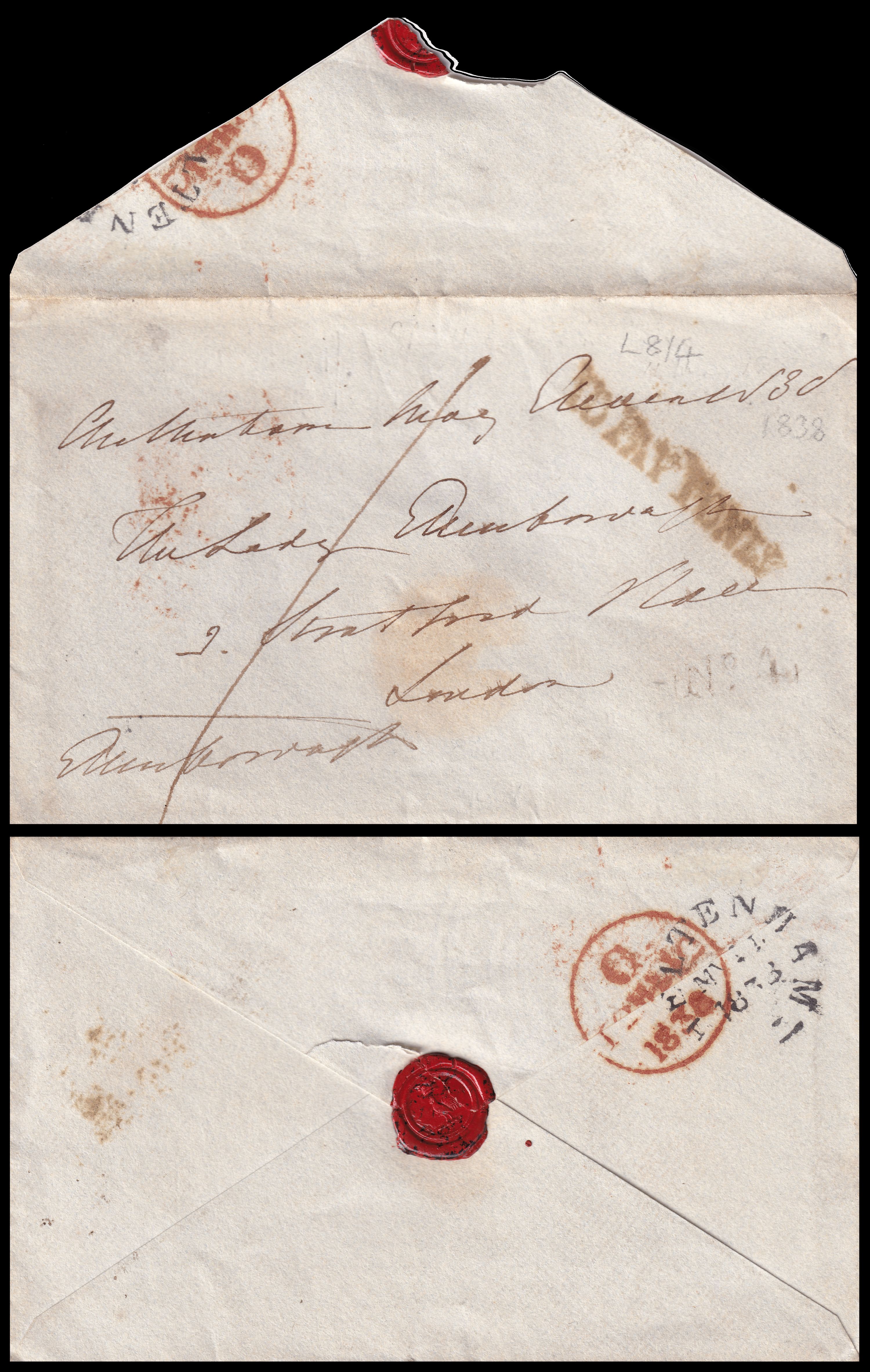
A "FREE" letter posted in 1836.
The "FREE" handstamp is absent, but the privilege of free postage is indicated by the signature in the lower-left corner,
that of Lord Ellenborough, who also wrote the full address in his own hand.
Because the letter entered the London Penny Post system for final delivery, an additional charge of 1d was levied on the recipient, resulting in the application of the "To Pay 1d Only" handstamp. |
|
|
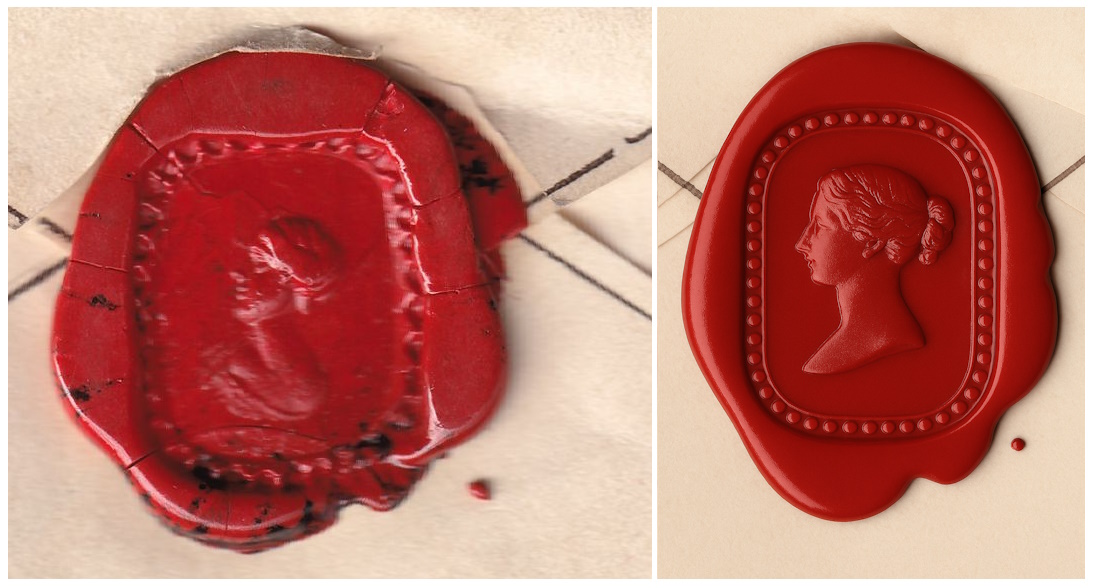
| The seal, on the reverse side of the Mulready envelope, most likely depicts Queen Victoria. It was commonly used in the 1830s–1840s, especially during and just after the introduction of the Penny Black stamp, which features a very similar profile. |
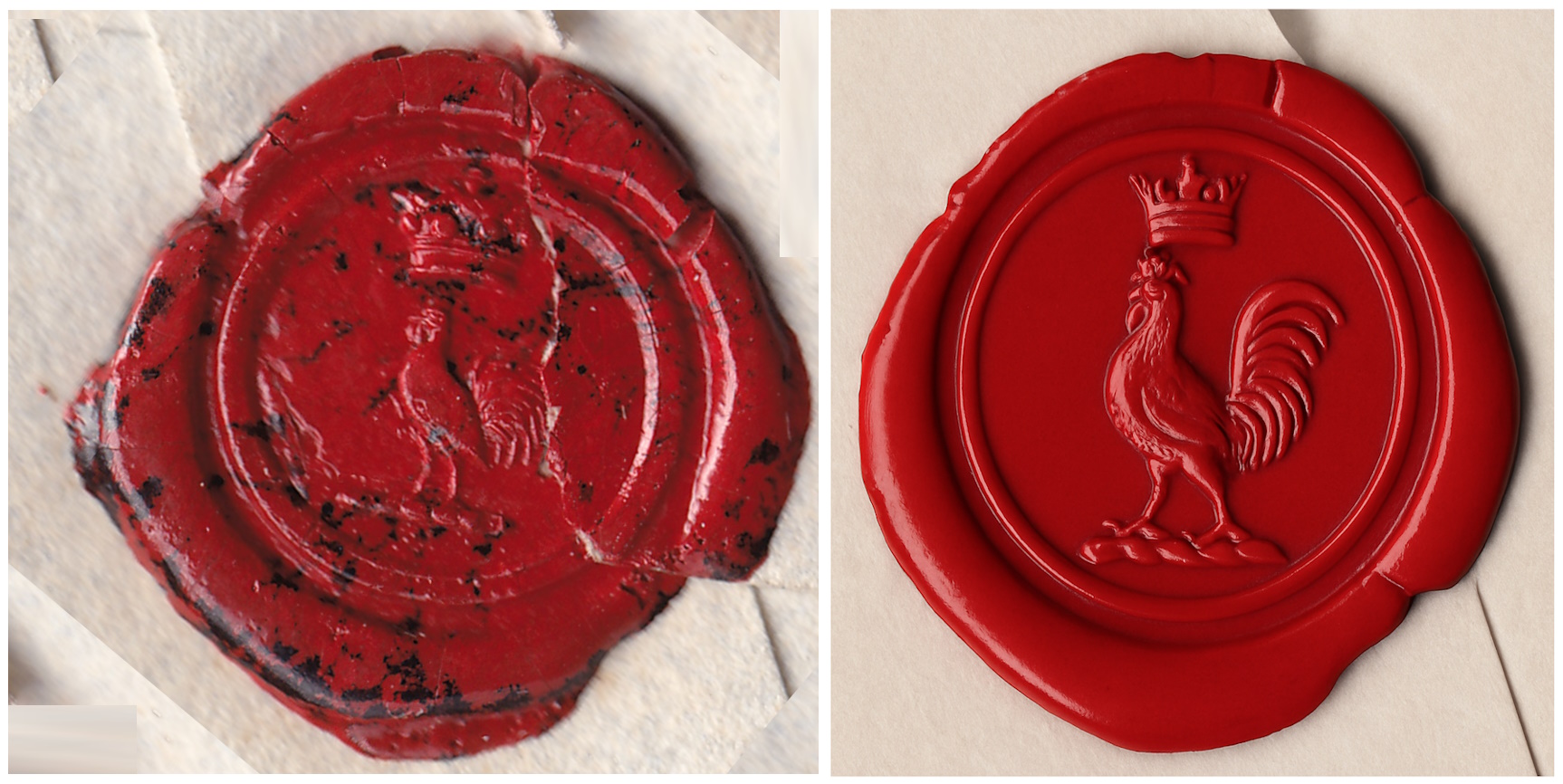
The seal, on the reverse side of the envelope, depicts the personal crest of the Ellenborough family:
the cock beneath a coronet.
This is a classic heraldic cock, commonly used in British arms to symbolize watchfulness, courage, and readiness.
|
The Mulready Advertisements
Many firms, organizations, government agencies, banks, merchants ... recognized new business opportunities in usage of the pre-paid letter sheets and envelopes. Bankers recognized the practicality and convenience of enclosing cheques in prepaid envelopes. Insurance companies were the most active users of the Mulready letter sheets for promoting life assurance.
Some companies printed their advertisements in the envelopes, but due to the limited space, the envelopes were little used for the advertisement purpose.
From late May 1840, publishers, booksellers, and stationers began offering advertising subscriptions, much like modern newspaper and magazine campaigns, by printing promotions inside letter sheets and on envelopes.
This postal stationery with advertisements was sold below the face value written on them (see on the top-right corner of the example above), because the letter sheets were covered by advertisements and it was required to purchase writing paper, but in total the buyer was saving money.
Insurance companies sent their promotion materials inside of prepaid letter sheets too, either printed on the letter sheets or enclosed.
By late September 1840, however, it became clear that multiple-advertisement Mulreadys could only be issued once a month, with at least 27 days between publications; otherwise, they would be subject to the Newspaper Tax. This restriction made the venture financially unviable, and the multiple-advert Mulreadys soon disappeared.
Paleontology-related Advertisements
At least two such advertisements were related to topic of paleontology:
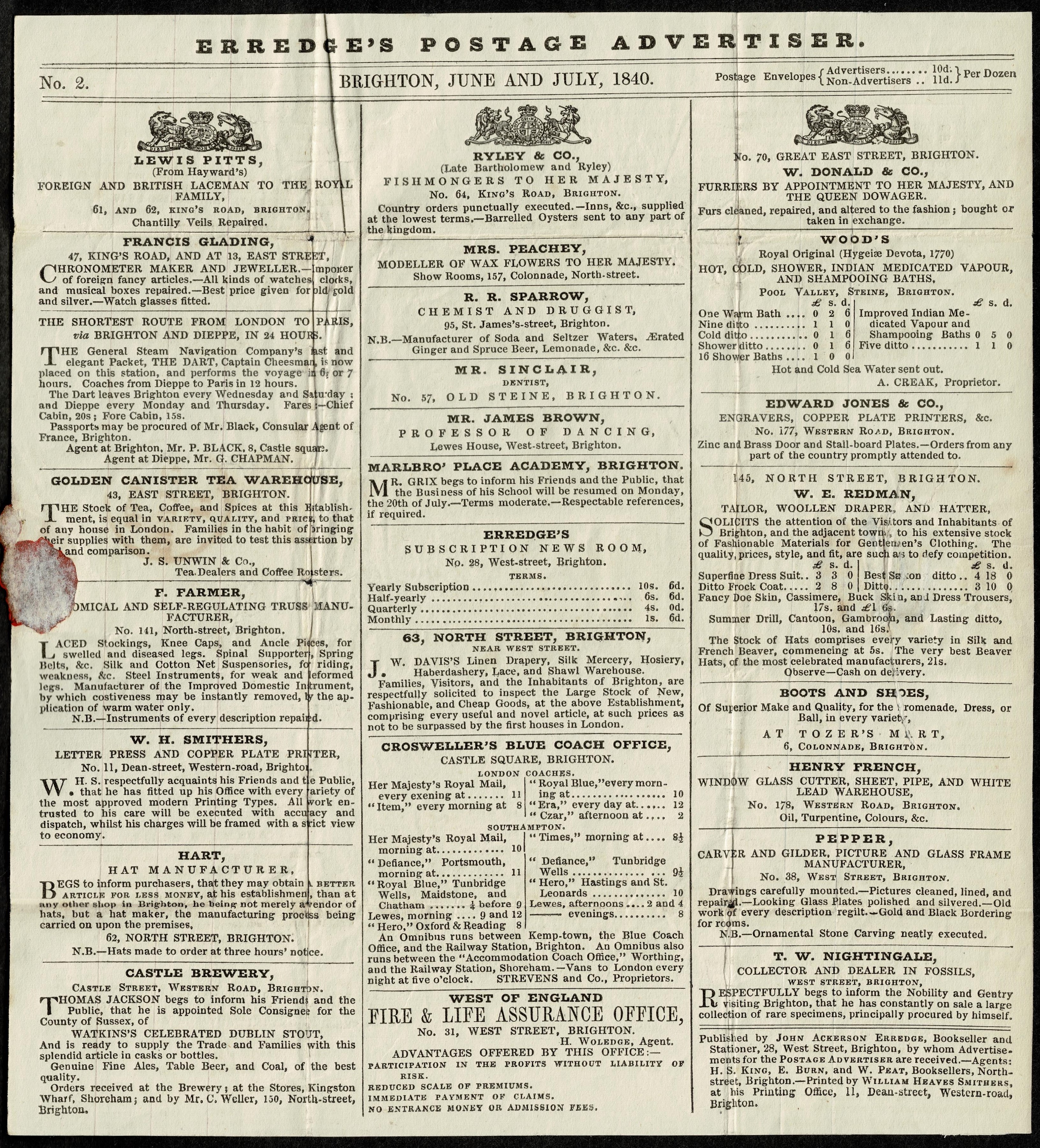
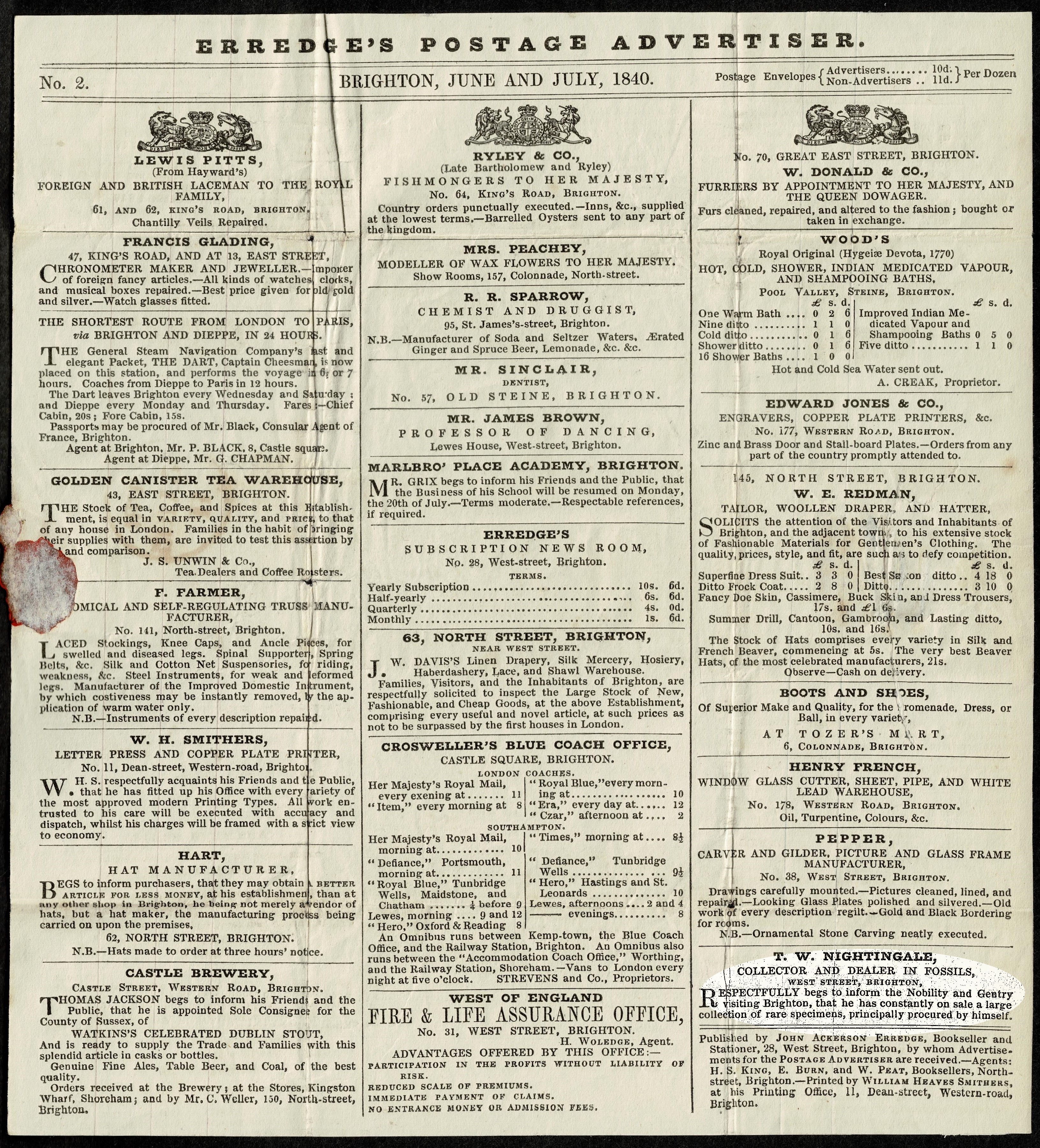
- Advertisement of a fossil dealer T. W. Nightingale, inside a Mulready letter sheet, published in June-July 1840, by Erredge's Postage Advertiser.
- Advertisement of Taylor's Book Catalogue, which included a book by William Buckland - the first professor of Geology in Great Britain, who made significant study on fossils.
Erredge's Postage Advertiser
 |
|
Mulready letter sheet with advertisements inside, SG: MA11b, Malcolm G. Lowe: MA8a-b,
"Brighton No. 2,
June-July 1840", by Erredge's Postage Advertiser. Image courtesy Robin Cassell, co-author of "The Mulready Caricature" book issued in two volumes in 2024 (ISBN 978-1-913015-31-2). |
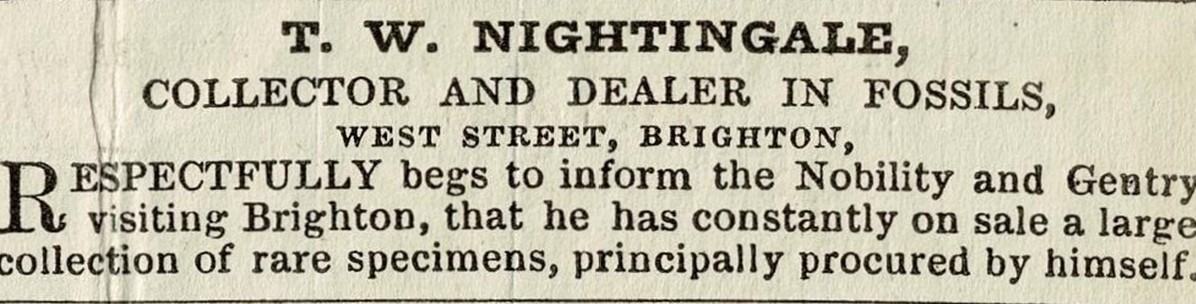
It was intended to introduce Brighton's visitors to Nightingale's fossil business:
Respectfully begs to inform the Nobility and Gentry visiting Brighton, that he has constantly on sale a large collection of rare specimens, principally procured by himself.
Far from being a mere amateur enthusiast, historical records show that T. W. Nightingale was a highly respected professional figure in early British commercial paleontology, specializing in the meticulous preparation of delicate fossil specimens recovered from the rich Sussex Chalk.
 |
The opening of the London and Brighton Railway in 1841 greatly accelerated Brighton's development as a mass tourist destination. Visitors could now travel from London in only a few hours, creating a steady stream of affluent customers eager to purchase local fossils as scientific specimens, educational objects, and fashionable souvenirs.
T. W. Nightingale's commercial activities coincided with the rapid growth of fossil collecting in early Victorian Britain. The pioneering discoveries of Mary Anning at Lyme Regis had already demonstrated the scientific and commercial value of fossils, inspiring widespread public interest in prehistoric life.Sussex itself occupied a special place in the history of paleontology. It was there that the discovery of the first known Iguanodon tooth by Mary Ann Mantell, followed by their scientific investigation by her husband, Dr. Gideon Mantell, resulted in one of the most significant paleontological discoveries of the nineteenth century.
The rapid expansion of Britain's railway network further transformed paleontology by exposing extensive new geological sections in railway cuttings, tunnels, and associated quarries. These excavations frequently revealed fossils that would otherwise have remained buried and, in regions such as Sussex, stimulated a thriving fossil trade. Quarrymen and local dealers soon discovered that wealthy visitors to the fashionable seaside resort of Brighton were eager to purchase prehistoric specimens as curiosities and scientific collectibles. At the same time, the expanding Victorian middle class developed an increasing interest in natural history, geology, and collecting. Fossils became fashionable display objects in private cabinets of curiosities as well as valuable scientific specimens. Collectors and dealers such as Nightingale became an important link in this expanding network, connecting industrial discoveries with museums, private collections, and the emerging scientific community.
Nightingale's professional reputation was acknowledged by Gideon Mantell himself. In the "Dealers in Fossils" directory of The Medals of Creation; or, First Lessons in Geology, and the Study of Organic Remains, published in 1854, Mantell wrote:
Nightingale, Mr. 52, Frederick-street, near the railway station Brighton A large assortment of Sussex chalk and other fossils. Mr. Nightingale is a first-rate artist in clearing chalk fishes and crustaceans.In nineteenth-century paleontological terminology, "clearing" referred to the painstaking removal of the surrounding chalk matrix with fine tools to expose fragile fossil bones, fishes, and crustaceans without damaging them. The quality of this preparation often determined both the scientific value and commercial price of a specimen. Mantell's endorsement demonstrates that Nightingale was regarded not merely as a fossil dealer but as an exceptionally skilled fossil preparator whose craftsmanship was recognized by one of Britain's foremost paleontologists.
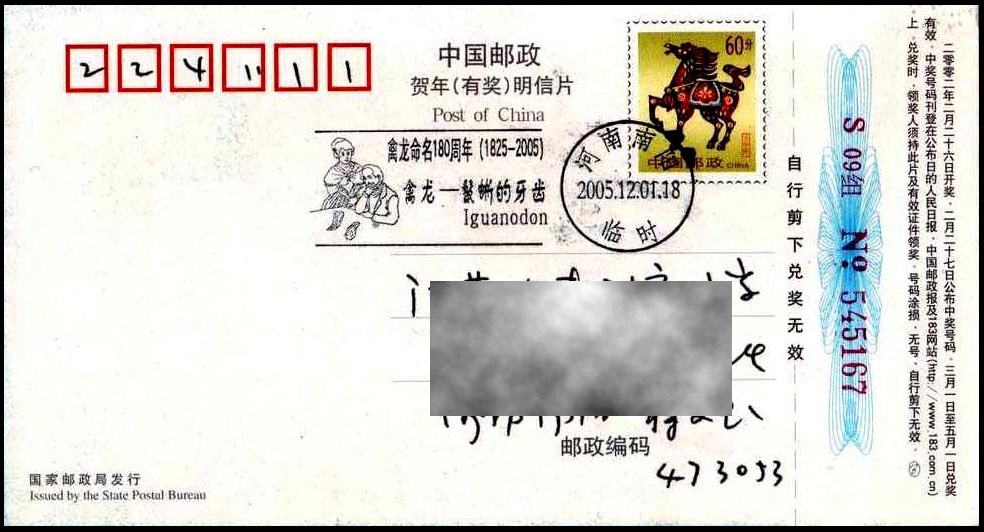 |
| Chinese commemorative cancellation (2005) depicting Gideon and Mary Ann Mantell studying Iguanodon teeth. |
It was Mary Ann who discovered the famous Iguanodon tooth in the early 1820s, while Gideon recognized its scientific significance through years of careful investigation.
Gideon Mantell and his wife, Mary Ann, lived in Brighton from 1833 to 1838, where he continued his pioneering investigations of the fossils of Sussex before moving to London. His work on Iguanodon, Hylaeosaurus, and other fossil reptiles from the Sussex Weald attracted international scientific attention. Hylaeosaurus was discovered in 1832 in Tilgate Forest near Cuckfield, West Sussex, within the Lower Cretaceous Wealden Group - the same geological formation that yielded Iguanodon. Mantell described and named Hylaeosaurus armatus in 1833.
Iguanodon and Hylaeosaurus were two of the three prehistoric reptiles that Professor Richard Owen used in his famous Plymouth lecture of 1841 when defining the group that he formally named Dinosauria the following year. Mantell's discoveries and publications also stimulated a flourishing local fossil trade, creating opportunities for skilled collectors, preparators, and dealers such as T. W. Nightingale, who specialized in fossils from the Sussex Chalk.
Taylor's Book Catalogue
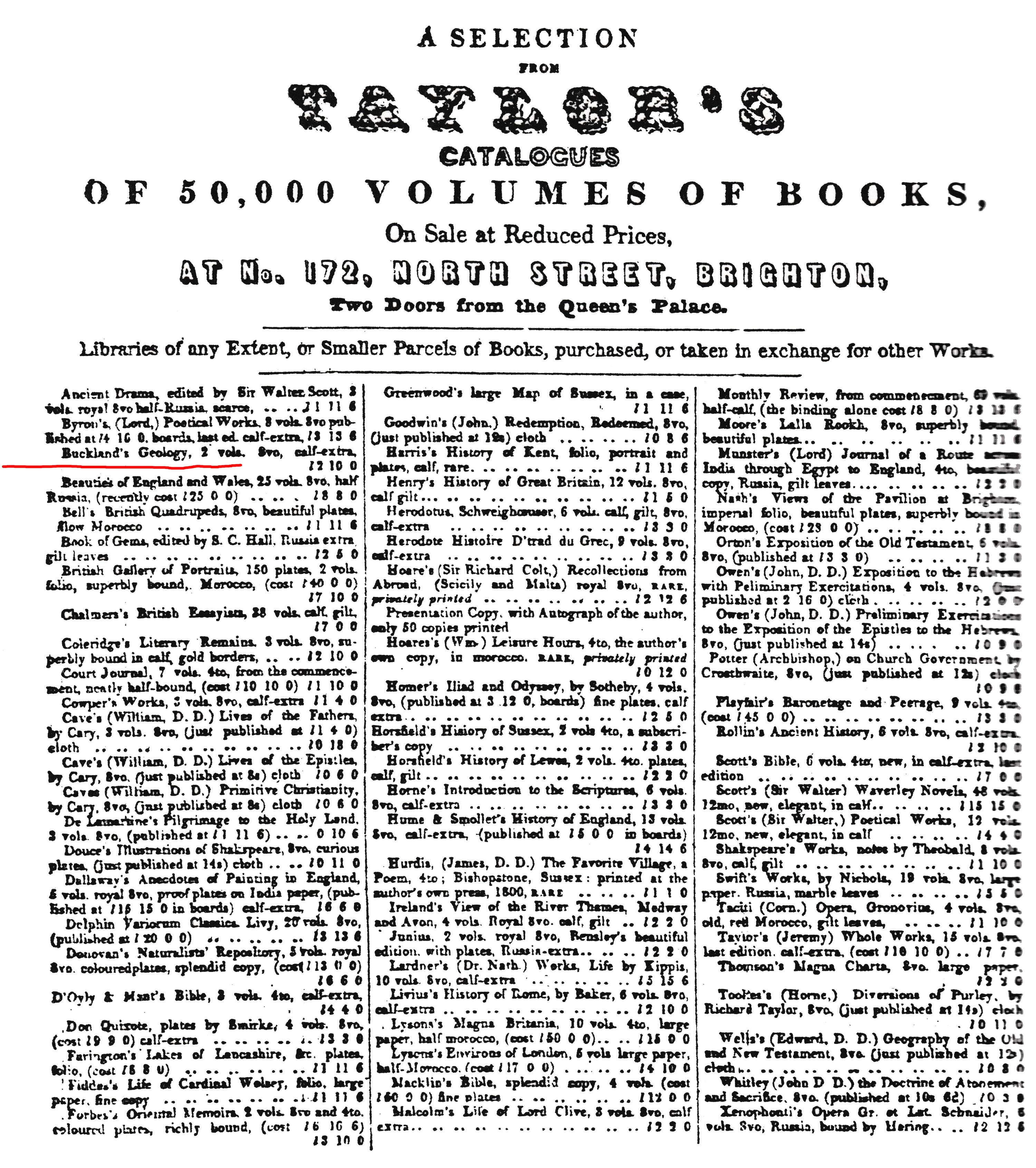 |
| Taylor's Book Catalogue advertisement inside Mulready letter sheet, SG: 484, Malcolm G. Lowe: MA129a. |
The full name of the book, published in two volumes in 1836, is "Geology and Mineralogy: Considered with Reference to Natural Theology". This work is a comprehensive study of geology and mineralogy, with a particular focus on their relationship to natural theology. In this book Buckland described many fossils discovered in England and on the mainland of Europe, such as Ichthyosaurs, Plesiosaurus, Mosasaurus from Maestricht (the Netherlands), Pterodactylus from Germany, etc.

|
| William Buckland and the Megalosaurus jaw on postmark of South Korea 2001. |
While Buckland based his academic career at Oxford, he was also a highly familiar face to the Brighton gentry. Following his close friend Gideon Mantell’s relocation to the seaside town in 1833, Buckland frequently visited Brighton to deliver animated public lectures and directly assist in organizing and curating the spectacular prehistoric specimens inside the famous Mantellian Museum on Steine Lane.
The inclusion of Buckland's work in a general discount catalogue highlights a major cultural shift in 1840s Britain. This two-volume treatise formed part of the celebrated Bridgewater Treatises — a high-profile publishing project that sought to reconcile the latest geological and paleontological discoveries with natural theology. The work also included Buckland's famous account of Megalosaurus, which, together with Mantell's Iguanodon and Hylaeosaurus, later became one of the three reptiles used by Richard Owen to establish the group Dinosauria.
Richly illustrated and intended for an educated general readership, these volumes helped popularize geology and paleontology far beyond universities and learned societies. Their appearance in an ordinary Brighton bookseller's discount catalogue demonstrates that scientific literature had become a major commercial commodity for the expanding middle class. Ultimately, advertisements like Taylor's helped democratize scientific knowledge, while cheap postage under Rowland Hill's Postal Reform further accelerated this process by enabling booksellers to distribute catalogues widely throughout Britain, transforming paleontology into a subject of mainstream public fascination.
The Expansion of Geological Correspondence
The introduction of weight-based penny postage in 1840 did not merely simplify business; the cheaper postal system greatly facilitated communication between provincial collectors, amateur naturalists, and scientific institutions, that permanently transformed Victorian science.
Prior to the reform, exchanging detailed fossil descriptions or hand-drawn stratigraphic maps was financially prohibitive, as the post office charged by the individual sheet of paper. Under Rowland Hill's uniform penny system, researchers, provincial collectors, and skilled preparators like T. W. Nightingale could freely mail multi-page letters, intricate geological sketches, and even flat, lightweight fossil specimens, such as Sussex chalk fish scales and small teeth, directly to academic giants like William Buckland and Gideon Mantell for rapid identification. This democratization of mail effectively crowdsourced the British landscape, creating a vast, interconnected postal network of amateur observers who rapidly funneled the raw data and fossil evidence required to map the British Isles and formally define the prehistoric world.
The Mulready Caricatures
The stationers, particularly in London and Edinburgh, believed that by issuing this postal stationery the Post Office would undermine their business.
Before May 1840, stationers held a highly lucrative monopoly on selling plain writing paper, letter sheets, and envelopes. The introduction of cheap, pre-paid government stationery threatened their core business model and their very livelihood. Fearing a catastrophic collapse in their income, major stationers in London and Edinburgh launched a coordinated campaign of satirical sabotage. They systematically manipulated the press with derogatory reviews and flooded the retail market with comic parodies to intentionally destroy public trust in the official Post Office stationery.
This opposition from stationers contributed to the rapid popularity of satirical caricatures to the ultimate act of historical trolling just one week after the official release.
On May 13th, 1840, Scottish artist and stationer Robert Wright Hume posted his famous parody envelope, "Britannia seated on an Egg", directly to William Mulready himself. Rather than discarding the insulting mail, Mulready recognized its artistic wit and kept it in his private collection. This created an enduring historical irony: William Mulready, the artist chosen by the government to create Britain’s first postal stationery design, became the recipient and preserver of the satirical caricatures that ridiculed his work and helped seal the fate of the Mulready issue.
Following Hume's early success, many other stationers, print sellers, and publishers rushed to produce their own satirical Mulready caricatures. One of the most popular and commercially successful was Fores's Comic Envelope No.1, designed by the celebrated illustrator John Leech and published by Messrs. S. W. Fores. It was already on sale by May 20th, 1840.
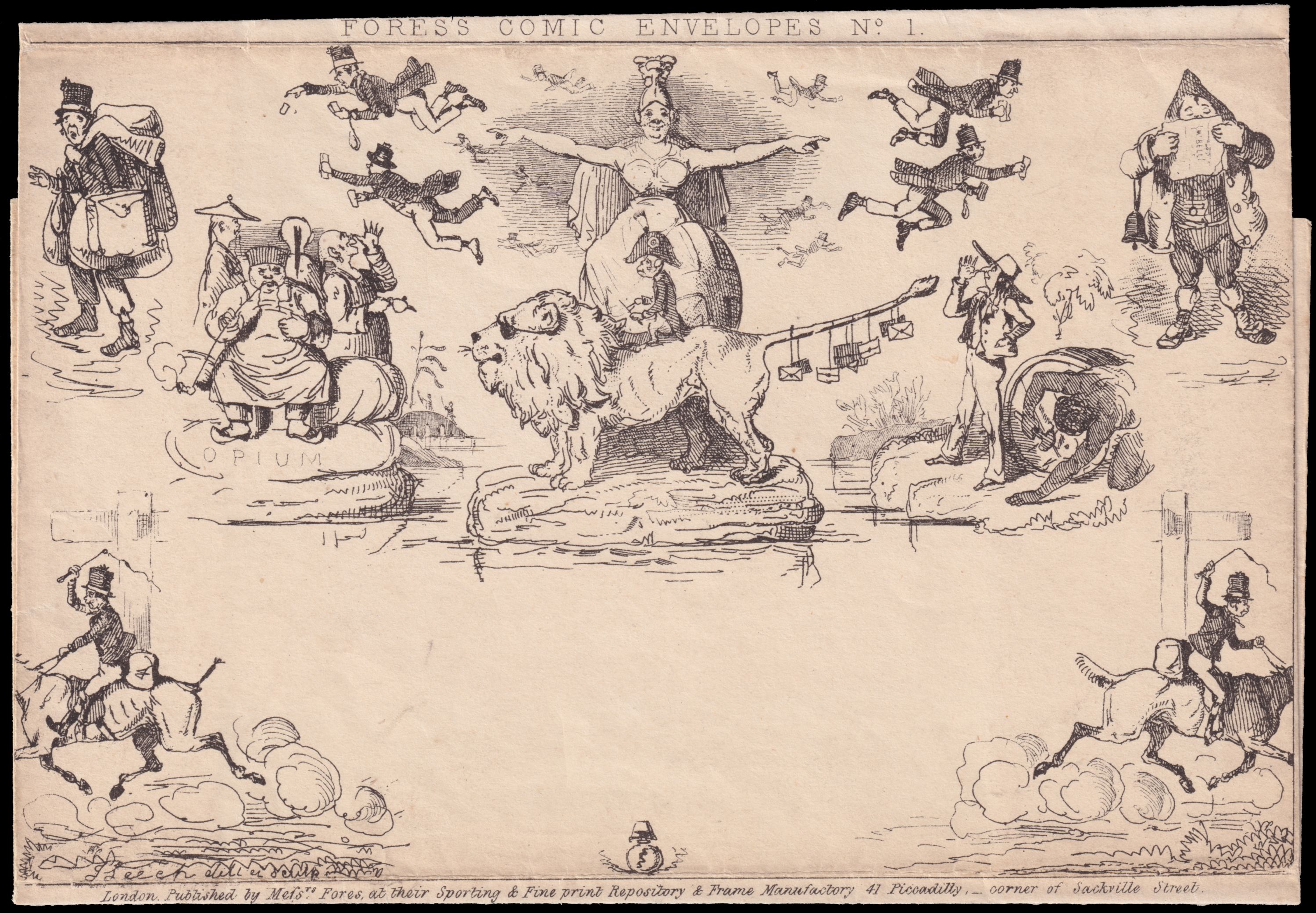 |
| One of many caricatures of the Mulready postal stationery - “Fores's Comic Envelope No. 1“, created by John Leech in 1840 |
Although intended to provide stationers with an additional source of revenue, most envelopes were purchased as souvenirs rather than used for correspondence. They also became popular as small gifts, much as people today might bring a box of chocolates when visiting friends for dinner.
Many hundreds of them are shown in "The Mulready Caricature" book, created by Robin Cassell
and Richard Hobbs, issued in two volumes in 2024 (ISBN 978-1-913015-31-2).
Withdrawal of Mulready postal stationery
Even though Rowland Hill expected the Mulready postal stationery to be more popular than the postage stamps, a week after start of the sale he stated:
I fear we will be obligated to substitute some other stamp for that designed by Mulready, which is abused and ridiculed on all sides, the public have shown their disregard and even distaste for the beauty.
By June 1840, it had become clear that there was little public demand for the Mulready postal stationery. "Large quantities of the more than 20 million printed letter sheets and envelopes remained unsold. Rowland Hill even noted that "the stock of covers being so large that it will perhaps be some years before they are exhausted." After only a few months, it was obvious that postage stamps were becoming the preferred method of postage prepayment in Great Britain, despite Hill’s early expectations in favour of the "Mulready" stationery. Within two months, the decision was taken to replace them.
As early as June 6th, Rowland Hill was already considering using the same design as the Penny stamps for the new stationery.
On October 14th, 1840, Hill wrote:
It is settled to issue new Envelopes of two sizes made in the first instance of Dickinson’s paper (of which we have a large stock) and stamps with Wyon’s die.
By November 1840, with vast quantities of Mulready stationery still unsold, it was decided to discontinue its production entirely. The majority of remaining envelopes and letter sheets were handed over to government departments, such as the Tax office, for official use, replacing the “Penny Black VR” stamps originally produced for government correspondence. Some Mulready items also stayed in stock at local post offices, where the public could still buy them if they wished.
On 10 February 1841, a new embossed one penny stamped envelope, later known as the "Penny Pink", was introduced as a replacement for the unpopular "Mulready One Penny" postal stationery. The new design abandoned the elaborate allegorical illustration of Mulready and presented a much simpler appearance, with a plain front featuring only the embossed Queen Victoria profile and one penny postage indication.
The next chapter tells its story.
In 1842, the Stamps and Taxes Office in London began recalling the remaining unsold stationery for destruction. It took several years to collect and destroy the millions of unused Mulready letter sheets and envelopes from across Britain.
References
Mulready postal stationery
|
William Mulready |
Postal stationery
Pre-paid postage envelope embossed with the Sydney GPO |
Paleontology-related Advertisements
| T. W. Nightingale | Gideon Mantell (1790-1852) | William Buckland (1784-1856) |
Recommended Books
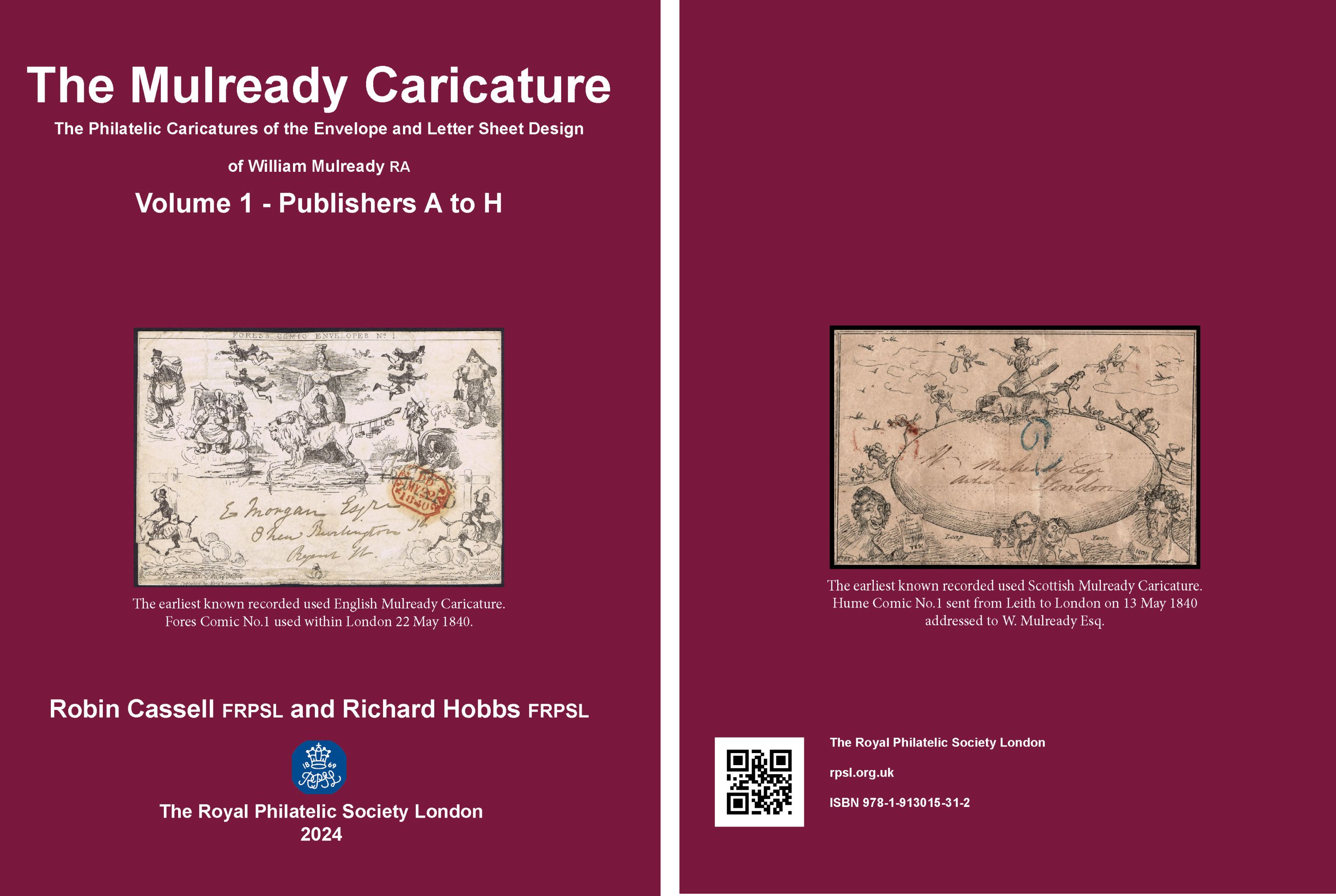 |
- "The Mulready Caricature", by Robin Cassel and Richard Hobbs, published by the Royal Philatelic Society London in two volumes in 2024 (ISBN 978-1-913015-31-2), printed by "Pardy and Son". The book includes 2,392 images of all known copies.
- "The Mulready postal stationery - its Genesis, Production and Usage", by Alan Huggins and Alan Holyoake, published by GB Philatelic Publication Ltd. in 2015. ISBN: 978-0-907630-29-6
- "International Postal Reforms, volumes 1 and 2, Postal Reforms and the Historical Background to the Postage Stamp 1550 to 1898", by James Grimwood-Taylor RDP FRPSL, published by the Royal Philatelic Society London in 2020, ISBN: 978-1-913015-06-0 and 978-1-913015-07-7.
- "The Mulready Advertisements", by Malcolm G. Lowe, published by Mulready Research Foundation in 1983, ISBN: 0-911451-00-5
- "The Mulready Envelopes and Letter Sheets", by Tom Slemons, published in Gibbons Stamp Monthly in March 2012
- "British Post Office Notices: 1666 - 1899, Volume 4: 1840 - 1849", by M. M. Raguin, Published by the author in 1990.
- GB Specialised Volume 1 Part 1 'Queen Victoria' Stamp Catalogue (1st Edition), published by Stanley Gibbons in 2020, ISBN: 978-1-911304-54-8.