Simultaneous Development of Philately, Geology, and
Palaeontology as a Result of the British Industrial Revolution
Part 3: Postal System and the Postal Reform of Great Britain at the beginning of the 19th century
Postal System of Great Britain at the beginning of the 19th century
The invention of the postage stamp in 1840 was part of an attempt to improve the postal system in the United Kingdom of Great Britain and Ireland as requested by the growing business community who needed to exchange more communications due to the industrialization process beginning in the 1760s which we now call the British Industrial Revolution. Before the introduction of adhesive stamps, the British postal system was slow, with high and complex rates.
Although business and science moved forward and the transformation of Great Britain from a rural to an industrial country was in full force, the Postal System of the country was stuck in the past.
The postal service was slow, inefficient, expensive, and its rates were so complex that they were difficult to understand. This was partly because the government used postal charges as a source of revenue, particularly in the years following the end of the Napoleonic Wars.
Most letters passed through London, where the postage due was assessed and the amount to be paid was written on the cover before the letter continued to its destination.
Letters could be sent prepaid by the sender or unpaid, due to the common opinion the delivery was more reliable if the postman had to collect money from the recipient, most of the letters were sent unpaid.
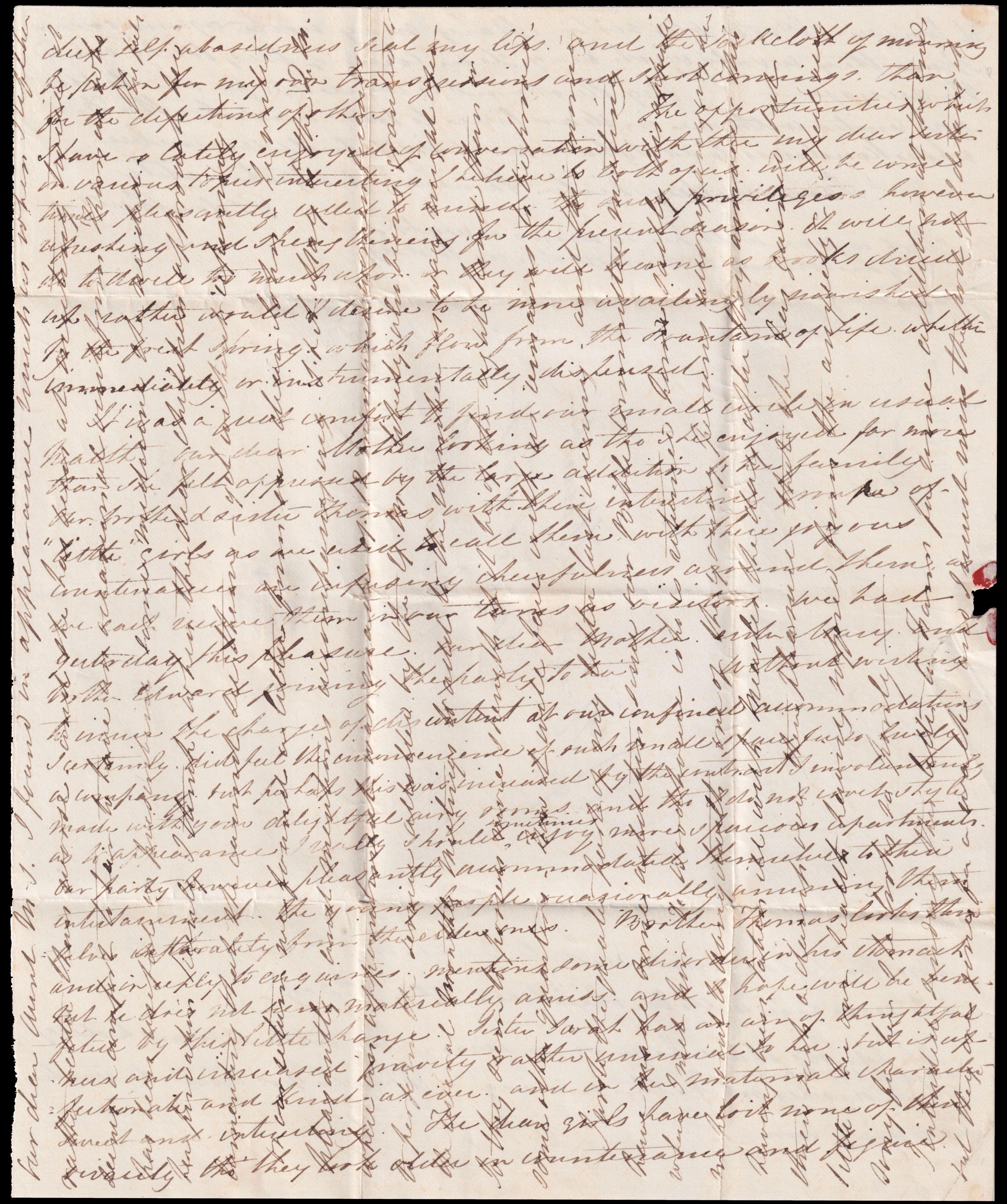 |
| An example of a cross-written letter: the letter was posted from Southall Leominster to Royal Fort Bristol (9d rate) in 1838. |
 |
 |
 |
Most "PAID" handstamps feature circular or tombstone designs struck in red ink. While rectangular shapes and alternative colors like black were also used, they are far less common. |
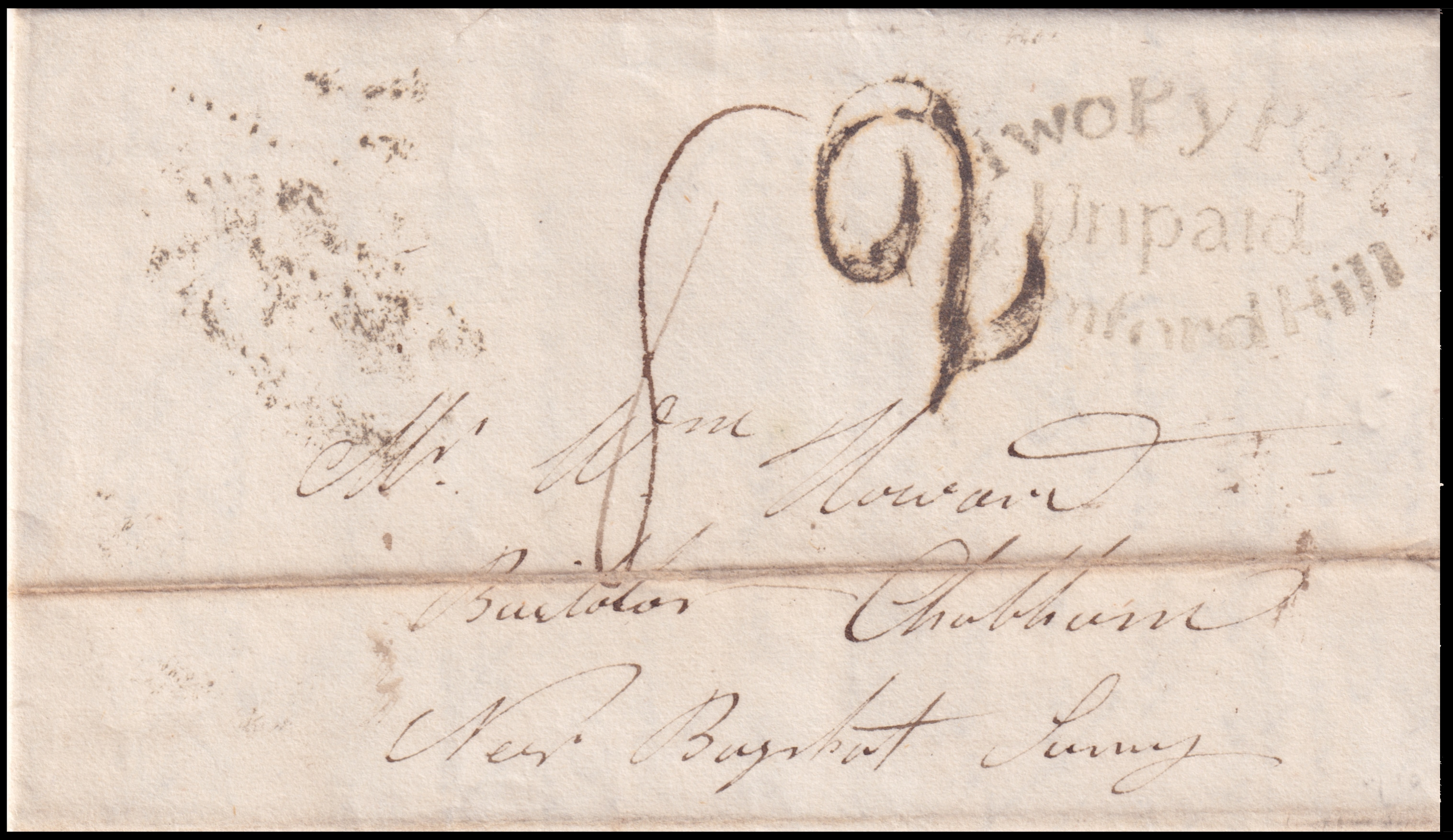 |
 |
An "Unpaid" handstamp did not mean a letter was being returned; it simply meant the sender had not prepaid the postage. Instead, the recipient was responsible for paying the fee (such as 2 pence) upon delivery. Usually, these letters did not get a specific "Unpaid" stamp, but instead only bore a marking showing the amount of postage due. |
The charge was determined by the number of sheets of the letter and distance travelled, and might include some extra charges or taxes, such as passing through a turnpike toll between England and Scotland ("Add 1/2" Penny), but the recipient could simply refuse delivery after examining the cover.
To save costs, people often used the "cross-writing" technique to save the number of sheets in the letter (see example on the top-right).
On the other hand, the postman spent considerable time knocking on doors, waiting for answers, arguing with the recipient on whether or not the letter was properly charged, and the finding of the correct money and counting change.
Dead Letter Office
Postage rates were high, and every letter represented a valuable financial asset that had to be carefully accounted for throughout its journey.After postage had been assessed at one of the three General Post Offices (London, Edinburgh, or Dublin), letters were forwarded to the appropriate local Postmaster by the next available mail, accompanied by a Letter Bill. This important accounting document listed the dispatched letters together with the postage due on each item. The total amount was then debited to the receiving Postmaster's account.
The Postmaster and his staff delivered the letters and collected the postage from the addressees. If every letter was successfully delivered and paid for, the Postmaster's account balanced: the amount debited by the General Post Office was matched by the postage collected from recipients. However, not every letter could be delivered. Undeliverable mail required a procedure to ensure that the Postmaster's account was properly credited for postage that could not be collected.
In 1784, the Dead Letter Office (DLO) was established in London to examine letters that could neither be delivered to the addressee nor returned to the sender because no return address had been provided.
Its principal function was to support the accounting system of the General Post Office by verifying the reasons for non-delivery and ensuring that local Postmasters received credit for postage on undeliverable letters. The DLO also investigated claims that letters had been incorrectly charged or overcharged.
To ensure consistent handling of undeliverable mail throughout the country, Postmasters received detailed instructions specifying the steps required to complete delivery and the length of time different categories of letters were to be retained before being sent to the Dead Letter Office.
The following are just a few examples:
- Letters addressed to deceased persons were returned to the DLO with the next scheduled dispatch.
- Letters that were refused, or where the addressee had gone away, were retained for one week before being forwarded to the DLO.
- If the addressee was not known, the letter was displayed for one week in the Post Office window in the hope that it would be claimed before being sent to the DLO.
- Letters marked to be called for were held at the Post Office for one month. If they remained not called for, they were forwarded to the DLO.
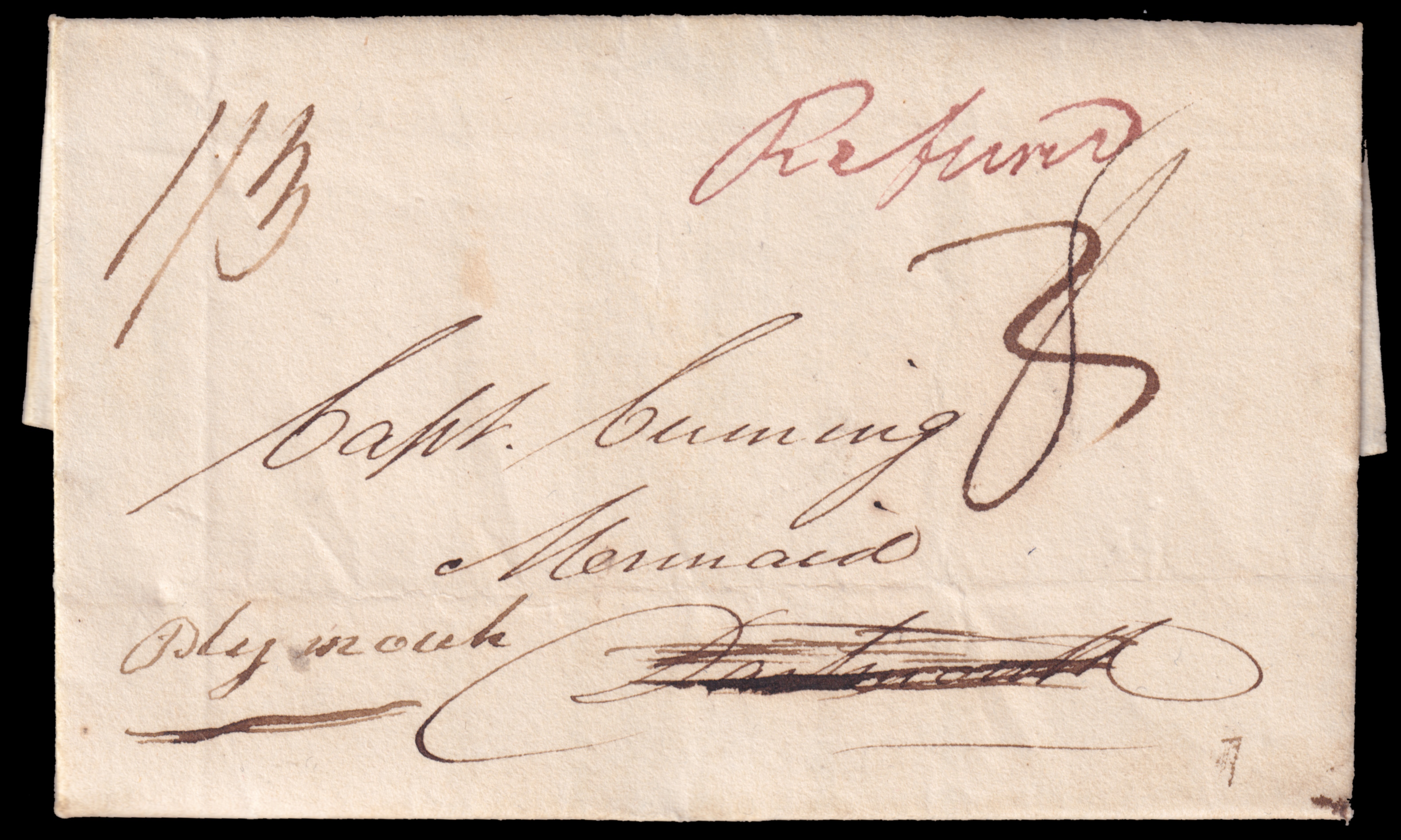 |
|
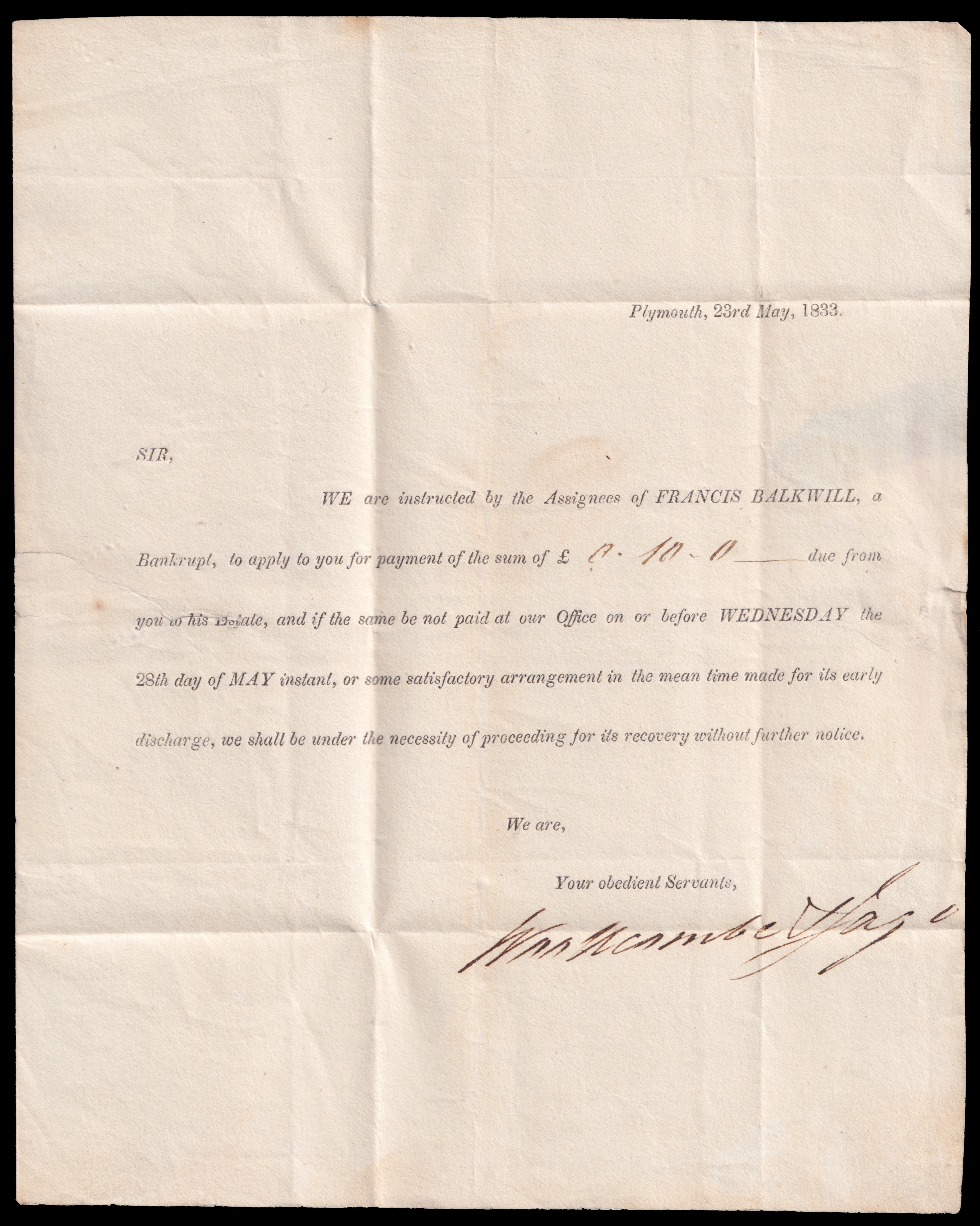
An example of a "Returned" letter
posted in 1833
from Plymouth.
Addressed to Captain Cuming of the Mermaid in Dartmouth, this letter demanded repayment of a debt. Suspecting its contents, the Captain refused delivery — a common tactic to avoid legal notice. The letter was sent back to London via the Plymouth GPO, opened in London “Returned Letter/Dead Letter Office” to identify the sender, and the postage increased from 8d to 1s 3d for the redirection. |
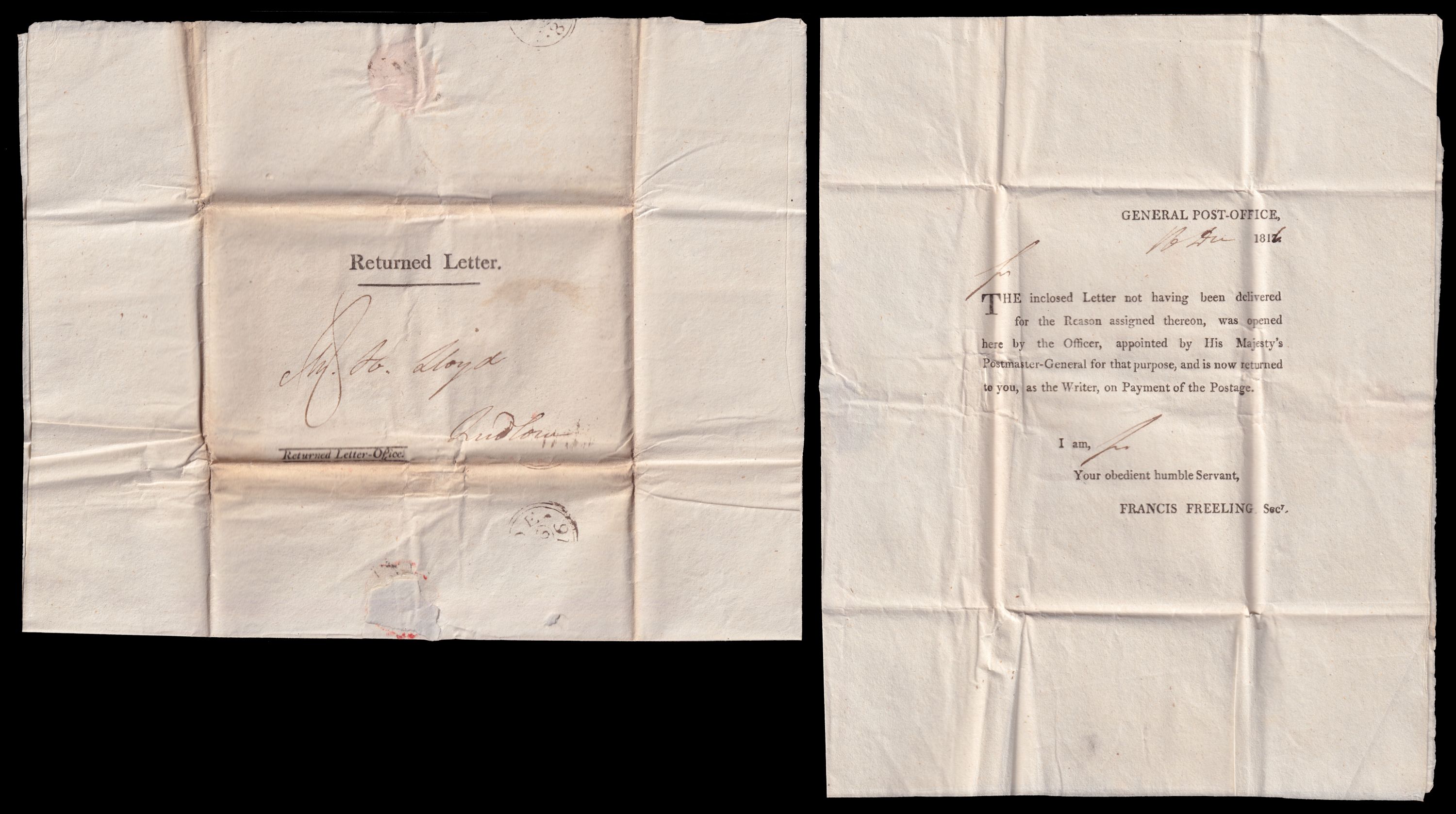 |
|
The wrapper of Return Letter Office from 1816,
with the following text inside: GENERAL POST-OFFICE, 16 Dec 1816 THE inclosed Letter not having been delivered for the Reason assigned thereon, was opened here by the Officer, appointed by His Majesty’s Postmaster-General for that purpose, and is now returned to you, as the Writer, on Payment of the Postage. I am, Your obedient humble Servant, FRANCIS FREELING Sec. |
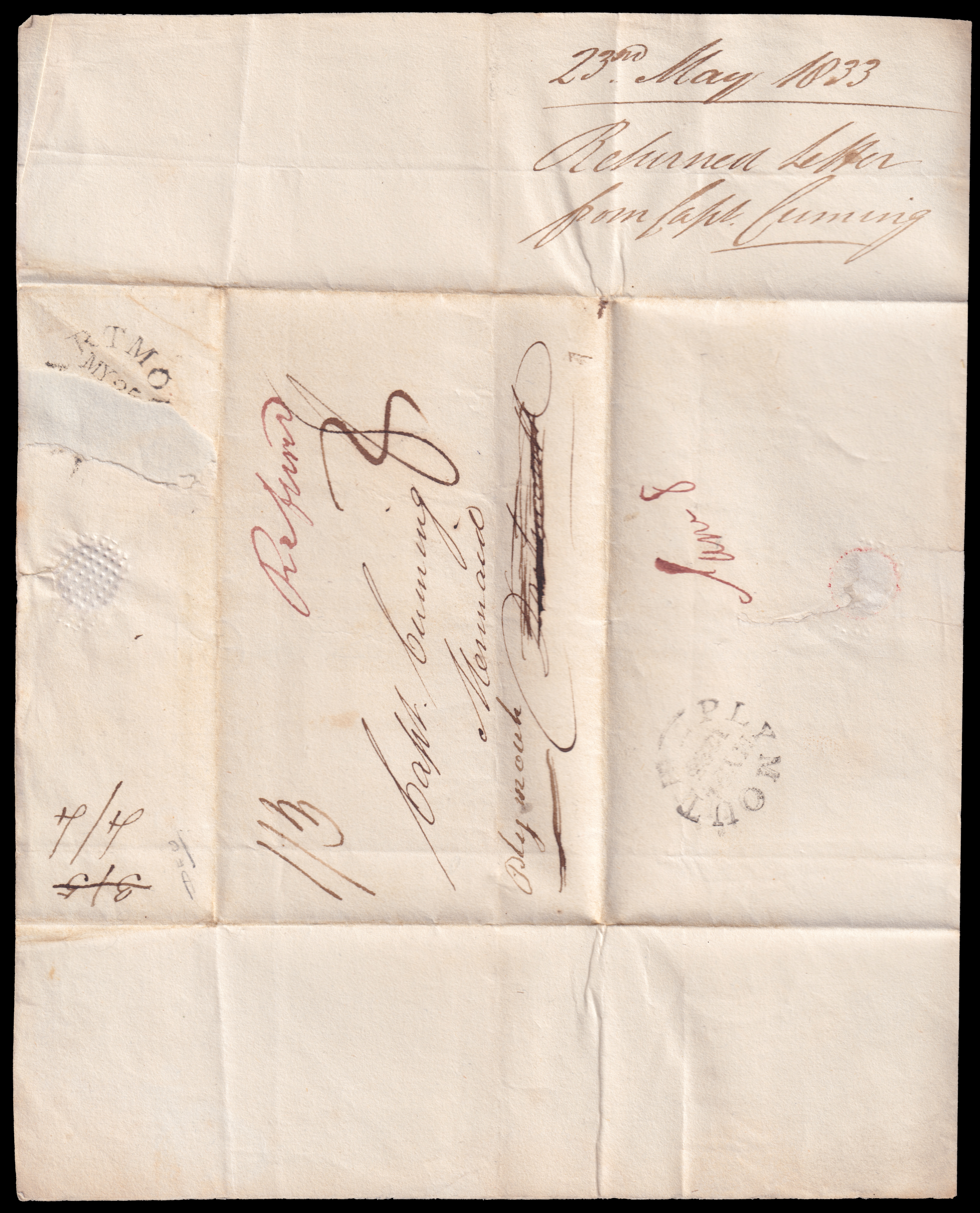
At the Dead Letter Office, undeliverable mail was usually opened in an attempt to find a forwarding address. If one was found, the letter was wrapped in protective paper and marked "Dead Letter Office" (later renamed "Returned Letter Office" or RLO) before being sent for delivery.
If the letter or parcel remained completely undeliverable, any valuable enclosed items were typically auctioned, while the remaining correspondence was destroyed. As a result, the postal service absorbed all processing and handling costs, eliminating any revenue gained from the original postage.
Within a few decades, the number of undeliverable letters forwarded by Postmasters to the Dead Letter Office increased dramatically, from approximately 480,000 in 1811 to 990,000 in 1836 and 2,407,000 in 1857. This rapid growth followed the postal reforms introduced by Rowland Hill, which greatly increased the volume of mail carried throughout Great Britain.
At the same time, the Dead Letter Office became considerably more effective in returning undeliverable correspondence. The number of letters successfully redirected or returned increased from approximately 264,000 (27%) in 1836 to 1,730,000 (72%) in 1857, significantly reducing the financial losses incurred by the Post Office as a result of unpaid postage.
Fraud and abuse
Fraud and abuse of the postal system were common.Some senders and recipients devised simple codes to avoid postage costs — for example, a letter addressed to John Brown might mean the sender was doing well, while Mr. John Brown signalled a request for help. The recipient could read the message from the address alone and refuse delivery, avoiding payment.
One of the stories, often told about the postal service before the Postal Reform is about an old mother whose son was a soldier. The son was sending a letter every day to let his mother know he was alive and in good health. The postman visited the mother daily, but she always refused the letter after examining the cover.
The case of Joseph Ady
Another form of postal abuse was practiced by impostors such as Joseph Ady (or Adey, 1770–1852), who exploited the early postal system by sending thousands of unpaid letters promising recipients "something to their advantage" in exchange for a fee over a period of more than three decades, from the 1810s into the late 1840s.
Ady’s scheme involved consulting lists of unclaimed dividends and funds held at the Bank of England and
then searching town directories for people with matching surnames.
He would write to these individuals claiming to possess valuable information concerning money or property
to which they might be entitled.
In return for revealing the information, he demanded a fee — initially five shillings,
later increased to ten and eventually twenty shillings.
Many recipients evidently paid Ady's fee, enabling him to continue the scheme for more than three decades.
Contemporary newspapers and Post Office records show that his activities generated numerous complaints,
while the large volume of undelivered letters accumulated substantial postage charges against him.
His circular letters were distributed mainly throughout England, Ireland, and Scotland, making him one of the most prolific users of the mail in Britain during the first half of the nineteenth century.
However, some of Ady's circulars reached far beyond Britain. According to the Observer (29 October 1832), George Thompson, a shoemaker from St. Kitts in the West Indies, received one of Ady's letters and travelled to London believing that he was entitled to money or property. The promised opportunity proved illusory, and Thompson ultimately required charitable assistance to return home. His case illustrates both the wide reach of Ady's correspondence and the hardship it could cause to those who trusted his claims.
An Act passed by Parliament in 1837 established that:
"every letter or packet which is rejected unopened by the person to whom it is directed shall be returned by post to the sender, and the said sender shall be liable for the return postage thereon unless the original postage has already been prepaid."
 |
|
The handwritten letter was dated 30 August 1840 but was not posted until 24 July 1841.
It was retained by Ady for nearly eleven months before being addressed to Mr. Wm. Hawkes, solicitor
in Norwich, prepaid with a Penny Red (Plate No. 11),
and mailed from Whitechapel (London). The use of prepaid postage is noteworthy, as Ady had previously accumulated substantial charges on undelivered letters and had promised the Post Office that future correspondence would be prepaid. 
The letter is a typical example of the circulars by which Ady offered to reveal "something to your advantage" in return for a fee of twenty shillings. The undersigned is able to inform you of something he believes to your advantage on receipt of twenty shillings for his trouble by Post Office Order or otherwise.The handwriting of the message differs noticeably from that of the address, suggesting that the two were written by different individuals. Contemporary accounts indicate that Ady employed assistants in his large-scale mailing business, and it is possible that the text was copied by a schoolboy for that purpose. The eleven month interval between the date of the letter and its mailing further suggests that Ady maintained stocks of pre-written circulars which could be addressed and dispatched as required. |
According to The Sun (21 July 1838), the Post Office solicitor informed the court that hundreds of Ady’s letters had accumulated because the intended recipients were deceased, could not be traced, or had refused delivery. By pleading poverty, denying his signature, and promising not to offend again, Ady successfully frustrated the Post Office’s attempts to prosecute him.
Despite repeated warnings and considerable leniency from officials, Ady continued his activities for several decades. The Post Office repeatedly brought him before the courts in an effort to recover unpaid postage and put an end to his fraudulent mailing practices. As Ady consistently refused to pay the charges imposed on him, he was imprisoned several times; however, he was usually released shortly afterwards after pleading poverty and poor health.
After 1840, when postal rates were significantly reduced following the introduction of postal reform, Ady attempted to avoid further arrests by prepaying some of his letters. He also sought to imitate the impressions left by removed postage stamps on other letters in order to lend credibility to his claims against the Post Office. These practices were reported by Rowland Hill, the architect of the postal reforms of the 1830s and 1840s, who devoted considerable effort to strengthening postal regulations and pursuing legal action against Joseph Ady and other impostors.
One of the very few known prepaid letters sent by Ady is shown on the right.
His promise to reform, however, proved short-lived and in 1848, Ady was convicted and imprisoned. Because of his advanced age and failing health, he was released in 1852, only a few months before his death later that year.
The case of Joseph Ady, who is often regarded as the inventor of spam mail, became one of the best-known examples of abuse of the pre-reform postal system and was frequently cited in discussions of postal administration and reform.
It demonstrated the practical difficulties created by unpaid and undeliverable correspondence and helped justify tighter controls on postal traffic.
Postal Charges
 |
|
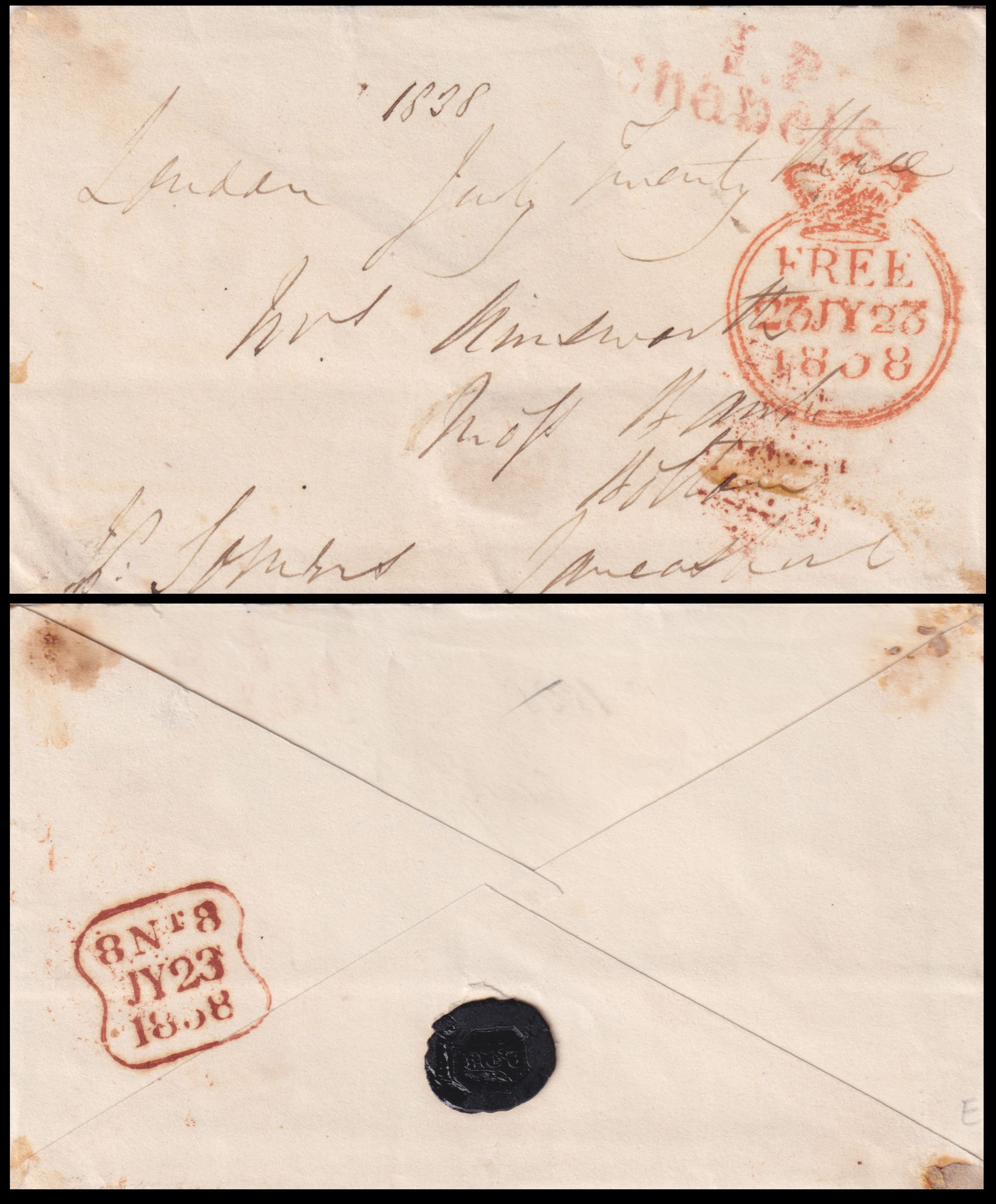
This letter was posted in 1838 from London to Oxford, a distance of approximately 92 km,
and was charged 8 pence, prepaid by the sender.
The expense was of little concern to the sender,
Alexander Nasmyth (1789–1848),
a Fellow of the Royal Medical and Chirurgical Society who was later appointed as dentist to
Queen Victoria in 1844. The recipient of the letter was the renowned Dr. William Buckland, the first Professor of Geology at the University of Oxford. In 1824, he published the first scientific description of Megalosaurus, the earliest dinosaur to be formally recognized by science. |
The money system of Great Britain until 1971 was very different
from today - the smallest unit was the Farthing.
1d - One Penny made up of four Farthings.
1s or 1/ - One Shilling made up of 12 Pence (Pence is plural of Penny).
£1 - One Pound made up of 20 Shillings (20s) or 240 Pence (240d).
There are also Guinea (£1 + 1s, or 21 Shillings), Half Crown (2s 6d) and Florin (2s).
Due to the very high postage rate many private persons and merchants tried to use alternative postage services. Even though the government tried to monopolize the postage system by acquiring some private postal companies and defining most of the private postal services as illegal, it was estimated that as many as half of all letters sent in Great Britain in the 1830s were not sent through the government's postal system.
|
 |
|
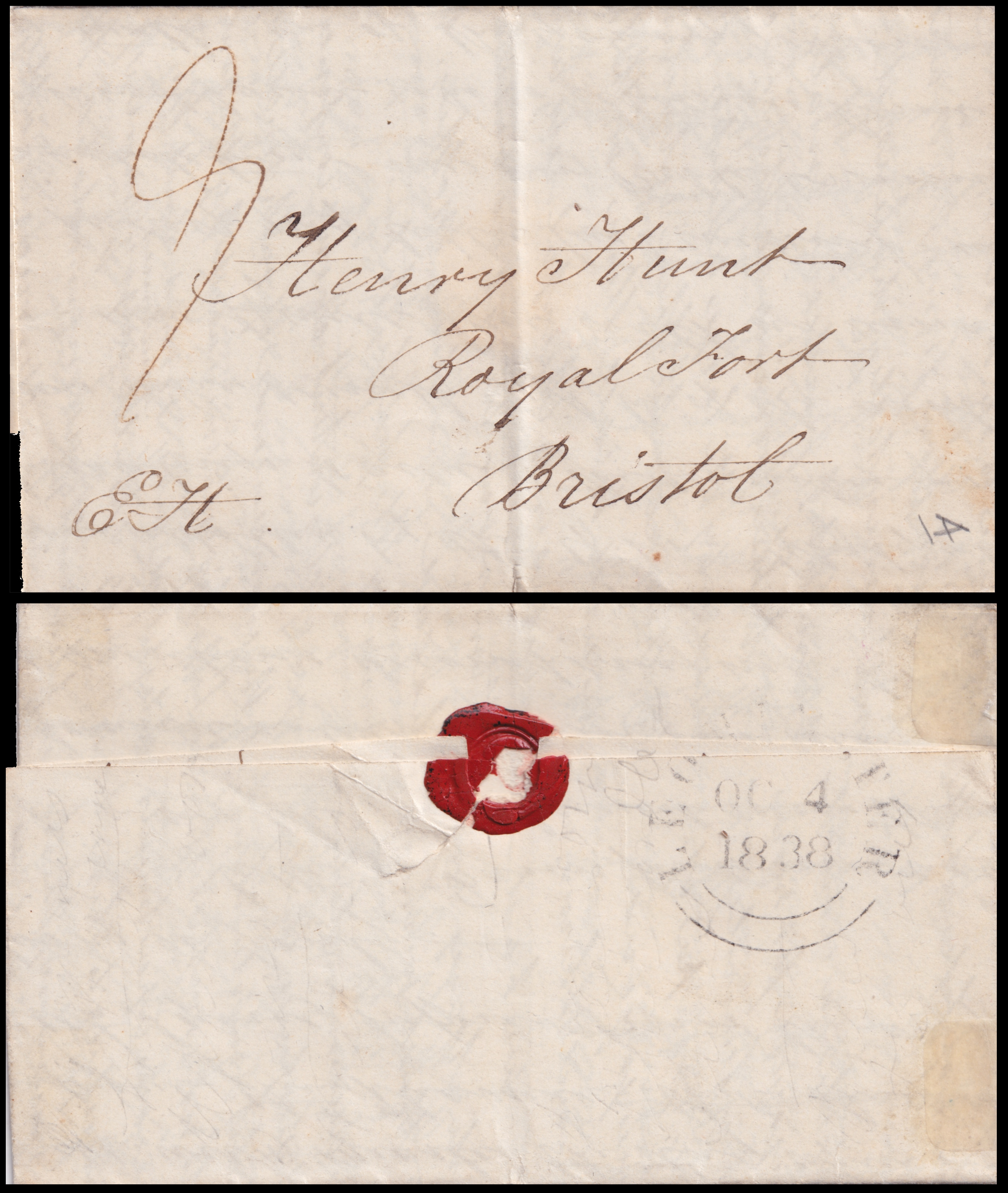
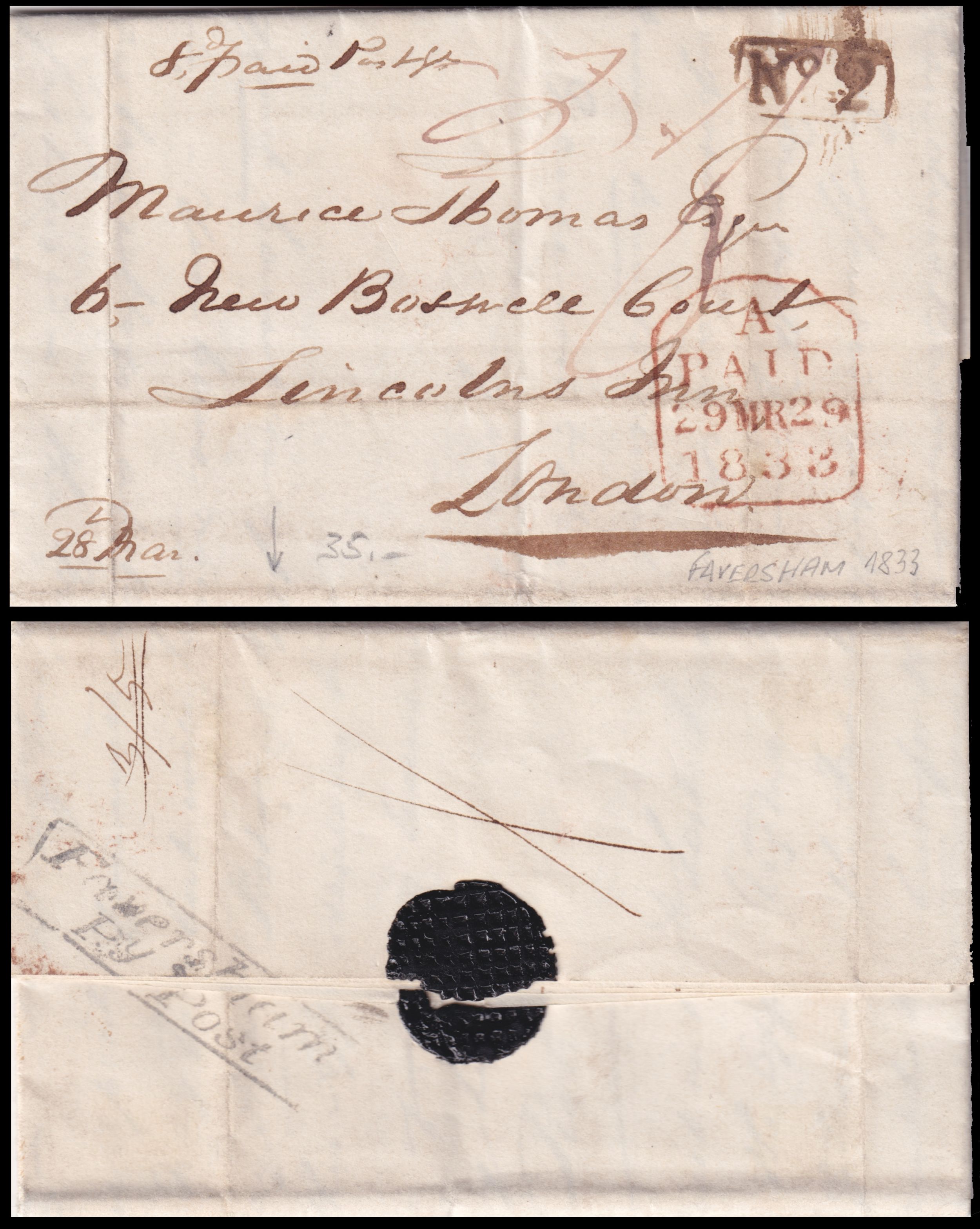
8d-paid (by sender) letter, posted in 1833. The letter was sent from Faversham, a market town in Kent, England, located approximately 77 kilometres southeast of London. The region is known for its chalk formations, which are rich in fossils such as ammonites and echinoids. It was addressed to "Maurice Thomas Esq" at "6 New Bosmere Court, Lincoln's Inn, London." The use of "Esq." (Esquire) suggests the recipient was a gentleman, likely a lawyer or other professional. The address at Lincoln's Inn, one of the four Inns of Court in London, further supports this assumption, as the area is historically associated with the legal profession. |
Free-postage privilege letter, posted in 1838. The letter was sent by Edward John Stanley (1802–1869), Member of Parliament (MP) for North Cheshire (1832–1841), who was entitled to send mail without charge under the franking privilege, a benefit granted to members of Parliament prior to the introduction of the Uniform Penny Post in 1840. The letter was addressed to Peter Ainsworth (1790–1870) from Bolton, Lancashire who was MP and represented Bolton in the House of Commons. |
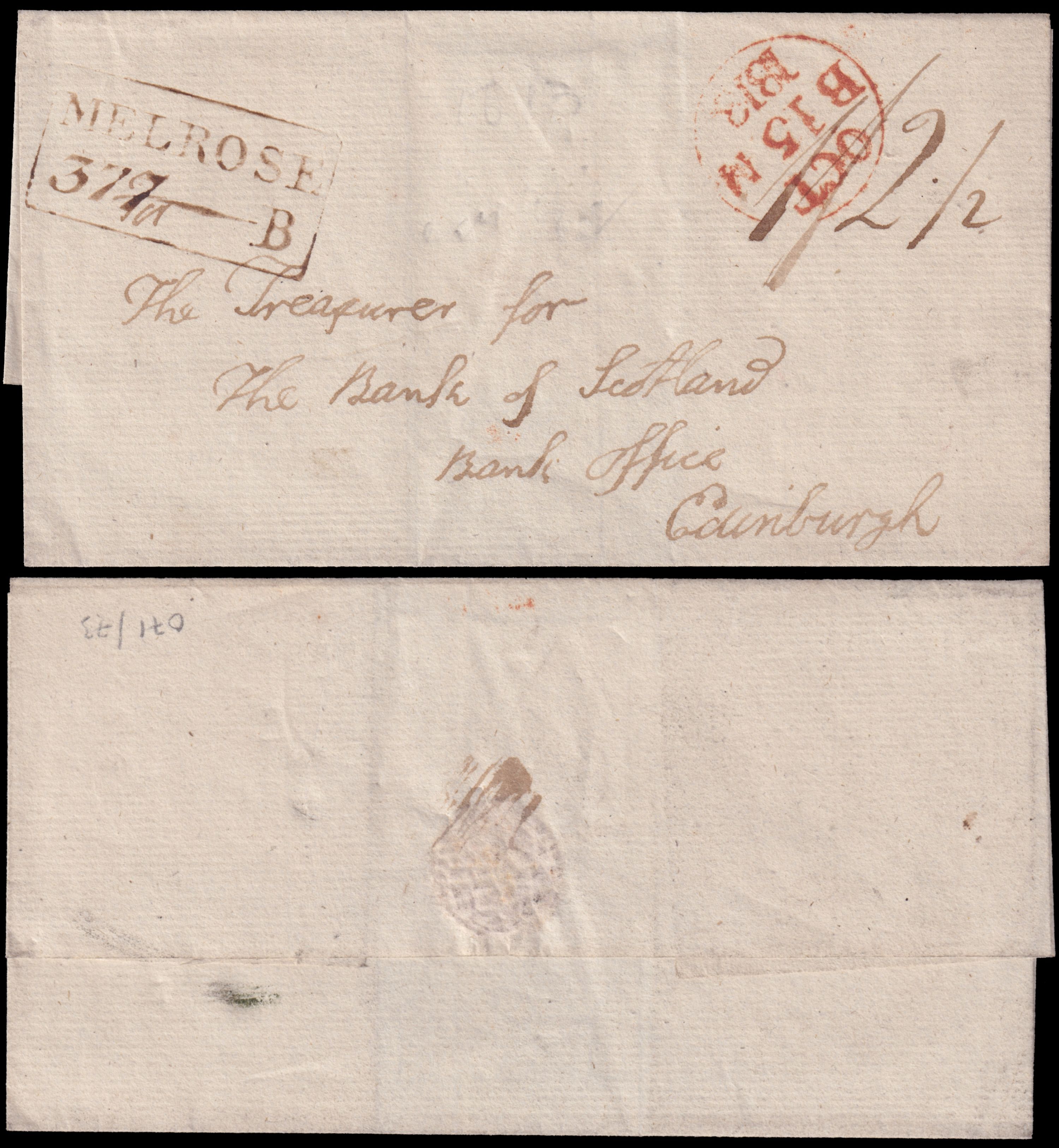
Two letters below illustrate the complexity of the postal rate and how expensive it was.
The letter on the bottom-left was posted from Melrose to Edinburgh (56–61 kilometers apart) in October 1813 and was charged "1/2/./2"(1 Shilling + 2 Pence + Half-Penny or two Farthings) or 14.50 Pence. One Shilling and 2 Pence was the postal rate for a double sheet letter (a letter sheet wrapped in another sheet - a kind of envelope) for the distance between 48 and 80 kilometers. 1/2 Penny was the Scottish tax which came into effect on June 7th, 1813, for letters, regardless of weight, carried within Scotland by Post Office vehicles with “more than 2 wheels” (horses, small carts and pedestrians did not pay the high tolls).
The rectangular mark on the left is not the mileages from Melrose to Edinburgh, but the distance from Melrose to London (607 kilometers), and B means the letters from Melrose to London were delivered via Berwick (one of the closest ports). The distance between the post office and London was added on the cover because the postage rates were charged by distance from or through London. To help postmasters calculate or check the rates the mileage of post towns was added to some postal marks in 1784.
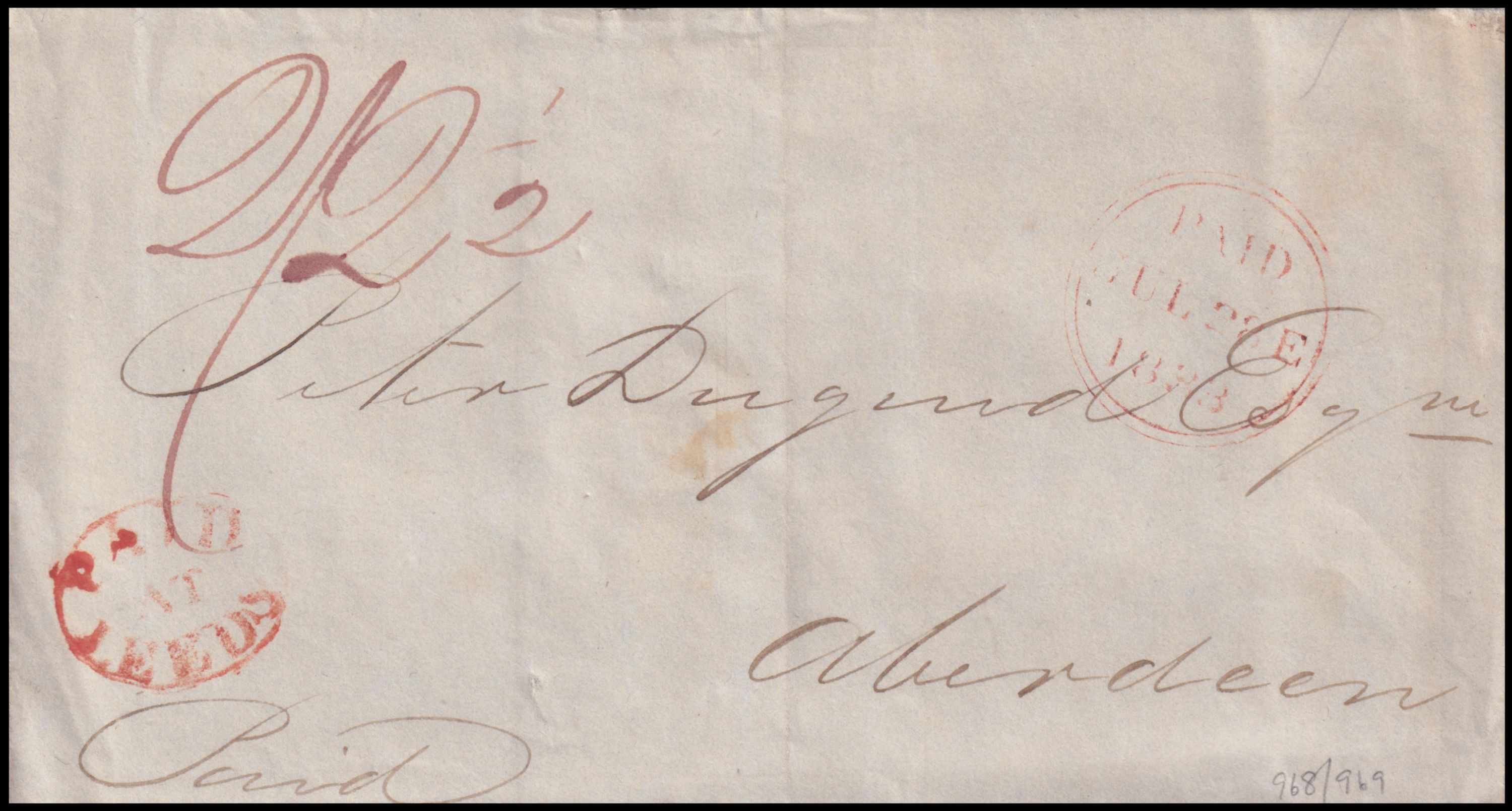
Skilled man-labour daily wages in 1813 were approx. 2 Shillings (2 Shillings = 24 Pence). The woman-labour earned half and the kid-labour a quarter of the man-labour wages. 14.50 Pence in 1813 in today's money is equivalent to approx. €60 - €70.The second letter posted from Leeds to Aberdeen (563 kilometers apart) in July 1833 is almost twice as expensive - 2s-2d-1/2d (2 Shilling + 2 Pence + Half-Penny or two Farthings) or 26.50 Pence in today's money is equivalent to approx. €100 - €130.
The first well-known Ichthyosaurus skeleton (skull and torso), discovered in 1811-1812 by Mary Anning and her elder brother Joseph, was purchased by lord of the manor of Colway, near Lyme Regis for £23, equivalent to 460 Shillings.
 |
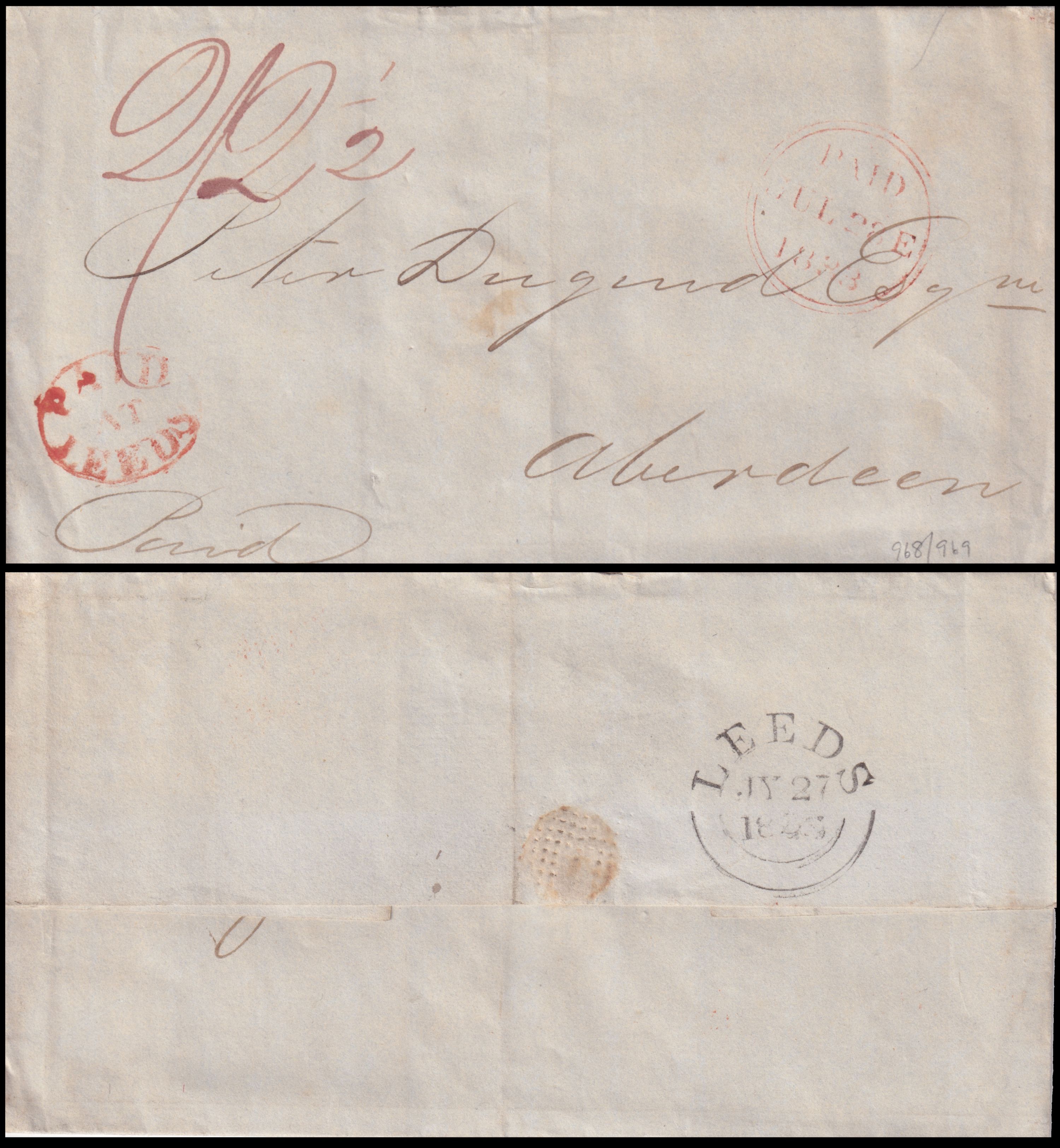 |
| Examples of expensive letters, posted in Scotland in 1813 and 1833 respectively. | |
|
The letter was sent to:
"The Treasurer for the Bank of Scotland, Bank Office, Edinburgh".
The sender is unknown.
|
The letter was sent from Leeds, England, on July 27, 1833, to Peter Duguid Esq. in Aberdeen, Scotland. The "PAID" handstamp indicates the sender paid the postage upfront. |
The postal rate for letters to overseas was even more expensive, making communication impossible between families who lived in North America or other colonial territories, because the only way to keep in contact with those family members would have been the mail - the telephone and even the telegraph were not invented yet.
The highest prestamp Transatlantic Postal rate known to date, is £26-8s-10d. This rate included £11-2s-8d ship letter rate and £15-6s-2d inland rate (both rates hold records for the highest prestamp Ship Letter rate and the highest inland postage charge). This amount was comparable with the half-annual wages of a skilled labour.
This package weighing 83.5 oz (approx. 2.4 kg) was posted from New York to England, contained the documents signed by the sender in America who inherited about £500.000 (equivalent to approx. £65.0000.000 today) from a remote cousin who had died in India, to confirm that he was to inherit the estate.
Postal Reform of Rowland Hill
The Postal Reform was needed not only to increase revenue, but also due to the growing business communications, as result of the British Industrial Revolution, businessmen requested quick and cheap postal service. The business increasingly saw the high rates and slow correspondence delivery as an obstacle to further growth.
The first discussion in the Parliament about the need to reform the Postal System started in 1833. In 1835 the campaign for cheap postage was initiated to investigate the problems by a governmental commission.
Rowland Hill's Reform
In January 1837, Sir Rowland Hill (1795-1879), who was an English teacher, inventor and social reformer (knighted as a Knight Commander of the Order of the Bath in 1860), with support of Robert Wallace who was a Member of Parliament, wrote a leaflet called "Post Office Reform", where he presented his ideas to simplify the postal system.
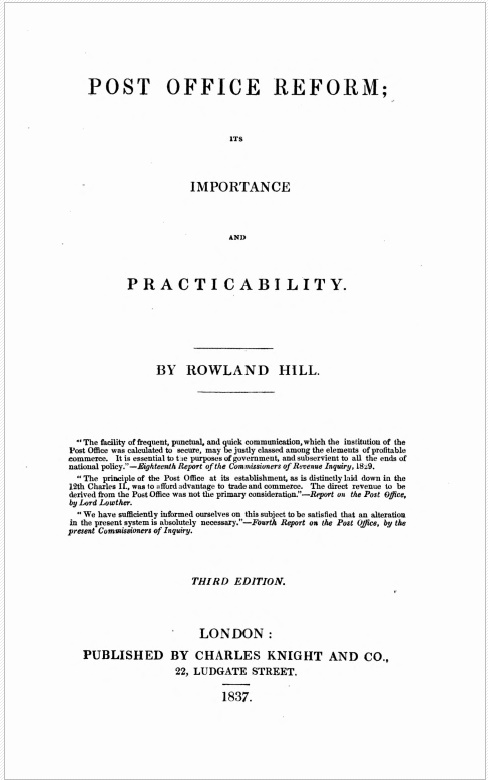 |
| "Post Office Reform: Its Importance and Practicability", by Rowland Hill, published in London in 1837 |
Main objectives of Hill's reform were:
- reduce the cost of postage by replacing the collection of money on delivery with prepayment by sender by means of adhesive stamps or prepaid covers sold by the post office.
- simplify the rate, by charging per weight instead of the number of sheets and the distance travelled
- create proportional rates for increased weight
- remove the Franking Privilege
"a bit of paper just large enough to bear the stamp, and covered at the back with a glutinous wash."
Hill also argued, prepaid post will significantly reduce delivery costs of the Post Office, by reducing the postman’s effort:
it would soon be unnecessary even to await the opening of the door, as every house might be provided with a box into which the Letter Carrier would drop the letters, and having knocked, he would pass on as fast as he could walk.
Today every house, flat, and office has a front-door letterbox, but it was an innovative proposal in the 1830s.
The first letter-boxes were installed on a wall in one of the biggest churches of Florence, Italy at the beginning of the 16th century. They were closed wooden boxes with an opening for letters to allow anonymous complaints against evildoers.
However, many years after the introduction of postage stamps, not every household, even in London, had a letterbox. In 1848, Rowland Hill persuaded the Postmaster General to issue a circular encouraging residents to install letterboxes in their doors to improve postal delivery. The message, however, was not well received by everyone. Some found it intrusive, and one indignant gentleman reportedly asked whether the Postmaster General truly expected him “to cut a slit in his mahogany door”.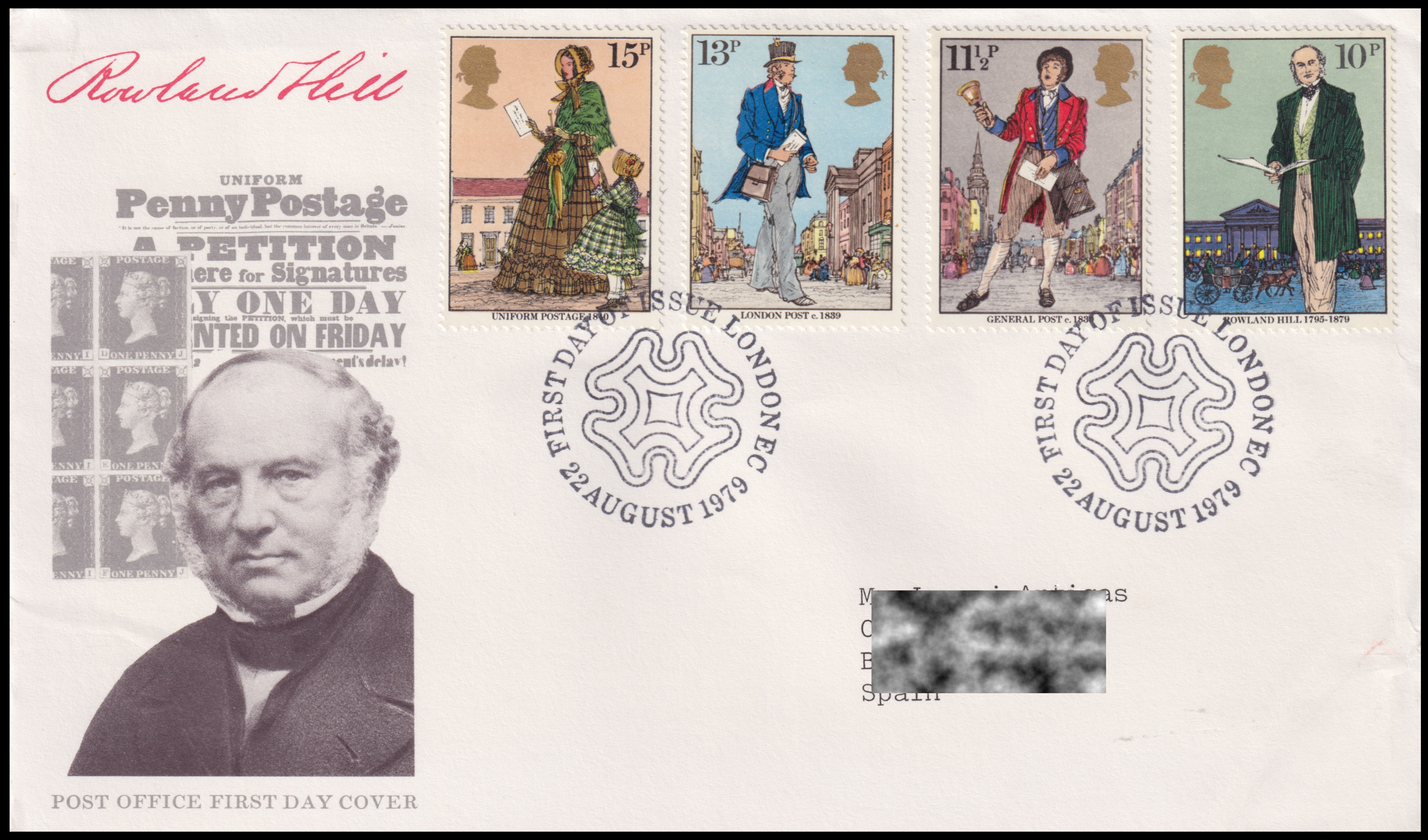
Rowland Hill's proposal to the Parliament
In 1838 Hill made a proposal to the Parliament in which he suggested that
"the postage on all letters received in a post-town, and delivered in the same, or any other post-town in the British Isles, shall be at the uniform rate of one penny per half ounce [14g.]".
The price of one penny was proposed by Hill following his calculation, based on documentation provided by Mr. Wallace, which showed that the cost for the Post Office to deliver a letter to any part of the kingdom, including Ireland, was less than a farthing (four farthings made a penny).
In his proposal, Hill also called for official pre-printed envelopes and adhesive postage stamps as alternative ways of getting the sender to pay for postage.
Hill argued, that if letters were cheaper to send, people, including the poorer classes, would send more of them, thus eventually profits would go up and it would reduce the cost of business communication too.
Most of Hill's proposals were based on existing solutions and ideas proposed
but not accepted before.
- The concept of the reform was an extension of local "Penny Posts" to the entire country.
The local "Penny Posts" were started by William Dockwra in 1680 as an independent local
London postal service.
In 1765 the service was monopolized by the General Post Office and
later spread all over the kingdom.
By 1838, the number of local "Penny Posts" reached 520.
Only the English and Welsh, local "Penny Posts" served over 1,550 towns and villages.
The post delivery within a city or a town, sometimes including the neighbourhood villages, was based on a single postage rate calculated by weight, rather than number of sheets. The covers were stamped with markings such as "PP", "Py Post", or "Penny Post" along with the name of the town. - One Penny (1d) rate for single letters sent prepaid by or to non-commissioned officers and private soldiers and ordinary sailors, was introduced in Great Britain in 1795 and was known as "Soldiers' Penny Concession Rate" (it was the first British "Uniform Penny Postage"). The letter of one sheet and with weight under one ounce could be sent anywhere in the world, when carried by British vessels, for One Penny.
- The idea of prepayment was proposed by Charles Whiting in 1830, who proposed to prepay postage of printed matter with no restriction on distance, by using security-printed envelopes, based on compound-printed banknotes.
- Prepaid “stamps” existed in Great Britain since as early as 1694 but were used for tax rather than postage purpose.
The embossed tax stamps were either embossed directly onto a sheet of paper or small paper stamps were glued onto the
reverse side of taxed document in the Stamp Office premises in London.
Since 1702 they were printed in black on white paper sheets and have a comparable size to the Penny Black and Two Pence Blue stamps, introduced by Hill in 1840.
Mercantile Committee on Postage
In February 1838 the "Mercantile Committee on Postage" was set up in London, with Henry Cole as its Secretary.
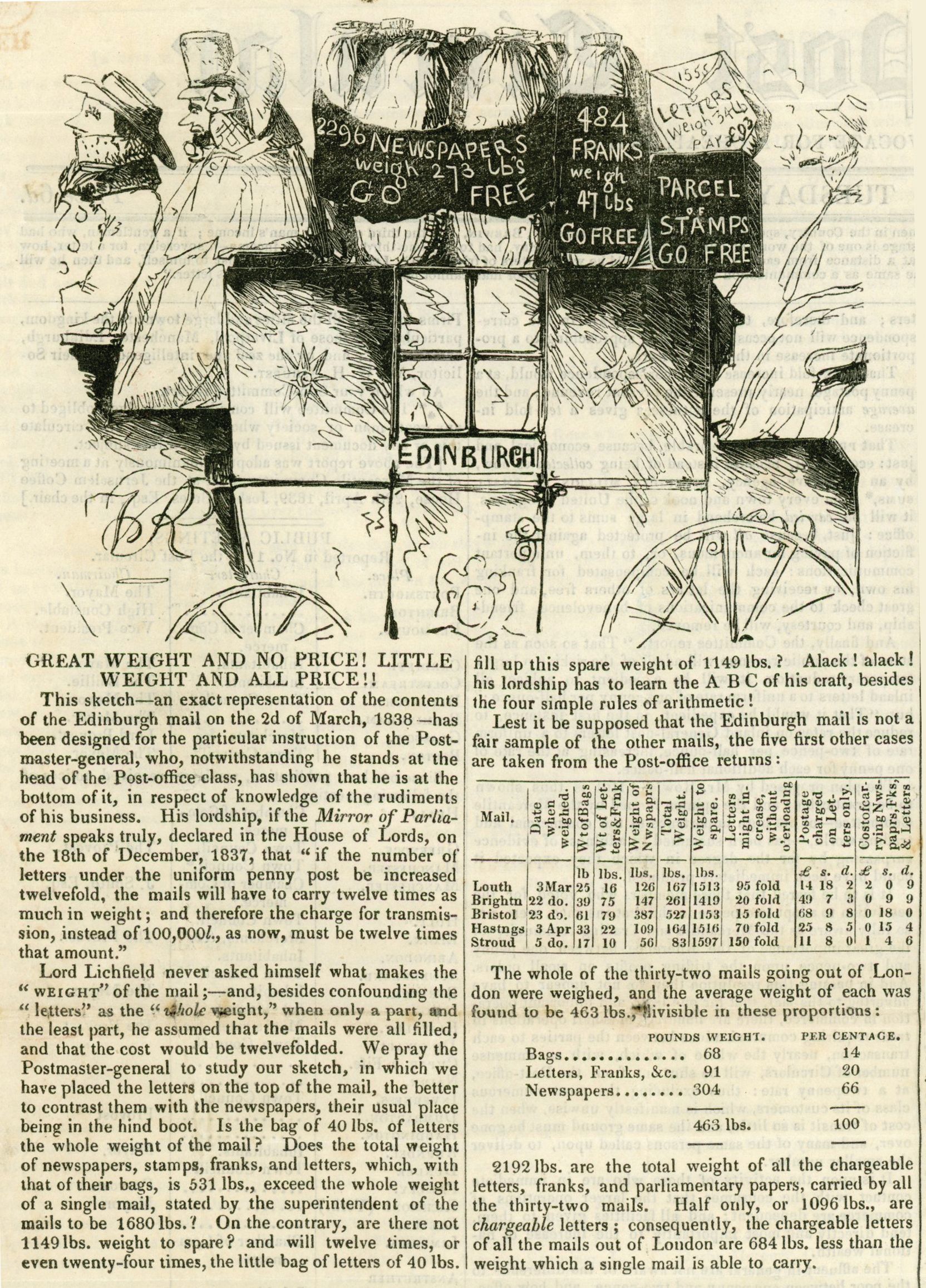 |
| One of "Mercantile Papers" propaganda circulars created by Henry Cole in April 1839. From the personal collection of James Grimwood-Taylor, RDP, author of "International Postal Reforms", published by the Royal Philatelic Society London in 2020. |
Sir Henry Cole (1808 – 1882) was an English civil servant and inventor who facilitated many innovations in commerce and education in the 19th century in the United Kingdom. Cole is credited with devising the concept of sending greetings cards at Christmas time, introducing the world's first commercial Christmas card in 1843. From 1837 to 1840, he worked as an assistant to Rowland Hill and played a key role in the introduction of the Penny Post.
The Committee contained a group of merchants who lobbied Parliament to enact the reforms desired, to increase business correspondence and commerce through postal communication.Rowland Hill was joined by Henry Cole with whom he pushed Hill's Postal Reform and designed the first adhesive postage stamp.
Henry Cole created and edited "The Post Circular" newspaper where he advocated for cheap postage and removal of the "FREE" postage privilege. A lot of petitions to the Parliament were organized by the "Mercantile Committee on Postage".
Even though many people supported the reform the government was worried about the loss of revenue and the noble people who had the privilege of free postage were reluctant to pay for it. However, the joint effort of Rowland Hill, Henry Cole and the "Mercantile Committee on Postage" created too much pressure on the Parliament and was rewarded by an Act of Parliament that created the "Uniform Fourpenny Post" and Rowland Hill was given a two-year contract to run the new system.
Start of the Reform

|
| The Post Office Regulation published on January 7th, 1840 in London. Image source: Wikimedia Commons. |
The trial period was a success - the quantity of letters carried increased significantly, therefore the second trial called "The Uniform Penny Post" went into effect on 10 January 1840.
The "FREE" postage privilege was abolished. Special, prepaid envelopes were introduced for mail posted from the Houses of Parliament, House of Lords and House of Commons in the same month and these remained in use until the introduction of the first adhesive postage stamps and postal stationery in May 1840. These envelopes were inscribed in different font on the top side with the following text:
- "To be posted at the Houses of Parliament only. Post Paid - One Penny. - Weight not to exceed 1/2 oz."
- "To be posted at the House of Lords only. Post Paid - One Penny. - Weight not to exceed 1/2 oz."
- "To be posted at the House of Commons only. Post Paid - One Penny. - Weight not to exceed 1/2 oz."
There are also prepaid envelopes with the "Two Pence. - Weight not to exceed 1 oz." rate.
References
Internet Resources
Postal System in Great Britain in the 18th and 19th centuries
|
Postal Reform of Rowland Hill
|
Recommended Books
 |
- "International Postal Reforms, volumes 1 and 2, Postal Reforms and the Historical Background to the Postage Stamp 1550 to 1898", by James Grimwood-Taylor RDP FRPSL, published by the Royal Philatelic Society London in 2020, ISBN: 978-1-913015-06-0 and 978-1-913015-07-7.
- "Postal Reform and the Penny Black - a new appreciation", by Douglas N Muir published by the National Postal Museum in London in 1990, ISBN: 9780951594803.
- "The Returned Letter Offices of Great Britain to 1912 and Beyond", by J. Kenneth Snelson and Robert B. Galland, published by GB Philatelic Publication Ltd. in 2017. ISBN: 978-0-900631-91-7
- "British Post Office Notices: 1666 - 1899, Volume 4: 1840 - 1849", by M. M. Raguin, Published by the author in 1990.