Simultaneous Development of Philately, Geology, and
Palaeontology as a Result of the British Industrial Revolution.
Part 2: The British Industrial Revolution (1760s-1840s) and the Formation of Geology
The British Industrial Revolution (1760s-1840s)
The British Industrial Revolution transformed Britain from a predominantly agricultural society into the world's first industrial nation. Innovations such as the steam engine, mechanized textile production, and improved iron manufacturing revolutionized industry, while canals and railways accelerated the movement of goods and people. These technological advances fueled rapid economic growth, expanded global trade, and reshaped everyday life, although they also brought urban overcrowding, harsh working conditions, and significant social change. Britain’s industrial achievements during this period laid the foundations for the modern industrial world.
 |
| Landmark innovations and industries of the British Industrial Revolution depicted on Great Britain postage stamps issued in 2021. MiNr.: 4819-4824, Scott: 4140–4145. |
The Industrial Revolution commemorative stamp issue of Royal Mail from 2021 (shown above) celebrates six landmark innovations that exemplify this remarkable period of technological progress.
The story begins in the early 18th century with Lombe's Silk Mill, built in 1721 as one of the world's earliest water-powered factories, which pioneered the corporate factory system.
Decades later, mechanized production reached a massive scale when James Hargreaves invented the Spinning Jenny in 1764, fundamentally altering textile manufacturing.
This rapid industrial expansion demanded reliable mechanical energy, a need met by James Watt's rotative steam engine in 1780, which supplied efficient power independent of geography and became the literal engine of the revolution.
As production soared, heavy transport had to evolve, leading Richard Trevithick to introduce the Penydarren locomotive in 1804 — the very first successful steam railway locomotive to run on rails. Simultaneously, the physical landscape of Britain transformed through infrastructure improvements powered by Joseph Aspdin's 1824 invention of Portland cement, which revolutionized civil engineering and concrete construction.
Finally, the legacy of this era extended into the mid-19th century when Henry Bessemer patented his groundbreaking steel-making process in 1856, introducing a method for the cheap mass production of high-quality steel that ultimately constructed the modern world.
Pioneers of the Industrial Revolution
 |
| Pioneers of the Industrial Revolution on stamps of Great Britain 2009, MiNr.: 2735-2742, Scott: 2645-2652. |
Pioneers of the Industrial Revolution stamps of Royal Mail from 2009 celebrate eight of the pioneering inventors, engineers, and entrepreneurs whose innovations drove Britain's Industrial Revolution and transformed the nation into the world's leading industrial power. Instead of simple lists, each stamp visually captures how these individuals reshaped specific sectors of society.
In manufacturing, Richard Arkwright laid the organizational groundwork for the era by developing the water-powered textile factory system, while Josiah Wedgwood revolutionized the arts and commerce through the massive industrialization of ceramics.

 |
| Josiah Wedgwood on stamp of Great Britain 2009, MiNr.: 2738, Scott: 2648 |
In 1765, the company received a prestigious commission from the British Royal Family. Later, Queen Charlotte granted Wedgwood permission to describe himself as "Potter to Her Majesty", leading to the introduction of the famous "Queen's Ware". The company also supplied fine ceramics to Catherine the Great, Empress of Russia, who placed several important orders with Wedgwood.
After the death of his business partner, Thomas Bentley, in 1780, Wedgwood sought the assistance of his close friend Erasmus Darwin in managing the business. The friendship between the Wedgwood and Darwin families grew even stronger, and one of Josiah Wedgwood's daughters, Susannah Wedgwood, later married Erasmus Darwin's son, Robert Waring Darwin. Their son was Charles Darwin.
While Arkwright and Wedgwood advanced manufacturing, providing the literal power behind these new industrial systems was James Watt, whose improved steam engine became the ultimate driving force for automation, financed and scaled by his business partner Matthew Boulton through unprecedented, large-scale manufacturing operations at the famous Soho Manufactory.
To keep pace with this surging factory output, transport infrastructure had to expand rapidly. James Brindley answered this call by engineering crucial segments of the early British canal network, which was later complemented by John Loudon McAdam’s innovative road designs that pioneered modern, durable highway construction.
Finally, as the era advanced, heavy transport took to the tracks under George Stephenson, who pioneered the development of public steam railways. This rapid expansion of complex machinery across the country was only made possible through the precision machine tools designed by Henry Maudslay, whose standardization allowed the industrial world to measure with absolute accuracy.
Together, these issues pay tribute to the individuals whose inventions and entrepreneurial vision revolutionized manufacturing, transportation, and engineering, leaving a lasting impact on Britain's economy and the development of the modern industrial world.
Railways and Reforms
Since the first railroad in Great Britain was built in 1825 between Stockton and Darlington, railways were built all over the country to transport goods, machines and resources, coal, etc.
 |
|
| Industrial Archaeology on UK stamps from 1989, MiNr.: Bl.5 (1210-1213), Scott: 1284. |
The process of industrialization introduced new technologies, mechanization, and deep social changes. Factories, roads and canals were constructed at an unprecedented pace to support economic growth.
Ultimately, the growing demand for coal and minerals necessitated a better understanding of geological structures.
The depth of British coal mines increased significantly following the introduction of Thomas Newcomen’s atmospheric engine in 1712, which was later improved by James Watt's separate condenser design. These steam-powered pumps drained deep underground water, allowing miners to excavate coal and minerals from deeper subterranean strata than previously possible, exposing hidden rock layers to direct observation.
Foundation of Geology
To address the increasing economic demand, it was essential to determine the location of the country's mineral and ore deposits.
.jpg) |
 |
| William Smith (1769 - 1839), the "Father of English Geology". | Geological map Britain William Smith 1815 |
While excavating the canal, Smith closely observed the exposed strata (the horizontal layers of rock) and became deeply familiar with their sequence. He noticed a consistent pattern: fossils embedded in these layers (strata) always appeared in the same vertical order, with the oldest at the bottom and the youngest at the top. As he travelled throughout England, Smith observed this pattern of fossil succession was repeated wherever he went.
From these observations, he deduced that each fossil species existed for a specific time period during Earth's history and that their stratigraphic order could be used to compare the ages of rock formations across regions.
Around 1799, while working on his geological maps, Smith formulated the Principle of Faunal Succession:
Fossil organisms succeed one another in a definite and recognizable order, so that rocks containing similar fossils are of a similar age, even if they are found in different locations.
This principle allowed him to date and correlate rock layers (strata) using their fossil content, laying the groundwork for the modern science of Biostratigraphy. In 1815, William Smith published the first geological map of England, a landmark in Earth science that vividly illustrated the distribution of rock layers and their fossil content across the country. For his pioneering work in correlating strata through fossil evidence, Smith is rightfully celebrated as the "Father of English Geology".To translate his extensive field data into a three-dimensional visual guide, Smith employed a brilliant watercolor tinting technique. Rather than choosing colors at random, he carefully matched the pigments on his map to the actual natural hues of the British rocks and soils. Furthermore, he shaded the lower boundaries of each formation darker to represent the precise direction in which the rock layers dipped beneath the earth, giving a flat map an unprecedented sense of geological depth.
Today, such fossils are known as "index fossils".
Index fossils are the preserved remains of organisms that lived during a relatively short geological time span, were geographically widespread, and are easily recognizable. They are crucial for dating and correlating rock layers across different regions.
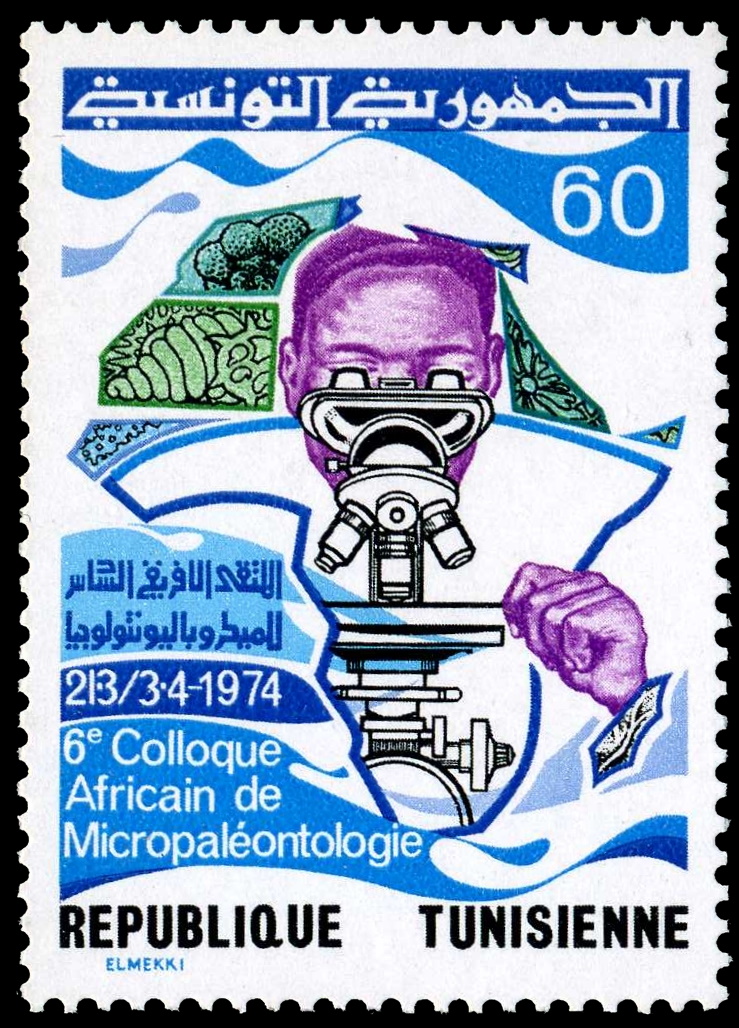
The most important ones are trilobites, ammonites, brachiopods and foraminifera (Planktonic forms). Some index fossils are microscopic and are studied within the specialized field of Micropaleontology. |
 |
 |
 |
 |
| Trilobite on postage stamp of Slovenia 2000,
MiNr.: 295; Scott: 397. |
Ammonite on postage stamp of Luxembourg 1984,
MiNr.: 1109; Scott: 716. |
Brachiopod on postage stamp of the British Antarctic Territory 1990,
MiNr.: 157; Scott: 154. |
Radiolarian, closely related to foraminifera on postage stamp of Norway 2005, MiNr.: 1553; Scott: 1449. | Micropaleontology on postage stamp of Tunisia 1974, MiNr.: 831; Scott: 627.
|
The British Geological Survey, the first official geological survey in the world, was established in London in 1835. Its primary objectives were to systematically map the country's geology, identify mineral and ore deposits, support the rapidly expanding mining industry, and provide geological information for major engineering and infrastructure projects.
The Survey also played a pivotal role in transforming geology from the pursuit of amateur collectors into a rigorous, systematic scientific discipline.
Foundation of Paleontology
As miners dug ever deeper to meet the growing demand for coal, ores, and other minerals during the Industrial Revolution, they unearthed an increasing number of unusual rocks and fossilized remains. While some dismissed these discoveries as mere "sports of nature", many were unmistakably the bones and teeth of long-extinct creatures.
At the time, nearly all scholars accepted the Divine Creation of Earth and its inhabitants, making the concept of extinction deeply troubling. By the early 19th century, pioneering naturalists and geologists had begun proposing new ideas about Earth's history, extinction, and the changing nature of life, laying the foundations of modern geology and, later, evolutionary theory.
The world's first national public museum, the British Museum,
was established in London in 1753 by an Act of Parliament and opened to the public in 1759.
Its collections were based largely on those of Sir Hans Sloane (1660–1753), an Anglo-Irish physician,
naturalist, and one of the greatest collectors of the eighteenth century.
They included an extraordinary range of objects, such as books, antiquities, minerals, shells,
and fossils.
At the time, the word "fossil" retained its original meaning, from the Latin
fossilis ("dug up"), and referred not only to the preserved remains of ancient plants
and animals but also to minerals, rocks, ores, and other natural objects excavated from the Earth.
As geology and paleontology emerged as scientific disciplines during the late 18th
and early 19th centuries, the Museum's growing collections of fossil bones, minerals,
and rocks became an invaluable resource for the study of Earth's history and extinct life.
In 1881, the Museum's natural history collections were transferred to the newly built
Natural History Museum in London, where they continue to form one of the world's
finest scientific collections.
In the 1820s and 1830s, the first three dinosaurs were named by British naturalists:
Megalosaurus was described by William Buckland in 1824, Iguanodon and Hylaeosaurus were described by Gideon Mantell in 1825 and 1833 respectively, without assigning them to any group of animals.
Richard Owen then Hunterian Professor of Comparative Anatomy and Physiology at the Royal College of Surgeons in London, introduced a group for these animals during a presentation in July 1841 at the British Association for the Advancement of Science meeting in Plymouth, though he officially coined and published the term Dinosauria, meaning "terrible lizards," the following year, in 1842 (he was later knighted in 1883).
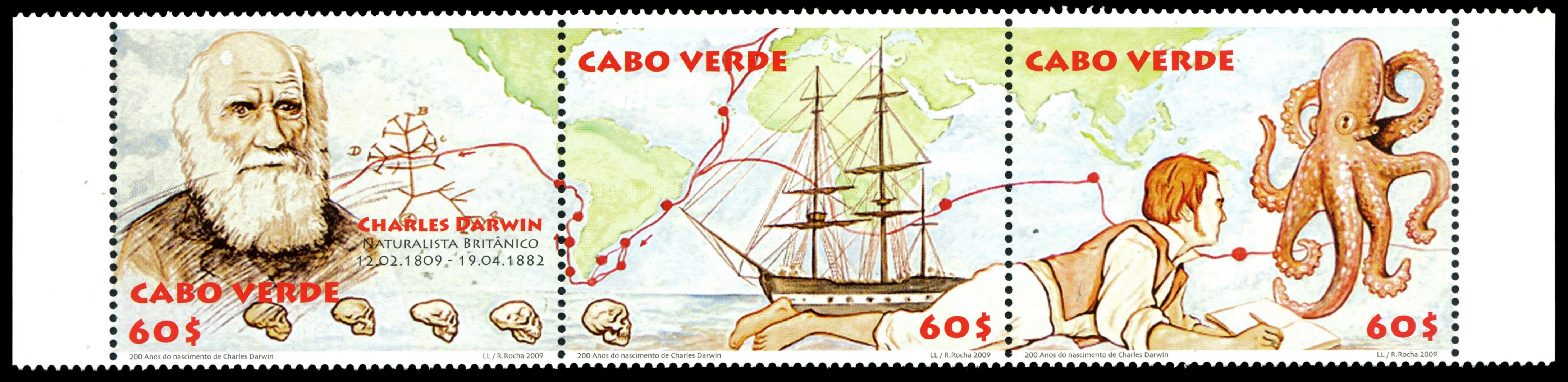
Charles Darwin sailed on the HMS Beagle around the world between 1831 and 1836.
His observations during the voyage led him to start thinking about animal adaptations to their living environment. These thoughts culminated in his most famous work “On the Origin of Species”, published in 1859. In this work, he presented his theory of evolution which became the foundation of all biology-related sciences including paleontology.
 |
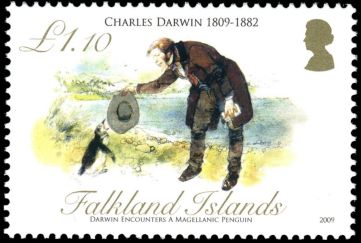 |
| Charles Darwin exploring local fauna on Cabo Verde and Falkland Islands during his voyage on the HMS Beagle between 1831 and 1836. | |
Discovery of Prehistoric Marine Reptiles and Discussions About Extinction and Divine Creation
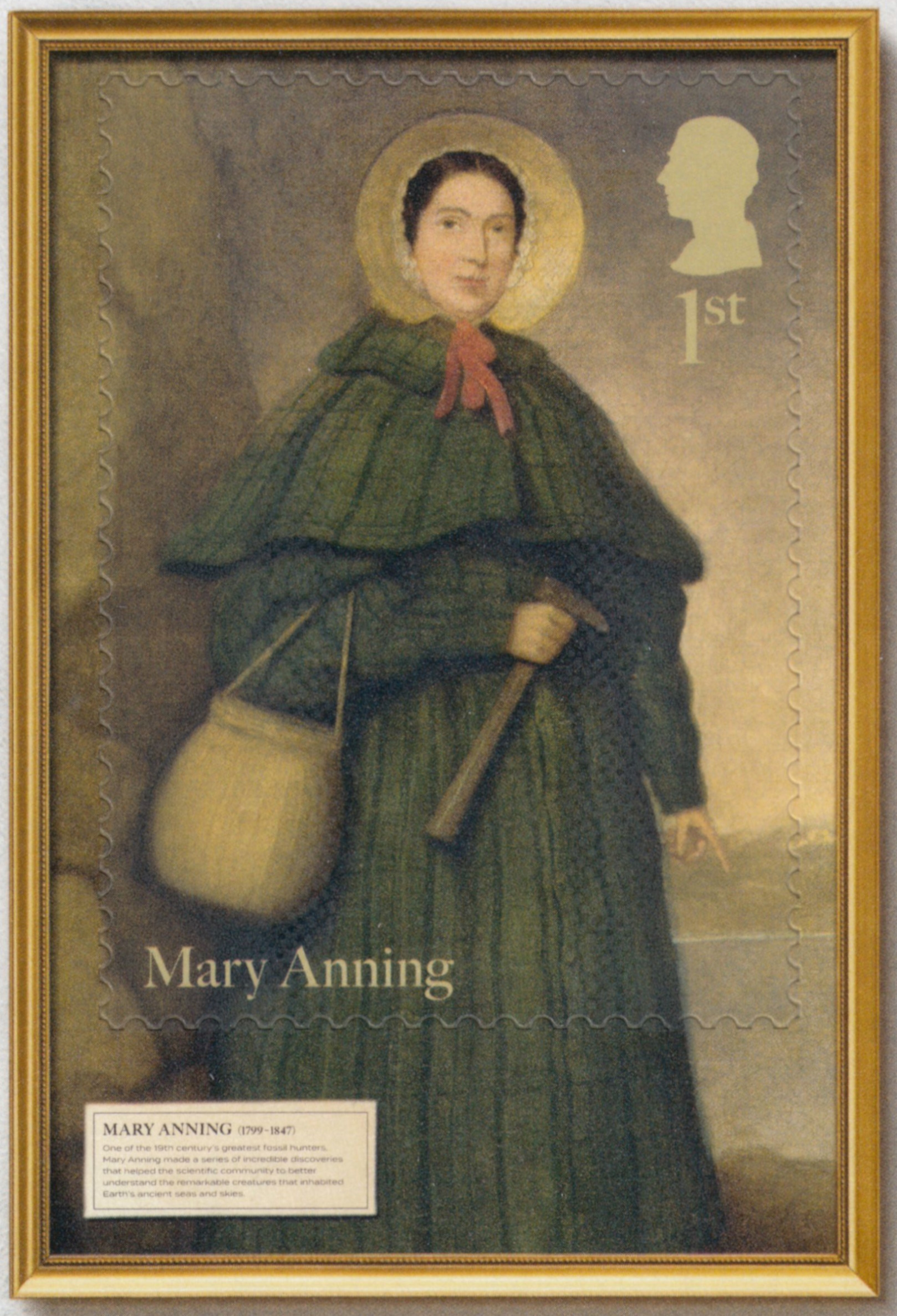 |
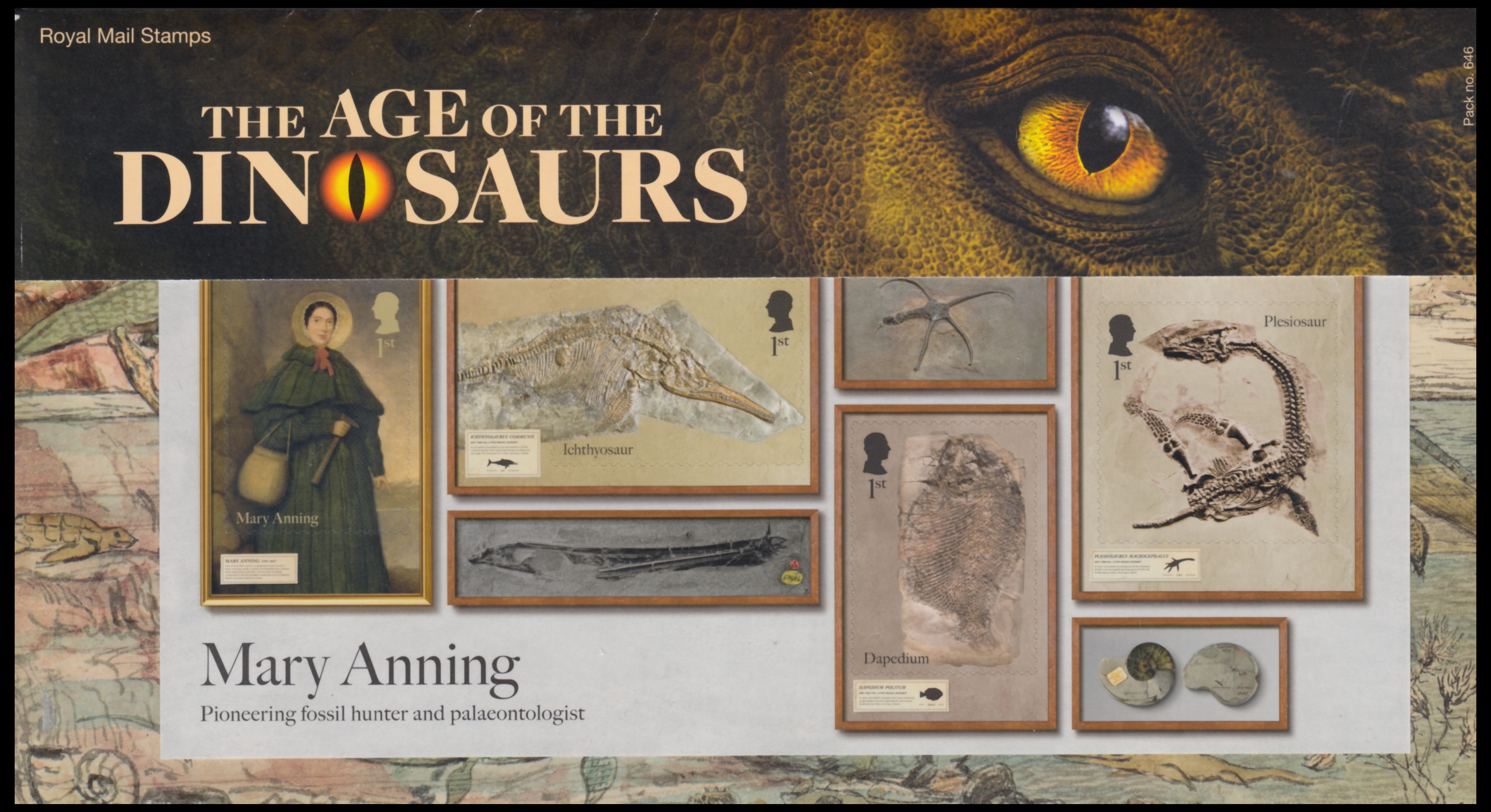
| Mary Anning on stamp of UK 2024, MiNr.: 5391, Scott: 4484a. |
This changed after 1811 when Mary Anning (1799-1847) and her elder brother discovered a torso and a skull of an unfamiliar creature.
At the time Mary Anning lived, many people refused to believe fossils were the remains of once-living
organisms, believing instead that they were just stones in curious forms.
The reason for this perception was a strict religious belief in the Genesis account in the Bible.
This find fueled intense 19th century debates on extinction and divine creation,
causing people to ask:
"Why would God, who created the Earth and all living organisms according to his divine plan,
allow some species to disappear and vanish from the Earth?"
Following this discovery, the animal was formally described in 1814 by Sir Everard Home, who called it "an animal more nearly allied to fishes than any of the other classes of animals", because it was so bizarre and different from any known animal.
The animal was named Ichthyosaurus in 1818 by Charles König, then Keeper of Natural History at the British Museum, marking it as the first prehistoric marine reptile to spark widespread scientific classification and debate in Great Britain.
Coprolites
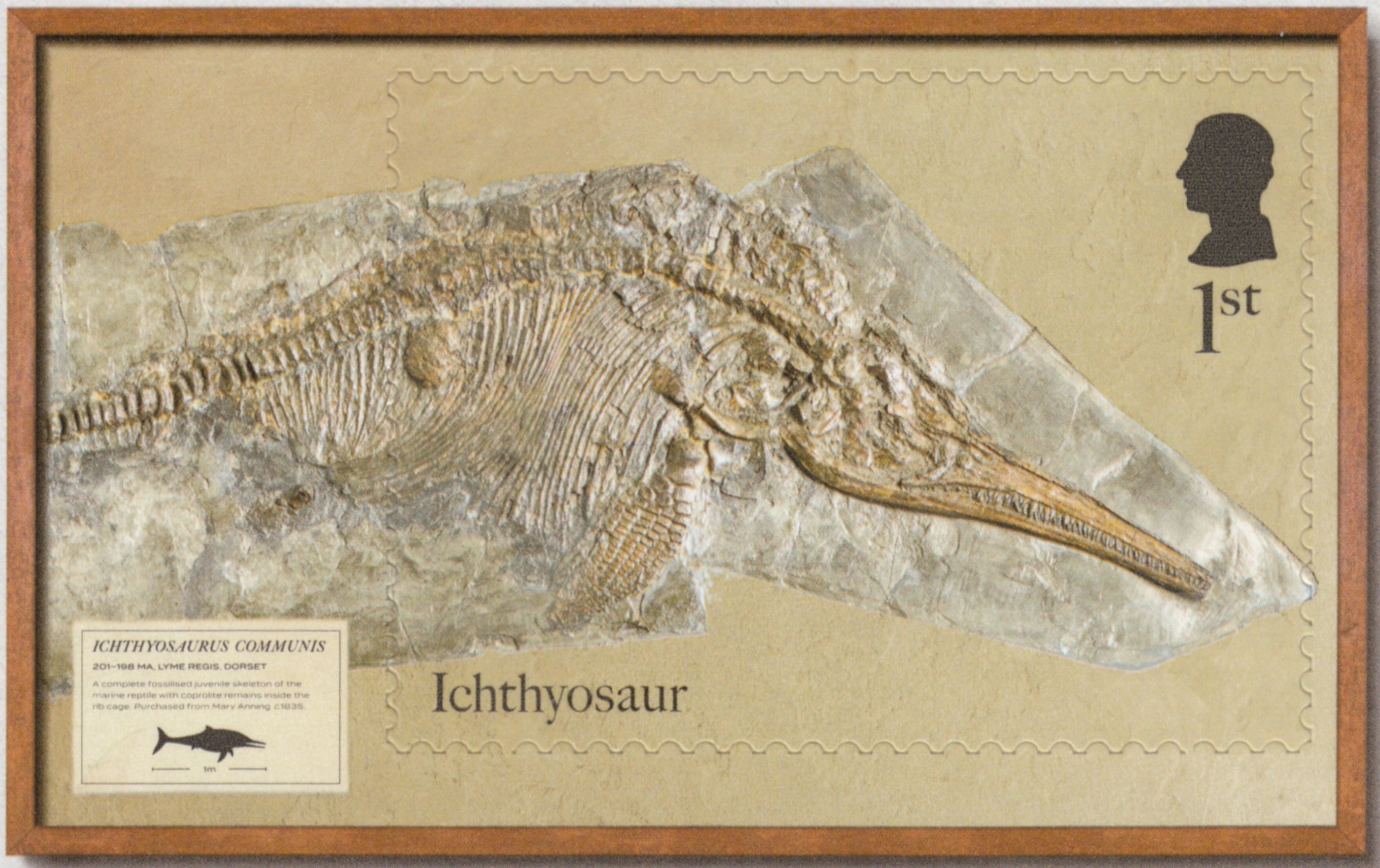
In 1835, the British Museum purchased from Mary Anning, who since 1812 had found many fossils of prehistoric marine animals that were acquired by museums across Britain and overseas, an exceptional Ichthyosaur specimen with a coprolite (fossilized feces) within its ribcage. The discovery of a coprolite within a fossil provided crucial evidence that the ichthyosaur was once a living animal, as only living organisms consume food and produce waste. This specific specimen was featured on a Royal Mail stamp in 2024 and is shown below.
Some science historians note that fossils recovered by Anning may have also contributed, in part, to the theory of evolution put forth by English naturalist Charles Darwin.
The fossils collected by Mary Anning and other fossil hunters in England, as well as the fossils collected by Charles Darwin himself in South America during his voyage on the HMS Beagle convinced him that the Earth was once inhabited by animals and plants unlike any that are living today.
Bezoar stones
 |
| Ambroise Paré on postage stamp of France 1943, MiNr.: 602, Scott: B163. |
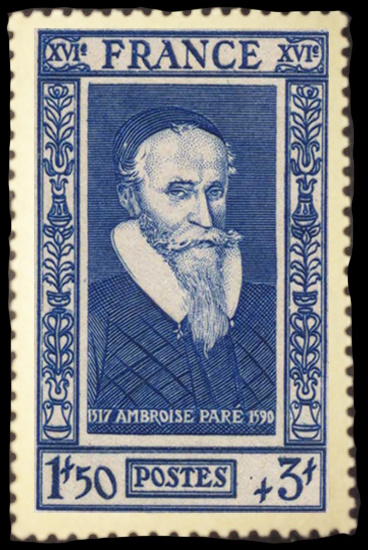
The supposed powers of bezoars were famously tested by the French surgeon Ambroise Paré (c. 1510–1590). In 1567, after a cook at the French royal court was caught stealing valuable silver cutlery, he was sentenced to death. The condemned man agreed to take poison on the condition that he would immediately receive a bezoar and be pardoned if he survived. Despite being given the stone, he died in agony seven hours later. Paré concluded that bezoars were not the universal antidotes they were claimed to be, dealing a serious blow to one of the most enduring medical beliefs of the Renaissance.
First reconstruction of prehistoric environment
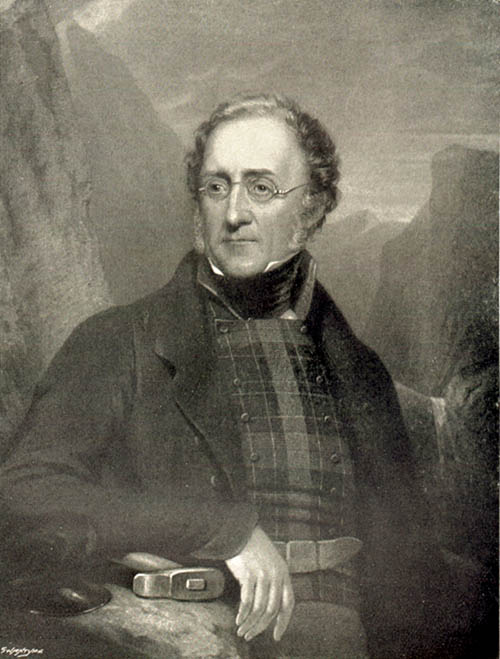
In 1830, the British geologist and palaeontologist Henry Thomas De la Beche created a watercolour reconstruction of prehistoric life, inspired by William Buckland's descriptions of the ancient marine environment of the Lias at Lyme Regis and based on fossil discoveries made by Mary Anning. De la Beche titled the work "Duria Antiquior" in Latin, meaning "A More Ancient Dorset" in English.
|
| Henry Thomas de la Beche |
In 1835, he became the first director of the Geological Survey of Great Britain, the world's first national geological survey, establishing methods for geological mapping that influenced geological surveys worldwide.
He also established the Museum of Economic Geology in London, created to illustrate the practical applications of geological science through collections of rocks, minerals, and fossils.
De la Beche made important contributions to early vertebrate palaeontology through his studies and illustrations of fossil marine reptiles from the Jurassic Coast of Dorset, including Plesiosaurus and Ichthyosaurus specimens discovered by Mary Anning.
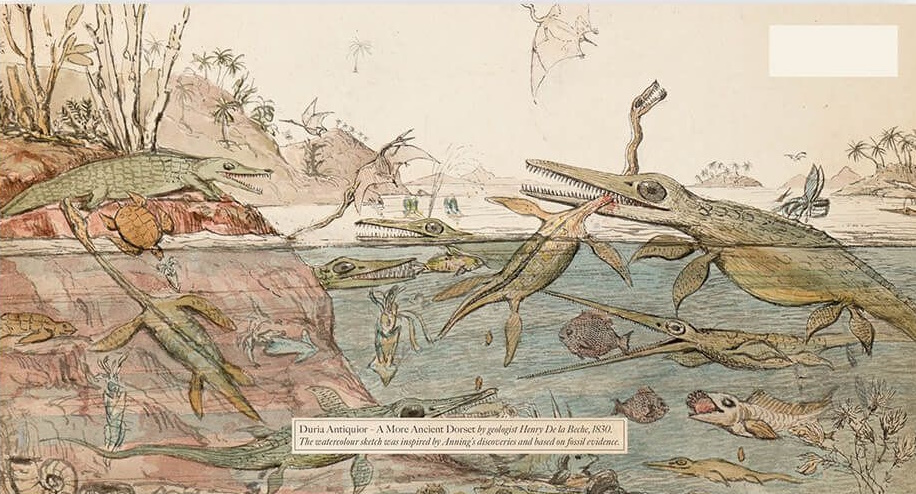
Many of the creatures were depicted in violent interactions. The central figures are a large ichthyosaur biting into the long neck of a plesiosaur. Another plesiosaur is seen trying to surprise a crocodile on the shore, and yet another is using its long neck to seize a pterosaur flying above the water. This emphasis on violent interactions in nature was typical of the Regency era.
One of the ichthyosaurs and a plesiosaur near the center are even shown producing faeces, which are gently sinking to the seabed, to become the coprolites identified by Anning and Buckland.
Anning shared these observations with geologist William Buckland, who used her findings to coin the scientific term "coprolite" (fossilized feces) in 1829, introducing the study of fossilized dung to scientific literature.
The drawing was the first pictorial representation of a scene of prehistoric life based on evidence from fossil reconstructions, a genre now known as paleoart.
Paleoart has since become key to the public understanding of - and fascination with - palaeontology.
References
The British Industrial Revolution (1760s-1840s)
| Money system of Great Britain in the 19th century |
Industrial Revolution in Great Britain
|
Social Reform in Great Britain in the 19th century
|
The Formation of Geology and Paleontology
- William Smith (1769-1839):
Wikipedia, Encyclopaedia Britannica, The Geological Society of London. - Index fossils:
Wikipedia, Encyclopaedia Britannica.
- Mary Anning (1799-1847):
Wikipedia, Encyclopaedia Britannica, NHM UK. - Coprolites:
Wikipedia, Blog Biodiversity Library. - Sir Henry Thomas De la Beche (1796–1855)
Wikipedia- “Duria Antiquior”:
Wikipedia, Sothebys, Smithsonian,
- “Duria Antiquior”: