Gibraltar 2025 "Europa 2025 - National Archaeological Discoveries"
| Issue Date | 08.05.2025 |
| ID | Michel: 2200-2201, Bl. 172; Scott: Stanley Gibbons: 2119-2120, MS2121; Yvert et Tellier: ; Category: An |
| Design | Designer: Stephen Perera, Illustration: Jonathan Pointer |
| Stamps in set | 2 |
| Value | £1.96 - Reconstructions of Neanderthal £3.16 - Neanderthal skull (Gibraltar 1) |
| Size (width x height) | stamps: 40.0mm x 30.0mm Souvenir-Sheet: 105.0mm x 71.0mm |
| Layout | Two Mini-Sheets, 6 stamps each. Souvenir-Sheet of 2 stamps. |
| Products | FDC x2, PP x2, MC x2 |
| Paper | |
| Perforation | 13.50 x 13.25 |
| Print Technique | Offset Lithography, 4 colours |
| Printed by | Cartor Security Printers |
| Quantity | |
| Issuing Authority | Gibraltar Philatelic Bureau Ltd |

On May 8th, 2025, the Gibraltar Philatelic Bureau Ltd on behalf of the Royal Gibraltar Post Office issued the set of two stamps "Europa 2025 - National Archaeological Discoveries". One stamp features a reconstruction of a Neanderthal pair, while the other depicts the famous “Gibraltar 1” skull. The design of the skull stamp was later reused for ATM stamps issued in Gibraltar on July 4th, 2025.
Gibraltar has previously released several stamps featuring Neanderthals and the sites where their remains were discovered in Gibraltar. Click here to view them.
Below are quotes from an official press release, published by Gibraltar Post in 2025.
The Gibraltar Neanderthal skulls are among the most significant fossil discoveries related to Neanderthals. The first skull, known as the Forbes’ Quarry Skull or Gibraltar 1, was discovered in 1848 at Forbes’ Quarry, on the northern face of the Rock of Gibraltar. This find predated the famous discovery of Neanderthals in Germany’s Neander Valley (1856), but its importance wasn’t fully recognised at the time. The skull is that of an adult female and exhibits classic Neanderthal features such as a large brow ridge, a long, low skull, and a robust build. It remains one of the best-preserved Neanderthal skulls ever found.

Discovery of Gibraltar 1 Neanderthal skull in the Forbes’ Quarry in 1848 on the Souvenir-Sheet from the Prestige Booklet of Gibraltar 2000. 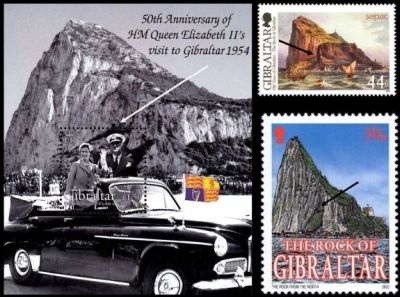
The Rock on stamps of Gibraltar, the arrow marks the entrance to the Gorham’s Cave
A second skull, Gibraltar 2, was found in 1926 close to Forbes’ Quarry, at Devil’s Tower Cave and belonged to a Neanderthal child. This discovery provided valuable insights into the growth and development of Neanderthals. Studies of the Gibraltar Neanderthals suggest they were among the last surviving populations of their species, with evidence indicating that Neanderthals lived in the region until around 32,000 years ago, long after they had disappeared from much of Europe.
Gibraltar’s caves, particularly Gorham’s Cave, on the Rock’s eastern side, have provided further evidence of Neanderthal life, including hearths, tools, and even possible engravings that suggest symbolic behaviour. The region’s mild climate and rich marine resources may have contributed to the Neanderthals’ prolonged survival.
Today, the Gibraltar skulls are housed in the Natural History Museum in London, and Gorham’s Cave is a UNESCO World Heritage Site, recognised for its importance in understanding Neanderthal history.
Recent research on the Gibraltar Neanderthals has shed light on their diet, behavior, and cognitive abilities. Isotopic analysis of remains from Gorham’s Cave suggests that these Neanderthals had a diverse diet, including marine resources such as shellfish, fish, and seals, challenging earlier notions that Neanderthals were primarily big-game hunters. Additionally, discoveries of charred plant remains indicate they also consumed roasted vegetables. Perhaps most intriguingly, an engraving found in Gorham’s Cave, a cross-hatched pattern etched into the rock, has been interpreted as possible evidence of symbolic or artistic behavior, suggesting that Neanderthals were capable of abstract thought. These findings contribute to the growing understanding that Neanderthals were not the brutish, primitive beings they were once thought to be, but rather intelligent and adaptable hominins capable of complex survival strategies.

Products and associated philatelic items
| FDCs | First-Day-of-Issue Postmark | |
 |
 |
 |
| Presentation Packs | Mini-Sheets | |
 |
 |
 |
| Maxi cards | ||
 |
||
References
- Technical details and official press release:
Gibraltar Post.
Acknowledgements
- Many thanks to Dr. Peter Voice from Department of Geological and Environmental Sciences, Western Michigan University, for reviewing the draft page and his valuable comments.