A 1928 Cover from the Paleobiological Institute (Paläobiologisches Institut), University of Vienna, to the International Education Board in Paris

This cover was mailed from Vienna, Austria, on 15 November 1928 and addressed to the European Office of the International Education Board (IEB) in Paris. Although the enclosed letter and the reverse side of the envelope are no longer available, the surviving front provides valuable evidence of scientific and administrative contacts between the University of Vienna and one of the most important philanthropic organizations supporting international scholarship during the interwar period.
The address was typed, indicating formal institutional correspondence, was addressed to:
Comptroller's Office
International Education Board
European Office
20, Rue de la Baume
Paris (8e)
Note:
The envelope is addressed specifically to the Comptroller's (Controller's) Office,
a department responsible for financial administration and accounting.
Comptroller is a formal spelling variant used traditionally by governments,
universities, and large philanthropic trusts (like the Rockefeller Foundation) to designate
a chief financial officer or accounting department.
 |
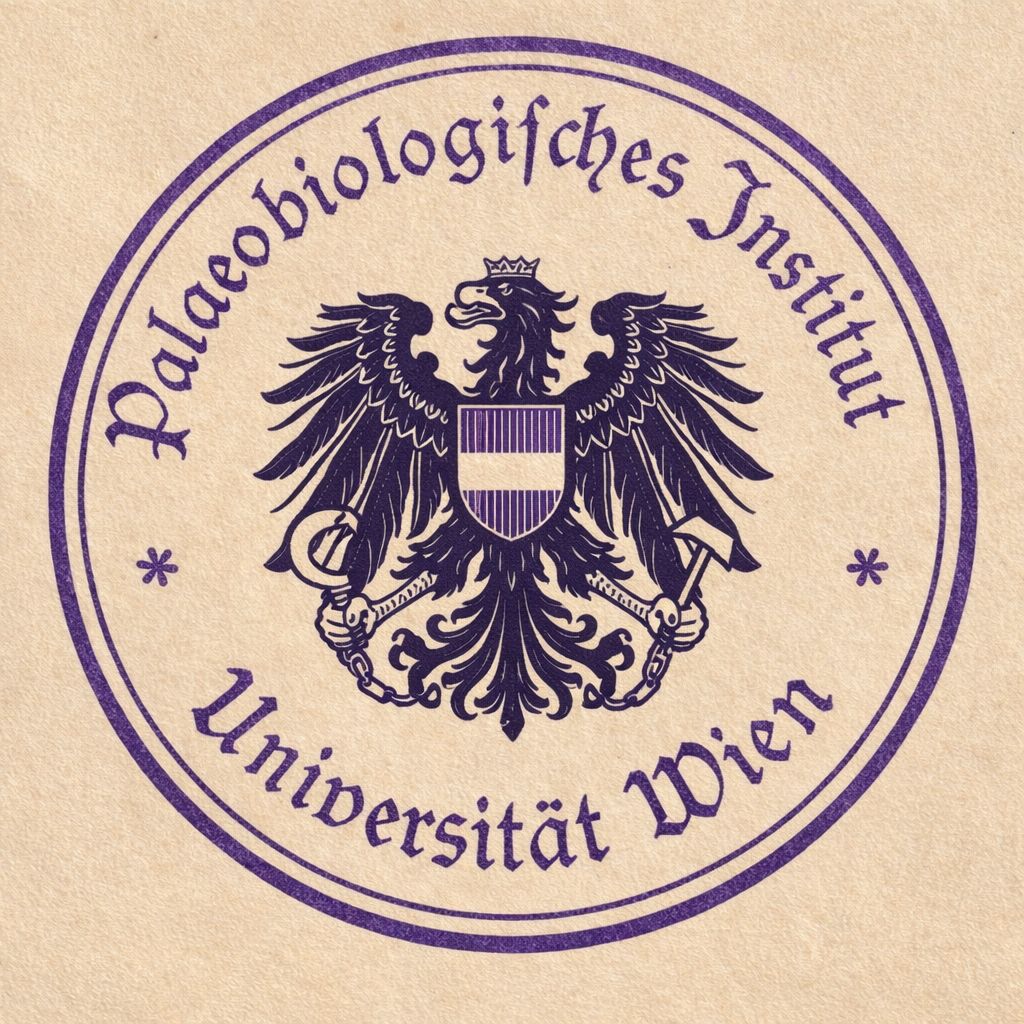 |
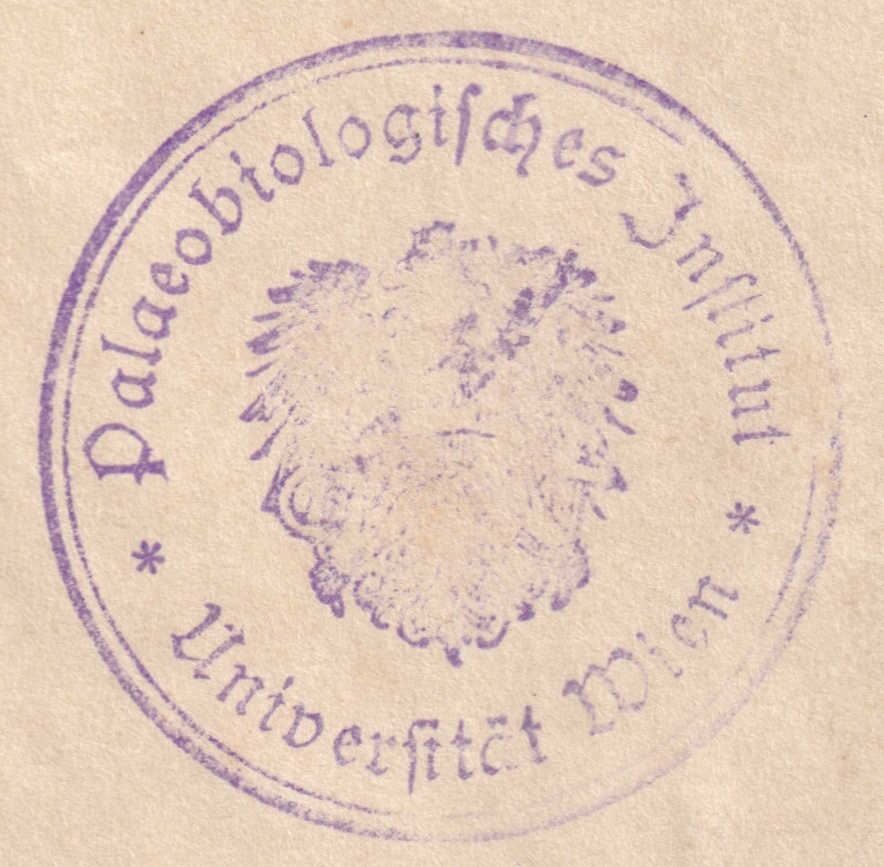
| Official seal of Paleobiological Institute of Vienna University: original and reconstructed by AI. | |
|
During the 1920s, in Austria public universities and state-run research institutes were legally mandated to use an official seal featuring the federal Austrian eagle (Bundesadler) to authenticate formal external correspondence. It acted strictly as a verified sender ID. |
|
Postal Details
The envelope was franked with a block of four 10-Groschen definitive stamps from Austria's 1925 series, totaling the required 40-Groschen international letter rate (Auslandsbrief), for the first weight step (up to 20 grams). According to the MICHEL stamp catalogue, the design by Fritz Zerritsch depicts stooks of grain alongside telegraph lines, beautifully capturing the intersection of agriculture and modern communication in the Austrian First Republic (MiNr: 455).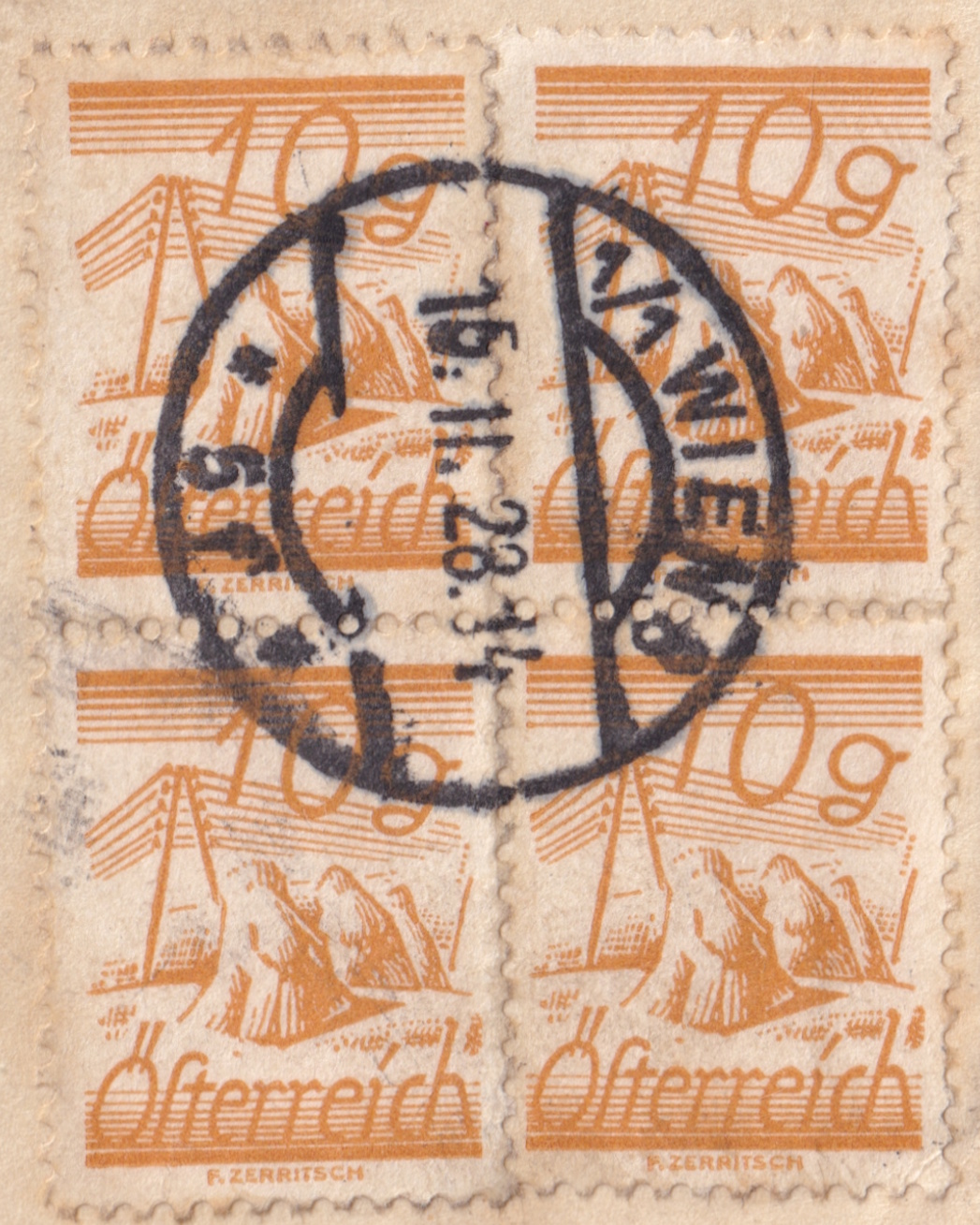
These stamps were cancelled with a Vienna Central Post Office postmark (WIEN 1/1) dated 15 November 1928. The number following the year is difficult to decipher, but it is almost certainly "14", indicating that the letter was processed between 14:00 and 15:00.
The Paläobiologisches (Paleobiological) Institut
The Paläobiologisches Institut of the University of Vienna (now part of the modern Department of Palaeontology) was one of Europe's leading centres for palaeontological research during the 1920s. At the time of this mailing, the institute was directed by Othenio Abel, a prominent Austrian palaeontologist known for his work on fossil vertebrates and evolutionary history.
Othenio Abel (1875–1946) was a key figure in the development of early 20th-century paleobiology, best known for his
efforts to reconstruct fossil organisms as living, ecologically coherent animals rather than isolated remains.
Working as a professor in Vienna, he helped shape the emerging discipline that combined geology and biology into a
unified approach to ancient life.
His influential work "Lebensbilder aus der Tierwelt der Vorzeit" from 1922
(Reconstructed Scenes from the Animal World of Prehistory) epitomizes this vision:
through detailed reconstructions and vivid descriptions, Abel aimed to
“bring the dead witnesses of the past to life”,
presenting prehistoric animals in their environments, behaviours, and interactions.
This approach not only transformed scientific communication in
paleontology but also resonated strongly
with broader cultural interpretations of fossils, making his work a valuable reference point for discussions
of how extinct creatures inspired imagination and myth-making.
Abel’s reconstructions highlight the same tension between scientific interpretation and narrative imagination
that underlies the historical transformation of
fossil finds into legendary beings.
The institute played an important role in the development of palaeobiology as a distinct scientific discipline and maintained contacts with researchers and institutions throughout Europe and beyond.
 |
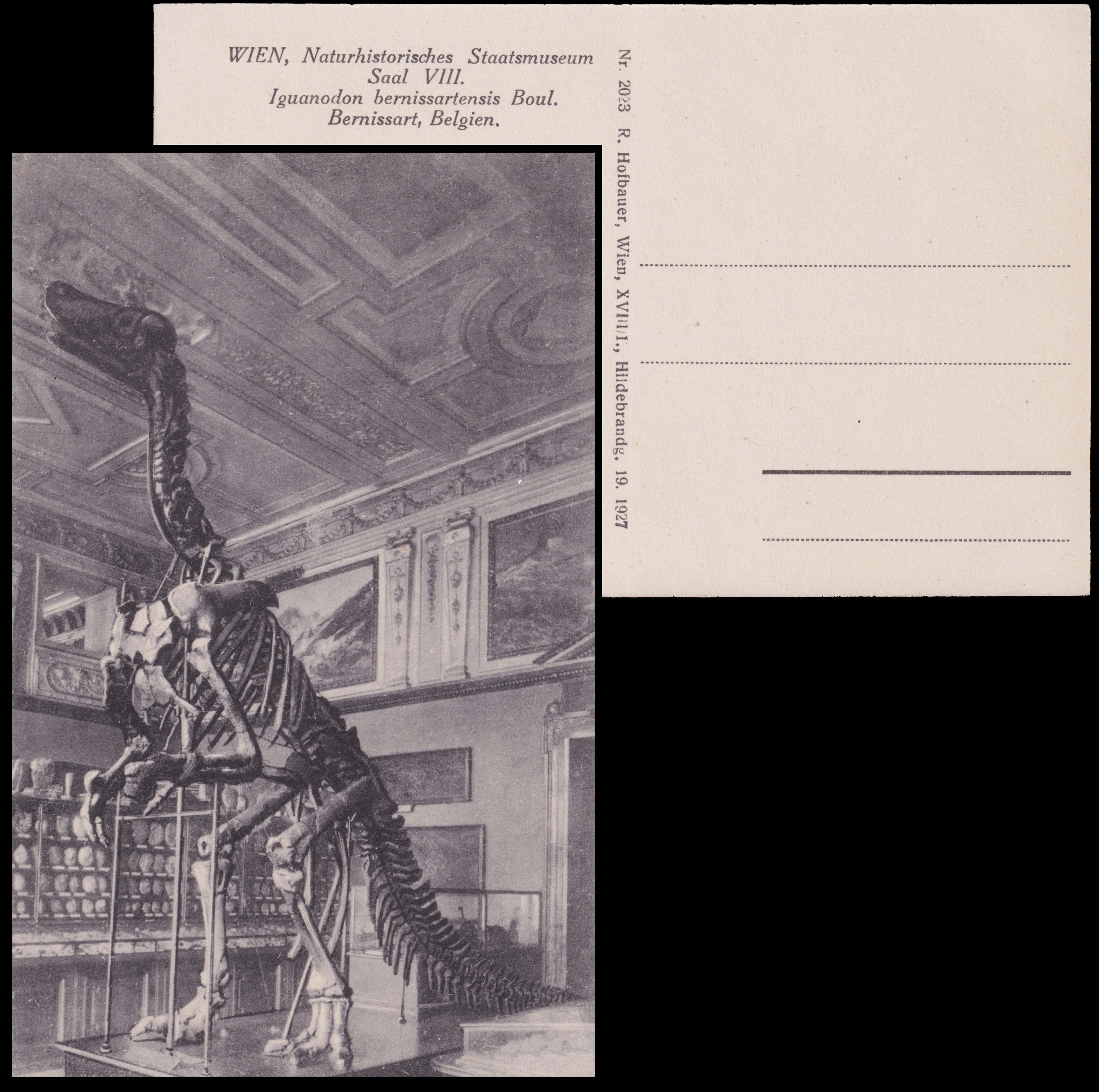 |
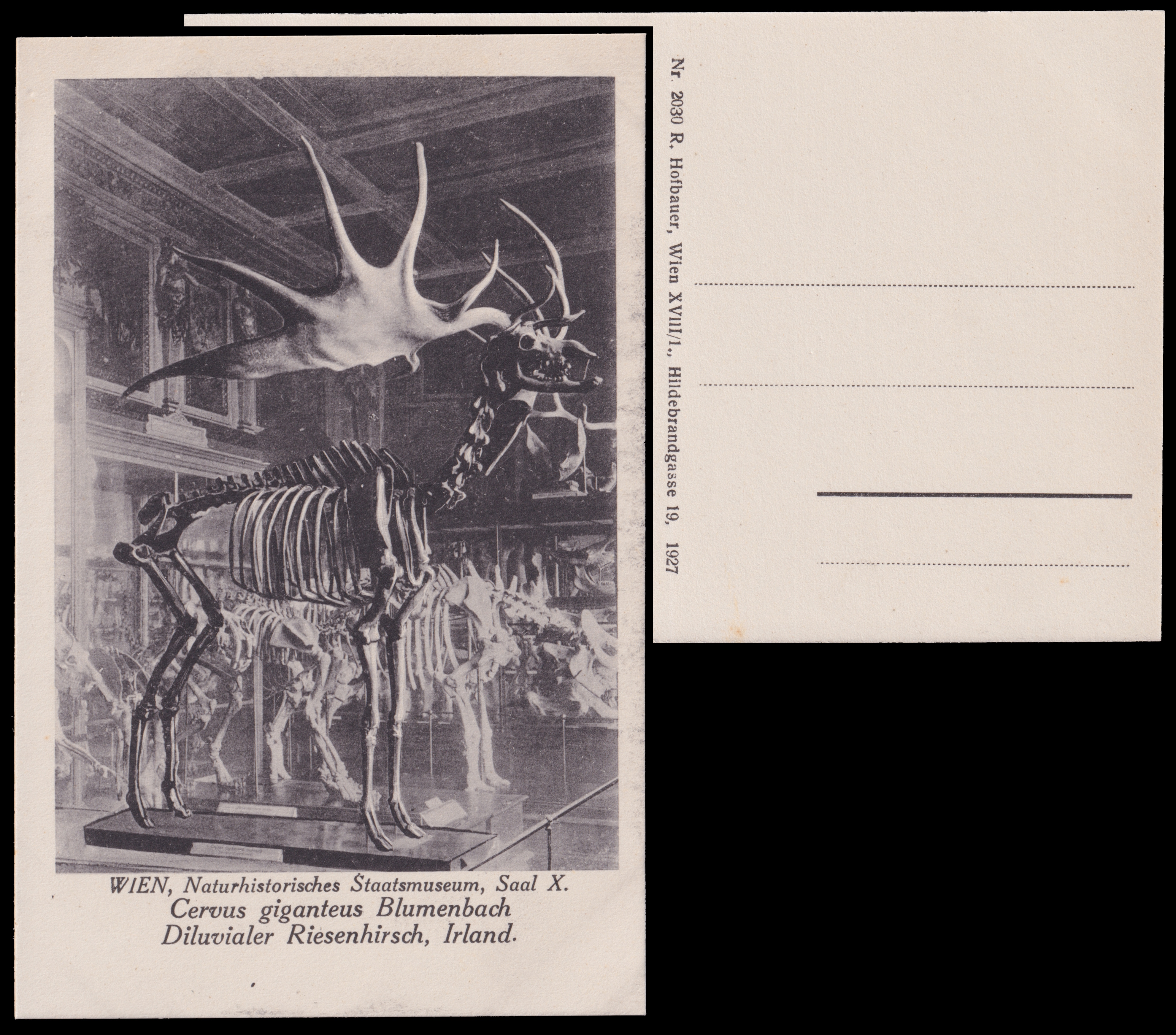
| Irish Elk (Megaloceros giganteus) and Iguanodon bernissartensis, in collection of the Natural History Museum on postcards of Austria 1927. | |
In Saal X, his team extensively analyzed the iconic Irish Elk (Megaloceros giganteus), utilizing its massive antler morphology to investigate theories of paleopathology, evolutionary momentum, and hyper-development (Hypertely).
Hypertely refers to the development of structures or forms beyond what is functionally necessary — features whose resemblance to other objects is more pronounced than required, or which appear to serve no obvious purpose.
Simultaneously, the Iguanodon bernissartensis skeletal cast in Saal VIII served as a foundational model for Abel’s breakthrough biomechanical analyses on dinosaur locomotion, posture, and gait mechanics, reflecting his close collaborative lineage with Belgian paleontologist Louis Dollo. These exact specimens formed the baseline data for the celebrated paleobiological life reconstructions (Lebensbilder) produced by the institute during the interwar era.
The International Education Board (1923–1938)The International Education Board was established in 1923 through Rockefeller philanthropy and operated internationally to promote higher education, scientific research, fellowships, and academic exchange. Its European Office in Paris coordinated many of the Board's activities across the continent. In fifteen years, the IEB supported 57 institutions and 603 fellows, including 509 in the natural sciences.The Board placed particular emphasis on strengthening scientific research in Europe during the difficult years following the First World War. Through grants, fellowships, and institutional support, it helped modernize laboratories, facilitated international collaboration, and enabled researchers to study and work abroad. Its programs contributed to the reconstruction of scientific infrastructure in several countries and fostered closer links between European and American academic institutions. Although the International Education Board ceased operations in 1938, its activities formed an important part of the broader Rockefeller effort to promote scientific advancement and international scholarly exchange during the interwar period. |
Historical SignificanceThis cover documents a direct connection between the University of Vienna's Paleobiological Institute and the Rockefeller-supported International Education Board during the late 1920s. It represents a small but tangible piece of the international network through which scientific institutions sought funding, exchanged information, and participated in scholarly cooperation during the interwar period.Although the original letter text is no longer preserved, it is important to note that the International Education Board (IEB) played a significant role in channeling post–First World War funding into selected European scientific institutions, particularly in the natural sciences. Its support was not a general reconstruction program, but rather a targeted initiative aimed at strengthening promising research centers in economically weakened countries, including Austria. In this context, Othenio Abel’s academic environment at the University of Vienna may have sought access to such support through formal IEB application channels or institutional correspondence via university networks. |
Acknowledgements:
- Many thanks to Dr. Peter Voice from Department of Geological and Environmental Sciences, Western Michigan University, for reviewing the draft page and his very valuable comments.
References:
- The Paläobiologisches Institut of the University of Vienna:
Wikipedia,
"100 Jahre Paläontologisches Institut der Universität Wien 1873 - 1973 von F.Steininger & E.Thenius Wien " - Othenio Abel (1875–1946):
Wikipedia, University of Vienna (in German), - International Education Board:
rockarch.org.