Postcard mailed from Paleontological Institute of Vienna University to France in 1899
 |
 |
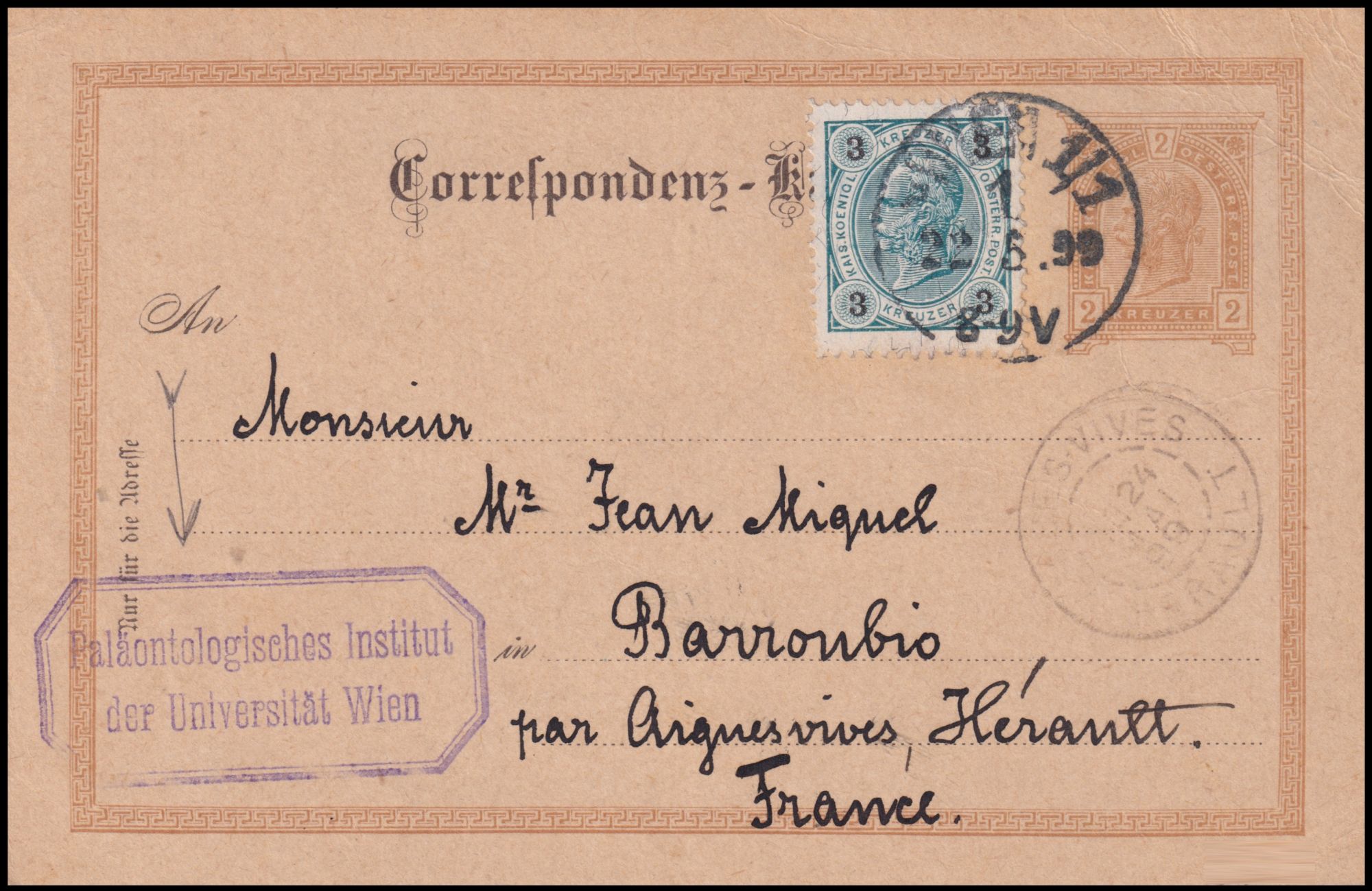
| Postcard from the Paleontological Institute of Vienna University to Jean Miquel (Barroubio, France), posted on May 21st, 1899. | |
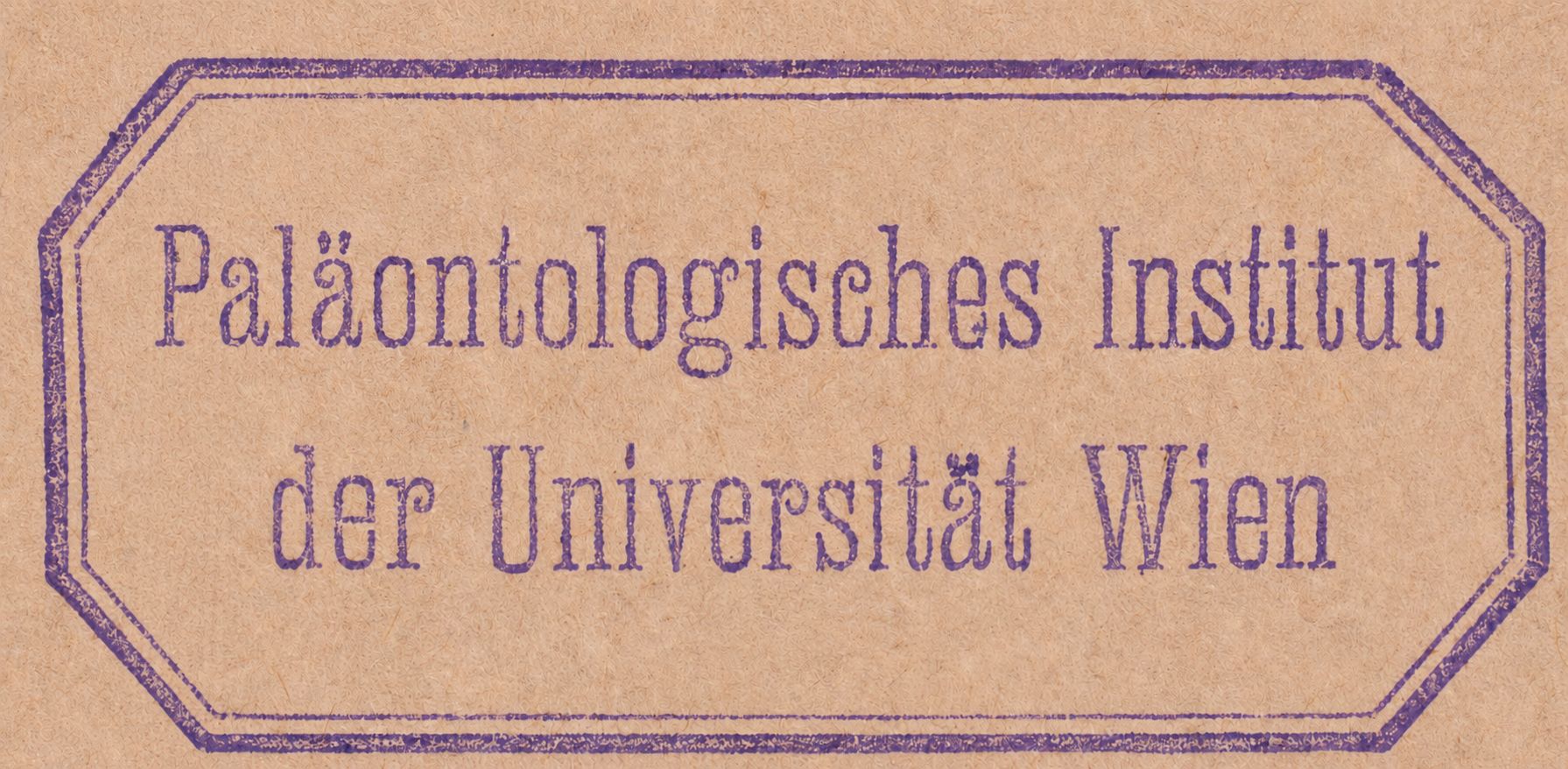 |
A violet logo of the Paläontologisches Institut der Universität Wien (Palaeontological Institute of the University of Vienna) appears in the lower-left corner, identifying the institutional origin of the correspondence.
The Institute for Paleontology at the University of Vienna is one of the oldest paleontological research institutes in the world, formally founded in 1873 during a major expansion of the Earth sciences in Vienna under the influence of leading geologists such as Eduard Suess.
A French arrival postmark dated just three days later, May 24th, 1899, appears on the right side. The handwritten message on the reverse, penned by the noted Austrian palaeontologist Dr. Gustav von Arthaber, highlights the existence of international scientific correspondence networks of the era. In the message, Dr. von Arthaber arranges an exchange of marine fossils from the local "First Mediterranean Stage" (today recognized as part of the Early Miocene, approximately 16 to 20 million years old) in return for Miquel's prized Paleozoic specimens collected in southern France.The postcard
The postcard is an Austrian postal stationery Correspondenz-Karte bearing the imprinted 2-Kreuzer stamp of Emperor Franz Joseph I. To meet the required international postal rate, an additional 3-kreuzer adhesive stamp was affixed, bringing the total postage to 5 kreuzer.
On October 1, 1869, the Austro-Hungarian Post issued the world's first pre-stamped postcard,
the Correspondenz-Karte, based on a proposal by Dr. Emanuel Herrmann.
Although Prussian postal official Heinrich von Stephan proposed an open "post-sheet" in 1865,
it was rejected for lack of privacy, leading to the success of Herrmann's 1869 model, which integrated a pre-printed stamp
for efficiency.
The postcard (inscribed Correspondenz-Karte in German, meaning "Correspondence Card" in English) featured an imprinted 2-Kreuzer stamp in the upper right corner. It cost half the price of an ordinary letter and was valid for delivery throughout the Austro-Hungarian Empire.
As had earlier been the case in Prussia, the Austrian postal authorities were doubtful whether the public would accept such a lack of privacy in their correspondence. Therefore, the earliest cards bore the following inscription on the reverse side: "Die Post übernimmt keine Verantwortung für den Inhalt der Mitteilung", in English: "The Post Office undertakes no responsibility for the contents of the communication". Despite these concerns, over three million postcards were sold in the first three months.
The postcard (inscribed Correspondenz-Karte in German, meaning "Correspondence Card" in English) featured an imprinted 2-Kreuzer stamp in the upper right corner. It cost half the price of an ordinary letter and was valid for delivery throughout the Austro-Hungarian Empire.
As had earlier been the case in Prussia, the Austrian postal authorities were doubtful whether the public would accept such a lack of privacy in their correspondence. Therefore, the earliest cards bore the following inscription on the reverse side: "Die Post übernimmt keine Verantwortung für den Inhalt der Mitteilung", in English: "The Post Office undertakes no responsibility for the contents of the communication". Despite these concerns, over three million postcards were sold in the first three months.
 |
| Correspondenz-Karte, Austria 1869 (the first postcard in the world) versus 1871. The earliest postcards bore an inscription on their reverse side: "Die Post übernimmt keine Verantwortung für den Inhalt der Mitteilung". Later the disclaimer was removed and the "An" (To) was replaced by the "Adresse" (Address). |
The message
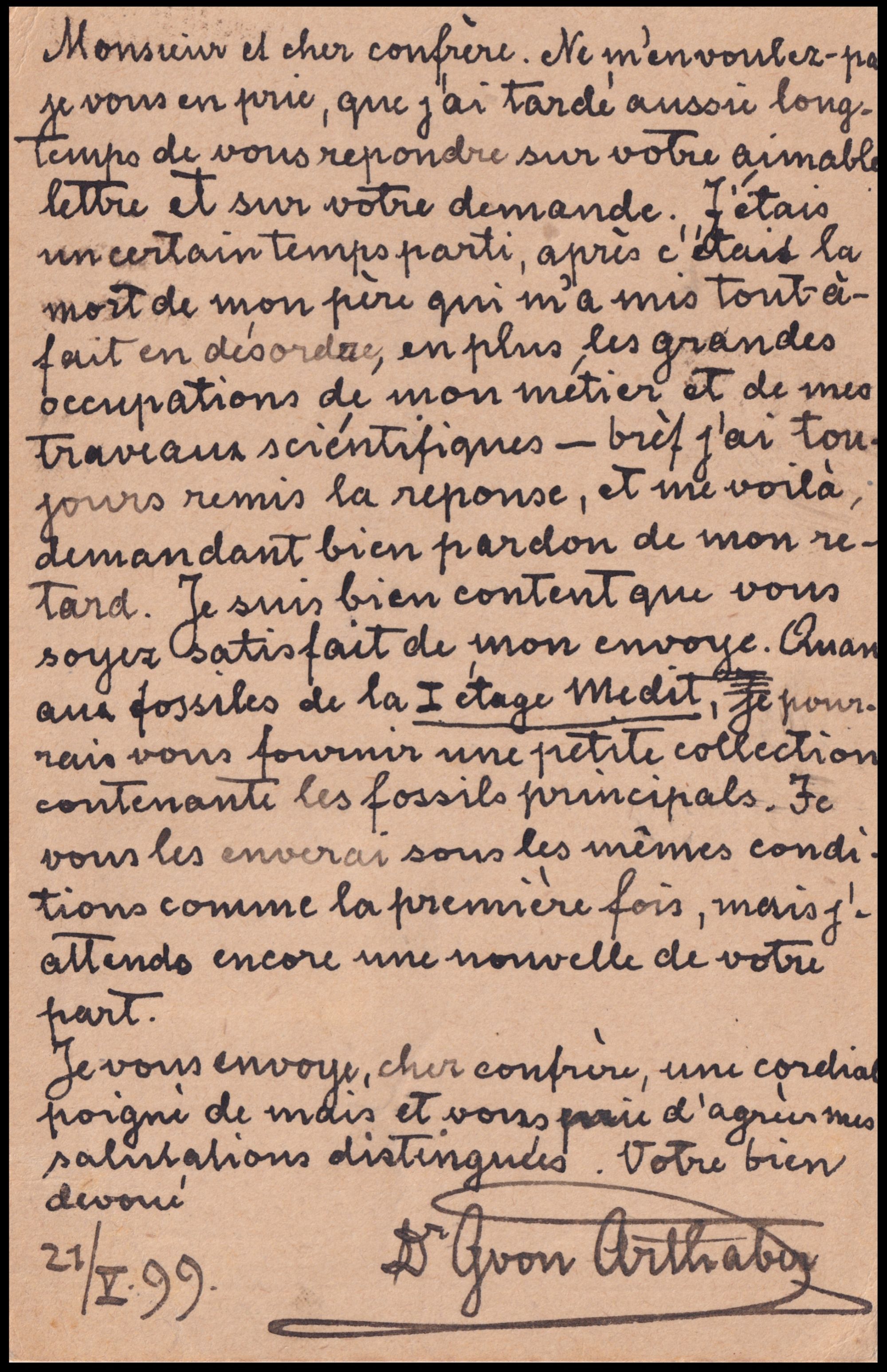
The message, written in French, begins with an apology for a delayed reply. Dr. Gustav von Arthaber explains that he had been absent for some time and that the recent death of his father had caused considerable disruption to his affairs. Combined with professional obligations and scientific work, these circumstances had prevented him from responding sooner. He further notes that the specimens would be supplied under the same conditions as a previous exchange, indicating an ongoing relationship between the two correspondents.
|
Original French text,
reproduced in its original orthography, contains several grammatical errors,
which are indicated by [sic].
Monsieur et cher confrère. Ne m'en voulez-pas je vous en prie, que j'ai tardé aussi longtemps de vous répondre sur votre aimable lettre et sur votre demande. J'étais un certain temps parti, après c'était la mort de mon père qui m'a mis tout-à-fait en désordre, en plus les grandes occupations de mon métier et de mes travaux scientifiques – bref j'ai toujours remis la réponse, et me voilà demandant bien pardon de mon retard. Je suis bien content que vous soyez satisfait de mon envoyé [sic]. Quant aux fossiles de la I étage Medit, je pourrais vous fournir une petite collection contenante les fossiles principals [sic]. Je vous les enverrai sous les mêmes conditions comme la première fois, mais j'attends encore une nouvelle de votre part. Je vous envoye [sic], cher confrère, une cordial [sic] poignée de main et vous prie d'agréer mes salutations distinguées. Votre bien dévoué 21/V/99 Dr. G. von Arthaber |
English translation Dear Sir and Colleague. Please do not hold it against me that I have delayed so long in replying to your kind letter and your request. I was away for a certain time, and afterward, the death of my father completely disrupted my affairs, alongside the heavy demands of my profession and scientific work—in short, I kept putting off the reply, and here I am asking for your forgiveness for my lateness. I am very glad that you are satisfied with what I sent. As for the fossils of the '1st Mediterranean Stage' [a geological classification from that era], I could provide you with a small collection containing the primary fossils. I will send them to you under the same conditions as the first time, but I await further word from you. I send you, dear colleague, a cordial handshake and ask you to accept my distinguished regards. Yours truly, 21/V/99 Dr. G. von Arthaber |
The sender - Dr. G. von Arthaber
Dr. Gustav Adolph Edler von Arthaber (1864–1943) was a highly influential Austrian geologist, stratigrapher, and paleontologist. From 1893 to 1897, he served as an assistant at the University of Vienna's Institute of Paleontology, and from 1898 to 1907 as an adjunct. In 1907, von Arthaber was appointed associate professor of paleontology, and in 1921 he became a full professor, a position he held until his retirement in 1933.
Von Arthaber was primarily a specialist in the paleontology and stratigraphy of the Triassic formations within the region of the former Tethys Sea, focusing particularly on Triassic cephalopods (ammonites) due to their significance as index fossils. His work culminated in his major contribution to the Lethaea geognostica, where he authored the comprehensive account of the Alpine Triassic of the Mediterranean region, integrating his research on ammonite biostratigraphy and stratigraphic correlations across the Alpine domain.
 |
| "150th anniversary of the Federal Geological Institute" postage stamp of Austria, 1999, MiNr: 2298; Scott: 1801. |
The depiction of these ammonites on the Austrian Geological Survey commemorative stamp reflects their broader significance in Central European Triassic research.
Both taxa originate from the Ladinian Stage of the Middle Triassic, a time interval that is exceptionally well represented in the Northern Calcareous Alps and has played a central role in the development of modern biostratigraphic zonation.
The Reifling Formation, in particular, has long served as a reference section for correlating Alpine stratigraphy across the former Austro-Hungarian territories.
| Anolcites is an important index fossil genus of the Middle Triassic period, and it fell squarely within his primary scientific focus. In his comprehensive monograph on the Alpine Triassic, von Arthaber systematically catalogued and evaluated the ammonite species found in the Reifling Limestone formations. In his data sheets, he analyzed Anolcites cf. doleriticus and Anolcites elisabethae. He used the shell morphology and suture line patterns of these specimens to map the stratigraphy of famous Austro-Hungarian fossil beds such as Tiefengraben. | Heraclites robustus is well known for its presence in the Hallstatt Limestone (Hallstätter Kalk) of the Eastern Alps in Austria. Because von Arthaber dedicated decades to mapping the precise boundaries of Alpine Triassic layers, this species served as an important biostratigraphic marker in his work. It is highly distinctive due to its strong, robust ribbing on the shell flanks and its characteristic suture line pattern. |
The receiver - Jean Miquel
Jean Miquel (1859–1940) was a remarkable self-taught naturalist and multidisciplinary regional scientist. Although he earned a law degree from the University of Toulouse, he devoted his life to exploring and documenting the geology, archaeology, and paleontology of the Montagne Noire region in southern France. Working from his family estate at Barroubio, Miquel became one of the key regional authorities on the area's Paleozoic strata and made important contributions to regional geological and archaeological research.
His scientific work focused particularly on the Cambrian and Ordovician strata of the Montagne Noire, where he documented and collected rich trilobite faunas from several key localities, including the Barroubio and Coulouma areas. These assemblages contributed significantly to the early understanding of Paleozoic stratigraphy in southern France.
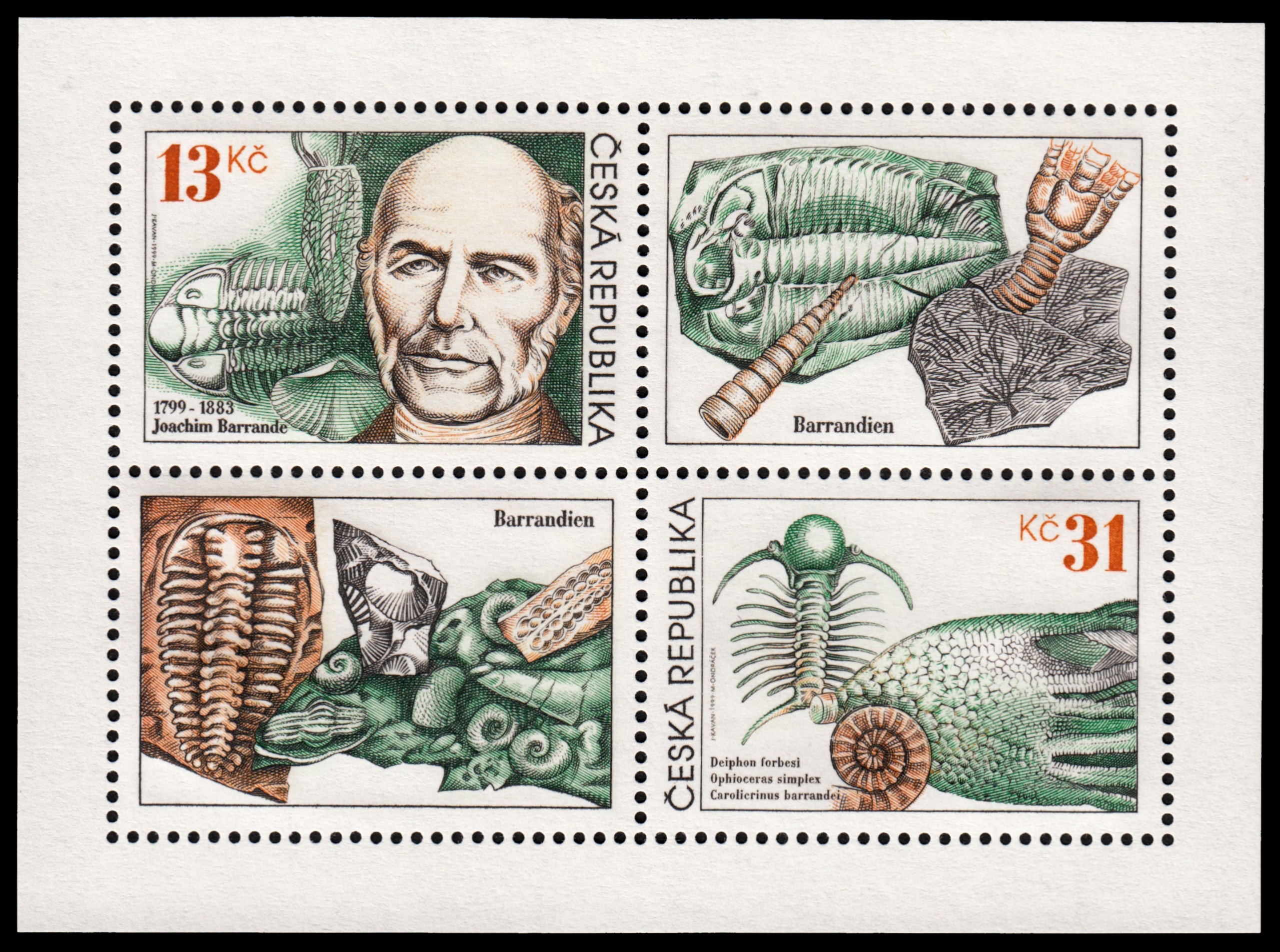 |
| "Joachim Barrande and Czech Trilobites" postage stamps of Czechia, 1999, MiNr: 221-222; Scott: 3094a-b. |
When Miquel began searching the southern slopes of the Montagne Noire in the late 1880s and 1890s, he relied directly on Barrande’s published anatomical templates, terminology, and stratigraphic logic to accurately identify his own French specimens.
Miquel shipped portions of his prized trilobite collections from Barroubio directly to the National Museum in Prague, which also housed Barrande's trilobite collection.
Miquel also collaborated with professional geologists such as Charles Depéret, who studied vertebrate-bearing levels in the Saint-Chinian region, further integrating Miquel’s field observations into broader stratigraphic frameworks.
In the late 1890s, Depéret was conducting geological mapping in the
Hérault department of southern France.
During this work, he met the local researcher Jean Miquel, who had discovered dinosaur remains in the non-marine
Upper Cretaceous deposits of the hills surrounding the small town of Saint-Chinian.
Depéret first mentioned these dinosaurs in a geological paper on the Saint-Chinian region published in 1899, the same year the postcard was mailed. He discussed them in greater detail in a series of short notes published in 1900. In that paper, he reported the presence of the sauropod Titanosaurus, as well as separate armored remains belonging to Crataeomus (a genus from Austria today recognized as a nodosaurid ankylosaur).
Due to contemporary discoveries in North America, Depéret
erroneously hypothesized that Crataeomus was a primitive ceratopsian related to Triceratops.
He also noted isolated theropod teeth that he assigned to the megalosaurid genus Dryptosaurus,
a group already known from
the United States and
Madagascar.
In 1940, the French geologist, palaeontologist, and Roman Catholic priest Albert-Félix de Lapparent (1905–1975) reinterpreted the theropod specimens, assigning them to the genus Megalosaurus. Modern palaeontological reviews now recognize these specific teeth as the earliest reported European remains of abelisaurids — a group of carnivorous, bipedal ceratosaurian theropods that flourished primarily on the southern supercontinent of Gondwana.
Depéret first mentioned these dinosaurs in a geological paper on the Saint-Chinian region published in 1899, the same year the postcard was mailed. He discussed them in greater detail in a series of short notes published in 1900. In that paper, he reported the presence of the sauropod Titanosaurus, as well as separate armored remains belonging to Crataeomus (a genus from Austria today recognized as a nodosaurid ankylosaur).
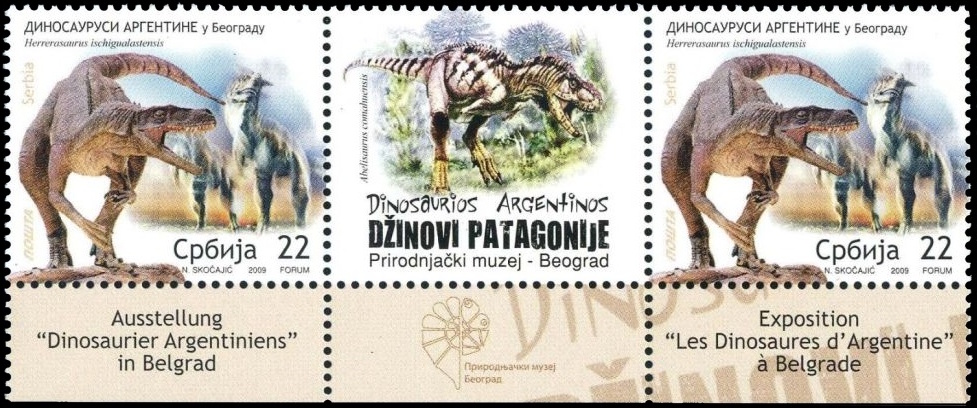 |
| South American abelisaurids, Abelisaurus comahuensis on a label of Serbia 2009. |
In 1940, the French geologist, palaeontologist, and Roman Catholic priest Albert-Félix de Lapparent (1905–1975) reinterpreted the theropod specimens, assigning them to the genus Megalosaurus. Modern palaeontological reviews now recognize these specific teeth as the earliest reported European remains of abelisaurids — a group of carnivorous, bipedal ceratosaurian theropods that flourished primarily on the southern supercontinent of Gondwana.
Miquel maintained correspondence with several European geologists and paleontologists of his time, such as von Arthaber.
He exchanged parts of his extensive fossil collection with several European museums and universities (Copenhagen, Lille, Montpellier, Paris, Prague, Vienna, etc.), and specimens from his collections are still preserved today in these institutions, commonly referred to as the “Miquel collections”.
Summary
The postcard is an interesting document of scientific collaboration at the turn of the twentieth century. It illustrates how professional palaeontologists and dedicated amateur collectors exchanged fossils, publications, and geological information across national borders long before modern communication technologies existed. At the same time, it preserves evidence of the activities of one of Europe's most important palaeontological institutions and offers a rare glimpse into the personal correspondence of a leading Austrian palaeontologist.
Acknowledgements:
- Many thanks to Dr. Peter Voice from Department of Geological and Environmental Sciences, Western Michigan University, for reviewing the draft page and his very valuable comments.
References:
- Dr. Gustav Adolph Edler von Arthaber (1864–1943):
Wikipedia, Österreichisches Biographisches Lexikon, Evangelisches Museum Österreichisches, - Jean Miquel (1859–1940):
pays-saint-ponais.fr, "ABELISAURIDS BEFORE Abelisaurus: EARLY REPORTS OF ABELISAURID DINOSAURS FROM EUROPE" (PDF), sciencepress.mnhn.fr (PDF), naturalhistory.si.edu (PDF). - Charles Jean Julien Depéret (1854–1929):
Wikipedia.