Robert Falcon Scott - Antarctic Explorer and Contributor to Palaeontology
 |
| Robert Falcon Scott on stamp of the British Antarctic Territory 1987 MiNr.: 140, Scott: 137. |
- During the first expedition, he led a southern journey that reached a new record latitude of approximately 82°17'S and explored parts of the Antarctic Plateau, on which the South Pole is located.
- On his second expedition, Scott led a party of five that reached the South Pole on 17 January 1912, 34 days after the Norwegian expedition led by Roald Amundsen. Scott and all four of his companions died during the return journey.
Scott's Contribution to Antarctic Palaeontology
Scientific research was an important objective of both of Scott's Antarctic expeditions. Although Scott was not a palaeontologist himself, his leadership and support of the scientific programme enabled the collection of geological and fossil material from previously little-known regions of Antarctica. These specimens subsequently became important resources for the study of the continent's geological and palaeontological history.
The First Expedition: Discovery (1901–1904)
 |
|
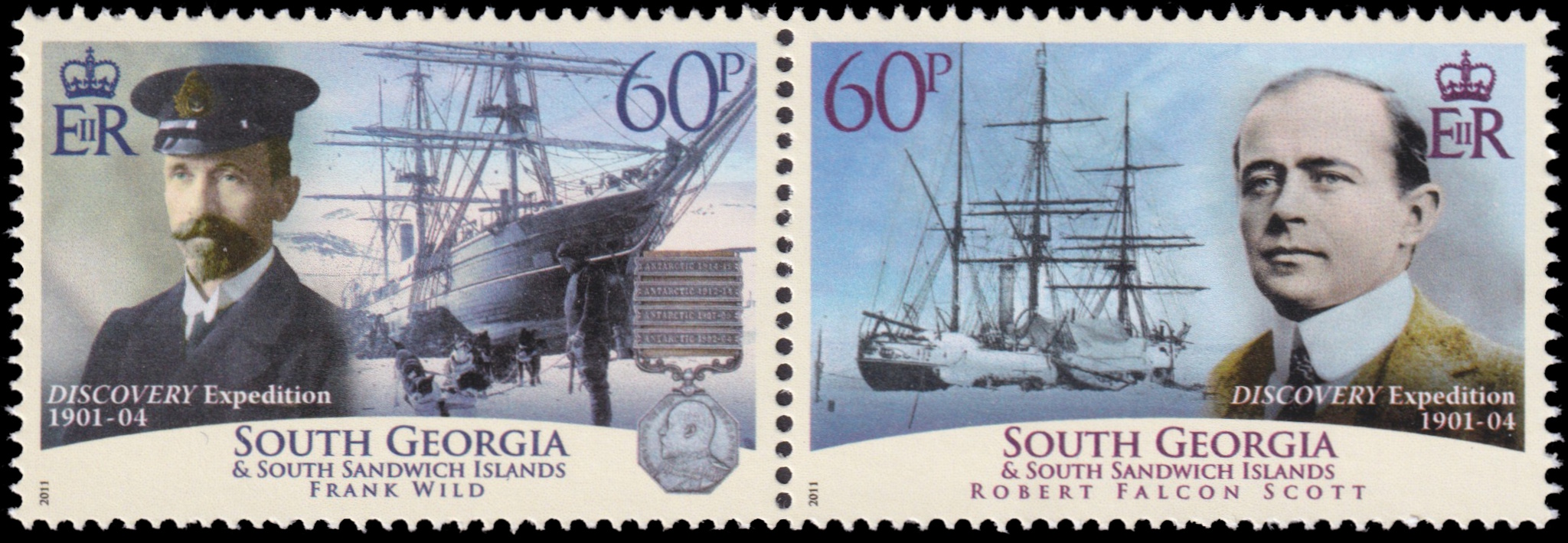
Frank Wild (left) and Robert Falcon Scott (right) with the expedition ship RRS Discovery
(1901–1904) on a
se-tenant pair of stamps of South Georgia and the South Sandwich Islands 2011, MiNr.: 542–543, Scott:
439a–439b. Frank Wild (1873–1939) was a British polar explorer who served under Scott on the Discovery Expedition and later took part in four more Antarctic expeditions, notably discovering coal seams and fossil wood near the Beardmore Glacier during Ernest Shackleton's Nimrod Expedition in 1908. |
During the British National Antarctic Expedition (1901–1904), often known as the Discovery
Expedition,
Scott's team carried out the first extensive inland geological surveys of Victoria Land.
In late 1903, while accompanying Scott on a western sledging journey into the Transantarctic Mountains, the
expedition
geologist Hartley T. Ferrar (1879–1932) examined the sedimentary formations along the glacier that now bears
his name
and described the thick sequence of rocks known as the Beacon Sandstone.
Within these sandstone strata, Ferrar discovered coal-bearing seams and collected carbonised fossil plant impressions and woody fragments—among the very first fossil plant remains ever reported from the Antarctic continent. Following the expedition's return to Britain, the specimens were examined by the Cambridge palaeobotanist Edward A. Newell Arber (1870–1918), who published his findings in the official expedition report in 1907. Although the fossils were too fragmentary to be identified to a specific genus at the time, the discovery provided crucial early evidence that Antarctica had once supported terrestrial vegetation and motivated Scott to make palaeobotanical collecting a priority on his second expedition.
The Second Expedition: Terra Nova (1910-1913)
|
|
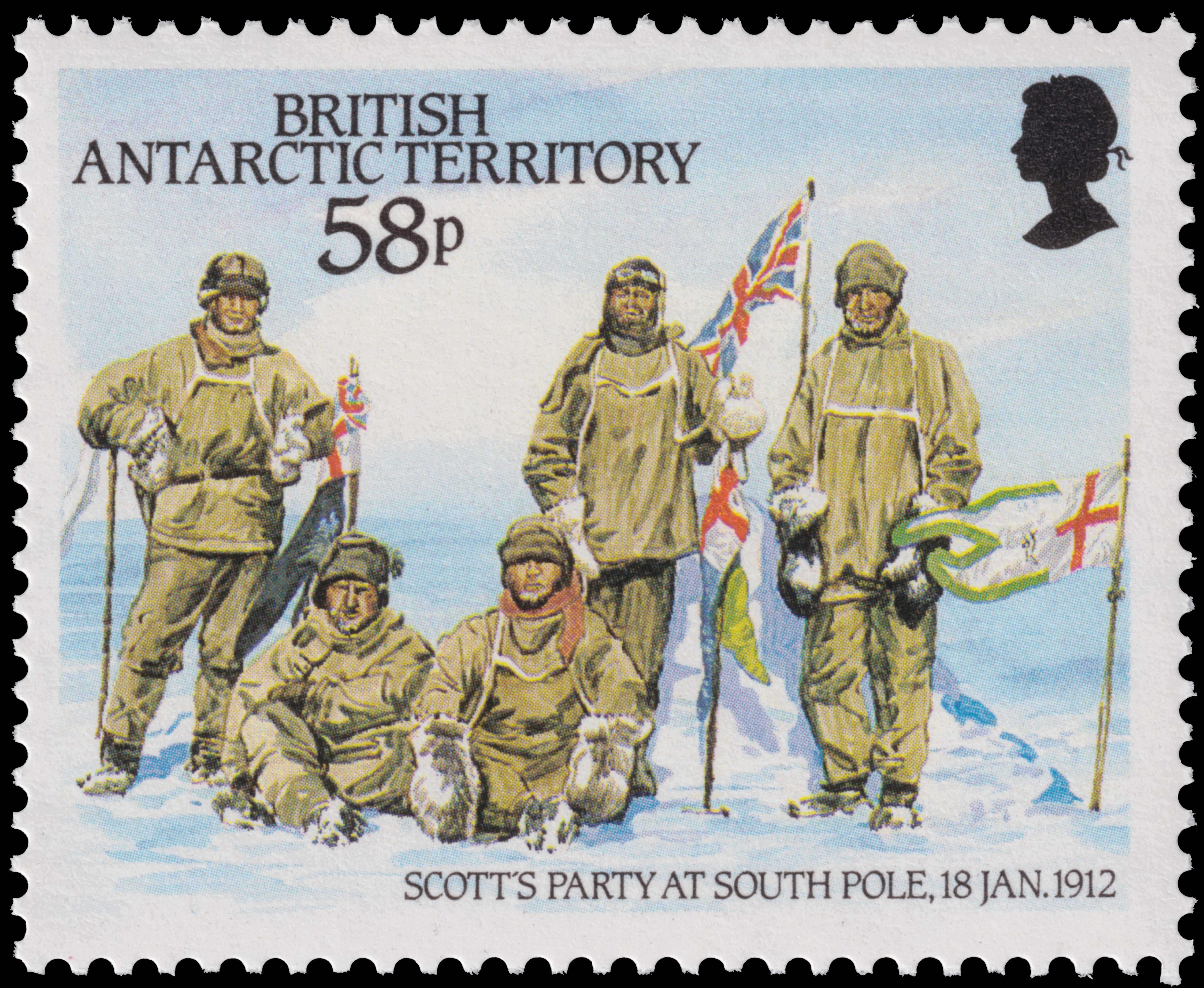
Robert Falcon Scott's polar party at the South Pole on 18 January 1912 on a stamp of the British
Antarctic Territory
1994, MiNr.: 227, Scott: 215. Shown from left to right: standing — Captain Lawrence Oates, Captain Robert Falcon Scott, and Dr. Edward Wilson; seated — Lieutenant Henry "Birdie" Bowers and Petty Officer Edgar Evans. |
Its geological investigations included field journeys led by geologists Thomas Griffith Taylor (1880–1963), Frank Debenham (1883–1965) and Raymond E. Priestley (1886–1974).
Their work involved geological surveys, the examination of sedimentary formations and the collection of rocks and fossils from different parts of Victoria Land.
The expedition's geological collections also included fossil fish remains, which were subsequently examined by the British palaeontologist Arthur Smith Woodward (1864-1944) and described in a report published in 1921.
One of the most remarkable palaeontological discoveries of the expedition occurred during the return journey of Scott's polar party.
 |
| Marie Charlotte Carmichael Stopes on one of the "Women of Distinction" stamps of Great Britain 2008, MiNr.: 2676, Scott: 2603. |

Stopes showed him fossil specimens of Glossopteris, an extinct genus of seed-bearing plants commonly known as seed ferns, which formed an important part of the vegetation across the southern continents during the Permian Period (298.9–251.9 million years ago). She explained the scientific importance of finding similar fossils in Antarctica, as they could provide evidence for a former connection between the southern continents, an idea associated with the work of Eduard Suess and his concept of Gondwanaland.
Before his departure, Scott visited Stopes again, and she showed him further fossil specimens so that he could become familiar with their appearance and recognise comparable material in Antarctica.
On 8 February 1912, during the return journey from the South Pole, Scott's polar party reached the area beneath Mount Buckley, near the Beardmore Glacier. Scott decided to stop and spend the day examining the surrounding rocks.
 |
| Plant Fossil on Geological Research stamp from New Zealand involvement in Antarctica set of New Zealand 1984, MiNr.: 889, Scott: 791. |
 |
 |
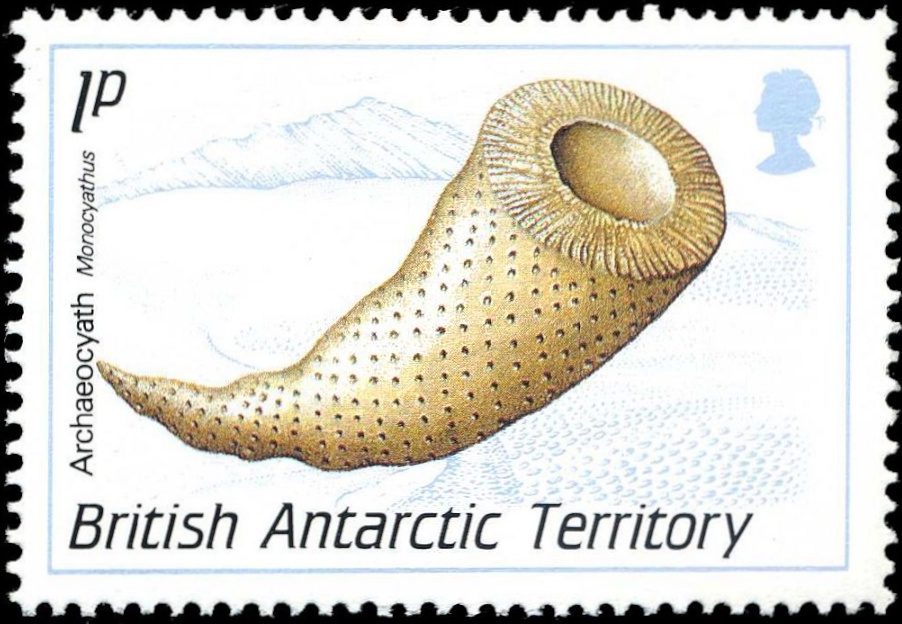
| Archaeocyathus and Glossopteris on definitive stamps of the British Antarctic Territory 1990, MiNr.: 156, 160, Scott: 153, 157, respectively. |
 |
| British Antarctic Territory, 70p Commemorative Stamp Issued to honor the British National Antarctic Expedition (1901–1904), this stamp features portraits of explorers Ernest Shackleton, Robert Falcon Scott, and Edward Wilson above an illustration of their sledging camp. On December 30, 1902, the trio achieved a new "Farthest South" record at latitude 82° 17' S before harsh conditions forced their return. MiNr.: 889, Scott: 791. |
The party also found a specimen of limestone containing fossils identified as Archaeocyathus. Scott's diary records that Henry Bowers, known to his companions as "Birdie", had obtained this unusual specimen. Archaeocyathus were early Cambrian reef-building organisms, generally regarded as an extinct group of sponge-like animals. The origin of the limestone was uncertain, as similar rocks were rare among the surrounding glacial debris. This discovery was significant because it provided evidence of very ancient marine rocks in the region.
The fossil plant impressions collected near Mount Buckley were particularly important because they included well-preserved leaves of Glossopteris. Although the explorers did not recognise their botanical identity, they understood that the geological specimens were scientifically valuable and decided to retain them. Despite their increasingly desperate physical condition and the weight of their equipment, the party continued to carry approximately 16 kg (35 lb) of geological specimens, including the fossil-bearing rocks.
All five members of the polar party died on their return journey. Their bodies, diaries and scientific collections were discovered by a search party in November 1912.
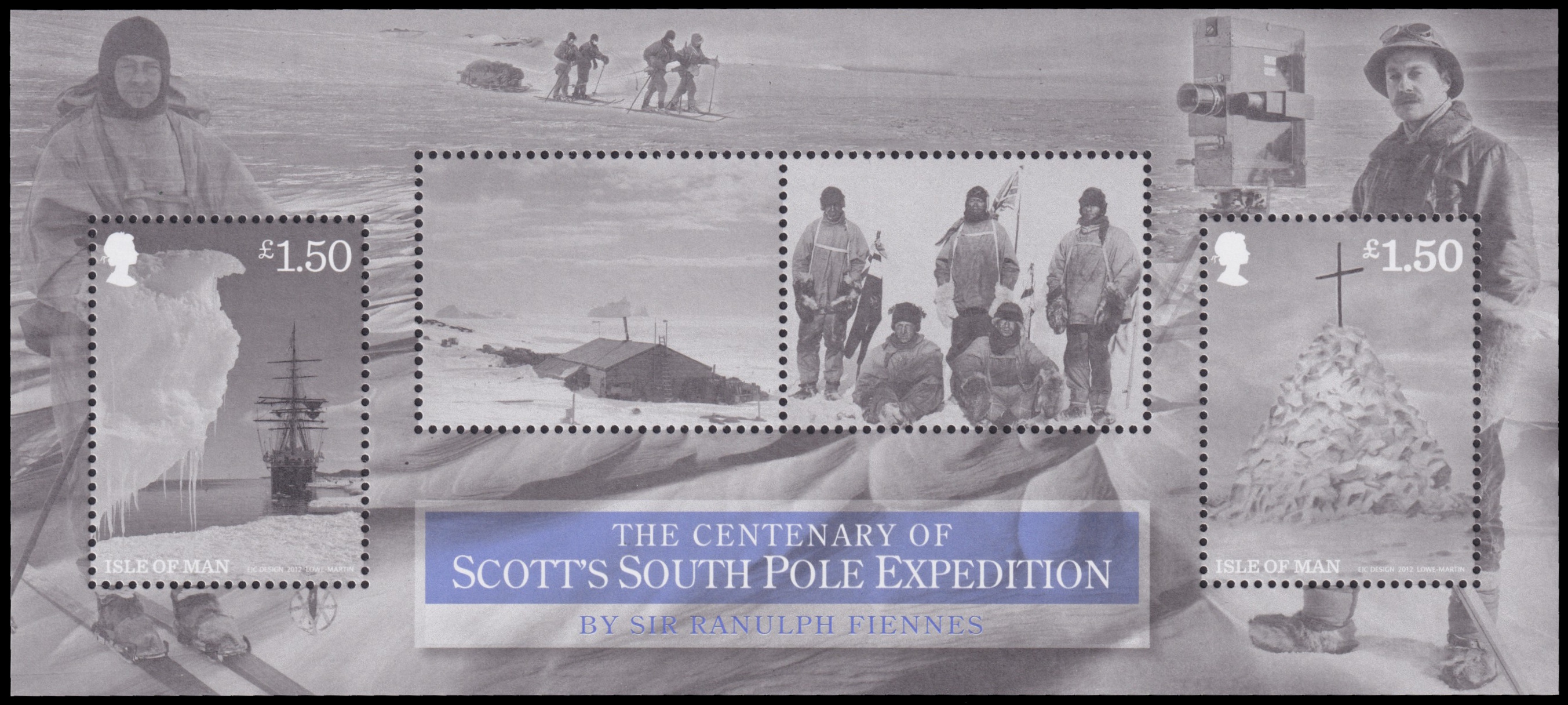
The stamp with the face value of GBP 1.50 on the right side of the Souvenir Sheet, show the grave of Robert Falcon Scott. Robert Falcon Scott is shown on the left side of the souvenir sheet and some scenes from his expeditions are shown in the middle.
Scientific Study and Legacy of the Fossils
The geological specimens were subsequently brought back to Britain. The fossil plants were examined by the British palaeobotanist Albert Charles Seward (1863–1941), Professor of Botany at the University of Cambridge. He identified the characteristic leaves as Glossopteris indica and described and illustrated the specimens in his 1914 publication, Antarctic Fossil Plants. This was the first comprehensive scientific account of the fossil plants collected during Scott's Terra Nova Expedition.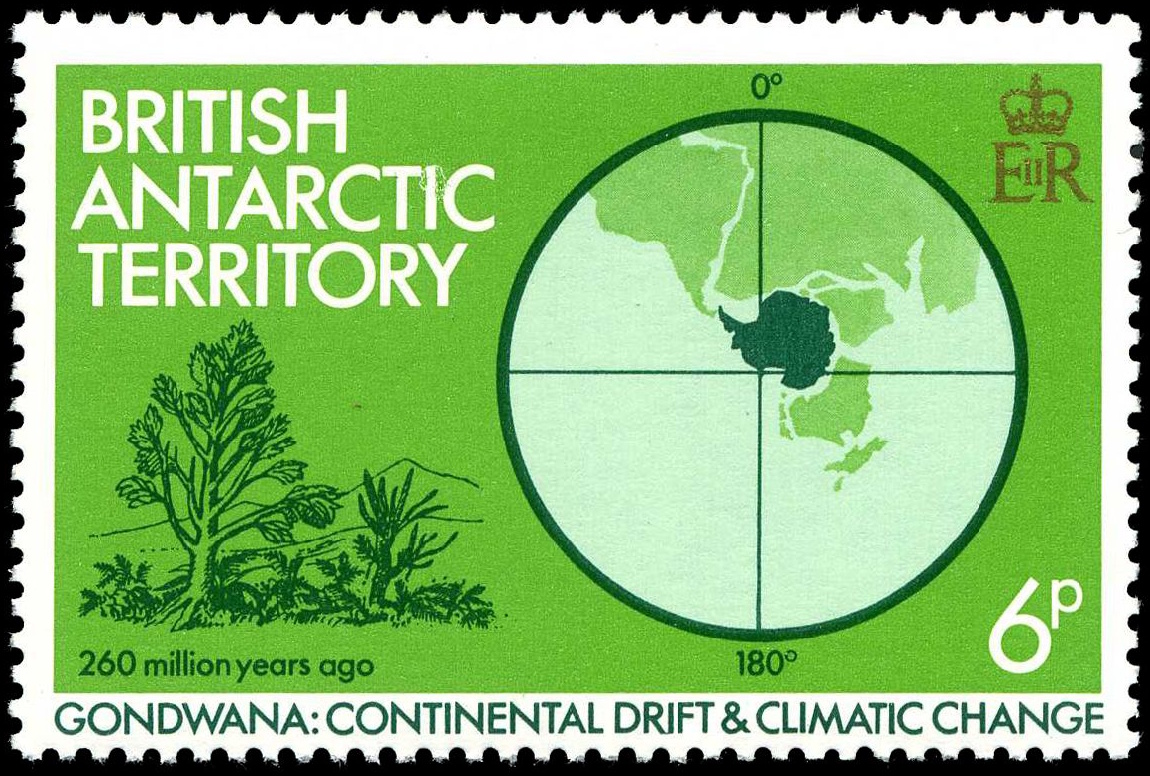
|
| Antarctica as part of Gondwana continent on stamp of the British Antarctic Territory 1982, MiNr.: 89, Scott: 87. |
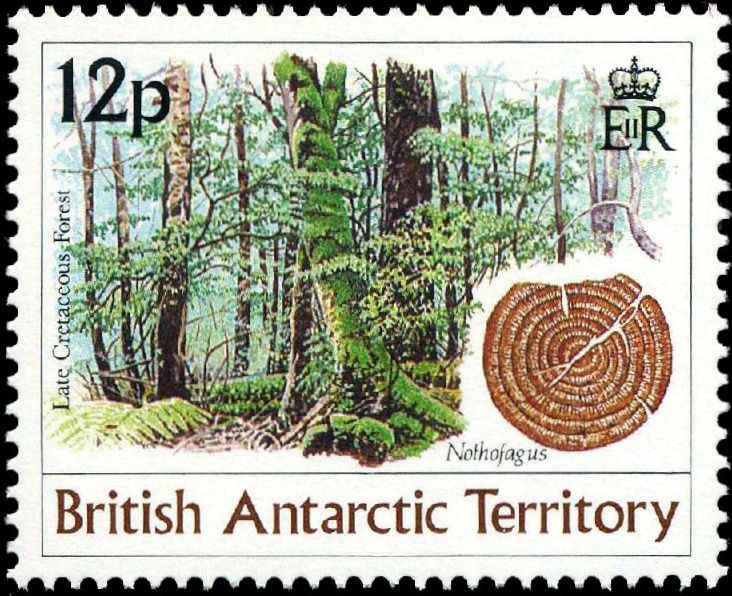 |
| Late Cretaceous Fotest in Antarctica on stamp of the British Antarctic Territory 1991, MiNr.: 173, Scott: 172. |
The specimens collected by Scott's party provided important evidence that Antarctica had once formed part of Gondwanaland, an ancient southern supercontinent that also included what are now South America, Africa, India and Australia. The widespread distribution of Glossopteris across these now widely separated continents supported the idea that they had once been connected. The fossils also revealed that Antarctica had supported extensive vegetation under climatic conditions very different from those prevailing today.
The discoveries made during Scott's expeditions therefore contributed to several areas of Antarctic palaeontology, from the study of ancient plant life and Cambrian marine organisms to the reconstruction of the continent's geological past. Although the scientific identification and interpretation of the specimens were carried out by specialists after their return to Britain, Scott's leadership and the decision to preserve and transport the collections made their subsequent study possible.
Robert Falcon Scott in Philately
Antarctic teritoories
| The British Antarctic Territory | |||
| 19.03.1987 "75 years since first expedition of Robert Falcon Scott to Antarctic" [A1] | 17.11.1994 "Polar explorers and their ships" [A1] | 05.12.2001 "British Antarctic Expedition II" [A1] | |
 |
 |
 |
|
| 23.11.2008 "History of Arctic Research" [A1] | 03.12.2010 "Centenary of British Antarctic Expedition (1910-13)" [A1] | 18.11.2019 "Bicentenary of Discovery of Antarctica" [A1] | |
 |
 |
 |
|
| 18.11.2019 "Centenary of Scott Polar Research Institute" [A1] | |||
 |
|||
| The French Antarctic Territory | |||
| 25.06.2022 "Antarctic Explorers" [O2] | |||
 |
|||
| Ross dependency | |||
| 11.01.1957 "Sterling Currency Definitives" [O1] | 10.07.1967 "Decimal Currency Definitives" [O2] | 09.11.1995 "Antarctic Explorer and their ships" [O1] | |
 |
 |
 |
|
| 06.11.2002 "The Discovery Expedition 1901-1904" [O1] | 02.11.2011 "Race to the Pole" [O1] | ||
 |
 |
|
|
Great Britain and the Commonwealth
| Great Britain | ||
| 16.02.1972 "British Polar explorers" [O1] | 29.04.2003 "Extreme achievements in the 20th century" [O1] | 09.03.2012 "The centenary of Scott's South Pole Expedition" [O1] |
 |
 |
 |
| Isle of Man | South Georgia and the South Sandwich Island | |
| 09.03.2012 "The centenary of Scott's South Pole Expedition" [O1] | 25.11.2011 "Polar Explorers" [2] | |
|
 |
|
Other countries
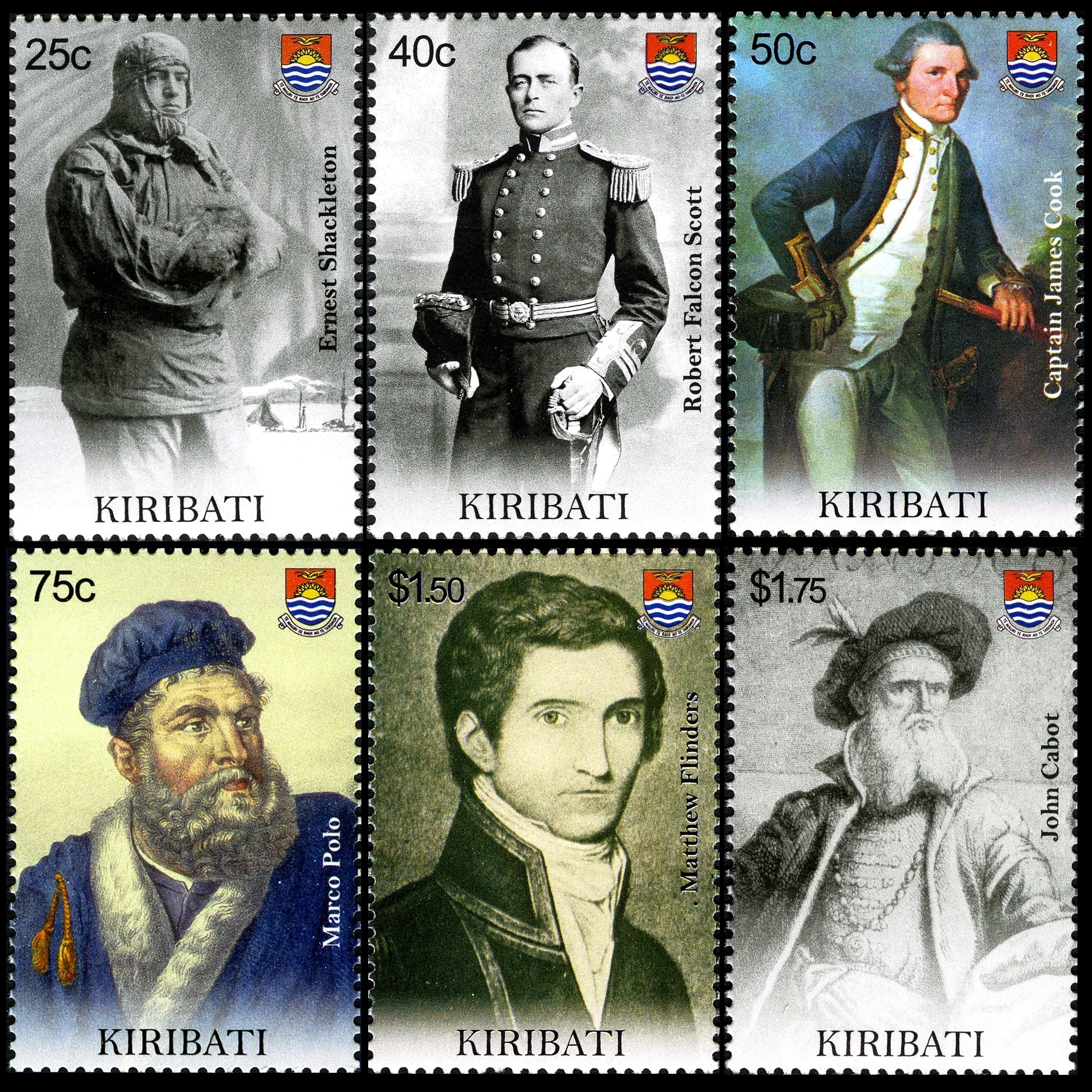
| Bulgaria, 28.02.2019 "South Pole Expedition by Robert Falcon Scott" [A5] | Hungary, 30.06.1987 "Antarctic Explorers" [A3] | Kiribati, 09.03.2009 "Sea Explores" [A1] |
 |
 |
 |
References
- Wikipedia, Encyclopaedia Britannica.
- Four things Captain Scott found in Antarctica (BBC History)
- Seward, A. C. 1914. Antarctic Fossil Plants. British Antarctic ("Terra Nova") Expedition, 1910. Natural History Report, Geology, Vol. 1, No. 1: 1–49. British Museum (Natural History), London. (Biodiversity Heritage Library)
- Woodward, A. S. 1921. Fish-Remains from the Upper Old Red Sandstone of Granite Harbour, Antarctica. British Antarctic ("Terra Nova") Expedition, 1910. Natural History Report, Geology, Vol. 1, No. 2: 51–62. British Museum (Natural History), London.