Marie Charlotte Carmichael Stopes - a British palaeobotanist
Marie Charlotte Carmichael Stopes (1880–1958) was a British palaeobotanist, geologist and author.
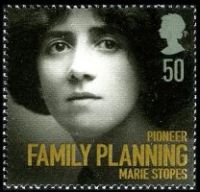 |
| Marie Charlotte Carmichael Stopes on one of the "Women of Distinction" stamps of Great Britain 2008, MiNr.: 2676, Scott: 2603. |

Born in Edinburgh, Scotland, Stopes studied botany and geology at University College London, graduating with honours in both subjects in 1902. She subsequently continued her studies at the University of Munich, where she earned a doctorate in botany in 1904. In the same year, she became the first woman appointed to the scientific staff of the University of Manchester, where she worked as a demonstrator in botany and was later promoted to lecturer in palaeobotany. In 1905, she became the youngest person in Britain to receive a Doctor of Science (DSc) degree.
Research on fossil plants and coal
Stopes's early research concentrated on Carboniferous fossil plants, particularly those preserved in coal balls. These are carbonate concretions found within coal seams that preserve fossilised plant tissues in remarkable anatomical detail. By examining such specimens under the microscope, she investigated the structure, composition and preservation of ancient vegetation, contributing to the understanding of the plants that formed Carboniferous coal deposits.
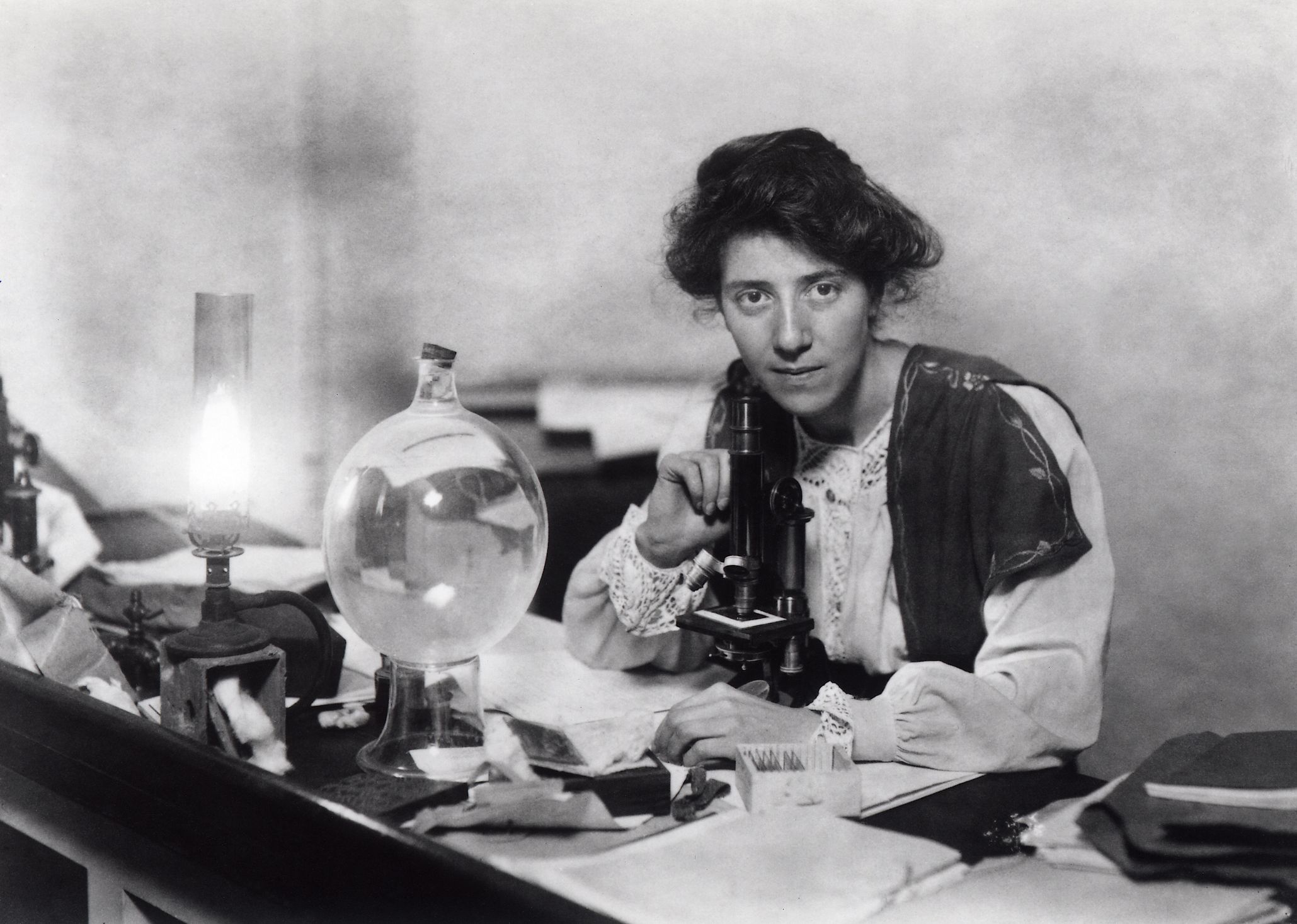 |
| Marie Stopes in her laboratory, 1904. Image credit: Wikipedia |
Stopes also investigated coal deposits in Britain and Canada, including the Carboniferous coalfields of New Brunswick. Her research into the physical and microscopic characteristics of coal led to a classification of its four principal macroscopic constituents: vitrain, clarain, durain and fusain. She introduced this terminology in her 1919 publication on the constitution of coal and it became widely adopted in coal geology and laid important foundations for the subsequent classification of coal components.
Marie Stopes, Robert Falcon Scott and the Antarctic fossils
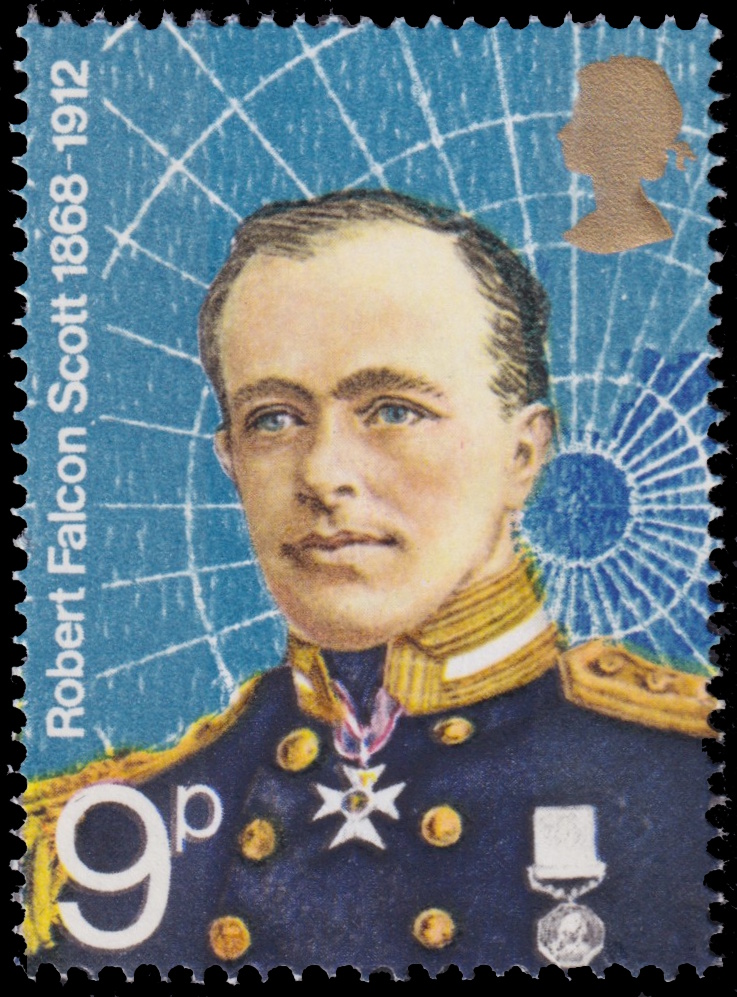 |
| Robert Falcon Scott on stamp of Great Britain 1972, MiNr.: 593, Scott: 667. |
Stopes showed him fossil specimens of Glossopteris, an extinct seed-bearing plant commonly known as a seed fern, which flourished across the southern continents during the Permian Period (298.9–251.9 million years ago).
She explained the scientific importance of finding similar fossils in Antarctica, as their distribution could provide evidence of former geographical connections between the southern continents, supporting ideas associated with the work of Eduard Suess.
Scott subsequently agreed to look for fossil plants during his second Antarctic expedition, the Terra Nova Expedition (1910–1913). Before his departure, Stopes familiarised him with the appearance of fossil plant specimens so that he could recognise and collect similar material.
During the return journey from the South Pole in February 1912, Scott's party discovered fossil plant remains in
coal-bearing rocks near Mount Buckley, in the Beardmore Glacier region.
Among the specimens were well-preserved leaves of Glossopteris.
Despite the increasingly desperate conditions, the explorers retained their geological
collections.
All five members of the polar party died on the return journey.
Their bodies and scientific collections were discovered by a search party in November 1912.
The British palaeobotanist Albert Charles Seward (1863–1941) subsequently examined the fossil
plants and identified the characteristic leaves as Glossopteris indica.
He described and illustrated the specimens in his 1914 publication,
Antarctic Fossil Plants.
The fossils provided important evidence that Antarctica had once formed part of the southern supercontinent Gondwana, together with South America, Africa, India and Australia. The widespread distribution of Glossopteris across these continents demonstrated their former geographical connection and revealed that Antarctica had once supported extensive vegetation.
 |
| Glossopteris on definitive stamp of British Antarctic Territory 1990, MiNr.: 160, Scott: 157. |
The fossils provided important evidence that Antarctica had once formed part of the southern supercontinent Gondwana, together with South America, Africa, India and Australia. The widespread distribution of Glossopteris across these continents demonstrated their former geographical connection and revealed that Antarctica had once supported extensive vegetation.
Research in Japan and fossil flowering plants
In 1907, Stopes undertook an approximately 18-month scientific expedition to Japan, supported by a research grant from the Royal Society. Her scientific objective was to investigate Cretaceous fossil plants, particularly the early evolutionary history of flowering plants (angiosperms). However, the expedition also had a personal motivation: she hoped to reunite with the Japanese botanist Kenjiro Fujii (1866–1952), whom she had met and fallen in love with during her doctoral studies in Munich. The two had maintained a romantic relationship and corresponded after Fujii returned to Japan.
 |
| Cover from Utanobori, Hokkaido — the northern Japanese island where Marie Stopes conducted fieldwork and collected Cretaceous fossil plants in 1907–1908. The 2017 landscape postmark depicts a skeleton of the extinct marine mammal Desmostylus, while the 1977 stamps commemorate the Centenary of the National Science Museum in Tokyo, where Stopes carried out her laboratory studies at the Imperial University. |
Among her most significant finds were Cretaceous plant fossils preserved in calcareous concretions, including exceptionally well-preserved reproductive structures. She identified fossil evidence of an ancient flowering plant ovary, providing important material for investigating the early evolution of angiosperms. Working with Fujii, she examined and described the Japanese specimens, publishing several scientific papers, including a joint study of the Cretaceous fossil plants of Hokkaido in 1910.
Her personal hopes, however, were not fulfilled. Although Fujii and Stopes had previously discussed marriage, their relationship deteriorated during her stay in Japan and eventually came to an end. The disappointment deeply affected Stopes. She later drew on their correspondence and experiences for her book Love-Letters of a Japanese (1911), published under the pseudonym G. N. Mortlake. The book presented a fictionalised account of a romantic relationship between a British woman and a Japanese botanist.
Despite this personal disappointment, Stopes regarded her Japanese expedition as an important scientific experience. She documented her travels, scientific work and impressions of Japanese society in A Journal from Japan: A Daily Record of Life as Seen by a Scientist (1910), which provides an unusual account of Japan in the early twentieth century from the perspective of a Western woman scientist.
These discoveries contributed to the understanding of the early evolutionary history and geological distribution of flowering plants. Her Japanese research also resulted in several scientific publications and established her reputation as an internationally recognised palaeobotanist.
Return to England
After returning to Britain in 1909, Stopes resumed her academic career at the University of Manchester as a Lecturer in Fossil Botany. Her growing reputation as a palaeobotanist led to a commission from the Natural History Museum in London to prepare a comprehensive catalogue of its Mesozoic fossil plant collections. The resulting work, Catalogue of the Mesozoic Plants in the British Museum (Natural History), was published in two volumes, in 1913 and 1915, and became an important reference for the study of fossil plants from this geological era.
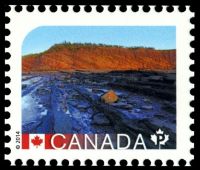 |
| Joggins Fossil Cliffs on stamp of Canada 2014, MiNr.: 3073, Scott: 2718b. |
During the First World War, Stopes also applied her geological expertise to the study of coal. Working with the Department of Scientific and Industrial Research (DSIR), she investigated coal composition and properties, including the microscopic constituents of coal. This research had practical importance for improving the understanding and utilisation of coal, an essential fuel for British industry, transport and the wartime economy.
Stopes published around fifty scientific papers and books on fossil plants, coal geology and related subjects. Her pioneering investigations of Carboniferous coal balls, fossil seed plants and early flowering plants made lasting contributions to palaeobotany and the study of coal.
Although her later activities increasingly focused on social reform, her early scientific contributions to palaeobotany and coal geology remain significant.
References
- Wikipedia, Encyclopaedia Britannica
- Falcon-Lang, H. J. & Miller, R. F. 2007. Marie Stopes and the Fern Ledges of Saint John, New Brunswick. Geological Society, London, Special Publications 281: 227–245. (Lyell Collection)
- Gelsthorpe, D. 2007. Marie Stopes the palaeobotanist, Manchester and her adventures in Japan. The Geological Curator 8(8): 375–380. (Geological Curators' Group)