Kyrgyzstan 2025 "Prehistoric animals of Kyrgyzstan II"
| Issue Date | 29.12.2025 |
| ID | Michel: ; Scott: 241-243, 243a ; Category: pR |
| Designer |
Artwork: Daria Maier, Kyrgyz Express Post, Moldova. Technical support: Aizek Asanbekovich Bakirov, the acting director of the M. M. Adyshev Institute of Geology of the National Academy of Sciences of the Kyrgyz Republic. |
| Stamps in set | 3 |
| Value |
KGS 50 - Rhamphorhynchinae indet. KGS 150 - Tashkumyrodon desideratus KGS 300 - Alpkarakush kyrgyzicus |
| Emission/Type | commemorative |
| Issue place | Bishkek |
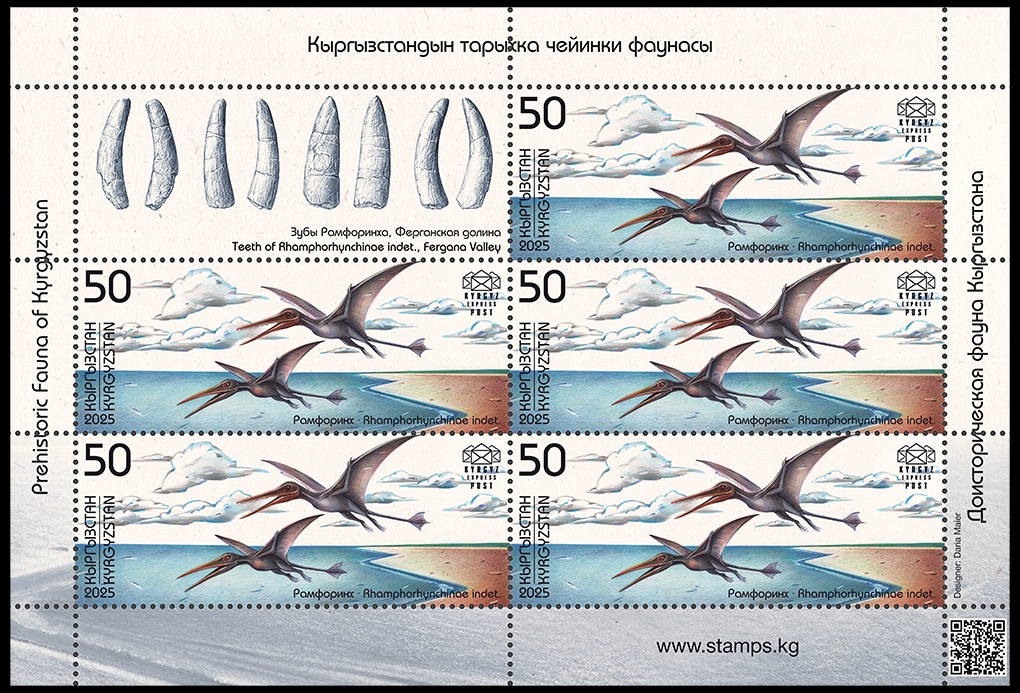
| Size (width x height) | stamps: 69.00 mm × 27.50 mm Mini-Sheet of 5: 159 mm x 108 mm Mini-Sheet of 3: 124 mm x 80 mm |
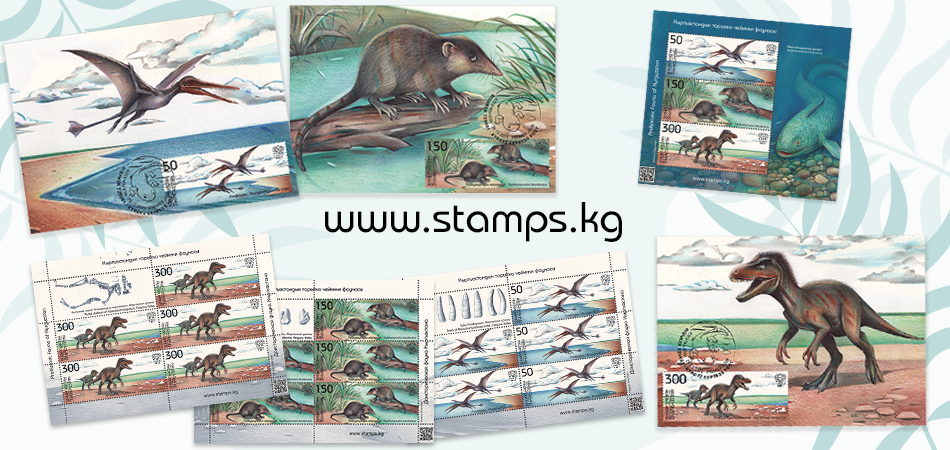
| Layout | 3 Mini-Sheets of 5 stamp + 1 tab 1 Mini-Sheet of all 3 stamps |
| Products | FDC x4, MC x3 |
| Paper | coated, gummed, 105 g/m2 |
| Perforation | 14 x 14.50 |
| Print Technique | full-colour offset lithography |
| Printed by | "Nova Imprim" (Chișinău, Moldova). |
| Quantity | 7.500 copies of each stamp
(5.000 in Mini-Sheets plus 2.500 in collective Mini-Sheets). FDC: 400; MC 400 sets |
| Issuing Authority | Kyrgyz Express Post |
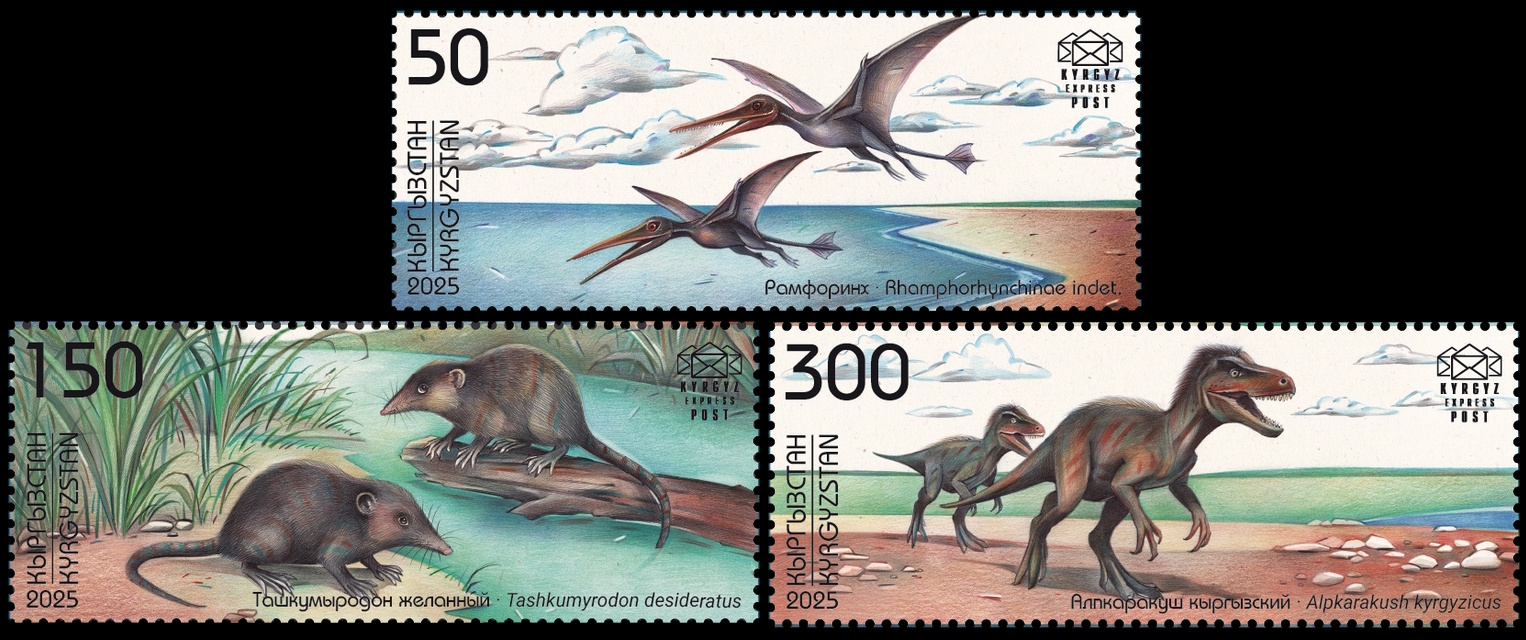
On December 29th, 2025, the Ministry of Digital Development of the Kyrgyz Republic issued a new series of Kyrgyz Express Post (KEP) postage stamps titled “Prehistoric Fauna of Kyrgyzstan II”.
The set contains three stamps:
- KGS 50 - postcard rate - Rhamphorhynchinae indet.
(a type of pterosaur) - KGS 150 - regular letter with weight up to 50g. - Tashkumyrodon desideratus (an early mammal-like animal)
- KGS 300 - regular letter with weight up to 100g. - Alpkarakush kyrgyzicus (a large theropod dinosaur)
Unlike the first issue, the author of this website was not involved in the design of this stamp set. As Michael Kogan explains:
I received the final sketches of these stamps when it was already too late to make any changes. The only modification I was able to implement was an elongation of the tail of the Rhamphorhynchinae.
 Millions of years ago, the territory of modern Kyrgyzstan was home to remarkable creatures,
whose remains today help paleontologists reconstruct the picture of the region's distant past.
Unique fossils were discovered in the deposits of the Jurassic Period, reflecting the
richness and diversity of the region’s prehistoric fauna.
Millions of years ago, the territory of modern Kyrgyzstan was home to remarkable creatures,
whose remains today help paleontologists reconstruct the picture of the region's distant past.
Unique fossils were discovered in the deposits of the Jurassic Period, reflecting the
richness and diversity of the region’s prehistoric fauna. All four prehistoric animals featured on the stamps and the postmark were discovered in the Balabansai Formation is a fossil rich-unit. A site in western Kyrgyzstan where fossils were found in the Balabansai Formation is shown on the cachet of the FDC.
The Balabansai Formation, dating to 165 million years ago, was deposited by fluvial, lacustrine, and coastal processes. The rock layers tell a story of rivers shifting, floodplains forming, and shallow lakes under a warm, seasonal climate. The formation stretched across what is now western Kyrgyzstan, Uzbekistan, and south-eastern Kazakhstan and has yielded an amazing variety of fossils, including dinosaurs, turtles, amphibians, fish, and some of the earliest mammal-like creatures. These fossils show that Middle Jurassic Kyrgyzstan was a lively ecosystem with large herbivores, predators, small mammals, and fish all living together.
The following prehistoric animals were depicted on the stamps and a postmark
Rhamphorhynchinae (Rhamphorhynchinae indet.)
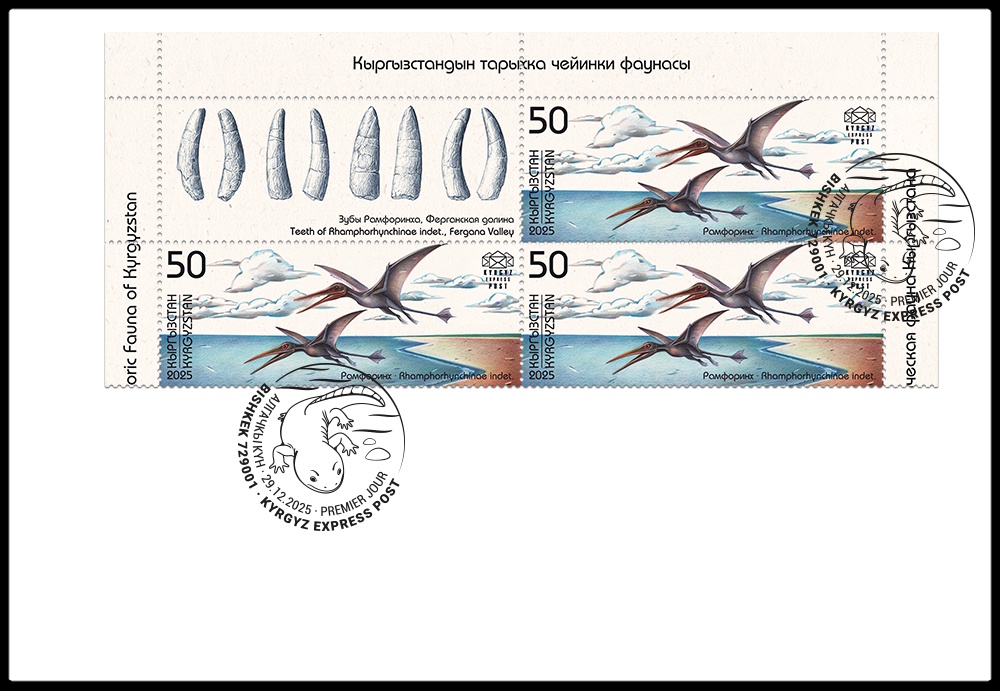
Tiny teeth found in the Balabansai Formation near Tash-Komur, one of the five largest towns in the Jalal‑Abad Region, belong to long-tailed pterosaurs called Rhamphorhynchinae. Paleontologists cannot determine the exact species from these fragments, but they offer a fascinating glimpse into the flying reptiles that lived in this region over 160 million years ago.
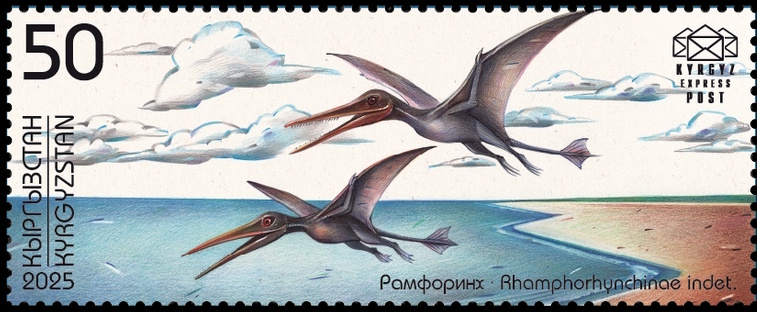 |
| Rhamphorhynchinae on stamp of Kyrgyzstan 2025, MiNr.: , Scott: |
Although only a few teeth were discovered, they prove that pterosaurs were part of Middle Jurassic ecosystems in Central Asia, bridging an important gap between finds in Europe and East Asia. The fossils suggest that flying reptiles were more widespread than previously thought. However, because we only have teeth, scientists cannot determine the full size or appearance of these animals, leaving much about their behavior and lifestyle a mystery.
These small fossils are still scientifically valuable, helping researchers understand how pterosaurs spread across the ancient world and adapted to different environments. They also show that even fragmentary remains can reveal big stories about life millions of years ago.
Tashkumyrodon (Tashkumyrodon desideratus)
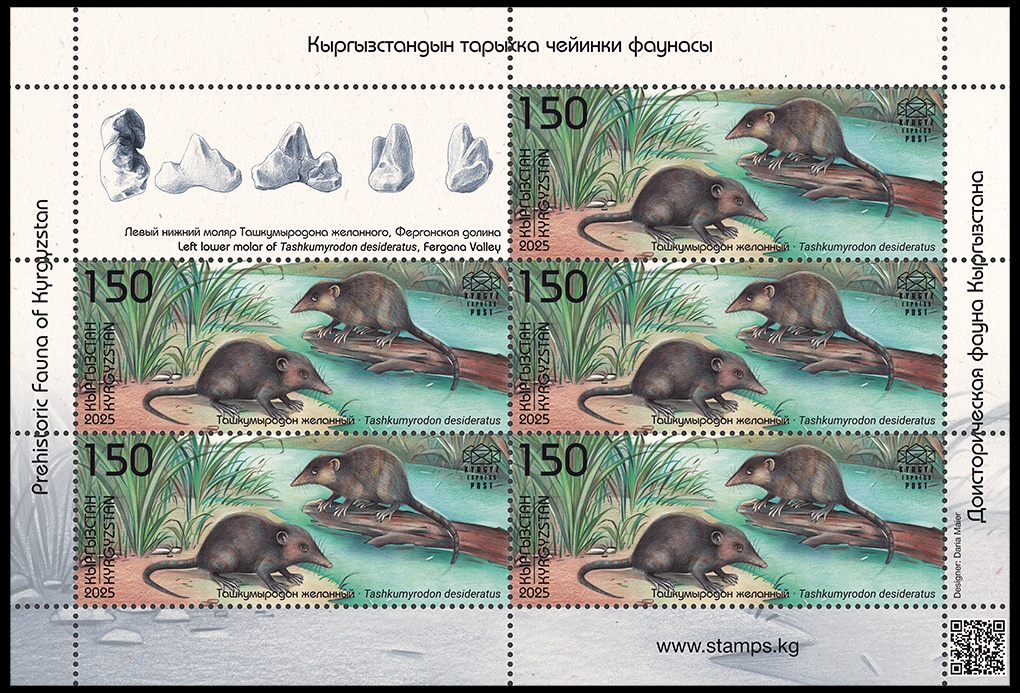
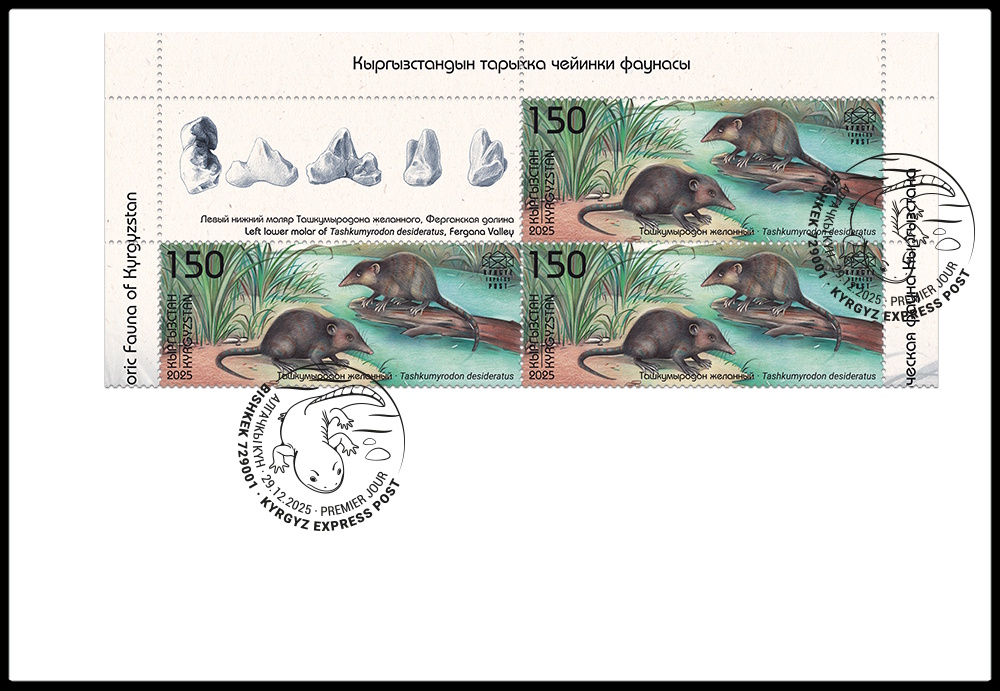
Tashkumyrodon was a small, extinct mammaliaform that lived during the Middle Jurassic, around 165 million years ago. Its fossils were found near the town of Tash-Komur too. The genus name comes from this town, while the species name, desideratus, refers to its uniqueness as a member of the early mammal lineage.
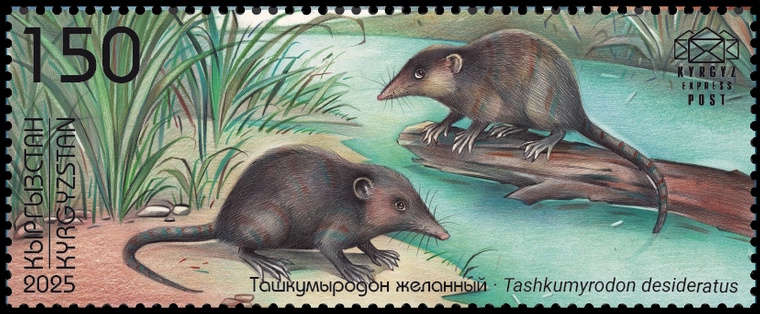 |
| Tashkumyrodon desideratus on stamp of Kyrgyzstan 2025, MiNr.: , Scott: |
During the Jurassic, small creatures like Tashkumyrodon would have shared their environment with dinosaurs, pterosaurs, turtles, amphibians, and fish. Their tiny size and delicate bones meant they rarely survived as complete skeletons, making isolated teeth like this one extremely valuable for paleontologists. Today, the holotype tooth of Tashkumyrodon desideratus is carefully preserved in the Zoological Institute of the Russian Academy of Sciences in St. Petersburg, Russia, serving as a key reference for studying early mammals.
Alpkarakush (Alpkarakush kyrgyzicus)
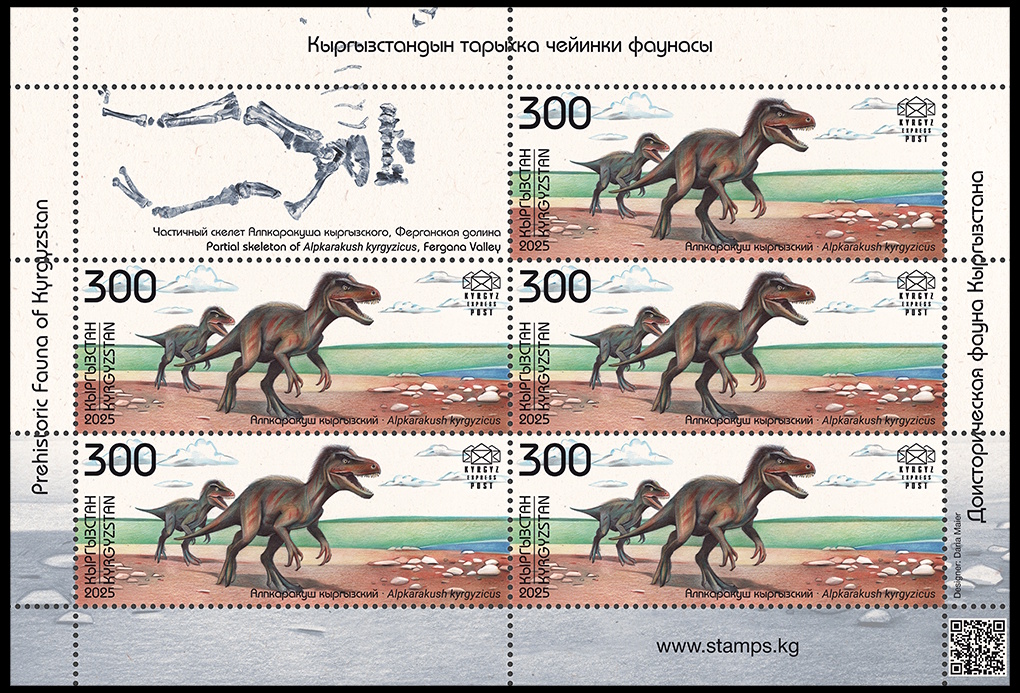
Alpkarakush kyrgyzicus is a newly discovered carnivorous dinosaur from the Middle Jurassic, making it the first well-documented Jurassic predator from Kyrgyzstan. Its fossils were first found in 2006 by Kyrgyz paleontologist Aizek Bakirov near the town of Tash-Komur too. Excavations over the following years uncovered parts of two individuals: a larger subadult and a smaller juvenile.
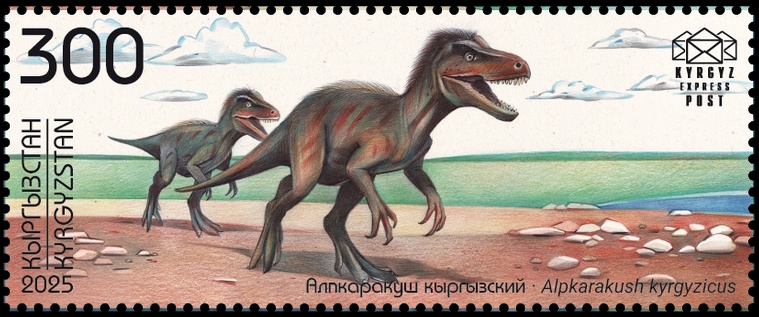 |
| Alpkarakush kyrgyzicus on stamp of Kyrgyzstan 2025, MiNr.: , Scott: |
- A pronounced ridge above the eye, almost like a small horn.
- Hollow spaces in the vertebrae of its back, which may have helped lighten its skeleton.
- A distinct groove on one of its hand bones.
- Special features on the thigh bone, including a deep groove and a ridge offset from the end of the bone.
The name Alpkarakush comes from a mythical bird in the Kyrgyz epic Manas, while kyrgyzicus honors the country of discovery. This find not only adds to our knowledge of dinosaurs in Central Asia but also connects science with Kyrgyz cultural heritage. There are plans to display a reconstructed skeleton in a national museum.
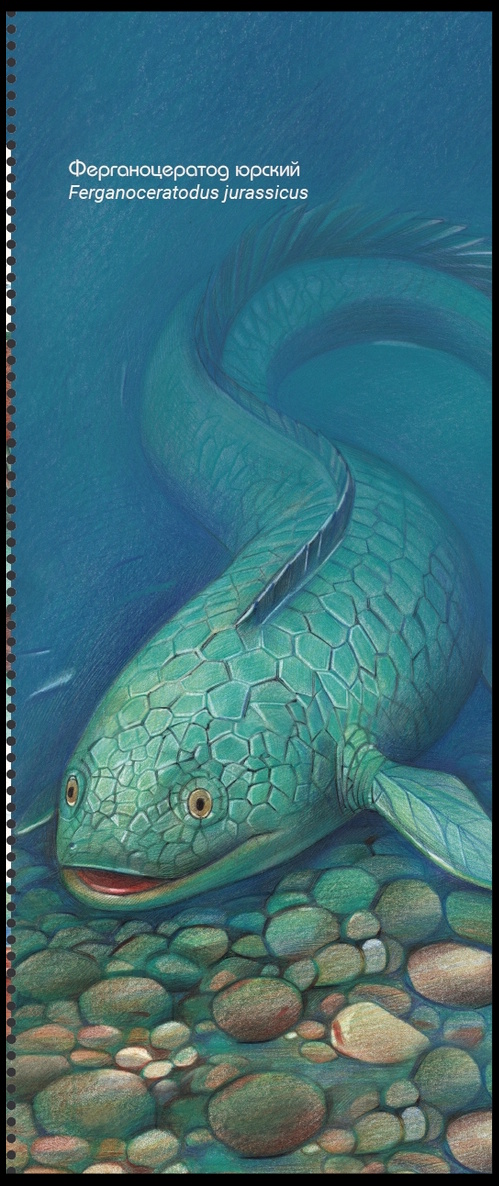 |
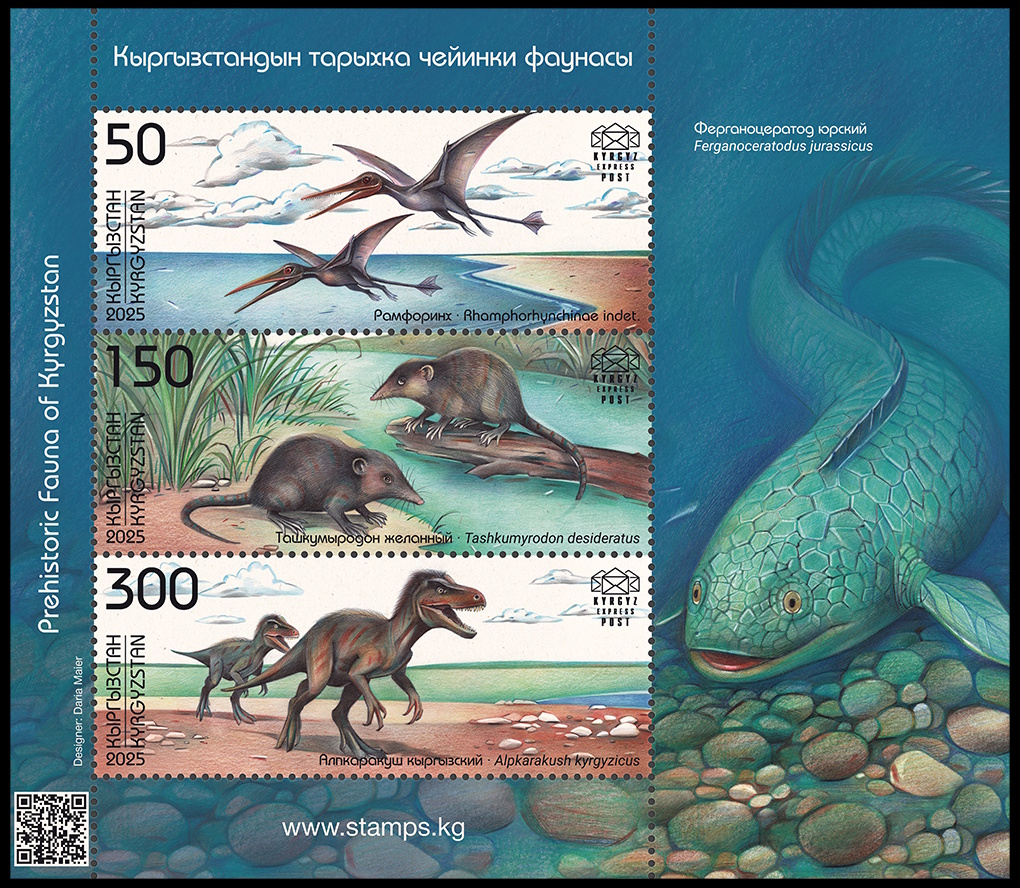
| A freshwater lungfish Ferganoceratodus jurassicus on a margin of a Mini-Sheet |
Ferganoceratodus jurassicus was a freshwater lungfish that swam in rivers and lakes of Central Asia about 165 million years ago. Unlike dinosaurs, lungfish are closely related to the first animals that moved from water to land, making them important for understanding one of the most dramatic steps in vertebrate evolution.
The genus Ferganoceratodus was first described in 1985 by Soviet paleontologists Lev Nessov and Mikhail Kaznyshkin. They named it after the Fergana Valley, a broad region near where the Balabansai Formation outcrops, rather than the specific site where the fossil was found, as a way to honor the wider area where these ancient fish once lived—a common practice in paleontology.
Fossils of Ferganoceratodus include tooth plates and pieces of the skull, which show unique features: the upper plates had five ridges, while the lower had four, separated by deep grooves.
These adaptations suggest it was well-equipped for crushing food, likely feeding on small invertebrates or plant matter in rivers and lakes.
Although first discovered in Kyrgyzstan, other species of Ferganoceratodus have been found elsewhere: for example, Ferganoceratodus annekempae in Thailand and Ferganoceratodus edwardsi in Zimbabwe.
This shows that the genus was widespread across the ancient supercontinent of Pangea and survived for tens of millions of years.
Lungfish like Ferganoceratodus are also scientifically fascinating because they represent a living link to the first four-limbed vertebrates. By studying these fossils, scientists can better understand how life transitioned from water to land, one of the most important events in Earth’s history.
Kokartus (Kokartus honorarius)
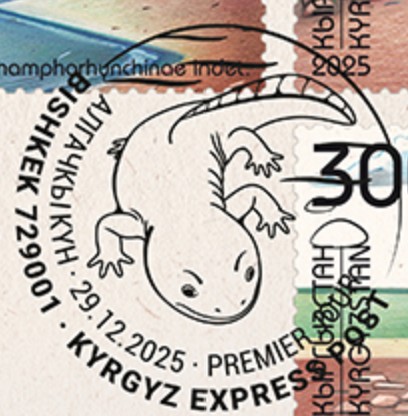
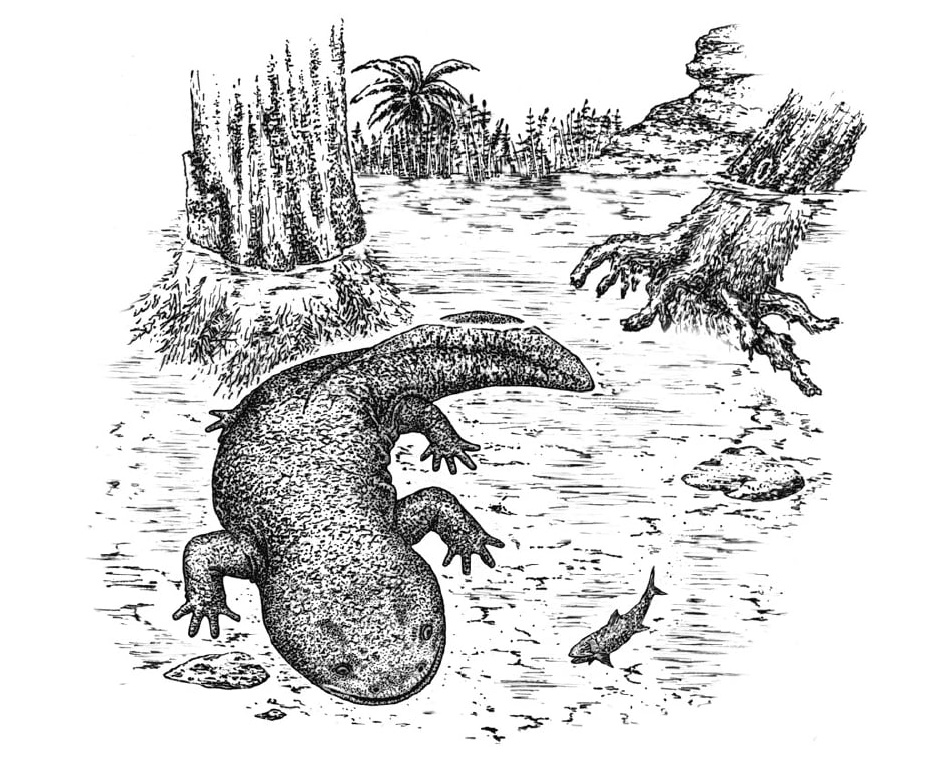
Kokartus is an extinct genus of prehistoric stem-group salamander (Caudata) from the Middle Jurassic, around 165 million years ago, Balabansai Formation of Kyrgyzstan, was depicted on the First-Day-of-Issue Postmark. To date the genus contains only one species Kokartus honorarius, described by the Soviet paleontologist Lev Nessov in 1988 on the basis of fragmentary specimens.
 |
 |
|
Kokartus honorarius on First-Day-of-Issue Postmark of Kyrgyzstan 2025.
|
The design of the postmark was inspired by the reconstruction of Kokartus honorarius drawn by V. N. Glinskiy, published in Zoological Journal of the Linnean Society in 2011. |
Kokartus honorarius is among the oldest and most basal salamanders known in the fossil record and lived at a time when dinosaurs dominated terrestrial ecosystems. Its remains were found in sediments representing a coastal environment along the northern shore of the Tethys Ocean, a region that has yielded important fossils of Jurassic freshwater animals. Although very small, estimated at only 8 to 12 cm in total length, Kokartus is scientifically significant because it preserves an early stage in salamander evolution, combining primitive amphibian characteristics with features seen in modern species. These fossils provide valuable insight into how modern salamanders evolved and how early amphibians lived in Jurassic freshwater environments.
Products and associated philatelic items
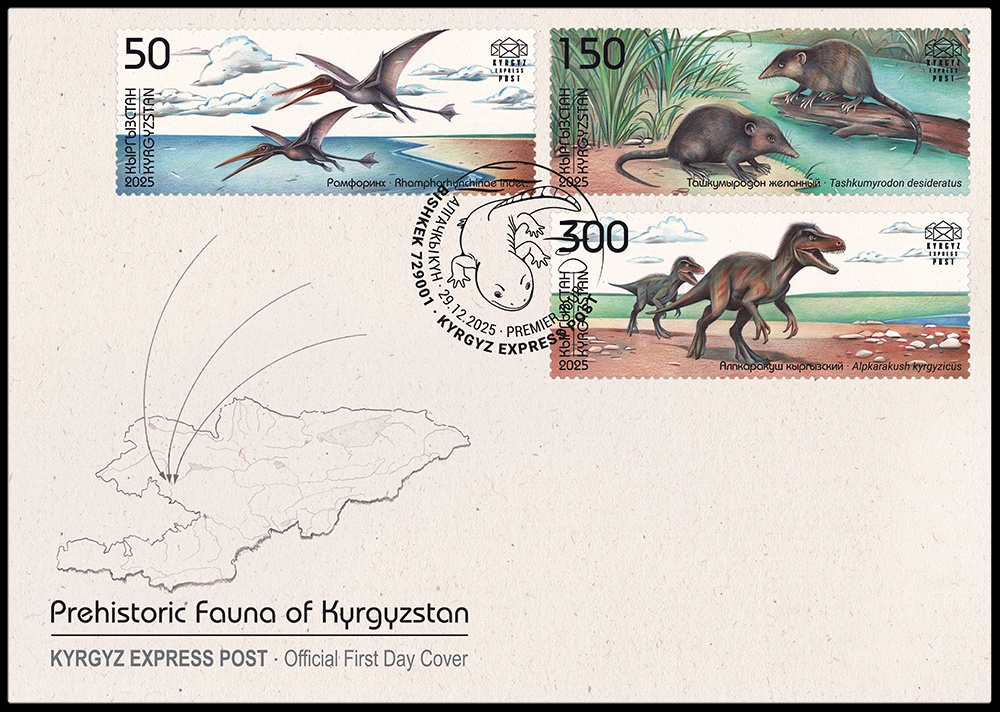
| Official FDC | Mini-Sheet of 3 | |
 |
 |
 |
|
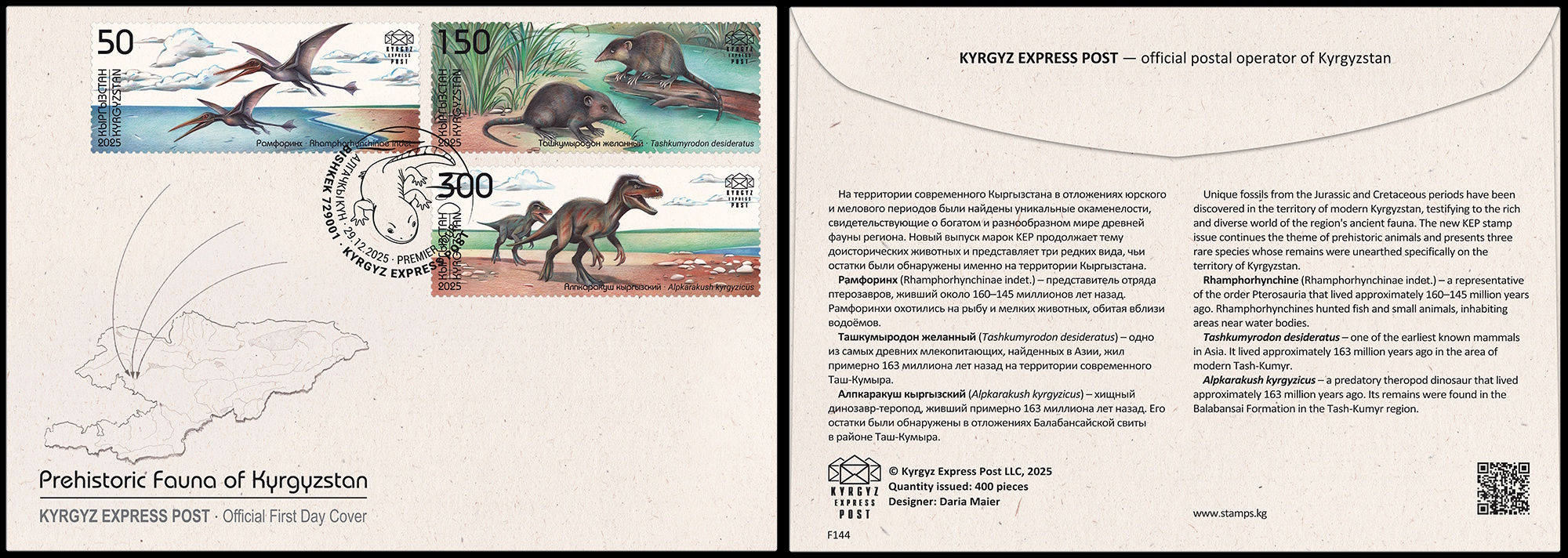
The reverse side of the FDC
contain a short descriptive text. The first day cover features a map of Kyrgyzstan with arrows indicating the locations where fossils of the respective prehistoric animals depicted on the stamps were discovered. |
A freshwater lungfish Ferganoceratodus jurassicus depicted on the margin of the Mini-Sheet.
|
|
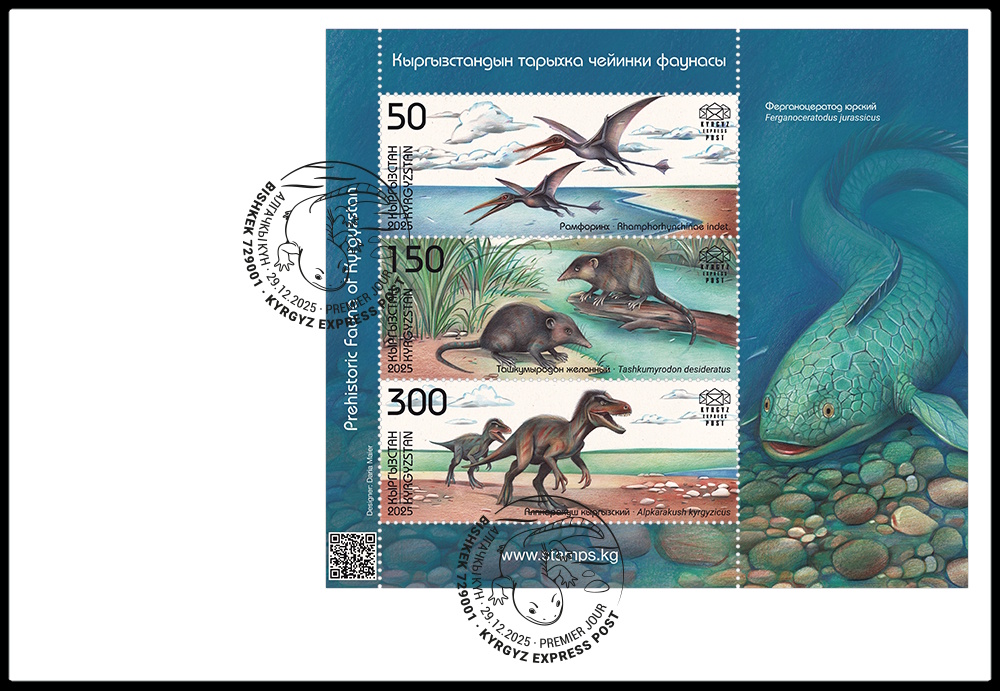
| Circulated FDC | ||
 |
 |
 |
| Mini-Sheets | ||
 |
 |
 |
| Additional FDC | ||
 |
 |
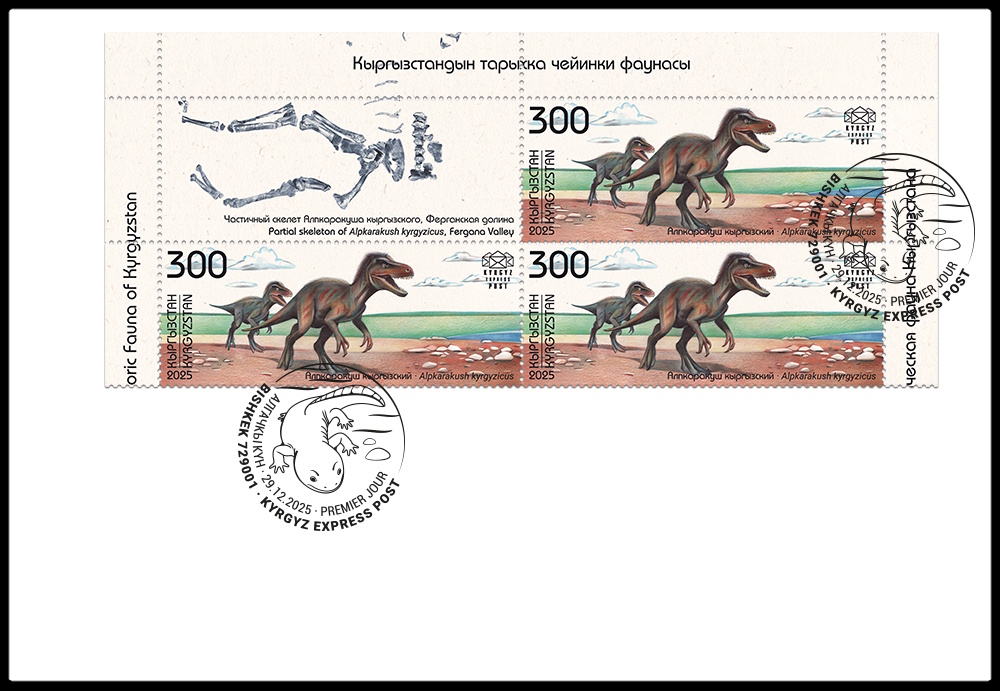 |
 |
 |
 |
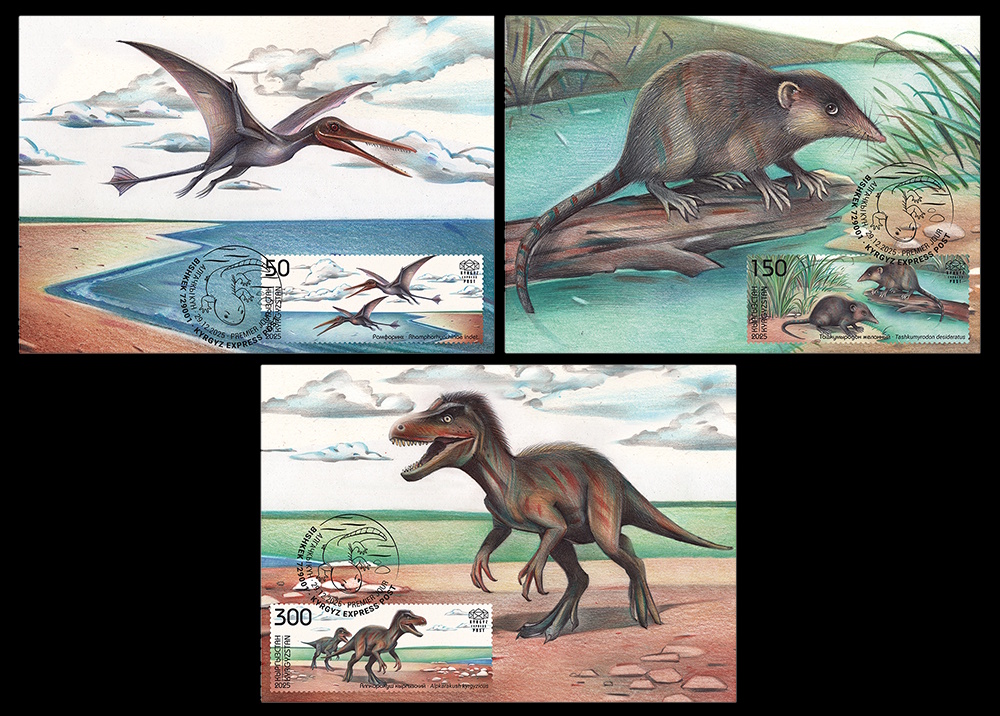
| First-Day-of-Issue Postmark | Maxi Cards | |
|
 |
|
References
- Technical details and official press release
- Newsletter no. 121 of Kyrgyz Express Post from 26 December 2025.
- Balabansai Formation
- Rhamphorhynchinae
- Wikipedia
- "Pterosaur and dinosaur remains from the Middle Jurassic Balabansai Svita in the northern Fergana Depression, Kyrgyzstan"
- Pterosaurs philatelic exhibit, in German, by Mr. Rudolf Hofer.
- Tashkumyrodon
- Alpkarakush
- Wikipedia
- "A new theropod dinosaur from the Callovian Balabansai Formation of Kyrgyzstan"
- "New Carnivorous Dinosaur Species Unearthed in Kyrgyzstan"
- "T. rex relative with giant, protruding eyebrows discovered in Kyrgyzstan"
- "Epic dinosaur skull dug up in Kyrgyzstan desert has got scientists VERY excited. Here's why"
- "Paläontologie: Neuer Raubdinosaurier mit markanter 'Augenbraue'"
- "New Species of Dinosaur Discovered in Kyrgyzstan."
- Ferganoceratodus
- Kokartus
- Wikipedia
- "Cranial anatomy of the stem salamander Kokartus honorarius (Amphibia: Caudata) from the Middle Jurassic of Kyrgyzstan", by PAVEL SKUTSCHAS and THOMAS MARTIN, published in Zoological Journal of the Linnean Society, 2011, 161, 816–838.
Acknowledgements
Many thanks to Dr. Peter Voice, PhD Department of Geological and Environmental Sciences, Western Michigan University, USA, for his help in finding information and for review of a draft of this article.