Short presentation about Mr. Michael Kogan, the Author and Admin of this website
I found my first fossil when I was 12-13 years old, in the mid-1980s. It was a tooth of a prehistoric fish in a piece of stone. I took it to the Natural History Museum where an employee explained to me what I had found. It was astonishing, because in Lviv, the Ukrainian city, where I grew up, there was no sea or even a river. Prehistoric creatures began to occupy my imagination. I began to study them, collecting fossils and stamps on the theme. After some time, I had quite a few fossils of ammonites, belemnites, petrified wood and teeth of prehistoric fishes and I dreamt of being a paleontologist.
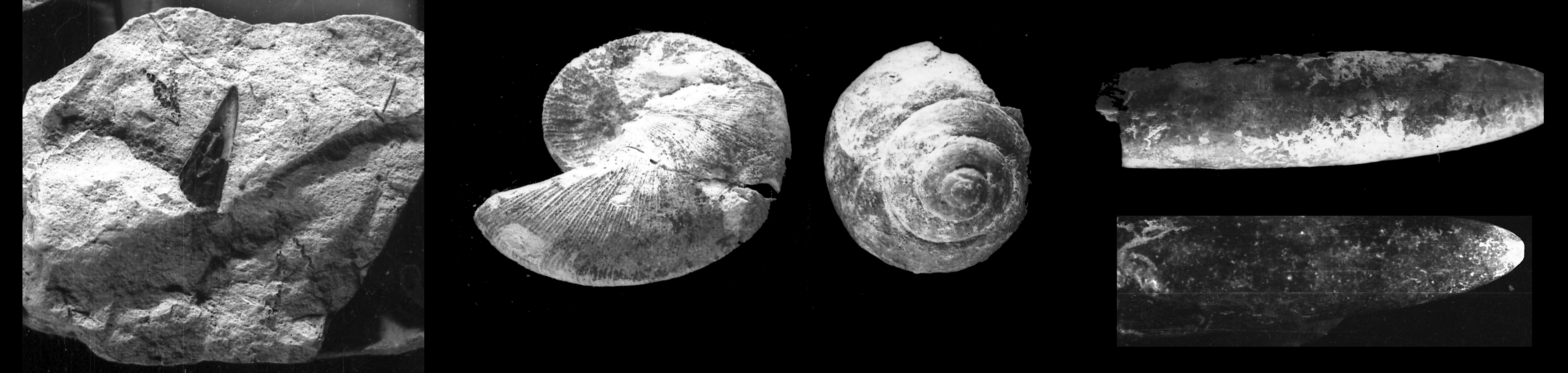
Shortly after finishing school, my family emigrated from Ukraine, and my life changed significantly. Adapting to a new country, learning a new language, and completing studies in electronics and computer science (rather than paleontology) took much of my time. Marriage and the start of my professional career left little room for hobbies, but my interest in paleontology never disappeared, and I continued to follow the field whenever possible.
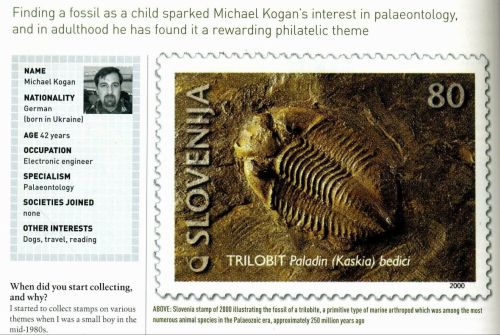 |
| Mr. Kogan's interview for "STAMP" magazine in April 2014 |
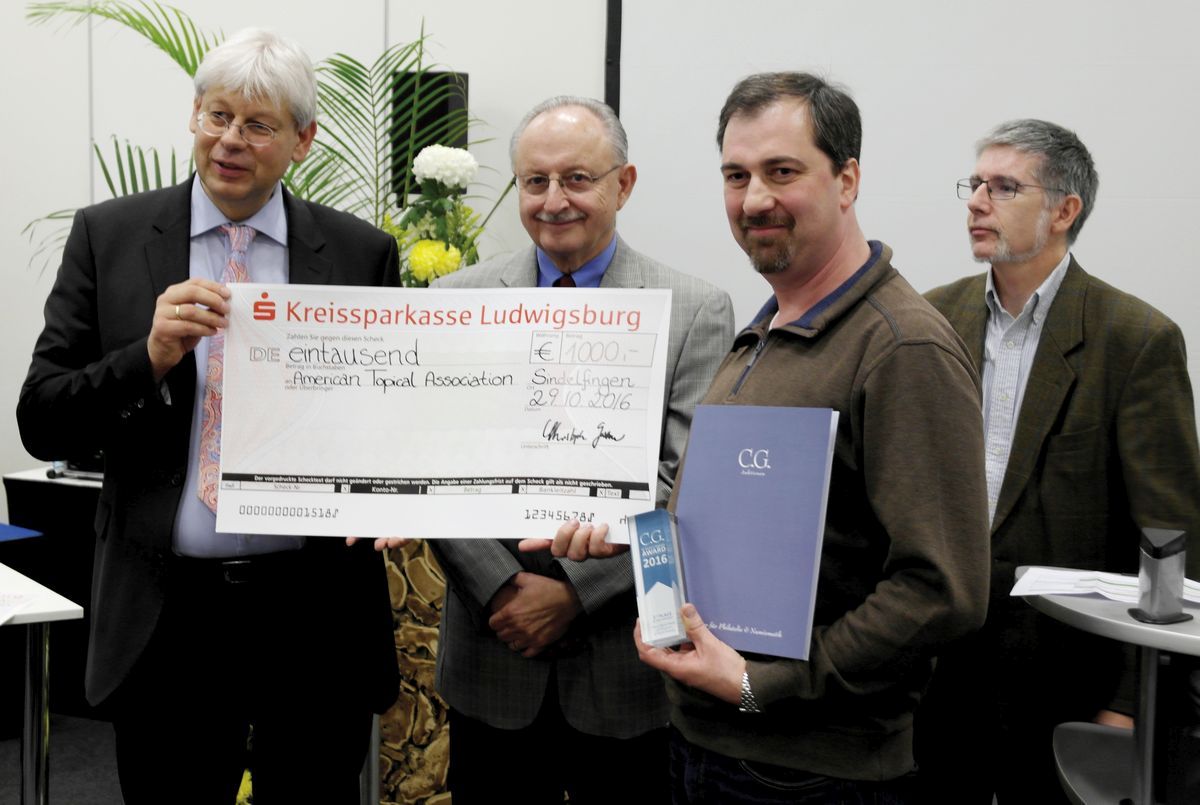 |
| Mr. Kogan (on the right side) receives a prise for "Topical Times" magazine on behalf of American Topical Association (ATA), in Sindelfingen, Germany in 2016. |
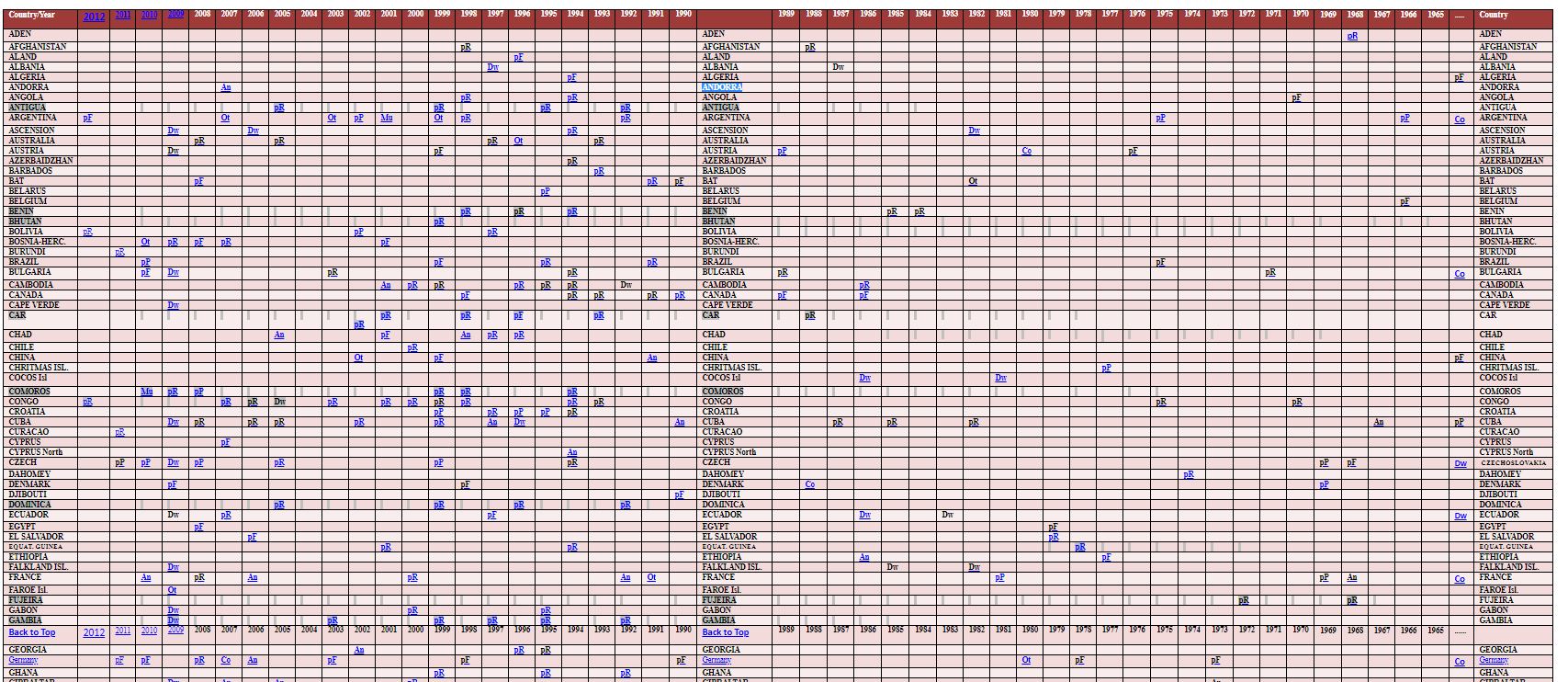
|
| The first page of Paleophilatelie website. |

|
| Mr. Michael Kogan, November 16th, 2025 |
At the end of 2001, I accepted an offer from a German company and moved to Munich, where I still live today. In 2010, while sorting through old books and photographs, I rediscovered my stamp album. Leafing through its pages rekindled my enthusiasm. Searching online, I discovered a surprisingly large number of stamps depicting dinosaurs, other prehistoric animals, fossils, and paleontologists. I was astonished by how many such stamps had been issued since 1990, the year I had stopped collecting. Nearly every country had released at least a few issues, and some had produced extensive thematic sets.
This discovery prompted me to resume my collection.
I collect all kinds of philatelic material related to paleontology, not only
mint stamps and First Day Covers
(FDCs),
but also attractive postally used covers featuring relevant
stamps or postmarks.
I treat my collection as a "Museum in an Album" and only add items
with interesting background stories.
I focus on those that genuinely interest me.
I also avoid stamps issued by certain countries solely for commercial purposes,
with no meaningful historical or scientific background.
After restarting my collection, I searched for ataloguesc or websites listing paleontology-related stamps and postmarks. The only printed catalogue I found was the Domphil catalogue from 2002. Although it was of good quality, many new issues had appeared since its publication. The few thematic websites I encountered offered only basic information, such as title, date of issue, and catalogue number. Some displayed only very small images, while others had none at all, making it difficult to identify specific items. Furthermore, none provided detailed information about the prehistoric animals depicted or the background of the stamp issues themselves.
To fill out the gap and to be able to share the information with other collectors, Paleophilatelie website was created in October 2010.The earliest version of the website consisted of two tables created in MS Word, offering an overview of prehistoric-themed stamps.
Simply filling albums with stamps and covers has never been satisfying to me; I am far more interested in researching the stories behind each item and learning as much as possible about every new acquisition. As information became available, I began creating detailed description pages and linking them within the tables.
Today, the website contains over 700 pages and more than 16,000 images.
The development history of the Paleophilatelie.eu website can be traced through the Internet Archive of Wayback Machine, where numerous snapshots have been preserved since June 2011.
Since 2018, I have submitted this website to many international competitions for philatelic websites in the "Electronic Literature" Category. The website has earned many medals including Large Gold Medals.
Today, I'm a member of:
- International Association of Philatelic Journalists
- American Topical Association (ATA)
- American Philatelic Society (APS)
- Biophilately Study Unit of ATA, where I hold Associated Editor position for Paleontology division (short presentation of the club is here)
- German Philatelic Association - Bund Deutscher Philatelisten (BDPh)
- "Arbeitsgemeinschaft Bergbau und Geowissenschaften e. V" (in English: Mining and Geosciences Study Group, short presentation of the club is here)
Collectors who share the same interest are very welcome to join my
Facebook-Group
"Paleophilately",
follow me on
Twitter or
contact me by
email.
You can find me under the nickname "PaleoPhilatelist" on the following philatelic sites:
Colnet,
and many
international forums.
I also have a small store on
Delcampe,
where I sale some duplicates and outlets of my collection.
Michael Kogan, also known as Paleophilatelist, December 23th, 2025, Munich Germany
Acknowledgements
Many thanks to Dr. Peter Voice from Department of Geological and Environmental Sciences, Western Michigan University, for reviewing the draft page and his valuable comments.