Spain 2026 "The centenary of the Geomineral Museum"
| Issue Date | 03.09.2026 |
| ID | Michel: Scott: Stanley Gibbons: Yvert: UPU: Category: pF |
| Design | |
| Stamps in set | 1 |
| Value | €2 - museum main hall |
| Size (width x height) | 74.6mm x 28.8mm |
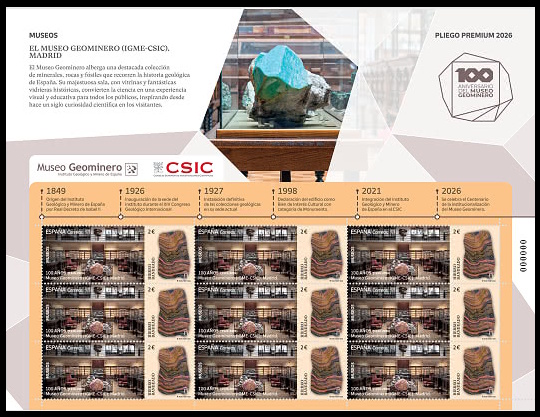
| Layout | Sheet of 15 and premium sheet with 9 stamps each |
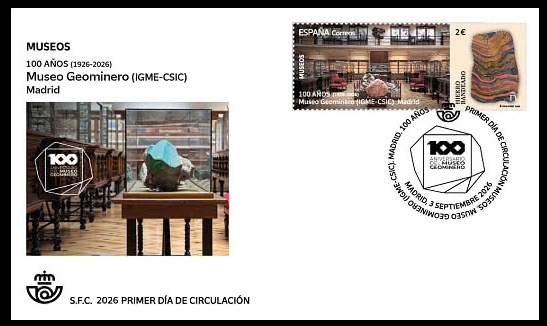
| Products | FDC x1 |
| Paper | |
| Perforation | 12.75 x 13.75 |
| Print Technique | Offset |
| Printed by | Fábrica Nacional de Moneda y Timbre-Real Casa de la Moneda (RCM-FNMT) |
| Quantity | 75.000 |
| Issuing Authority | Correos y Telégrafos S.A. |

On September 3rd, 2026, the Spanish postal operator Correos y Telégrafos S.A. issued a commemorative stamp marking the centenary of the Geomineral Museum.
The design features a view of the museum's exhibition hall, together with two notable exhibits: a replica of the skull of “Stan”, a Tyrannosaurus rex discovered in 1987 in Upper Cretaceous deposits in South Dakota, USA, and a specimen of Australian banded iron formation, one of the oldest geological specimens in the museum's collection, dating back approximately 3.5 billion years.
May 24, 1926, marked an important milestone in the history of the Geological and Mining Institute of Spain (IGME-CSIC). On that day, the XIV International Geological Congress was inaugurated in Madrid, bringing together Earth science specialists from many countries. The congress also helped establish the institution as an important international centre for geological research.
The exhibition hall, designed by architect Francisco Javier de Luque to host the congress, subsequently began a new chapter as a permanent exhibition space. The institution's collections of minerals, fossils and rocks, accumulated through decades of geological research since the mid-19th century, were displayed there. Over time, this exhibition space evolved into the present-day Geomineral Museum, now regarded as one of IGME's architectural gems. Its main hall is particularly notable for its elegant design and spectacular false ceiling decorated with polychrome stained glass, whose light creates a distinctive atmosphere for the exhibits.
Today, the museum's collections encompass an extensive range of geological and palaeontological specimens. Its fossil collection comprises approximately 6,000 specimens, of which around 1,000 are on display. Among the larger exhibits are almost complete skeletons of a mountain goat and a cave bear, recovered from Pleistocene deposits in Madrid and Guipúzcoa, respectively.
Other notable palaeontological exhibits include stromatolites, some of the oldest evidence of life on Earth; amber and copal containing fossilised insects and arachnids; and trace fossils recording the activity of ancient organisms.
A large-scale display recreates the excavation of the Pliocene proboscidean Anancus arvernensis at Las Higueruelas in Ciudad Real. It incorporates original fossil remains, including tusks and a skull.
The museum's history reflects not only the transformation of its exhibition space, but also the development of a scientific, educational and cultural institution dedicated to preserving and sharing Spain's geological heritage.
Products and associated philatelic items
| FDC | Sheet of 9 | |
 |
 |
|
References
- Technical details and short description:
Correos - Geological and Mining Museum (IGME-CSIC) in Madrid:
Correos, Official website of the Museum: [1], [2], [3].