Spain 2023 "JUVENIA, Teruel - Liopleurodon" (ATM stamp)
| Issue Date | 19.04-23.04.2023 |
| ID | Michel: Scott: Stanley Gibbons: Yvert: Category: pF |
| Designer | |
| Stamps in set | 16 1 ATM-label with pre-printed design x 4 design variations x 4 values |
| Value |
A - Liopleurodon A2 - Liopleurodon B - Liopleurodon C - Liopleurodon |
| Emission/Type | commemorative, ATM stamps. |
| Issue place | Teruel, Albarracín, Madrid |
| Size (width x height) | 55mm x 25mm |
| Layout | Roll of 1500 ATM-labels |
| Products | None |
| Paper | |
| Perforation | die-cut 14 |
| Print Technique | |
| Printed by | ATM vending machine |
| Quantity | |
| Issuing Authority | Correos y Telégrafos S.A. |
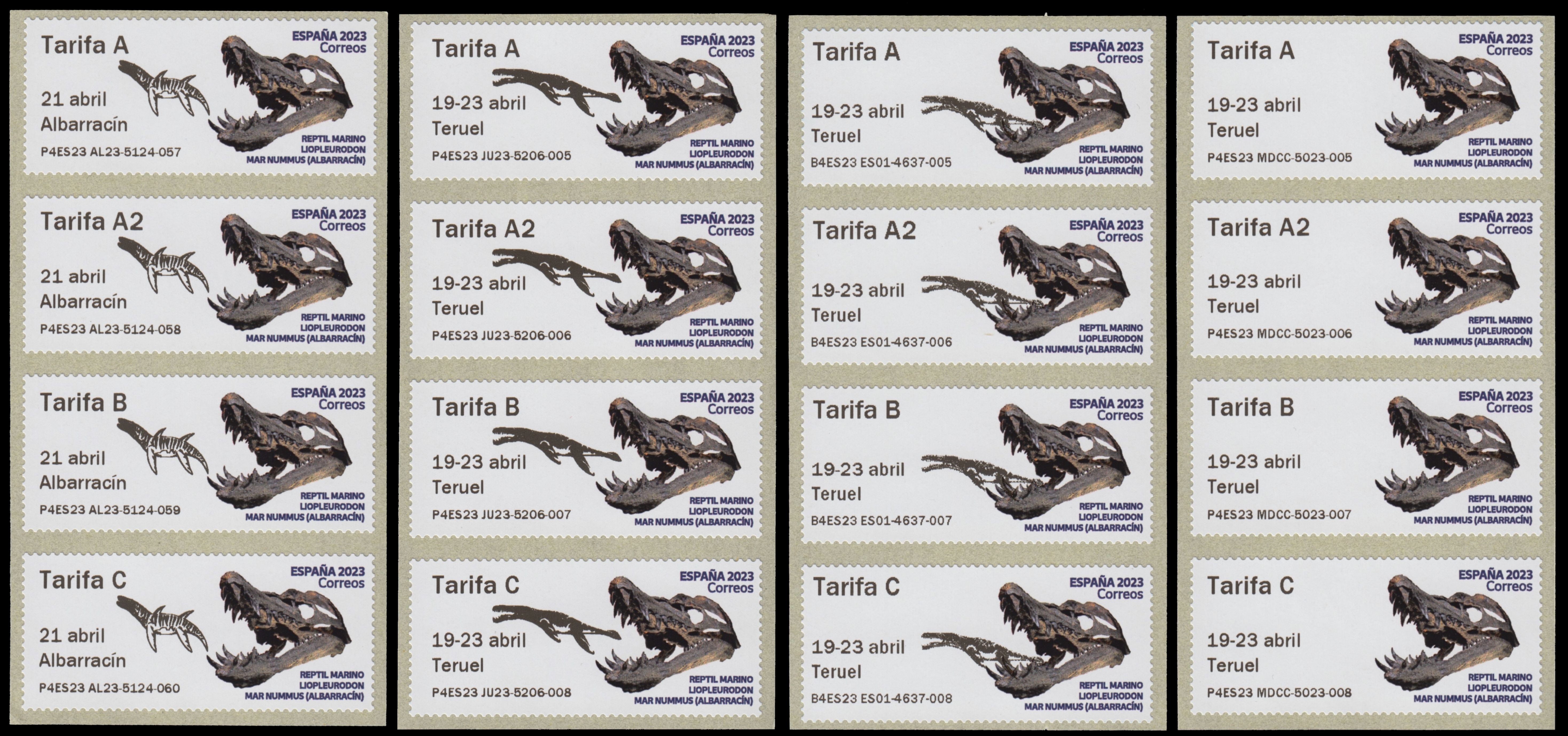
Between April 19th and April 23rd, Teruel (the capital of Teruel Province in Aragon, located in eastern Spain) hosted 3 philatelic events at the same time:
- the 61st National Philatelic Exhibition and Spanish Championship - EXFILNA 2023
- the 28th National Exhibition of Youth Philately and Spanish Championship - JUVENIA 2023
- the 5th European Championship of Maximofilia
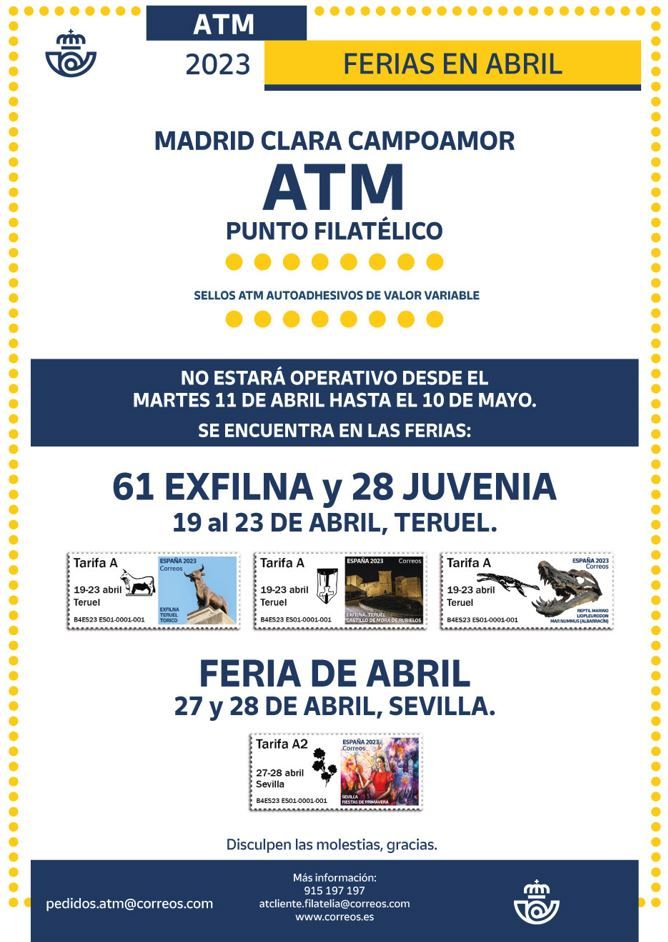
In order to commemorate these events, "Correos" - Post Company of Spain, issued a gummed stamp depicting the dinosaur "Aragosaurus ischiaticus", 3 ATM-labels and 20 postmarks, including 5 First-Day-of-Issue postmarks for ATM stamps, as well as some philatelic souvenirs. These ATM stamps were on sale in Teruel and Albarracin (37km away from Teruel) during the show's hours, as well as at the philatelic desk in Madrid.
One of the ATM-labels featured a skull of a prehistoric marine reptile - Liopleurodon, who lived during the Late Jurassic - 166 to 155 million years ago.
 |
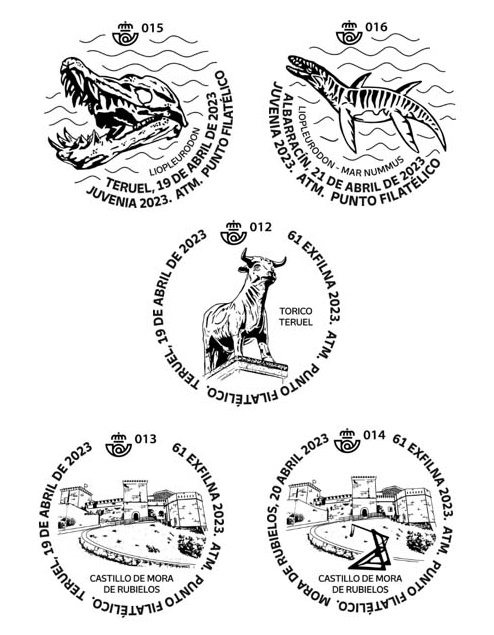 |
| Announcement of Spain's Post about ATM stamps issue in April 2023. | Postmarks associated with the ATM stamps. |
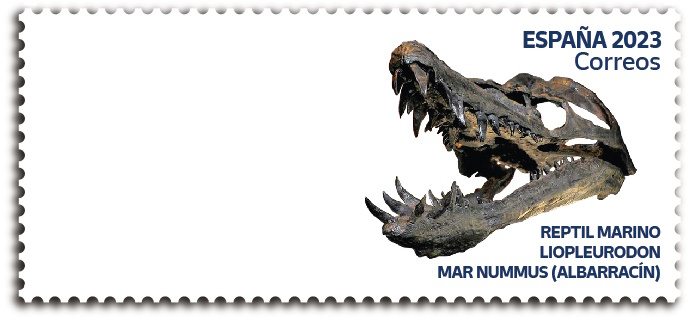
ATM-labels are semi-ready stamps.
Part or an entire design is pre-printed,
the skull of Liopleurodon and the text in blue color on the
right side of the stamp for example.
The face value and in some cases additional text or images are printed on the
label by the vending machine at the time of purchase.
The stamp vending machine is called an Automatic Teller Machine or ATM.
ATM vending machines can be installed inside or outside of the post offices and
print stamps on the ATM-labels.
These Spanish machines print text and simple images, such as the silhouette of
Liopleurodon, by thermic procedures on thermal self-adhesive labels.
The ATM-labels, usually loaded in the vending machines in rolls of several
hundreds or thousands of labels (1.500 labels in the Spanish machines).
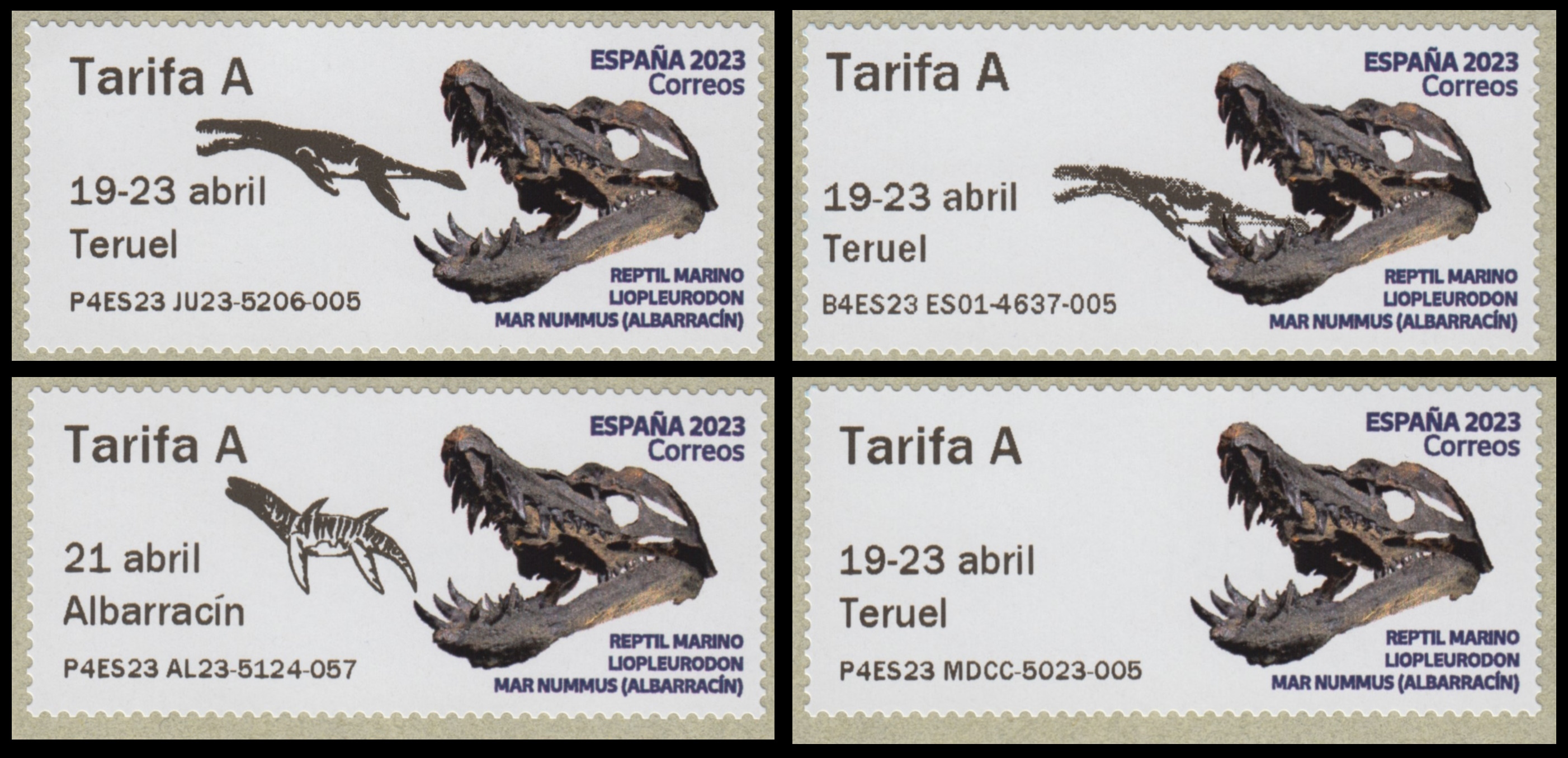
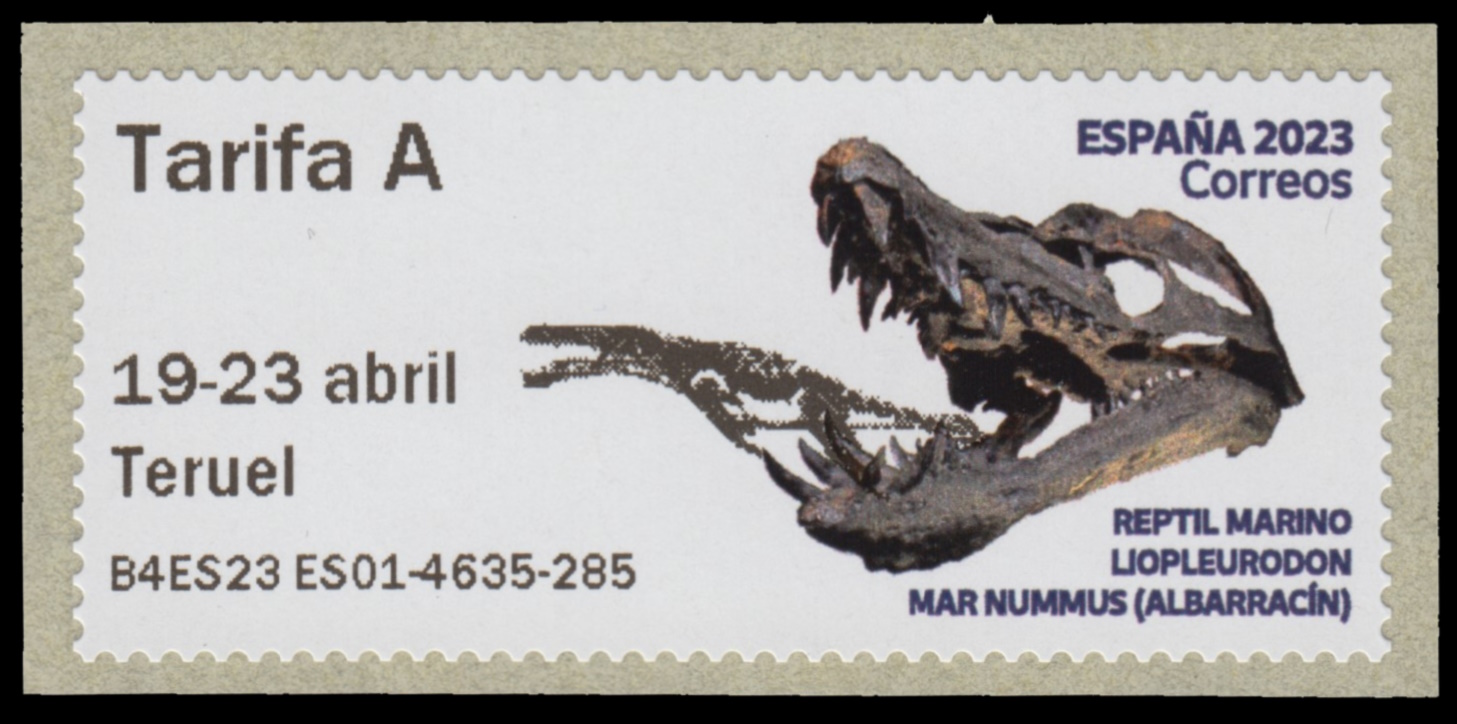
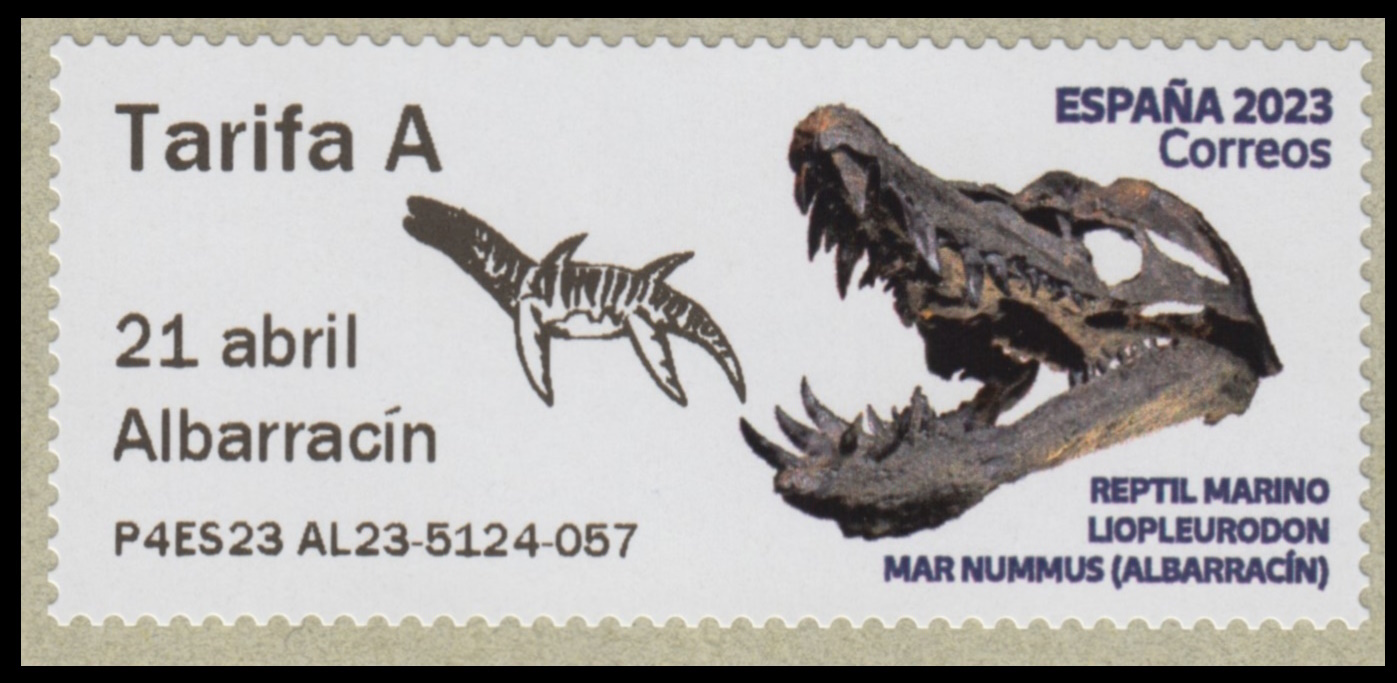
The ATM-label of the Liopleurodon stamp, contain the following pre-printed Spanish text underneath: "REPTIL MARINO LIOPLEURODON MAR NUMMUS (ALBARRACIN)" - in English: Marine Reptile Liopleurodon Mar Nummus (Albarracin).
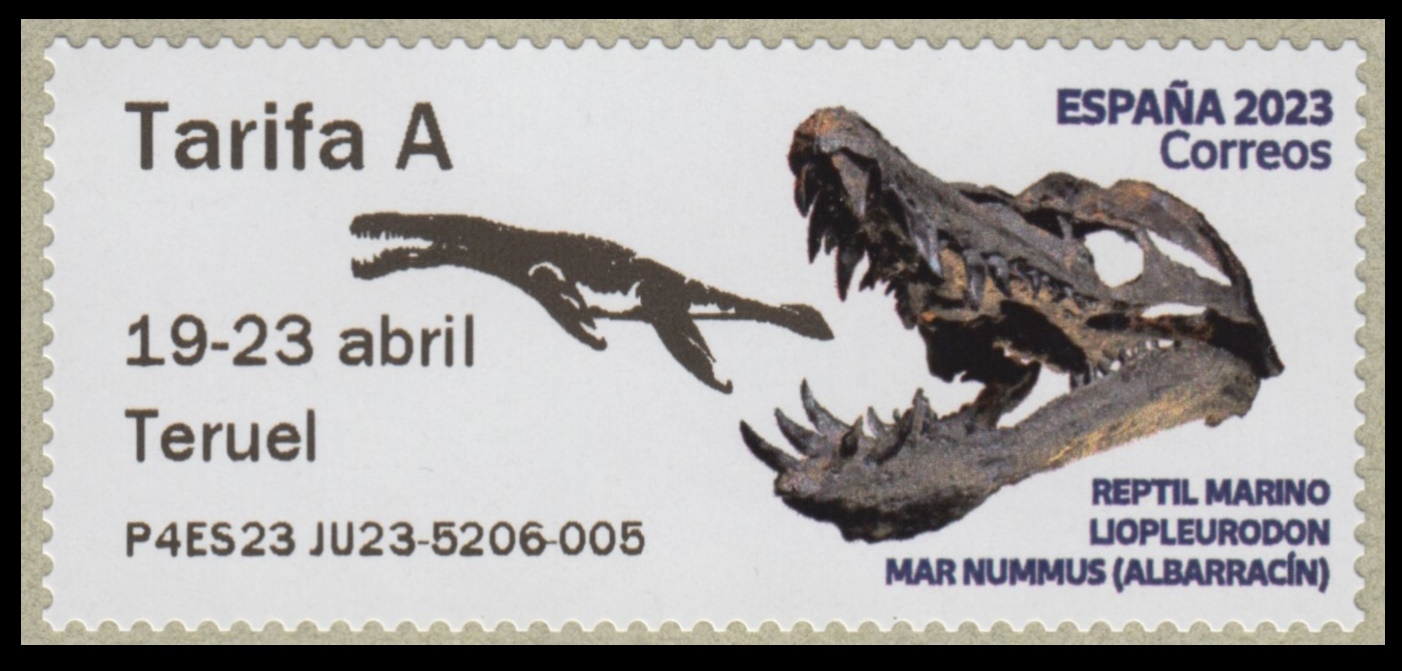
The face value, date, place of the issue, additional image of Liopleurodon's silhouette and the stamp ID code, where printed by the vending machine on the left side of the stamp.
 |
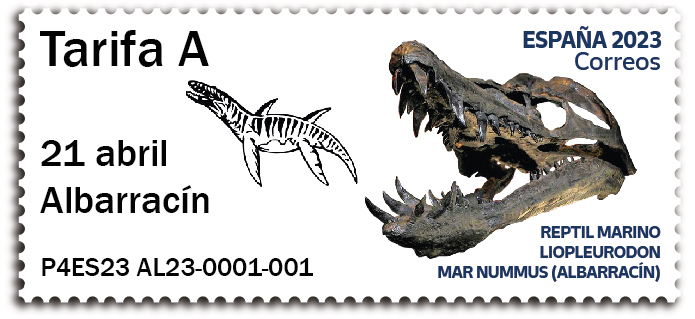 |
| ATM-label and an example of Liopleurodon ATM stamp. Image credit: exposicionesfesofi.es | |
Every stamp has a unique code on the bottom-left side. The code is built from two parts. For example: P4ES23 AL23-5119-001
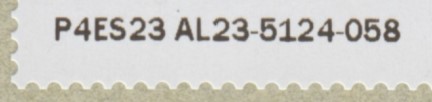 |
The second part contain "machine/printer ID" - "purchase number" (digits that increase with every purchase) - "number of stamp in the purchase". AL23-5119-001, on the example above, means: "AL23" - the printer installed in Albarracin town, "5119" - the purchase/order, "001" - stamp number in the purchase.
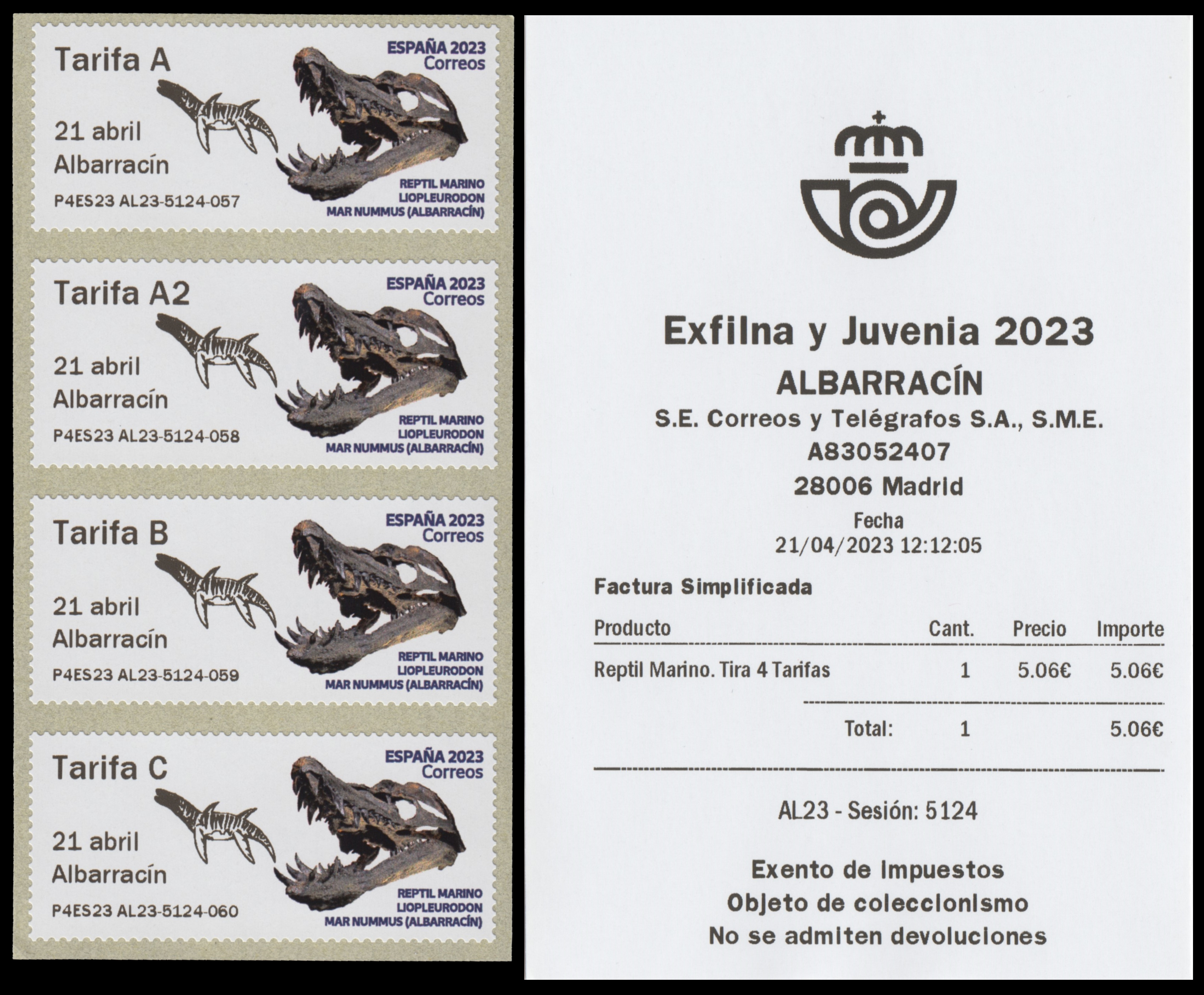 |
| Strip of 4 ATM stamps, printed in Albarracin on April 21, 2023. The purchase number 5124, printer ID AL23. |
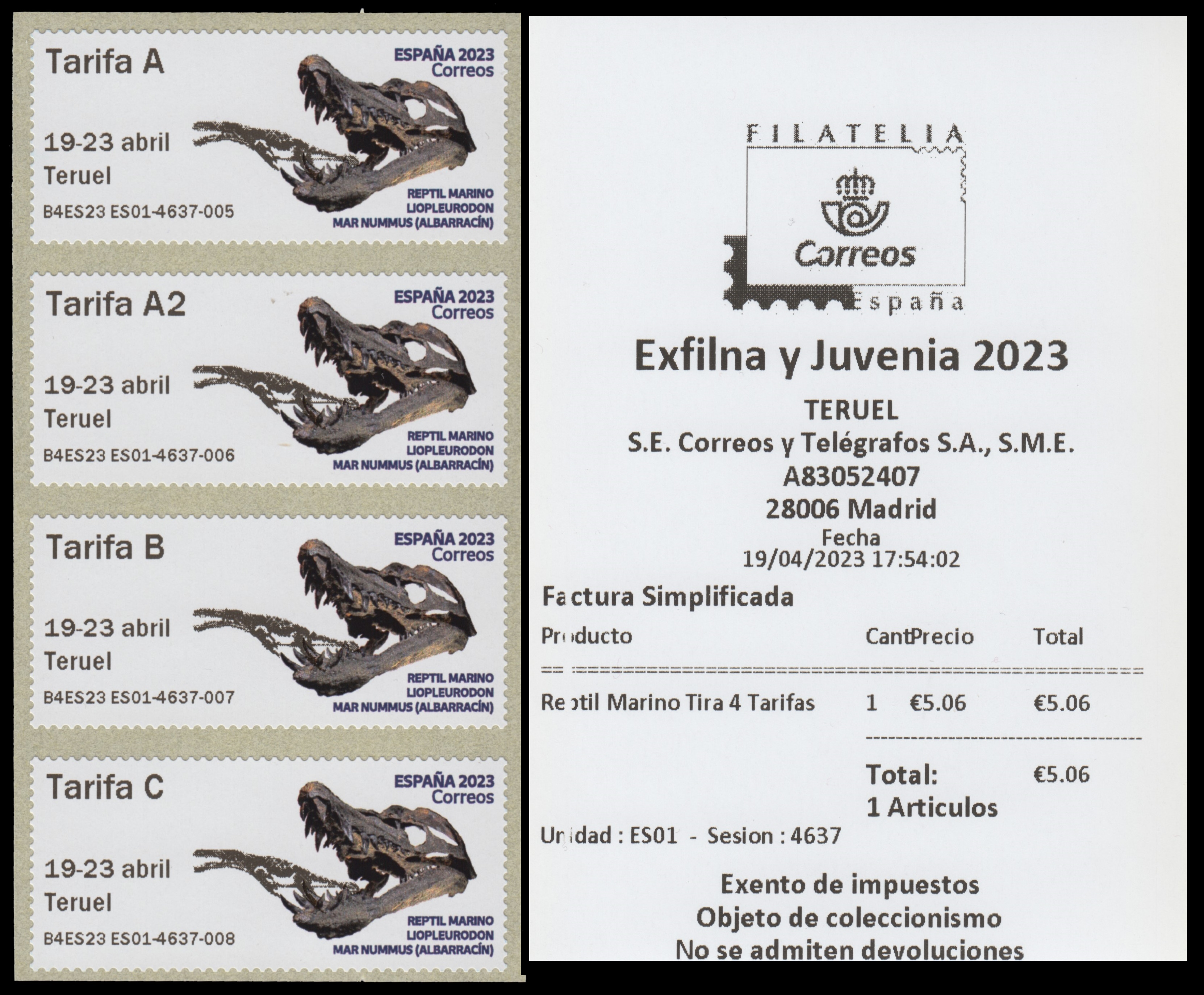 |
| Strip of 4 ATM stamps, printed in Teruel on April 19, 2023. The purchase number 4637, printer ID ES01. |
 |
|
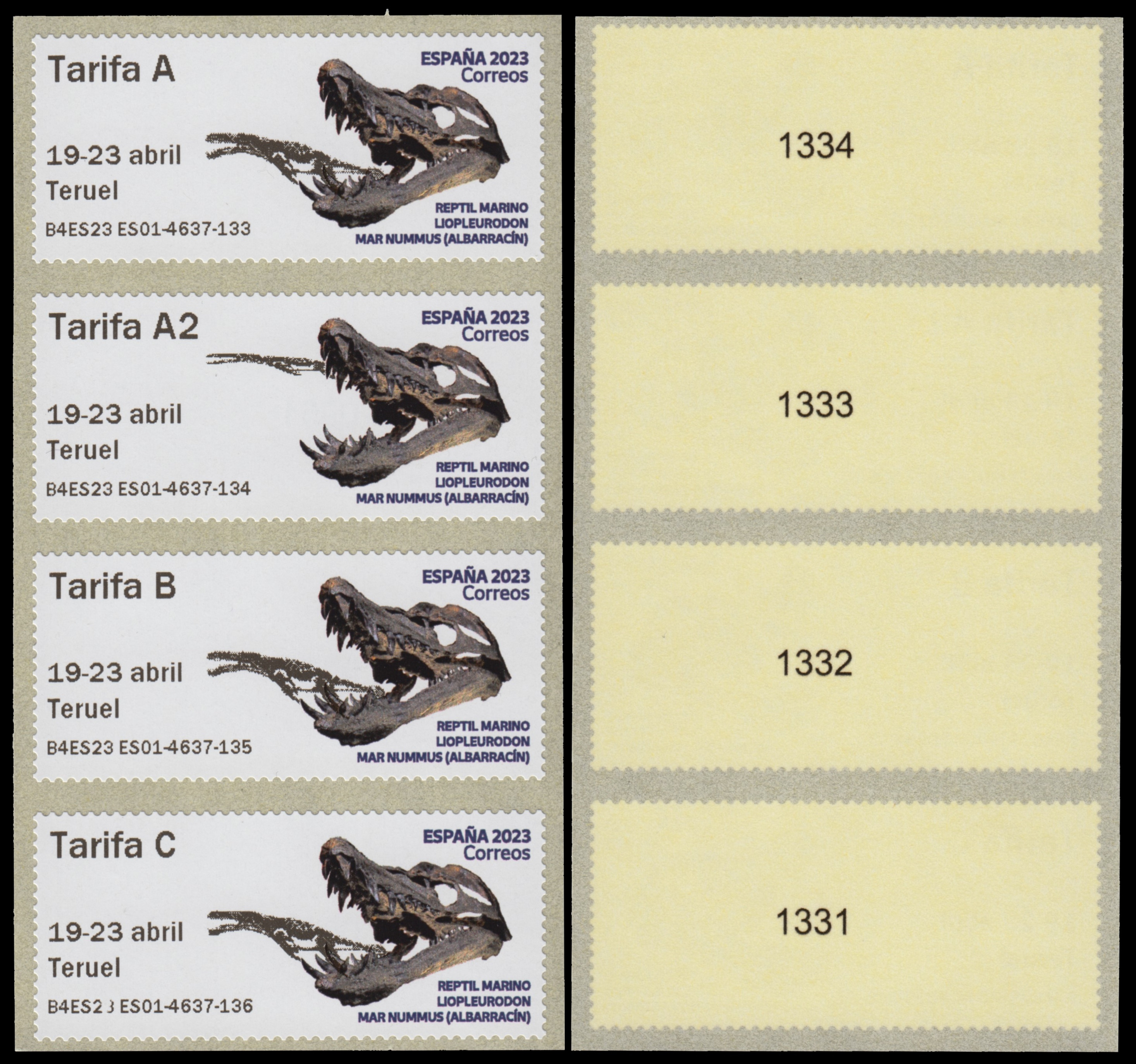
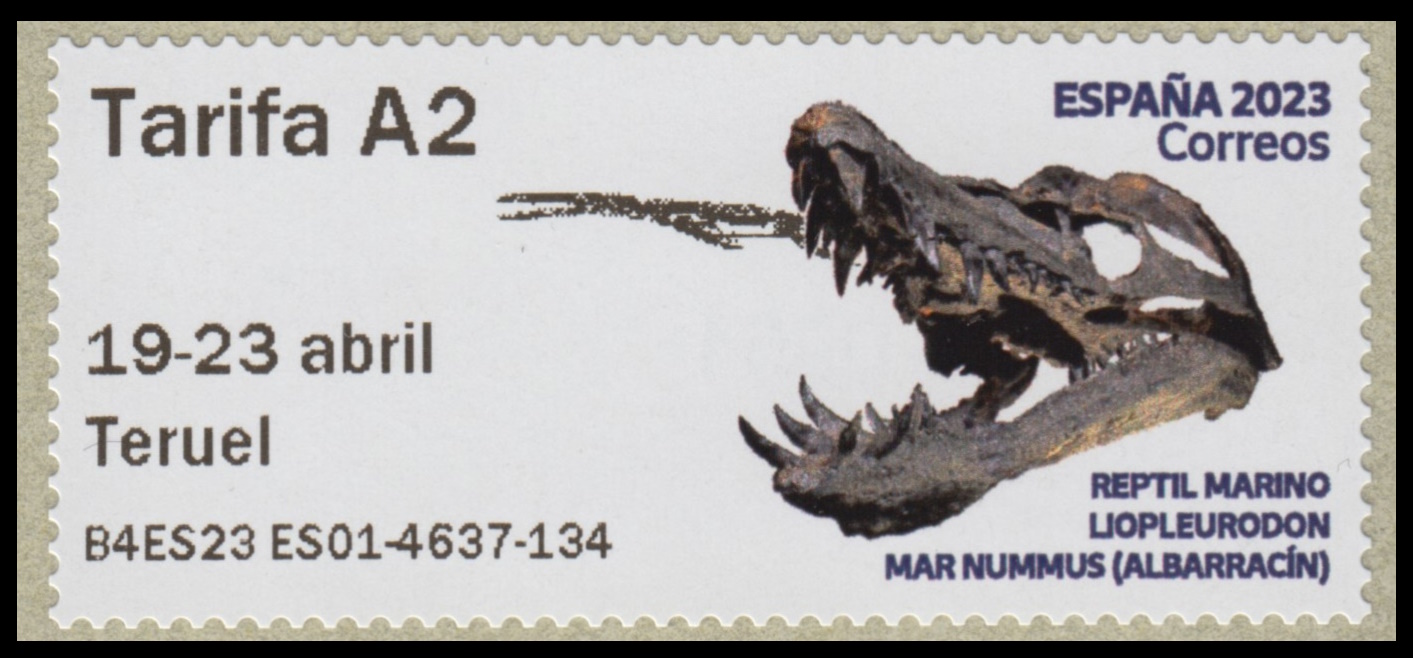
Both sides of ATM stamps - stamp numbers in a roll, printed on the reverse side. The second stamp from the top (A2) have a design error - the Liopleurodon image was misplaced and suppressed. |
The stamps purchased by an individual at the ATM are numbered starting from 001.
The following stamp combinations can be printed by the vending machine:
(1) single stamps with the four available postal tariffs,
(2) collectors strips of four stamps for domestic mail,
(3) collectors strips with the four-values set.
In one purchase operation one or a combination of 3 options can be ordered.
For example: 10 ATM domestic stamps,
plus three strips of four domestic stamps, plus five sets of four values.
Only these two last options include the printing of single receipts per item.
Then, the system prints one receipt as a summary or list of the complete operation
with the total, plus three receipts for the three strips of domestic stamps,
plus five additional receipts for the sets.
This allows the collector to have one single receipt per each collectors strip bought.
Therefore, stamp numbers on the invoices on the right, start not on 001, but
on 057, 005, 133 accordingly.
These ATM stamps were printed by printers/machines of two companies: "P" - Brother and "B" - Intelligent AR Limited, at four locations:
-
ES01:
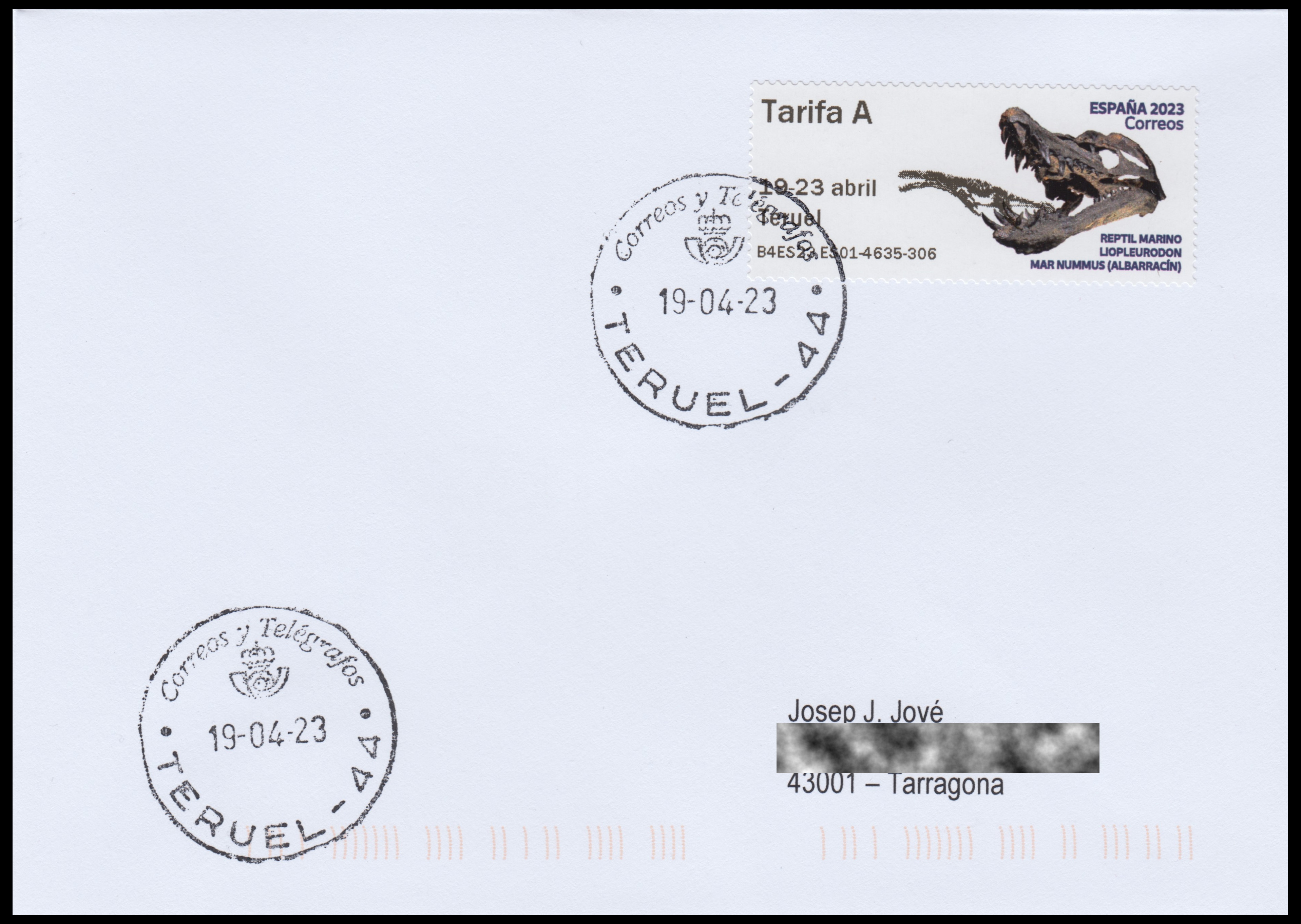
machine code of Kiosk, temporary, installed at EXFILNA - JUVENIA, Teruel, at the Tent of the Plaza La Glorieta.
These stamps were available between April 19th and April 23rd.
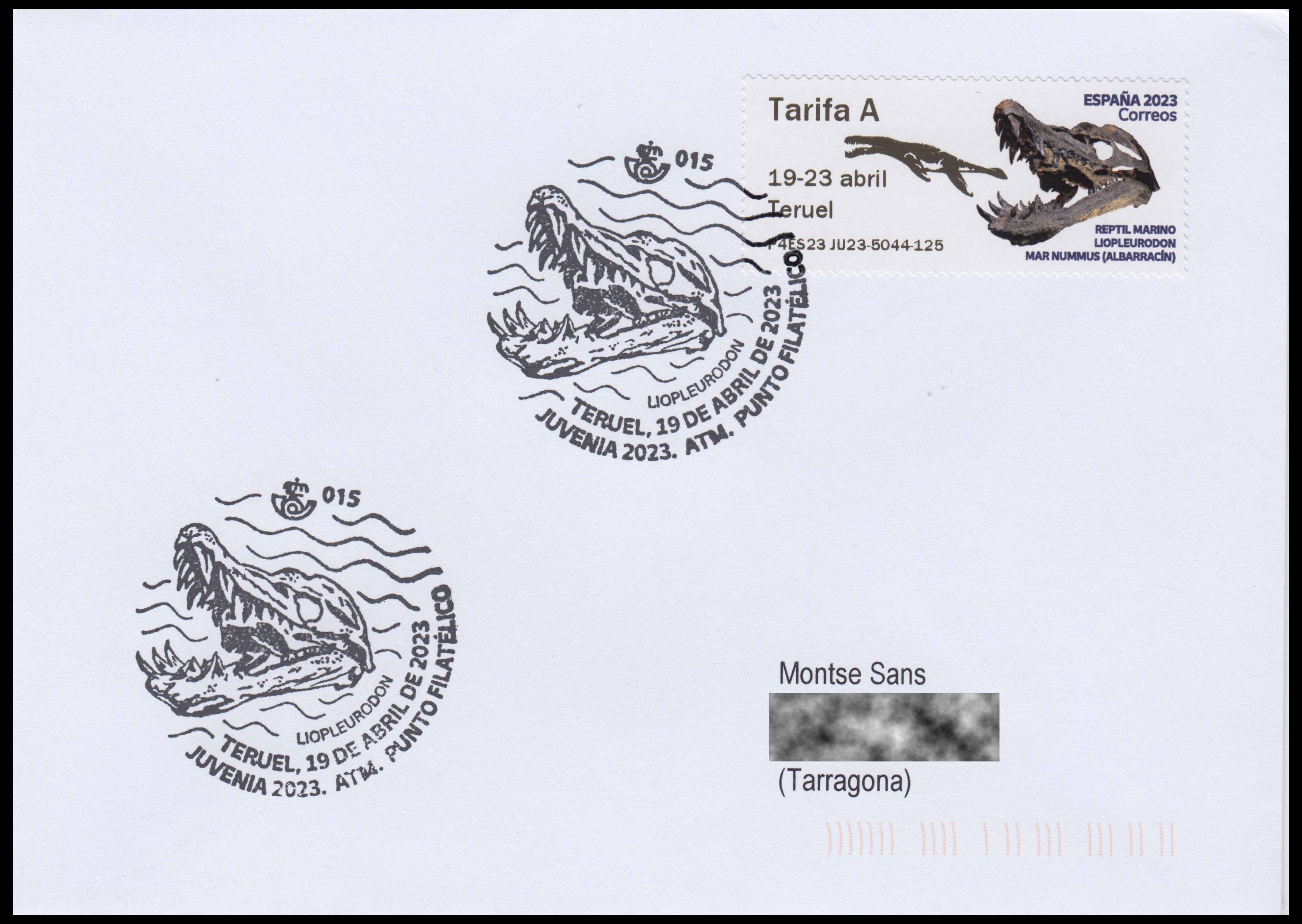
- JU23 (JUVENIA 2023): machine code of Desktop printers at EXFILNA - JUVENIA, Teruel, at the Youth Leisure Center. These stamps were available between April 19th and April 23rd.
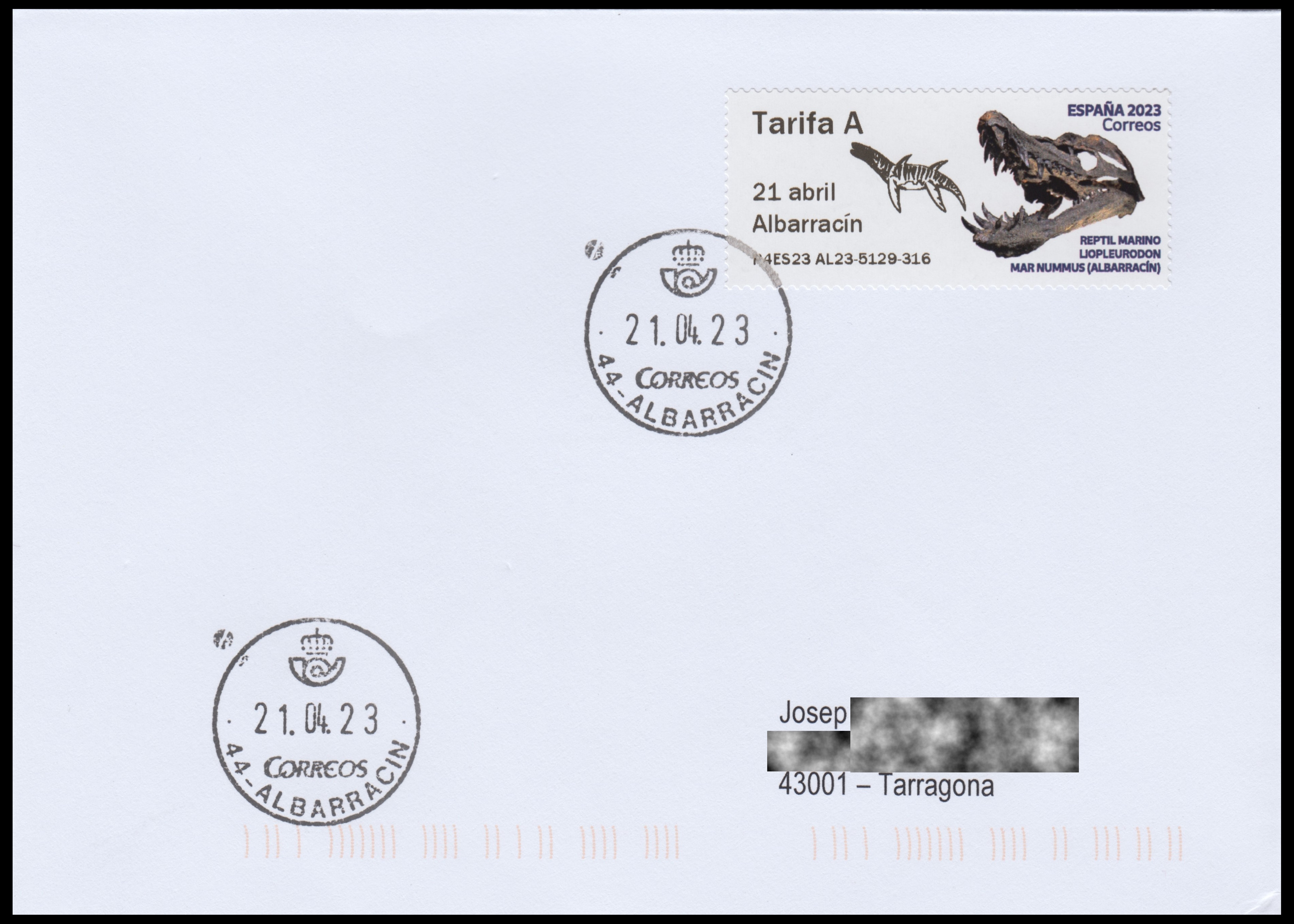
- AL23 (ALBARRACIN 2023): machine code of desktop printer installed on April 21st at the Correos stand next to Mar Nummus Museum in Albarracín. The Liopleurodon has a different shape compared to the labels issued at Teruel.
-
Additional variation
MDCC (Madrid Clara Campoamor): machine code of Philatelic service printers of Madrid.
Correos company has only one postal kiosk (manufactured by intelligent AR in the UK). The Postal kiosk is permanently installed at Madrid's post office, near the Correos Clara Campoamor building.
Several times per year, for the main philatelic events, the staff moves the kiosk for just a few days to the events. From 19 to 23rd April, the kiosk was moved to EXFILNA in Teruel for example.
The rest of the year, it is possible to order ATM stamps of the different designs released over the year (with a minimum order amount). These ATM stamps printed the actual month number, but without additional graphics (without Liopleurodon's silhouette, for example).
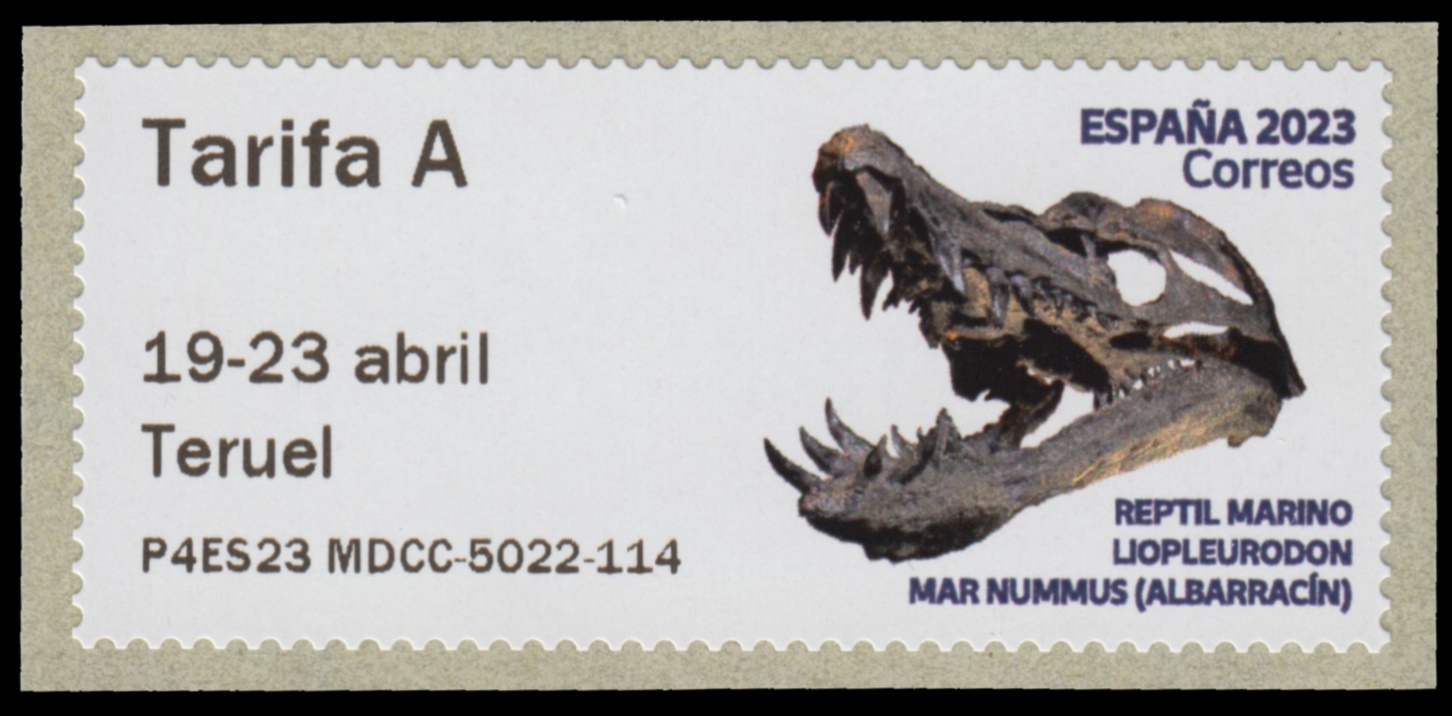
- Rate A - 0,78€. - "standardized" Ordinary National Letter or Postcard, up to 20 g.
- Rate A2 - 0,88€ - Letter or Ordinary National Postcard "standardized", from 20 to 50 g.
- Rate B - 1,65€ - "standardized" Ordinary International Letter or Postcard addressed to Europe (including Greenland), up to 20 g.
- Rate C - 1,75€ - "standardized" Ordinary International Letter or Postcard addressed to the rest of the world (except USA, Canada, Japan, Australia and New Zealand), up to 20 g.
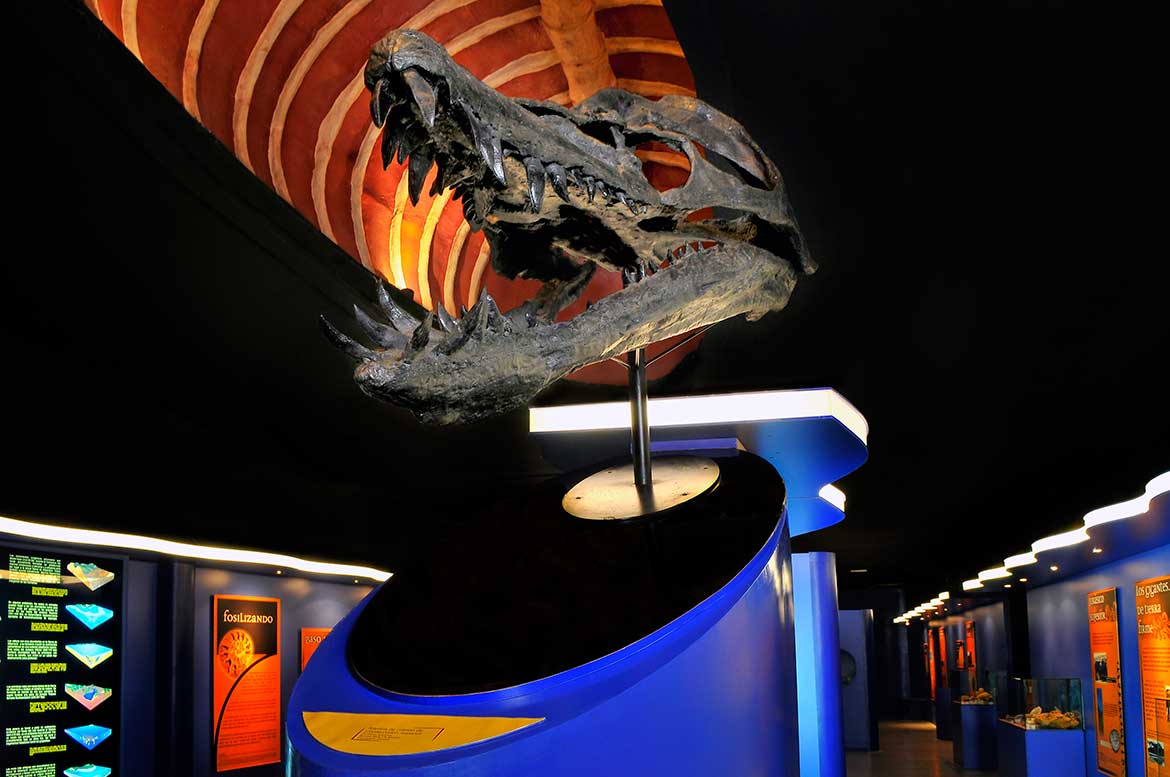
The skull on the stamp shows the skull from the Mar Nummus Museum. This museum is the headquarters of Territorio Dinópolis, located in Albarracín town (37km away from Teruel).
The satellite Dinopolis in Albarracín was inaugurated on 1 July 2008 and it is part
of a Teruel-organised tour entitled Dinopolis-Jurassic Route, which addresses the
extraordinary diversity of Jurassic invertebrate marine fossils found in these areas.
Formed by a large central park in Teruel and seven more centers in eight locations in its province,
Dinópolis combines science and fun, so that visitor can live closely the fascinating world of dinosaurs.
A journey of 4,500 million years in which visitors hear the first heartbeat of the Earth,
discover how life arose and with it the most extraordinary creatures that have ever existed.
 |
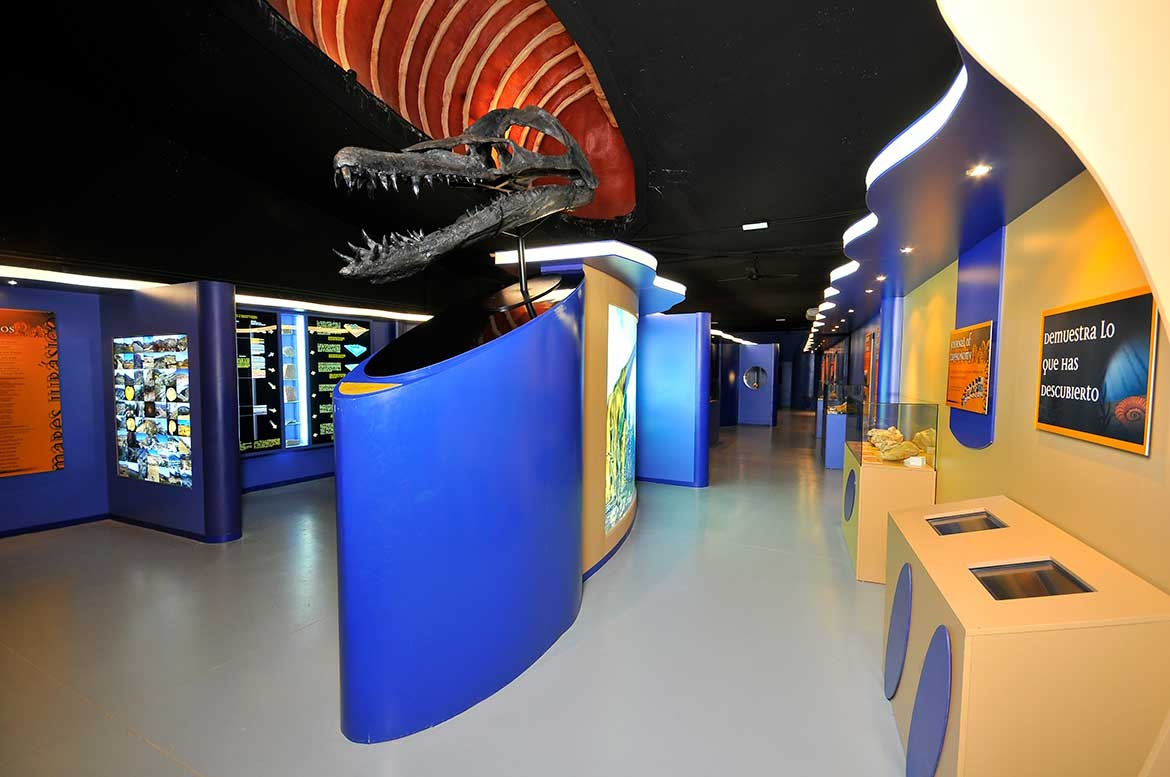 |
| The replica skull of Liopleurodon on display in Mar Nummus Museum in Albarracín. Image credit: official website of the museum | |
The Mar Nummus Museum in Albarracín is dedicated to the living beings that lived in the sea that was in this area more than 150 million years ago.
At that time, the Sierra de Albarracín was covered by the Tethys Sea.
Jurassic marine fossils such as ammonites and sponges are on display at the Mar Nummus Museum.
Many of these fossils were discovered in the calcareous rocks that border the Guadalaviar River and the roads that accompany it. The fossils of marine reptiles are quite limited in Teruel, however. A Pliosaurid vertebra was found at Jabaloyas village (the village where Mar Nummus is located), is on the display in the museum.
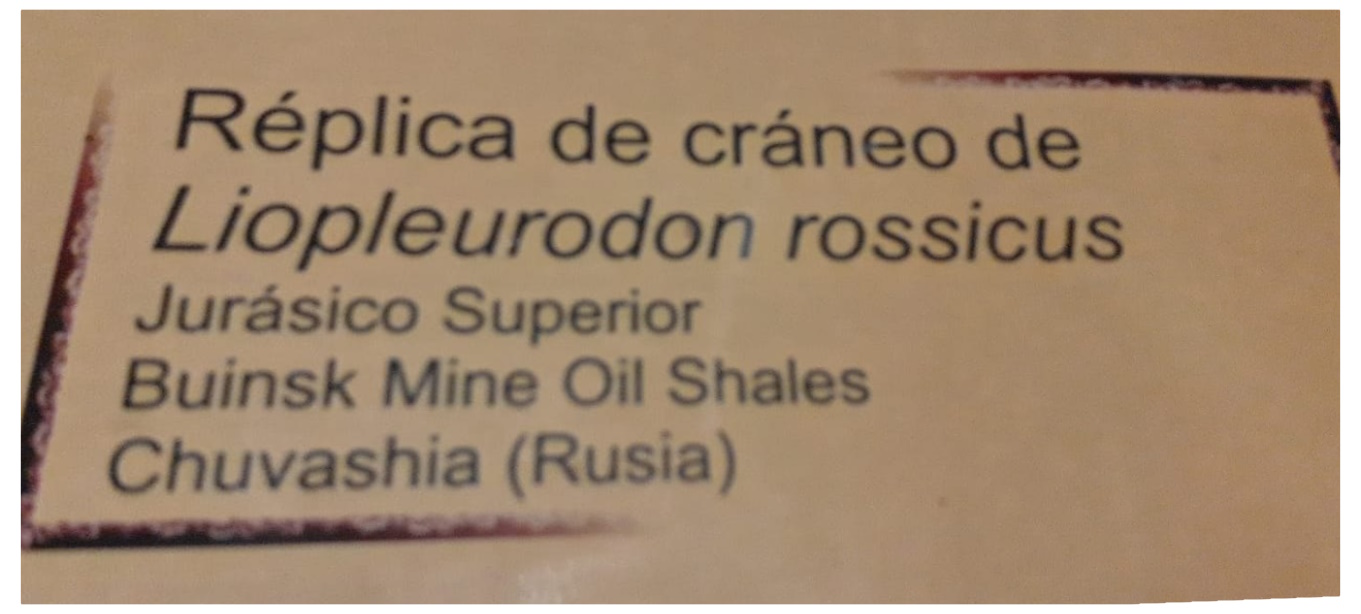 |
| The skull description label from the Mar Nummus Museum in Albarracín |
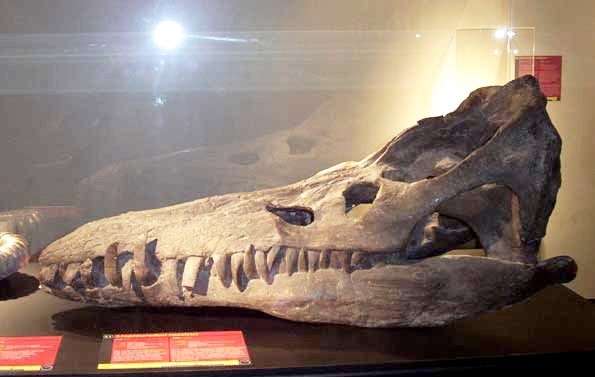 |
| Skull of Pliosaurus rossicus Novozhilov, 1948 on display at Paleontological Institute, Russian Academy of Sciences in Moscow. Image credit: Wikipedia |
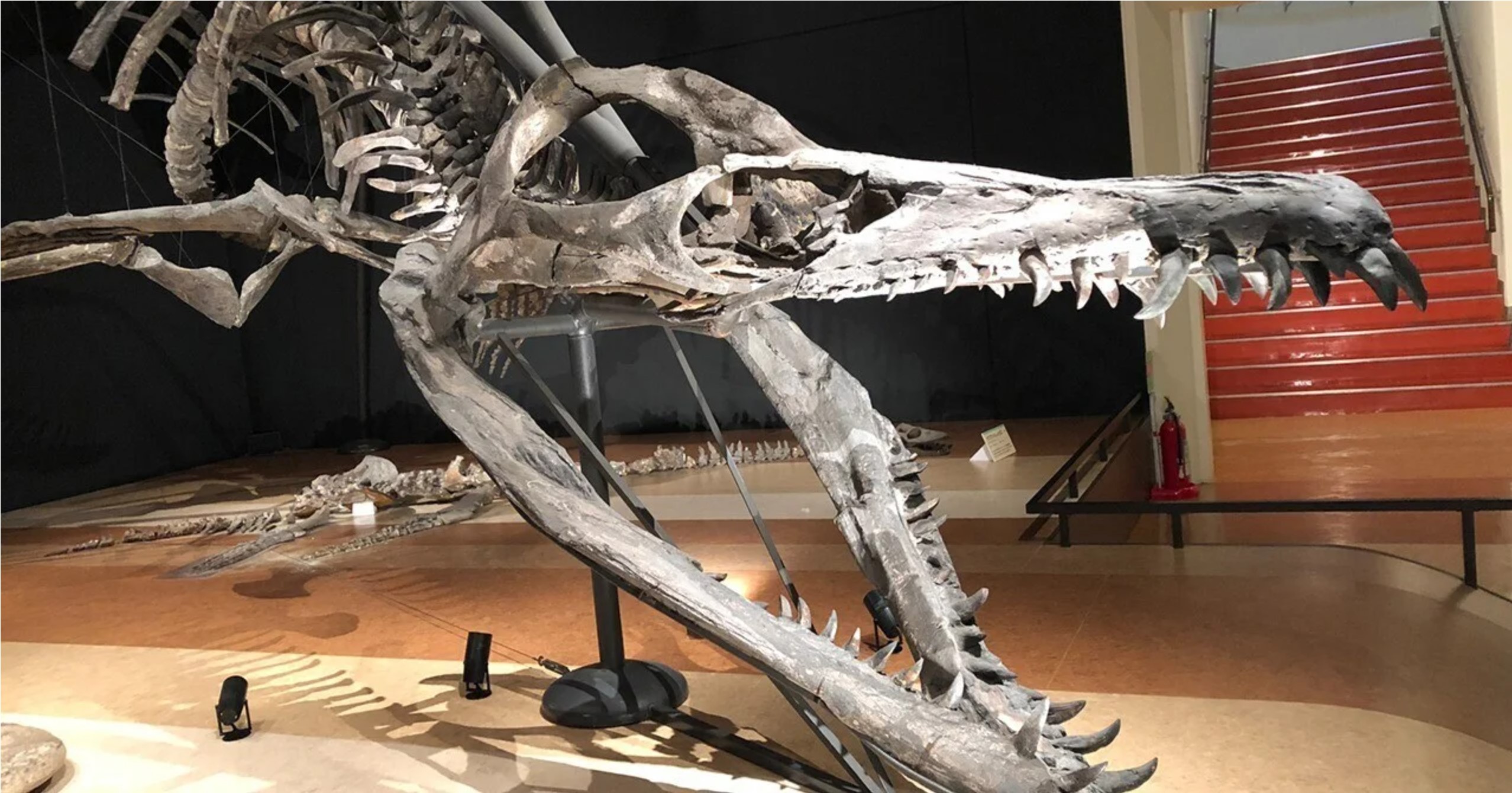 |
| Skull of Pliosaurus rossicus on display in Iwaki City Coal and Fossil Museum Horuru in Iwaki city, Japan. Image credit: note.com |
Pliosaurs (meaning 'more lizard'), a group of large carnivorous marine reptiles characterized by massive heads, short necks, and streamlined tear-shaped bodies. Pliosaurs have been found as fossils from the Jurassic and Cretaceous periods (about 200 million to 65.5 million years ago).
They are classified in the order Plesiosauria, along with their long-necked relatives, the plesiosaurs. Pliosaurs possessed powerful jaws and large teeth, and they used four large fins to swim through Mesozoic seas. Their diet would have included fish, cephalopods, and marine reptiles, including ichthyosaurs. Most species of Pliosaurus reached 8 metres in length and 5 tons in body mass, while Pliosaurus rossicus and Pliosaurus funkei may have reached or even exceeded 10 metres in length and 11 tons in body mass, being the largest plesiosaurs of all time.
Four strong paddle-like limbs suggest that Pliosaurus was a powerful swimmer. The hind flippers are longer than the fore flippers - a very unusual feature, as it is the opposite case for most of the plesiosaurs. The feature might enhance their ability to accelerate, desirable trait in an ambush predator.
According to the label under the skull at the Mar Nummus Museum, this skull is a replica of a Liopleurodon rossicus skull from the Buinsk Mine Oil Shales, Chuvashia (Russia) that is Jurassic in age.
(Original text: "Replica de craneo de Liopleurodon rossicus, Jurasico Superior, Buinsk Mine Oil Shales, Chuvashia (Russia)")
The full-size replica of the reptile, was mounted on the roof of the museum (see a video below).
The postmark of Albarracin reproduce the replica.
The first fossil of Pliosaur/Liopleurodon rossicus was found in the Buinsk shale mine, in Chuvashia region of Russia in 1937.
It was described and named by Soviet paleontologist Nestor Ivanovich Novozhilov in 1948.
The specific name is derived from the name of Russia, where the holotype was found. The holotype of Pliosaurus rossicus, PIN 304/1 is housed at the Paleontological Institute, Russian Academy of Sciences in Moscow and consists of cranial and some postcranial remains of a relatively small pliosaur.
The fossils belonged to a very young pliosaurus who did not exceed 5m in length.
The skull, and reconstruction of the pliosaur were displayed on a postage stamp of Russia in 2020.
The skull from the display in Mar Nummus Museum in Albarracín, looks different, as the skull from Buinsk Mine Oil Shales have closed jaws. Albarracín's skull resemble another Pliosaurus rossicus's skull, discovered in Russia - the best known fossil of Pliosaurus rossicus known to date, unearthed by fossil hunters near Ulyanovsk city of Russia in mid-1990th and illegally moved to Japan, where it was perfectly prepared and mounted in "Iwaki City Coal and Fossil Museum Horuru".Products and associated philatelic items
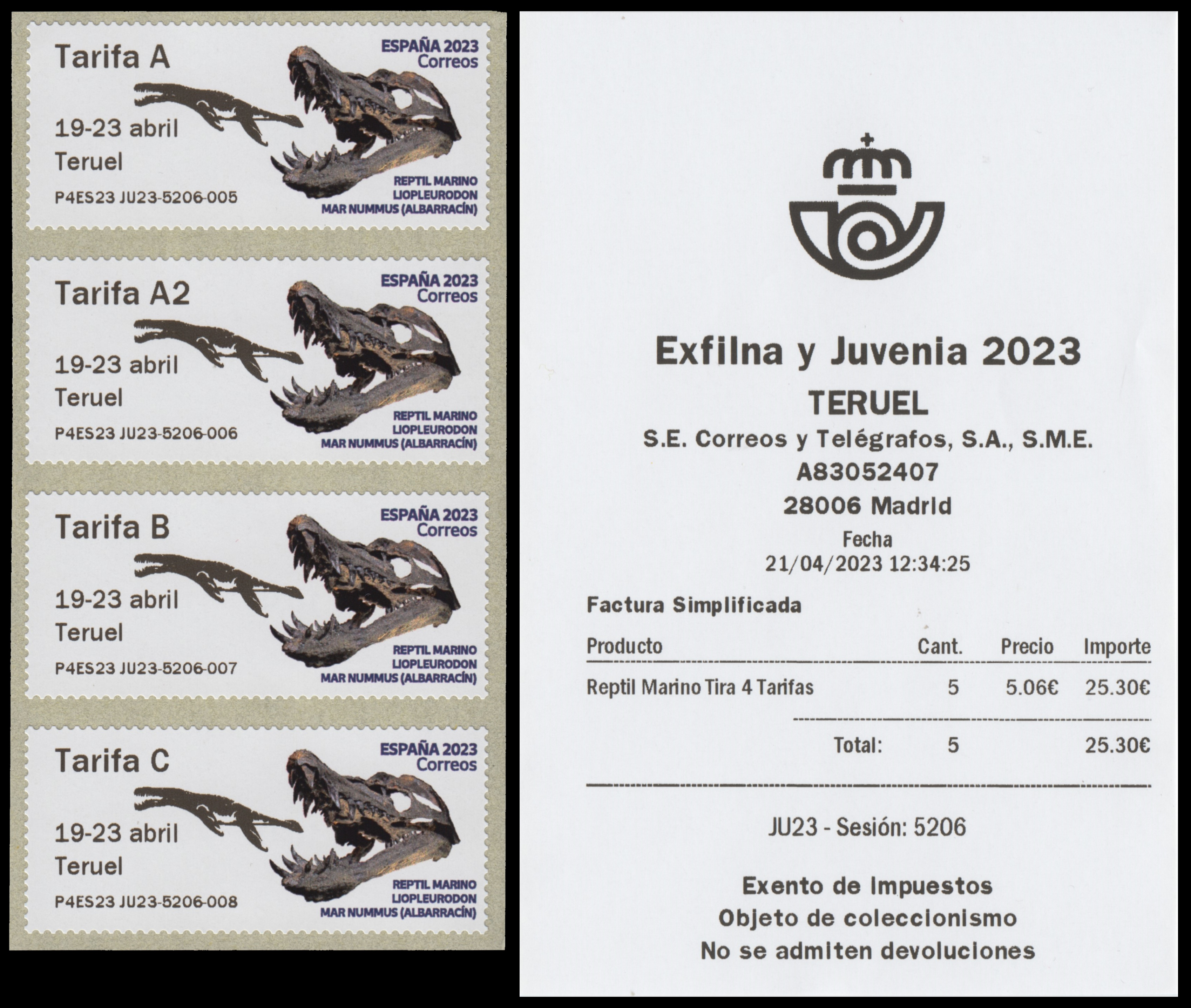
| Strips with all 4 values | |||
|
 |
|
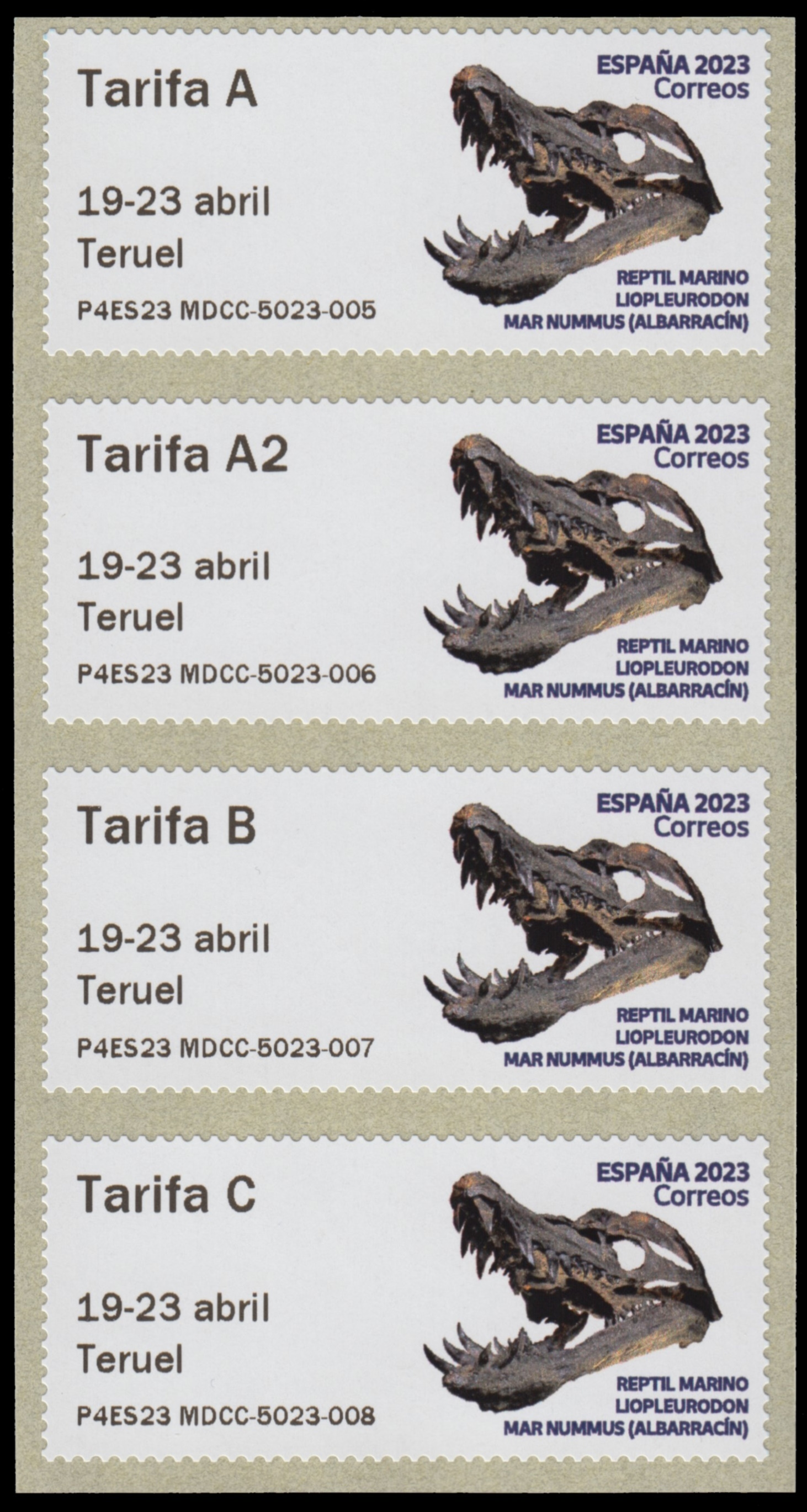 |
| AL23 - desktop printer (Brother) in Albarracin | JU23 - desktop printer (Brother) at EXFILNA - JUVENIA, Teruel | ES01 - Kiosk installed at EXFILNA - JUVENIA (Intelligent AR Limited printer), Teruel | MDCC - desktop printer (Brother) of Madrid. It is the same computer system used in Teruel (JU23), but just changing the code and some configuration (MDCC stamps does not include the special graphics and are printed with no associated receipts). |
 |
 |
 |
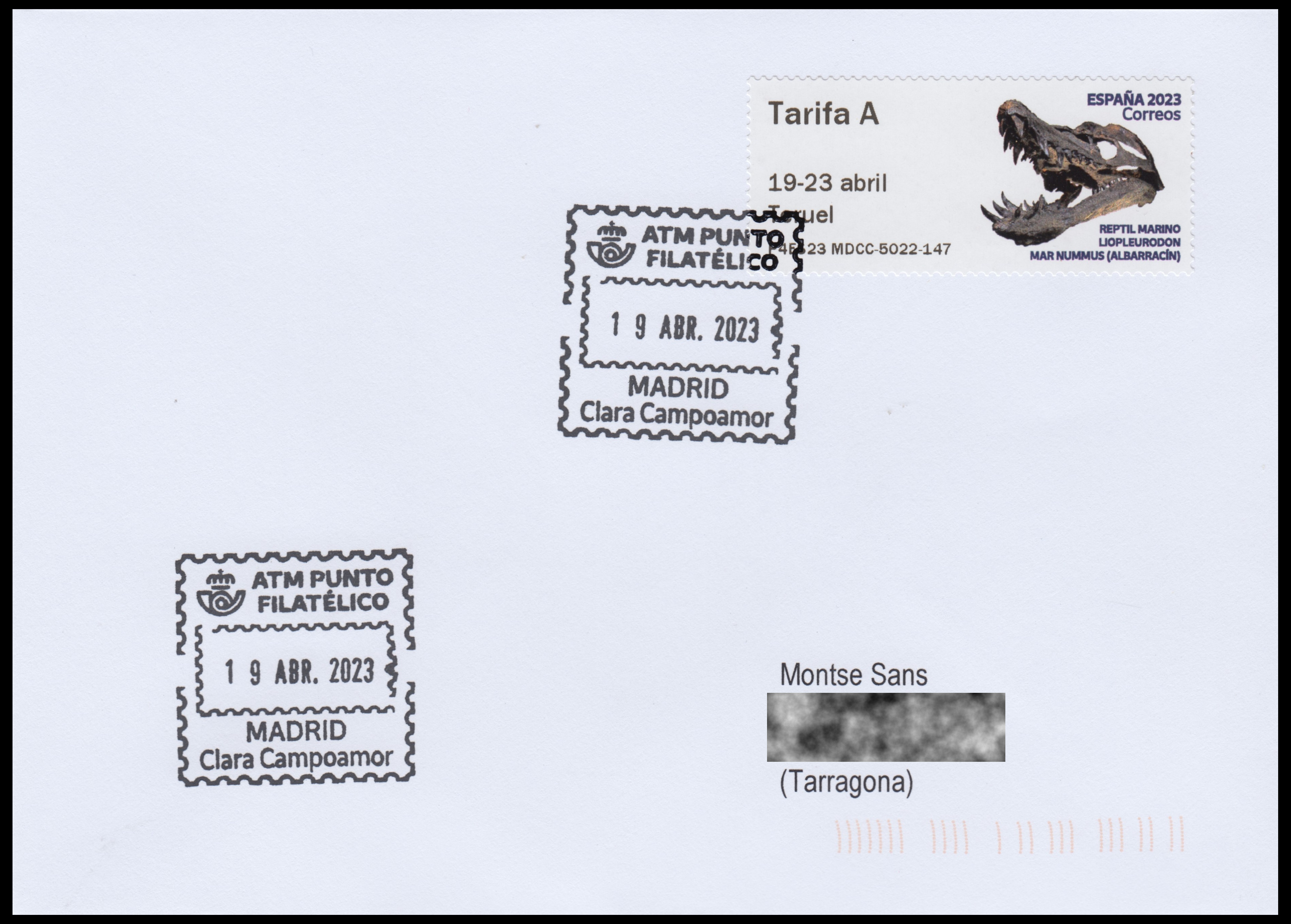 |
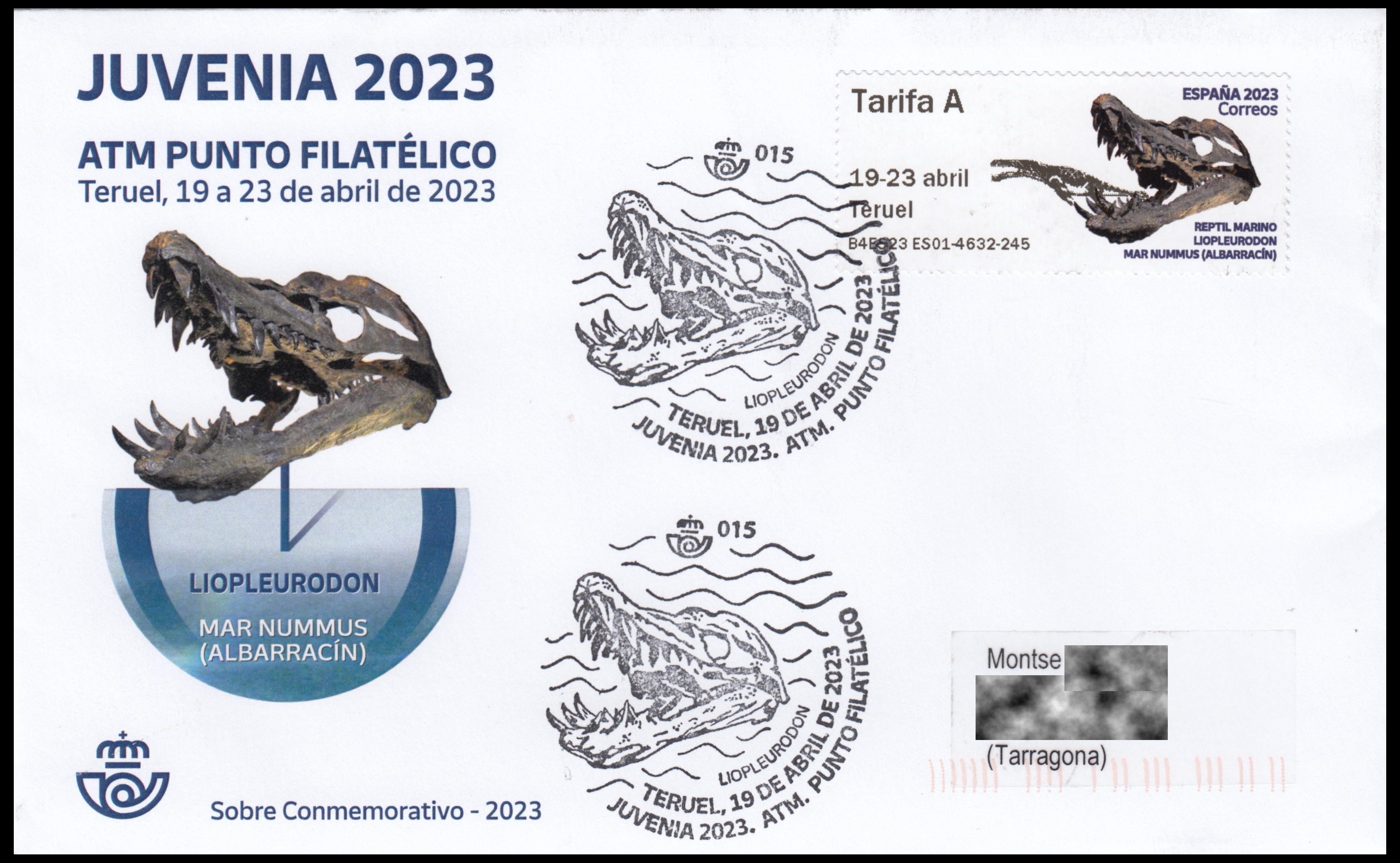
| Albarracin ATM stamp on domestic circulated letter, Spain 2023. | Teruel ATM stamp (variation 1) on domestic circulated letter, Spain 2023. | Teruel ATM stamp (variation 2) on domestic circulated letter, Spain 2023. | Madrid ATM stamp on domestic circulated letter, Spain 2023. |
 |
 |
 |
|
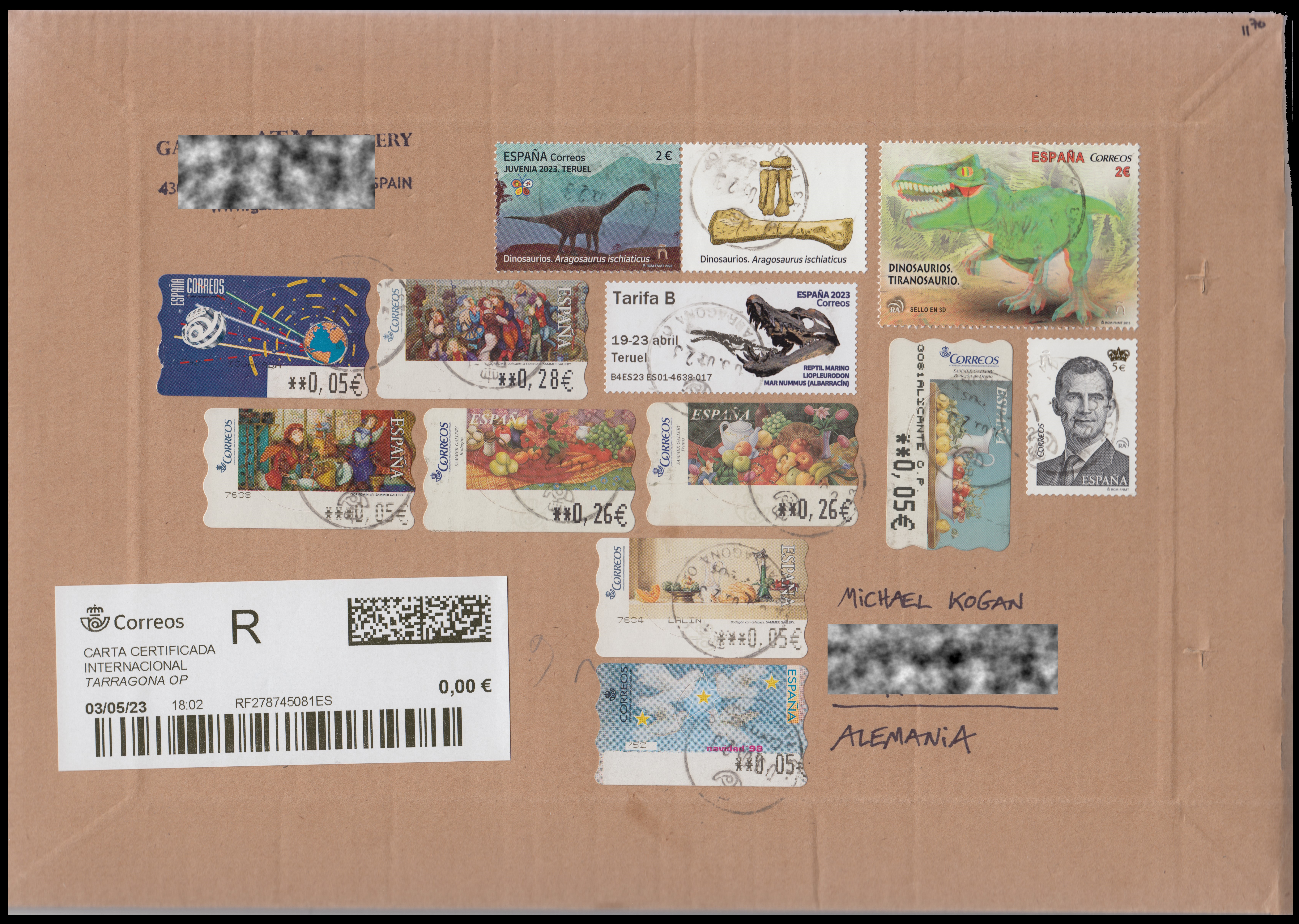
| Teruel ATM stamp (variation 2) on registered letter to the USA, Spain 2023. | Teruel ATM stamp (variation 2) on letter to France, Spain 2023. | Teruel ATM stamp (variation 2) on domestic letter, up to 50g rate, Spain 2023. | |
| All letters above were posted on the first day of stamp issue and can be considered as FDC. | |||
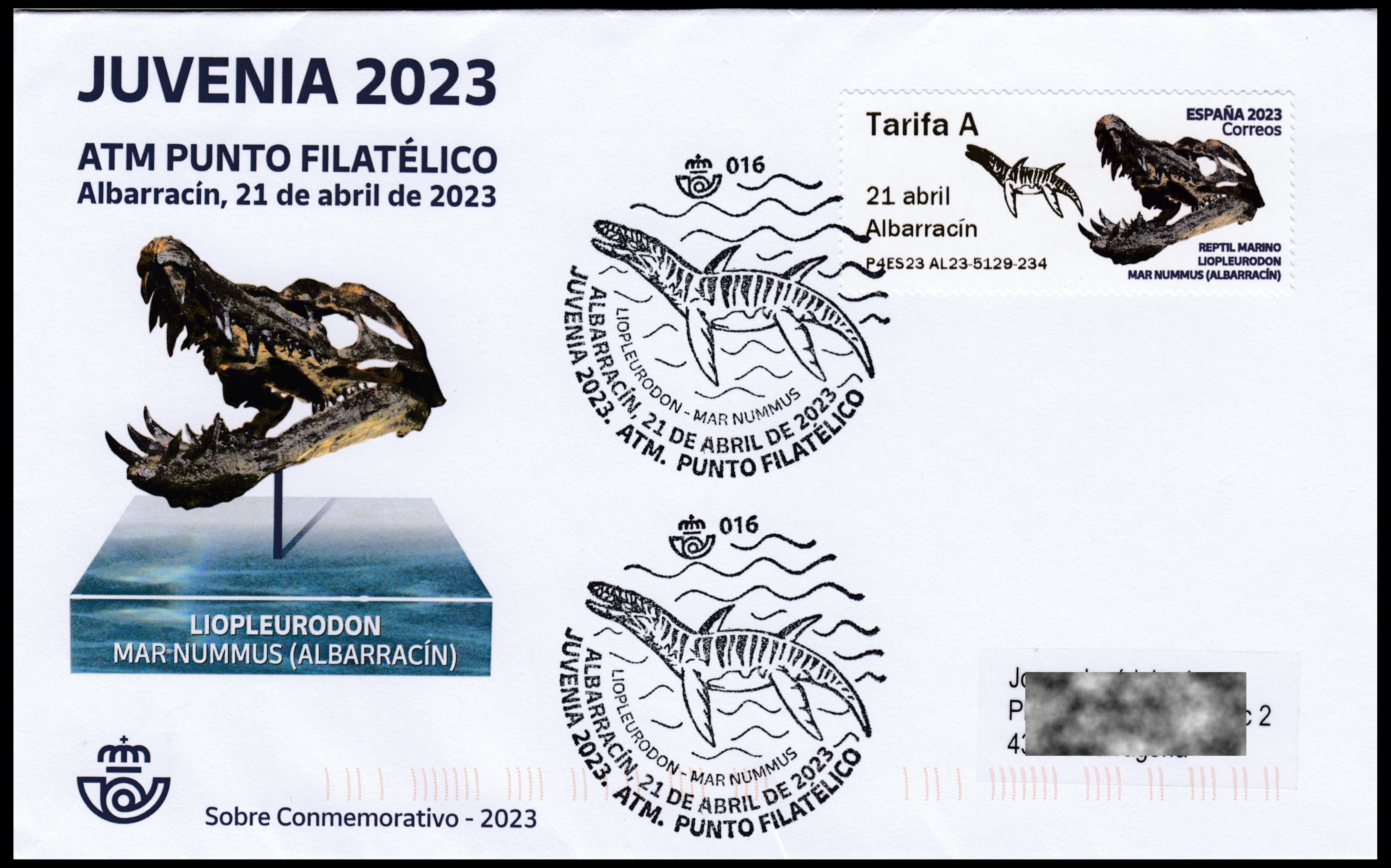
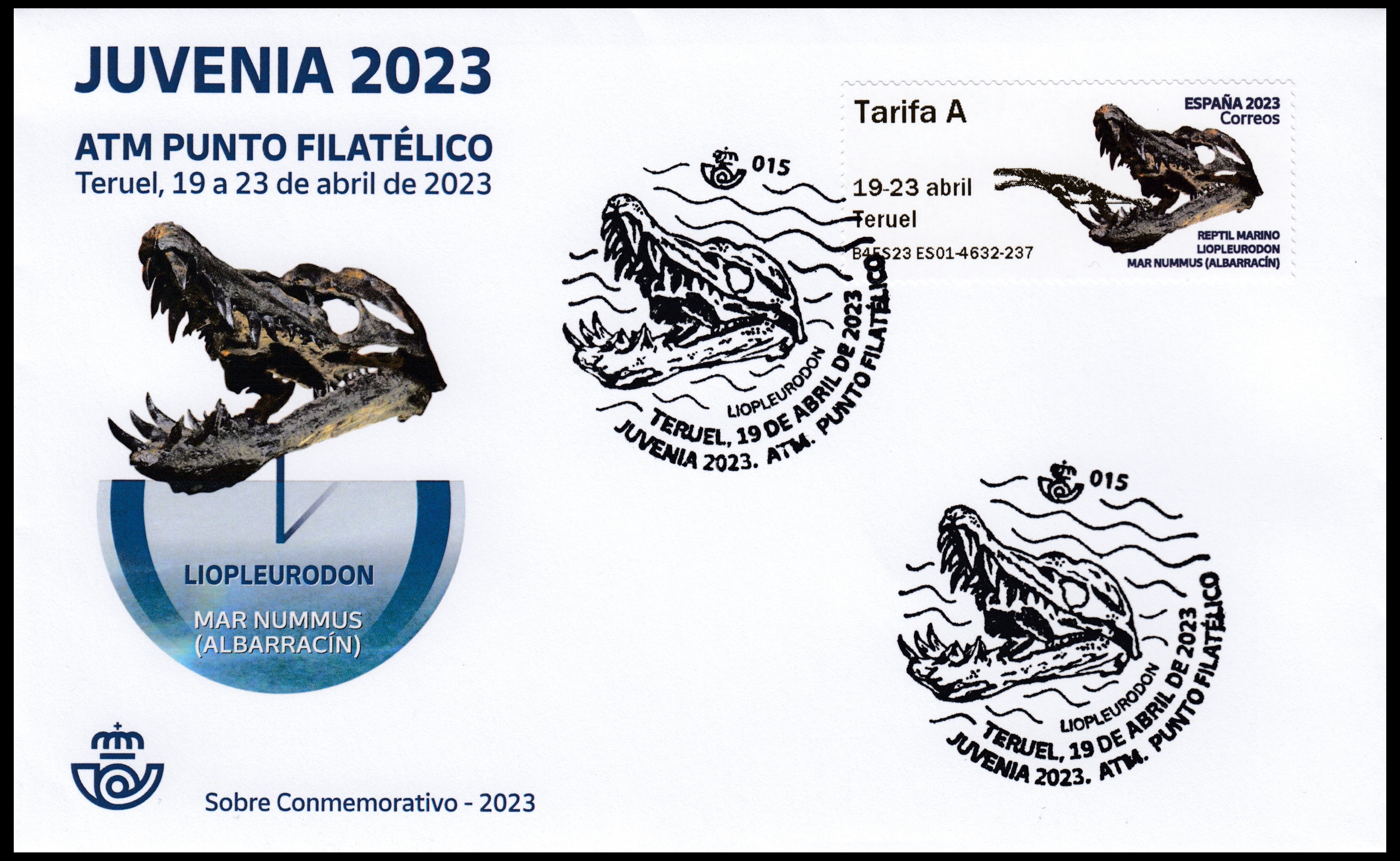
| FDC | ||
 |
 |
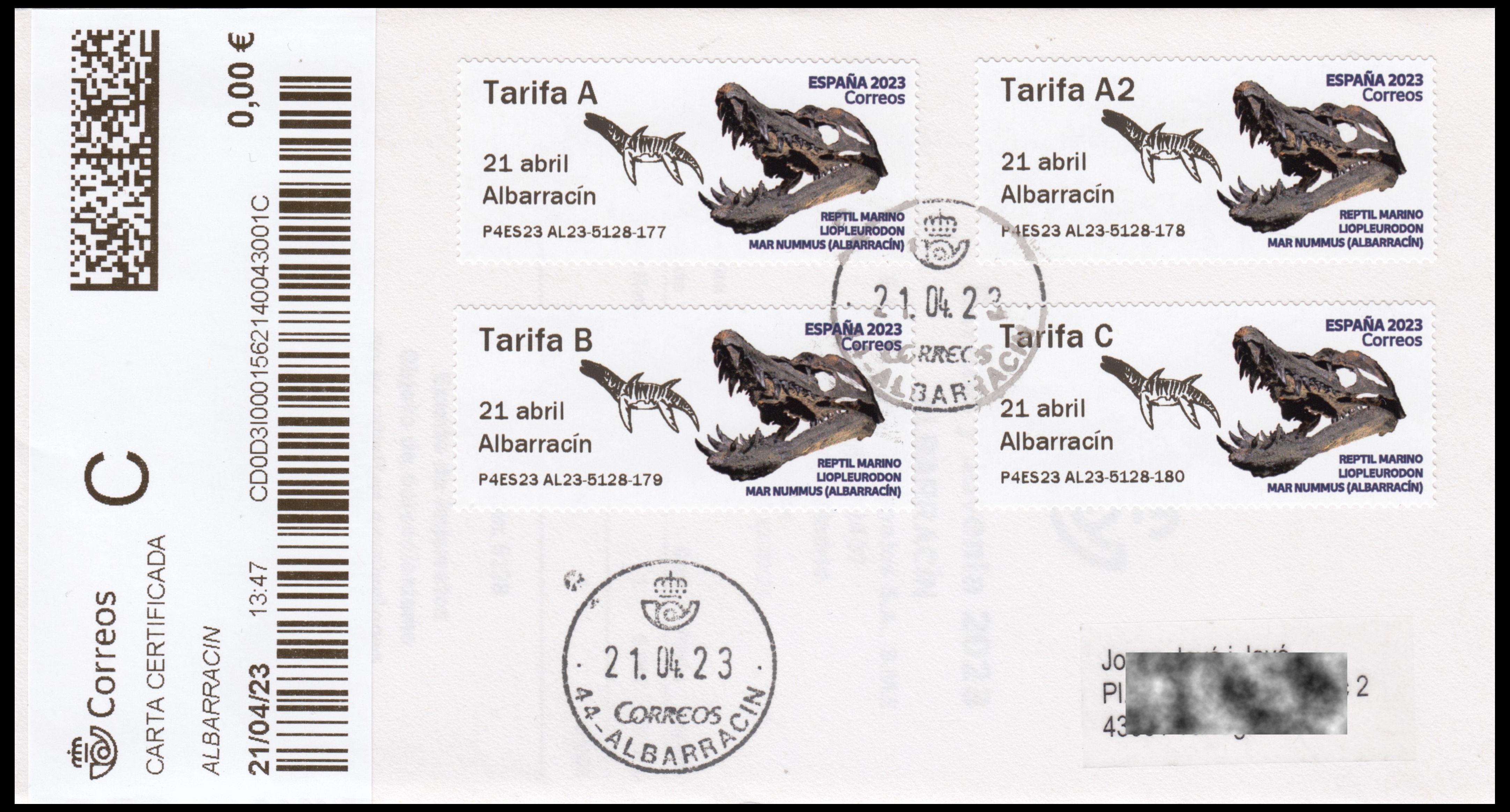 |
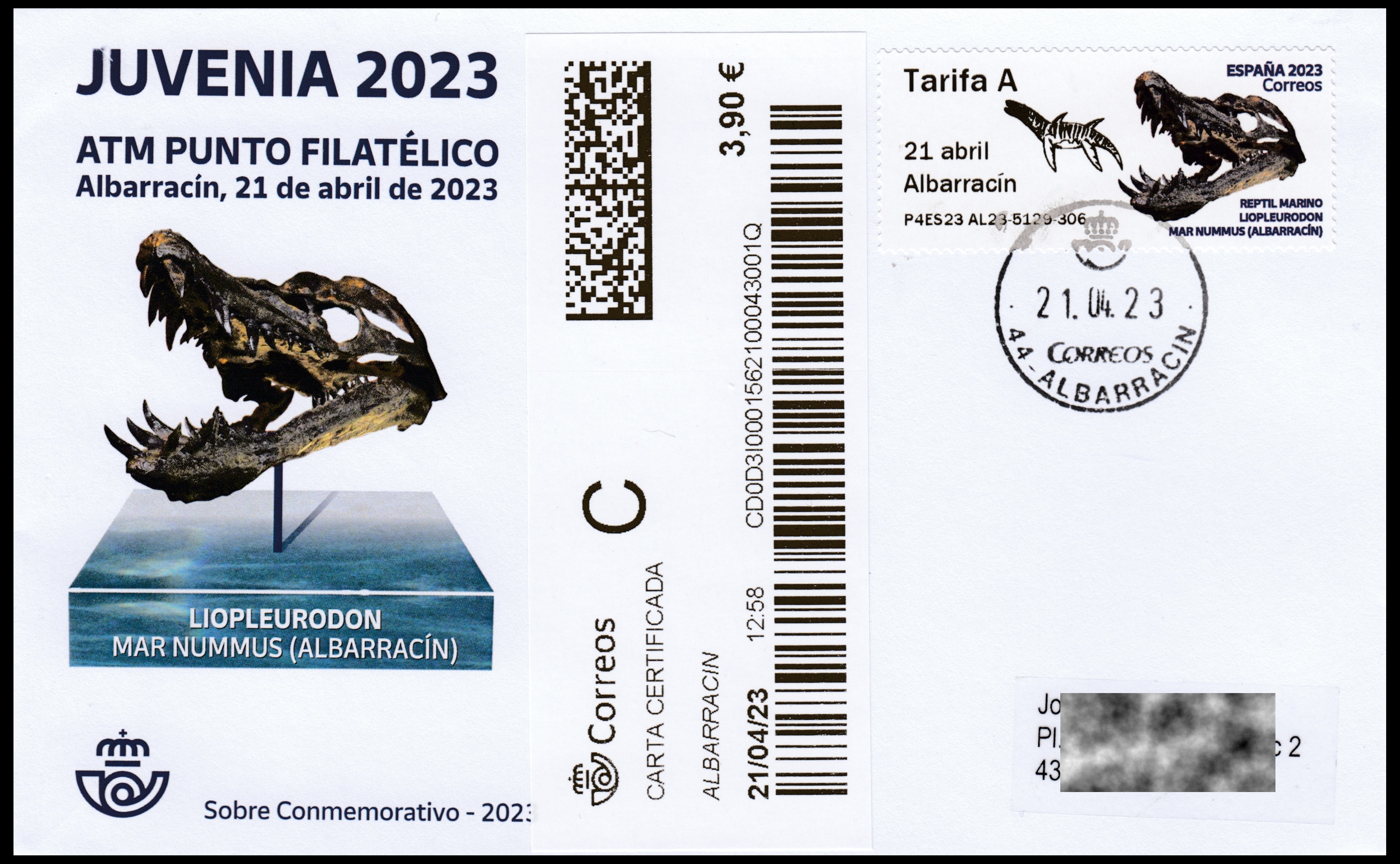
| FDC with ATM stamp and postmark of Albarracin | ||
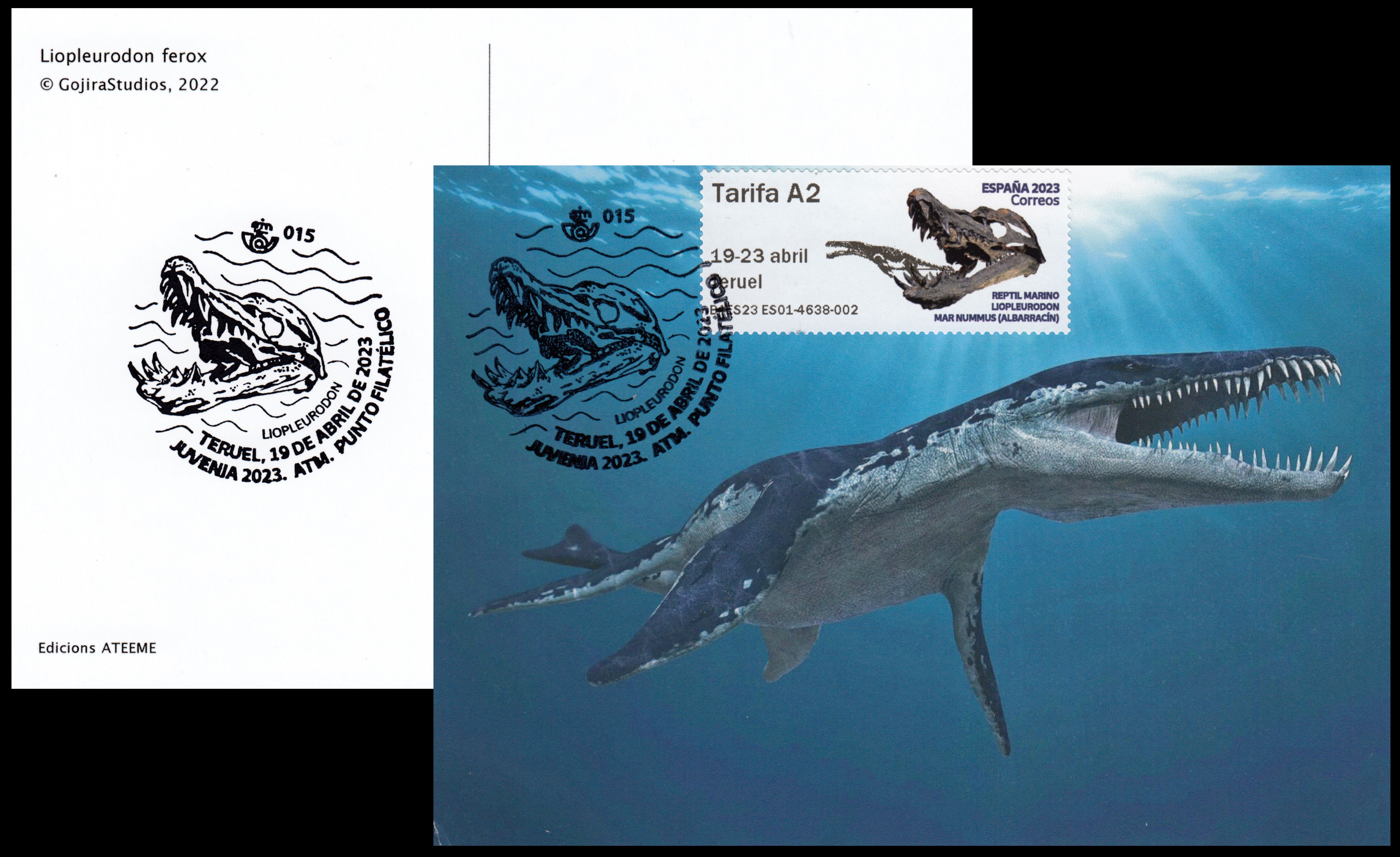
| Maxi Card | ||
 |
 |
 |
| FDC with ATM stamp and postmark of Teruel | ||
| Example of circulated covers | First-Day-of-Issue Postmarks | |
 |
 |
 |
|
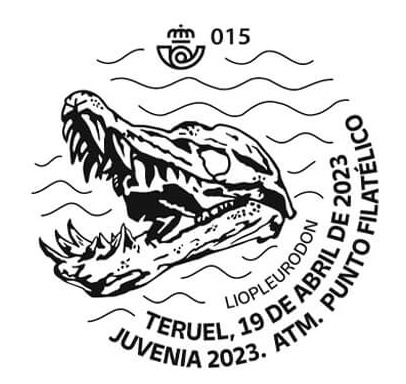
This postmark was available between 10:00 on April 19th
and 14:00 on April 23rd at the tent Post Office in La Glorieta in Teruel. The skull represents the skull of Liopleurodon from the exhibit of Mar Nummus Museum in Albarracín. |
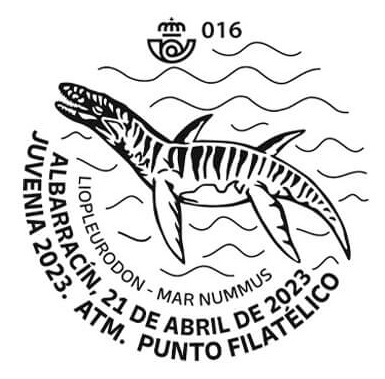
This postmark was available between 10:00 and 14:00 on April 21st
at Philatelic Stand at Dinópolis in Albarracín. The Liopleurodon on the postmark recall the figure of Liopleurodon installed on the roof of the museum's building. |
|
| Design Errors | ||
 |
 |
 |
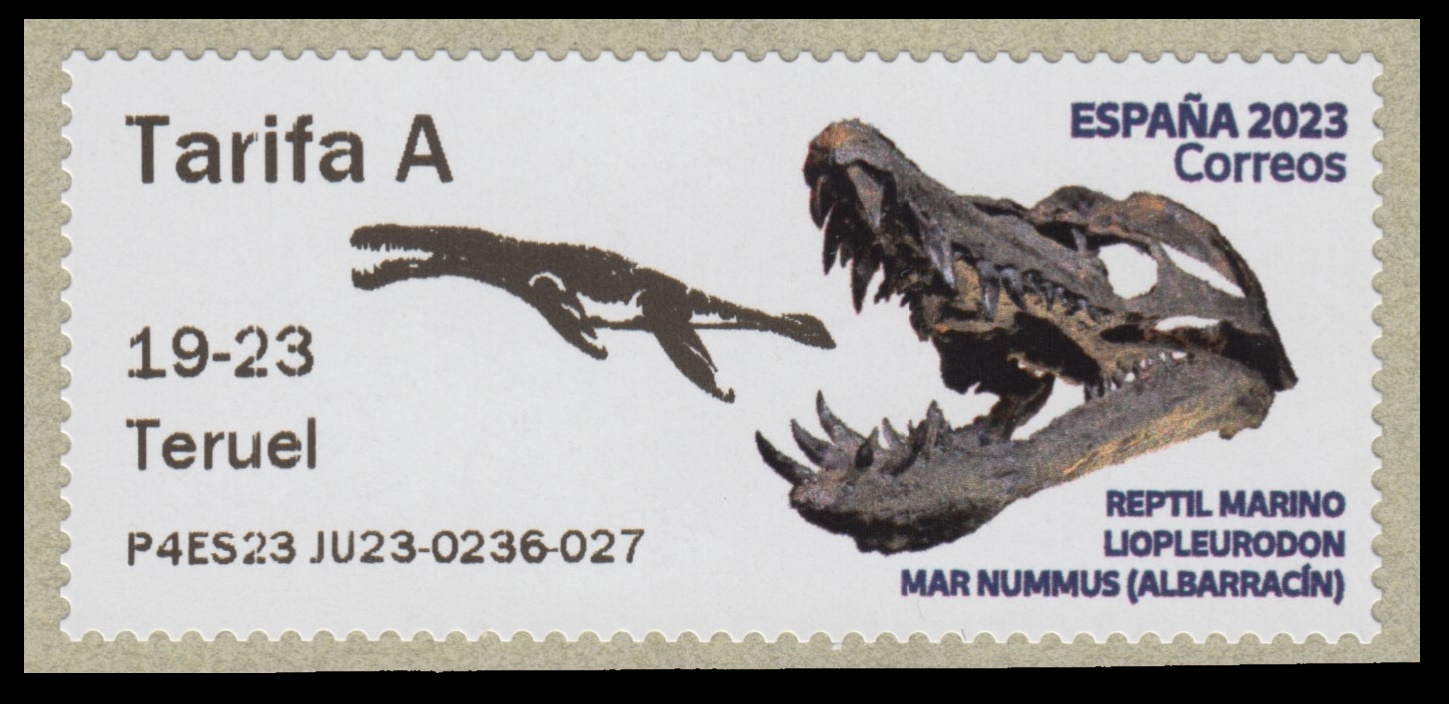
| Example where the name of the month (April) is omitted. | The Liopleurodon image was misplaced and suppressed. | The Liopleurodon image printed on the wrong ATM-label. It happened on the afternoon of 20th, during one hour only, before the staff realized the error and changed the roll. |
References
- Technical details and official press release:
Post of Spain - ATM stamps of April 2023. First-Day-of-Issue Postmark (Teurel). First-Day-of-Issue Postmark ( ALBARRACÍN).
exposicionesfesofi.es (these articles does not exist anymore) - ATM definitions: ateeme.net.
- EXFILA and JUVENIA 2023, stamp shows:
official website, - Pliosaur:
Wikipedia,
Encyclopedia Britannica,
fossilworks.org.
- Liopleurodon: Wikipedia.
- Pliosaur of Iwaki Museum: japan-guide.com, gltjp.com, zh-tw.hamadori-coast.com.
- Dinopolis:
official website, fundaciondinopolis.org. - Mar Nummus Museum in Albarracin:
official website, albarracinturismo.com, bezas.org.
Acknowledgements
- Many thanks to Mr. Josep Jove i Jove, the coordinator of ATEEME, the international philatelic group specializing in the study and collecting of variable value stamps, for his help finding information about these stamps. This group also runs an on-line store for ATM stamps - Galeria ATM Gallery.
- Many thanks to Dr. Peter Voice, PhD Department of Geological and Environmental Sciences, Western Michigan University, USA, for his help in finding information and for review of a draft of this article.
- Many thanks to the staff of the Mar Nummus Museum in Albarracin for their help in finding information about the skull of Liopleurodon.