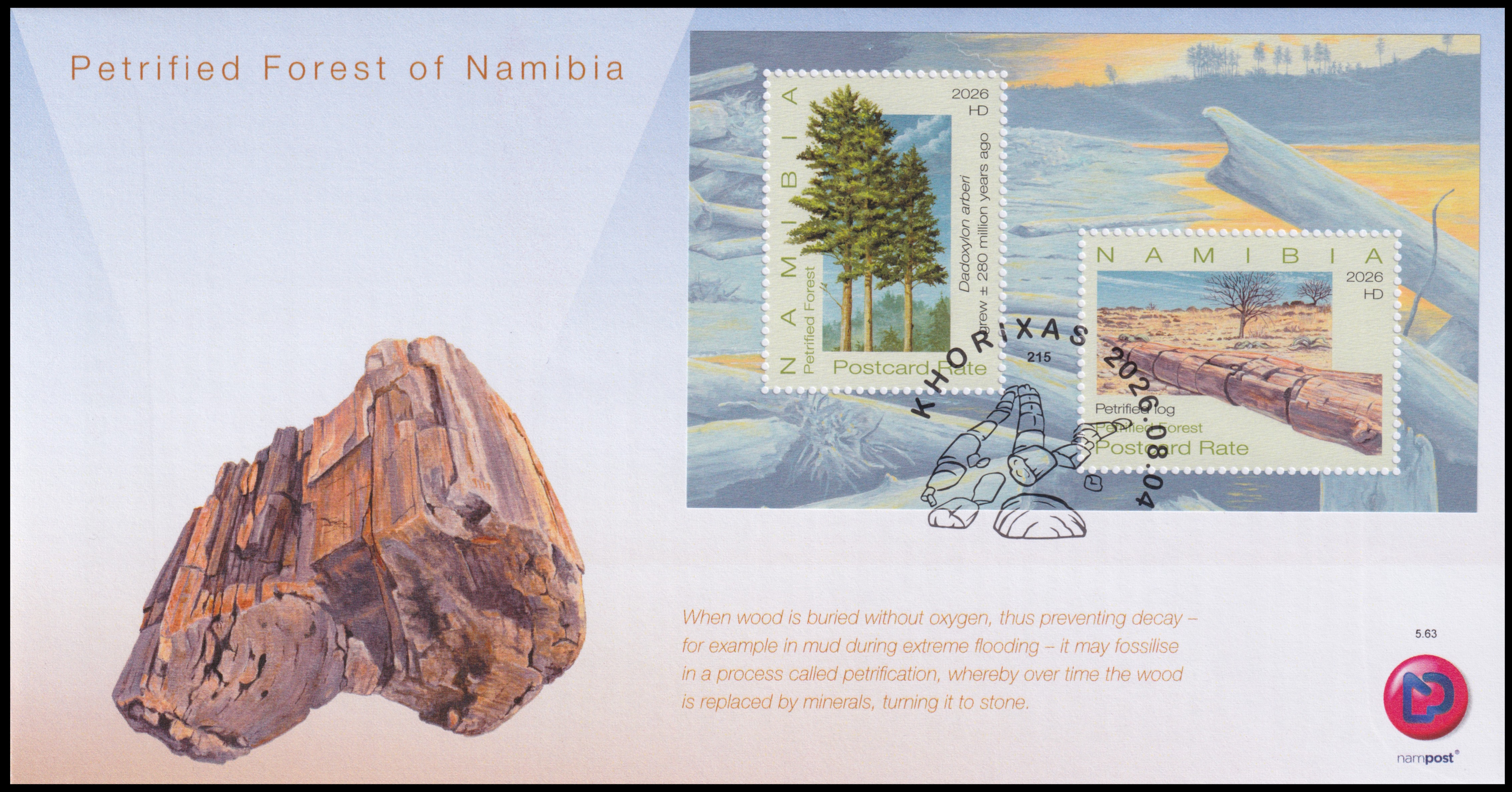
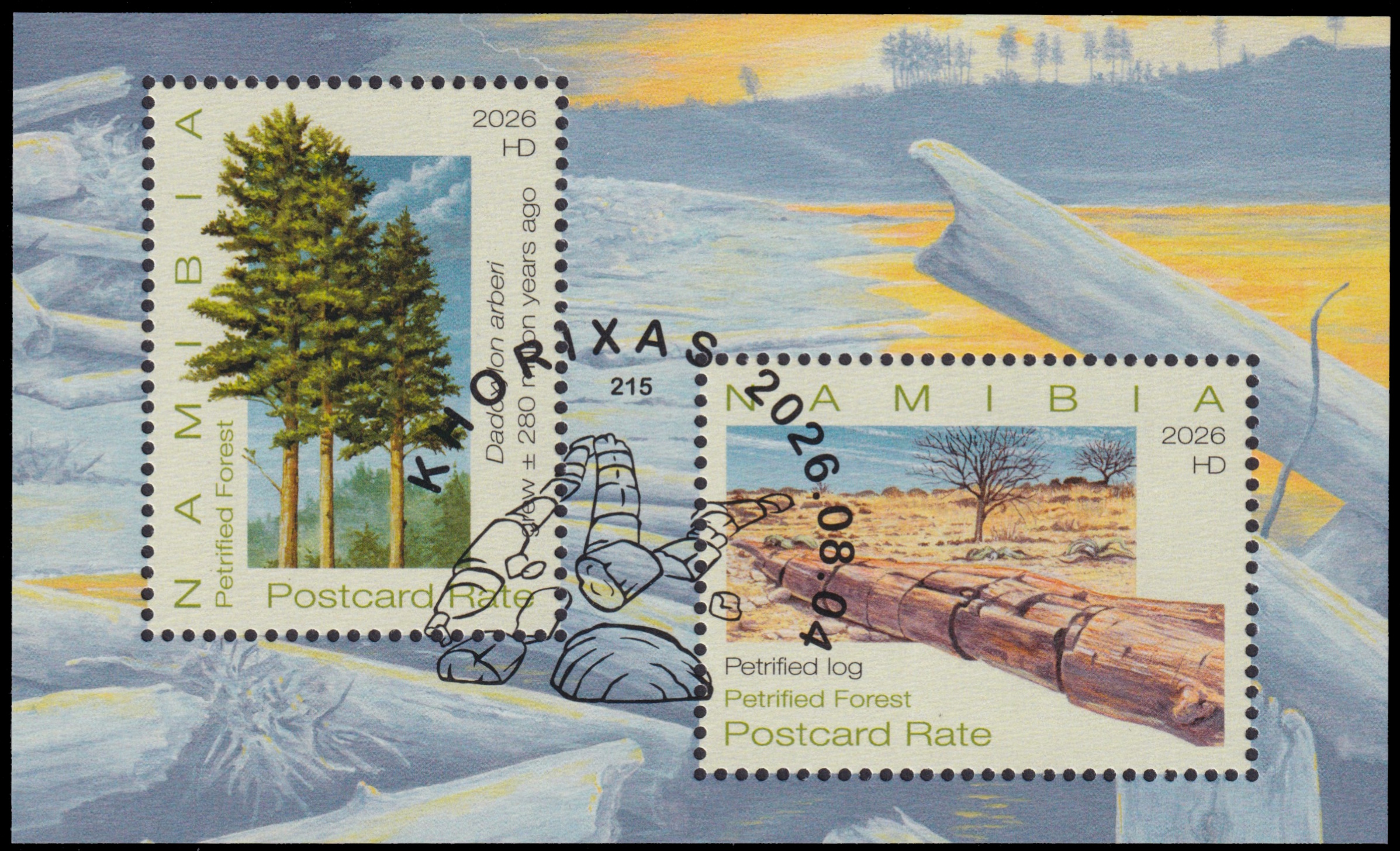
At the end of August 2026, the “Petrified Forest of Namibia” souvenir sheet appeared
in the online store of Namibian Post, although the issue had originally been announced
for August. 4th
The First Day of Issue postmark, which may have been applied to First Day Covers during
their production, still bore the originally announced date.
The following text was published in the information-card inside the FDC
When wood is buried without oxygen, thereby preventing decay – for example in mud during
extreme flooding – it may fossilise in a process called petrification, whereby over time
the wood is replaced by minerals, turning it to stone.
It is a slow process that takes hundreds of thousands, or even millions of years.
In Namibia, there are many sites where
such fossil wood has been unearthed.
Most of these fossils stem from around 300 to 270 million years ago, a period known
in geology as the Lower Permian.
Most discoveries of petrified wood consist of relatively small fragments, yet sometimes,
entire tree trunks are preserved.
One such site is world-famous:
Namibia's Petrified Forest – a national monument – represents the largest
assemblage of fossil wood known from southern Africa.
The Petrified Forest National Heritage Site is located in northwestern Namibia,
some 45 kilometres west of the town of Khorixas.
The rock formations of the Namibian desert depicted on stamps issued
by South West Africa (the former name of Namibia) in 1986.
A petrified tree trunk is depicted on the cachet of the First Day Cover (FDC).
It is a deposit of hundreds of well-preserved
petrified logs, some with lengths of more than 40 metres and diameters of over a metre,
lying scattered across a broad area of many square kilometres, extending far beyond
the national monument site.
The tree trunks have fractured into segments of less than two metres in length – though
in a number of stunning cases preserved in place to show the great length of the logs –
while countless smaller fragments litter the entire area.
The trunks do not have branches or roots attached – a clear indication that they were
transported by floodwaters over significant distances, with all larger protuberances broken
off during the roiling passage.
The actual forest that was the source of the trees grew in a place and time hard to imagine
today.
The evolution of Earth has included extreme continental drifts and related geological upheavals,
such as earthquakes and volcanoes.
Climates have shifted from bitter ice-ages to turbulent tropical conditions, and everywhere
in between.
Namibia is not only the African country where petrified trees or plant fossils were discovered.
Namibia is not only the African country where petrified trees or plant fossils were discovered.
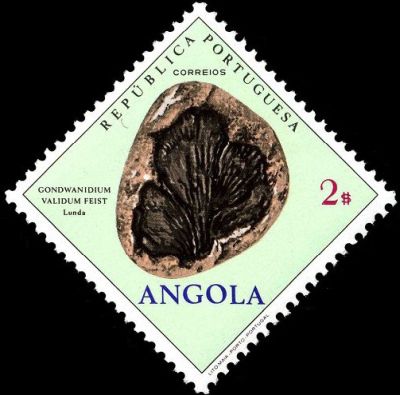
Petrified leaf of Gondwanidium validum was depicted on stamp of Angola 1970.
Gondwanidium validum is the name given to an extinct, fern-like fossil plant
from the Permian Period. It belongs to the fossil flora of the ancient
supercontinent Gondwana, which included present-day
South America, Africa, India, Australia and Antarctica.
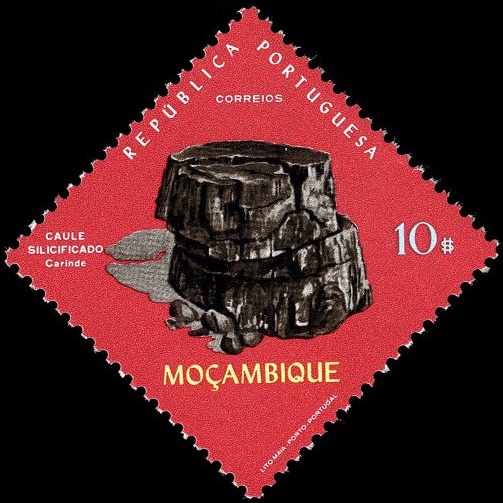
Petrified wood on stamp of Mozambique 1971.
The place that is today Namibia has been pushed and pulled and crumpled across the globe.
The so-called supercontinent Rodinia, which formed around 1,300 million years ago as an
amalgamation of most of the contemporary continents, slowly began to break apart some
750 million years ago, with various land masses, including what are today Africa and
South America, realigned as Gondwanaland by around 550 million years ago.
A new constellation of land known as Pangea had formed by 300 million years ago,
yet this also experienced a gradual disintegration from 230 million years ago.
The remnants of former Gondwanaland were repositioned in the southern hemisphere and
fragmented further, and by 65 million years ago had become similar to what we now know
as Africa and South America.
These geological processes have continually built and reshaped entire landscapes,
burying and exposing earlier formations to create a complex meld of strata – into which the
fossils of trees and other lifeforms have been embedded.
Around 300 million years ago, the land that is today Namibia began to experience temperate
conditions after a period of extensive glaciation.
Warm temperatures and plentiful rain enabled the evolution of life that flourished under
these conditions, including areas of forest and diverse fauna and flora.
Climatic turmoil around 280 million years ago included massive flooding, during which huge
trees were uprooted and transported over substantial distances, along with rubble, soil and
mud.
When the flooding eased, the stripped tree trunks were deposited in low-lying areas in thick
layers of conglomerated sediment.
Sealed away from the air, the wood did not rot; instead, the plant fibres were slowly
infiltrated by diverse dissolved minerals – over time replacing the wood with stone.
Comparatively recent erosion of the sediments in which the petrified wood had been buried
has exposed some of the logs, to be discovered by modern-day people.
The climate of the area has changed considerably since the trees grew here – where once there
were rivers, lakes and coniferous forests, today hardy desert-adapted plants such as the
famous welwitschia grow.
The region now receives an average annual rainfall of only around 200 millimetres.
Vegetation is sparse and taller trees are mostly restricted to the fringes of ephemeral
rivers – here no perennial rivers flow, nor forests grow anymore.
The fossil wood of Namibia's Petrified Forest stems from Dadoxylon arberi,
which refers to a collective of tree species of the conifer family.
The trees had simple, needle-like leaves and apparently a rather shallow, lateral root system.
Seven different tree species have been identified amongst the broad assemblage of fossils.
The fossils are striking in their range of red, maroon, ochre, beige and white hues,
the result of complex mineral infiltration.
Amazingly detailed, the fossils clearly show the structure of the wood, including annual
growth rings and the knots of broken-off branches.
The Petrified Forest National Monument was declared in 1950 by the South African
administration of the time, after some of the fossils had been reported by white settlers
in the 1940s.
Since Namibia's independence in 1990, the country's national monuments are managed by
the National Heritage Council of Namibia.
The Petrified Forest has become an important tourist attraction, drawing many thousands
of visitors each year.
The national heritage site protects only a portion of the overall fossil deposits.
Other equally attractive sites are accessible on adjacent communal land, managed by the
local communities.