Portugal 2019 "Centenary Museums of Portugal"
| Issue Date | 05.04.2019 |
| ID | Michel: 4491-4503: Scott: 4116a-j; Stanley Gibbons: 4720-4728; Yvert et Tellier: 4478-4486; Category: pR |
| Design | Design: AF Atelier Photo: Manuel Aguiar, Carlos Monteiro |
| Stamps in set | 13 |
| Values |
13 x N20g rate (domestic letter rate for letter up to 20gr. equipment to €0.53)
|
| Emission/Type | commemorative |
| Places of issue | Lisbon |
| Size (width x height) | 40 mm x 30.6 mm |
| Layout | Sheets of 52 stamps with 13 stamp printed vertically together. |
| Products | FDC x2, Presentation Pack x1 |
| Paper | FSC 110g/m2 |
| Perforation | 12.25 x 12 |
| Print Technique | Offset |
| Printed by | bpost Philately & Stamps Printing |
| Quantity | 100.000 each |
| Issuing Authority | CTT Correios de Portugal SA |
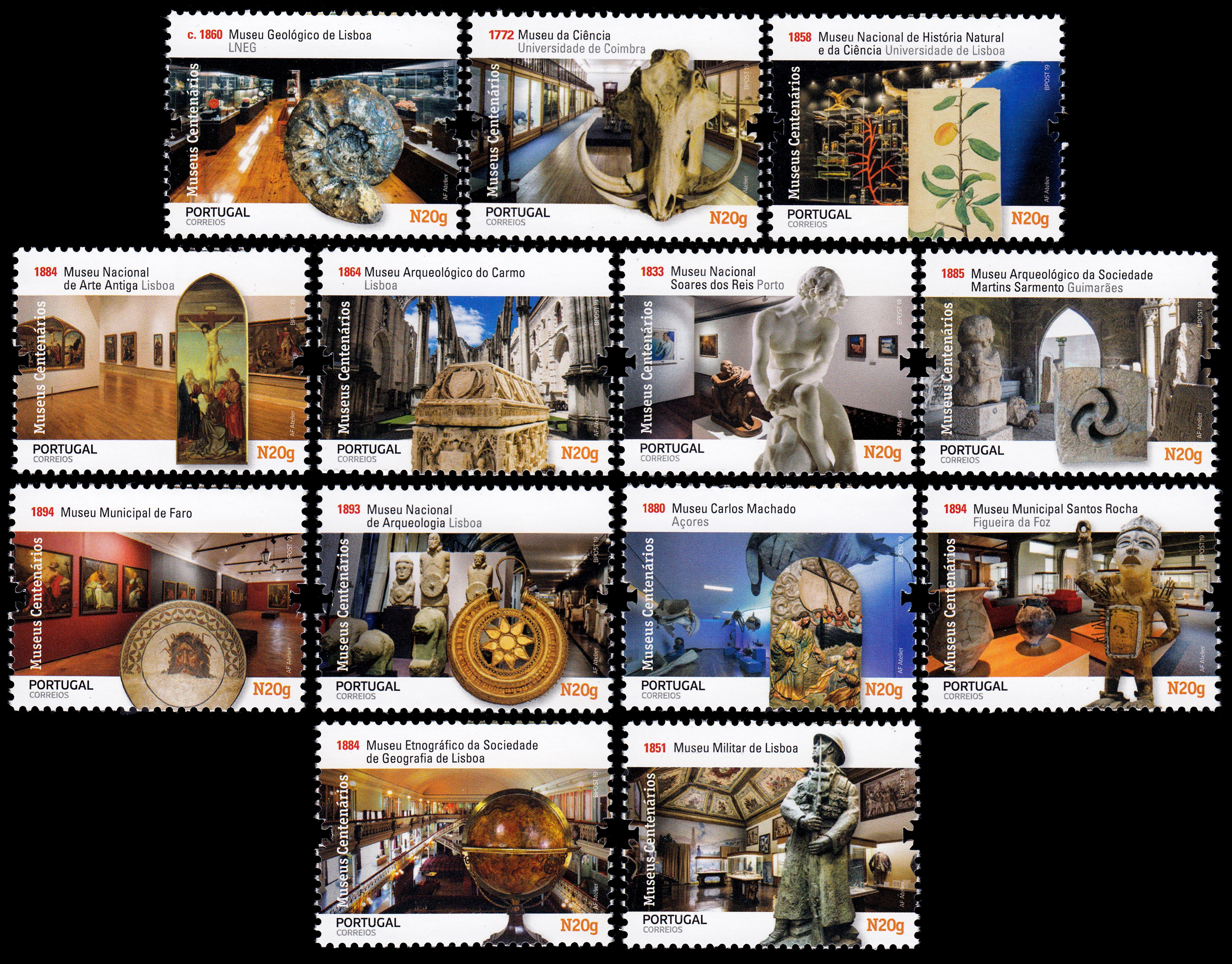
On April 5th, 2019, the Post Authority of Portugal introduced the set of 13 stamps "Centenary Museums of Portugal".
Every stamp is dedicated to a different museum of the country.
The following text was written by Cristina Cordeiro, published in the brochure produced by Portuguese Post (CTT) for this issue.
"This stamp issue is an integral part of a work dedicated to Portuguese museological heritage, the first volume of which is now coming to light. True guardians of memory, the thirteen century-old museums that are presented here were all founded between 1772 and 1894, in a period marked by extraordinary advances, having each one of them its own story to tell. A unique story that distinguishes it from all others. A story of resilience marked by the will to thrive in often adverse circumstances, and which made them repeatedly reinvent themselves up to the present day. Distributed throughout the national territory, on the mainland and on the islands, from the coast to the interior, these century-old museums, both public and private, act as bridges between the monuments, places and communities that form them.
Dating to 1772, the Natural History Cabinet of the University of Coimbra – today the Museum of Science – is the oldest living museum in Portugal.
It is the heir to the country's first scientific collections, gathered by Domingos Vandelli in the Royal Museum and Botanical Garden of Ajuda, which was founded in 1768 at the behest of the Marquis of Pombal.
Six decades later, even amidst the siege of Porto, King Pedro IV created the Museu Portuense, now the Soares dos Reis National 1833, it was the country's first public art museum.
In 1851, the Artillery Museum – today the Military Museum – was opened in the facilities of the former Royal the importance of this military institution in a century marked by liberal struggles.
In 1858, now Museum of Natural History of Science of Lisbon - MUHNAC – was established in the building of the Royal Nobles, later the Polytechnic School.
Around 1860, the Lisbon Geological Museum was opened on the first floor of the Academy of Sciences building in the heart of Bairro Alto, housing the most complete geological collection of the country.
In 1864, the Archaeological Museum of Carmo was founded within the Royal Association of Portuguese Civil Architects and Archaeologists, to whom King Luis ceded the management of a convent erected in the 14 by Nun'Álvares Pereira to mark the victory of Aljubarrota. Focused on Natural History, the Azorean Museum – today the Carlos Machado Museum – appeared in 1880 on the island of Sao Miguel in the Azores. Based in the Santo Andre Convent in Ponta Delgada, it quickly expanded its collections.
In 1884, the Historical and Ethnographic Museum was founded by the Lisbon Geographical Society. Now the Ethnographic Museum of the Lisbon Geographical Society, it tells the story of the Portuguese presence in Africa, India, Macao and Timor.
Following the Ornamental Art Exhibition that had taken place in Lisbon that same year, the Museum of Fine Arts and Archaeology was created, today the National Museum of Ancient Art.
Months later in 1885, the Martins Sarmento Society, an illustrious cultural institution in Guimarães, opened the doors of its Archaeological Museum.
Eight years later, in 1893, Jose Leite de Vasconcellos founded his Ethnographic Museum, currently the National Museum of Archaeology. Today, around 380 thousand pieces make up its collections, which cover a vast chronological spectrum of almost half a million years.
A year later in 1894, the country witnessed the birth of the Archaeological and Lapidary Museum of Faro, currently the Municipal Museum of Faro, a guardian of the heritage of this city of the Algarve from Roman times to today.
Also in that year, the Municipal Museum of Figueira da Foz – now the Santos Rocha Municipal Museum – was created, dedicated to the study of the various branches of human sciences.
Each of these museums carries a living and dynamic legacy which gives rise to new readings every day. A heritage condensed here in twenty-six images and spanning more than a century of history."
There are 3 stamps of interest for Paleontology stamp collectors
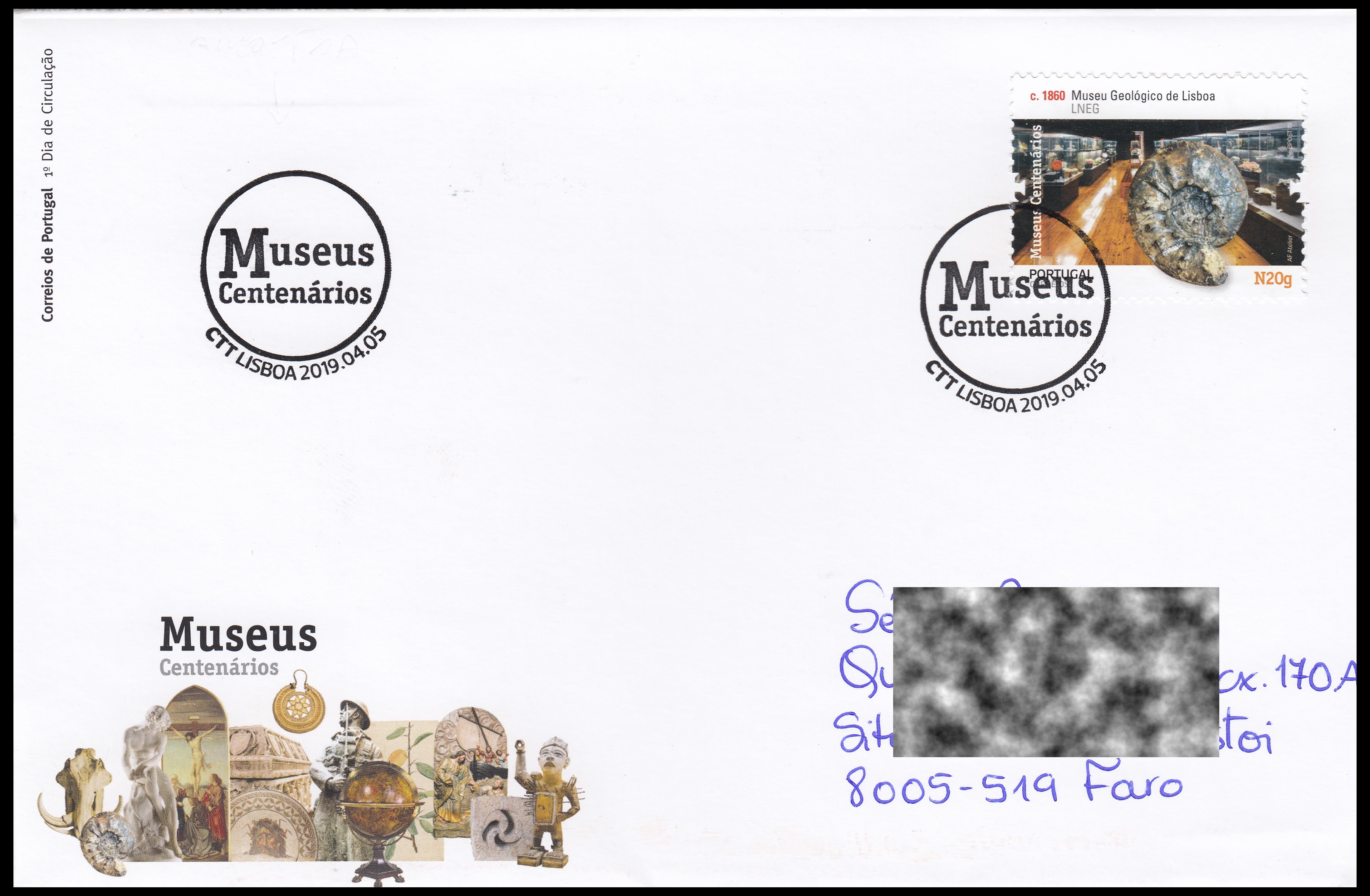
Lisbon Geological Museum (LNEG)
The Geological Museum is located on the 2nd floor of the building of the old Convent of Nossa Senhora de Jesus of the Order Terceira de S. Francisco, in the heart of the historical center of Lisbon, near Bairro Alto.
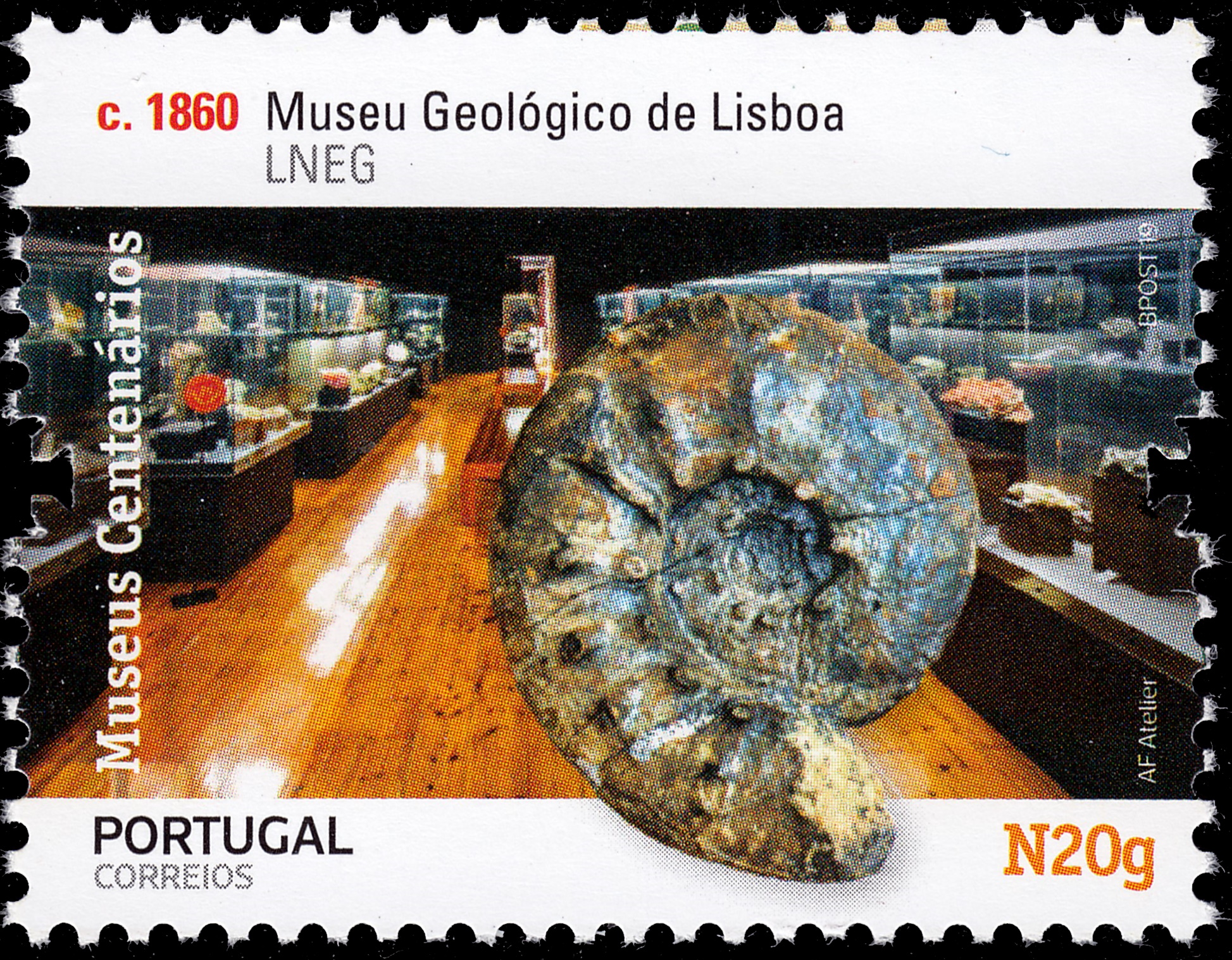 |
| Geological Museum of Lisbon on stamp of Portugal 2019 MiNr.: 4495, Scott: 4116e |
The permanent exhibition consists of four rooms: palaeontology and stratigraphy; the palaeontology of vertebrates; prehistoric archaeology; and mineralogy.
The "
"100 Million Years of History of Lisbon" exhibit of the museum is dedicated to the geology of Lisbon, from its oldest formation outcrops of the Late Cretaceous to the Quaternary. Each one of the display cases is dedicated to a certain period of time represented in the Lisbon area, exhibiting some of the most representative fossils: corals, bivalves, gastropods, echinoderms, cephalopods, reptiles and mammals, as well as some samples of sedimentary and eruptive rocks.
One of the fossils, a fossil Ammonite of the genus Euaspidoceras from the Upper Jurassic (50 million years ago), found in Malhao, Loule, is shown on the foreground of the "Museu Geologico de Lisboa" stamp.
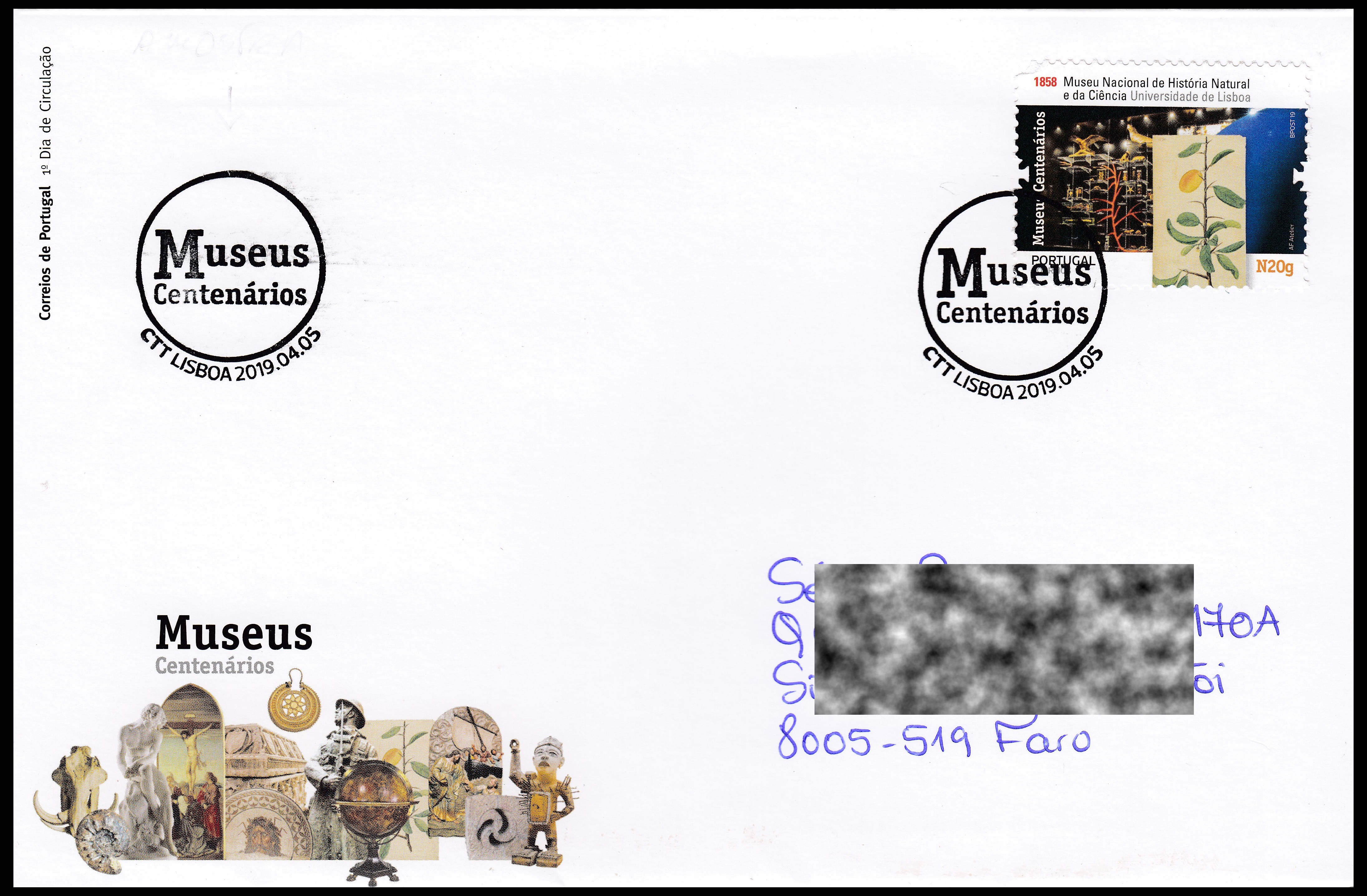
National Museum of Natural History and Science of the University of Lisbon (MUHNAC)
The National Museum of Natural History and Science in Lisbon (MUHNAC), is the country's main museum focusing on nature. The museum functions under the University of Lisbon.
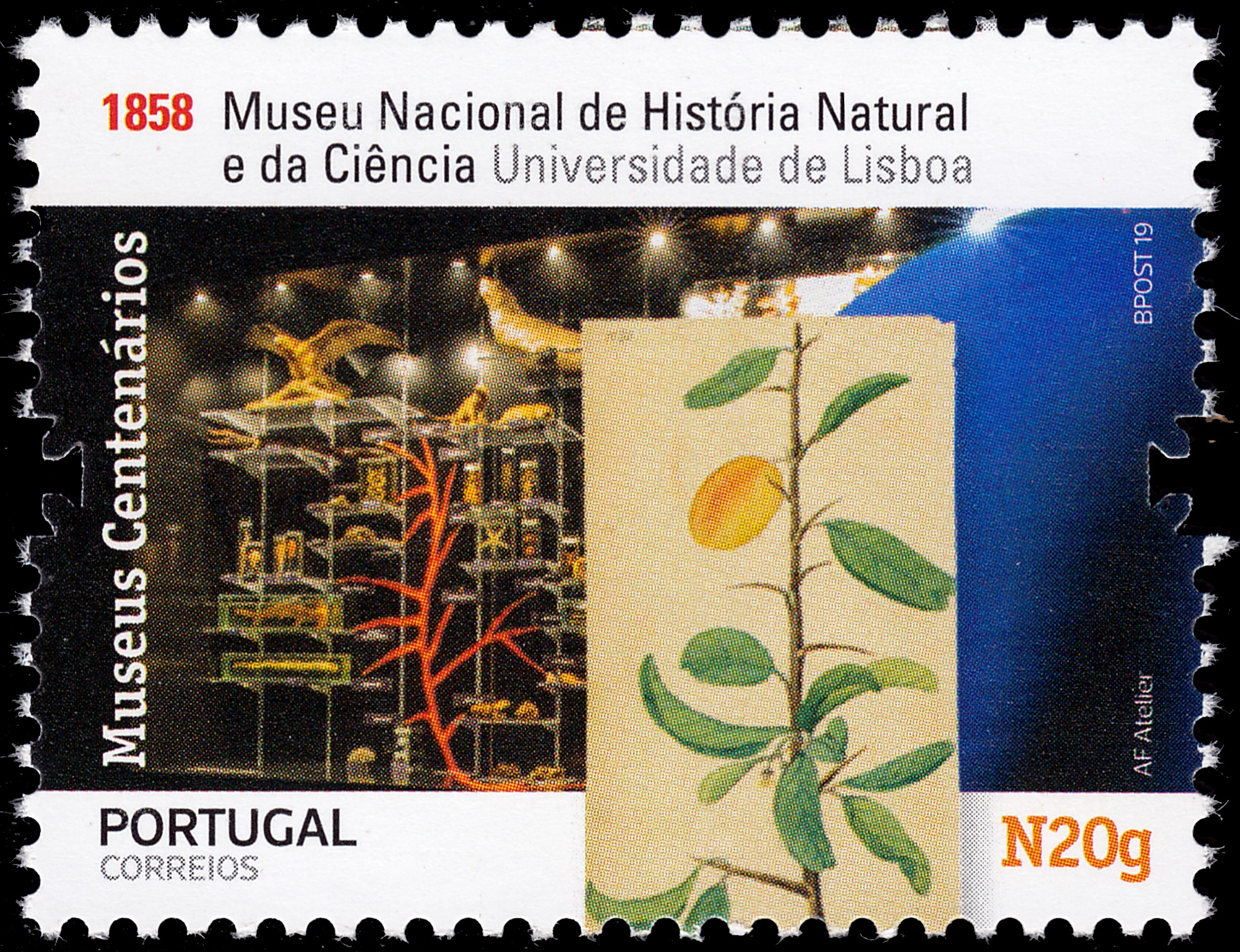 |
| Natural History and Science Museum, University of Lisbon on stamp of Portugal 2019, MiNr.: 4494, Scott: 4116d. |
This mission is achieved through the valorization of its collections and the university heritage, research, organization of exhibitions, conferences and other scientific, educational, cultural and leisure activities.
The museum's recent public designation was awarded in October 2011. This incorporated the former National Museum of Natural History and the University of Lisbon Science Museum, integrating their collections, the historical buildings of the Polytechnic School, the Lisbon Botanical Gardens and, since July 2012, the Lisbon Astronomical Observatory.
The Museum supports research and teaching in the fields of zoology and anthropology, botany, mineralogy, geology, paleontology, and other natural sciences.
The Mineralogy, Geology and Paleontology Department preserves and enhances the museum's mineralogy, geology and paleontology collections, promoting its use in advanced research and training, and in educational activities and the diffusion of scientific culture.
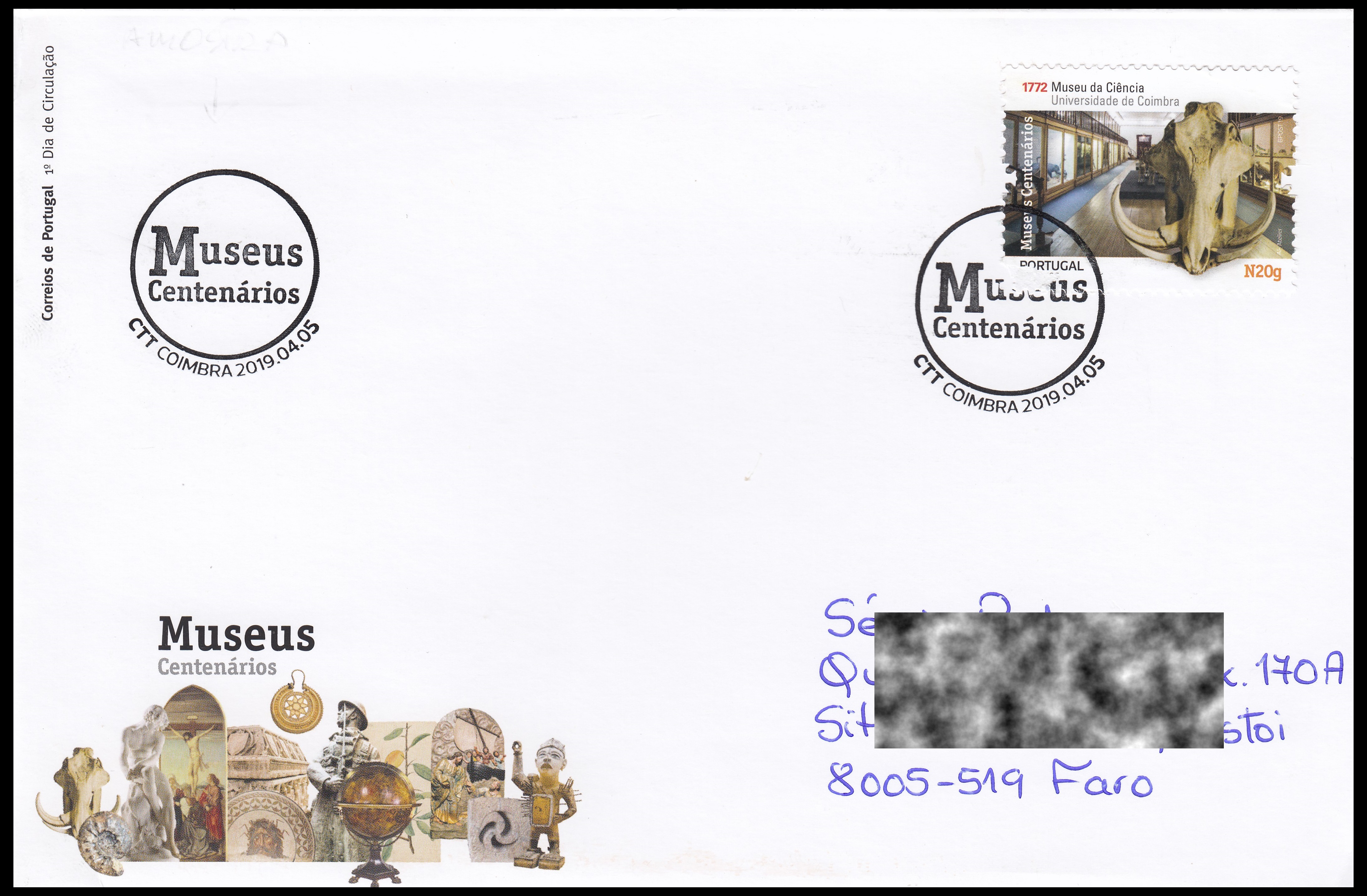
Science Museum of the University of Coimbra
The Science Museum of the University of Coimbra gathers the historical scientific collections of several units of the University of Coimbra, in Coimbra, Portugal.
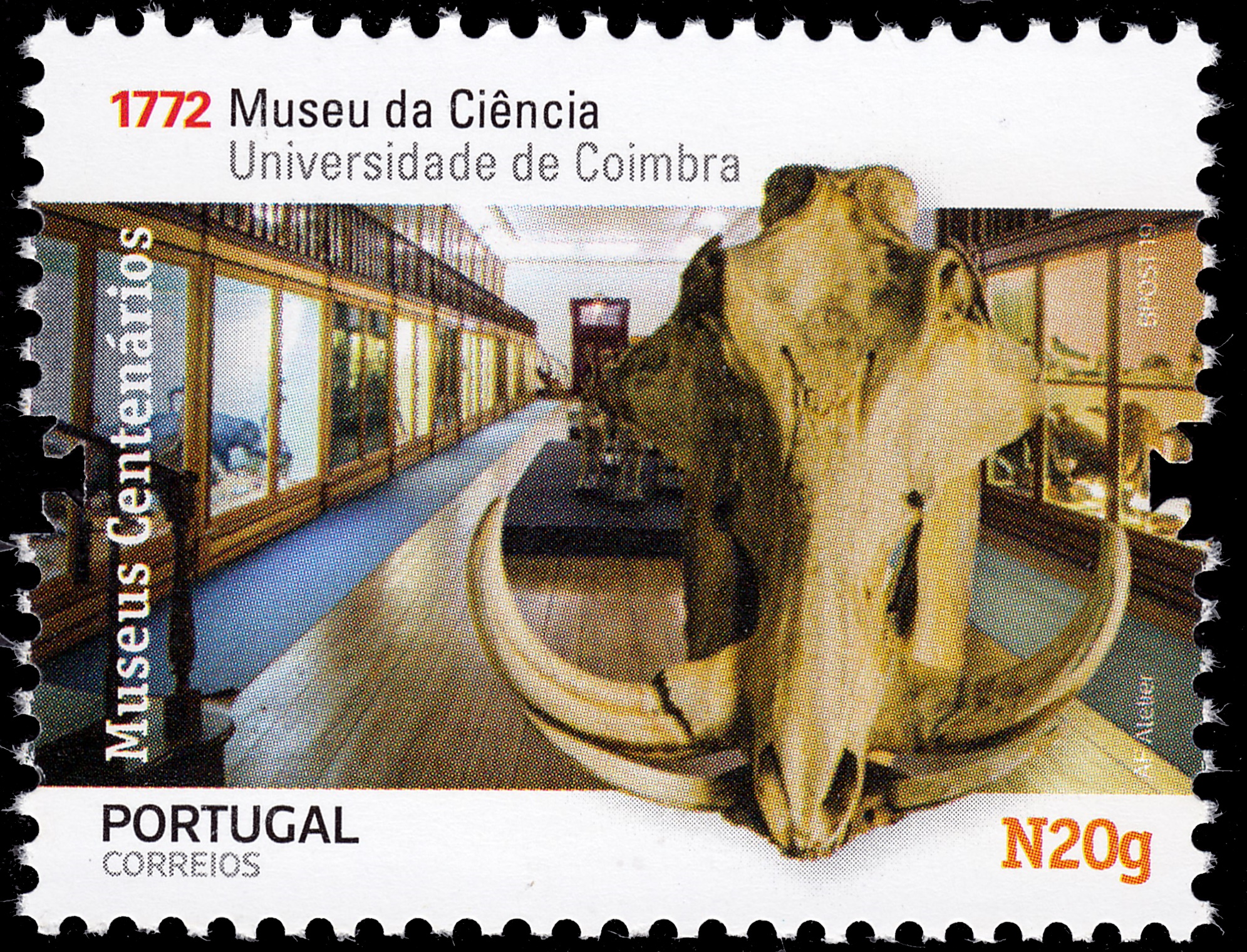 |
| Science Museum, University of Coimbra on stamp of Portugal 2019, MiNr.: 4491, Scott: 4116a. |
The university is among the oldest universities in continuous operation in the world, the oldest in Portugal, and played an influential role in the development of higher education in the Portuguese-speaking world.
In 2013, UNESCO declared the university a World Heritage Site, noting its architecture, unique culture and traditions, and historical role.
The scientific collections of the Museum of the University of Coimbra are unique in Portugal and are very important at the international level. It includes the collection of scientific instruments from the 18th and 19th century of the Physics Museum, the collections of botany, zoology, anthropology and mineralogy of the Natural History Museum, and the collections of the Astronomical Observatory and the Geophysical Institute of the University of Coimbra.
In 2022, the Post of Portugal issued the set of two stamps "250th anniversary Pombal's Reform of the University of Coimbra".
One of the stamps shows an ammonite of the genus Echioceras from the paleontological collection of the museum, which contains about ten thousand fossils.
Products and associated philatelic items
| FDC | ||
 |
 |
 |
| Example of circulated cover | ||
 |
||
References
- Technical details and short description:
Information brochure of Portuguese Post (CTT), colnect. - Geological Museum in Lisbon:
official website, Visit Lisbon. - National Museum of Natural History and Science:
official website, Wikipedia, - Science Museum, University of Coimbra:
Wikipedia, official website.
Acknowledgments
Many thanks to Dr. Peter Voice from Department of Geological and Environmental Sciences, Western Michigan University, for reviewing the draft page and his very valuable comments.