North Korea 2013 "Fossils"
| Issue Date | 10.11.2013 |
| ID | Michel: 6042-6044; Scott: 5219-5221; Stanley Gibbons: ; Yvert et Tellier: 4220-4222; Category: pF |
| Design | |
| Stamps in set | 3 |
| Values |
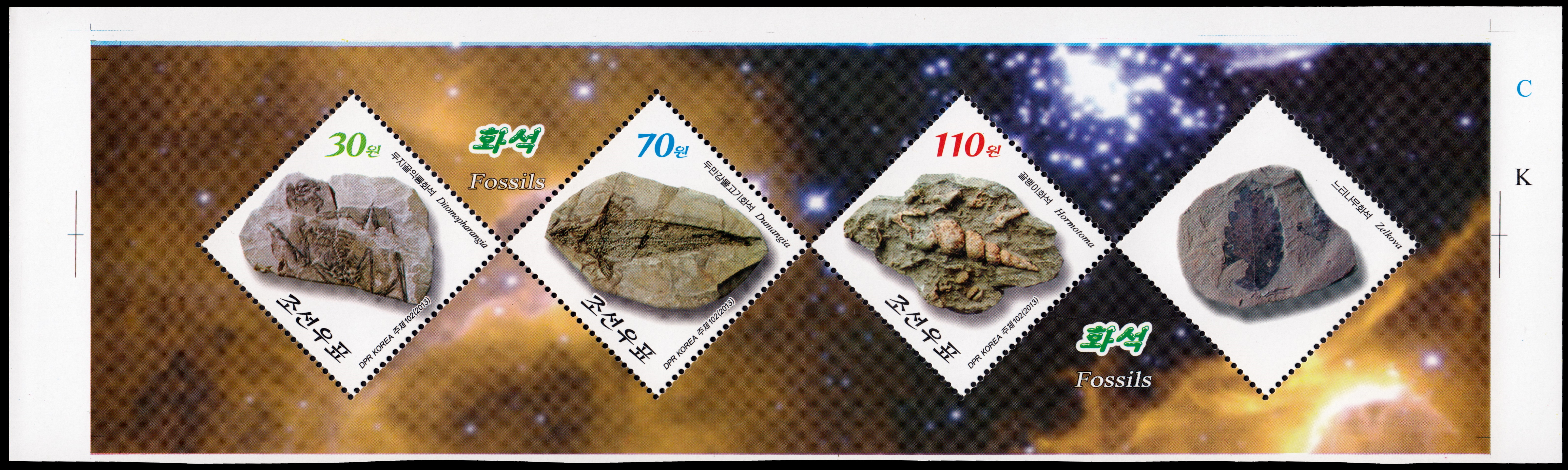
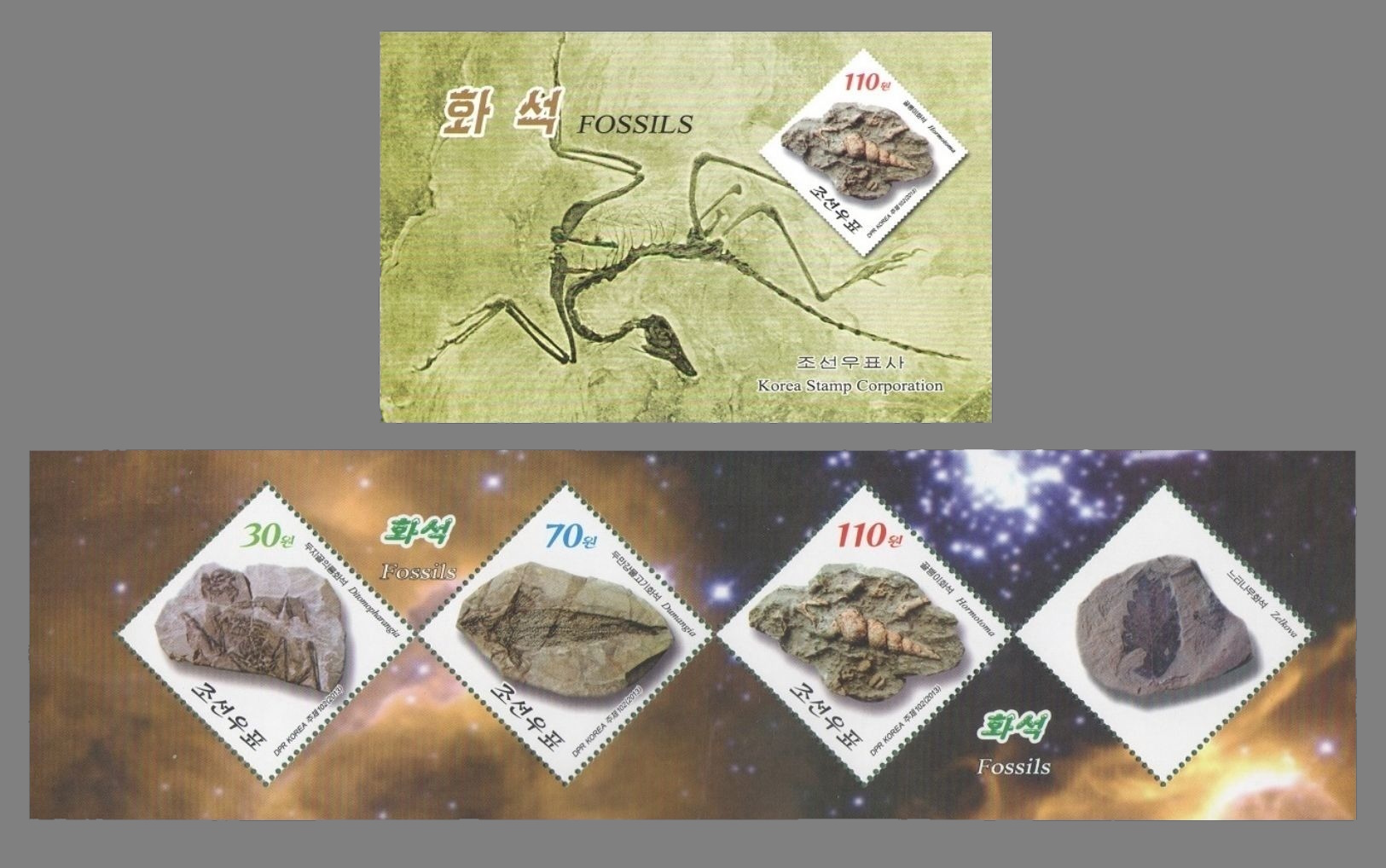
30 W - Ditomopharangia 70 W - Dumangia 110 W - Hormotoma tab - Zelkova |
| Emission/Type | commemorative |
| Issue place | |
| Size (width x height) | |
| Layout |
Strips of 3 stamps and one tab |
| Products | FDC x1, Booklets x2, PS x3 |
| Paper | |
| Perforation | 13 x 13 |
| Print Technique | Offset |
| Printed by | |
| Quantity |
50.000 perforated sets, 1.000 imperforate sets, 1.000 booklets with perforated stamps, 500 booklets with imperforated stamps |
| Issuing Authority | Korea Stamp Corporation |

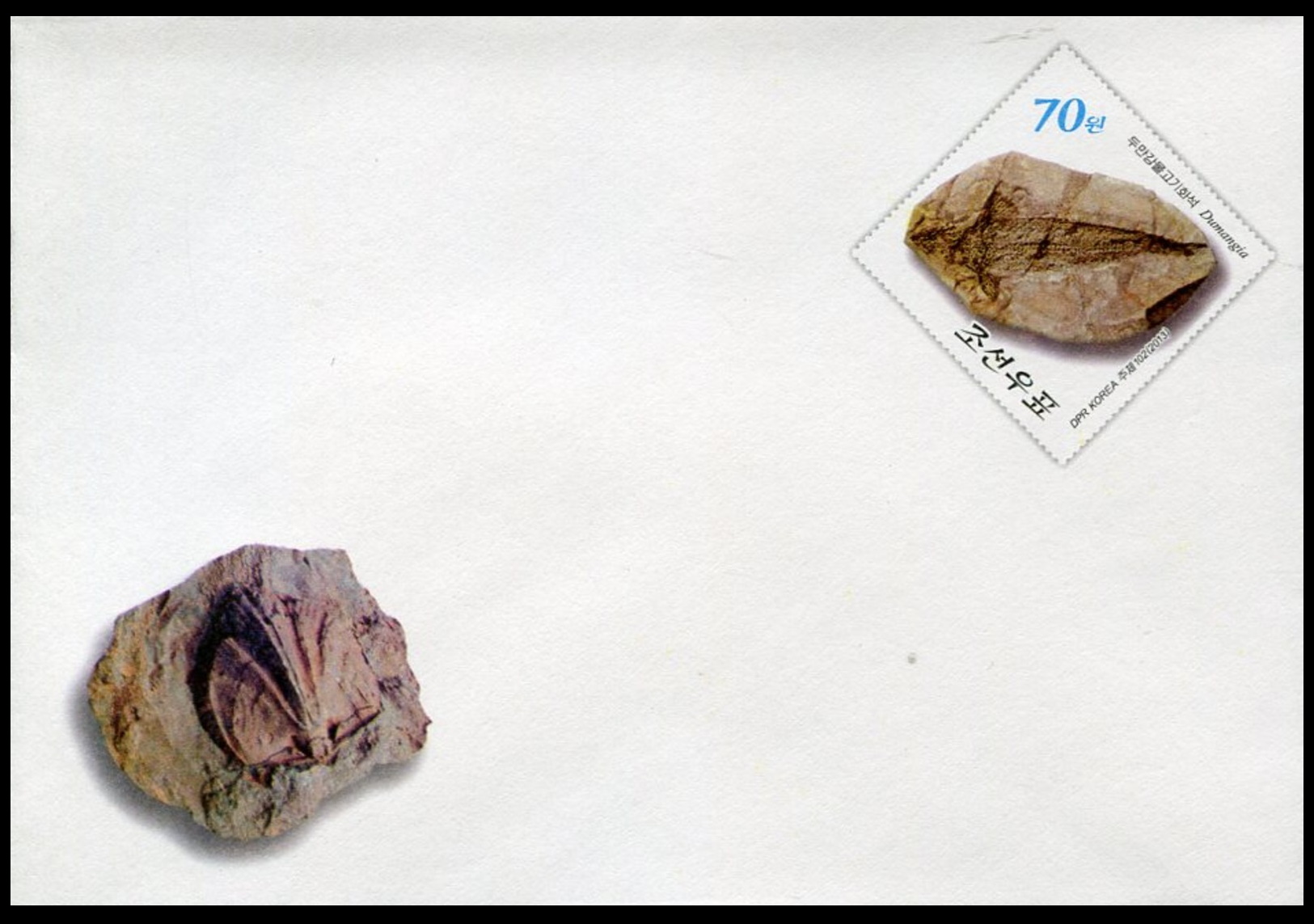
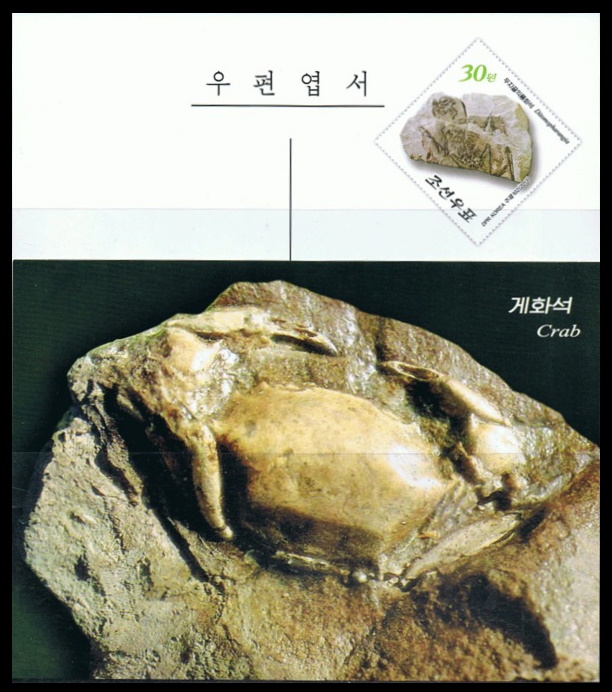
On November 11th, 2013, the Post Authority of North Korea issued the set of three fossil stamps. These stamps were issued as a booklets: one booklet with perforated and another one booklet with imperforate stamps. On top of the stamps North Korean post also issued three postal stationaries with imprinted stamps of the same design: aerogramme, envelope and postcard with imprinted stamps.
All fossils that depicted on these stamps are uncovered in North Korea, unfortunately the names of the stamps are not valid taxonomic names, as they do not appear to have been properly published under the Code of Zoological Nomenclature.
 |
| Ditomopharangia fossil on stamp of North Korea 2013, |
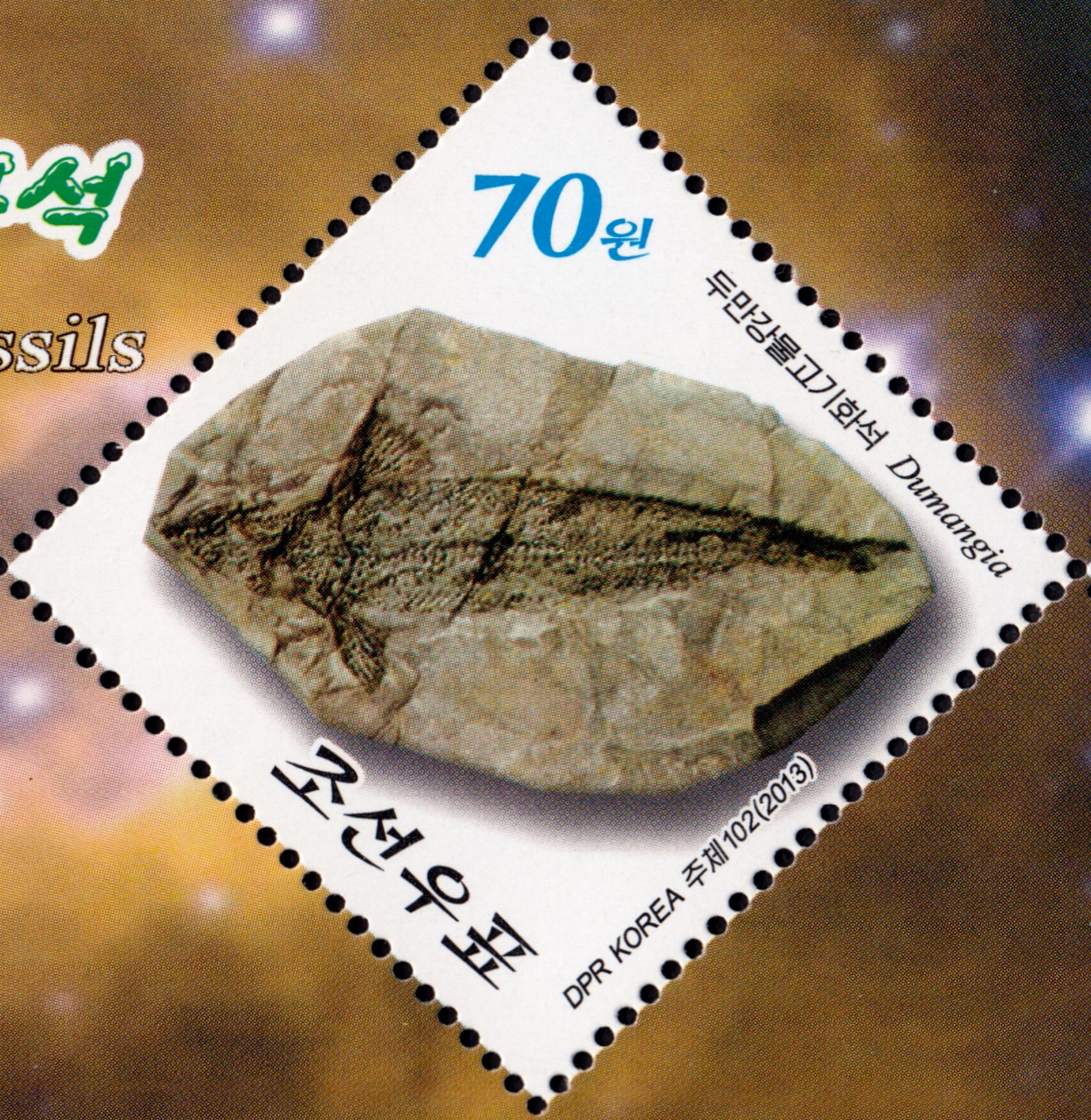 |
| Dumangia fossil on stamp of North Korea 2013 |
The Korean text on the Ditomopharangia stamp reads "Pterosaur fossil from Dooji valley", the valley located in the south of the Ryanggang Province of North Korea .
This is pigeon-sized pterosaur from the Anurognathidae family, suborder Rhamphorhynchiodea, from the Sinuji Series - approximately 25 cm long from the tip of the snout to the end of the tail, and probably had a wingspan of more than 80 cm.
Dumangia
Dumangia - fossil fish from Duman river, the river along the North Korea- China border.
Dumangia is not valid genus name and the image on the stamp is not good enough to allow its identification.
Hormotoma synonym of Murchisoniina, alternative spelling: Murchisonia (Hormotoma)
Hormotoma is a gastropod (molluscs) that is generally preserved as molds, from the Paleozoic Era. There are reports of fossils of this genus from North America, Russia, China, and Australia - from Ordovician and Silurian-aged rocks.
 |
| Hormotoma fossil on stamp of North Korea 2013, |
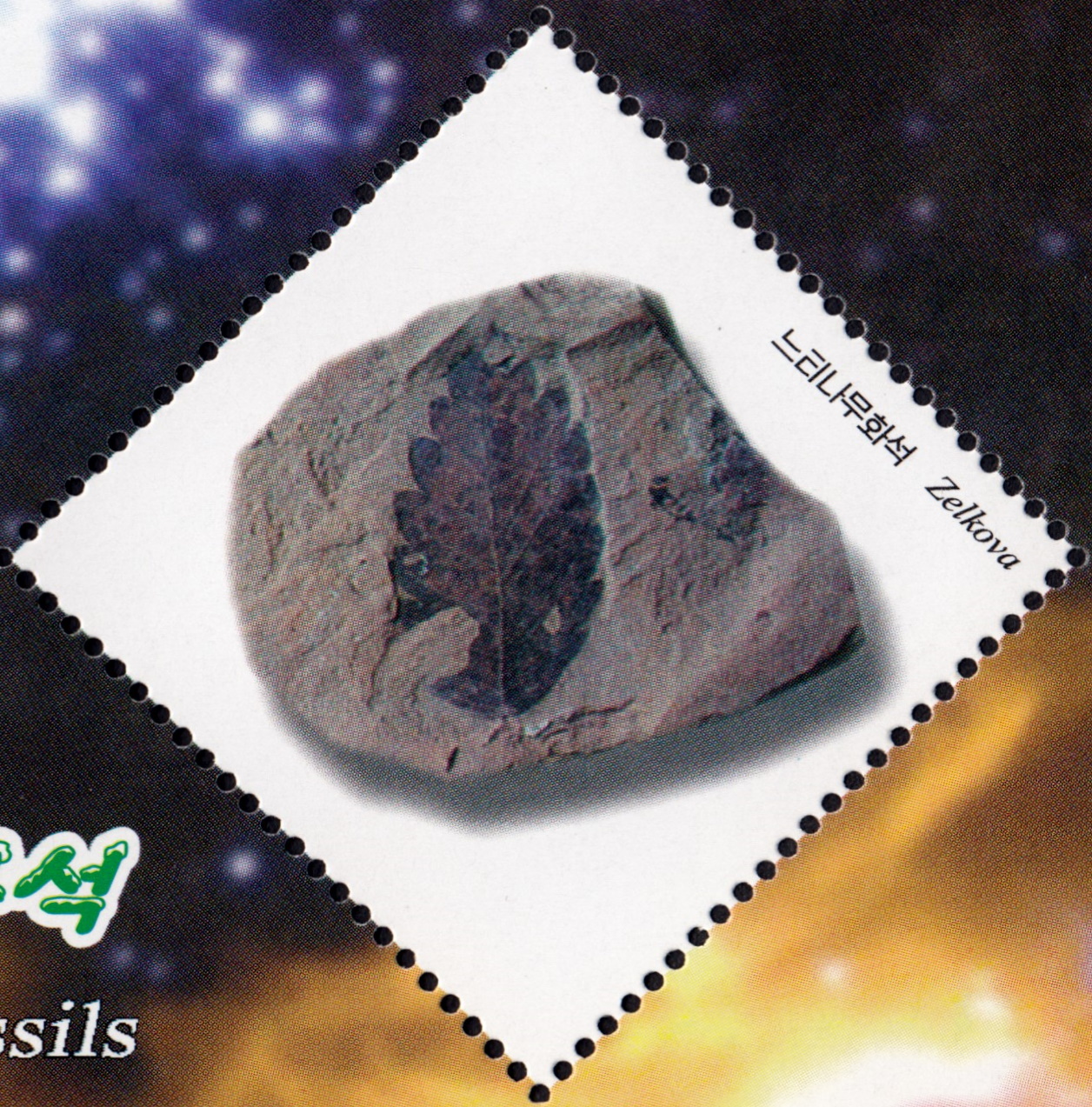 |
| Zelkova fossil on tab of North Korea 2013 |
The fossil shown on the stamp is more of a "form" genus - that Korean Post used it for high spired, snails that have similar shapes - because they are preserved as molds - they don't necessarily preserve other ornamentation that might actually be useful for classification.
Zelkova
Fossilized leaf of a tree from the genus Zelkova.
Zelkova (from Georgian 'stone pillar') is a genus of six species of deciduous trees in the elm family Ulmaceae, native to southern Europe, and in southwest and eastern Asia still alive.
They vary in size from shrubs to large trees up to 35 m tall. The bark is smooth, dark brown. Unlike the elms, the branchlets are never corky or winged. The leaves are alternate, with serrated margins, and (unlike the related elms) a symmetrical base to the leaf blade.
Products and associated philatelic items
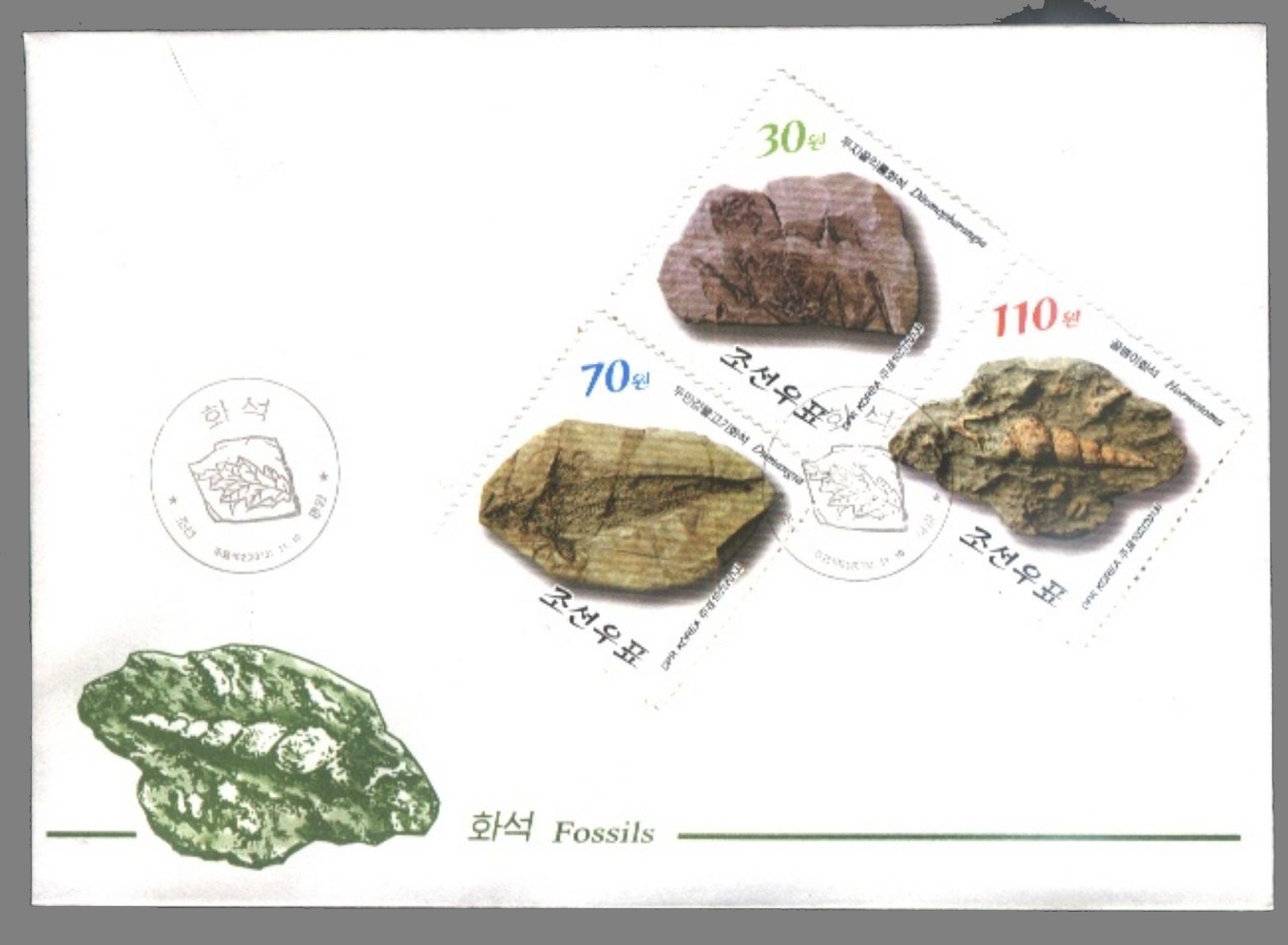
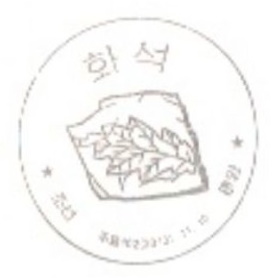
| FDC | First-Day-of-Issue Postmark | Set of Souvenir-Sheets |
 |
 |
 |
| Postal Stationeries | ||
| Aerogramme | Envelope | Postcard |
 |
 |
 |
| Proof Strip | Booklet | |
 |
 |
|
References
- Ditomopharangia:
"Early Cretaceous birds and pterosaurs from the Sinuiju Series, and geographic extension of the Jehol Biota into the Korean Peninsula", written by Ke-Qin Gao, Quanguo Li, MINGRUI WEI, HyonUk Pak, and Insop Pak.
Figure 3 on page 5 shows fossil image of the pterosaurus. - Dumangia:
"Fossil fishes worldwide - the world of prehistoric fishes and their reflection in Philately", written by Has Ulrich Ernst and Oliver Hampe. ISBN: 978-3-89937-241-0 - Hormotoma :
fossilworks.org, fossilid, Wikipedia, Wikidata. - Zelkova:
Wikipedia
Acknowledgements
Many thanks to
- Dr. Peter Voice from Department of Geological and Environmental Sciences, Western Michigan University, USA
- Mr. Rudolf Hofer from Switzerland, Editor of Paleontology column of "Glückauf" Magazine of Arbeitsgemeinschaft Bergbau und Geowissenschaften e. V. club
- Mr. Kevin Nolis Administrator of the “Société d'Histoire Régionale de Rance – Musée du Marbre” from Belgium
- Mr. Richard S. White former Curatorial assistant, paleontology at American Museum of Natural History, USA
- Many thanks to Dr. Peter Voice from Department of Geological and Environmental Sciences, Western Michigan University, for review of a draft of this article.