Hungary 2020 "The World of the Bakony Dinosaurs (II)"
| Issue Date | 04.03.2020 |
| ID | Michel: Bl. 437 (6110-6115) Scott: Stanley Gibbons: Yvert: UPU: Category: pR |
| Designer | Tibor Zoltán Petényi |
| Stamps in set | 6 |
| Value |
HUF 200 - Hungarobatrachus Sukachi HUF 200 - Mochlodon vorosi HUF 200 - Bauxitornis mindszentyae HUF 200 - Atractosteus HUF 200 - Foxemys trabanti HUF 200 - Doratodon carcharidens HUF 200 - on the date of issue, this can be used as a supplementary denomination. |
| Emission/Type | commemorative |
| Places of issue | Budapesht |
| Size (width x height) | 40mm x 30 mm, Mini Sheet size 150mm x 88mm |
| Layout | Mini Sheet of 6 stamp |
| Products | FDC x1, Imperforated M/S x1 |
| Paper | Gummed postage stamp paper |
| Perforation | 12x12 |
| Print Technique | Miniature sheet: 4-color offset |
| Printed by | ANY Security Printing Company |
| Quantity | 50.000 Mini Sheets, 4.000 numbered Imperforated Mini sheets |
| Issuing Authority | Magyar Posta |
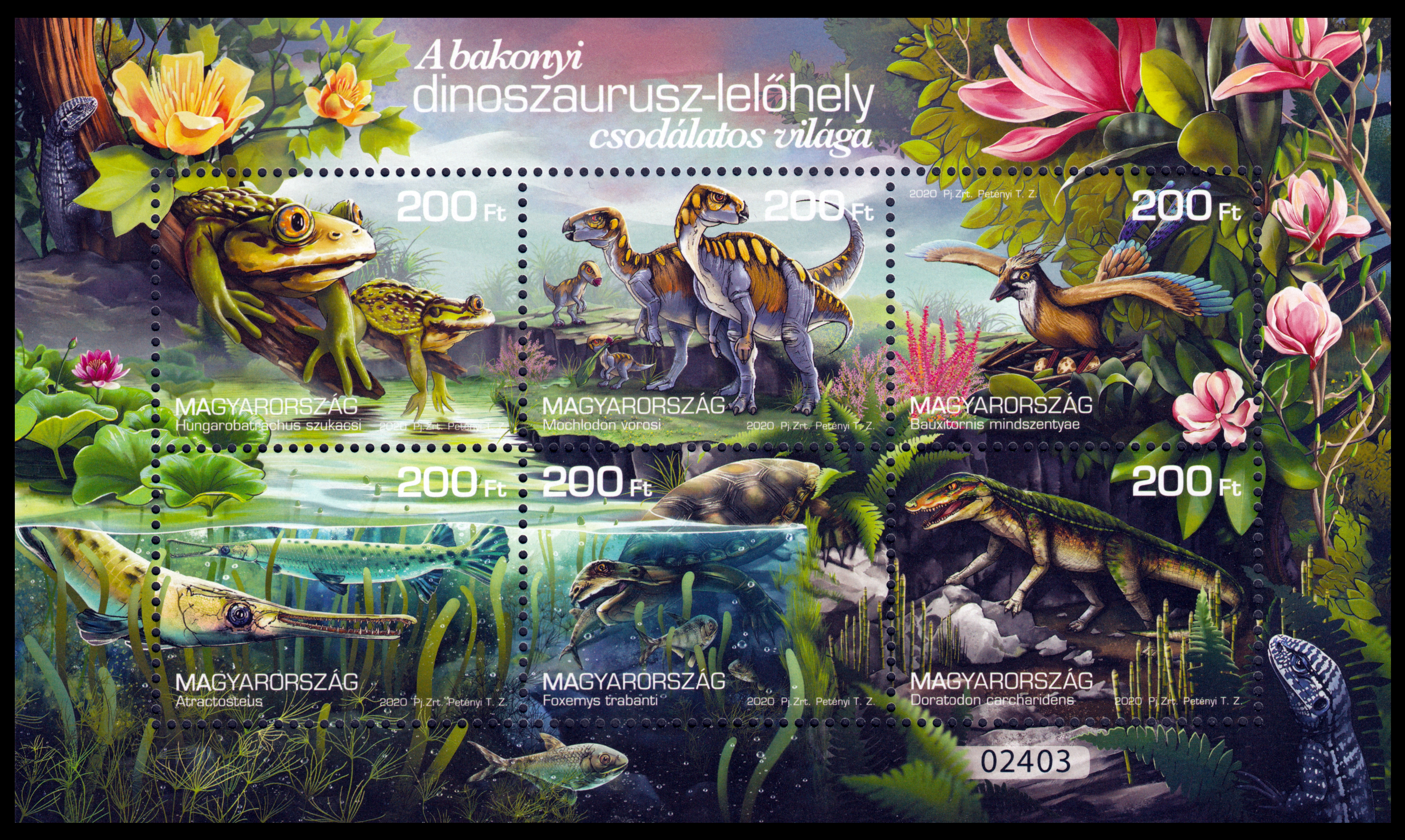
On the March 4th, 2020, the Hungarian Post issued a Mini-Sheet with six stamps of prehistoric animals, whose fossils were excavated at the Bakony region of Hungary. This is the second issue, following the concept begun in 2018.
In the spring of 2000, after much preliminary information collecting and research, the first dinosaur fossils in modern Hungary were unearthed from a sandstone formation at Iharkút in the Bakony Mountains. After the initial finds, more fossils came to light, and in the subsequent years, in addition to numerous small collecting trips, research camps lasting several weeks were regularly organized, where contiguous skeletons and several thousand individual bones and teeth were found.
The design of the six stamps of the souvenir sheet shows the following creatures in this order:
- Hungarobatrachus szukacsi (meaning "Hungarian frog") is an extinct genus of advanced frog, which lived during the Late Cretaceous Epoch. This genus was named by Zoltán Szentesi and Márton Venczel in 2010.
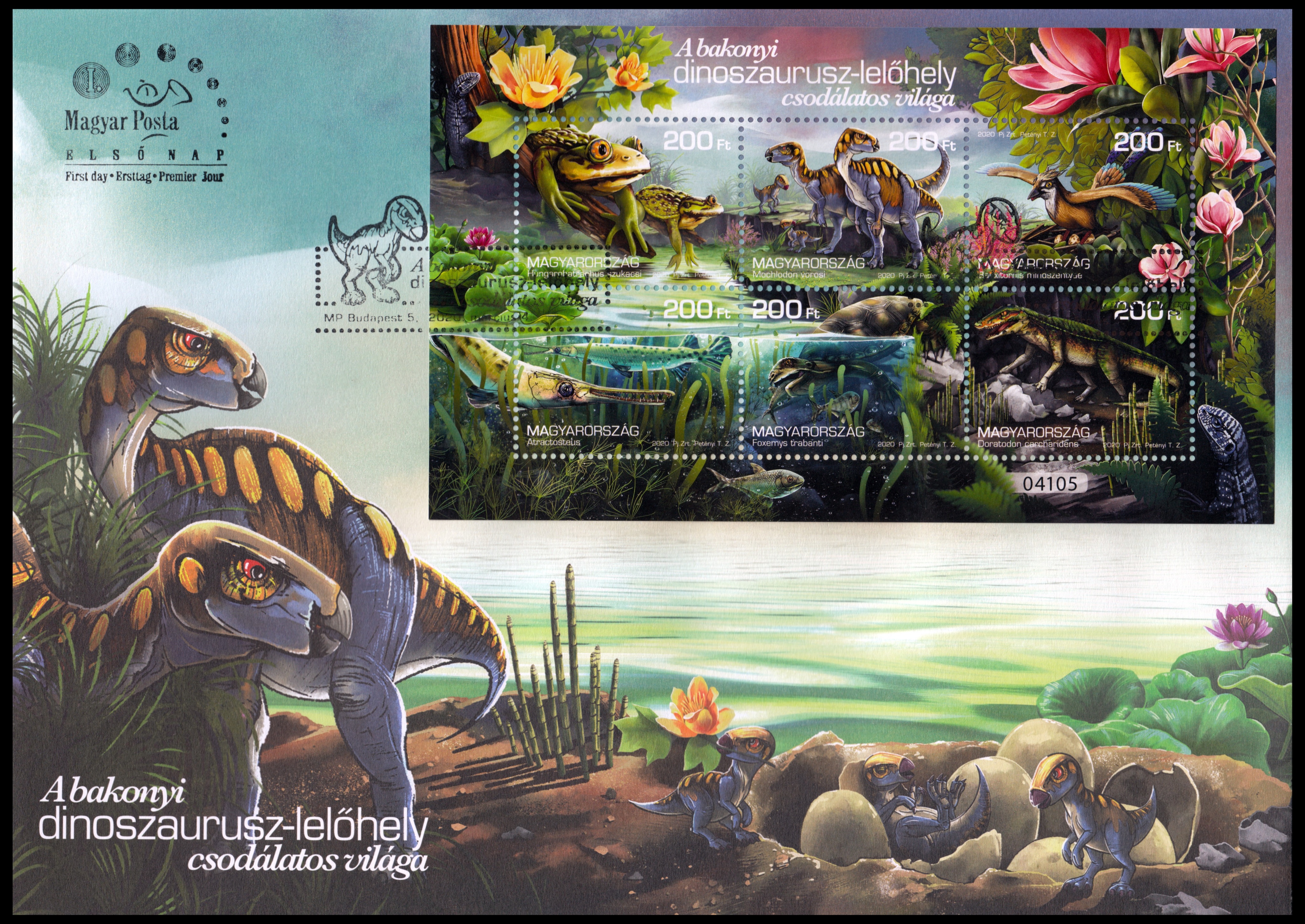
- Mochlodon vorosi (shown on the postmark too), a genus of iguanodont dinosaurs from the Late Cretaceous. This species was described from the Santonian aged Csehbánya Formation of Hungary in 2012.
- Bauxitornis mindszentyae, an extinct species of a bird which lived in what is now Hungary during the Santonian Age of the Late Cretaceous Epoch.
- Atractosteus, is a genus of gars in the family Lepisosteidae, with three species. The genus first appeared in the Campanian in the Late Cretaceous.
- Foxemys trabanti belonged to side-neck turtles, a group that retracts their head horizontally to the side instead of vertically, originating in the South-American part of the ancient Gondwanan supercontinent.
- Doratodon carcharidens, terrestrial crocodilians from the Mesozoic Era, it is an enigmatic crocodilian of the European Late Cretaceous faunas and the best preserved remains are that of Doratodon carcharidens from Austria.
Products and associated philatelic items
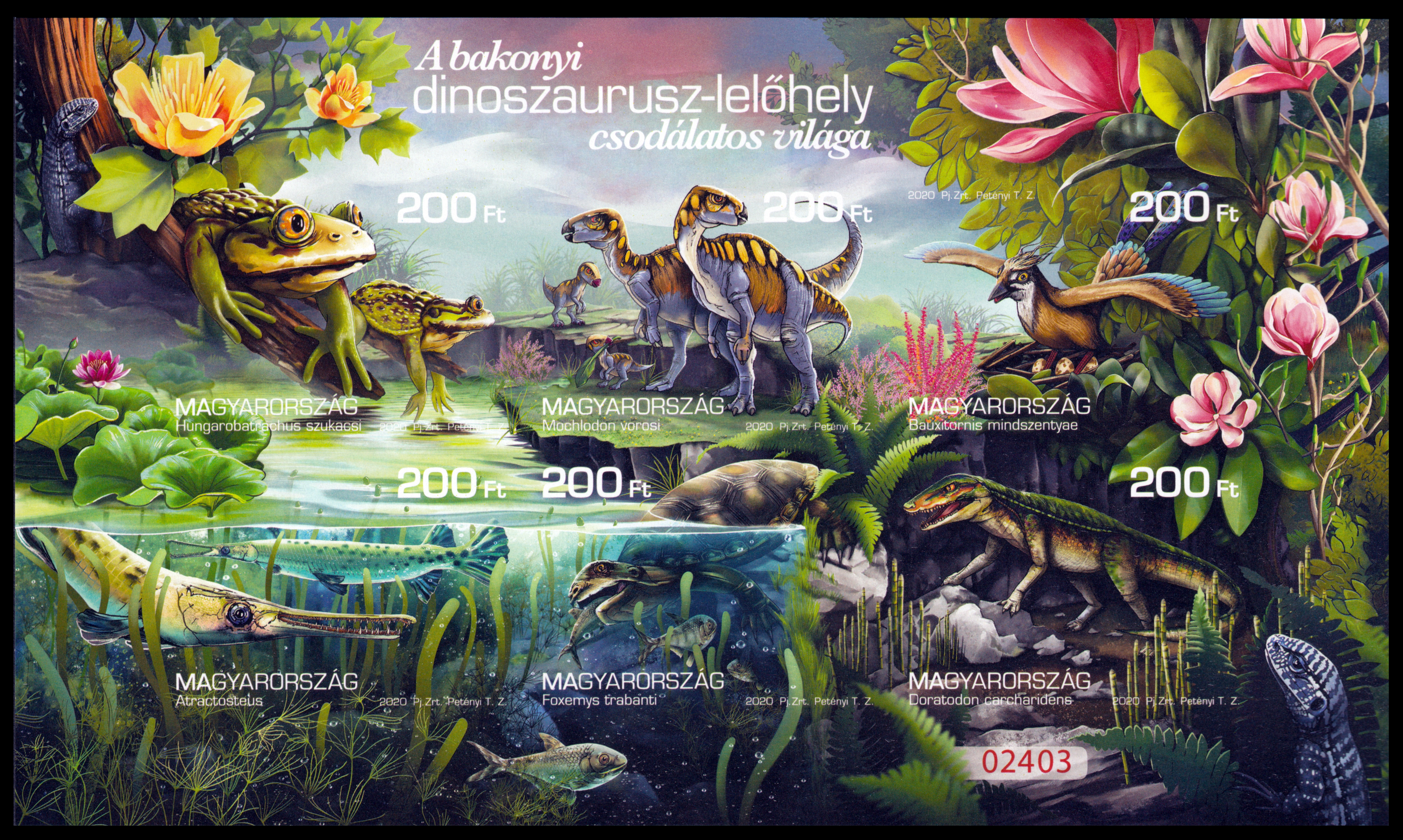
| FDC | First-Day-of-Issue Postmarks | Imperforate Mini-Sheet with red serial number |
 |
 |
 |
References
- Technical details and short press releases: Hungarian Post: PDF
- Foxemys trabanti: Magyar Dinoszaurusz
- Doratodon carcharidens: Magyar Dinoszaurusz
Acknowledgements
Many thanks to Dr. Peter Voice from Department of Geological and Environmental Sciences, Western Michigan University, for reviewing the draft page .