Armenia 2017 "Flora and fauna of the ancient world (I)"
| Issue Date | 28.12.2017 |
| ID | Michel: 1048-1049; Scott: 1129-1130; Stanley Gibbons: 1056-1057; Yvert: 900-9001; Category: pF |
| Designer | David Dovlatyan |
| Stamps in set | 2 |
| Value |
Dram 230- Pterosaur Dram 280- Tyrannosaurus |
| Emission/Type | commemorative |
| Issue place | Yerevan |
| Size (width x height) | 40mm x 24mm |
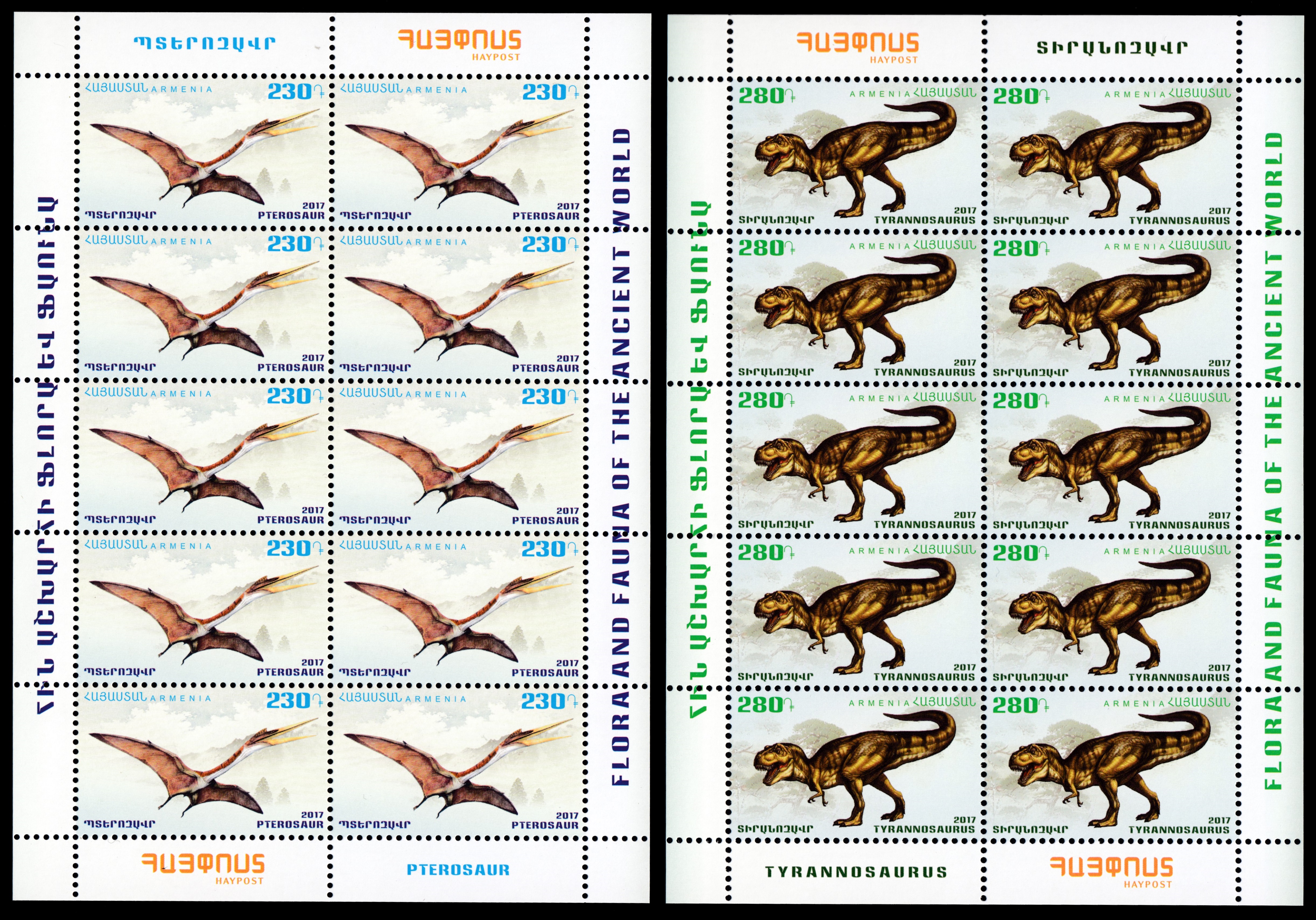
| Layout | Two Mini-Sheets 10 stamp each |
| Products | FDC x1, MS x2 |
| Paper | chalky, no watermark |
| Perforation | 13x13.25 |
| Print Technique | Offset lithography |
| Printed by | Cartor Security Printing, France |
| Quantity | 40,000 each Stamp |
| Issuing Authority | Haypost CJSC |

On December 28th, 2017, (initially planned for November 1, 2017) Post Authority of Armenia - Haypost - issued a set of 2 commemorative stamps, showing some prehistoric animals - the flying reptile, pterosaur and the dinosaur Tyrannosaurus.
Even though some dinosaur fossils have been found in Armenia, there was not enough material to associate them with any particular species, so Haypost used the classic dinosaur and pterosaur for these stamps.
Pterosaurs were flying reptiles that existed during most of the Mesozoic: from the late Triassic to the end of the Cretaceous.
 |
| Pterosaur on stamp of Armenia 2017, MiNr.: 1048, Scott: 1129. |
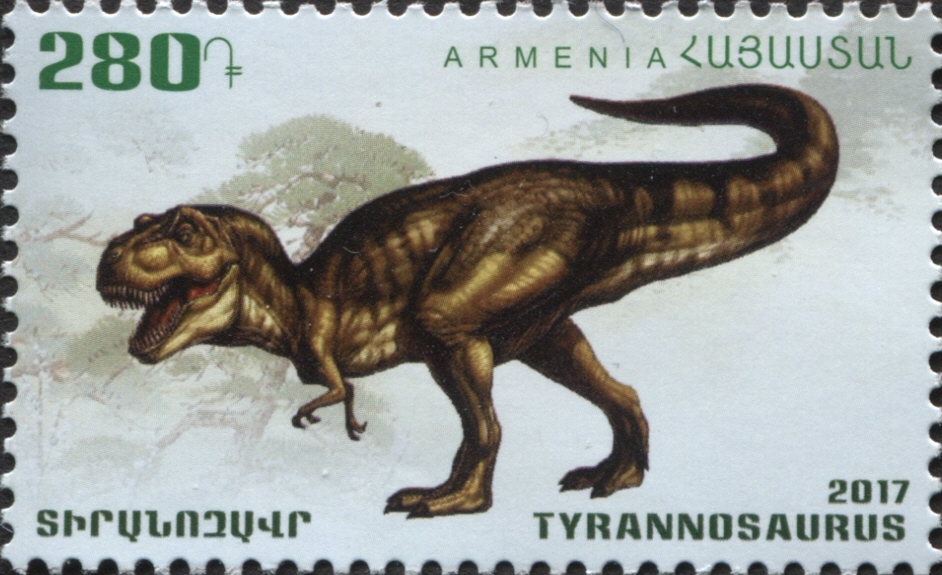 |
| Tyrannosaurus on stamp of Armenia 2017, MiNr.: 1049, Scott: 1130. |
Tyrannosaurus is a genus of theropod dinosaur. The species Tyrannosaurus rex (rex meaning "king" in Latin), is one of the most well-represented of the large theropods. Tyrannosaurus lived throughout what is now western North America, on what was then an island continent known as Laramidia. Fossils are found in a variety of rock formations dating to the Maastrichtian age of the upper Cretaceous Period, 68 to 66 million years ago.
Products and associated philatelic items
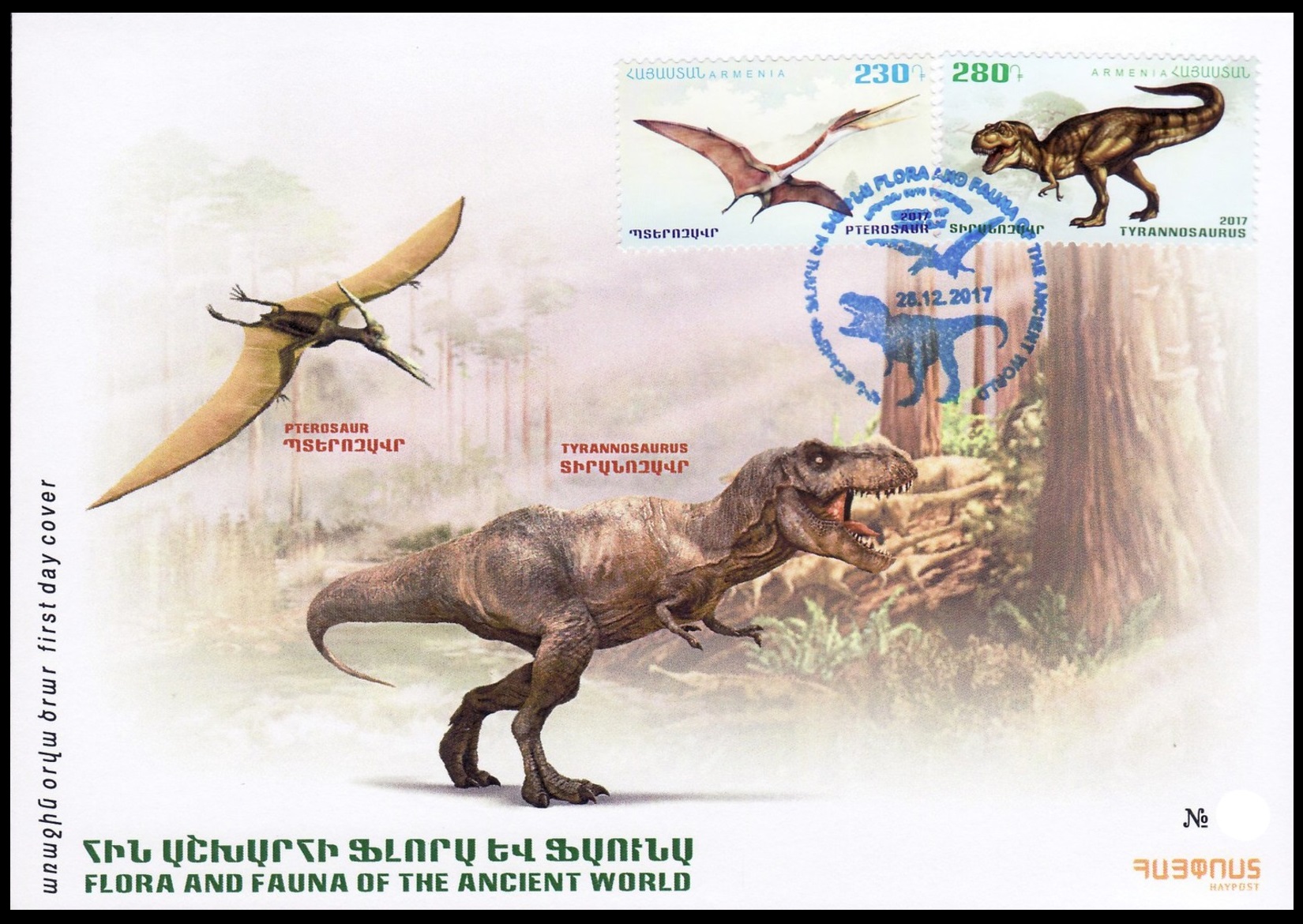
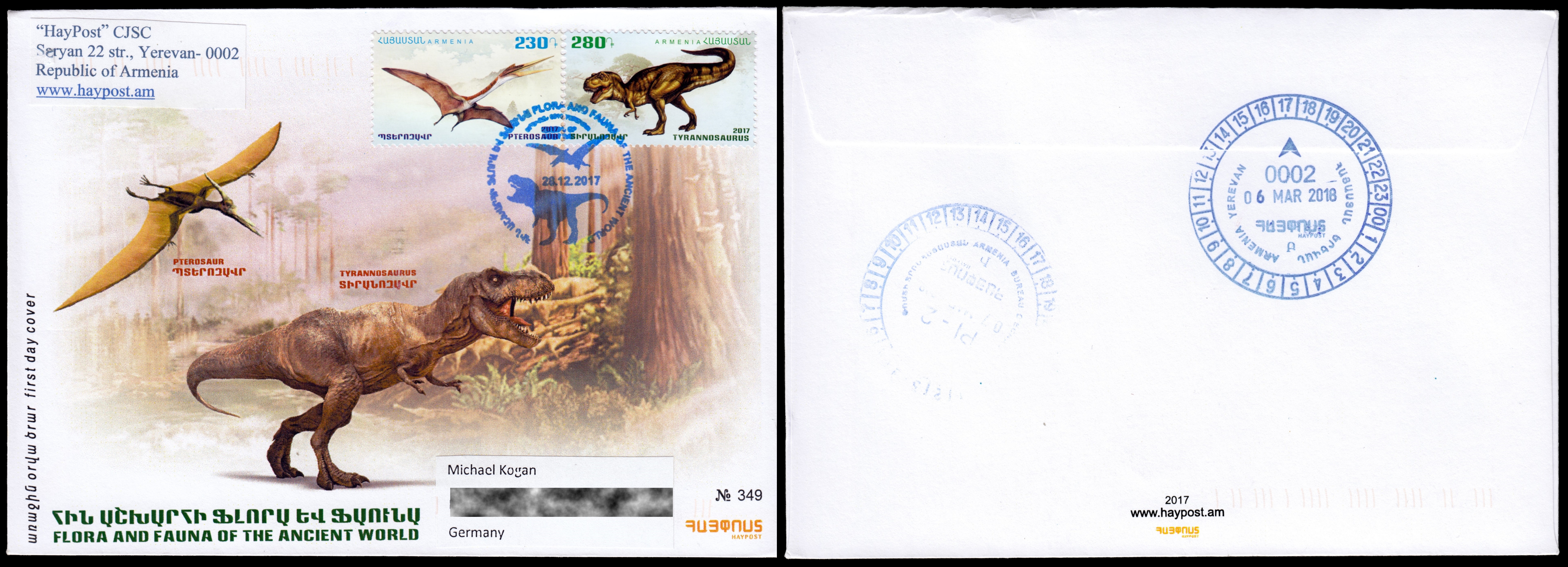
| FDC (clean and circulated) | First-Day-of-Issue Postmark | |
 |
 |
 |
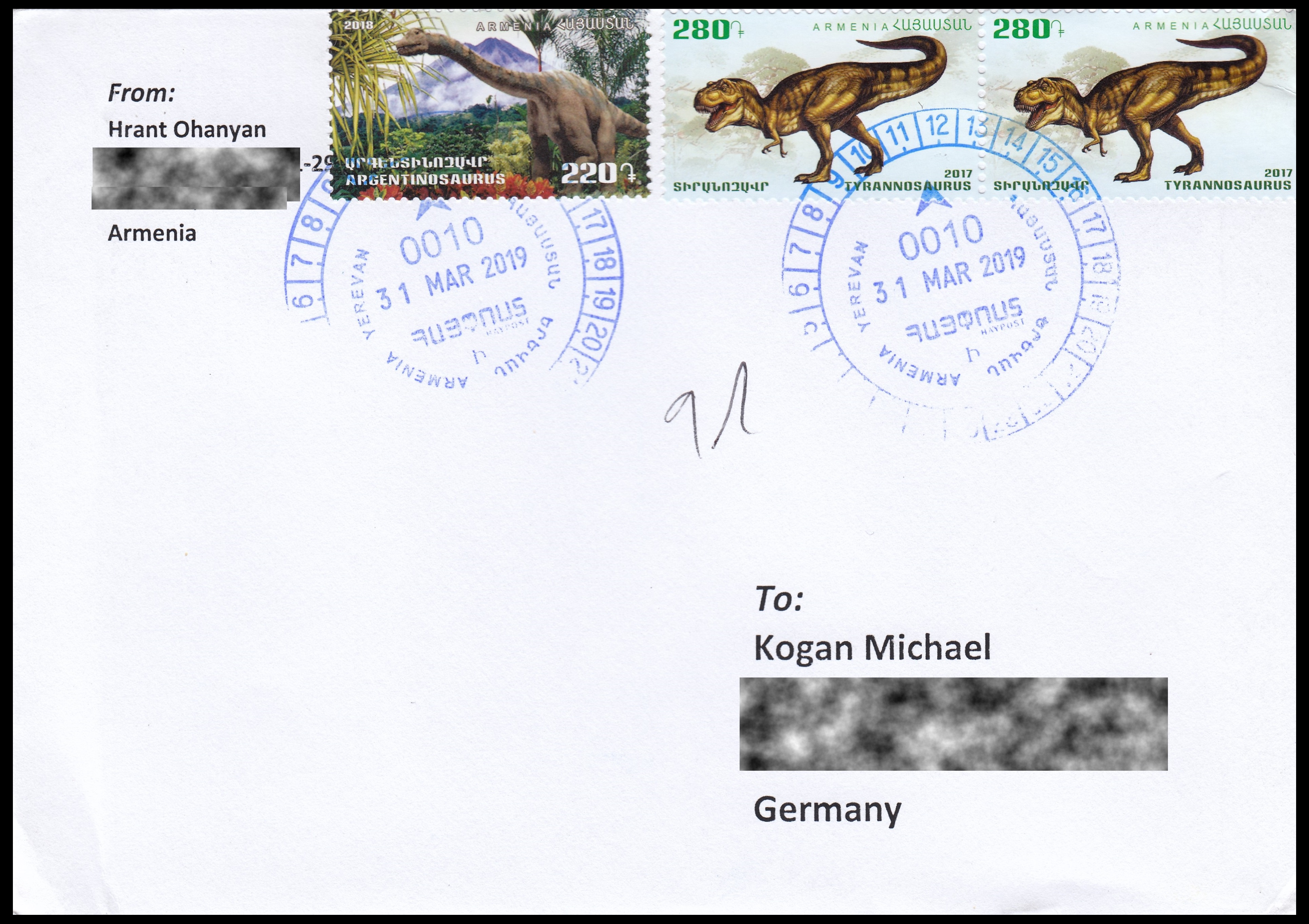
| Example of Circulated Covers | ||
 |
 |
 |
| Mini Sheets | ||
 |
||
References
Acknowledgements
Many thanks to Dr. Peter Voice from Department of Geological and Environmental Sciences, Western Michigan University, for reviewing the draft page and his very valuable comments.