Letter to Professor Dr. Unger, mailed from Bavaria between 1844 and 1848
 |
 |
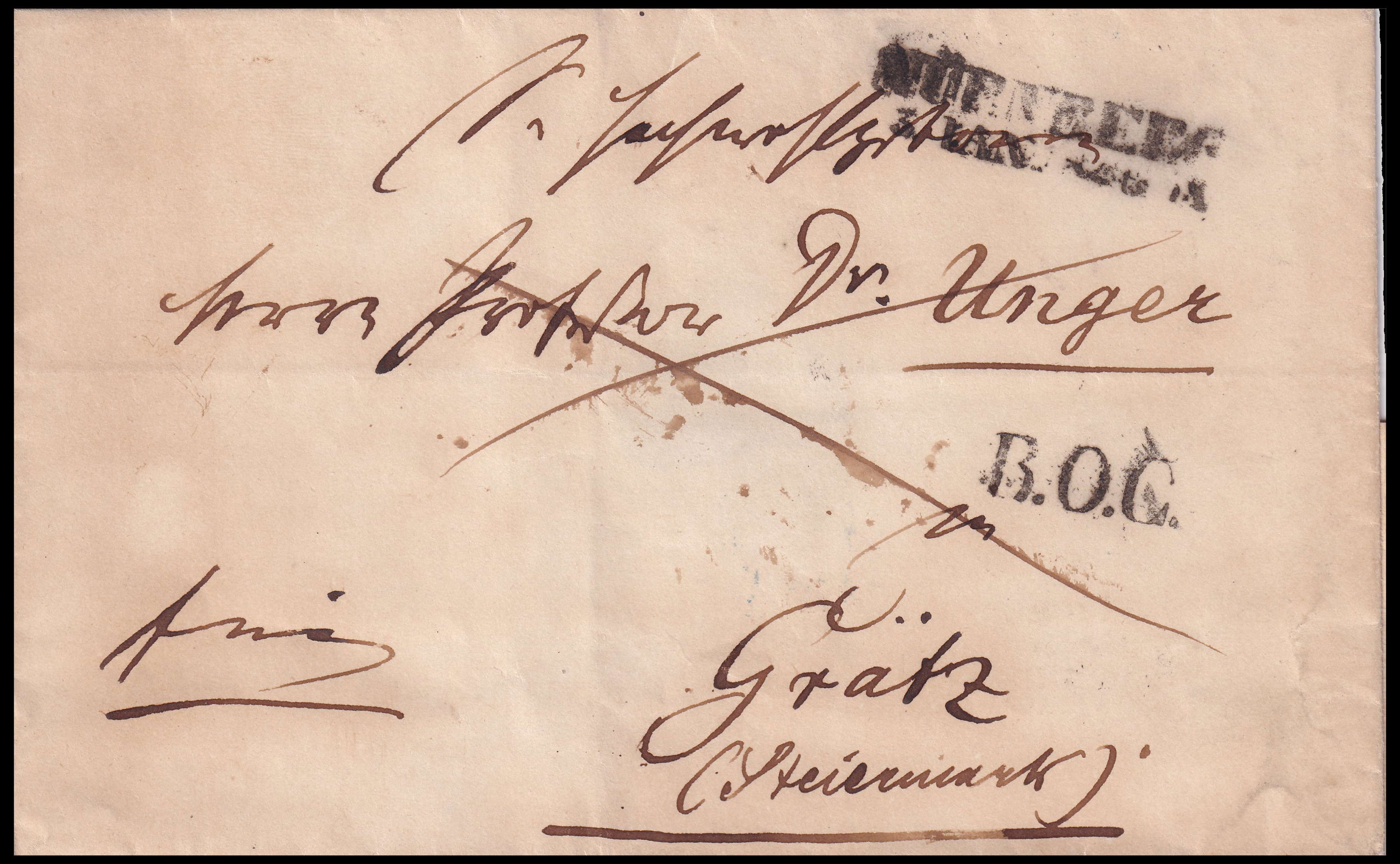
| The letter mailed from Nuremberg, Germany to Professor Dr. Unger in Graz, Styria, Austria. | |
The envelope
 |
|
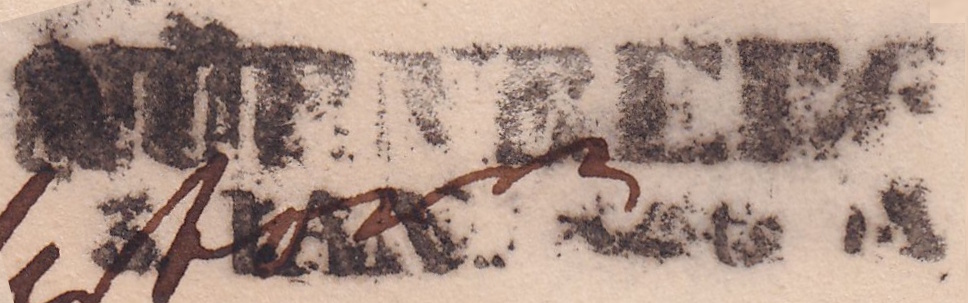
The postmark of Nuremberg, was used in the Kingdom of Bavaria before
November 1st, 1849, when the first postage stamp
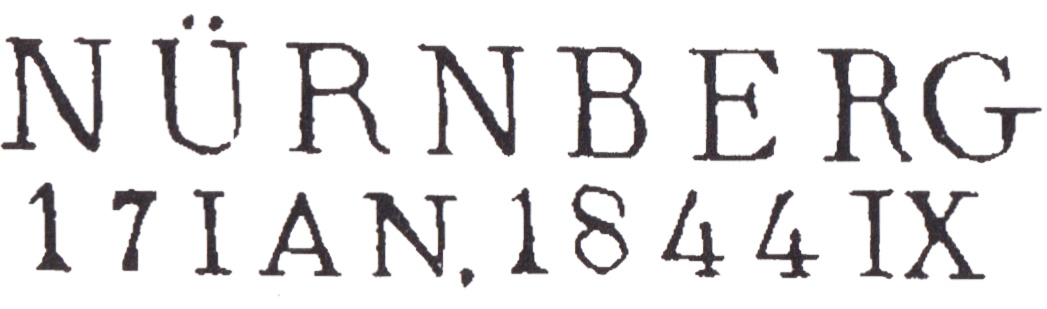
and numeral obliterators to cancel stamps were introduced in Bavaria. The postmark recalls the postmark Nr. 2547-17B (TY) of Peter Feuser's catalogue
|
An Hochwohlgeboren
NÜRNBERG
3 IAN ... IX
Herrn Profeßor Dr. Unger
B.O.C.
Frei
Grätz [old spelling of Graz]
(Steiermark)
According to the postmark in the upper-right corner, the letter was posted from Nuremberg (NÜRNBERG), in the Kingdom of Bavaria (Königreich Bayern). Such two-line postmarks were used in Bavaria before the introduction of adhesive postage stamps and numeral obliterators, which came into use on November 1st, 1849.
The first line of the postmark contains the name of the town, while the second line contains the day, the month abbreviation in Latin, the year, and the post office code (IX in this postmark).
The year of the postmark is missing, while the day and month are clearly visible - 3 IAN. “IAN” is the Latin-style abbreviation for January (Ianuarius), used in several Bavarian and Austrian postmarks of the period.
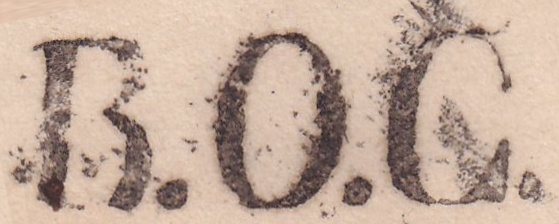 |
| BOC postmark, type I (black colour and wide „O“), used in Bavaria between 25.02.1843 – 26.06.1848 |
According to specialized Bavarian postal transit registries, the black ink cancellation displaying wide spacing and dots between letters represents the "Typ I" variety of this mark. This configuration has a verified operational use window restricted between February 25, 1843, and June 26, 1848. Because the departure date reads January 3rd, the letter could not have been processed in early 1843 before the type's rollout. Consequently, the combination of these parameters definitively restricts the historical posting window to January 1844 through January 1848.
During this period, Bavaria and Austria maintained a tight postal convention that regulated the exchange of border-crossing mail and established standardized accounting tracks. Reciprocal mail sent in the opposite direction from Austria into Bavaria was similarly stamped with the "O.B.C." (Oesterreichisch-Bayerische Correspondenz) counterpart mark.
The formal script line at the very top of the address block reads "An Hochwohlgeboren" ("To the Highly Well-Born"). This was a mandatory 19th-century German administrative and social honorific applied to official correspondence to formally salute university professors, medical doctors, and highly respected members of the academic bourgeoisie.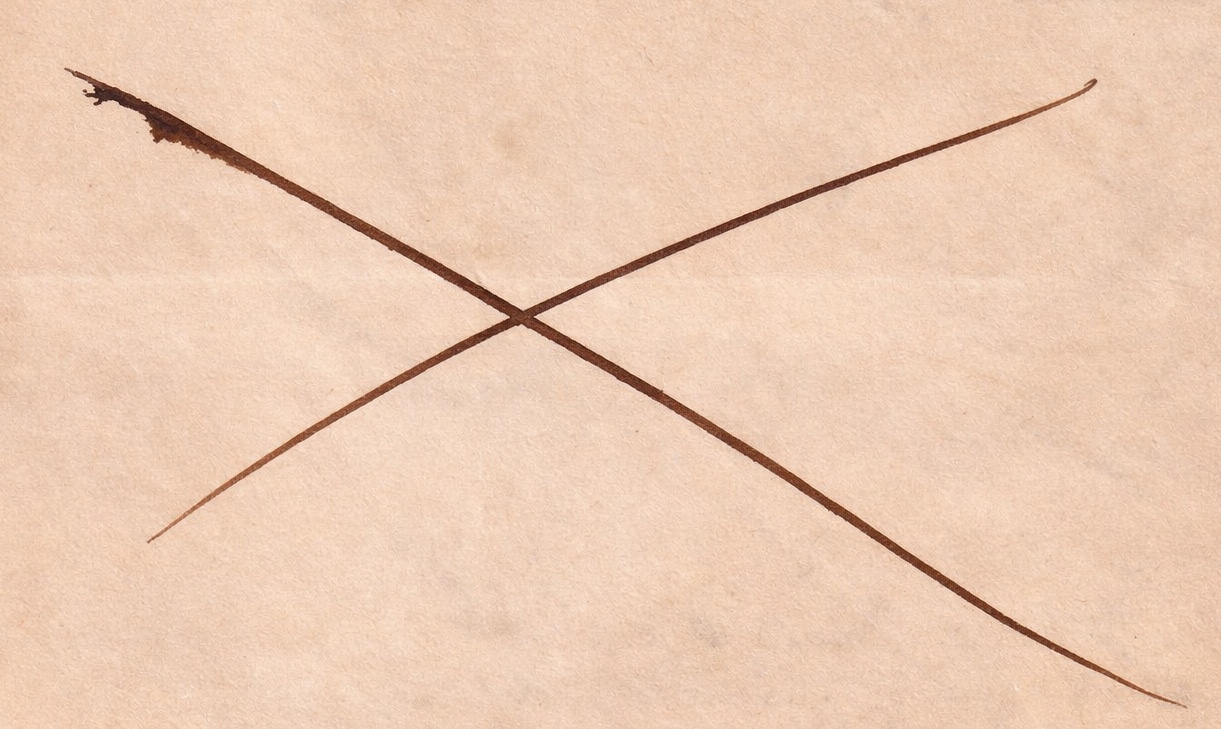 |
 |
| The large ink cross - served as a sign for a fully prepaid letter | |
 |
|
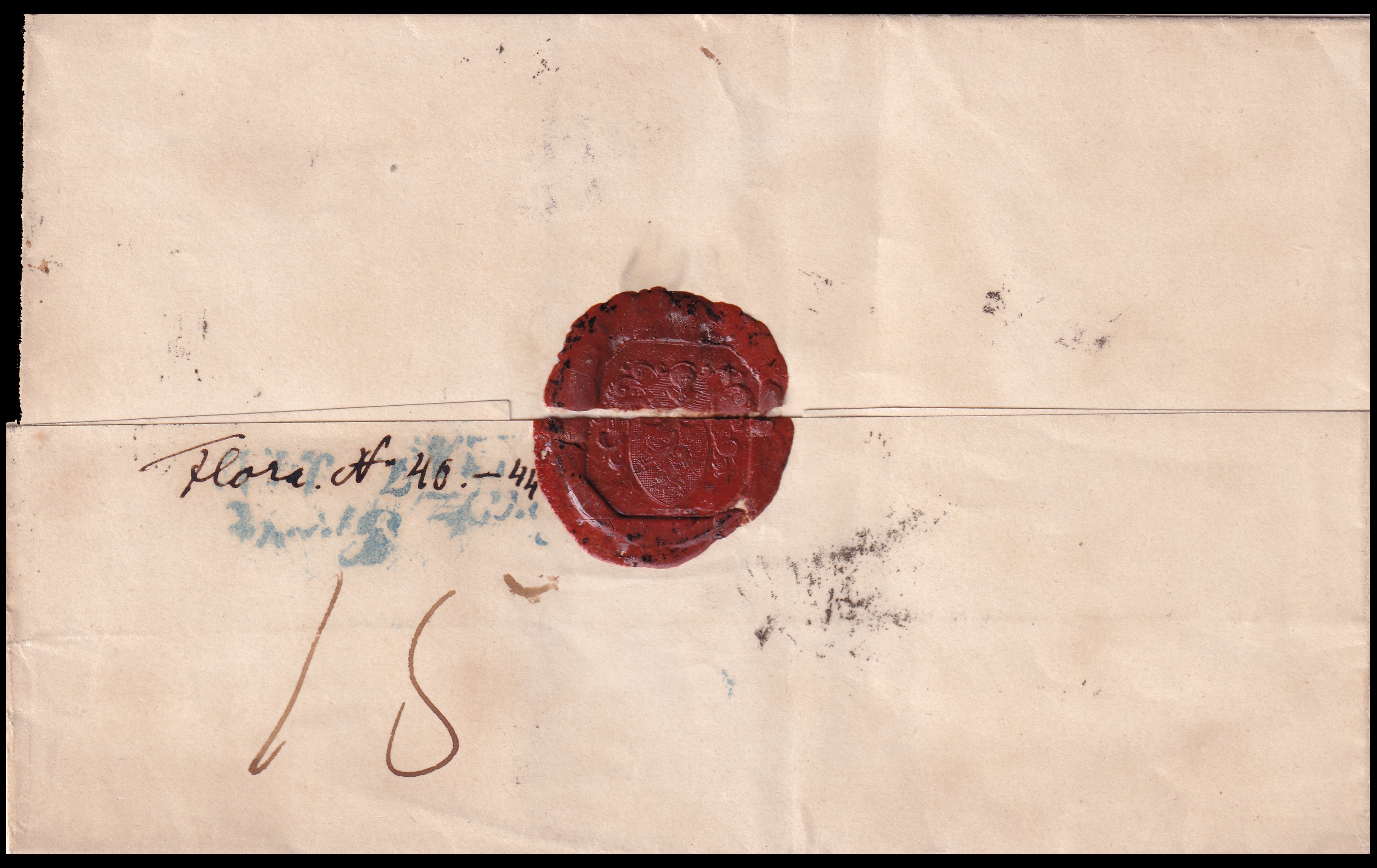
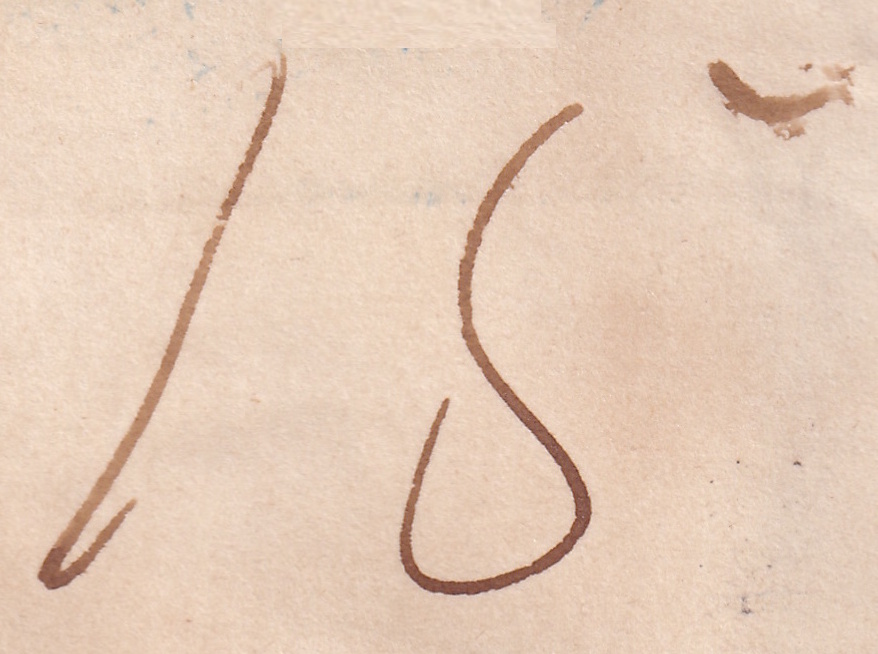
| The handwritten frei (free/paid) notation | A giant, prominent number 15 represents the total postal rate of 15 Kreuzer. |
In 19th century German pre-stamp philately (Vorphilatelie), this cross served as a critical visual instruction applied by the dispatching postmaster to signify a fully prepaid letter (Frankobrief), serving as a macro-validation of the handwritten frei (free/paid) notation.
On the reverse side, the postmaster scrawled a giant, prominent number 15 in iron-gall ink. This numeral represents the total postal rate (Porto) calculated in Kreuzers for international cross-border transit under the 1842 Bavarian–Austrian postal convention.
The potential sender
The letter was folded and secured with a prominent red heraldic signet wax seal, which was standard practice before commercially manufactured envelopes became universally available. The impression displays a classic bourgeois coat of arms (Bürgerliches Wappen) consisting of a shield with a rampant lion or a griffin facing left (dexter), a closed tilting helmet, and ornate leaf mantling.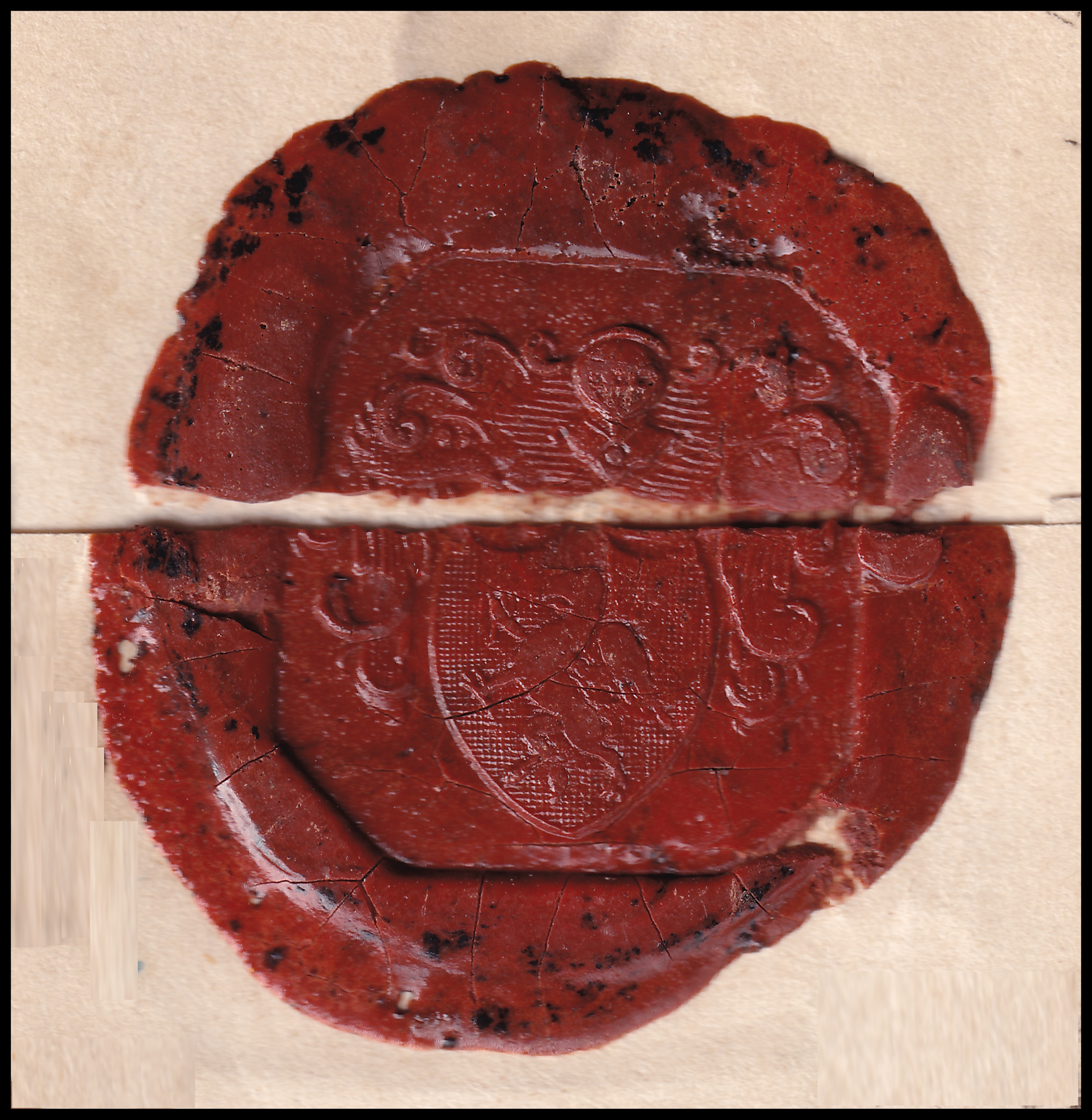 |
 |
 |
.svg.png "Coat of arms of Kingdom of Bavaria between 1835 and 1918") |
| The original seal is shown on the left, together with two AI generated reconstructions: one depicting a lion and the other a griffin as the central figure. Further research is required to identify the sender. | Coat of arms of Kingdom of Bavaria between 1835 and 1918 | ||
| Lions have appeared in the coats of arms of Bavaria since 1623 and continue to be used today, with the exception of the period from 1806 to 1835. Therefore, it is plausible that the seal also depicts a lion. However, a magnified view may reveal what appears to be a wing rather than a tail, leaving open the possibility that the animal is a griffin or another heraldic creature. | |||
The potential sender may have been:
- Dr. August Emanuel Fürnrohr (1804–1861), the editor of Flora, a leading botanical journal.
- Dr. Adalbert Schnitzlein (1814–1868): Professor of Botany at Erlangen, a university town located only about 20 km northwest of Nuremberg. He came from a distinguished family of court physicians and, in all likelihood, bore a civic coat of arms.
- Prof. Wilhelm Daniel Joseph Koch (1771–1849): A prominent botanist at Erlangen who is known to have corresponded with Dr. Unger.
- The Sturm family (Jacob Sturm or Johann Wilhelm Sturm): Nuremberg naturalists, copperplate engravers, and publishers of botanical works.
- A Nuremberg university bookseller or publisher: Nuremberg was an important center of printing and publishing. The cover may simply represent the commercial distribution of issues of Flora.
The recipient - Professor Dr. Unger
 |
| Dr. Franz Unger (1800-1870), lithograph by Josef Kriehuber |
Although trained as a physician, Unger became particularly known for his studies of fossil plants, plant anatomy (phytotomy), and plant physiology. He made important contributions to paleobotany and helped establish the scientific study of fossil floras. Unger hypothesized that hereditary characteristics are determined by combinations of simple elements within plant cells, an idea that anticipated later concepts of heredity and influenced the thinking of his student Gregor Johann Mendel. He was also a pioneer in documenting the relationship between soil and vegetation, publishing influential studies on the subject in 1836.
Gregor Mendel’s groundbreaking work in genetics was profoundly shaped by his time at the University of Vienna
(1851–1853), where he studied plant physiology under Dr. Franz Unger.
Unger’s radical cell theories and his belief in the transmutation of species rejected the idea of fixed,
unchanging plant varieties, directly inspiring Mendel to explore the mathematical laws governing variation and heredity.
Applying this progressive training to his famous pea-plant experiments at the St. Thomas Abbey, Mendel discovered
the foundational principles of dominant and recessive traits, building a quantitative bridge between cellular biology
and evolutionary thought that Unger had long championed.
Unger is notable for proposing evolutionary ideas before the publication of
Charles Darwin's On the Origin of Species (1859).
He accepted the transmutation of species and argued that living organisms had developed from earlier forms through natural processes.
These views placed him among the early advocates of evolutionary thought in the German-speaking scientific world. 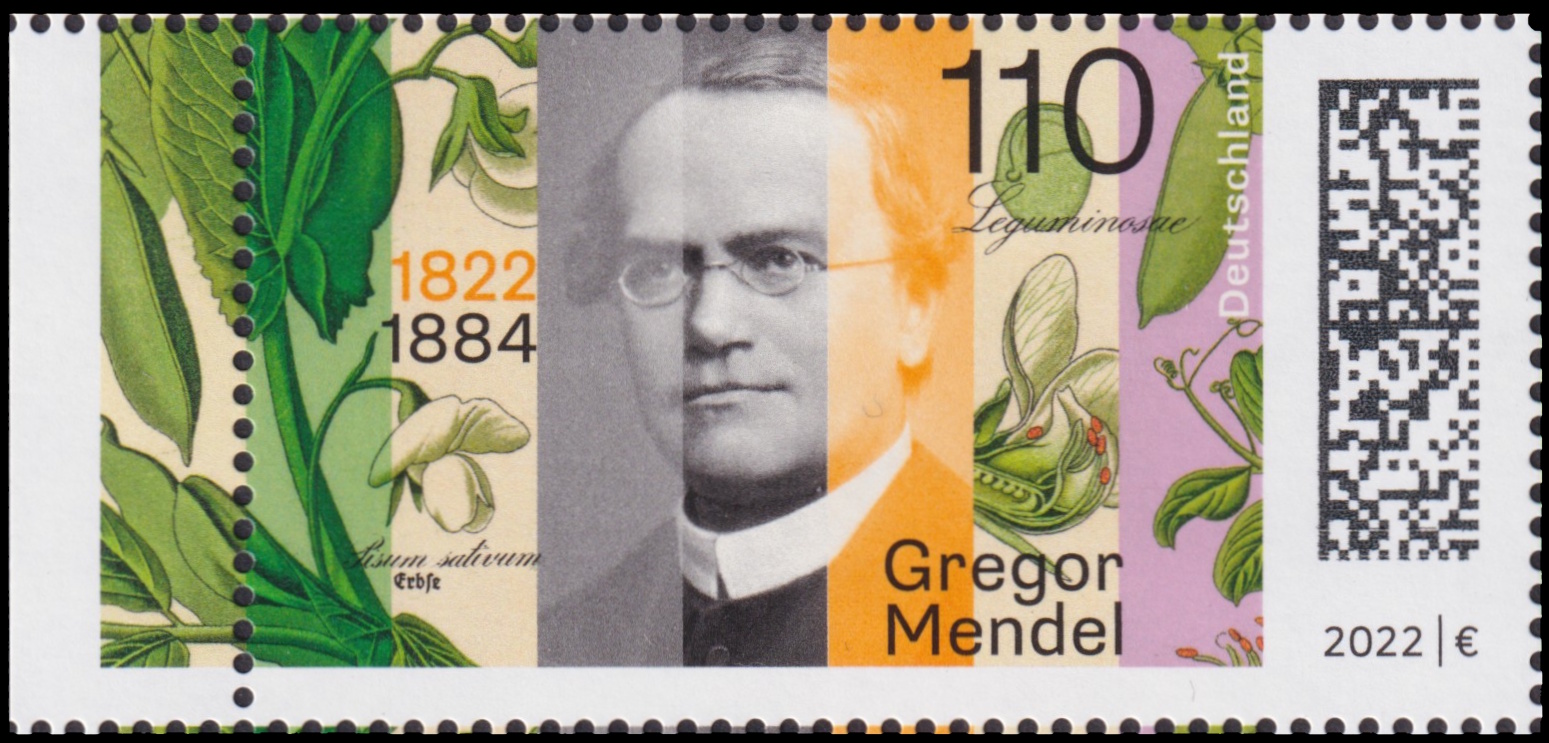 |
| Gregor Mendel on stamp of Germany 2022 |
Dr. Franz Unger was a prominent contributor to Flora (Allgemeine Botanische Zeitung), one of the most important weekly botanical journals of the 19th century and the official publication of the Regensburg Botanical Society. Between 1843 and 1861, the magazine was edited by the botanist Dr. August Emanuel Fürnrohr from Regensburg. As the official organ of the Society, the journal served as a major forum for botanical research in the German-speaking world.
Dr. Fürnrohr was a middle-class academic, scientist, and former pharmacist. Unlike his contemporary aristocrats or families who purchased nobility, he was never ennobled by the Kingdom of Bavaria, meaning he did not possess an official, registered family crest.
Throughout the 1840s, Unger regularly published articles on plant physiology, paleobotany, and the geographical distribution of vegetation in its pages. Unger's association with Flora began early in his scientific career. A member of the Regensburg Botanical Society since 1831, he participated in scientific initiatives sponsored by the Society, which published its research findings and prize-winning works in Flora. This close relationship helps explain his frequent contributions to the journal throughout the following decades.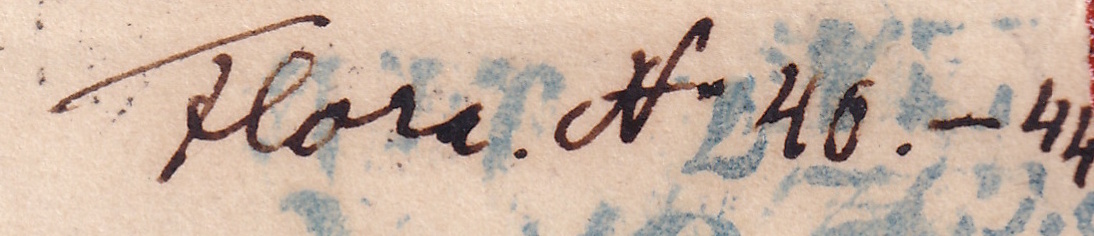 |
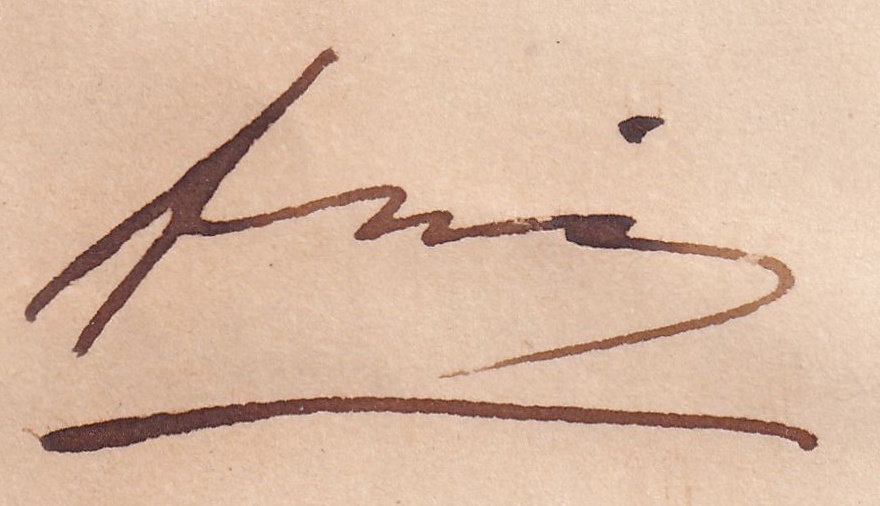
| The note from the reverse side of the letter, perhaps written by Dr. Franz Unger. |
Scientific correspondence in the mid-nineteenth century frequently circulated among authors, editors, publishers, printers, and learned societies. Consequently, the cover may have served not only as a postal wrapper but also as part of the journal's editorial or archival record, preserving material associated with the preparation, publication, or organization of botanical research.
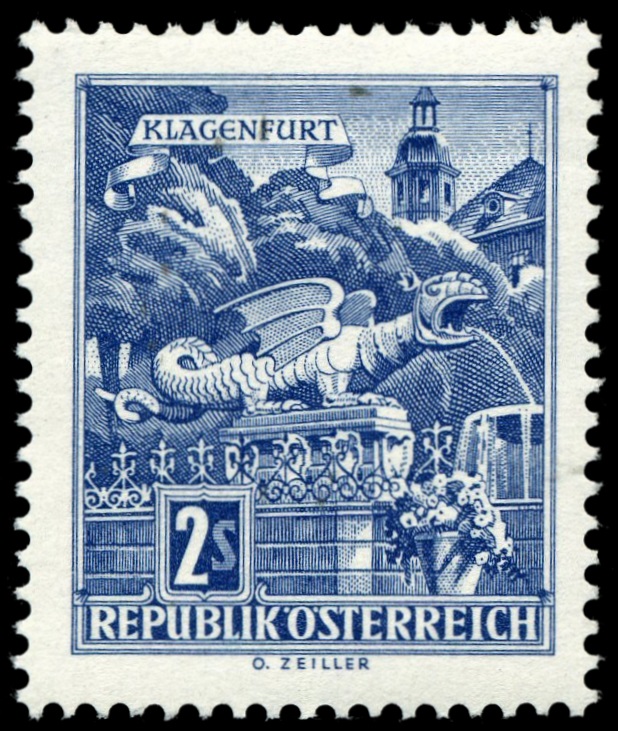 |
| Lindwurm from Klagenfurt on Austrian stamp from 1968, MiNr.: 1256, Scott: 696. |
Unger details his anatomical examination of the Klagenfurt skull, identifying it as a fossilized woolly rhinoceros (Rhinoceros tichorhinus - known as Coelodonta antiquitatis today). He demonstrates that this specific find, historically known to date back to the 14th century, served as the physical model for the city’s 1590 dragon monument and argues that prehistoric remains frequently inspired European monster myths.
Acknowledgements:
- Many thanks to Dr. Peter Voice from Department of Geological and Environmental Sciences, Western Michigan University, for reviewing the draft page and his very valuable comments.
References:
- Franz Unger (1800-1870):
Wikipedia, Wikisource, EtHeritage.- Franz Unger about the dragon skull of Klagenfurt: Naturhistorische Bemerkungen über den Lindwurm der Stadt Klagenfurt, Franz Unger (1838)
-
Austro-German Postal Union:
Wikipedia, -
Bavarian Postmarks
- NÜRNBERG:
"Deutsche Vorphilatelie: Spezialkatalog und Handbuch / Peter Feuser, Werner Münzberg", ISBN: 3-927483-31-1, published in 2000. -
BOC:
philatelisten-regensburg (in German) philaforum
"Bayrische Postgeschichte : 1806 - 1870 ; Grundlagen zur Interpretation altdeutscher Briefe / Joachim Helbig", ISBN: 3-927230-05-8, published in 1991.
- NÜRNBERG:
-
Kingdom of Bavaria:
Wikipedia-
Coat of arms of Bavaria:
Wikipedia
-
Stamps of Bavaria:
Wikipedia
-
Coat of arms of Bavaria: