Costa Rica
Prehistoric animals and Natural History Museum on stamps of Costa Rica
Costa Rica officially the Republic of Costa Rica.
It has a population of around 4.9 million people living in a land covering 51,060 square kilometers. The capital and largest city, is San Jose with an estimated population of 335,000 people.
Costa Rica has been known for its stable democracy in a region that has had some instability and for its highly educated workforce, most of whom speak English.
The country was a peripheral colony of Spanish empire until independence as part of the short-lived First Mexican Empire, followed by membership in the United Provinces of Central America, from which it formally declared independence in 1847. Since then, Costa Rica has remained among the most stable, prosperous, and progressive nations in Latin America. [R1]
Costa Rica has produced its own stamps since 1863. The first issue of stamps was printed by the American Bank Note Co. [R2]
Nowadays Costa Rica produce 15-40 stamps per year.
Notes:
[A1] The Natural History Department of the National Museum has a large collection of fossil including over 9,000 specimens of sponges, corals, mollusks, echinoderms, vertebrates, plants and more.
This collection has the most important collection of fossil vertebrates in the country. [R3]
Unfortunately none of these fossils are shown on the stamps.
Notes:
[F1] In the middle of 2017 these prehistoric animal stamps appeared on the internet as local stamps of Guácimo. Guácimo is the capital of Guácimo, Limón Province in Costa Rica, similar to the rest of the country only official stamps are used there.
Many thanks to Dr. Peter Voice from Department of Geological and Environmental Sciences, Western Michigan University, for reviewing the draft page and his very valuable comments.
It has a population of around 4.9 million people living in a land covering 51,060 square kilometers. The capital and largest city, is San Jose with an estimated population of 335,000 people.
Costa Rica has been known for its stable democracy in a region that has had some instability and for its highly educated workforce, most of whom speak English.
The country was a peripheral colony of Spanish empire until independence as part of the short-lived First Mexican Empire, followed by membership in the United Provinces of Central America, from which it formally declared independence in 1847. Since then, Costa Rica has remained among the most stable, prosperous, and progressive nations in Latin America. [R1]
Costa Rica has produced its own stamps since 1863. The first issue of stamps was printed by the American Bank Note Co. [R2]
Nowadays Costa Rica produce 15-40 stamps per year.
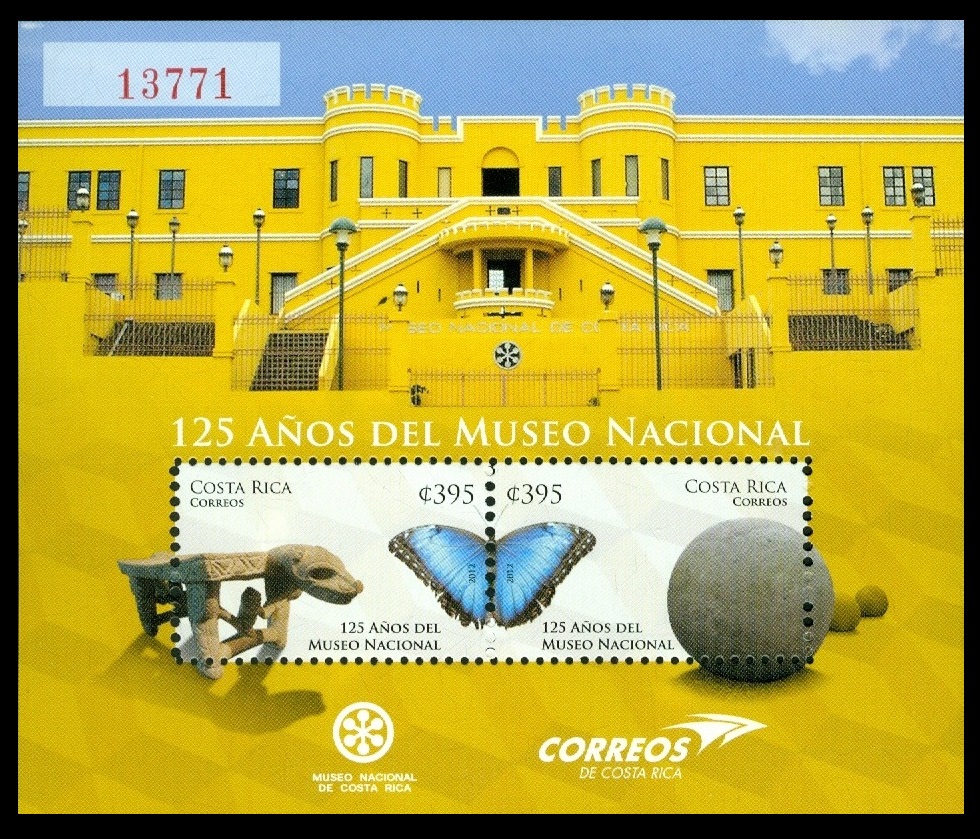
Some stamps of Costa Rica to consider: Natural History Museum
| 04.05.2012 - "125th Anniversary of the National Museum" [A1] | ||
|
||
Notes:
[A1] The Natural History Department of the National Museum has a large collection of fossil including over 9,000 specimens of sponges, corals, mollusks, echinoderms, vertebrates, plants and more.
This collection has the most important collection of fossil vertebrates in the country. [R3]
Unfortunately none of these fossils are shown on the stamps.
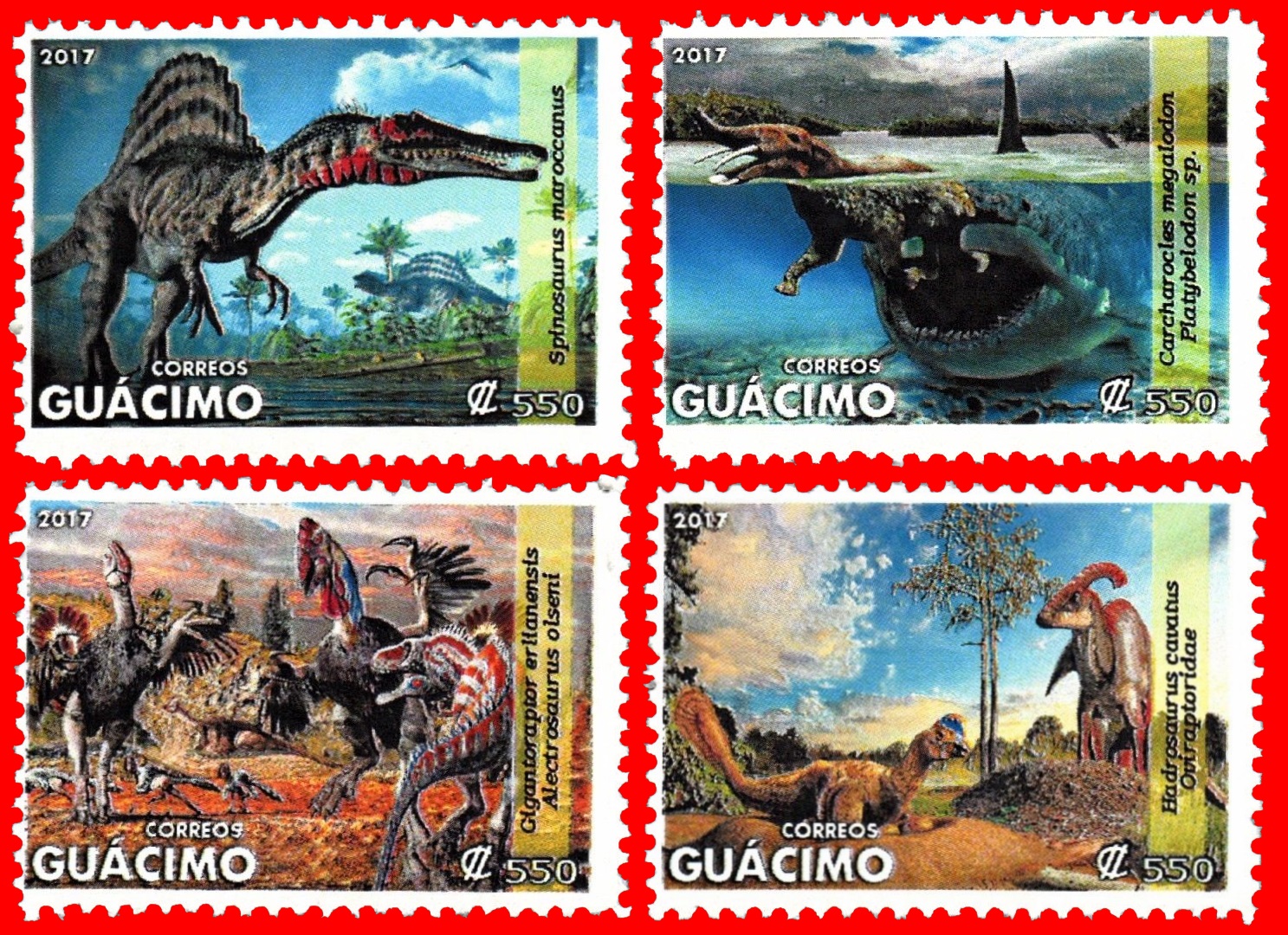
Attention: fake/Cinderella stamps of Costa Rica related to Paleontology: dinosaurs and prehistoric animals
| 2017 - "Prehistoric animals" [F1] | ||
|
||
Notes:
[F1] In the middle of 2017 these prehistoric animal stamps appeared on the internet as local stamps of Guácimo. Guácimo is the capital of Guácimo, Limón Province in Costa Rica, similar to the rest of the country only official stamps are used there.
References
- [R1] Costa Rica : Wikipedia, WikiTravel, FlagCounter.
- [R2] Postal History and Philately of Costa Rica:
Wikipedia,
Links to official website of the Post Authority, stamp catalog and a list of new stamps of Costa Rica are here. - [R3] National Museum of Costa Rica: official site
Acknowledgements
Many thanks to Dr. Peter Voice from Department of Geological and Environmental Sciences, Western Michigan University, for reviewing the draft page and his very valuable comments.