Switzerland 2015 "Ammonite"
| Issue Date | 05.03.2015 |
| ID | Michel: Scott: Stanley Gibbons: Yvert: UPU: N/A Category: pF |
| Design | Christian Kitzmüller, Bülach (ZH) |
| Stamps in set | 1 |
| Value | CHF 2 - Colombiceras ammonite |
| Emmision | commemorative |
| Size (width x height) | 105mm x 70mm |
| Layout | Block |
| Products | FDC x1 |
| Paper | White stamp paper, with optical, mat gummed |
| Perforation | 14 |
| Print Technique | Offset, 4 colors |
| Printed by | Gutenberg AG, Schaan, Liechtenstein |
| Quantity | |
| Issuing Authority | La Poste |
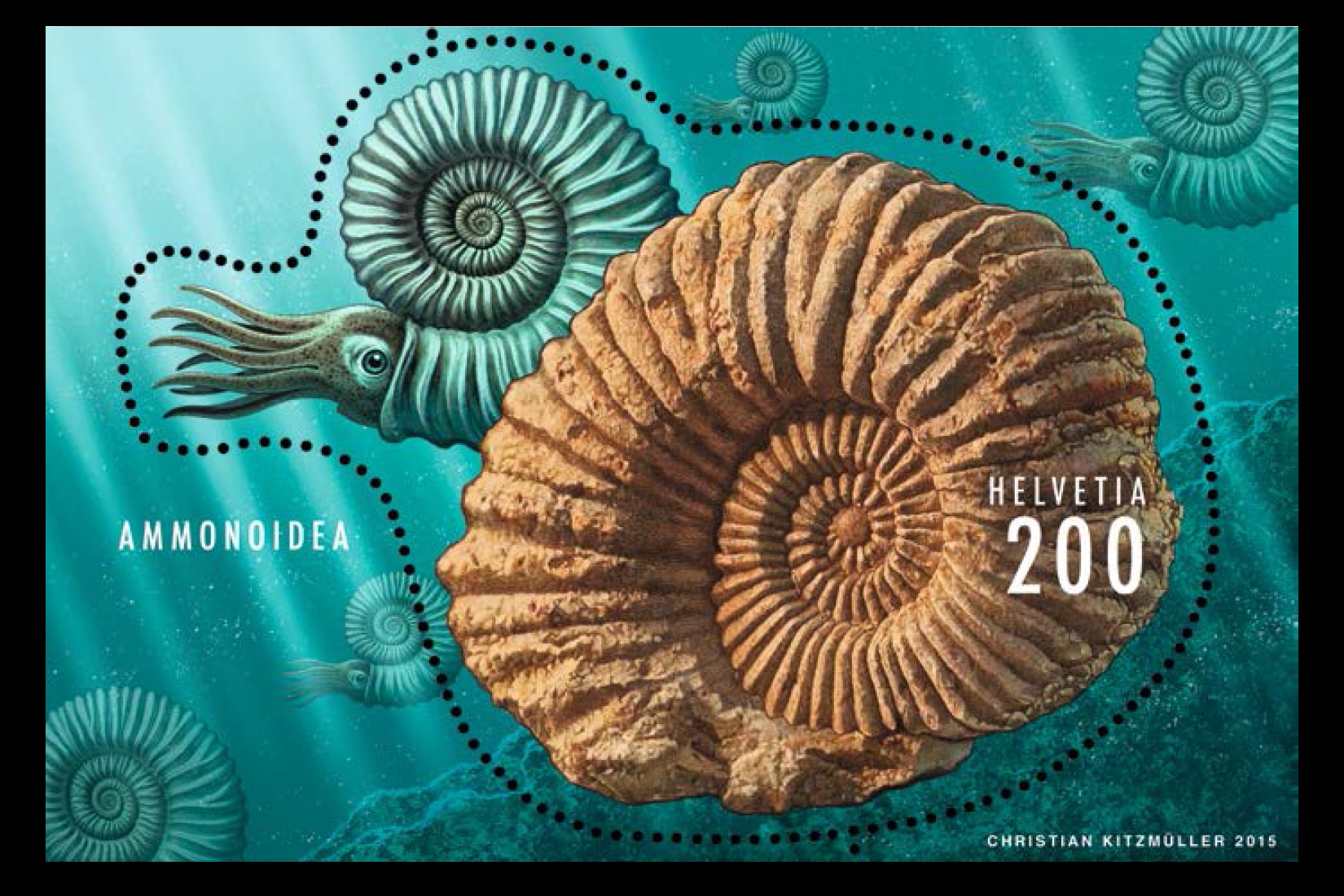
On 5 March 2015, Switzerland issued a 2-swiss franc souvenir sheet containing one irregularly shaped stamp depicting an ammonite fossil along with an image showing a reconstruction of how the creature may have appeared when it was living.
Official press release, written by Dr. Walter Etter Geoscience Curator Basel Natural History Museum
When collectors go scouting in the fossil rich layers of the Swiss Jura mountains, they are usually looking for the beautiful spirally coiled ammonites. These fossils are the remains of creatures related to octopus and squid that first appeared around 400 million years ago, spread throughout the world’s oceans, then died out at the same time as the dinosaurs approximately 65 million years ago. Ammonites had an outer shell like a snail, but the inner part of the shell had chambers of the kind we can still see today in the living pearly nautilus. The shell protected the soft parts of their anatomy, while air in the chambers created buoyancy.The septa dividing the chambers were tightly folded at the edge, presumably making the shell better able to withstand water pressure. If the external shell is no longer present or is removed from an ammonite, these folds are marked by ridges known as suture lines. We know that ammonites are more closely related to today’s squid and octopus than the pearly nautilus. We are also familiar with the anatomy of ammonites’ jaws, know that they did not have ink sacs, that they are likely to have fed on small prey, and probably lived a largely hidden existence close to the sea floor. Many questions still remain unanswered, however. Did they have eight or ten tentacles, or perhaps up to 100 like the nautilus? Did their tentacles have suckers? Did the ammonites have powerful large eyes with lenses like living cephalopods? There were a huge variety of ammonites. It is estimated that almost 20,000 different species of ammonite existed, although spread over a period of some 335 million years. There are ones with disc shaped and spherical shells, smooth and ribbed shells, as well as ones adorned with spines and tubercles. Each of these numerous types of ammonite existed for only a short period of time. Ammonites therefore make excellent “index fossils” which can be used to date geological strata. On the basis of its characteristic ribs, the ammonite depicting on the stamp is probably a Colombiceras, a species of ammonite that lived during the Cretaceous Period around 120 million years ago.
Dr. Hans Ulrich ERNST, author of some books about fossil on
stamps, recognized the ammonite depicted on the stamp as a species in the genus
Cheloniceras.
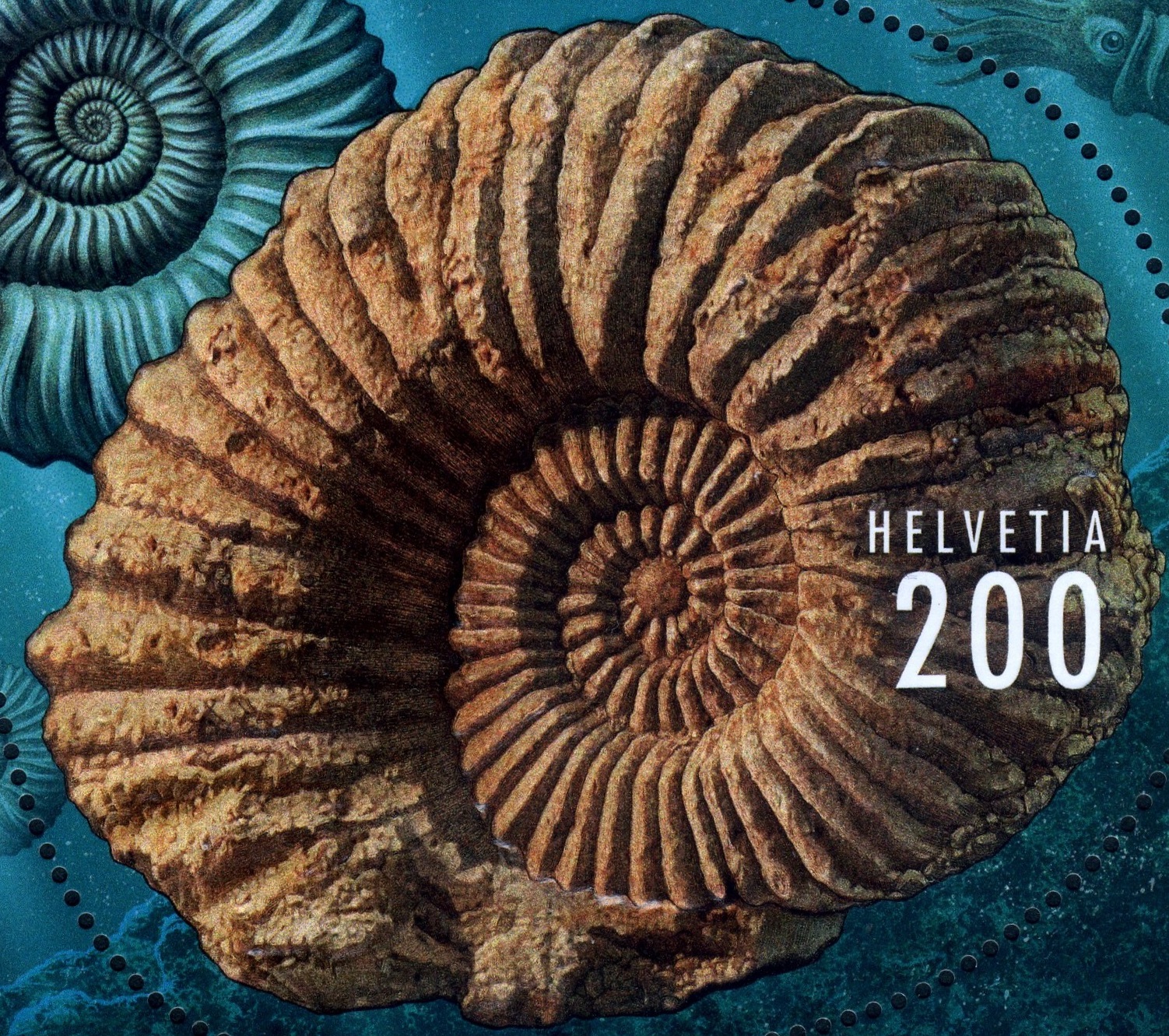
The following pictures illustrate the differences.
Unlike Colombiceras, fossils of Cheloniceras are not found in Switzerland, but mostly in Morocco. Moreover, on closer look at the fossil depicted on the stamp, it is possible to see some artificial signs such as defects on the fins. It is very like that the fossil depicted on the stamp is based on the sculpted remains of a Cheloniceras from Lower Aptian strata at Agadir, Morocco. These artificially modified fossils are common from Morocco.
According to Mr. Dr. Ernst, the stamp designer said that he had received this fossil from a friend, and he didn’t know its origin. Pity that Swiss Post missed an opportunity to depict some real local fossil on their stamp and depicted a Morocan art object instead.
 |
 |
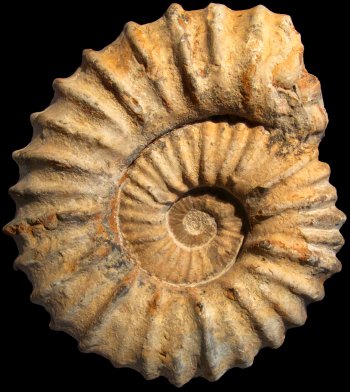 |
| Colombiceras, Image from Ammonites.fr | Ammonite fossil on the stamp | Cheloniceras, Image from Ammonites.fr |
Unlike Colombiceras, fossils of Cheloniceras are not found in Switzerland, but mostly in Morocco. Moreover, on closer look at the fossil depicted on the stamp, it is possible to see some artificial signs such as defects on the fins. It is very like that the fossil depicted on the stamp is based on the sculpted remains of a Cheloniceras from Lower Aptian strata at Agadir, Morocco. These artificially modified fossils are common from Morocco.
According to Mr. Dr. Ernst, the stamp designer said that he had received this fossil from a friend, and he didn’t know its origin. Pity that Swiss Post missed an opportunity to depict some real local fossil on their stamp and depicted a Morocan art object instead.
Products and associated philatelic items
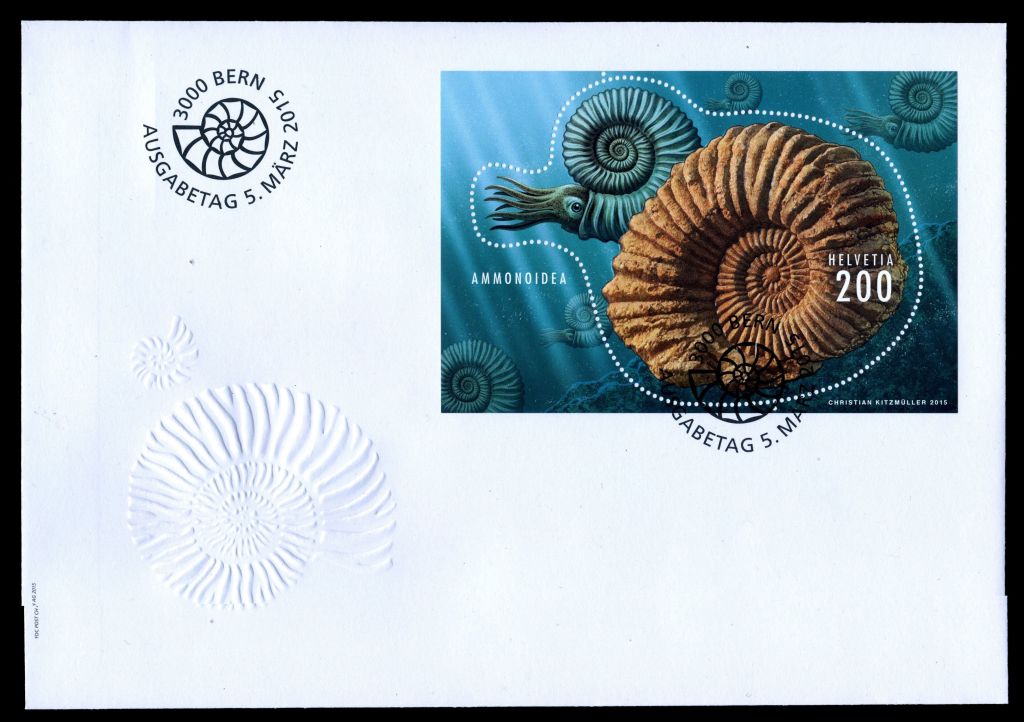
| FDC (clean and circulated) | ||
 |
 |
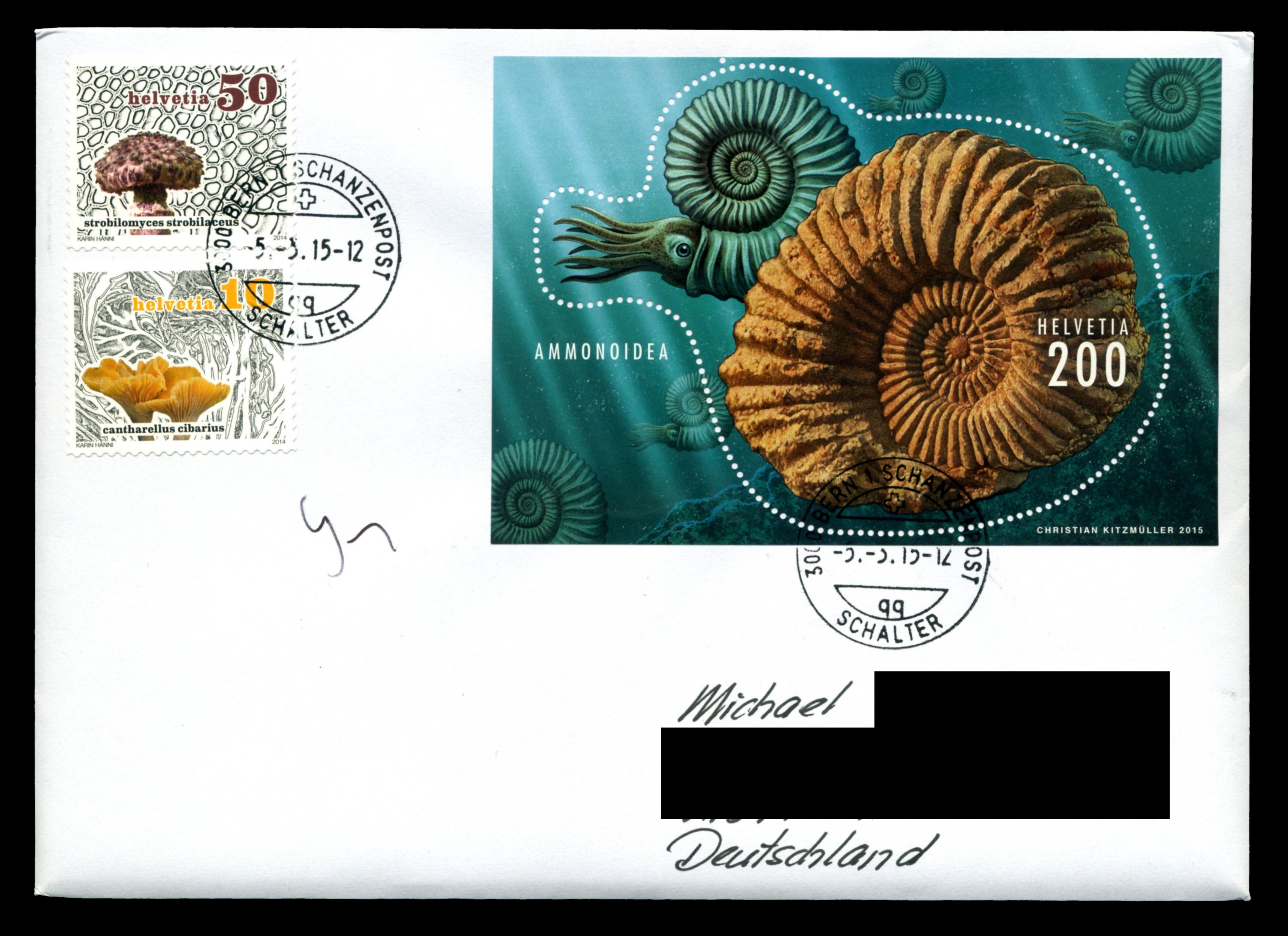 |
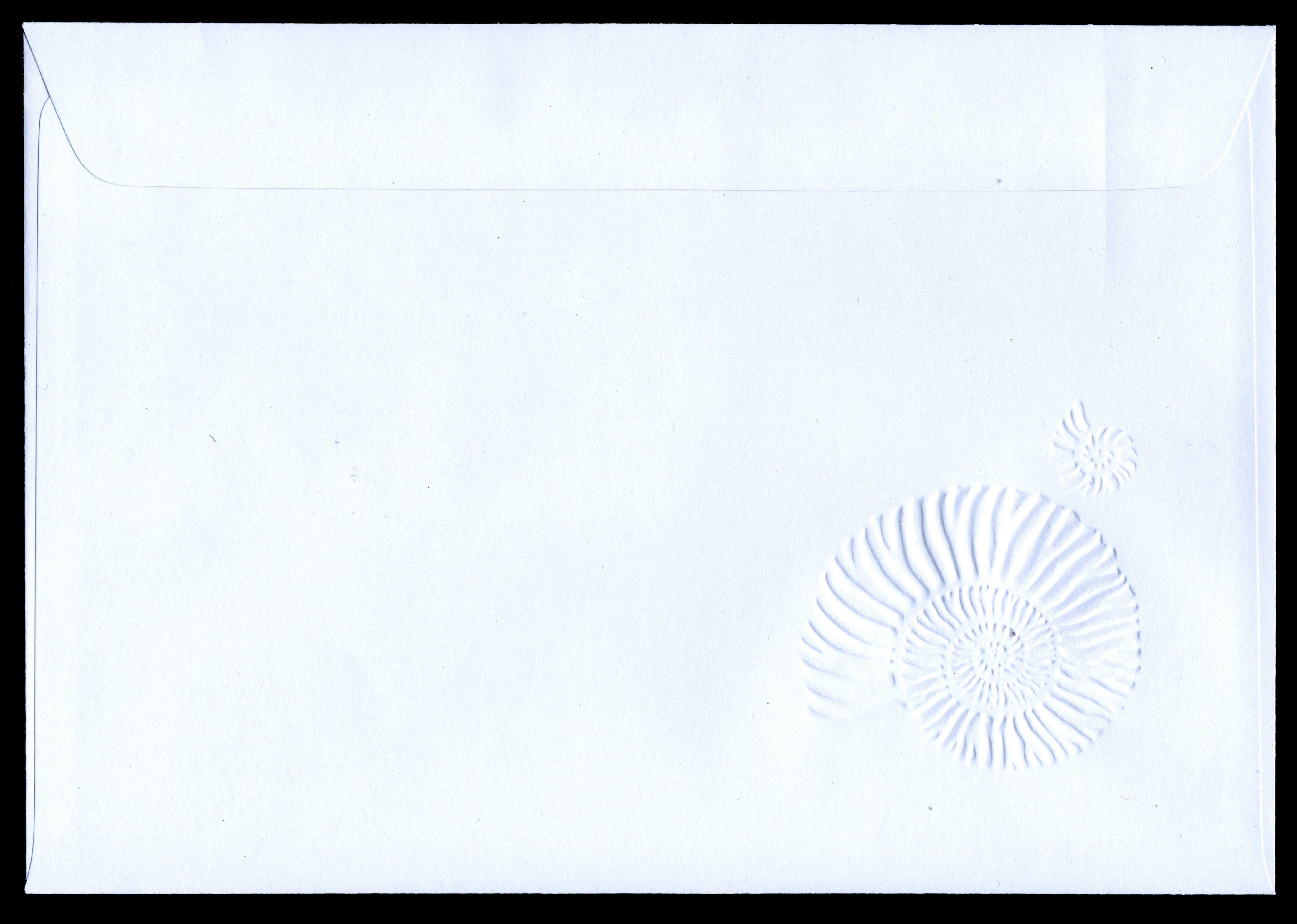
| Official FDC issued in two formats: C6 (162x114 mm) and E6 (200x140mm), the covers are the same, just different in size. | The letter was posted on the day of the stamp issue and used a regular envelope. | The letter was posted on the day of the stamp issue and used the envelope designed for the FDC. |
| Two embossed ammonites appear on the left side of the cover and can even be recognized on the reverse side. | ||
Philatelic Souvenirs
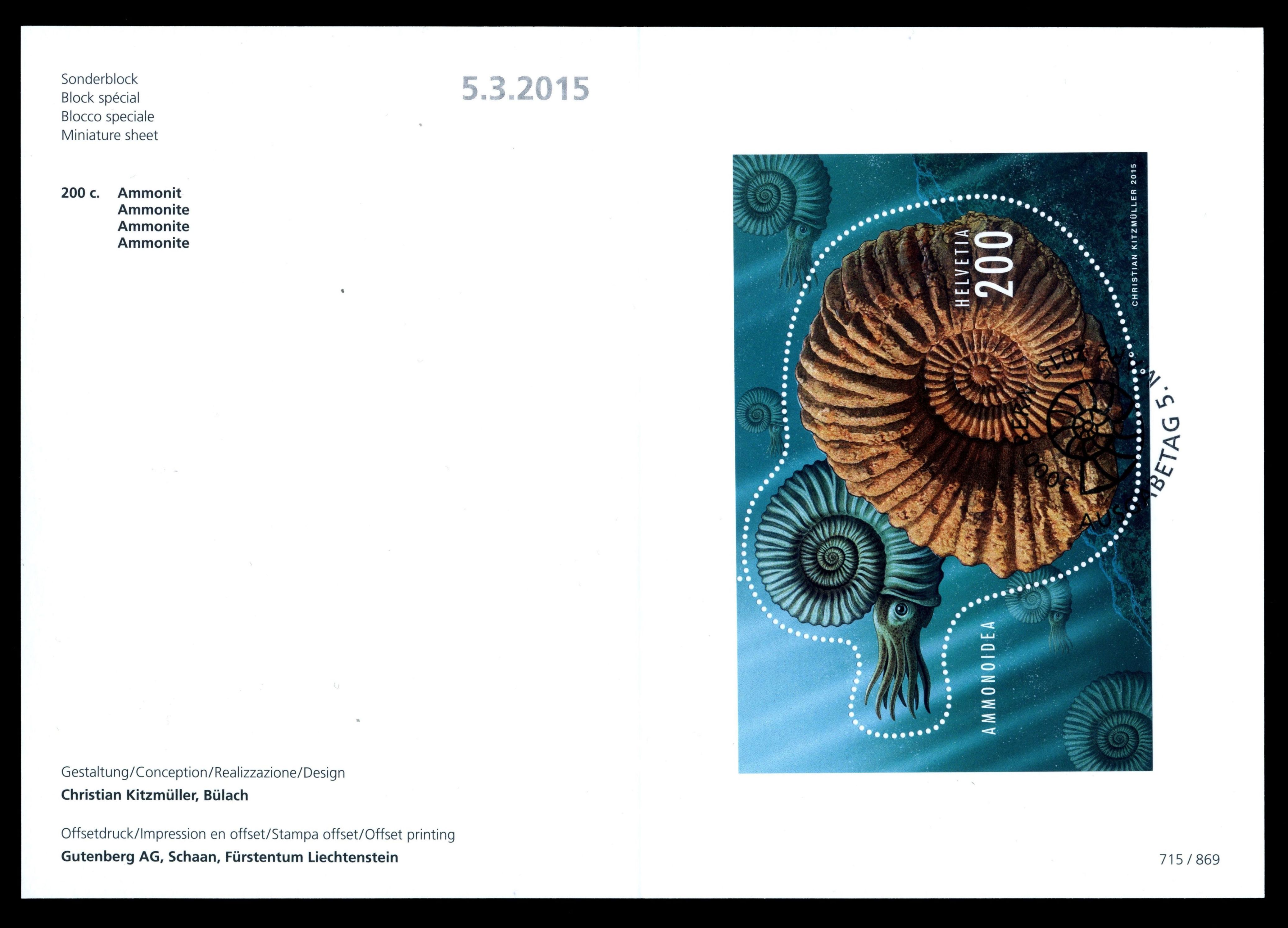
| Official Souvenir Sheet | ||
 |
||
| Issued together with the stamps | ||
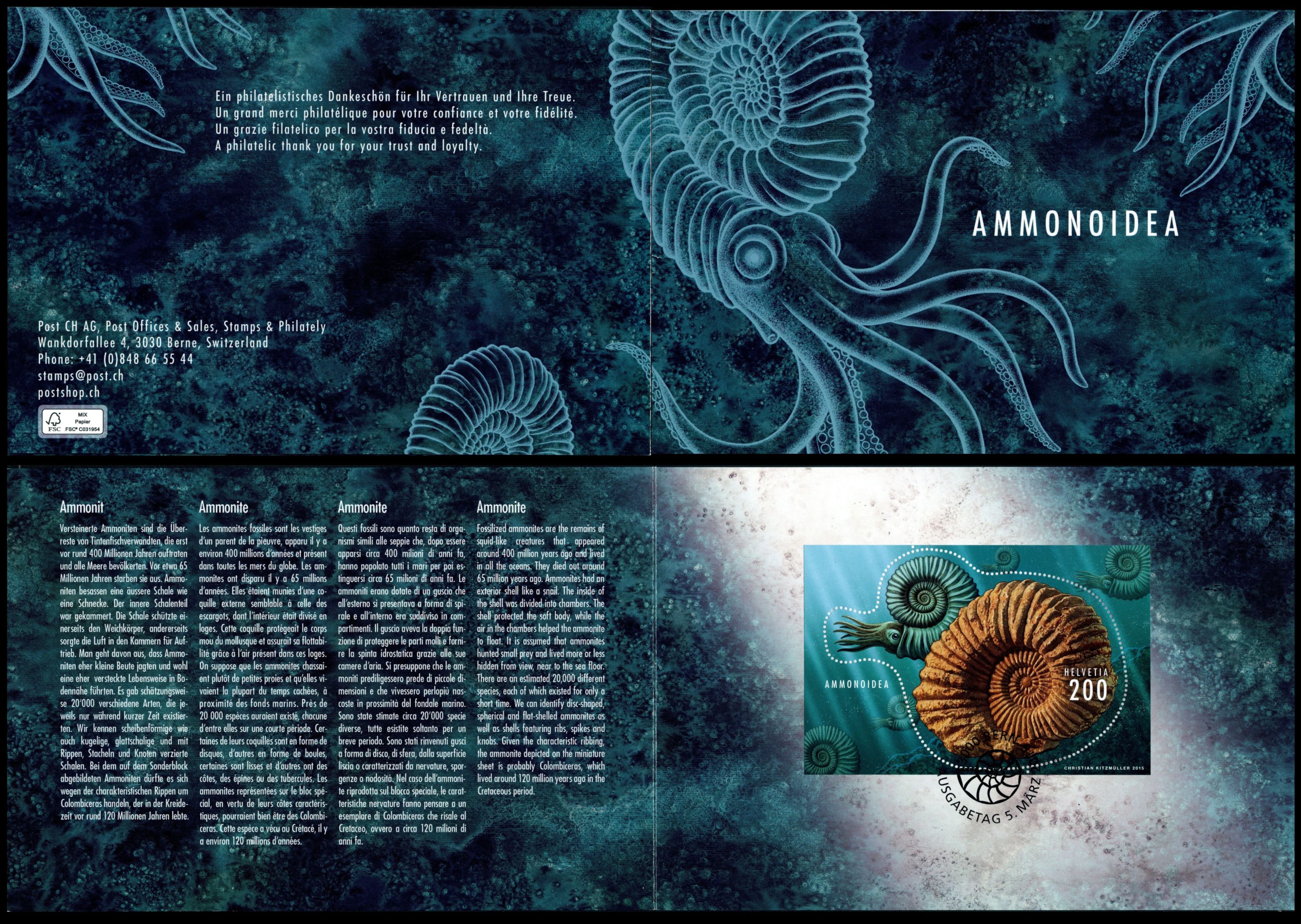
| Souvenir Booklet | Exhibition Sheet and special Cover produced for Europhilex'15 in London | |
 |
 |
 |
| Issued several months after the issue of the stamp and in very limited quantities. | ||
References
Die Lupe (Focus on Stamps) 1/2015, 4/2015, 1/2016
Acknowledge
- Many thanks to Dr. Hans Ulrich ERNST for his advice about the ammonite species.
- Many thanks to Dr. Peter Voice from Department of Geological and Environmental Sciences, Western Michigan University, for reviewing the draft page and his very valuable comments.