Mexico 2006 "Dinosaurs of Mexico"
| Issue Date | 29.09.2006 |
| ID | Michel: 3268-3270 Bl. 69; Scott: 2524a-c; Stanley Gibbons: ; Yvert et Tellier: BF65; Category: pR |
| Design | Designer: Ernesto Castellanos Castellanos Illustration: Ilustracion y composicion digital |
| Stamps in set | 3 |
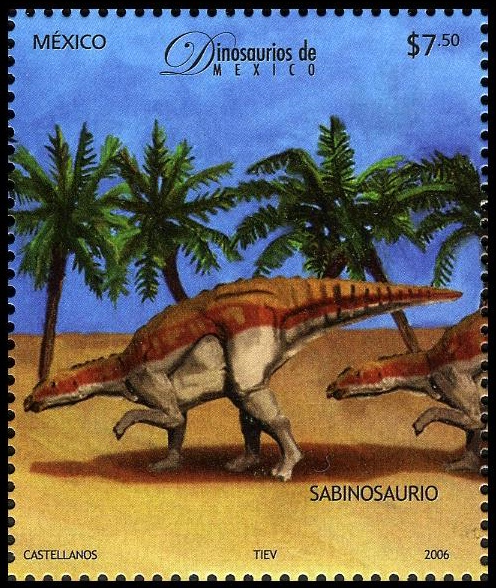
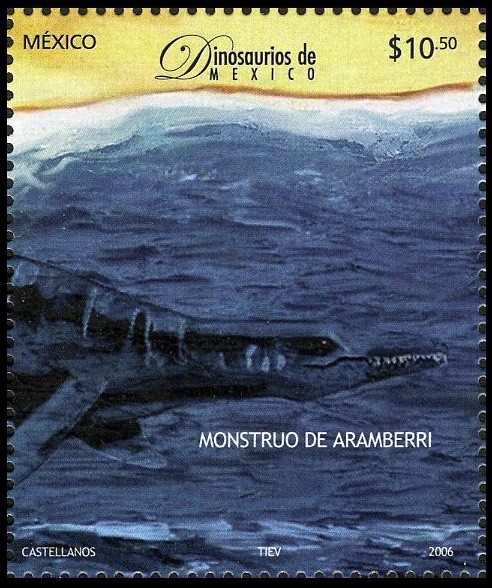
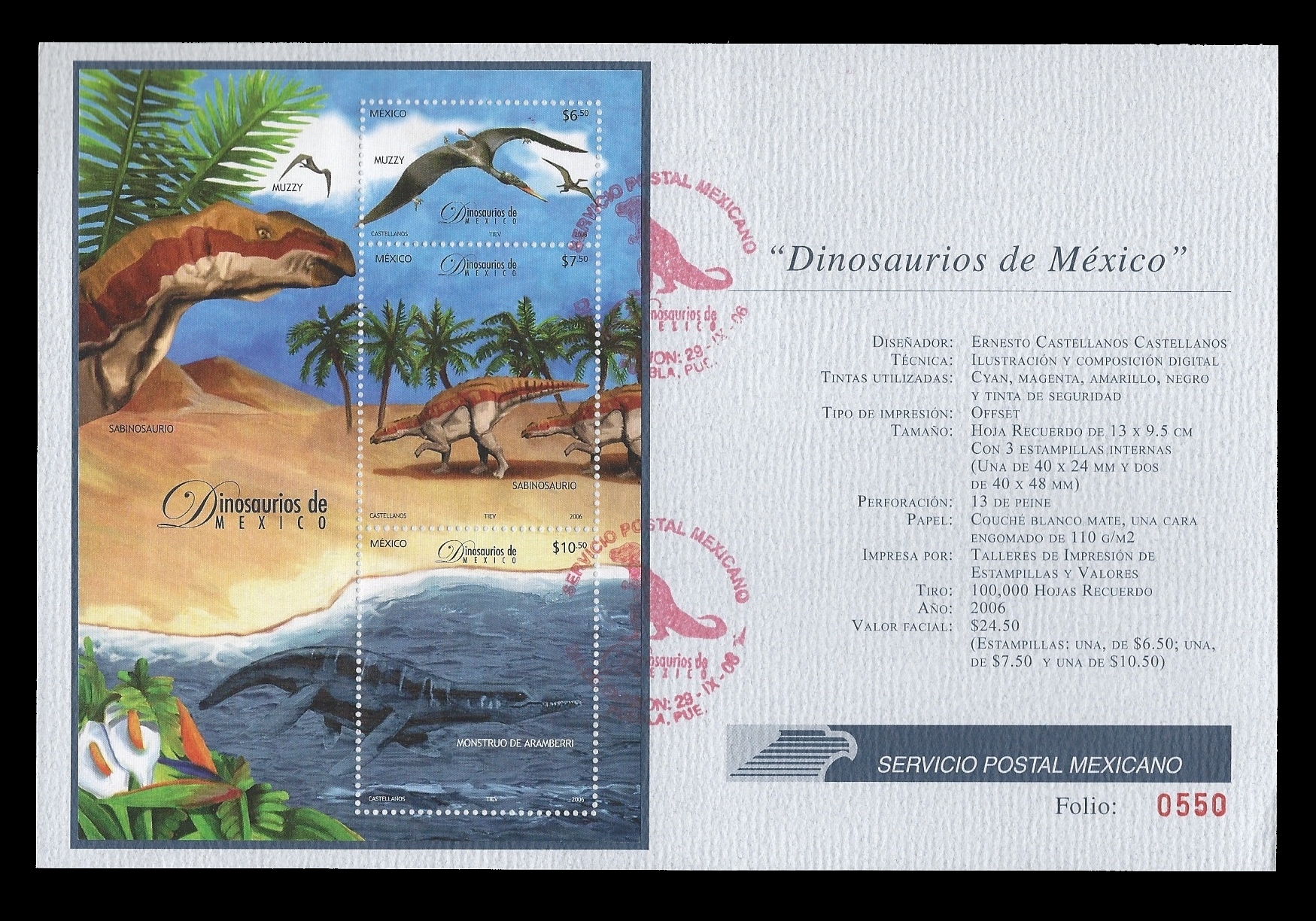
| Value | MXN 6.50 - Muzzy (Muzquizopteryx coahuilensis) MXN 7.50 - Sabinosaurus MXN 10.50 - "Monstruo de Aramberri" (pliosaur) |
| Emission/Type | commemorative |
| Issue place | Mexico City |
| Size (width x height) | 40mm x 24mm Mini-Sheet: 130mm x 95mm |
| Layout | 3 stamps in mini-sheet |
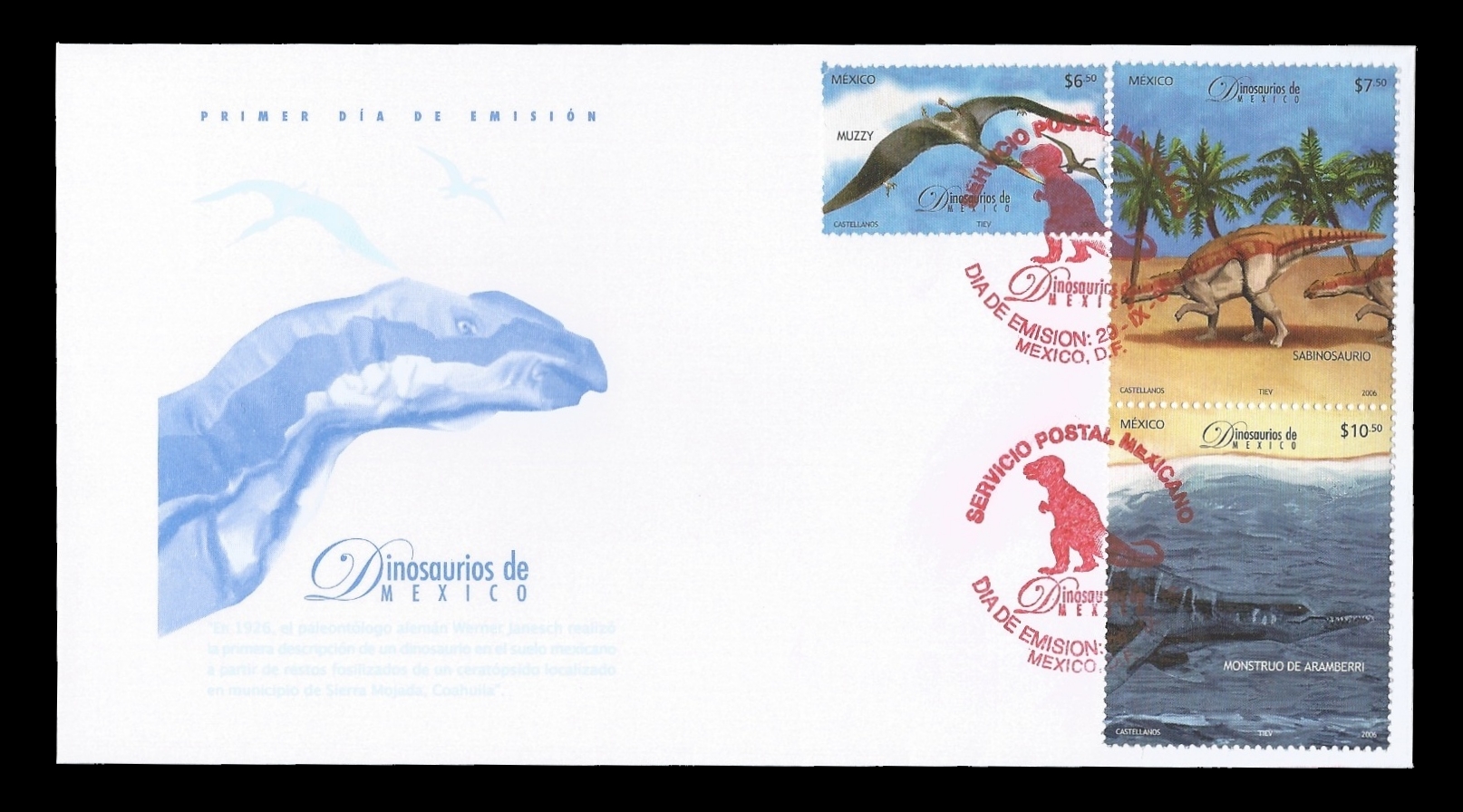
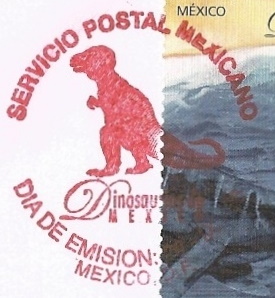
| Products | FDC x 1, SS x1 |
| Paper | Couche white, one side gluing 100gms./m2 |
| Perforation | 13 |
| Print Technique | Offset |
| Printed by | Talleres de Impresion de Estampillas y Valores |
| Quantity | 100,000 Mini-Sheets |
| Issuing Authority | Servicio Postal Mexicano |
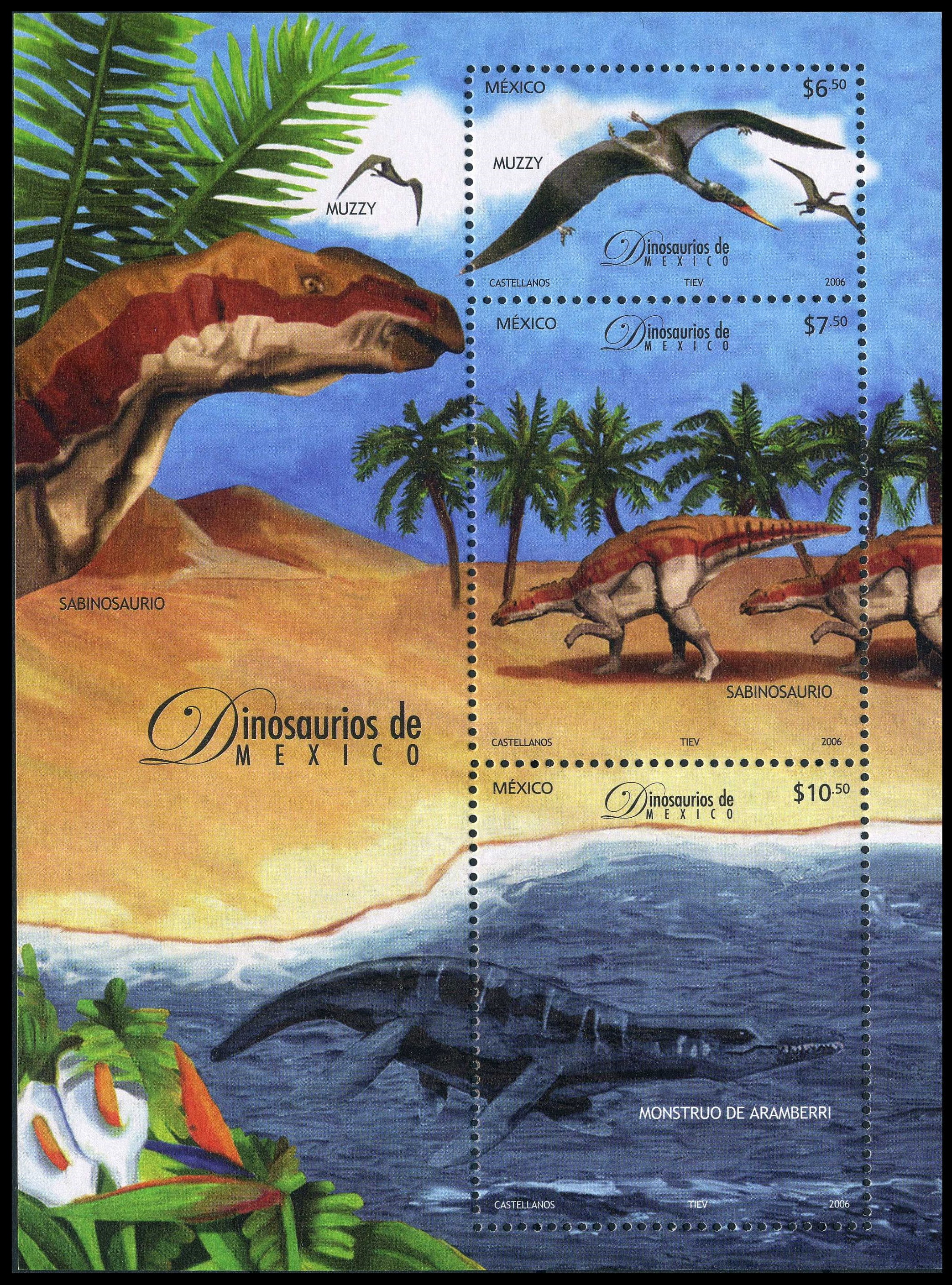
On September 29th, 2006, Mexican Postal Service in cooperation with The Museo del Desierto (the Desert Museum), presented, for the enjoyment of philatelists and the general public, a souvenir sheet with 3 stamps of prehistoric creatures which lived on the territory of the country in the far geological past: Upper Cretaceous (100 - 60 million years ago) and Late Jurassic (160 - 145 million years ago).
Actually, there is only one dinosaur depicted on these stamps. The other two animals are not dinosaurs, but instead include a pterosaur (a flying reptile) and a pliosaur (a marine reptile). More correct names for this set should have been “Prehistoric Reptiles of Mexico” or “Prehistoric Monsters of Mexico” instead of “Dinosaurs of Mexico”.
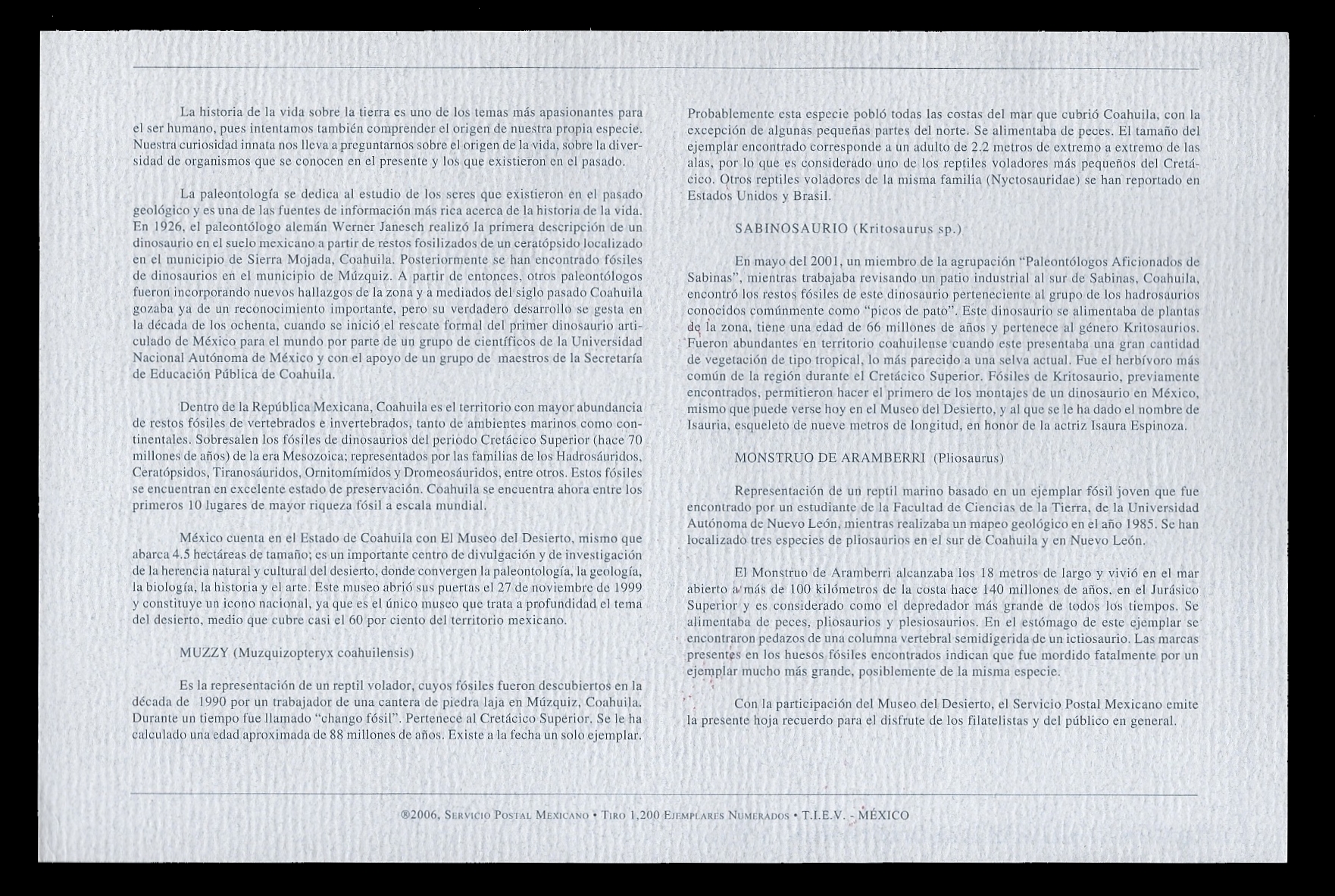
Below is translation of the text from the Official First Day Sheet, with some comments added by the author of this website.
The history of life on the Earth is one of the most thrilling topics for the human being, because we intend to comprehend the origin of our own species.
Our innate curiosity makes us ask ourselves about the origin of life, about the diversity of organisms known in the present and the ones that existed in the past.
Paleontology makes studies about this creatures that lived in a geological past and is the source of information about the history of life.
In 1926, the German paleontologist Werner Janensch made the first description of a dinosaur in Mexican soil, the fossilized remains of a ceratopsid found in the locality of Sierra Mojada, Coahuila.Werner Ernst Martin Janensch (11 November 1878 - 20 October 1969) was a German paleontologist and geologist, who is most famous contributions stemmed from the expedition he led with Edwin Hennig to the Tendaguru Beds in what is now Tanzania. The Museum fuer Naturkunde Berlin excavated at Tendaguru hill and in the surroundings for four years, from 1909 through 1911, when Werner Janensch was an expedition leader. Many excavated fossils of dinosaurs (including Brachiosaurus brancai, 14 meter high the bigest dinosaur skeleton of the world, shown on German stamp from 2010) from the Tendaguru Beds are moved to Germany and can be seen in the the Museum fuer Naturkunde Berlin.
Later, more dinosaur bones has been found in Murquiz municipality. Thereafter, others paleontologists made another findings in the area in the second half of the past century, made Coahuila was well known at paleontologists community, but the real development was in the middle of 1980’s, when the first articulate dinosaur's skeleton of Mexico was discovered by a group of scientists of National University (Universidad Nacional Autonoma) of Mexico, with the support of a group of teachers from the Secretary of Public Education of Coahuila.
In the Mexican Republic, Coahuila is the territory with the most abundance of vertebrate and invertebrate fossils, both marine and continental environments. Most notable are dinosaur fossils of Upper Cretaceous period (70 million years ago) of Mesozoic Era; represented families of Hadrosaurs, Ceratopsians, Tyrannosaurids, Ornithomimids and Dromaeosaurids, among others.
These fossils are in excellent state of preservation. Coahuila is in the top 10 of places of major fossil richness around the world. In the state of Coahuila we find the Desert Museum (El Museo del Desierto) which occupy an area of 4,5 hectares it is a very important site of divulgation and research of the natural and cultural heredity of the desert, where the paleontology, geology, biology, history and art converge. This museum opened its doors on November 27, 1999 and is a national icon, due to the fact that it´s the only museum that deeply investigate the subject of the desert which covers almost 60% of the national territory.
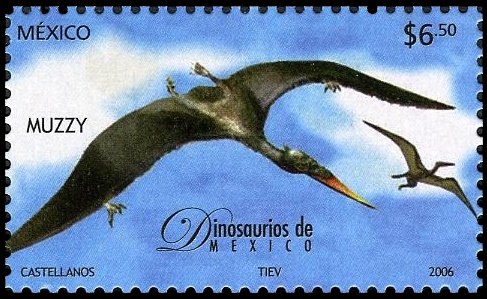
MUZZY (Muzquizopteryx coahuilensis)
is the representation of the flying reptile from the Upper Cretaceous, it's age has been estimated to 88 million years old, whose remains were discovered in the 1990’s by a worker of the flagstone quarry in Muzquiz, Coahuila.
For a while it was called “chango fossil” (chango means boy).
Only one specimen is found to date, this species maybe populated all the shores of the sea that covered Coahuila with the exception of some parts to the north. The size of the adult specimen is about 2,2 meters of wingspan, so it's considered a small reptile of Cretaceous Period, whose ate fishes. Other flying reptiles from the same family (Nyctosauridae sp.) are discovered in USA and Brazil.
SABINOSAURIO (Kritosaurus sp.)
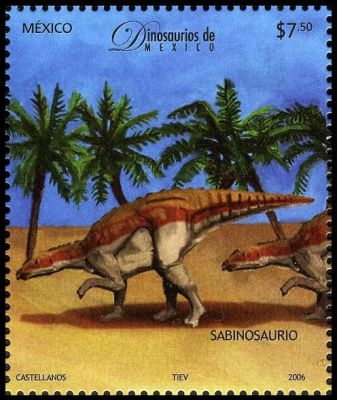
On May 2001, a member of the group "Amateur Paleontologists of Sabinas" (“Paleontologos Aficionados de Sabinas”), found the fossil remains of this dinosaur that belongs to the hadrosaurs group commonly known as "duck bills", while he was working on industrial ground south from Sabinas, Coahuila.
This is herbivorous dinosaur (ate plants only) from the area, it age was estimated to 66 million years old and it belongs to the genus Kritosaurid.
They were abundant in the Coahuilan territory when it had a great quantity of tropical type vegetation, which was very similar to a tropical rainforest of today. It was the most common herbivore in the region during the Upper Cretaceous.
The Kritosaur skeleton was the first mounted dinosaur in Mexico, which can be seen at the Museo del Desierto and which has been given the name of Isauria, it is a 9 meter long skeleton honouring the actress Isaura Espinoza.
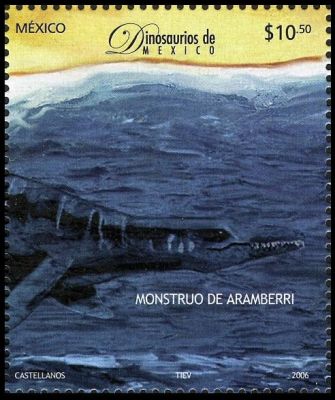
MONSTER OF ARRAMBERRI (Pliosaurus).
It is the representation of a marine reptile based on a young fossil specimen found by a student of the Sciences of the Earth Faculty from the Autonomous University of Nuevo Leon, while he was doing a geological mapping in the year 1985.
There are 3 pliosaur species that have been found in the south of Coahuila and in Nuevo Leon.
The Arammerri Monster reaches 18 meters in length and lived in the open sea more than 100 kilometres from the cost 140 million years ago in the Upper Jurassic and it is considered the biggest predator of all times.
They ate fishes, pliosaurs and plesiosaurs. Some pieces of a half-digested backbone that belongs to an ichthyosaurus have been found in the stomach of this specimen. Some marks, present on the fossil bones, indicate that it was fatally wounded by a much larger specimen, possibly from the same species.
Products and associated philatelic items
| FDC | Souvenir Sheet | First-Day-of-Issue Postmark |
 |
 |
 |
| Examples of circulated covers | ||
 |
 |
|
References
- Technical details and short description of the stamps:
Official First Day Sheet - Werner Ernst Martin Janensch:
Wikipedia
Acknowledgements
Many thanks to Dr. Peter Voice, PhD Department of Geological and Environmental Sciences, Western Michigan University, USA, for reviewing of a draft of this article.