Gibraltar 2000 "History of Gibraltar - Millennium Stamps"
| Issue Date | 09.05.2000 |
| ID | Michel: 914-929, Scott: 841, Stanley Gibbons: 916-937 MS916a, Yvert: 919-934, Category: pR |
| Design | Christian Hook |
| Stamps in set | 16 |
| Value |
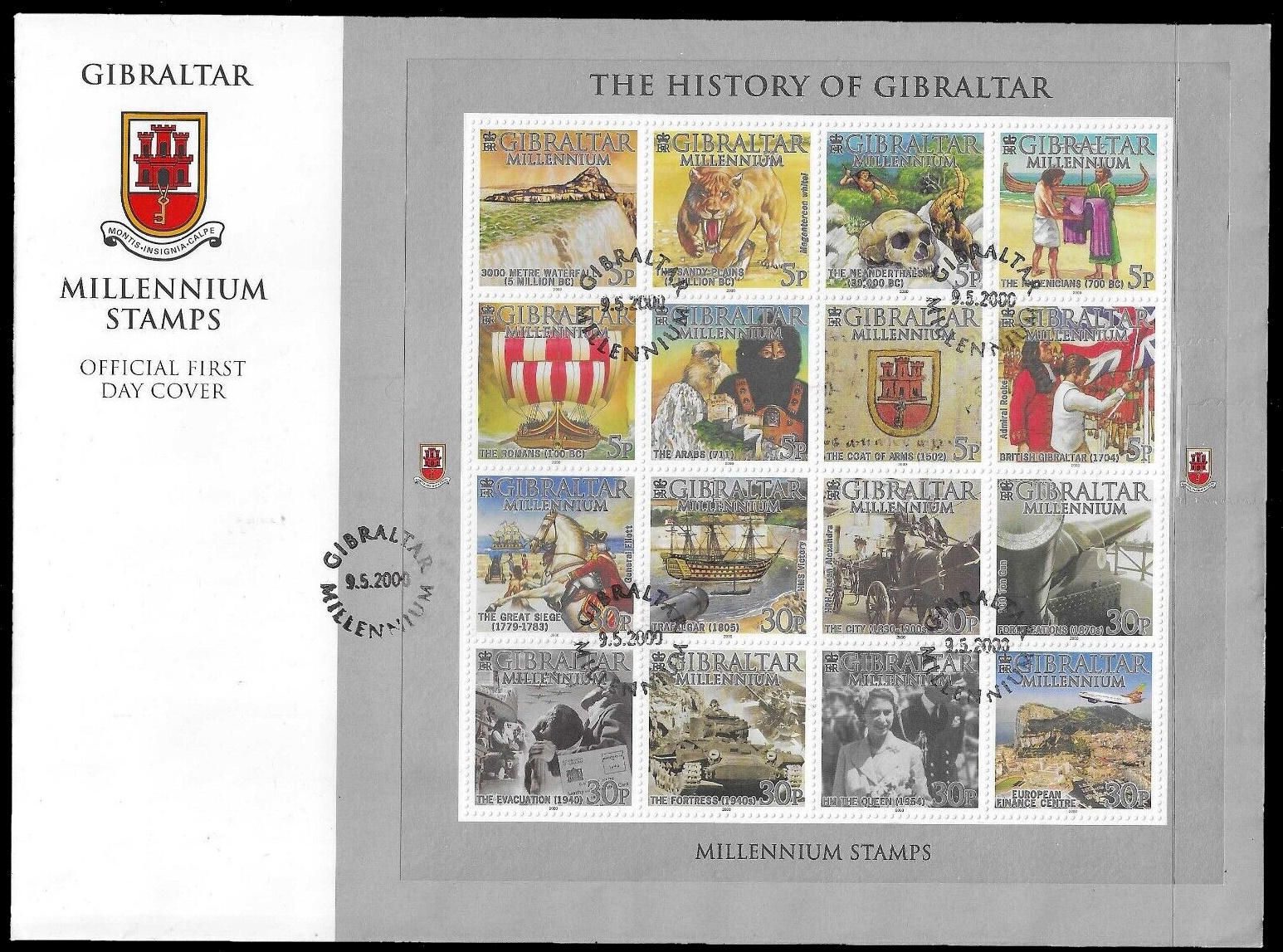
5p 3,000 meters Waterfall (5 million years ago) 5p The Sandy Plains (2 million years ago) - Megantereon whitei 5p The Neanderthals (30,000 BC) 5p The Phoenicians (700 BC) 5p The Romans (100 BC) 5p The Arabs (711) 5p The Coat of Arms (1502) 5p British Gibraltar (1704) 30p The Great siege (1779-1783) 30p Trafalgar (1805) 30p The City (1830-1900s) 30p Fortifications (1870s) 30p The Evacuation (1940) 30p The Fortress (1940s) 30p HM The Queen (1954) 30p European Finance Centre |
| Emission/Type | commemorative |
| Issue places | |
| Size (width x height) | stamps: 32.10 x 32.10 MS: 150mm x 150mm |
| Layout | MS of 16 stamps x1; Booklets Mini-Sheets: MS of 2 stamps x9, MS of 3 stamps x7. |
| Products | FDC x1, Booklet x1 |
| Paper | ? |
| Perforation | 14 x 14 |
| Print Technique | Offset Lithography, Multicoloured |
| Printed by | House of Questa |
| Quantity | ? |
| Issuing Authority | Gibraltar Post |
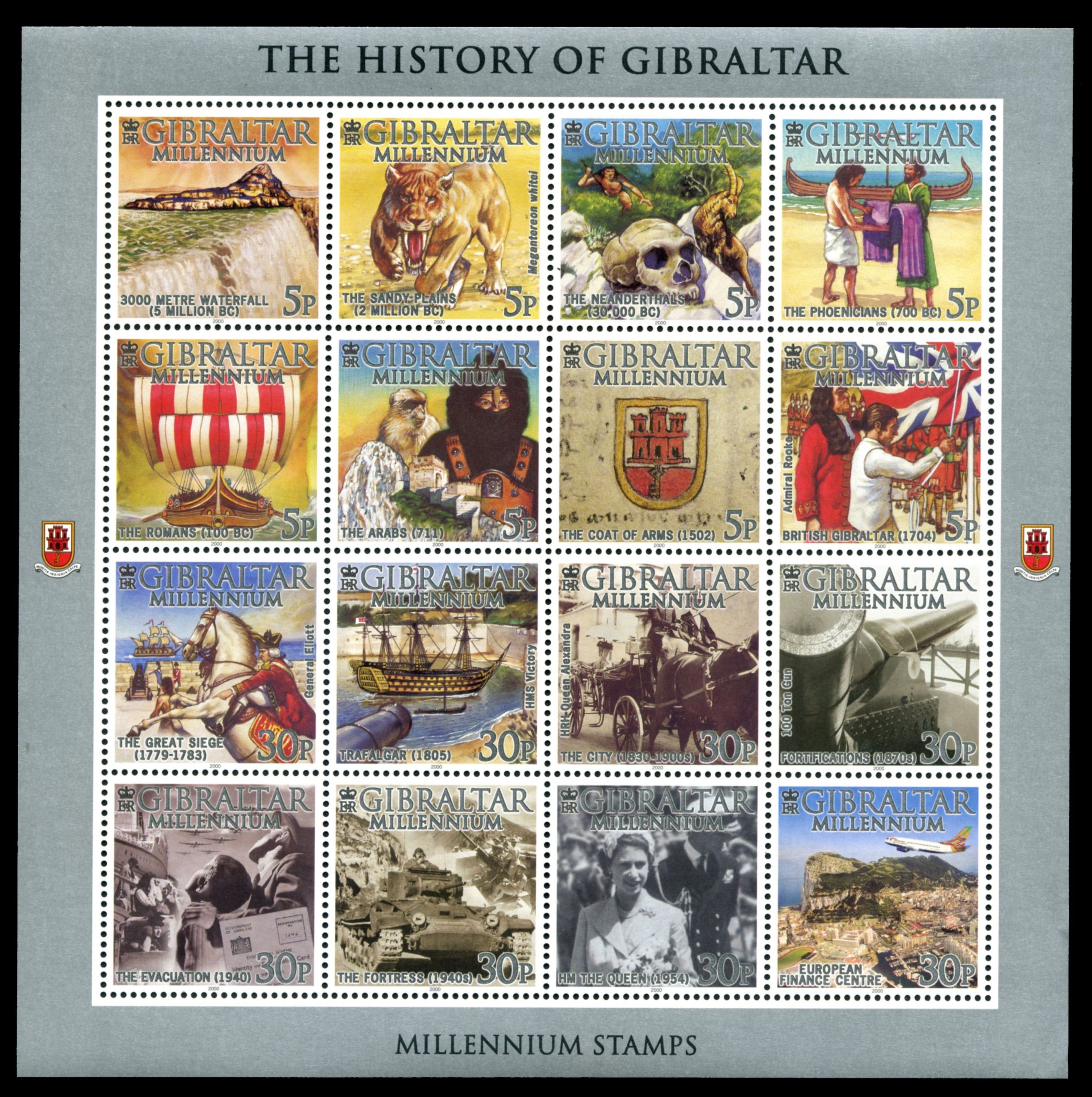
On May 9th, 2000, the Postal Authority of Gibraltar issued the miniature sheet History of Gibraltar – Millennium Stamps.
The miniature sheet contains 16 stamps depicting important events and periods in the history of Gibraltar, beginning with the geological formation of the Rock around five million years ago.
The first stamp depicts the reopening of the Strait of Gibraltar at the end of the Messinian Salinity Crisis, when the Mediterranean Basin was refilled by the Zanclean Flood approximately 5.33 million years ago.
Subsequent stamps showcase prehistoric wildlife, such as the saber-toothed cat Megantereon, and highlight one of Gibraltar's major archaeological treasures — the Neanderthals.
The remaining stamps trace Gibraltar's history through the arrival of the Phoenicians, Roman influence, the Moorish conquest, the granting of the Coat of Arms in 1502, British rule following the capture of Gibraltar in 1704, the Great Siege, the Battle of Trafalgar, Victorian expansion, the massive nineteenth-century fortifications, the Second World War evacuation and fortress years, the first visit of Queen Elizabeth II, and Gibraltar's emergence as a modern European financial centre.
The miniature sheet combines paintings, historical reconstructions, archival photographs, and contemporary imagery to create a concise visual history of Gibraltar. The issue reflects the territory's unique position as a crossroads of civilisations, where geology, archaeology, military history, and modern development are woven together into a single chronological narrative.
In addition to the miniature sheet, Gibraltar Post also issued a Prestige Booklet containing sixteen smaller miniature sheets, each featuring two or three of the same stamp designs.
Three of the stamps are of particular interest to collectors of paleontology and paleoanthropology
3,000 meter waterfall (5 million years ago)
The stamp illustrates one of the most dramatic geological events in Earth's recent history — the Messinian Salinity Crisis. Between approximately 5.96 and 5.33 million years ago, the connection between the Atlantic Ocean and the Mediterranean Sea was greatly restricted, causing the Mediterranean Basin to partially or almost completely dry out.
 |
|
3,000 meters Waterfall on the Mini-Sheet from the Prestige Booklet of Gibraltar 2000. The text from the Mini-Sheet: The following text from the Prestige Booklet described the stamp. 5 million years ago the Strait of Gibraltar closed up as land masses shifted. This caused the Mediterranean Sea to evaporate and turn into barren lands with hard, crusty salt layers. Subsequently, a series of earthquakes opened up the Strait as the continents moved to form a spectacular 3,000 meters waterfall between Gibraltar and the North African coast, refilling the Mediterranean. |
The exact causes of the closure of the Strait of Gibraltar were related to complex movements of the African and Eurasian tectonic plates, which gradually changed the configuration of the Mediterranean–Atlantic connection. The eventual reopening of the strait at the beginning of the Pliocene Epoch, about 5.33 million years ago, allowed Atlantic waters to rapidly flow back into the Mediterranean Basin in an event known as the Zanclean Flood.
The Zanclean flood likely caused the Mediterranean to refill with massive, rapid water cascades. Scientific models of this era suggest a 3,000-metre waterfall through the Strait of Gibraltar, which is depicted on the stamp. The mini-sheet's margins display the wider context of this extraordinary period, showing the dry seabed and paleogeographic views. This provides a detailed geological introduction to the history of the Rock, leading into the later, human-focused stamps in the series.
The Sandy Plains - Megantereon whitei
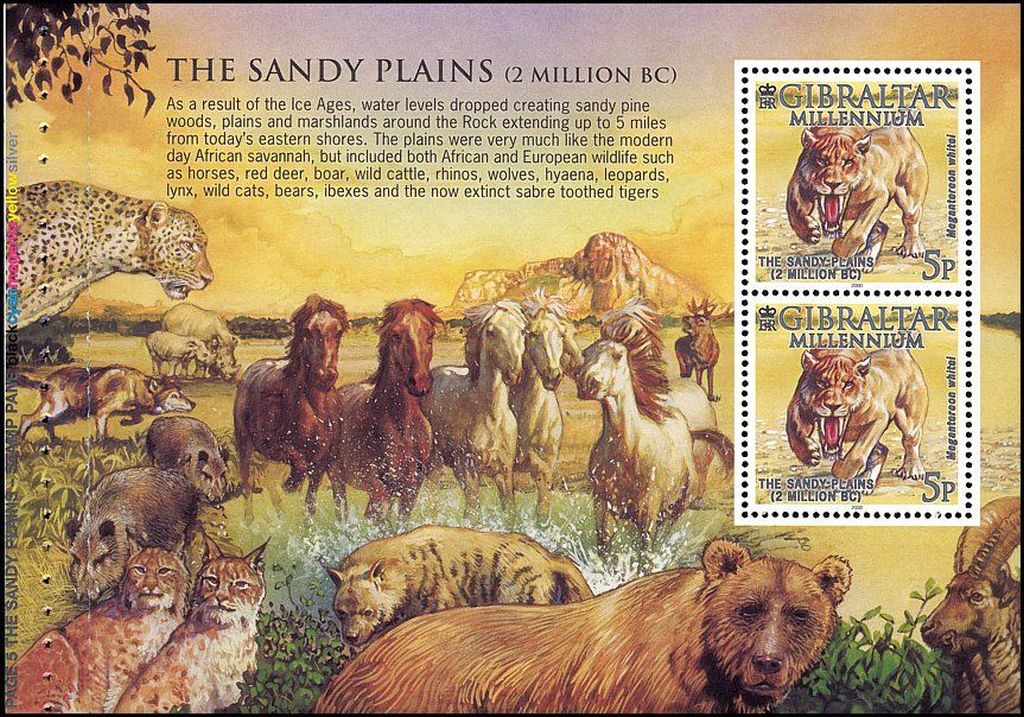
The stamp depicting the "Sandy Plains" shows Megantereon whitei, a prehistoric sabre-toothed cat that lived from the Late Pliocene to the Early Pleistocene, approximately between 3.5 and 1 million years ago.
Megantereon whitei was a medium-sized but powerful predator. Its fossils are known from Africa, Europe and Asia, showing that the species had a wide geographic distribution. The animal inhabited a variety of environments, from open woodland to savannah-like landscapes, where it hunted large herbivorous mammals.
 |
|
Megantereon whitei on the Mini-Sheet from the Prestige Booklet of Gibraltar 2000 The text from the Mini-Sheet: THE SANDY PLAINS (2 MILLION BC) As a result of the Ice Ages, water levels dropped creating sandy pine woods, plains and marshlands around the Rock extending up to 5 miles from today's eastern shores. The plains were very much like the modern day African savannah, but included both African and European wildlife such as horses, red deer, boar, wild cattle, rhinos, wolves, hyaena, leopards, lynx, wild cats, bears, ibexes and the now extinct sabre-toothed cats. |
Broom named the species in honour of A. G. White, a museum preparator at the Transvaal Museum, who assisted him in the collection and preparation of fossil mammals. Broom wrote that he named the species after Mr. White "who has been of much assistance in the collection of the fossil mammals".
Megantereon belonged to the machairodont subfamily (Machairodontinae) of sabre-toothed cats, which included some of the most spectacular predators of the prehistoric world. Fossils attributed to Megantereon have been found mainly in Africa, Europe and Asia. It was closely related to Smilodon, the famous sabre-toothed cat of the Americas. Megantereon is often considered part of the evolutionary lineage that gave rise to later machairodonts, although the exact relationships among these genera remain debated.
Compared with modern big cats, Megantereon had a robust body, powerful forelimbs and strong neck muscles adapted for using its long upper canine teeth. Unlike modern lions or tigers, which rely on a prolonged struggle with prey, sabre-toothed cats likely used their enlarged canines to deliver a precise killing bite after immobilising their prey with their powerful forelimbs.
Fossils attributed to Megantereon have been found at several important Pliocene and Early Pleistocene localities in Europe, including sites in the Iberian Peninsula. These discoveries show that Megantereon was among the large carnivores that dispersed between Africa and Eurasia during the Early Pleistocene.
The Iberian Peninsula was an important region for studying the evolution and distribution of Megantereon, as it preserves a rich fossil record of Early Pleistocene mammals. The proximity of Gibraltar to the southern tip of the Iberian Peninsula places the Rock within this broader prehistoric landscape, where sabre-toothed cats formed part of a diverse community of extinct mammals.
Although Megantereon whitei is not represented by the famous fossil discoveries from Gibraltar itself, its depiction on the Gibraltar 2000 Millennium miniature sheet represents the ancient Pleistocene fauna of the region and highlights the importance of the Iberian Peninsula in understanding the history of extinct predators.
The Neanderthals
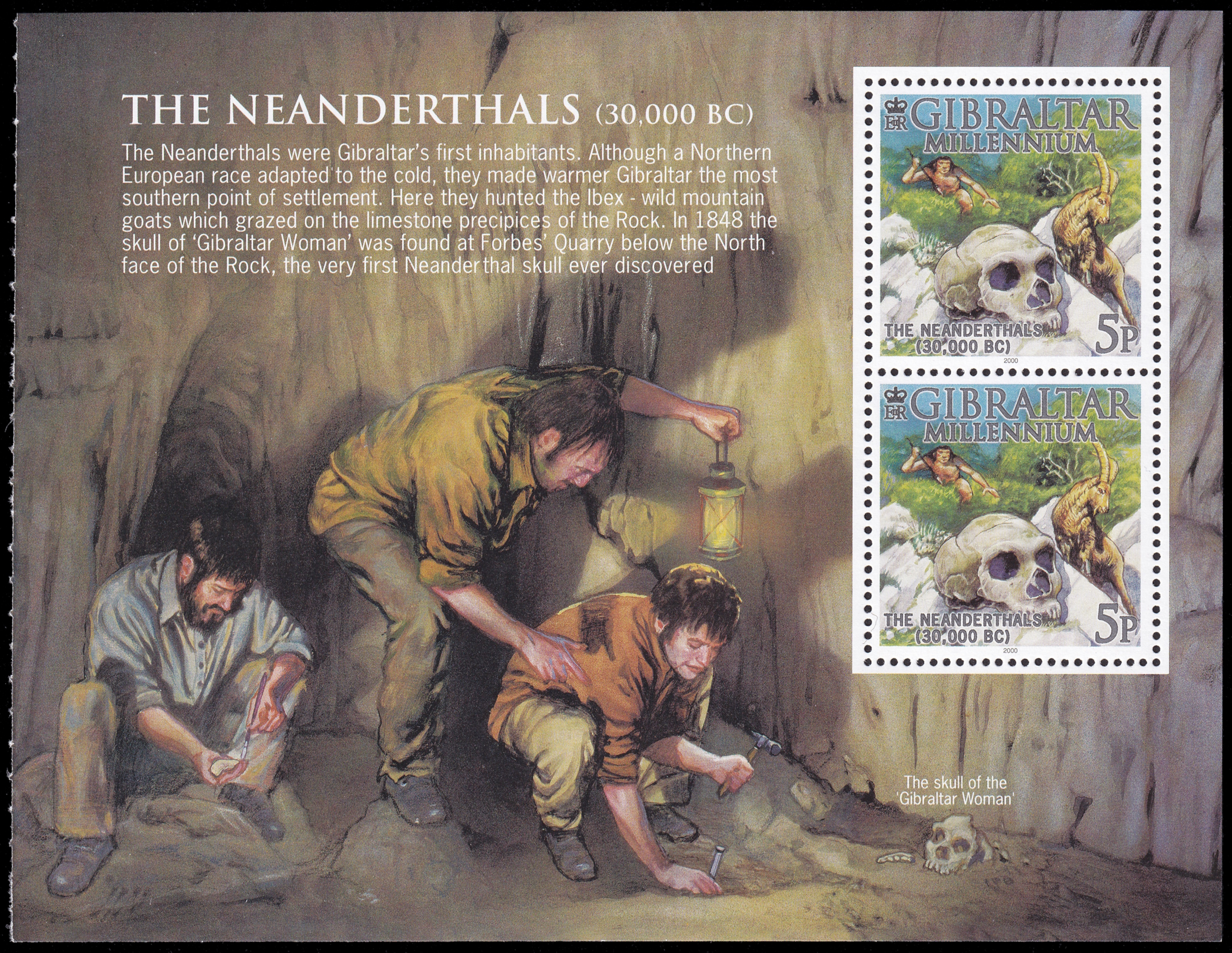
The third prehistoric subject depicted on the Mini-Sheet is devoted to the Neanderthals, showing a hunting scene together with the skull of a Neanderthal discovered in Gibraltar.
Gibraltar occupies a special place in the history of paleoanthropology.
In 1848, a fossil human skull was discovered at Forbes' Quarry, a limestone quarry on the northern face of the Rock of Gibraltar.
The quarry was named after Captain Douglas Forbes of the 74th Highland Regiment,
after the nearby Forbes' Battery, a military installation located above the site.
The area was extensively quarried during the 19th century to obtain limestone
for civil engineering projects, including the reshaping of the Line Wall and the extension of
the South Mole.
During these activities, the removal of vegetation and rock at the
base of the slope exposed a limestone cave.
Much of the cave was subsequently destroyed by quarrying, but the excavation
also revealed fossil remains, including the skull of an adult female Neanderthal
discovered in 1848 by Lieutenant Edmund Henry René Flint.
 |
|
Neanderthal skull discovery on the Mini-Sheet from the Prestige Booklet of Gibraltar 2000 The text from the Mini-Sheet: THE NEANDERTHALS (30,000 BC) The Neanderthals were Gibraltar's first inhabitants. Although a Northern European race adapted to the cold, they made warmer Gibraltar the most southern point of settlement. Here they hunted the Ibex - wild mountain goats which grazed on the limestone precipices of the Rock. In 1848 the skull of 'Gibraltar Woman' was found at Forbes' Quarry below the North face of the Rock, the very first Neanderthal skull ever discovered. |
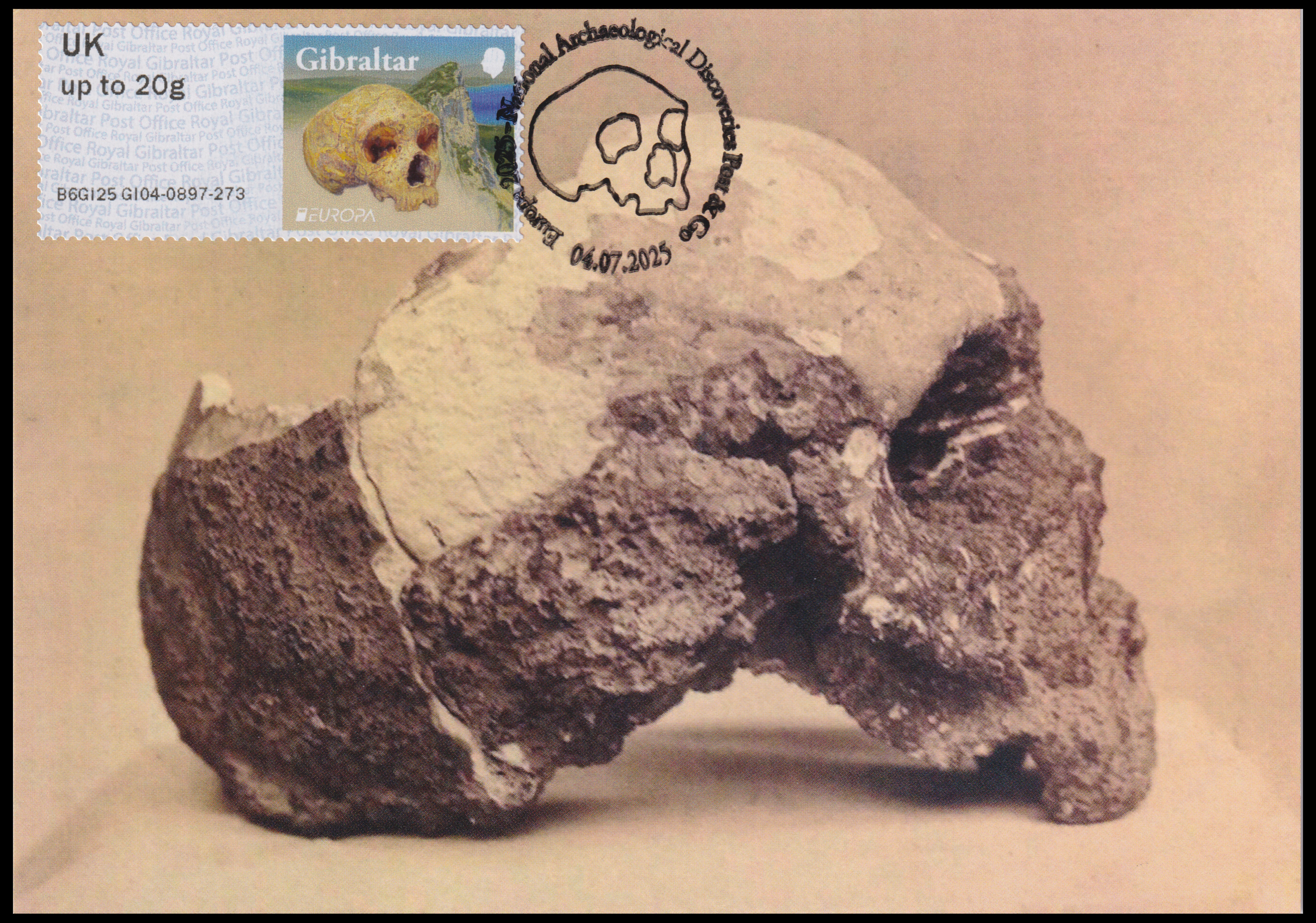 |
| Gibraltar 1 skull on the Maxi Crad of Gibraltar 2025 |
The skull was remarkably well preserved and displayed several unusual features, including a prominent brow ridge, a sloping forehead, and a robust construction unlike typical modern human skulls. However, when it was discovered in 1848, the scientific significance of ancient human remains of this kind was not yet understood, and the specimen attracted little attention.
For many years, Gibraltar 1 was regarded as an unusual example of a modern human and remained largely forgotten. Following the discovery of the Neander Valley specimen near Düsseldorf, Germany, in 1856, and the recognition of an extinct human group distinct from modern humans, earlier fossil discoveries were reassessed.
In 1864, Irish geologist and anatomist William King proposed the name Homo neanderthalensis for the extinct human group represented by the Neander Valley specimen.
In the same year, British anatomist George Busk examined the Gibraltar skull and recognized that it belonged to the same extinct human group.
Gibraltar 1 was the earliest discovered Neanderthal fossil, although its significance was not recognized until after the discovery of the Neander Valley specimen in 1856. Once identified as a Neanderthal, it played a pivotal role in the history of paleoanthropology. Together with later discoveries from caves on the Rock, it established Gibraltar as one of the most important regions for the study of Neanderthals in Europe.
The Neanderthals inhabited Gibraltar during the Late Pleistocene, when the landscape was very different from today. The caves of the Rock provided shelter and were repeatedly occupied by Neanderthal groups. Later excavations at sites such as Gorham's Cave, Vanguard Cave, and Devil's Tower Cave revealed stone tools, animal remains, and other evidence of Neanderthal life, demonstrating that Gibraltar was one of the westernmost and latest known areas of Neanderthal occupation in Europe.
While late survival dates of 28,000–32,000 years ago were historically proposed for sites such as Gorham's Cave, improved radiocarbon dating methods using modern decontamination techniques suggest that Neanderthal occupation of the cave probably ended around 42,000 years ago.
Products and associated philatelic items
| FDC | Prestige Booklet | Example of circulated cover |
 |
 |
 |
References
-
Technical details and stamps presentation:
Gibraltar Post - Messinian salinity crisis:
Wikipedia. - Megantereon:
Wikipedia,
"On some new Pleistocene mammals from limestone caves of the Transvaal, by R. Broom, published in South African Journal of Science, 33: 750–768, in March 1937. - Neanderthal skull Gibraltar 1:
Wikipedia: [1], [2].
The Ministry for Heritage of Gibraltar,
Acknowledgements
- Many thanks to Peter Brandhuber for his help and sharing scans of some unique philatelic material from his personal collection.