Guinea Bissau
Dinosaurs, prehistoric animals, fossils, prehistoric human, Charles Darwin on stamps of Guinea Bissau
Guinea-Bissau officially the Republic of Guinea-Bissau is a country in West Africa.
It covers 36,125 square kilometres with an estimated population of 2 million.
In the 19th century, it was it was the colony of Portuguese Guinea. Upon independence, declared in 1973 and recognized in 1974, the name of its capital, Bissau, was added to the country's name to prevent confusion with Guinea (formerly French Guinea).
Guinea-Bissau has a history of political instability since independence. The country's per-capita gross domestic product is one of the lowest in the world. More than two-thirds of the population lives below the poverty line and depends mainly on agriculture and fishing. [R1]
The first stamps of independent Guinea-Bissau were issued in 1974. Before that, Guinea-Bissau used the stamps of Portuguese Guinea.
After gaining independence, the Post Authority of Guinea issued issued about 40 stamps a year with designs directly connected to the country: local fauna, famous personalities, landscapes etc.
Later on, the number of stamps produced per year increased rapidly, especially after 2001 when Guinea-Bissau became a client of Stamperija. Stamperija produces hundreds of stamps on every popular topic, such as dinosaurs for Guinea Bissau. Almost none of the stamps are related to the country.
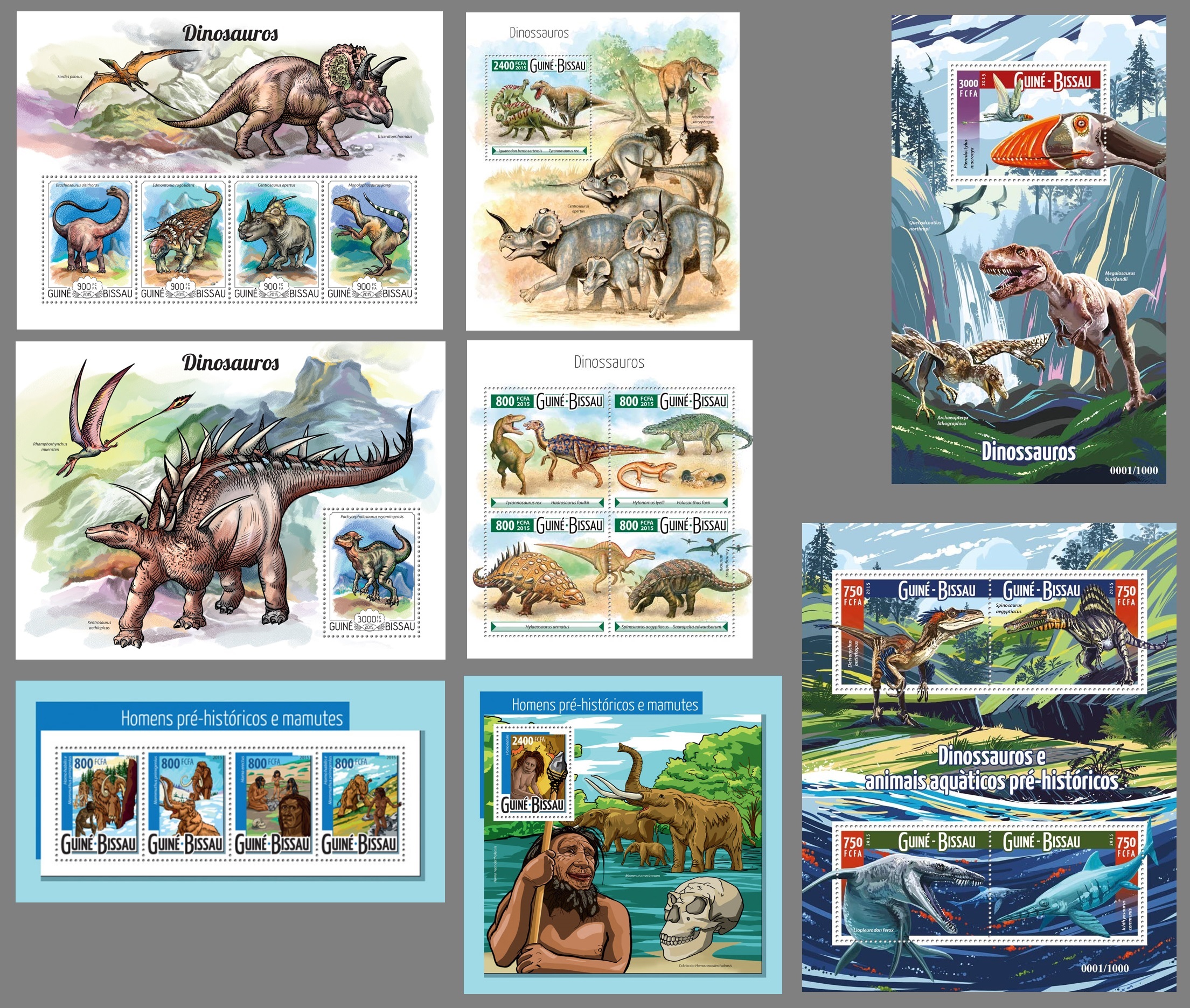
For example: only in 2015 Stamperija produced over 370 Block and Mini-Sheets, that contain over 900 (!) stamps, on behalf of Guinea-Bissau. This is about the same number of stamps issued by Guinea-Bissau in the first 30 years since their gained an independence from Portugal in 1974. [R2]
Notes:
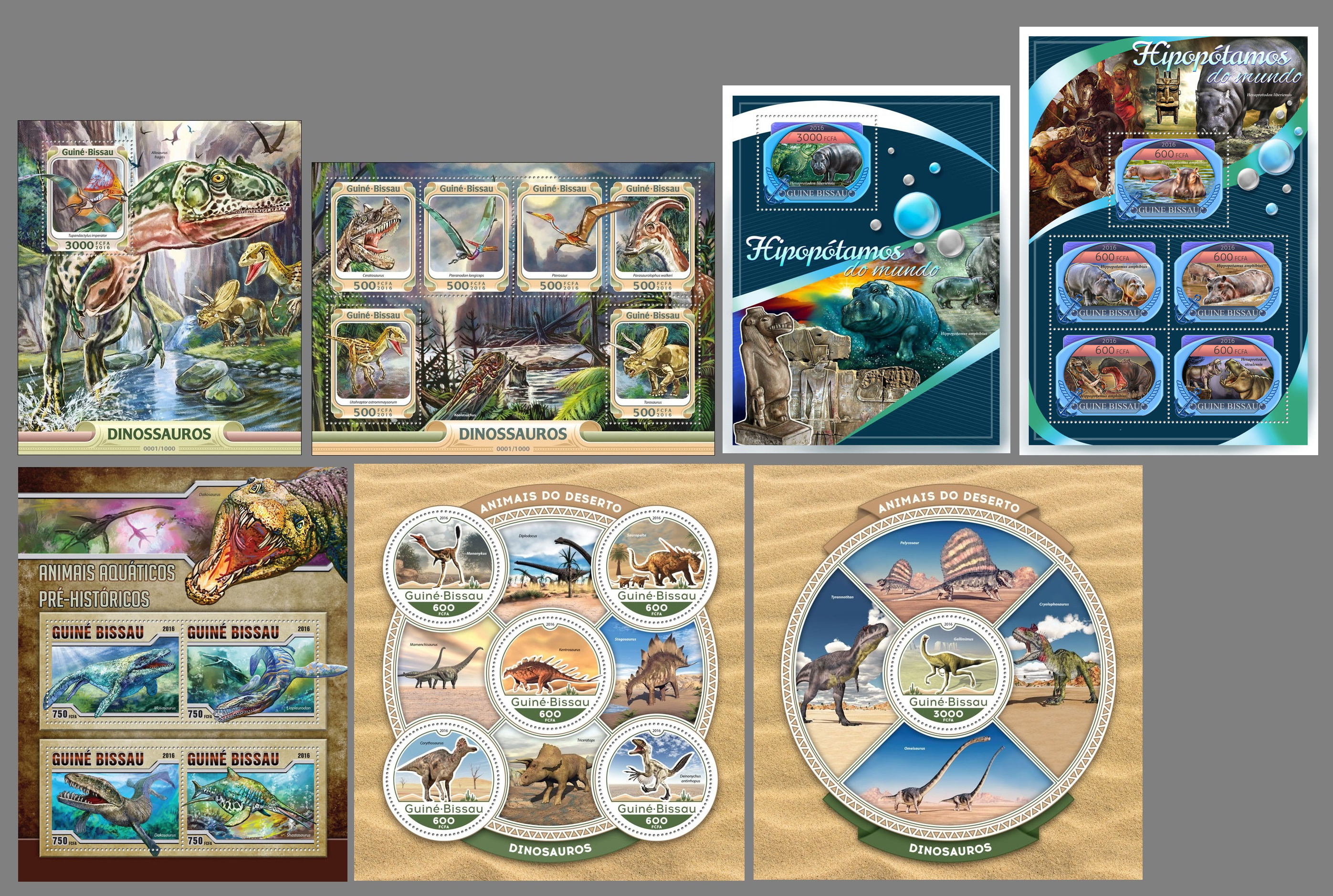
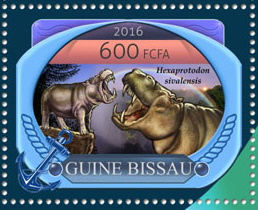
[1] Hexaprotodon sivalensis - extinct species of hippopotamus belonging to the genus Hexaprotodon which may include today's pygmy hippopotamuses.
Hexaprotodon sivalensis’s geographic range included much of south and southeast Asia in the Pliocene. By the Pleistocene this species was restricted to India – and died out roughly 16,000 years ago. [R3]
Hexaprotodon sivalensis shown on stamp in bottom-right corner of Mini Sheet
Hexaprotodon sivalensis is also shown on stamps of Nepal 2013.
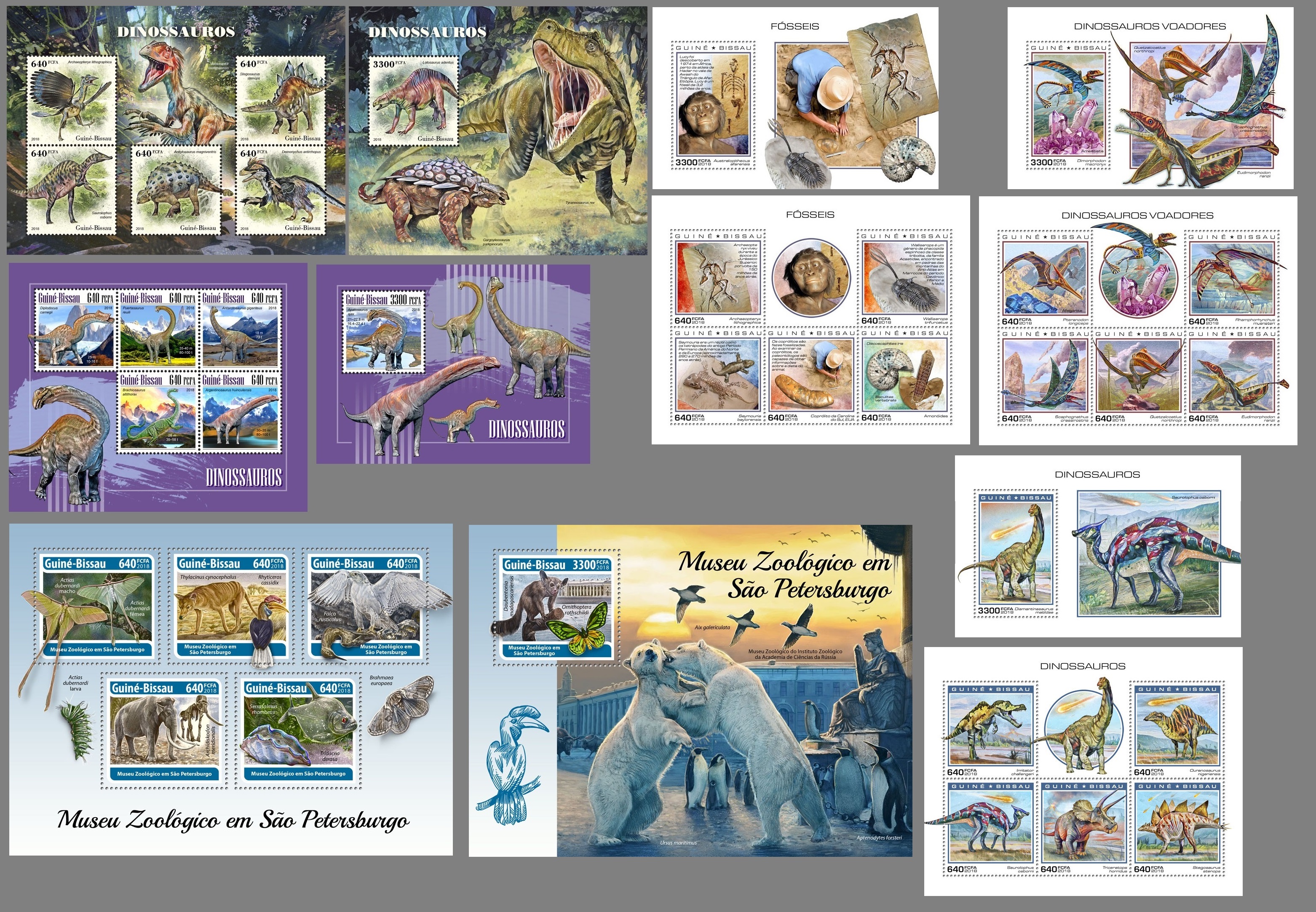
[N2] "Flying dinosaurs" is not a correct term to apply to the animals shown on these stamps.
The animals pictured are pterosaurs.
Pterosaurs are a group of flying reptiles in the Archosauria. Reptiles in the archosaurs include crocodiles, dinosaurs, and pterosaurs.
[3] One of the Mini-Sheets of “Flying dinosaurs” and “Prehistoric water animals” contains two stamps of the Republic of Guinea and two stamps of Guinea-Bissau.
Notes:
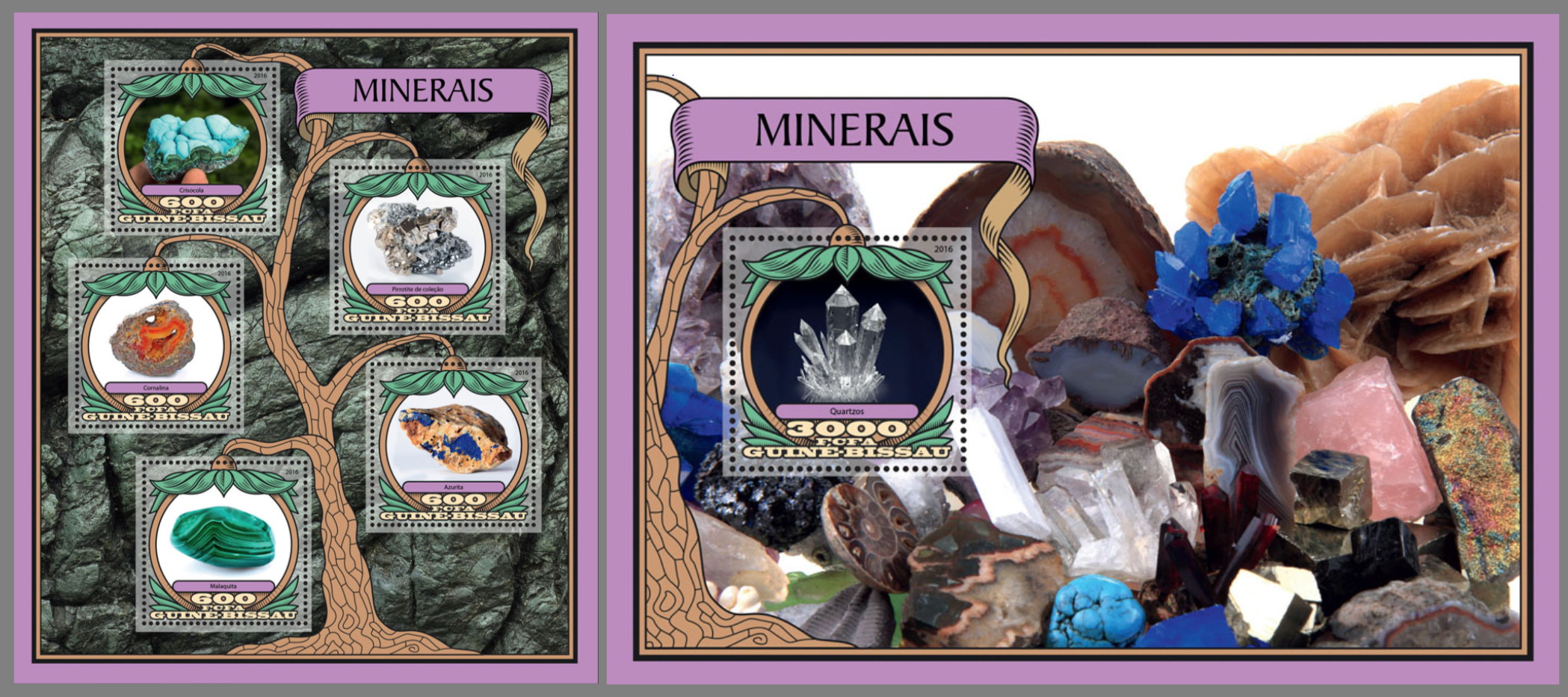
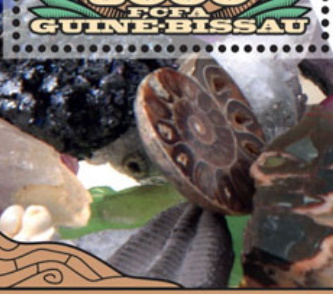 [O1] Ammonite and piece of Trilobite shown on margin of the Souvenir Sheet of the Mineral stamps,
just below the stamp.
[O1] Ammonite and piece of Trilobite shown on margin of the Souvenir Sheet of the Mineral stamps,
just below the stamp.
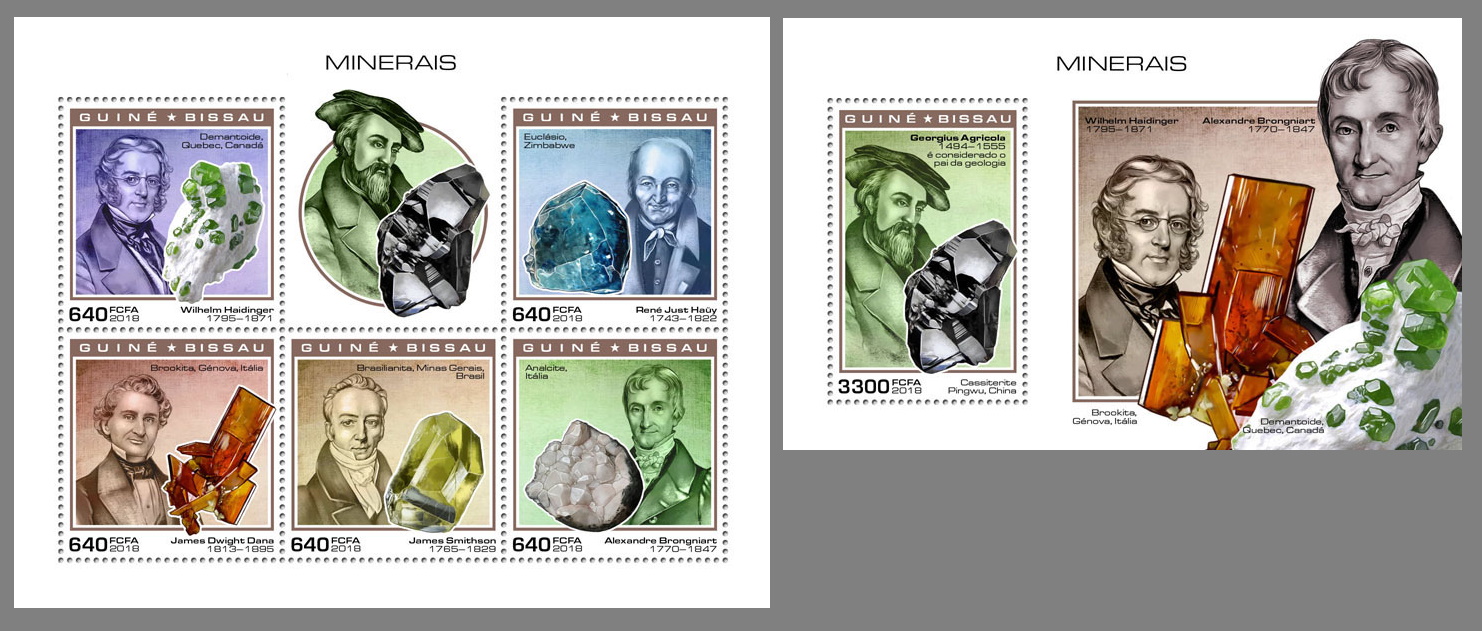
[O2] Georgius Agricola and Alexandre Brongniart shown among other scientists on the stamps.
In the 19th century, it was it was the colony of Portuguese Guinea. Upon independence, declared in 1973 and recognized in 1974, the name of its capital, Bissau, was added to the country's name to prevent confusion with Guinea (formerly French Guinea).
Guinea-Bissau has a history of political instability since independence. The country's per-capita gross domestic product is one of the lowest in the world. More than two-thirds of the population lives below the poverty line and depends mainly on agriculture and fishing. [R1]
The first stamps of independent Guinea-Bissau were issued in 1974. Before that, Guinea-Bissau used the stamps of Portuguese Guinea.
After gaining independence, the Post Authority of Guinea issued issued about 40 stamps a year with designs directly connected to the country: local fauna, famous personalities, landscapes etc.
Later on, the number of stamps produced per year increased rapidly, especially after 2001 when Guinea-Bissau became a client of Stamperija. Stamperija produces hundreds of stamps on every popular topic, such as dinosaurs for Guinea Bissau. Almost none of the stamps are related to the country.
For example: only in 2015 Stamperija produced over 370 Block and Mini-Sheets, that contain over 900 (!) stamps, on behalf of Guinea-Bissau. This is about the same number of stamps issued by Guinea-Bissau in the first 30 years since their gained an independence from Portugal in 1974. [R2]
Due to the facts above most stamps of Guinea-Bissau should be avoided from serious collections and philatelic exhibition, therefore all of them are marked with a gray background.
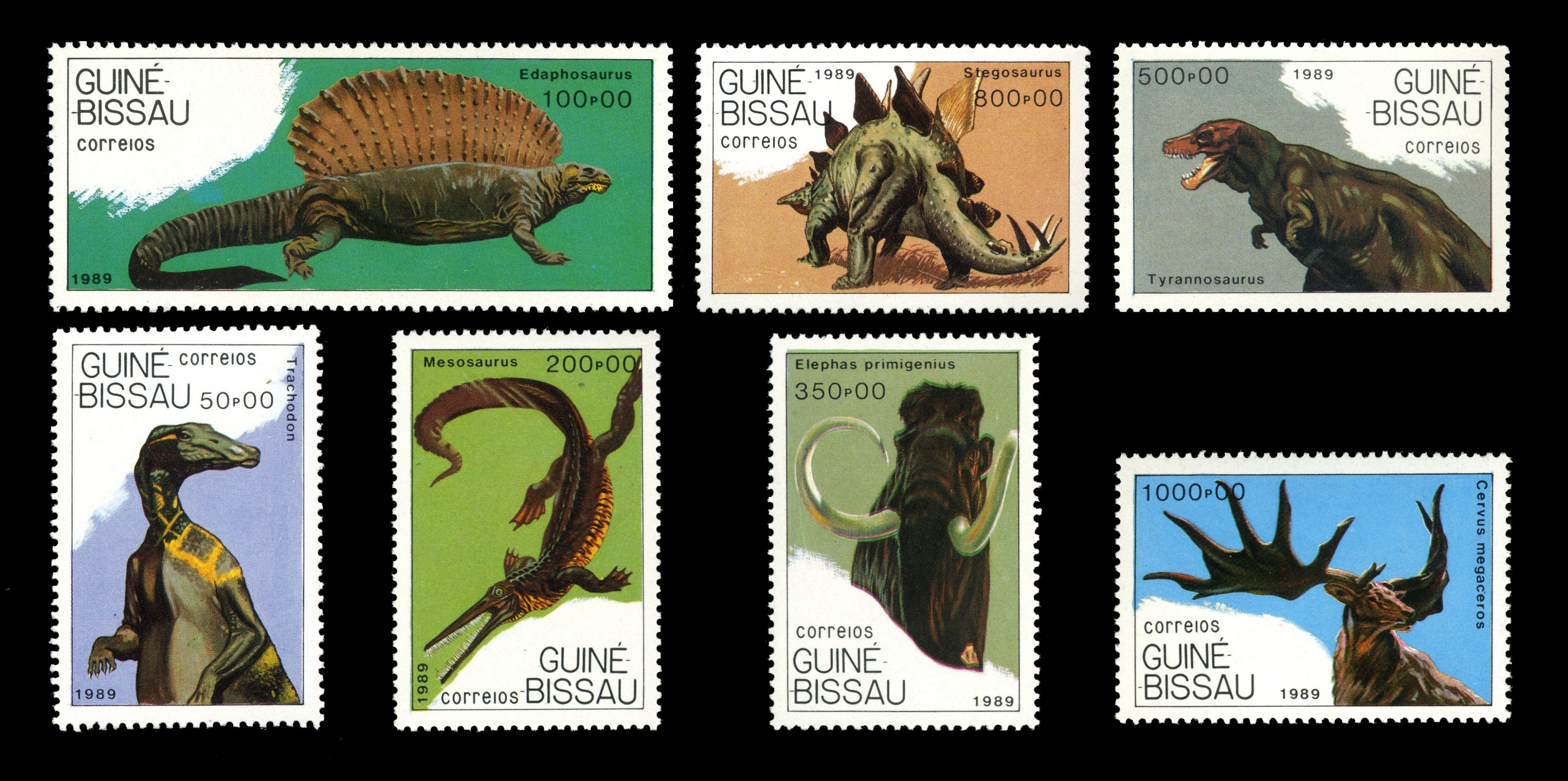
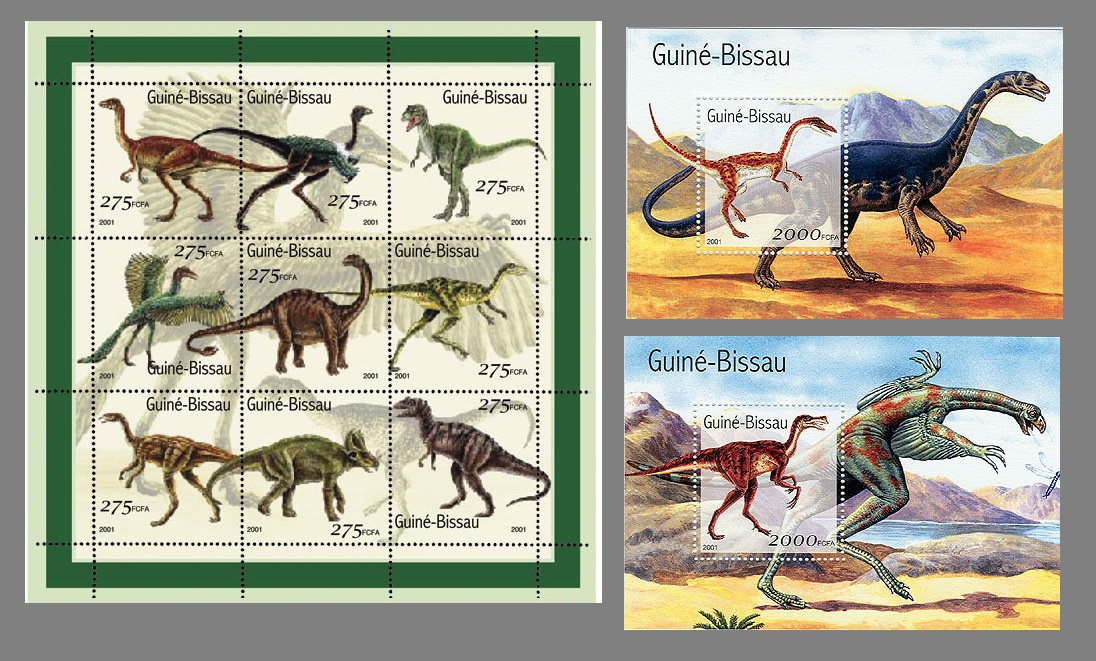
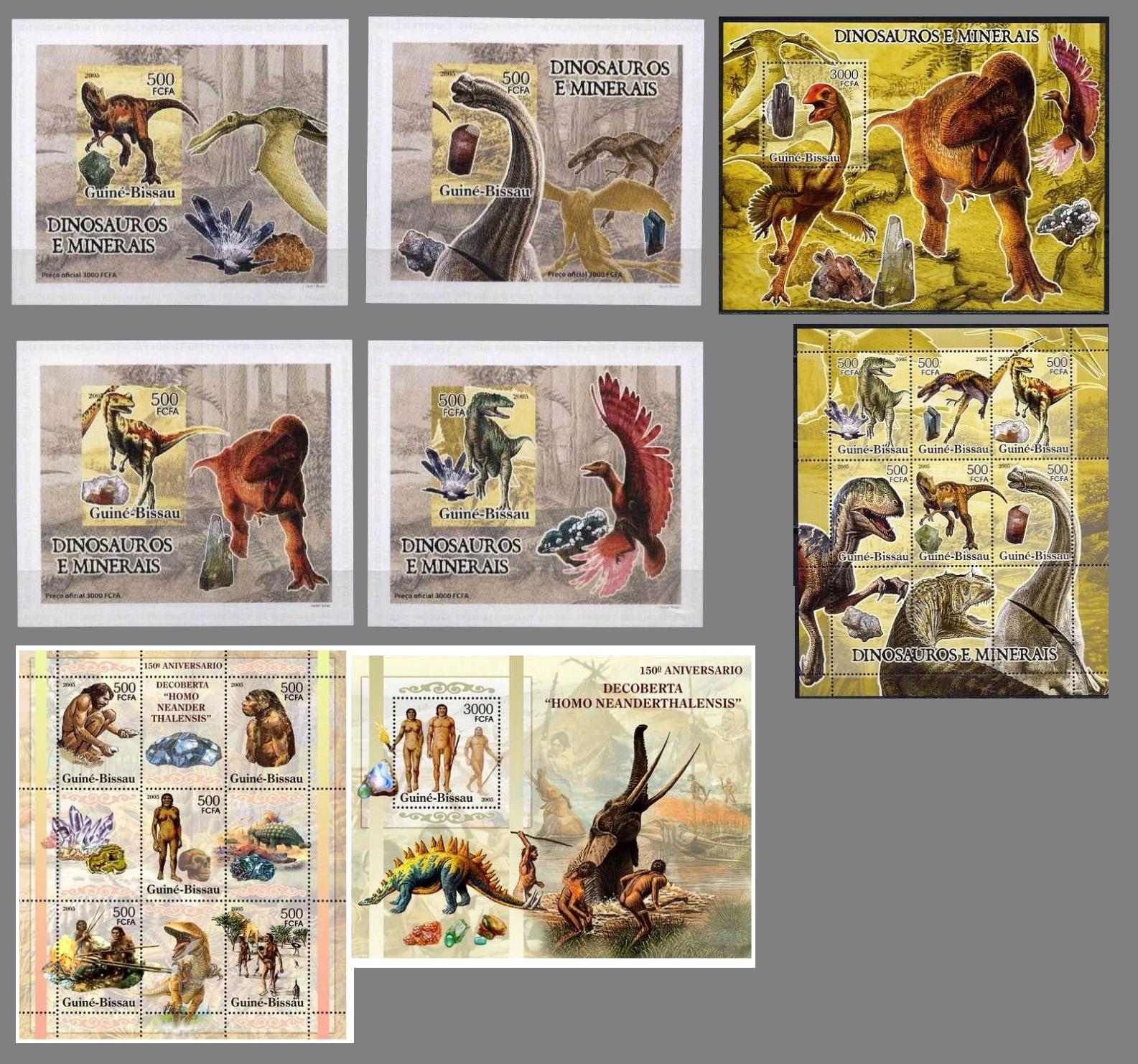
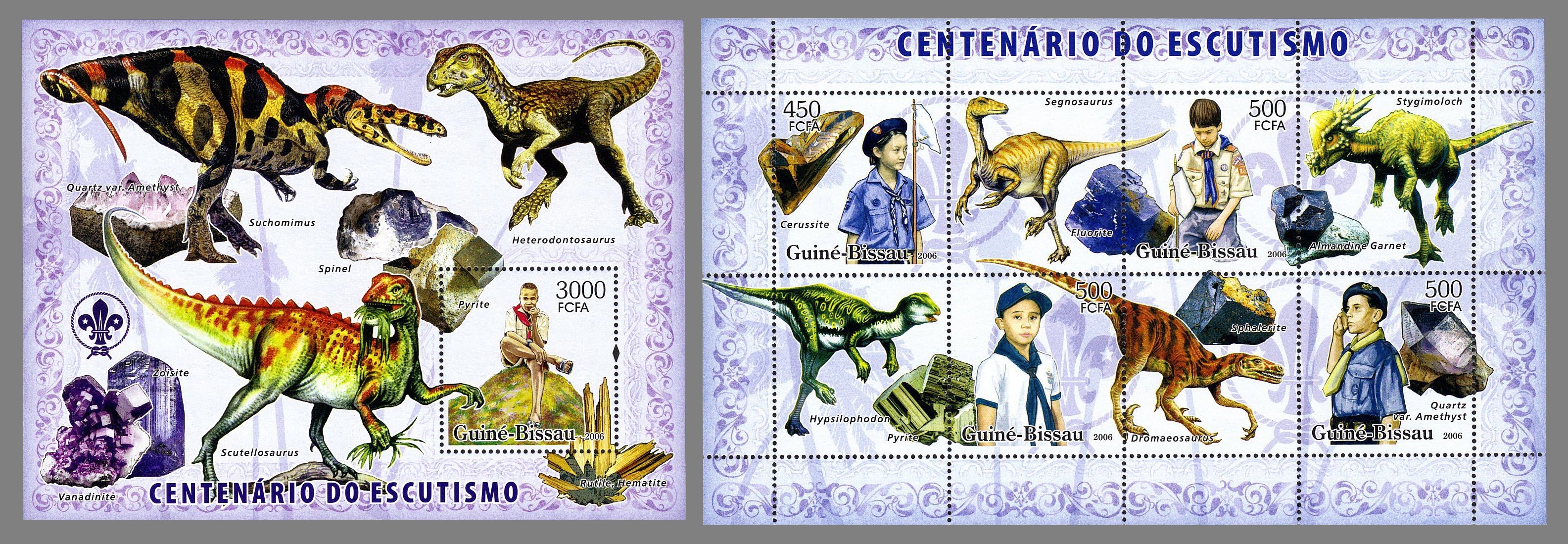
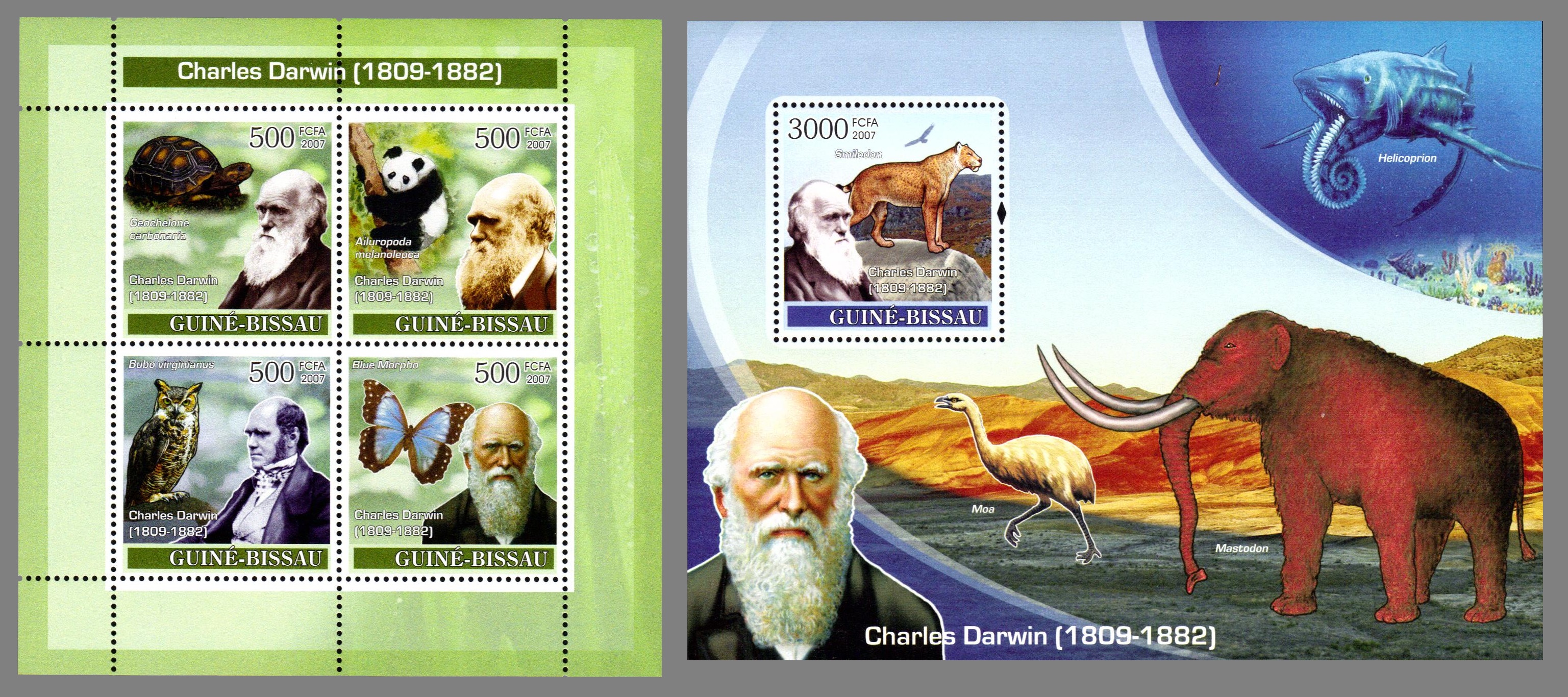
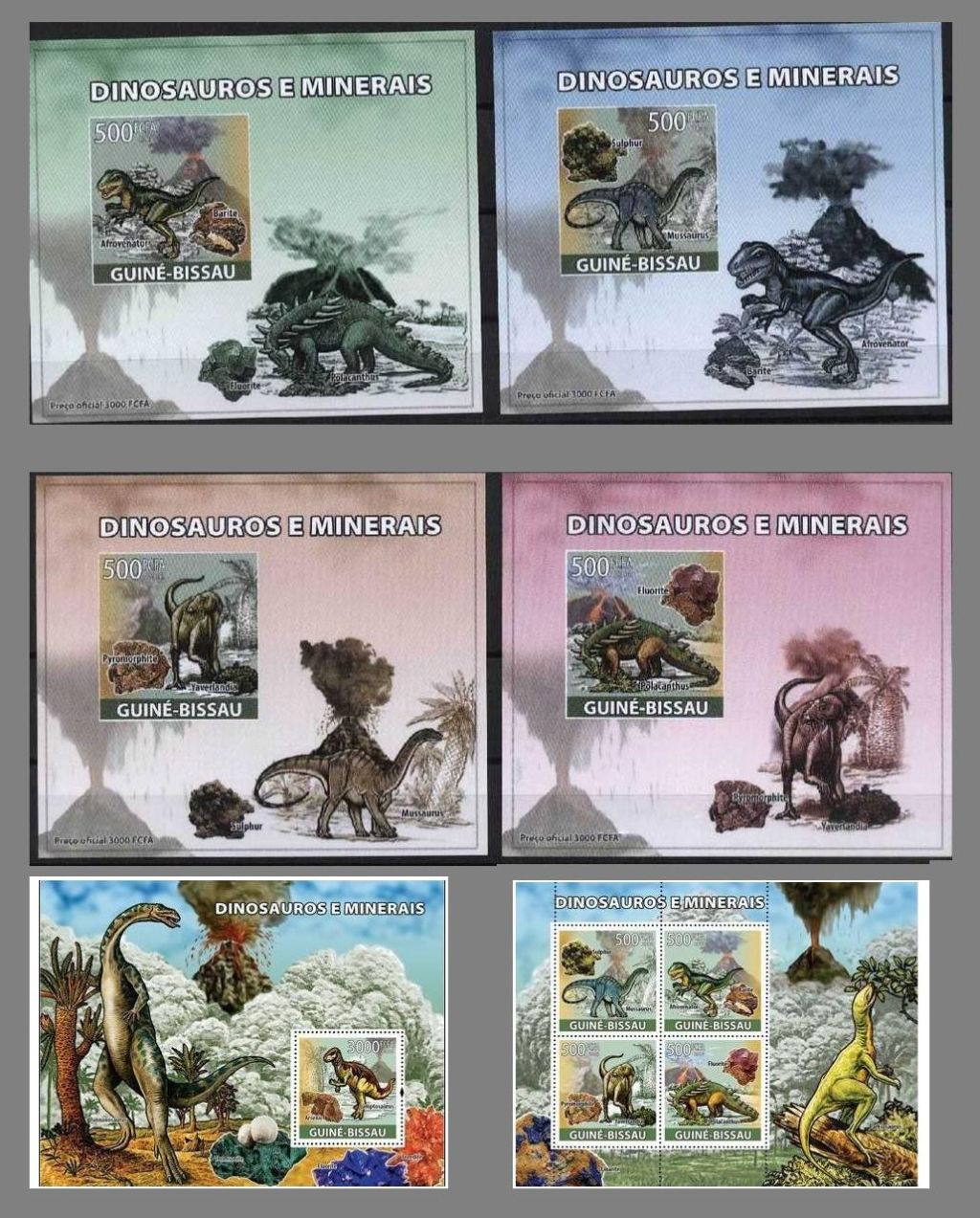
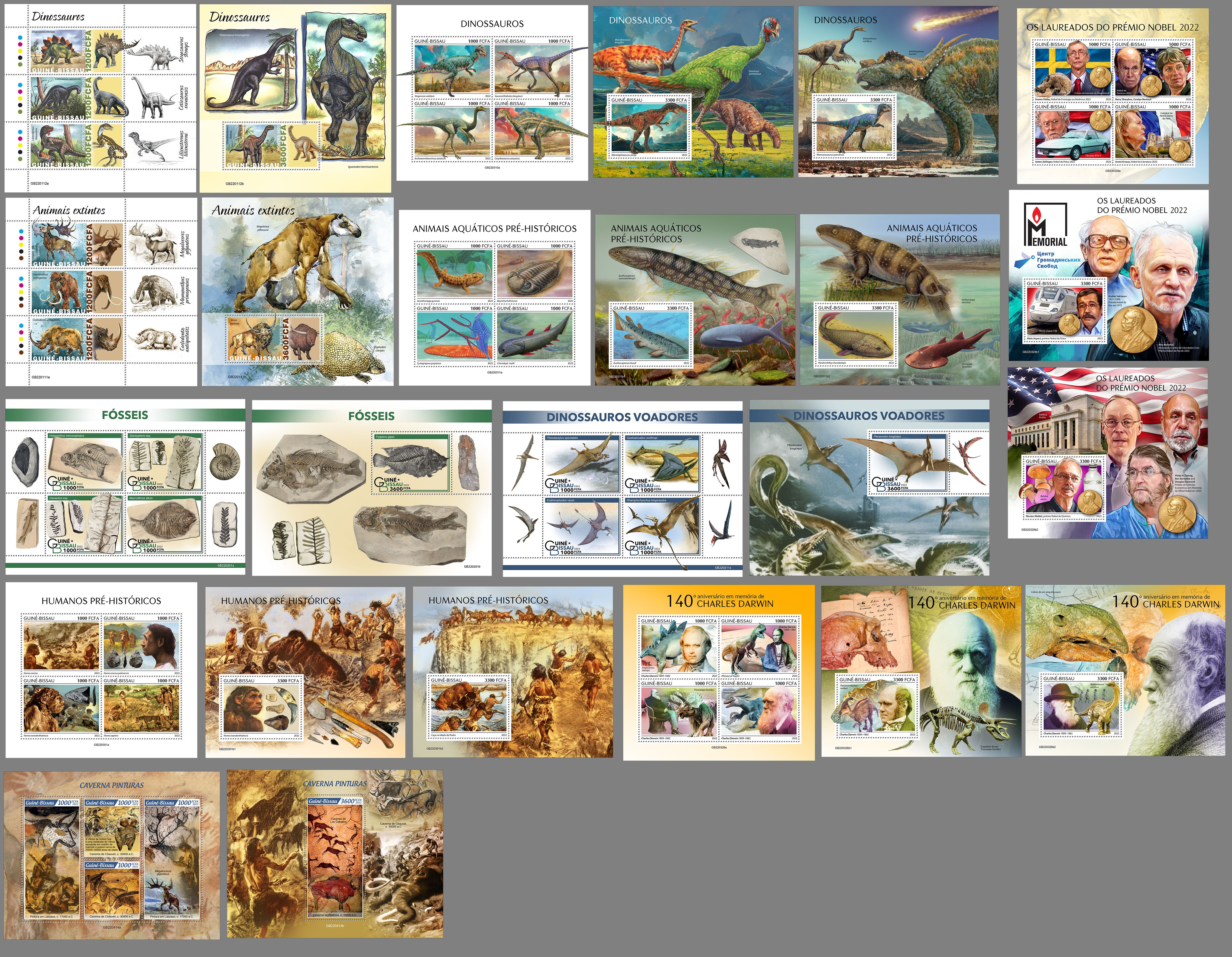
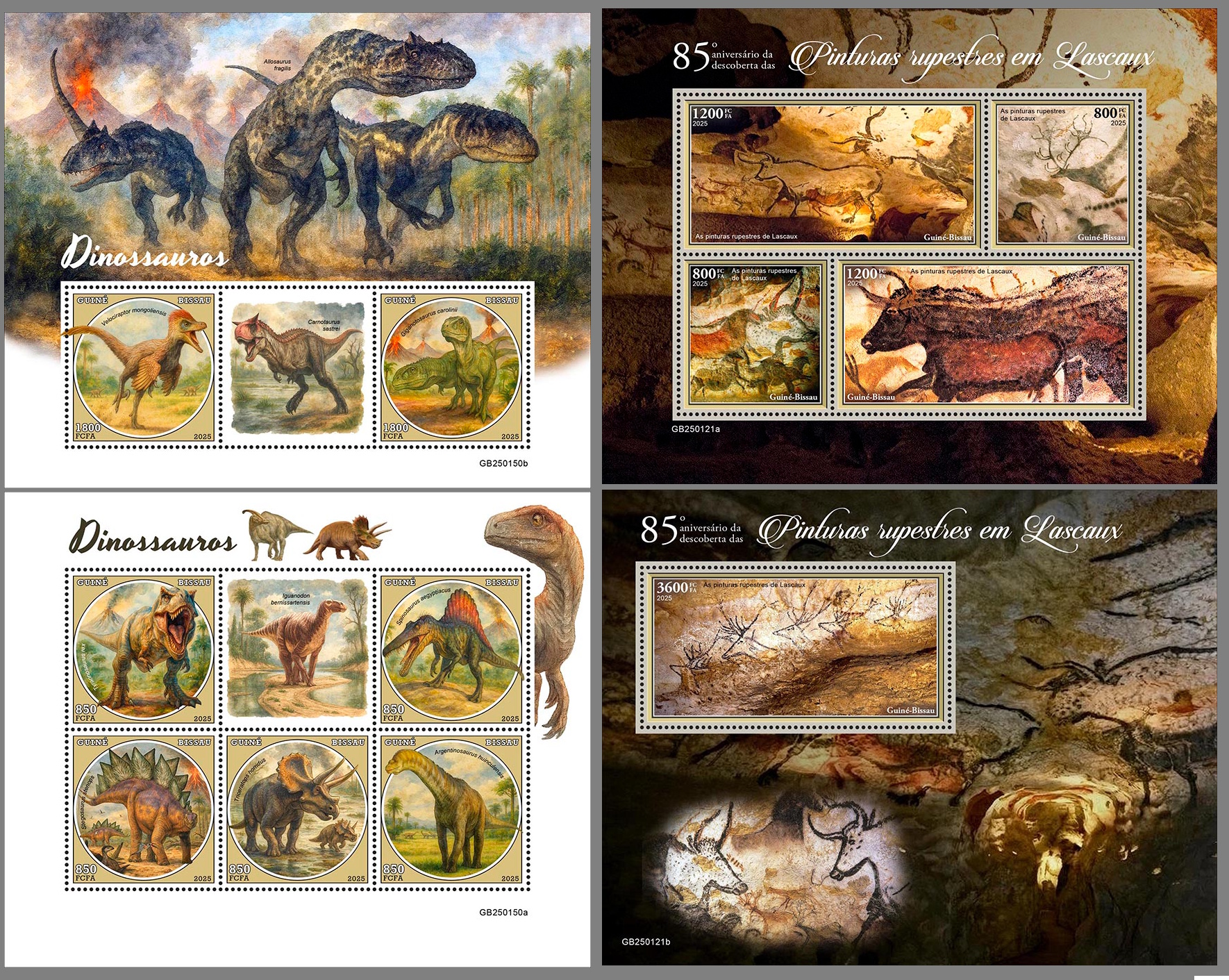
Official stamps of Guinea-Bissau related to Paleontology and Paleoanthropology: dinosaurs and other prehistoric animals, fossils, Charles Darwin
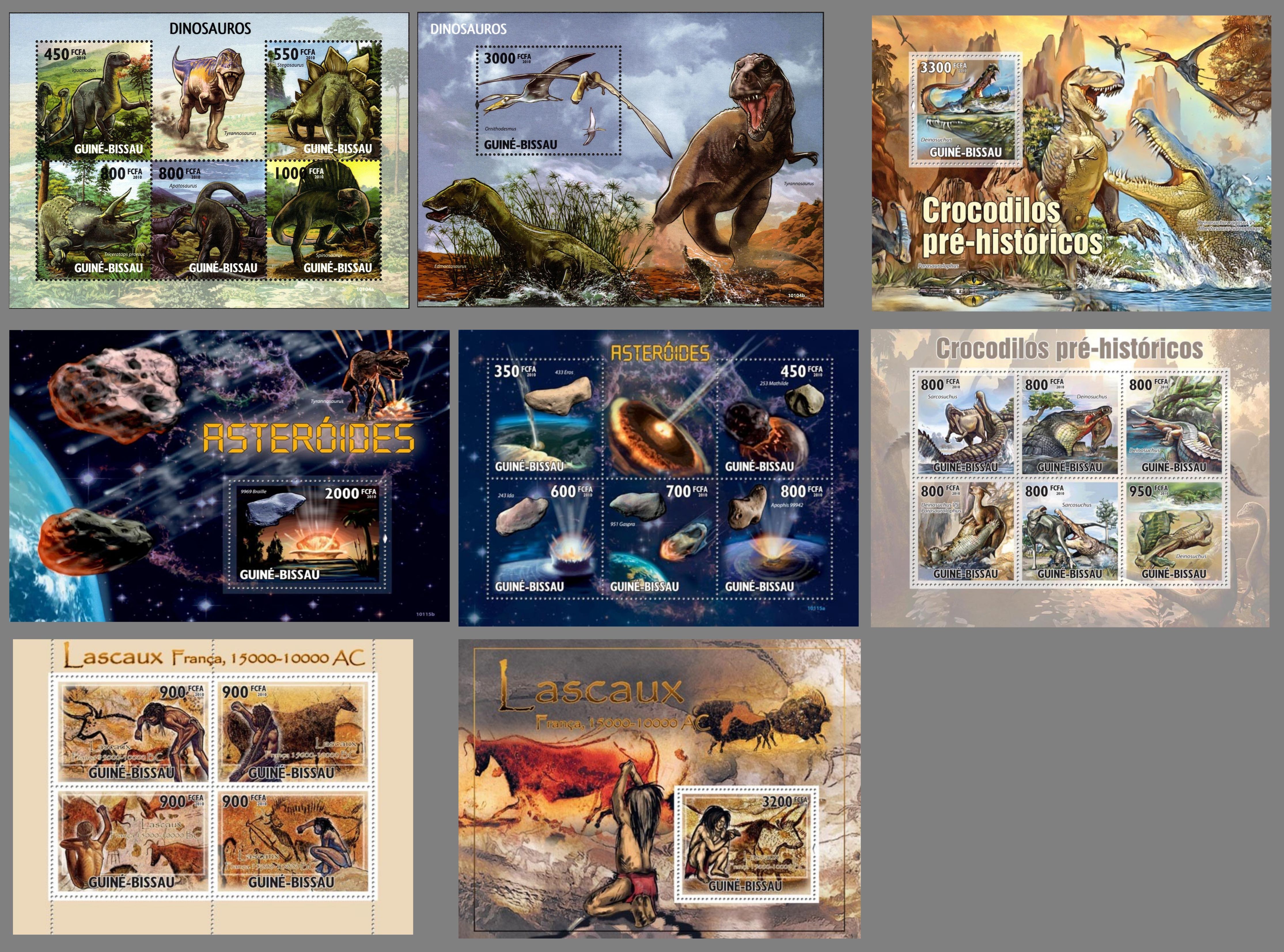
| 15.09.1989 "Prehistoric Animals" | 01.05.2001 "Dinosaurs" | |
 |
 |
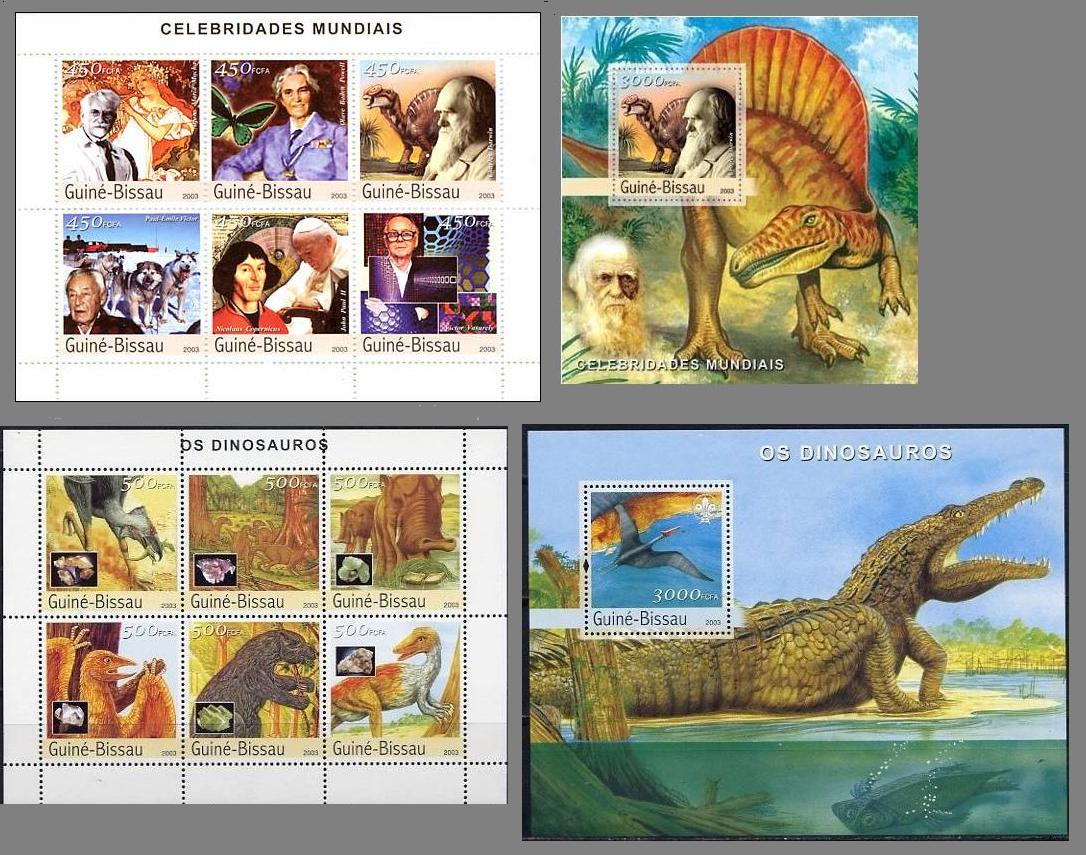 |
| 27.11.2006 "Scouts, Minerals and Prehistoric Animals" | 26.11.2007 "Charles Darwin" | |
 |
 |
 |
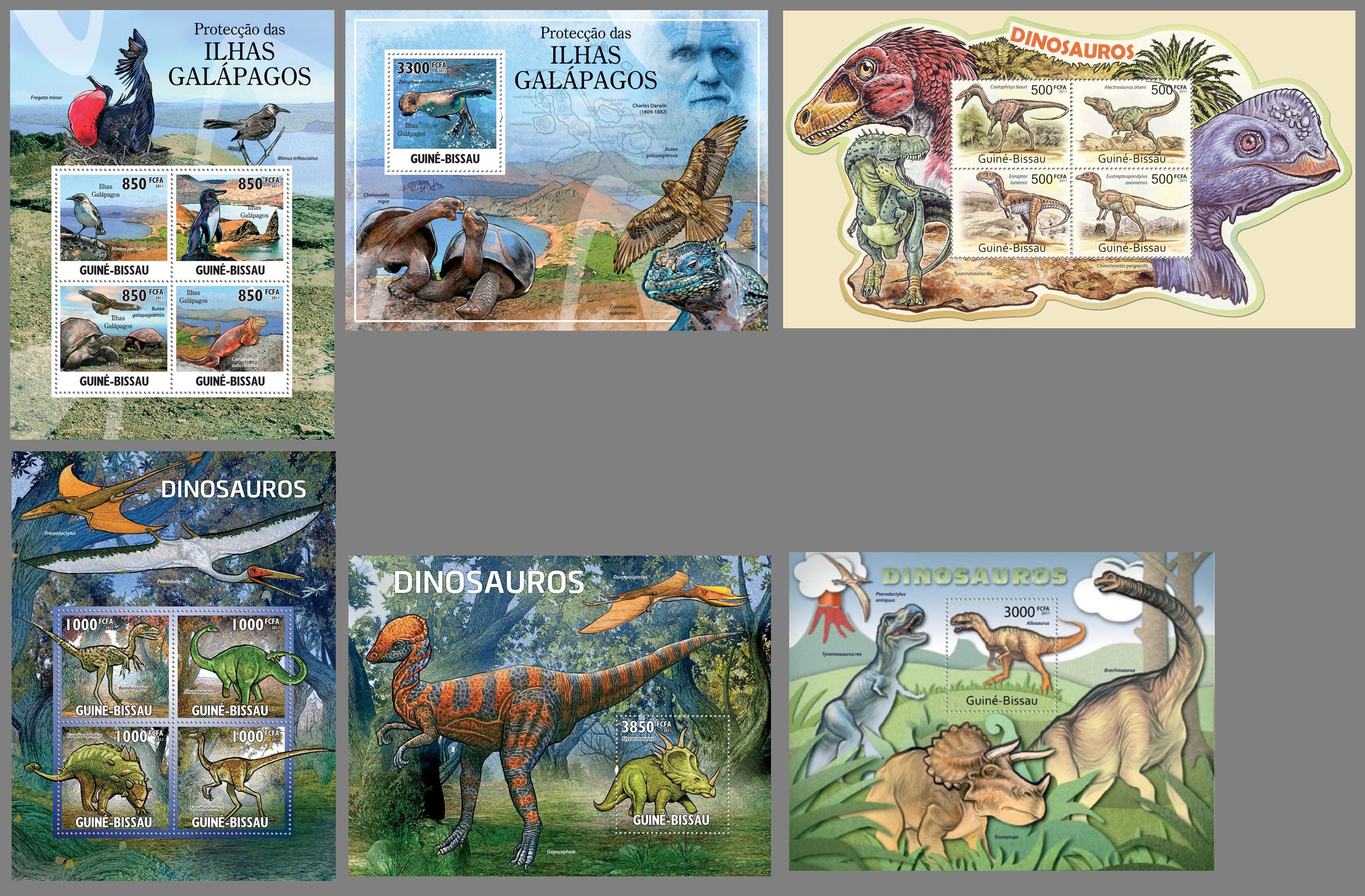
| 05.08.2008"Dinosaurs & Minerals" | ||
 |
 |
 |
 |
 |
 |
 |
 |
 |
 |
 |
 |
 |
 |
 |
|
12.01.2023 "Dinosaurs"
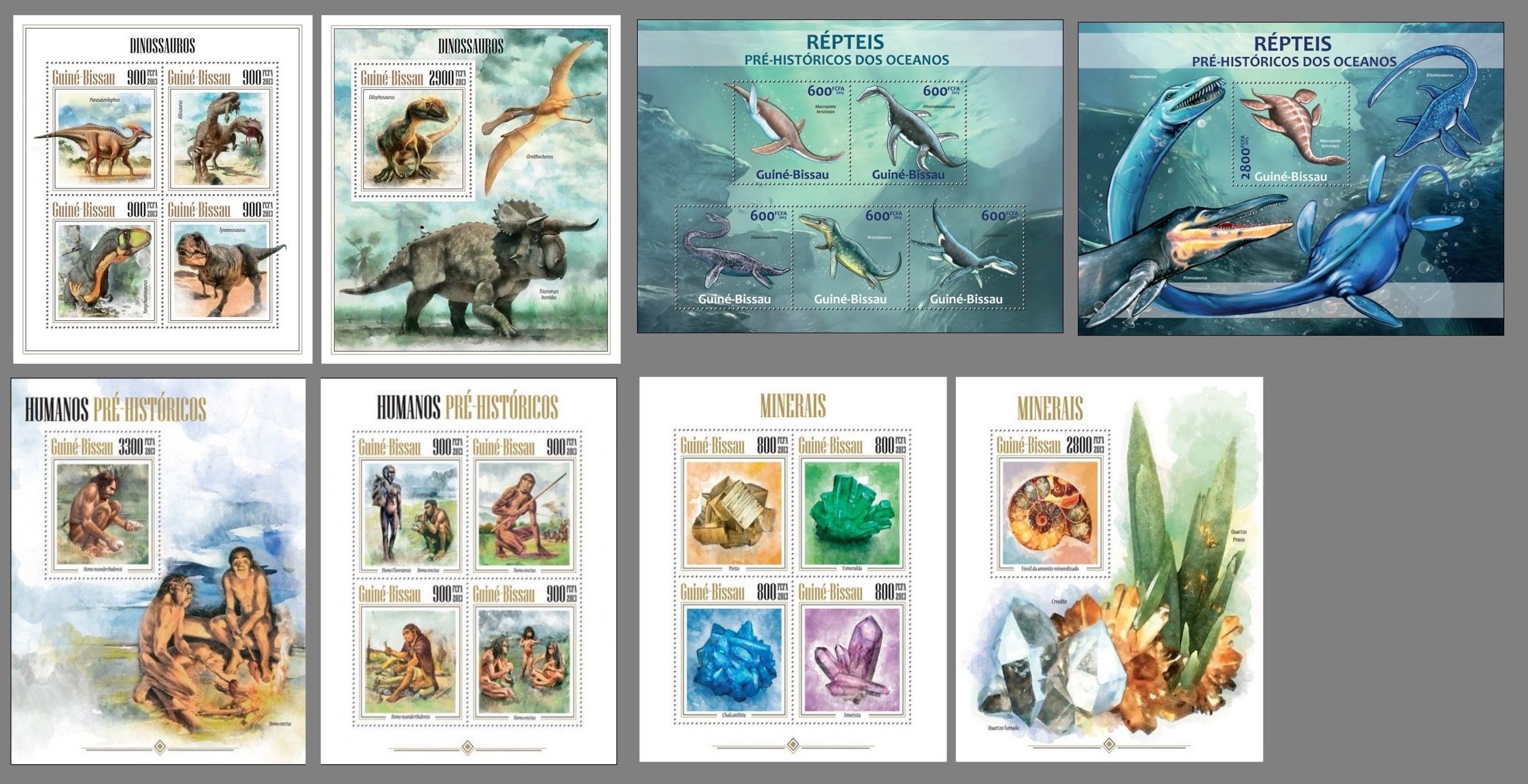
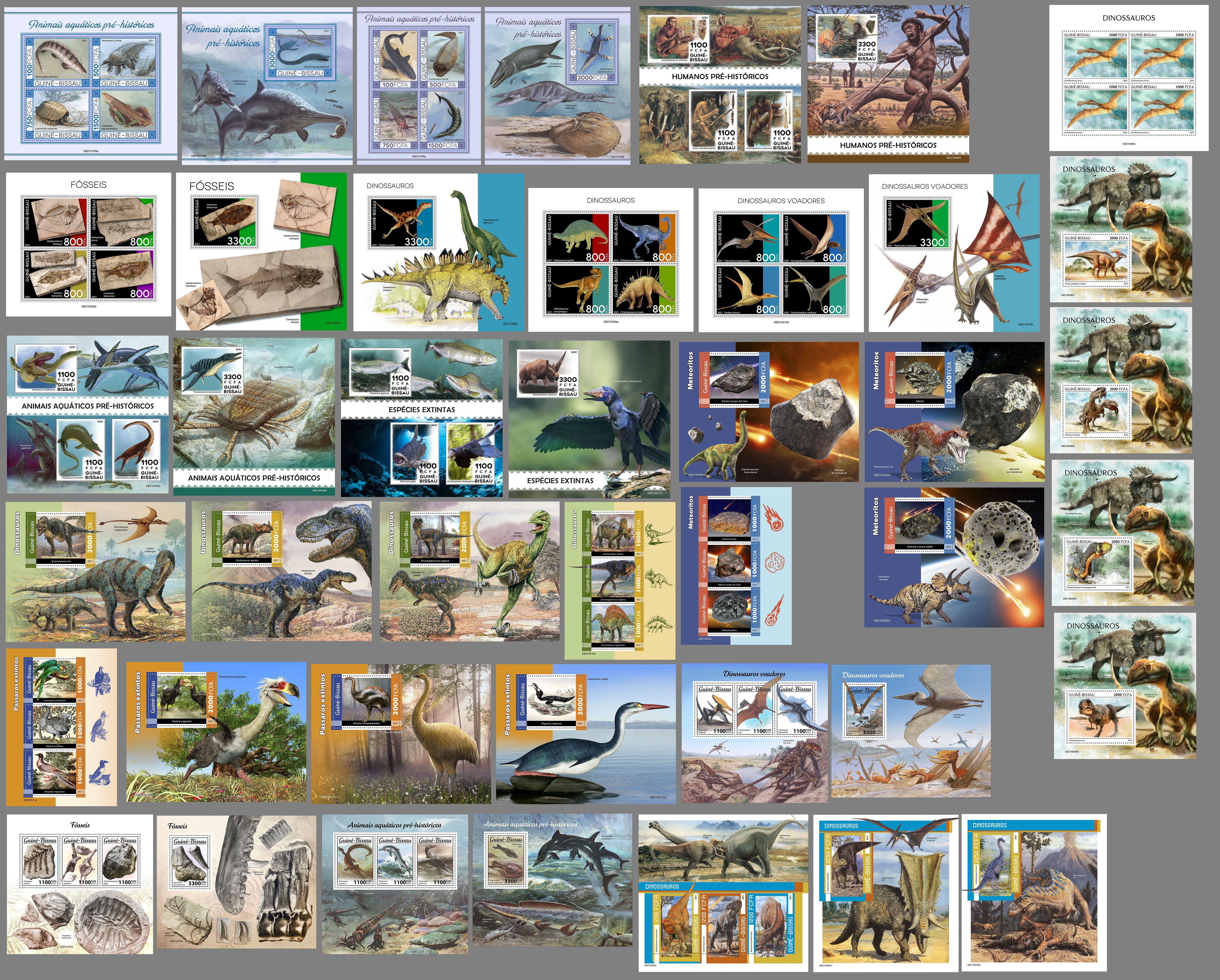
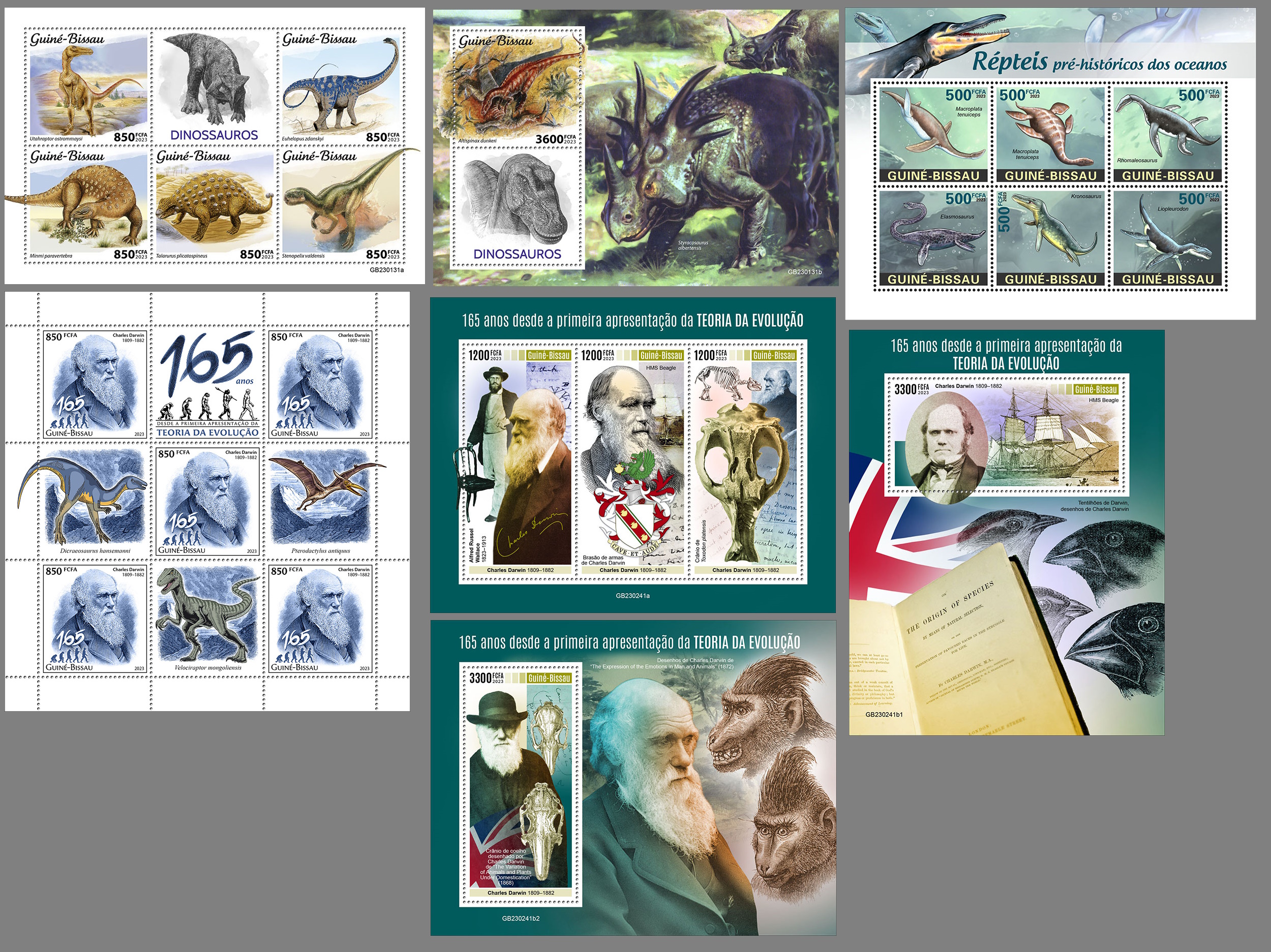
20.04.2023 "Theory of evolution" 22.05.2023 "165 years since Charles Darwin publishes his theory of evolution" 05.09.2023 "200th anniversary of Alfred RusselWallace" 11.08.2023 "“Prehistoric reptiles of the oceans" 22.05.2023 "Fossils" 22.05.2023 "Prehistoric water animals" 22.05.2023 "Extinct mammals" 22.12.2023 "Fossils" 22.12.2023 "History of Earth" 22.12.2023 "215th anniversary of Charles Darwin" 22.12.2023 "Dinosaurs" 22.12.2023 "Prehistoric humans" |
||
 |
 |
 |
|
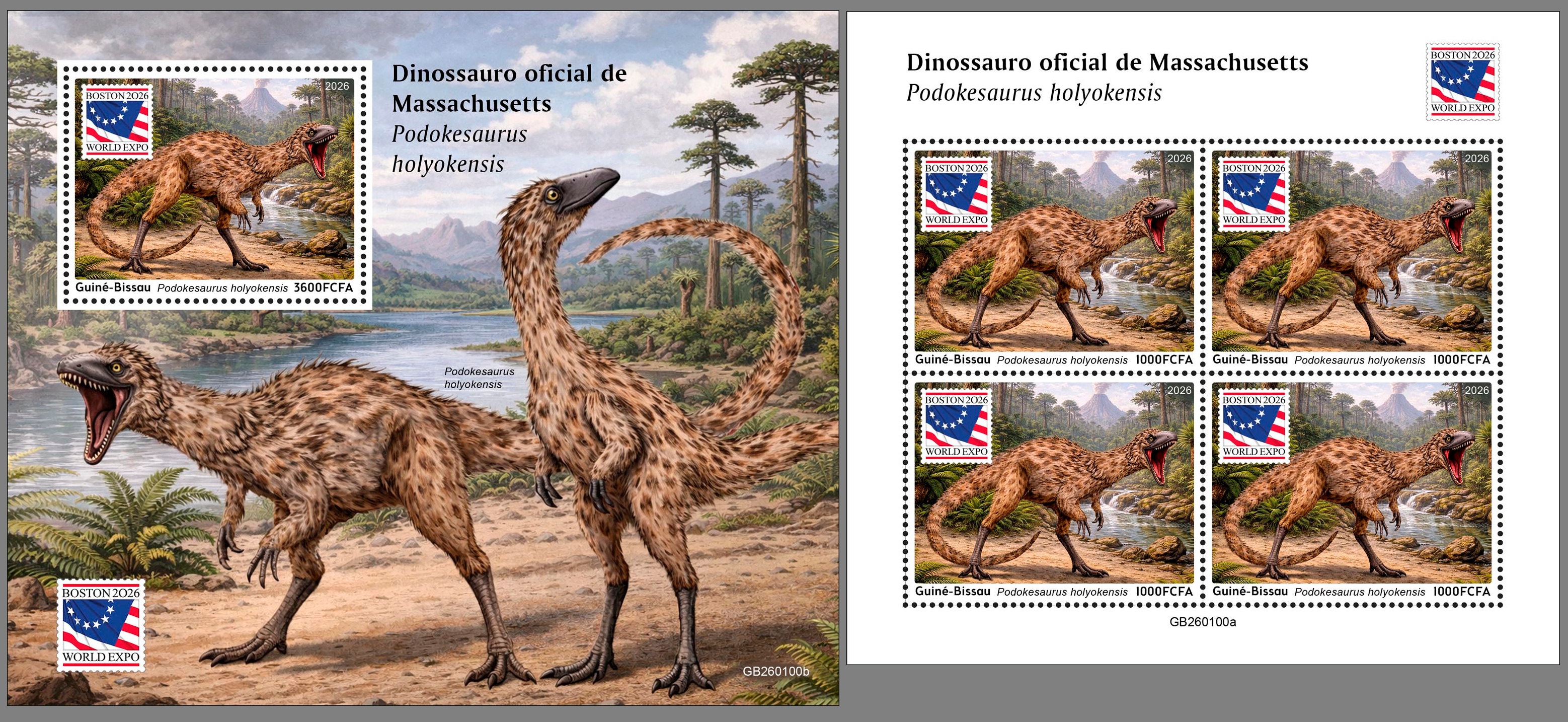
22.05.2026 "The Boston 2026 Philatelic Exhibition: Official dinosaur of Massachusetts, Podokesaurus holyokensis"
|
||
 |
Notes:
[1] Hexaprotodon sivalensis - extinct species of hippopotamus belonging to the genus Hexaprotodon which may include today's pygmy hippopotamuses.
Hexaprotodon sivalensis’s geographic range included much of south and southeast Asia in the Pliocene. By the Pleistocene this species was restricted to India – and died out roughly 16,000 years ago. [R3]
 |
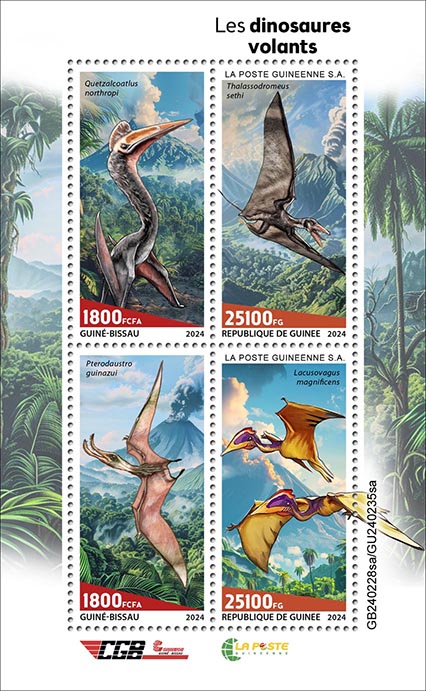 |
| Hexaprotodon sivalensis - extinct species of hippopotamus on stamps of Guinea Bissau 2016 | Stamps of the Republic of Guinea (on the right) and Guinea Bissau (on the left) on the same Mini-Sheet from 2024 |
Hexaprotodon sivalensis is also shown on stamps of Nepal 2013.

[N2] "Flying dinosaurs" is not a correct term to apply to the animals shown on these stamps.
The animals pictured are pterosaurs.
Pterosaurs are a group of flying reptiles in the Archosauria. Reptiles in the archosaurs include crocodiles, dinosaurs, and pterosaurs.
[3] One of the Mini-Sheets of “Flying dinosaurs” and “Prehistoric water animals” contains two stamps of the Republic of Guinea and two stamps of Guinea-Bissau.
Some other stamps of Guinea Bissau: prehistoric animals on margins
| 24.10.2016 "Minerals" [O1] | 17.12.2018 "Minerals" [O2] | |
 |
 |
|
Notes:
[O1] Ammonite and piece of Trilobite shown on margin of the Souvenir Sheet of the Mineral stamps,
just below the stamp.[O2] Georgius Agricola and Alexandre Brongniart shown among other scientists on the stamps.
- Georgius Agricola shown on a stamp of the Souvenir-Sheet and in the margin of the Mini-Sheet.
Georg Bauer, better known by the Latin version of his name Georgius Agricola, is considered the founder of geology as a discipline. His work paved the way for further systematic study of the Earth and of its rocks, minerals, and fossils.
More information here. - Alexandre Brongniart (5 February 1770 – 7 October 1847) was a French chemist,
mineralogist, geologist, paleontologist and zoologist, who collaborated with Georges Cuvier on a study of the geology of the region around Paris.
More information here.
References
- [R1] Guinea-Bissau:
Wikipedia
WikiTravel
FlagCounter
-
[R2] Postal History and Philately of Guinea-Bissau:
Wikipedia
Links to official website of the Post Authority, stamp catalog and a list of new stamps of Guinea-Bissau are here - [R3] Hexaprotodon sivalensis: Wikipedia, Nepal 2013
Acknowledgement
- Many thanks to fellow collector Maxim Gapich from Russia, for his help to find some stamps of Guinea Bissau with fossils and prehistoric animals on it.
- Many thanks to Dr. Peter Voice from Department of Geological and Environmental Sciences, Western Michigan University, for reviewing the draft page and his valuable comments.