Ascension Islands
Prehistoric animals, Charles Darwin on stamps and postmarks of Ascension Islands
Ascension Island
is an isolated volcanic island in the equatorial waters of the South
Atlantic Ocean, around 1,600 kilometres from the coast of
Africa and 2,250 kilometres from the coast of Brazil, which
is roughly midway between the horn of South America and Africa.
It is governed as part of the British Overseas Territory of Saint Helena,
Ascension and Tristan da Cunha, of which the main island, Saint Helena,
is around 1,300 kilometres to the southeast.
The island was discovered by the Portuguese seafarer João da Nova Castella in 1501, (although this visit apparently went unrecorded) and “found again” two years later on Ascension Day by Alphonse d’Albuquerque, who gave the island its name. Being dry and barren it was of little use to the East Indies fleets. So it remained uninhabited until Emperor Napoleon I was incarcerated on St Helena in 1815 when a small British naval garrison was stationed on Ascension to deny it to the French.
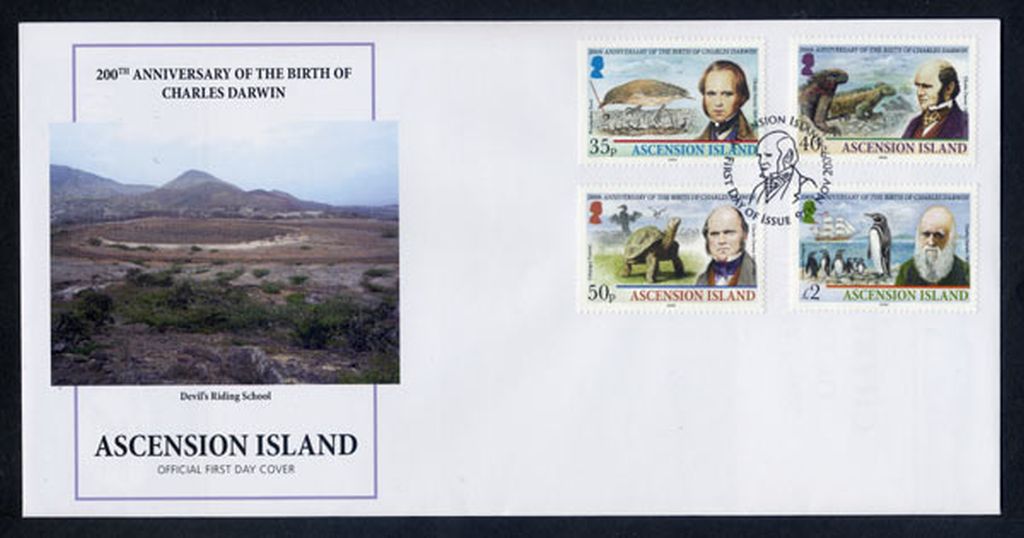
In 1836 the HMS Beagle visited Ascension. Charles Darwin spent some time ashore and visited several geologically interesting sites, including the Devil’s Riding School where he found, and later wrote about “Devil’s Eyeballs”, lumps of hard rock with a soft calcareous outer coating that was acquired as they rolled around the bottom of the lake that once filled the crater. [R1]
Ascension Island was known as the Sailor’s Post Office as early as the seventeenth century. Ships passing Ascension would call at the island and leave letters for others going in the right direction to deliver. Philatelically, Ascension’s history starts on 3rd March 1867, when the UK Postmaster General sent a supply of stamps to the Island for the Island’s postmaster, H.A. Haswell, to sell. Since 1863, the Union Castle Steamship Company had been calling at Ascension to deliver and collect mail. On 20th August 1924, the first sets of Ascension definitive stamps were produced.
Approximately five sets of stamps are issued per year, although this policy is flexible to incorporate special and commemorative issues. A “definitive” set is released every five years, and remains on sale until it is replaced, whereas the special and commemorative issues are withdrawn from sale fifteen months after their release date. [R2]
Notes:
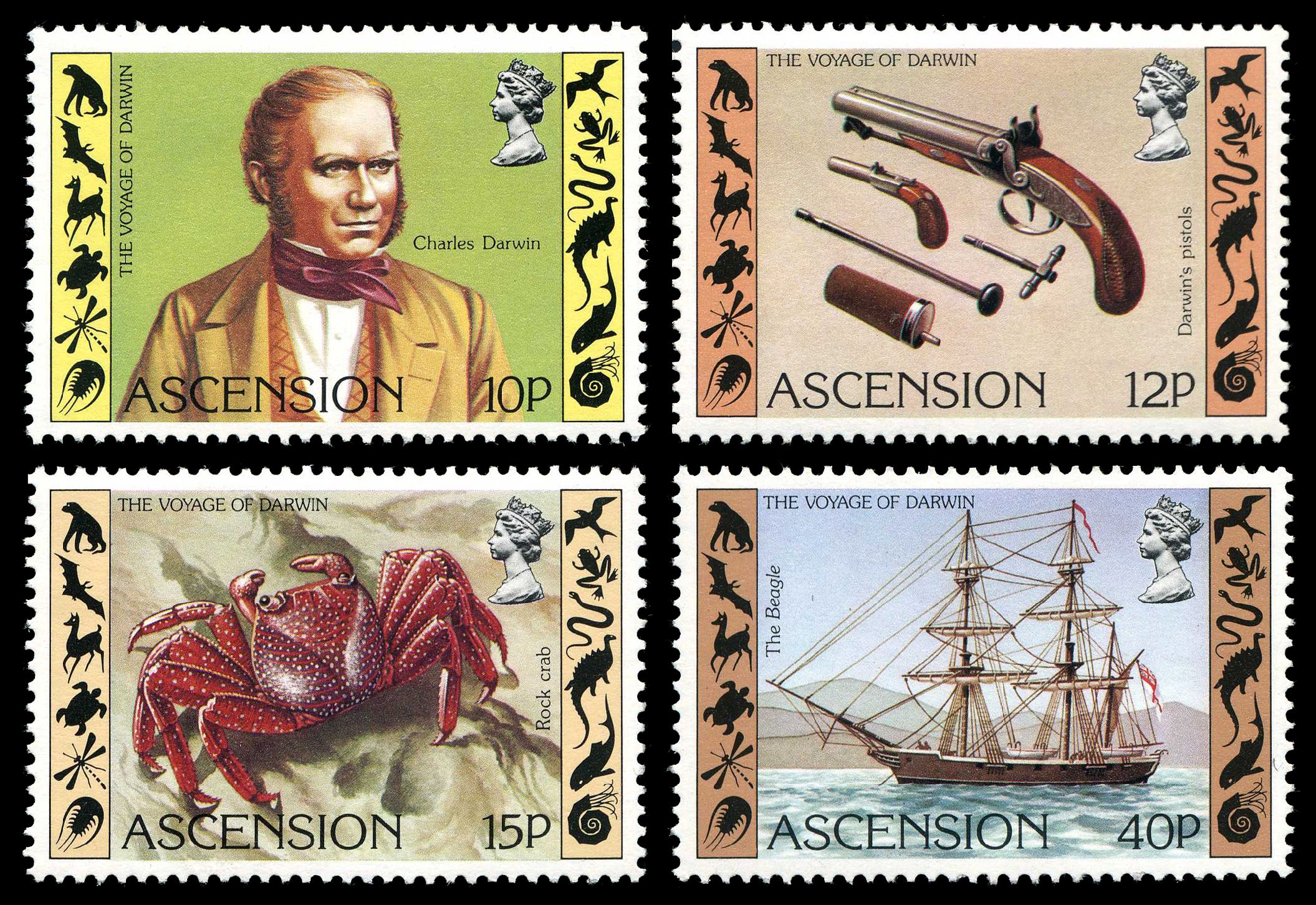
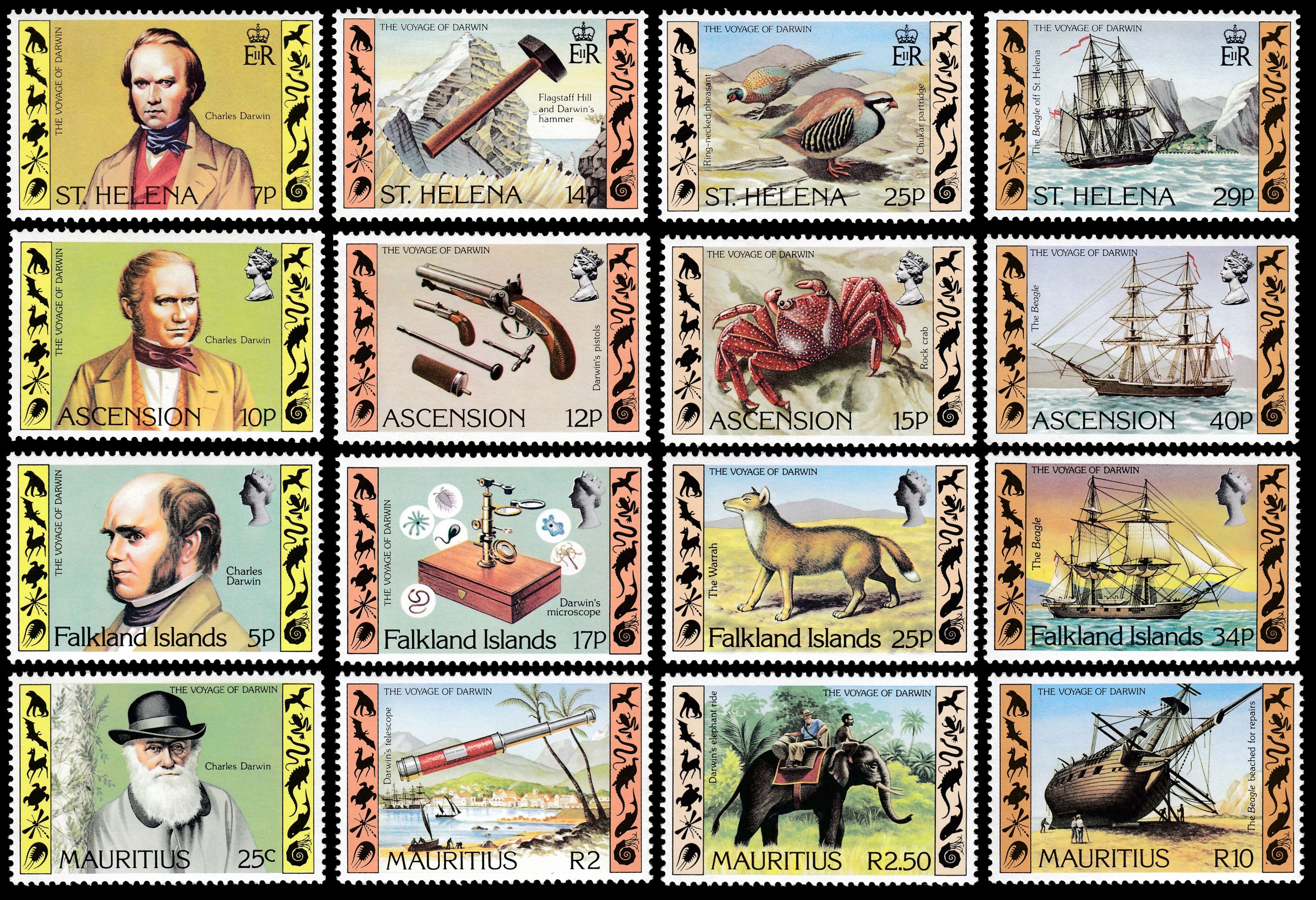
[1] On April 19, 1982, four island nations (Ascension Island, the Falkland Islands, Mauritius, and St. Helena) individually issued sets of 4 stamps with very similar design.
The sets were designed to commemorate the 150th anniversary of the start of Charles Darwin’s famous voyage on the HMS Beagle (1831-1836). During the voyage, he visited all four sets of islands.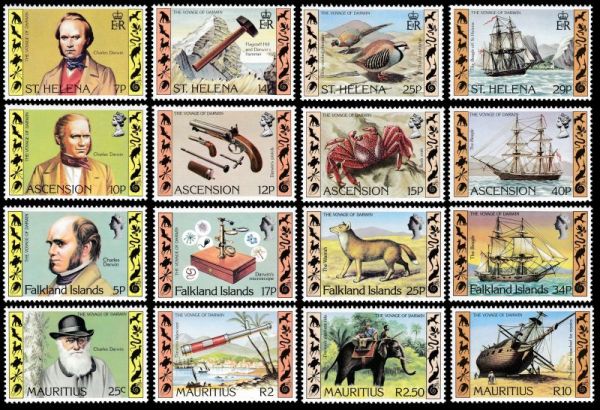
Every set contain four stamps:
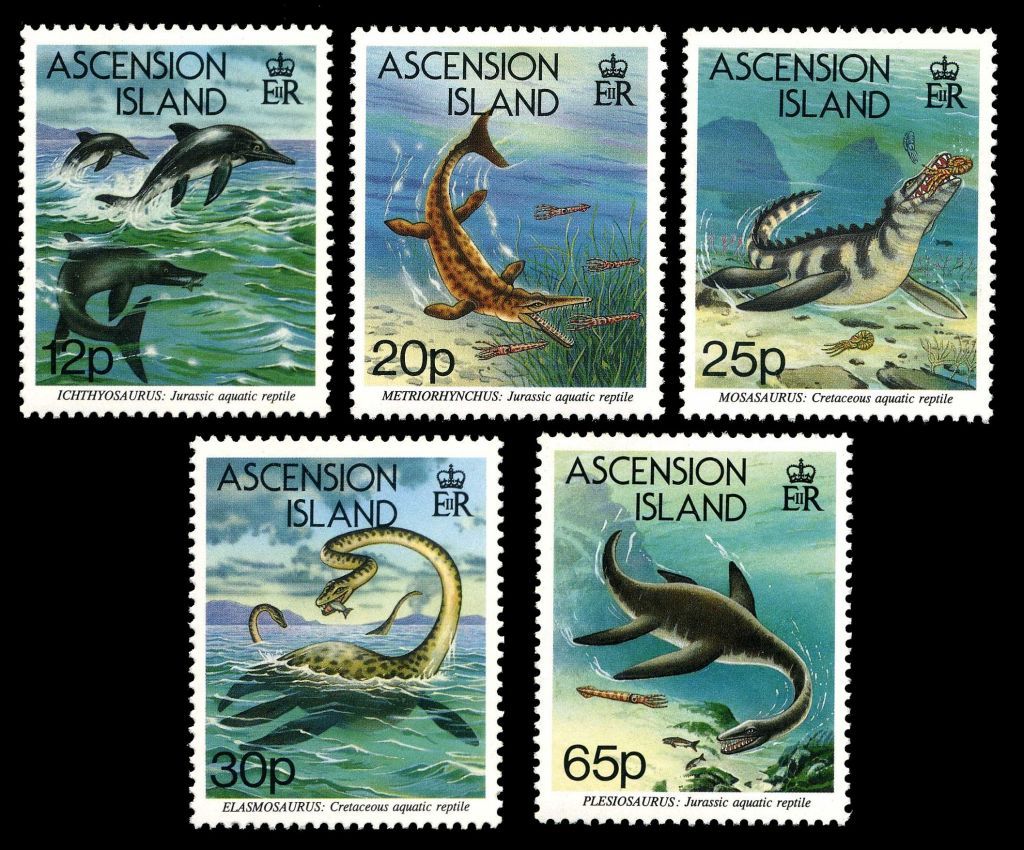
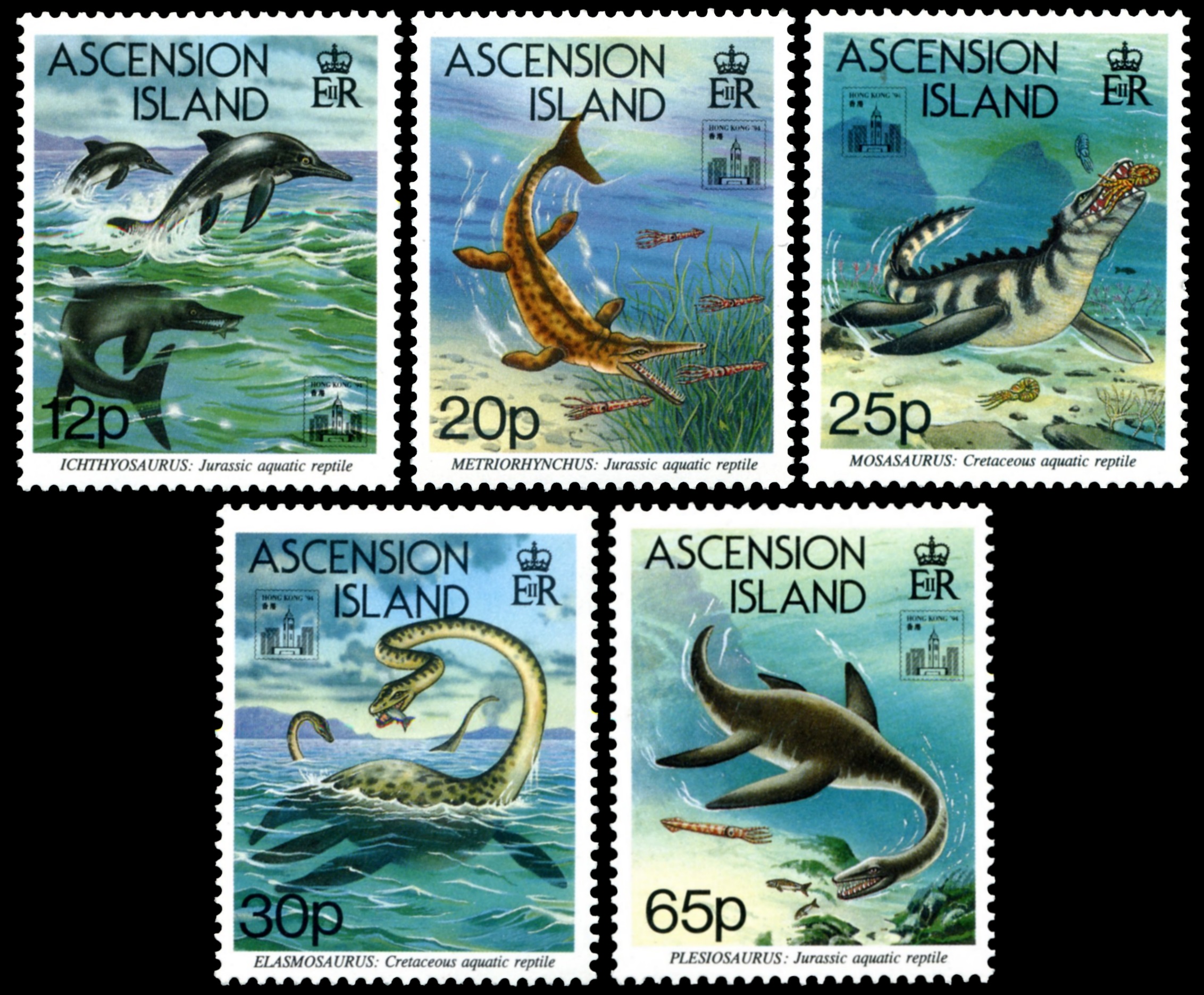
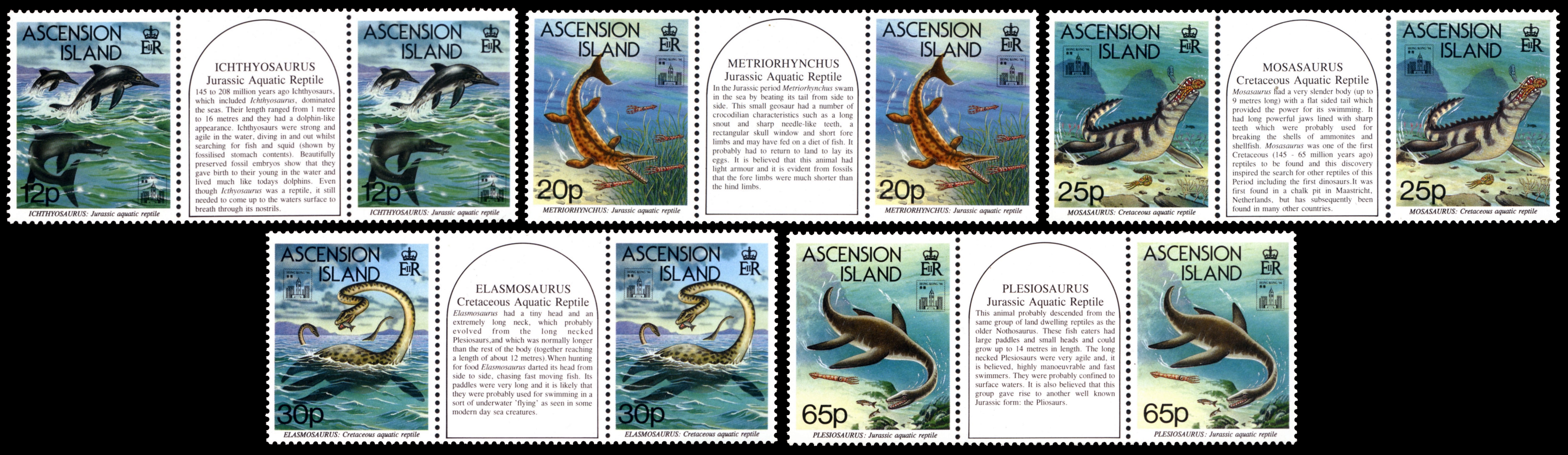
[2] Overprinted with logo of Hong Kong '94 stamp exhibit. Gutterpairs with label that contain some text about every animal, exist for every stamp in the set (with and without the logo of Hong Kong's stamps show).
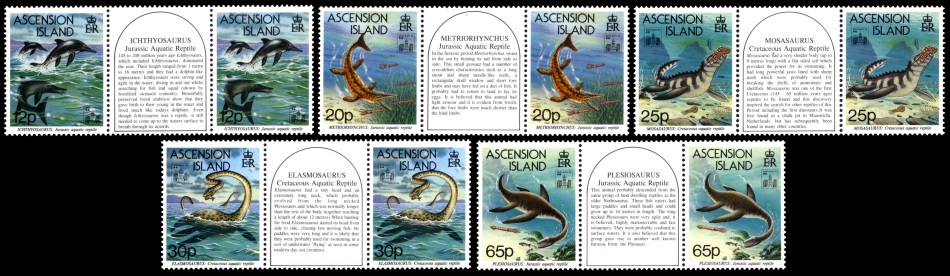
Similar stamps were issued by Barbados 1993 (MiNr.: 835-839, Scott: 855) and Saint Kitts 1994 (MiNr.: 367-371, Scott: 372).
[3] Charles Darwin on stamp with face value of 20p (top-left).
Notes:
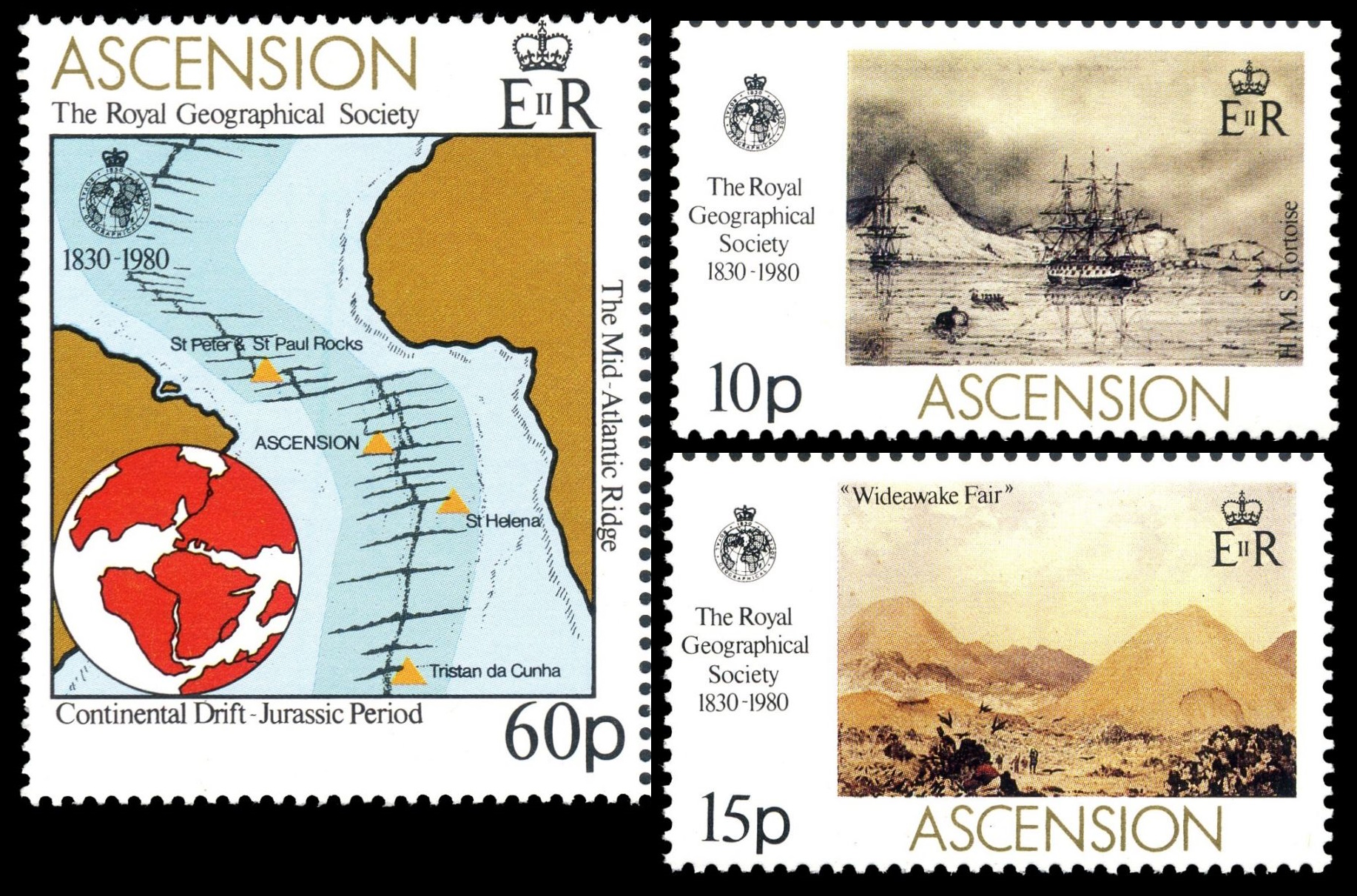
[A1] The lower inset map on the stamp with a face value of 60p shows a paleogeographic reconstruction of the world during the Jurassic period.
Legend is here
Many thanks to Dr. Peter Voice from Department of Geological and Environmental Sciences, Western Michigan University, for reviewing the draft page and his very valuable comments.
The island was discovered by the Portuguese seafarer João da Nova Castella in 1501, (although this visit apparently went unrecorded) and “found again” two years later on Ascension Day by Alphonse d’Albuquerque, who gave the island its name. Being dry and barren it was of little use to the East Indies fleets. So it remained uninhabited until Emperor Napoleon I was incarcerated on St Helena in 1815 when a small British naval garrison was stationed on Ascension to deny it to the French.
In 1836 the HMS Beagle visited Ascension. Charles Darwin spent some time ashore and visited several geologically interesting sites, including the Devil’s Riding School where he found, and later wrote about “Devil’s Eyeballs”, lumps of hard rock with a soft calcareous outer coating that was acquired as they rolled around the bottom of the lake that once filled the crater. [R1]
Ascension Island was known as the Sailor’s Post Office as early as the seventeenth century. Ships passing Ascension would call at the island and leave letters for others going in the right direction to deliver. Philatelically, Ascension’s history starts on 3rd March 1867, when the UK Postmaster General sent a supply of stamps to the Island for the Island’s postmaster, H.A. Haswell, to sell. Since 1863, the Union Castle Steamship Company had been calling at Ascension to deliver and collect mail. On 20th August 1924, the first sets of Ascension definitive stamps were produced.
Nowadays population of the island is less than 1000 persons. There is no national postal service within Ascension Island, houses have numbers, but few of the roads have names! All postal addresses there, are those of employing organizations. Organizational representatives collect the mail from the Post Office, but internal deliveries between organizations are to separate boxes, one for each organization, outside the Administrator’s office. As most people within the small communities know each other, mail within Ascension other, than business mail, is very rare!
Approximately five sets of stamps are issued per year, although this policy is flexible to incorporate special and commemorative issues. A “definitive” set is released every five years, and remains on sale until it is replaced, whereas the special and commemorative issues are withdrawn from sale fifteen months after their release date. [R2]
Official stamps of Ascension Island that related to Paleontology: prehistoric animals, Charles Darwin
| 19.04.1982 "Charles Darwin" [1] | 25.01.1994 "Prehistoric Aquatic Reptiles" [2] | 18.02.1994 "Prehistoric Aquatic Reptiles" [2] |
 |
 |
 |
| 24.07.2006 "Anniversaries" [3] | 09.11.2009 "Charles Darwin" | |

|
 |
|
Notes:
[1] On April 19, 1982, four island nations (Ascension Island, the Falkland Islands, Mauritius, and St. Helena) individually issued sets of 4 stamps with very similar design.
The sets were designed to commemorate the 150th anniversary of the start of Charles Darwin’s famous voyage on the HMS Beagle (1831-1836). During the voyage, he visited all four sets of islands.
Every set contain four stamps:
- stamp with portrait of Charles Darwin,
- stamp of one of the tools young Darwin used during his voyage
- stamp of an animal Darwin met on a particular island
- stamp shows HMS Beagle. The ship that cared recently graduated naturalist Charles Darwin around the world.
[2] Overprinted with logo of Hong Kong '94 stamp exhibit. Gutterpairs with label that contain some text about every animal, exist for every stamp in the set (with and without the logo of Hong Kong's stamps show).

Similar stamps were issued by Barbados 1993 (MiNr.: 835-839, Scott: 855) and Saint Kitts 1994 (MiNr.: 367-371, Scott: 372).
[3] Charles Darwin on stamp with face value of 20p (top-left).
Other stamps to consider: continental drift
| 17.11.1980 "The Royal Geographical Society" [A1] | ||
|
||
Notes:
[A1] The lower inset map on the stamp with a face value of 60p shows a paleogeographic reconstruction of the world during the Jurassic period.
Postmarks of Ascension island that related to Paleontology: prehistoric animals, Charles Darwin
Legend is here
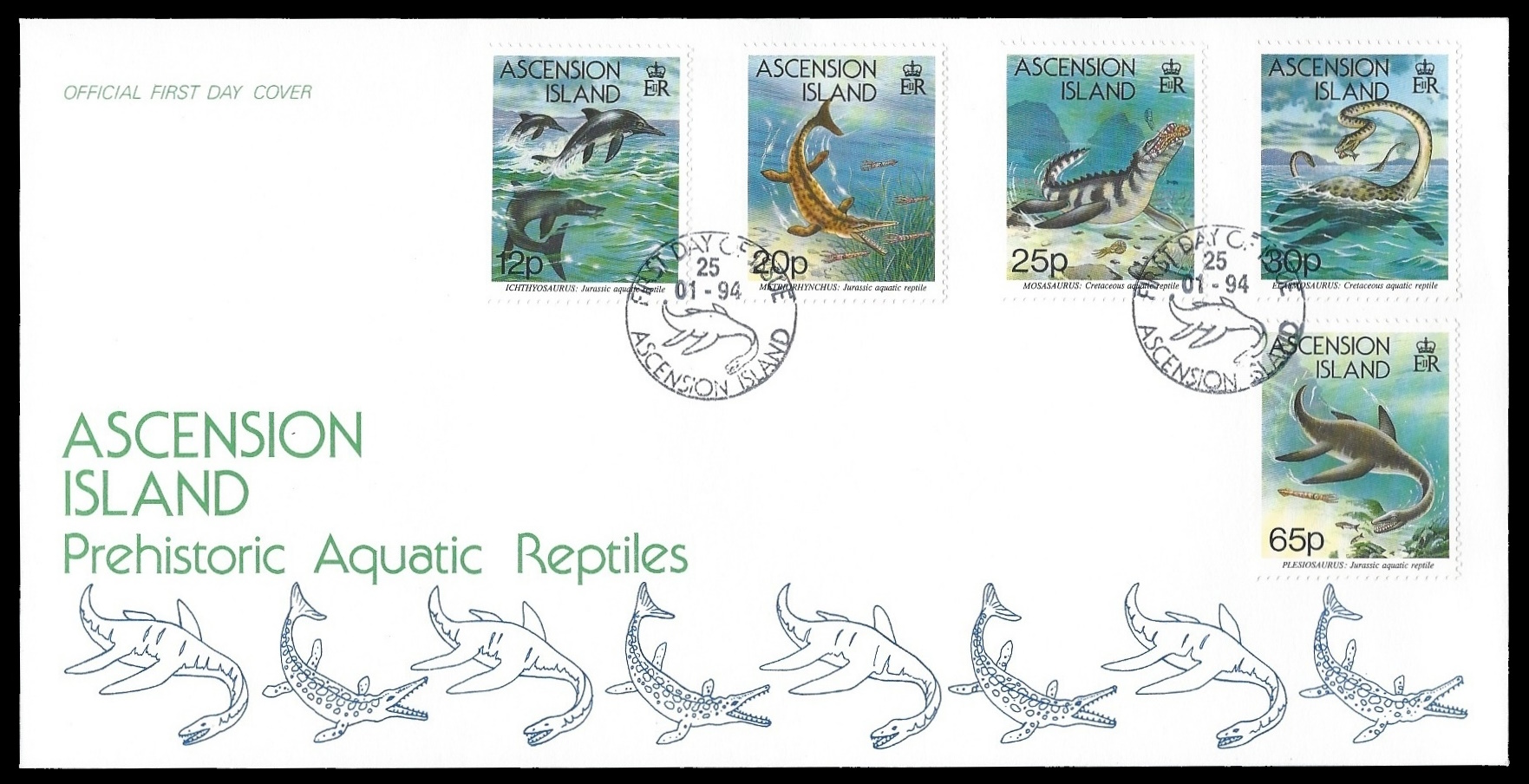
| 25.01.1994 "Prehistoric Aquatic Reptiles" [FDC] | 09.11.2009 "200th Anniversary of the birth of Charles Darwin" [FDC] | |
 |
 |
|
References
- [R1] Ascension Island: Wikipedia, WikiTravel,
- [R2] Postal History and Philately of Ascension Island:
Wikipedia,
Links to official website of the Post Authority, stamp catalog and a list of new stamps of Ascension Island are here
Acknowledgements
Many thanks to Dr. Peter Voice from Department of Geological and Environmental Sciences, Western Michigan University, for reviewing the draft page and his very valuable comments.