History of paleontology in Germany
Chapter 6:
Universal Classification and the Fossil Record (18th century)
By the mid-18th century, the study of fossil remains in the German territories and across Europe had reached a critical turning point. The pioneering field discoveries of the previous decades, such as the Quedlinburg unicorn, the Altdorf vertebrae, and the Burgtonna mammoth remains, had successfully demonstrated the organic reality of fossils, effectively dismantling older myths of localized monsters or accidental mineral growths. However, this sudden surge of empirical evidence created a massive new challenge: naturalists were now buried under a chaotic mountain of unorganized bones, plant impressions, and rock samples with no standardized method to name, group, or understand them.
The European Enlightenment addressed this confusion not merely by unearthing more specimens, but by revolutionizing how science organized nature itself.
This chapter tracks that crucial intellectual transition. It moves from Emanuel Swedenborg’s early practical observations of mining strata and deep time, to Carl Linnaeus’s monumental standardization of the natural kingdoms through binomial nomenclature, and finally to the dramatic international investigation of the Maastricht Mosasaurus. Together, these breakthroughs provided the universal rulebook and comparative anatomical tools necessary to transform natural history into a structured, academic discipline.
Mining, Strata, and Early Fossil Observations
The Swedish scientist, polymath, and natural philosopher Emanuel Swedenborg (1688–1772), born as Swedberg, was among the scholars who contributed to the development of geology and the study of fossils during the early 18th century.
 |
|
Emanuel Swedenborg on stamp of Sweden 1938,
MiNr. 244A, Scott 267. |
Swedenborg's professional work at the Swedish Board of Mines provided him with practical experience in mining, metallurgy, and mineralogy. During his travels through continental Europe in 1721, he visited mining districts in the German territories, including Saxony and the Harz Mountains, and examined geological formations and mineral deposits.
He published his observations in Miscellanea Observata circa Res Naturales, praesertim Mineralia, Ignem et Montium Strata (1722), a collection of studies on natural phenomena, particularly minerals, fire, and mountain strata. The first three parts were printed in Leipzig, while the fourth appeared near Hamburg. The work presented his investigations to the wider European scholarly community.

Swedenborg also devoted considerable attention to fossils.
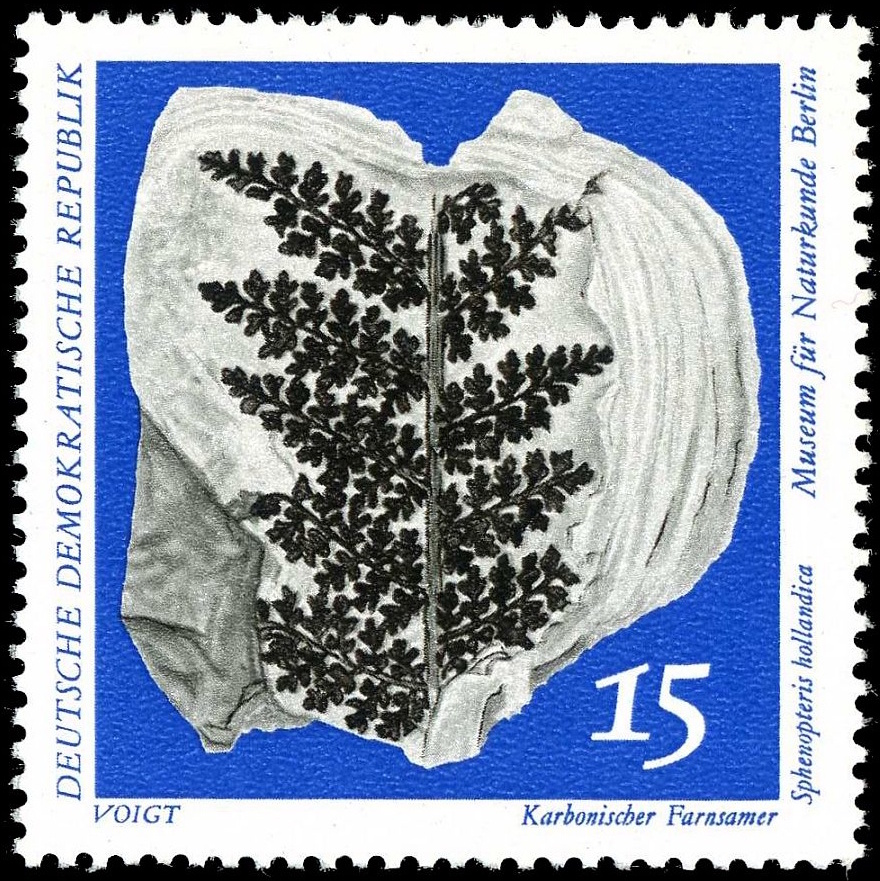 |
|
Carboniferous plant impression embedded in rock,
from the collection of the Museum für Naturkunde Berlin
on a stamp of East Germany (DDR) 1973, MiNr.: 1823, Scott: 1445. |
He also reproduced illustrations of animal fossils from the Cretaceous chalk deposits around Aachen (today Germany), then commonly known by its French name, Aix-la-Chapelle.
These studies demonstrated his keen interest in identifying fossil remains through their physical characteristics and relating them directly to the geological formations in which they occurred.
Another important aspect of Swedenborg's work was his attempt to reconstruct historical updates to the Earth's surface. In a study published in 1719, he discussed evidence that the sea had formerly stood considerably higher in parts of Sweden. To support this, he drew on observations of marine fossils, shell deposits, whale remains, and ancient shorelines situated well above the present sea level. Although he correctly recognized that these observations indicated substantial changes in the relationship between land and sea, his explanation remained speculative and did not correctly identify the underlying geological processes responsible.
Swedenborg died in London in 1772 and was buried in the Swedish Church in Princes Square, Shadwell. In 1912, his remains were transferred to Uppsala Cathedral in Sweden, where they now rest near the grave of the prominent naturalist Carl Linnaeus.
Carl Linnaeus (Carl von Linne) and the Classification of the Natural World
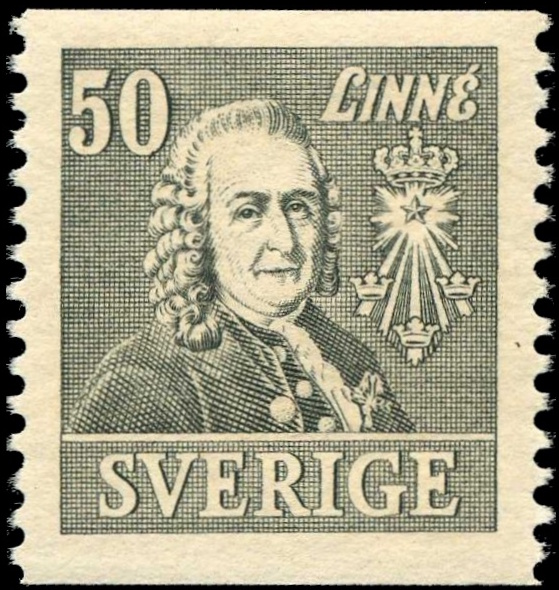 |
|
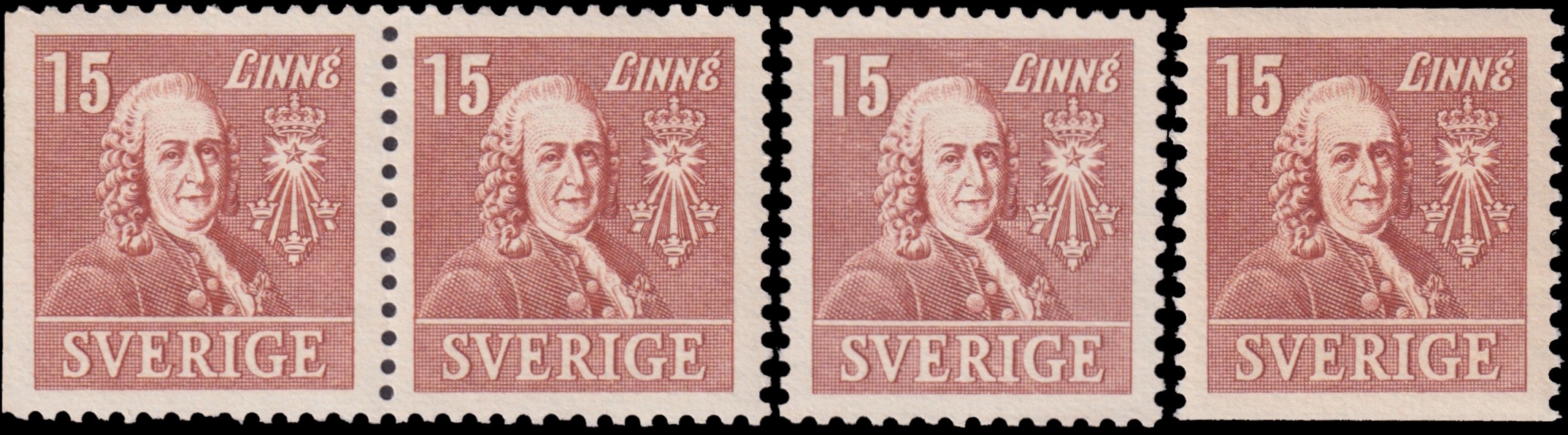
Carl Linnaeus on stamp of Sweden 1939,
MiNr. 2775A, Scott 296. |
In his Systema Naturae, first published in 1735, Linnaeus classified the natural world into three kingdoms: the animal, vegetable, and mineral kingdoms. He arranged natural objects into groups based on their characteristics, developing a systematic approach to the classification of nature.
One of Linnaeus's most influential contributions was the standardisation and widespread adoption of binomial nomenclature, in which each species is designated by a two-part scientific name consisting of its genus and specific epithet. For example, the scientific name of modern humans is Homo sapiens.
 |
|
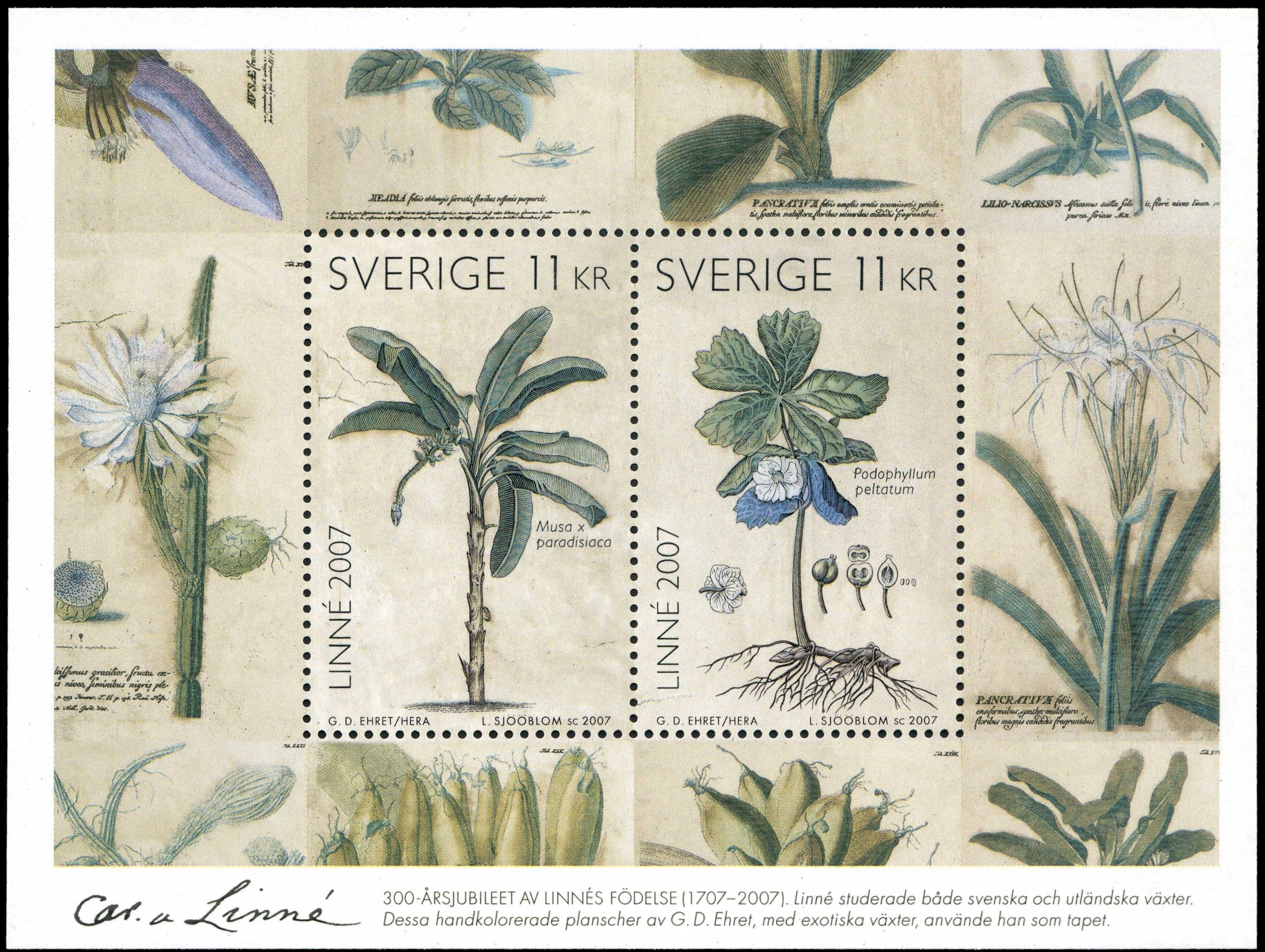
Swedish souvenir sheet (Scott #2561, Michel Block #21) issued in 2007 to commemorate
the 300th anniversary of Carl Linnaeus’s birth.
The stamps feature illustrations of
Musa paradisiaca and Podophyllum peltatum,
both species described and named by Linnaeus using the binomial
nomenclature system that he standardized in Species Plantarum (1753). |
 |
| Cro-Magnon as inscribed on these stamps of Cuba, 1967, MiNr.: 1285, 1286, Scott: 1215, 1216, are early modern humans associated with remains found at the Cro-Magnon site in France, with scientific name Homo sapiens. |
Linnaeus's Species Plantarum (1753) became the starting point for modern botanical nomenclature, while the tenth edition of Systema Naturae (1758) established the starting point conventionally used for modern zoological nomenclature.
Although Linnaeus did not develop a classification system specifically for fossils, his methods of naming and classifying organisms laid the foundations for later palaeontological research.
As scientific knowledge expanded, these methods were refined and applied to both living organisms and fossil remains, enabling researchers to identify specimens, compare fossils with living species, and incorporate new discoveries into a shared body of scientific knowledge. Standardised names also facilitated communication across national and linguistic boundaries.
Despite the growing use of scientific naming conventions, differences in zoological nomenclature continued to cause confusion. In 1889, the First International Congress of Zoology, held in Paris, adopted some proposed rules and referred the matter for further discussion at subsequent congresses.
This marked an important step towards internationally agreed standards for naming animals.
Scientific Classification
The common names of animals and plants can sometimes be misleading or overly general. Examples include the "Irish Elk" or a Giant Deer, and the "Sabertooth Cat".
Scientific names follow the binomial nomenclature system, in which each species is identified by a two-part name consisting of its genus and specific epithet.
The common names of animals and plants can sometimes be misleading or overly general. Examples include the "Irish Elk" or a Giant Deer, and the "Sabertooth Cat".
-
The Irish Elk is neither an elk nor an animal unique to Ireland. It is an extinct species of giant deer, scientifically known as Megaloceros giganteus, whose closest living relative is the fallow deer. Its geographical range extended across Eurasia, from Ireland to western Siberia. Although the species is commonly associated with Ireland, where numerous remains have been preserved in peat bogs, its fossils have also been found across mainland Europe and beyond. The first nearly complete skeleton of the "Irish" elk was unearthed on the Isle of Man in 1819, five years before a similar find was made in Ireland. The common name "Irish Elk" therefore reflects the abundance of its remains in Ireland rather than its true taxonomic identity or geographical distribution.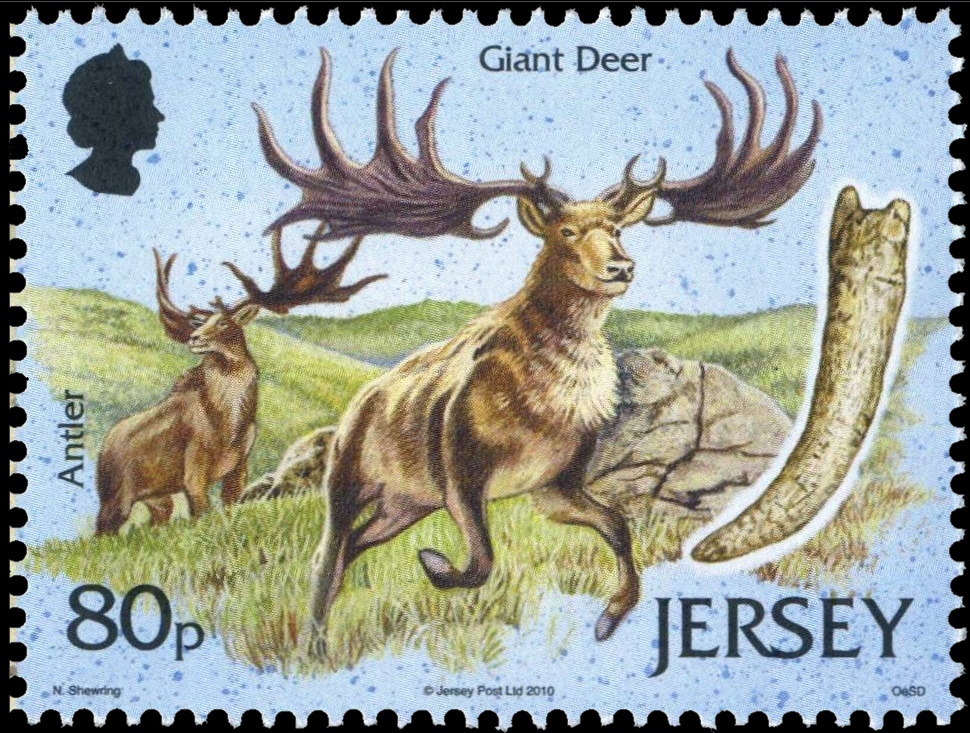
A Giant Deer, Megaloceros giganteus, on stamp of Jersey 2010, MiNr.: 1525, Scott: 1480. -
"Sabertooth Cat" is a common name used for several groups of extinct, cat-like predators characterized by exceptionally elongated, blade-like upper canine teeth. Although commonly referred to as sabertooth cats, these predators did not all belong to the family Felidae; similar adaptations evolved independently in different mammalian lineages. Among the best-known sabertooth cats were the genera Smilodon, Homotherium, and Megantereon. These predators inhabited parts of Africa, Eurasia, and the Americas at different times during the Cenozoic Era. Each genus included several species, and their evolutionary histories and geographical distributions varied considerably.
"Sabertooth Cat", Machairodus, on stamp of Bulgaria 1971, MiNr.: 2093, Scott: 1949.
 |
| Homotherium on a Great Britain stamp 2006, MiNr.: 2391, Scott: 2359. |
 |
| A Giant Deer, Megaloceros giganteus, on stamp of France 2008, MiNr.: 4404, Scott: 3432. |
| Rank | Irish Elk | Sabertooth Cat | |
|---|---|---|---|
| Kingdom: | Animalia | Animalia | |
| Phylum: | Chordata | Chordata | |
| Class: | Mammalia | Mammalia | |
| Order: | Artiodactyla | Carnivora | |
| Family: | Cervidae | Felidae | |
| Genus: | †Megaloceros | †Homotherium | |
| Species: | †Megaloceros giganteus | †Homotherium latidens |
Scientific names follow the binomial nomenclature system, in which each species is identified by a two-part name consisting of its genus and specific epithet.
- The genus name begins with a capital letter, while the specific epithet begins with a lowercase letter; both are written in italics.
- A specific epithet may honour its discoverer or another person,
refer to the location where the animal was found, or describe one of its
distinctive characteristics.
For example, the epithet giganteus in Megaloceros giganteus means "giant" or "gigantic," referring to the animal's impressive size, as it stood about 2.1 metres tall at the withers.
- The dagger symbol (†) indicates that the genus or species is extinct.
Fossils Interpretations
In the 17th and 18th centuries, interpreting unfamiliar fossil remains was challenging, as illustrated by the discovery of the animal now known as Mosasaurus in the Sint-Pietersberg limestone quarry near Maastricht in the Netherlands. Two competing interpretations emerged.
 |
 |
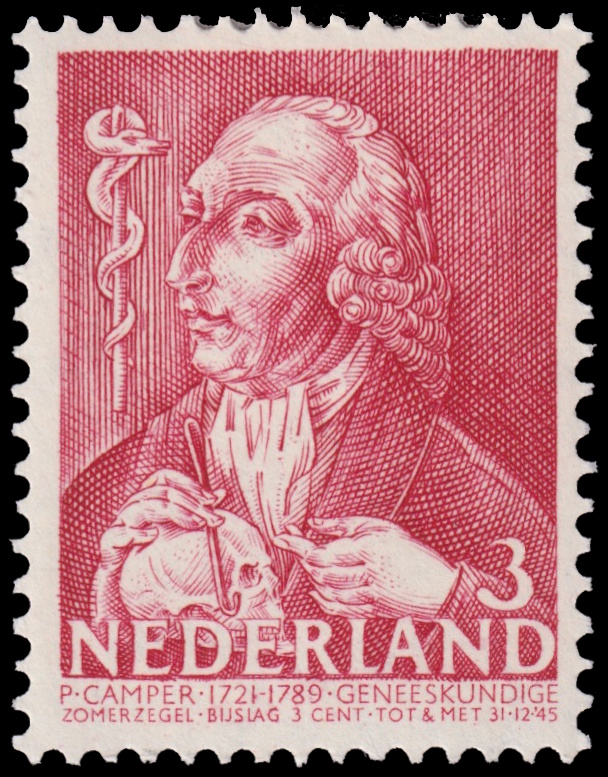
| Petrus Camper on stamp of the Netherlands 1940, MiNr. , Scott . | Skull of Mosasaurus on personalized stamp of the Netherlands 2019. |
 |
 |
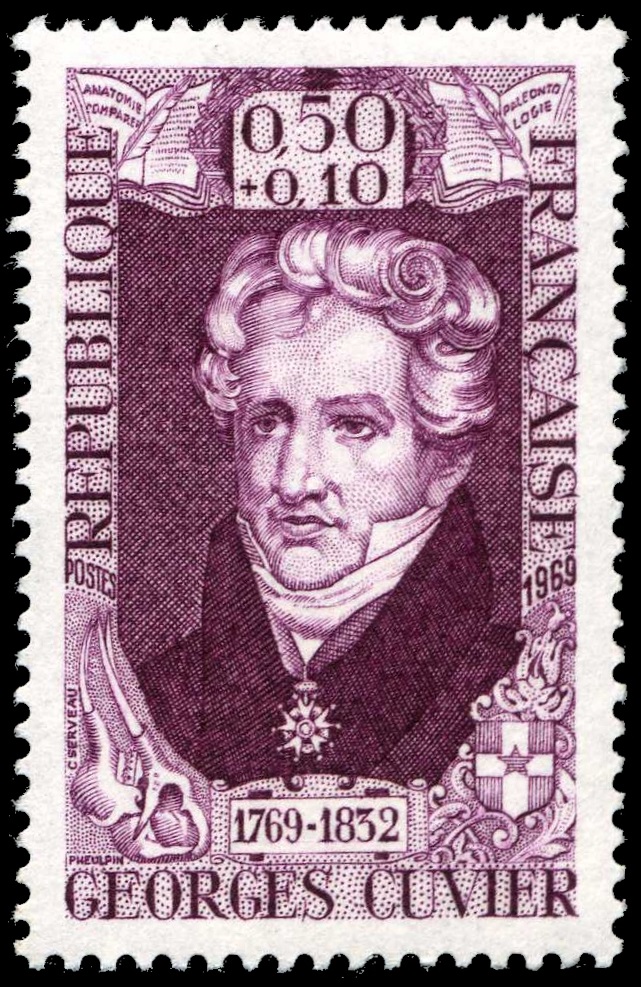
| Georges Cuvier on stamp of France 1969, MiNr. , Scott . | Tooth of Mosasaurus on stamp of Denmark 2009, MiNr. , Scott . |
Hoffmann corresponded directly with the Dutch physician and anatomist Petrus Camper (1722–1789), sharing his observations and fossil material with him. In 1786, Camper argued that the remains belonged to a toothed whale, based on comparisons with anatomical specimens and fossils in his own and other collections.
After his father's death, Adriaan Gilles Camper (1759–1820) inherited the collection and continued studying the fossils.
By around 1800, he had concluded that the animal was neither a crocodile nor a whale, but a giant, extinct lizard related to monitor lizards.
He communicated his findings to the French naturalist Georges Cuvier (1769–1832), Europe's leading comparative anatomist of his time and one of the founders of modern palaeontology.
In 1808, Cuvier independently examined the Maastricht fossil and after discussing and refuting earlier interpretations, he endorsed Camper's conclusion that the animal was an extinct marine reptile.
In 1829, the species was named Mosasaurus hoffmanni by the British naturalist Gideon Mantell (1790–1852), in honour of Johann Leonhard Hoffmann, who had been among the first to investigate the fossil and comment on its identity.
According to the account published by the French geologist and naturalist
Barthélemy Faujas de Saint-Fond (1741–1819) in his work
Histoire naturelle de la montagne de Saint-Pierre de Maestricht
(published in several editions between 1798 and 1803),
quarry workers informed Hoffmann after discovering the fossil.
Hoffmann reportedly rewarded them for their find and arranged for the
large block of rock containing the skull to be carefully extracted.
However, this account has subsequently been challenged by historical
research, which questions whether Hoffmann ever owned or recovered
the famous specimen.
The history of the discovery illustrates how anatomical comparison and the reassessment of earlier interpretations helped advance the scientific study of fossils.
The extraordinary resolution of the Maastricht fossil showcased the true power of the Enlightenment's scientific revolution. By combining Carl Linnaeus’s standardized binomial naming conventions with the rigorous comparative anatomy of Petrus Camper and Georges Cuvier, researchers successfully looked past historical myths and modern distortions to locate the true identity of the immense animal. When Cuvier definitively placed Mosasaurus hoffmanni within the animal kingdom as an extinct marine reptile, he did far more than resolve an old quarry puzzle; he proved to the world that entire groups of massive creatures had completely vanished from the face of the Earth. The establishment of extinction as a biological fact fundamentally changed how humanity viewed the history of life. With a universal system of classification now locked into place and the reality of extinct worlds out in the open, the stage was cleared for the ultimate step in earth history. In Chapter 7, the narrative shifts back into the heart of the German lands to witness the formal academic birth of paleontology, as early mining academies and pioneering universities transformed these deep-time theories into a systematic, state-recognized science.
References
Emanuel Swedenborg:
|
Carl Linnei Systema Naturae | Petrus Camper |