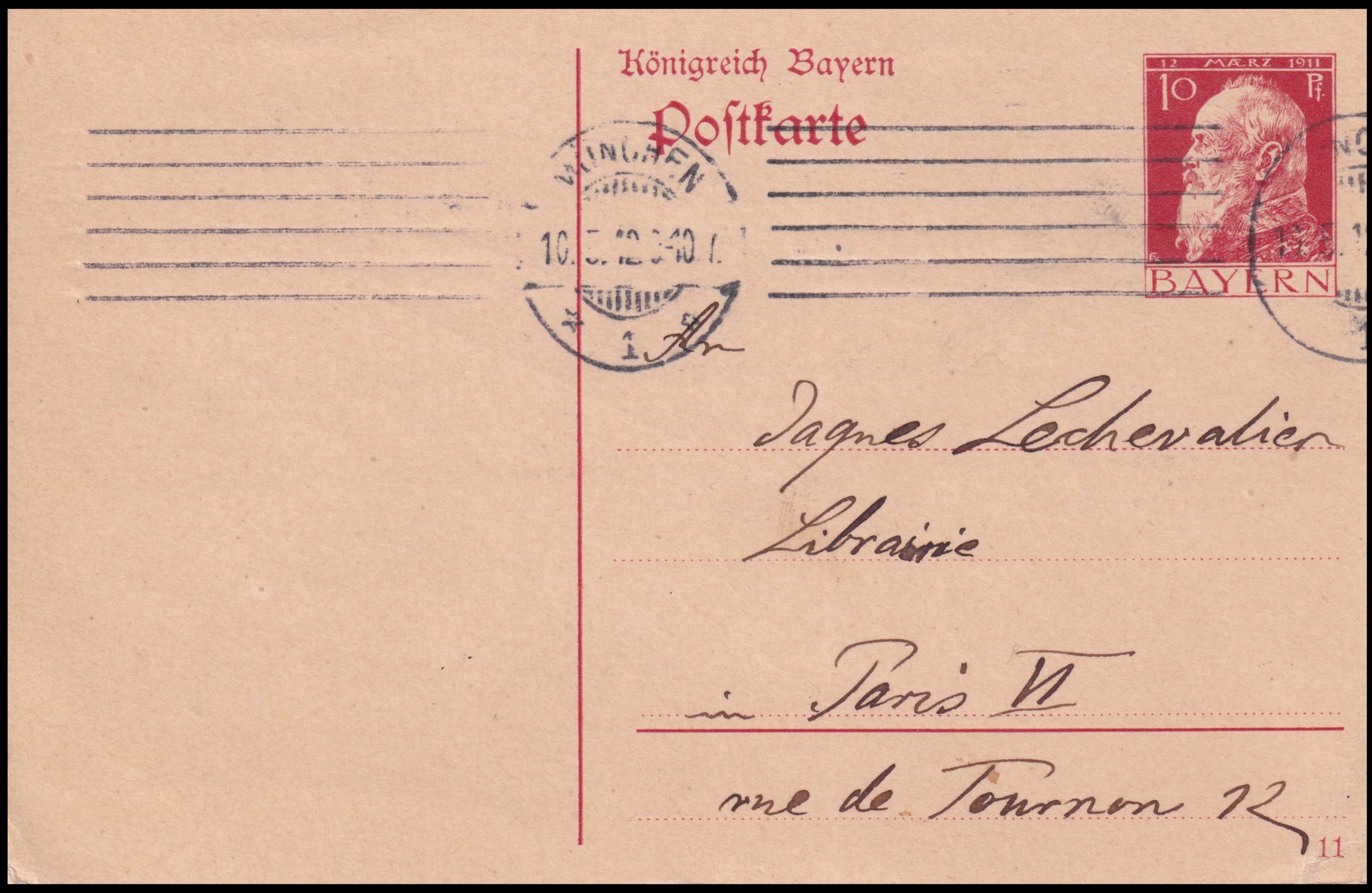
Postcard mailed by Professor Ernst Stromer von Reichenbach in 1912
 |
 |
| Postcard mailed by Professor Ernst Stromer von Reichenbach in 1912 | |
The postcard
The postcard was mailed in May 1912, by the German paleontologist Dr. Ernst Stromer von Reichenbach, commonly referred to as Dr. Ernst Stromer, from the Geological Institute in Munich to Jacques Lechevalier from the Parisian Librairie scientifique in Paris who was one of the important European scientific booksellers and publishers specializing in natural history, geology, and paleontology.
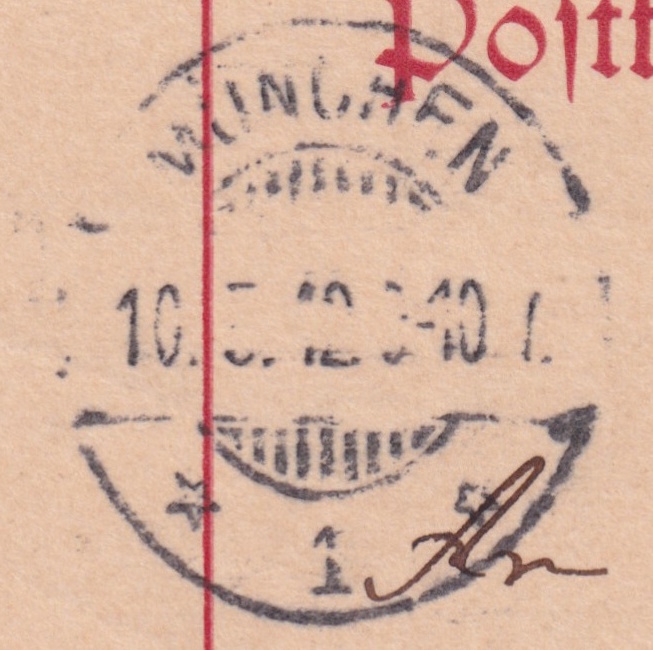 |
| The postmark from the postcard. The text on the postmark, except the city name, is not clear: the left side is certainly 10.5.12. |
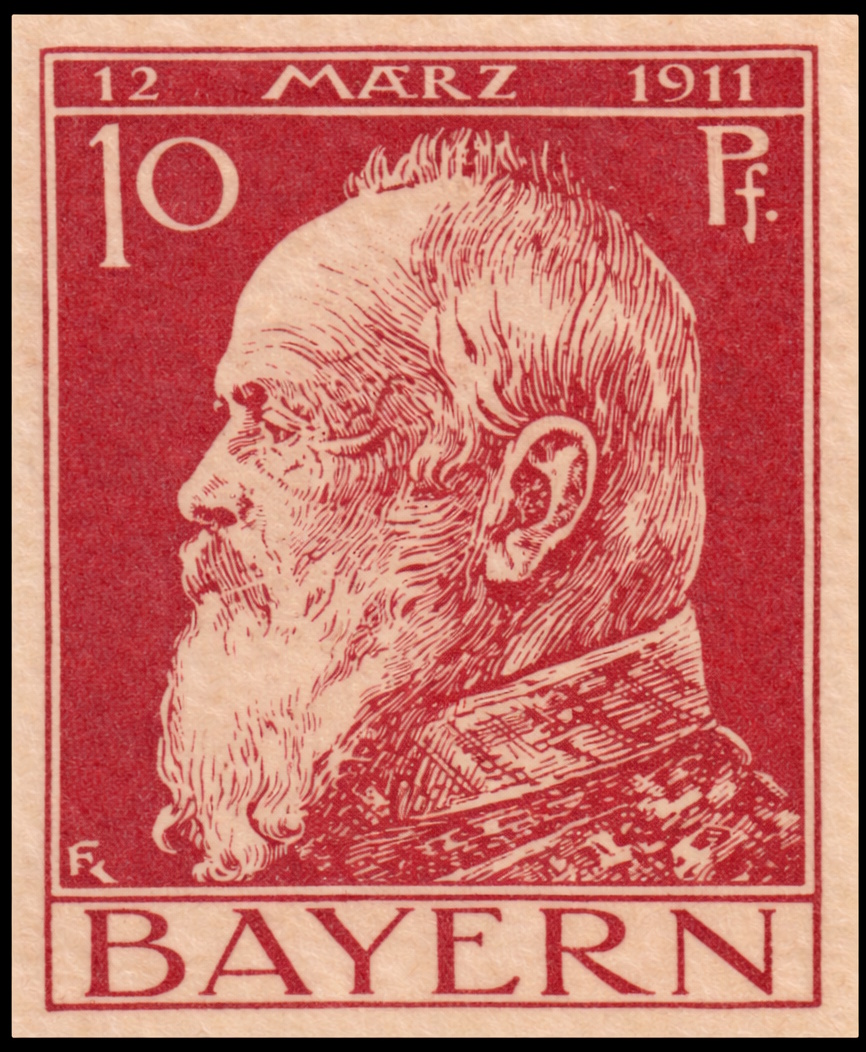 |
| The imprinted postage stamp from the postcard. |
Jacques Lechevalier
Librairie
in Paris VI
rue de Tournon 12
The postcard is a pre-stamped postal stationery card of the Kingdom of Bavaria bearing a 10 Pfennig indicium depicting Luitpold, Prince Regent of Bavaria.
The Kingdom of Bavaria was a German state that succeeded the former Electorate of Bavaria in 1806 and continued to exist until 1918.
The stamp features the date “12 März” (12 March) 1911 at the top, which was a special commemorative jubilee issue released to celebrate the Prince Regent's 90th birthday (born March 12, 1821).Ernst Stromer von Reichenbach (1871–1952) was a German paleontologist best known for his third expedition to Egypt between 1910 and 1911. The expedition was primarily intended to recover fossil mammals in support of Stromer’s theory of an African origin of humanity. Instead, it resulted in the discovery of the first significant dinosaur remains known from Egypt, including Spinosaurus, Aegyptosaurus, Bahariasaurus, and Carcharodontosaurus.
 |
 |
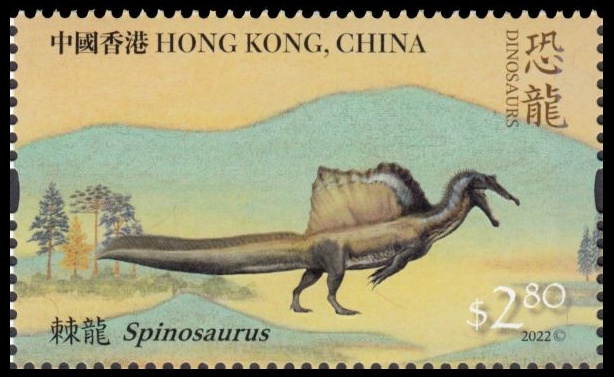 |
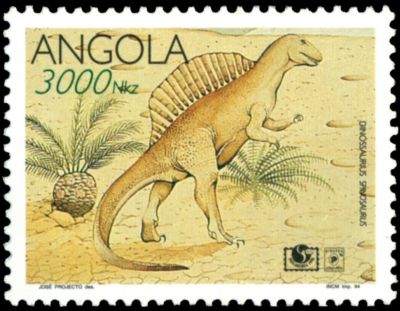
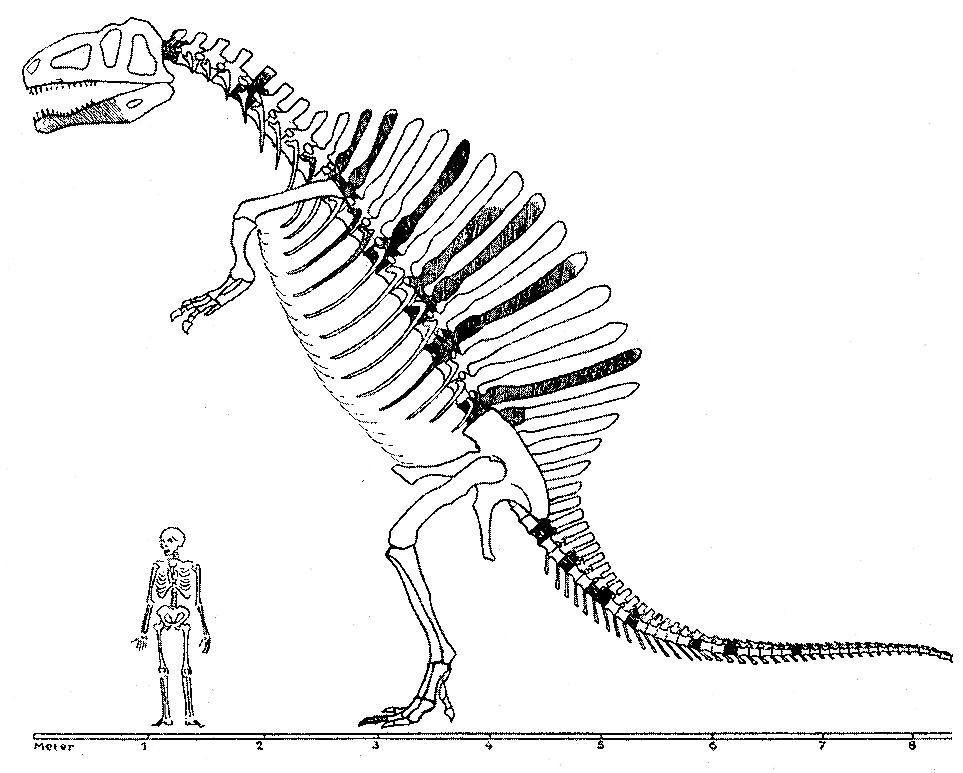
| Spinosaurus on stamp of Angola 1994, based on Stromer's reconstruction | Stromer's reconstruction of Spinosaurus in 1915, based on the fossils marked by black | Spinosaurus on stamp of Hong Kong 2022, based on recent discoveries |
The postcard illustrates the highly international nature of scientific research before the First World War, when German paleontologists routinely acquired specialized literature through French scientific booksellers. It reflects Stromer’s engagement with comparative anatomical literature and highlights the broader transnational scholarly networks that supported early twentieth-century paleontological research.
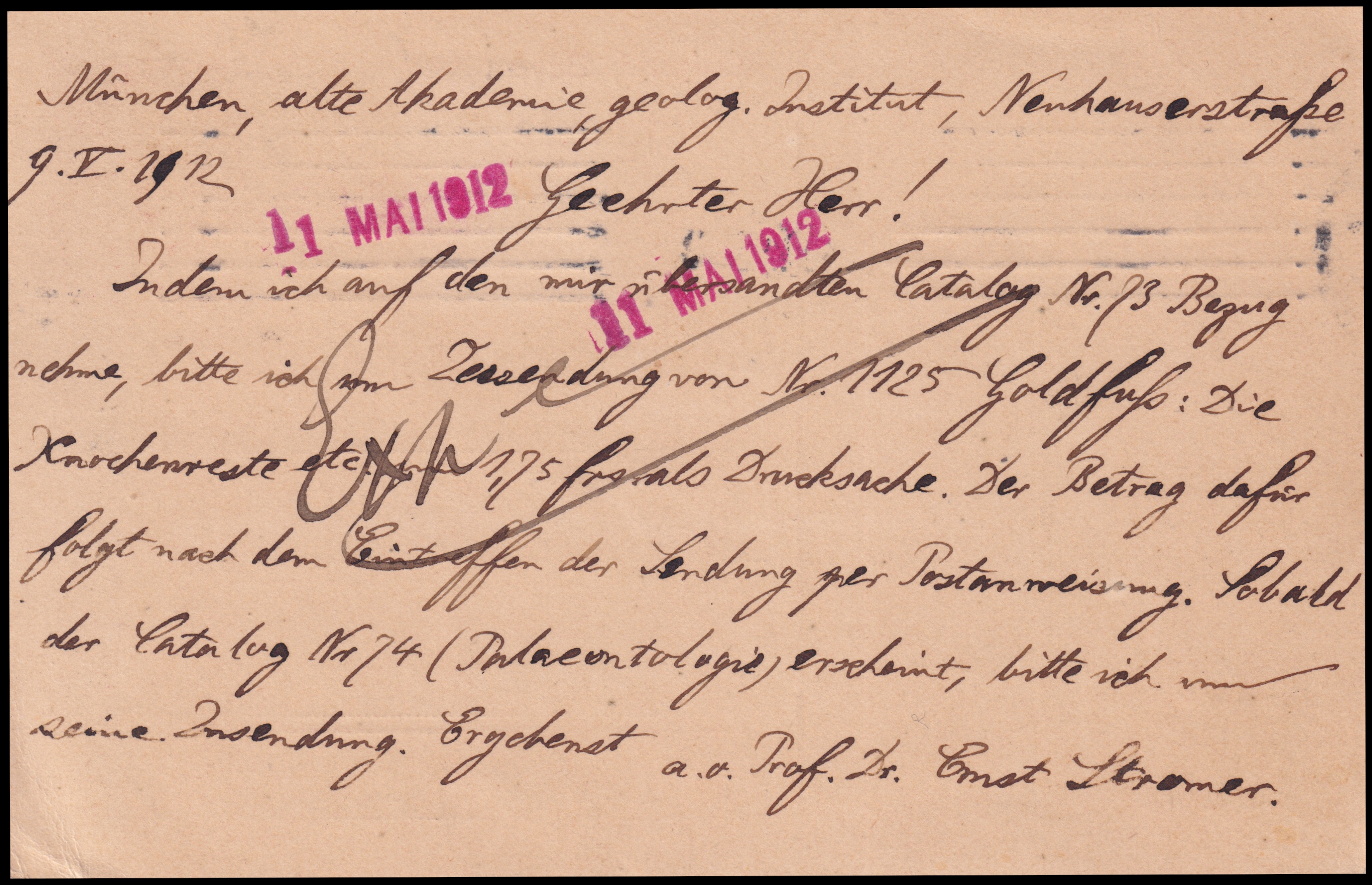
The message
|
Original, German, text München, alte Akademie geolog. Institut, Neuhauserstraße 9. V. 1912 Geehrter Herr! Indem ich auf den mir übersandten Catalog Nr. 73 Bezug nehme, bitte ich um Zusendung von Nr. 1125 Goldfuss: Die Knochenreste etc. f. 1,75 frs als Drucksache. Der Betrag dafür folgt nach dem Eintreffen der Sendung per Postanweisung. Sobald der Catalog Nr. 74 (Palaeontologie) erscheint, bitte ich um seine Zusendung. Ergebenst a.o. Prof. Dr. Ernst Stromer. |
English translation Munich, Old Academy, Geological Institute, Neuhauser street 9 May 1912 Dear Sir! Referring to catalogue no. 73 that was sent to me, I request the shipment of no. 1125, Goldfuss: The bone remains etc. for 1.75 frs as printed matter. Payment for it will follow after receipt of the shipment by postal money order. As soon as catalogue no. 74 (Palaeontology) appears, I request that a copy be sent to me. Respectfully yours, Associate Professor Dr. Ernst Stromer. |
At the time this postcard was written, Dr. Ernst Stromer was working as an associate professor at the Geological Institute of the Old Academy (Alte Akademie) on Neuhauser Street (Neuhauserstraße) in Munich. He was actively publishing the geological results of his recent expeditions while preparing for a large influx of new fossil shipments being sent from Egypt by his local collector, Richard Markgraf.
Simultaneously, Stromer was expanding the Munich institute’s reference library to support his broader paleontological and comparative anatomical research, including his long-term studies of fossil vertebrates and mammalian evolution. The item “No. 1125 Goldfuss” ordered on this postcard for 1.75 Francs was most probably the monograph „Die Knochenreste eines in der Papierkohle des Siebengebirges aufgefundenen Moschusthieres“ by the German paleontologist Dr. Georg August Goldfuss. The work, originally dating from 1845 and later published in Novorum actorum Academiae Caesareae Leopoldino-Carolinae Naturae Curiosorum (Vol. 22, 1847), dealt with the fossil hornless ruminant Moschus meyeri and included two illustrative plates. Such publications likely served Stromer as comparative reference material for the study and identification of fossil mammals.
Like many European museum curators and academics of his era, Dr. Stromer likely monitored newly issued booksellers’ catalogues and bibliographic notices published in scientific journals such as the German Geologisches Zentralblatt. These announcements helped researchers identify and acquire specialized literature for institutional collections and private scholarly libraries.
The species described by Goldfuss as Moschus meyeri in 1845 was later reassigned to Palaeomeryx meyeri, an extinct artiodactyl species from the Oligocene Epoch. Artiodactyls are even-toed hoofed mammals, a diverse group that today includes deer, cattle, pigs, camels, and giraffes. The species lived approximately 25–30 million years ago and is primarily known from fossils discovered at the world-famous Rott fossil locality near Bonn, Germany.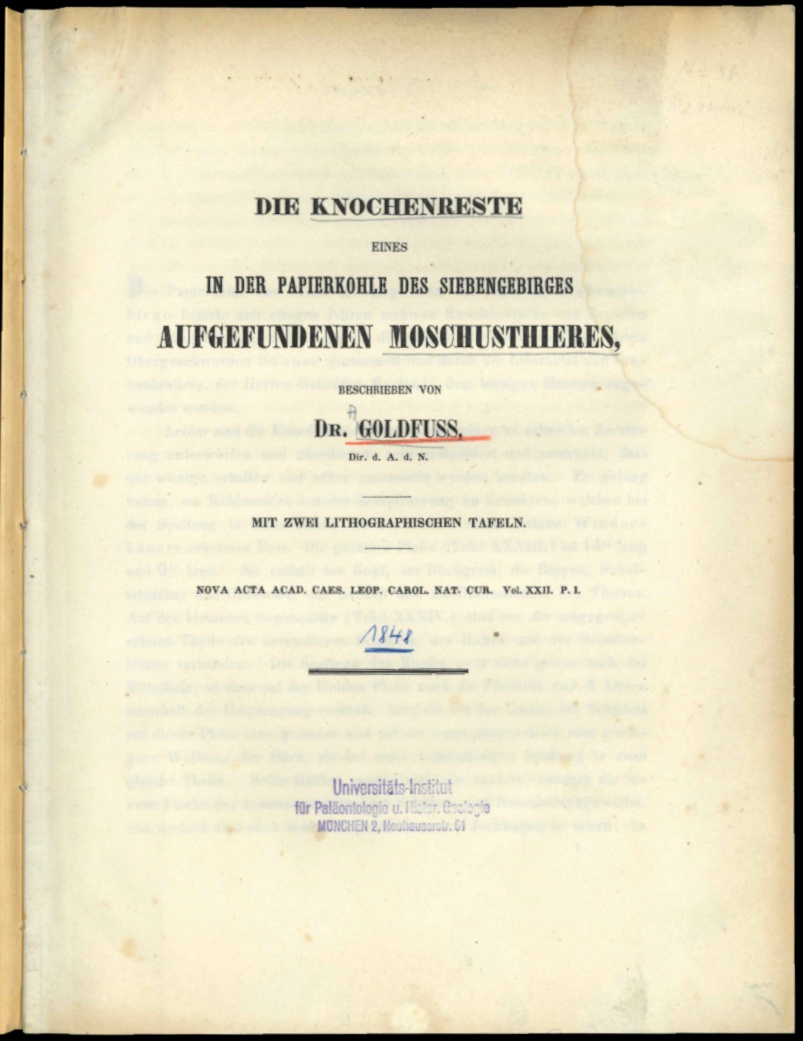 |
| The title page of „Die Knochenreste eines in der Papierkohle des Siebengebirges aufgefundenen Moschusthieres“ monograph by Dr. Georg August Goldfuss in the library of the Bavarian State Collection for Palaeontology and Geology. |
Whether Stromer actually received this specific copy from the Paris bookseller remains unknown. While the Bavarian State Collection for Palaeontology and Geology in Munich holds a copy of Goldfuss's monograph today, there is no surviving archival evidence proving when and by whom it was purchased. Because the institute and the museum were completely destroyed during the 1944 bombings, many fossils including the holotype material of Spinosaurus aegyptiacus, as well as much of Dr. Stromer correspondence and scientific documentation are lost forever, the final fate of this specific mail order remains unconfirmed. This remarkable postcard, however, survived in France.
However, it is certain that Stromer successfully gained access to Goldfuss’s work. He explicitly cited and referenced this precise monograph to analyze dental and skeletal anatomy in his major publications on Southern German fossil mammals:
- Stromer, E. (1928): Wirbeltiere im oberoligozänen Flinz Münchens. Abhandlungen der Bayerischen Akademie der Wissenschaften, mathematisch-naturwissenschaftliche Abteilung, 32 (1): 1–71.
- Stromer, E. (1940): Die jungtertiäre Fauna des Flinzes und des Schweiß-Sandes von München. Nachträge und Berichtigungen. Abhandlungen der Bayerischen Akademie der Wissenschaften, mathematisch-naturwissenschaftliche Abteilung, Neue Folge, 48: 1–102.
Notes
The Librairie Jacques Lechevalier (later operating as Éditions Paul Lechevalier), originally located at 12, rue de Tournon in the 6th Arrondissement of Paris, was one of Europe’s premier antiquarian bookstores and publishing houses specializing exclusively in natural sciences, botany, geology, and paleontology. Established in the late 19th century, the bookshop acted as an essential international clearinghouse for rare academic monographs, scientific journals, and illustrated lithographic plates. Naturalists and museum curators from across the globe relied on Lechevalier’s meticulously detailed mail-order sales documents—such as the Catalog Nr. 73 referenced on Ernst Stromer’s 1912 postcard, to track down rare, out-of-print reference works across borders. The shop’s enduring influence on the global scientific community was further cemented by its popular instructional series, the Encyclopédie Pratique du Naturaliste and the Encyclopédie Biologique, which educated generations of field researchers throughout the 20th century.
Richard Markgraf (1869–1916) was a German-Bohemian fossil collector who played a key role in the early
paleontological exploration of Egypt.
After arriving in Egypt in the late 19th century, he was trained in field methods and later became
Ernst Stromer’s principal collector.
Working under difficult desert conditions, Markgraf excavated and shipped important fossil material from regions
such as the Fayum Oasis and, most significantly, the Bahariya Oasis.
His discoveries provided the basis for Stromer’s descriptions of several major Cretaceous vertebrates,
including Spinosaurus aegyptiacus, Aegyptosaurus, and Bahariasaurus.
Although not formally trained as a scientist, Markgraf’s fieldwork was essential to Stromer’s Egyptian
research program and significantly shaped early knowledge of African dinosaur faunas.
The fossil collection amassed by Georg August Goldfuss (1782–1848)
served as one of the ultimate empirical pillars for early German geology and paleontology.
By collecting, classifying, and illustrating thousands of specimens, Goldfuss shifted geology from a field of abstract
theories into a highly rigorous, observable science.
His work at the University of Bonn directly laid the groundwork for modern biostratigraphy, paleoecology,
and evolutionary thought in Central Europe.
 |
| Spinosaur and Professor Ernst Stromer on personalized postal stationery of Czechia 2015 |
On the night of 24 April 1944, a British Royal Air Force bombing raid struck the Alte Akademie, destroying the stored fossils, including the original Spinosaurus material, which was never recovered. The library, including the monograph of Goldfuss, survived as it was evacuated in advance.
In 2000, a joint expedition led by researchers from the University of Pennsylvania and Egyptian scientists returned to the Bahariya Oasis in an effort to relocate the fossil sites explored by Ernst Stromer nearly ninety years earlier. By combining Stromer’s original field notes, maps, and geological descriptions with modern surveying techniques, the team successfully identified several of the historic excavation localities, including the area where the original Spinosaurus aegyptiacus material had been discovered by Richard Markgraf in 1912.
Although no additional Spinosaurus remains were recovered during the expedition, the researchers uncovered the remains of an enormous titanosaurian sauropod dinosaur. In 2001, the animal was formally described as Paralititan stromeri, meaning “Stromer’s tidal giant”, in honor of Ernst Stromer and his pioneering work on the fossil vertebrates of the Bahariya Oasis. At the time of its discovery, Paralititan was considered one of the largest known dinosaurs from Africa and provided important new evidence about the rich coastal ecosystems that existed in northern Egypt during the Late Cretaceous.
References:
 |
| Amazon: USA, UK DE |
 |
| Amazon: USA UK DE |
- Ernst Stromer (1871 -1952):
Wikipedia, Linda Hall Library, Dinosaur Earth, Letters from Gondwana.- Stromer's Expedition in the Deserts of Egypt:
Results of Prof. E. Stromer's Research Expedition in the Deserts of Egypt (PDF, 33 pages), published in 1915 in Munich, translated by R.T. Zanon in 1989.
Original, German article: Bayerische Akademie der Wissenschaften (PDF, 67 pages).
- Stromer's Expedition in the Deserts of Egypt:
- Georg August Goldfuss (1782–1848):
Wikipedia.-
"Die Knochenreste eines in der Papierkohle des Siebengebirges aufgefundenen Moschusthieres"
Biodiversity Heritage Library.
-
"Die Knochenreste eines in der Papierkohle des Siebengebirges aufgefundenen Moschusthieres"
- Richard Markgraf (1869-1916):
Wikipedia, - Spinosaurus:
Wikipedia, NHM UK, National Geographic, Carnegie Museum of Natural History,
Acknowledgements
- Many thanks are due to fellow collector Peter Brandhuber of Germany, founder of the Facebook group “Evolution of Mankind and Philately”, for providing me information about this unique postcard, which he originally discovered on the Internet. Remarkably, despite its historical significance, the lot attracted little apparent interest when it was offered by a French dealer.
- Many thanks to Dr. Winfried Werner, Principal Curator (ret.), SNSB – Bavarian State Collection for Palaeontology and Geology, for his help in my research.
- Many thanks to my friend Dr. Peter Voice from Department of Geological and Environmental Sciences, Western Michigan University, for reviewing the draft page and his very valuable comments.