Cephalopods
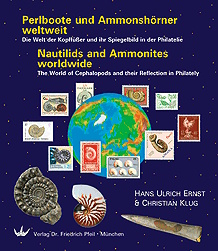 |
"Nautilids and Ammonites worldwide - the world of Cephalopods and
their reflection in Philately",
by Hans Ulrich Ernst, Christian Klug. Published in 2011. Preview of some pages is here You can still buy it on Amazon: UK, DE |
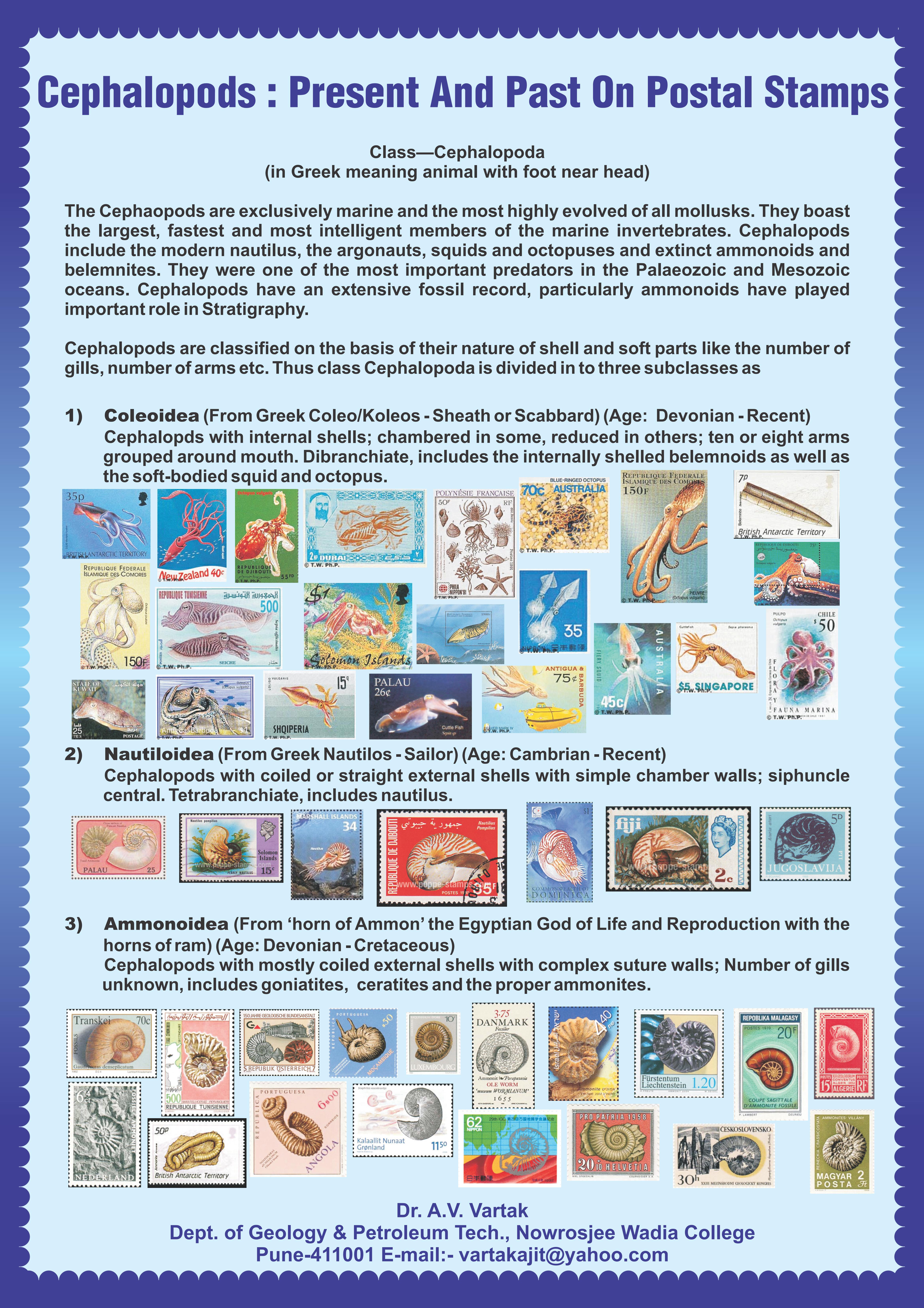
Cephalopods include the modern nautilus, the argonauts, squids and octopuses and extinct ammonoids and belemnites.
They were one of the most important predators in the Palaeozoic and Mesozoic oceans. Cephalopods have an extensive fossil record, particularly ammonoids have played important role in Stratigraphy.
Cephalopods are classified on the basis of their nature of shell and soft parts like the number of gills, number of arms etc. Thus class Cephalopoda is divided in to three subclasses as
- Coleoidea (From Greek Coleo/KoIeos -Sheath or Scabbard) (Age: Devonian - Recent) Cephalopds with internal shells; chambered in some, reduced in others; ten or eight arms grouped around mouth. Dibranchiate, includes the internally shelled belemnoids as well as the soft-bodied squid and octopus.
- Nautiloidea (From Greek Nautilos -Sailor) (Age: Cambrian - Recent) Cephalopods with coiled or straight external shells with simple chamber walls; siphuncle central. Tetrabranchiate, includes nautilus.
- Ammonoidea (From 'horn of Ammon' the Egyptian God of Life and Reproduction with the horns of ram) (Age: Devonian - Cretaceous) Cephalopods with mostly coiled external shells with complex suture walls; Number of gills unknown, includes goniatites, ceratites and the proper ammonites.
|
|