USA 1970 "Centenary of American Natural History Museum"
| Issue Date | 06.05.1970 |
| ID | Michel: 999-1002; Scott: 1387-1390; Stanley Gibbons: 1377-1380; Yvert et Tellier: 889-893; Category: pR |
| Design | Walter Richards, Dean Ellis, Paul Rabut, Robert J. Jones. |
| Stamps in set | 4 |
| Value |
6c - "American Bald Eagle" 6c - "African elephant herd" 6c - "Tlingit chief in Haida ceremonial canoe" 6c - "The age of reptiles" |
| Emission/Type | commemorative |
| Places of issue | New York, NY |
| Size (width x height) | 50.0mm x 32.0mm |
| Layout | stamps per sheet |
| Products | None |
| Paper | No Watermark |
| Perforation | 11 x 11 |
| Print Technique | Lithographed and engraved, multicolor |
| Printed by | Bureau of Engraving and Printing |
| Quantity | 50,448,550 |
| Issuing Authority | U.S. Postal Service |
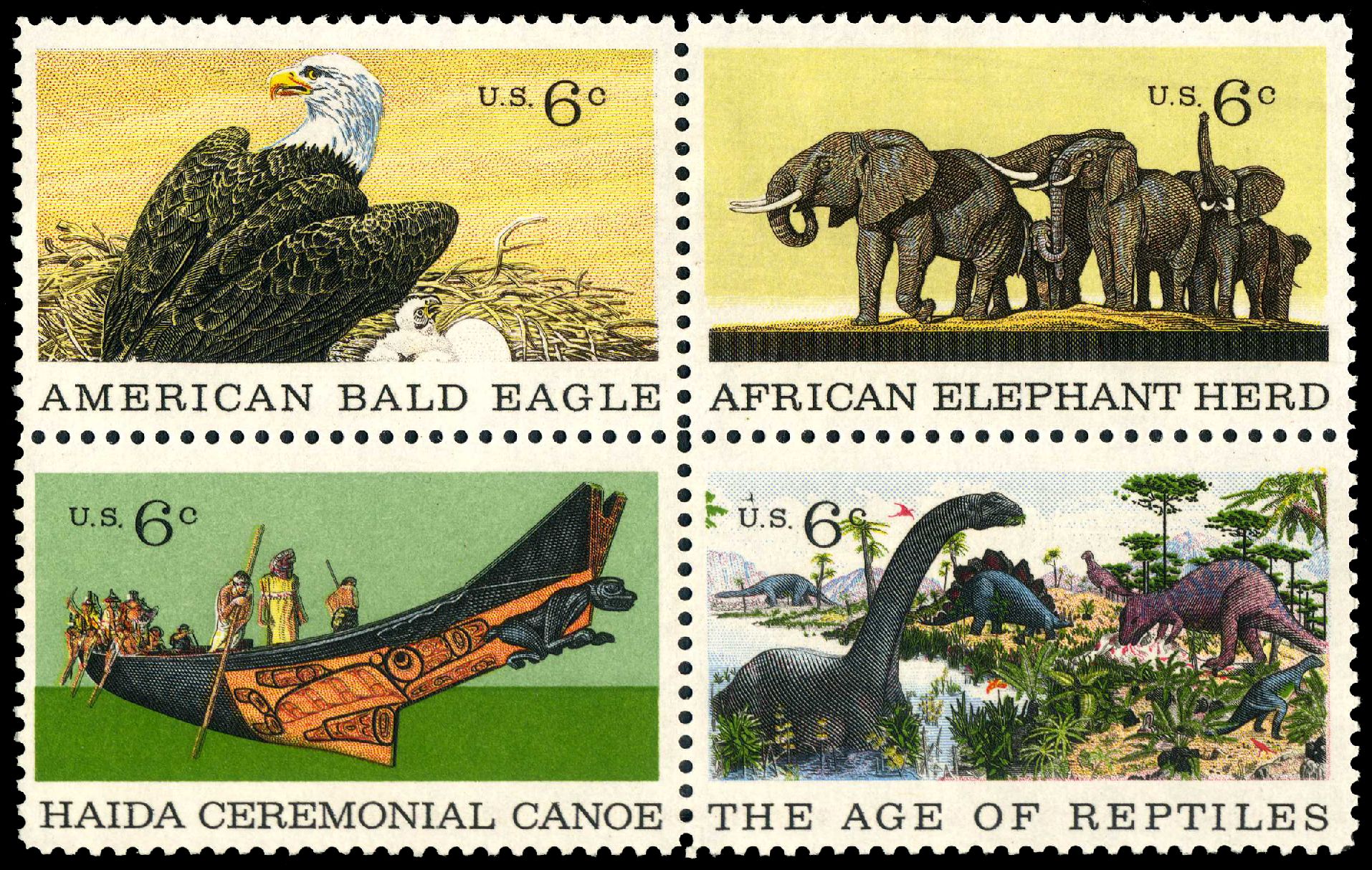
On May 6th, 1970, the United States Post Office issued the stamps set to commemorate the 100th anniversary of the opening of the American Museum of Natural History.
The stamps were printed using the offset lithography method. The first three press runs were produced in offset lithography - two yellows, followed by red and blue, and finally two greens. Two brown tones were subsequently added using the Giori press.
- Walter Richards, of New Canaan, Connecticut, designed the American Bald Eagle stamp.
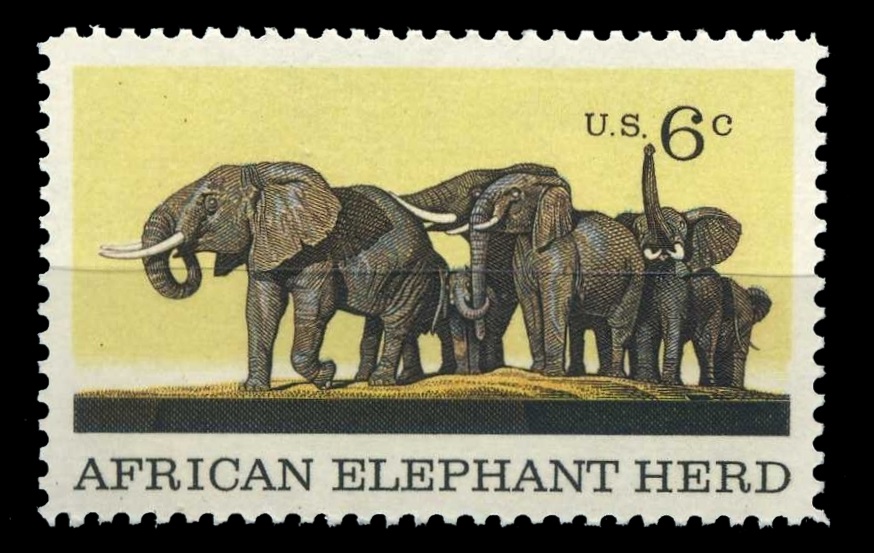
- Dean Ellis, of New York City, designed the African Elephant Herd stamp.
- Paul Rabut, of Westport, Connecticut, designed the Haida Ceremonial Canoe stamp.
- The Age of Reptiles stamp features a detail from one of the largest murals in the world, 110 feet (approximately 33.5 meters) long and 16 feet (approximately 4.9 meters) high, painted by Rudolph Zallinger for Yale Peabody Museum. The monumental work required four and a half years to complete.
The American Museum of Natural History (AMNH) was founded in 1869 in New York City through the efforts of a group of prominent citizens, scientists, and philanthropists. Among its leading founders were Theodore Roosevelt Sr., the father of the future U.S. President, and the financier J. P. Morgan.
 |
| First Day Ceremony Program |
By 1970 it occupied 18 buildings, and by 2010 it had expanded to 25 interconnected structures housing permanent exhibition halls, research laboratories, and one of the most important scientific libraries in the field. Today, the museum preserves more than 32 million specimens.
The museum is internationally renowned for its outstanding paleontological collections. Entire exhibition halls are devoted to vertebrate evolution, displaying exceptional fossil material that documents the history of life on Earth. Its dinosaur skeletons, prehistoric mammals, and other fossil specimens rank among the most significant in the world and have contributed substantially to scientific research and public understanding of paleontology.
While widely known to the general public through the 2006 film Night at the Museum, the institution’s true importance lies in its scientific collections. In addition to its fossil treasures, the museum houses celebrated displays such as habitat dioramas of African, Asian, and North American mammals; a full-scale model of a Blue Whale suspended in the Milstein Family Hall of Ocean Life; a 31-ton fragment of the Cape York meteorite; and extensive anthropological collections representing cultures from around the globe.
The age of reptiles
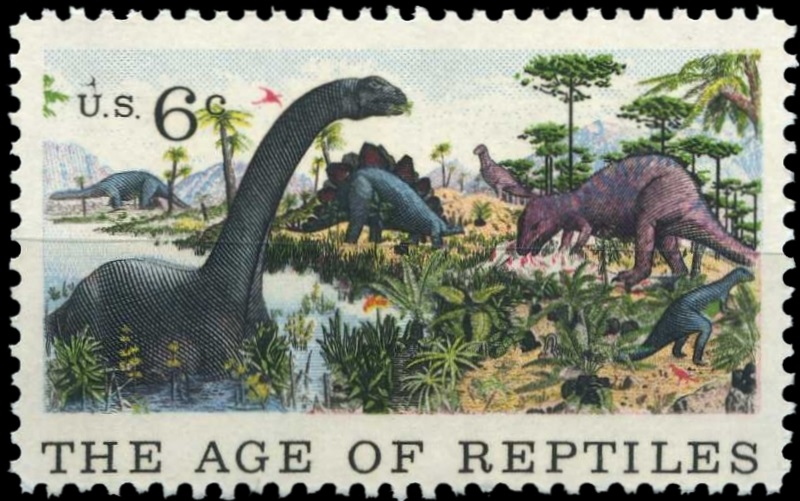 |
| Dinosaurs on the “Age of Reptiles” stamp of USA 1970 MiNr.: 1002, Scott: 1390. |
Rudoph Zallinger was one of the pioneers of paleontological art, perhaps second only to Charles R. Knight in that respect. Zallinger is best known for his stunning mural, "The Age of Reptiles", that covers the entire east wall of the Yale Peabody Museum's Great Hall. The mural depicts the evolution of life on earth over 300 million years, with different sections, separated by the visual device of foreground trees, for geologic periods. It was painted with egg tempera in the fresco secco method; meaning "dry plaster", as opposed to the more familiar traditional method of painting into wet plaster (buon fresco) as practiced by Michelangelo for his frescos in the Sistine Chapel.
Did you know?
Most of the Museum's mammalian and dinosaur fossil collections remain hidden from public view. They are preserved in numerous storage areas deep within the Museum complex.
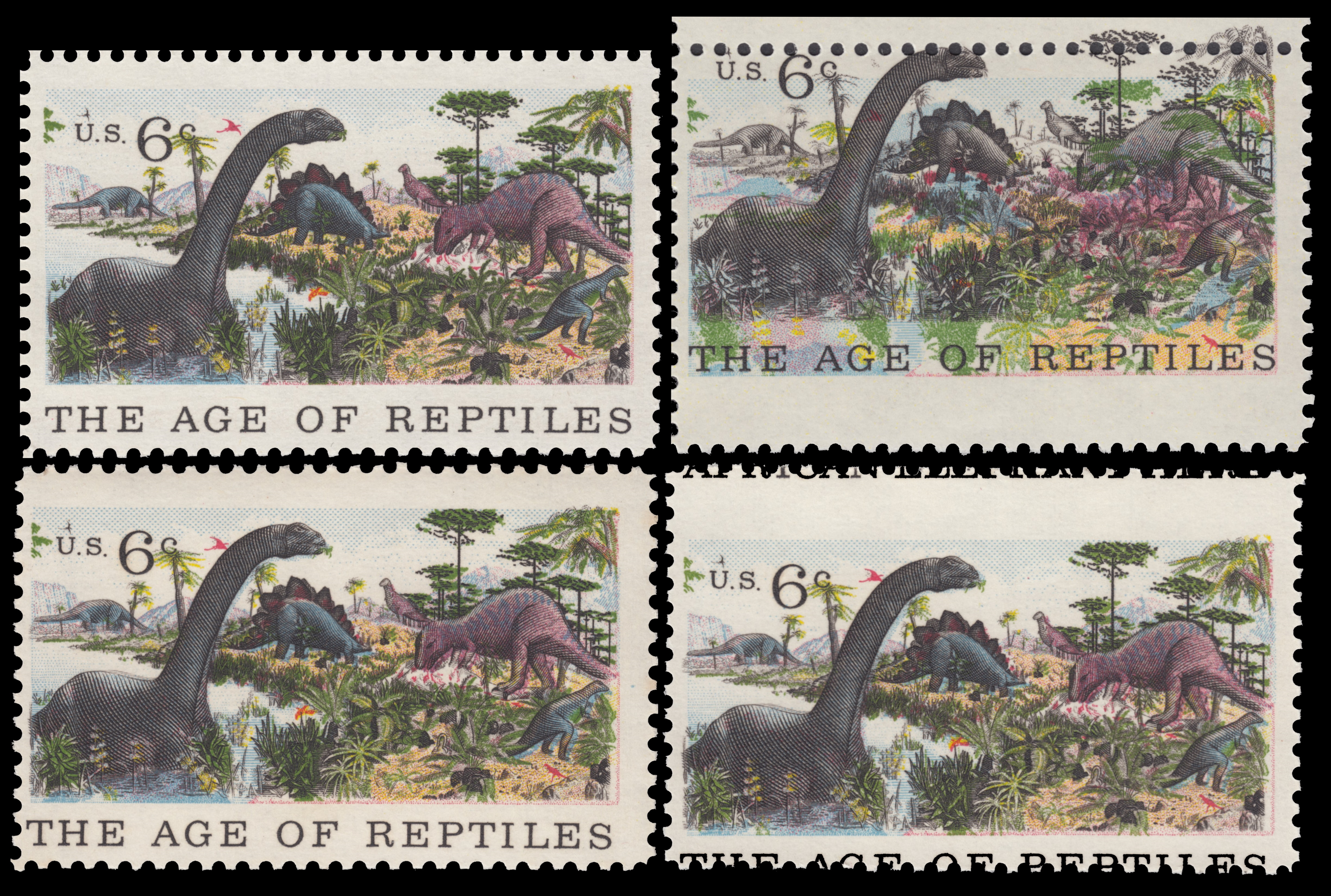 |
| During the mass production of the Age of Reptiles stamp, shifts in both color registration and perforation occurred. |
Because of the enormous weight of the fossil specimens, the building required special steel reinforcement. Today, it houses the world’s largest collection of fossil mammals and dinosaurs. These collections occupy the basement and the lower seven floors, while the top three floors contain laboratories and offices.
It is within this building that many of the Museum’s most intensive research programs in vertebrate paleontology are conducted.
Other stamps of the set

|
|

|
|
Haliaeetus leucocephalus, the American bald eagle, is a rare species that is the national emblem
of the United States.
Although protected by law, some large eagles are killed by farmers or captured for use in falconry.
The bald eagle, like other birds, has been affected by the widespread use of pesticides that can weaken eggs.
They are large, predatory birds that are the symbol of power, courage, and freedom.
|
African elephants are native to parts of southern, central, and eastern Africa, living in forests, grasslands, river valleys, and deserts. Its numbers have been reduced by overhunting, principally for its ivory tusks. Where it is protected, it tends to overpopulate and defoliate its range, resulting in its own starvation. The African elephant uses its trunk to strip trees of branches and bark and even to uproot them. There is a ban on ivory trading. Initiated in 1989, the ban was put into place when the African elephant was declared endangered by the U.N.'s Convention on International Trade in Endangered Species. |
Of the Nadene linguistic stock, the 13 Tlingit tribes are a group of North American Indians who formerly occupied
the Alaskan panhandle southward from Yakutat Bay.
A population of about 10,000 in the 1750s dropped to about 4,500 circa 1900.
The Tlingits built large wooden dugout canoes, multi-family plank houses, and wooden storage boxes and dishes.
They also made masks and wove spruce-root baskets.
They frequently had disputes with the Russians.
In 1799 the Russians built a fort on an island in the southeast archipelago,
but in 1802 the Tlingit drove them out.
|
Products and associated philatelic items
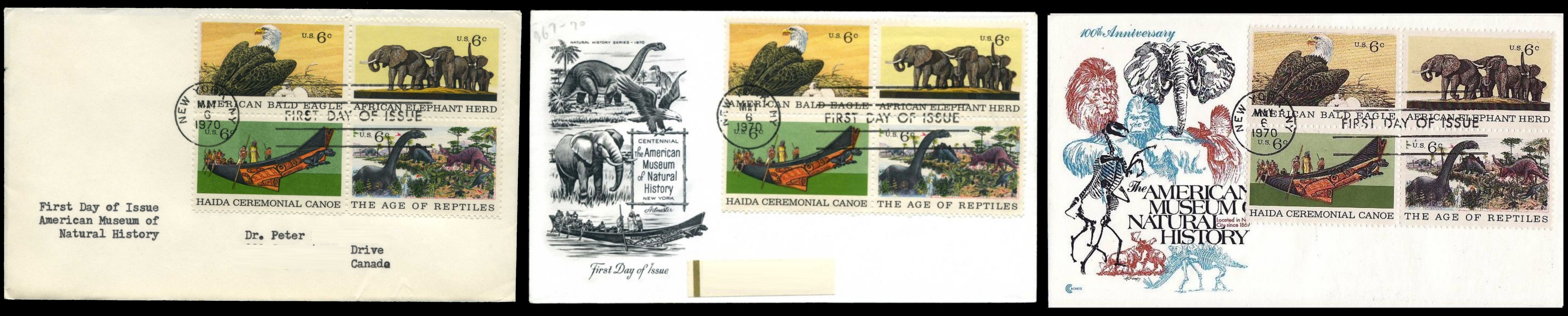
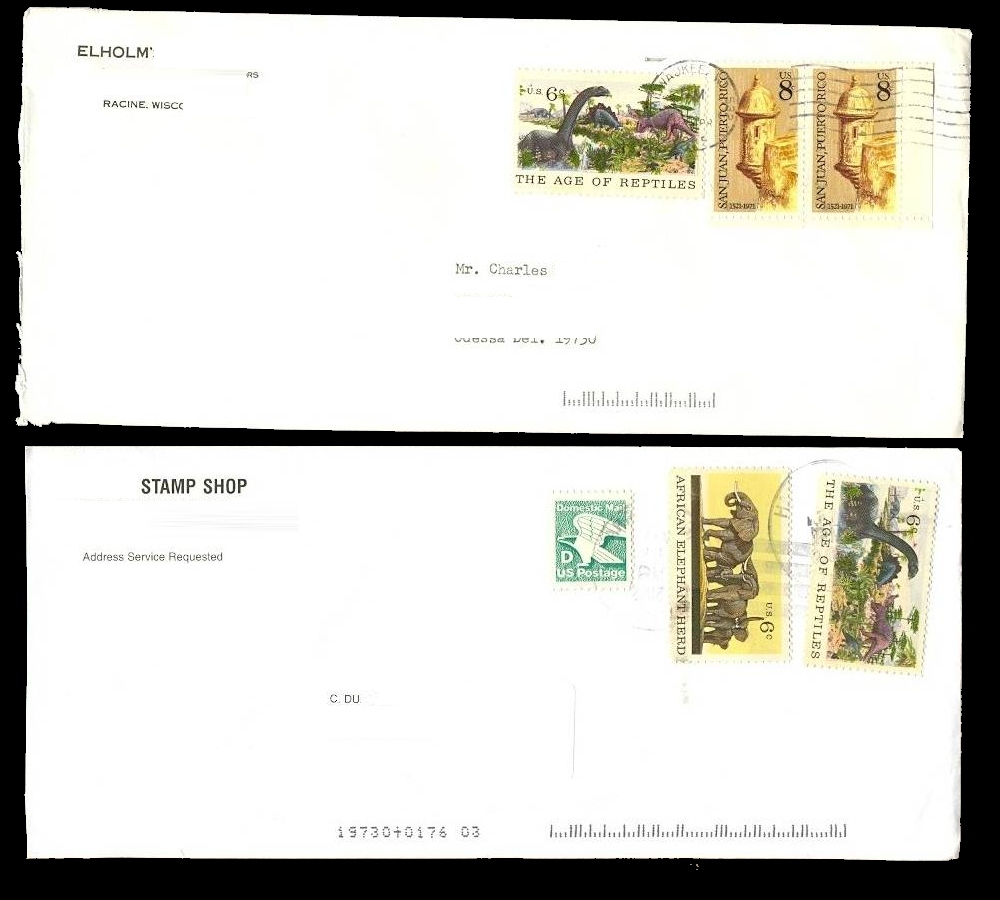
No official philatelic products were issued in connection with this stamp issue. The United States Postal Service did not produce an official First Day Cover (FDC) or a pictorial First-Day-of-Issue postmark. All first day covers illustrated below are privately produced items.
| Examples of personalized FDCs | A piece of stamp sheet | |
 |
 |
 |
| Signed by Rudoph Zallinger | ||
| Examples of Circulated Covers | ||
 |
 |
 |
References
- Technical Details: colnect, mysticstamp, Post on Bulletin Board,
- The American Museum of Natural History:
official site, official YouTube channel, Wikipedia. - The Age of Reptile Mural:
Yale Alumni Magazine, Smithsonian Magazine. - Rudoph Zallinger Wikipedia, Linda Hall Library,
Acknowledgement
Many thanks to Dr. Peter Voice from Department of Geological and Environmental Sciences, Western Michigan University, for reviewing the draft page, his valuable comments and great help to find materials for this article.