Slovenia 2016 "Mammal Fossils In Slovenia: Cave Bear"
| Issue Date | 25.03.2016 |
| ID | Michel: 1186; Scott: 1160; Stanley Gibbons: ; Yvert et Tellier: 998; Category: pR |
| Designer | stamp design: Edi Berk photo: Matija Križnar, Ciril Mlinar from Natural History Museum of Slovenia in Ljubljana |
| Stamps in set | 1 |
| Value | €0.58 - Cave bear (Ursus spelaeus) |
| Emission/Type | commemorative |
| Places of issue | Luce |
| Size (width x height) | 42.60 mm x 29.82 mm |
| Layout | Sheet of 25 stamps |
| Products | FDC x1 |
| Paper | |
| Perforation | 14 x 14 |
| Print Technique | Offset lithography, 4 colours |
| Printed by | Agencija za komercijalnu djelatnost d.o.o., Zagreb, Croatia |
| Quantity | 500.000 |
| Issuing Authority | Posta Slovenije |
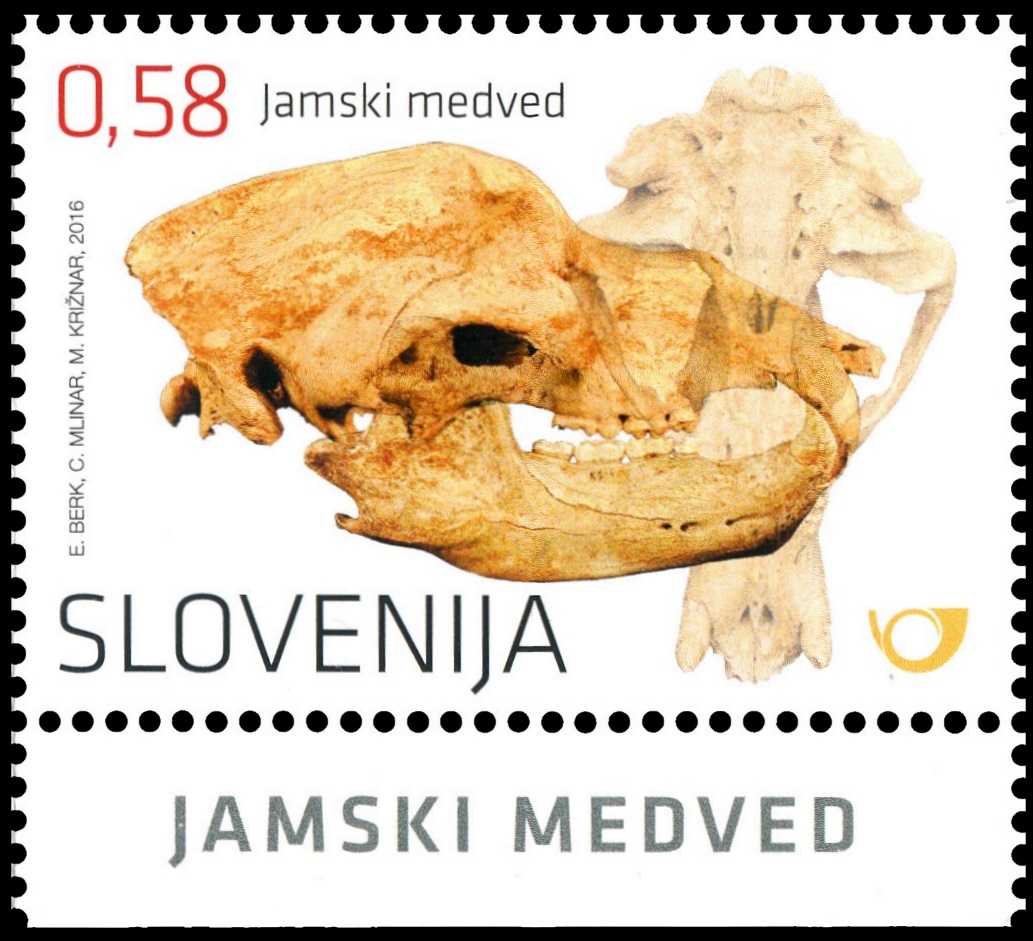
On March 25th, 2016, Slovenian Post Authority issued a single stamp with fossil of Cave Bear and started a new multi-year series "Prehistoric Mammals of Slovenia".
The following text was written by Matija Kriznar from Department of Geology, Natural History Museum of Slovenia and was published on the website of Slovenia in 2016.
The cave bear is one of the most typical examples of the Pleistocene megafauna that once roamed the Slovene landscape.
Cave bear remains have been discovered in a large number of sites in Europe and western Asia. The ancestors of the cave bears that inhabited the Ice Age landscape can be traced back more than a million years. The last species of cave bears were omnivorous animals about the size of a cow.
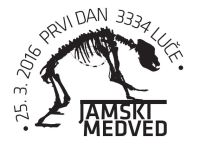
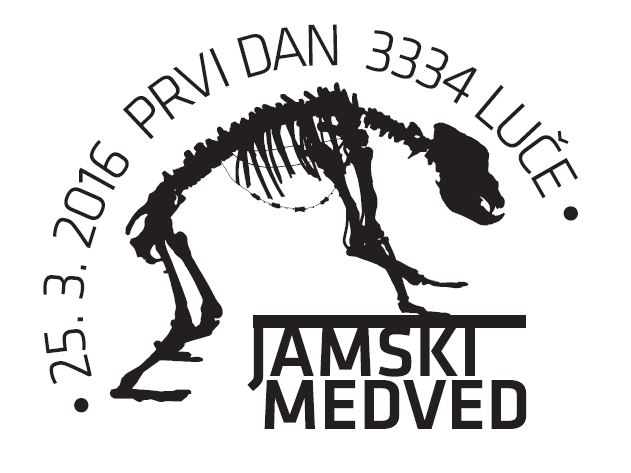
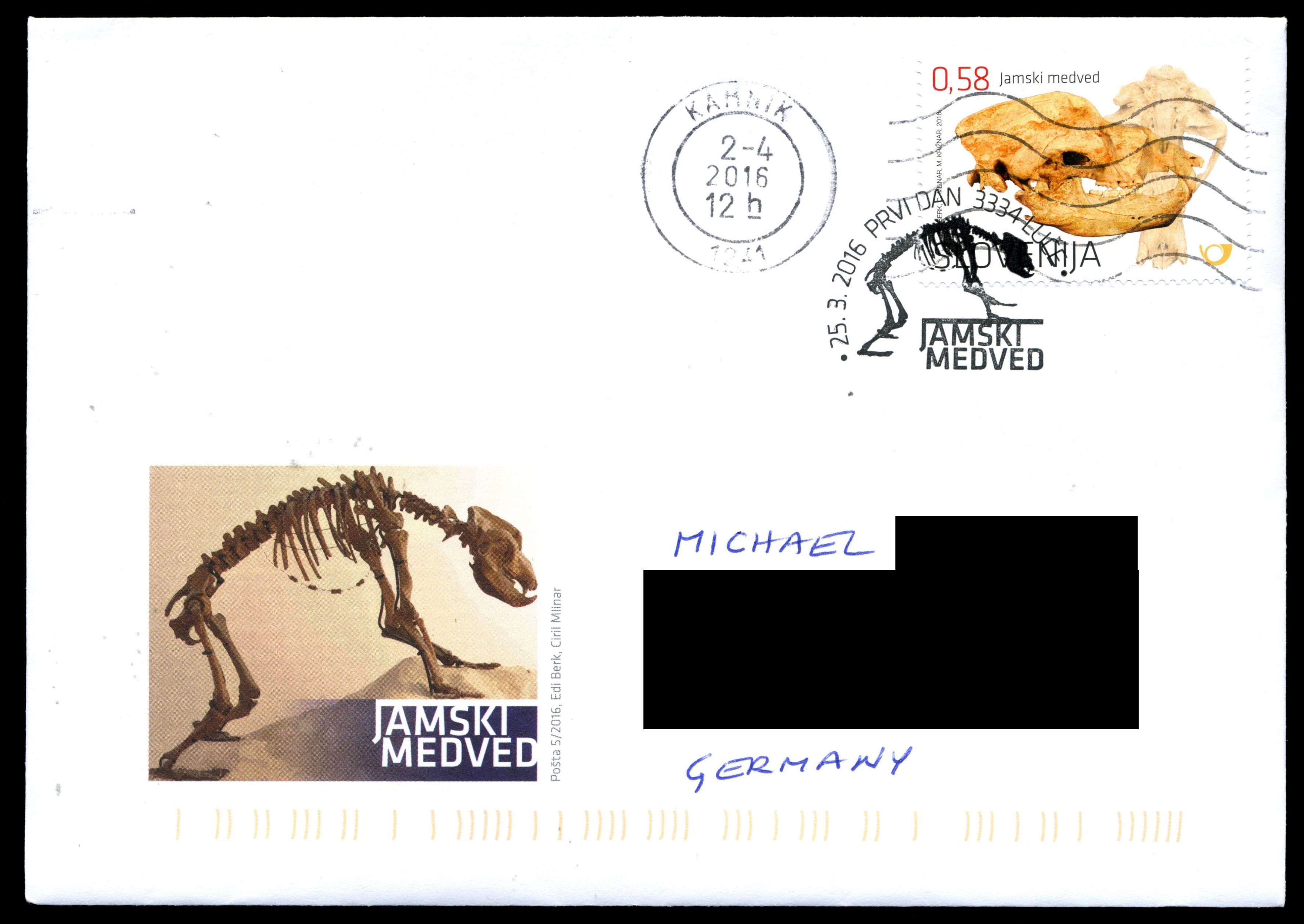
The skeleton of the cave bear on the First-Day-of-Issue Postmark and cachet of FDC.
There are more than 70 documented cave bear sites in Slovenia. The best known are Potocka Zijalka (a cave on the southern slope Olševa), of Mokriska Jama (a cave above the valley of the Kamniska Bistrica), Krizna Jama ("Cross Cave") near Loz, and the Divje Babe cave near Cerkno. Enormous quantities of bones have been unearthed in the large number of caves, where cave bear remains have been found, indicating the presence of up to a thousand animals. Bones found in caves are covered by layers of sediment, while in open-air sites (such as quarries) bones are often discovered by chance.
Cave bears used to be known by the scientific name Ursus spelaeus and it was long believed that this was the only species to settle in Europe.
In the last decade, however, fresh excavations and genetic analyses have enabled researchers to prove the existence of a number of other species or subspecies of cave bears. These species are distinguished from each other both by genetic differences and by the shape of their skulls and teeth. In Slovenia today we have thus been able to identify the remains of Ursus deningeri (Herkova Jama), Ursus ingressus (Potocka Zijalka and many other caves) and Ursus ladinicus (Ajdovska Jama). The last cave bears in Slovenia died out approximately 25,000 years ago.
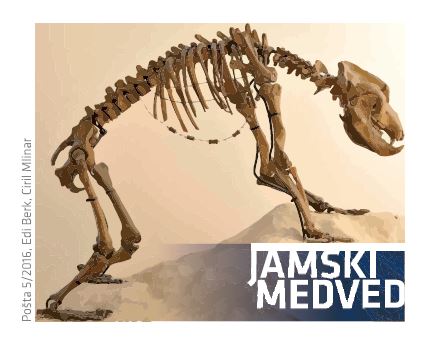


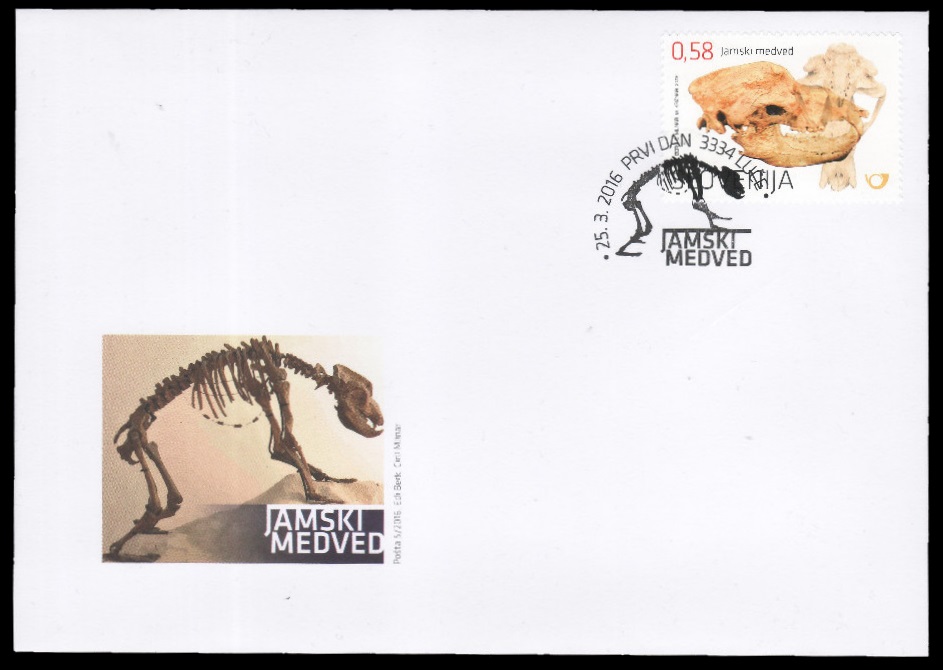
Products and associated philatelic items
| FDC | First-Day-of-Issue Postmark | Specimen stamp |
 |
 |
 |
| The specimen stamps of Slovenia cancelled by round mark without any text | ||
| Circulated FDCs | ||
 |
 |
 |
| Registered letter | Regular letter | Regular letter, posted after the date of the issue stamp |
| Examples of circulated covers | ||
 |
 |
|
| Registered letter | Regular letter | |
References
Technical details and short description: Posta Slovenije, colnect.
Acknowledgements:
Many thanks to Dr. Peter Voice from Department of Geological and Environmental Sciences, Western Michigan University, for reviewing the draft page.