Germany 2025 "Europa 2025 - National Archaeological Discoveries - UNESCO World Heritage Site - Caves and Ice Age Art of the Swabian Alb"
| Issue Date | 08.05.2025 |
| ID | Michel: Bl. 94 (3907); Scott: 3461; Stanley Gibbons: MS4644; Yvert et Tellier: F3685; Category: Ot |
| Designer | Professor Sandra Hoffmann Robbiani, Bern, Switzerland Photos: Manuela Schreiner, Hendrik Zwietasch, Yvonne Mühleis Technical support: the University of Tübingen, Museum Ulm, Archaeological State Museum of Baden-Württemberg. |
| Stamps in set | 1 |
| Value | 0,95€ - archeological artefacts from the Ice Age |
| Emission/Type | commemorative |
| Issue place | Berlin, Bonn |
| Size (width x height) | Souvenir-Sheet: 100mm x 60mm |
| Layout | Souvenir-Sheet |
| Products | FDS x1 |
| Paper | white, without watermark |
| Perforation | 13.25 x 14 |
| Print Technique | Offset lithography |
| Printed by | Bundesdruckerei Berlin |
| Quantity | 551.900 |
| Issuing Authority | Deutsche Post |

On May 8th, 2025, the Post Authority of Germany issued the stamp "National Archaeological Discoveries - UNESCO World Heritage Site - Caves and Ice Age Art of the Swabian Alb".
Many figures created by the "Ice Age" humans were depicted on the stamp and selvages.
As part of the annual EUROPA stamp series, this issue represents Germany’s entry in the 2025 PostEurop EUROPA Stamp Competition. Dedicated to the theme of "Archaeological Discoveries", the stamp was presented alongside issues from numerous European postal administrations, with the public invited to vote for their favorite design on the official PostEurop platform.
The stamp’s €0.95 denomination has additional postal significance, as it corresponds to the domestic postage rates introduced by Deutsche Post AG on January 1, 2025. The standard letter rate (up to 20 g) increased from €0.85 to €0.95, while the postcard rate rose from €0.70 to €0.95, making this denomination valid for both domestic postal services.
Below is translation from an official press release, published by Deutsche Post and German Federal Ministers of Finance in 2025.
A Cultural Revolution 40,000 Years Ago in the Swabian Alb.
Roughly 40,000 years ago, at the edge of the Swabian Alb where the hills descend into the Alpine foothills, a profound cultural transformation took place. In the caves of the Ach and Lone valleys near Ulm, early modern humans began crafting figurative art and musical instruments—marking a major milestone in human development. These Ice Age artists created images of animals, people, and mythical hybrids, along with the world’s oldest known musical instruments. Nowhere else on Earth have similar prehistoric artworks and instruments been discovered.
These finely made ivory sculptures reflect the emergence of a modern human consciousness—one capable of symbolic thought, artistic expression, music-making, ritual, and belief systems. They demonstrate how deeply rooted art and music are in the human experience, revealing their essential role in shaping human culture across time.
Among the most iconic pieces of Ice Age art are the “Lion Man” — a remarkable fusion of human and cave lion features; the “Venus of Hohle Fels” — the oldest known representation of a human figure; and the “Mammoth of Vogelherd”. Crafted from mammoth ivory, these tiny sculptures—typically four to six centimeters tall are about 40,000 years old. The "Lion Man" stands out due to its impressive height of 31 centimeters.
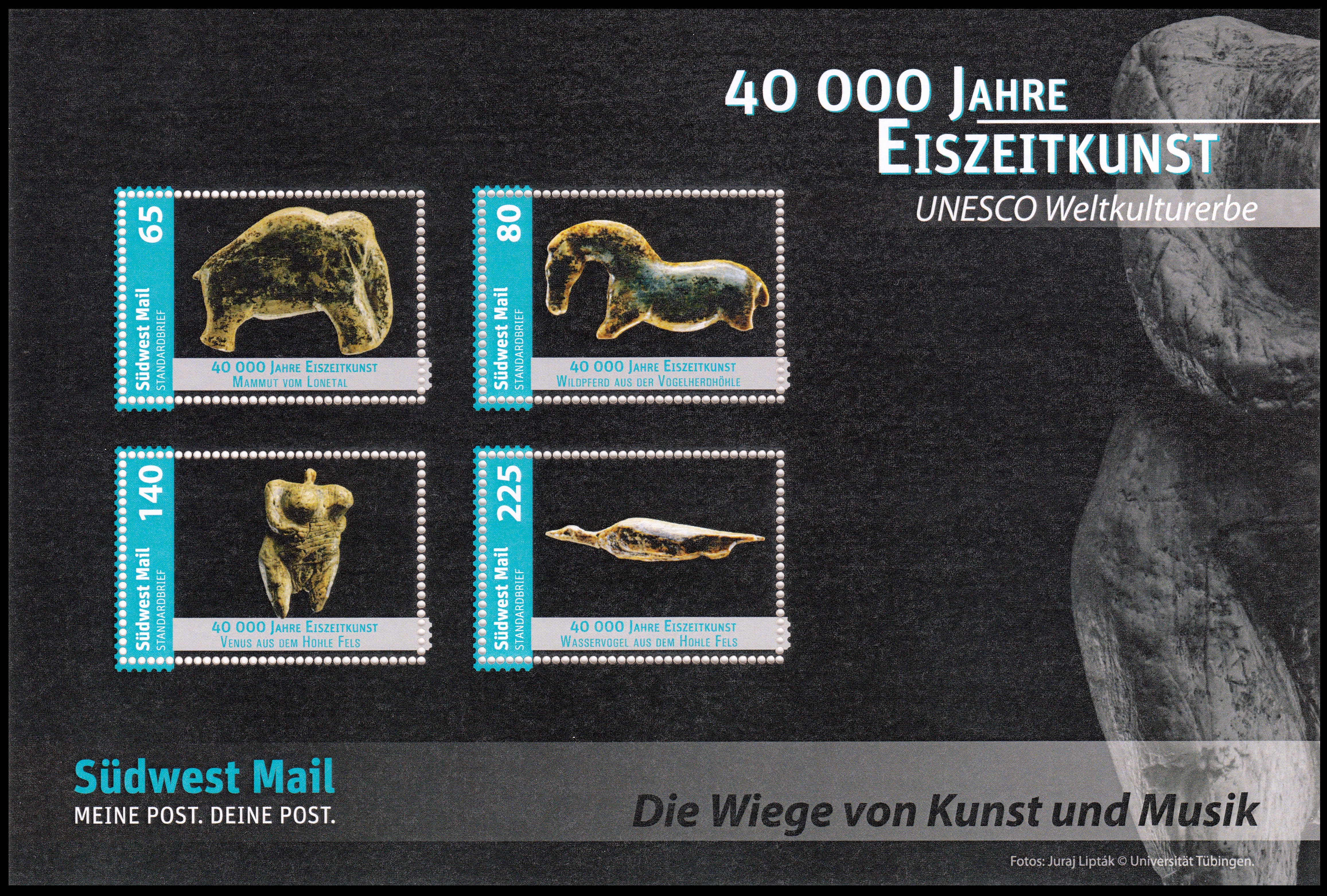
In 2017, some of these figures were depicted on postage stamps of a private post company "Suedwest mail", who operates in Swabian Alb region of Germany. This Mini-Sheet "40,000 years of the Ice Age Art" was sold in a souvenir folder with explanatory text in German. 
Today, many of these extraordinary artifacts, including originals like the Venus and the "Lion Man", are on display at the Prehistoric Museum in Blaubeuren and the Ulm Museum. Additional finds from the Swabian Alb caves can be seen at the Wuerttemberg State Museum in Stuttgart and the University Museum in Tuebingen.
The oldest known examples of figurative art and musical instruments were unearthed in caves such as Hohle Fels, Geißenkloesterle, and Sirgenstein in the Ach Valley, and Bockstein, Hohlenstein-Stadel, and Vogelherd in the Lone Valley. Recognizing their global importance, UNESCO declared these six caves and their surrounding landscapes a World Heritage Site in July 2017 under the title “Caves and Ice Age Art of the Swabian Alb.”
Even today, the Ach and Lone valleys remain largely pristine, offering visitors a unique opportunity to step back in time with scenic hiking and cycling trails that follow the footsteps of the first artists and musicians of humankind.
Most of the objects depicted on the stamp and selvages of the Souvenir-Sheet are from the collection of the Urgeschichtliche Museum Blaubeuren (URMU), in English Prehistoric Museum Blaubeuren. Blaubeuren is a small town 20km away from Ulm.
The Prehistoric Museum is the central museum for Paleolithic art and music in Baden-Württemberg. Since 2012, it has been a branch museum of the Archaeological State Museum of Baden-Württemberg. The URMU's permanent exhibition shows how Neanderthals and early modern humans lived during the last Ice Age.
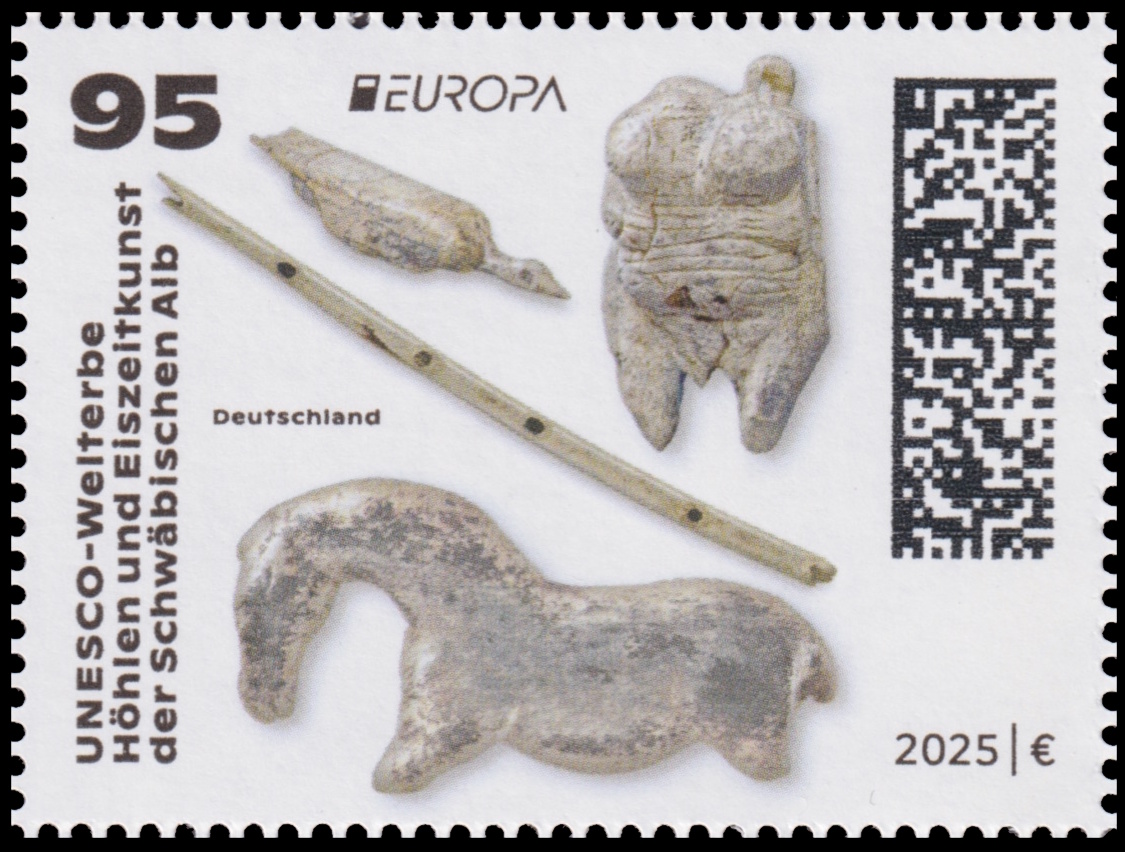
There are 25 figures depicted on the stamp and the selvages of the Souvenir-Sheet
Four unique figures are shown on the stamp in the middle of the Souvenir-Sheet: a water bird, a Venus, whooper swan flute, and a wild horse.
A water bird
Dating to around 40,000 years ago, this ivory carving is the oldest known depiction of a bird in the world. The body was discovered in 2001, with the head found the following year. The wings are folded as if the bird is about to dive, and the beak resembles that of a duck. Beyond its naturalistic form, the figure is notable for its intricate detail and exceptional craftsmanship.
 |
| The Lion-man on the right side of the Souvenir-Sheet |
Flute Made of Griffon Vulture Bone
In 2008, an almost completely preserved flute made of griffon vulture bone was discovered in Hohle Fels near Schelklingen. Like the flutes from Geißenklösterle, the instrument is between 35,000 and 40,000 years old.
Four finger holes are still intact on this particular find. The lower end of the flute appears to have broken off at a fifth hole. Given the possible length of the bone, the instrument was likely not much longer originally. At the other end of the bone, the edge was beveled, creating a notch in the shaft. This provides a clue as to how the flute was played. Whether the notched flute principle applies to all flute finds from the region is uncertain.
The Woman of Hohle Fels
The so-called Venus of Hohle Fels is the oldest known human-made female figurine. Dating to approximately 40,000 years ago, the statuette was carved from a mammoth tusk and later broke into pieces while buried in the ground. Six fragments were reassembled to form an almost complete figure. Instead of a head, the figure features a loop in the neck area, indicating that it was worn as an amulet or piece of jewelry. The figurine is immediately striking for its exaggerated sexual characteristics. The prominently protruding breasts and the clearly defined pubic triangle with an open vulva dominate the composition, while the waist is comparatively narrow. The figure does not depict pregnancy. In contrast to the simply rendered feet, the arms and hands are finely carved. Numerous notches, lines, and markings suggest symbolic meaning. Despite extensive study, the Woman of Hohle Fels has no definitive scientific interpretation. Its central message appears to be its gender: a powerful symbolic representation of femininity and sexuality, independent of any specific individual woman.
Wild Horse
The Vogelherd horse, approximately 5 cm tall, is one of the most famous works of Ice Age art. Only the head and neck are fully preserved; the body is chipped on one side. Fracture marks on the legs indicate that they were once longer and may have formed a loop with the forelegs. The head is carved with remarkable detail, showing the mouth, nostrils, eyes, and a clearly defined jaw. The curved neck suggests a stallion in a threatening or display posture, and together with the arched back gives the figure a strong sense of movement and vitality. The carefully smoothed neck and back are decorated with notched cross patterns. Black manganese deposits, formed during long burial in the ground, are visible on this and many other figures. The original is housed at the Museum of the University of Tübingen, with a replica on display at the URMU.
 |
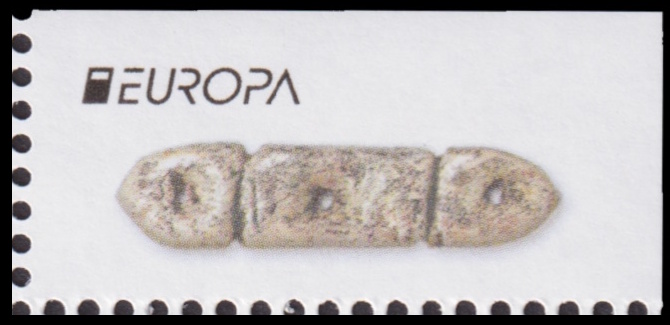 |
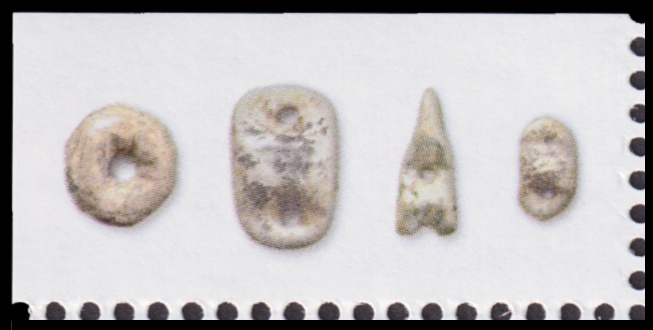
| Jewelry from mammoth ivory was featured on the selvages on the top-left and top-right corner of the Souvenir-Sheet, respectively. |
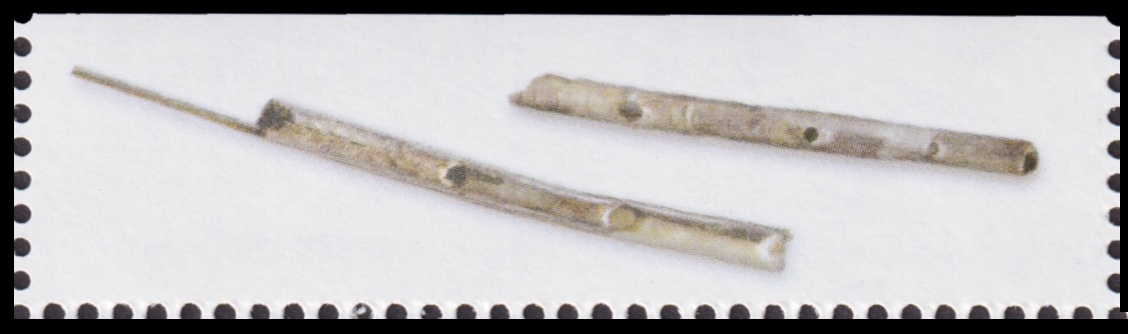 |
| Mammoth ivory and swan bone flutes on the top-middle of the Souvenir-Sheet |
 |
| The flute from thigh bone (femur) of a juvenile cave bear (Ursus spelaeus) on stamp of Slovenia 2007. |
Jewelry from mammoth ivory were featured on the selvages on the top-left corner of the Souvenir-Sheet.
The double-hole beads, teardrop-shaped pendants made of mammoth ivory are a typical form for the Aurignacian period in the Ach and Lone valleys, dated between 33.000 and 31.000 years old. Hundreds of them have been unearthed at some sites. And even if it is unclear whether they served any function beyond decoration, the fineness of the beads is striking; many of the double-hole beads are no larger than one centimeter.
The two flutes were featured on the selvages on the top-middle of the Souvenir-Sheet.
The first flute, shown with an elongated fragment, is the mammoth ivory flute from Geißenklösterle site, a unique technical masterpiece of Paleolithic craftsmanship. Initially published in 1988 as a decorated ivory fragment, it was only in 2003 that excavation technician Maria Malina identified the finger holes and reassembled the flute from 31 fragments.
The instrument was made by shaping a sliver of mammoth tusk, splitting it lengthwise, hollowing both halves, and rejoining them with birch tar and animal sinew. Three finger holes are still visible, and a notch at one end likely served as the mouthpiece.
As the flute is incomplete, its exact playable notes cannot be determined, though the intervals between notes can be inferred from the finger holes.
Another flute is the Swan Bone Flute.
It was discovered largely by chance. While examining animal bone remains, Dr. Susanne Münzel identified carved holes and was able to reconstruct a flute from more than 20 fragments.
The flute has a preserved length of 126.5 mm and three finger holes. It was made from the radius (wing bone) of a whooper swan. Traces of manufacture remain visible: after the surface was cleaned and smoothed, the finger holes were carefully scraped rather than drilled, as drilling would have caused irregular breaks that disrupted airflow.
Because of its short length and narrow diameter, the flute produces a relatively high pitch and is more difficult to play than larger Paleolithic bone flutes, which were often made from cubit bones. The blowing end is not preserved, so the original playing technique is unknown.
Since the instrument is incomplete and bone shapes vary naturally, the exact notes cannot be determined; only the intervals between notes can be inferred from the finger holes.
The original flute is displayed at the Landesmuseum Württemberg in Stuttgart, with a replica exhibited at the URMU.
Note: To date, the only flute made from the bone of a prehistoric animal to be featured on a postage stamp is the flute crafted from the thigh bone (femur) of a juvenile cave bear (Ursus spelaeus). This artifact was discovered among cave bear remains in Divje Babe I Cave and was featured on a Slovenian postage stamp issued in 2007.
The left side of the Souvenir-Sheet features four figures, three mammoth figures and a fish.
The first figure is a mammoth figurine measuring nearly 7 cm in length and composed of 40 fragments. The body and shortened legs are well preserved, while much of the skull is missing. One fragment shows part of the trunk and possibly the tusks. Incised lines are visible on the smoothed surfaces of the back, belly, and flanks. Traces of red ochre raise the question of whether the pigment was deliberately applied or resulted from storage in a container stained with ochre.
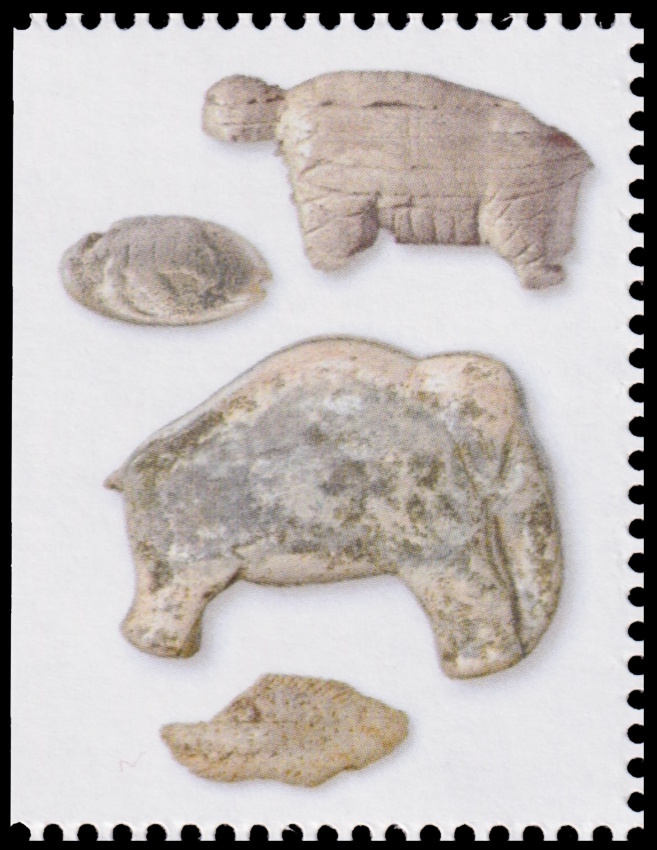 |
| Mammoth and fish figures on the left side of the Souvenir-Sheet |
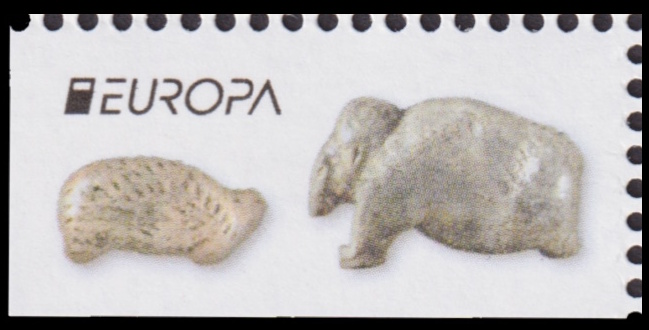 |
| Mammoth and hedgehog figures on the left side of the Souvenir-Sheet |
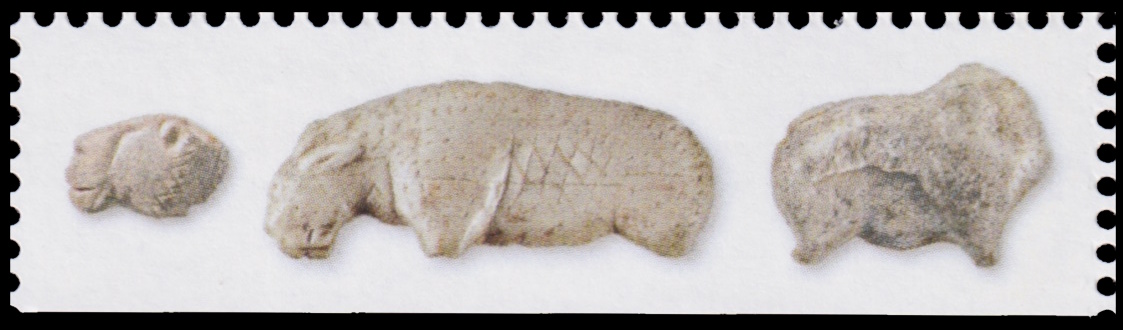 |
| A cave lion head, a big cat and a buffalo on the bottom-middle side of the Souvenir-Sheet |
The second figure is a retoucher with an engraved mammoth. It features a mammoth in relief carved into a massive, oval piece of antler, with the foreleg, head with trunk, and belly clearly visible. Three deep vertical lines are engraved on the animal’s flanks. A broken loop at the edge suggests the object was worn as a pendant.
Wear marks on the surface indicate that the piece was also used as a retoucher, a tool for shaping stone tools. The original is housed at the University of Tübingen, with a replica displayed at the URMU. A 3D scan of the object is available on the URMU website.
The third figure is a mammoth figurine approximately 5 cm long, discovered in 2006 during follow-up excavations of the spoil heap from the 1931 dig. Its realistic form and fine details, including a curved trunk, eyes, ears, suggested tusks, and a small tail—give the animal a remarkably lifelike appearance.
The figurine bears only minimal markings: six fine lines on the head and a cross pattern on the soles of the feet. It is completely intact, though a crack runs along the tusk’s growth rings. The figure is dated to approximately 40,000 years old.
The fourth figure is a fish. This ivory figurine, approximately 7 cm long, is the only known example to depict a fish. The head, with a clearly indented eye, the mouth, the anterior and posterior pelvic fins, and the dorsal fin are all clearly recognizable. The fins are marked with obliquely incised lines, while the body features dotted markings. The depiction may represent a trout. The original is housed at the University of Tübingen, with a replica on display at the URMU.
Another mammoth and a hedgehog figure are featured on the bottom-left side of the Souvenir-Sheet.
The hedgehog is a small figurine carved from mammoth ivory. Elongated notches on its body likely represent spines. It has a rounded rear, leg buds at both ends of the belly, and a partially preserved head raised forward and upward.
The figure was discovered at Niederstotzingen, Heidenheim, and is dated to approximately 40,000 years ago. The original is housed at the University of Tübingen, with a replica on display at the URMU.
The figures on the bottom-middle of the Souvenir-Sheet feature a cave lion head, a big cat and a buffalo.
Head of a Cave Lion
This lion’s head is intricately carved from mammoth ivory. A series of notches runs across the muzzle, and a band of cross-hatching extends across the neck behind the finely shaped, rounded ears. It is unclear whether the carving originally depicted only the head or a complete lion figure. The strong carving marks around the eye and at the base of the neck contrast strikingly with the delicate notching.
The piece comes from a private collection and represents only the left third of the head; the right third is also privately held, while the central ivory section is missing.
The figure was discovered at Niederstotzingen, Heidenheim and dated at 40,000 years old. The original is on display at the Landesmuseum Württemberg in Stuttgart, with a replica exhibited at the URMU.
Big Cat
This depiction of a big cat, often called a “lion,” was originally found in 1931 as only half a body and described as a half-relief. The muzzle, jaw, and ears are finely carved, and the smoothed surface bears numerous markings: rows of dots on the back and thighs and diamond-shaped cross-hatching on the flanks.
A fragment of the head with muzzle, recovered in later excavations, shows that the nearly 9 cm long figure was originally carved in the round.
The original is housed at the University of Tübingen, with a replica displayed at the URMU.
Buffalo
This Ice Age buffalo was carved in the round from mammoth ivory, though only one side of the body survives, and the head and tail are missing. The withers, back, and hindquarters remain clearly recognizable, and the neck shows traces of heavier hair. The pronounced withers indicate an adult male.
The figure’s surface is largely intact, with deep incised lines along the back and dots on the belly and shoulders. It was discovered at Niederstotzingen, Heidenheim, and is dated to approximately 40,000 years ago. The original is housed at the University of Tübingen, with a replica displayed at the URMU.
Cave Bear
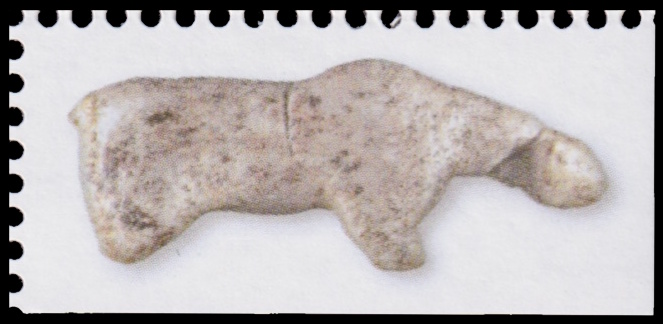 |
| A cave bear on the bottom-right side of the Souvenir-Sheet |
The figure was discovered at Niederstotzingen, Heidenheim, and is dated to approximately 40,000 years ago. The original is housed at the University of Tübingen, with a replica on display at the URMU.
Three figures of Lion-men were depicted on the right side of the Souvenir-Sheet.
Small Lion Man
This 2.5 cm tall figurine is broken, with only half preserved. Its resemblance to the Lion Man from Hohlenstein-Stadel is clear, as seen in the upright posture, pronounced shoulder, rounded lion-like muzzle, and small round ear. The find suggests connections between Ice Age people of the Ach and Lone valleys and reflects a shared worldview in which hybrid human-animal beings held significance. It was discovered at Schelklingen, Alb-Donau-Kreis, and is dated to approximately 40,000 years ago.
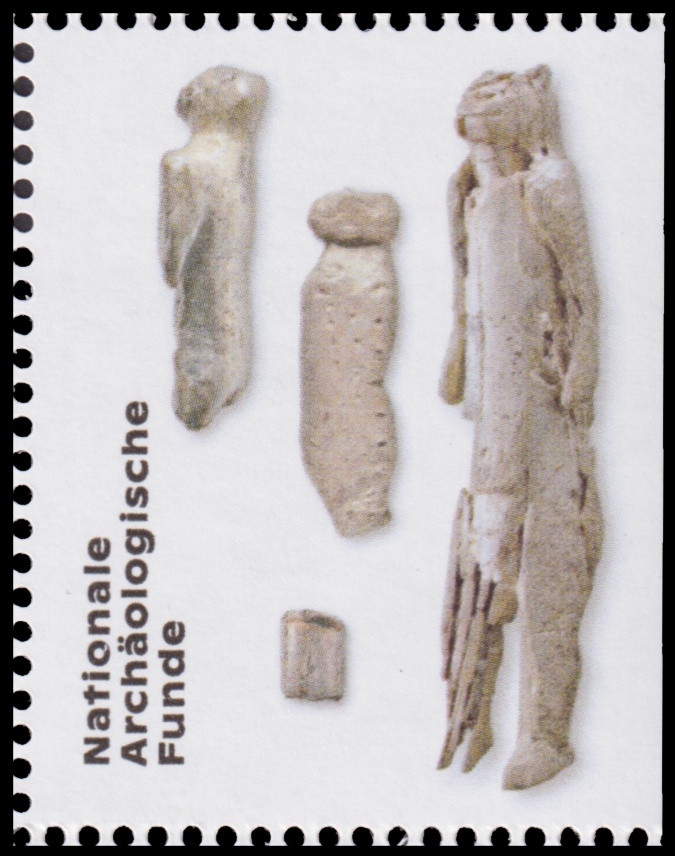 |
| The Lion-man on the right side of the Souvenir-Sheet |
This ivory carving, approximately 7 cm high, is described as an anthropomorphic (human-like) representation. A flat, button-like head sits atop the elongated body, set off by a notch. The body is decorated with rows of dots and has a slight indentation in the middle on one side, possibly suggesting the buttocks. The thinning at the bottom could represent shortened legs. It was discovered at Niederstotzingen, Heidenheim and dated at 40,000 years old. The original is housed at the University of Tübingen, with a replica on display at the URMU.
Lion Man
The Lion Man is the largest and most enigmatic artwork from the early Upper Paleolithic, around 40,000 years ago. On August 25, 1939—the final day of excavation before World War II, fragments of the sculpture were found. Initially recognized as pieces of an ivory figurine, its subject remained unknown. Over 30 years passed before the first reconstruction, and another two decades before professional restoration, though important parts were still missing.
In 2009, archaeologists rediscovered the original find spot in Stadel Cave, uncovering excavation debris from 1939 containing about 700 additional ivory fragments of the Lion Man. A major restoration in 2012–13 disassembled, cleaned, and reassembled the figure. The statuette is now nearly complete, standing 31.1 cm tall, revealing details that shed light on its creation and possible meaning. Carved entirely from the tusk of a young mammoth, the Lion Man depicts a hybrid being—part human, part cave lion, the Ice Age’s most formidable predator. The lion’s head, elongated body, and paw-like arms are animalistic, while the legs, feet, and upright posture are human. Visible details indicate the figure is male. Though it appears static at first, careful observation suggests an attentive, tense posture. Whether representing a mythological creature or a human wearing a lion mask, the Lion Man offers a remarkable glimpse into the spiritual world of Ice Age people. It was discovered at Asselfingen, Alb-Donau-Kreis. The original is housed at the Ulm Museum, with a replica on display at the URMU.
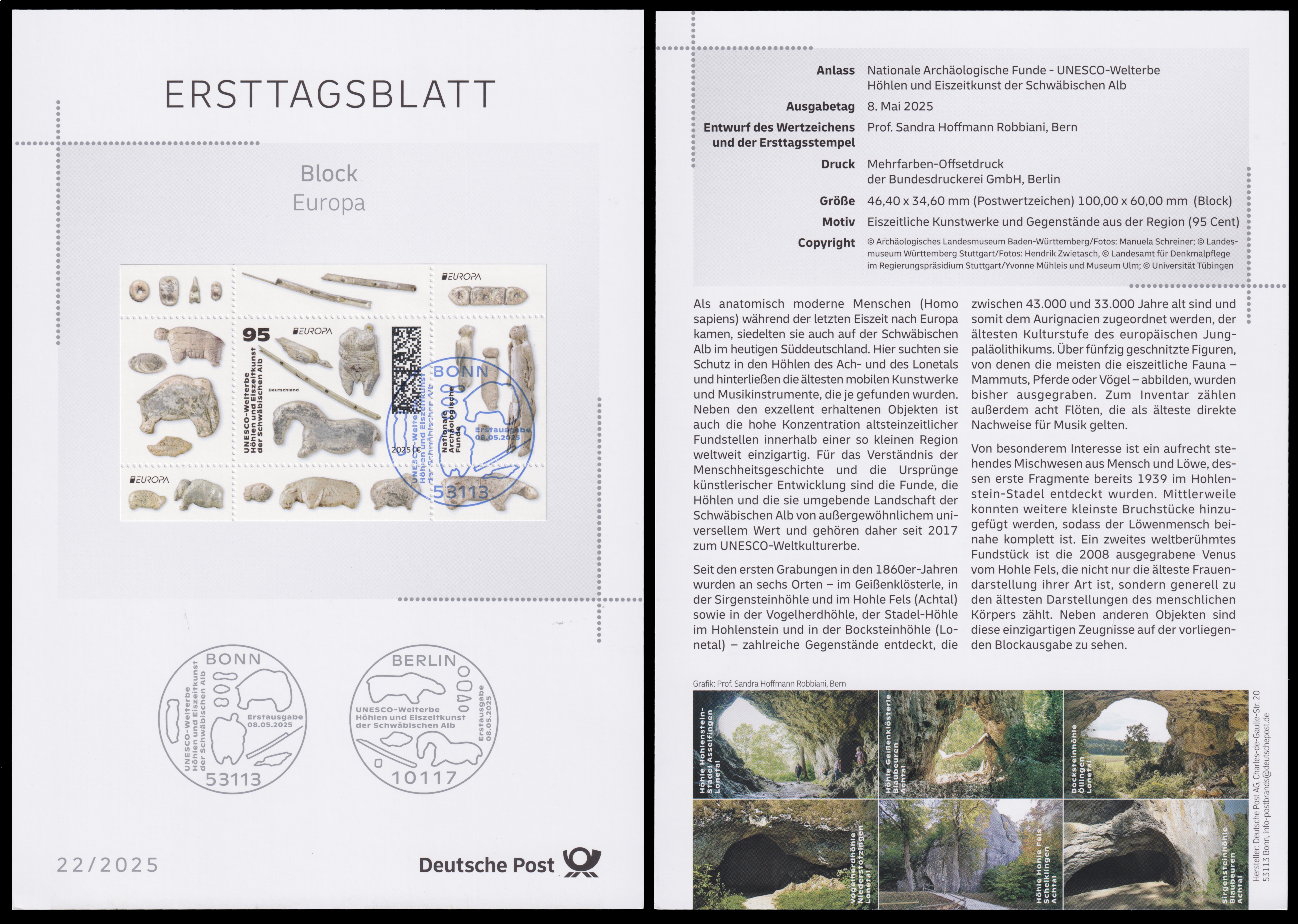
Products and associated philatelic items
| First-Day-of-Issue Postmark | Souvenir-Booklet: "Archaeology in Germany" | |
 |
 |
 |
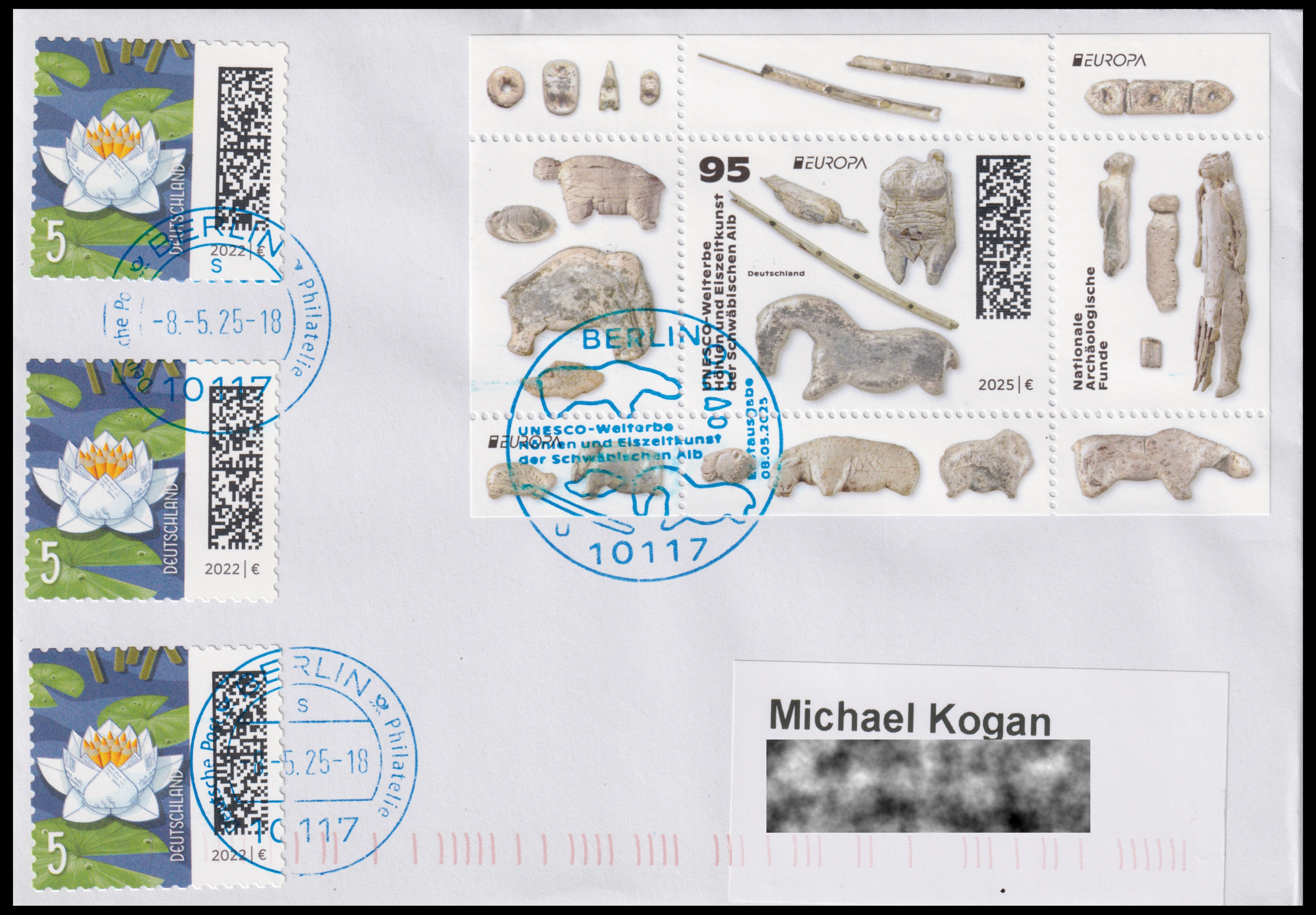
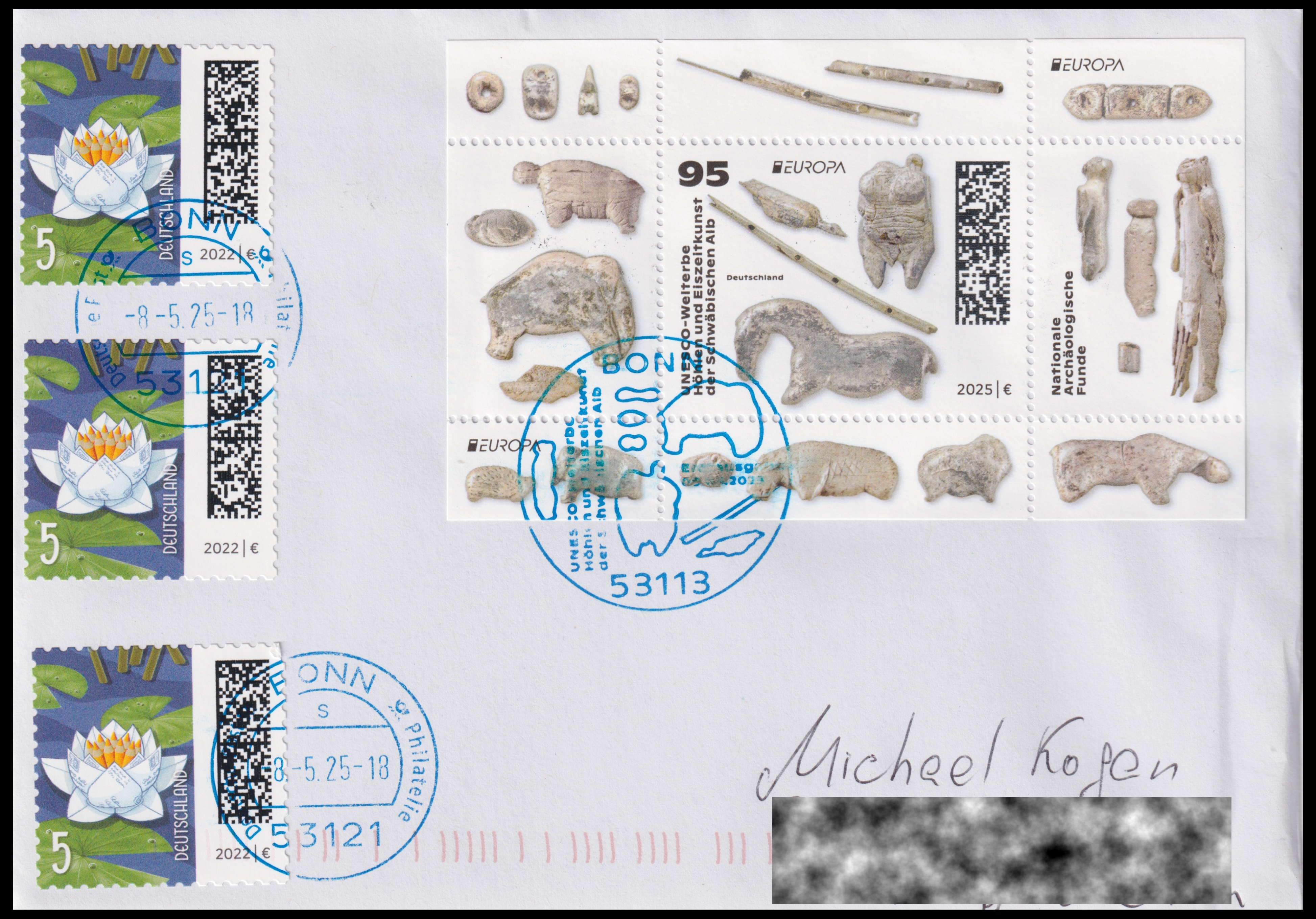
| Examples of circulated covers | First Day Sheet | |
 |
 |
 |
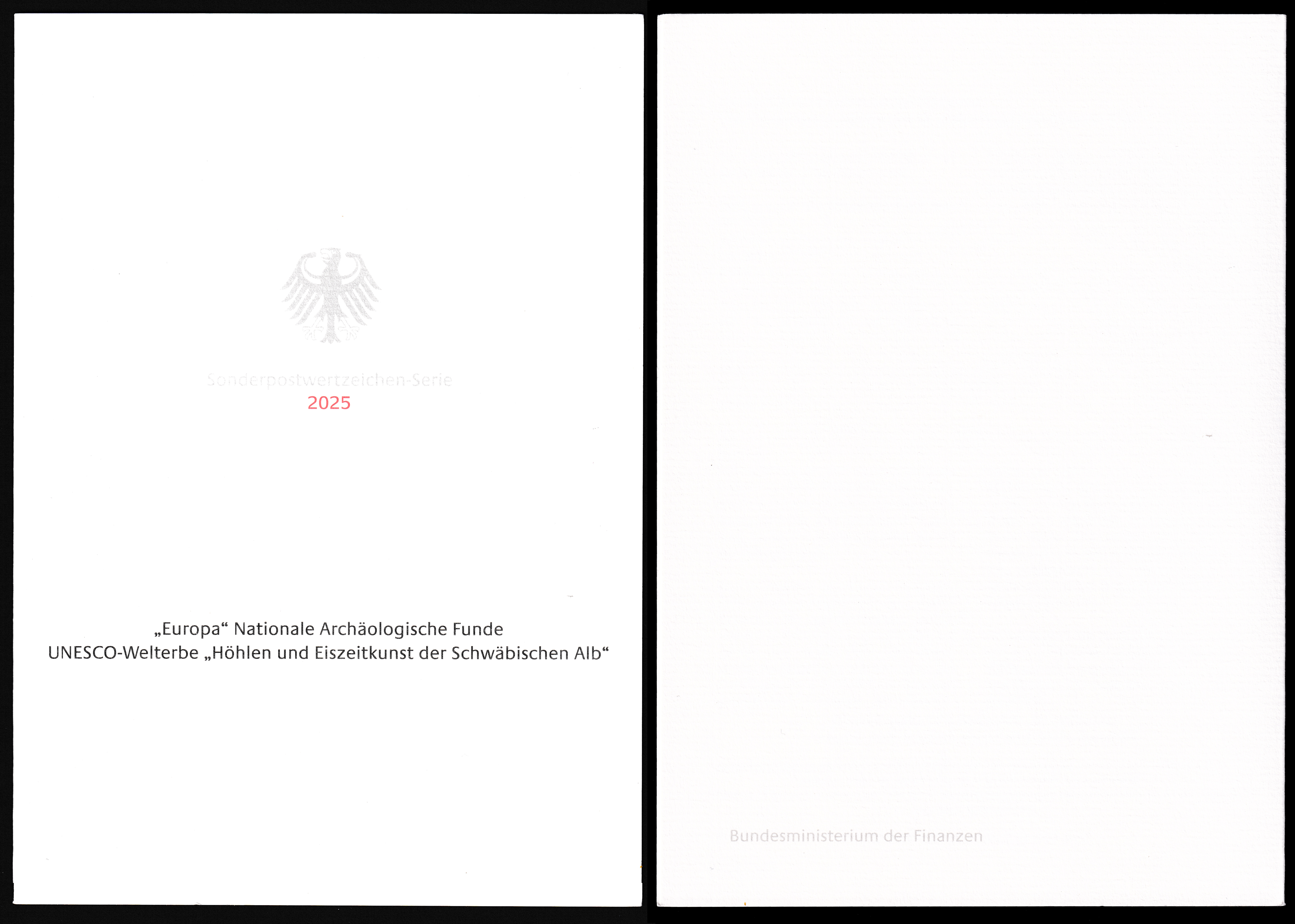
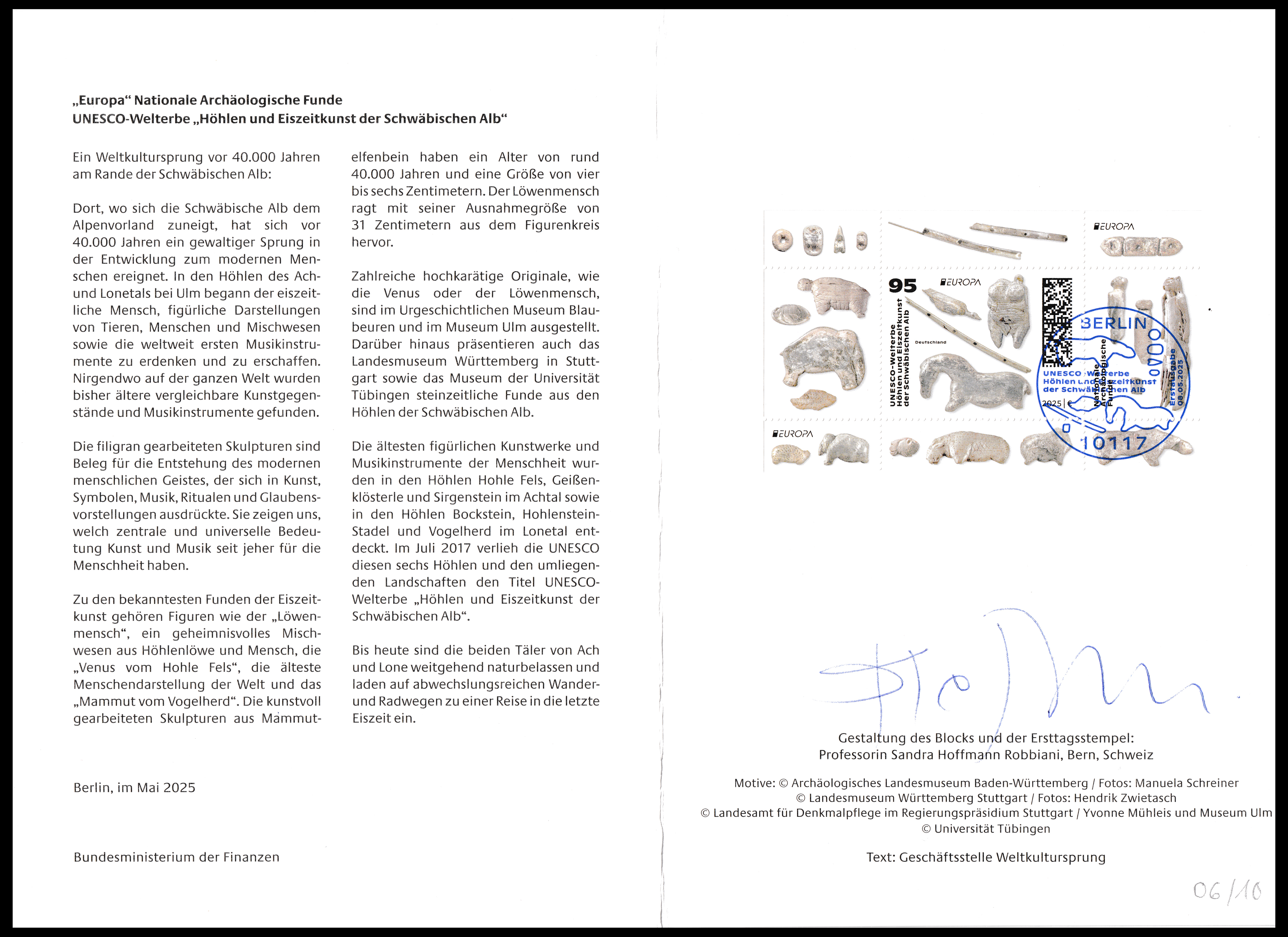
| Souvenir Card of German Federal Ministry of Finance, signed by the stamp designer Sandra Hoffmann Robbiani | |
 |
 |
Stamp Show in Ulm (23-25.10.2025)
The International Stamp Show (Briefmarken-Börse) Ulm 2025, took place from 23 to 25 October at the Ulm Fair Center. The stamps show in Ulm is the biggest stamp show in the south of Germany, bringing together collectors, dealers, postal administrations, and specialist groups from Germany and abroad.
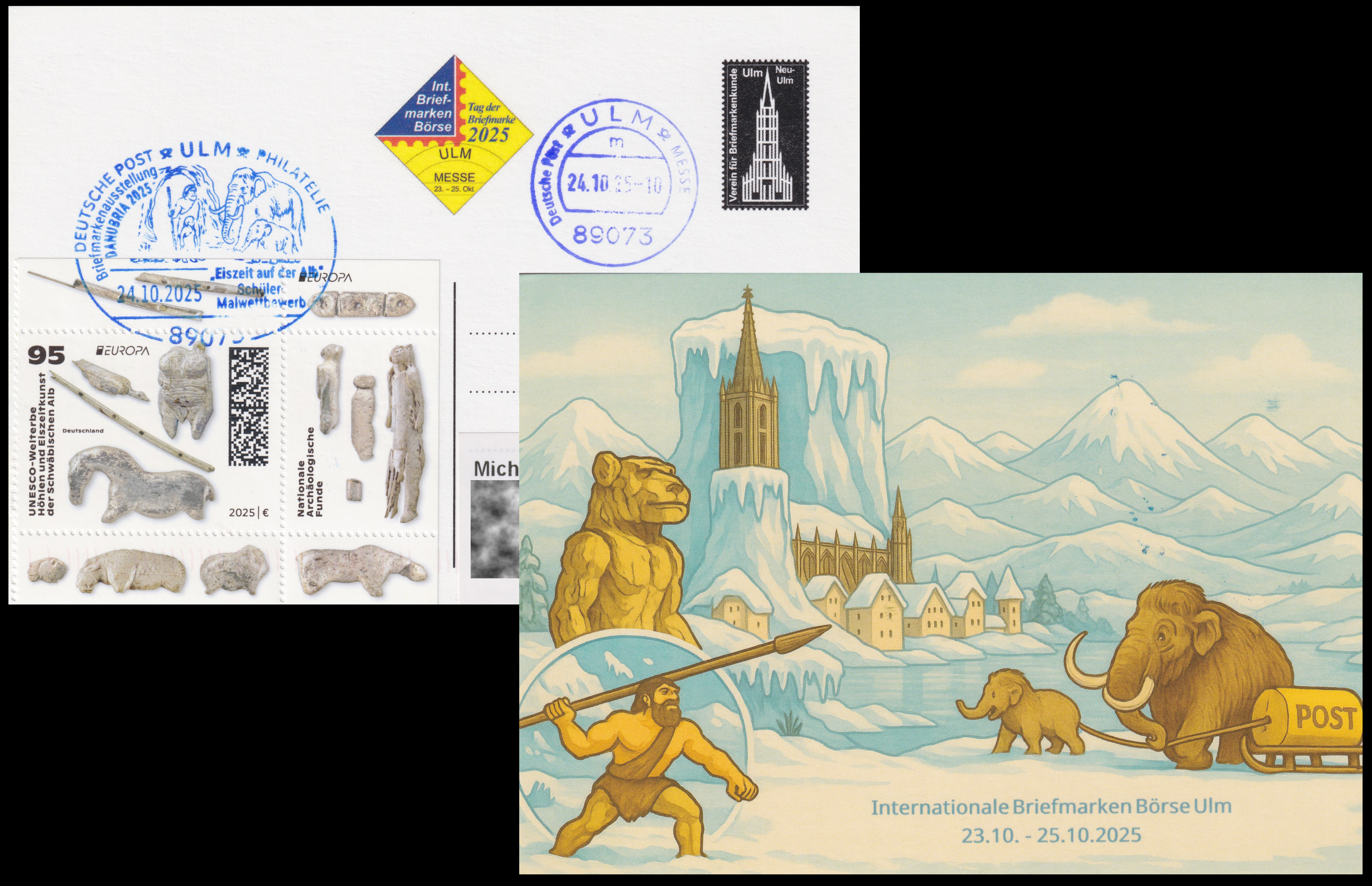
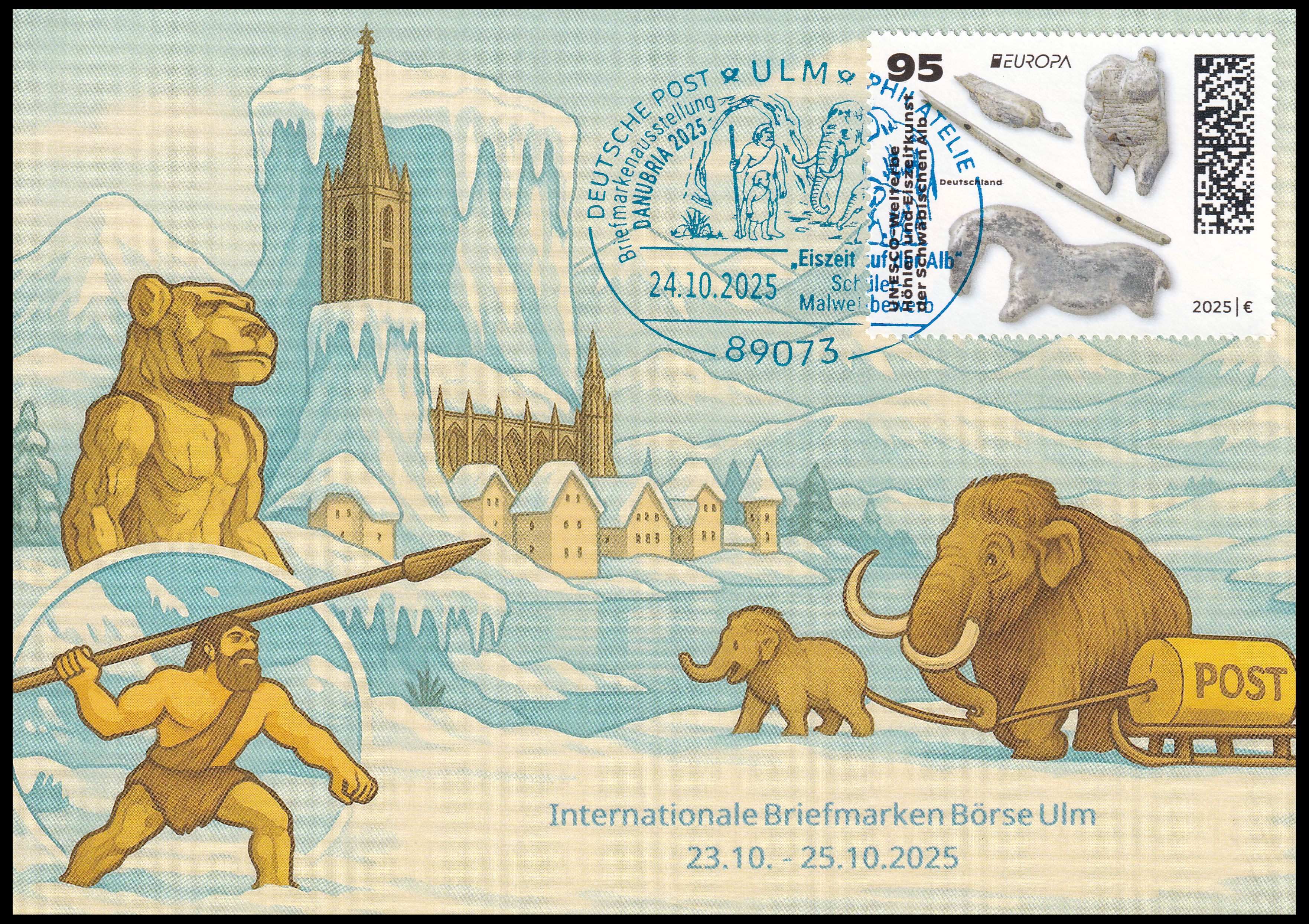
Landesverband Südwestdeutscher Briefmarkensammlervereine im Bund Deutscher Philatelisten e. V. (LSW), in English Regional Association of Southwest German Stamp Collecting Societies within the Federation of German Philatelists, organized a school drawing competition with the title, “Eiszeit auf der Alb” ("Ice Age in Alb"). The best 10 of 194 images were issued on the personalized stamps, which sold during the stamp show. The Society also issued a postcard and a commemorative postmark featuring Neanderthals and a couple of mammoths. The famous Lion-Man was also depicted on the postcard.
Together, the postcard and the special cancellation form an attractive contemporary philatelic souvenir that vividly documents the Ulm stamp show of 2025.
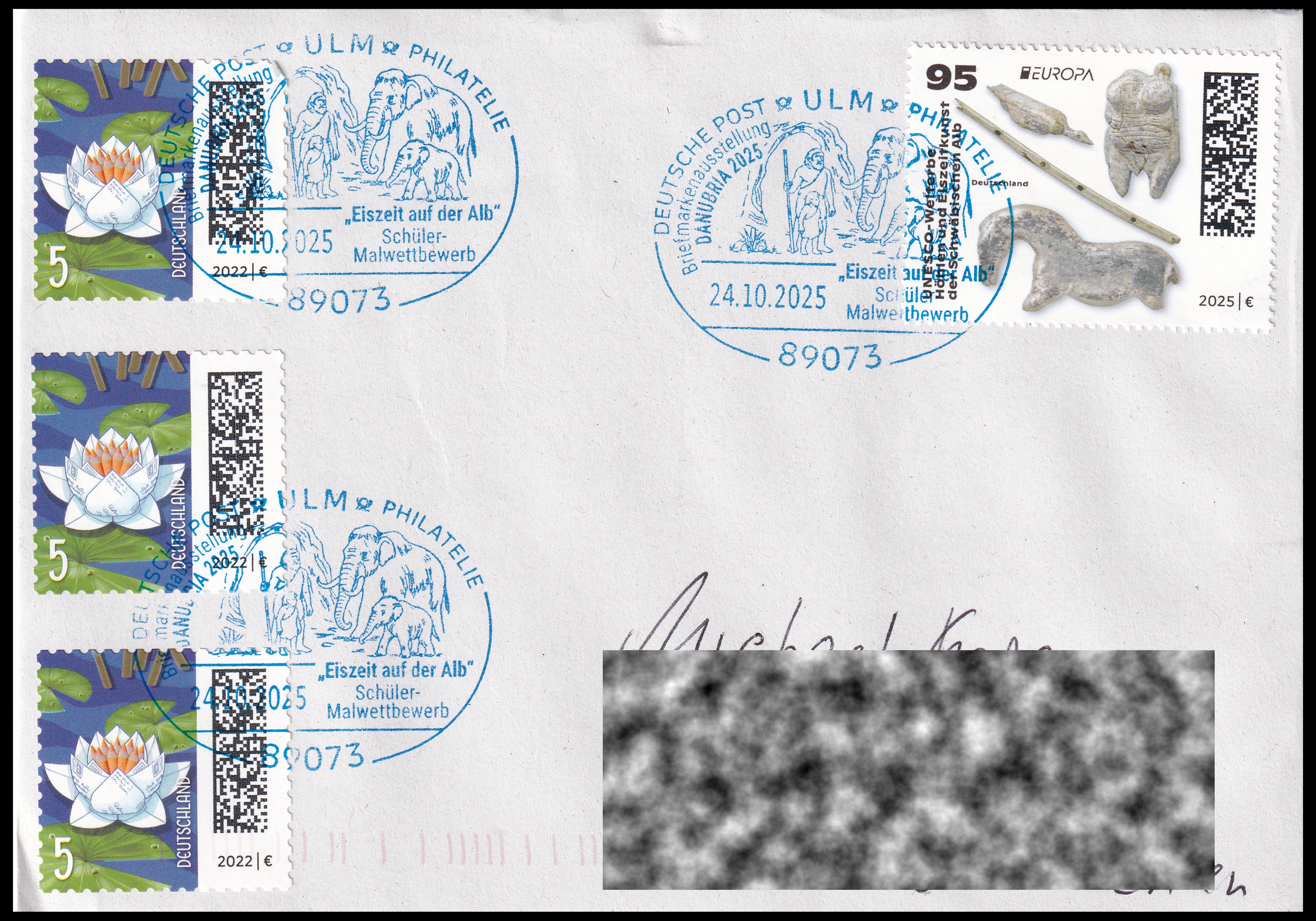
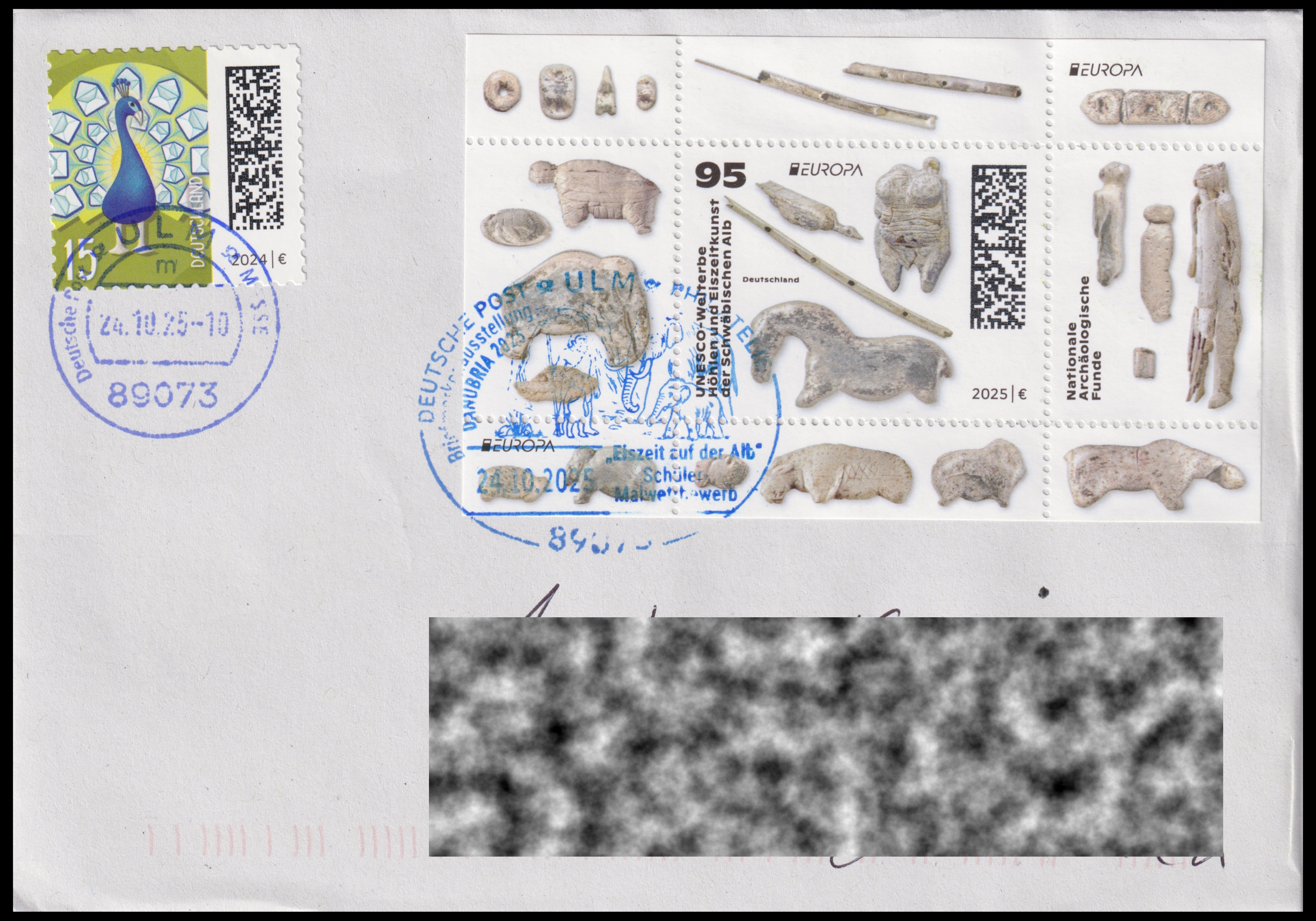
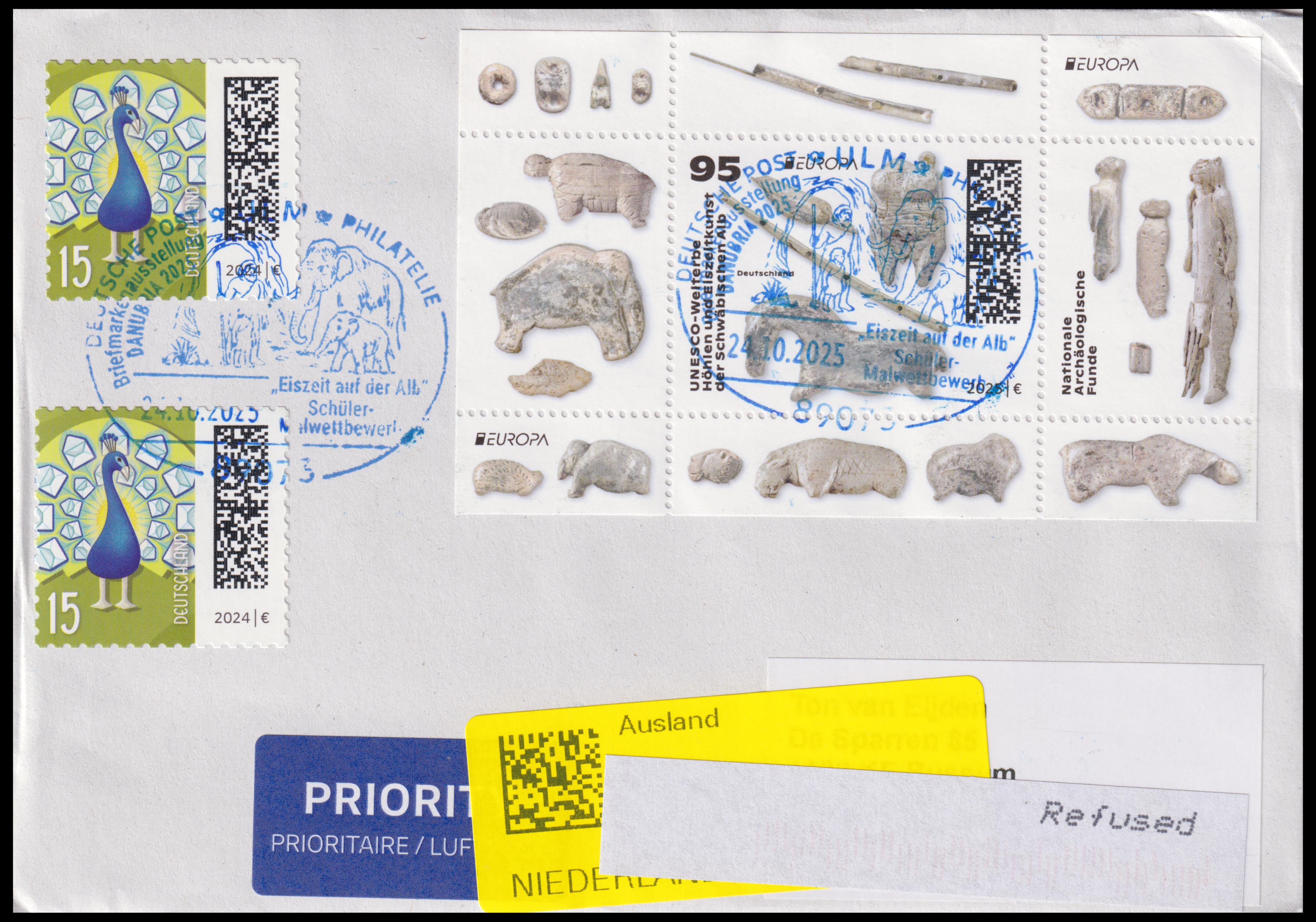
Some collectors used the opportunity to create a Maxi Cards or send the letters with the Europa 2025 stamp cancelled by the postmark of the same topic.
| Commemorative Postmark | Postcard | Maxi Card |
 |
 |
 |
| Examples of circulated covers | ||
 |
 |
 |
References
|
|