Canada 1990 "Prehistoric Life in Canada I, The Age of Primitive Life"
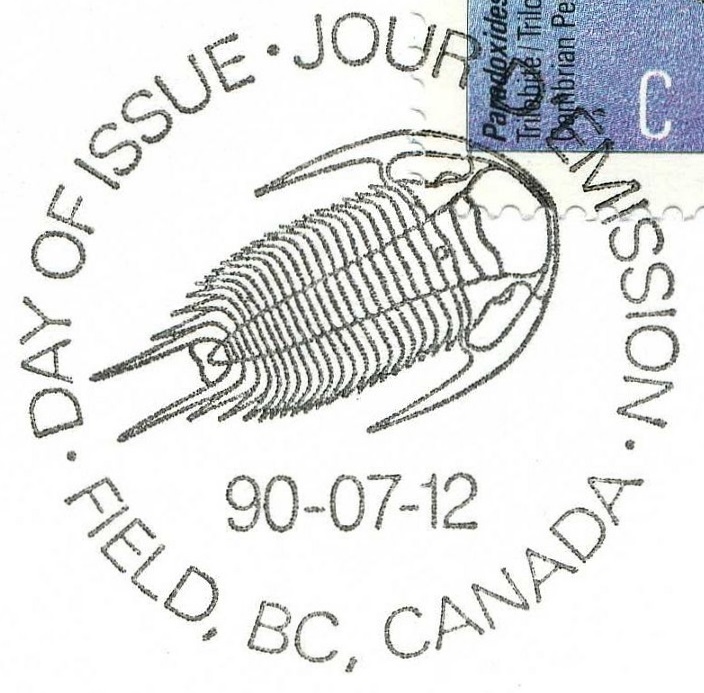
| Issue Date | 12.07.1990 |
| ID | Michel: 1187-1190, Scott: 1281-1283, Stanley Gibbons: 1390-1393, Yvert et Tellier: 1149-1152 Category: pR |
| Design |
Designed by Rolf P. Harder, engraved by Yves Baril |
| Stamps in set | 4 |
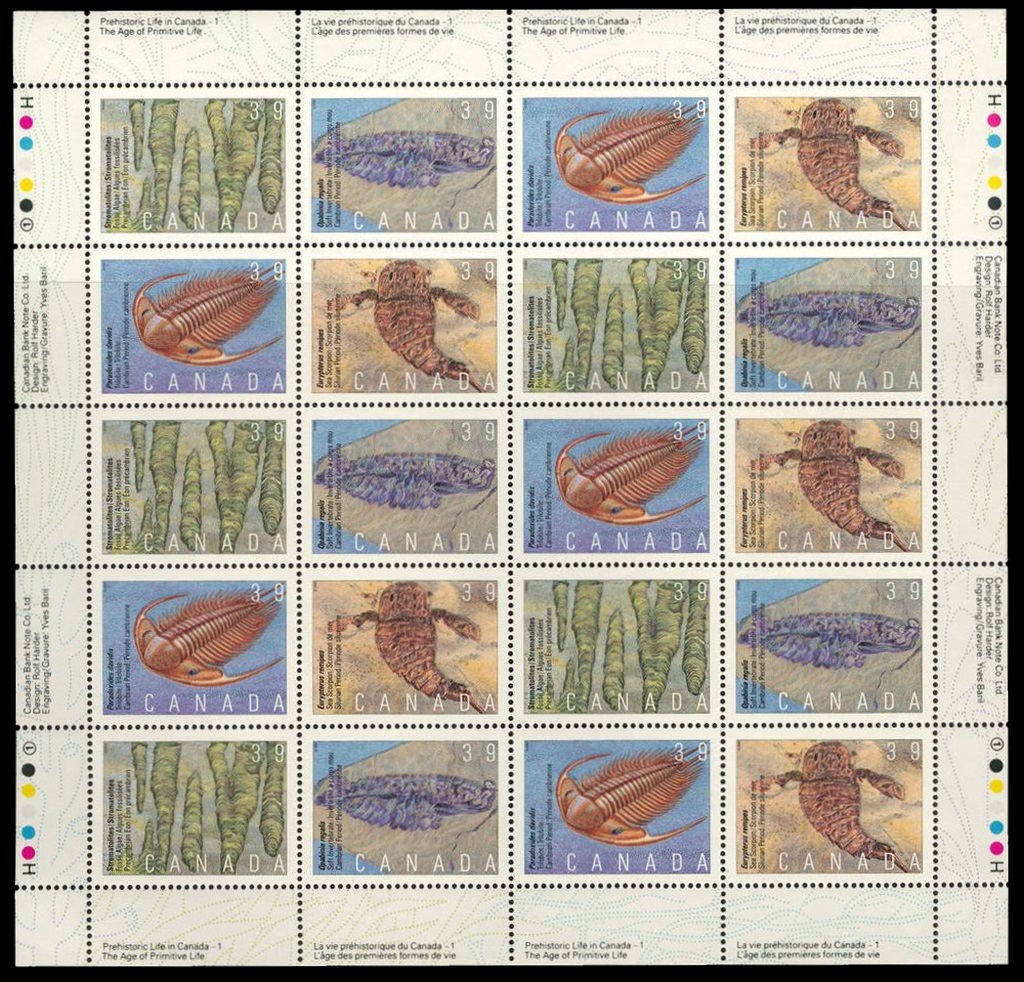
| Value | c39 - Stromatolites, Fossil Algae, Precambrian Eon c39 - Opabinia regalis, Soft Invertebrate, Cambrian Period c39 - Paradoxides davidis, Trilobite, Cambrian Period c39 - Eurypterus remipes, Sea Scorpion, Silurian Period |
| Emission/Type | commemorative |
| Places of issue | Field, BC |
| Size (width x height) | 40mm x 30mm |
| Layout | Sheet of 20 stamps |
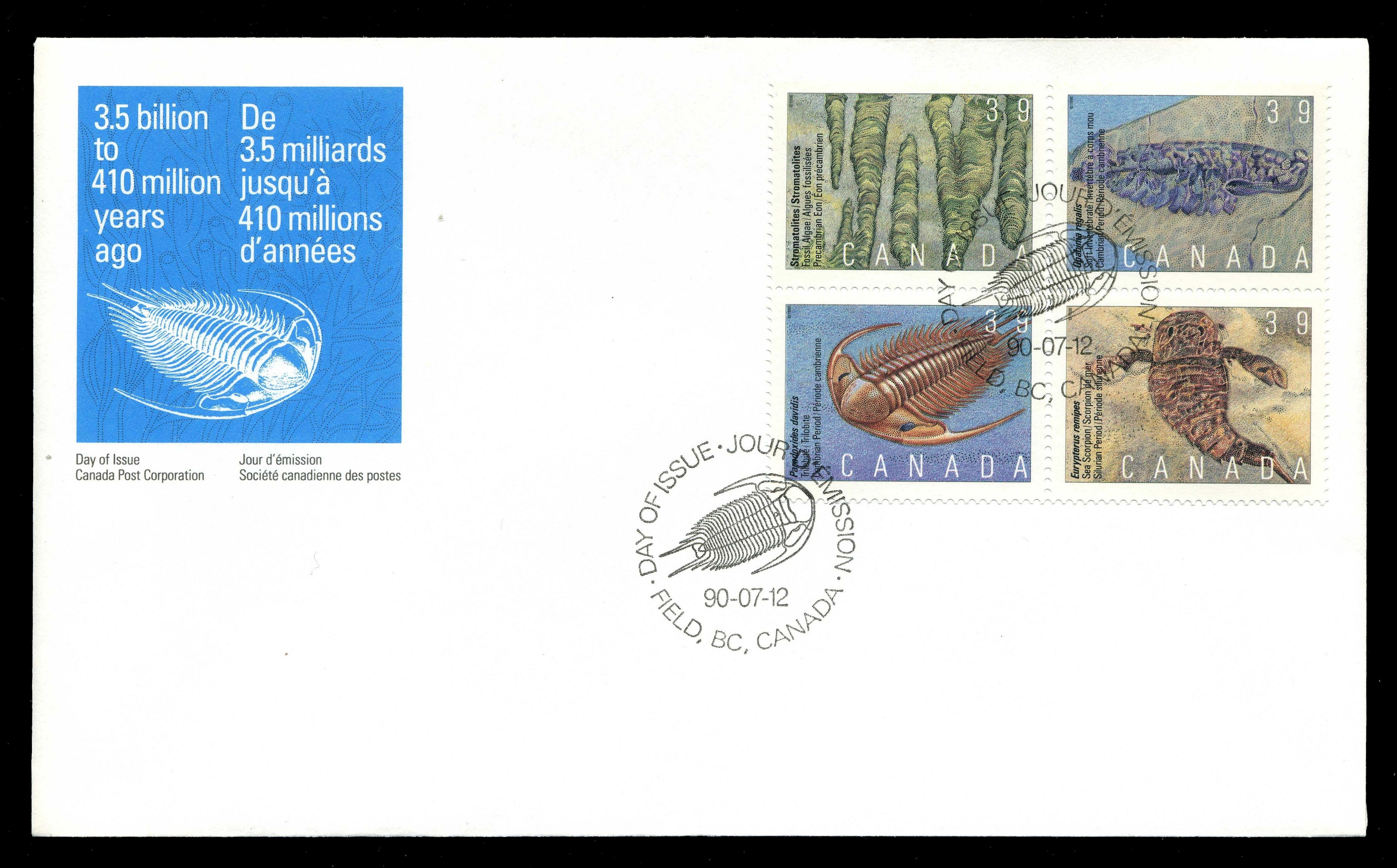
| Products | FDC x1 |
| Paper | HP - Harrison and Sons Inc., no watermark |
| Perforation | 13 x 13.5 |
| Print Technique | Offset lithography and Recess |
| Printed by | Canadian Bank Note Company, Limited |
| Quantity | 3 750 000 each |
| Issuing Authority | Canadian Post |
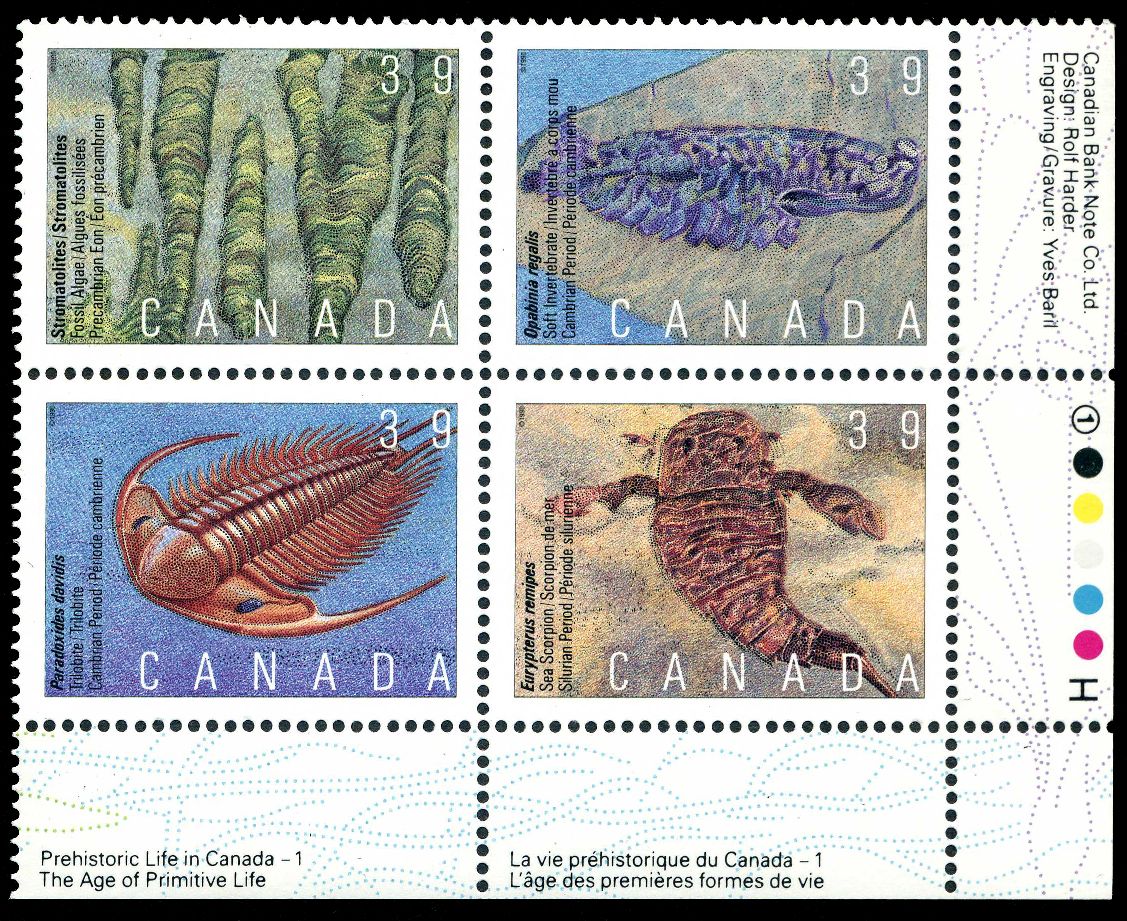
On July 12 1990, Canadian Post issued the set "Prehistoric Life in Canada, The Age of Primitive Life" - the first four stamps in a four-year series on "Prehistoric Life in Canada". This series covers a time period from 1,9000 million to 10,000 years ago and features organisms found as fossils in different parts of Canada.
Montreal graphic designer Rolf Harder worked closely with Canadian paleontologists to ensure the accurate depiction of these prehistoric life forms in his art.
Rolf Harder was born in Hamburg, Germany in 1929.
He studied at the Hamburg Academy of Fine Arts and spent most of the 1950s working as a designer
and art director in both German and Canadian ad agencies and design firms.
He moved to Montreal in 1959 and opened his own firm, Rolf Harder Design.
In 1972, he was a founding member of Editions Signum and Signum Press, publishers
of limited editions of original graphics and books.
In 1990s he was the head of Rolf Harder and Associates Inc. in Quebec.
His work has won more than one hundred national and international design awards
in countries throughout the world and has appeared in professional publications in
North America, Europe, Korea, and Japan.
Harder (died in 2013) has had long-term relationships with clients in government, including Canada Post.
He has designed more than 60 postage stamps, including all four stamp issues of
"Prehistoric Life in Canada" (1990 - "The Age of Primitive Life",
1991 - "The Age of Primitive Vertebrates",
1993 - "The Age of Dinosaurs",
1994 - "The Age of Mammals")
These stamps from "The Age of Primitive Life" shows the following prehistoric animals, discovered in the territory of Canada:
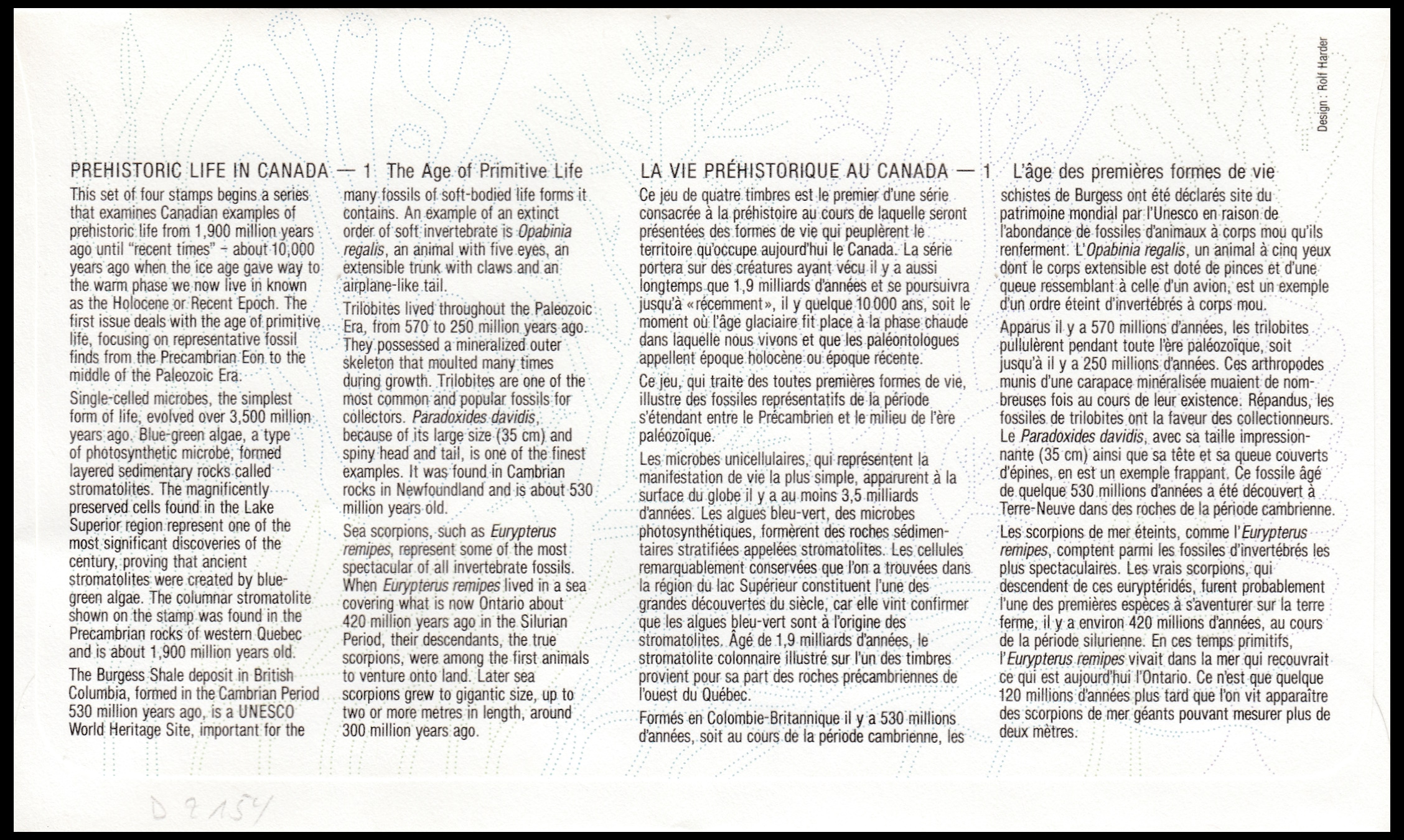
- Single-celled microbes, the simplest form of life, evolved over 3,500 million years ago Blue=green algae, a type of photosynthetic microbe, formed layered sedimentary rocks called stromatolites. The magnificently preserved cells found in the Lake Superior region represent one of the most significant discoveries of the century, proving that ancient stromatolites were created by blue-green algae. The columnar stromatolite shown on the stamp was found in the Precambrian rocks of westem Quebec and is about 1,900 million years old.
- The Burgess Shale deposit in British Columbia, deposited during the Cambrian Period 530 million years ago, is a UNESCO World Heritage Site, important for the many fossils of soft-bodies life forms it contains. An example of an extinct species of invertebrate isOpabinia regallis, an animal with five eyes, an extensible trunk with claws and an airplane-like tail. Opabinia regallis an extinct order of invertebrates with no living relatives.
- Trilobites lived throughout the Paleozoic Era, from 570 to 250 million years ago. They possessed a mineralized outer skeleton that moulted many times during growth. Trilobites are one of the most common and popular fossils for collectors. Paradoxides davidis because of its large size (35 cm) and spiny head and tail, is one of the finest examples found in Cambrian rocks of Newfoundland and is about 530 million years old.
-
Sea scorpions, such as Eurypterus remipes represent some of the most
spectacular of all invertebrate fossils.
When Eurypterus remipes lived in a sea covering what is now Ontario
about 420 million years ago in the Silurian Period their cousins,
the true scorpions, were among the first animals to venture onto land.
Later sea scorpions grew to gigantic size, up to two or more metres in length,
around 300 million years ago.
Eurypterids are a member of the chelicerata. The chelicerates include three major groups- the horseshoe crabs
- the eurypterids
- the arachnids
Products and associated philatelic items
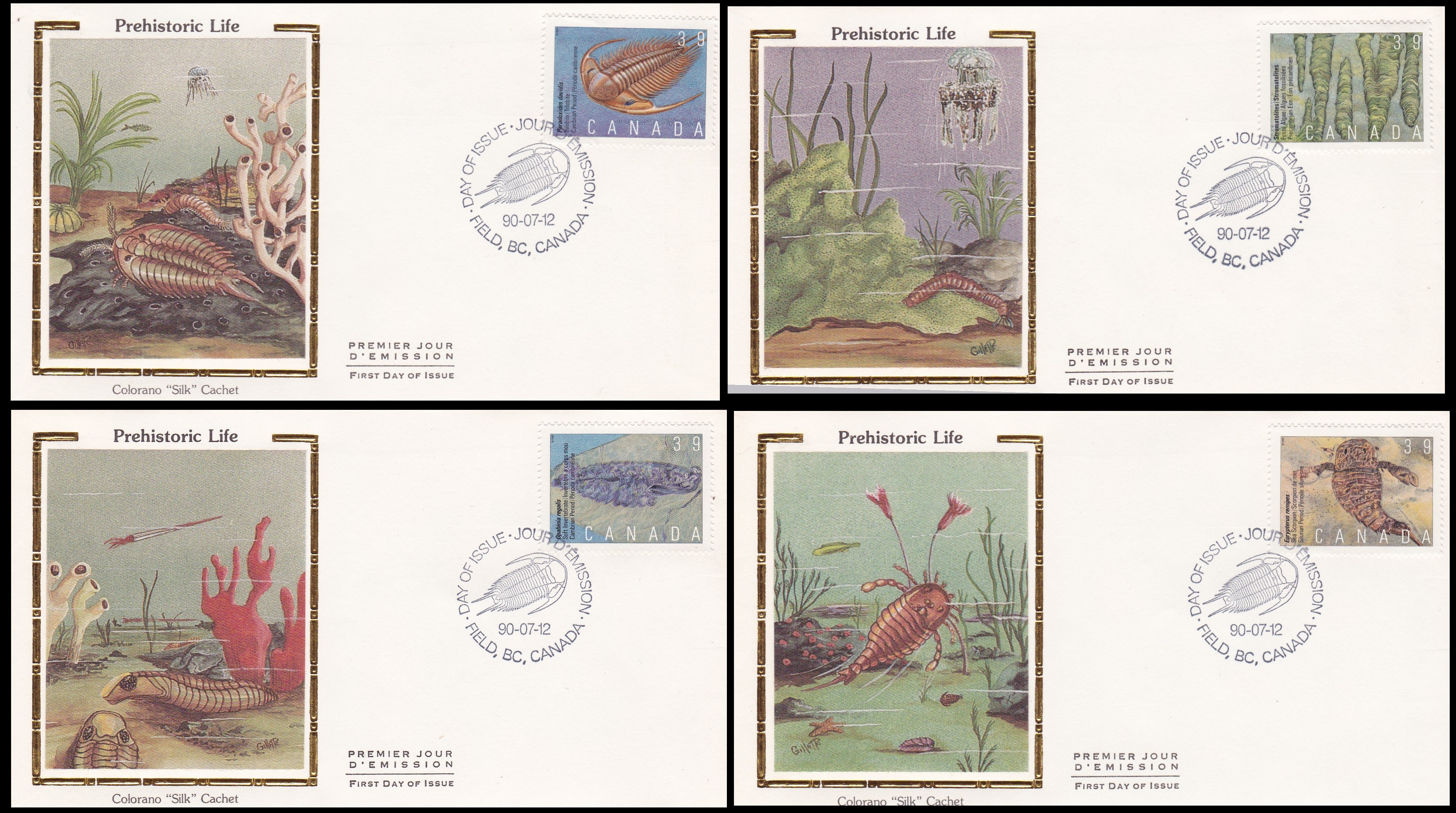
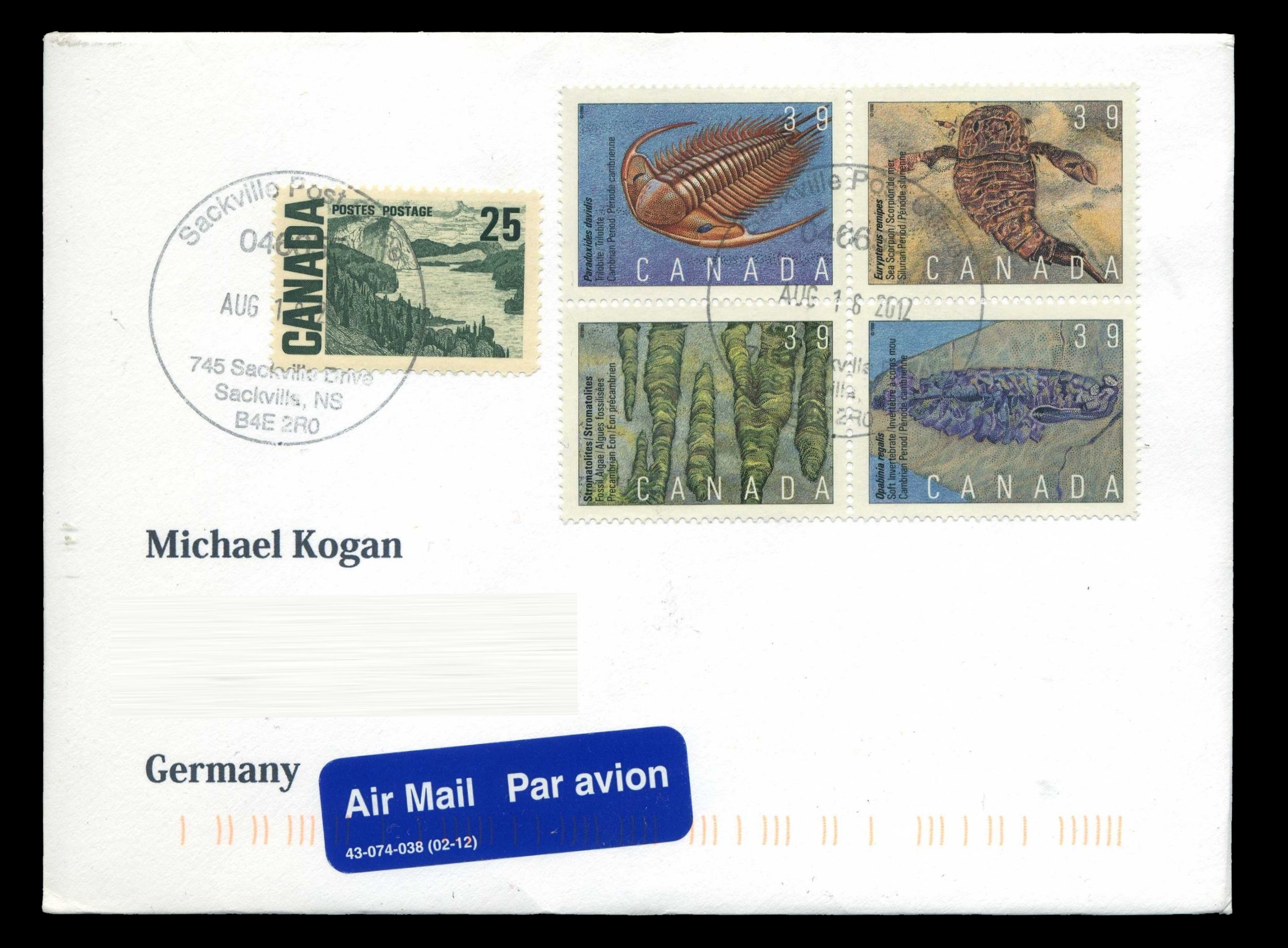
| FDC | Customized FDC | Example of circulated covers |
 |
 |
 |
| The reverse side is here | ||
| First-Day-of-Issue Postmark | Stamps Sheet | |
 |
 |
|
References
- Technical details and description of the stamps:
The Postage Stamp Press Release of Canada Post Corporation, reverse side of an FDC, colnect.
 |
- Rolf Harder: GDS (this article doesn't exist anymore)
- Stromatolites: Wikipedia
- Opabinia regalis: Wikipedia
- Paradoxides davidis: Wikipedia
- Trilobite: Trilobite
- Eurypterus remipes: Wikipedia
- Precambrian: Wikipedia
- Cambrian Period: Wikipedia
- Silurian: Wikipedia
Acknowledgements
Many thanks to Dr. Peter Voice, PhD Department of Geological and Environmental Sciences, Western Michigan University, USA, for his help in finding information and for review of a draft of this article.