Estonia 1937 - "Estonian Red Cross"
| Issue Date | 23.12.1937 |
| ID | Category: Ot |
| Designer | |
| Value | Stamp: 10-senti The envelope price: 5-senti. |
| Cachet | a trilobite in the genus Calymene |
| Printed by | Libris printing house in Tallinn |
| Quantity | 1084 |
| Issuing Authority | Estonian Red Cross |
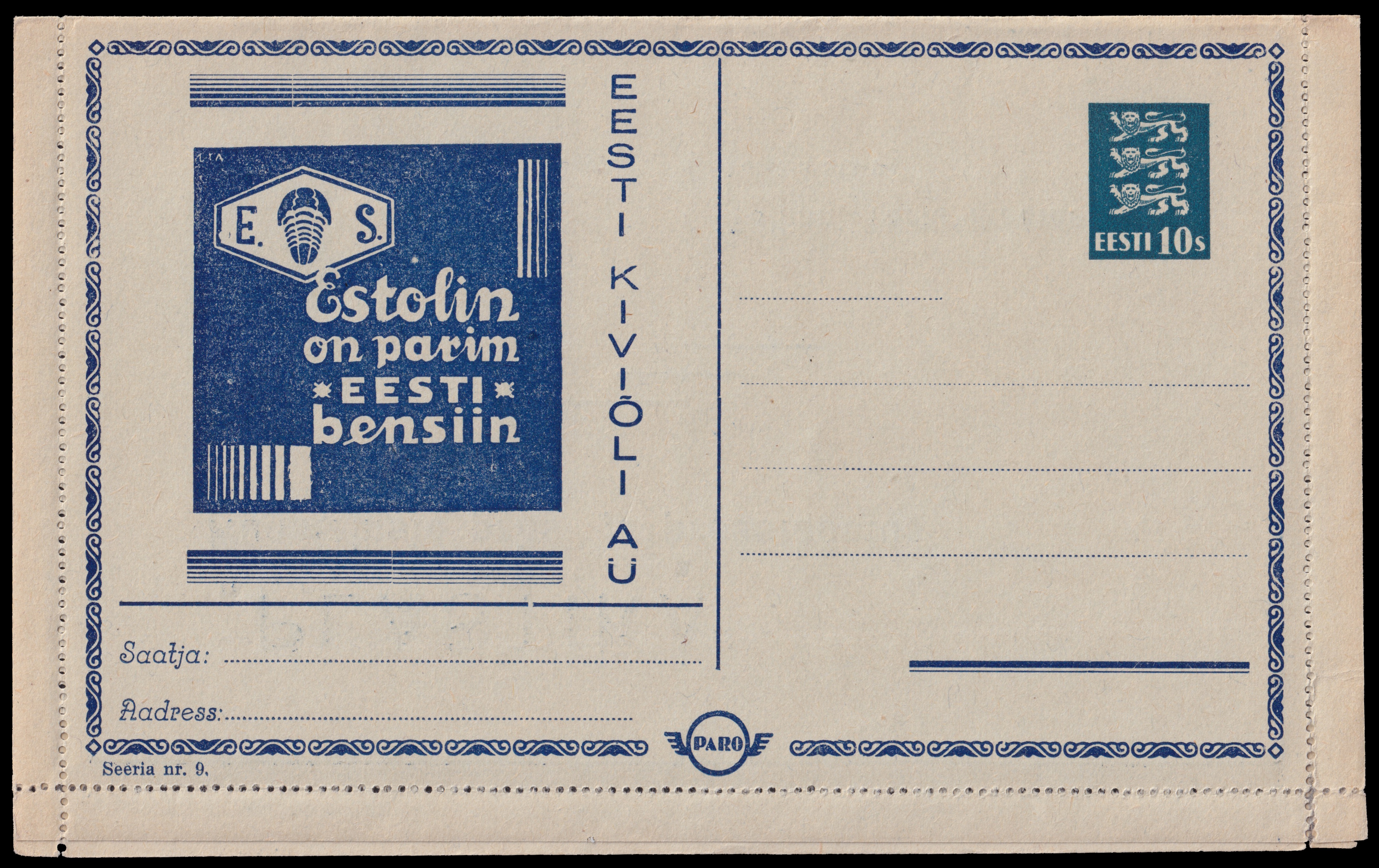
A set of 28 postal stationeries (lettercards) was produced by the Estonian Red Cross to support the Youth Red Cross and was released for sale in post offices on December 23rd, 1937. From the total printing of 30,372 lettercards covering all 28 designs, 29,424 were sold over the counter, while the remainder were distributed to the Universal Postal Union (UPU) and to postal museums in Tallinn and Berlin.
In Estonia these lettercards were sold in the Post Offices as so called private articles (as note paper, envelopes, postcard forms etc.), the net amount thus realized was not remitted to the GPO but transferred to a special fund for the benefit of the Postal Officers.
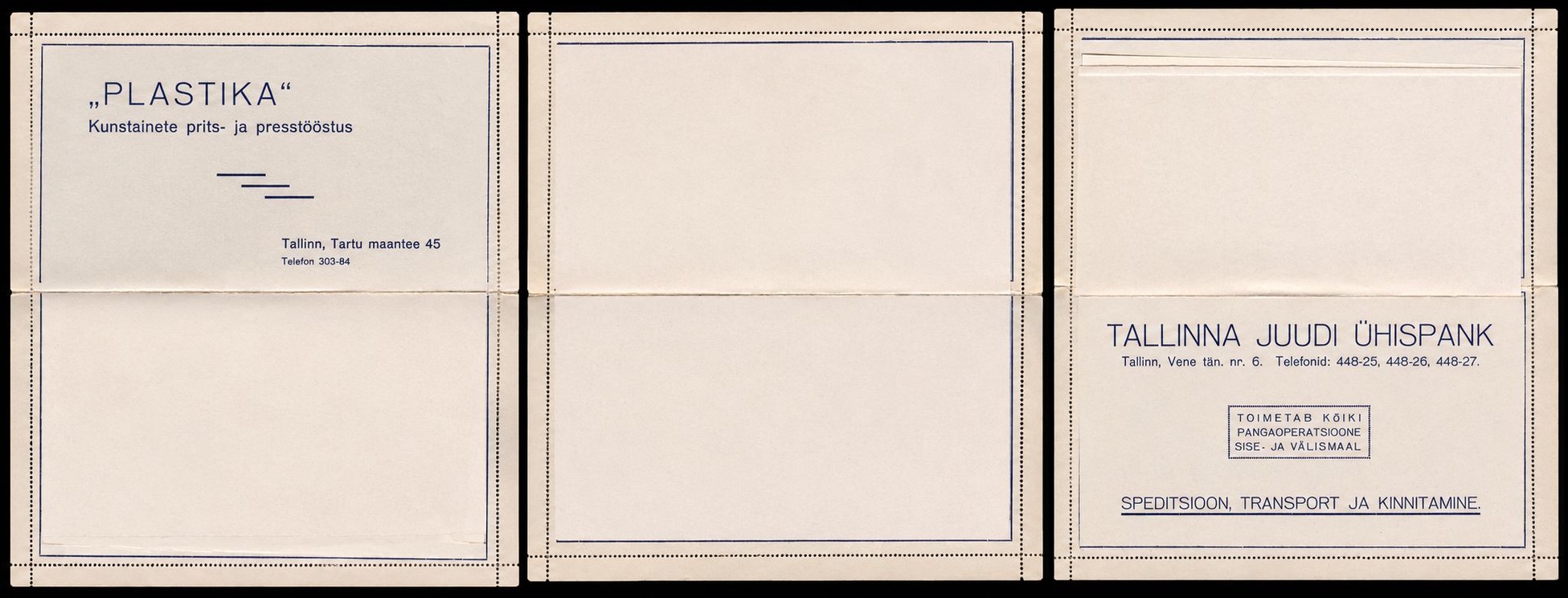
These stationery envelopes with imprinted stamps were made from a single sheet of paper folded in half with perforated edges, and featured advertisements inside and on both the front and back.
One or more writing sheets were attached inside the envelope for correspondence.
The message was written on the inside, after which the lettercard was folded and sealed. It was then mailed at the postcard rate. Upon receipt, the addressee opened the lettercard by tearing along the perforated edges to read the contents. Similar lettercards were also used in other countries at the time, including Germany.
 |
| Paro logo from the postal stationery of Estonia 1937. |
Normally, charity postal issues include a surcharge added to the postage value, but in this case the situation was reversed. Although the postcards carried a printed 10-senti stamp, they were sold for only 5 senti each.
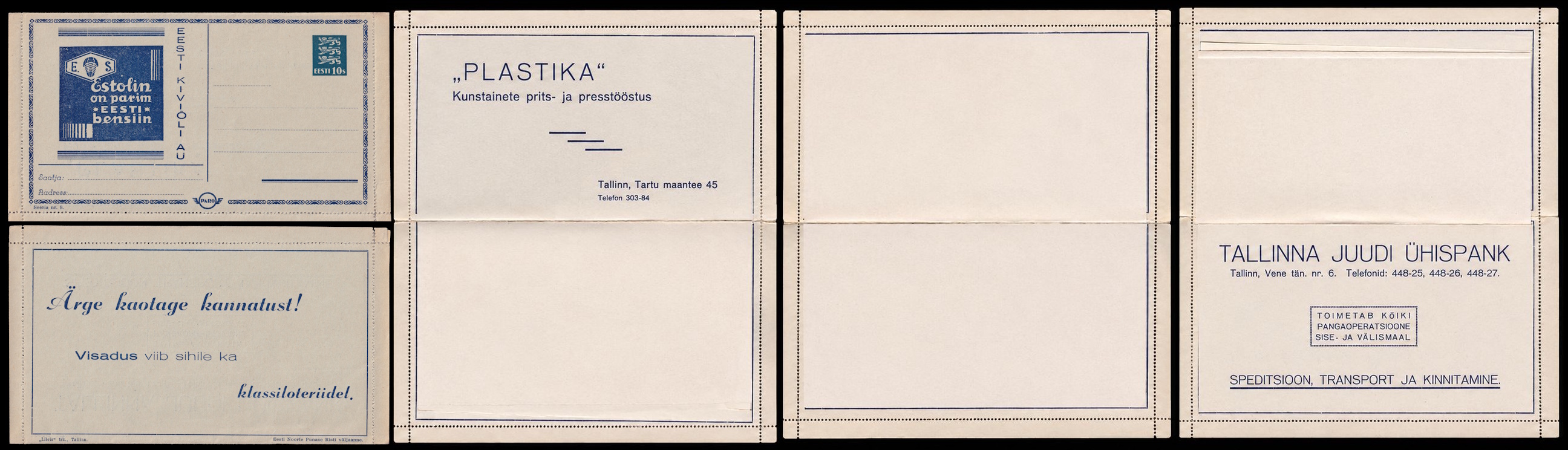
The advertisement inside and on the outside sides of these postal stationaries are not related to each other: lottery, Jewish bank, etc.
 |
| Trilobite on a cachet of Estonian postal stationary 1937. |
“Eesti Kiviõli” (Estonian Oil Shale Co. Ltd.) was originally the name of an oil-shale company established in 1922. In the 1930s, it became the largest shale-oil producer in Estonia and, in 1939, produced 70,000 tonnes of shale oil. A workers’ settlement belonging to the village of Varinurme was built in the 1930s and renamed Kiviõli after the company. In 1946, the settlement was granted town status, and the town still exists today with a population of approximately 5,000 inhabitants.
The text beneath the trilobite reads “Estolin on parim Eesti bensiin”, which translates as “Estolin is the best Estonian gasoline”.During the 1920s and 1930s, Estonia strongly promoted fuel produced from its famous kukersite oil shale, an Ordovician rock formed around 450 million years ago in an ancient sea. By the 1930s, Estonia’s shale-oil industry had become internationally significant, and shale-derived gasoline was marketed as a distinctly national product.
Why the trilobite?
Trilobites are iconic fossils of the Ordovician Period, the same geological age as Estonia’s oil-shale deposits. They were also closely associated with Estonia’s oil-shale industry and with the branding of Estolin. Fossils are common in Estonian oil shale and limestone formations, and the trilobite likely symbolized the ancient marine origin of the raw material used to produce Estolin gasoline. At the same time, it conveyed the idea of “prehistoric energy” through a modern Art Deco commercial design.
Calymene is a genus of trilobites found throughout North America, North Africa, and Europe. Calymene trilobites are small, typically about 2 cm in length. Their cephalon is the widest part of the animal, and the thorax usually has 13 segments. They are also frequently found enrolled.
Gallery
| Unused Postal Stationery (the front and the reverse sides) | The inside pages | |
|
 |
 |
References
- About the postal stationary
- The Estonian National Museum
- Glückauf #127, page 63, from August 2015 (the magazine of German philatelic study group „Bergbau und Geowissenschaften“ - Mining and Geosciences)
- "Estonia Philately and Postal History Handbook and Catalogue" (PDF), by HURT, V. & E. OJASTE, issued by Estonian Philatelic Society in 1986. Page 241.
- "Eesti Vabariigi postmargid 1918-1941.a." (Postage stamps of the Republic of Estonia from the years 1918–1941), by Indrek Liigvald, ISBN: 978-9916-4-2242-7. ELBERD 2024/2026 ERI - special edition. Page 58.
- Eesti Kiviõli
- Kiviõli town
Acknowledgements:
- Many thanks to Dr. Eckart Bergmann, the Chairman of German philatelic study group „Bergbau und Geowissenschaften“ (Mining and Geosciences) for his very valuable comments